A Young Pilot Ordered An Old Man Out Of The Cockpit, Then Learned Who Once Commanded That Jet
Chapter 1: The Old Man Sitting In The Cockpit
The old man was already in the cockpit when the first alarmed voice rose from the flight line.
“Sir, you need to get out of there.”
Steven Mitchell did not turn right away.
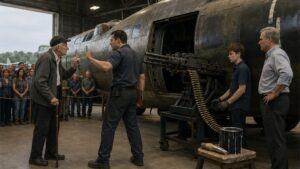
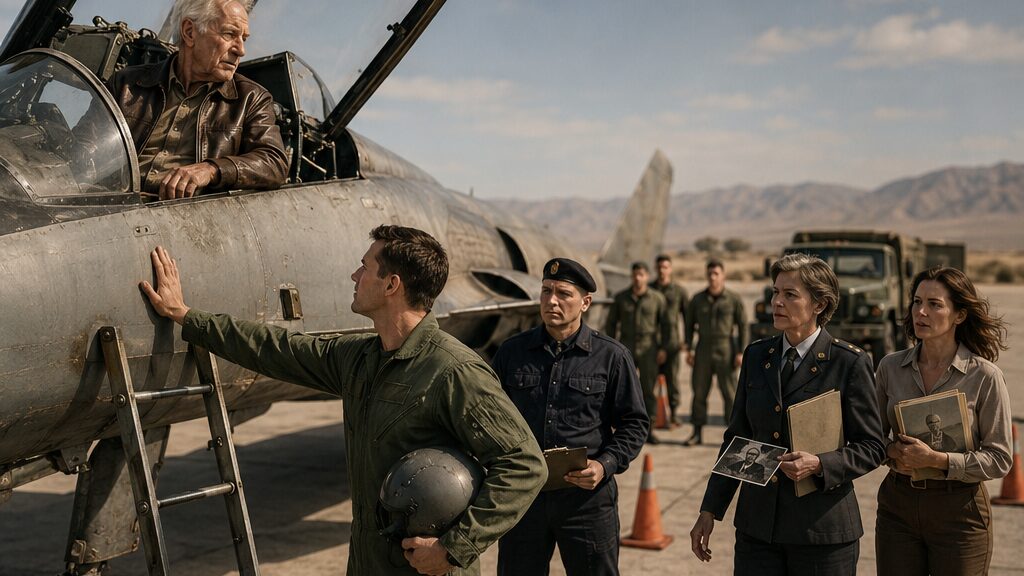
He sat beneath the open canopy of the aging fighter, one hand resting lightly beside a darkened mark on the control panel. The aircraft had been towed out before sunrise and parked between orange cones on the desert tarmac, its faded gray skin catching the hard morning light. Heat already shimmered above the concrete. Beyond the perimeter rope, rows of folding chairs waited for the decommissioning ceremony. A few flags snapped in the dry wind, but the crowd had not arrived yet.
That was why Steven had come early.
Not for the flags.
Not for the chairs.
Not for the speeches that always made service sound clean after the years had made it complicated.
He had come for the quiet.
The cockpit smelled different now. Cleaner. Museum-clean. No fuel in the air, no hot electronics, no sweat trapped in canvas straps. But beneath the polish and age there remained something he knew: sun-baked metal, old rubber, dust pressed into seams no rag could reach. His fingers knew where to rest without looking. They found the edge of the worn panel, then the small scorch mark just above a switch cover no longer connected to anything that mattered.
He remembered the sound that had made that mark.
He closed his eyes for one breath.
“Sir.”
The voice below came sharper now.
Steven opened his eyes and looked down.
A young pilot stood beside the aircraft ladder in a green flight suit, helmet tucked beneath one arm, his jaw tight in the way young men held it when they wanted older men to know they were not boys. His name patch read Campbell. Behind him, two younger airmen had stopped beside a utility cart. Farther back, a dark blue security truck rolled past the cones and slowed.
Steven could have answered quickly. He could have said the title people once used when they entered rooms too fast and needed reminding. He could have mentioned the invitation folded inside his jacket pocket, or the name printed on the program, or the rank that still followed him in official records long after it had stopped following him into grocery stores and doctor’s offices.
Instead, he looked once more at the panel.
“I heard you,” he said.
The young pilot’s expression hardened. “Then you understand this is a restricted aircraft.”
Steven studied him. The man was perhaps thirty. Good posture. Clean boots. Flight suit still stiff in places. A sharpness in him, but not cruelty. Not yet.
“This aircraft has been restricted longer than you’ve been alive,” Steven said.
One of the airmen glanced at the other.
Ryan Campbell’s eyes narrowed. “Sir, I don’t know how you got past the line, but you cannot be in that cockpit.”
Steven looked out past him, over the tarmac. The desert stretched pale and empty beyond the base fence. Once, it had seemed endless from this altitude. Once, every runway had looked like a promise or a verdict.
“I came through the east hangar,” Steven said. “The side door was open.”
“That doesn’t make this okay.”
“No,” Steven said quietly. “It only explains the path.”
Ryan seemed to dislike that answer more than denial. He shifted his helmet under his arm and looked toward the security truck as it stopped. A security officer stepped out, dark uniform crisp despite the heat, beret set low, hand resting near his belt.
“Sir,” Ryan said, louder now, because witnesses had arrived, “climb down from the aircraft.”
Steven’s knees had protested on the way up. They would protest worse on the way down. He had known that before touching the ladder. The old body made every private decision public if a man was unlucky enough to be watched.
He reached for the canopy rail but did not rise.
The movement pulled his brown leather jacket open slightly. The jacket was old, not theatrical-old, not costume-old. Its cuffs were softened from decades of use, the shoulder seam mended once with thread a shade too dark. To Ryan Campbell, it must have looked like something bought at a thrift store by a man who had wandered where he shouldn’t.
Steven understood that. He had spent many years reading what people believed before they said it.
The security officer approached the ladder. “What’s going on?”
Ryan kept his gaze on Steven. “Found him sitting in the cockpit. No escort, no badge visible. Says he came through the east hangar.”
The officer looked up. “Sir, do you have authorization to be on this flight line?”
Steven reached slowly into his inside pocket. The young airmen stiffened as if an old man’s hand could turn dangerous through mere uncertainty. He paused long enough for them to see the movement was harmless, then withdrew a folded paper and held it down.
Ryan took it before the security officer could.
The invitation had been handled too many times. Steven had folded and unfolded it at his kitchen table the night before, then again in the parking lot before dawn. The paper was formal but not grand: decommissioning ceremony, aircraft dedication review, honored guest arrival instructions. His name appeared near the top.
Ryan read it, then looked back up with suspicion rather than apology.
“This says General S. Mitchell.”
Steven said nothing.
Ryan looked at his worn jacket, his unshined shoes, the pale hair lifting in the wind. “Do you have current military identification?”
“In the truck.”
“Where is the truck?”
Steven nodded past the hangar. “Visitor lot.”
Ryan made a short sound through his nose. “You walked from the visitor lot, through an unsecured hangar, climbed into a restricted aircraft, and left your identification in your vehicle?”
“I didn’t plan on needing it to sit with an old friend.”
The words left Steven before he could stop them.
For a moment the wind was louder than anyone. It moved over the aircraft’s skin with a low, hollow whisper.
Ryan looked at the jet, then back at him. “This is not an old friend. This is government property.”
Steven’s fingers shifted. They settled again beside the scorch mark.
To him the aircraft was not property. It was noise and heat and a night sky split by radio calls. It was a young pilot’s laugh on a bad morning. It was Samantha’s hand gripping his when the families waited behind yellow tape. It was the silence after command made a decision that could not be unmade.
But he had no right to demand that Ryan know any of that.
The security officer stepped closer. His name tape read Adams. “Sir, I’m going to need you to come down now. We’ll sort this out on the ground.”
A small group had formed near the cones. Maintenance crew. Two officers in short sleeves. A civilian woman carrying folders, too far away to hear but close enough to watch. Steven felt their attention collect against his skin.
It was a strange thing, being old in public. People talked louder. Slower. As if age had turned a man into bad equipment.
Ryan lifted his chin. “Sir, this is your last warning.”
Steven looked at him then, fully.
In another life, that look had stilled rooms. Not because it was angry. Because it weighed things. Weather. Fuel. Panic. Men’s voices. The distance between survival and command error. Ryan did not know what he was seeing, and Steven did not help him.
“That mark,” Steven said, tapping one finger lightly near the blackened place on the panel, “was already there before you were born.”
Ryan’s face changed, but only for a second. A flicker. Curiosity, maybe. Then the shutters came down.
“Anyone can say that.”
“Yes,” Steven said. “They can.”
Christopher Adams held out a hand toward the ladder. “Sir.”
Steven took one last look inside the cockpit. The seat had been stripped of its old harness and refitted for display safety. The instruments were dead. The switches would not answer him. Yet for a breath he heard Samantha’s voice from years ago, soft and tired: When you go back, Steven, go as yourself. Not as the ghost they made of you.
He had not managed that.
He gripped the rail and began to climb down.
His first step was steady. The second hurt. The third made the young airman nearest the ladder move as if to help, then stop when Ryan glanced at him. Steven pretended not to notice. Pride was not the right word. Pride was too clean. This was simply the last small privacy his body allowed him.
When his boots touched the tarmac, Ryan held up the invitation again.
“We’ll verify this,” he said. “Until then, you are not going near that aircraft.”
Steven looked past him to the old jet. The morning sun flashed along the canopy. For a moment he saw not reflection but fire.
Christopher Adams took a clipboard from the security truck. “I’m going to escort you to the tent.”
Steven nodded.
Ryan turned to the gathering personnel. “Back to your stations.”
No one moved quickly. Their eyes remained on Steven, on the jacket, on the folded invitation now in Ryan’s hand.
Steven started toward the security tent with Christopher beside him.
Ryan followed, still holding the paper like evidence.
At the edge of the cones, Steven stopped and looked back once.
The cockpit sat open to the desert sky.
Ryan’s patience snapped. “Sir, we’re done here. If that name is real, someone will confirm it.”
Steven met his eyes.
“Check the name again,” he said.
Chapter 2: The Badge That Did Not Match The Man
Ryan Campbell had been taught that hesitation became trouble if a pilot let it live too long.
In the air, hesitation burned fuel. On approach, it lost altitude. In command, it spread. The first thing an instructor had ever written in his evaluation was decisive, underlined twice. Ryan had kept that word folded inside himself like a certificate. He had needed it there.
Now, beneath the canvas roof of the security tent, decisiveness felt less like strength and more like a door he had shut too quickly.
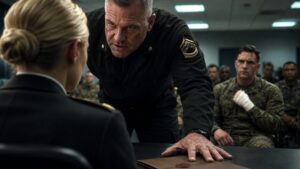
The old man sat in a metal folding chair near a portable fan that clicked each time it turned. His leather jacket lay over the back of another chair, sleeves hanging down as if someone had removed a second body from the room. On the table in front of Ryan sat the folded invitation, a visitor log, and the blank form Christopher Adams had pulled from his clipboard.
Unauthorized Access Report.
Christopher had not filled it out yet.
Ryan noticed that.
“He needs to be processed,” Ryan said.
Christopher glanced at him. “He needs to be identified.”
“That’s what I mean.”
“No,” Christopher said, voice low enough not to travel to Steven. “It isn’t.”
Ryan looked toward the old man. Steven Mitchell sat with both hands resting on the head of a plain wooden cane Ryan had not noticed before. The cane leaned slightly against his knee, not decorative, not dramatic. His face was calm, but it was not empty. There was something in his gaze Ryan could not place. Not fear. Not embarrassment exactly.
Disappointment, maybe.
Ryan disliked that most of all.
He picked up the invitation again. “Sir, this paper lists General S. Mitchell as an honored guest for today’s decommissioning ceremony.”
Steven nodded once.
“Are you claiming that’s you?”
Christopher’s eyes cut toward Ryan.
Steven looked at the invitation as if it belonged to someone at a distance. “That is my name.”
“Your full name?”
“Steven Mitchell.”
Ryan waited for more. The old man gave him nothing.
“And your current ID is in your truck.”
“Yes.”
“In the visitor lot.”
“Yes.”
“You understand how that sounds.”
Steven’s mouth moved almost into a smile, but without amusement. “At my age, many true things sound unlikely to young men.”
Ryan felt heat rise in his neck. “This isn’t about age.”
Steven looked at the form on the table. “No?”
The word was not accusation. That made it worse.
Christopher pulled a radio from his shoulder. “Security control, this is Adams at temporary flight-line post. I need visitor verification for Steven Mitchell, possible ceremony guest, no current badge on person.”
The radio cracked back with static and a request to repeat the last name.
Ryan moved to the tent opening and looked out. The decommissioning area was coming awake. A maintenance crew wiped dust from the aircraft’s nose. A row of chairs was being straightened. Beyond the old jet, a black truck moved slowly past the hangars. In less than two hours, senior officers, guests, and civilians would gather here. A breach on the flight line before a public ceremony would not be a minor incident.
He imagined the report moving upward.
Young pilot failed to secure aircraft.
Young pilot allowed unidentified man to access cockpit.
Young pilot hesitated because the man seemed old.
No. Ryan had not worked this hard to become a cautionary anecdote.
He turned back. “Why did you come early?”
Steven’s gaze stayed on the jacket. “Because I was asked to come.”
“The ceremony doesn’t start until later.”
“I know.”
“That doesn’t answer the question.”
For the first time, Steven’s fingers tightened on the cane. It lasted only a second. “I wanted to see it before people started telling me what it meant.”
Ryan stared at him.
Christopher lowered the radio slightly.
Outside, a jet took off from a distant runway, the sound building until the tent fabric trembled. Steven’s eyes lifted toward the noise. It was an involuntary movement, quick and exact. Ryan had seen that look before on older pilots visiting training days: measuring the engine note, the climb, the invisible line of ascent.
When the sound faded, Ryan said, “Were you Air Force?”
Steven looked back at him. “A long time ago.”
“What rank?”
Christopher’s jaw tightened.
Steven’s gaze did not move. “You have the paper.”
“That paper could belong to someone else.”
“Yes.”
“It could be old.”
“Yes.”
“It could be fake.”
Steven leaned back slightly, as if the word had not offended him but had tired him. “Then check it.”
Ryan lifted the invitation. “That is what we’re doing.”
But they were not, not fast enough. Security control had trouble with the guest system because the event roster was being handled by the historian’s office, not standard visitor processing. The east hangar door had been left open for maintenance vendors. The visitor lot camera had a blind angle near the temporary shuttle sign. Everything came back partial, delayed, or inconvenient.
Steven waited through it all.
That patience irritated Ryan more than anger would have. If the man had shouted, threatened, demanded respect, Ryan could have put him into a category. Entitled civilian. Confused veteran. Base trespasser. Instead, Steven sat as if he had already endured rooms worse than this one.
Christopher clipped the invitation to the edge of the Unauthorized Access Report so it would not blow away when the fan turned. The two papers hung together in absurd contrast: formal honor and suspected violation, the same name trapped between them.
Steven noticed.
Ryan saw him notice.
Something passed through the old man’s face then, so quick Ryan almost missed it. Not humiliation exactly. Recognition. As if this had happened before in another form. As if institutions had always been capable of forgetting the hands that built them.
Ryan cleared his throat. “Sir, until we verify your identity, you’ll remain here.”
“Am I under arrest?”
Christopher answered before Ryan could. “No, sir.”
Ryan added, “But you’re not free to return to the aircraft.”
Steven nodded. “That was clear.”
The radio crackled again. “Adams, control. We have a Steven Mitchell on an event list, but status field says distinguished guest, no arrival time logged. No photo attached. Need historian confirmation.”
Ryan seized on the uncertainty. “No photo.”
Christopher said nothing.
Steven looked toward the tent opening. From where he sat, he could see only the aircraft’s tail and one slice of open sky.
Ryan followed his gaze. “If you really were expected, why didn’t anyone meet you?”
Steven did not answer at first. The portable fan clicked, turned, clicked again.
“Because I asked them not to,” he said.
Ryan laughed once, not loudly, but enough.
Steven looked at him.
The laugh died in Ryan’s throat.
“You asked an Air Force base not to escort a distinguished guest,” Ryan said. “To a restricted flight line. For a ceremony where your name is supposedly on the program.”
“I asked to arrive quietly.”
“Why?”
Steven’s thumb moved over the top of his cane. “Because some goodbyes are not improved by witnesses.”
For a moment, Ryan had no reply.
Then a civilian woman hurried past the tent opening with a stack of folders pressed to her chest. She was moving toward the hangar office, speaking quickly to a maintenance crew chief. Ryan caught only a few words.
“Ceremony folder—guest list—Mitchell—”
The name made Christopher turn.
Ryan stepped out from under the tent shade. “Ma’am.”
The woman stopped, startled. She had windblown hair, a base visitor badge, and the distracted intensity of someone holding three crises in her head at once.
“I’m looking for Colonel King’s aide,” she said.
Ryan straightened. “Are you with the ceremony?”
“Yes. Cynthia Hall, base history office.”
Christopher came to the tent opening. “We requested historian confirmation for a Steven Mitchell.”
Cynthia’s face changed immediately.
“Steven Mitchell?” she repeated.
Ryan pointed back into the tent. “We have an elderly gentleman claiming that name. No current ID on him. Found inside the aircraft cockpit.”
Cynthia’s grip tightened around the folders.
Inside the tent, Steven lowered his eyes.
Cynthia looked past Ryan, into the shade, at the old man seated beside the fan and the jacket hanging from the chair.
She did not speak.
Ryan mistook her silence for doubt.
“That’s what I thought,” he said. “The invitation lists a general, but—”
Cynthia looked down at the ceremony folder in her arms. Her thumb slid under the top page. The paper lifted in the wind just enough for Ryan to see a printed line.
Honored Guest: General Steven Mitchell.
Cynthia went very still.
Chapter 3: The Photograph In The Archive Folder
Cynthia Hall had spent six months preparing the old aircraft to become history, and still she had not been ready for history to sit in a folding chair under a security tent.
She had known the name Steven Mitchell before she knew the man. The name appeared in flight logs, after-action summaries, maintenance notes, oral histories, and one brittle newspaper clipping sealed in an archive sleeve. It appeared in official language first: command pilot, squadron lead, later wing commander, then general officer. But the documents had never captured the thing she saw through the tent opening.
A tired old man in a brown leather jacket.
A young pilot standing over him with suspicion.
An invitation clipped to a violation form.
For one suspended second, Cynthia could not make the past and present touch.
Then the wind snapped the top page of her folder against her wrist, and she moved.
“I need to check something,” she said.
Ryan Campbell’s mouth tightened. “We need confirmation now.”
“You’ll have it,” Cynthia said. “But not from memory.”
She turned before he could ask what that meant and walked fast toward the museum office beside the old hangar. Walking fast became nearly running once she passed the utility cart.
Inside the hangar, the temperature dropped, but only slightly. The old building held the smell of dust, oil, and sun-warmed concrete. Display boards leaned against a wall, not yet carried out. A museum volunteer was arranging laminated placards on a table. The aircraft’s story had been printed in neat paragraphs, smoothed of terror and radio static.
Cynthia crossed to the archive cabinet behind her temporary desk. Her hands were clumsy with the key. She forced herself to slow down, because old paper punished panic.
“Need help?” the museum volunteer asked.
“Find the decommissioning packet,” Cynthia said. “The blue one. No, the original packet, not the public copy.”
The drawer opened with a metal scrape.
Inside were folders labeled by tail number, year, mission group, restoration status. She pulled the one for the aircraft parked outside and set it on the desk. On the cover, someone decades earlier had written the tail number in black ink. Beneath it, in her own newer handwriting, she had added: Final Ceremony / Historical Verification.
Her pulse beat in her fingers.
She opened the folder.
The first pages were maintenance summaries. Engine history. Transfer orders. Museum evaluation. She pushed them aside. The mission record lay deeper, protected in a plastic sleeve with copied photographs. She had read it so many times she could nearly recite the official summary, though she knew better than to trust official summaries to tell the full truth.
Evacuation convoy pinned down by weather and hostile ground movement.
Two aircraft diverted.
Command lead continued under deteriorating visibility.
Civilians extracted.
Two pilots lost in secondary action.
The report never used the word saved without wrapping it in procedure.
Cynthia turned to the photographs.
The first showed the aircraft twenty-eight years earlier, nose darkened by exhaust, panels streaked, a crewman crouched beneath the wing. The second showed a row of pilots standing in front of it. The image was grainy but clear enough. Young faces. Flight suits. A desert behind them. One man near the center wore a brown leather jacket over his gear, collar turned slightly up against the wind.
Cynthia lifted the photograph closer.
The jacket.
Not similar. The same mended shoulder seam. The same darker thread.
Her throat tightened.
She turned the photo over. Names were written on the back in fading pen. Some had been added later by an archivist. Near the center:
Maj. Steven Mitchell.
Before the stars. Before the title. Before the speeches he apparently did not want.
Cynthia set the photograph down and pulled another document from the folder: a cockpit damage notation, written after the aircraft’s return from the evacuation mission.
Minor interior scorching near auxiliary switch cover. Cause consistent with electrical surge during manual override.
Manual override.
She had written a placard about that switch. She had written, with careful museum neutrality, that the crew had used an emergency system during the mission. She had not known what it cost a person to remember the place where his hand had been.
The museum volunteer came over holding the blue packet. “Is this what you need?”
Cynthia took it and opened to the ceremony program. There it was again.
General Steven Mitchell, USAF, Retired.
Honored guest.
No photo, because he had declined publicity.
No escort, because someone had written in the margin: Guest requested quiet arrival.
Cynthia stared at the note.
The phrase felt suddenly unbearable.
Quiet arrival.
Outside, a loudspeaker crackled as a technician tested sound for the ceremony. A voice counted to three, stopped, counted again. Chairs scraped across concrete. Somewhere beyond the hangar wall, the old aircraft waited beneath the sun while the man who had flown it sat under suspicion.
Cynthia gathered the photograph, the cockpit notation, and the program. She slid them into the folder but kept the old squadron photo on top.
As she moved toward the door, she saw another item in the file: a copy of a letter from years earlier, sent by a family member declining an earlier anniversary event on Steven’s behalf. The signature at the bottom read Samantha Perez.
Cynthia paused only long enough to read the first line.
General Mitchell is grateful for the invitation, but he is not ready to stand beside that aircraft while cameras are present.
Not ready.
The words carried more weight than any rank.
Cynthia put the letter back. It was not hers to carry into the open, not yet.
She stepped out of the office into the hangar light, then stopped.
Through the open bay door she could see the security tent in the distance. Ryan stood outside it, helmet still under his arm, speaking to Christopher Adams. The old aircraft sat beyond them, canopy open. Steven was no longer visible from this angle.
A convoy of two vehicles approached from the main road, dark against the pale runway. A small command flag fluttered from the lead vehicle’s fender.
Colonel Barbara King had arrived.
Cynthia knew Barbara only professionally, but everyone in the history office knew her connection to the aircraft. She had been a young officer under Mitchell’s command before Cynthia ever learned to read an archive label. Barbara had insisted the decommissioning not become a hollow display. “No mythology,” she had said during planning. “Tell it straight, or don’t tell it.”
Cynthia clutched the folder and started across the tarmac.
The heat struck her immediately. Papers shifted in her arms. She pressed the photograph flat with her palm as she walked faster.
Halfway to the flight line, she heard Ryan’s voice carry.
“We’re not accusing him of anything unless he makes this harder,” he said. “But we can’t let every old veteran with a story climb into restricted equipment.”
Cynthia flinched.
Christopher answered, too low for her to catch.
Ryan replied, “I saw the invitation. It doesn’t match the man.”
Cynthia broke into a run.
The old photograph slipped halfway from the folder, and for a moment the younger Steven Mitchell stared up from the paper, wind frozen in his jacket collar, the aircraft behind him alive and scarred and waiting.
At the road, the lead vehicle stopped. Barbara King stepped out in uniform, removing her sunglasses as she looked toward the gathering near the tent.
Cynthia lifted one hand, folder pressed to her chest with the other.
“Colonel King,” she called.
Barbara turned.
Cynthia did not slow down.
“We have a problem,” she said, breathless. “And I think it’s with Gener
Chapter 4: The Young Pilot Who Needed Control
Ryan Campbell saw Colonel Barbara King step from the lead vehicle, and something in his spine locked.
There were officers a man saluted because the regulations required it, and officers he saluted because every person around him seemed to make room before they spoke. Barbara King was the second kind. She did not move quickly across the tarmac, but no one mistook that for slowness. The base commander’s aide straightened near the chairs. A maintenance crew chief removed his cap. Even Christopher Adams shifted his stance beside the tent.
Ryan had wanted everything clean before she arrived.
Instead, an elderly man sat under temporary security shade with a disputed invitation, no current badge, and dust on his shoes from a restricted hangar.
Ryan stepped away from the tent and met Cynthia Hall halfway, intercepting her before she reached Barbara.
“Ma’am, we’re handling it,” he said.
Cynthia’s eyes moved past him to the tent. “Is he still there?”
“Yes.”
“Has anyone called the event office?”
“Security control is verifying.”
“That isn’t enough.”
Ryan glanced toward Barbara, who had paused beside the lead vehicle and was watching them now. “I said we’re handling it.”
Cynthia clutched the archive folder against her chest. A corner of an old photograph peeked from beneath her thumb. “Captain Campbell, you need to stop treating this like a trespass report.”
Ryan heard the title in her voice and stiffened at it. Captain. Correct, but not weighty. Not like colonel. Not like general. His father had always said rank was earned twice—once by the service and once by the room. Ryan had spent his adult life trying to earn both.
His father had washed out of pilot training before Ryan was born. He never talked about it directly. He talked around it, in small bitter pieces: instructors who played favorites, standards that shifted, men with family names who got second chances. When Ryan was twelve, he had found an old helmet bag in the garage and asked if it had been his. His father had taken it from him too quickly and said, “Don’t touch things you haven’t earned.”
Ryan had earned everything with that sentence behind him.
So when an old man in a worn jacket climbed into a restricted cockpit and spoke as if rules bent for memory, Ryan had felt something personal rise before he had named it.
Cynthia lowered her voice. “The invitation is real.”
Ryan’s jaw tightened. “The paper may be real. That doesn’t prove he is the man on it.”
“Look at the photograph.”
“Not here.”
“Then where?” she asked.
He glanced again toward Barbara. The colonel had begun walking toward them.
Ryan made the decision before doubt could form. “After security completes verification.”
Cynthia stared at him. “You’re making this worse.”
“No. I’m preventing it from becoming worse.”
He turned back to the tent.
Inside, Steven Mitchell had stood. Christopher was beside him, one hand out, not touching him, only ready in case the old man’s balance failed. Steven had put his jacket back on despite the heat. The leather looked heavier now, darker across the shoulders, the old seam visible where it had been mended.
Ryan stepped under the shade. “Sir, we need you to remain seated.”
Steven looked at him, then at the chair. “I’ve sat long enough.”
“This isn’t optional.”
Christopher shifted. “Captain.”
Ryan ignored the warning. Outside the tent, more personnel were watching. A group of younger airmen had slowed near the utility cart. The maintenance crew chief stood near the aircraft ladder, arms folded. Ceremony staff had begun to gather by the chairs. Ryan could feel the moment becoming something people would describe later, and he hated that he no longer controlled how.
Steven rested one hand on the cane, the other on the tent pole. There was a faint tremor in his fingers. Ryan saw it and, for an instant, felt his certainty soften.
Then Steven moved toward the opening.
Ryan stepped in front of him.
“Sir, you are not walking back to that aircraft.”
Steven stopped.
The old man’s eyes did not flash. He did not raise his voice. He simply looked at the space Ryan had put his body into.
“I did not ask you to move,” Steven said.
“No,” Ryan answered. “You didn’t.”
The words came out harder than he intended.
Behind him, Cynthia arrived at the tent edge, breathless, Barbara King several paces behind her. Christopher looked between all of them.
Steven’s hand shifted on the cane. The tremor was there again. He glanced toward the aircraft. The ladder still leaned against its side, narrow and sunlit. The cockpit stood open.
Ryan saw the longing before the old man hid it.
He saw it and almost stepped aside.
Almost.
Then he thought of the report. The ceremony. The colonel’s arrival. The base commander’s aide. The faces behind him. He thought of his father’s helmet bag, of earning rooms, of young officers who got remembered for one mistake.
“Until confirmed,” Ryan said, “you’re just a visitor who entered a restricted area.”
The sentence landed in the tent like dropped metal.
Steven lowered his eyes.
For the first time that morning, Ryan saw him look old.
Not dignified. Not mysterious. Just old.
Christopher said quietly, “Captain, that’s enough.”
Ryan looked at him. “Is it?”
The challenge surprised even Ryan. Christopher’s face closed.
Steven took one slow breath. Then, without asking permission, he moved around Ryan. Not toward escape. Not toward the flight line. Only to the edge of the tent, where he could see the aircraft fully again.
No one stopped him.
His hand, the trembling one, reached for the aircraft ladder where it rested outside the tent’s shadow. The ladder had been moved near the security post after he came down, partly blocking the path. Steven’s fingers closed around one rung.
The tremor stopped.
Ryan noticed it.
He did not want to.
The old man’s hand became still the instant it touched the ladder. Not stronger in some theatrical way. Not magically young. Just certain. As if metal gave him back the shape of a former life.
Steven looked at the rung beneath his fingers. “They changed the grip pattern.”
The maintenance crew chief, standing several yards away, turned his head.
Ryan said, “What?”
“The old ladders bit harder through gloves. This one is kinder.” Steven released the rung. “That is good.”
The maintenance crew chief took one step closer, curiosity overcoming caution. “You worked on this model?”
Steven looked at him. “No.”
Ryan seized the answer. “Then please stop implying—”
“I flew it.”
Silence followed.
Not the full silence of revelation. Not yet. A smaller one. The kind that opens when a statement is too simple to dismiss and too large to accept.
Ryan looked at Steven’s jacket, the cane, the plain shoes, the pale hair. He could have asked when. He could have asked where. He could have asked for the old man’s full name again and held the invitation beside his face.
Instead, he heard his own voice harden.
“A lot of men flew a lot of aircraft, sir.”
Steven turned from the ladder.
“Yes,” he said. “They did.”
There was no pride in it. No claim. The answer slipped past Ryan’s defenses because it carried no demand.
Barbara King had reached the edge of the tent now. Cynthia stood beside her, the folder open in both hands.
Ryan felt them there and became aware of every person watching. The airmen. The crew chief. Christopher. The aide by the chairs. The old man in the worn jacket who would not behave like either a liar or a confused visitor.
Barbara’s gaze moved from Steven’s face to the jacket, then to the cane, then to Cynthia’s folder.
Ryan straightened. “Colonel, we have a possible unauthorized access issue. This gentleman entered the aircraft before the ceremony. We’re waiting on final verification.”
Barbara did not answer him.
Steven looked at her for less than a second, then away.
That small avoidance struck Ryan as strange.
Cynthia tried to speak, but Ryan went on before she could. “He had an invitation with a name on it, but no current identification. I made the call to hold him here until—”
Barbara’s eyes remained on Steven.
Ryan felt his control slipping and grabbed for it.
“He’s just an old man who wandered where he didn’t belong.”
The words came out clear enough for everyone nearby to hear.
The maintenance crew chief stopped moving.
Christopher looked down.
Cynthia closed her eyes briefly, as if bracing for impact.
Barbara King turned her head slowly toward Ryan. The expression on her face was not anger. Anger would have been easier.
It was recognition of damage already done.
Chapter 5: The Colonel Who Remembered His Voice
Barbara King had known Steven Mitchell first as a voice in her headset.
Not a face. Not a rank. Not a name in a ceremony program.
A voice.
Calm through static. Low when others rose. Precise when weather, fuel, and fear began folding over each other in the dark. Years later, when people asked what she remembered from the evacuation mission, they expected her to say fire or altitude or the moment the convoy lights appeared through the dust. She rarely told them the truth.
What she remembered most was a voice saying, Hold the line. We are not leaving them.
Now that same voice was quiet under a security tent, wearing age like a garment no one had bothered to respect.
Barbara looked at Ryan Campbell, then at the old man beside the ladder.
For a moment, she did not trust herself.
Time had done its work. Steven Mitchell’s hair was white now, his face drawn into deeper lines, his shoulders narrower beneath the worn leather jacket. But the set of his eyes had not changed. Nor had the way he stood under pressure: not resisting it, not yielding to it, simply measuring what it would cost to answer.
Cynthia held out the folder with both hands. “Colonel.”
Barbara took it.
The top photograph trembled slightly in the wind. A line of young pilots stood before the same aircraft, decades earlier. Dust blurred the background. The man near the center wore a brown leather jacket with a mended shoulder seam, collar lifted, one hand resting against the aircraft skin. Younger face. Same bearing. Same eyes.
Barbara’s thumb moved to the handwritten name on the back.
Maj. Steven Mitchell.
She turned the photograph over again and looked from the image to the man standing before her.
“Sir,” she said softly.
Steven’s mouth tightened almost imperceptibly. “Barbara.”
The use of her first name, quiet and unceremonious, struck harder than any formal address. She was twenty-six again for half a heartbeat, a junior officer with her hands shaking over a checklist while his voice told her to breathe, count fuel, and listen.
Ryan’s face changed. “Colonel?”
Barbara did not look at him.
She stepped closer to Steven. Her body knew what to do before her mind finished catching up. Her shoulders squared. Her chin lifted. Not for show. Not for the watching airmen. For the old order of things that had existed before any of them had gathered under that canvas.
“General Mitchell,” she said, clear enough for the flight line to hear.
The air seemed to leave the tent.
Ryan went still.
Christopher Adams stared at Steven as if the invitation clipped to the violation form had become something dangerous in retrospect.
The maintenance crew chief removed his cap completely.
Steven closed his eyes for one brief second. When he opened them, he looked not honored but burdened.
“Please don’t,” he said.
Barbara heard him, but there were moments when refusal could not erase truth.
She inclined her head. “Sir, I owe you better than this.”
He looked past her toward the aircraft. “No. You owe me accuracy. Better is too much to ask from a morning that started badly.”
Cynthia opened the folder wider, her voice careful. “The ceremony roster lists General Steven Mitchell as the honored guest. The arrival note says he requested no escort and no public reception. The aircraft file includes his mission record.” She hesitated, then lifted the photograph. “And this was taken before the evacuation mission.”
Ryan swallowed. “That doesn’t—”
Barbara turned to him.
He stopped.
Cynthia looked toward the aircraft. “There’s also a cockpit damage notation. Minor interior scorching near the auxiliary switch cover after manual override.”
Steven’s gaze moved to the open canopy.
Barbara followed it.
The old aircraft waited under the sun, stripped of flight and still somehow holding its shape of purpose. She remembered the switch. Not visually; she had not been in his cockpit. She remembered the radio call. Manual override engaged. Heat warning. Continue.
She took the photograph from Cynthia and walked toward the aircraft.
No one ordered her not to.
At the ladder, the maintenance crew chief stepped aside. Barbara climbed two rungs, enough to see into the cockpit. The panel was faded, labels worn pale. Near the auxiliary switch cover, half hidden by glare, was the small blackened mark.
The same place.
She looked down at the photograph in her hand. In the image, the younger Steven stood near the aircraft, not in the cockpit, but another archival sheet tucked behind it showed a close inspection after the mission. Someone had circled the scorched panel. Someone had written: Mitchell’s aircraft.
Barbara climbed down.
When she returned, the flight line had gone almost completely quiet. Even the loudspeaker test had stopped. People who had been pretending not to watch were no longer pretending.
Ryan looked at the ground.
Barbara held the photograph beside her, not as a weapon, but as a correction.
“This aircraft flew under General Mitchell’s command,” she said. “He led the mission that brought an evacuation convoy out when the weather closed and the ground route failed. Some of us are standing here because decisions made from that cockpit gave other people time to live.”
Steven’s jaw shifted. “Barbara.”
She stopped.
He did not raise his voice, yet everyone listened.
“You are making it cleaner than it was.”
Her throat tightened. “I’m making it true enough for this moment.”
“No moment is improved by leaving out the cost.”
Ryan looked up then.
Barbara saw confusion in his face. Shame, yes, but also confusion. He had expected perhaps a famous man, a decorated name, a triumphant correction. He had not expected a general who seemed to resist his own rescue.
Steven turned toward Ryan.
The young pilot straightened automatically, then caught himself too late.
“I gave you the chance to check the name,” Steven said.
Ryan’s lips parted. “Sir, I—”
Steven lifted one hand. “Not yet.”
The words were not harsh. They were worse. They were patient.
Christopher stepped forward, his face pale beneath the brim of his beret. “General Mitchell, I apologize. I should have verified through the event office before—”
Steven looked at him. “You followed a procedure. Improve it.”
Christopher absorbed that in silence.
Barbara glanced at the violation form still clipped to the invitation. The wind lifted both pages. The invitation fluttered above the accusation, then fell flat again.
She reached for the papers and unclipped them. The Unauthorized Access Report remained blank except for the first line where Christopher had written the date.
Ryan watched her remove the invitation from it.
His voice came low. “I thought I was protecting the aircraft.”
Steven looked at him for a long moment.
“No,” he said. “You were protecting your certainty.”
The words struck Ryan visibly, but Steven did not press them. He turned toward the old jet, and the years seemed to gather around him with the heat.
Barbara felt the pull in the assembled group. Someone wanted to salute. She could sense it moving through the airmen like a reflex waiting for permission. Recognition demanded form. The military had trained all of them to answer rank with shape and motion.
Barbara’s own hand wanted to rise.
Steven sensed it too.
He looked at her first, then at Ryan, then at the others who stood watching him as if the old jacket had become a uniform in front of their eyes.
“Do not salute me,” he said.
No one moved.
His voice softened, but it carried. “Not until you understand why I came.”
Chapter 6: The Mission He Never Spoke About
The hangar office had one small window facing the flight line, and Steven chose the chair that did not look through it.
Barbara noticed but did not comment.
Cynthia placed the archive folder on the table and stepped back, giving the room the quiet it needed. Christopher remained outside the door. Ryan stood just inside, helmet gone now, hands empty at his sides. Without the helmet, he looked younger. Not innocent, exactly. Exposed.
Steven sat with his cane resting against his knee and his leather jacket still on despite the warmth. The room smelled of paper, machine oil, and old air-conditioning. On the wall behind Cynthia’s temporary desk, a framed layout of the aircraft’s final museum display hung slightly crooked.
Barbara closed the door.
For several seconds, no one spoke.
Steven looked at the folder. “You kept a great deal.”
Cynthia answered gently. “Not enough, sir.”
He almost smiled. “That is usually true.”
Barbara pulled out a chair but did not sit. “You were expected at fourteen hundred. We thought you had changed your mind.”
“I nearly did.”
“Why didn’t you?”
Steven reached into the inside pocket of his jacket.
Ryan stiffened slightly, then seemed ashamed of the reflex. Steven saw it. He did not punish him for it. He withdrew a folded envelope, soft from handling, its edges worn almost clothlike. The handwriting on the front had faded, but Barbara saw one word clearly.
Steven.
He set it on the table.
“Samantha wrote this before she died,” he said. “She had a habit of leaving orders she pretended were suggestions.”
Barbara’s face softened. Cynthia looked down. Ryan remained very still.
Steven unfolded the letter with care. He did not offer it to them. He did not need to. Some things could be understood from the way a man touched paper.
“She said if the aircraft ever came to its final day, I was to go. Not to speak. Not to smile for photographs. Just go.” His thumb rested on the crease. “She said I had made a shrine out of absence.”
No one answered.
Outside, footsteps passed the door, then faded.
Steven looked toward the windowless wall as if the runway were projected there.
“The mission was not what the program says.”
Cynthia began to reach for the folder. “Sir, I can remove—”
“No,” Steven said. “The program is not false. It is simply incomplete.”
Barbara sat slowly.
Steven’s eyes lowered to the letter. “Weather closed faster than forecast. The convoy had civilians mixed with support personnel, families attached to an advisory group, medical staff, two buses that should never have been on that road after sundown. Ground command wanted them to hold position. They would not have lasted the night.”
Ryan listened without moving.
“We had a narrow window,” Steven said. “Bad visibility, worse fuel, conflicting instructions. I made the call to continue support while extraction rerouted. Two pilots followed me past the line I had no right to make ordinary.”
Barbara’s voice was quiet. “You saved the convoy.”
Steven looked at her. “I spent years accepting that sentence from people who did not have to write the letters.”
The room changed.
Not dramatically. No one gasped. But Ryan’s eyes dropped.
Steven folded the edge of Samantha’s letter back into place. “One aircraft took damage covering the evacuation route. Another went down after diverting attention from the convoy. The report says secondary action. I knew their names. I knew their voices. I knew what they wanted mailed home if things went badly because young pilots talk too much when they are afraid and pretend they are joking.”
Barbara’s hand tightened on the chair arm.
Steven looked at her then. “You were in the second wave.”
“Yes, sir.”
“You sounded steady.”
“I was not.”
“I know.”
Her eyes shone, but she did not look away.
Steven turned the letter over. “Afterward they promoted me. They called it command judgment. They put the aircraft in photographs. Men shook my hand and said impossible choices were part of leadership. Samantha listened to all of it. Then she watched me spend years refusing every invitation that mentioned honor.”
Cynthia whispered, “Why come today?”
“Because she asked me to stop mistaking grief for loyalty.”
The words settled heavily.
Ryan drew a breath as if he had been holding it since the flight line. “General Mitchell.”
Steven looked at him.
Ryan’s voice faltered, then steadied. “I owe you an apology.”
“Do you?”
Ryan flushed. “Yes, sir.”
“For what?”
Ryan glanced at Barbara, then back at Steven. “For questioning your identity. For calling security. For what I said outside.”
Steven waited.
Ryan’s shoulders tightened. “For saying you were just an old man who wandered where he didn’t belong.”
The room held its breath.
Steven rested both hands on the cane. “And why was that wrong?”
Ryan seemed confused by the question. “Because you’re General Mitchell.”
Steven’s expression did not change, but something in the silence sharpened.
Barbara closed her eyes briefly.
Ryan realized it a second too late.
“No,” Steven said.
Ryan swallowed.
Steven’s voice remained calm. “That is why you are embarrassed.”
Ryan looked down.
“It was wrong,” Steven continued, “because you believed an old man without the right badge could be handled without courtesy. My rank made your mistake visible. It did not create it.”
Ryan’s face had gone pale.
Steven let the words stand without adding to them. He had commanded men long enough to know that correction needed room to enter, and shame became useless when crowded.
Cynthia gathered the old photograph and slid it back into the folder. “The ceremony is in thirty minutes.”
Barbara looked at Steven. “We can cancel your remarks. We can change the program. Whatever you want.”
“I did not prepare remarks.”
“You never do.”
That drew the faintest breath of amusement from him.
Then it was gone.
He looked toward the door. Beyond it waited the aircraft, the people, the chairs, the version of his life that could be recited into microphones. His first instinct was to leave. He could still do it. Walk to the visitor lot. Take Samantha’s letter home. Let Barbara clean up the ceremony and Ryan carry his shame privately.
It would be easier.
It would also be another absence.
Steven folded Samantha’s letter and returned it to his jacket.
“I will stay,” he said.
Barbara exhaled.
Ryan looked up.
Steven did not look at either of them. “Not for honor. Not for the program. I will stay because something happened here this morning that should not become normal.”
He reached for his cane and stood. Barbara moved as if to help, then stopped herself. Steven noticed and gave her the smallest nod, grateful for the restraint.
At the door, Ryan stepped aside.
Steven paused beside him.
Ryan’s voice came low. “Sir, I am sorry.”
Steven looked at the young pilot for a long moment.
“Not yet,” he said. “Firs
Chapter 7: The Seat That Was Never About Rank
By sunset, the aircraft’s shadow stretched long across the tarmac, touching the first row of folding chairs before the ceremony began.
The desert had cooled by only a few degrees, but the light had softened. It turned the old jet’s gray skin silver at the edges and made every scratch visible. People had gathered quietly after word moved through the base in fragments, never officially announced and never completely stopped. A guest had been detained. The guest was the guest of honor. The old man in the cockpit was General Mitchell. No, he did not want to be called that. Yes, Colonel King had recognized him. No, nobody knew what would happen now.
Steven heard none of it directly, but he felt it when he walked from the hangar office toward the chairs.
Conversation thinned as he approached.
That was the part he had wanted to avoid.
Not because respect offended him, but because it so easily became performance. People straightened when they saw a title. They softened their voices for rank after sharpening them for age. They put dignity on like a jacket when someone told them who deserved it.
He wore the old brown leather one instead.
Barbara walked at his left, not escorting him exactly, though everyone would have understood it that way. Cynthia followed with the ceremony folder held carefully against her chest. Christopher Adams stood near the security post, no longer pretending to be busy. Ryan Campbell waited beside the first row of chairs, hands clasped in front of him, face pale and controlled.
A seat in the front row had been marked with a printed placard.
General Steven Mitchell, USAF, Retired.
Steven stopped before it.
The placard was centered carefully. The letters were bold enough to be read from several feet away. Someone had meant honor by it. He could not blame them for that.
Still, he looked past the chair to the aircraft.
“Sir?” Barbara said quietly.
Steven took the placard, folded it once, and placed it beneath the chair.
No one asked him why.
The base commander’s aide went to the small podium. The microphone gave a low hum before settling. Behind him, the aircraft sat with its canopy closed now, reflecting the orange sky. Steven had asked that it be left closed during the public portion. Open canopies invited photographs. Closed ones invited memory.
The ceremony began simply. A welcome. A short history of the aircraft. Cynthia’s careful wording appeared in the speech: operational service, evacuation support, final transfer for preservation. She had resisted turning the old jet into myth, and Steven was grateful for the restraint. Not every life saved had been mentioned. Not every life lost had been named. But the silence around those omissions did not feel careless. It felt deliberate, like a hand over a wound.
Then Barbara stepped to the podium.
She looked once at Steven before she spoke.
“This aircraft has carried many names,” she said. “Tail number, squadron assignment, mission designation. Those are the names the archive keeps. But everyone who has served around aircraft knows machines collect other names too. The names of crews. Maintainers. Families waiting at the fence. Voices heard over bad radios. People who came home, and people who did not.”
The audience was still.
Steven kept his eyes on the aircraft’s nose.
Barbara did not tell the story as a triumph. She did not use the word hero. She said a convoy had been trapped. She said weather had cut options down to almost none. She said command decisions were made under pressure that no document could fully describe.
Then she stopped.
“And today,” she said, “one of the people most connected to that history asked that this ceremony not be about him.”
A small movement went through the crowd. Heads turned, then stopped themselves.
Barbara continued. “We will respect that. But we will also tell the truth. General Steven Mitchell was invited here because this aircraft’s history cannot be separated from his service. He requested no escort, no introduction, and no public reception. That request should have been honored with care. This morning, it was not.”
Steven’s hand tightened once on the cane.
Ryan lowered his eyes.
Barbara’s voice remained steady. “That failure is ours to correct. Not because of the rank we later recognized, but because respect should not arrive only after verification.”
The words moved through the chairs more quietly than applause would have.
Steven looked at her then.
Barbara stepped back from the podium.
The base commander’s aide leaned toward Steven. “Sir, would you like to say a few words?”
Steven had expected the question. He had dreaded it anyway.
He stood.
The audience rose with him.
“No,” he said.
The single word carried without the microphone.
People hesitated, uncertain whether to sit again. Steven looked over the rows: officers, airmen, maintenance crew, civilian guests, a few older veterans whose faces had gone still with recognition of something beyond the event. Then his gaze found Ryan.
He changed his mind.
“Not from there,” Steven said.
He walked not to the podium, but to the space beside the aircraft ladder.
Barbara made a small gesture, and the aide stepped away from the microphone. No one stopped Steven. No one rushed to help him. That, he noticed, was progress.
The ladder rested where it had rested that morning.
Steven placed one hand on it.
The metal was warm from the sun.
“I came early,” he said, “because I did not come here to be seen.”
The crowd remained silent.
“I came because someone who knew me better than anyone asked me not to let this aircraft leave my life as a thing I avoided. She said I had confused grief with loyalty for too long.”
The wind moved softly across the tarmac.
Steven looked at the aircraft’s closed canopy. “This machine carried men who were braver than any sentence written about them. It also carried decisions that looked cleaner on paper than they felt in the hands of the people who made them. If you remember anything from today, remember that service is not made only of the moments people applaud. Much of it is made of things people carry afterward.”
No one shifted.
He turned slightly toward the rows.
“This morning, I was treated poorly by a few people trying to protect a place they serve. That does not excuse it. It also does not make them villains.” His eyes found Ryan again. “A uniform can hide insecurity as easily as an old jacket can hide rank.”
Ryan looked up.
Steven let the words settle.
“Do not wait to learn who someone used to be before deciding how much dignity they deserve.”
He stepped back.
For a moment, the crowd seemed to want to respond and did not know how. A few hands began to lift, then stopped. No applause rose. Steven was grateful.
Ryan left the front row.
Every eye followed him as he walked toward Steven, but Steven did not let the moment become theater. He met him halfway, beside the aircraft’s nose, where their voices did not carry far.
Ryan stood rigidly. “Sir, I know why I’m sorry now.”
Steven waited.
Ryan swallowed. “I’m sorry because I thought respect was something people had to prove they were entitled to. I thought if I was strict enough, nobody could question whether I belonged here.” His voice tightened. “I was wrong before I knew your name.”
Steven studied him.
The young pilot’s face held shame, but not the shallow kind that only fears consequence. There was something stripped open beneath it. The boy with the helmet bag. The man protecting certainty. The officer learning, too late but not uselessly, that command began before authority was recognized.
Steven nodded once.
“Good,” he said.
Ryan’s breath left him unevenly.
“That does not erase the morning,” Steven added.
“No, sir.”
“But it may keep you from repeating it.”
Ryan looked down. “I’ll try.”
“Do more than try. Check the name. Then check yourself.”
Ryan absorbed the sentence as if it had weight.
Christopher approached next, stopping a respectful distance away. “General Mitchell, I’ve already spoken to control. We’ll revise the guest verification process for special events and elderly visitors. No one gets held on assumption alone.”
Steven looked at him. “Make it for everyone, not just elderly visitors.”
Christopher nodded. “Yes, sir.”
Cynthia stood near the chairs with the archive folder, watching the living part of history refuse to behave like an exhibit.
When the formal ceremony ended, there was no grand announcement. People rose quietly. Some approached Barbara. Some remained where they were, looking at the aircraft differently. A few older veterans stepped close enough to nod to Steven but not trap him in conversation. He returned each nod.
The sun touched the horizon.
Barbara came to him last. “They’re ready to close the aircraft for transport tomorrow.”
“Not yet,” Steven said.
She understood immediately.
This time, Ryan brought the ladder himself. He set it carefully against the aircraft, checked its lock twice, then stepped aside.
Steven placed Samantha’s letter inside his jacket pocket and climbed slowly. His knees burned. His hand tightened on the rail. No one moved to help until he asked, and he did not ask. At the top, he paused before lowering himself into the cockpit.
The seat accepted him differently than it had in the morning.
Not as a ghost.
Not as an intruder.
Only as an old man returning to a place that had waited without knowing it.
The canopy stayed open above him. The sunset spread across the glass. Below, Barbara, Ryan, Cynthia, and Christopher stood back far enough to give him privacy, close enough to bear witness.
Steven took out Samantha’s letter.
For a while he simply held it.
Then he unfolded it and read the line he had been avoiding all day.
Go back once, Steven. Not because the aircraft needs you. Because you need to stop leaving yourself there.
His vision blurred. He did not fight it. There was no one in the cockpit to command.
He placed the letter gently against the worn control panel, just beneath the old scorch mark. His fingers rested there too, touching paper, metal, and memory at once.
“I came,” he whispered.
The wind crossed the open canopy.
For the first time in years, the silence that followed did not accuse him.
He sat until the sun slipped low and the aircraft’s instruments disappeared into shadow. When he finally climbed down, Ryan stood nearby but did not reach for him. Steven gave him a small nod, and only then did the young pilot step close enough to steady the ladder, not the man.
On the tarmac, Barbara handed Steven the folded placard from beneath the chair.
He looked at the printed title, then gave it back.
“Put it in the archive,” he said. “But not alone.”
Cynthia understood. “With the invitation?”
“With the violation form,” Steven said.
Christopher looked stricken.
Steven’s voice was gentle. “History should include what we learn too late.”
Cynthia nodded, holding the placard as if it had become heavier.
The aircraft remained behind him as Steven walked toward the visitor lot. No escort surrounded him. No formal line formed. The old leather jacket moved slightly in the evening wind, its mended shoulder catching the last light.
At the edge of the tarmac, he stopped and looked back once.
The cockpit was dark now, but he knew where the scorch mark was. He knew where the letter had rested. He knew the seat would be empty tomorrow when they prepared the aircraft for transport.
For once, empty did not mean abandoned.
Ryan stood beside the ladder, looking up at the cockpit he had ordered an old man to leave. After a moment, he turned to a young airman who had been waiting with a coil of rope near the cones.
“Help that museum volunteer with the chairs,” Ryan said.
The airman blinked. “Sir?”
Ryan looked across the flight line, then back at him. His voice changed, not softer exactly, but cleaner.
“And ask before you lift anything from her hands. Don’t assume she needs help. Don’t assume she doesn’t.”
The airman nodded and went.
Steven saw it.
He did not smile, but something in his face eased.
Then he turned away from the aircraft, from the ceremony, from the title folded into the archive behind him, and walked slowly toward his truck in the same worn jacket he had worn when no one knew his name.
The story has ended.