The Young Man Everyone Thought Was Threatening the Memorial and the Veteran Who Refused to Judge Him Too Soon
Chapter 1: The Man Watching From the Memorial Hill
William Anderson saw the young man before anyone else noticed him.
The figure stood at the edge of the veterans memorial park just after sunrise, half-hidden behind a row of cedar trees. He wasn’t reading the plaques. He wasn’t visiting a grave marker. He was simply standing there, watching.
William paused on the observation deck and lowered the rake he had been carrying.
The memorial grounds were quiet at that hour. The stone pathways still held the coolness of the night. Dew clung to the grass surrounding the engraved walls where hundreds of names stretched across polished granite.
Every Tuesday and Thursday morning, William volunteered at the park.
Most people assumed he came because he had nothing better to do.
He never corrected them.
The young man remained still.
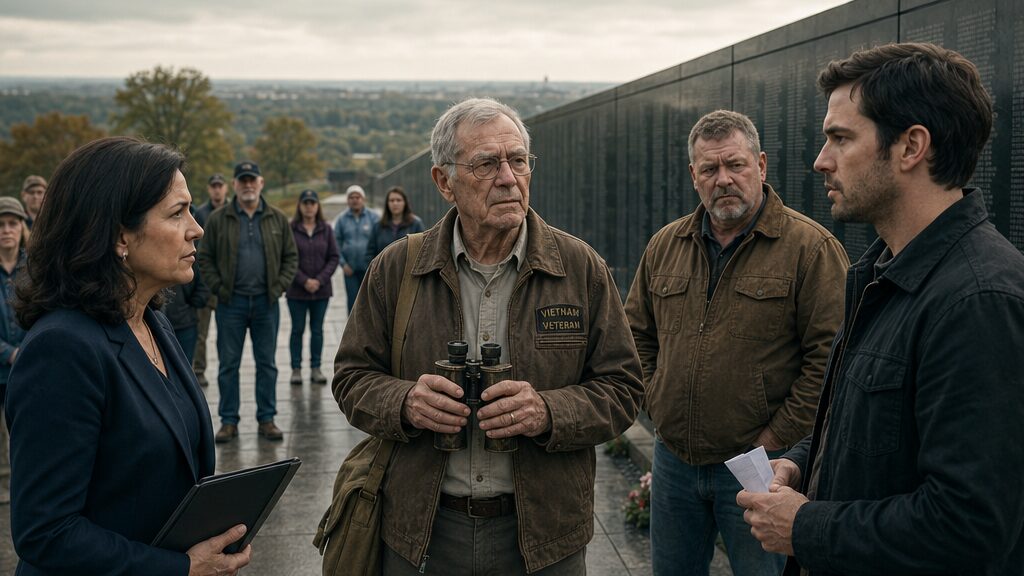
William studied him for several seconds before reaching into the worn canvas bag hanging from his shoulder.
Inside rested an old pair of binoculars.
The leather strap was cracked. The metal edges were faded silver.
Forty years earlier they had belonged to another man.
Now they belonged to William.
He raised them slowly.
The young man came into focus.
Mid-thirties, maybe.
Dark jacket.
Unshaven.
Hands buried in his pockets.
His eyes moved across the memorial grounds without settling anywhere for long.
Not sightseeing.
Searching.
William lowered the binoculars.
Something about that bothered him.
Not because the man looked dangerous.
Because he looked uncertain.
People who planned trouble usually knew exactly where they were going.
The man looked lost.
A truck engine growled nearby.
Raymond Thomas pulled into the maintenance lot and climbed out carrying a coffee cup.
“Morning, William.”
William nodded.
Raymond followed his gaze.
“Who’s that?”
“Don’t know.”
“You expecting somebody?”
“No.”
Raymond squinted.
The young man had already started walking away.
“Probably nothing,” Raymond said.
William wasn’t sure.
By noon the man was gone.
But the next morning he returned.
This time William spotted him near the northern memorial wall.
Again he wasn’t acting like a visitor.
He walked slowly along the engraved names.
Stopped.
Studied a section.
Moved on.
Returned.
Studied it again.
As if looking for something that wasn’t there.
William watched through the binoculars.
The young man ran his fingers lightly across the stone.
Then took out a notebook.
Wrote something.
Closed it.
Left.
No flowers.
No photographs.
No visible tribute.
Just questions.
The behavior spread through William’s thoughts for the rest of the day.
By Thursday the man returned again.
Three visits in four days.
Now other volunteers noticed him.
Whispers followed him across the grounds.
The memorial board had already spent months dealing with vandalism concerns after rumors of redevelopment plans nearby.
People were nervous.
Nervous people filled empty spaces with assumptions.
William knew that better than most.
Near midday he saw the young man kneeling beside an information kiosk.
Writing.
Again.
The binoculars rose instinctively.
The man copied something from an old directory listing.
Then folded the paper carefully.
Not hurried.
Not secretive.
Careful.
That detail mattered.
William couldn’t explain why.
Only that it did.
The young man eventually noticed him watching.
Their eyes met across nearly two hundred yards.
For a brief moment neither moved.
William expected irritation.
Instead he saw relief.
The man took one hesitant step forward.
Then stopped.
A maintenance cart drove between them.
When it passed, the man had turned away.
Gone again.
That evening William sat alone in his small house.
Rain tapped softly against the windows.
The binoculars rested on the kitchen table.
He stared at them while heating soup.
Some nights memories arrived quietly.
Other nights they forced themselves through the cracks.
This night was somewhere in between.
Observation.
Recognition.
Uncertainty.
The same old ingredients.
He pushed the thought away.
The next morning brought another appearance.
This time near the records building.
Visitors rarely entered that part of the property.
The young man stood outside for nearly ten minutes before going inside.
When he emerged, he carried several photocopies.
Raymond happened to be nearby.
“That’s the fourth time this week.”
William nodded.
“You think he’s scouting the place?”
“I don’t know.”
“You should tell Sarah.”
William looked toward the records building.
The young man was studying the papers while walking.
Not paying attention to anything around him.
Not watching cameras.
Not checking locks.
Not looking for weaknesses.
Just reading.
Again that uncertainty.
Again that feeling.
Something didn’t fit.
“You should tell Sarah,” Raymond repeated.
William remained silent.
The younger man folded the papers and disappeared down the hill.
Raymond shook his head.
“If something happens later, everybody’s going to ask why nobody said anything.”
William understood the warning.
He also understood something else.
People liked certainty.
Certainty felt safe.
Truth rarely arrived that way.
That afternoon he walked the northern wall alone.
Hundreds of names reflected sunlight.
Young men.
Old men.
Some remembered.
Many forgotten.
He stopped near a section where the stranger had lingered repeatedly.
Nothing unusual.
No damage.
No markings.
No sign of tampering.
Only names.
William traced one engraved letter with his fingertips.
A breeze moved through the trees.
For reasons he couldn’t explain, he suddenly imagined the young man standing here after everyone else had gone home.
Looking for someone.
Not something.
Someone.
The thought arrived without evidence.
Just instinct.
And instincts had betrayed him before.
Still.
He couldn’t shake it.
Late that evening his phone rang.
It was Sarah Martinez.
“Raymond mentioned a visitor you’ve been watching.”
William smiled faintly.
The news traveled fast.
“He mentioned it?”
“He said the guy keeps showing up.”
“He does.”
“You think we should be concerned?”
William looked out the window.
The last light was fading from the sky.
“I think we should pay attention.”
Sarah waited.
“And?”
“And that’s all I know.”
A pause.
“You usually know more than that.”
“Not this time.”
When the call ended, William sat quietly for several minutes.
Then he picked up the binoculars.
The leather strap creaked softly in his hands.
For the first time all week, he made a decision.
He would not report the young man.
Not yet.
Because the more he watched him, the less certain he became.
And uncertainty, William had learned long ago, was often the first sign that a person needed understanding instead of judgment.
Chapter 2: Everyone Already Made Up Their Minds
The memorial board meeting was already tense before William arrived.
Sarah Martinez stood near the front of the room organizing papers while volunteers filled folding chairs.
Rain clouds hung outside the windows.
The atmosphere felt heavier than the weather.
William took a seat near the back.
The binoculars rested inside his canvas bag beside his chair.
The meeting began with maintenance updates, budget concerns, and a discussion about landscaping repairs.
Then Raymond raised his hand.
“What about the guy?”
Several heads turned immediately.
Sarah sighed.
“I assume we’re discussing the visitor.”
“The same visitor,” Raymond said.
“He keeps showing up around restricted areas.”
A murmur spread through the room.
William remained silent.
One volunteer leaned forward.
“I saw him near the archives.”
Another nodded.
“So did I.”
“What’s he doing there?”
“No idea.”
The room quickly filled the absence of facts with theories.
Looking for valuables.
Scouting.
Researching security.
Preparing vandalism.
Every possibility sounded increasingly certain the longer people discussed it.
Sarah listened carefully.
Then looked toward William.
“You’ve seen him more than anyone.”
Several faces turned.
William felt their attention settle on him.
“What do you think?”
He considered the question.
“I think he’s looking for something.”
A volunteer laughed.
“Well obviously.”
William ignored it.
“I don’t think he’s looking for trouble.”
The room quieted.
Raymond frowned.
“What makes you think that?”
“I don’t know yet.”
That answer disappointed everyone.
People wanted conclusions.
Not caution.
Sarah folded her arms.
“William, with respect, we need more than a feeling.”
“I know.”
“Then what are we supposed to do?”
He looked around the room.
Faces already convinced.
The verdict had arrived before the evidence.
“Watch him.”
A younger volunteer shook his head.
“We’ve been watching him.”
“Then keep watching.”
The response produced visible frustration.
Sarah glanced toward the back wall.
“We learned something this morning.”
That caught everyone’s attention.
“He requested access to memorial records.”
Several people exchanged looks.
William sat straighter.
“What records?”
“Casualty lists. Historical submissions. Name verification documents.”
The room immediately grew suspicious again.
“Why?”
Sarah spread her hands.
“He didn’t say.”
“There you go,” someone muttered.
William listened carefully.
A person searching for weaknesses rarely requested decades-old paperwork.
Still, he kept the thought to himself.
The discussion continued for nearly twenty minutes.
Each new detail somehow increased suspicion rather than reducing it.
By the end of the meeting the young man had become a problem despite nobody knowing what he had actually done.
When the meeting ended, Sarah stopped William near the doorway.
“You really don’t think he’s dangerous?”
William adjusted the strap on his bag.
“I think people become dangerous when nobody bothers to understand them.”
“That’s not an answer.”
“It’s the only one I have.”
Sarah looked unconvinced.
Outside, rain had begun falling.
William walked toward the observation deck.
The memorial grounds were nearly empty.
Halfway there he noticed movement.
The young man.
Again.
Standing beside the northern wall.
The timing felt almost impossible.
William approached slowly.
Not directly.
Just enough to observe.
The young man held several photocopies.
One page appeared old.
Yellowed.
Worn.
He compared it against the engraved names.
Back and forth.
Paper.
Stone.
Paper.
Stone.
Then frustration crossed his face.
Not anger.
Disappointment.
As if the answer he wanted wasn’t there.
William considered speaking.
The distance between them narrowed to less than fifty feet.
The young man looked up.
For one brief moment it seemed he might approach.
Instead Sarah’s voice echoed across the grounds.
“Sir.”
The young man turned.
Sarah and Raymond were walking toward him.
His posture immediately stiffened.
“We need to ask what you’re doing here,” Sarah said.
The question was polite.
The suspicion beneath it wasn’t.
The young man looked from Sarah to Raymond.
Then to William.
For a second William saw something unexpected.
Not guilt.
Not fear.
Weariness.
The look of someone tired of explaining himself.
“I was leaving,” the young man said quietly.
“That wasn’t the question.”
Silence.
A few visitors had stopped walking.
Watching.
Waiting.
The situation suddenly felt public.
The young man folded his papers.
“I’m not causing problems.”
“We need to protect the memorial.”
“I understand.”
His calmness somehow made everyone more suspicious.
William recognized the pattern.
People often mistrusted what they couldn’t categorize.
Sarah looked toward William.
“Can you explain why you’ve been defending him?”
Several observers now stared openly.
William felt older than usual.
Not because of age.
Because of the assumptions surrounding him.
As though caution itself had become evidence of confusion.
“Because I don’t know enough yet.”
Raymond sighed.
“William, you’re seeing things that aren’t there.”
A few people nodded.
“Maybe you’re giving him the benefit of the doubt because you don’t want conflict.”
“Maybe you’re overthinking it.”
Sarah softened her voice.
“No one is criticizing you.”
The sentence felt strangely familiar.
People often said that immediately before criticism.
William opened his canvas bag.
Removed the binoculars.
Several people exchanged glances.
Raymond rubbed his forehead.
“William…”
“I watch this park every week.”
His voice remained calm.
“I watched him for days.”
He looked at the young man.
“He’s searching.”
Sarah crossed her arms.
“For what?”
William answered honestly.
“I don’t know.”
The silence that followed felt worse than disagreement.
It felt like dismissal.
As though age had finally reduced him to a man clinging to instincts nobody trusted anymore.
He could have argued.
Could have pushed harder.
Instead he slipped the binoculars back into the bag.
Then stepped aside.
The young man looked at him for a long moment.
Almost grateful.
Almost apologetic.
Then he walked away.
Nobody stopped him.
Nobody followed.
By sunset he was gone.
The next morning he didn’t return.
Nor the day after.
And for the first time since he had appeared, William found himself wondering not whether the young man was dangerous.
But whether they had just driven away the only person who knew what they were missing.
Chapter 3: The Mistake William Never Forgot
Jack’s disappearance should have settled the matter.
For everyone else, it mostly did.
The suspicious visitor was gone.
The memorial was safe.
The concern faded.
But William couldn’t let it go.
Three days passed.
Then four.
Each morning he arrived at the park expecting to see the young man standing somewhere along the walls.
Each morning the pathways remained empty.
On the fifth day William brought the binoculars to the observation deck and sat alone.
The northern wall stood silent below him.
He raised the lenses automatically.
Habit.
Routine.
Memory.
Through the glass he could see every engraved name clearly.
Thousands of letters.
Thousands of stories.
Thousands of people reduced to stone.
The sight pulled him backward in time.
Not gently.
Abruptly.
Like a door opening without warning.
Vietnam.
Rain.
Smoke.
Fear.
A hillside village at dusk.
William closed his eyes.
The memory had waited years for moments like this.
He was twenty-one again.
Young enough to believe certainty existed.
Old enough to carry a rifle.
A figure had appeared through the trees.
Running.
Shouting something nobody could hear.
The man moved fast.
Too fast.
Every nerve in William’s body had screamed danger.
He remembered raising his weapon.
Remembered the pressure in his chest.
Remembered believing he had only seconds to decide.
Friend or enemy.
Threat or warning.
Life or death.
The same question repeated endlessly in war.
He had squeezed the trigger.
Only once.
The bullet missed.
Another soldier tackled him sideways before he could fire again.
Moments later the truth emerged.
The running man had been an unarmed local farmer.
He’d been trying to warn them.
Not attack them.
William still remembered the expression on the man’s face.
Confusion.
Fear.
And hurt.
Not physical hurt.
Something deeper.
The hurt of being mistaken for a threat.
The farmer survived.
But the memory never left.
For decades William carried it quietly.
Not because he had fired.
Because he had been certain.
Certain enough to almost destroy an innocent life.
A voice interrupted the memory.
“Thought I’d find you here.”
Raymond.
William lowered the binoculars.
Raymond sat beside him.
Neither spoke for several seconds.
Finally Raymond cleared his throat.
“You still thinking about that guy?”
“Yes.”
Raymond laughed softly.
“You’re stubborn.”
“So are you.”
“Fair enough.”
The two men watched the empty memorial grounds.
“I don’t think you’re losing your mind, you know,” Raymond said.
William smiled.
“That’s encouraging.”
“I’m serious.”
Raymond hesitated.
“I just think you’re making this personal.”
Maybe he was.
The thought lingered after Raymond left.
That afternoon William walked toward the records building.
The office clerk recognized him immediately.
“Back again?”
“I need to check something.”
She pointed him toward a storage room containing archived memorial submissions.
The room smelled like paper and dust.
Boxes lined the shelves.
Folders stacked neatly across metal cabinets.
William moved slowly between them.
He wasn’t entirely sure what he was looking for.
Only that Jack had spent time here.
Enough time to request records.
Enough time to keep returning.
Eventually William found a stack of recently accessed files.
Most contained routine documentation.
Name corrections.
Family requests.
Verification forms.
Nothing unusual.
Then he noticed something odd.
A folder sat partially open.
Several papers appeared out of place.
He lifted them carefully.
One page contained an old casualty review.
Another referenced a rejected memorial submission.
The third page was missing.
William frowned.
Someone had removed it.
He checked again.
Still missing.
A chill moved through him.
Not because of theft.
Because of timing.
He remembered Jack comparing papers against the northern wall.
Searching names.
Searching records.
Searching for something absent.
William sat down at a nearby table.
The missing document suddenly felt important.
He didn’t know why.
Yet every instinct told him the gap mattered.
He opened the binocular case resting beside him.
The lenses reflected the fluorescent lights overhead.
Years ago they had helped him identify distant movement.
Now they seemed to represent something else.
A reminder.
Observation wasn’t understanding.
Looking wasn’t knowing.
The difference mattered.
Outside, evening shadows stretched across the memorial grounds.
William gathered the papers.
As he returned the folder to its shelf, something slipped loose.
A torn corner of a document.
Barely larger than a postcard.
It had apparently fallen between two storage boxes.
William picked it up.
Most of the page was missing.
Only a fragment remained.
A partial surname.
A faded date.
And a handwritten notation.
Submission incomplete.
He stared at the words.
Then at the empty space where the rest of the document should have been.
For the first time since Jack disappeared, William felt certainty returning.
Not certainty about guilt.
Certainty that something important had been overlooked.
And if Jack had been searching for that missing piece, then the story everyone believed might be completely wrong.
William folded the fragment carefully and slipped it into his pocket.
Outside, the memorial lights flickered on one by one.
Across the darkening grounds, engraved names caught the glow.
Waiting.
Remembering.
And somewhere inside those missing records, William suspected, another name was waiting too.
Chapter 4: A Name Missing From Stone
The fragment stayed in William’s pocket for two days.
Not because he wanted to hide it.
Because he wanted to understand it before bringing it to anyone else.
On Monday morning he returned to the archive office.
The clerk recognized him immediately.
“You again.”
“I need the rejection files.”
She blinked.
“The old ones?”
“Especially the old ones.”
She pointed toward a shelf near the back.
William spent nearly three hours working through dusty folders.
Most were routine.
Misspelled names.
Duplicate submissions.
Incomplete military records.
Families unable to provide enough documentation.
Nothing unusual.
Then he found another reference to the same missing file.
Not the file itself.
A mention.
A cross-reference buried inside an index list from nearly twenty years earlier.
He adjusted his glasses and read the entry twice.
Submission deferred pending verification.
Applicant deceased.
Review incomplete.
Supporting records misplaced.
The file number matched the torn fragment in his pocket.
William sat back slowly.
Misplaced.
Not denied.
Not rejected.
Misplaced.
There was a difference.
Outside the office window, sunlight moved across the memorial grounds.
William stared at the paper.
For the first time, he began wondering whether Jack had discovered this before anyone else.
If he had, the young man wasn’t searching for a name already on the wall.
He was searching for one that never made it there.
The thought followed William through the afternoon.
By evening he found himself standing before the northern memorial wall again.
The same section Jack had visited repeatedly.
The same section where he had compared papers against stone.
William removed the binoculars and slowly scanned the engraved names.
Not because he needed magnification.
Because it helped him focus.
The world narrowed through the lenses.
Names.
Dates.
Rows.
Patterns.
He lowered them and looked at the wall again.
Something suddenly occurred to him.
Jack hadn’t spent most of his time reading names.
He had spent most of his time reading the spaces between names.
Looking for where a missing one should have been.
The realization felt simple.
Yet it changed everything.
A voice interrupted his thoughts.
“Still looking?”
Sarah Martinez approached carrying a folder.
William nodded.
“Maybe.”
She stopped beside him.
For several moments neither spoke.
The tension between them wasn’t hostility.
Just uncertainty.
Sarah glanced toward the wall.
“I heard you’ve been digging through archives.”
“So have you.”
A faint smile touched her face.
“Fair.”
She opened the folder she carried.
“People are asking questions.”
“About me?”
“About the visitor.”
William expected that.
“Any answers?”
Sarah shook her head.
“Only more confusion.”
She looked down at the papers.
“The records building confirmed he requested casualty submissions.”
“That matches what I heard.”
“He specifically asked about files connected to missing verifications.”
William turned toward her.
That was new.
Sarah noticed.
“You didn’t know that.”
“No.”
“We found the request form.”
The information settled heavily between them.
Neither spoke for a while.
Finally Sarah asked, “What do you think he was looking for?”
William looked at the memorial wall.
“I think he was looking for someone.”
Sarah exhaled slowly.
“That’s what I’m starting to think too.”
It wasn’t an apology.
But it was the first crack in her certainty.
The next morning William returned to the archives.
The clerk seemed less surprised this time.
He spent hours comparing file numbers.
Most led nowhere.
A few contained missing attachments.
Several referenced families who never completed applications.
Then, shortly before noon, he found it.
Not the missing file.
A duplicate notation.
One page.
Half-faded.
Apparently overlooked because it had been attached to the wrong folder decades earlier.
William’s pulse quickened.
The document referenced a serviceman whose memorial submission had stalled after conflicting records appeared.
The surname was partially visible.
Only a few letters remained legible.
Yet they matched the torn fragment almost perfectly.
Wilson.
William stared at the page.
Wilson.
Jack Wilson.
The connection might have been coincidence.
But it didn’t feel like one.
He carefully copied the information.
Then requested additional records.
The clerk returned twenty minutes later carrying an apologetic expression.
“That’s all we have.”
“What happened to the rest?”
“No idea.”
The answer frustrated both of them.
William left carrying more questions than answers.
Late that afternoon he walked the memorial grounds alone.
The names gleamed beneath the sun.
Hundreds of families represented in stone.
Hundreds of stories reduced to dates.
Some remembered.
Some forgotten.
And perhaps one missing entirely.
As he reached the northern wall, he stopped.
Something felt wrong.
He moved closer.
One of the maintenance display cases stood partially open.
Not broken.
Just unlocked.
Inside, several archive copies normally displayed for visitors were missing.
Nothing valuable.
Nothing worth stealing.
Only documents.
Historical records.
Copies.
Paper.
William’s stomach tightened.
Someone had been looking for information.
Or removing it.
He immediately called the archive office.
The clerk checked inventory.
Within an hour she called back.
Three photocopies were gone.
All connected to the same incomplete submission.
The same one linked to the missing Wilson file.
William stood quietly beneath the memorial wall after the call ended.
The evening wind rustled nearby trees.
For the first time since Jack disappeared, another possibility entered his mind.
What if someone else wanted those records hidden?
The question unsettled him more than any suspicion directed at Jack.
Because if the documents were vanishing now, then the story wasn’t finished.
Somebody still cared about what those papers might reveal.
And somewhere in that missing trail of records was the reason Jack had come to the memorial in the first place.
Chapter 5: What Jack Was Really Looking For
The storage room sat beneath the oldest section of the memorial complex.
Most volunteers barely knew it existed.
The room had once held original dedication materials, construction records, and community submissions before everything moved into digital archives.
Now it mostly collected dust.
William had visited it only twice in the last decade.
The missing documents changed that.
On Wednesday morning he obtained permission from Sarah to search through old storage boxes.
She arrived with him carrying a flashlight.
“You really think something’s down there?”
“I think something used to be.”
The basement door creaked as they entered.
Dust floated through narrow beams of light.
Metal shelves stretched across the room.
Cardboard boxes filled nearly every corner.
William moved slowly.
His knees complained with each step.
Sarah began checking labels.
For nearly an hour they found nothing useful.
Old newsletters.
Volunteer rosters.
Construction invoices.
Retired maintenance reports.
Then Sarah stopped.
“William.”
He turned.
She held up a box marked Deferred Submissions.
His pulse quickened.
The box looked untouched for years.
Together they lifted it onto a table.
Inside sat dozens of folders.
Most yellowed with age.
Many incomplete.
They worked carefully.
Folder after folder.
Application after application.
Some ended with approval.
Others ended with rejection.
Then William found a familiar number.
The same file reference from the torn fragment.
The same incomplete submission.
His hands became very still.
The folder was thinner than expected.
Several pages were missing.
But enough remained.
Sarah leaned closer.
“What is it?”
William opened the file.
The applicant’s name had faded almost beyond recognition.
Yet portions remained legible.
A woman had submitted documentation decades earlier requesting memorial recognition for a family member.
Additional military records had been requested.
Before the review finished, she died.
The case stalled.
Eventually the paperwork vanished into storage.
Sarah sat down slowly.
“That’s it?”
“Part of it.”
William continued reading.
A second document remained attached.
A family statement.
Most of the ink had deteriorated.
Only fragments survived.
But one sentence remained clear.
His sacrifice deserves to be remembered with the others.
Silence filled the room.
Sarah looked toward the shelves.
“My God.”
William didn’t answer.
Because another paper had caught his attention.
A handwritten note.
Added years later.
Apparently by a volunteer reviewer.
Attempting contact with surviving family member.
No response received.
Last known relative: grandson.
The surname appeared clearly.
Wilson.
For several seconds neither spoke.
The answer had finally emerged.
Not completely.
But enough.
Jack wasn’t searching for weakness.
Or vandalism opportunities.
Or anything criminal.
He was searching for family.
Searching for a name that should have existed but didn’t.
William closed the folder carefully.
The room felt strangely quiet.
Not peaceful.
Heavy.
The weight of a forgotten story.
Sarah rubbed her forehead.
“We accused him.”
“We suspected him.”
“We never asked.”
William’s voice remained gentle.
The distinction mattered.
She looked at him.
“You knew.”
“No.”
“You believed.”
That was different.
William accepted the correction.
Later that afternoon he sat alone on the observation deck.
The binoculars rested in his lap.
Below him stretched the memorial grounds Jack had crossed so many times.
The pathways.
The walls.
The records building.
Every place suddenly made sense.
The notebook.
The photocopies.
The repeated visits.
The frustration.
The disappointment.
The silence.
William raised the binoculars.
Not to search.
To remember.
Through the lenses the memorial wall sharpened.
Names stood clear against polished stone.
One space in particular seemed impossible to ignore now.
Not because there was physical room.
Because there was absence.
A story missing from the larger story.
Footsteps approached.
Raymond climbed the stairs.
“You found something.”
William lowered the binoculars.
“What makes you say that?”
“You finally stopped looking worried.”
William almost laughed.
Almost.
Instead he handed Raymond a copy of the recovered paperwork.
Raymond read quietly.
The skepticism slowly disappeared from his face.
When he finished, he looked toward the memorial.
“That kid was trying to find his grandfather?”
“Looks that way.”
Raymond sat heavily beside him.
Neither man spoke for a while.
Eventually Raymond said, “We got this wrong.”
William nodded.
“Yes.”
The admission hung between them.
Not dramatic.
Not crushing.
Simply true.
As sunset approached, Sarah called.
Her voice sounded tired.
“The town council wants a hearing.”
William frowned.
“For what?”
“Questions about the missing records.”
“And Jack?”
“They think he took them.”
William closed his eyes.
Of course they did.
The easiest explanation had returned.
Despite everything.
Despite the evidence.
Despite the truth beginning to emerge.
Sarah hesitated.
“I need you there.”
William looked across the memorial grounds.
The evening light touched the engraved names.
Thousands of people remembered because someone insisted they mattered.
Now another story stood at risk of being lost.
“I’ll be there,” he said.
After the call ended, he remained seated long after sunset.
The binoculars rested in his hands.
Years earlier they had helped him identify movement at great distances.
Now they reminded him of something harder.
Seeing was easy.
Understanding required effort.
And at the hearing, William suspected, effort would be in short supply.
Chapter 6: Choosing Truth Instead of Convenience
The town hearing took place on a Thursday evening inside a municipal meeting hall that smelled faintly of coffee and old paper.
William arrived early.
He preferred arriving early everywhere.
In war, arriving late sometimes meant arriving after the decision had already been made.
Some habits never left.
He sat near the side wall and rested his canvas bag beside his chair.
The binoculars remained inside.
People slowly filled the room.
Volunteers.
Council members.
A few reporters.
Several residents who knew only fragments of the situation.
William recognized Katherine Moore near the front row.
She was speaking quietly with another reporter while flipping through notes.
By six o’clock nearly every seat was occupied.
Sarah entered carrying several folders.
She looked exhausted.
The previous week had clearly taken its toll.
When the meeting began, the council chair summarized the issue.
Missing records.
Questions regarding archive security.
Concerns surrounding a visitor repeatedly seen on memorial property.
The description felt strange to William.
So much attention focused on suspicion.
So little on truth.
As discussion opened, several residents voiced concerns.
“We can’t just ignore this.”
“If records disappeared, somebody took them.”
“That young man was there every week.”
The comments weren’t cruel.
They were ordinary.
Which somehow made them harder to challenge.
Ordinary assumptions often carried more weight than obvious hostility.
People trusted them.
One council member turned toward Sarah.
“Do we know where this individual is now?”
“No.”
“Has anyone contacted him?”
“We don’t have current contact information.”
Murmurs spread through the room.
The absence sounded suspicious.
William understood how easily gaps became accusations.
A missing document.
A missing person.
A missing explanation.
The mind rushed to connect them.
The council chair nodded toward Sarah.
“What does the memorial board recommend?”
Sarah hesitated.
For a brief moment William saw uncertainty cross her face.
Not long ago she would have spoken with confidence.
Now she carried more information than certainty.
“We recommend continuing the review before assigning responsibility.”
A resident immediately objected.
“Why?”
Sarah opened one of her folders.
“Because evidence suggests the situation is more complicated than we originally believed.”
The room grew quieter.
Several people exchanged glances.
The chair leaned forward.
“What evidence?”
Sarah described the incomplete memorial submission.
The misplaced records.
The recovered storage documents.
The missing family connection.
She avoided conclusions.
Presented only facts.
Yet even facts seemed to create tension.
When she finished, one council member asked the question everyone had been circling.
“So you’re saying the visitor may have been researching family history?”
“Possibly.”
“Possibly isn’t certainty.”
“No,” Sarah agreed. “It isn’t.”
The discussion continued for another twenty minutes.
Back and forth.
Concern against caution.
Assumption against patience.
William listened carefully.
The pattern felt familiar.
Not because of the memorial.
Because of life.
Most people preferred an answer they could hold immediately.
Even if it was wrong.
Finally Katherine Moore stood.
The room recognized her instantly.
She adjusted her glasses.
“As a reporter, I’ve reviewed several public documents related to this issue.”
The room quieted.
“I’ve also spoken with archive personnel.”
William watched Sarah carefully.
Neither woman appeared entirely comfortable.
Katherine continued.
“At this point, there is no evidence connecting the visitor to the missing records.”
The statement landed heavily.
Not because it proved innocence.
Because it challenged certainty.
Several people shifted in their seats.
A man near the back frowned.
“Then who took them?”
“No one knows.”
The answer disappointed everyone.
Including William.
Truth often arrived incomplete.
The council chair glanced toward the audience.
“Anyone else wish to speak?”
William felt Sarah looking at him.
Then Raymond.
Then Katherine.
A familiar pressure settled over the room.
Not expectation.
Opportunity.
He rose slowly.
His knees protested.
The hall fell silent.
Many people knew William.
Most respected him.
A few probably assumed he would confirm their suspicions.
He approached the microphone.
For several seconds he said nothing.
Then he placed the binoculars on the table beside him.
The old leather strap hung over the edge.
The room watched.
“I’ve spent years observing the memorial.”
His voice remained calm.
“I’ve watched visitors, volunteers, families, veterans.”
He paused.
“I’ve also spent years learning that observation and understanding are not the same thing.”
Nobody interrupted.
William looked around the room.
Faces.
Assumptions.
Questions.
Fear.
All ordinary.
All human.
“We saw a young man walking around with papers.”
He nodded slightly.
“We saw him return again and again.”
Several people nodded.
“We noticed behavior we couldn’t explain.”
More nods.
Then William took a slow breath.
“And because we couldn’t explain it, we started explaining it ourselves.”
Silence.
No accusation.
No anger.
Just truth.
He continued.
“I did the same thing once.”
The room became very still.
William rarely spoke about Vietnam.
Most people knew that.
“I saw a man running toward my unit.”
His eyes remained on the audience.
“I thought I knew what I was seeing.”
The memory remained painful even now.
Not sharp anymore.
Just heavy.
“I was wrong.”
No further details.
None were necessary.
The hall understood enough.
William looked down briefly at the binoculars.
Then back at the audience.
“Maybe this visitor took those records.”
A few people straightened.
“Maybe he didn’t.”
The room relaxed again.
William wasn’t giving them certainty.
He was denying it.
“What matters is that we don’t know.”
His voice softened.
“And until we do, he deserves the same fairness we would want for ourselves.”
When he returned to his seat, no applause followed.
He was grateful.
Applause would have made the moment smaller.
Instead people sat quietly.
Thinking.
The meeting ended without a conclusion.
No accusations.
No declarations.
Just an agreement to continue the investigation.
As people filed out, Sarah approached William.
“Walk with me?”
They stepped outside into the cool evening air.
Streetlights illuminated the parking lot.
For several moments neither spoke.
Finally Sarah stopped.
“I owe you something.”
William waited.
“I should have listened sooner.”
The words were simple.
No dramatic apology.
No excuses.
Just honesty.
William appreciated that.
“You were trying to protect the memorial.”
“I was.”
“You weren’t wrong to care.”
Sarah looked down.
“I was wrong about other things.”
They stood quietly beneath the lights.
Then Sarah handed him a folded sheet of paper.
“We found this after the meeting.”
William unfolded it.
His eyes widened.
A recently updated contact record.
One line highlighted.
Possible surviving relative location.
Jack Wilson.
A current address.
Sarah exhaled slowly.
“I think it’s time we hear the rest of the story.”
Chapter 7: The Name That Finally Returned Home
Three weeks later, the memorial grounds looked different.
Not because the stone walls had changed.
Because the people had.
The morning sun warmed the pathways as volunteers arranged folding chairs near the northern section of the memorial.
A small gathering had formed.
Nothing elaborate.
No large ceremony.
No television crews.
No banners.
Just families, veterans, volunteers, and a handful of community members.
The kind of gathering that existed because something mattered.
William arrived early, as usual.
The binoculars hung from his shoulder.
He paused at the observation deck and looked across the grounds.
The memorial seemed peaceful.
Perhaps it always had been.
Perhaps people simply noticed peace more after conflict.
Footsteps approached behind him.
William turned.
Jack Wilson stood several feet away.
The same dark hair.
The same cautious expression.
The same weariness William had noticed weeks earlier.
Only now there was something else.
Relief.
Neither man spoke immediately.
They simply looked at each other.
The distance that had once felt enormous now seemed very small.
Jack smiled first.
“You kept looking.”
William nodded.
“You kept searching.”
A faint laugh escaped Jack.
“Fair enough.”
They walked together toward the northern wall.
Over the previous weeks, the missing story had slowly emerged.
Jack’s grandfather had served during the war.
Documentation problems had interrupted the memorial submission process decades earlier.
His grandmother had spent years trying to correct the mistake.
Then illness intervened.
Records vanished.
Applications stalled.
Time passed.
People died.
The unfinished file disappeared into storage.
Eventually only fragments remained.
Jack had inherited those fragments.
Nothing more.
A few papers.
Several family stories.
And one belief.
Someone had been forgotten.
So he searched.
Not for recognition.
Not for attention.
Simply for truth.
As they approached the gathering area, Sarah Martinez greeted them.
Her smile carried none of the stiffness William remembered from earlier weeks.
“Good morning.”
Jack nodded politely.
Sarah extended her hand.
He accepted it.
A small gesture.
Yet William understood its significance.
Changed behavior mattered more than dramatic words.
Nearby, Raymond adjusted chairs while pretending not to watch.
Eventually he walked over.
“I owe you an apology.”
Jack looked surprised.
Raymond shrugged.
“I should’ve asked questions before making assumptions.”
Jack smiled gently.
“You’re not the only one.”
The answer seemed to ease something inside Raymond.
A few feet away, Katherine Moore spoke with visitors while reviewing a short article she planned to publish.
Not about controversy.
Not about accusations.
About history.
About records.
About how easily stories could disappear.
The gathering began shortly after ten.
No stage.
No speeches from politicians.
Just a brief acknowledgment of the restored record.
A memorial committee member read a summary of the documentation review.
The recovered records.
The verified service history.
The corrected submission.
Then attention shifted toward the wall itself.
A newly engraved name now appeared among the others.
Simple.
Permanent.
Belonging.
The crowd remained quiet.
William appreciated that.
Silence felt appropriate.
Some moments demanded observation rather than celebration.
Jack stepped forward.
For a few seconds he simply stared at the stone.
His grandfather’s name rested where it should have been years earlier.
No dramatic reaction followed.
No tears.
No speech.
Just a long breath.
As though something unfinished had finally settled.
William understood.
Certain burdens disappeared loudly.
Others simply loosened.
When Jack stepped back, Sarah moved beside him.
“I’m glad you didn’t stop searching.”
Jack looked toward the memorial.
“I almost did.”
Sarah nodded.
“I know.”
The honesty between them felt earned.
Nearby, visitors slowly resumed conversation.
Children wandered along pathways.
Veterans exchanged quiet stories.
Life continued.
Yet something had changed.
Not only for Jack.
For the community.
Because now they knew how close they had come to getting the story wrong.
Again.
Later that afternoon the gathering dispersed.
The memorial returned to its usual calm.
William remained behind.
He often did.
The observation deck overlooked the entire park.
From there he could see the northern wall clearly.
The restored name.
The pathways.
The visitors moving below.
He lifted the binoculars one final time.
The lenses sharpened the scene.
Every detail became clear.
For years he had relied on those binoculars to help him see farther.
Now he understood what they truly represented.
Not certainty.
Responsibility.
The obligation to look carefully before deciding what something meant.
Footsteps sounded nearby.
Jack climbed the observation deck stairs carrying a small envelope.
“I wanted to give you something.”
William accepted it.
Inside was a copy of the original family statement recovered from the archives.
The sentence remained visible.
His sacrifice deserves to be remembered with the others.
William read it quietly.
Then folded the paper and returned it.
“You should keep this.”
Jack nodded.
“I will.”
For a moment neither man spoke.
The memorial stretched silently below them.
Finally Jack asked, “Why did you defend me?”
William looked toward the horizon.
The answer felt simple now.
Because of a memory.
Because of a mistake.
Because of a lesson that had taken fifty years to learn.
But he chose different words.
“I wasn’t defending you.”
Jack frowned slightly.
William smiled.
“I was defending the possibility that we didn’t know the whole story.”
The younger man considered that.
Then slowly nodded.
Together they stood overlooking the memorial.
Names carved in stone.
Lives carried forward through memory.
A place built not only to remember the dead, but to remind the living.
The wind moved softly through the trees.
Below them, sunlight touched the newly restored name.
And for the first time in many years, William felt the weight of an old mistake ease slightly.
Not disappear.
Some things never disappeared.
But ease.
Enough.
The story has ended.