They Tried To Remove An Elderly Passenger From The Cockpit Until The Fighter Pilots Recognized Her Name
Chapter 1: The Passenger Standing Behind The Pilots
The first warning came as a sharp tone through Captain Gregory Thomas’s headset.
A second later, the aircraft shuddered.
Not violently. Not enough to frighten passengers.
Just enough to make every pilot in the cockpit stop breathing for half a second.
Gregory looked up from the instrument panel.
The sky ahead had darkened into a sheet of gray cloud.
Beside him, First Officer Samuel Clark adjusted a frequency.
“Center just changed our route again.”
Gregory frowned.
“Third time in twenty minutes.”
Before Samuel could answer, another voice crackled through the radio.
“Flight 728, maintain current heading and altitude. Further instructions forthcoming.”
The wording felt wrong.
Not dangerous.
Just unusual.
Gregory had flown for nearly thirty years. Experience taught him when something was normal and when something only sounded normal.
This sounded normal.
And wasn’t.
Samuel seemed to feel it too.
Neither spoke.
The cockpit settled into an uneasy silence.
Then someone knocked softly on the cockpit door.
A flight attendant stepped inside.
Her face was controlled, but Gregory immediately noticed tension in her eyes.
“Captain?”
“What is it?”
“There’s a passenger asking to speak with you.”
Gregory sighed.
Now?
“Tell them we’re busy.”
“I did.”
She hesitated.
“She said you’d want to hear what she has to say.”
Samuel glanced over.
Gregory rubbed his forehead.
“What passenger?”
The attendant handed over a small laminated visitor pass.
“Seat 3A.”
Gregory examined it.
An elderly woman.
Deborah Carter.
No special designation.
No government markings.
Nothing remarkable.
“Why would I want to hear what she has to say?”
The attendant lowered her voice.
“She said the aircraft isn’t being rerouted.”
Gregory stared.
“What?”
“She said we’re being intercepted.”
For a moment nobody moved.
Then Samuel laughed.
Not because it was funny.
Because it sounded ridiculous.
“Intercepted by who?”
The attendant shook her head.
“That’s all she said.”
Gregory handed back the pass.
“Keep her seated.”
The attendant nodded.
But before she could leave, another alert sounded.
Samuel’s eyes widened.
“Traffic.”
Gregory turned.
The radar showed fast-moving contacts approaching.
Very fast.
His stomach tightened.
The attendant slowly backed out and closed the door.
Nobody spoke.
A minute later, the contacts appeared visually.
Samuel saw them first.
“Oh my God.”
Gregory followed his gaze.
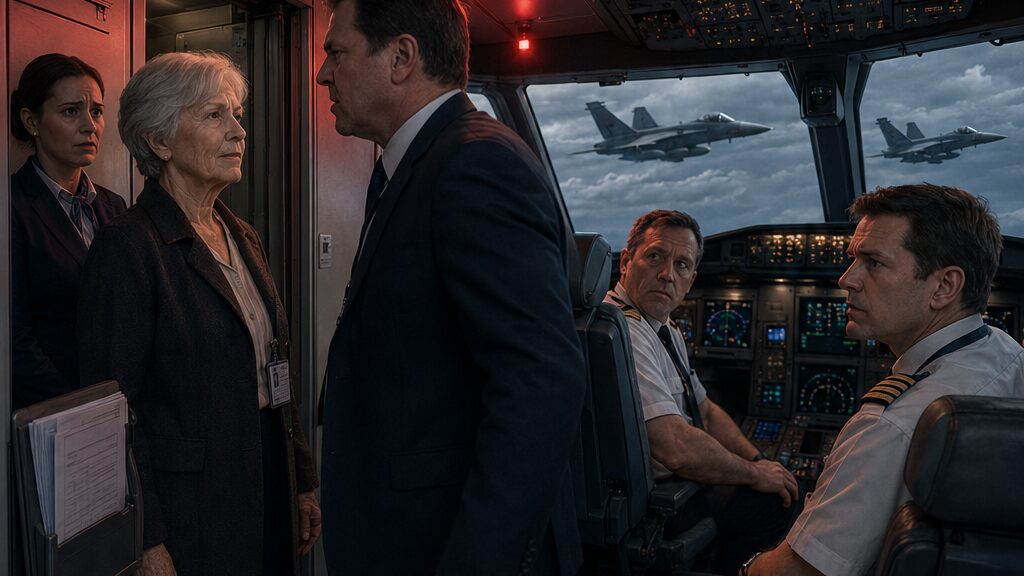
Two fighter jets.
Gray.
Sharp.
Close enough to identify.
One on each side.
Escorting them.
Not attacking.
Not threatening.
Simply present.
The sight turned the cockpit cold.
Gregory immediately contacted air traffic control.
Questions.
Requests.
Demand for clarification.
Answers came slowly.
Incomplete.
Unsatisfying.
Meanwhile the fighters remained beside them like silent shadows.
Behind the cockpit door, passengers began noticing.
The cabin atmosphere shifted.
Whispers spread.
Flight attendants moved quickly through the aisle.
Gregory focused on flying.
Nothing else mattered.
Not now.
Not until they understood what was happening.
Then the cockpit door opened again.
The same attendant entered.
This time Deborah Carter stood behind her.
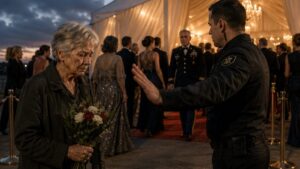
The old woman wore a plain dark coat.
Nothing expensive.
Nothing impressive.
Silver hair pulled neatly back.
A simple handbag over one shoulder.
Gregory immediately felt irritation.
The last thing he needed was a passenger wandering near the cockpit during an incident.
“Ma’am,” he said firmly. “You need to return to your seat.”
She looked through the windshield.
At the fighters.
At the clouds.
Then at him.
Calmly.
More calmly than anyone else on the aircraft.
“I’m sorry to interrupt.”
Her voice was soft.
Controlled.
“I thought you should know they’re not escorting you because of a navigation issue.”
Gregory exchanged a glance with Samuel.
“Then why are they escorting us?”
She considered.
“Someone wants confirmation.”
“Confirmation of what?”
Her eyes drifted toward the radio panel.
“For now, I’d rather not guess.”
Gregory felt his patience thinning.
“Ma’am, unless you’re directly involved in aviation operations—”
“No.”
She smiled faintly.
“Not anymore.”
The answer irritated him even more.
Not anymore.
What did that even mean?
Samuel watched her carefully.
Something about her confidence felt unusual.
Not arrogant.
Certain.
As if she had stood in situations far more serious than this.
The radio crackled again.
A coded transmission followed.
Gregory didn’t recognize it.
Neither did Samuel.
Deborah did.
Her eyes shifted almost imperceptibly.
A tiny reaction.
Gone immediately.
But Samuel noticed.
So did Gregory.
The old woman looked away before either could ask.
“Please return to your seat,” Gregory repeated.
She nodded.
No argument.
No complaint.
Just compliance.
Yet as she turned to leave, Gregory noticed something tucked inside her handbag.
A weathered folder.
Military green.
Old.
Worn from years of handling.
Before he could focus on it, the door closed.
The cockpit fell silent again.
Samuel finally spoke.
“You notice that?”
“What?”
“The transmission.”
Gregory nodded.
“Yeah.”
“She recognized it.”
“Maybe.”
Samuel leaned back.
“She knew something.”
Gregory stared ahead.
Outside, the fighters maintained position.
Steady.
Patient.
Waiting.
For what?
Nobody seemed willing to explain.
An hour later the situation worsened.
Airline operations became involved.
Additional communications arrived.
Aviation authorities requested updates.
Questions multiplied.
Answers didn’t.
Then another message appeared in the cockpit system.
A request.
Not from air traffic control.
Not from the airline.
From military coordination channels.
The request contained a single line.
Confirm passenger Deborah Carter remains onboard.
Gregory read it twice.
Then a third time.
Samuel leaned forward.
“What does that mean?”
Gregory didn’t know.
And for the first time that day, he found himself thinking less about the fighter jets and more about the elderly woman in seat 3A.
Who was she?
And why did military channels care whether she remained on the aircraft?
Outside the windshield, the fighter jets adjusted formation.
Moving closer.
Chapter 2: Orders Nobody Could Explain
Deborah Carter had spent much of her life inside aircraft.
Not as a passenger.
As responsibility.
As consequence.
As decision.
The difference mattered.
A passenger worried about arriving safely.
A commander worried about everyone arriving safely.
Even after retirement, the habit remained.
She sat quietly in seat 3A while nervous conversations filled the cabin around her.
People pointed toward the windows.
Speculated.
Invented explanations.
Foreign threats.
Security concerns.
Mechanical failures.
Nobody knew.
Fear always preferred imagination over uncertainty.
Deborah folded her hands.
Across the aisle, a young mother tried to reassure her son.
Several rows back, a businessman demanded answers from a flight attendant.
Near the rear cabin, someone recorded video.
Human behavior rarely changed.
Only the circumstances did.
A flight attendant approached her.
“Ma’am.”
Deborah looked up.
“The captain would like you to remain seated.”
A polite order.
Not a request.
She nodded.
“Of course.”
The attendant hesitated.
“You don’t seem worried.”
Deborah smiled.
“I’ve spent time in worse places.”
The attendant laughed nervously and moved on.
Deborah turned toward the window.
One fighter remained visible.
Its position was precise.
Disciplined.
Professional.
She recognized the formation immediately.
Not because of the aircraft itself.
Because of the message behind it.
Someone wanted presence.
Not force.
A signal.
A reminder.
Years ago she would have known exactly who issued such orders.
Now she only had fragments.
Retirement created distance.
Sometimes useful distance.
Sometimes painful.
The intercom chimed.
The captain’s voice reassured passengers.
Professional.
Measured.
Trying to create calm he didn’t entirely feel.
Deborah respected that.
Leadership often meant sounding steadier than you were.
Half an hour later, the atmosphere changed again.
A flight attendant returned.
“Ms. Carter?”
“Yes?”
“We need you near the front.”
Deborah followed her.
The corridor felt narrower than before.
More eyes watched.
More questions.
At the front galley stood a man in a tailored airline operations jacket.
Richard Williams.
His expression revealed irritation before he spoke.
“You are Deborah Carter?”
“Yes.”
“I’m Richard Williams from airline operations.”
She waited.
Richard glanced at a tablet.
Then at her.
Then back at the tablet.
Clearly dissatisfied.
“There appears to be some confusion involving your booking.”
“Confusion?”
“Military coordination channels have repeatedly referenced your name.”
Several nearby crew members listened.
Deborah remained silent.
Richard continued.
“We need clarification.”
“I don’t believe I can help.”
His eyebrows rose.
“Excuse me?”
“I purchased a ticket.”
“Military authorities don’t escort commercial flights because someone purchased a ticket.”
The edge in his voice became sharper.
Deborah noticed several crew members growing uncomfortable.
He wanted answers.
More importantly, he wanted control.
And he didn’t have it.
That frightened him.
“I understand,” she said.
“Then explain.”
She looked at him quietly.
“No.”
His jaw tightened.
The answer seemed to offend him.
“Ma’am, this situation affects hundreds of people.”
“And I hope everyone arrives safely.”
“That’s not what I asked.”
Richard stepped closer.
“Who are you?”
The question lingered.
Deborah could have answered.
Not fully.
But enough.
Instead she simply said, “A passenger.”
His frustration deepened.
“A passenger doesn’t trigger military notifications.”
Deborah’s eyes drifted toward a manifest clipped near the cockpit doorway.
Names.
Seat numbers.
Codes.
Information.
Proof.
The world often revealed itself through paperwork long before people listened.
Richard followed her gaze.
Then looked back.
“You need to tell us what’s happening.”
“I don’t know exactly what’s happening.”
That part was true.
“What do you know?”
“Less than you think.”
“And more than everyone else?”
She didn’t answer.
The silence felt like confirmation.
Richard turned toward the crew.
“She’s not authorized to be here.”
Deborah remained still.
“Please return to your seat.”
His tone shifted.
More public.
More dismissive.
As though speaking to someone confused.
Someone old.
Someone inconvenient.
Several nearby passengers watched.
One whispered.
Another shook his head.
Deborah felt the familiar sting of being reduced to appearance.
Age did that.
People assumed uncertainty where there was patience.
Weakness where there was restraint.
She looked at Richard.
“You can check the name again.”
Nothing more.
The words landed strangely.
Not defensive.
Not angry.
Merely factual.
Richard almost laughed.
“We’ve checked it repeatedly.”
“Then check it again.”
A silence followed.
Deborah’s eyes moved toward the cockpit window.
Beyond it, one fighter shifted position.
A subtle movement.
Deliberate.
The exact moment she saw it, she lifted one hand slightly.
Not dramatically.
Just enough to indicate the aircraft.
Samuel noticed.
So did Gregory.
The formation changed.
Instantly.
The fighters widened separation.
Adjusted bearing.
Then stabilized.
Richard stared.
“What was that?”
Deborah lowered her hand.
“Nothing.”
But even Gregory no longer believed that.
Chapter 3: The Name On The Manifest
Samuel Clark had spent years learning how to notice details.
Most pilots did.
Tiny details prevented large disasters.
A strange vibration.
A missing sound.
A wrong number.
The same instinct now focused entirely on one passenger.
Deborah Carter.
The fighter movement might have been coincidence.
Probably was.
Yet it didn’t feel like coincidence.
Neither did the military messages.
Neither did the coded transmission she seemed to recognize.
Neither did Richard Williams becoming increasingly agitated.
Samuel sat inside the cockpit reviewing information displayed on a secondary operations screen.
Passenger manifest.
Booking data.
Security records.
Most entries looked ordinary.
Business travelers.
Families.
Tourists.
Then Deborah’s file appeared.
At first glance, it seemed normal too.
Age seventy-four.
Destination Washington.
No special requests.
No VIP designation.
Nothing obvious.
Then Samuel noticed a small annotation.
Not a word.
A code.
He didn’t recognize it.
Another code appeared beneath it.
And another.
Hidden among routine airline data.
Samuel frowned.
“What are these?”
Gregory leaned over.
“Where?”
Samuel pointed.
Gregory studied the screen.
“I’ve never seen those.”
Neither had Samuel.
He requested additional information.
Access denied.
That was unusual.
Passenger records rarely denied cockpit access.
Especially during active operational investigations.
Samuel tried again.
Same result.
He felt a chill.
“Captain.”
Gregory was already staring.
“I know.”
Outside, dusk slowly darkened the horizon.
The fighter escort remained.
Patient.
Unwavering.
As if waiting for a conclusion nobody understood.
A call arrived from airline operations.
Richard’s voice sounded irritated.
“Any update?”
Samuel answered.
“We found clearance markers.”
Silence.
“What kind?”
“We don’t know.”
Another pause.
Then Richard said something unexpected.
“Military liaison wants a copy of the manifest.”
Samuel exchanged a look with Gregory.
“Why?”
“They didn’t explain.”
Of course they didn’t.
Nobody explained anything anymore.
The request arrived moments later.
Official.
Urgent.
Specific.
Not the entire manifest.
Only one page.
Deborah Carter’s entry.
Samuel printed it.
The paper slid from the machine with an ordinary mechanical sound.
Yet somehow it felt important.
The page contained little information.
Name.
Seat.
Booking reference.
And those strange codes.
He handed it to a flight attendant.
Minutes later she returned.
“They want a clearer copy.”
Samuel blinked.
“It’s perfectly clear.”
“That’s what they said.”
Gregory rubbed his face.
“What exactly are they looking for?”
Nobody knew.
Another hour passed.
Then a military liaison officer finally joined a secure communication channel.
The officer sounded cautious.
Professional.
“Please confirm passenger Deborah Carter remains onboard.”
Gregory answered.
“Confirmed.”
“And remains unharmed?”
Samuel looked at Gregory.
“Yes.”
A pause followed.
Long enough to feel strange.
Then the officer asked:
“Can you read the manifest code located beneath her booking reference?”
Samuel complied.
The officer immediately became silent.
Not confused.
Not uncertain.
Silent.
Like someone hearing something important.
When he finally spoke again, his tone had changed completely.
“Stand by.”
The connection ended.
Gregory stared at the speaker.
“What was that?”
Nobody answered.
Because nobody knew.
Except perhaps Deborah Carter.
And she remained seated quietly in 3A.
Waiting.
Far below, city lights began appearing through breaks in the clouds.
Inside an operations center hundreds of miles away, phones started ringing.
One call led to another.
Then another.
Until finally someone requested access to a restricted archive.
A few minutes later, a message was transmitted to a military command center.
The subject line contained only a name.
Deborah Carter.
And a request.
Verify immediately.
Hours after the fighters first appeared, someone somewhere had finally decided to ask the question that should have been asked from the beginning.
Who exactly was Deborah Carter?
Far away, a classified call was requested.
Chapter 4: Someone Remembered The Call Sign
Colonel Jerry King was halfway through reviewing a logistics report when the secure phone rang.
The line rarely rang after normal hours unless something had gone wrong.
He picked up immediately.
“King.”
A voice from operations answered.
“We need verification on a passenger name connected to an active military coordination request.”
Jerry glanced at the clock.
“What’s the name?”
A pause followed.
Then:
“Deborah Carter.”
The report in front of him ceased to exist.
For several seconds he simply stared at the wall.
The operator continued speaking, but Jerry barely heard him.
Deborah Carter.
The name reached backward through decades.
Airfields.
Briefing rooms.
Long nights beneath glowing maps.
Decisions that carried the weight of lives.
When Jerry finally spoke, his voice had changed.
“Repeat the name.”
The operator did.
Jerry leaned back slowly.
“Where did this come from?”
“A commercial flight currently under military observation.”
“What kind of observation?”
“We’re still determining that.”
Jerry rubbed his jaw.
Of all the names in all the records they could have sent him, it had to be hers.
Years earlier, before promotions and command assignments, he had been a young officer assigned to a strategic air command exercise.
Deborah Carter had led it.
At the time she had already carried a reputation few people matched.
Calm.
Demanding.
Never theatrical.
Never loud.
The kind of commander whose silence often meant more than another person’s speech.
Young officers learned quickly around her.
Or they left.
Jerry had learned.
The operator interrupted his thoughts.
“Colonel?”
“I’m here.”
“Can you verify identity?”
“Not from a name alone.”
The answer was technically true.
Yet he already knew the odds.
There were not many Deborah Carters connected to military aviation history.
And only one who would trigger that reaction inside him.
The operator transmitted the manifest entry.
Jerry opened the file.
Passenger name.
Seat number.
Booking details.
Then his eyes settled on the coded markings beneath the entry.
His pulse quickened.
Most people would never recognize them.
Even many officers wouldn’t.
The codes referred to archival status categories linked to long-retired command personnel whose records remained protected.
Protected not because of fame.
Because of responsibility.
Jerry looked again.
The old designation appeared beside a secondary notation.
One he hadn’t seen in years.
A call sign.
Not printed directly.
Embedded.
Hidden inside the administrative sequence.
He whispered it aloud.
“Sentinel Seven.”
The room suddenly felt smaller.
The operator heard him.
“What does that mean?”
Jerry remained silent for a moment.
Because the answer wasn’t simple.
Sentinel Seven had never been public.
Never famous.
Never discussed outside a narrow circle.
It belonged to a command structure responsible for strategic air coordination during one of the most dangerous periods of military aviation planning.
Deborah Carter had commanded that structure.
Not temporarily.
Not symbolically.
She had commanded it when mistakes could reshape history.
The operator waited.
Finally Jerry said, “Who requested verification?”
“Multiple channels.”
“Military?”
“Some.”
That worried him.
Too many people were becoming aware of the name.
And most of them probably had no idea what they were looking at.
He opened another archive.
Then another.
Photographs appeared.
Old briefing images.
Personnel records.
Command rosters.
Years fell away.
There she was.
Younger.
Standing before a wall-sized operations map.
Expression unchanged.
The same calm face.
The same watchful eyes.
The same posture that suggested she had already considered problems everyone else had only begun noticing.
Jerry exhaled.
No doubt remained.
The woman aboard that aircraft was General Deborah Carter.
Retired.
Four stars.
Former commander.
One of the most respected leaders he had ever served under.
He contacted the operations center.
“Identity confirmed.”
The response arrived instantly.
“What level?”
Jerry hesitated.
The answer sounded absurd when spoken aloud.
“Highest.”
Silence followed.
Then:
“You’re certain?”
“Completely.”
Another pause.
“What is she doing on a commercial flight?”
Jerry almost laughed.
That sounded exactly like something Deborah would do.
No staff.
No entourage.
No announcements.
Just a ticket and a seat assignment.
“I don’t know,” he said.
“But I intend to find out.”
The operator informed him that the aircraft would divert for precautionary landing due to ongoing coordination requirements.
Jerry stood.
Already reaching for his coat.
“Colonel?”
“Yes?”
“We can handle verification remotely.”
Jerry looked once more at the photograph on his screen.
The younger version of Deborah Carter seemed to stare back through time.
“No.”
He closed the file.
“You can’t.”
An hour later he was on his way to the airport personally.
Because some names deserved more than a phone call.
And because after hearing that name again, he suddenly felt certain of one thing.
Someone aboard that aircraft had made a serious mistake.
They just didn’t know it yet.
Chapter 5: The Woman Who Once Commanded The Sky
The emergency landing was smoother than Gregory Thomas expected.
The aircraft touched down beneath floodlit darkness and rolled toward a remote section of the airport.
Outside, vehicles waited.
Not just airport vehicles.
Military vehicles.
Operations vehicles.
Security teams.
Far more attention than Gregory had ever seen for a routine diversion.
Passengers noticed immediately.
Questions spread through the cabin.
Nobody answered them.
Gregory completed post-flight procedures before finally stepping into the aisle.
The tension he’d carried for hours had not disappeared.
It had merely changed shape.
Now the mystery was standing somewhere behind him.
Deborah Carter remained seated.
Most passengers were already gathering belongings.
She sat quietly beside the window.
Hands folded.
Watching the lights.
Gregory approached.
For the first time all day, he wasn’t entirely sure what to say.
“Ma’am.”
She looked up.
“Captain.”
The simple acknowledgment somehow felt formal.
Not because of her words.
Because of the way she said them.
Gregory glanced toward the front door.
Several officials were already boarding.
Including Richard Williams.
The operations manager looked exhausted.
And increasingly nervous.
“Do you know what’s happening?” Gregory asked.
Deborah considered.
“A little.”
“More than us?”
“Probably.”
The honesty surprised him.
“So why not tell anyone?”
A faint smile touched her face.
“Would they have believed me?”
Gregory didn’t answer.
Because he wasn’t sure they would have.
Movement near the front door drew their attention.
A military officer had entered.
Tall.
Purposeful.
His gaze moved through the cabin.
Searching.
Not generally.
Specifically.
Passengers noticed him immediately.
Conversation faded.
The officer stopped.
His eyes settled on Deborah.
For a moment he simply stared.
Then he walked forward.
Not hurriedly.
Not dramatically.
Steadily.
As though approaching someone important.
Gregory watched confusion spread across Richard Williams’s face.
The officer stopped beside Deborah’s row.
The old woman rose.
The two looked at each other.
Years seemed to pass silently between them.
Then the officer smiled.
Not the smile of someone meeting a stranger.
The smile of someone recognizing a piece of his own history.
“General Carter.”
The cabin became perfectly still.
Gregory felt the air leave his lungs.
Richard blinked.
Once.
Twice.
As though he had misheard.
Deborah sighed softly.
“Hello, Jerry.”
The officer laughed.
“I haven’t heard you say my name in fifteen years.”
A passenger dropped a bag somewhere behind them.
Nobody looked.
Every eye remained fixed on the scene.
Richard stepped forward.
“General?”
Jerry turned.
The expression on his face immediately made Richard stop speaking.
Not hostility.
Respect.
The kind that came naturally.
The kind people couldn’t fake.
Jerry looked back at Deborah.
“Ma’am, operations requested identity verification.”
“I suspected as much.”
“They didn’t know who you were.”
“No.”
Her voice remained calm.
“They didn’t.”
The silence deepened.
Gregory suddenly remembered every interaction.
Every assumption.
Every moment he had treated her as an inconvenience.
Heat climbed into his face.
Not because she had been a general.
Because she had never once used that fact.
Jerry noticed the manifest clipped to a nearby operations folder.
He picked it up.
Examined the page.
Then shook his head.
“The codes were right here.”
Richard looked at the document.
Confused.
“What codes?”
Jerry pointed.
Administrative markings.
Meaningless to most people.
Obvious to those who understood.
“You thought she was an ordinary passenger.”
Richard opened his mouth.
Then closed it.
Because technically she was.
That was the problem.
He had seen only that.
Nothing else.
Around them, whispers spread through the cabin.
General.
Four-star.
Military.
Commander.
The words moved from passenger to passenger.
Growing.
Transforming.
Yet Deborah seemed almost uncomfortable with it.
As though the attention belonged to someone else.
Gregory finally spoke.
“General Carter…”
She looked at him.
“Captain, Deborah is fine.”
That somehow made him feel worse.
Because kindness often did.
Jerry studied her carefully.
“You were heading to Washington?”
“Memorial review board.”
“Still doing that work?”
“Someone should.”
The answer carried quiet weight.
Jerry nodded.
He understood.
Most people in the cabin did not.
A flight attendant approached slowly.
Almost afraid to interrupt.
“Ma’am?”
Deborah turned.
The attendant swallowed.
“I just wanted to say…”
She stopped.
Unable to finish.
Deborah smiled gently.
“You don’t need to.”
The attendant nodded.
Eyes suddenly bright.
Across the aisle, Richard remained motionless.
Staring at the manifest.
At the name.
At the evidence he had dismissed repeatedly.
The same document he refused to examine properly.
The same document Deborah had calmly asked him to check again.
For the first time all day, nobody was speaking over her.
Nobody was dismissing her.
Nobody was assuming.
The aircraft cabin had become very quiet.
And Gregory sensed the quiet wasn’t over yet.
Because the full story still hadn’t been told.
Chapter 6: The Room That Went Quiet
The airport operations briefing room had been designed for efficiency.
White walls.
Bright lights.
Long tables.
Screens filled with schedules and weather data.
Nothing about the room encouraged reflection.
Yet silence settled over it the moment Deborah Carter entered.
Not because she demanded it.
Because everyone already knew who she was.
Word had traveled quickly.
Airline executives.
Military personnel.
Operations staff.
Even some airport administrators.
All gathered for a briefing that no longer resembled a normal briefing.
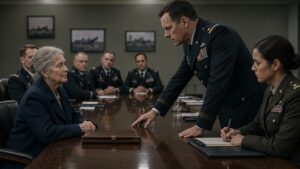
Deborah took a seat near the end of the table.
Not at the head.
Not in the center.
Near the end.
Exactly where she preferred.
Richard Williams stood across the room.
Uncomfortable.
His confidence had disappeared hours ago.
Now he looked like a man replaying every decision he had made that day.
Jerry occupied a chair beside Deborah.
Gregory and Samuel sat nearby.
The meeting began.
Reports.
Timelines.
Procedural explanations.
Most of it barely mattered.
Everyone already knew what they wanted to understand.
Not the diversion.
Not the fighters.
Her.
One airport administrator finally asked the question.
“General Carter, were the escort aircraft assigned because of you?”
Deborah folded her hands.
“Indirectly.”
The answer triggered immediate attention.
She continued.
“A security review connected to an archival designation created a misunderstanding between agencies.”
“Meaning?”
“Someone believed I was traveling under an active protection classification.”
Several people exchanged looks.
Jerry almost smiled.
That sounded exactly like bureaucratic confusion.
Complicated enough to create problems.
Simple enough to embarrass everyone involved.
The administrator nodded slowly.
“So this entire situation…”
“…was not supposed to happen.”
A few strained laughs followed.
The tension eased slightly.
Then Richard spoke.
“General.”
The room turned.
His voice sounded smaller than before.
“I owe you an apology.”
Deborah studied him.
Not coldly.
Not warmly.
Simply waiting.
Richard swallowed.
“I judged you.”
No one interrupted.
“I assumed things based on appearance.”
His eyes lowered briefly.
“And I never really listened.”
The room remained silent.
Deborah could have accepted the apology immediately.
She could have rejected it.
Instead she asked a question.
“When did you decide I deserved respect?”
Richard looked confused.
“I…”
“When you thought I was a passenger?”
He said nothing.
The answer was obvious.
She continued softly.
“Or after you learned who I used to be?”
The room became still.
No screens.
No papers.
No distractions.
Only the question.
Richard’s face reddened.
Because there was no easy response.
Deborah saved him from struggling further.
“That’s the important part.”
She glanced around the room.
“Not my rank.”
Nobody moved.
Years of command still lingered in her voice.
Not power.
Clarity.
“The mistake wasn’t failing to recognize me.”
She looked directly at Richard.
“The mistake was deciding an ordinary passenger wasn’t worth the same courtesy.”
No accusation.
No anger.
That somehow made the words stronger.
Several people lowered their eyes.
Gregory among them.
Because he remembered.
The dismissals.
The assumptions.
The impatience.
Jerry watched quietly.
This was why people followed Deborah Carter.
Not because of stars on a uniform.
Because she understood where the lesson actually lived.
One airport executive cleared his throat.
“General, many people here know your title now. But they don’t know your history.”
Deborah hesitated.
She disliked discussing herself.
Jerry spoke instead.
“Then I’ll tell them.”
She gave him a look.
Not approval.
Not disapproval.
Resignation.
Jerry smiled slightly.
“I served under General Carter.”
Nobody interrupted.
“She commanded operations responsible for thousands of personnel.”
A few heads lifted.
“She made decisions that carried consequences most people in this room will never have to imagine.”
The room listened.
“Pilots came home because of decisions she made.”
His voice grew quieter.
“And some didn’t.”
Deborah looked down at her hands.
The room finally understood the sadness beneath her calmness.
Not mystery.
Memory.
Jerry continued.
“After retirement she spent years reviewing memorial records.”
A few people looked surprised.
“Voluntarily.”
No glory in that work.
No headlines.
No promotions.
Just names.
Families.
History.
Responsibility that never fully ended.
The room grew quieter still.
Then Gregory noticed something.
Deborah had unconsciously raised one hand slightly.
The same gesture from the aircraft.
The same restrained movement.
Not commanding.
Remembering.
As though reaching toward something long gone.
A formation.
A radio call.
A face.
A name.
The gesture disappeared as quickly as it came.
But Gregory understood it now.
The hand had never represented power.
It represented habit.
A lifetime of responsibility.
Nobody spoke for several seconds.
Then the meeting concluded.
No applause.
No dramatic celebration.
Just silence.
Respectful silence.
The kind that couldn’t be ordered.
As people began leaving, an executive approached Deborah.
“We’d like to arrange special accommodations.”
She shook her head.
“No, thank you.”
“A private car?”
“No.”
“Priority handling?”
Again she declined.
The executive looked bewildered.
Jerry laughed softly.
“You’re wasting your time.”
Deborah smiled.
A small smile.
Tired.
Peaceful.
And entirely genuine.
Outside the briefing room, Richard remained waiting.
When she emerged, he stood.
“I am sorry.”
This time the apology sounded different.
Not fearful.
Not strategic.
Honest.
Deborah nodded.
“I know.”
Then she walked past him.
Not because she wished to punish him.
Because the apology wasn’t the ending.
The lesson was.
And for the first time all day, Richard seemed to understand that.
He watched her leave.
Carrying the same worn coat.
The same handbag.
The same quiet dignity she had possessed before anyone knew her name.
The story wasn’t finished.
But the room had already changed.
Chapter 7: Respect Before Rank
Deborah Carter arrived in Washington the following morning carrying the same handbag and wearing the same dark coat.
No escort accompanied her.
Jerry had offered.
Twice.
She had declined both times.
The airport was quieter than the night before, and she preferred it that way.
For nearly a day, people had been looking at her differently.
Some with admiration.
Some with curiosity.
Some with embarrassment.
She understood all of it.
None of it felt particularly important.
A car from the memorial review board met her outside the terminal.
The driver greeted her politely without any sign that he knew her history.
Deborah found the exchange unexpectedly comforting.
The drive carried her through familiar streets.
Washington had changed over the years.
Buildings rose.
Roads shifted.
New names appeared.
Yet certain memories remained attached to certain corners.
A particular intersection reminded her of an officer she once knew.
A row of trees brought back a briefing held decades earlier.
Memory rarely followed logic.
It simply arrived when invited.
The memorial review board occupied part of a modest federal building.
Not famous.
Not impressive.
Just necessary.
The work performed there concerned military memorial records, corrections, family requests, and historical verification.
Quiet work.
Important work.
Work most people never noticed.
Exactly the sort of work Deborah preferred.
Inside the building, a clerk greeted her.
“Good morning.”
“Good morning.”
“Name, please?”
“Deborah Carter.”
The clerk checked a list.
Then smiled.
“There you are.”
No recognition.
No surprise.
Only professionalism.
Deborah signed in.
For a moment she stared at the printed roster.
Rows of names.
Much like the passenger manifest from the flight.
Names always carried more history than the paper holding them.
She moved toward the conference room.
Several board members were already present.
Most were retired service members, historians, or administrators.
People dedicated to preserving details that others forgot.
The chairman welcomed her.
“Good to see you again.”
“You too.”
“Interesting trip?”
The faint smile in his voice suggested he already knew something.
News traveled quickly in certain circles.
Deborah took her seat.
The meeting began.
Files were reviewed.
Requests examined.
Records discussed.
The work absorbed her completely.
For several hours she focused on the names.
Pilots.
Crew members.
Families seeking corrections.
Families seeking answers.
Families seeking remembrance.
At one point a photograph appeared on a screen.
A young aviator who had died decades earlier.
Deborah recognized him immediately.
The room moved on to administrative details.
She remained still for a moment longer.
Long enough to remember his laugh.
Long enough to remember the day his aircraft never returned.
Service never truly ended.
It simply changed form.
Near midday, the meeting paused.
Board members gathered around coffee and conversation.
Deborah stood near a window overlooking the city.
A familiar voice approached.
“General.”
She turned.
Jerry.
He carried a folder beneath one arm.
“I thought you were heading home.”
“I was.”
He handed her the folder.
Curious, she opened it.
Inside lay a copy of the passenger manifest from Flight 728.
The same document that had followed her through the entire ordeal.
The same sheet Richard Williams had dismissed.
The same page that eventually forced people to look more carefully.
Deborah laughed softly.
“I should have guessed.”
Jerry smiled.
“Thought you might want it.”
She studied the page.
Her name appeared exactly as it had the day before.
Nothing impressive.
Nothing dramatic.
Just ink on paper.
Yet somehow the document now felt different.
Not because it had revealed her identity.
Because it had revealed everyone else’s assumptions.
Jerry leaned beside the window.
“Richard called me this morning.”
Deborah raised an eyebrow.
“Oh?”
“He wanted to know whether you accepted his apology.”
“And what did you tell him?”
“That he should stop worrying about whether you accepted it and start thinking about what he learned from it.”
Deborah smiled.
“Good answer.”
Jerry shrugged.
“I learned from the best.”
For a moment neither spoke.
The city stretched beyond the glass.
Traffic moved.
People hurried through ordinary lives.
Most of them had no idea who Deborah Carter was.
That fact no longer bothered her.
Perhaps it never truly had.
What troubled her was something else.
The fear that years of service disappeared once people stopped remembering.
The fear that retirement slowly erased meaning.
The fear that silence eventually became invisibility.
The previous day had reminded her of something important.
Meaning did not depend on recognition.
It never had.
A knock interrupted the moment.
The chairman entered.
“General Carter?”
Deborah looked up.
“Yes?”
“We’ve approved the memorial corrections.”
She nodded.
Good.
That mattered.
Far more than fighter escorts.
Far more than awkward apologies.
A family somewhere would receive accurate records.
A name would be remembered properly.
A small piece of history would remain intact.
That was enough.
The chairman hesitated.
“There’s one more thing.”
Deborah waited.
He held out a document.
Not an award.
Not a commendation.
A policy proposal.
“The board would like to adopt a new review procedure.”
She scanned the page.
The proposal required additional verification steps whenever individuals, regardless of rank or status, were involved in historical disputes.
Its purpose was simple.
Listen first.
Verify second.
Assume less.
The language was administrative.
Yet the meaning was obvious.
The events of the previous day had reached farther than she expected.
She signed the recommendation.
Not because it honored her.
Because it might help someone else.
Someone unknown.
Someone overlooked.
Someone with no title at all.
The meeting concluded late in the afternoon.
Board members departed.
The building slowly emptied.
Eventually Deborah found herself alone in the archive room.
Rows of records surrounded her.
Boxes.
Files.
Names.
Lives.
She opened her handbag.
Carefully folded the passenger manifest.
And placed it inside a storage envelope attached to the meeting records.
Not as proof of who she was.
As a reminder of what happened.
A reminder that respect should never require verification.
She sealed the envelope.
Then turned off the archive light.
Outside, evening sunlight painted the city gold.
Deborah stepped into it carrying the same coat and the same bag she had carried onto the airplane.
Nothing about her appearance had changed.
Only a few people would ever know what had happened.
That seemed appropriate.
As she walked down the sidewalk, she passed a maintenance worker pushing a cart.
The worker smiled.
“Good evening.”
Deborah smiled back.
“Good evening.”
No titles.
No ranks.
No introductions.
Just simple courtesy exchanged between two strangers.
For reasons she could not entirely explain, it felt like the perfect ending.
The story has ended.