They Told The Old Veteran To Stand In The Back Until His Name Stopped The Room
Chapter 1: The Empty Card In The Front Row
The chair in the front row had no name.
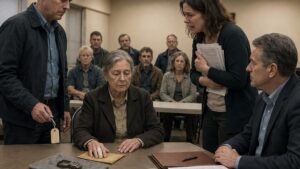
Stephen Walker saw it before anyone else did, a small white tent card set between two polished brass chair arms, its folded face turned toward the aisle with nothing printed on it. All around it, the other cards stood in straight ceremonial lines: Daniel Roberts. Nicole Green. Gold Star Families. Seated Veterans. Local Officials. Every name and title had its place. Every place had been measured, printed, checked, and corrected.
Except his.
Stephen stopped with one hand on the back of the chair, not gripping it, only resting his fingers there as if asking the wood whether it belonged to him. The hall was already filling. Boots struck the polished floor in clean, clipped sounds. Volunteers crossed between rows carrying programs. Families murmured near the side walls. At the far end, beneath a row of folded flags, the color guard waited without moving.
He had arrived early so there would be no trouble.
That had been the plan.
Catherine had offered to walk in with him, but he had asked her to park the car and take her time. He had told her he wanted a minute. Not a dramatic minute. Not a moment in front of anyone. Just enough time to find the right chair, sit down, and make his breathing behave before the room became too loud.
The medal made that harder.
It hung from a blue ribbon under his dark suit jacket, not outside it. He had tucked it inward before leaving the house, letting the jacket fall over it so only the edge of the ribbon showed if he moved wrong. It had weight without being large. The metal rested against his shirt like a cold coin held too long in the palm.
He had almost left it in the drawer.
Catherine had watched him stand in front of the dresser that morning, staring down at the small case as if it might speak first. She had not told him to wear it. She knew better. She had only brought his dark suit from the closet, brushed the shoulders with her hand, and said the hall might be cold.
Now the hall was warm. Too warm. The air carried coffee, floor wax, wool uniforms, flowers, and the electric dust smell of equipment set up too early. A photographer tested a flash near the front. Stephen blinked once but did not turn.
“Excuse me, sir.”
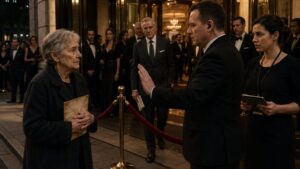
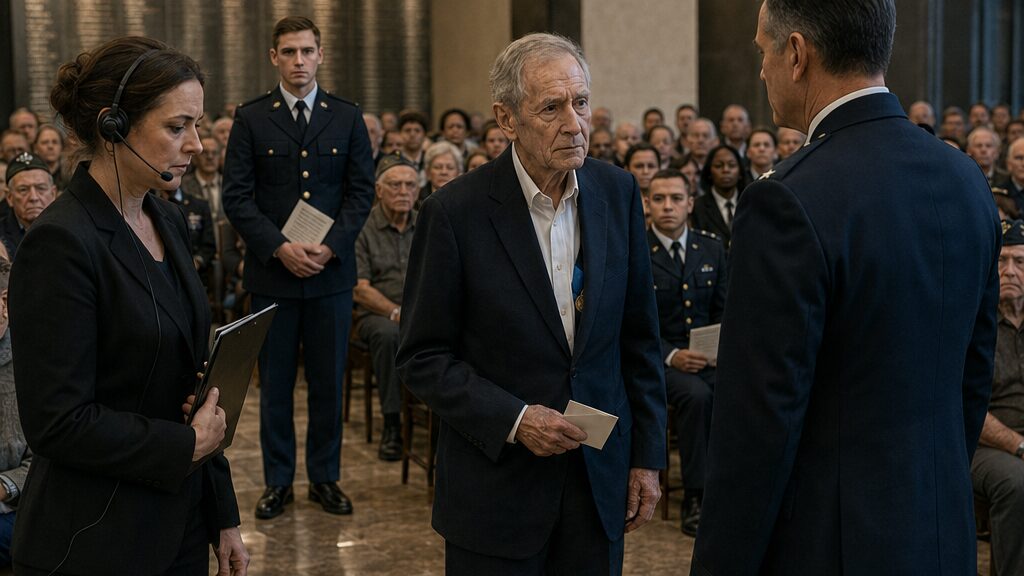
The voice came from his right. A woman with a headset and a clipboard stepped into the aisle, moving quickly but not rudely. Her badge read Nicole Green. Her eyes dropped to the empty card, then to the row number printed on a sheet clipped to her board.
“Are you looking for someone?” she asked.
Stephen drew his hand back from the chair. “Only my seat.”
Nicole gave the smile of someone trying to solve three problems at once. “Of course. Do you have your invitation?”
He reached inside his jacket slowly. The medal shifted under the cloth, and he felt the old, familiar scrape of ribbon against shirt button. His fingers found the folded invitation in his inner pocket. He held it out.
Nicole read it while a hall volunteer leaned past her to place two more programs on the next row. The volunteer moved as if Stephen were part of the furniture, his shoulder nearly brushing Stephen’s sleeve.
Nicole’s face tightened, not with anger, but with procedure.
“Mr. Walker,” she said. “Thank you for coming. This section is reserved.”
Stephen looked at the empty card again.
“I was told front row,” he said.
“I understand. We had some changes this morning.” She checked the list. “The front row is for honorees and presenting personnel. Families are two rows back, and general guests are behind the aisle.”
The words were careful. That made them worse.
Stephen could feel people moving around him, not watching closely yet, but aware enough to sense a delay. An older man in a dress uniform sat two chairs down, his name card printed clearly in black. The man looked forward, pretending not to hear. On the other side, a family whispered over the program, the corner of it tapping against a child’s knee.
Stephen held his invitation between two fingers. His name was on it. Not large. Not important. But there.
“I can sit behind the aisle,” he said.
Nicole’s relief came too quickly. “Thank you. I appreciate your understanding. We’re just trying to keep the presentation smooth.”
Smooth.
He had heard that word in rooms where nobody wanted to say mistake.
She reached for the blank card as if to remove the evidence before anyone else noticed. Stephen got there first. He lifted it from the brass clip and held it in his left hand. It was thick, good paper, with a faint ridge along the fold. Someone had paid attention to every other card. Someone had ordered them, printed them, matched them to rows, probably checked them against a master list.
His was blank.
Nicole paused. “Sir, I can take that.”
“It’s all right,” Stephen said.
He folded the card once, though it was already folded. The crease sharpened under his thumb. His hands had grown thinner with age, the knuckles larger, the skin looser, but they still knew how to fold paper cleanly. They still knew how to perform a small task when the room was watching.
He slipped the card into his pocket.
At the movement, his jacket opened slightly. A sliver of blue ribbon showed against his white shirt. Nicole glanced at it, then away, not long enough to understand. Her eyes returned to the list because the list was what she trusted.
“We have accessible seating if you need it,” she said.
Stephen gave her a look then, not sharp, not offended. Only tired.
“No,” he said. “I can walk.”
He turned from the front row.
The aisle seemed longer facing the back. The hall had filled since he entered. Uniformed service members stood near the sides. Local families settled into their rows. A low hum of conversation rose toward the rafters, broken by the squeak of microphone stands being adjusted near the lectern. On the wall, a display case held old photographs and a service roll behind glass, the names too far away for Stephen to read without stopping.
He did not stop.
The medal under his jacket clicked once against a button. It was so small a sound no one else could have heard it.
But Stephen heard it.
He remembered another room, not like this one, not polished, not formal. A room where names had been spoken because the men were alive enough to answer. A room where one name had not made it to paper the way it should have. He closed that thought before it opened fully.
Two rows behind the aisle, a volunteer stepped aside to let him pass. She did not ask his name. She only pointed toward several empty seats near the end.
Stephen nodded and kept walking.
He could have corrected them. He could have taken out the invitation and asked someone to check again. He could have opened his jacket and let them see the medal properly. He could have said the words people expected from men who had once worn uniforms and later became symbols in rooms like this.
He said nothing.
At the end of the row, he lowered himself carefully into a chair meant for guests who did not need to be seen. From there, the front row looked clean again. Nicole was already moving, already speaking into her headset, already replacing the gap he had left with a smooth motion of her clipboard.
Stephen looked down at his hands.
The blank card sat in his pocket, its edge pressing against his palm through the fabric.
He told himself it did not matter.
Then Daniel Roberts entered from the side of the stage in dress uniform, and the room began to rise around him.
Stephen stayed seated half a breath too long, not because he meant disrespect, but because his knees had stiffened and his thoughts had gone somewhere else. By the time he stood, the hall was already facing forward.
Nicole crossed the aisle once more, her voice low but firm.
“Sir,” she whispered, “the front row is reserved for honorees.”
Chapter 2: The Name The Program Left Out
Justin Miller had been assigned to the left side of the hall because he was young enough to stand for long stretches and senior enough not to look nervous doing it.
He failed at the second part.
His gloves felt too tight. His collar sat too high. The program in his hand had softened at the corner where his thumb kept pressing it. Every time the microphone gave a faint crackle, he looked toward the lectern as if the ceremony might begin without permission.
He had done ceremonies before. Promotions. Retirements. Memorial observances. Once, a school visit where second graders asked whether the medals were heavy and whether soldiers got scared. He had known how to answer those questions. He did not know how to answer the quiet pressure in this hall.
The front rows held older veterans and families, some with canes hooked over chair backs, some with folded hands, some with eyes fixed on nothing visible. Behind them sat local guests and base staff. Along the walls stood service members ordered into stillness. On the stage, Daniel Roberts reviewed a small stack of speech pages while a technician adjusted the microphone.
Justin’s job was simple: watch the left aisle, help with seating, keep the ceremony smooth.
Smooth. Nicole Green had said it four times in the last hour.
That was why Justin noticed the old man.
Not at first as a person, exactly. At first he noticed the disturbance around him: Nicole leaning in, the empty card in the man’s hand, the slight opening of the front row, the volunteer’s confused glance. The old man wore a dark suit that fit well but seemed heavier than he was. He stood carefully, with the stillness of someone measuring every movement before making it.
Justin saw Nicole point toward the back.
Then he saw the old man fold the blank card.
It should not have bothered him. Mistakes happened. Programs changed. People sat in the wrong places. The older guests sometimes confused rows, especially when families dropped them at the entrance and hurried to park. Nicole was not being cruel. Justin knew that. She was keeping order.
Still, something about the fold stayed in his eyes.
The old man did not protest. He did not puff up or demand a supervisor. He did not perform hurt. He simply folded the empty name card once, as if accepting a receipt for something taken from him, and put it away.
Justin glanced down at the program in his hand.
The ceremony title had been printed in dark blue above a faded photograph of service members standing beside a transport aircraft. Beneath that, in smaller type, the program listed the afternoon’s honorees. Justin had skimmed it before. He had been more worried about where to stand than who the speeches were for.
Now his eyes moved through the names.
Daniel Roberts. Remarks.
The color guard.
Recognition of surviving service members.
A line for a citation reading.
Stephen W—
Justin’s thumb covered the rest. He moved it.
Stephen Walker.
He looked up.
The old man had reached the aisle behind the reserved section. Nicole was speaking to him again, her headset wire bright against her dark jacket. The room had begun to rise for Daniel, chairs scraping softly, bodies shifting into attention. The old man was slow getting upright, and Nicole’s whisper carried just enough for Justin to hear the last part.
“Reserved for honorees.”
Justin looked at the program again.
Stephen Walker.
Then to the old man.
Then to the wall display near the left side of the hall.
He had stood beside that display for twenty minutes without reading it. It was one of those permanent installations people stopped seeing because it was always there: black-and-white photographs, unit patches, an old service roll behind glass. A printed placard described an operation from decades earlier in careful official language. Below it, names had been etched in narrow columns.
Justin stepped closer, still holding the program.
The glass reflected the hall lights. He shifted until the glare moved.
There were many names, grouped by unit and year. Some had small symbols beside them. Some lines were worn where visitors had touched the glass over time. Justin searched too quickly, then forced himself to slow down.
Walker, Stephen.
There it was.
His stomach tightened.
Beside the name was a small notation Justin did not understand. Not rank. Not award. A cross-reference to a citation, maybe, or an archived transcript. He looked back at the old man. Stephen Walker had not turned toward the display once.
Justin felt suddenly foolish in his pressed uniform. He had been standing in a room full of history and treating it like furniture.
Nicole had begun guiding Stephen farther back. A couple in the second row watched, trying not to stare. Daniel Roberts had moved toward the lectern. The ceremony was seconds from starting.
Justin crossed the space before he could decide whether he had authority to do so.
“Ma’am,” he said, low.
Nicole turned, impatience flashing and disappearing. “Not now.”
Justin held out the program, one finger under the name. “This is him.”
Nicole looked down. “What?”
“This is Mr. Walker.”
Stephen’s eyes moved to Justin’s face. They were pale and steady, not surprised, not relieved. If anything, they looked as if Justin had opened a door Stephen had been holding shut.
Nicole took the program. Her expression changed in pieces. First confusion. Then recognition of the printed name. Then a quick glance toward the front row where the blank card had been. Then embarrassment, controlled but visible.
“I—” she began.
Daniel’s voice sounded from the front. “Please remain standing.”
The room settled into silence.
Justin felt the timing collapse around him. He should have stepped back. He should have let Nicole fix it quietly. Instead he remained where he was, because Stephen Walker was still standing behind the aisle with no name on his chair and the ceremony was about to honor him from a distance like an absent man.
Daniel looked up from his pages.
His eyes went first to Nicole, then to Justin, then to Stephen.
Justin did not raise the program. He did not need to. Daniel saw enough in Nicole’s face. He left the lectern without speaking into the microphone.
The hall noticed.
The movement was small, only a senior officer stepping away from prepared remarks, but it changed the air. Conversations had already died. Now even the settling sounds stopped. Daniel walked down from the stage and came along the front row, not hurried, not theatrical. His polished shoes struck the floor with measured restraint.
Stephen remained still.
Nicole took one step back.
Daniel stopped in front of him.
For a moment no one said anything. Justin could hear the soft hiss of the overhead lights and the faint click of a camera finding focus.
Daniel looked at Stephen’s jacket. The dark fabric had fallen open slightly. The blue ribbon showed now, not fully, but enough. A piece of metal caught the light beneath the lapel.
Daniel’s posture changed.
It was not dramatic. He did not gasp or call the room to attention. He simply straightened in a way that made every service member along the wall seem to straighten with him. His face lost the polished expression of a man about to deliver remarks and became the face of a man who had realized the remarks were standing in front of him.
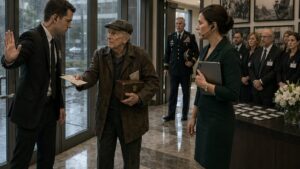
“Mr. Walker,” Daniel said, voice low.
Stephen gave the smallest nod.
Daniel brought his right hand up.
The salute was not large. It was controlled, formal, and held just long enough to make the hall understand it was not for show. Justin felt the back of his neck heat. Around the room, people shifted from curiosity into stillness. Nicole lowered the clipboard to her side.
Stephen did not return the salute. He was not in uniform. He only stood there, one hand resting near the pocket where the folded blank card had gone, the medal half-hidden against his shirt.
His face did not brighten.
That was what struck Justin most.
He had expected pride, maybe embarrassment, maybe the soft smile older men gave when a room finally noticed them. But Stephen looked as if the salute had landed on a bruise.
Daniel lowered his hand.
“I owe you an apology,” he said.
Stephen’s voice was quiet. “No, sir.”
Daniel’s eyes flicked once to the empty front row. “Yes,” he said. “We do.”
Nicole swallowed. The microphone at the lectern stood unattended, carrying none of this to the speakers, yet the whole room seemed to hear.
Daniel turned slightly, not away from Stephen but toward the front.
“Please bring a chair forward,” he said to no one in particular. “And a proper card.”
A volunteer moved too fast, then slowed when Nicole touched the person’s arm and took the task herself. Justin watched her retrieve a clean card from the table near the entrance. She looked at the marker beside it, then at the program in her hand. Her fingers hesitated.
Stephen saw the hesitation too.
His hand moved to his pocket.
“No need,” he said.
He took out the blank card, unfolded it along the sharpened crease, and held it toward Nicole.
She accepted it with both hands.
The gesture did something to the room that the salute had not. The salute told them he mattered. The card told them they had nearly erased him.
Nicole wrote carefully. Not quickly now. Not as a task. She printed Stephen Walker in dark letters, then waited for the ink to dry before sliding the card into the brass holder at the front row.
Daniel turned back to Stephen.
“Sir,” he said, and his voice lowered further, “before we continue, may I ask what name you want this room to use?”
Chapter 3: After The Salute, He Asked For Water
Catherine Walker saw her father ask for water the way some people might ask for a chair, a coat, a door.
Not because he was thirsty.
Because he needed a reason to leave the room.
She had been standing near the entrance when the hall went silent. At first she thought something had gone wrong with the sound system. Then the crowd’s attention shifted, and she saw the dark line of uniforms along the wall straighten. She saw Nicole Green standing with a card in her hands. She saw a senior officer in front of her father.
Then Daniel Roberts saluted.
Catherine felt the old anger rise so quickly she had to close her fingers around the strap of her purse. Not anger at the salute. The salute was proper. Restrained. Earned.
That was the trouble.
People always believed the proper gesture fixed the improper wound.
Her father stood through it without moving. From the back of the hall, he looked smaller than he had that morning in the kitchen, smaller even than he had looked last winter when she found him sitting in the garage with the medal case open beside a mug of cold coffee. The blue ribbon showed now against his shirt. He must have forgotten to tuck it back in. Or maybe the room had simply found it.
When Daniel asked him something too quietly for Catherine to hear, her father looked toward the front row, then toward the side corridor.
Catherine started moving before he answered.
She reached him as Nicole stepped aside, her face tight with regret. Daniel was still close, speaking carefully, bending his authority down so it did not press too hard. Several people watched with open sympathy. A photographer lifted a camera and then lowered it after Daniel gave the slightest shake of his head.
Good, Catherine thought.
At least someone understood that not every moment needed to be captured.
Her father saw her and gave a faint nod. It was the nod he used in doctors’ offices when he wanted her to stop asking questions in front of strangers.
“I need some water,” he said.
Daniel turned at once. “Of course.”
“I know where it is,” Catherine said.
She did not wait for permission. She took her father’s elbow, lightly enough that he could pretend she had not, and guided him toward the side corridor. He moved with care, but not weakness. That difference mattered to him. She let him set the pace.
No one clapped. She was grateful for that.
The corridor outside the hall was narrow and cooler. Framed photographs lined one wall: aircraft, crews, ceremonies, old commanders standing in stiff rows. The sound of the audience dimmed behind the closed door until it became a low, contained murmur. Somewhere nearby, ice shifted in a plastic cooler.
Stephen stopped beside a small table stacked with paper cups.
Catherine filled one from the water dispenser. Her hand shook enough that the stream hit the rim first. She steadied it, then gave him the cup.
He held it but did not drink.
“Dad,” she said quietly.
He looked at the cup.
“Shouldn’t have come early.”
“That’s not what happened.”
“It is one part of what happened.”
She hated when he did that, when he made a narrow factual statement and hid inside it. As if the world could not harm him if he described only the smallest true piece.
Through the door, Daniel’s voice began again over the microphone, formal now but less polished than before. Catherine could not make out the words. The ceremony had resumed, or tried to.
Her father’s jacket hung open. She reached to straighten it, then stopped before touching the ribbon.
“Do you want me to put it back?” she asked.
He looked down, as if surprised to see the medal exposed.
“No.”
The answer was soft, but it held.
Catherine drew her hand back.
He finally drank. Only a small sip. Then he folded the cup slightly between his fingers. Not crushing it, just bending the paper in and out along the seam.
“They didn’t mean anything by it,” he said.
“That does not make it nothing.”
His mouth shifted, not quite a smile. “You sound like your mother.”
“Good.”
He looked down the corridor. At the far end, a hall volunteer carried a box of extra programs without noticing them. The programs had the same blue cover Catherine had seen on the check-in table. She had picked one up when she entered, read the first page, and put it back because the paragraph about her father had made her chest tighten.
A clean paragraph. Too clean.
Recognition of surviving service members from the 1972 evacuation operation.
Her father’s name listed under citation reading.
No mention of the man whose photograph had sat in their hallway drawer for thirty years, wrapped in tissue, never framed and never thrown away.
Catherine had read that program twice in the car before deciding not to show him. Then he had taken one from the table anyway.
“You saw the program,” she said.
He kept bending the paper cup.
“Some of it.”
“Is that why you wore the medal?”
He did not answer.
For most of her childhood, the medal had been a sealed thing. She knew where it was kept. She knew not to touch the case. She knew her mother dusted around it instead of lifting it. Other families had photographs on mantels, flags in triangular boxes, uniforms in closets. Their house had ordinary things: grocery lists, school calendars, her mother’s sewing basket, her father’s work boots by the back door. His service lived in pauses.
Only after her mother died had Catherine found the old envelope in the garage, the one with brittle clippings and a transcript copy so faded she could barely read the last page. She had brought it inside. Stephen had taken one look and said, “Not today.”
That had been six years ago.
“Dad,” she said, “if you want to leave, we can leave.”
His fingers stilled on the cup.
Inside the hall, the crowd made a sound, not applause exactly, more like people shifting after being asked to sit. The ceremony was moving forward. It would move forward with or without him. It always had.
He leaned one shoulder lightly against the wall. The posture made him look tired, and he knew it, because he straightened almost immediately.
“I don’t want them making a scene,” he said.
“They already did.”
“No. They made a mistake. Then the officer did what he thought was right.”
“You deserved that salute.”
He closed his eyes for one breath.
Catherine regretted the sentence as soon as she said it. Not because it was false. Because it was too simple.
When he opened his eyes, he looked not at her but at the row of framed photographs across the hall. One showed young men standing beside a transport aircraft, their faces blurred by age and distance. She wondered if any of them were still alive. She wondered if any daughters had learned to read silence the way she had.
“The salute wasn’t the hard part,” he said.
Catherine waited.
He reached into his jacket pocket and pulled out the name card. Nicole had written Stephen Walker in careful letters. The fold line still ran through the center, a pale scar across his name.
He rubbed his thumb over the ink once, lightly, as if testing whether it would smear.
“They put it back,” Catherine said.
“Yes.”
“But?”
He held the card between them.
“There was another name,” he said.
The corridor seemed to narrow around the words.
Catherine knew better than to rush him. If she moved too fast, spoke too quickly, showed too much hunger for the truth, he would close again. She had learned that grief could be startled back into hiding.
“From the operation?” she asked.
His jaw tightened.
He looked toward the closed hall doors. Daniel’s voice sounded beyond them, stronger now, telling the audience what the printed pages told him to tell. Catherine could not hear the exact words, but she saw her father hear them anyway.
The cup bent in his other hand.
“They still left him out,” Stephen said.
Chapter 4: The Line In The Old Roll Book
Justin found the archive room by following the wrong sound.
The hall had nearly emptied after the first ceremony ended. Families drifted toward the parking lot carrying programs rolled in their hands. Volunteers gathered water bottles and folded chairs from the side aisles. Somewhere near the entrance, Nicole Green was speaking quietly into her phone, her free hand pressed against her forehead. Daniel Roberts had disappeared behind the stage doors with two pages of his speech folded into his fist.
But from the left side of the hall came a thin metallic rattle, like a key turning in a lock that had not been used enough.
Justin crossed toward the display alcove.
The base historian stood with one shoulder inside a narrow office door, working a ring of keys through a stubborn cabinet. He was old enough to move slowly but not old enough to be one of the men in the photographs. On the floor beside him sat three flat archival boxes and a rolling cart with white cotton gloves laid across the top.
“You’re still here?” the historian asked without turning.
“Yes, sir.”
“Then make yourself useful. Hold that light.”
Justin picked up the small desk lamp from the cart and aimed it through the doorway. The room beyond was not really a room, more a storage alcove with old shelving, framed certificates, acid-free boxes, and the dry paper smell of things saved because no one was willing to throw them away.
The historian got the cabinet open on the fourth key.
“Nicole said you were the one who noticed,” he said.
Justin did not know whether that was praise or accusation. “I noticed the program.”
“You noticed a name.”
“Yes, sir.”
The historian slid out a long, shallow drawer. Inside was a ledger protected by a plastic sleeve, its cover the color of dried leaves. He lifted it with both hands and set it on the cart.
Justin looked back through the alcove entrance. The hall beyond was quieter now. The front row remained in place. Stephen Walker’s name card still stood in the brass holder, the ink darker than the printed cards beside it. Someone had not removed it during cleanup.
Justin was glad.
The historian opened the ledger to a flagged page. “This is the roll copy used for the permanent display. The original is stored off-site. What we have here is a cleaned transcription made years later.”
“Cleaned?” Justin asked.
The historian’s mouth tightened. “That word has caused more damage than people think.”
He turned the page, then another.
There were names written in careful columns, typed in black and annotated in pencil. Justin saw dates, units, citation numbers, archive codes. Some lines had check marks. Others had small question marks that made the neat page feel suddenly unstable.
The historian put one gloved finger beside a line.
Walker, Stephen.
Justin had seen it behind glass, but up close the name seemed less like a label and more like a door. Beside it was the same notation from the display: C-17 / transcript fragment / evacuation witness.
“C-17?” Justin asked.
“Citation file seventeen. Not an aircraft. People assume that.”
Justin flushed. “I didn’t know.”
“That’s why we keep notes.”
The historian turned to another box. “The ceremony committee used this roll, the public citation summary, and a newspaper clipping. They did not use the transcript folder.”
“Why not?”
“Because it was damaged. Because it was incomplete. Because nobody likes incomplete material when they are preparing a clean public event.”
Justin heard Daniel’s voice from earlier in the hall: honorable, measured, polished. He thought of Stephen standing in the aisle, the blank card folded in his hand.
“What’s missing?” Justin asked.
The historian opened the box.
Inside were paper copies, old photographs, a brittle envelope, and a typed transcript clipped with a rust-stained fastener. The top sheet bore official stamps and a line across the corner: audio degraded. partial recovery only.
The historian did not hand it to Justin at first.
“This is not a mystery story,” he said. “Do you understand that?”
Justin straightened. “Sir?”
“These are not clues for entertainment. They are pieces of people who did not get to explain themselves properly.”
Justin looked at the old paper and felt the rebuke land where it should. Since the salute, some part of him had been chasing the emotional force of the moment, the way the room had gone still, the way Daniel’s hand had risen, the way Stephen’s face had not softened. It had felt important, and importance could turn greedy if no one checked it.
“Yes, sir,” he said. “I understand.”
The historian studied him for a moment, then passed him the transcript.
Justin held it with both hands.
The first page was ordinary enough: dates, location, operation summary. The second had fragments of recorded testimony, each line marked by speaker identification where possible. Some names had been redacted or lost. Some words were bracketed as unclear. Stephen Walker appeared halfway down the page.
Walker: We were told to keep the line moving.
A few lines later:
Walker: He went back because the boy had fallen near the—
The sentence broke off.
Justin leaned closer.
The next lines were marked unintelligible. Then another voice, speaker unknown. Then Stephen again:
Walker: No, I did not pull him out. That is not what I said.
Justin read it twice.
The hall outside seemed farther away now.
“Who is ‘he’?” Justin asked.
The historian reached into the box and removed a photograph. It showed several young service members standing near a transport ramp, faces grainy, bodies angled against wind. One man had a hand raised to shield his eyes. Another stood partly behind Stephen Walker, younger then, almost unrecognizable except for the set of his shoulders.
The historian tapped the man behind him.
“The file does not settle it cleanly.”
“But Mr. Walker knows.”
“I expect he does.”
“Why isn’t the other man named in the display?”
The historian looked toward the glass case as if it could answer for itself. “Because the official citation honored the surviving witness. Because the newspaper simplified the account. Because later committees copied what earlier committees wrote. Because once a clean version is framed, people stop asking who was cropped out.”
Justin looked down at the transcript again. The phrase seemed to rise from the page.
That is not what I said.
He thought of Stephen’s face during the salute. Not proud. Not healed. Hurt.
“Does Colonel Roberts know about this?” Justin asked.
The historian gave him a dry look. “He knows now that there is a problem. He does not yet know how old it is.”
Justin reached for the program still folded in his pocket. The paper had been creased from his grip. He opened it to Stephen’s name, then set it beside the transcript.
On the program, Stephen Walker was a neat line under Recognition of surviving service members.
On the transcript, he was a voice stopping mid-sentence.
Justin suddenly understood that he had not discovered a hero. He had discovered an omission.
The difference mattered.
The historian pulled another page from the folder. “There is a recovered audio log reference, but not the audio itself. The transcript stops here.” He pointed to the broken line. “The last clear sentence from Walker before the damage is this.”
Justin bent over the page.
Walker: If you say my name, you say—
The rest had been swallowed by static, time, or somebody’s decision not to look harder.
The historian turned the page over, though there was nothing on the back.
“That is where his voice ends,” he said.
Justin stood very still.
Beyond the alcove, a custodian clicked off one bank of hall lights. Shadows moved over the front row. Stephen Walker’s name card remained visible in the dimming room, a small white shape where no card had been that afternoon.
Justin looked from the card to the transcript.
For the first time all day, he stopped wondering what Stephen had done to deserve a salute.
He began wondering whose name Stephen had been trying to say when the record broke.
Chapter 5: The Speech That Made Him Smaller
Daniel Roberts knew the speech was wrong before Stephen Walker entered the rehearsal room.
He knew it by the way the pages sounded when he set them on the lectern. Too clean. Too balanced. Too ready to be applauded.
The hall looked different in the morning. Without the full crowd, every chair seemed more deliberate. The front row had been reset. A corrected card sat in the brass holder: Stephen Walker, printed cleanly this time, with no crease through the middle. Nicole had replaced it before sunrise. Daniel had seen her do it, standing alone with a small stack of blank cards and the careful expression of someone making repairs no audience would notice.
He had not interrupted her.
Now the ceremony committee occupied the first few rows with coffee cups, rehearsal notes, and strained faces. The color guard waited near the side wall. A technician tested the microphone with soft taps. Justin Miller stood near the display alcove, hands folded behind his back, quieter than Daniel had ever seen him.
On the lectern lay Daniel’s revised remarks.
He had revised them twice after reading the transcript fragment. Once to include more detail. Once to remove the detail after realizing he was turning Stephen’s pain into a better paragraph.
Neither version felt right.
Nicole approached with her clipboard. “Mr. Walker and his daughter just arrived.”
Daniel nodded. “Thank you.”
“She asked if this would be brief.”
“It will be as brief as he wants it to be.”
Nicole looked down at her board. “I owe him more than a card.”
Daniel did not soften the truth. “Yes.”
She accepted that without defense. “Then I’ll wait until he tells me how.”
Stephen came through the side entrance with Catherine beside him. He wore the same dark suit. The blue ribbon was hidden again, tucked beneath his jacket, though Daniel knew now where it rested. Stephen moved slowly but without asking for help. Catherine stayed close enough to catch him if needed and far enough not to insult him by trying.
Daniel stepped down from the lectern.
“Mr. Walker,” he said.
Stephen gave him a nod. “Colonel.”
The title made Daniel feel less steady than it should have. Yesterday he had offered a salute because protocol, instinct, and shame had all arrived in the same second. Today there was no gesture large enough to cover what he did not know.
“I’d like to review the remarks with you before anything is said publicly,” Daniel said.
Stephen looked toward the lectern. “You don’t need my permission to run your ceremony.”
“No,” Daniel said. “But I need your permission to tell your story.”
Stephen’s eyes moved to his.
For a moment Daniel thought he had gone too far. Then Catherine looked away, and Daniel understood that the sentence had reached something true enough to hurt.
They moved to the front row. Nicole remained standing until Stephen sat, then took a seat several chairs away instead of hovering. Justin stayed by the wall.
Daniel picked up the pages.
He began with the introduction, not reading dramatically, only plainly. He spoke of the event they were commemorating, the surviving service members, the purpose of the gathering. Stephen listened with his hands folded over the top of his cane. His face changed little.
Then Daniel reached the citation summary.
“During the evacuation operation,” Daniel read, “then-service member Stephen Walker acted with extraordinary composure under dangerous and rapidly deteriorating conditions. His efforts helped preserve order during the withdrawal and contributed to the survival of—”
“Stop there,” Stephen said.
Daniel stopped.
The room seemed to hold its breath.
Stephen looked at the lectern, not at him. “That sentence makes it sound like I did more than I did.”
Daniel lowered the page. “The citation uses similar wording.”
“I know.”
“The official record says—”
“I know what it says.”
Daniel let the correction stand.
Catherine sat very still beside her father. Nicole’s pen hovered above her clipboard, then lowered without writing.
Stephen reached into his jacket. For one awful second Daniel thought he was reaching for the medal, and he felt the room lean toward the familiar symbol of recognition. But Stephen took out the folded card from yesterday, the one with his name written across the crease. He had kept it.
He set it on the empty chair beside him.
“This is the first honest thing this room gave me,” he said.
Nicole’s face tightened.
Stephen touched the card once with two fingers. “It had nothing on it.”
Daniel waited.
“I was not forgotten yesterday,” Stephen said. “Not really. You had my name in the program. On the wall. In your pages. You were going to say it plenty.”
He looked up then.
“The problem is not that you forgot mine.”
Daniel felt the speech pages grow useless in his hand.
Justin stepped forward from the wall. “Sir,” he said, then stopped as if unsure whether he had earned the right to speak.
Stephen turned slightly toward him. “You found the transcript.”
“Yes, sir.”
“Then you saw where it stops.”
Justin nodded.
Daniel said, “Mr. Walker, the historian told me the transcript was damaged.”
Stephen’s mouth moved with something like a smile, but it held no humor. “Most things are, after long enough.”
Catherine inhaled softly.
Daniel looked down at the sentence he had been about to read. His own language now seemed polished into dishonesty. Extraordinary composure. Preserved order. Contributed to survival. All true perhaps, but so smooth that nothing human could catch on it.
“What should it say?” Daniel asked.
Stephen looked at the rows of empty chairs. “Less.”
Daniel waited, expecting more.
Stephen did not give it.
“Less,” Daniel repeated.
“You can say I was there. You can say I was one of the men brought out. You can say I gave testimony later, if you must.” Stephen’s hand rested on the folded card. “But don’t say my efforts made the difference.”
Daniel kept his voice low. “Whose efforts did?”
Stephen’s fingers stilled.
Catherine looked at him, not urging, not stopping. Only there.
“The man who went back,” Stephen said.
No one moved.
“The transcript has me trying to say that,” he continued. “It did not record the rest. Or it did and someone lost it. I don’t know anymore.” He looked at the program in Daniel’s hand. “But every time they read the clean version, he disappears a little more.”
Daniel saw now what the salute had done. It had not honored Stephen out of darkness. It had brought him into a brighter room where the wrong story could be told again, with better lighting and kinder faces.
He set the speech pages on the lectern.
“Tell me the sentence to remove,” he said.
Stephen did not hesitate. “His efforts helped preserve order.”
Daniel found the line. It was his line, not the old citation’s. He had added it last night to make the moment flow.
He drew a single line through it.
Stephen watched the pen move.
“Anything else?” Daniel asked.
Stephen looked at the corrected name card in the front row, then at the folded one beside him.
“Leave space,” he said.
“For what?”
Stephen’s eyes stayed on the card.
“For a name you may not have printed.”
Daniel nodded, though he did not fully understand.
Nicole rose quietly. “I can make another card.”
Stephen shook his head. “Not yet.”
The refusal was gentle, but it ended the matter.
Daniel gathered the pages, now marked and uneven. For the first time since taking command of the ceremony, he felt relieved that they looked imperfect.
“Mr. Walker,” he said, “will you still attend?”
Stephen sat with the blank-creased card beside him and the hidden medal against his chest. He seemed older in the morning light, but not weaker.
After a long silence, he answered.
“I’ll attend,” he said. “If that sentence stays gone.”
Chapter 6: The Name He Would Not Let Stay Buried
Stephen Walker had survived long enough to learn that rooms could lie without anyone in them meaning to.
A room could lie with polished floors, flags set at equal angles, programs stacked straight on a table. It could lie with respectful voices and clean microphones. It could lie by leaving one chair open too late, by printing one name too neatly, by asking grief to stand at attention while a simplified version of the past passed for honor.
That afternoon, the hall was full again.
Stephen sat in the front row because Daniel Roberts had asked him to, and because Catherine had looked at him in the hotel room that morning with the quiet patience of her mother’s face and said, “You don’t have to finish it, but you do have to decide.”
He had decided by putting on the suit.
The blue-ribbon medal rested beneath his jacket, turned inward as before. He had not displayed it. He had not hidden it either. It lay against him with its old weight, no heavier than yesterday and no lighter for all the attention it had drawn.
On the chair beside him sat the corrected name card.
Stephen Walker.
Nicole had printed it again, not because the first correction was illegible, but because the crease in the old one had bothered her. She had shown Stephen the new card before placing it in the holder. He had thanked her. Then he had placed the creased card in his own pocket.
He did not know why he wanted both.
Perhaps because one showed what they meant to do now, and the other showed what had almost happened.
Catherine sat to his left. Her hands were folded in her lap. She had asked no more questions after breakfast. For that he was grateful. Questions required strength. Silence required more, but it let a man choose the door through which he entered his own memory.
Daniel stood at the lectern.
The room rose for the opening. The color guard moved with measured steps. The flag passed Stephen’s row, and every old habit in his body arranged itself around respect. He stood as straight as his back allowed. His knees complained. His hand did not shake until he sat again.
Justin Miller stood near the left wall, close to the display case. Stephen saw him glance once toward the old roll behind glass, then toward the front row. The young man’s face had changed since yesterday. Less eager. More careful. Stephen recognized that expression. It came to some men after they learned that history was not the same as a story.
Daniel began.
His voice carried well, but not loudly. He welcomed families, service members, veterans, and guests. He spoke of remembrance without dressing it up too much. Stephen listened with his eyes on the program folded in his lap.
The dangerous part came slowly.
“Today,” Daniel said, “we recognize those whose names appear in our records, and we acknowledge that records, even when kept with care, are not the same as memory.”
Stephen looked up.
That sentence had not been in the rehearsal.
Daniel did not look at him. He looked at the room.
“We have learned that some parts of the account we prepared for today were too clean. We will not repair that with a performance. We will begin by listening.”
A murmur passed softly through the audience, not displeased, only uncertain. Catherine’s hand moved once on her lap, then stilled.
Daniel turned a page.
“Mr. Stephen Walker is with us today.”
A camera shifted near the aisle. Daniel glanced toward it, and the photographer lowered it.
Stephen breathed out.
“He has asked that we be careful,” Daniel continued. “So we will be careful.”
That nearly undid him.
Not the salute. Not the printed name. Not the hall standing yesterday in a silence it did not understand. That one sentence: he has asked that we be careful.
For years, people had asked Stephen to be brave, grateful, proud, available, clear, patient, willing. They had asked him to accept what had been written because reopening old records was difficult and most of the men involved were gone. They had asked him to understand that ceremonies needed shape and time limits.
Few had asked how to be careful.
Daniel turned toward him. “Mr. Walker, you are welcome to remain seated. You are also welcome to say nothing.”
Stephen felt the whole room loosen its expectation.
That, too, was respect.
He could have stayed seated. For a moment he intended to. Daniel had already removed the wrong sentence. The day could pass without public discomfort. The hall could leave with a better version than before, not perfect, but less false. Catherine would drive him home. The medal would return to the drawer. The creased card would go wherever old paper went when daughters found it later and did not know whether to keep it.
Then his fingers found the fold in his pocket.
The blank card, no longer blank, bent under his thumb.
He saw again a younger hand reaching backward. A transport ramp slick with rain. A boy crying in a language Stephen did not know. A man turning when everyone else moved forward. The official report had turned all of that into “deteriorating conditions.” The citation had turned survival into composure. The newspaper had turned fear into heroism because heroism fit better in a column.
Stephen stood.
Catherine did not help him. He loved her for that.
Daniel stepped away from the lectern but did not rush down. He waited, giving Stephen room to decide whether to come forward or speak from where he was.
Stephen walked to the lectern.
The hall watched him in a silence different from yesterday’s. Yesterday they had watched a mistake become recognition. Today they watched a man carry something toward them without knowing whether it would be too heavy for the room.
Daniel adjusted the microphone lower, then stepped aside.
Stephen looked at the pages on the lectern. Daniel’s speech lay there with the crossed-out sentence visible near the middle. The line was dark and straight.
Good, Stephen thought.
He did not read the speech.
He looked at the front row where his name card stood, clean and uncreased. Beside it was an empty brass holder Nicole had placed there without explanation. He had noticed it when he sat down. He had not thanked her because he did not yet know what it meant.
Now he did.
“Yesterday,” Stephen said, and his voice sounded thinner than he wished, “my card was empty.”
No one moved.
“That was a mistake.” He looked toward Nicole, who met his eyes and did not look away. “A small one. The kind people fix.”
He took the creased card from his pocket and set it on the lectern.
“This one was fixed.”
The paper looked very small beneath the microphone.
“There is another kind that gets harder to fix because people repeat it with respect.”
He stopped.
His throat closed with a suddenness that angered him. He had prepared no speech. That had been pride, maybe. Or fear disguised as restraint. Catherine leaned forward in her seat, but only an inch. Daniel’s hand moved toward the water glass at the lectern and stopped before touching it, asking without asking.
Stephen nodded.
Daniel slid the glass closer.
Stephen drank. The water was room temperature. It helped enough.
“I was there,” he said. “That much is true. I was brought out. That is true. I gave a statement. That is true.”
He rested his hand on the card.
“But the part that mattered most was not mine.”
A sound moved through the hall, a collective intake, then quiet.
Stephen looked down at the clean name card in the front row.
“I have let people say my name alone because correcting them meant walking back into a day I have spent most of my life trying not to enter.” His fingers pressed lightly against the card. “That was my failure. Not the clerk’s. Not the committee’s. Mine first.”
Catherine lowered her head.
He did not look at her. If he did, he might stop.
“There was a man who went back when the order was to keep moving. There was a child down near the ramp. I saw him turn. I saw him go. I saw enough to know why some of us got out.”
The microphone carried his breathing.
“I tried to say that in my statement. Maybe the machine failed. Maybe the page was damaged. Maybe someone decided the sentence made the story harder. I don’t know. But the record kept my name where his should have stood beside it.”
Daniel stood very still to his right.
Stephen picked up the clean card from the brass holder in the front row. No one stopped him. He brought it back to the lectern and turned it around so the audience could see his printed name.
For a moment he held it there.
Then he laid it flat.
“Colonel,” he said.
Daniel stepped closer.
Stephen pointed to the empty space beneath Stephen Walker.
“Write the other name there.”
Daniel did not ask him to repeat it for the microphone. He leaned close. Stephen spoke the name softly, for Daniel’s ear first, not for the room’s hunger. Daniel took a pen from inside his jacket, the same pen he had used to cross out the sentence, and wrote beneath Stephen’s name with careful, deliberate strokes.
The audience could not read it from where they sat.
That seemed right.
Not every act of repair needed to be enlarged before it was finished.
When Daniel was done, he turned the card toward Stephen, not toward the crowd. Stephen looked at the two names together.
The air left him slowly.
“Yes,” he said.
Only then did Daniel place the card back in the holder.
Stephen remained beside the lectern. His legs ached. His hand wanted the edge of the wood, but he let it hang at his side.
Daniel lifted the microphone from its stand.
For one second, Stephen thought the officer would explain, complete, polish, rescue the room from the discomfort of silence. That would have been the old instinct. The ceremonial instinct. The need to make the moment smooth.
Instead Daniel lowered the microphone.
He did not take it back.
Chapter 7: The Chair Left Open Beside His Name
Several weeks later, Justin Miller stopped a volunteer from removing an empty chair.
He did it quietly, with one hand raised and no sharpness in his voice, but the volunteer froze as if he had shouted. The hall was nearly empty that morning, stripped of ceremony and crowd. No flags moved. No microphone waited at the lectern. Sunlight came through the high windows in pale bars, catching dust above the polished floor.
The volunteer held a stack of folded programs against one hip. “I thought this row was only for confirmed honorees.”
“It is,” Justin said.
She glanced at the empty chair. “Then why leave it?”
Justin looked down at the brass holder clipped to the chair arm. A white card stood inside it, printed cleanly.
Stephen Walker.
Beneath it, in darker ink, was another name written by Daniel Roberts’s hand.
Justin had read both names often enough that they no longer felt like text. They felt like posture. Like something the room had learned to hold correctly.
“That seat stays,” he said.
The volunteer looked at him, uncertain.
Justin softened his voice. “Some names arrive before the people do. Some arrive after. We leave room either way.”
She nodded slowly, not fully understanding but understanding enough not to argue. She moved to the next row and began placing programs more carefully than before.
That was the first change Justin had noticed after Stephen Walker spoke: people moved more carefully.
Not slowly. Not dramatically. Just with less assumption.
Nicole Green had changed the check-in table first. The old printed lists were still there, but now there was a second sheet labeled service confirmation, written in plain language and checked by two people instead of one. A small sign sat near the entrance: If you served and your name is missing, please tell us. We will make room.
No one had announced the change. Nicole had simply made it.
Daniel Roberts had changed the ceremony script next. He had removed three polished sentences that made grief sound easy to manage. He no longer allowed a citation summary to be read unless someone had checked whether a family member, witness, or surviving service member had something to add. It made rehearsals messier. It made timing harder.
Daniel seemed less interested in smooth timing now.
The base historian had changed the display last. Behind the glass, beside the service roll, a small note had been added. It did not accuse anyone. It did not dramatize the omission. It stated that some records were incomplete, that future corrections would be received with care, and that the hall would preserve both confirmed names and unresolved testimony.
At the bottom was a copy of the card.
Stephen Walker.
And beneath it, the other name.
Justin stood before that display every morning he was assigned to the hall. Not out of guilt exactly. Guilt had been useful for about a day, then too easy. Standing there had become a way to remember that recognition was not a moment you survived and moved past.
A side door opened.
Stephen Walker entered without Catherine at his elbow.
Justin turned.
The old man wore the same dark suit jacket, though not the full suit this time. Under it was a plain shirt buttoned at the collar. The blue ribbon was there, Justin noticed, but barely visible, turned inward as always. Stephen carried no cane today. He moved carefully, taking each step as if the floor deserved his attention.
Justin walked toward him, then stopped before he got too close.
“Good morning, Mr. Walker.”
Stephen looked at the card in the front row before he looked at Justin. “Morning.”
“Colonel Roberts is in his office. He said he’d come down if you wanted.”
“I didn’t come for him.”
Justin nodded. “Yes, sir.”
Stephen’s mouth twitched faintly. “You can say good morning without the sir if it helps you breathe.”
Justin felt his ears warm. “Good morning, Mr. Walker.”
“That’s better.”
Stephen walked to the front row. He stood before the chair with the card and read the two names. Justin did not know whether he should leave. He stayed because Stephen had not asked him to go.
For a long while, the old man did nothing.
Then he reached inside his jacket and withdrew the creased card from the first day. The fold still cut through his name. The ink had softened at the edges from handling. He held it beside the newer card in the brass holder, comparing them without expression.
Justin said, “Nicole wanted to keep that one in the archive, but Catherine said it was yours to decide.”
“It is just paper.”
“Yes.”
Stephen looked at him.
Justin corrected himself. “No. It isn’t.”
Stephen gave the smallest nod, accepting the correction without rewarding it.
From the entrance, the volunteer returned with another stack of programs. She noticed Stephen, glanced at the front row, and approached with new caution.
“Good morning,” she said. “Would you like to sit here, Mr. Walker?”
Justin watched Stephen’s face.
There had been a time, not long ago, when someone would have asked whether he was lost, whether he needed accessible seating, whether he belonged somewhere behind the aisle. This question was not grand. It carried no salute. It would never stop a room or be replayed by strangers.
It changed more than the salute had.
Stephen looked at the volunteer. “Thank you. Not yet.”
The volunteer nodded and stepped away.
Justin felt something settle in his chest.
Stephen placed the creased card on the chair seat, not in the holder. Then he removed the newer card from the brass clip, looked at both names once more, and slid it back with great care. His thumb paused beneath the second line.
“Does anyone ask about him?” Stephen said.
“Yes.”
“What do you tell them?”
“That we know he went back. That we know the old record did not carry his name properly. That the hall is still looking for what can be found.” Justin hesitated. “And that we say both names here.”
Stephen continued looking at the card.
After a moment, he said, “That is enough for now.”
Justin had learned not to fill silence with gratitude. He had learned not to say things like you must be proud or this is healing or thank you for your service when the words were meant to make himself feel less helpless. He stood beside the front row and let the quiet be plain.
The side door opened again. Nicole entered carrying a small box of blank name cards. She stopped when she saw Stephen.
“Mr. Walker,” she said.
“Ms. Green.”
She held up the box slightly. “New cards came in. Heavier paper. Easier to read.”
Stephen glanced at Justin, then back at her. “Still blank first?”
Nicole took the question seriously. “Yes. Until someone gives us the right name.”
Stephen nodded. “Good.”
She set the box on the check-in table as if placing something breakable.
The morning ceremony would be small: a handful of families, two older veterans, a few service members who had been ordered to attend and a few who had asked to. No photographer had been scheduled. No public salute waited in the program. Daniel had written a short welcome and left space where names might need to breathe.
Near the entrance, another elderly man came in slowly with a folded invitation in his hand. His jacket was plain. His shoes were worn at the heels. The volunteer started toward him, then looked at the check-in table, at the second sheet, at the box of blank cards.
Justin watched her change direction.
Instead of pointing toward the back, she stepped forward and said, “Good morning. What name would you like us to use?”
Stephen heard it.
Justin knew because the old man’s shoulders shifted, not relaxing exactly, but lowering from a weight no one else could see.
Catherine arrived a few minutes later, pausing at the doorway when she saw her father standing by the front row. She did not rush to him. She had learned something too. She walked down the aisle at an ordinary pace and stopped beside him.
“You all right?” she asked.
Stephen looked at the card with the two names.
“No,” he said.
Catherine’s face tightened.
Then he added, “But better than before.”
She took that in, and her hand found his sleeve. Not his elbow. Not support. Just contact.
Daniel entered from the side, saw them, and did not approach. Instead, he stood near the lectern and waited for the room to gather. Justin noticed that when Daniel looked toward the front row, he did not look only at Stephen. He looked at the empty space beside the name.
The ceremony began without drama.
When the room rose, Stephen rose with it. The medal remained turned inward, hidden except for the slightest line of blue near his lapel. No one asked him to show it. No one needed it to know where he belonged.
After the welcome, Daniel read the names slowly. When he came to the card in the front row, he read Stephen Walker first. Then he read the second name.
He did not ask the room to applaud.
No one did.
The silence that followed was not empty. It was held.
Stephen sat down carefully. Catherine sat beside him. Justin remained near the wall, watching the volunteer at the entrance greet another older guest with the same careful question.
What name would you like us to use?
The words moved through the hall without ceremony, without music, without anyone calling attention to them. They were only behavior now.
At the end, when people began to leave, Stephen stayed seated for a moment longer. He took the creased card from the chair, folded it once along the old line, and slipped it back into his pocket. Then he stood and buttoned his jacket over the inward-facing medal.
The newer card remained in the brass holder.
His name was already waiting.
The story has ended.