He Refused to Pay the Six-Thousand-Dollar Dent Bill They Pushed Into His Hands
Chapter 1: The Bill on the Black Hood
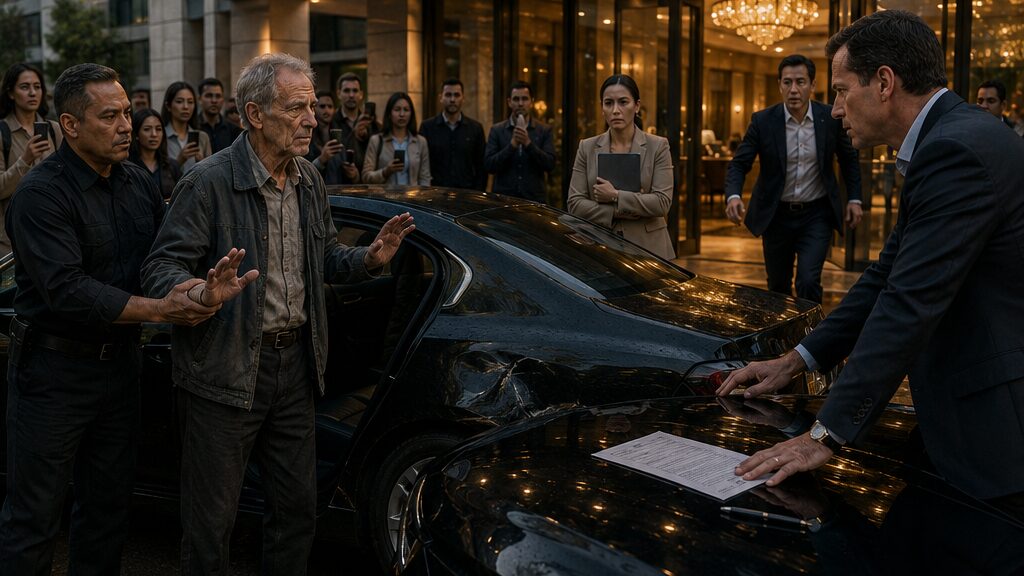
Gary Harris saw the paper before he understood the hand on his wrist.
It lay flat on the black hood of Patrick Moore’s car, bright white against all that polished paint, with the total circled twice in blue ink.
$6,480.
The number seemed to float under the chandelier glow spilling through the glass doors of Aster House Condominiums. Gary stood beside the open passenger door with his palms raised, one shoulder aching from the way the security guard held him back. The late-afternoon air smelled of rain on concrete, car wax, and the expensive flowers Michelle Rivera kept replacing in the lobby vases.
Residents had stopped along the curb. Some stood near the revolving door. Some stayed under the awning. Several held up phones.
Patrick Moore pressed two fingers on the repair estimate as if the paper might fly away.
“You scraped my car,” he said, loud enough for the phones. “And now you’re pretending you don’t remember.”
Gary looked from Patrick’s fingers to the dent along the car’s rear quarter panel. The black paint had a thin wound in it, low and ugly, with a pale slash and a speck of blue at the edge. The car was so clean the building lights curved across it like ribbons.
“My cart didn’t touch your car,” Gary said.
Patrick gave a short laugh. He wore a gray suit with no tie, the kind of clothes Gary saw in the elevator beside polished shoes and gym bags that cost more than his winter coat. Patrick was younger than Gary by twenty years, maybe more, but he carried himself like the building had been put up around him.
“Your cart was right here,” Patrick said. “You were dragging it through the valet lane like you always do.”
Gary glanced behind him. His old rolling cart stood tipped near the curb, its gray rubber wheels wet from the sidewalk. He had used it to bring up groceries, a bag of potting soil, and two small boxes from the storage unit. He had kept close to the curb because his knees did not like sudden turns.
“I wasn’t dragging it,” Gary said. “I was rolling it.”
“Listen to yourself.” Patrick turned slightly toward the watching residents. “This is exactly what I’m talking about.”
The security guard’s hand tightened around Gary’s wrist.
Gary raised both palms higher.
“I’m not fighting,” he said quietly.
“No one said you were fighting,” the guard muttered, but he did not let go.
Michelle Rivera stood near the lobby doors with a tablet held against her chest. She looked troubled, but not surprised. That was worse. Gary had lived at Aster House for eighteen years. He had seen three property managers come and go. Michelle knew his unit number, knew his wife had died, knew he still changed the furnace filters himself because he did not like waiting for maintenance unless he had to.
But now she looked at him as though his memory were something that needed confirmation from younger people.
“Mr. Harris,” she said, “we just need to document what happened.”
Patrick tapped the repair estimate again.
“It’s documented. Ronald Scott looked at it. Rear quarter panel repair, paint correction, sensor calibration. Six thousand four hundred eighty dollars. He can sign responsibility right here.”
Gary’s mouth went dry.
The number pressed into him harder than the guard’s hand. Six thousand dollars was not just a repair. It was winter utilities. It was property tax reserves. It was the small account he had promised himself he would not touch unless a pipe burst or his heart acted up again.
Patrick pulled a pen from inside his jacket and placed it on the hood.
The pen clicked softly when it hit the paint.
Gary stared at it.
Someone behind him whispered, “That’s the guy from 5B, isn’t it?”
Another voice said, “He always has that cart.”
A phone camera adjusted with a tiny electronic chirp.
Gary could feel his ears getting hot. He had not felt that kind of heat since he was a boy and a store clerk followed him down an aisle for touching something too expensive. He had thought age would put an end to certain embarrassments. Instead, it seemed to give people a cleaner excuse.
“You need to move back,” the guard said.
“I live here,” Gary said.
“I’m asking you to move back from the vehicle.”
“My cart didn’t touch it.”
Patrick stepped closer. “Then sign that you’ll cooperate with insurance.”
“That isn’t what this says.” Gary lowered one hand just enough to point at the estimate. The guard’s fingers twitched, ready to stop him, but Gary only tapped the corner of the paper. “This says I accept responsibility.”
“Because you are responsible.”
Gary looked at the dent again.
He had worked maintenance for a school district for thirty-one years. Boilers, lockers, door frames, mower blades, cafeteria carts, bus-lane rails. Damage had a language. People lied with their mouths all the time, but dents had habits. Height mattered. Direction mattered. Paint mattered.
He leaned forward a little.
The estimate described the damage in neat printed lines.
Lower rear quarter panel. Horizontal scrape. Blue transfer visible at edge of impact.
Blue.
Gary’s cart had no blue on it. The frame was dull aluminum. The handle was wrapped in old black tape. The wheels were gray rubber. Even the bungee cords were red.
Patrick saw him reading and snatched the top of the paper with two fingers.
“Don’t smudge it.”
Gary lifted his eyes.
“I remember enough not to sign another man’s mistake.”
The small crowd shifted. It was not applause, not support, only the sound people made when a scene changed shape and they were not sure which side to stand on.
Patrick’s face tightened.
“You’re calling me a liar?”
“I’m saying the bill doesn’t even know where the scratch came from.”
Michelle took a step forward. “Mr. Harris, please. No one is trying to embarrass you.”
Gary almost smiled at that, but it would have come out wrong.
He looked at the phones, the lobby staff frozen behind the desk, the delivery driver paused with a stack of parcels, the woman in workout clothes who had stopped mid-sip from her metal bottle. The embarrassment was already there. It had been there from the moment the guard took his wrist beside the open car door.
Patrick picked up the pen again and held it out.
“Sign, or I file the claim naming you. Then it gets worse. Deductible, attorney fees, HOA involvement. You want that at your age?”
At your age.
The words did not come like a shout. They came smooth and practical, almost concerned, and that made them worse.
Gary’s raised hands trembled once. He closed his fingers slowly and opened them again. He imagined his late wife, Deborah, standing beside the lobby flowers in the navy coat she used to wear to Sunday breakfast. She would have looked at that paper, then at Patrick, then at Gary with the look that meant breathe first.
So Gary breathed.
“No,” he said.
Patrick blinked.
“No?”
“I won’t sign it.”
The guard shifted his weight. “Mr. Harris, let’s step inside.”
“Why?” Gary asked.
“Because this is becoming a disturbance.”
“I’m not the one shouting.”
Patrick laughed again, but this time it sounded forced. “You hear that? He damages my car and I’m the disturbance.”
Michelle’s tablet chimed. She ignored it.
“Mr. Harris,” she said, softer, “we can discuss this in the office.”
“Then take his bill off the hood,” Gary said. “And take his pen out of my face.”
The guard began to turn him by the wrist.
Pain shot up Gary’s forearm. Not sharp enough to cry out, but sharp enough that his knees weakened. His right hand rose again without his permission, palm open, the old instinct of making himself harmless.
More phones lifted.
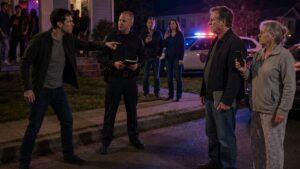
Through the glass doors, a man in a dark suit came fast across the lobby.
Robert Lee pushed through the entrance so hard one of the doors swung back against its stop. His face was usually calm, shaped by years of telling residents where not to park and contractors where not to leave ladders. Now his tie was crooked and his eyes moved from Gary’s wrist to Patrick’s car to the estimate on the hood.
“Let go of him,” Robert said.
The guard obeyed, but slowly.
Patrick exhaled in irritation. “Robert, this doesn’t concern security beyond keeping the area clear.”
Robert did not look at him. He looked at Gary first.
“You all right, Mr. Harris?”
Gary rubbed his wrist once. “I’m standing.”
Robert turned toward Michelle. “The car wasn’t supposed to be at the front curb this morning.”
Patrick’s head snapped toward him. “What?”
Robert’s jaw worked as if he had already said more than he intended.
“The vehicle was logged for loading access earlier,” he said. “Before any report from the valet lane.”
The crowd quieted.
Gary looked down at the black hood. The repair estimate still lay there, white and bright, with the blue-circled number staring up at everyone.
Chapter 2: Sarah Counts the Savings Twice
Sarah Harris counted the same column of numbers twice and came up with the same silence both times.
Gary sat across from her at his kitchen table, his wrist wrapped in a dish towel full of ice that had already begun to melt. The repair estimate lay between them, flattened beside his checkbook and the old green repair folder Deborah had labeled in careful handwriting years ago.
Aster House — Unit 5B. Receipts, warranties, repairs.
The kitchen light hummed overhead. Outside the window, evening pressed against the glass, turning the room into a reflection of itself: Sarah’s bent head, Gary’s tired shoulders, the paper with $6,480 circled like a bruise.
Sarah touched the checkbook but did not open it.
“Dad.”
He knew that tone. It was the tone she used when she wanted to sound gentle before saying something hard.
“I didn’t do it,” Gary said.
“I know that’s what you believe.”
He looked at her.
Sarah closed her eyes briefly. “I’m sorry. That came out wrong.”
“No,” he said. “It came out how people say it now.”
She pushed the estimate away from the checkbook, then pulled it back as if distance changed nothing. She was in her forties, with Deborah’s mouth and his habit of folding receipts into exact thirds. Her work blouse was wrinkled from driving straight over after he called. She had arrived with groceries he did not need and worry she could not set down.
“What did Robert say after?” she asked.
“Not much. Michelle told everyone to clear the curb. Patrick took his paper and said the claim was moving forward. Robert said he’d write an incident note.”
“Does he have footage?”
Gary shook his head. “He didn’t say that.”
“Can you ask?”
“He can’t just hand me building footage, Sarah.”
“Then how are you supposed to defend yourself?”
Gary looked at the ice towel. Water had run down into the lines of his knuckles. His hands looked older wet. He disliked noticing that.
“I start by not signing something false.”
Sarah’s expression tightened. She stood and walked to the counter, then back again. The kitchen was small enough that every step looked like she had changed her mind.
“Patrick Moore is on the board,” she said. “Michelle is already treating this like a formal complaint. If insurance gets involved, they could name you. If the HOA adds fees—”
“I know what fees are.”
“I’m not saying you don’t.”
“You are saying I don’t know what this could cost.”
“I’m saying I’m scared.”
That stopped him.
She sat down again, slower this time.
“I’m scared because six thousand dollars is awful, but a legal fight could be worse. You know that. A claim, a deductible, maybe court, maybe they tack on administrative charges. These places always do that. They put language in letters that makes people panic and pay.”
Gary let out a breath through his nose.
“That’s what he’s counting on.”
“Maybe. But if settling half makes it disappear—”
“No.”
“Dad.”
“No.”
The word came sharper than he meant. Sarah leaned back, hurt flashing across her face before she hid it.
Gary took the towel off his wrist and folded it, though it was soaked.
“I’m not angry at you,” he said.
“You sound angry at me.”
“I’m angry you had to drive over here and sit at my table deciding how much of a lie we can afford.”
Sarah looked down.
For a while, neither of them spoke.
The refrigerator clicked on. Somewhere above them, a chair scraped across another unit’s floor. Aster House was never silent. Pipes, elevators, shoes, doors, carts, distant conversations. Gary knew the building’s sounds the way some men knew birdsong. He knew which elevator groaned in winter, which basement door stuck after heavy rain, which loading-dock hinge needed oil though no one believed him until it screamed.
Deborah had loved the place for the light.
“We can see the city without the city seeing all of us,” she used to say.
After she died, people asked whether he would move closer to Sarah. He told them no. Not because he wanted to be difficult. Not because he liked being alone. Because every corner of Unit 5B still held evidence that he and Deborah had made a life carefully, one paid bill at a time.
Sarah opened the green folder.
Inside were old furnace service forms, appliance manuals, elevator notices, water shutoff schedules, receipts for small repairs. Deborah had saved everything. Gary had teased her for it until the year a contractor tried to charge them for a dishwasher part still under warranty.
Sarah’s fingers paused on a yellowed receipt.
“Mom kept the warranty for a hallway light fixture?”
“She said paper remembers better than people.”
Sarah smiled despite herself, then lost it.
“I don’t want them cornering you,” she said. “When I saw that video—”
“What video?”
Her face changed.
Gary’s stomach sank.
“Someone posted part of it in the residents’ group,” she said.
He stared at her.
“It doesn’t show everything,” Sarah added quickly. “Just you with your hands up and security holding your arm. Patrick is talking, but the audio is bad.”
Gary looked toward the window. His reflection stared back in the dark glass. Gray hair flattened from the rain. Old shirt. Tired eyes. A man who looked guilty if the viewer had already decided he was.
“How many saw it?” he asked.
“I don’t know.”
He nodded once.
Sarah reached for his hand. He let her take it.
“That’s why I’m saying maybe we stop it before it grows.”
Gary looked at the repair estimate again.
Lower rear quarter panel. Horizontal scrape. Blue transfer visible at edge of impact.
He pulled the paper closer.
Sarah watched him. “What?”
“Read that line.”
She leaned in. “Blue transfer visible at edge of impact.”
“What part of my cart is blue?”
Sarah glanced toward the hallway, where the folded rolling cart leaned near the closet. “None.”
Gary stood slowly. His knees complained. He went to the closet and rolled the cart into the kitchen. Its wheels made their familiar rubber whisper over the tile.
The frame was scratched aluminum. The handle was wrapped in black tape where the foam had split years ago. Gray wheels. Red bungee cord. A small rust spot near one hinge.
“No blue,” Sarah said.
“No blue,” Gary repeated.
“Could it have picked up paint from something else?”
“Not today. I only went to storage and back.”
He opened the repair folder wider and found a blank envelope. From the drawer he took a pencil, then paused and changed it for a pen. Pencil could be erased. Ink was better for things people might question later.
On the envelope he wrote:
Cart handle height.
Wheel height.
Damage height?
Blue transfer.
Where was car before curb?
Sarah watched him for a long moment.
“You’re making a list?”
“I’m making a start.”
She rubbed her forehead. “Dad, lists don’t stop insurance letters.”
“No,” Gary said. “But panic signs them.”
He unfolded the cart completely and reached for the measuring tape he kept in the junk drawer. It still had a paint smear from a shelf repair he had done three summers ago. He hooked the metal end to the floor, stretched the tape to the cart handle, and wrote down the number.
Sarah did not stop him this time.
The estimate lay beside the checkbook, but Gary no longer looked at the total first. He looked at the line about blue paint, the lower rear quarter panel, the small language Ronald Scott had probably typed without thinking it would matter.
Then he opened Deborah’s green folder to a clean page and began writing measurements instead of a check.
Chapter 3: Close Enough Is Not Proof
By nine the next morning, Patrick’s black car was back under the front awning as if it had been placed there for display.
Gary saw it through the lobby glass before he stepped outside. The car had been washed again. Rain beads gathered on its hood in perfect little circles, and the chandeliers overhead curved across the paint, broken only by the white slash near the rear quarter panel.
Ronald Scott crouched beside it with a clipboard, a measuring tape, and the practiced frown of a man who charged by certainty.
Michelle Rivera stood nearby, tablet ready. Patrick leaned against the far side of the car with his arms folded. A few residents slowed near the mailroom. Nobody held up a phone yet, but Gary could feel the possibility of it in the way people looked.
His rolling cart stood beside him.
He had brought it because Michelle requested it in an email sent at 7:13 that morning.
For documentation purposes, please bring the cart alleged to have contacted the vehicle.
Alleged did not soften anything.
Gary wheeled the cart to the valet lane and stopped three feet from the car.
Patrick smiled without warmth. “Glad you decided to cooperate.”
“I brought the cart,” Gary said. “That’s all.”
Ronald glanced up. He was a square-shouldered man with close-cropped hair and a black jacket bearing the logo of his auto-body shop. His estimate was clipped to the top of the board, now marked with yellow tabs.
“Mr. Harris?” Ronald asked.
Gary nodded.
“I’m just going to compare contact points. Should be quick.”
“Quick is how this got sloppy,” Gary said.
Ronald’s eyebrows lifted. Patrick made a noise under his breath.
Michelle stepped in. “Let’s keep this civil.”
Gary looked at her. “Civil would have been doing this before putting a bill on the hood.”
She lowered her eyes to the tablet.
Ronald pulled the measuring tape from his belt and knelt by the car. He set one end at the ground, raised the tape to the scrape, and read the number. Gary watched his hand, not his face.
“Twenty-one inches to center of damage,” Ronald said.
He wrote it down.
Gary said nothing.
Ronald moved to the cart. He measured the lower frame first, then the wheel bracket, then the handle. He worked fast, but not carelessly. Gary gave him that much. Still, the man kept glancing at Patrick as if confirming the shape of the story.
“Cart lower rail, roughly eighteen and a half,” Ronald said. “Handle at thirty-six. Wheel housing around seven.”
Patrick pointed. “The lower rail. That’s what hit it.”
Gary looked at the cart rail. It was dull aluminum, rounded at the edge, with gray rubber bumpers he had added himself after Deborah complained it nicked the closet door.
Ronald pulled the cart closer to the car.
Gary stepped forward. “Don’t touch the paint with it.”
Ronald paused.
Patrick laughed. “Now he’s worried about the paint.”
“I’m worried about you making new marks.”
Michelle’s head came up.
Ronald held his palms out. “No contact. Just alignment.”
He positioned the cart near the damaged panel without letting it touch. The lower rail came near the scratch, but not cleanly. Gary saw it at once. The scrape on the car was too low for the cart’s rail if the cart had been upright. Too level for a wobble. Too sharp at the front edge.
Ronald tilted the cart slightly.
Gary watched the angle change.
“That’s not how I pull it,” he said.
Ronald did not look up. “Carts tilt.”
“Not sideways.”
Patrick straightened. “You were struggling with it. People saw you.”
“I was pulling groceries.”
“You were bumping around the curb.”
Gary turned to him. “Say exactly what you saw.”
Patrick’s jaw tightened. “I saw enough.”
“That isn’t exact.”
Michelle’s fingers moved over her tablet. “Mr. Harris, please let Mr. Scott complete his assessment.”
Ronald stood and compared his numbers. “The height matches close enough.”
Gary looked at him.
“Close enough is for gossip,” he said, “not six thousand dollars.”
A resident near the door stopped walking.
Patrick’s face colored. “This is ridiculous.”
Ronald clipped the measuring tape back with a snap. “Damage comparisons aren’t always perfect. There’s movement, angle, pressure—”
“And paint,” Gary said.
Ronald looked at him.
Gary pointed to the estimate on the clipboard. “You wrote blue transfer visible at edge of impact.”
Ronald’s eyes flicked to the page. “Yes.”
“Where’s the blue on my cart?”
The question sat in the damp morning air.
Patrick answered before Ronald could. “It could’ve come from anything.”
“That’s what I’m asking.”
Ronald crouched by the cart again. He looked at the wheels, the frame, the rubber bumpers, the taped handle. His face did not change much, but Gary saw the moment he found nothing. Professionals often got quiet before they admitted a fact was inconvenient.
“No visible blue transfer on the cart,” Ronald said at last.
Patrick pushed away from the car. “Because he cleaned it.”
Gary gave him a tired look. “With what?”
“You tell me.”
“I haven’t washed that cart since spring.”
“That’s not exactly helping your case.”
“No,” Gary said. “But it’s true.”
Michelle moved closer and took photos of the cart from several angles. The small clicks from her tablet sounded too official for what they were. She photographed the wheels, the frame, the handle. Then she photographed the dent again.
Gary watched the car’s reflection while she worked. In the glossy black paint, the lobby lights bent and stretched. Michelle’s red scarf looked like a wavering ribbon. The curb stripe ran in a pale broken line. Behind them, the glass doors opened and closed, swallowing and releasing residents who pretended not to listen.
Ronald marked the estimate with a pen.
Gary saw the note upside down.
No blue visible on cart.
It was small. Almost reluctant. But it existed.
Patrick saw it too.
“Ronald,” he said, voice low.
Ronald did not remove the note. “I’m documenting what I see.”
“What you see is my car damaged after he was beside it.”
“What I see,” Gary said, “is you skipping the part before that.”
Patrick turned on him. “You want to play detective because you don’t want to pay?”
Gary felt the old heat rise in his face again, but this time it did not scatter him. He had slept badly, but he had measured the cart twice before bed and once again before breakfast. Numbers steadied him.
“I want the damage matched to the thing that damaged it.”
Patrick leaned closer. “You think people here don’t know what’s happening? You drag that cart through the lobby, bang it into corners, leave scuffs near the elevator. Everybody’s been patient because you’re old.”
Michelle said, “Patrick.”
Gary’s hand tightened on the cart handle.
Because you’re old.
The words tried to make him smaller. He felt it happening, the old instinct to apologize for taking up space, to promise he would be careful, to look harmless so no one made a bigger scene.
Instead, he turned the cart slightly and showed Ronald the gray rubber bumper.
“I put these on in 2019,” Gary said. “After my wife’s walker scratched the closet door. Rubber leaves a dull smear, not blue paint.”
Ronald studied the bumper.
Sarah would have told Gary not to say too much. People mistook detail for confusion if it came from an old mouth. But Ronald was listening now, at least halfway.
Michelle lowered the tablet. “Mr. Scott, does the cart explain the blue transfer?”
Ronald hesitated.
Patrick’s eyes sharpened.
“Not by itself,” Ronald said.
“Meaning?” Michelle asked.
“Meaning there would need to be another source for that paint.”
Patrick threw up one hand. “This is absurd. The car was perfect before he came through.”
Gary looked at Robert Lee, who had appeared near the lobby door without Gary noticing. Robert was not in yesterday’s dark suit now, only a security blazer and tie, but his face carried the same tension.
Robert gave the smallest shake of his head. Not here.
Gary understood. Not in front of everyone. Not without records.
Ronald closed his clipboard.
“I’ll update the file,” he said. “But the estimate stands unless there’s evidence of another impact.”
Patrick smiled again, recovering ground. “There isn’t.”
Gary looked at the scrape, then at the estimate, then at the black paint reflecting the bright lobby behind him.
“There may be,” he said.
Patrick rolled his eyes. Michelle sighed as though patience itself had become paperwork.
Robert waited until Patrick walked around the car to take a call and Ronald packed his tape. Then he moved beside Gary without looking directly at him.
“Mr. Harris,” he said quietly, “don’t ask me for footage in the lobby.”
“I wasn’t going to.”
“The loading-dock bollards were repainted blue two months ago.”
Gary kept his hand on the cart handle.
“Blue,” he said.
Robert nodded once.
Then he stepped away before anyone could ask what they had been discussing.
Chapter 4: The Place Where the Paint Was Missing
Gary waited until the lobby had thinned before he went downstairs.
The elevator carried him past the polished floors and quiet hallways into the part of Aster House most residents never saw unless something broke. The air changed at the basement level. It smelled of concrete dust, old mop water, cardboard, and the faint metallic dampness that lived near utility rooms. Fluorescent lights hummed overhead. Somewhere behind a closed door, a compressor clicked and settled.
Gary rolled his cart beside him, though he did not need it anymore.
He wanted the sound of it.
The gray wheels whispered over the concrete, steady and familiar. He had used that cart long enough to know when one wheel caught grit, when a load pulled left, when the handle vibrated over a seam in the floor. It did not wobble sideways unless someone forced it. It did not leap into cars. It did not leave blue paint behind.
At the end of the basement hallway, a sign read LOADING ACCESS. The door beyond it was heavier than it looked. Gary pushed it open with his shoulder.
The loading dock was empty except for stacked moving blankets, a pallet of bottled water, and three blue-painted steel bollards set in a row near the turn-in lane. The paint was a bright municipal blue, the kind chosen because no one could pretend not to see it.
Gary stood still.
He remembered the day the bollards were repainted. Two months ago. A painter had propped the dock door open while Gary returned from the storage unit with an old box of Deborah’s holiday dishes. One bollard still had wet paint then. The painter had warned him, “Careful, sir.” Gary had gone wide with the cart and nodded thanks.
Now the middle bollard had a scrape near its outer curve.
Black.
It was not a large mark. Just a crescent of dark paint cut through the blue, with a rough edge where something glossy and hard had kissed it at an angle. Most people would have walked past it. They would have seen a post doing what posts did—collecting scuffs in places where drivers misjudged space.
Gary set the brake on his cart.
He took the folded repair estimate from inside his jacket. The paper was already soft at the creases from being handled too much. On the second page, Ronald Scott had described the damage in careful shop language.
Lower rear quarter panel. Horizontal scrape. Blue transfer visible at edge of impact.
Gary looked at the scrape on the bollard again.
He did not smile. The mark did not clear him by itself. Marks could come from delivery trucks, moving vans, maintenance carts. A single scrape was not proof. He knew that. He had spent too many years finding leaks that had three possible sources and only one guilty pipe.
But it was the first thing since Patrick’s accusation that seemed to answer him instead of threaten him.
He drew the measuring tape from his pocket.
His fingers were stiff from the morning’s rain and the ache left by the guard’s grip, but the tape slid out cleanly. He hooked the end on the floor and raised the metal strip along the bollard.
Twenty-one inches to the center of the black scrape.
Gary read it twice.
Then he read Ronald’s estimate again.
Twenty-one inches to center of damage.
The dock door opened behind him.
Gary turned.
Robert Lee stepped through and let the door close softly. “I thought I’d find you here.”
Gary let the tape retract slowly, not snapping it. “You told me blue.”
“I did.”
“You didn’t say black paint on blue.”
Robert looked at the bollard. His face did not change much, but his shoulders lowered a fraction.
“I can’t tell you whose paint that is,” he said.
“I didn’t ask you to.”
“And I can’t give you footage.”
“I didn’t ask that either.”
Robert glanced toward the corner of the dock where a black half-dome camera watched the bay doors. “Residents think cameras are simple. They aren’t. There are privacy rules, board rules, management rules. And sometimes angles that don’t show what people hope they show.”
Gary folded the estimate and tucked it back inside his jacket.
“I worked in buildings most of my life,” he said. “I know a camera doesn’t fix a bad process.”
Robert looked at him then. There was something like apology in his eyes, but Gary had no use for apology yet. Apology was often how people tried to end a thing before fixing it.
“What can I see?” Gary asked.
Robert hesitated.
“Not footage,” Gary added. “Not anything private.”
Robert rubbed his thumb along the edge of his key card. “Vehicle access logs. Times only. Unit-linked garage entries, loading access requests, gate scans. They don’t show fault. They show movement.”
“Are residents allowed to request those?”
“Through management, usually.”
“Michelle won’t give them to me today.”
“No,” Robert said. “She probably won’t.”
Gary nodded toward the scrape. “Can I photograph that?”
Robert looked up at the camera again, then back at Gary. “It’s common area property. You can photograph a bollard.”
Gary took out his phone. Sarah had bought it for him after Deborah died and set the text size so large that messages looked like headlines. He held it carefully with both hands and took three photos: one wide, showing the loading lane; one close, showing the black scrape on blue paint; one with the measuring tape held beside it.
His hands shook on the last one.
Robert noticed but said nothing.
Gary appreciated that.
They walked back through the basement hall toward the security office. The rolling cart followed with its small, steady sound. Near the service elevator, a desk clerk pushed a bin of packages and glanced at Gary with quick recognition. The video had moved through the building by then. Gary could feel it in the way eyes touched him and slipped away.
At the security desk, Robert took the chair behind the computer. Gary remained standing. He did not want to look as if he had come to be handled.
“I can show you a summary screen,” Robert said. “You can write down what you see. I cannot print it for you without Michelle’s approval.”
“That’s fair.”
“It may not be enough.”
“Most starts aren’t.”
Robert’s mouth moved like he almost smiled.
He clicked through several screens. Gary looked away when unit numbers appeared. Robert shifted the monitor slightly, blocking most of the information with his shoulder, then opened a page with date and time entries.
“Here,” Robert said. “Vehicle loading access.”
Gary leaned in.
The date was yesterday.
The list showed service vans, a moving truck, two contractor entries, and then Patrick Moore’s vehicle registered for loading access at 9:42 a.m.
Gary took out the envelope from his pocket, the same one where he had written the night before. He copied the time slowly.
9:42 a.m. Patrick loading access.
“What time did Patrick say your cart hit the car?” Robert asked.
Gary knew the answer because Patrick had repeated it often enough for the crowd.
“After two. When I came up from storage.”
Robert nodded toward the screen. “Front curb incident report was logged at 2:18 p.m.”
Gary wrote that too.
The numbers did not yet accuse Patrick. A man could use the loading dock in the morning and suffer unrelated damage in the afternoon. Gary would not pretend otherwise. He had disliked that kind of sloppy thinking when it was aimed at him; he would not use it on someone else.
But Patrick had said the car was perfect before Gary came through.
Gary looked at the paper in his hand.
“When he came out yesterday,” Gary said, “he didn’t say the car had been at the dock.”
“No.”
“Michelle knew?”
“Not until I told her at the curb.”
Gary folded the envelope. “That bothered him.”
Robert leaned back. “Patrick doesn’t like surprises.”
“Most people don’t when they’ve arranged the room.”
Robert was quiet for a moment. Then he said, “Mr. Harris, be careful at the HOA meeting.”
Gary looked up.
“Is there one?”
“Michelle is scheduling something. Patrick asked for board review if you don’t sign by tomorrow.”
Gary slipped the envelope back into his pocket. He thought of Sarah counting his savings, of the repair estimate beside the checkbook, of Patrick’s voice saying at your age.
“I won’t sign tomorrow either,” Gary said.
Robert turned off the monitor.
As Gary left the security desk, he paused by the basement hallway and looked back toward the loading dock. From that angle, the blue bollards were just bright shapes under fluorescent light, ordinary and overlooked.
The middle one held its black scrape quietly.
Gary touched the repair estimate through his jacket, feeling the folded edge against his chest.
For the first time since the paper had landed on Patrick’s hood, the bill felt less like a trap and more like a map.
Chapter 5: The Form That Called Him Responsible
The HOA meeting room had no windows, which made every paper on the table look more important than it was.
Gary sat at one end with his repair folder on his lap. Sarah sat beside him, hands folded so tightly her knuckles had gone pale. Michelle Rivera sat opposite them with a tablet, a stack of printed forms, and the careful expression of someone trying to sound neutral while already holding a decision.
Patrick Moore arrived five minutes late.
He did not apologize. He placed a glossy folder on the table, took the chair nearest Michelle, and set his phone face down beside him. Ronald Scott followed with his clipboard and the same black shop jacket from the curb.
Two HOA board members sat along the wall, quiet and watchful. Robert Lee stood near the door, not seated, not quite part of the meeting but unable to pretend he was not involved.
Michelle began by reading from a prepared note.
“This is an informal responsibility review regarding vehicle damage reported on the front curb of Aster House Condominiums. The purpose is not to assign legal liability today, but to determine whether the association will forward documentation to the insurer and assess administrative costs according to resident conduct rules.”
Gary listened to every word.
Informal responsibility review. Not assign legal liability today. Forward documentation. Assess administrative costs.
People used long phrases when they wanted short actions to look reasonable.
Patrick opened his folder and slid out a printed photograph of the damaged car. The dent appeared larger in the photo than it did in person. The black paint caught the lobby light and stretched it into bright streaks. At the edge of the scrape, the blue fleck looked almost intentional.
“My car was undamaged before Mr. Harris came through the valet lane,” Patrick said. “He was pulling that cart, lost control near the curb, and struck the rear quarter panel. I saw him beside the car immediately after.”
Gary said nothing.
Sarah shifted as if she wanted to object. Gary touched two fingers lightly to the edge of his folder, and she stayed quiet.
Michelle looked at him. “Mr. Harris, you’ll have a chance to respond.”
“I’m listening,” Gary said.
Patrick did not like that. Gary could see it. He had expected interruption, confusion, defensiveness. Silence gave him nothing to push against.
Ronald placed his estimate on the table. It was a cleaner copy than the one Gary had carried around, with the total still visible near the bottom.
$6,480.
“Mr. Scott inspected the damage and found it consistent with contact from a cart or similar object,” Patrick said.
Ronald cleared his throat. “Consistent with possible contact.”
Patrick glanced at him.
Ronald looked down at his clipboard. “The damage is low, horizontal, and includes paint transfer. I noted no visible blue paint on Mr. Harris’s cart during yesterday’s comparison.”
Michelle’s pen paused.
One of the board members looked up.
Patrick’s jaw tightened. “But you didn’t rule it out.”
“No,” Ronald said. “I didn’t rule it out.”
Michelle slid a form across the table toward Gary.
The paper stopped in front of him with a soft hiss.
Resident Acknowledgment of Damage Responsibility.
Gary looked at the title for a long second. It was printed in bold, as if bold letters could make a thing true.
“This is not an admission for court,” Michelle said. “It allows the association to process reimbursement and avoid further administrative escalation.”
Sarah leaned forward. “What does administrative escalation mean?”
Michelle turned to her. “Potential rule violation notices, hearing fees, insurance coordination, and if unpaid charges are assessed to the unit account—”
“A lien,” Sarah said.
Michelle did not answer quickly enough.
Gary felt Sarah’s fear move beside him like a draft under a door.
Patrick spoke gently now, which Gary disliked more than the shouting. “No one wants that. Gary, this can be simple. Sign the acknowledgment, we work out payment, and nobody has to make this uglier.”
Gary looked at the form.
His name was already typed in.
Gary Harris, Unit 5B.
The sight of it made his stomach turn. Not because the paper had power by itself, but because someone had prepared a place for his surrender.
He picked it up.
Sarah whispered, “Dad.”
Gary read the first paragraph. It said he acknowledged contact between his personal cart and Patrick’s vehicle. The second paragraph said he agreed to cooperate in reimbursement. The third allowed the association to apply related charges to his unit account if direct payment was not resolved.
He set the paper back down.
“I won’t sign this.”
Patrick exhaled hard. “Then refusal will be treated as noncooperation.”
Michelle looked uncomfortable, but she did not correct him.
Gary turned to her. “Is that true?”
“It may be recorded as refusal to resolve the matter.”
“Then write down that I cooperated with the truth,” Gary said, “not the shortcut.”
The room went still.
Robert looked at the floor.
Patrick’s face darkened. “You keep talking like you have proof.”
Gary opened the green repair folder. Inside were his notes, the envelope, the photos of the bollard printed at the small pharmacy kiosk Sarah had taken him to that morning, and the repair estimate with his own marks in the margins.
“I have questions,” Gary said.
Michelle folded her hands. “Go ahead.”
Gary placed Ronald’s estimate beside Patrick’s photo.
“The estimate says blue paint transfer at the lower rear quarter panel.”
Ronald nodded. “Correct.”
“My cart has no blue paint. You noted that.”
“I did.”
Gary placed one of his printed photos on the table. The blue bollard filled most of the image, black scrape visible at twenty-one inches. He did not announce what it proved. He only set it down.
Patrick barely looked at it. “A loading dock post? This is desperate.”
Gary placed the second photo beside it, the one with the measuring tape.
“Twenty-one inches,” he said.
Ronald leaned forward despite himself.
Michelle looked from the photo to the estimate.
Patrick gave a short laugh. “Do you know how many things hit those posts?”
“I do,” Gary said. “That’s why I’m not saying the post proves who did it.”
“Then what are you wasting our time for?”
Gary picked up Patrick’s glossy photo.
The car’s black paint reflected the lobby awning, Michelle’s scarf, Patrick’s own sleeve. Near the damaged panel, the curve of the paint caught something distorted but bright: a vertical blue shape behind the car, bent by the shine.
Gary had noticed it the night before only after holding the photo near his kitchen light. He had not slept much after that.
He placed the photo in the center of the table and turned it toward Michelle.
“What does that look like to you?”
Michelle leaned in.
Ronald stood halfway from his chair.
Sarah gripped the edge of her seat.
“It’s a reflection,” Patrick said quickly. “Everything reflects in black paint.”
Gary nodded. “Yes.”
“Then it means nothing.”
“It means the car was close enough to reflect blue.”
Michelle looked at Patrick. “Was this photo taken at the front curb?”
Patrick’s answer came too fast. “Yes.”
Gary waited.
Michelle examined the photo again. “The front curb doesn’t have blue posts.”
“The lobby has blue planters sometimes,” Patrick said.
“No,” Gary said. “It doesn’t.”
The simple correction landed harder than if he had raised his voice.
Patrick’s eyes snapped to him. “You’re not the building manager.”
“No. I’m the man who has walked past those doors for eighteen years.”
Michelle lifted the photo closer. “Patrick, when exactly did you take this?”
“After I found the damage.”
“At the front?”
“Yes.”
Gary opened the envelope and read from his notes. “Your car entered loading access at 9:42 that morning.”
Patrick turned toward Robert. “You showed him logs?”
Robert’s voice stayed even. “I did not provide a printout. Mr. Harris viewed a time summary at my desk.”
“That’s private information.”
“It was his incident,” Robert said.
Michelle raised a hand. “Enough.”
But there was a crack in the room now. Not large, not final, but visible.
Gary slid the responsibility form back toward Michelle.
“I’m asking for a reinspection,” he said. “At the loading dock. Same car. Same damaged panel. Same estimate. Same measuring tape.”
Patrick laughed. “Absolutely not.”
Michelle looked at him.
Patrick caught himself. “I mean, this is unnecessary. We’ve already inspected the car.”
“Not where it was earlier,” Gary said.
Patrick tapped the table. “You have no right to order me to move my vehicle around because you found a scuffed post.”
“No,” Gary said. “I don’t.”
He looked at Michelle.
“But if you’re going to forward a claim against me, I have the right to ask that the building look at the place the damage may have happened before it uses my name.”
Sarah turned toward him. Her face had changed. The fear was still there, but something steadier had come through it.
Michelle removed the responsibility form from the table and placed it atop her stack.
“I will allow forty-eight hours,” she said. “During that time, the association will not forward the claim. Mr. Moore, please make the vehicle available for reinspection if requested.”
Patrick stared at her. “You’re rewarding this?”
“I’m documenting process,” Michelle said.
Gary closed his folder.
Forty-eight hours was not victory. It was only time. But time mattered when someone was trying to rush you into a lie.
As they stood to leave, Patrick leaned close enough that only Gary and Sarah could hear.
“You’re making a mistake,” he said. “People get tired of old men who don’t know when to stop.”
Gary held the folder against his chest.
“Then they can rest,” he said. “I’m not done.”
Chapter 6: The Dent Did Not Reach High Enough
The next morning, Sarah held the measuring tape while Gary knelt beside the blue bollard.
“Tell me if it slips,” he said.
“It’s not slipping.”
“You’re pulling it at an angle.”
“I’m holding it straight.”
Gary looked up at her.
Sarah adjusted the tape half an inch. “Now I’m holding it straight.”
He nodded, satisfied, and wrote the number again in the margin of Ronald’s estimate.
Twenty-one inches.
The loading dock was quiet except for the buzz of overhead lights and the distant knock of a pipe somewhere behind the service wall. Sarah had parked in visitor parking and come down without being asked. She wore jeans and an old sweater instead of work clothes, and she had tied her hair back like she expected the morning to become practical.
Gary had not said thank you. It sat between them anyway.
He stood slowly, one hand on the bollard for balance. The blue paint was cold under his palm. Up close, the black scrape had more detail than it showed in the photo: a darker streak at the center, a slight shine at one edge, and a tiny ridge where the blue paint had pushed up.
“Car paint?” Sarah asked.
“Maybe.”
“That sounds less certain than last night.”
“Last night I was angry.”
“And now?”
“Now I’m measuring.”
She smiled faintly and held the tape while he photographed the bollard again, this time with the estimate visible beside it. He did not expect anyone to accept a photo as final proof. Photos could lie by cropping. Still, they helped honest people remember what they had seen.
They moved next to his storage unit.
Gary unlocked it and rolled up the door. The space was narrow, packed with labeled bins, a folded ladder, two old dining chairs Deborah had refused to throw away, and the box of holiday dishes he had brought up the day of the accusation. The cart stood in the middle where he had left it, open and empty.
Sarah looked around. “Mom labeled everything.”
“She said grief was bad enough without looking for tape.”
Sarah touched a box marked Winter linens, then pulled her hand back.
Gary pretended not to notice.
They set the cart on the smooth concrete outside the unit. Gary measured from floor to wheel housing, floor to lower rail, floor to handle. Sarah wrote the numbers on the envelope because her handwriting was clearer.
“Lower rail eighteen and a half,” she said.
“Again.”
“Dad.”
“Again.”
She measured again. “Eighteen and a half.”
“Damage center twenty-one.”
“That’s two and a half inches.”
“It matters.”
Sarah crouched and looked from the cart rail to the tape. “Could the cart bounce?”
“With groceries and potting soil? It rolls heavy. It doesn’t bounce upward.”
“What if it tilted?”
Gary took the handle and tilted the cart carefully toward where a car would have been. “To reach twenty-one, the rail has to come up. When it comes up, the edge angle changes. It would leave an upward scrape, not level.”
Sarah watched him demonstrate. “You sound like you’re back at work.”
Gary lowered the cart. “At work, people believed me after the third flood.”
“Only after the third?”
“The first two were blamed on rain.”
Sarah’s smile faded. “I should have believed you faster.”
He looked at her, then away. The storage hallway gave a man nowhere to hide his face.
“You were scared,” he said.
“I was treating scared like it was the same thing as smart.”
“That runs in families.”
She laughed once, softly.
Gary opened his repair folder on top of a storage bin. He laid out the estimate, the envelope of measurements, the bollard photos, and the note he had copied from Robert’s access log. The papers looked thin against the size of what they had to stop.
Sarah tapped Patrick’s printed photo. “This reflection. It could be the bollard.”
“It could be.”
“It could also be something else.”
“Yes.”
She waited.
Gary looked at her. “That’s why I need the car at the dock.”
They went back through the basement corridor toward the garage entrance. At the security desk, Robert was speaking to a delivery driver. He noticed Gary but did not interrupt his conversation. When the driver left, Robert handed Gary a clipboard.
“Visitor sign-in for reinspection,” he said. “Michelle wants everyone logged if this happens.”
“If?”
“Patrick hasn’t confirmed.”
Gary was not surprised.
Robert lowered his voice. “He called twice this morning asking whether the inspection could be done at the curb instead.”
Sarah’s eyes narrowed. “Why would he care?”
Robert did not answer. He did not need to.
Gary signed the clipboard in the slow, careful hand that had signed mortgage papers, maintenance forms, birthday cards, and death certificates. His name looked a little shaky. He disliked that, too, but not enough to rewrite it.
“Mr. Lee,” he said, “can the association require the vehicle be brought to the loading dock?”
Robert glanced toward the hallway camera. “Michelle can request it as part of the review. Require is another matter.”
“Patrick is on the board,” Sarah said.
“Yes,” Robert said. “But not the whole board.”
Gary handed back the clipboard. “I don’t want anyone bending rules for me.”
Robert met his eyes. “I know.”
“I just want the same straight line measured on both ends.”
Robert nodded. “I’ll be there.”
By noon, Michelle sent an email confirming a final review at three o’clock. The vehicle was to be made available for visual comparison at the front entrance and, if needed, the loading dock. The language was guarded, but the words if needed mattered.
Gary printed the email at the business center because he wanted paper in his folder. The printer jammed once, and he fixed it without thinking, removing the crumpled sheet and smoothing the next one through. The desk clerk watched him do it with a strange look, as if skill in an old man were a surprise that needed explanation.
He carried the printed email upstairs and ate half a sandwich he did not want. Sarah stayed, making coffee neither of them finished. They did not talk much. The papers lay on the table between them, no longer scattered by fear but arranged in order.
Estimate. Cart measurements. Bollard photos. Access time. Patrick’s photo. Michelle’s email.
At two-thirty, Gary put on his cleanest shirt and the gray jacket Deborah used to say made him look stubborn. He slipped the repair estimate into the folder last. Its edges were worn now. The paper that had been shoved at him in public had become softened by his own hands.
Sarah stood by the door. “Ready?”
“No.”
She nodded. “Me neither.”
They took the elevator down.
At the lobby level, the chandeliers were already lit though daylight still glowed through the glass. Residents lingered near the mailroom and seating area with the restless stillness of people pretending not to gather. Michelle stood by the entrance speaking to Ronald Scott. Robert waited outside under the awning.
Patrick’s black car idled at the curb.
Gary saw it through the glass and stopped.
A valet-lane attendant stood by the driver’s door. Patrick leaned toward him, speaking sharply, one hand slicing the air in a low, controlled motion. Gary could not hear the words through the glass, but the attendant’s face told him enough.
Robert stepped closer to them outside.
The attendant shook his head, uncertain.
Patrick pointed toward the street, away from the loading entrance.
Sarah touched Gary’s arm. “What is he doing?”
Gary watched Patrick straighten, smooth his jacket, and glance toward the lobby as though checking whether Gary had seen.
“He’s trying to keep the car where the story works,” Gary said.
Then he opened the glass door and stepped out with the folder held flat against his chest.
Chapter 7: The Reflection Nobody Wanted to See
Gary stepped into the valet lane with the folder held flat against his chest.
The black car idled under the awning, its engine so quiet it seemed expensive even at rest. Rain had stopped, but the curb still shone dark. In the polished paint, the lobby chandeliers floated upside down, broken into gold ribbons along the hood and rear panel.
Patrick turned from the valet-lane attendant.
“There’s no need to move the car,” he said before anyone asked. “The damage is here. Everyone can see it here.”
Gary looked at the attendant, then at Robert.
Robert’s face was still, but his eyes had sharpened. Michelle came through the glass doors with Ronald Scott behind her. Two HOA board members followed at a distance. Several residents gathered beneath the awning, pretending to wait for rides that were not coming.
Sarah stayed at Gary’s side.
Michelle checked her tablet. “Patrick, the notice said the vehicle should be available for visual comparison at the entrance and, if needed, the loading dock.”
“It isn’t needed.”
Gary opened his folder and took out the repair estimate. The same paper Patrick had pressed against the hood now showed creases from Gary’s hands, notes in the margins, and a faint damp spot from the kitchen table.
“That depends on whether the bill is meant to collect money,” Gary said, “or find out what happened.”
Patrick’s mouth tightened.
Ronald stepped closer to the damaged panel. “Let’s start with the vehicle here.”
Gary nodded.
He did not rush. That mattered. Rushing had been Patrick’s tool from the beginning: sign now, admit now, pay now, stop making trouble now. Gary laid the estimate on his own folder instead of the car hood. He would not use Patrick’s paint as a desk.
Ronald crouched at the rear quarter panel with his measuring tape.
“Center of visible damage,” he said, “twenty-one inches.”
Gary watched Michelle write it down.
“Blue transfer still visible?” Gary asked.
Ronald leaned closer. “Yes. Small amount at the forward edge.”
“Please write that too.”
Patrick gave an impatient laugh. “It’s already in the estimate.”
Gary looked at Michelle, not Patrick. “Then it won’t hurt to write it again.”
Michelle wrote it.
Gary removed his cart measurements from the folder and handed the page to Ronald. “My lower rail is eighteen and a half inches when the cart is upright. The handle is thirty-six. Wheel housing is seven. You measured the same yesterday.”
Ronald took the page, glanced at it, and nodded.
Gary rolled the cart beside the car but kept it well away from the paint. He placed his hand on the handle. “To bring the rail up to twenty-one inches, the cart has to tilt. When it tilts, the rail angle changes.”
Ronald looked at the cart, then the damage.
Gary tilted the cart slightly in the air, not toward the car. “That would make the scrape rise, not stay level.”
“Possibly,” Ronald said.
Patrick cut in. “Possibly. Not definitely.”
“No,” Gary said. “Not definitely.”
That answer seemed to throw him off.
Gary took the next photo from the folder: the blue bollard with the black scrape and the measuring tape beside it. He handed it to Michelle.
“This post is in the loading dock. The scrape on it is twenty-one inches from the floor.”
Patrick waved a hand. “Posts get hit every day.”
“I agree.”
Again Patrick faltered. Gary could see him wanting an argument, something messy enough to make everyone forget the measurements.
Gary gave him none.
“The post alone doesn’t prove your car hit it,” Gary said. “Your photo helps more.”
Patrick went still.
Gary took out the glossy photo Patrick had submitted at the meeting. The dent looked dramatic in it, but now Gary saw past the scratch. He saw what he had trained himself to see: the distorted shape in the paint, the bright blue vertical reflection bending along the black curve near the damage.
He held the photo out to Michelle.
“You said this was taken at the front curb,” Michelle said to Patrick.
“It was.”
Gary pointed toward the entrance planters, the brass luggage cart, the gray stone columns, the black awning supports. “There are no blue posts here.”
Patrick’s face hardened. “It could be anything reflected from the street.”
Robert spoke for the first time. “The street side has red fire-lane markings and black bollards. The loading dock has blue bollards.”
Patrick turned on him. “You’re security, not an investigator.”
Robert accepted that with a nod. “That’s why I’m only identifying building fixtures.”
Michelle stared at the photo longer than she had the first time. Ronald came beside her and leaned in.
“It does look like a vertical post,” Ronald said.
Patrick snapped, “It looks like a reflection. You can’t bill a reflection.”
Gary folded his hands over the folder. “No. But you tried to bill me with one.”
Silence moved through the small crowd.
Not applause. Not justice. Only the uncomfortable quiet of people recognizing too late that they had been watching an old man be pushed toward a payment no one had earned.
Michelle looked up. “Patrick, I’m requesting that the vehicle be moved to the loading dock for comparison.”
Patrick’s eyes flashed. “Request denied.”
“You filed the claim through the association process,” Michelle said. “If you refuse the requested comparison, that will be documented too.”
For a moment, Patrick seemed ready to walk away. Then he looked at the residents, the board members, Ronald’s clipboard, Michelle’s tablet. His confidence had depended on everyone moving in the direction he chose. Now they were standing still.
He took the keys from the attendant.
“Fine,” he said. “But this is a waste of time.”
Gary stepped aside as Patrick got in.
The short drive from the entrance to the loading dock took less than a minute. Gary rode the service elevator down with Sarah and Michelle. No one spoke. The repair estimate rested against his chest inside the folder, the same place he had carried it for two days.
At the loading dock, Patrick positioned the car near the blue bollards, stopping farther away than necessary.
“Closer,” Ronald said.
Patrick stared at him through the open window.
Ronald’s voice remained calm. “For comparison.”
Patrick pulled forward and adjusted. The rear quarter panel came level with the middle bollard.
Gary stood back.
He would not crowd the car. He would not point with shaking fingers. He would not beg them to see.
Ronald measured the bollard scrape again.
“Twenty-one inches,” he said.
He measured the car damage.
“Twenty-one.”
He checked the blue transfer on the car, then touched the raised edge of blue paint around the bollard scrape without removing anything. “Color is consistent visually. I’m not saying laboratory match.”
“No one asked you to,” Gary said.
Ronald looked at him briefly, almost grateful.
Michelle opened the access summary Robert had provided her through the proper channel that morning. “Patrick’s vehicle was logged for loading access at 9:42 a.m. The curb incident was reported at 2:18 p.m.”
Patrick folded his arms. “I use the loading dock all the time. That doesn’t mean anything happened here.”
Gary nodded. “By itself, no.”
He placed Patrick’s photo beside the car, holding it where Michelle and Ronald could see the distorted blue shape in the paint. Then he angled it toward the panel now reflecting the actual blue bollard.
The shape bent the same way.
Not perfectly. Not like a confession. But enough.
Ronald took the photo from Gary and held it up himself. He shifted two steps left, then right. The reflection slid across the black paint until it caught near the damaged area, a blue vertical smear bending in the same curve as the printed image.
He lowered the photo.
“The submitted photo appears to have been taken near this dock,” Ronald said.
Patrick’s voice dropped. “Careful.”
Ronald looked at him. “I’m being careful.”
Michelle turned to Patrick. “You stated in the review that the photo was taken at the front curb after Mr. Harris damaged the car.”
“I was upset. I may have been mistaken about where I took one photo.”
Sarah made a small sound but stopped herself.
Gary looked at Patrick. The man’s face was flushed now, but not broken. People like Patrick rarely collapsed under truth. They adjusted around it.
Gary opened the repair estimate one final time.
“You asked me to sign responsibility for this,” he said. “You said my cart made blue paint transfer at twenty-one inches. My cart has no blue paint and doesn’t reach that damage cleanly. Your car was at the loading dock before you accused me. The loading dock has a blue post scraped at the same height. Your own photo reflects that post.”
Patrick stared at him. “You still can’t prove I hit it.”
Gary felt Sarah tense beside him. He knew what Patrick was doing. Pulling the line higher. Making truth chase certainty until everyone grew tired.
“No,” Gary said. “I can’t prove exactly what your bumper touched.”
Patrick’s mouth lifted, almost smiling.
Gary held the estimate out to Michelle. “But you can’t use this paper to prove I touched it.”
The smile vanished.
That was the line. Not punishment. Not revenge. Not forcing Patrick to confess in front of the building. Just removing Gary’s name from a bill that never should have held it.
Michelle took the estimate.
She looked at Ronald. “Would you continue to support this claim as written?”
Ronald was quiet for several seconds.
“No,” he said. “Not as written. The damage source is not sufficiently supported.”
Patrick threw his keys onto the driver’s seat. “This is unbelievable.”
Michelle’s voice cooled. “The association will withdraw the responsibility notice to Unit 5B. No fees will be assessed to Mr. Harris’s account. Patrick, if you continue through insurance, the association will not identify Mr. Harris as responsible based on the current documentation.”
The residents at the dock entrance shifted. Someone lowered a phone. Another person looked away when Gary’s eyes passed over them.
Gary did not want their shame any more than he had wanted their suspicion.
Michelle opened a form on her clipboard and wrote quickly. Then she handed it to him.
“This acknowledges that the association has removed the claim from your unit account,” she said.
Gary read every line.
Sarah leaned close, but she did not tell him what to do.
He took his time. He checked that it did not say he accepted responsibility. He checked that it did not say unresolved resident conduct. He checked that the amount was not attached to his name.
Then he signed.
His hand shook slightly on the H in Harris. He let it. A steady signature was not what made a man honest.
Michelle accepted the form. “Mr. Harris,” she said, and stopped.
He looked at her.
She seemed to search for something official enough to hide behind and found nothing.
“We should have slowed down,” she said.
Gary closed his folder. “Yes.”
The word was not cruel. It did not need to be.
Patrick got into his car without looking at him. The engine started, low and smooth. He backed carefully away from the bollard this time, leaving more room than before.
Gary noticed.
So did Sarah.
When the car disappeared up the ramp, the loading dock seemed to exhale. Robert stepped aside from the door, giving Gary room to pass first.
But Gary stayed a moment longer.
He looked at the blue bollard with the black scrape, then at the repair estimate now in Michelle’s stack, no longer a weapon against his checkbook. The paper had not saved him. Robert had not saved him. Sarah had not saved him. Even the scrape had not saved him by itself.
What saved him was the refusal to hurry past the small wrong detail.
Blue paint where no blue paint should be.
Sarah slipped her hand around his arm. Not to guide him. Not to steady him. Just to walk with him.
At the lobby level, the chandeliers glowed warm behind the glass doors. The same entrance waited, the same polished floor, the same residents pretending ordinary errands had brought them there.
Gary stepped through with his folder at his side.
No one applauded.
That was all right.
As he crossed the lobby, the desk clerk looked up and gave him a small nod. Not pity. Not surprise. Just recognition.
Gary nodded back and continued to the elevator.
When the doors opened, Sarah entered beside him. The folder rested under his arm, light now, almost ordinary.
She pressed the button for five.
“I’m sorry I tried to make you pay,” she said.
Gary watched the doors close over the lobby’s reflection.
“You were trying to keep me safe.”
“I should have trusted you.”
He looked at her then.
“Next time,” he said, “we measure first.”
Sarah laughed softly, and this time it did not break into fear.
The elevator rose.
The story has ended.