The Crack Nobody Wanted to See Until the Old Veteran Walked Back Onto the Site
Chapter 1: The Man Nobody Asked Back
The first thing Brandon Walker noticed was that people stopped talking.
Not everyone. Just enough of them.
The welders near the temporary fencing lowered their voices. A crane operator paused halfway through a joke. Even one of the laborers standing beside the steel delivery truck turned his head and stared toward the gate.
Brandon followed their gaze.
An older man was walking onto the site.
Black long-sleeve shirt. Work boots. Gray hair cut short. Broad shoulders that age hadn’t managed to shrink. He moved without hurry, carrying a carpenter’s pencil behind one ear.
Brandon frowned.
“Who’s that?”
The laborer beside him shrugged.
“No idea.”
The old man passed through the gate without looking around as if he already knew where everything was.
Which made no sense.
The project was only eight months old.
Most people hadn’t even been there since the beginning.
Yet the man walked between stacks of steel beams and concrete forms like he had built the place himself.
Brandon returned to fastening safety lines.
“Probably another consultant.”
“Looks more like somebody’s grandfather.”
A few workers laughed.
The old man didn’t react.
He kept walking.
Toward the central structure.
Toward David Torres.
The site superintendent was standing beside the field office reviewing schedules with two managers.
David noticed the approaching figure and immediately looked irritated.
Not surprised.
Irritated.
That caught Brandon’s attention.
The old man stopped a few feet away.
David folded his arms.
“We’ve already had this conversation.”
The old man nodded once.
“Then this should go quicker.”
The workers nearby exchanged looks.
Brandon moved closer under the excuse of carrying equipment.
Nobody stopped him.
Nobody stopped listening either.
David glanced toward the structure rising above them.
“We’re behind schedule.”
“I know.”
“We lose another inspection day and corporate starts asking questions.”
“I know that too.”
David exhaled sharply.
“Then what exactly are you doing here, Steven?”
So that was his name.
Steven.
The older man looked toward the steel frame instead of answering immediately.
His eyes moved across the structure.
Column.
Beam.
Joint.
Connection plate.
Brandon had seen inspectors do that before.
But this felt different.
Less like checking.
More like remembering.
Finally Steven said, “I wanted another look.”
David laughed once.
Not because it was funny.
Because he was tired.
“You retired two years ago.”
Steven nodded.
“Still doesn’t change what I saw.”
David rubbed his forehead.
“We already have engineers.”
Steven said nothing.
That silence somehow made the exchange more uncomfortable.
David dismissed him with a wave.
“I have work to do.”
Steven turned away without argument.
No anger.
No speech.
Nothing.
Just walked toward the structure.
Brandon expected him to leave.
Instead he grabbed a hard hat from a rack and headed toward the steel frame.
Curiosity got the better of Brandon.
He followed.
Not close enough to be obvious.
Just close enough to watch.
Steven climbed slowly.
Not weakly.
Carefully.
Every movement deliberate.
The upper level was a maze of temporary decking, exposed beams, and unfinished connections.
Workers moved around them carrying tools and materials.
Nobody paid much attention to the old man.
At least not at first.
Steven stopped beside one particular column.
Brandon watched him study it.
Ten seconds.
Twenty.
Thirty.
Nothing happened.
A worker carrying equipment smirked.
“Looking for buried treasure?”
Several people chuckled.
Steven ignored them.
He crouched.
Ran his fingers across painted steel.
Then he pulled the carpenter’s pencil from behind his ear.
Brandon expected him to write something.
Instead Steven tapped the column lightly.
Once.
Twice.
Three times.
The sound echoed differently on the third tap.
Brandon wasn’t sure why he noticed.
But Steven did.
The old man leaned closer.
Studying a section near a welded connection.
A hairline mark crossed the paint.
Tiny.
Almost invisible.
Brandon would never have noticed it.
Neither would most people.
Steven stared at it for a long moment.
Then he stood.
A younger welder laughed.
“That thing isn’t going anywhere.”
Steven looked at him.
Not annoyed.
Not offended.
Just measuring.
“Hope you’re right.”
The welder grinned.
“Been doing this a long time.”
Steven’s expression didn’t change.
“So have I.”
The smile faded slightly.
Steven turned back toward the column.
Brandon found himself stepping closer.
The mark was still barely visible.
Maybe not even a crack.
Maybe a scratch.
Maybe nothing.
Yet Steven’s attention never wavered.
There was something unsettling about that.
Not fear.
Certainty.
The kind that came from seeing something before.
Alexander Clark arrived a few minutes later carrying drawings.
The structural engineer looked young for his position.
Early thirties.
Sharp.
Confident.
He noticed Steven immediately.
“Back again?”
Steven nodded.
Alexander followed his gaze to the column.
“What is it this time?”
Steven pointed.
Alexander leaned closer.
For several seconds he said nothing.
Then he straightened.
“Could be paint separation.”
“Could be.”
Alexander studied the area again.
“But?”
Steven slipped the pencil into his hand.
“Mark the end.”
Alexander hesitated.
Then did it.
A small line.
Nothing more.
Steven nodded.
“Come back tomorrow.”
Alexander looked uncomfortable.
“We already checked this section.”
“You checked dimensions.”
The engineer’s expression tightened.
“And what did you check?”
Steven looked at the steel.
“The story.”
Alexander frowned.
Before he could respond, David’s voice echoed across the platform.
“Alexander.”
The engineer turned.
“We need those drawings.”
Alexander handed back the pencil.
When he walked away, he glanced over his shoulder once.
Only once.
But Brandon noticed.
And Steven noticed too.
The old man watched the engineer leave.
Then looked back at the column.
His jaw tightened.
For the first time all morning, Brandon saw concern.
Real concern.
Not irritation.
Not stubbornness.
Concern.
As if the steel was trying to tell him something.
An hour later David climbed onto the platform.
He wasn’t interested in subtlety.
“We are not stopping work over a scratch.”
Workers nearby pretended not to listen.
Every one of them listened.
Steven remained calm.
“I didn’t ask you to stop work.”
“Good.”
“I asked you to inspect that connection.”
“We already did.”
“Again.”
David shook his head.
“We don’t have time.”
Steven looked toward the growing skyline beyond the site.
When he finally spoke, his voice was quiet.
“You never have time until something happens.”
David’s face hardened.
“We’re done.”
For a moment Brandon thought Steven would push.
Argue.
Demand.
Instead he nodded.
One slow nod.
Then stepped back.
Conversation over.
David walked away.
The workers gradually returned to their jobs.
Brandon should have done the same.
Instead he kept watching.
Steven approached the column one final time.
He pulled out the carpenter’s pencil.
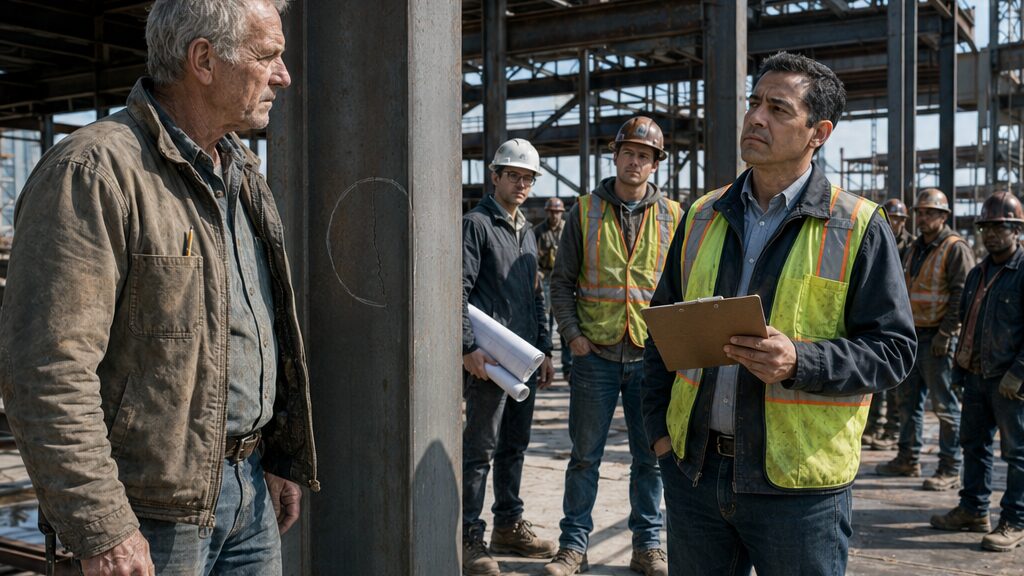
Carefully, deliberately, he drew a circle around the tiny crack.
Nothing dramatic.
Just a faded yellow ring on painted steel.
Then he tucked the pencil away and walked toward the stairs.
Brandon stared at the circle.
A simple mark.
Barely noticeable.
Yet something about it made his stomach tighten.
Because Steven had acted like a man placing a warning sign no one intended to read.
Chapter 2: The Circle on the Steel
Steven returned before sunrise.
The site was quieter then.
No grinders.
No shouted instructions.
No engines.
Only wind moving through unfinished steel.
He preferred it that way.
Structures spoke more honestly when people weren’t talking over them.
The column stood exactly where he’d left it.
The pencil circle remained visible beneath work lights.
Steven climbed slowly to the platform and stopped beside it.
For several seconds he simply looked.
Then his shoulders tightened.
The crack had grown.
Not much.
A fraction.
Enough.
Enough to confirm what he had feared yesterday.
He removed a tape measure from his pocket and checked the length.
Then checked again.
No mistake.
The steel wasn’t behaving normally.
Footsteps echoed behind him.
A laborer carrying tools approached.
The younger man glanced at the column.
“Back already?”
Steven nodded.
“Looks the same to me.”
“Most things do.”
The laborer laughed and kept walking.
Steven watched him leave.
The comment wasn’t cruel.
Just dismissive.
Age had taught him there was a difference.
Most people weren’t trying to insult him.
They simply couldn’t see what he saw.
That was harder to argue with.
He knelt beside the connection plate.
Paint had stretched along one edge.
Tiny distortion.
Barely visible.
A pattern.
Not a random flaw.
A message.
The problem was that structures never sent messages in plain language.
They whispered.
You had to listen before they started shouting.
A vehicle door slammed below.
More workers arrived.
The site came alive.
Within thirty minutes the platform was crowded.
Brandon appeared carrying equipment.
He noticed Steven immediately.
The older man hadn’t expected that.
Most young workers stopped paying attention after the first day.
Brandon kept looking toward the pencil circle.
Curiosity had taken hold.
Good.
Curiosity was usually the first step toward learning.
The second was doubt.
The third was patience.
Most people never reached the third.
Alexander climbed onto the platform carrying rolled drawings.
He approached cautiously.
“I checked the measurements from yesterday.”
Steven looked at him.
“And?”
Alexander hesitated.
“No change.”
Steven pointed at the crack.
Alexander crouched.
His expression shifted.
Just slightly.
Enough.
“The mark moved.”
“Three sixteenths.”
The engineer stared.
“That’s impossible.”
Steven nodded.
“That’s what worries me.”
Alexander examined the connection.
Silence stretched between them.
Below, workers shouted instructions.
Steel clanged.
Machinery hummed.
Life continued.
Yet Alexander remained frozen beside the column.
Thinking.
Finally he asked, “What do you think caused it?”
Steven answered honestly.
“I don’t know.”
That surprised the engineer.
Steven saw it immediately.
People expected certainty from old men.
Especially old men who kept warning everyone.
But experience wasn’t certainty.
Experience was recognizing when uncertainty mattered.
“What do you know?” Alexander asked.
Steven tapped the connection plate.
“That crack doesn’t belong here.”
Alexander nodded slowly.
For the first time, he seemed less defensive.
Then David arrived.
The change in atmosphere was immediate.
Pressure entered with him.
“What now?”
Alexander stood.
“We should probably—”
David raised a hand.
“Not you.”
The engineer fell silent.
David looked directly at Steven.
“You brought him into this?”
Steven ignored the accusation.
“The crack grew.”
David stepped closer.
“How much?”
Steven told him.
David stared at the steel.
Then at the circle.
Then back at Steven.
For a brief moment uncertainty crossed his face.
It disappeared almost instantly.
“We’re still within tolerance.”
Alexander shifted.
“Technically—”
David turned.
“Technically what?”
The younger engineer paused.
Steven almost felt sorry for him.
Almost.
“Technically we should inspect the entire section.”
The platform went quiet.
David looked toward the structure stretching across the site.
Inspection meant delays.
Delays meant money.
Money meant consequences.
Steven knew exactly what calculation was happening behind the superintendent’s eyes.
David wasn’t reckless.
That was the problem.
Reckless people were easy to predict.
David believed he was being practical.
Practical people sometimes ignored danger because danger was expensive.
“We already passed inspection,” David said.
Alexander didn’t answer.
Neither did Steven.
The silence lingered.
Finally David exhaled.
“No shutdown.”
Steven looked away.
There it was.
The decision.
The same decision he had seen in different forms throughout his life.
Not denial.
Minimization.
Maybe later.
Maybe tomorrow.
Maybe it isn’t serious.
The language changed.
The logic never did.
David walked away.
Alexander remained.
“What are you going to do?”
Steven studied the steel.
“Keep looking.”
The engineer almost smiled.
“That’s all?”
“For now.”
Alexander glanced around.
Then lowered his voice.
“If you’re right…”
Steven interrupted gently.
“I don’t need to be right.”
The younger man frowned.
Steven tapped the pencil circle.
“I need this to be wrong.”
That answer stayed with Alexander.
Steven could see it.
The engineer left more thoughtful than before.
Hours passed.
Work continued.
Cranes lifted steel.
Welders worked connections.
Deliveries arrived.
Nobody stopped.
Yet Steven kept noticing things.
A vibration where none should exist.
A slight alignment change.
A faint sound traveling through connected members.
Pieces that didn’t fit.
Not yet.
Near midday he climbed to a higher section.
From there he could see most of the framework.
The structure spread beneath him like a map.
And suddenly he saw it.
Not one issue.
Several.
Tiny.
Separated.
Connected.
A pattern.
The crack wasn’t the problem.
The crack was evidence of the problem.
His stomach tightened.
Below, Brandon watched him from across the platform.
The younger worker seemed puzzled by the intensity on Steven’s face.
Steven almost called him over.
Almost explained.
But old habits held him back.
Too much explanation sounded like pleading.
Too much pleading sounded desperate.
So he stayed silent.
The same mistake he always made.
Late afternoon shadows stretched across the steel.
Workers prepared to finish their shifts.
David passed through the structure one final time.
Steven stopped him.
“Inspect the west section.”
David looked exhausted.
“No.”
“It isn’t isolated.”
“No.”
“You’re making a mistake.”
Something flashed across David’s face.
Not anger.
Fear.
Then it was gone.
“We keep stopping every time somebody worries, this project dies.”
Steven looked at him carefully.
“You think I’m worried about the project.”
David didn’t answer.
Because he knew that wasn’t true.
For a moment neither man moved.
The sounds of the site drifted around them.
Then David walked away.
Steven remained standing beside the column.
The pencil circle seemed almost insignificant now.
One small ring around one small crack.
Yet it represented everything nobody wanted to hear.
As workers headed toward the exits, a deep metallic groan rolled through the structure.
Not loud.
Not dramatic.
Just long enough to make several people stop.
Heads turned.
Silence followed.
Then the sound disappeared.
Brandon looked up.
Alexander froze.
Even David stopped walking.
Nobody spoke.
But for the first time, Steven wasn’t the only person listening.
Chapter 3: The Sound Beneath the Deadline
The groan spread through the site like a rumor.
By the next morning everyone had heard about it.
Nobody agreed on what it meant.
Brandon arrived early and found three workers arguing beside a stack of steel decking.
“It was temperature movement.”
“No, it wasn’t.”
“Buildings make noise.”
“Not like that.”
Brandon pretended not to care.
The truth was he hadn’t stopped thinking about it.
Especially after seeing Steven’s face.
The old man hadn’t looked surprised.
He had looked confirmed.
That bothered Brandon more than the sound itself.
Inside the field office, tension had replaced the usual morning routine.
David stood at a table covered with schedules.
Several managers surrounded him.
The conversation stopped when Brandon entered to collect paperwork.
Not completely.
Just enough.
“Everything stays on schedule,” David said.
One manager nodded uncertainly.
“What about the reports?”
“We don’t have reports.”
“We have concerns.”
David’s jaw tightened.
“We have opinions.”
Brandon grabbed his documents and left before anyone noticed him listening.
Outside, work resumed.
But something had changed.
People were paying attention now.
Not openly.
Quietly.
Watching.
Listening.
Waiting for another sound.
Near midmorning Brandon climbed to the upper levels.
Steven was already there.
Tap.
Tap.
Tap.
The carpenter’s pencil rested behind his ear while he checked another section of steel.
Brandon stopped nearby.
“What are you listening for?”
Steven didn’t look up.
“Difference.”
“Difference from what?”
“The way it sounded yesterday.”
Brandon stared.
“Steel sounds different?”
A faint smile appeared.
“Everything sounds different.”
The answer should have felt irritating.
Instead it felt honest.
Steven straightened.
“Most people stop noticing.”
Brandon hesitated.
Then asked the question he’d been carrying for two days.
“Why do you care so much?”
The smile vanished.
Not because the question offended him.
Because it landed somewhere deeper.
For several seconds Steven looked out across the structure.
When he finally spoke, his voice was quiet.
“Because things usually tell you they’re failing before they fail.”
He turned and walked away.
Brandon remained standing beside the column.
The pencil circle was still there.
The crack looked slightly longer.
Or maybe he imagined it.
For the first time, he wasn’t sure.
A few hours later Alexander requested additional measurements.
Not inspections.
Not officially.
Just measurements.
Workers muttered about it.
David approved them reluctantly.
That alone told Brandon something.
The superintendent wasn’t as confident as he pretended.
By afternoon the deadline pressure became visible.
A project owner representative arrived unexpectedly.
Meetings multiplied.
Voices rose behind closed office doors.
Schedules were revised.
Revised again.
Then restored.
Nobody wanted delays.
Nobody wanted responsibility either.
Brandon carried equipment past the field office and accidentally caught sight of David through the window.
The superintendent was alone.
Staring at a report.
Not reading.
Staring.
For a moment he looked tired enough to collapse.
Then he folded the document and locked it in a drawer.
When someone entered, his expression changed immediately.
Confident again.
Certain again.
The moment disappeared.
But Brandon had seen it.
David was worried.
Which meant the situation was worse than he admitted.
Late in the day Alexander found Brandon near the tool storage area.
“You worked that section yesterday, right?”
Brandon nodded.
Alexander handed him a clipboard.
“Check these connection numbers.”
“Why?”
The engineer looked around before answering.
“Because I want another set of eyes.”
That surprised Brandon.
Nobody asked laborers for opinions.
Not usually.
Yet an hour later Brandon found himself comparing markings across multiple sections.
One detail kept repeating.
Tiny deviations.
Nothing dramatic.
Just enough to feel wrong.
The same feeling Steven seemed to have from the beginning.
As sunset approached, a company notice appeared.
The project owner would conduct a progress review within forty-eight hours.
Missing deadlines would trigger financial penalties.
Workers reacted immediately.
The pressure doubled.
Nobody said the word safety.
Everyone said schedule.
Brandon searched for Steven.
He found him standing alone near the original column.
The old man was looking at the circle again.
Not touching it.
Just looking.
“What happens if you’re right?” Brandon asked.
Steven considered the question.
Then answered.
“We fix it.”
“And if nobody listens?”
The older man’s eyes remained on the steel.
“Then the structure decides for us.”
The answer lingered long after he walked away.
Near quitting time another sound echoed through the framework.
Shorter than before.
Sharper.
Workers froze.
Heads turned.
A crane operator shut down his machine.
Silence spread.
Then came a sudden metallic pop somewhere deep inside the west section.
Several workers stepped backward.
Instinct.
Nothing more.
Nothing collapsed.
Nothing visibly failed.
For a few moments people laughed nervously and returned to work.
But Brandon noticed something.
Steven wasn’t looking toward the place where the sound came from.
He was looking thirty feet beyond it.
At a completely different section.
As if the noise had revealed something else.
As if the real problem was somewhere nobody was watching.
Then, before anyone could react, part of a beam connection shifted.
Only an inch.
Maybe less.
Enough to send dust drifting from a joint.
Enough for everyone who saw it to stop moving.
The site fell silent.
And this time nobody laughed.
Chapter 4: The Report Nobody Read Twice
Alexander Clark found the report by accident.
At least that was what he told himself.
The truth was that he had spent most of the morning looking for reasons Steven Harris was wrong.
The structural shift from the previous evening had triggered mandatory internal reviews. Not a shutdown. Not yet.
Just paperwork.
The kind everyone hated and nobody took seriously until something failed.
Alexander sat alone in a temporary records office while construction noise echoed outside.
Stacks of inspection binders covered the table.
He flipped through them methodically.
Connection logs.
Material certifications.
Load calculations.
Nothing unusual.
Everything neat.
Everything approved.
Everything apparently fine.
Which made the crack harder to explain.
He opened another binder.
Then froze.
A familiar section number appeared.
The west span.
The same area Steven kept worrying about.
Alexander leaned closer.
The inspection report was four months old.
The comments section contained a brief notation.
Minor movement observed during temporary loading phase.
Recommend follow-up review after additional steel installation.
He frowned.
There should have been an attachment.
There wasn’t.
The page numbers jumped.
Twenty-seven.
Twenty-eight.
Thirty-one.
Alexander checked again.
Three pages were missing.
His stomach tightened.
Maybe it was an administrative mistake.
Maybe.
He stood and walked to the filing cabinet.
More records.
More reports.
Another inspection from the same week.
This one referenced a supplementary review.
No attachment.
No findings.
Just a reference to documents that weren’t there.
The absence felt louder than the paperwork itself.
A knock sounded against the open door.
Alexander looked up.
Brandon stood there.
“You look like somebody stole your truck.”
Alexander almost laughed.
“Maybe they stole something else.”
Brandon stepped inside.
“What happened?”
Alexander held up the report.
“Ever hear of this inspection?”
Brandon glanced at the paperwork.
“No.”
“Neither did I.”
The younger worker leaned closer.
“What does it mean?”
“I don’t know.”
That answer irritated Alexander.
He was supposed to know.
That was his job.
Yet the more he looked, the less comfortable he felt.
Brandon pointed to the missing pages.
“Those gone before?”
“I think so.”
“You think?”
Alexander sighed.
“Records don’t usually lose exactly the pages that matter.”
Neither man spoke for a moment.
Outside, machinery roared to life.
Work continued.
Schedules advanced.
The project marched forward.
Inside the office, the missing pages sat between them like a warning.
Later that afternoon Alexander climbed into the structure carrying copies of the reports.
Steven was exactly where Alexander expected him to be.
Near the original column.
The pencil circle remained visible.
Faded now.
Still there.
Steven looked up as Alexander approached.
“You found something.”
It wasn’t a question.
Alexander handed him the paperwork.
The older man read quietly.
His expression barely changed.
That unsettled Alexander more than surprise would have.
“You already knew.”
Steven shook his head.
“No.”
“But you’re not shocked.”
Steven folded the report.
“I’ve been doing this a long time.”
Alexander waited.
The older man finally tapped the paper.
“Problems leave tracks.”
“You’re saying somebody hid this?”
“I’m saying somebody didn’t want to look twice.”
The distinction mattered.
Alexander could hear it.
Intentional concealment and convenient neglect weren’t always the same thing.
Both caused damage.
But for different reasons.
He looked toward the west span.
“You think it’s connected?”
Steven nodded.
“I think the crack isn’t alone.”
Alexander felt the weight of those words.
Not one defect.
A pattern.
The possibility turned his stomach.
They walked the structure together.
For the first time, Alexander stopped treating Steven like a retired consultant.
Instead he watched how the older man worked.
No dramatic conclusions.
No guesses.
Observation.
Comparison.
Patience.
Steven would stop, tap steel lightly, study a connection, then move on.
Again and again.
Collecting details.
Building a picture.
Like somebody assembling pieces of a puzzle nobody else noticed existed.
By late afternoon they found two additional locations showing similar stress behavior.
Not identical.
Related.
Enough to confirm Steven’s suspicion.
The issue stretched farther than anyone had believed.
Alexander stared at the framework.
A cold feeling settled in his chest.
The structure wasn’t failing.
Not yet.
But it was moving.
Slowly.
Quietly.
In ways it shouldn’t.
A voice interrupted them.
David.
“What are you two doing now?”
The superintendent sounded exhausted.
Alexander handed him the report.
David scanned the pages.
His expression darkened.
“What is this?”
“An earlier inspection.”
David looked again.
Then at the missing page sequence.
The silence lasted longer this time.
Long enough for Alexander to realize something.
David had never seen the report either.
The discovery surprised him.
Genuinely.
For the first time Alexander understood that David wasn’t protecting a secret.
He was drowning under a thousand responsibilities and choosing which warnings deserved attention.
Unfortunately, he kept choosing wrong.
“We’ll review it,” David said.
Steven looked at him.
“When?”
David hesitated.
That hesitation answered the question.
Not now.
Not today.
Not before the owner review.
The old man nodded once.
A gesture carrying more disappointment than anger.
David turned away.
“Tomorrow.”
Nobody believed him.
As the superintendent left, Steven remained focused on the paperwork.
Then suddenly he went still.
Alexander noticed immediately.
“What?”
Steven’s eyes fixed on a signature near the bottom of the page.
Not David’s.
Not an engineer’s.
An inspector.
Alexander followed his gaze.
“You know him?”
For the first time since meeting him, Steven looked unsettled.
Not worried about steel.
Not worried about schedules.
Something personal.
The older man touched the signature with one finger.
Very lightly.
“I knew him.”
Alexander waited.
Steven folded the report.
His voice was distant.
“Twenty years ago.”
Before Alexander could ask another question, Steven turned toward the stairs.
The report remained tucked beneath his arm.
And for the first time, Alexander realized the story behind Steven’s concern had started long before this construction site existed.
Chapter 5: Lessons That Never Left the Service
“You planning to run away from this one too?”
Steven stopped halfway across the veterans center parking lot.
He didn’t need to turn around.
He recognized Emily Martinez’s voice immediately.
The prosthetic leg produced a faint mechanical rhythm as she approached.
Steven faced her.
Emily folded her arms.
“You left three messages unanswered.”
“I was busy.”
“You always say that.”
“I usually mean it.”
She wasn’t smiling.
Neither was he.
The veterans center sat inside a renovated brick building a few miles from the construction site. Emily worked there helping former service members navigate benefits, housing issues, and whatever else life threw at them.
She had a talent for spotting avoidance.
Steven hated that talent.
“How bad is it?” she asked.
Steven knew exactly what she meant.
Not the structure.
Him.
He looked away.
“Bad enough.”
Emily studied his face.
“You haven’t slept.”
“I’ve slept.”
“You’ve stared at ceilings.”
That earned a reluctant smile.
Only for a second.
Emily motioned toward the entrance.
“Coffee.”
“I’m not staying.”
“You are today.”
Something about her certainty made resistance feel pointless.
A few minutes later they sat in a quiet room overlooking the parking lot.
Veterans came and went through the hallway.
Conversations drifted past.
Life continuing.
Steven wrapped both hands around a paper cup.
Emily waited.
Eventually he spoke.
“There’s a structural problem.”
She nodded.
“I gathered that.”
“They aren’t listening.”
“Who?”
“Enough people.”
Emily took a sip.
“That’s not what’s bothering you.”
Steven stared at the coffee.
The silence stretched.
Then she said it.
“Who didn’t listen last time?”
His jaw tightened.
Not because she was wrong.
Because she was right.
The memory arrived without permission.
A younger version of himself.
Marine uniform.
Temporary structures.
Equipment staging.
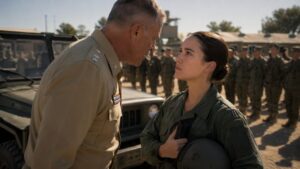
A warning dismissed because schedules mattered more.
Nothing dramatic.
Nothing cinematic.
Just a concern pushed aside.
Then an avoidable collapse.
People injured.
Lives changed.
The lesson had remained long after the event.
Small warnings mattered.
Especially when they were inconvenient.
Emily watched him carefully.
“You still carry that.”
Steven shrugged.
The motion felt weak even to him.
“That’s what memory does.”
“No.”
Emily leaned forward.
“That’s what guilt does.”
He looked away.
Outside, traffic moved through the intersection.
The world carried on.
Always had.
Always would.
“You know what the funny part is?” Emily asked quietly.
Steven shook his head.
“I don’t think you’re afraid the building fails.”
He frowned.
“What?”
“I think you’re afraid you’ll be ignored again.”
The words landed harder than expected.
Because they were close to the truth.
Not exact.
Close.
For years Steven had told himself he cared only about safety.
Only about responsibility.
Only about doing the right thing.
Those things were true.
But there was another truth underneath.
Being dismissed hurt.
Not because of pride.
Because it made him feel invisible.
Old.
Finished.
A man people tolerated until they no longer needed him.
Emily saw it.
Of course she did.
“You’re allowed to say it.”
Steven laughed softly.
“No.”
“Why not?”
“Because it sounds pathetic.”
“It sounds human.”
Neither spoke for a while.
Eventually Emily tapped the table.
“You know why younger people ignore experience sometimes?”
Steven raised an eyebrow.
“Tell me.”
“Because experienced people keep speaking in riddles.”
That drew a genuine smile.
“Is that what I’m doing?”
“Constantly.”
She pointed toward him.
“You see something. You expect everyone else to see it too.”
Steven started to object.
Then stopped.
Because she wasn’t entirely wrong.
The thought lingered as they left the center.
Outside, Emily paused beside her truck.
“You going back?”
“Probably.”
“Then stop expecting people to read your mind.”
He watched her climb inside.
Before shutting the door she added one final sentence.
“Teach them before you judge them.”
The truck pulled away.
Steven remained standing alone in the parking lot.
The words followed him all afternoon.
By evening he sat in his small house reviewing notes from the site.
Measurements.
Sketches.
Observations.
Patterns.
The phone rang.
He almost ignored it.
Then saw Alexander’s name.
Steven answered immediately.
“Alexander?”
The younger engineer sounded breathless.
“We have another problem.”
Steven stood.
“What happened?”
“The west span moved again.”
Every muscle in his body tightened.
“How much?”
“Enough.”
Noise echoed in the background.
Voices.
Shouting.
Confusion.
Steven grabbed his keys.
“Where’s David?”
“On-site.”
“Is everyone out?”
A pause.
Too long.
“We’re trying.”
The words hit like cold water.
Steven headed for the door.
Then Alexander added something that stopped him.
“Steven.”
“What?”
“The crack wasn’t the beginning.”
Steven froze.
“What do you mean?”
“We found another report.”
Silence.
Alexander’s voice dropped.
“The first inspector warned them.”
Steven closed his eyes.
For a moment the room seemed very still.
Another warning.
Another report.
Another chance ignored.
Then a loud alarm sounded through Alexander’s phone.
The engineer’s next words came fast.
“You need to get here now.”
The call disconnected.
Chapter 6: When the Structure Finally Spoke
Nobody seemed to know who was in charge.
That was the first thing Brandon noticed when he arrived at the emergency assembly area.
Workers clustered behind temporary barriers.
Supervisors shouted conflicting instructions.
Vehicles blocked access roads.
Sirens echoed somewhere in the distance.
The site had transformed from organized construction project to controlled chaos.
Brandon pushed through the crowd.
“What happened?”
Nobody gave the same answer twice.
Structural shift.
Connection failure.
Inspection issue.
Evacuation order.
Rumors spread faster than facts.
Then he saw David.
The superintendent stood near the command trailer speaking into a phone.
His face looked pale.
Not angry.
Not defensive.
Scared.
For the first time since Brandon met him, David looked like a man who understood the situation might be bigger than his ability to control it.
A security worker blocked access to the main structure.
“No entry.”
Brandon pointed toward the steel frame.
“My crew’s still up there.”
“They’re coming down.”
The man sounded uncertain.
That uncertainty made Brandon’s pulse quicken.
Another metallic groan rolled through the structure.
Louder than before.
Everyone heard it.
Conversations stopped instantly.
Heads turned.
The sound seemed to travel through the entire framework.
A warning.
Not yet a failure.
But close enough.
A pickup truck skidded into the site entrance.
Steven stepped out before it fully stopped.
He moved quickly.
Not recklessly.
Purposefully.
The crowd parted almost without realizing it.
Brandon watched him cross the site.
No shouting.
No panic.
Just focus.
Alexander met him halfway.
The engineer looked exhausted.
“We isolated three more movement points.”
“Show me.”
David intercepted them.
“No.”
Both men turned.
David rubbed his face.
“The city inspector is coming.”
Steven didn’t stop walking.
“We don’t have time.”
David stepped in front of him.
“The area is unstable.”
“That’s why I’m going up.”
For a moment neither man moved.
Then David said quietly, “If something happens up there—”
Steven interrupted.
“Something is already happening.”
The words landed hard because nobody could argue with them.
David looked away first.
Alexander led Steven toward the structure.
Brandon followed despite repeated instructions not to.
Nobody had enough energy left to stop him.
The upper levels felt different now.
Not visibly damaged.
Uneasy.
The kind of feeling workers developed after years around heavy materials.
Instinct.
Pressure.
Possibility.
Steven moved from connection to connection.
Listening.
Watching.
Measuring.
The carpenter’s pencil remained tucked behind his ear.
A familiar sight amid growing tension.
Alexander pointed toward a section near the west span.
“There.”
Steven crouched.
Examined the joint.
Then looked beyond it.
Much farther.
Brandon saw the change immediately.
The older man’s attention shifted somewhere else.
Not to the obvious problem.
To the hidden one.
“What?” Alexander asked.
Steven pointed toward a support line.
“That’s where it’ll go.”
Alexander frowned.
“This isn’t the damaged section.”
“I know.”
The engineer followed the load path with his eyes.
Understanding arrived slowly.
Then all at once.
His face drained of color.
“That’s impossible.”
Steven stood.
“No.”
A deep metallic pop interrupted him.
Everyone froze.
The structure moved.
Not much.
Enough.
Dust drifted from a distant connection.
Steven turned immediately.
“Evacuate that side.”
Alexander grabbed his radio.
Workers began moving.
Some quickly.
Some reluctantly.
Then another groan rolled through the steel.
This one sounded different.
Closer.
The structure had stopped whispering.
Now it was speaking.
Brandon found himself running messages between crews.
People moved faster now.
Fear had replaced skepticism.
A worker stumbled while descending temporary stairs.
Others helped him.
Equipment was abandoned where it stood.
Tools dropped.
Machinery shut down.
Minutes stretched.
The evacuation felt both rushed and painfully slow.
Steven remained near the center of the structure.
Watching.
Calculating.
Listening.
Brandon reached him.
“Come on.”
Steven didn’t move.
“Not yet.”
The answer frustrated him.
“Why?”
Steven pointed.
The original pencil circle.
Still visible.
Still marking the crack that had started everything.
Only now the crack had extended beyond it.
The circle looked too small.
Like a warning nobody had taken seriously enough.
Steven stared at it for a moment.
Then finally nodded.
“Now.”
They descended together.
The moment their boots touched ground, a sharp report echoed through the west span.
Not a collapse.
A partial connection failure.
Steel shifted.
Several members moved unexpectedly.
The crowd gasped.
Dust burst into the air.
Then everything stopped.
Silence followed.
No complete structural failure.
No catastrophe.
Because the area had been evacuated.
Because people were no longer standing beneath it.
Because someone had listened before the next warning arrived.
Emergency personnel secured the site.
Hours later workers remained gathered outside barriers.
Nobody wanted to leave.
Nobody understood everything that had happened.
But everyone understood enough.
Steven sat on the tailgate of his truck.
Exhaustion showed in every line of his face.
Brandon approached slowly.
“You knew.”
Steven shook his head.
“No.”
“But you predicted it.”
“I recognized it.”
The distinction mattered.
Brandon finally understood that.
Across the site, investigators began arriving.
Engineers.
Officials.
Inspectors.
Questions replaced rumors.
Near sunset Donna Roberts stepped through the gate carrying a case file.
She spoke briefly with city officials.
Then with David.
Then with Alexander.
Finally her eyes settled on Steven.
The expression on her face changed.
Not recognition.
Interest.
The kind people showed when they realized a story was much larger than it first appeared.
As workers drifted home, Donna opened the first investigation folder.
Inside sat copies of old reports.
Missing records.
Inspection notes.
And a growing trail of decisions.
The official investigation had begun.
Chapter 7: The Weight of Being Correct
“They ignored my recommendation because he convinced them to.”
David Torres pointed across the hearing room.
At Steven.
The accusation landed with a dull heaviness rather than surprise.
For three days investigators had interviewed workers, reviewed records, and reconstructed timelines. The construction site remained closed behind temporary fencing while engineers evaluated the damaged sections.
Now everyone sat in a municipal conference room that smelled faintly of coffee and paper.
Donna Roberts looked up from her notes.
“You’re saying Mr. Harris influenced the review process?”
David straightened in his chair.
“I’m saying he created uncertainty.”
Steven said nothing.
The room waited.
Donna glanced toward him.
“Would you like to respond?”
Steven folded his hands.
“No.”
That answer visibly irritated David.
“Of course not.”
Donna’s eyes narrowed slightly.
“Mr. Torres, facts are more useful than frustration.”
A few people shifted uncomfortably.
David looked away.
The superintendent appeared older than he had a week ago.
Not because of time.
Because of consequences.
Steven recognized the look.
Too many sleepless nights.
Too many conversations replayed in memory.
Too many chances to choose differently.
Donna continued.
“We’ve already established the crack existed.”
She turned a page.
“We’ve established multiple stress points.”
Another page.
“We’ve established that evacuation prevented injuries.”
David rubbed his forehead.
“Then what exactly are we doing here?”
The answer came from Donna immediately.
“Determining why it reached that point.”
Silence followed.
The investigation was no longer about steel.
It was about decisions.
And everyone in the room knew it.
Several hours later the questioning shifted toward documentation.
Reports appeared on screens.
Inspection notes.
Internal emails.
Measurement logs.
Each piece added another layer.
Nothing dramatic.
Nothing corrupt.
Just warning after warning receiving less attention than it deserved.
The pattern was difficult to ignore.
Donna projected a photograph onto the screen.
Steven leaned forward.
The room did too.
A steel column.
A faded yellow circle.
His pencil mark.
Someone had photographed it before the evacuation.
The image filled the wall.
A simple ring surrounding a hairline crack.
Nothing more.
Yet suddenly it seemed impossible to look away from.
Donna pointed toward the image.
“When was this marked?”
A supervisor answered.
“Four days before the incident.”
“And who marked it?”
Several people glanced toward Steven.
The older man raised his hand slightly.
“I did.”
Donna nodded.
“Why?”
Steven studied the photograph.
For a moment he almost answered the way he usually did.
Short.
Technical.
Detached.
Then he remembered Emily’s voice.
Teach them before you judge them.
He cleared his throat.
“Because the crack wasn’t behaving normally.”
The room listened.
“The shape was wrong.”
He stood and walked toward the screen.
Not dramatically.
Simply because it was easier to point.
“The steel wasn’t failing here.”
His finger touched the image.
“It was reacting to something somewhere else.”
Several engineers nodded.
Others took notes.
Steven continued.
“I didn’t know exactly what. I knew enough to keep looking.”
Donna watched carefully.
“And when your warnings weren’t acted upon?”
Steven paused.
The answer mattered.
“I kept checking.”
“Why?”
The room became very quiet.
Steven looked at the photograph again.
The faded circle.
The pencil mark.
The thing everyone had laughed at.
The thing nobody could ignore now.
Finally he answered.
“Because structures don’t care who’s right.”
A few heads lowered.
No speech followed.
No dramatic declaration.
Just the truth.
The hearing continued.
Piece by piece the investigation revealed what had happened.
An earlier inspection had flagged concerns.
Follow-up reviews never received proper attention.
Deadlines grew more important.
Warnings became background noise.
Nothing malicious.
Just human.
And dangerous.
By late afternoon even David stopped arguing.
He looked tired.
Defeated.
Not because Steven had beaten him.
Because reality had.
During a break, David approached quietly.
The room around them buzzed with conversations.
Neither man spoke for several seconds.
Then David said, “You think I wanted this?”
Steven shook his head.
“No.”
David laughed bitterly.
“Everyone acts like I ignored it on purpose.”
“You ignored it anyway.”
The words weren’t cruel.
That somehow made them harder to hear.
David stared at the floor.
“I kept telling myself we’d inspect after the review.”
Steven nodded.
“I know.”
“You knew?”
“I’ve done the same thing.”
That got David’s attention.
The younger man looked genuinely surprised.
Steven shrugged.
“Not with this.”
A pause.
“But I’ve made mistakes.”
The admission hung between them.
Neither man tried to soften it.
Finally David looked away.
For the first time there was no argument left.
Only regret.
The hearing resumed.
Toward evening Donna announced preliminary findings.
No final conclusions.
No punishments yet.
Just facts.
Enough facts to change careers.
Enough facts to change reputations.
Enough facts to ensure nobody forgot the incident.
As people gathered their belongings, Brandon stood.
The movement surprised everyone.
Including Steven.
The younger worker looked nervous.
Very nervous.
Yet he remained standing.
“I’d like to say something.”
Donna nodded.
“Go ahead.”
Brandon glanced around the room.
Then directly at Steven.
“When he first came back to the site, I thought he was just another retired guy who couldn’t let go.”
A few uncomfortable smiles appeared.
Brandon continued.
“I wasn’t the only one.”
Nobody argued.
“We all kept asking why he cared.”
His voice steadied.
“The wrong question was why we didn’t.”
Silence filled the room.
No applause.
No reaction.
Just thought.
Brandon sat down.
The hearing ended minutes later.
But Steven found himself replaying those words as everyone filed toward the exits.
Outside, evening light stretched across the parking lot.
For the first time in days, the investigation felt less like a fight.
And more like a lesson.
Chapter 8: What the Young Men Finally Saw
The workers were already waiting when Steven arrived.
The construction site looked different.
Not because of the repairs.
Because of the pace.
The rush was gone.
The reopened project moved carefully now.
Deliberately.
Inspection tags hung from newly reinforced sections. Engineers walked the framework daily. Documentation followed every adjustment.
People looked twice.
Sometimes three times.
Steven parked near the gate and sat for a moment before getting out.
Part of him expected things to return to normal.
To be ignored again.
To fade quietly into the background.
Old habits were difficult to abandon.
When he stepped through the gate, conversations paused.
Not dramatically.
Just enough.
Several workers nodded.
A crane operator raised a hand.
A welder greeted him.
Simple things.
Ordinary things.
Respect expressed without performance.
Steven found that easier to accept.
Brandon approached carrying a clipboard.
The younger man grinned.
“You took your time.”
“I wasn’t aware I had a schedule.”
“You do now.”
Steven raised an eyebrow.
“Oh?”
Brandon pointed toward the structure.
“People keep asking questions.”
“Sounds unfortunate.”
“It is when nobody else knows the answers.”
Steven almost smiled.
Almost.
Together they walked through the site.
The repaired west span stood stronger than before.
New analysis had identified the broader pattern Steven suspected from the beginning.
The crack had never been the real problem.
Just the first visible symptom.
The lesson remained etched into every revision.
Brandon stopped beside a column.
Without thinking, he pulled a carpenter’s pencil from behind his ear.
Steven noticed immediately.
“So that’s what we’re doing now?”
Brandon laughed.
“I don’t even realize I’m doing it anymore.”
The younger worker crouched beside a connection.
Tap.
Tap.
Tap.
The same routine.
The same habit.
The same listening.
Steven watched quietly.
Brandon studied the steel.
Then stood.
“Nothing wrong.”
“Good.”
“But I checked anyway.”
Steven nodded.
“Also good.”
The moment lasted only seconds.
Yet it carried unexpected weight.
Because it wasn’t imitation.
It was understanding.
Later that morning Alexander joined them during an inspection walk.
The engineer carried updated drawings.
He handed one set to Steven.
“I still think you’re impossible.”
Steven glanced at him.
“That’s a strange way to say thank you.”
Alexander laughed.
“I mean it.”
They reviewed the plans together.
Not as consultant and engineer.
As colleagues.
The difference wasn’t spoken.
It didn’t need to be.
Around noon Steven noticed a familiar vehicle entering the site.
Emily Martinez stepped out.
The prosthetic leg clicked softly against the pavement as she crossed the yard.
Brandon immediately moved aside.
“Is that the person who keeps winning arguments against you?”
Steven frowned.
“Nobody wins arguments against me.”
Emily arrived in time to hear it.
“That’s adorable.”
Brandon laughed and wisely retreated.
Emily looked around the site.
“Looks better.”
“It is.”
“They finally listening?”
Steven considered the question.
Workers moved through the structure.
Conversations flowed.
Inspections continued.
Nobody treated safety concerns like interruptions anymore.
At least not today.
“Some are,” he answered.
Emily nodded.
“That’s enough.”
For now, it was.
They walked together through the project.
Several workers greeted Emily.
Some recognized her from veteran outreach events.
Others simply noticed the confidence with which she carried herself.
The same confidence people often overlooked before they knew her story.
By afternoon the site superintendent’s office door opened.
David emerged.
He no longer held the same position.
Corporate restructuring had seen to that.
He remained involved during the transition period.
A difficult compromise.
One he accepted quietly.
David approached Steven.
Neither man seemed eager for the conversation.
Yet both stopped.
“I wanted to tell you something.”
Steven waited.
David looked toward the structure.
“I should’ve listened sooner.”
The statement arrived without excuses.
Without qualifications.
Steven respected that.
“It wouldn’t have changed everything.”
“No.”
David exhaled.
“But it would’ve changed enough.”
For a moment neither spoke.
Then David offered his hand.
Steven shook it.
Not because everything was fixed.
Because pretending otherwise served no purpose.
The conversation ended there.
Exactly where it should.
Late afternoon sunlight reflected off repaired steel as crews prepared to leave.
Brandon remained behind finishing inspection notes.
Steven found him beside the original column.
The pencil circle was gone.
Painted over during repairs.
Yet Brandon still knew where it had been.
“So that’s it?” the younger man asked.
“What is?”
“The big lesson.”
Steven looked up at the framework.
The question deserved thought.
Not because it was complicated.
Because it wasn’t.
Finally he said, “Pay attention.”
Brandon laughed.
“That’s it?”
“Most people don’t.”
The younger worker shook his head.
“You’re impossible.”
Steven smiled.
This time he didn’t hide it.
The site slowly emptied.
Engines shut down.
Tools disappeared into storage containers.
The day ended.
Before leaving, Brandon reached into his pocket and pulled out a carpenter’s pencil.
The same kind Steven carried.
He tucked it behind his ear.
Then headed toward the gate.
Steven watched him go.
Not as a replacement.
Not as a student.
As someone who had learned to look twice.
For years Steven had measured his worth through what he could still do.
What he could still fix.
What he could still notice.
The investigation, the crack, the arguments, the near failure—none of it had solved that fear.
Something else had.
The realization that experience only mattered when shared.
Not protected.
Not hidden.
Shared.
He looked once more at the structure.
Then turned toward his truck.
Behind him, the site continued.
Stronger than before.
Not because one old veteran had been right.
Because eventually people learned to listen.
The story has ended.