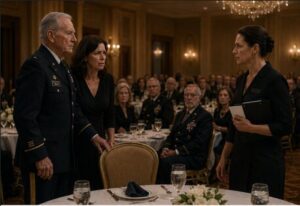
The Young Officer Checked Her Name on the Tablet and Finally Stood Straight
Chapter 1: The Woman at Desk Seven Would Not Leave
By the time the third clerk told Cynthia Wright the file did not exist, she had already unfolded the request card so many times the crease had begun to whiten.
The card lay beneath her left hand on Desk Seven, small and stubborn against the broad gray surface. Around it, the records archive moved with the quiet rhythm of a place that belonged more to machines than to people. Printers clicked behind frosted glass. Fluorescent lights hummed overhead. Somewhere beyond the shelves, a cart squeaked along a track and stopped with a soft metallic knock.
Cynthia did not move when the clerk slid her form back across the desk.
“Ma’am, I’m sorry,” the clerk said, not unkindly. “The system says incomplete request. Without a current authorization number, we can’t pull restricted material.”
Cynthia looked down through her glasses at the form. Her handwriting was still straight, though smaller than it had once been. She had written the name carefully.
Joseph Campbell.
Below it, she had written the file number from memory first, then checked it against the folded card before adding the final two digits. The number had lived in her mind for longer than some of the clerks in the room had been alive.
“I have the file number,” Cynthia said.
“Yes, ma’am, but the file number alone isn’t enough.”
“It was enough when I called last month.”
The clerk glanced toward the line forming behind Cynthia. A man in a veterans cap shifted his weight from one foot to the other. A woman with a folder under her arm checked her watch. Near the wall, a young serviceman in a pressed uniform stood with a tablet tucked against his ribs, watching the front counters with the practiced impatience of someone assigned to solve bottlenecks.
The clerk lowered her voice. “Sometimes the phone center gives general information. Here, we have to follow the access rules.”
Cynthia nodded once. Rules had never bothered her when they were protecting something. It was when they stood in front of what they were meant to protect that she had learned to sit very still.
“I’ll wait,” she said.
The clerk blinked. “There may not be anything to wait for.”
“There is a file.”
“Ma’am—”
“There is a file,” Cynthia repeated, not louder, not sharper. “Joseph Campbell. Transfer group attached to evacuation records. Box code seventy-four. Supplemental witness statement missing from the public index.”
The clerk’s expression shifted, only slightly. Not belief. More like caution.
Cynthia folded her hands over the card. Her fingers were thin now, the knuckles raised and pale beneath the skin. When she pressed her palms together, the old ache came through the joints, traveling from finger to wrist with familiar persistence. She had ignored worse pains. She ignored this one.
The young serviceman by the wall noticed the delay. He said something quietly to another man beside him, then started toward Desk Seven.
His name tag read Allen.
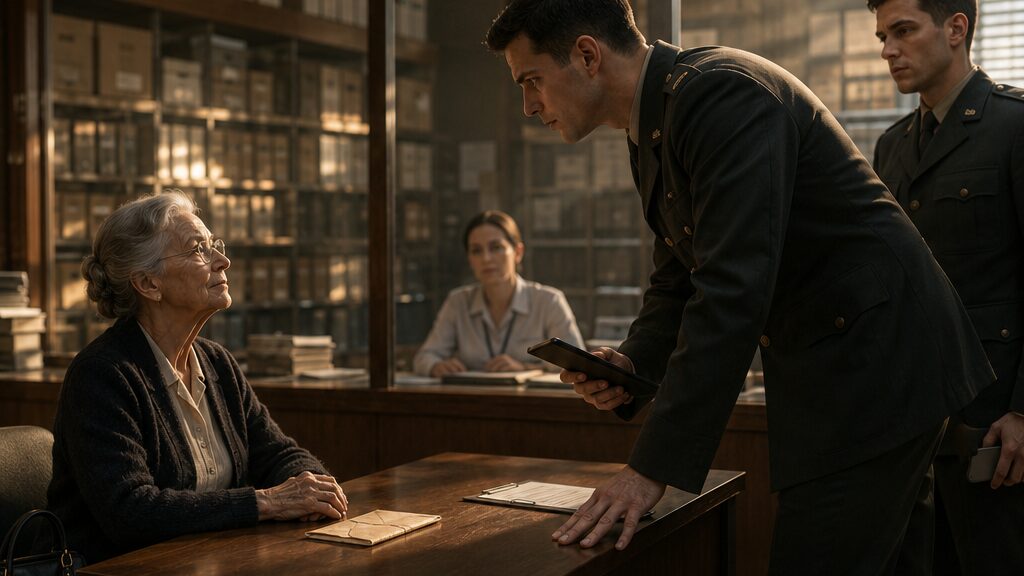
He was tall enough that when he reached the desk, his shadow fell across Cynthia’s form. The light from the high windows striped his sleeve and jaw. He did not seem angry. That would have been easier. He seemed busy, and busy men often thought politeness was the same as listening.
“Problem here?” he asked the clerk.
The clerk straightened in her chair. “Request for a restricted file. The form is incomplete.”
Nicholas Allen turned his attention to Cynthia. His eyes dropped first to her cardigan, then to the pill organizer peeking from the side pocket of her handbag, then to the old request card beneath her hands.
“Ma’am, we can help you resubmit the proper form online,” he said. “But we can’t keep a desk tied up when there are other appointments waiting.”
Cynthia looked at the line behind her. The man in the veterans cap looked away, embarrassed for her or for himself. The woman with the folder shifted again. No one complained out loud.
“I have an appointment,” Cynthia said.
Nicholas took the form from the clerk and scanned it. He did it quickly, with the confidence of someone accustomed to screens giving him the whole truth. “This appointment was for a general records consultation. Not restricted retrieval.”
“It was for Joseph Campbell’s file.”
“That’s not what this says.”
“It is what I requested.”
He set the form down with two fingers, as if returning something too fragile to trust. “Ma’am, sometimes older request cards are no longer valid. The system updates. Procedures change.”
Cynthia almost smiled. “Yes. They do.”
The clerk’s face tightened. The younger man with Nicholas, the one standing half a pace behind, glanced toward Cynthia as if he had heard something in her voice that Nicholas had missed. His name tag read Harris.
Nicholas did not catch it. He shifted the tablet against his forearm and leaned a little closer over the desk.
“What we can do,” he said, “is schedule you for assistance with digital access. Someone can help you search family records, service dates, burial information, whatever you’re trying to find.”
Cynthia’s thumb moved once over the folded card. There were words on the back that no one could see. Not many. Just enough to make her cross three states by train and taxi and base shuttle, enough to bring her to Desk Seven before the archive opened.
“I’m not searching family records,” she said.
Nicholas gave the careful pause of a man trying to remain patient. “Then what exactly are you trying to find?”
“The statement that should have been attached to Joseph Campbell’s final report.”
Daniel Harris looked up then.
Cynthia saw it. She had spent years watching faces over bedsheets, over clipboards, over letters sealed too late. Young men always thought they could hide recognition. They could not. It flashed before training caught up.
Nicholas noticed Daniel’s change and frowned. “Harris?”
Daniel adjusted the tablet in his hands. “Sir, there was a transfer list this morning. Some older restricted files flagged for consolidation.”
“That happens every week.”
“Yes, sir. Campbell might have been on it.”
Cynthia kept her eyes on the card.
Nicholas turned back to her. “Ma’am, if this file is part of a scheduled transfer, then that makes access even less likely today.”
“Less likely isn’t impossible.”
“Without authorization, it is.”
The clerk behind the desk said, “The archive supervisor won’t override a restricted hold unless there’s a verified service connection or legal request.”
Cynthia drew in a slow breath. She had known this might come. She had prepared for many things: the wrong building, the wrong desk, a system that had renamed old units twice since the last time she looked, a clerk too young to know that paper sometimes carried what databases forgot. She had not prepared for how tired she would be by midmorning.
“I have a service connection,” she said.
Nicholas’s eyes softened in the wrong way. “If Mr. Campbell was your husband or brother, we still need documentation.”
Cynthia lifted her gaze to him.
The room did not stop, but it seemed to thin around her. The printer kept working. The cart squeaked again. Someone at Desk Three laughed quietly into a phone. Life continued, as it had always continued after men were loaded onto stretchers and others were left waiting for transport that came too late.
“He was not my husband,” Cynthia said.
Nicholas waited.
“He was not my brother.”
The clerk asked, “Then your relation to him?”
Cynthia looked down at the card. The ink was faded but legible, written years ago by her own hand on a morning she had thought she would never forget and somehow had spent decades trying not to remember.
“I was there,” she said.
Nicholas did not understand. Not yet. He looked from her face to the form and back again. His voice grew careful, but not respectful.
“Ma’am, a lot of people believe they remember things connected to old records. That doesn’t make the archive standard different.”
Daniel’s eyes went again to the tablet.
Cynthia saw his thumb hover near the search bar. She also saw Nicholas’s hand lift, stopping him without a word.
“You need to understand,” Nicholas continued, “if that file is on today’s transfer list, it may be physically moved by noon. Once it leaves this office, there’s nothing anyone at this desk can do.”
The word noon settled between them.
Cynthia looked toward the tall windows. The sun had moved across the blinds, throwing bright bars over the floor. Somewhere in the building, a clock ticked toward a deadline that had waited forty-nine years and now had the cruelty to arrive on schedule.
She folded the request card once, along the old crease, and slid it beneath her palm again.
“Then I’ll stay until noon,” she said.
Nicholas stared at her. The impatience did not leave his face, but something in it loosened, unsettled by the quiet certainty of an old woman who would not raise her voice and would not leave.
Behind him, Daniel Harris lowered his eyes to the tablet.
Chapter 2: Nicholas Allen Checks the Second Line
Nicholas Allen had seen people hold up the records line for many reasons, and most of them had nothing to do with records.
They came looking for proof a grandfather had been braver than the family remembered. They came with rumors, misspelled names, courthouse copies, water-damaged letters, and stories that grew softer or larger depending on who had told them last. Some cried. Some got angry. Some expected a uniform at the desk to turn a missing date into a miracle.
Nicholas had learned to keep his voice even, his shoulders square, and his answers brief.
The woman at Desk Seven did not fit any category neatly, which irritated him more than it should have.
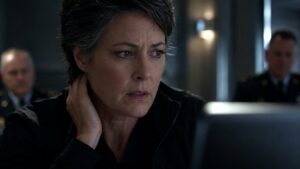
She was too calm. That was the first thing. People who demanded exceptions usually pushed their papers forward, tapped counters, repeated themselves loudly enough to recruit witnesses from nearby desks. Cynthia Wright did none of that. She sat with her purse beside her chair, her gray hair pinned at the back, her glasses low on her nose, her hands folded over a card as if she were keeping it warm.
Nicholas looked at the clock above the intake window.
10:43.
If Campbell was on the transfer list, he was not going to stop that process for a woman with an incomplete form and a memory she had not explained.
“Harris,” Nicholas said, “pull up the transfer queue.”
Daniel did. His thumb moved across the tablet. The screen reflected pale light onto his face.
Nicholas kept his attention on Cynthia. “I’m going to verify whether the file is scheduled for movement. That doesn’t mean access is approved.”
“I understand,” she said.
He expected some challenge. None came.
The clerk at the desk shifted back slightly, grateful to have the decision lifted above her pay grade. The line behind Cynthia had grown. Nicholas could feel the watching eyes. That was part of the problem. Small scenes in public offices became stories before anyone knew what had happened. An old woman refused at a military archive. A young officer speaking too sharply. A misunderstanding clipped in someone’s memory and passed along without the rules that caused it.
Nicholas lowered his voice. “If you’ll step aside, we can continue without blocking the intake desk.”
Cynthia looked at the empty chairs along the wall.
Then she looked back at him. “If I step aside, will the file still be checked?”
Nicholas exhaled through his nose. “Yes.”
“Then I’ll step aside.”
She reached for her purse. The movement was slower than he expected, not theatrical, just aged. Daniel stepped forward before Nicholas could, lifting the strap when it caught under the chair leg.
“Thank you,” Cynthia said.
Daniel nodded. “Ma’am.”
Nicholas noticed the word. Not its use, but its tone. Daniel said it as if it belonged to her already.
They moved to the side consultation table near the tall shelves. It was quieter there, though not private. Cynthia sat facing the room. Nicholas remained standing. Daniel stood beside him with the tablet.
“Campbell, Joseph,” Daniel said. “There are multiple entries.”
“Middle initial?” Nicholas asked.
Cynthia answered before he could look at her form. “R.”
Daniel entered it.
The tablet loaded.
Nicholas watched the screen over Daniel’s shoulder. Rows appeared: service index, casualty administrative supplement, evacuation unit cross-reference, restricted witness packet, transfer status pending consolidation.
Daniel’s jaw tightened.
Nicholas tapped the side of the screen. “Open transfer status.”
Daniel opened it.
“Scheduled physical movement,” he read. “Today. Twelve hundred. Box code seventy-four.”
Cynthia’s fingers closed around the folded card.
Nicholas felt the first small shift in his own certainty. The file existed. The box code was right. She had not guessed it from a family rumor.
Still, existence was not access.
“Open requester eligibility,” Nicholas said.
Daniel hesitated. “For Campbell?”
“For the request.”
Daniel backed out and opened Cynthia’s visitor record. The tablet displayed her typed appointment profile. Cynthia Wright. Civilian visitor. General consultation. No active legal authorization. No family relation listed.
Nicholas turned the screen slightly toward her. “This is the issue. Your appointment doesn’t establish eligibility.”
Cynthia studied the screen through her glasses. Her expression did not change.
“Check the second line,” she said.
Nicholas glanced back. “The second line says civilian visitor.”
“No,” Cynthia said. “Not that screen.”
Daniel looked at her.
“The service cross-reference,” she said. “Under witness packet.”
Nicholas frowned. “You know the database layout?”
“I know what used to be in the paper index.”
“That’s not the same thing.”
“No,” she said. “But paper taught the system what to forget.”
Daniel’s thumb moved before Nicholas stopped him. He returned to Joseph Campbell’s file, opened the restricted witness packet summary, and scrolled.
The first line showed Joseph’s name and file status.
The second line showed a linked witness entry.
Wright, Cynthia A.
Former Army Nurse, Evacuation Attachment 17.
Service record verified. Supplemental witness statement pending review.
For a moment, Nicholas did not read it correctly. The words were familiar, but their arrangement did not fit the woman seated in front of him. He saw Wright. He saw Cynthia. He saw Army Nurse. He saw service record verified.
Daniel stopped breathing beside him.
Nicholas looked from the tablet to Cynthia.
She sat exactly as she had before. Nothing triumphant crossed her face. No satisfaction. No anger. The same calm, almost tired composure remained, and it struck him harder than accusation would have.
He had asked if Joseph Campbell was her husband or brother. He had offered to help her search family records. He had thought she was one more elderly visitor trying to pull history closer before memory let go.
She had not corrected him.
Not fully.
Nicholas straightened without deciding to. His shoulders pulled back. His hand fell away from the edge of the table.
Daniel lowered the tablet slightly, as if the screen had become heavier.
“Mrs. Wright,” Nicholas began, then stopped.
Cynthia looked up.
He corrected himself, not knowing whether it was enough, only knowing the old word no longer fit the moment as he had used it.
“Ms. Wright,” he said, quieter. “You served with the evacuation attachment?”
“Yes.”
Daniel’s eyes flicked once to Nicholas, then back to her. “Ma’am, I’m sorry. I didn’t realize—”
“I didn’t ask you to realize,” Cynthia said.
The words were not harsh. They were worse than harsh. They were level.
Nicholas felt heat rise under his collar. He had been trained to respect service. He had stood through briefings, ceremonies, memorial runs, flag foldings. He knew the gestures. But all morning, service had been sitting at Desk Seven with a folded card under her hand, and he had treated her like a delay.
He brought the tablet closer to his chest, no longer letting it hang casually from his hand.
“May I ask why your appointment was listed as civilian?” he said.
“I am a civilian now.”
The answer landed cleanly.
Daniel looked down, almost smiling despite himself, not from humor but from the precision of it.
Nicholas nodded once. “Yes, ma’am.”
This time the word came differently. He heard the change in his own voice.
Cynthia’s gaze rested on him a moment. “I’m not here to correct my file.”
“What are you here to correct?”
“Joseph Campbell’s.”
Nicholas looked back at the tablet. “His record shows a restricted witness packet, but the statement is pending review. If your name is linked, there may be a way to request supervisor access.”
“There is a way,” Cynthia said.
“You’ve done this before?”
Her eyes moved to the shelves beyond him. “A long time ago, I helped build rooms like this.”
Nicholas did not know what to say to that.
The archive noise seemed to return all at once: printers, footsteps, the soft ring of a desk phone. But the small space around the consultation table had changed. Daniel stood straighter. The clerk at Desk Seven watched from behind her monitor, sensing a reversal without knowing the details.
Nicholas tapped the restricted packet. A warning box appeared.
Supervisor authorization required.
He read the message twice. “I can call Linda Scott. She’s the archive supervisor.”
“Please,” Cynthia said.
Nicholas turned to Daniel. “Find out whether Box seventy-four has left staging.”
Daniel nodded and moved quickly toward the restricted corridor.
Nicholas remained by the table. He wanted to apologize. The words arranged themselves in his head, proper and official and useless.
Cynthia unfolded the card once more, smoothing the crease with her thumb.
Nicholas saw, for the first time, writing on the back. Only a few words. He could not read them from where he stood.
“Ms. Wright,” he said.
She glanced up.
“I should have checked before I assumed.”
“Yes,” she said.
No anger. No comfort either.
He accepted it because there was nothing else to do.
Daniel returned from the corridor faster than expected. His face had changed again, this time not with recognition but alarm.
“Sir,” he said, holding his voice low. “Campbell’s box is still in restricted staging, but there’s a sealed file notice attached.”
Nicholas turned. “What kind of notice?”
Daniel looked at Cynthia, then back at Nicholas.
“It says opening the witness packet could trigger administrative review.”
Cynthia folded the card carefully and slid it into her palm.
Nicholas asked, “Review of what?”
Daniel swallowed.
“An omission from the original evacuation report.”
Cynthia closed her eyes for one brief second.
When she opened them, she said Joseph Campbell’s name softly, as if answering someone who had waited a long time.
Chapter 3: The File Number No One Wanted Opened
Daniel Harris had been inside the restricted records room only six times before, and each time he had felt as if the building expected him to apologize.
The room was cooler than the public archive. It smelled of paper, dust, metal shelving, and the faint plastic scent of storage bins that had replaced older boxes without ever making the older boxes disappear. Rows rose on either side of him, labeled by year, conflict, unit, and classification code. Overhead lights clicked on in sections as he walked, illuminating one narrow aisle at a time.
Box seventy-four sat on a waist-high transfer cart near the back wall.
It did not look important.
That was the thing Daniel could not get past. It was gray, standard, scuffed along one corner, sealed with a barcode strip and a red temporary hold tag. A dozen boxes just like it sat beneath and above it. Any one of them could have held a life. Any one of them could have held a mistake.
He stopped in front of it and checked the tablet again.
Campbell, Joseph R.
Restricted witness packet.
Pending consolidation.
Administrative review risk.
The final phrase sat on the screen with no explanation. Review risk. As if the danger were not that something had been forgotten, but that someone might notice.
Daniel heard the door open behind him.
Nicholas stepped in first. Cynthia came after him, slower, one hand on the rail beside the short ramp into the room. Daniel moved at once to help, but she lifted two fingers from the rail.
“I have it,” she said.
He stopped.
Nicholas noticed. He did too. The morning had made them both clumsy in different ways. Before, Daniel had helped because she looked old. Now he was afraid not to help because he knew she had served. Neither response seemed quite right.
Cynthia reached the cart and looked at the box.
For the first time since Daniel had seen her, her composure thinned. Not much. Only enough that her mouth softened and her shoulders lowered, as if the box had spoken before anyone else could.
“Joseph,” she said under her breath.
Nicholas stood on the other side of the cart. He held the tablet with both hands now. “Ms. Wright, before we open anything, Supervisor Scott needs to approve access. She’s on her way.”
Cynthia nodded.
Daniel looked at the red hold tag. “It says do not open pending transfer.”
“It says do not remove,” Cynthia said.
Daniel leaned closer. She was right. The tag prohibited removal from staging. Opening required authorization, but the physical hold was for movement, not access.
Nicholas looked at the tag, then at her. Daniel saw the small discomfort on his face. Cynthia had spent less than five minutes in the restricted room and had already read the label more carefully than both of them.
“Still,” Nicholas said, “we wait for Linda.”
“Yes,” Cynthia said.
She rested her fingertips on the edge of the cart, not touching the box itself.
Daniel could not stop looking at her hands. Earlier, he had seen only age in them. Now he saw steadiness. He wondered what those hands had done when they were young. He wondered whether they had held bandages, tags, letters, instruments, other hands. The tablet had not told him that. It had only opened a door in his imagination and left him standing there ashamed.
The restricted room door opened again.
Linda Scott entered with a badge clipped to her jacket and a pencil tucked behind one ear. She was not in uniform, but she carried authority with less effort than Nicholas had. Her eyes moved first to the box, then to Cynthia, then to the tablet.
“I understand we have a linked witness requesting access,” Linda said.
Cynthia turned. “Cynthia Wright.”
Linda held out her hand. “Linda Scott. Archive supervisor.”
Cynthia shook it.
Linda did not rush the handshake, and Daniel saw Nicholas notice.
“I’ve reviewed the digital summary,” Linda said. “Your service record is verified, but the access issue remains complicated.”
“Because the statement was never attached,” Cynthia said.
Linda’s expression sharpened. “You know that?”
“I know what I sent.”
Nicholas looked up. “You sent the statement?”
Cynthia did not answer immediately. The restricted room seemed to press closer around them, shelves holding their silence upright.
“I wrote it,” she said. “I signed it. I placed it with the supplemental packet before the unit records were separated.”
Linda took the tablet from Nicholas and scrolled with practiced movements. “The index shows a pending statement, but no scanned document. If there’s a physical original in this box, opening it under your linked witness status might be permissible. But if the document contradicts the original report, it could trigger review.”
Daniel asked, “Isn’t that the point?”
Linda looked at him.
He regretted speaking, but not enough to take it back.
Linda’s voice remained even. “The point of an archive is preservation. Correction is a separate process.”
Cynthia looked at the box. “Preserving an error is still preservation, I suppose.”
Linda did not flinch. “Sometimes a correction requires sworn context. Sometimes it requires more than one witness. Sometimes the person asking for correction becomes part of the record in a way they may not want.”
At that, Cynthia’s gaze shifted.
Daniel caught it: a small movement, but full of something old and guarded.
Nicholas caught it too. His face changed, not dramatically, but with the look of a man beginning to understand that procedure was not the only thing standing in the room.
Linda set the tablet on the cart beside the box. “Ms. Wright, I need to ask plainly. Are you seeking access to Joseph Campbell’s file in order to amend his record?”
“Yes.”
“Are you prepared for your own service record to be cross-referenced in that amendment?”
Cynthia’s hand closed around the folded card.
Daniel saw the old crease again, the worn edge, the softness of paper handled across years. He wondered what was written on the back. He wondered why she kept folding and unfolding it as if it were not a note but a promise.
Cynthia said, “I am prepared for Joseph’s record to tell the truth.”
“That isn’t the same answer,” Linda said.
“No,” Cynthia replied. “It isn’t.”
For a moment, none of them spoke.
Linda reached for the red hold tag and turned it over. There were signatures on the back, transfer initials, dates, a chain of custody stamped in black. “This box leaves for consolidation at noon unless I place a supervisor delay.”
Nicholas checked the clock on the tablet. “Eleven twenty-six.”
Daniel felt the time tighten in his chest.
Linda looked at Cynthia. “A delay requires reason. If I enter ‘possible administrative correction,’ the base administrator may lock the file until legal review. That could take months.”
Cynthia’s face remained calm, but Daniel saw her thumb press hard into the folded card.
“And if you don’t enter that?” Nicholas asked.
Linda looked at him. “Then the box transfers. The witness packet may not be physically reviewed before consolidation. If the missing document is inside, it remains missing in practice.”
Daniel looked from Linda to Cynthia.
That was when the room changed for him. It was no longer a place of shelves and numbers. It was a place where a man named Joseph Campbell could disappear a second time, not in smoke or battle or distance, but in a barcode queue at noon.
Cynthia lifted the folded card and held it between both hands.
“I don’t want special treatment,” she said.
Nicholas lowered his eyes.
“I don’t want ceremony,” she continued. “I don’t want anyone to make me explain more than the record needs. I came because that file number was given to me, and because I said I would come if the statement did not surface before I died.”
Daniel felt the words settle into the cold room.
Linda’s voice softened, though only slightly. “Who gave you the number?”
Cynthia turned the card over.
For the first time, Daniel could read the writing on the back. It was faded, careful, written in a hand not quite as steady as the one on her modern request form.
If it gets lost, find me in the paper.
J.R.C.
Nicholas stared at it.
Linda looked at the card for a long moment. Then she reached for the tablet and opened the supervisor menu.
“I can delay the transfer for one hour,” she said. “No more without a formal reason.”
Cynthia nodded. “One hour is more than he had.”
No one asked what she meant.
Linda entered her credentials. The tablet chimed softly, and the red status on the screen changed to temporary supervisor hold.
Daniel released a breath he had not realized he was holding.
Then Linda looked up from the screen.
“If we open this,” she said, “and the missing statement is there, it may expose an administrative error in the original evacuation report. Not a small one.”
Nicholas’s grip tightened on the cart.
Daniel looked at Cynthia.
She did not look afraid of the error. She looked afraid of what correcti
Chapter 4: Cynthia Wright Remembers the Last Evacuation
Cynthia waited in the public archive because Linda Scott said the restricted room needed two signatures before the box could be opened.
It was a reasonable sentence. Clean. Procedural. Entirely harmless unless a person knew what it meant to wait for signatures while time became smaller.
The chairs along the wall were upholstered in stiff blue fabric, each one squared against the next. Cynthia chose the chair closest to Desk Seven, not because she needed to hear the clerks, but because she wanted the file number to remain in sight. Through the glass panel beside the restricted corridor, she could see the cart where Box seventy-four sat under its red hold tag.
Nicholas Allen stood near the corridor with Linda, speaking in low tones. Daniel Harris had gone somewhere behind the shelves, sent to find the second access log. Their voices did not reach Cynthia. Their movements did.
Nicholas no longer leaned over counters.
That should have meant nothing. Men learned posture from training, from mirrors, from correction. Still, Cynthia saw the difference. He had stood over her earlier without knowing he was doing it. Now he kept space between himself and anyone seated. When the clerk from Desk Seven approached him with a question, he stepped aside instead of crowding the passage.
Cynthia looked down at the folded card.
If it gets lost, find me in the paper.
J.R.C.
Joseph had written those words with his left hand because his right was bandaged and useless by then. He had made a joke about it. Something about his handwriting finally matching his singing voice. Cynthia had told him to save his breath.
He had not listened.
The archive faded around her by degrees. First the printers softened. Then the fluorescent hum became the drone of an old transport fan. The blue chairs blurred into canvas litters. The clean smell of paper became antiseptic, diesel, rain-soaked wool, and the metallic edge that never fully left a field station no matter how many times the floor was scrubbed.
She was twenty-six again, though memory was never kind enough to give the body back without the weight.
The evacuation station had been set up inside a schoolhouse with half its roof missing. They had used classroom tables for supply sorting and chalkboards for casualty numbers. Children’s drawings still clung to one wall, curling at the corners from damp air. Outside, trucks arrived without rhythm, some full, some nearly empty, some carrying men who had stopped needing urgency before they reached the door.
Joseph Campbell had come in on the second truck after dusk.
Not as a patient.
He had been walking beside the stretcher line, one sleeve dark, his jaw clenched so tightly Cynthia could see the muscle jumping beneath the skin. He was young enough that his face still held the softness of home in the wrong light. A boy’s face trying to do a man’s work. He carried a clipboard against his chest as if paper could hold the night together.
“You’re bleeding,” Cynthia had said.
“So are they,” he answered, nodding toward the stretchers.
She had disliked him for half a second. Not because he was wrong. Because he was right and knew it.
By midnight, dislike had no place left. Joseph knew names before tags were tied. He knew which ambulance had space, which driver would push through a bad road, which patient had a brother in the next unit and should not be loaded beside him if one of them woke and the other did not. He moved through noise without raising his voice.
When the last evacuation order changed, he was the one who caught the mistake.
“They’ve left Ward C off the count,” he said, standing in front of Cynthia with rain running from his hair into his eyes.
“There is no Ward C,” someone snapped.
Joseph pointed toward the rear hall. “There is tonight.”
Ward C was a storage room behind the school office. Six patients had been moved there when the ceiling over the east classroom began to drip plaster dust onto the beds. Temporary move. Temporary note. Temporary, like so many things that became permanent when nobody carried the paper forward.
Cynthia remembered running with him.
She remembered the hallway lamp swinging overhead.
She remembered Joseph kicking aside a fallen cabinet because his injured arm would not pull it. She remembered him saying, “Not them. Not because of a list.”
They got four out before the shelling came close enough to break the remaining windows.
The fifth patient was too heavy for Cynthia and the driver together. Joseph put his bad arm across his own chest, grabbed the litter with his left hand, and pulled anyway. Cynthia had shouted at him. He had ignored her. The driver cursed. Dust came down. Somewhere behind them, a radio voice kept repeating a call sign no one answered.
The sixth patient was awake.
That was what had stayed with Cynthia when other details blurred. He was awake, staring at the cracked ceiling, lips moving around a prayer or a name. Joseph knelt beside him and said, “You’re on my list. That means you’re leaving.”
It was a ridiculous thing to say. A clerk’s promise. A paper promise.
The patient believed him.
They moved him last.
Afterward, there had been no clean ending. No heroic stillness. No photograph. Joseph collapsed against the side of the ambulance after the final stretcher went in, more gray than alive, and told Cynthia there was an error in the report draft.
“Ward C won’t show,” he said.
“You can fix it later.”
He shook his head. “Later eats paper.”
She pressed gauze against his side. “Then I’ll write it.”
His hand caught her sleeve. Weakly. Angrily. “Not for me.”
“For the record,” she said.
“For them,” he answered.
The archive returned with the click of a door.
Cynthia blinked. Her hand was tight around the folded card. Pain had climbed into her fingers, and she opened them one by one before the paper bent.
Nicholas stood a few feet away.
He had not spoken yet. That, too, was a change.
“Ms. Wright,” he said when she looked at him, “Supervisor Scott is reviewing the access log. She asked if you would be willing to answer one question before opening the box.”
Cynthia looked past him to the glass panel. “Only one?”
His mouth moved, almost a smile but not quite. “For now.”
“What question?”
Nicholas held the tablet in both hands. On the screen, she saw the digital entry for Joseph Campbell’s file. It listed evacuation attachment, transfer status, pending statement. Beneath that, a blank space waited where linked witnesses should have been fully indexed.
Nicholas turned the screen toward himself, then back again, as if making sure he had read it correctly.
“The original evacuation report mentions missing patient count reconciliation,” he said. “But it doesn’t list you as attached to the correction. It only lists Joseph Campbell.”
“Yes.”
“If you wrote the statement, why wasn’t your name attached?”
Cynthia let the question sit between them.
Beyond him, Linda watched from the restricted corridor. Daniel stood beside her, holding a slim folder. Neither interrupted. The waiting room seemed to hush around Cynthia though people still moved through it.
“Because Joseph died before the supplemental packet was finalized,” Cynthia said.
Nicholas lowered the tablet a fraction.
“And because after that,” she continued, “someone decided the simplest report was the safest report.”
Nicholas’s eyes stayed on her. He did not rush to fill the silence.
Cynthia could have stopped there. For forty-nine years, that had been the shape of her answer. Something happened. Someone simplified. Joseph was left smaller on paper than he had been in life. She had sent one statement, then another inquiry, then gone where the service sent her next. There were always more beds. More names. More lists.
But the box was behind glass now. The file number was not only in her memory. It was in the building, on the cart, under a tag that would soon move whether she spoke or not.
“I was there,” she said.
Nicholas looked down at the tablet.
“No,” Cynthia said softly.
He looked back at her.
“I mean I was there when he pulled the last patients out. I was there when he realized they had been left off the count. I was there when he made me promise the paper would not lose them.”
The words did not break her. That surprised her. She had thought, all these years, that speaking them might open some deep seam and let everything out. Instead they came quietly, old facts taking their place on the table.
Nicholas’s face changed in a way she had not expected. Not shock. Not pity. Something more troubled.
“Your name should have been attached to the original correction,” he said.
“Yes.”
Daniel stepped forward from the corridor, the slim folder held against his chest. “Sir.”
Nicholas turned.
Daniel glanced at Cynthia first, as if asking permission with his eyes. Then he opened the folder enough for Nicholas to see the top page.
“I found the paper access log from the prior storage index,” Daniel said. “There’s an entry from years ago. Supplemental statement received. Initialed by C.A.W.”
Nicholas looked from the initials to Cynthia.
Cynthia folded the card once, carefully.
Nicholas’s voice dropped. “Cynthia A. Wright.”
Linda appeared in the corridor doorway.
“If that log is accurate,” she said, “then Ms. Wright was not just a witness. She was the missing submitting officer for the correction.”
Nicholas looked at the tablet again, then at the file behind the glass, then back at Cynthia.
This time, when he stood straighter, it was not because of her service record alone.
It was because the room had begun to understand what the record had done without her.
Chapter 5: The Rule That Almost Erased a Soldier
Linda Scott had spent eighteen years protecting records from people who believed emotion was a form of authorization.
She had learned to mistrust urgency. Urgency bent names, skipped lines, opened sealed packets before chain of custody could catch up. Urgency made grieving families hear promises no archive could make. Urgency turned clerks into judges and officers into witnesses without meaning to. The dead deserved better than rushed hands.
Still, when Linda placed Joseph Campbell’s folder on the conference table in her office, she found herself aligning its corners with more care than policy required.
Cynthia Wright sat across from her, back straight, purse at her feet, folded card resting beside her right hand. Nicholas Allen stood near the door until Linda looked at him and gestured toward a chair. Daniel Harris remained just inside the office with the tablet, quiet enough to be forgotten if not for the way his eyes kept returning to the folder.
Linda’s office was small, windowless, and lined with binders that no visitor ever asked about. On the wall behind her desk hung a framed notice about preservation standards. No flag. No photographs. She had always preferred it that way. The office was not about her.
Today, that felt less like humility and more like hiding.
“The supervisor hold gives us until twelve-thirty,” Linda said. “After that, I need a formal justification to keep the box from transfer.”
Nicholas checked his watch but said nothing.
Linda opened the digital case file on the tablet. Daniel placed it in front of her, then stepped back. The screen showed a record update field locked behind three warnings. She had seen warnings like this before. They were designed to make a person pause, which was useful. They were also designed to make a person feel that doing nothing was safer.
“Ms. Wright,” Linda said, “there are two separate issues. Accessing the physical file is one. Amending the record is another.”
“I know.”
“If the missing statement is inside and bears your signature, it may support a correction. But the system won’t accept a correction based solely on recovered paper if the correction affects the original report’s casualty accounting.”
Cynthia’s hand remained near the folded card. “It affects whether Joseph’s action is recorded.”
“It may also affect who was credited with the evacuation decision, who signed the incomplete count, and why Ward C was omitted from the first report.”
Nicholas looked toward Cynthia. Daniel’s expression tightened at the words Ward C.
Cynthia did not look away. “Then perhaps it should.”
Linda folded her hands on the table. “Perhaps. But I need you to understand what that means. Your own record would be linked. Your statement would become part of the administrative review. You could be asked for sworn clarification.”
“I can clarify.”
“You may be asked why you didn’t pursue the correction more aggressively before now.”
At last, something moved across Cynthia’s face.
Not guilt exactly. Linda had seen guilt. It made people eager to confess or eager to blame. This was quieter. A door closing from the inside.
Nicholas spoke before Linda could. “That may not be fair.”
Linda looked at him.
He held her gaze for only a second, then turned back to the table. “Sorry.”
Cynthia saved him from the rebuke. “It’s fair enough.”
“No,” Nicholas said, surprising Linda and possibly himself. “It’s a question the review might ask, but that doesn’t make it fair.”
Cynthia studied him. “There were other wounded men.”
The room stilled.
She turned the folded card once between her fingers. “After Joseph died, I wrote the statement because I said I would. I sent it with the packet. When it didn’t show in the index, I sent an inquiry. Then my unit moved. Then another. There was always another bed, another transport, another mother asking whether her son had spoken before he passed.”
Linda watched her thumb move along the crease.
“I told myself the paper would catch up,” Cynthia said. “Paper was supposed to catch up. That’s what records were for.”
Daniel looked down.
Cynthia’s voice remained even. “Years passed. I checked when I could. Sometimes Campbell was indexed. Sometimes he vanished under a unit number. Sometimes the request came back saying restricted. After a while, I began to think I was asking for him because I could not ask for the others.”
“The others from Ward C?” Linda asked.
Cynthia nodded once.
Nicholas leaned forward. “The patients Joseph got out.”
“And the ones I could not remember clearly enough,” Cynthia said. “Faces, yes. Names, not always. Joseph had the list. He was better with names.”
Linda looked at the tablet update screen. A blank field waited for justification, white and empty, as if daring her to translate a life into acceptable terms.
“Why come today?” she asked.
Cynthia slid the folded card toward the center of the table but did not release it. “Because last month I received notice that the old paper index was being consolidated. I knew what that meant.”
Linda did too. Consolidation was not destruction. Every training module said so. Paper became scan. Scan became metadata. Metadata became searchable. Searchable became preserved.
But she also knew the smaller truth. A misfiled statement scanned under the wrong packet remained lost with better lighting. A missing link became permanent if no human eye knew what absence looked like.
Cynthia lifted her hand, leaving the card between them.
“Joseph wrote that before he died,” she said. “He knew paper could lose a person.”
Linda read the back.
If it gets lost, find me in the paper.
J.R.C.
She had expected sentiment. Instead, the words struck her as instruction.
Linda turned to the tablet. The locked update field glowed under her fingers. She knew the rule. She could recite it without looking. Corrections affecting legacy casualty or evacuation reporting required sworn witness support, recovered documentation, and administrative review. Without sworn support, recovered documentation could be preserved as associated material but not used to alter the official summary.
The difference was small on a screen.
In a life, it was everything.
“Ms. Wright,” Linda said, “if we find your statement, I can attach it as recovered documentation. But to initiate correction, I need your signed present-day affirmation that the statement is yours and that its contents are accurate to the best of your memory.”
Cynthia looked at the card.
Nicholas’s eyes moved from Linda to Cynthia. “She already wrote it once.”
Linda kept her voice steady. “The system needs her to say she still stands by it.”
“The system,” Nicholas said, and stopped.
Linda heard what he did not say. The system had already failed once.
Cynthia answered before Linda could. “I still stand by it.”
Linda nodded. “Then I can prepare the affirmation.”
Daniel stepped closer. “And the box?”
“I’ll open it under supervisor authority if Ms. Wright consents to being listed as linked witness and submitting officer.”
Cynthia’s fingers rested on the edge of the card. “What happens if I don’t sign?”
Linda hated that she had to answer plainly. She did anyway.
“The statement, if found, can be preserved. Joseph Campbell’s public-facing record may remain unchanged until another valid correction request is approved.”
“And if no one else requests it?”
Linda did not look away. “Then it may remain unchanged.”
Cynthia leaned back slightly. Her body seemed very small in the conference chair, but not fragile. Linda thought of old bridges—narrow, weathered, still carrying weight because they had been built before anyone thought to make things decorative.
“I spent years avoiding this part,” Cynthia said.
No one asked which part.
She looked at Nicholas, then Daniel, then Linda. “Not because I doubted Joseph. Because I knew once I signed again, people would ask where I was, what I saw, why I lived. They would make the story wider than him.”
Linda said, “We can keep the affirmation focused.”
“Can you?”
It was not an accusation. It was a real question.
Linda looked at the framed preservation notice behind her desk. For years she had believed care meant preventing the wrong thing from entering the record. Today, care might mean making room for a truth that had arrived late because the person carrying it had been carrying too much.
“I can try,” Linda said.
Cynthia accepted that answer more readily than she would have accepted certainty.
Daniel set the tablet on the table, turning the screen so Cynthia could see the affirmation form. The cursor blinked in the blank field.
Nicholas moved as if to pick up the folder, then stopped with his hand just above it.
“Ms. Wright,” he said.
She looked at him.
“May I?”
It took Linda a moment to understand what he was asking. Permission before touching the file. Permission not as regulation, but as respect.
Cynthia looked at his hand suspended over Joseph Campbell’s folder.
Then she nodded.
Nicholas lifted the folder carefully and placed it squarely in front of her.
Linda rose to retrieve the physical box key from the lock cabinet. When she returned, Cynthia was still looking at the tablet screen.
The archive clock outside chimed the half hour.
Linda inserted the key into the box seal cutter and placed the tool on the table.
“We can open it now,” she said. “But the affirmation must be signed before the archive closes if you want the correction initiated today.”
Cynthia looked at the blinking cursor, then at the folded card.
For the first time, Linda saw fear in her face.
Not fear of rules. Not fear of Nicholas, or Linda, or the archive.
Fear of making a promise true.
Chapter 6: She Signed Only After They Listened
Cynthia asked them to read Joseph’s file aloud before she signed.
Linda Scott looked at the clock first. Nicholas Allen saw it and looked away, as if ashamed of the reflex. Daniel Harris stood beside the conference table with the opened box in front of him, holding a thin packet whose paper had yellowed along the edges.
Cynthia did not apologize for the request.
“If I am going to put my name beside his again,” she said, “I would like to hear what the record says without me.”
No one argued.
Linda removed the first report from the packet and placed it flat on the table. She used cotton gloves, though Cynthia knew the gloves were more for show than necessity with this kind of paper. Still, she appreciated the care. Care mattered even when it came late.
Nicholas sat across from Cynthia. He no longer occupied the room like a man assigned to manage it. He sat with both feet on the floor, hands folded, tablet dark beside his elbow. Daniel stood near the wall until Cynthia glanced at the empty chair beside him.
“You may sit,” she said.
He did, quickly, like a young man caught being too formal.
Linda began reading.
The report was clean. That was the cruelest part. The sentences had no blood on them. No rain. No shouted corrections. No lamp swinging in the hallway of a broken schoolhouse. It summarized transport numbers, staffing, weather interference, temporary evacuation delay, final casualty movement. Joseph appeared twice: once as administrative support, once as deceased before final reconciliation.
Administrative support.
Cynthia kept her hands still.
Linda continued. Ward C did not appear. The six patients did not appear. The count discrepancy appeared only as “resolved under field conditions.”
Nicholas looked up.
Daniel whispered, “Resolved.”
Cynthia heard the anger in it, young and immediate. She had once had anger like that. It could warm a person for a while. It could not keep the dead from cooling.
Linda finished reading the report and set it aside.
“There’s a supplemental index sheet,” she said.
She lifted the next page.
Joseph’s handwriting appeared in three lines at the bottom, slanting left because of the injury. Cynthia did not need to lean close to recognize it. Her chest tightened anyway.
Linda read the typed portion first. It referenced additional patients evacuated from temporary holding area. It listed no names, only a note: see attached witness statement.
Then Linda turned the page.
The attached statement was there.
Cynthia closed her eyes.
For nearly fifty years, she had imagined the paper in a hundred places. Burned. Misfiled. Read and ignored. Lost between desks. Trapped behind a classification code no one remembered how to unlock. She had not imagined it resting quietly in the correct packet, waiting for someone to open the box before the system swallowed its silence whole.
“Ms. Wright?” Linda asked.
Cynthia opened her eyes. “Read it.”
Linda did.
The first lines were Cynthia’s own, though younger, sharper. She had written in the formal voice they taught nurses when grief needed to fit inside margins. She identified herself by unit attachment, date, station, and duty. She stated that Joseph Campbell discovered an omission in the evacuation count. She stated that six patients were in a temporary holding room not reflected on the active movement list. She stated that Joseph personally assisted in retrieving those patients despite injury.
Linda’s voice paused before the final paragraph.
Cynthia looked at the table.
“Continue,” she said.
Linda did.
The final paragraph named Joseph’s action as the reason the six patients were not left behind during the final evacuation movement. It stated that his correction of the list and his physical assistance under unsafe conditions directly changed the outcome of the evacuation. It requested that the final report reflect his role.
The room remained still after Linda finished.
The paper had not shouted. It had not accused. It had simply stood where it should have stood all along.
Nicholas cleared his throat once. “Why wasn’t it attached to the final report?”
Linda turned the index sheet over. “There’s a routing mark. Looks like the statement was received after the final summary had already been closed.”
“Then reopened?”
“No.” Linda’s mouth tightened. “Marked pending.”
Daniel looked at the tablet. “And pending became permanent.”
Cynthia looked at Joseph’s handwriting.
If it gets lost, find me in the paper.
“You found him,” Daniel said softly.
Cynthia shook her head. “No. He was never missing. People knew where to put him. They just stopped looking.”
Nicholas absorbed that without defending anyone. That mattered.
Linda turned the tablet toward Cynthia. The affirmation form waited with her name already entered: Cynthia A. Wright. Linked witness. Submitting officer.
Below it, the statement box remained blank.
“We only need a concise affirmation,” Linda said. “You do not have to restate everything.”
Cynthia looked at the tablet, then at the paper statement. “I won’t sign until you understand what I’m signing.”
Nicholas leaned forward. “Then tell us.”
There it was. Not procedure. Not a challenge. An invitation.
Cynthia felt the old resistance rise, automatic and practiced. The story wanted to remain narrow. Joseph. Ward C. The list. The statement. If she widened it, the questions would come. Where were you when he died? Could you have saved him? Why did his name stay smaller than the act? Why did you go on working after that? Why did you stop checking? Why now?
She looked at Nicholas, expecting impatience.
He waited.
Daniel waited.
Linda waited with her hands folded beside the file, not touching it.
So Cynthia told them only what the record needed and what the room had earned.
She told them Joseph had not been assigned to carry stretchers that night. He had been tracking names because someone had to know who had left and who had not. She told them that when Ward C vanished from the movement list, Joseph did not ask who had made the mistake. He asked where the patients were.
She told them about the storage room behind the school office. About the sixth patient awake and afraid. About Joseph saying, You’re on my list. That means you’re leaving.
Daniel looked down at his hands.
She told them Joseph was injured before he went back the final time. That he knew it. That everyone knew it. She told them she had ordered him to stop, and he had looked at her with that stubborn young face and said, “Then put it in the report.”
Nicholas’s eyes lifted.
“He said that?” Nicholas asked.
“Yes.”
Cynthia’s voice almost faltered. She let it steady itself before going on.
“He was not asking for praise. He was telling me that if the paper did not show the mistake, someone would believe the list had worked. And if they believed the list had worked, they would trust the next list too much.”
Linda closed her eyes briefly.
Cynthia looked at the statement. “So I wrote it. Then he died. Then the report closed without it.”
The office seemed smaller now, but not tighter. The truth had taken up space, and no one tried to move it aside.
Linda turned the tablet fully toward Cynthia. “What would you like the affirmation to say?”
Cynthia lifted her glasses and wiped one lens with the edge of her sleeve. Her hands were not steady now, and she did not pretend they were.
“That the recovered statement is mine,” she said. “That it is accurate to the best of my memory. That Joseph Campbell identified and corrected the omission of six patients from the evacuation list. That his actions directly contributed to their removal before the station closed.”
Linda typed exactly.
Nicholas watched the words appear. Daniel watched Cynthia.
When Linda finished, she slid the tablet forward. “Please review it.”
Cynthia read every line. Not because she distrusted Linda, but because paper had taught her what could happen between one true sentence and the next.
“It says enough,” she said.
“There’s a signature box at the bottom.”
Nicholas reached for the stylus lying beside the tablet, then stopped. His hand hovered there, just as it had over the folder.
“May I hand it to you?” he asked.
Cynthia looked at him.
This was the same young man who had leaned over Desk Seven, who had called her request incomplete because the system did. He had not become perfect because a tablet showed him her service record. He still stood inside the rules. He still wanted the right field, the right authority, the right sequence. But he had learned, in the space of one morning, that a person was not an interruption to the record.
“Yes,” she said.
He picked up the stylus and placed it in her hand as carefully as if it were part of the file.
Cynthia signed.
Not quickly. The letters took effort. C. Wright. The signature looked older than the one on the statement, but it belonged to the same hand. When she finished, Linda pressed submit.
The tablet processed for several seconds.
No one spoke.
Then the status changed.
Correction review initiated. Physical documentation preserved under supervisor hold. Transfer delayed pending review.
Daniel let out a quiet breath.
Nicholas looked at the screen, then at Cynthia. “Joseph’s file won’t move today.”
Cynthia set the stylus down. “Good.”
Only then did she let her shoulders lower.
Linda gathered the papers and returned them to the folder in order. Nicholas stood, but before he reached for the folder, he paused again.
“Ms. Wright,” he said, “may I return this to the box?”
The question went through Cynthia more deeply than she expected. Not because it was grand. Because it was small. Because it had arrived after listening.
“Yes,” she said. “Thank you.”
Nicholas lifted Joseph Campbell’s folder with both hands.
Outside the office, a voice rose near the public desk. The waiting room had filled again. Someone was asking why the line had stopped. A clerk answered softly. Then Cynthia heard Nicholas’s voice through the open door, calm and clear.
“Please give Ms. Wright room when she comes through.”
Not “the visitor.” Not “the woman from Desk Seven.”
Ms. Wright.
Cynthia looked toward the doorway.
Nicholas had corrected nothing official with that sentence. No system field changed. No report reopened because of it. But the people nearest the door shifted back, making a path before she had even stood.
Cynthia looked down at the folded card beside her hand.
For the first time that day, she
Chapter 7: Respect Was the Way They Handled the Paper
Nicholas Allen carried Joseph Campbell’s folder back to Box seventy-four with both hands.
It was not heavy. That was what stayed with him as he walked through the restricted corridor behind Linda Scott. The folder weighed less than his tablet, less than his service cap, less than the lunch he had forgotten in the break room refrigerator. A few pages. A recovered statement. A routing sheet. A man’s name made too small by a line that said administrative support.
He had handled thicker files all morning without thinking. He had balanced them under one arm while checking messages. He had tapped their corners against desks to straighten them. He had let some slide across counters toward clerks, trusting folders to be folders, paper to be paper.
Now every step felt measured.
Behind him, Cynthia Wright walked slowly with Daniel Harris at her side. Daniel did not touch her elbow. He did not hover. He matched her pace without making a show of it, carrying the folded request card in a clear sleeve Linda had offered from her desk.
Cynthia had resisted the sleeve at first.
“It’s only a card,” she had said.
Linda had answered, “Not anymore.”
Cynthia had looked at her for a long moment, then allowed Daniel to seal it inside.
The restricted records room was quiet when they entered. The cart still stood beneath the overhead light. Box seventy-four remained open, its lid folded back, its red transfer tag still attached but crossed by Linda’s supervisor hold notice.
Nicholas placed the folder inside the box where Linda indicated. He did not let it drop. He set it down flat, aligned it with the other folders, and withdrew his hands.
Linda checked the placement against the inventory sheet. Daniel scanned the barcode with the tablet. A soft chime confirmed the update.
Physical documentation preserved under supervisor hold.
Nicholas looked at the screen. This morning, he would have seen that line as a completed task. Now it felt like a door held open.
Linda closed the box and sealed it with a temporary archive band. “It will stay here until review receives the correction packet.”
“And Joseph’s record?” Cynthia asked.
“The current public summary won’t change today,” Linda said. “But the file can no longer transfer as if the statement is missing. That part is stopped.”
Cynthia nodded. “Stopped is enough for today.”
Nicholas wanted to say it wasn’t enough. He wanted to promise something faster, cleaner, more worthy of what she had carried into the building. He understood, perhaps for the first time, why people made promises in rooms like this. Silence felt inadequate, and language reached too quickly for certainty.
So he said only what was true.
“I’ll make sure the correction packet is routed before I leave.”
Cynthia looked at him. “Will you read it first?”
The question caught him.
Nicholas glanced at Linda, then back to Cynthia. “Yes, ma’am.”
“No,” Cynthia said gently. “Not because I asked. Read it because the next person who opens it should not have to start from doubt.”
Nicholas felt the words settle where the morning had unsettled him.
“Yes,” he said. “I will.”
They returned to the public archive just before closing announcements began. The room had changed in small ways while they had been behind the restricted door. The line was shorter. The sunlight through the high windows had shifted from white to amber. Dust floated in the bands of light above the counters. Desk Seven was empty now, wiped clean except for the faint mark where Cynthia’s form had rested.
A few people looked over as Cynthia stepped through the doorway. The man in the veterans cap who had stood behind her earlier was seated near the wall, waiting for his own appointment. He glanced at her, then at Nicholas and Daniel walking slightly behind her, and his expression sharpened with curiosity.
Nicholas saw what he might have missed before: the room’s hunger for a visible explanation.
An old woman had gone into the restricted area with officers and the archive supervisor. Now she returned with the same purse, the same cardigan, the same careful steps, but the air around her had changed because the staff had changed.
That was dangerous in its own way. Recognition could become a spectacle if people were careless with it.
The clerk at Desk Seven stood when Cynthia approached. “Ms. Wright,” she said softly, “would you like your copy of the receipt printed or emailed?”
Nicholas heard the difference immediately.
Not ma’am as a placeholder. Not dear. Not honey. Not the soft, dismissive kindness people sometimes used when they wanted age to become simpler than a name.
Ms. Wright.
Cynthia heard it too. She paused, then said, “Printed, please.”
The clerk printed the receipt and slid it across the desk with both hands. “The supervisor hold number is at the top. The correction review number is below it.”
Cynthia folded the receipt once, then stopped. She looked at the clean paper, then at the clear sleeve Daniel held out with Joseph’s card inside.
“No,” she murmured, almost to herself.
She did not fold the receipt again. She placed it flat inside her purse.
Daniel’s face softened.
Nicholas turned to the waiting room. “For anyone waiting on restricted records,” he said, “we’ll handle remaining appointments by order and make sure no transfer deadline affects your place in line.”
Several people looked up. The man in the veterans cap nodded once. The woman with the folder relaxed her shoulders.
Nicholas did not mention Cynthia. He did not explain what she had done. He did not invite the room to admire her. The correction was procedural on the surface, which was perhaps why it mattered. He had not learned to perform respect. He had learned to let it change the work.
Linda stepped beside Cynthia. “Your taxi can meet you at the front entrance. Security opened the side ramp, so you won’t have to cross the parking lane.”
“I can manage the front steps,” Cynthia said.
“I know,” Linda replied. “The ramp is still open.”
Cynthia accepted that with the faintest hint of a smile.
Nicholas walked her toward the archive exit. Daniel followed a few steps behind, carrying nothing now. The tablet was tucked against Nicholas’s side, its screen dark. All morning, it had seemed like the final authority in his hands. Now it felt like a tool that had almost failed because no one had asked the right person to tell them what was missing.
At the glass doors, Cynthia stopped.
Beyond the entrance, evening light lay across the base walkway. Cars moved slowly past the curb. A flag shifted in the distance, visible between two buildings, its motion quiet against the pale sky.
Nicholas stood beside the door without reaching for it too quickly.
“Ms. Wright,” he said.
She looked up at him.
There were many things he could have said. He had practiced some of them while walking from the restricted room. Apologies, gratitude, acknowledgment. They all sounded too polished now, too easy to spend after what she had paid.
“I was wrong when I thought your request was the interruption,” he said.
Cynthia studied him through her glasses.
Nicholas continued, “The interruption was that no one had listened before today.”
Her expression did not soften dramatically. She was not there to absolve him. He understood that now.
After a moment, she said, “You listened today.”
It was not forgiveness exactly. It was better than that. It was a standard he could meet again or fail again.
Daniel stepped forward, holding the clear sleeve with Joseph’s card. “Ms. Wright, this is yours.”
Cynthia took it. The old card looked strange inside preservation plastic, as if part of her life had become evidence while she was still holding it.
She read the back once more.
If it gets lost, find me in the paper.
J.R.C.
Then she placed it in her purse beside the flat receipt.
Nicholas opened the door.
Cynthia took one step, then paused as if remembering something. She turned back toward him.
“You asked earlier if Joseph was my husband or brother.”
Nicholas’s face warmed. “Yes, ma’am. I shouldn’t have assumed.”
“No,” she said. “But I never answered properly.”
He waited.
“He was a soldier who trusted a list more than he trusted his own pain,” she said. “And when the list was wrong, he made himself responsible.”
Outside, the flag moved again in the distance.
Cynthia adjusted the strap of her purse. “That is enough relation for a record.”
Nicholas swallowed. “Yes, ma’am.”
The word came from him with full weight now. Not habit. Not correction. Not a substitute for her name. A recognition that she had stood in places he had only read about, and that she was still standing.
He straightened.
He did not make a ceremony of it. He did not raise his hand in a salute that would have turned her quiet departure into something for the room to watch. He simply stood as he should have stood at Desk Seven, shoulders squared, eyes level, voice lowered.
“Good evening, Ms. Wright.”
Cynthia gave him a small nod.
“Good evening, Officer Allen.”
She walked through the door and down the ramp Linda had opened, moving slowly but without hesitation. The taxi waited at the curb. The security guard opened the rear door, then stepped back with unexpected care when she approached.
Nicholas remained inside the glass entrance until she was seated.
Daniel stood beside him. “Sir?”
Nicholas looked at him.
“The correction packet,” Daniel said. “Do you want me to route it?”
Nicholas glanced back toward the archive counters, the waiting room, Desk Seven, the corridor that led to Box seventy-four.
“No,” he said. “I’ll read it first.”
Daniel nodded.
Together they walked back into the archive. The room was nearly empty now. Linda stood behind Desk Seven, reviewing the final receipt log. She looked up when Nicholas approached.
“Campbell packet?” she asked.
“I’ll prepare it before I leave.”
Linda handed him the file receipt. “Then start with this.”
Nicholas took the paper carefully.
It was only a receipt. One page. Fresh ink. Nothing fragile about it yet.
Still, he held it by the edges.
At Desk Seven, the tablet waited where he had left it. He woke the screen and searched Joseph Campbell’s file. The record opened to the same lines as before, but they no longer looked complete. Nicholas scrolled to the correction review number, opened the pending packet, and began to read.
Outside, Cynthia’s taxi moved past the windows and turned toward the gate.
No one in the archive applauded. No one called after her. No one asked her to stand for a photograph or retell the worst night of her life so they could feel better about recognizing it.
The only sound was paper being handled with care, and keys moving across a tablet screen as a young officer made sure the next person would not have to begin from doubt.
The story has ended.