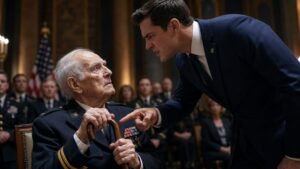
The Old Veteran Sat In The Rain With A Cardboard Folder No Officer Wanted To Read
Chapter 1: The Man Beside The Wet Brick Wall
The rain had started before dawn and never decided whether it wanted to stop.
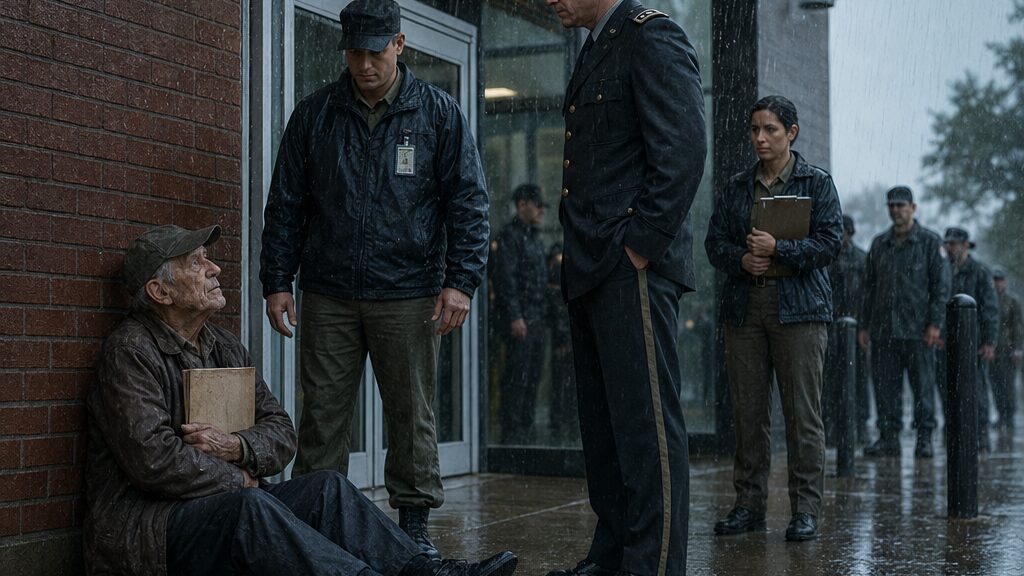
Ronald Walker sat beneath the edge of a brick wall outside the military records building and watched water slide down the mortar lines. The wall gave him little shelter. His shoulders were damp. The knees of his worn trousers were darker from the wet.
The cardboard folder rested against his chest.
He held it carefully, as if it were made of something more fragile than paper.
People passed through the entrance twenty feet away. Some hurried beneath umbrellas. Others carried coffee cups and clipped badges to their jackets before stepping through the security doors.
Most never looked at him twice.
The ones who did usually looked away quickly.
Ronald was used to that.
A cold gust pushed rain beneath the awning. He adjusted the folder and checked the folded appointment slip tucked inside.
The ink had faded.
The edges had softened.
But it was still there.
That was what mattered.
A military truck rolled past the entrance.
A pair of young soldiers crossed the walkway.
One glanced toward Ronald.
“Think he needs help?”
The other looked briefly.
“Probably waiting for a shelter to open.”
They kept walking.
Ronald lowered his eyes.
Not because the words hurt.
Because correcting strangers took energy.
Energy was better saved for important things.
The folder felt heavier than it should.
Not from the papers.
From the years.
The security gate opened.
A young sentry stepped outside.
Kevin Hill.
His uniform was neat despite the weather. His expression carried the alert caution of someone trying very hard not to make mistakes.
He spotted Ronald immediately.
The sight seemed familiar.
That meant Ronald had been noticed before.
Kevin approached.
“Morning, sir.”
Ronald nodded.
“Morning.”
Kevin glanced at the folder.
Then at Ronald’s soaked jacket.
“You waiting for someone?”
“I have an appointment.”
Kevin looked toward the building.
“What office?”
“Records.”
Kevin hesitated.
Something about Ronald’s appearance clearly conflicted with the answer.
“Do you have paperwork?”
Ronald gently patted the folder.
“Yes.”
“Can I see it?”
“Not unless I need to.”
The answer wasn’t hostile.
Just calm.
Kevin shifted his weight.
Rain tapped against the brim of his cap.
“Sir, we can’t have people sitting around the entrance all day.”
“I understand.”
“Could you move somewhere else?”
Ronald looked at the building.
Then at the wet pavement.
Then back to Kevin.
“I can wait.”
Kevin frowned.
“That isn’t what I asked.”
“I know.”
The young sentry exhaled.
For a moment he looked frustrated.
Then uncertain.
Ronald recognized the expression.
Young people often expected resistance to look angry.
Patience confused them.
Kevin rubbed the back of his neck.
“Just stay clear of the doors.”
“I will.”
The sentry walked away.
The rain continued.
Ronald watched people arrive.
Watched uniforms come and go.
Watched a maintenance worker push a cart across the lot.
Hours ago, before sunrise, he had considered turning around.
The folder was old.
The request was old.
The promise was older still.
Nobody would blame him if he quit.
Except one person.
And that person was no longer alive.
So Ronald stayed.
A woman emerged from the entrance carrying a clipboard.
Dark hair pulled back.
Rain jacket over her uniform.
Purposeful stride.
She paused when she saw him.
Not because she recognized him.
Because she was counting people near the entrance.
Her eyes moved over the visitors.
The guards.
Then Ronald.
She approached Kevin first.
The two exchanged a few quiet words.
Kevin pointed toward the wall.
The woman glanced back at Ronald.
Then started walking over.
“Sir?”
Ronald looked up.
“Yes?”
“I’m Officer Laura Sanchez.”
He nodded.
“Ronald Walker.”
Her expression softened slightly.
Most people expected hesitation before he gave his name.
“Are you waiting for assistance?”
“I have an appointment.”
“Do you have documentation?”
Ronald opened the folder carefully.
Rain pattered against the cardboard.
Laura’s eyes followed the movement.
She expected random papers.
Instead she saw organized documents protected inside clear sleeves.
Old military forms.
Copies.
Letters.
A folded appointment slip.
Something in her expression changed.
Only slightly.
But Ronald noticed.
People looked differently when they saw evidence.
“May I?”
She pointed toward the slip.
Ronald handed it over.
Laura studied it.
The paper was faded almost yellow.
The stamp near the corner had nearly disappeared.
Her brows tightened.
“That’s old.”
“Yes.”
“How old?”
“A while.”
She looked closer.
The faded stamp carried the building’s original seal.
A seal retired years earlier.
Laura glanced toward the entrance.
Then back to Ronald.
“You came here for this?”
“Yes.”
“In this weather?”
“Yes.”
“Why didn’t you come inside?”
Ronald smiled faintly.
“Didn’t seem like my turn yet.”
Laura looked at him for a moment.
Not understanding.
But no longer dismissing him.
Behind her, the entrance doors opened again.
More personnel arrived.
Someone called her name.
She handed back the slip.
“Wait here.”
“I planned to.”
A reluctant smile touched her face.
Then she left.
Ronald settled against the brick.
The folder rested in his lap.
The rain continued to fall.
But for the first time that morning, someone had looked at the papers before looking away.
It wasn’t much.
Still, it felt like movement.
Across the entrance, Laura stopped beneath the awning and looked again at the faded appointment slip she had memorized.
Then she looked back toward the old man sitting beside the wet brick wall.
Something about the stamp bothered her.
Chapter 2: The Officer Who Only Saw A Problem
By midmorning, Ryan Scott had already dealt with three scheduling issues, a vehicle delay, and a surprise inspection notice.
The last thing he needed was another complication.
He stood near the security desk reviewing reports when Kevin approached.
“There’s an older man outside.”
Ryan barely looked up.
“There are older people outside every day.”
“This one’s been sitting there for hours.”
“Waiting for an appointment?”
“Claims he is.”
Ryan signed a document.
“Then what’s the problem?”
Kevin hesitated.
“He looks like he might be confused.”
Ryan finally raised his eyes.
“What do you mean?”
“He’s sitting in the rain holding some old folder.”
Ryan sighed.
An inspection team would arrive before noon.
The entrance needed to stay clear.
Visitors needed to move efficiently.
Everything needed to look professional.
He stepped outside.
Rain mist drifted across the pavement.
Visitors passed through security.
And there, beside the brick wall, sat Ronald Walker.
The old man’s coat was worn.
His shoes looked older than some of Ryan’s soldiers.
The cardboard folder rested against his chest.
Ryan immediately saw a problem.
Not a person.
A problem.
He walked over.
“Sir.”
Ronald looked up calmly.
“Yes?”
“I’m Officer Ryan Scott.”
Ronald nodded.
Neither impressed nor intimidated.
“I need to ask what you’re doing here.”
“I have an appointment.”
“Do you?”
“Yes.”
Ryan glanced at the folder.
“Can I see documentation?”
Ronald handed him the slip.
Ryan studied it.
The date looked wrong.
The stamp looked ancient.
The paper looked ready to fall apart.
“This appointment isn’t current.”
“It was rescheduled.”
“When?”
“Several times.”
Ryan frowned.
“Sir, if there’s confusion, we can help you sort it out. But sitting in the rain isn’t helping anyone.”
Ronald accepted the slip back.
“I can wait.”
The phrase sounded simple.
Yet somehow irritating.
Ryan wasn’t sure why.
“Waiting isn’t always the answer.”
“It has been before.”
Ryan folded his arms.
Visitors entering the building had begun noticing the conversation.
Exactly what he didn’t want.
“Is this about benefits?”
“No.”
“Medical claims?”
“No.”
“Personal records?”
“No.”
Ryan blinked.
“Then what is it about?”
Ronald hesitated.
Not hiding.
Protecting.
Ryan could see the difference without understanding it.
“It’s about someone else.”
The answer surprised him.
“Family?”
“No.”
“Then who?”
Ronald looked down at the folder.
“A friend.”
The rain tapped softly against cardboard.
Ryan felt his certainty loosen slightly.
Not enough to change his opinion.
Just enough to create a question.
Behind him, Laura exited the building.
“Sir,” she called.
Ryan turned.
Laura approached quickly, clipboard under her arm.
“I checked that appointment number.”
Ryan raised an eyebrow.
“And?”
“It exists.”
Kevin looked surprised.
Ryan looked more surprised.
Laura continued.
“The record is old, but it’s real.”
Ryan glanced back at Ronald.
The old veteran remained seated.
Quiet.
Patient.
Almost stubborn.
“What exactly is he requesting?” Ryan asked.
Laura hesitated.
“I don’t know yet.”
“You checked the file.”
“Part of it.”
“Then what’s missing?”
Laura pulled a photocopy from her clipboard.
“The request references a different name.”
Ryan took it.
He read the line twice.
The applicant was Ronald Walker.
The subject was someone else entirely.
Ryan looked up.
“What does that mean?”
Laura shook her head.
“I don’t know.”
Then she pointed to the appointment slip.
“One more thing.”
“What?”
“The date.”
Ryan frowned.
“What about it?”
Laura looked toward Ronald.
“Why is the appointment newer than the request?”
For the first time all morning, nobody had an answer.
Chapter 3: A Name That Was Not His
Laura sat across from Mary Green in the records lobby while rain streaked the windows.
The old building smelled faintly of paper and dust.
Rows of filing cabinets lined the walls.
Most visitors never noticed them.
To Laura, they suddenly seemed important.
Mary adjusted her glasses and examined the documents Ronald had finally agreed to share.
“Interesting,” she murmured.
Laura leaned forward.
“What is it?”
Mary tapped a page.
“The request isn’t for Ronald Walker.”
“I know.”
“Then why is he here?”
“That’s what I’m trying to understand.”
Mary turned another sheet.
The cardboard folder had contained carefully preserved copies.
Old correspondence.
Military forms.
Service references.
Every page carried years of handling.
Years of protection.
Years of purpose.
A knock sounded at the office door.
Ronald stood outside.
Laura waved him in.
He entered slowly.
Water still clung to his coat despite the drying room.
The folder rested beneath one arm.
Mary looked up.
“Mr. Walker?”
“Yes.”
“Can you explain why you’re filing on behalf of another veteran?”
Ronald remained standing.
His eyes settled on the papers.
For a moment Laura thought he might finally tell the whole story.
Instead he asked quietly, “How much have you found?”
Mary exchanged a glance with Laura.
“Enough to know the name isn’t yours.”
Ronald nodded.
“That’s true.”
Mary pointed toward the document.
“Who is Thomas Green?”
The room grew still.
Even the rain seemed quieter.
Ronald lowered himself carefully into a chair.
His fingers brushed the softened edge of the folder.
A familiar gesture.
Like touching a memory.
“He served with me.”
Mary waited.
Laura waited.
Ronald stared at the name on the page.
“He was my friend.”
The words sounded small.
But not simple.
Laura noticed the difference immediately.
People used the word friend casually.
Ronald used it carefully.
Mary continued.
“The file indicates he is deceased.”
“Yes.”
“And this correction request concerns his record.”
“Yes.”
“Why?”
Ronald looked away.
Toward the rain-streaked window.
“Because nobody else did it.”
The answer settled heavily in the room.
Mary glanced at another form.
“This issue dates back decades.”
“I know.”
“Why wasn’t it corrected sooner?”
Ronald’s jaw tightened.
Not defensive.
Painful.
Laura saw it.
He wasn’t avoiding the question because he lacked an answer.
He was avoiding it because he had one.
Mary seemed to recognize that too.
She softened her voice.
“Mr. Walker?”
Ronald looked down at the folder.
“This isn’t my story to tell.”
Laura frowned.
“But you’re carrying it.”
“Yes.”
“Why?”
A long silence followed.
Finally Ronald answered.
“Because promises don’t stop mattering when people die.”
Nobody spoke.
The words hung in the office.
Simple.
Heavy.
True.
Mary turned back to the file.
More carefully now.
Less like paperwork.
More like responsibility.
A few minutes later she stopped at a notation buried deep in the record.
Her expression changed.
“What is it?” Laura asked.
Mary pointed.
“This case.”
Laura leaned closer.
“What about it?”
Mary tapped the screen.
“It wasn’t ignored once.”
She scrolled.
“Or twice.”
Laura felt a chill.
“How many times?”
Mary looked at Ronald.
Then at the rejection history.
“Three.”
The old veteran remained silent.
As if he had expected that answer all along.
Mary swallowed.
“The request was rejected three separate times.”
Laura stared at Ronald.
The rain continued beyond the windows.
The cardboard folder rested quietly in his lap.
And suddenly she understood something important.
He had never come because he expected success.
He had come because he had promised not to stop.
The rejection notices had not broken him.
They had simply added more papers to the folder.
Mary closed the file slowly.
“Mr. Walker,” she said.
“Yes?”
“For what it’s worth…”
She stopped.
Searching for the right words.
“I think we need to look at this again.”
For the first time that day, a faint warmth appeared in Ronald’s tired eyes.
Not relief.
Not victory.
Just the smallest sign of hope.
And somewhere deeper in the records system, hidden beneath decades of paperwork, waited the reason Thomas Green’s name had never been corrected.
Chapter 4: The Promise He Never Spoke Aloud
Ronald had not meant to say Thomas Green’s name aloud that day.
Names changed the air around people.
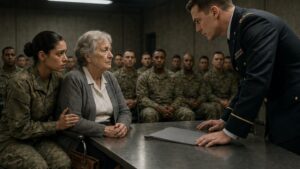
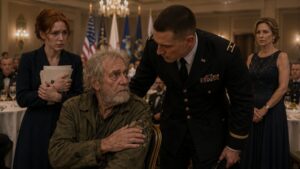
Before the name, there had only been a file, a rejected request, a wet old man with papers that looked too worn to matter. After the name, Mary handled the folder differently. Laura spoke more softly. Even Ryan Scott, standing near the doorway with his arms lowered now, seemed less certain where to put his eyes.
Ronald sat in the records office with his coat hanging over the back of a chair, dripping into a small plastic tray someone had fetched from beneath a desk. His hands rested around a paper cup of coffee he had not asked for and had not yet tasted.
Mary clicked through the digital entries.
Laura stood beside her, reading over her shoulder.
Ryan remained by the door.
Ronald looked at the folder.
The edges had gone soft from years of damp rooms, kitchen tables, bus rides, and waiting areas. He had reinforced one corner with clear tape long ago. The tape had yellowed. He remembered Thomas laughing once, saying Ronald could repair anything ugly enough to embarrass itself into holding together.
Ronald closed his eyes.
For a moment, the office fell away.
There was mud under his boots again. Young voices in the dark. Thomas Green sitting beside him with a letter folded in his hand, trying to make a joke and failing because fear had made his mouth dry.
“If I don’t make it back,” Thomas had said.
Ronald had cut him off.
“Don’t start that.”
Thomas had looked at him, and the joke had left both of them.
“If I don’t,” he said again, “make sure they don’t lose me in some drawer.”
Ronald had promised because promises were easier than fear.
He had been young enough then to believe a promise could be kept by strength alone.
“Mr. Walker?”
Ronald opened his eyes.
Mary was watching him.
“I’m sorry,” she said. “I need to ask something difficult.”
Ronald nodded.
“Did Mr. Green know his record was incomplete?”
“No.”
“You’re certain?”
Ronald rubbed his thumb along the coffee cup lid.
“He knew things got written wrong sometimes. He worried about his wife. He worried she’d have to fight for every little thing.”
Mary glanced at Laura.
“His widow is still listed as surviving spouse.”
Ronald nodded once.
“She is.”
“And you have been attempting to correct the service classification on his behalf?”
“Yes.”
Ryan finally spoke.
“Why now?”
The question was not sharp.
That made it harder.
Ronald looked at him.
“Because now is what I have left.”
Ryan’s face changed, but he said nothing.
Mary turned a page from the folder.
“This first handwritten request is dated many years ago.”
Ronald’s gaze dropped.
“Yes.”
“But the formal filings are recent.”
“Yes.”
Laura lowered her clipboard slightly.
“Why the gap?”
Ronald felt the question settle into the part of him he had avoided for too long.
Outside the office, the lobby murmured. A printer clicked somewhere. Rain tapped the windows as if asking to be let in.
He could have said illness.
He could have said lost papers.
He could have said he didn’t know how the system worked.
All were partly true.
None were the truth.
“I kept the papers in a drawer,” he said.
Mary did not type.
Laura did not move.
Ryan watched from the doorway.
Ronald continued, slowly.
“After Thomas died, I went to see his widow. I had his letters. Some things he wanted returned. She was young. Too young to look that tired.”
His fingers tightened around the cup.
“She asked if everything was finished. I told her I’d make sure it was.”
No one interrupted.
“I tried once. Not properly. I was angry then. Angry people don’t read instructions well.”
A faint, humorless smile touched his mouth.
“They sent it back. I put it away. Told myself I’d try again when I could stand looking at his name without feeling like I’d stolen something from him.”
Laura’s eyes softened.
“What did you think you stole?”
Ronald looked down at the folder.
“Time.”
The word came out almost too quietly.
Ryan shifted near the doorway.
Ronald drew a breath.
“Thomas asked me to check his paperwork if he didn’t come home. I came home. He didn’t. For a while, that was all I could understand.”
Mary folded her hands.
“And later?”
“Later, shame gets comfortable if you let it sit long enough.”
The room stayed silent.
Ronald finally lifted the coffee and drank. It had gone lukewarm.
“I saw his widow last year. She didn’t ask for anything. That made it worse. She said his name like she still expected the world to remember him correctly.”
He pushed the folder gently toward Mary.
“So I came back to the promise.”
Mary looked at the folder as if it had become heavier.
Laura reached for one of the rejection letters.
Ryan stepped closer.
“These rejections,” he said. “Were they all from this office?”
Mary checked the system.
Her face tightened.
“Two from regional processing. One from here.”
Ryan leaned over the screen.
“When?”
Mary hesitated.
“Four months ago.”
Ryan’s eyes narrowed.
“Four months?”
Mary clicked again.
“The walk-in note says documentation insufficient. Applicant advised to seek outside assistance.”
Ronald looked at the rain-dark window.
He remembered that day.
The desk.
The young clerk.
The way the folder had been pushed back before it was opened all the way.
Ryan’s voice lowered.
“Was I here?”
Mary checked the logged supervisor.
The silence answered before she did.
“Yes,” she said.
Ryan stared at the screen.
Ronald could have looked at him then.
Could have let the weight land where it wanted.
Instead he touched the folder’s taped corner and said, “That day was busy.”
Ryan turned toward him.
Ronald did not meet his eyes.
The rain continued steadily beyond the glass.
And for the first time since morning, Ryan Scott looked less like an officer managing a problem and more like a man realizing he might have helped create one.
Chapter 5: The Signature No One Wanted To Check
The archive room was colder than Ryan expected.
Metal shelves ran in narrow rows beneath fluorescent lights. Boxes sat labeled by year, unit, and case series. Some labels were crisp and new. Others had faded into pale ghosts of handwriting.
Ryan stood beside Mary Green while she unlocked a cabinet at the back.
Ronald waited near the table, cardboard folder placed before him.
Not clutched now.
Placed.
As if he had decided the room deserved a measure of trust.
Laura Sanchez stood with a clipboard beside the official file request log. The clipboard looked clean, rigid, replaceable. Ronald’s folder beside it looked like something that had survived weather, hands, and doubt.
Ryan noticed the contrast and disliked himself for not seeing it sooner.
Mary pulled out a thin archival box.
“This is the associated service packet.”
“That’s all?” Ryan asked.
“For this category, sometimes yes.”
She set it on the table.
Ronald did not reach for it.
His restraint made Ryan feel worse than accusation would have.
Mary opened the box and removed a stack of records. She handled them with careful efficiency, reading codes, dates, signatures, corrections. Laura took notes.
Ryan watched every movement.
Yesterday morning, he had wanted the entrance cleared.
This morning, the entrance mattered less than the fact that his office had cleared Ronald away months earlier.
Mary stopped at a page near the bottom.
“There.”
Laura leaned in.
“What?”
Mary pointed to a line.
“Service classification pending verification.”
Ryan read the notation.
“So it wasn’t final.”
“No,” Mary said. “It was waiting on confirmation.”
“From whom?”
Mary checked the attached form.
“A reviewing officer.”
Laura compared the document against Ronald’s copies.
“Mr. Walker has a duplicate.”
Ronald opened the folder and withdrew a sleeve.
His hand trembled slightly, though whether from age or memory Ryan could not tell.
Laura accepted the page.
Mary placed both documents side by side.
They matched almost exactly.
Except one had something the archive copy did not.
A signature.
Laura breathed in.
“Why does his copy have it?”
Mary adjusted her glasses.
“Because this is probably the field copy. The central file never received the signed version.”
Ryan looked at Ronald.
“How did you get that?”
Ronald’s eyes remained on the page.
“Thomas gave it to me with his letters.”
Mary studied the signature.
“If this can be authenticated, the case can reopen.”
Ryan felt something shift in the room.
Not relief.
Possibility.
Laura looked at Mary.
“How long would authentication take?”
“Usually longer than anyone wants.”
Ryan asked, “What’s the fastest path?”
Mary glanced at him.
“Supervisor review. Cross-check against stored signature cards. Legal confirmation. Then urgent benefits correction if the widow’s status is affected.”
Laura flipped through notes.
“Her review deadline is Friday.”
Ryan frowned.
“This Friday?”
Ronald nodded.
Mary’s mouth tightened.
“That gives us two days.”
The archive room seemed colder.
Ryan rested both hands on the table.
He had spent years telling younger officers that procedure protected people.
Now he stared at proof that procedure, ignored at the wrong moment, could abandon them.
“Why wasn’t this checked before?” Laura asked.
Mary’s expression became careful.
“Because the intake summary marked the documentation incomplete. After that, no one searched for matching field copies.”
Ryan looked at the official clipboard.
The prior note was there.
Brief.
Impersonal.
Insufficient documentation.
Move to outside assistance.
A phrase clean enough to hide harm.
He looked at Ronald.
“You brought this copy before?”
“Yes.”
“And no one checked the signature?”
Ronald’s answer came without bitterness.
“No.”
Ryan waited for anger.
Ronald gave him none.
That made the room feel smaller.
“I owe you an apology,” Ryan said.
Ronald looked at him then.
Not warmly.
Not coldly.
“Maybe,” he said.
Ryan accepted the quiet wound in that single word.
“I should have listened.”
Ronald glanced at the papers.
“You were listening to other things.”
It was not forgiveness.
It was truth.
Mary cleared her throat gently.
“If we focus, we may still make the deadline.”
Ryan straightened.
“What do you need?”
Mary listed documents, approvals, access permissions, scanned comparisons, supervisor authorization. Ryan wrote everything down himself instead of handing the task to Laura.
When Mary mentioned a locked personnel reference file, Ryan made the call.
When she said legal review usually required a separate request, Ryan walked down the hall and returned with approval.
When the copier jammed, he fixed it without calling maintenance.
Ronald watched quietly.
At noon, someone brought sandwiches. Ronald accepted half of one and wrapped the rest in a napkin without thinking. Ryan noticed, but said nothing.
By midafternoon, the signature comparison was underway.
Laura laid the field copy under a clear sheet.
Mary matched it with a stored card.
The loop of the G.
The pressure on the final line.
The slant of the initials.
Ryan did not understand enough to be certain.
Mary did.
“It matches,” she said.
Ronald’s eyes closed.
Just for a moment.
His hand went to the edge of the folder.
Ryan looked away to give him privacy.
Mary stamped the preliminary verification and passed it to Ryan.
“This reopens the case.”
Ryan took the document.
It felt heavier than any inspection report he had signed that month.
Laura checked the widow’s benefits notice again.
“She has until Friday before the pending support adjustment becomes final.”
Ryan looked at the clock.
Then at Ronald.
“We’ll move it today.”
Ronald shook his head.
“Don’t skip what must be done.”
“I won’t.”
“Don’t rush and make it break.”
Ryan absorbed that.
Even now, Ronald was protecting the process that had failed him.
“I’ll do it correctly,” Ryan said.
Ronald nodded once.
That was all.
Near the end of the day, Ryan walked Ronald back toward the lobby. The rain had stopped, but the brick wall outside remained dark.
Kevin Hill stood near the entrance.
He saw Ronald and straightened.
“Sir,” Kevin said, softer than before.
Ronald nodded.
“Officer Hill.”
Kevin looked at the folder, then at the floor.
Ryan saw the young sentry trying to form an apology and failing.
Ronald spared him.
“Long day,” Ronald said.
Kevin swallowed.
“Yes, sir.”
Ryan opened the door for Ronald.
The gesture was small.
Too late.
Still necessary.
Ronald stepped beneath the awning and looked at the wall where he had sat the day before. Water still clung to the bricks in dark vertical lines.
Ryan stood beside him.
“We’ll call you as soon as the final approval comes through.”
Ronald looked out across the wet pavement.
“Call her first.”
“The widow?”
“Yes.”
Ryan nodded.
“She should know before I do.”
Ryan understood then that the promise had never been about Ronald being seen.
It had always been about Thomas Green not being forgotten.
Behind them, Laura hurried from the desk with one more paper.
“Sir,” she said to Ryan.
He turned.
Her face was tense.
“The support adjustment is scheduled for Friday morning.”
Ryan glanced at Ronald.
Ronald’s expression did not change.
But his hand closed more tightly around the folder.
Chapter 6: He Refused To Make Them Bow
Friday morning arrived clear and cold.
Ronald Walker reached the records building before the doors opened.
He did not sit against the brick wall this time.
He stood beneath the awning, cardboard folder tucked under his arm, watching the pale light move across the wet places the rain had left behind.
The same wall waited beside him.
The same entrance.
The same glass doors.
But the morning felt different because people were watching before they pretended not to.
Kevin Hill came out first.
He stopped when he saw Ronald.
“Good morning, Mr. Walker.”
“Morning.”
Kevin opened the door.
“You can wait inside.”
Ronald looked at the lobby beyond him.
Warm light.
Dry chairs.
Polished floor.
A security desk.
People moving with purpose.
Then he glanced at the brick wall.
“I’m all right here for a minute.”
Kevin did not argue.
He simply stayed near the door.
That was new.
A few minutes later Laura Sanchez appeared carrying her clipboard. The board looked familiar, but her grip on it was looser now.
“Mr. Walker,” she said. “Mary is ready for you.”
“Is Officer Scott here?”
“Yes.”
Ronald nodded.
“Then I’ll come in.”
The lobby quieted as he entered.
Not completely.
Not dramatically.
But enough.
A few background soldiers glanced up. Intake visitors paused over their forms. Security staff watched from the desk.
Ronald knew that kind of silence.
It was the silence people used when they had decided a moment was important but did not yet know what kind.
Ryan Scott stood near the records counter.
His uniform was crisp.
His face was not.
Mary Green waited behind the desk with a file open before her. The official papers lay in a neat stack. Beside them was Ronald’s old folder.
Ryan stepped forward.
“Mr. Walker.”
“Officer Scott.”
Ryan looked toward the people gathered nearby, then back to Ronald.
“I need to say something.”
Ronald understood at once.
So did everyone else.
Ryan wanted to make it public.
Perhaps because the mistake had been public.
Perhaps because he needed others to hear it.
Ronald’s fingers tightened once around the folder.
Ryan began quietly.
“On Monday, you were treated as an inconvenience before anyone understood why you were here.”
The lobby stilled further.
Kevin lowered his eyes.
Laura watched Ronald.
Ryan continued.
“That should not have happened. Not because of what we found later. Not because of your service. Not because the papers mattered. It should not have happened before any of that.”
Ronald looked at him then.
Ryan’s voice remained steady, but his jaw held strain.
“I’m sorry.”
The words were plain.
No decoration.
No performance.
That helped.
Still, Ronald could feel the room waiting for him to complete the scene they wanted.
They expected him to accept.
Or refuse.
Or shame.
Or forgive.
They expected the old man with the wet folder to give meaning to their discomfort.
Ronald looked past Ryan to the records counter.
Mary’s hand rested near the phone.
The widow had until that morning.
“She shouldn’t have to wait,” Ronald said.
Ryan blinked.
Ronald nodded toward the papers.
“Thomas’s wife. She shouldn’t have to.”
Ryan absorbed the correction.
Then he stepped aside.
Mary moved the final document forward.
“The correction has been approved,” she said.
Ronald did not reach for it immediately.
His eyes stayed on Thomas Green’s name.
Not the stamp.
Not the signature.
The name.
Mary continued, gently.
“The support adjustment was stopped. Her file has been updated. The official notice is ready to send, and we called her before final printing, as you requested.”
Ronald’s throat moved.
“What did she say?”
Mary looked down, then back up.
“She was quiet for a while.”
Ronald nodded.
He understood quiet.
“Then she asked if his name was right now.”
The room blurred at the edges.
Ronald placed one hand flat on the counter.
Mary slid the page toward him.
“There it is.”
Thomas Green.
Corrected.
Recorded.
Not lost in a drawer.
Ronald touched the paper with two fingers.
He did not cry.
He had done too much waiting for tears to arrive easily.
But his shoulders lowered, as if something he had carried beneath them had finally been set down.
Ryan stood nearby, silent.
Ronald looked at him.
“You did the work.”
Ryan shook his head.
“Not soon enough.”
“No.”
The honesty landed between them.
Then Ronald added, “But you did it.”
Ryan accepted that too.
Mary prepared the final packet.
Laura signed as witness.
Ryan signed as reviewing officer.
Kevin, still near the door, watched every pen stroke as if learning that a signature could be a form of care or neglect depending on the hand behind it.
When the papers were complete, Mary placed the official copies in a new envelope.
“This is for the widow,” she said.
Ronald nodded.
“I’ll take it to her.”
Ryan stepped forward.
“We can send it directly.”
“I know.”
“We can also arrange transport.”
Ronald almost smiled.
“I know that too.”
Ryan understood enough not to press.
Mary handed Ronald the envelope.
For the first time, the old cardboard folder looked unnecessary.
He opened it slowly, removed Thomas’s field copy, and waited while Mary scanned and certified it into the official record.
When she handed it back, Ronald looked at the page for a long time.
Then he placed it inside the folder again.
Ryan said, “Mr. Walker, about what happened here…”
Ronald closed the folder.
“What happened here should help the next man.”
“It will.”
Ronald studied him.
“Not by memory.”
Ryan straightened.
“No. By procedure.”
Laura lifted her clipboard.
“We drafted a walk-in review step for elderly veterans and legacy records cases. No one gets turned away before documents are checked by records staff.”
Ronald looked at Kevin.
The young sentry met his eyes.
“And if someone waits outside?” Ronald asked.
Kevin swallowed.
“We ask what they need before deciding what they are doing.”
Ronald nodded.
That was enough.
The lobby still watched.
Ryan seemed about to say more, but Ronald gave a small shake of his head.
Not unkindly.
Simply ending it.
He would not make them bow.
He would not take their discomfort and shape it into punishment.
The correction was the point.
Thomas was the point.
The widow waiting by her phone was the point.
Ronald tucked the official envelope inside his coat to keep it safe.
Then he picked up the cardboard folder.
At the door, he paused.
The brick wall outside was dry now where the sun had reached it.
He turned back.
Laura stood near the counter.
Mary beside the files.
Ryan near the lobby center.
Kevin at the door.
Ronald looked at the folder in his hands.
Then he walked back to the records counter and set it down.
Mary looked startled.
“Mr. Walker?”
Ronald rested his palm on the folder’s softened cover.
“Keep the copies.”
“We can make new ones for you.”
“I don’t need them.”
Laura looked at the taped corner.
“But this is yours.”
Ronald shook his head.
“It was never just mine.”
He lifted his hand from the folder.
The old cardboard stayed beside the official clipboard.
Weathered.
Bent.
No longer ignored.
Ronald turned toward the door.
Kevin opened it before he reached it.
Outside, the morning was bright over the wet pavement.
Ronald stepped through without looking back.
Chapter 7: The Empty Place Beneath The Awning
A week later, Laura Sanchez arrived early enough to see the brick wall before anyone stood beside it.
The morning was dry. Pale sunlight rested across the pavement where rainwater had gathered days before. The entrance glass reflected the flag, the awning, and the empty stretch of wall where Ronald Walker had once sat with his cardboard folder held against his chest.
Laura slowed without meaning to.
The place looked ordinary again.
That bothered her.
Ordinary places could hide what had happened in them if people let them.
She carried her clipboard inside, but it was not the same clipboard. A new sheet was clipped at the top, printed in clean black lines.
Legacy Records Walk-In Review.
Elderly Veteran Assistance Step.
Document Check Required Before Referral.
The words were plain. Administrative. Almost dull.
Laura liked that.
Dull procedures lasted longer than emotional promises.
At the security desk, Kevin Hill was already reviewing the new intake card. His lips moved silently as he read.
Laura paused.
“Morning.”
Kevin looked up.
“Morning, Officer Sanchez.”
“How’s the new process?”
He glanced toward the entrance.
“I keep thinking about how easy it would have been to just ask him inside.”
Laura followed his gaze.
The wall remained empty.
“Yes,” she said. “It would have been.”
Kevin looked down at the card again.
“I thought I was keeping things orderly.”
“You were.”
That made him look up.
Laura continued, “That was the problem. Order was the only thing we were measuring.”
Kevin absorbed that quietly.
Across the lobby, Mary Green stood near the records counter entering a label into the system. Laura walked over and saw the file name on the screen.
GREEN, THOMAS — LEGACY CORRECTION — WALKER SUPPORTING FIELD COPY.
Beside Mary’s keyboard lay a scanned image of the old cardboard folder’s label. Its edges had been flattened digitally, but the wear still showed: softened corners, faint water stains, the yellowed tape Ronald had pressed along one side.
“You kept the label,” Laura said.
Mary nodded.
“The folder itself is in the evidence sleeve. But the label belongs in the record.”
Laura looked at the screen.
Ronald’s name appeared only where it needed to.
Supporting witness.
Not claimant.
Not beneficiary.
Not complainant.
Witness.
That felt right.
“Did the widow receive the packet?” Laura asked.
Mary’s expression softened.
“Yes. Signed yesterday.”
“Did Mr. Walker deliver it?”
“He did.”
Laura waited.
Mary glanced toward the lobby before speaking more quietly.
“She sent back a note. Not for the file. For him.”
“What did it say?”
Mary touched the corner of a sealed envelope resting near her desk.
“I didn’t open it.”
Laura nodded.
Of course she hadn’t.
Some things were not records.
Ryan Scott came out of the interior hallway carrying a thin stack of printed cards. He looked more tired than he used to in the mornings, but less hard.
“Updated desk copies,” he said, handing one to Mary and one to Laura.
Laura read the top line.
Before assessing why a person is waiting, ask what they are carrying and what they need.
She looked up.
Ryan noticed.
“Too much?”
“No,” Laura said. “It’s good.”
He glanced toward the entrance.
For a moment none of them spoke.
The lobby moved around them. A printer hummed. A visitor coughed. A soldier near the desk filled out a form.
Then the outer door opened.
An elderly veteran stepped into view beneath the awning.
Not Ronald.
This man wore a clean but faded jacket and held a plastic grocery bag with papers inside. He stopped before entering, looking at the security desk, then at the signs, then at the people moving through the lobby with practiced confidence.
Laura saw the hesitation.
Kevin saw it too.
So did Ryan.
For one suspended second, the old pattern waited to return.
A question.
A judgment.
A delay.
Ryan moved first.
He set the cards down on the counter and walked toward the door before anyone called for him.
Kevin reached it at the same time and opened it wider.
The elderly veteran looked startled.
Ryan stepped outside beneath the awning.
Laura watched through the glass.
She could not hear the words, but she saw the difference.
Ryan did not stand over the man.
He stepped beside him.
Kevin remained near the open door, not blocking it.
The man lifted the plastic bag slightly.
Ryan listened.
Really listened.
Then he gestured toward the lobby with one hand and toward the records counter with the other.
The elderly veteran entered slowly.
Dry.
Seen.
Asked before judged.
Laura looked back at the brick wall.
The empty place beneath the awning no longer felt like absence.
It felt like a marker.
Mary slipped Ronald’s old folder label into its protective sleeve and placed it in the file drawer, not hidden at the bottom, not left loose on a desk, but exactly where someone looking later would find it.
Laura clipped the new procedure sheet to her board.
Outside, sunlight touched the wall.
No one sat there waiting in the rain.
Not that morning.
The story has ended.