The Officer Ordered The Old Janitor Out Before Learning Why He Cleaned That Hallway Every Morning
Chapter 1: The Man With The Mop Cart In The Restricted Hall
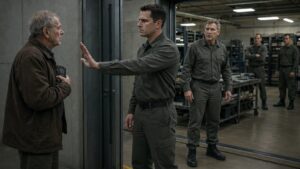
The mop bucket rattled once against the sealed door, and every head at the security desk turned.
Daniel Walker stopped with one hand on the wringer and the other resting on the handle of his mop. He had moved slower than he meant to. The left wheel on the cart had begun to complain in the last month, catching at every seam in the polished floor, and the hallway outside the old west corridor had more seams than the rest of the building. They were narrow lines, almost invisible beneath years of wax, but Daniel knew where each one was.
He knew where the floor dipped near the drinking fountain that no longer worked.
He knew where the ceiling light hummed louder than the others.
He knew where the wall had been painted three times but still held the faint rectangular shadow of the sign that used to hang there.
He also knew the door was supposed to stay closed.
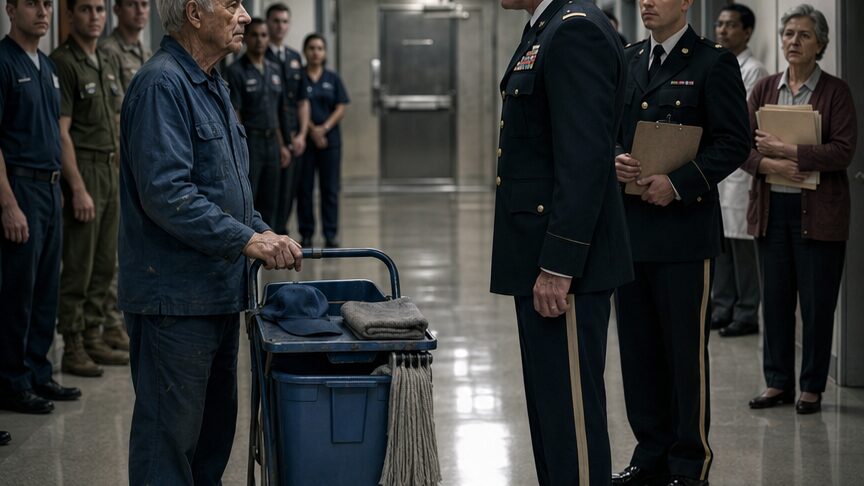
The security desk attendant rose halfway from his chair. Two younger soldiers waiting near the elevators looked up from their phones. Down the hall, medical admin employees hurried past with folders pressed against their chests, their shoes whispering over the floor Daniel had finished before dawn.
Daniel did not look at any of them. He turned the cart an inch away from the sealed door, lifted the wet mop head, and let it settle in the bucket without splashing.
His blue cap sat on the top shelf of the cart beside a folded gray cleaning cloth. The cap had faded almost white along the brim. Its stitching had loosened near the left side, where Daniel’s thumb had worried the seam for years. He did not wear it inside that stretch of hallway. He never had, not once in the twelve years he had worked the night shift in the building.
A voice came from behind him. “Sir, that area’s restricted today.”
Daniel turned.
The facility manager stood near the junction by the elevators, a tablet tucked under one arm and an inspection badge hanging crooked from a lanyard. She was younger than Daniel’s youngest daughter would have been, if Daniel had ever had children. Her hair was pulled back tight enough to make her expression look sharper than it probably was.
“I know,” Daniel said.
“You can’t block it. We’ve got command staff coming through in less than twenty minutes.”
Daniel looked at the cart. It was not blocking the hall. It stood close to the wall, yellow caution sign folded flat, bucket tucked in, handle angled inward the way he always left it. A man could pass with a wheelchair beside it if he had to. Daniel had measured once without meaning to, one cold morning when the building was quiet and memory had narrowed the hall around him.
“I’ll be done before then,” he said.
The facility manager glanced at the sealed door, then at the faint wet shine on the floor. “They told maintenance to skip this wing until after the inspection.”
“They told day maintenance,” Daniel said.
That made the two soldiers at the elevator exchange a look. It was a small thing, not exactly rude, but Daniel saw it. Old men saw plenty when nobody expected them to be watching.
The manager lowered her voice. “Mr. Walker, please. This is not the morning to get particular.”
Daniel dipped the mop, pressed it once through the wringer, and laid the strands neatly along the baseboard. He moved the mop slowly, pushing the water into a thin line, drawing it back, leaving no streak behind. His right shoulder ached with the motion. It had ached since before most of the people in the hallway were born.
The manager sighed. “I’m trying to help you.”
“I know.”
“Then help me back. Move the cart to the janitor’s closet. Come back later.”
Daniel looked at the stretch of floor in front of the sealed door. The fluorescent lights reflected in it like pale bars. Under the polish, under the wax and paint dust and the print of countless boots, there was still a place the shine never quite reached. Most people could not see it. The contractors had tried. The new buffer had tried. Daniel had tried for twelve years.
It remained.
“I come at this hour,” he said.
“That isn’t an answer.”
“No, ma’am.”
She stared at him, caught between irritation and something like helplessness. Daniel did not dislike her. She had a job to do. The building had many people with jobs to do. Everyone had a clipboard, a badge, a reason, a schedule. Schedules were useful things. They kept the living moving forward.
They did not do much for the dead.
From the far end of the hall came the clean, synchronized sound of polished shoes. The young soldiers straightened before they even saw who was approaching. The security desk attendant stood fully now.
Daniel turned his head just enough to see a small group entering from the main lobby. At the center walked an officer in a dark dress uniform, his ribbons aligned with severe precision, his jaw shaved clean, his eyes already measuring the hallway as if it belonged to him by the force of his inspection alone. A younger aide kept half a pace behind him, carrying a clipboard and trying to look older than he was.
The facility manager stiffened. “That’s him.”
Daniel rinsed the mop again.
“Mr. Walker,” she whispered, urgent now. “Please move.”
The officer’s gaze passed over the walls, the security desk, the elevator doors, the folded caution sign. Then it stopped on Daniel.
Daniel could feel the moment gather around him. It was not loud. Real trouble rarely was at first. It came as a tightening in the air, a shift in how people stood, the sudden awareness that everyone had noticed the same thing.
The old man in the blue work uniform.
The mop cart near the sealed door.
The wet floor in a hallway meant to look untouched.
Daniel set the mop back into the bucket. He wiped both hands on the gray cloth, folded the cloth once, and placed it beside his cap.
The officer was closer now. His nameplate caught the light.
Alexander Roberts.
Daniel read it without meaning to. He had always read nameplates. Long ago, names were what kept men from becoming numbers.
The facility manager stepped forward. “Sir, I apologize. We’re handling this.”
Alexander Roberts did not answer her. His eyes stayed on Daniel, then moved to the sealed door, then back to the mop cart.
“Who authorized work in this corridor?” he asked.
The question was not shouted. It did not need to be. It carried cleanly across the hall, firm and cold enough to make the two soldiers by the elevator stand even straighter.
The facility manager began, “Sir, he’s—”
“I asked him.”
Daniel lifted his cap from the cart. He held it against his chest, brim facing inward, thumb resting on the worn seam.
Nobody moved.
He looked at the officer, at the ribbons, at the spotless shoes, at the face of a man who believed the morning had a correct order and that Daniel had stepped outside it.
“I did,” Daniel said.
Alexander’s expression changed, not much. Just enough.
“You authorized yourself?”
Daniel lowered his eyes briefly to the floor, to the pale shine and the stubborn shadow beneath it.
“Yes, sir,” he said. “For this part, I did.”
The aide behind Alexander shifted his clipboard from one hand to the other. The facility manager closed her eyes as if she had felt the whole inspection slip out of her hands.
Alexander took one step toward Daniel.
At the far end of the hall, Mary Scott emerged from the records office carrying a stack of file folders. She paused when she saw the group gathered near the sealed corridor. Daniel noticed her before anyone else did. Mary had worked in the building long enough to know that some silences were not empty.
She looked at Daniel’s cap in his hands.
Then she looked at the sealed door.
Daniel gave her the smallest shake of his head.
Do not.
Mary stopped where she was.
Alexander Roberts did not see that exchange. He saw only an old janitor standing where he had been told not to stand, holding a cap as if it were an answer.
“Mr. Walker,” the facility manager said softly, “please.”
Daniel slipped the cap back onto the cart with care. He did not put it on.
Alexander looked down at the folded cloth, the mop bucket, the thin wet line along the baseboard. Then he turned his full attention back to Daniel.
“This corridor is closed,” he said. “And you are in the way.”
Daniel’s hand rested on the cart handle.
Behind Alexander, the younger aide had begun to stare at him as though trying to decide whether the old man was confused or simply stubborn.
Daniel had been called worse things than either.
He looked past the officer for a moment, toward the old west corridor, toward the place where the wall no longer carried its name.
Then he looked back.
“I understand,” Daniel said.
Alexander Roberts stepped closer, close enough for Daniel to see the tiny crease between his brows.
“Then move it.”
Daniel tightened his hand once around the cart handle.
Before he could answer, Alexander’s eyes shifted to the sealed door behind him.
“What exactly were you doing at Ward C?”
The hallway went still.
Chapter 2: The Officer Who Mistook Silence For Confusion
Alexander Roberts had spent the whole morning fighting disorder before he ever reached the old west corridor.
The first briefing had run nine minutes long because the projector failed. The visiting contractor had left protective plastic over a sign near the lobby. Someone had placed the wrong folders in the inspection binder, and the facility manager had apologized twice in the tone of a person who knew apology was cheaper than explanation. By the time Alexander stepped into the main hallway, his patience had been folded into something narrow and hard.
He did not enjoy being hard. He considered it necessary.
Military buildings, especially medical administration buildings, carried more than paperwork. They carried trust. A loose cable, an unlocked access door, a sloppy corridor—small things became habits. Habits became failures. Failures became names on reports that somebody’s family read later.
So when he saw the elderly janitor standing beside the sealed corridor with a mop cart and a wet floor, Alexander did not see a harmless old man.
He saw a breach.
“What exactly were you doing at Ward C?” he asked.
The words left his mouth before he considered why he had used the old designation. It was printed on the inspection map in small gray type beneath the new corridor code, a leftover from old schematics. Most staff called it West Administrative Storage now. The sealed door had no sign. Ward C was a dead name, useful only to people who read too much documentation.
The janitor looked at him.
Not startled. Not defensive. Not blank.
That bothered Alexander more than an argument would have.
The man’s face was deeply lined, his skin folded by age and weather, his eyes pale but steady. His blue work shirt had a stitched maintenance patch near the pocket. The fabric had been washed thin at the elbows. His hands were large, knuckled, and scarred in ordinary old-man ways, except there was nothing careless in how he held them. Even standing beside a mop bucket, he had the stillness of someone who knew where his weight belonged.
“I was cleaning the floor,” the man said.
Alexander waited for more.
None came.
The young aide behind him, Kevin Mitchell, shifted almost silently. Alexander sensed the movement without turning. The facility manager stood to his left, too tense. Two soldiers near the elevator watched with the rigid interest of people trying not to look interested. A records clerk had stopped farther down the hall with folders in her arms.
Public moments had to be handled cleanly. If Alexander let this slide, everyone watching would understand the lesson: restricted meant restricted unless the person ignoring it seemed old enough, harmless enough, familiar enough.
He kept his voice level. “This corridor is closed for inspection preparation. That means no cleaning, no equipment, no unauthorized access.”
“Yes, sir,” the janitor said.
“You were informed?”
“Yes, sir.”
“And you ignored that instruction.”
The facility manager began, “Sir, Mr. Walker has worked here—”
Alexander held up one hand. He regretted the gesture as soon as he made it. Not because it was wrong, but because it silenced her too completely.
“I’m speaking to Mr. Walker.”
The janitor’s name settled into Alexander’s mind. Walker. Daniel Walker, according to the facility manager’s strained whisper earlier. Alexander looked at him again, searching for signs of confusion: unfocused eyes, wandering attention, the softness of embarrassment. He found none.
Only the cap resting on the cart, carefully placed beside a folded gray cloth.
Alexander pointed toward the janitor’s closet down the side hall. “Move the cart. Let the floor dry. If this area needs attention, day maintenance can handle it after the inspection.”
For the first time, Daniel Walker’s gaze moved away from him.
Not toward the closet. Not toward the facility manager.
Toward the floor.
Alexander followed his eyes and saw nothing but polish, a dull reflection of ceiling lights, and the faint unevenness common in old government buildings. He looked back at the janitor.
“Mr. Walker.”
Daniel touched the folded cloth once with two fingers, as if confirming it was still there.
“I don’t leave it wet,” he said.
“That isn’t the issue.”
“No, sir.”
The answer was respectful. The tone was not submissive.
Alexander felt the distinction and disliked that he could not name why.
“Then explain the issue to me,” he said.
The old man’s mouth tightened slightly. It was not defiance. It was restraint. Alexander had seen young soldiers restrain anger badly, with stiff jaws and flaring nostrils. This was different. This was an old door closing from the inside.
“I clean this stretch before seven,” Daniel said. “Every morning I’m assigned.”
“That still does not authorize you to disregard a closure.”
“No, sir.”
“You understand that?”
“Yes.”
“Then why are we having this conversation?”
The words came sharper than Alexander intended. They bounced off the polished wall and came back with all the watching eyes attached to them.
Kevin looked down at the clipboard.
The two soldiers near the elevator went very still.
The facility manager’s face tightened with helpless embarrassment.
Daniel Walker did not look embarrassed. That was the thing Alexander would remember later, though at the time he mistook it for stubbornness.
The old man reached for his cap, lifted it from the cart, and held it in both hands. He folded the gray cloth once more, though it was already folded. The gesture was precise and slow. It drew every eye in the hallway.
Alexander almost told him to stop fidgeting.
He did not.
Daniel looked toward the sealed corridor door.
“This used to be Mercy Hall,” he said.
The records clerk at the far end made a small sound.
Alexander turned his head.
She had gone pale. The file folders in her arms had tilted, and one manila edge pressed into her wrist. She was staring at Daniel as if he had spoken a name from a grave.
Alexander looked back at the janitor.
“What did you say?”
Daniel’s thumb moved once along the torn seam of the cap. “Nothing that matters to the inspection.”
“That is not what I asked.”
“No, sir.”
The silence after that was worse than refusal because it left Alexander standing in front of everyone with the shape of a secret and no clean way to demand it.
Mercy Hall.
He knew the phrase from somewhere. Not from the inspection packet. Not from the signage. Something older. A footnote, maybe. A scanned archive. The kind of thing people renamed because old names gathered meanings that interfered with present use.
The facility manager stepped closer, voice low. “Sir, we can clear this now.”
Alexander’s instinct said to regain control. The corridor was closed. The cart was an obstruction. The staff were watching. The old man had already been given more room than regulations allowed.
“Mr. Walker,” he said, “I’m going to be very clear. Whatever this hallway used to be, today it is a restricted administrative corridor. You do not decide otherwise because of personal habit.”
Daniel listened without blinking.
“If you have a concern, you submit it through your supervisor. You do not bring cleaning equipment into a closed wing before command inspection.”
Daniel nodded once.
The nod irritated Alexander because it did not feel like surrender. It felt like the old man had accepted something heavy long before Alexander arrived.
Kevin cleared his throat behind him, barely audible. Alexander ignored it.
“Move the cart,” Alexander said.
Daniel placed his cap back on the cart. He took hold of the handle and turned it carefully so the bad wheel would not scrape the door. The movement was slow, controlled, almost ceremonial. The bucket rolled over the seam in the floor and clicked once.
Alexander stepped aside only enough to let him pass.
As Daniel moved by, Alexander saw the old man glance once toward the sealed door. It was quick, but not accidental. Something in the look made the officer’s anger lose its clean edge.
The janitor stopped beside the records clerk.
For a moment neither of them spoke. Then Mary Scott, whose name Alexander remembered from the personnel list, whispered something too low for him to hear.
Daniel shook his head.
“No,” he said softly. “Not today.”
Mary’s eyes shone, but she lowered them and tightened her grip on the folders.
Alexander watched the exchange with growing unease.
Kevin leaned slightly toward him. “Sir?”
Alexander took the clipboard from Kevin’s hand, though he did not need it. He looked down at the inspection checklist, at boxes and codes and corridor numbers.
West Administrative Storage: closed pending review.
No mention of Mercy Hall.
No mention of why an elderly janitor would know the name.
No mention of why a records clerk would look as if she had just heard a prayer.
Alexander forced his voice back into command shape. “Continue the route.”
The group moved, but the hallway did not return to normal. The two soldiers near the elevator watched Daniel push the mop cart away. The facility manager stared at the wet shine along the baseboard as if it had become evidence of something she could not read.
Alexander walked forward, but his mind stayed behind him.
At the junction, he turned once.
Daniel Walker had stopped outside the janitor’s closet. He stood with one hand on the cart, head slightly bowed, blue cap still untouched on the shelf.
Mary Scott had not moved.
She was staring at the sealed door.
Then, slowly, she turned and walked back toward the records office, still pale, still holding the folders too tightly.
Alexander watched her disappear through the office door.
For the first time that morning, the building’s silence felt less like order.
It felt like something had been covered.
Chapter 3: The Name That Was Removed From The Wall
Mary Scott shut the records office door with her hip and stood very still until the hallway sounds softened behind it.
The folders in her arms had left a red line across her wrist. She placed them on the nearest cabinet and pressed her hand flat on top, as if the papers might lift away without her permission. Her office smelled of dust, toner, old cardboard, and the faint lemon cleaner Daniel used on the door handles every Friday morning.
Mercy Hall.
Nobody said that name anymore.
New employees did not know it. Contractors did not know it. The facility manager probably had never heard it outside old floor plans. Even the veterans who came through for appointments called the building by its current name, a polished string of official words Mary had typed a thousand times without feeling anything.
But Daniel Walker remembered.
Of course he remembered.
Mary crossed to the back shelf, where the oldest binders sat behind boxes marked for transfer. She had meant to send them to off-site storage three years ago. Then two years ago. Then last spring. Each time, something stopped her. A misplaced form, a delayed approval, a sense she did not admit to anyone that some records should not be boxed while the people inside them still walked the halls.
She pulled down a gray binder with a cracked spine. Dust lifted into the air. Her fingers hesitated over the label.
FACILITY INCIDENTS / WARD C / ARCHIVE COPY.
Mary had worked in records for thirty-one years. She knew how institutions forgot. They did not forget all at once. They renamed. They reorganized. They moved paper into boxes and boxes into rooms and rooms into budgets no one wanted to maintain. They changed “ward” to “storage,” “patient transfer” to “logistical movement,” and “unaccounted for” to “pending verification.”
Eventually the words became clean enough to survive inspection.
People did not.
She opened the binder.
The first pages were typed reports: dates, times, signatures, water damage along one edge. She passed over maintenance logs, renovation forms, a fire code memo, a temporary closure notice from decades earlier. Then she found the map.
Her breath caught.
It was a copy of the old first-floor layout, printed before the west wing had been narrowed and sealed. The corridor appeared wider on the map, labeled in block letters: MERCY HALL. Beside it were rooms that no longer existed as rooms. Triage. Recovery. Ward C. Supply. Chapel Annex.
Mary touched the label with one finger.
The paper was thin beneath her skin.
Outside the office, voices moved down the corridor, clipped and official. The inspection group was continuing without the old janitor. That was how things worked. A man could carry a memory for half a lifetime, and a group with clipboards could walk past it in nine seconds.
Mary sat at her desk and opened the lower drawer.
Inside was a folder she had never entered into the digital index. She told herself it was because the pages were fragile. That was partly true. She told herself the file had no current administrative value. That was also partly true.
Mostly, she had kept it because Daniel came to the hallway every morning and never asked anyone for anything.
The folder was tied with cotton tape. She loosened it carefully.
The first photograph showed the hallway before renovation. Cots lined the wall. Blankets hung from temporary hooks. A nurse bent over a soldier whose face was blurred by motion. The floor was dark in places, not from dirt but from what had been tracked through by boots, wheels, and hands.
Mary turned the photograph over.
No caption.
She turned to the next page.
Emergency Evacuation Intake, handwritten duplicate, Mercy Hall overflow route.
A list of names followed, some typed, some added in pen. Beside several names were marks: transferred, stabilized, deceased, unknown. Mary had read the list many times, though never straight through without stopping.
Halfway down the second page, one name had been written in a hand so hard it had nearly cut the paper.
Walker, Daniel.
Mary stared at it.
She had known Daniel was former Army. Personnel had a veteran preference form in his hiring file. Honorable discharge. Prior service. No elaboration. He had never spoken of deployments, rank, awards, or wounds. He had appeared one winter morning twelve years ago for a maintenance position no one else wanted, wearing a dark coat and carrying his lunch in a paper bag. He had accepted night shift without complaint. He learned the building faster than men half his age. He remembered which staff needed quiet near exam rooms, which doors stuck during humidity, which lights flickered before failing.
And every morning he cleaned the old west corridor.
Mary turned another page.
There were more names. Some she recognized only because Daniel had whispered them once when he thought no one was near. Not loudly. Not dramatically. Just a breath on the air while he worked the mop along the baseboard.
She had thought, the first time, that he was praying.
Maybe he was.
A knock sounded on the records office door.
Mary closed the folder too quickly, then regretted it when the cotton tie slid to the floor.
The door opened before she answered. Kevin Mitchell stood there, clipboard against his chest, his expression caught between duty and curiosity.
“Ma’am,” he said. “Officer Roberts asked if we have archived schematics for the west corridor.”
Mary looked at him. Young, smooth-faced, uniform pressed, eyes still full of the morning’s discomfort. She wondered what he had seen in Daniel. An inconvenience? A strange old man? A janitor who should have known his place?
“Yes,” she said.
Kevin waited.
Mary did not move.
After a moment, he added, “He said current and historical, if available.”
“Historical,” Mary repeated.
“Yes, ma’am.”
She looked down at the folder on her desk. Daniel had shaken his head in the hallway. Not today. That was what he had said. Not never. Not don’t tell them. Not leave it buried.
Just not today.
Maybe he had been protecting himself.
Maybe he had been protecting the hallway from being turned into another inspection item.
Mary stood and went to the shelf. She pulled three official binders and set them on the counter in front of Kevin. “These are the approved schematics.”
He reached for them. “Thank you.”
She kept one hand on the top binder.
Kevin looked up.
Mary studied his face and made a decision she knew might cost her a reprimand, though reprimands had become less frightening the closer retirement came. She returned to her desk, lifted the old map from the gray binder, and slid it into a plain envelope.
“This,” she said, “is not in the digital packet.”
Kevin took the envelope carefully. “Should I give it to Officer Roberts?”
Mary almost said yes.
Instead, she looked through the small window in the office door. Across the hall, Daniel’s wet line along the baseboard had dried without a streak. The floor shone so evenly that no one passing would know what had happened there, or what had once been carried over it.
“Tell him,” Mary said, “that if he wants to understand the corridor, he should ask why Mr. Walker cleans it before sunrise.”
Kevin swallowed. “Is Mr. Walker in trouble?”
Mary’s answer came slower than she expected.
“He has been in trouble longer than you’ve been alive,” she said. “Just not the kind you can put in a report.”
Kevin lowered his eyes to the envelope.
Mary untied the cotton tape again after he left. Her hands were steadier now, though her chest felt tight. She turned past the intake sheets, past the transfer list, past the water-stained memo about temporary overflow procedures.
Near the back, tucked between two carbon copies, was a handwritten incident log she had forgotten.
The ink had faded brown.
She leaned closer.
Three lines down, the same hard handwriting appeared.
Walker, Daniel — assisted evacuation through Mercy Hall after structural failure. Returned twice after order to withdraw.
Mary sat back.
The office seemed suddenly smaller, the air heavier with dust and old toner and all the things a building could keep if people stopped pretending walls had no memory.
At the bottom of the page, below the final list of transferred wounded, someone had written another note.
She read it once.
Then again.
Her hand rose to her mouth.
Daniel’s name was there a second time, not as a patient, not as staff, but as witness.
And beside it was the name he had whispered near the floor.
Chapter 4: A Clean Floor Can Still Hide A Stain
By noon, Daniel Walker had been reassigned to the second-floor break rooms.
The order came through the maintenance supervisor as a printed sheet clipped to the schedule board. Daniel saw the change before anyone mentioned it. His name had been crossed out beside West Administrative Corridor and written again under Administrative Support Areas. Someone had used a red pen that bled slightly into the paper.
He stood in front of the board for a long moment, lunch pail in one hand, keys in the other.
The supervisor came up beside him and cleared his throat. “Just for today.”
Daniel nodded.
“Probably tomorrow too,” the supervisor added, softer.
Daniel looked at the red line through his name.
“It’s all right,” he said.
The supervisor rubbed the back of his neck. “They don’t want equipment near the west corridor until the inspection team clears out. That’s all this is.”
Daniel had learned years ago that most men added that’s all this is when they knew it was more.
He placed his lunch pail in his locker, took the second-floor supply list, and went about the work assigned to him. He wiped coffee rings from tables. He emptied trash cans filled with paper cups and sugar packets. He cleaned a microwave where oatmeal had boiled over and hardened along the glass plate. He moved carefully, without complaint, answering greetings with small nods.
The second floor had no memory for him.
That made the work easier and harder.
At two fifteen, while replacing paper towels in the staff restroom, he heard two employees talking outside.
“Was that the janitor from this morning?”
“Yeah. The one Roberts stopped.”
“I heard he was trying to get into a sealed area.”
“He’s old. Maybe he got confused.”
Daniel slid the dispenser shut.
The voices moved away, not cruel, not even especially interested. That was the part that stayed with him. They had turned him into a small explanation and gone on with their day.
Old.
Confused.
In the way.
He looked at his hands. There was a tremor in the right one, slight but visible when he was tired. He curled the fingers closed until it stopped.
By late afternoon, most of the inspection staff had moved into conference rooms. The west corridor would be quieter. Daniel told himself he was only checking whether the morning’s wet line had dried properly. A floor left streaked reflected badly on maintenance. That was a reasonable thing. A professional thing.
He took no mop. No bucket. No cart.
Only the gray cloth, folded in his back pocket, and his blue cap in his hand.
The hallway below had settled into the dull hush between shifts. The security desk attendant was speaking into the phone. A few medical admin employees crossed near the elevators. No one stopped Daniel when he walked toward the old west corridor, because a man without equipment looked less like a worker and more like a shadow.
The sealed door waited at the end.
Daniel stopped several feet from it.
The floor shone cleanly. He had known it would. He could still see the faint place beneath the polish, a brownish-gray mark that did not belong to the tile pattern. It was small now, thinned by years of machines, wax, and new finish. A person had to know where to look.
Daniel knew.
He lowered himself slowly to one knee. The movement pulled at his hip and sent a sharp line of pain down his leg. He steadied himself with one hand against the wall. For a moment, he stayed there, breathing through his nose, waiting for the hallway to stop tilting.
Then he took out the gray cloth.
He did not scrub. Scrubbing had never changed it. He wiped gently along the edge of the mark, removing nothing visible, touching the floor the way a man might touch the name on a stone.
The hallway was quiet enough that the old sounds could almost come back.
Wheels.
Shouting.
Someone praying without words.
A young man’s fingers locked around Daniel’s sleeve.
Don’t leave me here.
Daniel pressed the cloth flat beneath his palm.
“I didn’t,” he whispered.
His voice scraped on the last word.
He closed his eyes, and for one dangerous second the present thinned. The polished floor beneath him was no longer polished. The sealed door was gone. The lights were different. Smoke, dust, wet wool, antiseptic, metal. Men on cots. Men on blankets. Men sitting against the wall because there were no cots left. Daniel was not old then. His body had still obeyed him, even injured, even shaking. He had dragged one man by the straps of a field jacket, carried another with his arm hooked under the man’s knees, gone back because somebody was calling a name from the chapel annex.
The order to withdraw had come twice.
He had heard it both times.
He had gone back anyway.
Not for glory. Not for courage. At twenty-four, he would not have called it courage. He had gone back because the voice calling from the smoke had belonged to someone who had shared cigarettes with him two nights before and had once laughed so hard at a card trick that coffee came out of his nose.
The stain had been larger then.
Daniel opened his eyes.
The floor in front of him was only floor.
He folded the cloth once, then again, because his hands needed something to do. His cap lay beside his knee. He picked it up and brushed the brim, though there was no dust on it.
A sound came from behind him.
Daniel did not turn immediately. He took the time to put the cloth back in his pocket and push himself upright with one hand against the wall. His knee protested. His breath caught, but he did not let it show more than necessary.
Kevin Mitchell stood at the far end of the hall.
The young aide held an envelope in one hand. His mouth was slightly open, as if he had arrived with a question and forgotten how to ask it.
Daniel placed the cap back on his head now. In this part of the hallway, at this hour, with the floor already touched, he allowed himself that much.
“Sir,” Kevin said, then seemed embarrassed by the word.
Daniel looked at him.
Kevin glanced down at the faint mark on the floor, then at Daniel’s hand, then at the sealed door.
“I didn’t mean to interrupt,” he said.
“You didn’t.”
The young man stepped closer, but not too close. That was something. He had learned at least that much since morning.
“Ms. Scott asked me to bring Officer Roberts some records,” Kevin said. “About this corridor.”
Daniel said nothing.
Kevin swallowed. “She said he should ask why you clean it before sunrise.”
Daniel’s face did not change, but his eyes moved once toward the envelope.
“Did she.”
“Yes, sir.”
“I told her not today.”
Kevin looked uncomfortable. “Maybe she thought today had already happened.”
For the first time that day, Daniel almost smiled. It came and went before it became anything.
The young aide’s gaze returned to the floor. “I heard you say a name.”
Daniel looked toward the sealed door.
The hallway seemed to wait with them.
Kevin lowered his voice. “Was he someone you knew?”
Daniel’s thumb found the torn seam of his cap.
For a moment, he considered giving the answer that ended conversations. A friend. A soldier. Someone from long ago. Any of those would have been true enough and empty enough to protect him.
Instead, he said, “He was nineteen.”
Kevin’s face changed.
Daniel turned away before the young man could ask more. He had already said too much, and not nearly enough.
At the junction, he paused and looked back once. Kevin remained where he was, holding Mary’s envelope, staring at the clean floor as if he had just realized cleanliness did not mean nothing had happened there.
Daniel walked toward the maintenance closet.
Behind him, the hallway kept its silence.
Chapter 5: The Inspection Route Changed For The Wrong Reason
Alexander Roberts changed the inspection route because it was efficient.
That was what he told himself when he drew a firm line through West Administrative Storage on the clipboard and redirected the visiting contractor toward the east records wing. The west corridor was sealed, unsettled, and now surrounded by questions that had nothing to do with fire exits, access controls, or renovation budgets. An inspection did not improve by wandering into old grief.
He wrote: Deferred pending archival review.
The phrase looked clean.
Too clean.
The contractor beside him adjusted his hard hat and said, “We skipping the closed section?”
“For now.”
“Structural concern?”
“Administrative concern.”
The contractor accepted that with a shrug. Most people accepted official words if they were delivered in the right tone.
Kevin Mitchell did not.
The aide had been quiet since returning from records. He stood half a pace behind Alexander, envelope tucked under the inspection binder, eyes moving occasionally toward the west corridor. Alexander had noticed the change. He noticed most changes. Kevin had begun the morning eager to anticipate orders. Now he seemed careful about them.
Alexander waited until the contractor stepped away to photograph an exit sign.
“Mitchell,” he said.
Kevin straightened. “Sir.”
“You have something for me?”
Kevin handed him the envelope.
Alexander recognized Mary Scott’s precise handwriting on the front: Historical schematic and related notation.
He slipped the contents out.
The first page was an old floor plan. The corridor’s shape was different, wider, with side rooms where storage walls now stood. The label Mercy Hall appeared in block letters across the center.
Alexander felt the morning return: Daniel Walker’s steady voice, Mary Scott going pale, the old man holding his cap as though the hallway had rules no one else remembered.
The second page was a copy of an incident log.
Alexander read enough to understand that the corridor had once been used for emergency overflow. A structural failure. Evacuation. Temporary triage. Names. Transfers. Casualties. He kept his face still because Kevin was watching him, and because Alexander had trained himself not to react to documents until he had finished reading them.
Then he saw Daniel’s name.
Walker, Daniel — assisted evacuation through Mercy Hall after structural failure. Returned twice after order to withdraw.
Alexander read the line again.
A strange heat rose in his neck.
Not shame. Not yet. Shame came when a man knew exactly what he had done wrong. This was the more uncomfortable stage before it, when facts began rearranging a memory he still wanted to defend.
He looked down the hall.
The old west corridor had been bypassed. The floor outside it shone under fluorescent light. No mop cart. No blue cap. No old man in the way.
A perfect corridor, if perfection meant emptiness.
Kevin said quietly, “Sir?”
Alexander folded the page and slid it back into the envelope. “Where is Mr. Walker now?”
“Maintenance reassigned him to the second floor this afternoon.”
“On whose instruction?”
Kevin hesitated.
Alexander already knew the answer. It had moved through the building in the vague way instructions often did when no one wanted ownership. His morning order had become the supervisor’s schedule change, the manager’s relief, the staff’s rumor, the old man’s removal.
Alexander had not written, Remove Daniel Walker from the corridor.
He had merely made it clear that Daniel did not belong there.
Sometimes command did not need ink.
The contractor returned. “Ready for the lobby systems?”
Alexander looked at the checklist. The lobby systems were next. The day still had boxes to complete, photographs to verify, deficiencies to record. The building expected forward motion.
“Give me ten minutes,” he said.
The contractor looked surprised but nodded.
Alexander turned to Kevin. “Find Mary Scott.”
“She’s in records.”
“Ask her to meet me outside the west corridor.”
“Yes, sir.”
Kevin left quickly.
Alexander remained where he was, clipboard in hand. Around him the facility moved as if nothing had changed. Employees carried files. A printer whined from an open office. Someone laughed near the elevators and stopped when they saw him standing alone.
He looked at the checklist again.
Deferred pending archival review.
The words had allowed him to avoid the hallway without admitting why.
He crossed them out.
When Mary arrived, she carried no folders. Her hands were clasped in front of her, and her expression held the guarded calm of someone who had decided she was done being easily frightened.
“You asked for me, Officer Roberts.”
Alexander held up the envelope. “Why wasn’t this in the packet?”
Mary looked at the papers, then toward the sealed corridor. “Because no one asked for what the hallway was before it became storage.”
“That’s not an answer.”
“It’s the one records usually has.”
Alexander did not like that, mostly because it was true.
He lowered his voice. “You knew Mr. Walker was connected to this incident?”
“I knew pieces.”
“And you said nothing this morning.”
Her eyes returned to him. “He asked me not to.”
Alexander felt the rebuke, though she had not sharpened it.
“He also ignored a closure,” he said.
“Yes.”
“He created a safety issue.”
“No,” Mary said, more firmly than before. “He created an inconvenience.”
The distinction landed harder than he expected.
Mary continued, “That floor has been safer under his care than under any contractor we’ve had. You know how I know? Because every inspection for twelve years has marked that stretch clean, dry, and clear before seven. Nobody asked who did it. Nobody cared until today, when his cart was visible at the wrong moment.”
Alexander looked at the sealed door.
“Why does he clean it?”
Mary’s face softened then. “You should ask him.”
“I’m asking you.”
“And I’m telling you that some answers are not records.”
For a moment, the hallway held the same stillness it had held that morning when Daniel spoke the old name. Alexander thought of his own father, who had kept a shoebox of photographs in a closet and never opened it when anyone else was home. Alexander had once mistaken that silence for emptiness too.
Kevin returned from the side hall. “Sir, Mr. Walker is in the maintenance closet.”
Alexander nodded but did not move yet.
The facility manager approached, tablet in hand, worry already gathered in her eyes. “Sir, the contractor is waiting. If we delay the route much longer, command staff will arrive before we finish the lobby.”
Alexander looked at the clipboard.
There were many ways to serve the appearance of respect while avoiding the work of it. He had done one of them ten minutes earlier.
He handed the clipboard to Kevin.
“We’re not skipping the corridor,” Alexander said.
The facility manager blinked. “Sir?”
“We’ll inspect the access control and exterior condition. No entry beyond the sealed door until approved. But the hallway stays on the route.”
The manager glanced at Mary, then at the envelope. “Is there a problem?”
Alexander thought of Daniel holding his cap, of the old man’s careful hands, of his own voice saying You are in the way.
“Yes,” he said. “But not the one I thought.”
Mary lowered her eyes.
Alexander walked toward the maintenance closet. The door stood partly open. Inside, shelves held paper towels, floor cleaner, gloves, replacement bulbs, and a row of mops hanging like tired flags. Daniel Walker stood at the sink, rinsing the gray cloth by hand.
He did not turn when Alexander stopped in the doorway.
“Mr. Walker.”
Daniel wrung the cloth, folded it once, and set it on the edge of the sink. Only then did he face him.
“Sir.”
Alexander had intended to speak with authority. The intention felt suddenly useless.
“I changed the route,” he said.
Daniel waited.
“I was going to bypass the west corridor.”
Daniel’s gaze stayed on him, neither grateful nor accusing.
“That would be your decision,” he said.
“It was the wrong one.”
The old man’s hand rested lightly on the sink.
Alexander looked at the cloth, then at Daniel’s cap hanging from a hook beside the door. Without it, the old man looked more exposed, his white hair flattened from the brim.
“I read the incident log,” Alexander said.
Something passed behind Daniel’s eyes and was gone.
“Then you read paper,” Daniel said.
“Yes.”
“That’s not the same.”
“No,” Alexander said. “It isn’t.”
Daniel seemed to study him then, as if deciding whether the officer had come to correct him, question him, or clear his conscience at Daniel’s expense.
Alexander held the envelope out.
“I’d like to understand the hallway before I make another decision about it.”
Daniel did not take the envelope.
For several seconds, the only sound was water dripping once from the cloth into the sink.
Then footsteps came behind Alexander.
Mary Scott stood in the hall with the old incident log open in her hands. She had not brought the official packet. She had brought the fragile pages tied with cotton tape.
Daniel saw them.
His face changed more than it had all day.
Not fear exactly.
Recognition.
Mary held the log gently, as if it were something living.
“I’m sorry,” she said to Daniel. “But they were going to erase it again.”
Alexander turned toward the pages.
Mary stepped closer and placed the open log in his hands.
At the bottom, beneath Daniel’s name, was another name written in faded ink.
Chapter 6: The Old Janitor Finally Said What The Hallway Remembered
Daniel knew the page before Alexander Roberts read it aloud.
He did not need to see the ink. He remembered the hand that had written it, the pressure of the pen, the way the final letters dragged where the writer’s strength had begun to fail. Some names stayed in a man not as sound, but as weight.
Alexander held the old incident log carefully. The officer’s fingers had changed since morning. Less certain. More aware that paper could bruise if handled wrong.
At the bottom of the page, beneath the formal lines and clipped notations, the faded handwriting waited.
Daniel looked away first.
“Do not read it in the hall,” he said.
Alexander lifted his eyes.
Mary Scott closed the records folder against her chest. Kevin Mitchell stood several feet behind them, silent, clipboard lowered at his side. The facility manager hovered near the junction, unsure whether she belonged to procedure or to whatever had begun unfolding beyond it.
Daniel stepped out of the maintenance closet and walked toward the old west corridor.
No one told him to stop.
That was the first difference.
He moved slowly, not because he wanted to make them wait, but because his body had its own opinion about distance. The hallway seemed longer with people behind him. He heard their steps follow, softer than before. Alexander’s polished shoes. Kevin’s careful tread. Mary’s low, uneven pace.
The sealed door came into view.
Daniel stopped near the place where the floor held its faint stain. Sunlight from the lobby did not reach this far. The fluorescent lights above made everything clear and merciless.
He removed his cap.
For a moment, he did not speak.
The building filled the silence with little sounds: air through vents, paper shifting in Mary’s hands, a distant elevator bell. Daniel had spent years inside those sounds. They were safer than memory.
Alexander said quietly, “Mr. Walker, you don’t have to—”
“Yes,” Daniel said.
The word was not loud, but it ended the sentence.
He held the cap against his chest, thumb resting on the torn seam. The brim pressed into his palm. He kept his eyes on the sealed door because if he looked at their faces too long, he might begin telling the story for them instead of for the ones who were not there.
“This was not a storage corridor then,” he said. “It was wide. Wider than it looks now. Doors on both sides. Cots wherever they could fit them. They called it Mercy Hall because somebody thought a soft name would make it easier to walk through.”
Mary lowered her head.
Daniel breathed once.
“There had been a structural failure in the south annex. Part of the old roof went down after heavy rain. Not combat. Not something with a clean place in a history book. Just bad beams, bad timing, too many people in one place. Wounded from a transport unit had been brought in that week. Some were already hurt before the ceiling came down.”
He heard Kevin swallow.
Daniel did not look at him.
“I was young. Younger than you,” he said, and only then did his eyes move briefly to Kevin. “I was on temporary duty. Supposed to help with patient movement and supply intake. Nothing heroic. Mostly carrying boxes, moving beds, doing what I was told.”
Alexander stood with the incident log at his side now, no longer using it as the center of the moment.
“When the annex failed, the power went out in half the wing. Sprinklers came on where they should not have. Dust everywhere. Men calling from rooms that did not look like rooms anymore. We moved people through here because it was the only clear line to the ambulance bay.”
Daniel’s gaze dropped to the floor.
“This mark was not one thing,” he said. “People like to make a mark into one thing. It was water, dirt, medicine, blood, polish from old boots, rubber from wheels, everything that came through when nobody had time to care about a floor.”
The facility manager covered her mouth with one hand.
Daniel’s voice remained even, though his grip on the cap tightened.
“There was a boy named Matthew.”
Mary’s eyes closed.
“He was nineteen. He had a laugh you could hear from two rooms away. He used to cheat at cards badly and pretend he was good at it. That day, I got him as far as here.”
Daniel touched the air above the faint stain, not the floor itself.
“He told me not to leave him.”
Kevin’s face had gone pale.
Daniel folded the cap slightly in his hands, then forced his fingers to relax.
“I did not leave him. That is what I told myself for years. I stayed until they pulled him from my hands. Then I went back because there were others. I was ordered to withdraw. Twice, according to your paper.” His mouth moved almost like a smile, but without humor. “Paper remembers orders better than reasons.”
Alexander looked down at the log.
Daniel continued, “The wall had a list after. Not fancy. Just names typed on a board. Patients. Staff. Men transferred out. Men who did not leave alive. It stayed there a few years. Then renovations came. New command. New use for the building. They moved departments around. The board came down.”
Mary whispered, “It was supposed to be preserved.”
Daniel nodded. “A lot of things are supposed to be.”
No one answered.
“I came here years later looking for that board,” he said. “Not for myself. I knew where I had been. I wanted to see Matthew’s name. And the others. The person at the desk told me there was no Mercy Hall. Said I must have the wrong building.”
Alexander’s jaw tightened.
Daniel noticed but did not make use of it.
“I applied for maintenance the next month. Night shift had an opening. I told myself I needed work.” He looked along the baseboard, where his morning line had dried clean. “That was true enough.”
Mary’s hand trembled around the folder.
“So you cleaned it,” Kevin said. The words escaped him before he could stop them.
Daniel looked at him gently. “Somebody had to know where it was.”
The young aide lowered his eyes.
Alexander took one step closer, then stopped, as if he had learned not to enter Daniel’s space without permission.
“Why didn’t you say this morning?” he asked.
Daniel looked at him for a long moment.
The question was honest now. That mattered. It did not erase anything, but it mattered.
“Because you were not asking,” Daniel said.
Alexander absorbed the answer without flinching.
Daniel looked toward the sealed door again. “And because if I told it angry, it would become about what you did to me. That is smaller than what happened here.”
The words settled over the hallway.
Mary wiped at one eye quickly.
The facility manager stared at the floor as if seeing it for the first time. Kevin’s clipboard hung forgotten at his side.
Alexander closed the incident log with both hands.
“Mr. Walker,” he said, voice low, “I owe you an apology.”
Daniel turned toward him.
“I spoke to you with disrespect,” Alexander said. “In front of others. I treated your presence here like a problem to be removed.”
Daniel’s expression did not soften, exactly. It became more tired.
“Yes,” he said.
Alexander nodded once, accepting the word.
“I can correct the corridor record,” he said. “I can stop the bypass. I can recommend proper recognition for the hallway and the names attached to it.”
Daniel looked at Mary, then Kevin, then the facility manager, and finally back at Alexander.
“No ceremony,” he said.
Alexander seemed uncertain. “Mr. Walker—”
“No ceremony,” Daniel repeated, not sharply, but with the authority of a man who had earned the right to refuse. “No speeches about sacrifice from people who learned the names yesterday. No line of cameras. No making pain useful because it looks good on a report.”
Alexander’s face flushed faintly.
Daniel looked down at his cap. The seam had finally opened a little under his thumb.
“You want to correct something?” he asked.
“Yes.”
“Put the name back where people can see it. Not mine. The hall’s. And the names that passed through it. All of them you can find. If there are names you cannot find, say that too. Don’t make the missing neat.”
Mary nodded, tears moving quietly now.
Daniel continued, “And let the floor stay open in the morning.”
Alexander looked toward the faint stain beneath the polish.
“For cleaning?”
“For remembering,” Daniel said.
The officer held the incident log against his side. This time, when he looked at Daniel, he did not seem to be measuring him against procedure.
He seemed to be listening.
“I’ll do that,” Alexander said.
Daniel put his cap back on his head, slowly. His hand lingered once at the brim.
The hallway had not changed. The sealed door was still sealed. The floor still shone. The old mark still held beneath the wax, faint and stubborn.
But no one in the corridor looked at it as if it were clean anymore.
Daniel bent, picked up the gray cloth from where he had tucked it in his pocket, and folded it once.
Then he handed it to Kevin.
The young man accepted it with both hands.
“Wipe along the baseboard,” Daniel said. “Not hard. Just enough.”
Kevin stared at him.
Daniel’s voice softened.
“You should know where it is.”
Chapter 7: Respect Was Restored Without A Single Applause
One week later, Kevin Mitchell arrived before sunrise.
He had never been in the building that early without being ordered there. The lobby lights were dimmed to half strength, the security desk attendant was pouring coffee into a paper cup, and the long first-floor hallway held the blue-gray quiet that came before phones, footsteps, and instructions.
Kevin stood near the elevators with his clipboard tucked under one arm, though there was nothing on it he needed to check.
The west corridor was not sealed that morning.
The door remained closed, but the temporary barrier tape had been removed. A small work order had been completed the day before with no ceremony, no bulletin, no command-wide message. The facility manager had signed it. Alexander Roberts had approved it. Mary Scott had supplied the language.
Kevin had watched all of it happen in a series of small, deliberate actions.
No one had announced that the building was changing.
They had simply stopped pretending the hallway had no past.
At six twenty-eight, Daniel Walker came through the side entrance pushing his mop cart.
The left wheel clicked once at the tile seam.
Kevin turned.
Daniel wore the same blue uniform, clean and thin at the elbows. His cap sat on the top shelf of the cart beside the folded gray cloth. The torn seam on the brim had been stitched, not neatly, but firmly. Someone had repaired it with dark thread that did not match.
Daniel stopped when he saw Kevin.
“You’re early,” he said.
“Yes, sir.”
Daniel looked at the clipboard. “Inspection?”
“No, sir.”
The old man waited.
Kevin shifted his weight. “I wanted to see where it was.”
Daniel’s gaze moved past him to the west corridor. Then he nodded once, not as permission exactly, but as acceptance that the young man had come without needing an order.
Together they walked toward Mercy Hall.
That was what the new plaque called it now.
It was small, brushed metal, mounted at eye level on the wall where the old rectangular shadow had always remained beneath the paint. It did not shine like decoration. It looked almost plain enough to be missed by anyone hurrying. At the top were the words:
MERCY HALL
Below that, in smaller letters, was a short explanation of the emergency evacuation route, the structural failure, the patients and staff moved through the corridor, and the names that records could confirm. At the bottom was a line Mary had insisted remain exactly as written:
Others passed through here whose names are not yet known.
Kevin had read that line five times the day it was installed.
Daniel did not read it now. He only stood before it with one hand resting on the cart handle.
The silence was not empty. Kevin understood that better now.
Daniel removed his cap and set it on the cart.
Then he took the gray cloth, dampened it lightly, and handed it to Kevin.
“Along the baseboard,” Daniel said.
Kevin crouched where Daniel had shown him days earlier. The faint stain beneath the floor polish was still there. He could see it now without being told, not clearly, but enough. A shadow under shine. A reminder that clean did not always mean untouched.
He wiped slowly.
Not hard.
Just enough.
Daniel watched for a moment, then dipped the mop and began working the floor with the same careful rhythm Kevin had seen from a distance before. Push. Draw back. Turn. No wasted movement. No performance. No bitterness.
From the lobby came footsteps.
Kevin looked up.
Alexander Roberts entered the hallway without his inspection group. He wore a duty uniform instead of dress blues, and he carried no clipboard. Mary Scott walked beside him with a slim folder tucked under one arm. The facility manager followed a few steps behind, quiet in a way Kevin had not seen from her before.
Alexander stopped several feet from the mop cart.
This time, he did not step into Daniel’s space.
“Mr. Walker,” he said.
Daniel rested the mop in the bucket. “Officer Roberts.”
Alexander looked at the plaque, then at the floor, then at Daniel’s cap on the cart.
“The corrected record went into the facility archive this morning,” he said. “Mary added cross-references under both corridor names. The old one and the current one.”
Mary gave a small nod. “So it won’t disappear the next time someone changes a label.”
Daniel looked at her. “Thank you.”
Mary’s eyes softened, but she did not make more of it than that.
Alexander took a breath. “The morning access note has been changed too. Maintenance is authorized in this hall before seven. No one is to interfere unless there is an actual safety issue.”
Daniel’s hand remained on the mop handle.
“That was not necessary,” he said.
“Yes,” Alexander said. “It was.”
The answer settled between them.
There were no speeches. No gathered crowd. No applause echoing down the sterile hall. Only a few people standing in a place that had been misnamed for too long, trying in their separate ways to behave better than they had before.
Alexander reached into the folder Mary carried and removed a single sheet.
“I wrote a statement for the record,” he said. “Not about you. About the corridor. Before it’s filed, I wanted you to read it.”
Daniel did not take the paper at first.
Kevin could see the old man’s hesitation. Paper had taken things from him before. Paper had flattened Mercy Hall into storage. Paper had remembered orders better than reasons.
Mary seemed to understand. She stepped forward and held the page where Daniel could see it without touching it.
Daniel read slowly.
His face did not change until he reached the last paragraph. Then his eyes stopped. Kevin did not know what the line said, but Daniel’s hand tightened once around the mop handle, and his thumb searched for the cap seam that was no longer under his fingers.
After a moment, Daniel said, “This says they were carried through. Not processed through.”
Alexander nodded. “They were people. Not inventory.”
Daniel looked at him then.
It was the first time Kevin saw something pass between them that did not need apology to hold it up.
Daniel nodded once. “File it.”
Mary folded the page back into the folder.
The facility manager stepped forward, hands clasped in front of her. “Mr. Walker, I also wanted to say something.”
Daniel turned.
She looked embarrassed, but not the embarrassed of being caught. This was slower, more useful.
“I should have asked before I moved your assignment,” she said. “I was trying to keep the morning smooth. I didn’t think about what I was smoothing over.”
Daniel regarded her for a long moment.
Then he said, “Most people don’t.”
She accepted that with a small nod. It was not forgiveness wrapped in comfort, but it was honest enough to stand on.
The hallway began to wake around them. Elevator doors opened. Two younger soldiers stepped out, talking quietly, then saw the group near the plaque. One of them started down the corridor at his usual pace.
Kevin watched the soldier notice Daniel’s mop cart.
The old pattern almost happened. The quick glance. The assumption that the cart was in the way. The small impatience of someone young and late.
Then the soldier saw the plaque.
His steps slowed.
He read the first line. Mercy Hall.
His expression changed in a way Kevin recognized because he had felt it in himself: the uncomfortable rearranging of a person into someone more complete than his uniform, job, or age.
The soldier moved aside, giving Daniel room though Daniel had not asked for any.
The other soldier did the same.
Daniel saw it. Kevin knew he saw it because the old man paused half a second before rinsing the mop. He did not thank them. They did not salute him. Nothing dramatic crossed the air.
They simply made space.
That was all.
And somehow it was not small.
By seven, the hallway had filled with ordinary motion. Employees passed with folders and coffee. A contractor stopped to read the plaque. The security desk attendant walked down during a quiet minute and stood before it with his paper cup cooling in his hand. Mary returned to records. The facility manager answered calls. Alexander left for a briefing after one last quiet word with Daniel that Kevin did not try to hear.
Kevin stayed until Daniel finished the first pass of the floor.
The old man wrung the mop, wiped the rim of the bucket, and folded the gray cloth into its usual square. Then he picked up his cap from the cart.
For a second, Kevin thought Daniel would put it on.
Instead, Daniel placed it back on the top shelf, brim facing inward, beside the cloth.
“Same time tomorrow?” Kevin asked.
Daniel looked at the corridor, the plaque, the faint shadow beneath the floor polish.
“If I’m assigned,” he said.
Kevin smiled slightly. “And if you’re not?”
Daniel’s eyes shifted toward him, pale and steady.
“Then somebody else should know how to do it right.”
Kevin nodded.
Daniel pushed the mop cart forward. The bad wheel clicked over the seam in the tile, the same sound it had made one week earlier when every head had turned and the old man had been treated like a problem.
This time, no one stared as if he were in the way.
People moved around him with care. Not exaggerated care. Not pity. Just the ordinary respect of making room for someone whose work mattered.
Daniel reached the place beneath the plaque and guided the mop along the baseboard.
The floor caught the morning light.
Under the polish, the old stain remained faint and stubborn, no longer hidden by forgetting.
Daniel cleaned it anyway.
The story has ended.