The Young Soldiers Ignored the Old Veteran Who Heard One Missing Click in the Gear Room
Chapter 1: The Old Man Stopped the Inspection
The buckle closed in Dennis Martin’s hand without a sound.
Around him, the gear room kept moving.
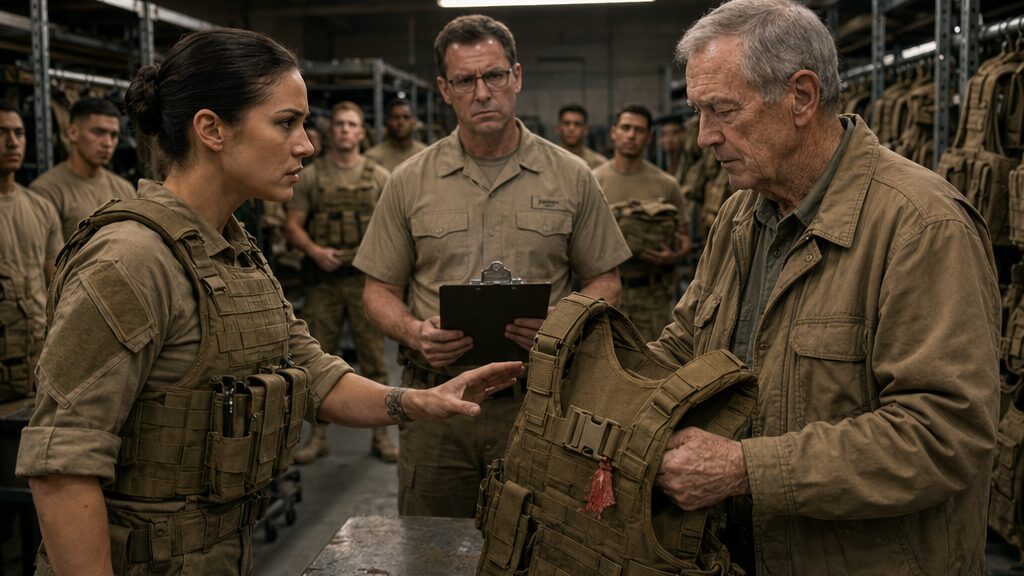
Tan vests came down from hooks. Rescue packs landed on the inspection table. Recruits called numbers from laminated cards. A scanner chirped every few seconds as each barcode passed under its red beam. Someone laughed near the back wall, where folded rain gear sat in uneven stacks. Boots scraped concrete. Nylon straps slapped metal shelving. The room had the crowded smell of dust, rubber, old canvas, and coffee gone cold.
Dennis stood at the end of the inspection table with the vest held flat between both hands.
He pressed the quick-release buckle again.
The plastic teeth seated. The latch looked closed. The front panel lay smooth. The scanner tag hung cleanly from the shoulder strap.
But there was no click.
Not the full one.
Not the sound that told a man the buckle had taken tension the way it was meant to.
Dennis did not move for a moment. His thumbs stayed on the tan plastic. His right hand, stiff at the knuckles, felt the narrow tremor in the strap where the webbing had been fed through the wrong path. It was small. Almost nothing. The sort of small that disappeared when a room was loud and everyone wanted to be finished.
“Set that one with the cleared stack,” Jason Thomas called from behind him.
Dennis did not set it down.
Jason looked up from the clipboard in his hand. He wore thin-framed glasses and had the careful expression of a man trying to keep five tasks from colliding. Behind him, two recruits waited with more vests draped over their arms.
“Mr. Martin,” Jason said, a little louder. “That one scanned green.”
Dennis pressed the buckle a third time.
Still wrong.
Rebecca King turned from the shelf where she was checking harnesses. Her dark hair was pulled tight under her cap, and the sleeve of her tan uniform sat high enough to show the edge of a tattoo on her forearm. She had spent the morning moving fast, correcting people before Jason had to, keeping her squad ahead of the visiting evaluator’s schedule.
Now she saw the old man holding up the line.
“It’s already checked,” she said.
Dennis ran one finger along the webbing where it entered the buckle. He did it slowly, not because he meant to irritate anyone, but because his hands no longer trusted speed. Speed could lie to a person. Sound rarely did.
“This one doesn’t close right.”
Rebecca gave a short breath through her nose. “It is closed.”
“It sits closed,” Dennis said.
Jason stepped closer, clipboard tucked under his arm. “We’ve got thirty-six more items to clear before the evaluator gets here. If there’s a visible defect, mark it. If not, we have to keep moving.”
Dennis looked at the vest, not at Jason. “The defect is the part you won’t see until it takes weight.”
The room softened around the edges. Not silent yet, but listening. Dennis felt that old change in a room when one person stopped the rhythm everyone else had agreed to follow. He had never liked being that person. At seventy-two, he liked it less. He had come in because Barbara Davis had called and said they were short two trained inspectors for the disaster-response weekend. Temporary help, she had said. A few hours. You know gear better than anybody.
He had told himself he would come in, check what he was asked to check, and leave before anybody started treating him like an old photograph.
But the buckle sat in his hands like a question.
Rebecca crossed to the table. “May I?”
Dennis passed her the vest.
She lifted it, looked at the front, tugged the strap, pressed the release, snapped the buckle back together. To anyone watching, it behaved perfectly. Closed. Opened. Closed again.
“There,” she said. “It locks.”
Dennis heard it again. The thin, soft seating noise. Not the full click.
Rebecca put the vest down harder than needed. “We’ve been using these all year.”
“That may be true.”
“It passed the barcode check.”
“That’s true too.”
Jason’s mouth tightened. He glanced toward the open gear-room door as if the visiting evaluator might appear just because Dennis had slowed the schedule. “Mr. Martin, the barcode confirms it’s assigned, inspected, and current.”
Dennis nodded once. “It confirms the record says that.”
A recruit near the shelves shifted his weight. Nylon rustled. Rebecca noticed the movement and straightened, as if she had been challenged in front of her own squad.
“With respect,” she said, though there was little respect in the speed of it, “you were asked to help count and clear. We’ve got a system for the rest.”
Dennis looked at her then.
She was not careless. That mattered. Her boots were tied right, her sleeves even, her gear arranged with the tense neatness of someone who expected to be judged before she spoke. She had probably been carrying her squad all morning and did not want some retired man with gray hair and slow hands making her look unready.
Dennis understood that kind of pride. He had trained it. He had also buried pieces of it.
“I’m not counting,” he said. “I’m inspecting.”
Rebecca’s jaw moved once. “Then inspect it.”
He picked up the vest again. He held it near his chest and pressed the buckle with his thumb.
Soft closure. No click.
“Listen,” he said.
Jason exhaled. “The room’s loud.”
“That’s part of the problem.”
Nobody answered.
Dennis reached for the inspection sheet at the edge of the table. There was a blank space beside the vest number. His name had been printed lightly under the last column, as if someone had expected his signature to be a formality. He looked at that space for a long second.
His fingers remembered another sheet. Another room. Another hurry. A younger voice saying it was probably fine. A supervisor saying the convoy was already behind. A buckle that had closed just enough to fool the eye.
Dennis let the memory pass without showing it.
He set the pen down.
“I won’t clear this vest.”
Jason’s face changed, not into anger yet, but into the guarded patience of an officer trying to manage a civilian problem. “You understand what that does to the issue list?”
“Yes.”
“It delays the lane assignments.”
“Yes.”
Rebecca folded her arms. “Over a sound.”
Dennis rested one hand on the vest. The tan webbing lay under his palm, ordinary and quiet.
“Over a missing sound,” he said.
Someone in the back gave a faint laugh, then stopped when Jason looked over.
Rebecca stepped closer to the table. She was close enough now that Dennis could see the fatigue under her eyes. Not weakness. Just pressure. She lowered her voice, but everyone still heard it.
“Do you even know how this current gear works?”
Dennis did not answer right away.
He looked down at the buckle once more, then at the rows of shelves behind her, each hook carrying equipment that had passed through too many hands too quickly. The scanner chirped again from somewhere behind Jason, bright and confident.
Dennis kept his voice level.
“I know what it sounds like when it doesn’t.”
Chapter 2: The Room Went Silent After One Click Failed
Rebecca King had been corrected by older men before.
Usually they did it with a story.
They leaned back, made everyone wait, and began with how things had been done when they were younger, tougher, better, back when nobody complained and equipment was heavier and orders were clearer. Rebecca knew how to survive those moments. Stand still. Let the story pass. Take what was useful, if there was anything useful, and keep the day moving.
Dennis Martin did not tell a story.
That bothered her more.
He only stood there with one hand on the vest and the other resting near the unsigned inspection sheet, as if he had all the time in the world to let the morning collapse around him.
The gear room had stopped pretending not to watch.
Recruits looked down at buckles in their own hands. Barbara Davis appeared in the doorway from the supply office, a tablet under one arm and a ring of keys against her hip. Jason Thomas stayed behind the inspection table, glasses low on his nose, his expression pulled tight between schedule and command responsibility.
Rebecca felt all of them.
She also felt the vest on the table like an accusation.
“Show me,” she said.
Dennis lifted the vest.
“No,” Rebecca said. “Show everyone. If it’s unsafe, show us.”
She did not mean it to sound like a challenge, but it came out that way. Too sharp. Too public. She saw Jason’s eyes flicker toward her, warning her to keep control. She saw Barbara’s mouth press into a line.
Dennis did not react to the tone. He turned the vest so the front buckle faced the room.
“This is a quick-release assembly,” he said.
“We know what it is,” Rebecca said.
“I expect you do.”
The quiet answer landed worse than a reprimand. It gave her nothing to push back against.
Dennis held the left side of the buckle in his weathered fingers. “When the webbing is fed clean, this side seats with tension behind it. Not just surface pressure. Tension.”
He brought the pieces together. The buckle closed with its thin, unsatisfying tap.
Several recruits leaned in.
“That’s locked,” Rebecca said.
Dennis handed it to her. “Pull from the shoulder strap.”
She did. The buckle held.
“Now from the side load point.”
Rebecca glanced at Jason. Jason gave no help.
She changed her grip and pulled. The buckle did not open, but the webbing shifted by a fraction. Barely anything. If Rebecca had not been watching Dennis’s eyes, she might have missed the way his gaze went straight to the strap, not the latch.
“It moved,” he said.
“Everything moves under force.”
“Not that way.”
Barbara stepped farther into the room. “That vest scanned green. I checked the inventory myself.”
Dennis turned slightly toward her. “I don’t doubt it.”
“The record shows inspected last night.”
“I believe the record.”
Rebecca could feel her patience thinning. “Then what exactly are you saying?”
Dennis set the vest back on the table and lifted the shoulder strap. Beneath it, half-hidden near the seam, a frayed red inspection tag hung from a small loop. It had curled at the edge, its color faded from too many fingers and too much dust.
“This tag,” Dennis said, “doesn’t belong on this vest.”
Barbara frowned. “Tags get moved during sorting.”
“They shouldn’t.”
“That doesn’t mean the buckle’s bad.”
“No,” Dennis said. “It means this vest has been in the wrong place long enough for people to stop seeing it.”
Rebecca looked at the tag. She hated that the room was now looking at it too. A red tag on a tan vest. A small, stupid thing. The kind of thing that became important only when someone decided to make it important.
“Or,” she said, “it means a tag got hooked on the wrong strap during the rush.”
Dennis nodded. “That could be.”
His agreement took the force out of her argument.
Jason checked the number printed near the vest’s lower seam against his clipboard. “The barcode matches the assigned list. Training lane three. Rescue support.”
Rebecca knew lane three. Her squad’s lane. Simulated flood extraction, two casualties, timed movement through debris, harness transfer on the platform. The visiting evaluator cared about lane three because it looked good on camera and exposed bad coordination fast.
“Sir,” Rebecca said to Jason, “we can swap the vest if it makes everyone feel better.”
Dennis’s eyes moved to her. “Feeling better isn’t the point.”
Rebecca faced him fully. “No, readiness is the point. And readiness includes trusting the system we’ve all been trained on.”
“The system told you where the vest is supposed to be,” Dennis said. “It didn’t tell you how it was handled after.”
Jason set his clipboard down. “Mr. Martin, with respect, we can’t rebuild the whole inspection because of one tag.”
Dennis picked up the buckle again. “I’m not asking you to rebuild anything.”
“Then what are you asking?”
“For quiet.”
A few of the recruits looked at each other.
Rebecca almost laughed. “Quiet?”
Dennis’s face did not change. “The room is too loud for people who think they already know the answer.”
That time, nobody moved.
Even Rebecca felt the sentence settle somewhere she did not want it to settle.
Dennis lifted the buckle near his ear. Not dramatically. Not like a demonstration meant to embarrass anyone. He simply brought the plastic halves together and pressed.
Tap.
He released it.
Pressed again.
Tap.
Then he reached for another vest from the cleared stack, one Rebecca had checked herself twenty minutes earlier. He brought that buckle together.
Click.
The sound was small but unmistakable. A hard, seated, finished sound.
The room heard it.
Dennis did not look pleased. If anything, he looked tired.
He put the good vest down, then the suspect vest beside it. “That is the difference.”
Rebecca stared at the two buckles. Her face grew warm, and she hated that too. She wanted the difference to be nothing. She wanted it to be an old man’s theater, a sound he had invented to slow them down.
But she had heard it.
Jason picked up the suspect vest. He pressed the buckle himself. Tap. He pressed the good one. Click. He said nothing.
Barbara came to the table and touched the red tag. “That tag number isn’t in this row.”
Dennis turned the vest over and traced the webbing route with one blunt finger. “This side’s misthreaded. It’ll hold straight pull for a while. Side load, wet strap, uneven weight—different story.”
Rebecca heard the words but saw the clock in her mind. Evaluator. Lane assignments. Her squad waiting. Jason’s signature. Her own name on the readiness sheet.
“How long to fix?” Jason asked.
Barbara answered before Dennis could. “If it’s just one vest, five minutes.”
Dennis looked at the cleared stack.
Rebecca followed his gaze.
The stack suddenly seemed larger than before.
Jason saw it too. “We don’t know there are others.”
“No,” Dennis said.
“But you think there are.”
Dennis rested the buckle on the table. “I think this one didn’t get this way by itself.”
Barbara opened her tablet and began tapping. “The late inventory was done by shelf group. If one tag moved, it may be from when the packs were shifted.”
Jason removed his glasses and rubbed the bridge of his nose. For the first time all morning, he looked less like a man watching Dennis and more like a man hearing him.
Then the hallway outside filled with voices. The visiting evaluator’s team had arrived early.
Jason put his glasses back on. The brief uncertainty hardened into decision.
“Set the suspect vest aside,” he said. “Clear the rest by barcode and visible check. We’ll flag this item as isolated.”
Dennis’s eyes remained on him. “You haven’t shown that it’s isolated.”
“I understand your concern.”
“No,” Dennis said quietly. “You’ve heard it.”
Rebecca expected Jason to snap back, but he only reached for the clipboard.
“We are not stopping the entire exercise.”
He signed the sheet for lane three readiness, leaving Dennis’s line blank. Then he handed the clipboard to the maintenance clerk at the door and told the recruits to move the cleared gear to staging.
The room began to breathe again, but differently now. Quieter in the wrong places.
Rebecca picked up her helmet and avoided looking at Dennis. She told herself she was angry because he had challenged her team in front of everyone.
But when the first cart of cleared gear rolled out, one of the buckles knocked softly against the metal rail.
Tap.
Rebecca turned before she could stop herself.
Dennis heard it too.
Chapter 3: The Tag Did Not Belong There
Barbara Davis trusted records because records remembered what people forgot.
People got tired. People rushed. People set things down on the nearest flat surface and swore they would come back for them. People borrowed from the wrong shelf, grabbed the wrong size, skipped a line because someone higher up wanted an answer before lunch.
Records were not perfect, but they were less emotional. They did not get embarrassed in front of recruits. They did not resent being questioned by retired men with slow hands. They did not care who had served when, or who was trying to impress an evaluator.
By noon, Barbara wanted badly for the records to be right.
She stood in the supply office with the suspect vest laid across the counter and Dennis Martin seated on the far side of the room, not because he had asked for a chair, but because she had seen the way his left knee stiffened after an hour on concrete. He had thanked her once and said nothing else about it.
On her tablet, the vest was clean.
Assigned to rescue support. Inspected. Scanned. Cleared for training lane three. The barcode matched. The serial number matched. The digital trail had no gaps.
Only the red tag did not belong.
Barbara pinched it between two fingers and tilted it toward the fluorescent light. The tag was frayed near the hole, and someone had written over the old number with black marker. Not enough to hide it. Enough to make a person stop looking.
“That’s from shelf B-seven,” Dennis said.
Barbara looked over. “You can read that from there?”
“No.”
“Then how do you know?”
“The tear.” He pointed, but did not get up. “B-seven tags were cut from the old red batch. Thinner plastic. They split at the corner.”
Barbara glanced at the tag again.
She hated that he was right.
Most people would not have noticed the difference between red tag batches. Most people did not spend enough time in gear rooms to understand that supplies had generations the way people did: old plastic, new plastic, old hooks, new labels, faded ink, fresh zip ties. Barbara knew those things because the room was her responsibility. Dennis knew them because he had been paying attention before half the recruits were born.
She opened the shelf map. “B-seven is training packs.”
Dennis nodded.
“Not vests.”
“No.”
Barbara leaned back in her chair. Outside the office window, the gear cage looked stripped and restless. Empty hooks. Half-filled bins. A cart left crooked near the door. In the hallway, Rebecca King’s squad moved past in pieces: helmet, shoulder, sleeve, boot, the quick confidence of people too young to feel how many things could go wrong between preparation and execution.
Barbara tapped into the previous night’s inventory log.
Maintenance clerk. Two recruits. Jason Thomas supervising. Late entry time: 2218.
She frowned.
“They moved training packs last night.”
Dennis watched her without answering.
Barbara kept scrolling. “Storm-response kits were shifted from B-seven to C-two because the evaluator wanted the flood lane closer to the loading bay.”
“Who moved the vests?”
“According to this, nobody.”
Dennis’s face stayed still.
Barbara understood the silence. It was not accusation. That made it harder to dismiss.
She opened the scan history. The scanner had recorded everything in order: packs, harnesses, vests, helmets. Clean green marks all the way down. But the time stamps were crowded too close together near the end, less than a second between some scans.
She knew what that meant. Someone had scanned tags in batches instead of lifting and checking each piece. Not malicious. Not even unusual when midnight came and the shelves looked endless.
She set the tablet down. “This doesn’t prove the buckle issue is connected.”
“No,” Dennis said.
“You say that a lot.”
“It keeps a person honest.”
Barbara almost smiled despite herself.
Dennis pushed himself up from the chair. He did it carefully, one hand on the armrest, weight shifting before he stood. For a moment he looked every bit of seventy-two. Then he crossed to the counter and picked up the vest with a steadiness that made the age seem irrelevant.
“May I see B-seven?”
Barbara took her keys. “If you start telling me my whole room is wrong, I’m putting you back in that chair.”
“I’m only looking at the tag.”
They entered the gear cage through the side gate. The cage was quieter than the inspection room had been, the sort of quiet that let small things announce themselves: key ring against Barbara’s belt, Dennis’s breath as he bent, the scrape of a hanger on the rail.
Shelf B-seven held training packs now, but not neatly. A row of hooks along the side showed old dust lines where something wider had hung for a long time. Barbara saw them and felt a prick of irritation at herself. She had walked past that shelf a dozen times and seen only what the map told her should be there.
Dennis touched one empty hook.
“Vests hung here before.”
“Months ago,” Barbara said.
“Maybe.”
She checked the shelf label. There was a newer sticker over an older one. The corner had lifted. Beneath it, faded block letters showed part of a word: RESC.
Barbara peeled the sticker back.
RESCUE VESTS.
She closed her eyes for one second.
“Old configuration,” she said.
Dennis did not answer.
“Don’t look at me like that.”
“I’m not.”
“You’re thinking it.”
“I’m thinking somebody changed the shelf faster than they changed the habits.”
That was worse because it was fair.
Barbara crouched and examined the lower hooks. A small knot of red plastic hung from one of them, torn and forgotten. Same thin batch. Same faded color. She touched it with her thumb.
The tag on the suspect vest had come from here. Somehow, during the late move, a tag from an old vest row had ended up on a current vest. Or a current vest had been pulled through old storage and returned wrong. Either way, the room had told the truth. Quietly. In dust lines and torn plastic.
From the staging area beyond the wall came the clatter of carts being loaded.
Barbara stood quickly. “They’re already moving lane gear.”
Dennis looked toward the sound.
His expression changed then, not much, but enough for Barbara to see something behind the calm. Not panic. Not anger. A tightening, as if some old door inside him had swung open and he was holding it shut with both hands.
“We should check the rest of the vests from that row,” he said.
Barbara went back to the office and pulled the staging list. “Most of them are already assigned.”
“Then we check what’s left.”
They returned to the inspection table. Barbara brought three vests from the held stack and two from the rack nearest B-seven. Dennis did not hurry. That nearly drove her mad until she understood that hurry was exactly what he was refusing.
First vest.
Click.
Second.
Click.
Third.
Tap.
Barbara’s hand stopped over the tablet.
Dennis set the third vest aside.
Fourth.
Click.
Fifth.
Tap.
The room seemed to shrink around the sound.
Barbara looked down at the two failed buckles. Both looked fine. Both had clean barcodes. Both had passed.
Dennis did not look triumphant. He looked older.
Barbara swallowed and reached for the phone on the wall.
“What are you doing?” Dennis asked.
“Calling Jason.”
Dennis put his palm lightly on one of the vests. “Tell him there are at least two more.”
Barbara stared at the tan plastic buckle, closed and wrong.
“At least,” she said.
Chapter 4: Dennis Refused to Put His Name Down
Jason Thomas received Barbara’s call while the visiting evaluator was explaining the importance of schedule discipline.
The evaluator stood at the front of the briefing room with one hand on the projector remote, outlining lane timing in a calm, practiced voice. Behind him, a slide showed the flood-response course in clean lines and bright blocks of color. Lane one: debris navigation. Lane two: medical triage. Lane three: rescue support and harness transfer.
Jason’s phone buzzed against the table.
He glanced down only because Barbara never called during briefings unless something was about to become his problem.
Two more.
That was all her message said at first.
Then another came through.
Same buckle issue. Same old red tag batch.
Jason turned his phone face down.
Across the room, Rebecca King sat with her squad in the second row. Her posture was straight, chin level, notebook open on one knee. She was not looking at Jason, but he could tell from the stillness in her shoulders that she had seen him read the message. Soldiers like Rebecca noticed everything that might affect their lane.
Jason looked toward the back wall, where Dennis Martin stood instead of sitting. The old man had chosen the edge of the room, half in shadow near the door, hands folded loosely in front of him. Not withdrawn. Not imposing. Just present.
Temporary assistant, Jason reminded himself.
Except temporary assistants did not usually make whole training schedules tilt.
The evaluator clicked to the next slide. “All gear cleared through unit-level inspection?”
Jason’s mouth opened before his thoughts fully settled.
“Yes,” he said. “With three items held for follow-up.”
The evaluator’s eyes moved briefly to his notes. “Three?”
“Non-critical,” Jason said.
Dennis did not move.
That bothered Jason more than if the old man had challenged him openly. No raised eyebrow. No sigh. No disappointed shake of the head. Dennis simply stood there, letting Jason hear his own words in the room.
Non-critical.
Jason finished the briefing with the familiar rhythm of command: lane start times, weather expectations, safety calls, evaluator access, squad responsibilities. His voice stayed even. He had learned long ago that uncertainty in front of a group multiplied faster than any actual problem.
When the room broke apart, chairs scraped backward and soldiers moved toward the door in clusters. Rebecca paused near the aisle, looking as if she wanted to speak, then thought better of it when the evaluator approached Jason.
“Your supply sergeant has concerns?” the evaluator asked.
“Inventory discrepancy,” Jason said. “We’re containing it.”
“Do I need to delay lane three?”
“No.”
The answer came too quickly.
The evaluator noticed. “You’re sure?”
Jason felt Dennis still standing at the back of the room. He kept his gaze on the evaluator. “We’ve isolated the suspect equipment. The remaining gear passed the system and visible check.”
“Good.” The evaluator tucked his folder under his arm. “I’ll expect full readiness by morning.”
When the evaluator left, the room felt too large.
Jason gathered his papers slowly. Rebecca disappeared into the hall with her squad. The recruits’ voices faded toward the loading bay. Only Dennis remained by the door.
Jason did not look up. “You heard.”
“I did.”
“You disagree.”
Dennis took a step into the room. “I think you believe three failed buckles are still three separate problems.”
Jason set the papers down. “And you believe they’re not.”
“I believe they came from the same hands, the same shelf, or the same hurry.”
Jason’s patience thinned. It had been thinning all day, worn down by the evaluator, the schedule, Barbara’s records, Rebecca’s pride, and Dennis’s calm refusal to act like a man who understood the size of the machine he had stopped.
“Mr. Martin, this unit has trained for six weeks for tomorrow. The county emergency office will be here. The evaluator will be here. We have limited access to the site, limited weather window, and thirty-four people who need the reps. I cannot cancel a full lane over a possibility.”
Dennis looked at the projector screen, where lane three still glowed in pale blue. “I’m not asking you to cancel.”
“You’re refusing to sign.”
“Yes.”
“That has consequences.”
“It should.”
Jason stared at him.
For the first time that day, irritation came loose in his voice. “Do you know what it looks like when the only outside inspector in the room refuses to put his name down?”
Dennis looked back at him. “It looks like someone should ask why.”
“I am asking.”
“No,” Dennis said. “You’re asking me to make the answer smaller.”
The words struck with no force and still landed hard.
Jason picked up the readiness sheet from the table. The lines were almost complete. Barbara’s initials. Rebecca’s lane leader confirmation. Jason’s approval. Only one blank remained beside Dennis Martin’s printed name.
Jason held out the pen.
“Sign for the cleared gear,” he said. “Not the held items. Just the cleared gear.”
Dennis did not take it.
“Dennis.”
The first name slipped out before Jason could stop it. It made the room less official and more uncomfortable.
Dennis looked at the pen. His hands remained at his sides.
“There was a training rig at Fort Polk,” he said.
Jason’s jaw tightened. “We don’t need—”
“It was cleared,” Dennis continued. “Paperwork was right. Tags were right. The man checking it was tired, and the sergeant in charge had a schedule that mattered. Everyone had somewhere else to be.”
Jason said nothing.
Dennis’s voice stayed level. That made it worse. He did not tell it like a memory asking for sympathy. He told it like a procedure that had failed.
“The buckle sat closed. Not locked. Closed. Nobody heard the difference because the bay was loud and the truck was running. I heard something wrong and let a younger sergeant talk me out of holding the line.”
His eyes moved to the readiness sheet.
“I signed.”
Outside, a cart rattled along the hall.
Jason realized he had stopped breathing normally. “What happened?”
Dennis looked past him, not far, maybe only as far as the screen.
“A trainee trusted the gear.”
That was all.
No dramatic detail. No courtroom ending. No name. No blame handed across the table. Just a sentence with a weight behind it that Jason could not file neatly under nostalgia or stubbornness.
Jason lowered the pen.
“I’m sorry,” he said, because there was nothing else to say.
Dennis nodded once, accepting the words without using them. “I’m not telling you tomorrow will become that day.”
“But you think it could.”
“I think if a mistake shows you its face, you don’t ask it to come back later with proof.”
Jason looked down at the sheet. He wanted the matter to be simple. He wanted three held items, one old memory, one cautious retired trainer, and a clean plan for morning. He wanted Rebecca’s lane to run on time and Barbara’s system to remain trustworthy. He wanted the evaluator to see competence, not hesitation.
He also wanted Dennis to be wrong.
That desire embarrassed him.
He turned the sheet toward himself and signed the final command approval line. Then he drew a firm box around the three suspect item numbers and wrote HOLD in block letters beside them.
Dennis watched.
Jason slid the paper into the folder. “The exercise starts in the morning. The suspect gear stays separated. Everything else moves forward.”
Dennis’s expression did not change, but something in the room did.
“You’re proceeding without my sign-off,” he said.
“Yes.”
“Then don’t tell yourself I cleared it.”
Jason met his eyes. “I won’t.”
For a moment, neither man spoke. Jason heard the hum of the projector fan, the faint noise of soldiers in the loading bay, the thick quiet around Dennis’s unclaimed signature.
Then Dennis stepped toward the door.
“Where are you going?” Jason asked.
“Back to the gear room.”
“We’re done for tonight.”
Dennis paused with one hand on the frame. “That’s usually when people miss things.”
Jason almost told him to go home.
Instead, he watched the old man walk into the hallway with his careful, uneven gait, one shoulder slightly lower than the other, his shadow cutting across the strip of light outside the briefing room.
By the time Jason reached the loading bay twenty minutes later, lane three’s carts were already staged.
The three suspect vests sat apart, tagged and held.
The rest of the gear waited under plastic covers, cleared by barcode, visible check, and command approval.
Jason stood in front of it longer than he needed to.
Then he turned off the bay lights and told himself morning would prove the difference between caution and fear.
Chapter 5: The Field Heard the Same Wrong Silence
The rain machines started before sunrise.
By seven-thirty, the training site looked enough like a flood zone to make Rebecca King’s squad move differently. Water streamed across broken concrete. Plywood debris shifted under boots. Orange cones marked unstable ground near a shallow drainage basin where the instructors had placed two weighted rescue dummies under a half-collapsed platform.
The air smelled like wet dirt, diesel, and rubber.
Rebecca liked the site better than the gear room.
Out here, movement answered questions. A person either carried weight or didn’t. A knot held or didn’t. A squad listened or drifted. The field did not care about tone, pride, or old men who could make a room feel guilty over a sound.
“Lane three ready,” she called.
Her squad formed behind her, faces damp under helmets. The rescue harnesses hung across their vests. Each soldier had checked and rechecked straps under her eye. No suspect gear. No red tags. No held items. Jason had confirmed it before they loaded out.
Still, when Rebecca clipped her own buckle that morning, she had paused.
Just once.
She hated that she had done it.
She had listened for the click.
It had been there, sharp and clean. She had moved on without telling anyone.
Now Jason stood near the evaluator’s tent with a radio at his shoulder. Barbara was farther back near the gear truck, tablet sealed in a rain sleeve. Dennis Martin was not on the field. Rebecca had noticed that too. His absence irritated her in a way she could not explain. Part of her had expected him to appear at the worst possible moment, quiet and inconvenient, holding some other tiny flaw in his hands.
The range safety officer raised one arm.
“Begin.”
Rebecca moved.
Her squad entered the lane hard and clean. Two soldiers cleared the first debris line. One marked the simulated hazard. Rebecca directed the harness team toward the platform, voice clipped, no wasted syllables. Rainwater struck her sleeves and ran under her collar. Boots splashed. A recruit slipped near the basin and recovered without losing pace.
Good, Rebecca thought. Stay sharp.
The first dummy came out smoothly. Harness under shoulders. Transfer line attached. Weight shifted. Pull team moved on her count.
“Three, two, lift.”
The dummy rose.
The system held.
Rebecca glanced toward the evaluator’s tent and saw Jason watching. Not smiling. Jason rarely smiled during lanes. But his shoulders had lowered a little.
Good.
They moved to the second dummy, the one under the platform. This transfer required a side angle. The harness had to take uneven load while two soldiers guided from the debris edge. Rebecca crouched, mud pressing cold through one knee, and took the rescue harness from a soldier beside her.
“Clip front. Route side. Keep the line clear,” she said.
The soldier fed the strap through.
Rebecca checked the shoulder points, the waist point, the side load path. Her hands moved quickly. This was the part that mattered in lane three. Too slow and the evaluator marked coordination. Too fast and safety called the lane dead.
“Ready on side load,” someone called.
Rebecca brought the buckle together.
Tap.
She froze.
Water ran down the front of her helmet and dripped from the edge of her chin strap.
The soldier across from her shouted over the rain. “Ready?”
Rebecca looked at the buckle.
It was closed.
The latch sat flush. The strap looked routed. The harness had passed inspection that morning. The barcode had scanned green before loading. The side webbing lay flat under her thumb.
She pressed it again.
Tap.
Not click.
Her pulse rose—not fear exactly, not yet, but the sudden internal silence of a room going still.
The room is too loud for people who think they already know the answer.
Rebecca swallowed rain.
“Hold.”
The soldier across from her stared. “What?”
“Hold the lift.”
“We’re on time.”
“Hold the lift.”
Her voice cut harder that time.
The pull team stopped. The dummy remained half-secured under the platform. Rain hammered the plywood overhead. From the evaluator’s tent, she saw Jason straighten.
The range safety officer cupped a hand near his mouth. “Lane three, status?”
Rebecca did not answer him yet.
She unclipped the buckle and clipped it again beside her ear.
Tap.
The sound was almost swallowed by rain, generator noise, boots in water, the radio chatter from the tent.
Almost.
Rebecca turned the harness and pulled from the side load point.
The webbing shifted.
Not much.
Enough.
A cold, clean feeling moved through her chest.
She looked toward the gear truck. Barbara had already stepped down from the tailgate. Jason was moving across the field, one hand holding his helmet against the rain. The evaluator followed at a slower pace.
“What’s the problem?” Jason called.
Rebecca held up the harness. Her pride tried to speak first. It wanted to say she was being careful, that she had found it, that this was different from yesterday.
Instead she heard herself say, “It didn’t click.”
Jason stopped two steps from her.
For a second, the whole wet field seemed to balance on that sentence.
The soldier beside Rebecca looked from her to Jason. “It’s closed, Sergeant.”
Rebecca turned to him. “I know what it looks like.”
Jason crouched beside her and took the buckle. He pressed it.
Tap.
Rain struck his glasses. He removed them, wiped them uselessly on his sleeve, and pressed the buckle again.
Tap.
The evaluator’s face had gone unreadable.
Barbara arrived breathing hard. “That harness wasn’t in the held group.”
“No,” Jason said.
Rebecca pointed to the side webbing. “It shifts under side load.”
Barbara crouched, tablet forgotten under her arm. She traced the strap with two fingers and went still.
“Same misroute,” she said.
No one spoke for a beat.
The range safety officer stepped closer. “Do we suspend the lane?”
Rebecca looked at the dummy under the platform. She imagined the team lifting on her count. The side angle taking force. The buckle sitting closed but wrong. A shift, a slip, a body dropping back into water and debris. It was a training dummy, weighted and faceless, but her mind supplied a soldier’s hands, a startled shout, the terrible half second after everyone realized the mistake had been there before the accident.
Her face burned despite the rain.
“Lane three is suspended,” she said.
The words cost her more than she expected.
Jason looked at her. Something passed between them that was not apology yet but carried the shape of it.
The evaluator turned to Jason. “Your equipment was cleared.”
Jason did not defend the paperwork.
“Yes,” he said. “It was.”
Barbara opened her tablet with wet hands. “I need to pull the load history. This harness came from the rescue support cart, not the held vest set.”
The range safety officer signaled the lane dead. The recruits began backing out of position, confused and quiet. Rebecca unclipped the harness from the dummy and held it in both hands.
It was heavier now than it had any right to be.
Jason keyed his radio. “Training control, this is lane three. Suspend rescue support. Hold all harness and vest use pending reinspection.”
A crackle answered.
Then Jason looked toward the parking area beyond the tents, where the reserve center building sat gray under the weather.
Rebecca knew who he was thinking of before he said it.
Jason lowered the radio and turned to Barbara. “Find Dennis.”
Barbara nodded once.
“No,” Jason said, correcting himself. “Ask him to come back to the gear room.”
Rebecca looked down at the buckle in her hands. Rainwater ran through the plastic seam and fell without sound.
She pressed it once more, not to prove anything, but because some part of her needed to hear the wrongness again.
Tap.
Jason heard it too.
Chapter 6: The Old Method Saved the New Team
Dennis Martin was drying mud from the legs of the inspection table when Jason brought the failed harness into the gear room.
No one had asked Dennis to clean the table. Barbara had told him to wait. Waiting had never suited his hands. So he had found a rag near the sink, wrung it out until his fingers ached, and worked the grit out of the table seams while the building filled with the muffled return of a suspended exercise.
The gear room that morning had been loud with preparation.
Now it was quiet with consequence.
Jason entered first, helmet tucked under one arm, glasses spotted with rain. Rebecca followed behind him, carrying the harness like something breakable. Barbara came in last with her tablet, keys silent in her hand for once.
No one rushed to speak.
Dennis set the rag aside.
Jason placed the harness on the inspection table. “Same failure pattern.”
Dennis looked at the buckle but did not touch it yet. “Anyone hurt?”
“No.”
Rebecca’s eyes stayed on him. “No.”
Only then did Dennis put his hand on the harness.
He did not say good. He did not say I told you. He did not look around to see who had been proven wrong. He simply drew the harness closer and turned it so the side load strap faced the light.
The old habit came over him like a coat.
First, stillness. Gear told more truth when a person stopped handling it like an argument.
Second, sound. He pressed the buckle.
Tap.
Third, path. He followed the webbing from latch to anchor, from anchor to adjustment point, from adjustment point back through the plastic teeth. The misroute was there, small and clean and almost reasonable. A tired hand could make it. A hurried hand could repeat it. A system could record it as present and current while knowing nothing about the path force would take through the strap.
Dennis looked at Barbara. “Bring me one from the held group.”
She did.
He laid the held vest beside the harness. Then another. Then the second failed vest from the day before. Four pieces now, tan and damp and silent on the table.
Jason closed the gear-room door.
Rebecca stood opposite Dennis, exactly where she had stood the day before when she asked if he knew how current gear worked. Today she said nothing.
Dennis lifted the harness buckle and the vest buckle side by side. “Same family of assembly. Different item. Same route mistake.”
Barbara tapped through records. “They were stored in different rows.”
“Now,” Dennis said.
Barbara stopped tapping.
Jason heard it too. “Not before.”
Dennis turned toward the shelves. “Gear rooms remember old layouts longer than maps do.”
He walked to B-seven without asking. His knee stiffened halfway there, and Rebecca took one small step as if to help, then stopped herself. Dennis noticed but gave no sign.
At the shelf, he touched the lifted corner of the newer label Barbara had peeled back the day before. RESCUE VESTS still showed underneath. He moved two hooks down and pointed to a shallow groove worn into the paint.
“Wide gear hung here. Not packs.”
Barbara nodded. “Old rescue setup.”
Dennis went to C-two, where storm-response kits had been staged the night before. He touched the lower rail. “And this rail is newer. No wear at the side hooks.”
Jason folded his arms. “So during the move, they pulled old rescue gear habits into new storage.”
“Maybe.” Dennis looked toward Barbara. “Who packed the lane carts?”
“Maintenance clerk supervised. Recruits did the lift and scan.”
“Were they trained on the old layout?”
“No.”
“Then they followed what the room suggested.”
Rebecca frowned. “The room suggested?”
Dennis returned to the table. “A hook at shoulder height. A red tag where red tags used to go. A shelf label covered but not gone. Gear that looks close enough to gear that used to hang there. People in a hurry don’t invent mistakes. They accept invitations.”
The words were not poetic when he said them. They were practical. That made them harder to ignore.
Barbara pulled up the late-night scan order and turned the tablet toward Jason. “The harnesses were scanned right after the old B-seven group was moved. Then vests. Then packs. The times are too close. They were probably staged together before sorting.”
Jason looked at the screen and said nothing.
Rebecca picked up the failed harness. “But I checked this morning.”
Dennis nodded. “You checked what you were trained to check.”
“That’s not an answer.”
“It is. Just not the one you want.”
Her mouth tightened, but she did not fire back.
Dennis took the harness from her and opened the buckle. “Most checks ask, does it close? Does it release? Is it assigned? Is it visibly damaged?” He routed the strap the wrong way, carefully, showing them the path. “This mistake says yes to all of those until load comes from the side.”
He pulled. The strap shifted.
Then he unrouted it and fed the webbing back through with slow, deliberate motion. Over the bar. Flat through the channel. Back against the tension path. He pressed the buckle.
Click.
The sound filled the room.
No one moved.
Dennis handed it to Rebecca. “Now you.”
She took it.
Her first attempt was too quick. The webbing twisted near the edge. She caught it before Dennis said anything and started again. This time she slowed. Over the bar. Flat through the channel. Back against the tension path.
She pressed.
Click.
Her shoulders dropped a fraction.
Jason watched her, then looked at Dennis. “Can this be turned into a checklist step?”
“Yes.”
Barbara lifted her tablet. “Manual load-path check after scan.”
“Before scan,” Dennis said.
Barbara looked up.
“If you scan first,” Dennis said, “the green light tells the hand to relax.”
Barbara’s thumb hovered over the screen, then she nodded and changed the order.
Jason leaned against the table. He looked tired now in a way the morning had not allowed. “Why didn’t you say all of this yesterday?”
Dennis’s eyes remained on the gear. “I did.”
Jason accepted that with a small nod. “Not all of it.”
The room went quiet again.
Dennis placed one corrected buckle beside one failed buckle. Click beside tap. A clean answer beside a warning.
“There was a trainee,” he said.
Rebecca looked down.
Dennis kept his hand on the table, palm flat, fingers spread slightly as if steadying himself against something no one else could see.
“He was nineteen. Strong. Funny when he shouldn’t have been. Always first to volunteer for the heavy end of anything. We were behind that day. Weather moving in. Trucks waiting. I heard a bad close on a rig and let the sergeant running the lane tell me it had already passed.”
No one interrupted.
Dennis rubbed his thumb once against the table edge.
“The rig failed under angle load. Not straight pull. Angle. Same as today would have been.”
Barbara’s face changed.
Jason lowered his eyes.
Rebecca held very still.
“He lived,” Dennis said. “But not the life he brought into the bay that morning.”
The sentence settled over the table.
Dennis drew in a quiet breath. “That was not my only mistake in uniform. Just the one that learned how to follow me into quiet rooms.”
Rebecca’s voice came softer than he had heard it before. “Is that why you wouldn’t sign?”
Dennis looked at her. “I wouldn’t sign because the gear was wrong.”
It was not a correction meant to shame her. It was a line he would not let anyone blur, not even for sympathy.
Jason straightened. “We’ll suspend all rescue-support equipment until rechecked.”
“No,” Dennis said.
Jason blinked. “No?”
“Don’t suspend it. Rebuild the check. Then run the lane when the gear is ready. If you stop at blame, people learn to hide mistakes. If you stop at fear, they learn nothing works.”
Rebecca studied him across the table. Yesterday she had thought his quiet was arrogance wearing age as armor. Now she saw the effort inside it. The restraint. The refusal to make his pain the center of the room even when it explained everything.
Jason turned to Barbara. “Full reinspection. Manual path first. Sound check second. Scan third. Anything wrong gets rerouted or held.”
Barbara nodded and began typing.
The next hour moved slowly. Not because Dennis made it slow, but because everyone did. Recruits were called back in pairs. The range safety officer sent lane gear inside under plastic covers. Barbara marked each item. Jason watched the process instead of the clock.
Dennis stood at the table until his knee forced him to sit. From the chair, he kept teaching. Not loudly. Never more than a few words when a few words would do.
“Flat.”
“Again.”
“Listen before you look at the screen.”
“Don’t pull angry. Pull true.”
Rebecca stayed beside him longer than required.
At first she told herself she was there because lane three was her responsibility. Then a recruit fumbled a strap and flushed red under the attention. Dennis did not sigh. He did not take it away. He only tapped the webbing path and waited.
Rebecca saw the recruit fix it himself.
Click.
The recruit looked surprised by his own success.
Dennis nodded once. “That’s the one.”
By midafternoon, the failed items formed a small row on the side table. Not many. Enough. Barbara’s records showed no single villain, no dramatic sabotage, no one person to blame cleanly. Just a rushed layout change, old labels under new labels, batch scanning, and hands trained to trust green lights before touch.
Jason signed the revised hold sheet in silence.
Then he placed a fresh inspection sheet in front of Dennis.
This time, only the corrected gear was listed.
Dennis read each line. Slowly. Thoroughly. He checked the held numbers against Barbara’s tablet. He asked one question about the harness group and waited while she answered it. Only then did he pick up the pen.
His signature was smaller than Jason expected.
Dennis Martin.
Not a flourish. Not a statement. Just a name where responsibility belonged.
Rebecca removed her own vest and set it on the table.
Dennis looked up.
She kept her hands on the shoulder straps. “Would you inspect mine again?”
The room did not stop this time. Recruits kept working. Barbara kept marking records. Jason kept reviewing the hold list.
But Dennis heard the difference.
Rebecca slid the vest toward him, not defensive, not challenging, not asking him to prove himself.
Asking to learn.
Chapter 7: Rebecca Listened Before She Led Them Out
One week later, Rebecca King stopped the gear room before anyone else had a chance to rush it.
She did not raise her voice.
She only lifted one hand.
The recruits near the shelves paused with vests half off their hooks. A cart wheel squeaked once and settled. The scanner in the maintenance clerk’s hand hung silent above a barcode. Morning light came through the high windows in pale strips, laying itself across the inspection table, the tan straps, the new checklist Barbara Davis had taped to the wall.
Manual path.
Sound check.
Scan.
In that order.
Rebecca stood at the head of the table with her helmet tucked under one arm and her own vest laid flat in front of her. A week ago she would have called the sequence and trusted everyone to keep up. Today she waited until every set of eyes was on the gear, not on her.
“Before anyone scans,” she said, “you trace the load path. Not the label. Not the barcode. The strap.”
No one argued.
That felt strange enough to make her careful.
Jason Thomas stood near the door with a folder under his arm. He had not taken over the room. He had not turned the revised procedure into a speech. He had simply handed out the printed cards that morning and told the squad leaders the rescheduled exercise would start only after the manual check was complete.
Barbara moved along the shelves, checking hooks against her tablet. The new labels were clean and square, but she had left one corner of the old B-seven label visible under clear tape. Rebecca had noticed it when she came in. RESCUE VESTS, faded and half-hidden, kept in sight like a warning the room had earned.
The red tags were back where they belonged.
Dennis Martin sat on the bench near the inspection table, a vest across his knees.
He had arrived ten minutes early and said almost nothing. Rebecca had seen the maintenance clerk offer to carry his bag; Dennis had thanked him and carried it himself. She had seen him pause before stepping over the threshold, not dramatic, just a brief taking-in of the room. The same shelves. The same concrete floor. The same hooks that had almost taught them the wrong lesson.
Now he watched the recruits work.
Not like a judge.
Like a man listening.
Rebecca picked up her own vest. “I’ll do mine first.”
She felt the room shift. Not much. Enough.
A week ago she had stood across from Dennis and asked whether he even knew how current gear worked. The memory had returned to her in pieces all week: her voice, too sharp; the faces of her squad; Jason’s silence; Dennis holding the buckle and refusing to make his answer bigger than the gear.
She had thought apology would be the hard part.
It turned out changing in front of the same people was harder.
She set the vest down with the front panel facing up. Her fingers moved over the strap path the way Dennis had shown her. Over the bar. Flat through the channel. Back against the tension path. No twist near the edge. No false straight line. She pulled once from the front, once from the side load point.
The buckle held.
She opened it, then brought the halves together.
Click.
The sound seemed louder than it was.
A recruit at the far side of the table looked down at his own vest and adjusted his grip.
Rebecca nodded to him. “You heard that?”
“Yes, Sergeant.”
“That’s what you wait for.”
She handed the vest to him. “Now check mine.”
He blinked. “Yours?”
“If you only check people below you, you’re not checking the gear. You’re checking rank.”
Jason looked down at his folder, but Rebecca saw the corner of his mouth move almost into a smile.
The recruit traced the straps carefully. His first pull came too gentle.
Rebecca shook her head. “Don’t be polite to it.”
Dennis spoke from the bench. “Don’t be angry at it either.”
The recruit glanced at him.
Dennis tapped two fingers against the vest on his knees. “Pull true.”
The recruit tried again. This time the strap took the force cleanly. He opened and closed the buckle.
Click.
Rebecca took the vest back. “Good.”
The room began moving again, but not in the old way. The pace was slower at first, uncertain, each soldier listening for permission from the equipment instead of the scanner. Then the rhythm found itself. Trace. Pull. Click. Scan. Set aside. Trace. Pull. Click. Scan.
The scanner’s chirp no longer led the room. It followed.
Barbara stopped beside Rebecca with the tablet. “Lane three gear is clear so far.”
“So far,” Rebecca repeated.
Barbara gave a small nod. “So far.”
That was another thing the week had changed. Nobody was saying clean when they meant unchecked. Nobody was saying isolated when they meant unexplained. The words had grown more careful because the room had.
Jason stepped to the front after the final rescue harness clicked clean.
“Gear cleared for lane three,” he said.
The old version of that sentence would have ended the matter.
This time he turned toward Dennis. “Mr. Martin?”
Every head turned.
Rebecca saw Dennis’s shoulders settle, not with satisfaction, but with the discomfort of being made visible. He placed the vest from his knees onto the table and stood. The movement took him a second longer than it would have taken most of them. No one moved to help. Not because they did not care. Because they had learned to let him decide what help meant.
Dennis walked to the table.
Jason handed him the revised inspection sheet.
Dennis read it line by line. Manual path completed. Sound check completed. Barcode scan completed. Held items removed. Shelf labels corrected. Red tags verified.
He did not hurry for the room.
Rebecca watched his hands. The knuckles were thick, the skin thin across them. Hands that had taught, signed, carried, and once failed to stop a line soon enough. She had not known that about him the first morning. She had only seen age where there had been history.
Dennis picked up the pen.
Then he paused.
Rebecca felt the pause in her chest.
He looked at her vest on the table. “Again,” he said.
For half a second, embarrassment rose in her. Not hot like before. Smaller. Human.
She opened the buckle.
The room waited.
She traced the strap path. Over the bar. Flat through the channel. Back against the tension path. She pulled front, then side. She brought the buckle together.
Click.
Dennis listened.
Then he signed.
No one clapped. No one made a joke. No one turned the moment into something easier to carry. The pen moved across paper, and when Dennis set it down, the room simply held the quiet for one respectful breath before returning to work.
The rescheduled exercise began under clear weather.
At the field site, lane three ran last. The debris was still damp from the week before, but the rain machines stayed off until the evaluator signaled. Rebecca led her squad to the start line, then stopped them before the range safety officer raised his arm.
“Final check,” she said.
The soldiers did not groan. They did not look toward the evaluator. They checked.
One by one, the buckles answered.
Click.
Click.
Click.
Rebecca checked the rescue harness herself, then passed it to the recruit beside her. He checked it too. When he handed it back, his eyes were steady.
“Good sound,” he said.
Rebecca nodded. “Good path first.”
From near the evaluator’s tent, Jason watched with his hands clasped behind his back. Barbara stood beside the gear truck, tablet tucked against her chest instead of raised like a shield.
Dennis stood farther back, near the edge of the staging area, where the gravel met the grass. He had no clipboard. No vest in his hands. No official place in the lane. Just a retired trainer in a plain jacket, listening as the team prepared to move.
The range safety officer raised his arm.
Rebecca looked once toward Dennis.
He did not nod like a commander. He did not give her permission. He only met her eyes, then looked to the harness in her hands.
That was enough.
“Lane three ready,” Rebecca called.
The exercise ran clean.
Not perfect. A recruit stumbled near the debris line. The pull team had to reset once when the angle went wide. Rebecca corrected them without heat, and they corrected themselves faster than they had the week before. When the second dummy came out from under the platform, the side load held. The harness carried the weight the way it was supposed to. No drama. No sudden rescue from disaster. Just training done well because someone had listened before the mistake became louder.
Afterward, the evaluator spoke briefly with Jason. Rebecca could not hear all of it, only the words revised procedure and worth keeping. Jason nodded, not proudly, but seriously.
Back in the gear room, the squad returned equipment to the shelves.
Rebecca took her vest to B-seven herself. She hung it on the correct hook, checked the red tag, and left the strap flat. Then she turned and found Dennis at the inspection table, closing his bag.
“Mr. Martin,” she said.
He looked up.
She had practiced an apology twice in her car and once in the hallway. Both versions had sounded too polished to be useful.
So she let them go.
“Would you show me the check again before the next drill?”
Dennis looked at her for a long moment.
Around them, the room moved carefully. Hooks clicked against rails. Nylon whispered over metal. The scanner chirped only after hands had done their work.
Dennis zipped his bag.
“You already know it,” he said.
“I know the steps.”
His eyes softened, barely. “That isn’t the same thing.”
“No,” Rebecca said. “It isn’t.”
He took the vest from the table and laid it between them.
This time, they stood side by side.
Rebecca traced the strap path while Dennis watched. Over the bar. Flat through the channel. Back against the tension path. Front pull. Side pull. Then the buckle.
Click.
Dennis listened until the sound faded.
“There,” he said.
Rebecca looked at the vest, then at him. “That’s the one.”
He nodded once.
Later, when the room had nearly emptied, Dennis walked toward the door. His steps were slow, but not uncertain. Jason held the door open without making a show of it. Barbara called from the shelves that she would send him the final procedure card. Dennis lifted one hand in answer.
At the threshold, he stopped and looked back.
Rebecca was at the inspection table with a recruit, guiding his hand away from the scanner and back to the strap.
“Listen first,” she said.
Dennis stayed only long enough to hear the buckle close.
Click.
Then he left the gear room, not because they had no more use for him, but because the room had finally learned how to hear.
The story has ended.