The Guard Blocked An Old Man At The Armory Door Before Learning Who Built It
Chapter 1: The Hand Raised Beneath The Armory Sign
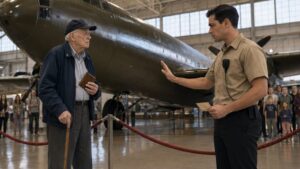
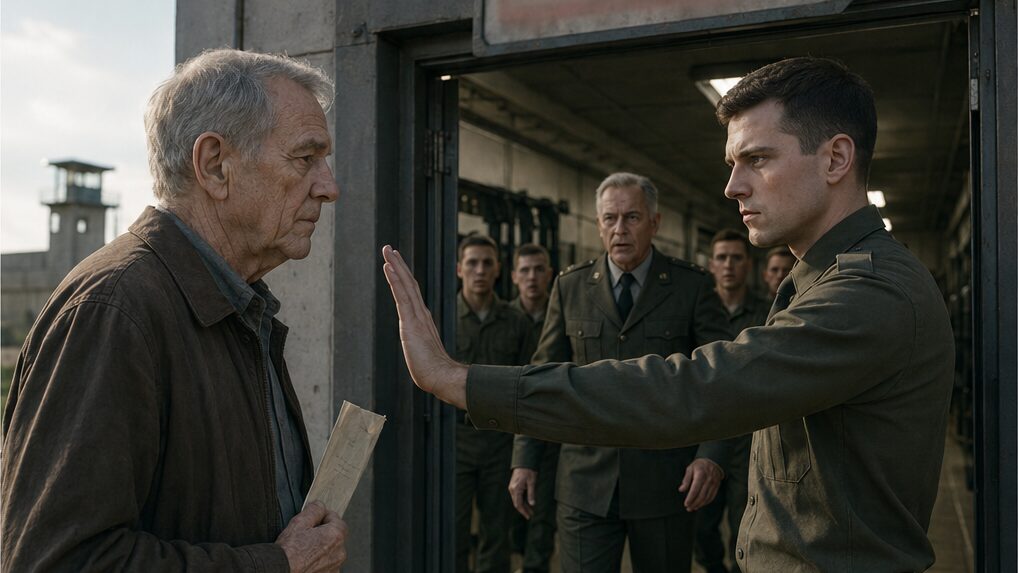
The young guard’s hand came up before Robert Harris had even reached the threshold.
It was not a violent motion. Not even rude, at first. Just a flat palm raised at chest height, fingers stiff, elbow locked, the way a man did when he had been taught that a door mattered more than the person standing in front of it.
Robert stopped beneath the sign.
ARMORY — AUTHORIZED PERSONNEL ONLY.
The letters were black on white metal, bolted above the reinforced door. The sign had been repainted since he had last seen it. The hinges had been replaced. The concrete apron outside had been widened and scored for drainage. Even the glass panel beside the entrance was newer, stronger, less cloudy than the old one that used to rattle in winter wind.
But the smell was the same.
Gun oil. Wet pavement. Floor wax. Coffee from somewhere deep in the building. A cold, metallic note in the morning air that belonged only to places where men and women had been taught to count, lock, check, and check again.
Robert stood with one hand in the pocket of his brown jacket and the other holding a folded invitation. The jacket was old enough to show a pale shine at the elbows. The collar had softened with years of rain and sunlight. It had been brushed clean that morning, though not well enough to hide the nap worn thin along the cuffs.
The guard looked from Robert’s jacket to his shoes, then to the invitation.
“Sir, this is a restricted entrance.”
Robert nodded once. “I know.”
“You’ll need to step back.”
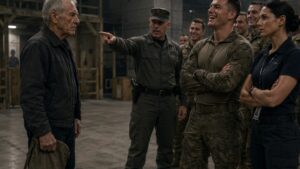
Behind the guard, the armory corridor was already awake. Two young soldiers carried a covered case between them. A maintenance supervisor moved along the wall checking a temporary cable taped near the baseboard. Farther inside, a table had been set with printed programs for the rededication ceremony, the paper edges still sharp and white.
Several heads turned.
Robert felt them turn. He did not look at them.
He had waited in longer lines, colder rain, worse rooms. He had once stood through twelve hours of briefings with a fever and a radio clipped to his belt because a convoy was late and no one wanted to say out loud what everyone feared. He had learned early that a man gave away less by standing still than by proving he could shout.
The guard held out his other hand. “Invitation.”
Robert placed the folded card in his palm.
The guard opened it with the caution of someone expecting a trick. His name tape read MILLER. His jaw was clean-shaven, his uniform exact, his boots polished with the kind of effort that came from wanting senior people to notice. His eyes moved across the card, then narrowed.
“This is not the current program.”
“It came by mail,” Robert said.
“When?”
“Three weeks ago.”
The guard glanced toward the table inside. “The updated list is digital. We’ve had two schedule changes and a security audit since then.”
“I understand.”
“Your name?”
“Robert Harris.”
The guard looked down at a clipboard resting on a metal stand beside the door. He flipped one page, then another. Robert noticed the edge of nervousness in the motion. The young man did not want to be wrong. That was not a sin. But he had already decided what kind of wrong was possible.
“Harris,” the guard repeated, not to Robert but to the paper. “Harris, Harris…”
A young soldier inside slowed near the doorway. Another soldier whispered something and smiled without quite smiling.
Robert kept his eyes on the sign.
AUTHORIZED PERSONNEL ONLY.
There had been a time when those words would have opened a corridor without a question. That memory did not comfort him. It made the morning heavier.
The guard closed the clipboard. “You’re not on the access sheet.”
“Check the original roster.”
“This is the roster.”
“No,” Robert said, gently. “That is the current access sheet.”
The guard’s face hardened just enough for Robert to see the boy beneath the uniform retreat behind procedure. “Sir, I’m not going to debate terminology with you at a secure armory entrance.”
Robert accepted the sentence without blinking.
The guard lowered his voice, which made the moment worse. “There’s a visitors’ tent near the east parking lot. Someone there can help you find where you’re supposed to be.”
“I am supposed to be here.”
A few more faces turned from inside. The maintenance supervisor stopped pretending to inspect the cable. One of the young soldiers set down his end of the case too carefully.
The guard’s palm rose again.
This time it was closer to Robert’s chest.
“Step back, sir.”
Robert looked at the hand. The skin across the knuckles was unscarred. The sleeve was pressed. The wristwatch was new, black, and large. Robert remembered other hands at other doors: shaking hands, gloved hands, bloodied hands, hands that had carried orders no one wanted to read. He remembered his own hand signing a page in a room that smelled of dust and burned coffee.
He stepped back half a pace.
Not because the guard deserved the victory. Because the doorway did not deserve a scene.
The guard seemed encouraged. “Thank you.”
Robert’s fingers tightened once around the old invitation. The paper had been handled too much already. The crease was beginning to split at the fold.
“I came early,” Robert said, “because I was asked to see the hall before the ceremony.”
“By who?”
Robert looked past him, into the corridor where the covered cases were being moved, where a blank space on the wall had been hidden behind a dark cloth, where chairs were being lined in rows for visitors who would soon arrive wearing better coats than his.
“Someone who remembered,” he said.
The guard exhaled through his nose. “Sir, that’s not an answer I can use.”
“No. I suppose it isn’t.”
The young soldier near the case murmured, “Maybe call the office.”
Jason Miller turned sharply. “I have the list.”
The soldier looked away.
Robert felt the embarrassment in the corridor now. It had changed shape. At first it had belonged to the old man at the wrong door. Now it spread thinly across everyone watching, because no one knew whether to intervene and no one wanted to be responsible if they did.
The guard leaned closer. “I don’t know what event you think this is, but we’ve got senior visitors arriving in less than an hour. I can’t have unauthorized civilians wandering into the armory.”
Robert folded the invitation along its old crease. “You should not.”
“Then we agree.”
“No,” Robert said. “We do not.”
The guard blinked.
Robert’s voice had not risen. That was what made the corridor quiet.
“Security is not the same as suspicion,” Robert said.
Jason’s cheeks colored. “I’m doing my job.”
“I hope so.”
The words landed softly and stayed there.
Jason looked toward the soldiers inside, then back at Robert. Whatever uncertainty had touched him hardened into irritation. “Sir, I need you to leave the doorway.”
Robert stood under the sign in his brown jacket while the polished floor inside reflected the boots of men young enough to believe every important thing had happened after they arrived.
He reached into his pocket.
Jason’s hand shifted toward the radio clipped at his shoulder. “Sir.”
Robert took out an old phone, its case rubbed smooth at the corners.
“I’m calling someone,” Robert said.
“Calling who?”
Robert lowered his eyes to the screen and found the number he had not wanted to use.
He pressed call.
He did not answer the guard.
Chapter 2: The Name That Changed The Room
Jason Miller hated being watched while he made a decision.
The armory entrance had too much glass, too much open corridor, too many angles where people could see a guard hesitate. That was how small mistakes became stories. That was how a man who wanted a clean record found himself answering questions from a senior officer who had only heard the worst version.
The old man held the phone to his ear like he had all the time in the world.
Jason kept his palm up, though his shoulder had begun to ache. He could lower it now, but lowering it would look like doubt. The old man’s stillness had already made him feel less in control than he should have.
“Sir,” Jason said, “phone calls don’t change access requirements.”
Robert Harris listened to whatever silence came through the line. “They rarely do.”
A soldier inside gave a small cough that might have been a laugh. Jason turned his head just enough to stop it.
He had been warned about this morning. Everyone had. Two weeks earlier, an audit team had walked through the building and found three names on an old vendor list that should have been removed. No breach. No missing inventory. Nothing dramatic. But the report had used words that stuck to people: lax verification, inconsistent protocol, inadequate challenge procedures.
Jason had read the findings twice.
He had not been the one who made the mistake, but he had been new enough to inherit the lesson. At the armory, embarrassment traveled downhill faster than orders.
So when an old man in a tired brown jacket arrived with a folded card that did not match the current list, Jason had done exactly what he had been told to do.
Challenge. Verify. Deny if uncertain.
Except the man did not behave like the uncertain ones usually did.
He did not bluster. He did not complain about taxes or service or knowing somebody important. He did not wave the invitation under Jason’s nose. He simply waited, as if the doorway belonged to time and not to either of them.
The phone clicked faintly.
Robert said, “Joseph? It’s Harris.”
The name meant nothing to Jason. Then something moved inside the corridor.
A senior officer had appeared at the far end near the temporary program table. He was broad-shouldered, silver at the temples, with his blouse already marked by the kind of careful preparation that meant ceremony duty. Joseph Clark. Jason knew him by sight. Everyone on morning security did.
Joseph had been speaking with Amanda Green, the civilian heritage coordinator, who held a stack of folders against her chest and looked as if she had not sat down since sunrise. At the sound of the name through the old man’s phone, Joseph turned.
Not quickly.
That was what Jason noticed.
Not like a man responding to noise. Like a man hearing a voice from a place he had sealed shut years ago.
Robert kept the phone at his ear. “I’m at the west entrance.”
Joseph stared down the corridor.
“Yes,” Robert said. “That west entrance.”
Amanda said something to him, but Joseph did not answer her. He began walking toward the door.
Jason lowered his hand a fraction before he caught himself.
The old man ended the call.
The corridor had gone quiet in a way Jason did not like. The soldiers were no longer amused. The maintenance supervisor had stepped aside. Even the two men carrying the covered case had stopped with it suspended between them, their gloved hands still locked on the handles.
Joseph Clark came to the doorway and looked first at Jason’s raised palm. Then he looked at Robert.
His expression changed so slightly that Jason might have missed it on any other morning. The officer’s mouth tightened. His eyes lowered for the briefest moment to the old brown jacket, then to the folded invitation in Robert’s hand.
“Harris,” Joseph said.
Robert nodded. “Joseph.”
Not sir. Not colonel. Not major. Just Joseph.
Jason felt irritation spark through his confusion. “Sir, this individual isn’t on the updated access sheet.”
Joseph did not look at him. “I heard.”
“He presented an outdated invitation.”
“I see that.”
“And he refused to proceed to the visitors’ tent.”
Joseph finally turned. “Did he refuse, or did he tell you he belonged here?”
Jason’s jaw set. “Those aren’t the same thing, sir.”
“No,” Joseph said. “They are not.”
Robert placed the folded invitation against his phone case and held both in one hand. “The young man asked for documentation.”
Jason seized on that. “Yes, sir. I followed procedure.”
“Which procedure?”
Jason reached for the clipboard. “The rededication access sheet issued after the audit.”
Joseph’s gaze moved to the clipboard with an expression Jason could not read. “And the original roster?”
“This is the operational roster, sir.”
“That wasn’t my question.”
The back of Jason’s neck warmed.
Amanda had come halfway down the corridor now, folders still held tight. She looked at Robert with polite concern, the expression staff used when a guest problem might become a schedule problem.
Joseph’s voice lowered. “Did you check the original roster?”
Jason swallowed. “I was not issued an original roster.”
“That is different from saying it does not exist.”
The sentence struck harder than it should have.
Robert shifted his weight slightly. It was the first sign that standing had cost him anything. Jason noticed it, then disliked himself for noticing it only now. The old man’s left hand had a faint tremor when he refolded the invitation, but his face remained composed.
Jason tried to recover. “Sir, with respect, he approached a controlled entrance in civilian clothes with an obsolete card. We’ve been instructed to prevent exceptions.”
Joseph looked at him for a long second. “Civilian clothes.”
Jason heard the mistake after he said it, though he still did not know what mistake it was.
Robert saved him from answering.
“He had no way to know,” Robert said.
Joseph’s eyes moved back to him. Something like pain crossed his face and was gone. “He had a way to ask.”
Robert did not respond.
The words hung under the sign.
AUTHORIZED PERSONNEL ONLY.
Jason looked at the sign, then at Robert, then at Joseph. The shape of the moment began to change, though no one had explained why. He felt as if he were standing in a room where everyone else had heard a warning tone too low for him to catch.
Amanda reached them, breath controlled but quick. “I’m sorry. Is there a problem with a guest?”
Jason answered before Joseph could. “This gentleman is not on the updated access sheet.”
Amanda turned to Robert. “May I see the invitation?”
Robert handed it to her.
She unfolded it carefully. Her eyes passed over the printed crest, the date, the rededication line, then the name. She paused there.
Robert Harris.
She looked up, first at Robert, then at Joseph.
“I don’t understand,” she said. “This version was superseded.”
Robert’s face softened, but not with surprise. “Many things are.”
Amanda looked embarrassed without knowing exactly why. “The public program was revised last week. Some titles were removed at the request of—”
She stopped.
Joseph’s gaze sharpened.
Robert slipped the phone back into his jacket pocket. “At my request.”
Jason’s grip tightened on the clipboard.
Amanda’s folders shifted in her arms. A few pages slid loose and fluttered against her wrist. “Your request?”
Robert said nothing.
Joseph stepped half a pace closer to Jason, not enough to threaten him, but enough to make the guard straighten. “Go to the administrative office with Amanda. Pull the original rededication roster.”
Jason hesitated. “Sir, who is he?”
Joseph looked toward Robert, as if asking permission to answer and being refused by silence.
So the senior officer gave Jason less than he wanted.
“He is a guest you should have verified before you dismissed.”
Jason felt every face in the corridor turn toward him again.
Robert looked at the young guard then, not with anger, not with victory. That was worse. His gaze was steady and tired, as though Jason had not injured his pride but confirmed something he had hoped the morning would not prove.
Joseph picked up the clipboard from the stand and held it out.
Jason took it.
The metal clip clicked under his thumb.
Joseph’s voice dropped so low that only those near the doorway could hear. “Did you check the original roster?”
Chapter 3: The Invitation Nobody Wanted To Read
Amanda Green had built the rededication morning out of paper, phone calls, and apologies.
The paper had seemed easiest at first. Programs, access lists, parking placards, donor acknowledgments, archival captions, tent cards for the chairs in the front row. Paper stayed where she put it. Paper did not call at six in the morning to say a speaker had the flu. Paper did not argue about whether a retired officer’s title should appear in bold. Paper did not ask why a covered plaque had been kept in storage for twenty-eight years.
But now paper had become the problem.
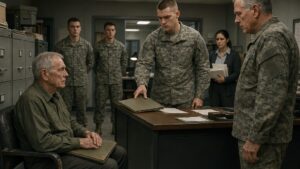
Amanda walked quickly toward the administrative office with Jason Miller beside her and Joseph Clark a few steps behind. Robert Harris followed at his own pace. Not slow enough to invite help. Not fast enough to pretend age had not earned its claims on him.
No one spoke until they reached the small office beside the armory corridor. It had two desks, a humming printer, a locked file cabinet, and a bulletin board crowded with ceremony schedules. Through the glass wall, Amanda could see the entrance sign backward from inside.
YLNO LENNOSREP DEZIROHTUA.
The reversed letters looked strange, as if the building itself had turned the question around.
Amanda set her folders on the desk and opened the top one. “The current access sheet came from the event office after the audit. It should have included all approved guests.”
Jason stood rigidly near the door. His face had lost the tight certainty it wore outside, but not the defensiveness. “I used what I was issued.”
“I know,” Amanda said.
Joseph remained standing. “Find the earlier file.”
Amanda opened the second folder. “The earlier file was archived after the program revisions.”
“Why?”
She could feel Robert watching her, though his gaze was not unkind.
“Because the final program removed certain titles and ceremonial language at a guest’s request.” She looked at Robert. “I assumed that request came through your office.”
“My office closed a long time ago,” Robert said.
Amanda’s fingers stilled.
He did not say it sharply. That made it worse. She had spent weeks moving his name through systems, invitations, drafts, and approvals. Harris, Robert. Guest. Early access approved. Public remarks optional. No formal title in printed program by request.
Somewhere in the process, the man had become a line item.
Amanda opened a drawer and pulled out a key ring. “The physical archive box is in the cabinet.”
Jason shifted. “Why would his name be removed from one list but not another?”
“Not removed,” Amanda said, unlocking the cabinet. “Separated. The event office used the public-facing program for the general guest list after the audit. Anyone without a title or current base credential had to be manually confirmed.”
Jason looked toward Robert, then away.
Amanda pulled out a gray archive box labeled ARMORY REDEDICATION — HISTORICAL MATERIALS / ORIGINAL INVITEES. The label had been printed by someone else months ago. She had seen it often enough to stop reading it.
She placed it on the desk.
Dust lifted from the cardboard lid.
Robert’s eyes moved to the box. For the first time since the doorway, Amanda saw something in his face that was not merely restraint. It was reluctance.
Joseph saw it too. “We can handle this quietly.”
Robert looked at him. “Quietly is how it became this.”
No one answered.
Amanda removed the lid. Inside were file sleeves, old photographs, copies of letters, ceremony notes, and a sealed packet marked with a red tab. She found the original roster beneath a stack of draft programs. The first page listed civic officials, base staff, visiting families, retired personnel, and donors.
Robert Harris appeared on the second page.
Not in the VIP section.
Not under speakers.
His name stood alone beneath a heading Amanda had not seen in the final version.
FOUNDING COMMAND REPRESENTATIVE — PRIVATE EARLY ACCESS APPROVED.
Beside the line was a handwritten note: No title in public program per R.H. request. Verify through heritage office or Col. Clark.
Amanda looked up slowly.
Jason read over her shoulder. “Founding command representative?”
Robert’s expression did not change.
Joseph corrected him quietly. “It means he was not supposed to be sent to the visitors’ tent.”
Jason’s mouth opened, then closed.
Amanda reached for the sealed packet with the red tab. “There’s more.”
Robert’s hand came down lightly on the edge of the box.
Not forcefully. Just enough.
“Not yet,” he said.
Amanda withdrew her hand.
Joseph looked at Robert. “The plaque is scheduled for unveiling at fourteen hundred. They’ll ask why the program changed.”
“They can ask.”
“They’ll ask me.”
“Then answer what is necessary.”
Amanda studied him. “Mr. Harris, if we had kept your title in the program, none of this would have happened.”
Robert turned toward her fully. His eyes were pale gray, steady, and more tired than his posture allowed him to appear.
“Maybe,” he said. “Or maybe a different old man in a different jacket would have been stopped at a different door.”
The office went quiet.
Jason’s face changed. Not enough to become apology. Enough for Amanda to see the words reach him and fail to find a place.
She looked down at the invitation still lying on the desk. The card was creased, old-fashioned, and heavier than the replacements she had printed in bulk. It bore the armory crest in dark blue and a line of text that no longer appeared anywhere in the public program.
In recognition of those who carried responsibility before these walls stood.
Amanda had cut that sentence in the final draft because it sounded too formal and no one had objected.
Now it felt like a warning she had ignored.
The printer hummed, clicked, and fell silent.
Outside the office, soldiers moved through the corridor in careful bursts, lowering voices as they passed the glass. The rededication kept approaching no matter what had been mishandled. Visitors would arrive. Chairs would fill. Someone would pull the cloth from the plaque. Someone would speak into the microphone and make the past sound orderly.
Amanda turned another page in the archive box and found an older file beneath the roster. The folder was stiff, darker than the others, its tab written by hand in ink that had faded brown at the edges.
HARRIS, ROBERT — ORIGINAL DEDICATION / COMMAND ORDER.
Beneath that, in smaller letters, was the date of the armory’s first dedication.
Amanda felt Joseph go still beside her.
Robert’s hand remained on the box, but his fingers had tightened against the cardboard.
She looked from the folder to the old man in the brown jacket.
“Mr. Harris,” she said softly, “is this the file you didn’t want opened?”
Robert did not look at the folder.
He looked through the glass wall, back toward the armory entrance, where the sign over the door waited in reverse.
“Yes,” he said. “That would be the one.”
Chapter 4: The Order Signed Before The Walls Were Built
Robert had not intended to enter the records room.
He had intended to enter the armory, look at the hall before it filled, stand in the place where the plaque would be uncovered, and decide whether he could remain through the ceremony without letting the past make a spectacle of itself. He had intended to leave before anyone asked too many questions.
But the folder lay on the table now, its faded tab carrying his name with the blunt patience of old paper.
HARRIS, ROBERT — ORIGINAL DEDICATION / COMMAND ORDER.
Amanda held herself very still beside the archive box. Jason stood near the office door with the clipboard tucked against his side, as if he no longer trusted his hands. Joseph watched Robert with the careful expression of a man who knew the first wrong word could close the room.
Robert looked at the folder and remembered the night before the order.
Not the whole night. Memory was kinder than that sometimes. It gave him pieces: rain tapping against a window, a cup of coffee gone cold, a young officer’s cap left on a chair because no one had known what to do with it. The old armory had been smaller then, squeezed into a converted storage wing with narrow aisles and bad lighting. The locks had been legal. The logs had been complete. Every inspection form had passed.
And still, three soldiers had been sent to the hospital because a routine movement became confusion in a room that should have been built to prevent confusion.
One returned to duty. One went home with a permanent limp. One never wore the uniform again.
No one in the final report used the word shame. Reports preferred cleaner language. Procedural failure. Poor visibility. Inadequate separation of storage zones. Command review required.
Robert had signed the review.
Then he had torn up the first version because it blamed people who had been trained inside a system too cramped to forgive one tired mistake.
“Mr. Harris?” Amanda said softly.
He looked at her hand near the folder.
“You may open it,” he said.
She did not move at once. “Are you sure?”
“No.”
Joseph’s eyes lowered.
Robert took a breath through his nose. The records room smelled of cardboard, toner, and dust. Through the wall came the dull movement of the armory preparing itself for ceremony: chairs scraping, cases rolling, a microphone being tested and cut off after one sharp burst of feedback.
Amanda opened the folder.
The top page was a copy of the command order. The paper had yellowed unevenly, the old typeface dark and official. Robert did not need to read the first line. He knew it the way old men knew scars under sleeves.
By authority of the commanding officer, the existing storage wing shall be decommissioned and replaced by a purpose-built armory facility with revised safety doctrine, dual-verification access, separated handling zones, and mandatory challenge procedure at all controlled entrances.
Amanda read silently. Jason took one small step closer before catching himself.
Joseph said nothing.
Robert watched their faces instead of the page. He had learned long ago that orders changed meaning depending on who had to live with them. To a commander, an order could be burden. To a clerk, procedure. To a young guard, protection. To an old man at a door, a hand in the chest.
Amanda turned the page. A black-and-white photograph rested beneath it. The image showed bare ground, survey stakes, and a line of uniformed personnel standing beside a temporary sign. Robert was in the center, younger by decades, shoulders squared, jaw harder, eyes already carrying too much. Joseph was barely visible near the back, thin and young, with the wary seriousness of a junior officer trying not to look proud.
Jason looked from the photograph to Robert.
Robert felt the comparison happen: the straight-backed officer in the picture, the old man in the worn brown jacket. Time did not erase a person all at once. It moved patiently, taking posture, speed, hair, certainty, until strangers thought the remains were the whole.
Amanda touched the edge of the photograph. “This was the original dedication?”
“The day before,” Joseph said. His voice had roughened. “Groundbreaking.”
“You were there?” Jason asked.
Joseph gave him a brief look. “I was carrying folders and trying not to drop them.”
Robert almost smiled. Almost.
Amanda turned another page. There were diagrams of storage rooms, notes in margins, red-lined procedures, memoranda from engineers, objections from budget officers. The armory, before it was concrete and steel, had been argument. Every wider aisle had been argued. Every double-check station. Every delay built into handling procedures had been called excessive by someone who did not have to stand in a hospital hallway.
Jason was reading now with a frown that no longer looked defensive.
“This says the challenge procedure came from your order,” he said.
Robert looked at him. “Part of it.”
“You wrote the rule I used at the door.”
“I signed the order that required it.”
Jason’s face tightened. “Then I was right to stop you.”
Robert met his eyes. “You were right to challenge me.”
The difference sat between them.
Jason looked back at the page. “But not right to dismiss you.”
Robert did not answer for him.
Amanda drew a slow breath. “The rededication program doesn’t explain any of this. It says the armory was modernized after a command review.”
“That is accurate,” Robert said.
“It is incomplete.”
“Most public history is.”
Joseph moved closer to the table. “The plaque is more complete.”
Robert’s jaw tightened.
Amanda looked up. “The covered plaque?”
Joseph nodded. “The original dedication plaque was removed during renovations. They planned to reinstall it today alongside the updated one.”
Robert turned toward him. “I asked that it be replaced with the unit language.”
“You asked,” Joseph said. “The committee declined.”
Robert looked at the old command order. His signature waited at the bottom in black ink, bold and slanted, written by a man who still believed that if he made a system strong enough, it could hold back regret.
“They should have honored the soldiers,” Robert said.
“They did,” Joseph answered. “On the inner wall.”
Robert’s eyes flicked up.
Joseph’s voice stayed low. “And they honored the person who made sure no one could call what happened unavoidable ever again.”
Robert looked away first.
Outside the records room, a group of visitors passed the corridor, speaking in bright, uncertain voices. The ceremony was moving toward them, indifferent to whether Robert was ready.
He had spent years avoiding moments like this. He had attended funerals, retirements, promotions, and anniversaries. He had stood in back rows, sent letters when he could not trust himself to speak, and worn plain clothes whenever the uniform would turn grief into theater. Rank had opened doors. Rank had also put names on orders that could not be unsigned.
Amanda closed the folder halfway, then stopped. “Do you want this file kept out of the ceremony?”
Robert thought of Jason’s raised hand. Thought of the sign. Thought of the old invitation nobody had wanted to read because a newer list looked cleaner.
“No,” he said.
Joseph looked at him.
Robert placed two fingers on the command order, not over his signature but above the paragraph that required every controlled entrance to challenge without humiliating, verify without assuming, and document without delay.
“Use what is necessary,” he said. “Not more.”
Amanda nodded. “I can correct the program remarks.”
“No speeches about me.”
“It may be difficult to explain the plaque without naming you.”
Robert gave a tired breath. “Then name me. But don’t decorate me.”
Jason stared at the words on the page.
Robert saw the young man’s throat move as he swallowed. For the first time that morning, Jason seemed less afraid of being blamed than of understanding what his own certainty had touched.
Joseph closed the folder gently.
“Robert,” he said, and the use of the first name felt older than the room, “the plaque still bears your full title.”
Robert looked at the cardboard archive box, the old photograph, the command order that had outlived the hand that signed it.
Then he looked toward the armory hall.
“I know,” he said.
Chapter 5: The Guard Who Followed Rules Without Listening
Jason Miller stood alone in the training bay and replayed his raised hand until he hated the memory of his own wrist.
The bay was empty except for stacked chairs, folded mats, and a row of blue training rifles locked behind mesh. Sunlight cut through the high windows in pale bars, catching dust that drifted above the floor. Somewhere beyond the wall, the rededication crew tested the microphone again. A voice said, “Check,” then silence, then “Check,” softer, as if the building had asked it to be respectful.
Jason should have been back at the entrance.
Instead, Joseph Clark had told him to wait in the training bay.
Not ordered. Told.
That was worse.
Orders gave a man something to obey. Waiting gave him room to think.
The audit memo had been folded in Jason’s breast pocket for two weeks until the crease nearly tore. He had read it before every shift. Challenge all uncleared entrants. Confirm credentials against current access list. Prevent unauthorized movement past controlled threshold. Report uncertainty immediately.
He had done those things.
Almost.
The door opened behind him.
Jason turned so fast his boots squeaked.
Joseph entered first. Robert Harris followed, slower, carrying the folded invitation and his old phone. The brown jacket looked even more ordinary in the clean training bay, surrounded by polished floors and safety posters.
Jason straightened. “Sir.”
Joseph glanced at him. “Which one?”
Jason flushed. “Colonel.”
Robert’s eyes moved over the bay, pausing on the locked mesh cabinet, the marked lanes on the floor, the emergency exit sign glowing above the rear door.
“You kept the lanes wide,” he said.
Joseph nodded. “Wider after the last renovation.”
“Good.”
Jason could not keep quiet. “I didn’t know who you were.”
Robert looked at him. “I know.”
“I was following the access procedure.”
“I know that too.”
The calm answer irritated Jason because it gave him nothing to push against. “Then I don’t understand what I did wrong.”
Joseph’s face hardened. “You don’t?”
Jason’s hands closed once at his sides. “The old invitation wasn’t on the current sheet. He was in civilian clothes. We had an audit. If I let someone through and something happened, everyone would ask why I ignored procedure.”
Robert stepped toward one of the painted training lanes. “You should not ignore procedure.”
Jason looked at Joseph, then back. “Then what was I supposed to do?”
“Verify without deciding the answer first.”
The words were plain. Jason felt them anyway.
He looked down. “I asked for his name.”
“You looked for a reason not to believe it,” Joseph said.
Jason’s eyes lifted. “With respect, sir, that’s easy to say now.”
Joseph took a breath, but Robert raised one hand slightly. Not the way Jason had at the door. Lower. Gentler. Enough to stop the older officer without commanding him.
Robert turned toward Jason. “Tell me about the audit.”
Jason hesitated.
Joseph watched him.
Jason stared at the painted floor line near his boot. “They found outdated vendor names on a secondary list. Nobody got in. Nothing was missing. But the report said challenge procedures were inconsistent.”
“And you were warned.”
“Yes.”
“By whom?”
“My supervisor. Then again at the morning briefing.”
“What did they tell you?”
Jason’s mouth tightened. “That if I wasn’t sure, I should deny entry.”
Robert nodded. “That is not bad advice.”
Jason’s frustration escaped. “Then why am I standing here like I failed some test nobody told me I was taking?”
The room went still.
Jason expected Joseph to cut him down for the tone. He almost wanted him to. A reprimand would be easier than the old man’s silence.
Robert looked toward the mesh cabinet. “Because the test was not whether you could keep a door closed.”
Jason said nothing.
“It was whether you could keep your respect intact while doing it.”
The words did not land loudly. They landed accurately.
Jason looked at Robert’s jacket, then at his face. He saw again the folded invitation in his own hand, the way he had searched the paper for proof of fraud before considering proof of belonging. He remembered saying senior visitors, as if the man before him could not possibly be one. He remembered the young soldier’s small laugh and his own decision to perform certainty for the corridor.
“I thought you were confused,” Jason said.
“I gathered.”
“I thought maybe you’d come to the wrong building.”
“That would have been possible.”
“I thought—” Jason stopped.
Robert waited.
Jason forced it out. “I thought you looked like someone who wanted to be important.”
Joseph’s jaw shifted.
Robert accepted the sentence without visible injury. That made Jason feel the cruelty of it more clearly.
After a moment, Robert said, “Many people want to be important. Most are quieter about it than we expect.”
Jason did not know what to do with that.
Joseph stepped closer. “The commander’s aide asked whether you should be removed from ceremony duty.”
Jason’s stomach dropped.
Robert turned his head toward Joseph. “No.”
Jason blinked.
Joseph said, “Robert.”
“No,” Robert repeated. “If he stands outside, he will spend the afternoon deciding he was punished for enforcing a rule. If he stands inside, he may have to listen.”
Jason looked at him, startled.
“I don’t deserve that,” Jason said.
Robert’s face changed slightly. Not softened. Focused.
“This is not about what you deserve.”
The sentence stripped away both punishment and forgiveness. Jason felt himself left with responsibility, which was heavier.
Joseph crossed his arms. “You’ll stand at the rear during the ceremony. You will not be at the entrance. You will observe. You will speak only if spoken to.”
“Yes, sir.”
“And you will return that clipboard to the stand before guests arrive.”
Jason’s eyes flicked toward Robert. “Yes, sir.”
Robert moved toward the door, then stopped beside him.
For the first time, Jason noticed how tired the old man seemed when no one was blocking him. His shoulders were straight because he kept them straight, not because age had spared him. His hand rested briefly against the doorframe before he stepped through.
Jason spoke before he could lose the chance.
“Mr. Harris.”
Robert turned.
Jason wanted to apologize, but the words lined up wrong. Every version sounded like it was reaching for the title he had not yet been officially told to use. Every version sounded late.
“I’ll stand inside,” Jason said.
Robert held his gaze.
“Good,” he said. “Start there.”
Chapter 6: The Plaque Under The Covered Cloth
By early afternoon, the armory had been made ceremonial.
Amanda Green stood near the first row with a revised program folded in her hand and watched staff transform a working building into a place of memory. The cases had been moved out of sight. The floor had been polished until the overhead lights showed in long white strips. Folding chairs faced the far wall, where two plaques waited beneath dark cloths.
One cloth covered the new dedication.
The other covered the old one.
Amanda had walked past that second cloth a dozen times during planning and thought of it only as a scheduling detail. Now she could feel its weight from across the hall.
Visitors filled the chairs in low conversation. Some wore uniforms. Some wore suits. Some carried canes, small flags, or paper programs. Young soldiers stood along the side walls, trying to look relaxed and failing. Joseph Clark spoke quietly with the base commander’s aide near the microphone.
Jason Miller stood at the rear, hands clasped behind his back.
He had returned the clipboard to the entrance. Amanda had seen him do it. He placed it on the stand carefully, then looked up at the AUTHORIZED PERSONNEL ONLY sign as if it had changed its wording while he was gone.
Robert Harris sat in the second row.
Not the first.
Amanda had tried to move him. Joseph had tried too, in fewer words. Robert had declined both attempts and chosen a chair near the aisle, his brown jacket still on, his folded invitation tucked in the inside pocket. He looked smaller seated among uniforms than he had at the doorway, but not lesser. There was a difference Amanda had only begun to understand.
She looked down at the revised program.
His name appeared once now. Not on the cover. Not in decorative lettering. One line in the ceremony sequence:
Recognition of Original Command Order — Robert Harris.
No title.
Amanda had honored his request there. But the plaque would not.
The microphone clicked.
Conversation faded.
The base commander’s aide welcomed the room, acknowledged guests, thanked staff, and spoke briefly about modernization, safety, and continuity. The words were polished and harmless. Amanda listened with one ear while watching Robert. He looked at the covered plaques only once, then lowered his eyes to his hands.
Joseph stepped to the microphone next.
He did not carry notes.
Amanda felt the room adjust. Joseph was not dramatic, but he had the stillness of someone about to say less than he knew.
“This armory was built because people decided that secure storage was not enough,” he said. “They decided safety had to be designed into the walls, the aisles, the doors, the logs, and the way one person challenges another at a threshold.”
At the rear, Jason’s face tightened.
Joseph continued. “This morning reminded some of us that procedures can protect a place and still fail a person if they are carried out without care.”
A thin unease moved through the room. No one turned toward Jason, not openly. That was a mercy. Jason stared straight ahead.
Amanda’s fingers pressed into the program.
Joseph looked at Robert. “The officer who signed the original command order asked not to be placed above the purpose of that order. He asked not to be introduced by rank. He asked, in fact, for very little.”
Robert did not move.
“But buildings remember more stubbornly than people do,” Joseph said.
He turned and nodded to Amanda.
For a moment she could not move. Then she crossed to the wall and took hold of the cord attached to the old plaque’s covering. The cloth was heavier than expected. It resisted, then slid free in a soft rush.
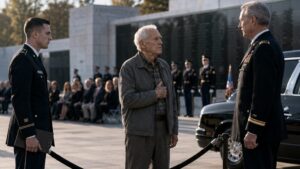
The old bronze plaque caught the light.
The room read before it reacted.
DEDICATED TO THE SAFE STEWARDSHIP OF ALL WHO SERVE
UNDER THE COMMAND ORDER OF
MAJOR GENERAL ROBERT HARRIS
WHO REQUIRED THAT RESPONSIBILITY BE BUILT BEFORE THESE WALLS STOOD
Silence settled so completely that Amanda heard the cloth brush her shoe.
It was not the silence of confusion. It was the silence of people rearranging the morning inside themselves.
A few heads turned toward the second row. Then more.
Robert remained seated.
Jason, at the rear, had gone pale.
Amanda saw his eyes move from the plaque to the old man in the brown jacket, then to the far entrance where the sign above the door was visible through the open corridor. His mouth parted slightly, as if an apology had reached him too early and found no shape.
Joseph stepped back from the microphone.
For a long moment, no one seemed willing to be the first to make the recognition public. No applause rose. No one wanted to cheapen the silence by filling it too quickly.
Then Robert stood.
Not fast. Not with the clean upward motion of the man in the photograph. He pushed once against the chair arm, steadied himself, and buttoned the lower button of his brown jacket as if that small act mattered.
Joseph moved as if to help. Robert stopped him with a glance.
He walked to the microphone.
The room stood straighter without being asked.
Robert looked at the plaque, then at the rows of faces. He did not look at Jason first. Amanda noticed that. He would not turn the ceremony into a punishment.
“I asked them to leave the title out,” Robert said.
His voice was low, but the microphone carried it clearly.
A few people glanced at the plaque again.
“Not because I am ashamed of it,” he continued. “And not because I think titles mean nothing. They mean something. They tell you what a person was trusted to carry.”
His hand rested lightly on the side of the podium.
“But a title is a poor test of whether a person deserves decency.”
The words moved through the hall more slowly than applause would have.
Robert looked toward the entrance now.
“Above that door is a sign that says authorized personnel only. It is a necessary sign. This building holds things that must be guarded carefully. I signed an order many years ago because I believed that. I still believe it.”
Jason’s eyes lowered.
“But a door can be guarded without making a person small. A question can be asked without contempt. A name can be checked before a judgment is made.”
Robert paused.
Amanda saw his fingers tighten once on the podium. For a second he was not in the rededicated hall. He was somewhere older, with a colder cup of coffee and a page waiting for signature.
“This armory exists because rules failed people once,” he said. “Not because no one cared. Because caring was not built strongly enough into the system.”
The room stayed still.
“So if you remember anything from this wall, don’t remember my rank first. Remember that responsibility is not proven by the hand that blocks a doorway. It is proven by what that hand does next.”
At the rear, Jason looked up.
Robert stepped back from the microphone.
No one clapped immediately. Then a few hands began, restrained and uncertain, less celebration than acknowledgment. The sound grew, but Robert did not seem to receive it as praise. He returned to his seat with the same measured steps, the brown jacket moving stiffly at his shoulders.
Amanda folded the cloth over her arm and stood beside the plaque, unable to look away from the name she had nearly allowed to become an administrative omission.
The rest of the ceremony continued, though changed. The new plaque was unveiled. The aide spoke. Joseph offered brief closing remarks. Visitors stood and moved into small conversations, but the loudness never returned. People approached Robert carefully, as if unsure whether gratitude might become intrusion.
He accepted each greeting with patience. No more.
Jason remained at the rear until the hall had begun to empty.
Amanda saw him start forward once, stop, then start again.
Robert stood near the aisle, speaking quietly with Joseph. The old invitation was visible when his jacket shifted, its crease worn nearly through.
Jason reached him and stopped at a respectful distance.
Joseph saw him first. His expression gave nothing away.
Robert turned.
Jason opened his mouth.
No words came.
The apology, when it finally tried to rise, broke before it became sound.
Chapter 7: The Door Opened The Right Way
Robert did not take Jason’s apology in the hall.
There were too many people still gathering programs, too many hands reaching for coats, too many eyes pretending not to watch. Jason stood with his mouth half open and his face pale, and Robert saw the danger in that moment. A young man humiliated in public could learn shame and call it respect. He could bow to a title and never understand the person he had dismissed before the title appeared.
So Robert spared him the performance.
“Walk with me,” he said.
Jason blinked. “Sir?”
Robert looked at him until the word corrected itself in Jason’s throat.
“Mr. Harris,” Jason said.
Robert nodded once and turned toward the side corridor.
Joseph made a small movement as if to join them, then stopped. Robert did not need to look back to know Joseph understood. Some conversations required witnesses. Some did not.
The armory had quieted by the time they reached the front corridor. The ceremony voices had faded into the parking lot. Chairs scraped faintly in the main hall as staff began to fold the afternoon back into ordinary use. Somewhere behind them, Amanda spoke in a low voice with the maintenance supervisor about storing the cloths and returning the archive box to the office.
The doorway waited ahead.
The sign above it was no longer reversed.
ARMORY — AUTHORIZED PERSONNEL ONLY.
Outside, the late sun lay across the concrete apron in a clean slant. The air had cooled. A few visitors crossed the parking lot slowly, carrying programs against their coats. None of them knew that the real ending of the ceremony had moved away from the microphone and returned to the place where the morning had gone wrong.
Robert stopped beneath the sign.
Jason stopped beside him, not in front of him.
For a moment neither man spoke.
Robert looked through the glass at the outside walk. He could still see the shape of Jason’s raised hand from the morning, as clear as if it remained in the air. He could also see the boy inside the uniform now: stiff-backed, frightened of error, ambitious enough to polish his boots but not yet steady enough to know that fear could become contempt if left unexamined.
Jason drew a breath. “I’m sorry.”
Robert kept his eyes on the door. “For what?”
The question struck Jason harder than accusation would have.
“For blocking you.”
“You were assigned to block that door when necessary.”
Jason swallowed. “For not checking the original roster.”
“That is closer.”
Jason looked down at his hands. “For assuming you didn’t belong.”
Robert turned toward him then.
The young guard’s face had lost its ceremony mask. Without the clipboard, without the door between them, without soldiers watching, he looked younger than he had that morning. Not innocent. Just unfinished.
“Why did you assume that?” Robert asked.
Jason’s eyes lifted, then dropped again. “Because you didn’t look like anyone they told us to expect.”
“No.”
Jason frowned.
“That is the answer you have been giving yourself,” Robert said. “Try again.”
The corridor hummed softly with fluorescent light. Jason’s jaw worked once.
“Because you looked old,” he said.
Robert waited.
“And your jacket looked worn.”
Still Robert waited.
“And you didn’t act like someone important.”
There it was.
Robert looked back toward the sign. “A dangerous habit, expecting importance to announce itself.”
Jason’s face tightened. “When I saw the plaque, I wanted to disappear.”
“I noticed.”
“I thought if I apologized right away, maybe…” He stopped.
“Maybe you could end the feeling.”
Jason did not answer.
Robert placed one hand against the doorframe. The metal was cool under his palm. He had touched this building in many versions of himself: younger officer, commander, visitor, old man stopped at the threshold. The building had outlasted them all.
“I have been on your side of the door,” Robert said. “Not this one. Others. I have made decisions too quickly because I believed delay looked weak. I have trusted a sheet of paper more than the person standing in front of me. Sometimes the cost was small. Sometimes it was not.”
Jason looked at him carefully, as if surprised to hear confession where he expected correction.
“The order you read today,” Robert continued, “came after people were hurt in a system I was responsible for. Not because I wished them harm. Not because no one had rules. Because the rules allowed us to stop thinking.”
He let the words settle.
Jason’s voice was quieter. “Is that why you didn’t want the title in the program?”
“Partly.”
“What was the other part?”
Robert almost smiled. The question had lost its defensiveness. That mattered.
“Because people behave strangely around rank,” he said. “Some become kinder. Some become smaller. Some stop telling the truth. I have had enough of all three.”
Jason looked through the glass toward the parking lot. “I was kinder after I knew.”
“No,” Robert said. “You were quieter.”
Jason flinched, but he did not look away.
Robert took no pleasure in the correction. “Kindness would have helped before you knew. Quietness after the fact is only the beginning.”
A door opened down the hall. Amanda stepped out of the administrative office with the archive box in both arms. She saw them by the entrance and slowed.
Robert looked toward her. “Ms. Green.”
She came closer. “Yes?”
“The verification process for events like this,” he said. “Who writes it?”
Amanda adjusted her hold on the box. “The event office drafts it. Security approves it. Heritage provides historical exceptions when needed.”
“Then add a step.”
Jason looked at him.
Amanda waited.
“When an elderly veteran, retiree, family member, or invited guest arrives with outdated or partial documentation, they are not to be sent away before a secondary verification call is made. Seat them somewhere decent. Ask their name twice if needed. Check the current list, then the original list. If you deny entry, explain it without embarrassment.”
Amanda’s expression changed slowly. Not surprise exactly. Recognition of a practical thing that should have existed already.
“I can draft that,” she said.
“Not as a favor to me.”
“No,” Amanda said. “As a correction.”
Robert nodded.
Jason’s shoulders shifted, as if something in him had loosened and become heavier at once. “May I help write it?”
Amanda looked at him.
Jason kept his eyes on Robert. “I know where I would have skipped the step.”
Robert studied him for a moment. “Then you may be useful.”
It was not forgiveness. Not fully. Jason seemed to understand that, because he did not smile.
Amanda held the box closer. “I’ll bring the draft to Colonel Clark before the end of the week.”
“Good,” Robert said.
She looked at the old invitation still tucked inside his jacket. “Do you want the original file resealed?”
Robert turned his eyes toward the records room. He thought of the folder, the photograph, the command order, the signature of a man who had believed control could protect him from grief.
“No,” he said. “Keep it available.”
Amanda nodded once, then carried the box down the hall.
Robert and Jason remained at the entrance.
Outside, the last visitors were leaving. The parking lot had grown spacious again. A flag rope tapped faintly against a pole somewhere beyond the glass.
Jason stepped toward the door, then stopped and looked at Robert. “Would you like me to open it?”
Robert considered the question.
In the morning, the same man had blocked him because he saw only risk. Now he asked because he saw a person. The distance between those acts was not large enough to celebrate, but it was large enough to begin with.
“Yes,” Robert said.
Jason opened the armory door.
He did not rush. He did not overcorrect with ceremony. He simply held the door and stood aside.
Robert stepped through onto the concrete apron. The cool air touched his face. Behind him, the armory smelled of wax, metal, and memory. Ahead, the parking lot lay almost empty, ordinary and quiet.
He turned back once.
Jason stood inside beneath the sign, hands at his sides, no clipboard pressed against his chest, no raised palm between them.
“Mr. Harris,” Jason said.
Robert waited.
“I’ll remember before I check the list.”
Robert’s eyes rested on him.
“Remember after you check it too,” he said.
Then he walked toward his car.
The brown jacket moved stiffly in the evening wind. It was the same jacket he had worn when he arrived, the same one that had made him look, to a careless eye, like a man who did not belong. Robert did not straighten it. He did not remove it. He did not need the plaque, the title, or the startled silence of a room to carry himself across the lot.
At the edge of the walkway, he looked back one final time.
The armory door closed slowly behind Jason. Through the glass, the sign remained bright under the corridor light.
AUTHORIZED PERSONNEL ONLY.
Robert read the words and, for the first time that day, did not feel the old weight of them in his chest.
Then he folded the invitation along its worn crease, placed it inside his jacket, and went home.
The story has ended.