The Man They Threw Out of the Showroom
The Man They Threw Out of the Showroom
Part I — The Wrong Kind of Shoes
The first thing anyone noticed was the coat.
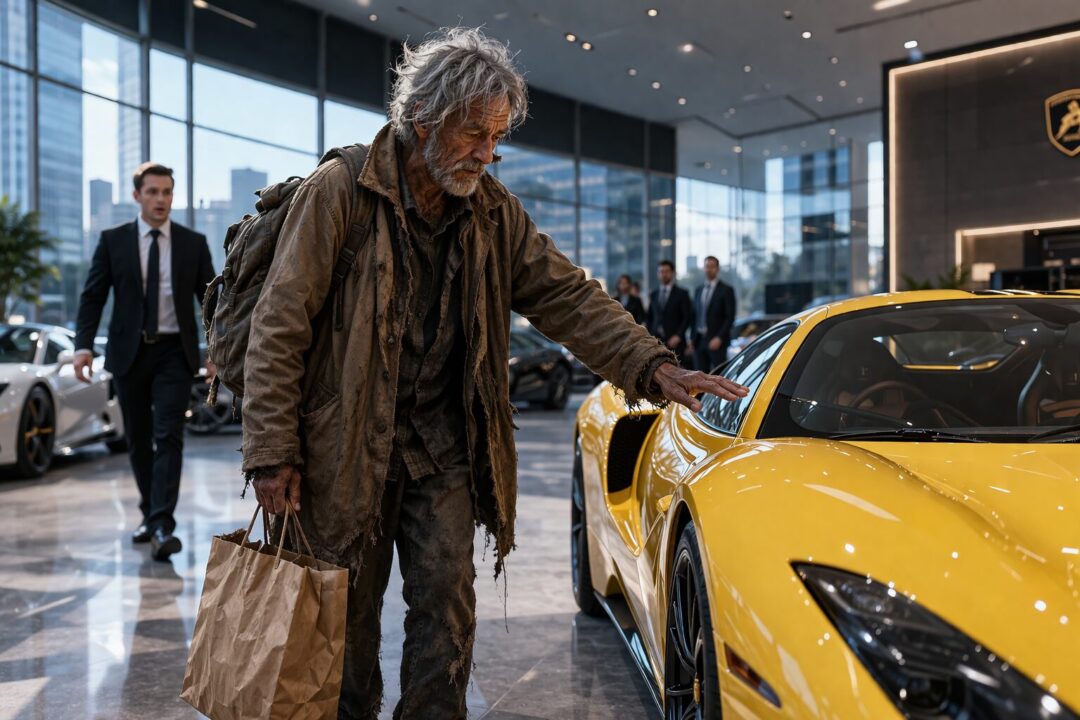
It hung off the old man in tired brown layers, frayed at the cuffs, shiny with age at the elbows, the sort of coat people stopped seeing as clothing and started reading as a warning. He carried a paper shopping bag that had softened from too many uses and an old backpack that seemed to pull one shoulder lower than the other. His shoes were cracked. His gray hair had not seen a comb in a long time.
When he stepped through the glass doors of Velmont Luxe Motors just after noon, the temperature of the room seemed to change.
Not because he made noise.
Because he didn’t.
The showroom was all polished marble, clean glass, and silence so expensive it felt rehearsed. A yellow supercar sat in the center beneath white lights, low and bright and untouchable, like something made less for driving than for worship. The sales staff moved around it with measured confidence, dark suits, straight shoulders, smiles that could be switched on and off as needed.
The old man paused three steps inside.
He looked at the car the way other people looked at a church altar.
Not greedily. Not even hungrily.
With recognition.
That was what made it strange.
He took a few slow steps forward, his attention fixed on the curve of the hood, on the sculpted vents, on the impossible gloss of the paint. There was nothing hurried in him. Nothing sneaking. He moved with the care of someone who knew the value of beautiful things, even if nothing about him suggested he could afford one.
At the front desk, a junior salesman named Owen noticed him and frowned.
Owen was twenty-five, sharp-faced, ambitious, and permanently alert to hierarchy. He had been working at Velmont for fourteen months and had not spent a single one of them forgetting how much he wanted out of the life he’d grown up in. He came from a two-bedroom apartment over a laundromat in East Hartford, a father who drove until his back gave out, and a mother who still clipped coupons with a focus usually reserved for surgery.
Now he wore tailored black suits, memorized luxury specs, and practiced his smile in mirrored surfaces.
He had taught himself the language of wealth so completely that sometimes he mistook it for character.
When he saw the old man reach out and lay his fingers lightly against the yellow car’s fender, a hot bolt of panic shot through him.
Panic came first.
Judgment followed right behind.
He crossed the showroom fast, his polished shoes skimming over the marble.
“Don’t touch that,” he snapped.
The old man turned, hand still half-lifted, as if he had forgotten for a second that touching beauty required permission.
Owen stopped in front of him, chest tight, pulse up. “Get out now.”
A few heads turned. A pair of clients near the espresso bar pretended not to watch.
The old man blinked once. His eyes were calm, almost tired. “I only wanted to look.”
The answer should have de-escalated things.
Instead, it made Owen feel mocked.
Maybe it was the quietness of it. Maybe it was the way the man didn’t seem embarrassed enough. Maybe it was because Owen had spent too much of his life terrified of being mistaken for the wrong kind of person, and now here was someone who looked exactly like the life he had outrun standing in the middle of the room he most wanted to belong to.
“You don’t belong here,” Owen said.
And because cruelty rarely arrives alone, he pointed toward the exit with enough force that his hand clipped the old man’s shoulder.
It wasn’t a shove.
Not quite.
But it was enough.
The old man lost his footing. The paper bag slipped from his hand. He staggered sideways, heel sliding on the polished floor, and went down hard beside the yellow car. Something rolled from the bag and spun away beneath a display platform.
For one stretched second, the entire showroom froze.
The old man stayed on the floor, one palm braced on the marble, breathing through the shock of impact. His face tightened, but he did not curse. He did not shout. He did not ask for help.
That restraint should have shamed everyone.
Instead, it made the silence worse.
A woman from reception half-rose from her chair.
One of the senior salesmen took a step forward, then stopped when Owen shot him a warning glance that said, without words, I’ve got this.
The old man slowly gathered himself. He pushed up to one knee, then to his feet. His paper bag had torn open. A folded garment sleeve showed through the split. So did the corner of a dark leather case.
Owen noticed none of it.
All he could hear was his own blood pounding in his ears.
“Sir,” he said, louder now, because volume can feel like authority when authority is thin, “you need to leave.”
The old man looked at him for a long moment.
There was no humiliation in his face. No pleading.
Only something quieter.
Disappointment, maybe.
Then he bent, picked up what remained of the bag, adjusted the worn strap of his backpack, and walked out of the showroom under the bright white lights while everyone watched.
No one stopped him.
No one said a word.
And because cruelty is easiest when it passes quickly, the room began to move again almost immediately. Someone exhaled. Someone pretended to straighten a brochure stand. A client resumed speaking in a lowered voice.
Owen smoothed the front of his suit and told himself he had protected the inventory.
But even as he did, something cold had already begun to gather under his ribs.
He just didn’t know yet what it was.
Part II — The Trunk
Outside, the city was all mirrored glass and traffic glare.
The old man crossed the sidewalk without looking back at the showroom. A black luxury sedan waited at the curb, parked with quiet precision. Not flashy. Not loud. The sort of car that didn’t need attention because attention came to it anyway.
The driver was nowhere in sight.
The old man opened the trunk himself.
Inside were two garment bags, a polished briefcase, and a narrow velvet case tucked neatly along the side. Nothing about the trunk matched the man who had just been thrown out of the showroom.
He set the torn paper bag inside.
Then he removed the old brown coat.
Under it, his frame changed.
Not physically. The years were still there. The gray in his hair remained. The weather in his face did not vanish. But the moment the disguise came off, so did the story people had told themselves about him.
He took out a navy suit jacket from one of the garment bags and slid it on with the ease of long practice. A tie followed. Then a clean white shirt collar was adjusted into place. He ran a hand through his silver-gray hair, smoothing it back. From the leather case he retrieved a slim badge in brushed gold and fixed it neatly to his lapel.
By the time he shut the trunk, the stooped drifter who had walked into Velmont Luxe Motors was gone.
In his place stood Gideon Vale, founder and chief executive officer of the Vale Automotive Group, the parent company that owned eleven luxury dealerships across the Northeast, including Velmont.
He stood still for a moment and looked at his reflection in the sedan window.
Not to admire himself.
To measure damage.
At sixty-two, Gideon had wealth beyond any practical use for it. He owned homes in three countries, had his own aircraft, and had once been on the cover of a business magazine that called him “the mechanic who built an empire.” But age had done what money could not. It had sharpened his dislike for performance and made him impatient with the insulation that came with power.
He had grown up in foster homes, bus stations, borrowed rooms, and repair shops. He had been dismissed, underestimated, and spoken over enough times to understand something most executives spent their lives avoiding:
People reveal themselves most clearly when they believe you are beneath them.
That was why, twice a year, Gideon visited one of his dealerships unannounced and unrecognized.
No assistants. No entourage. No warning.
Just truth.
Over the years he had learned which managers were patient, which salespeople were observant, which receptionists were kind when there was nothing to gain from kindness. He had promoted some because of what they sold.
He had promoted others because of how they treated the wrong-looking customer on an ordinary afternoon.
Velmont had been one of his flagship locations for seven years. Strong numbers. Beautiful showroom. Excellent regional reputation.
But numbers had a way of flattering rot.
He took out his phone and placed a single call.
When his chief of operations answered, Gideon’s voice was steady.
“Bring everyone inside.”
There was no need to explain.
Mara Chen had worked with him long enough to understand that tone.
“I’m ten minutes away,” she said.
Gideon ended the call and looked once through the showroom glass.
Inside, Owen was speaking animatedly to a pair of clients, all confidence again, one hand folded at his waist like a man born to this world.
Gideon watched him without expression.
Then he buttoned his jacket and walked back toward the entrance.
Part III — The Walk Back In
Word travels strangely in luxury spaces. Fast, but softly.
By the time Mara arrived with the regional director and two security staff from the corporate office nearby, a tremor had already moved through the showroom. Reception had received a message. Then the general manager. Then three staff members at once. Nobody had the full shape of it, but everyone felt something dropping into place.
When the front doors opened again, every conversation stopped.
Gideon entered first.
The same face.
The same eyes.
But now there was no place for anyone’s imagination to hide.
The navy suit fit him perfectly. The silver in his hair looked deliberate, not neglected. The gold badge on his lapel caught the showroom light. Mara walked half a step behind him with a tablet in hand, expression grave. The general manager, a red-faced man named Philip Doran, had gone almost colorless.
Owen turned toward the entrance and smiled automatically.
Then the smile collapsed.
For one confused second, his mind refused to connect the two images. The old man on the floor. The executive walking through the doors. They felt impossible together.
Then recognition hit him with such force that he actually took a step back.
Gideon walked down the center of the showroom toward the yellow car.
No one moved.
The room had become so quiet that Owen could hear the faint hum of the lighting overhead.
When Gideon stopped in front of him, there was less than three feet between them.
Up close, Owen could see the same weathered lines in the older man’s face, the same calm eyes he had mistaken for weakness, the same hand he had watched brace against the marble floor.
Only now there was nowhere to direct his contempt.
No costume left to dismiss.
No easy lie available.
Philip rushed forward at last, his voice cracking. “Mr. Vale, I—I had no idea—”
Gideon lifted a hand, and Philip fell silent.
Then Gideon looked at Owen.
Not theatrically. Not with rage.
With the kind of disappointment that leaves no room for defense.
“You pushed out your own CEO,” he said.
The sentence landed with more force than a shout ever could.
Owen opened his mouth, then closed it. His face had drained to a sick gray. He looked suddenly much younger than twenty-five. Young enough to be frightened. Young enough to understand, too late, what he had allowed himself to become.
“I thought—” he started.
But there was nowhere to go after those words.
Thought what?
That dignity had a dress code?
That money made a person visible?
That cruelty counted as professionalism if the furniture was expensive enough?
Gideon took one step closer, not threatening, simply final.
“You’re fired,” he said. “Leave.”
Across the room, someone inhaled sharply.
Owen’s gaze flicked to Philip, to Mara, to the other staff, searching for some sign that this could still be negotiated. Nobody gave him one. Even the clients near the espresso bar looked away, as though they understood they were witnessing something larger than an employee being dismissed.
This was judgment.
Not because Owen had made a mistake.
Because the mistake had exposed a belief.
His mouth trembled once before he forced it still. “Please,” he said, so quietly it was almost nothing. “I’m sorry.”
It was the first true thing he had said all afternoon.
Gideon held his gaze for a long moment.
“I believe you are,” he said.
And somehow that made it worse.
Because forgiveness was not being offered as a shield from consequence.
Owen lowered his head.
He removed his name pin with shaking fingers and placed it on the front desk. Then he turned and walked out through the same glass doors he had pointed to only twenty minutes earlier.
No one stopped him.
The symmetry of it struck several people at once, and shame moved through the showroom like a draft.
Gideon watched the doors close behind him.
Then he turned, not to the managers first, but to the receptionist who had half-risen from her chair when he fell.
“What’s your name?” he asked.
The young woman startled. “Lena, sir.”
“You were about to help.”
Lena swallowed. “Yes, sir.”
He nodded once. “Thank you.”
The acknowledgment was so simple that it brought instant tears to her eyes.
Only then did Gideon face the rest of the staff.
“What happened here today,” he said, his voice carrying easily through the room, “is not about one man’s temper. It is about what kind of place this becomes when someone is judged before they speak.”
No one interrupted.
Mara stood beside him, recording notes, but even she kept her eyes lowered.
“You sell beautiful machines,” Gideon continued. “That is the least important part of this business. People do not remember horsepower nearly as long as they remember humiliation.”
He let the words settle.
“I built this company for people who knew what it meant to be overlooked. If any location under my name forgets that, then it forgets me.”
The room remained perfectly still.
Somewhere toward the back, one of the senior salesmen took off his glasses and wiped at his eyes.
Philip tried again, voice broken now. “Mr. Vale, I take full responsibility.”
Gideon looked at him. “You should.”
Then, after a beat: “We’ll discuss whether you keep your position after I review the culture in this store.”
That landed almost as hard as Owen’s dismissal.
Because systems outlive incidents.
And Gideon had never confused one with the other.
Part IV — What It Cost to Be Seen
The showroom closed early that day.
Corporate stayed for four hours.
Mara interviewed every employee individually. Security pulled camera footage. Sales reports were reviewed beside complaint logs, customer feedback, turnover data, and internal messages. Patterns emerged the way rot always does: not as a shock, but as confirmation.
Velmont had numbers.
It also had arrogance.
Too many clients had been sorted by watch, handbag, accent, posture, shoes. Too many “non-buyers” had been brushed aside. Too many employees had learned that elegance mattered more than empathy as long as revenue stayed high enough to distract from it.
By evening, two managers were suspended pending review. Mandatory retraining was scheduled across the region. Lena from reception was promoted to customer care lead within a month. Three other employees who had quietly objected to the store’s culture but felt powerless to challenge it were brought into the rebuilding process.
And Owen?
For several weeks, Gideon heard nothing.
Then, one rainy Tuesday, Mara left a folder on his desk.
“Thought you should see this,” she said.
Inside was a simple letter.
Not legal. Not defensive.
Handwritten.
Owen had taken a job at a community garage outside the city. Smaller place. Fewer mirrors. Fewer polished surfaces. He wrote that for the first time in years, people brought in cars they actually depended on, not toys they wanted admired. Nurses. Contractors. Single mothers. Retired men who counted every dollar before approving a repair. He wrote that he had discovered how easy it was to feel important when serving the rich, and how much harder it was to serve ordinary people without contempt.
He did not ask for his job back.
He did not excuse what he had done.
He only said that the moment Gideon looked at him and said, You pushed out your own CEO, he realized the worst thing he had lost was not his career.
It was his ability to recognize another human being without ranking them first.
Gideon read the letter twice.
Then he folded it carefully and placed it in the bottom drawer of his desk, where he kept other things he did not want to forget.
That winter, he visited another dealership in another city wearing a frayed work jacket and carrying a duffel bag with broken straps. A porter offered him coffee before asking who he needed. A saleswoman crouched beside him when he admired a car’s wheel design and began explaining the engineering with genuine enthusiasm. Nobody rushed him. Nobody pointed him toward the door.
He bought lunch for the entire staff before he left.
But Velmont stayed with him the longest.
Not because it had been the worst incident.
Because of the look on Owen’s face when the truth arrived.
People imagine revelation as something loud. A public collapse. A dramatic scene.
Usually, it is much quieter than that.
Usually, it is a door you thought belonged only to other people opening in front of you and forcing you to see exactly who you have been.
Months later, Gideon stood once more in the Velmont showroom, now softer somehow despite the same marble, same glass, same impossible cars. Lena had changed the way guests were greeted. The new general manager insisted every visitor be offered the same attention, whether they arrived in a limousine or on foot. The staff no longer floated on rehearsed polish alone. There was warmth now. Not perfect. But real.
A man in work boots came in that afternoon just to ask about a sports coupe he had loved since high school. A salesman spent twenty minutes with him and never once looked past him toward someone richer.
Gideon watched from his office mezzanine and felt, for the first time in a while, that something useful had come from that day.
Not justice alone.
Correction.
He rested one hand on the railing and looked down at the yellow supercar still gleaming beneath the lights.
The same car.
The same room.
But not the same place.
And he thought, not of the humiliation on the marble floor, not of the cold snap of pain in his shoulder when he fell, not even of the moment Owen realized whom he had judged.
He thought of something smaller.
The receptionist half-rising from her chair.
A hesitation.
A flicker of conscience.
A human instinct reaching forward before fear pulled it back.
That, Gideon had learned long ago, was where every decent culture began. Not in mission statements. Not in polished speeches. Not in luxury.
In the split second when someone vulnerable appeared, and another person decided whether to turn away or step closer.
The world rarely announced the importance of that choice when it happened.
It was just a gesture.
A hand half-lifted.
A chair pushed back.
A voice about to say, Are you all right?
But whole lives could tilt on moments that small.
And sometimes, in the brightest rooms, those were the only moments worth trusting.