The Old Veteran Was Sent to the Back Until the Ticket in His Coat Remembered a Dead Marine
Chapter 1: The Invitation With No Rank Beside His Name
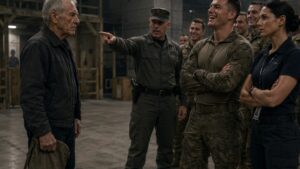
The brass doors of Mercer Veterans Hall were already closing when Thomas Ellis reached the top step.
He had counted the steps from the curb because counting gave his hands something to do besides tremble. Nine from the sidewalk to the landing. Three more from the landing to the old double doors. The rain made the stone shine black beneath the lights, and for one brief second, reflected in the glass, Thomas saw not a man arriving at a dedication ceremony, but an old coat with a tired face above it.
He adjusted the top button, missed the hole, and left it crooked.
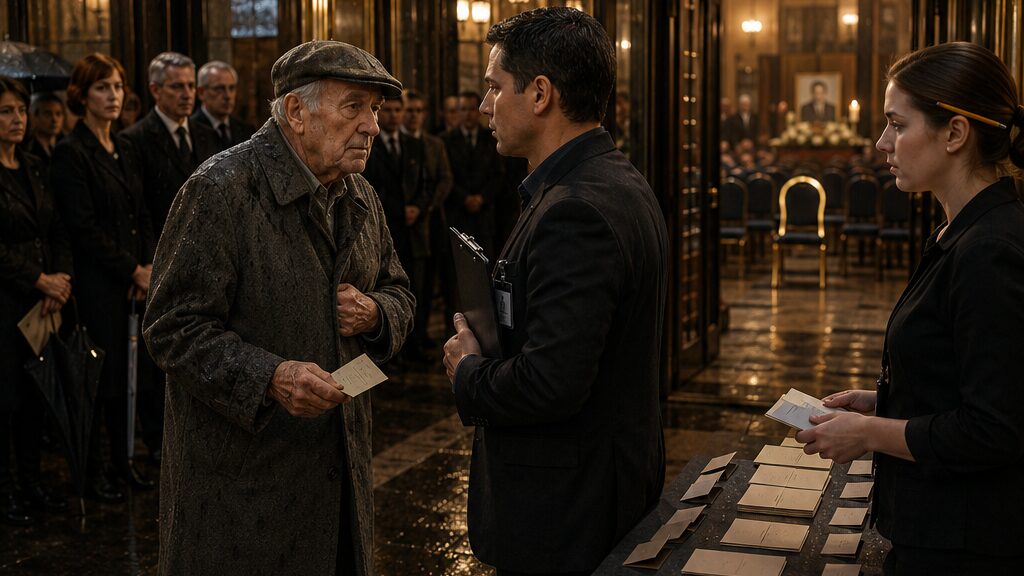
Inside the lobby, warmth rolled toward him with the smell of wet wool, floor polish, and flowers. People in dark suits and pressed dresses moved beneath the brass chandeliers, their voices low but hurried. A table near the entrance held white place cards, a clipboard, and a small sign that read INVITED GUESTS AND FAMILY CHECK-IN.
Thomas stopped just inside the door. Water dripped from the brim of his plain cap onto his cheek, then along the deep crease beside his mouth. He took the invitation from the inside pocket of his gray coat, but before he showed it to anyone, he pressed two fingers against the lining beneath it.
The ticket was still there.
Not the invitation. Not the printed card with his name. The other paper.
The older one.
He could feel its softened rectangle through the cloth, thin as a leaf after all these years. He had checked it in the car. He had checked it in the parking lot. He had checked it once more before climbing the steps, as if paper could vanish from a pocket simply because courage failed around it.
A young woman at the check-in table looked up. Her name tag read Nicole Harris. She had a pencil tucked behind one ear and a stack of seating cards beneath her palm.
“Good evening, sir,” she said, but her eyes flicked toward the clock on the wall. “Ceremony starts in about seven minutes. Can I see your invitation?”
Thomas stepped forward slowly, careful not to leave too much rainwater on the polished floor. Behind him, the doors opened again, letting in a burst of cold air and two couples laughing under umbrellas.
He held out the invitation.
Nicole took it gently enough. That mattered to him before he could stop it from mattering. She read the printed name, then looked down at the seating sheets.
“Thomas Ellis,” she said under her breath.
He heard his name spoken in the hall, and something moved inside his chest, not quite hope and not quite fear.
“Yes, ma’am.”
Nicole ran her finger down a list. Her pencil paused. She pulled another small card from under the stack, frowned at it, then looked past him toward the main hall where rows of chairs faced a stage.
Thomas followed her eyes.
He had seen the room from outside the window earlier, before he had made himself come in. The front row was angled slightly toward the memorial table. Third seat from the aisle. A white card lay on it. From the parking lot, through rain and glass and the blur of his own reflection, he had counted the chairs twice.
His knee hurt from standing. His left hand shook harder when he did not rest it against something. But he did not ask for help.
Nicole touched the card with the tip of her pencil. “It says—”
“Everything good here?” a man asked.
The voice came from Thomas’s right, smooth in the way of someone who had used it all evening. A younger man stepped between Thomas and the table with a clipboard tucked against his chest and a security badge hanging from a dark blazer. His hair was neat, his shirt collar clean, and his smile looked tired at the edges.
Nicole straightened. “Steven, I was just checking Mr. Ellis in. His name is—”
“Let me see.”
The man held out his hand.
Thomas looked at the hand before he surrendered the invitation. The fingers were dry and impatient. He had seen hands like that on gate guards, hospital clerks, men at desks who had to decide whether grief was properly documented before letting it pass.
“Thomas Ellis,” Steven read. He glanced at the invitation once, then at Thomas. “Do you have a family badge?”
“No.”
“Organization card?”
“No.”
“Are you with one of the veteran groups seated up front?”
Thomas’s eyes moved again toward the main hall. The third chair from the aisle sat empty under the soft white lights. A woman in the front row had a tissue in her hand, crushed but unused.
“I was asked to come,” he said.
Steven’s smile remained, but it thinned. “I understand. A lot of people were asked to come. We have limited family and reserved seating, and we’re already behind.”
Nicole looked down at the seating card again. “Steven, there’s a note here—”
He did not turn. “Nicole, can you help the Anderson party? They’re missing one of their donor packets.”
The young woman hesitated. Thomas saw it. A small tightening around her mouth. A decision not made, then made by not making it.
“Yes,” she said quietly.
She moved to the other side of the table where one of the couples was waiting.
Steven returned his attention to Thomas. “Mr. Ellis, do you know someone in the family?”
Thomas’s thumb moved toward the inside pocket again before he stopped himself.
“Yes.”
“Which family member?”
The question should have been simple. Thomas had rehearsed a dozen answers in the car while rain tapped the windshield. I served with Jack Mercer. I was asked by his sister. I have something that belongs to her. I am sorry I came so late. I am sorry I waited so long.
But now the lobby was too warm. The voices behind him pressed closer. His collar felt wrong against his throat. His invitation looked small in Steven’s hand.
“Brenda Mercer,” Thomas said.
Steven glanced toward the front row. “Mrs. Mercer is seated already. She’s had a long day. We’re trying not to disturb her before the dedication.”
Thomas absorbed the correction. Mrs. Mercer. Not Brenda. Not the young woman with her hair in a scarf standing outside an ICU room. Not the sister who had looked at him as if his breathing had stolen air meant for someone else.
“Of course,” he said.
Steven studied the invitation again. “This just lists your name. No rank. No unit. No plus-one. No title.”
Thomas nodded once.
“It doesn’t say family seating.”
“No,” Thomas said.
“Do you have another letter?”
“No.”
“Email?”
“No.”
“Then you can understand my position.”
Thomas looked at the empty chair. Third from the aisle. He had not driven forty miles in the rain to understand another man’s position, but he had spent much of his life standing where he was told to stand. A man could survive a lot by not demanding room.
The invitation had gone soft at the creases. Steven turned it over as if proof might be hiding on the back.
Behind Thomas, someone shifted. A woman whispered that they were going to miss the opening prayer. A man cleared his throat. The lobby clock clicked with a stern, official sound.
“I know where I’m meant to sit,” Thomas said.
Steven looked up. “You do?”
“Yes.”
“And where is that?”
Thomas lifted his chin toward the open doors of the hall. “Front row. Third chair from the aisle.”
Steven’s face changed only slightly, but enough. Suspicion entered where impatience had been.
“Sir,” he said, lowering his voice, “that section is reserved.”
“I know.”
“For family, officials, and honored guests.”
Thomas did not answer.
Steven leaned closer. “Did someone tell you that seat was empty?”
Thomas thought of the parking lot, the rain on the windshield, the glowing room beyond the glass. He thought of himself sitting in the car too long, watching people enter while he held the invitation in one hand and the old ticket in the other.
“No.”
Steven’s gaze dropped to Thomas’s scuffed shoes. They were polished, but age had cracked the leather in thin pale lines no polish could hide.
“Mr. Ellis, I’m not trying to be difficult. But we’ve had people wander in before during public events. Sometimes they’re confused. Sometimes they’re just looking for a warm place. And this ceremony is very important to the Mercer family.”
There it was. Not an insult yet. Not quite. Something softer and worse: a place already made for him in the man’s mind.
Thomas took a slow breath. He had been called worse by men who knew his name. He had been ignored by people who did not. But the word confused stayed in the air between them like a hand placed firmly against his chest.
“I am not confused,” he said.
Steven gave a quick, practiced nod. “I’m sure you’re not.”
Nicole had looked over again. Her hand rested on the seating card. Thomas could not read it from where he stood, but he saw her thumb cover something written in pen.
The doors to the hall opened wider as a volunteer inside waved to Steven.
“Two minutes,” the volunteer called. “Councilman Clark is ready.”
Steven’s jaw tightened. His anxiety showed then, not as cruelty but as calculation. Too many guests. Too little time. One old man with rain on his coat and no clean category.
“Mr. Ellis,” he said, handing back the invitation, “I can seat you in general seating near the back.”
Thomas did not take the paper right away.
“My name should be on that chair.”
“If it were, I’d have a card that tells me why.”
Nicole opened her mouth, then closed it when Steven glanced toward her.
Thomas saw that too.
The lobby had begun to quiet in the way public places do when people pretend not to listen. He could feel the line behind him now. Their impatience touched the back of his coat more sharply than the rain had.
He took the invitation.
His fingers shook as he folded it along the old creases. Once. Twice. He did not fold it because it needed folding. He folded it because his hands needed orders.
Steven softened his voice, perhaps aware of the watching faces. “You’re welcome to stand in the back if you prefer. But the front row isn’t for walk-ins.”
Thomas slid the invitation into his coat beside the old ticket. The two papers touched through the lining, one new and official, one old and nearly worn through.
Then he looked at Steven, not with anger, but with the tired steadiness of a man who had once learned how little anger could bring back.
“That name was enough once,” Thomas said.
Chapter 2: The Third Chair From the Aisle
Steven held Thomas’s invitation between two fingers and looked past him toward the rain-streaked glass doors, as if more problems might be coming in behind him.
“Sir,” he said, louder now, “this entrance is for invited guests, not people looking for a warm place to sit.”
The lobby did not go silent all at once. It faltered. A purse clasp clicked shut. Someone’s program stopped rustling. The low voices near the check-in table thinned until all that remained was the rain ticking against the brass-framed windows.
Thomas stood with one hand half inside his coat pocket and the other at his side. He had faced shouting before. That was not what made his ears burn. It was the shape of the sentence. It made him not a man in the wrong place, but a problem the room was allowed to recognize.
“I was invited,” he said.
Steven glanced at the paper again, then held it out as if returning a mistake. “You have an invitation, yes. But this doesn’t give you reserved access.”
Nicole shifted behind the table. “Steven, his name—”
“I’ve got it,” Steven said without looking back.
A couple behind Thomas moved around him toward the check-in table. The man’s shoulder brushed Thomas’s coat. No apology came, only a quick irritated breath.
“There’s always one,” someone muttered farther back.
Thomas heard it clearly. So did Steven. So did Nicole. No one looked toward the speaker, which somehow made it belong to everyone.
For a moment, Thomas saw himself as they must have seen him: gray coat buttoned wrong, plain cap damp at the brim, jaw unshaven in one small patch below the ear where his hand had missed that morning, shoes that had been cared for but not saved from age. He had dressed as well as he could. He had ironed the shirt the night before. He had stood in front of his bathroom mirror and practiced saying, “Mrs. Mercer, I should have brought this sooner.”
None of that showed.
Steven lowered his voice again, but the damage had already done its work. “Please don’t make this harder in front of everyone.”
Thomas looked toward the hall.
The third chair from the aisle remained empty.
Beside the stage, the memorial table held a framed photograph, a white candle, and a small wooden box. The photograph was angled toward the audience. From where Thomas stood, the face was too far away to see clearly, yet he knew the grin. He knew the way one corner of Jack Mercer’s mouth lifted before the rest of his face admitted he was amused. He knew the tilt of the head, as if Jack had already decided whatever trouble came next would be worth it.
Thomas’s thumb pressed against the inside pocket of his coat.
The fair ticket crinkled faintly.
Steven noticed. His eyes narrowed, not dramatically, just enough to say that every movement Thomas made was being measured.
“What’s in your pocket?” Steven asked.
Thomas let his hand fall away. “Paper.”
“What kind of paper?”
“Mine to carry.”
Steven exhaled through his nose. “Mr. Ellis, there’s a memorial table inside. We can’t have confusion near it.”
At that, something in Thomas tightened.
Not rage. Rage was too young a word. This was older. A door closing inside him before anything could escape.
“I won’t touch anything that isn’t mine,” he said.
Steven’s expression flickered, but he did not move aside. “I’m asking you to cooperate.”
“I am.”
“No, you’re insisting on a seat you can’t verify.”
Thomas looked at the invitation in his hand. “The paper has my name.”
“It has no rank.”
“No.”
“No organization.”
“No.”
“No family notation.”
Thomas looked at Nicole then, and she lowered her eyes.
The volunteer from the hall appeared again in the doorway. “Steven. They’re starting.”
A short burst of music rose from inside, strings from a speaker system, thin and formal. The guests who had already been checked in turned toward the open doors. Those still in the lobby grew restless.
Steven made his decision with the relief of a man choosing a rule over a person.
“You can watch from the back,” he said. “That’s the best I can do.”
Thomas did not say that the best a man could do was often more than this. He did not say that someone could walk ten steps and ask Brenda Mercer whether Thomas Ellis belonged in the third chair from the aisle. He did not say that he had once carried a younger man’s weight through smoke and mud until someone else took him from his arms.
He only folded the invitation.
The creases had become soft from being opened and closed too many times that week. First at the mailbox. Then at the kitchen table. Then in the car. Then in the parking lot when his courage nearly failed him. Now here, in front of people who did not know that the invitation was not the paper that mattered most.
Once folded, it fit again inside his coat.
The ticket waited there.
For forty-one years, it had lived in different pockets, different drawers, different hiding places when the grief became too loud. For the last week, it had stayed inside the coat he meant to wear to the hall. Two admissions to the county fair. Faded blue ink. A torn corner. The date from a summer Jack never saw.
Thomas kept his palm against it for one more second, then let go.
“Then I’ll stand,” he said.
Steven stepped aside, but not fully. He guided Thomas with an open hand toward the side aisle at the back of the hall, not touching him, yet directing him as clearly as if he had. Thomas walked where he was permitted.
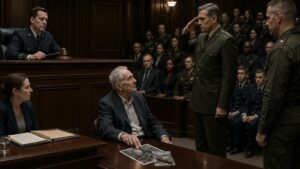
Inside, the hall glowed with clean light. Rows of chairs faced a raised stage draped in dark blue fabric. Along the walls hung photographs of men and women in uniforms from different wars and different decades, their faces arranged in solemn frames. Near the front, a polished plaque was covered with a cloth, waiting to be unveiled.
The front row was full except for one chair.
Third from the aisle.
A white card rested on the seat.
Thomas could not read it from the back, but he no longer needed to. The sight of it was almost worse than if it had been occupied. An empty place could accuse a man more quietly than any voice.
Brenda Mercer sat two seats away from it.
He recognized her not by youth, because youth had left them both long ago, but by the set of her shoulders. Still straight. Still braced. Her silver-streaked hair was pinned neatly, and one hand held a tissue so tightly it had become a small white knot. She faced forward, but as Thomas reached the back wall, her head turned slightly toward the empty chair, then back to the stage.
She did not see him.
Or if she did, she gave no sign.
Steven stopped beside the last row. “You can stand here. Please keep the aisle clear.”
Thomas nodded.
It would have been easy to leave then. Easier than standing under the gaze of a room that had already decided he was a minor disruption. Easier than waiting to learn whether Brenda’s face would harden with recognition. Easier than reaching into his coat and bringing the old ticket into the light.
He glanced toward the exit.
Rain blurred the glass doors. The outside steps glistened. His car waited somewhere in the dark lot with the engine cooling and the passenger seat still damp from his coat.
Then the speaker system clicked, and Kevin Clark stepped to the podium.
“Good evening,” Kevin said, voice warm and practiced. “Thank you all for joining us as we dedicate Mercer Veterans Hall in honor of Lance Corporal Jack Mercer, whose courage, sacrifice, and memory continue to shape this community.”
Jack.
The name moved through the room and found Thomas at the back wall.
He closed his eyes for one breath.
A boy’s laugh came back to him, quick and bright under a canvas roof far from home. Not a boy, Thomas corrected himself. A Marine. But memory did not respect ranks and ages. It kept Jack at nineteen, grinning over two county fair tickets as if surviving until August were no harder than catching a ride home.
Thomas opened his eyes.
Steven had returned to the lobby, but not before giving him one last warning look. Nicole stood by the check-in table beyond the doorway, half-visible, holding a seating card she seemed afraid to read again.
On the stage, Kevin continued.
“Tonight is not about one building,” he said. “It is about gratitude. It is about remembering the names of those who gave everything.”
Thomas looked at the memorial photograph.
From the back of the room, Jack’s face was small and bright beneath the glass.
Thomas took one step toward the aisle before he realized he had moved. Then he stopped.
Not yet.
He placed one hand flat against the wall to steady himself. The hall seemed too full of words and too empty of the one thing he had come to do. He wanted to disappear into the back, to wait until the ceremony ended, perhaps catch Brenda near the memorial table, perhaps leave the ticket on the edge and walk away before anyone asked.
But the front chair sat empty.
Third from the aisle.
Held for a man no one had bothered to ask about.
Thomas looked once more toward the exit, nearly turned toward it, and then Kevin Clark said Jack Mercer’s name again.
This time, Thomas stayed.
Chapter 3: The Woman Who Once Blamed the Survivor
Kevin Clark said sacrifice as if it were a polished stone, smooth enough to pass from hand to hand without cutting anyone.
Thomas stood beside the coat rack at the back of the hall and listened while the councilman spoke of courage, service, community, duty, legacy. The words were fine words. Thomas had no quarrel with them. He had used some of them himself over the years when younger veterans asked him to speak at small breakfasts or school events. He knew the comfort of words arranged properly.
He also knew what they left out.
They left out the smell of burned rubber and wet dirt. They left out the stupid jokes men told because silence was worse. They left out the way a person could survive a day and spend the rest of his life feeling as if survival had been a clerical error no one knew how to correct.
Thomas shifted his weight off his bad knee.
A woman seated near the back glanced up at him, then away. He kept his eyes on the stage.
Kevin gestured toward the memorial table. “Jack Mercer was nineteen years old when he left this town. Those who knew him remember his humor, his loyalty, and his deep love for his family, especially his sister Brenda, who joins us tonight.”
The room turned toward Brenda.
She did not stand. She only inclined her head slightly, the tissue still locked in her hand.
Thomas looked at her then because everyone else was looking, and for one moment it felt less like trespassing.
Forty-one years had changed her face but not erased the young woman in the hospital hallway. He remembered her at twenty-two, hair loose around her shoulders, eyes red, hands clenched at her sides as if grief needed fists.
You came back.
That was what she had said first.
Not where is he, because by then she knew. Not thank you for being with him, because no one could thank a man for standing where her brother should have stood. Not tell me he wasn’t alone.
You came back.
Thomas had been twenty-four, though that seemed impossible now. He had stood in a corridor that smelled of disinfectant and coffee burned too long on a hot plate. His right arm had been bandaged. There was mud still dried into his boot seams. A chaplain had placed a hand on Brenda’s shoulder, and she had thrown it off.
“My brother trusted you,” she had said.
Thomas had looked at the floor because he could not look at her face.
“He did,” he had answered.
“And you left him there?”
The hallway had gone still around them. Someone had tried to guide her away. She would not move.
Thomas could have said things. He could have explained the smoke, the second burst, the medic, the order screamed over the noise. He could have said he carried Jack until his legs failed and someone stronger pulled them both behind the vehicle. He could have said Jack was already slipping somewhere no man could follow.
But Brenda’s grief had needed a target, and Thomas had been alive.
So he gave her one.
“I’m sorry,” he had said.
She had slapped him. Not hard enough to injure. Hard enough to give her hand something to do besides reach for a brother who was gone.
He had not blamed her then.
He did not blame her now.
A soft scrape of movement drew him back to the hall. Brenda had turned slightly toward the empty chair beside her. Her eyes rested on it, not with confusion but with expectation sharpened by disappointment. She looked at the card on the seat, then toward the back of the room.
Thomas stiffened.
For a second, he thought she had seen him. He nearly lifted his hand. But someone in the row behind her leaned forward to whisper, blocking her view, and Brenda faced front again.
The empty chair remained between them like a question neither had dared ask directly.
In the lobby, beyond the open hall doors, Nicole stood at the check-in table with the seating sheets spread before her. Thomas could see her only in pieces: her shoulder, her hand, the pencil moving quickly down the page. She pulled the white card she had touched earlier from beneath the stack and read it again. Her expression changed.
She looked into the hall.
Thomas looked away before their eyes met.
On stage, Kevin had moved from praise to history. He spoke of the old building, its renovation, the donors who made the dedication possible. His tone warmed when he mentioned names of officials. People nodded at the proper moments.
Thomas heard little of it.
His attention had narrowed to the ticket in his coat. It seemed heavier now that Jack’s photograph sat so close. He could feel the paper not as paper but as years.
The memory came anyway.
Jack Mercer had bought the tickets from a folding table outside a feed store the week before deployment. He had waved them in Thomas’s face like he had won a prize.
“Two admissions,” Jack had said. “County fair. August. Brenda says she’s too old for the Ferris wheel, which is how I know she wants to go.”
Thomas had laughed and told him to put them somewhere safe before he lost them.
“You hold one,” Jack had said.
“I don’t want your fair ticket.”
“Then don’t think of it as a ticket. Think of it as insurance. If I lose mine, you tell Brenda I was prepared.”
“You planning on losing a lot of things?”
Jack had grinned. “Only arguments.”
Thomas had taken the ticket because Jack shoved it into his hand and because young men often accepted foolish tokens from one another without understanding how long such things could last.
Later, after everything, Jack’s ticket had been found in his personal effects. Thomas’s had remained in his pocket.
No, not remained. That was too easy a word.
It had survived because Thomas had kept it.
At first, he meant to give it back as soon as Brenda could bear it. Then she had struck him, and he had told himself she wanted nothing from his hands. Later, he meant to mail it. Then he imagined her opening an envelope alone and seeing his name. After that he put it away in a cigar box, took it out every August, and told himself grief had a right to remain undisturbed.
Years turned the excuse into a habit.
Habit turned into punishment.
A movement in the lobby pulled him back again. Nicole had approached Steven near the doorway. She held the seating card low, almost hidden against her skirt.
Thomas could not hear every word over Kevin’s speech, but he saw enough.
Nicole said something and pointed to the card. Steven’s shoulders tightened. He glanced toward the front row, then toward Thomas. His face showed recognition, not of who Thomas was, but of a problem becoming more complicated.
“Not now,” Steven whispered, loud enough that Thomas caught the shape of it. “We can’t interrupt.”
Nicole looked stricken. “But it says family request.”
Steven took the card from her hand and slipped it beneath his clipboard. “After the ceremony.”
After.
Thomas let the word settle.
After was where he had lived for forty-one years.
After the funeral. After the first anniversary. After Brenda married and moved away, then moved back. After Thomas retired. After his wife died. After the doctor told him his hand tremor would worsen. After he found the invitation in his mailbox and sat at the kitchen table until the evening light disappeared around him.
After was the country of men who did not know how to go back.
Kevin’s voice rose slightly, drawing the room toward the next part of the program.
“In a moment, we will unveil the plaque that bears Jack Mercer’s name. But before we do, Mrs. Mercer asked that we make space for personal remembrance. If there is anyone here tonight who personally served with Lance Corporal Jack Mercer, we would be honored to have you come forward or stand where you are.”
The room waited.
Chairs creaked. Programs rustled. Someone coughed into a fist.
No one moved.
Thomas looked at Brenda.
She had gone very still.
Kevin glanced toward the front rows, then toward the side aisle, searching for a response he had clearly expected someone else to provide. His polished expression faltered at the edges.
Steven stood in the doorway with the clipboard against his chest. Nicole was beside him, pale and silent.
Thomas’s right hand had begun to tremble. Not a little now. Enough that he had to close it into a fist.
He could stay at the back. He could let the silence pass. He could tell himself Jack’s name had been honored, that Brenda had her ceremony, that the ticket could remain in his coat until he found a quieter way.
Then Brenda turned toward the empty third chair from the aisle.
Not toward the room. Not toward the officials. Toward the absence.
Thomas took one breath.
His fingers opened.
And in the back of the hall, where no one had asked him to stand except memory, his trembling hand began to rise.
Chapter 4: The Ticket That Proved Less Than Expected
Thomas took one step into the aisle, and Steven moved faster than anyone in the room seemed to breathe.
“Sir,” Steven whispered, sharp and low, appearing at Thomas’s side before the old man had made it past the last row. “Please don’t interrupt.”
Thomas stopped.
The room had noticed him now. Not fully, not with understanding, but with the quick turn of heads that follows disturbance. Kevin Clark paused at the podium, one hand resting on his notes. The microphone caught the faint scrape of his sleeve and carried it through the speakers.
Thomas felt every eye as weight.
His raised hand lowered.
“I served with him,” he said.
Steven’s face tightened. “You should have told me that before.”
Thomas looked at him then. The words were not cruel, but they cut because they were partly true. He should have told him many things before. He should have told Brenda forty-one years before. He should have told himself the truth before it became easier to carry a ticket than to deliver it.
“I tried to come in,” Thomas said.
Steven glanced toward the front rows, then back toward the lobby, measuring damage. “We can handle this after the ceremony.”
After again.
Thomas’s fingers moved inside his coat.
This time, he did not stop them.
The paper came out folded inside his palm. Not the invitation. Smaller. Older. Softer at the edges. His hand shook badly enough that for a moment he had to hold it with the other one.
Steven saw only the movement. “Sir, I need you to keep your hands visible.”
Thomas unfolded the ticket.
The paper had once been blue, though years had dulled it toward gray. One corner was missing. The print remained just clear enough under the hall lights: COUNTY FAIR ADMISSION. Beneath it, the date from a summer the room had no reason to remember.
Steven stared at it, baffled and embarrassed by his own uncertainty. “What is that?”
Thomas did not answer him.
At the front of the hall, Brenda Mercer turned.
At first her face held only the cautious irritation of a woman being forced to look away from her brother’s ceremony. Then her eyes found Thomas’s hand. She saw the ticket before she seemed to see him.
Her lips parted.
The tissue fell from her fingers onto her lap.
Kevin Clark leaned toward the microphone. “Mrs. Mercer?”
Brenda rose so quickly the chair behind her shifted back with a hard wooden scrape.
The sound broke through the room more cleanly than any announcement could have.
Thomas stood halfway down the aisle, caught between the back wall and the front row, the ticket open in his trembling hand. Steven remained beside him, but his body had changed. He was no longer blocking a stranger. He was standing near something he did not understand and feared he had mishandled.
“Thomas?” Brenda said.
The name moved through the hall differently when she spoke it.
Not as a line on an invitation. Not as a possible error. Not as an old man’s claim.
As recognition.
Thomas lowered his eyes. “Mrs. Mercer.”
She took one step into the aisle. “Thomas Ellis?”
“Yes, ma’am.”
The old habit came back without permission. Ma’am. Distance. Respect. A small wall built of courtesy.
Brenda’s hand went to the back of the empty chair beside her. Third from the aisle. Her fingers gripped it the way she had gripped the tissue.
Kevin looked from Brenda to Thomas, then down at his notes as if the program might tell him what to do with silence. It did not.
Steven whispered, “Mr. Ellis, maybe we should—”
Brenda cut across him without raising her voice. “Let him come forward.”
Steven stepped back.
The space he had guarded opened in front of Thomas, and for one strange moment Thomas wished it had remained closed. There was safety in being stopped. A man could tell himself he had tried. He could return to his car with the ticket still in his coat and add this night to the long line of almosts.
But Brenda was standing.
Jack’s photograph waited beside the candle.
Thomas walked.
He moved slowly, not for effect but because his knee objected to every step and because the hall seemed longer than it had from the back. He kept his eyes on the aisle carpet. Not on the watchers. Not on Steven. Not yet on Brenda.
Halfway forward, the ticket trembled so badly that he nearly closed his hand around it. He forced his fingers to remain open.
By the time he reached the front row, Brenda had come out to meet him.
She looked older than his memory, which was only fair. He knew he did too. Lines bracketed her mouth. Her eyes were tired, but not dulled. The anger he remembered was not there in the same shape, yet its ghost stood between them.
“I didn’t come to speak,” Thomas said.
His voice sounded rough in the large room.
Brenda looked at the ticket.
“Where did you get that?”
Thomas held it toward her, but not close enough to make her take it before she chose to.
“Jack gave it to me.”
Her face changed again, and this time the room could not follow. People shifted, trying to see what the old scrap meant. Someone in the second row leaned forward. Kevin’s hand hovered near the microphone, then withdrew.
Brenda reached out but stopped just short of touching the paper.
“He bought those for me,” she said.
Thomas nodded once.
Her eyes lifted to his. “There were two.”
“Yes.”
“I had one in the envelope with his things.”
“Yes.”
Her voice grew thinner. “Why did you have the other?”
Thomas swallowed.
The answer could not be given in the aisle with programs in people’s laps and a candle burning beside a framed photograph. Not truly. Not fully. But he had come this far because silence had finally become heavier than fear.
“He said if he lost his, I should tell you he was prepared.”
A small sound left Brenda. It was not a laugh and not a sob, but it carried both.
The old ticket shook between them.
Thomas tried again. “He said he owed you a Ferris wheel ride.”
Brenda closed her eyes.
The hall did not applaud. It did not gasp. It simply held still, as if everyone had become aware that the ceremony they came to attend had been standing in the aisle all along, damp-coated and nearly turned away.
Steven’s face had gone pale.
Nicole stood in the open doorway with one hand over her mouth and the other still clutching papers.
Brenda opened her eyes. “You carried that all this time?”
Thomas looked at the ticket because it was easier than looking at her.
“I was meant to give it back.”
“Then why didn’t you?”
The question was soft, but it struck harder than Steven’s public doubt. Steven had judged his coat, his paper, his old hands. Brenda asked the thing he had spent most of his life not answering.
Thomas’s mouth moved.
No words came.
He remembered the hospital hallway. Her palm against his cheek. Her eyes accusing him of returning in a body Jack no longer had. He remembered deciding, with the arrogance of grief, that her anger was the final word she would ever want to speak to him.
“I wasn’t sure you’d want anything from me,” he said at last.
Brenda stared at him.
Something in her expression faltered. Not forgiveness. Not yet. Something more painful because it contained the possibility of responsibility.
Kevin cleared his throat at the podium, a tiny sound amplified by the microphone. “Mrs. Mercer, would you like a moment?”
Brenda did not look at him.
Thomas held the ticket out another inch.
This time she took it.
Her fingers touched his for less than a second. They were cold. Or perhaps his were. The paper passed from the hand that had carried it too long into the hand it had always been meant to reach.
Brenda looked down at it, both palms closing around the faded admission.
Around them, the room remained caught between public ceremony and private reckoning.
Then Brenda turned to the front row.
“That empty chair,” she said, her voice steady enough to travel without the microphone, “was never for an official.”
Steven lowered his eyes.
Kevin looked sharply toward the seating card on the chair.
Brenda’s gaze stayed on Thomas. “It was for him.”
A murmur moved through the room, quickly hushed.
Thomas felt the attention shift, and he disliked it almost as much as the earlier judgment. He had not come to become a lesson in front of strangers. He had come because Jack’s photograph had finally been placed in a room he could no longer avoid.
Brenda looked from the ticket to Thomas.
Then her voice dropped, no longer for the room but not hidden from it either.
“Did he give that to you before the convoy?”
Thomas’s hand, now empty, closed at his side.
The word carried them both backward.
The hall lights, the polished floor, the flowers, the officials, Steven’s badge, Kevin’s notes—all of it seemed to tilt around that one question.
Thomas looked at Jack’s photograph on the memorial table.
“Yes,” he said.
Brenda’s fingers tightened around the ticket.
“Then I need to know,” she said. “I need to know why you never came back with it.”
Chapter 5: The Promise He Could Not Deliver
Brenda closed the side-room door with the ticket still in her hand and asked the question Thomas had feared for forty-one years.
“Did Jack suffer?”
The room behind the stage was small and overlit, meant for coats, extra programs, and the kind of conversations people did not want spilling into a ceremony. Through the wall came the muffled sound of Kevin Clark speaking again, carefully filling the hall with thanks and acknowledgments while the real dedication stood suspended in a storage room.
Thomas remained near the door. He had not sat when Brenda pointed to a folding chair. Sitting felt too much like staying, and part of him still wanted the shape of an exit behind his shoulder.
Brenda stood by a table stacked with extra candles. The county fair ticket lay open across her palm.
“Thomas,” she said, and the name was no longer a public recognition. It was a demand. “Did he suffer?”
Thomas looked at the floor. The tile was scuffed where chairs had been dragged and stacked. A small puddle from his coat had gathered near his shoe.
“He knew we were with him,” Thomas said.
“That isn’t what I asked.”
“No.”
The answer left him before he could soften it. He heard Brenda’s breath catch and hated himself for not knowing whether the truth should be plain or padded after so long.
He forced himself to look up.
“He was hurt,” Thomas said. “He was scared for a minute. Then he was angry because he thought he’d lost something.”
Brenda’s brow tightened. “Lost what?”
Thomas nodded toward the ticket.
Her hand closed around it.
The memory came not as a clean scene but as pieces. Heat. Dust. The inside of a vehicle too loud for private thoughts. Jack patting his breast pocket, then slapping his own gear with panic entirely out of proportion to the morning around them.
“Ellis,” Jack had said, “you still got that ticket?”
Thomas, younger and annoyed and not yet old enough to know which moments would last, had looked over. “You worried about carnival rides right now?”
Jack had grinned, but his hands kept searching. “I told Brenda I’d take her. She said she wasn’t getting on anything that squeaked, which means she’s definitely getting on the Ferris wheel.”
“You planning to make it home in time?”
“I’m planning to make it home with options.”
The convoy had lurched forward. Someone had shouted something from the front. Jack had leaned close enough for Thomas to hear over the engine.
“If mine disappears,” Jack said, “you give her yours. Tell her I didn’t forget.”
Thomas had rolled his eyes. “You can tell her yourself.”
“Yeah,” Jack said. “But if I don’t.”
“You will.”
Jack’s grin had faded then, just slightly. The joking boy vanished, and the Marine remained.
“If I don’t,” he repeated.
Thomas remembered making a careless promise because he believed the world would not be cruel enough to hold him to it.
“I’ll tell her,” he had said.
Brenda listened without moving. Only her thumb slid once over the ticket’s torn corner.
“He made everything sound like a joke,” she said.
“He did that when he was afraid.”
Her eyes lifted to his.
It was too late to take back the intimacy of the answer. Thomas had known Jack’s fear. Brenda had known his laughter. The ticket lay between those two versions of him.
“Afterward,” Brenda said, “they gave us his things. His watch. His letters. One ticket. My mother thought it was trash from his pocket.”
Thomas nodded.
“I kept it,” she said. “For years. I thought the other one was gone.”
“No.”
“You had it.”
“Yes.”
“Forty-one years.”
Thomas could not make the number smaller.
Brenda leaned against the edge of the table as if her knees had become unreliable. “Why?”
Thomas looked toward the door. Through the wall, Kevin’s voice rose in a polished sentence about sacrifice. The crowd gave a small, proper response.
“I came to the hospital,” Thomas said.
“I know.”
“You were there.”
“I remember.”
Her voice had changed. The anger was not absent, but it was no longer alone.
Thomas’s right hand began to tremble again. He clasped it with his left.
“You said your brother trusted me.”
Brenda’s face tightened.
“You asked if I left him there.”
She lowered her eyes.
“I did not blame you for asking,” Thomas said. “You were his sister.”
“That doesn’t mean I was right.”
“No.”
The word surprised them both. It was quiet but firm, the first thing Thomas had said that did not bend entirely around her pain.
Brenda looked up.
Thomas swallowed. “You were grieving. But no. You were not right.”
For a moment, the small room held something that had no ceremony name.
Brenda’s eyes filled, though no tears fell. “Did you carry him?”
Thomas’s jaw worked once before he answered.
“As far as I could.”
She pressed the ticket to her chest. “No one told me that.”
“I didn’t tell anyone much.”
“Why not?”
“Because he still died.”
The words came out flat. Not dramatic. Not loud. Just the plain stone at the bottom of him.
Brenda stared at him as if seeing, for the first time, that Thomas had not been silent because nothing happened. He had been silent because something had.
“I thought,” she said slowly, “after that day in the hospital, you wanted nothing to do with us.”
Thomas almost smiled, but the attempt failed. “I thought that was what you wanted from me.”
“I was twenty-two.”
“I was twenty-four.”
They stood with those ages between them, ridiculous and unforgiving.
Brenda looked at the ticket again. “You could have mailed it.”
“I wrote the envelope once.”
“What happened?”
“I put your name on it. Then I saw mine in the corner.” His voice lowered. “I thought you would open it and be right back in that hallway.”
Brenda turned away, not from him but from the image. Her shoulders rose and fell once.
Thomas went on because stopping now would be only another form of hiding.
“A few years later, I saw your name in the paper. You had married. I told myself you had built a life and didn’t need old ghosts. Then when your mother passed, I stood outside the church and left before anyone saw me. After that, every year made it harder to explain the year before.”
“You were there?” Brenda asked.
“At the church?”
“At my mother’s service.”
“In the parking lot.”
Her mouth trembled. “I looked for you.”
Thomas went still.
It was not forgiveness that struck him. It was the smaller, sharper pain of learning he had been wrong in a way that stole time from someone else.
“You looked for me?”
“I didn’t know if I would speak to you,” Brenda said. “But yes. I looked.”
The ticket bent slightly beneath her fingers.
Thomas turned his face away. The old room blurred at the edges, but he did not lift a hand to his eyes. He had learned long ago that if he began wiping at grief, he might never stop.
At the door, a shadow moved.
Neither of them had heard it open, but it stood now an inch ajar. Steven was outside, one hand on the knob, his face rigid with the shock of a man who had heard enough to understand the shape of his mistake and not nearly enough to know what to do with it.
Behind him, Kevin Clark whispered, “Steven. We need Mrs. Mercer back out there. The donors are waiting for the plaque.”
Brenda heard that. Her expression hardened, but not toward Thomas.
“The donors can wait,” she said.
Steven stepped back as if the words had physical force. “Mrs. Mercer, I’m sorry. I was just—”
Thomas lifted one hand.
Not high. Not sharply. Just enough.
Steven stopped.
Thomas looked at him for the first time without the shelter of distance or public noise. He saw the younger man’s embarrassment, fear, calculation, and dawning shame. He also saw how easy it would be to let that shame become a public object. A few sentences, and Steven would stand in the same exposed place where Thomas had stood.
Thomas lowered his hand.
“Not here,” he said.
Steven’s eyes dropped.
Kevin shifted in the hallway, uncomfortable with silence that was not on the program. “Mrs. Mercer, we can take another minute, but we do need to resume.”
Brenda did not answer him. She looked at Thomas instead.
“I sent the invitation through the city office,” she said. “I didn’t write you myself.”
Thomas waited.
“I was afraid you would tear it up if you saw my handwriting.”
Before Thomas could answer, Nicole appeared in the doorway, breathless and pale. She held a white seating card in one hand and a larger sheet beneath it.
“I’m sorry,” she said. “I should have brought this earlier.”
Steven closed his eyes briefly.
Nicole stepped into the room and held the card toward Brenda.
The handwriting was blue and slanted, careful but slightly uneven.
Third chair from aisle — Thomas Ellis, if he comes.
Thomas read the words once.
Then again.
Brenda looked at him over the card, the old ticket still pressed in her other hand, and all the years he had called mercy stood suddenly between them as something else entirely.
Chapter 6: The Seat Reserved for an Absence
Kevin Clark returned to the microphone with the uneasy brightness of a man trying to pretend the room had not changed while he was away.
“Thank you for your patience,” he said, though no one had been patient. They had been listening to the closed side-room door, watching the empty chair, and wondering why Brenda Mercer had left her own brother’s dedication with an old man who had almost been turned away.
Brenda stood just inside the hall entrance, the fair ticket held in both hands.
Thomas remained beside her, close enough to feel the attention waiting for him to become something he did not want to be. A story. A correction. A lesson people could repeat later over coffee with their own kinder version of themselves.
Steven stood near the lobby, the clipboard hanging uselessly at his side.
Nicole hovered behind him, clutching the seating sheet now as if it were both proof and accusation.
Kevin continued, “We’ll now proceed with the formal unveiling of the plaque, and then Mrs. Mercer may offer any additional—”
“No,” Brenda said.
She did not raise her voice. She did not need to. The microphone caught only Kevin’s intake of breath, but the room heard Brenda clearly.
Kevin looked toward her. “Mrs. Mercer?”
Brenda walked forward.
Thomas did not move.
She stopped after two steps and looked back at him. For a moment, he thought she wanted him to follow, and fear rose in him so quickly it felt like anger.
“I don’t need to speak,” he said.
“I know,” Brenda said.
That was not what he expected.
She continued alone to the front row, passing the empty chair. Third from the aisle. Its white card still lay on the seat, innocent in the way paper could be innocent after doing harm.
Brenda reached the memorial table and placed the fair ticket beside Jack’s photograph, but only for a second. Then she picked it back up, as if she was not yet ready to let the paper belong to the table instead of her hand.
She turned to face the room.
“This ceremony was planned to honor my brother,” she said. “I want it to stay that way.”
Thomas saw Steven shift at the side aisle. The younger man’s face had tightened with the need to do something. Apologize, perhaps. Explain. Make himself useful in the very moment usefulness would draw more attention to the mistake.
He stepped forward.
Thomas caught his eye and gave one small shake of his head.
Steven stopped.
It was not forgiveness. Not yet. It was a boundary. Do not spend Jack’s day purchasing your relief with another public scene.
Brenda saw the exchange. Her expression softened for half a breath, then steadied again.
“When I was asked who should sit in the family row tonight,” she said, “I gave one name that some of the organizers did not know how to place.”
Kevin’s face reddened slightly, though he was not the one holding the seating card.
Brenda looked down at the ticket. “That was my mistake too. I gave the name, but not the story. I thought if I explained too much, I would lose the courage to send it.”
Thomas’s throat tightened.
Guests in the front rows turned toward him, but he kept his eyes on Brenda.
“I did not send Thomas Ellis a personal letter,” she continued. “I sent the invitation through the city office because I was afraid he would know my handwriting and decide not to come.”
A murmur moved through the hall. Not judgment. Not quite. The sound of people revising what they thought they had seen.
Thomas looked at the chair.
For forty-one years, he had imagined Brenda’s handwriting as a door closed against him. Now he learned she had hidden it because she thought he had closed the door first.
He wanted to sit down.
He wanted to leave.
He did neither.
Brenda lifted the seating card from the empty chair. “This chair was reserved for him. Not because of a title on a program. Not because of an office. Because my brother knew him. Because Thomas carried something of Jack’s that I did not know how to ask for, and he did not know how to return.”
Thomas closed his eyes briefly.
She was telling enough. Not all. Enough.
Kevin stepped away from the microphone, giving her the room without announcing that he was doing it.
Brenda placed the seating card back on the chair, then looked toward Thomas.
“Will you sit where I asked them to put you?”
The question crossed the hall quietly.
Thomas felt Steven’s eyes on him. Nicole’s. The donors’. The officials’. Strangers who had watched him stopped in the lobby and now wanted to see whether the wound could be neatly bandaged before the plaque was unveiled.
He could refuse. Refusal had always been easier when dressed as humility.
He could say the back was fine. He could spare everyone the sight of his slow walk. He could let the chair remain a symbol and keep his body out of it.
But Brenda was waiting.
So was Jack’s photograph.
Thomas started down the aisle.
No one applauded. For that he was grateful. Applause would have made the moment too large and too small at once, turning grief into performance. Instead, people moved quietly. A man pulled his knees back to clear the aisle. A woman lowered her program. Someone near the second row stood—not to cheer, but to make more room for Thomas to pass without hurrying.
Each step seemed to ask him whether he truly meant to arrive.
Steven looked as if he wanted to come help, then stopped himself. He had begun, at least, to understand the difference between helping and taking over.
When Thomas reached the front row, Brenda held the back of the empty chair, not pulling it out as one might for someone helpless, but steadying it as if both of them needed the touchstone.
Thomas lowered himself into the seat.
His knee protested. The chair creaked once beneath him.
The hall remained quiet.
From this distance, Jack’s photograph was no longer a blur. The young Marine grinned beneath the glass with unbearable ease. Thomas looked at him only briefly. Any longer, and he might not be able to stay.
Brenda sat beside him with one chair between them no longer empty, but occupied by all that had gone unsaid. After a moment, she leaned toward the memorial table and laid the fair ticket beside the photograph.
It looked impossibly small there.
A scrap of paper under a young man’s smile.
Kevin waited until Brenda nodded before returning to the microphone.
“We will continue,” he said, his voice changed now, less polished. “With gratitude for all who carry memory in ways we may not see.”
It was not perfect. It was still public language. But Thomas heard the effort beneath it.
The cloth was drawn from the plaque. Jack Mercer’s name caught the light. People stood, some with heads bowed, some with hands over their hearts. Thomas stayed seated until Brenda touched the back of his hand with two fingers.
Only then did he stand.
The ceremony resumed, but it no longer seemed to belong entirely to the program. The room’s attention kept returning to the ticket by the photograph, to the old man in the third chair, to the woman whose hand no longer crushed a tissue but rested open in her lap.
When the final prayer ended, people did not rush immediately for the doors. They lingered uncertainly, as if unsure whether to approach or respectfully avoid the very thing they were curious about.
Thomas picked up his invitation from inside his coat and ran one thumb along its crease. It had done its job poorly and perfectly. It had brought him to the threshold. It had failed to explain him. Perhaps no paper could.
Brenda rose.
She took the ticket from the memorial table once more, looked at it, then placed it carefully beneath the lower edge of Jack’s framed photograph so the date remained visible.
Then she turned back to Thomas.
“Please don’t leave yet,” she said.
Thomas slid the invitation into his pocket. The old ticket was no longer there to meet it.
Brenda’s eyes held his, tired and wet and steadier than he deserved.
“When this is over,” she said, “there’s something I should have said to you a long time ago.”
Chapter 7: No Applause for the Weight He Carried
People began to stand before Thomas understood why.
Not all at once. Not in a wave. A man in the second row rose first, then stepped sideways so Thomas would not have to turn his knee against the narrow aisle. A woman behind him gathered her purse into her lap to clear space. Someone else folded a program and held it close to his chest. The movement traveled quietly through the hall, not applause, not ceremony, simply bodies making room where there had been none.
Thomas remained seated for a second too long.
The old habit in him distrusted attention even when it came gently. He wanted to shrink from it, to make himself smaller so the room could return to Jack. His hand moved toward his coat pocket, seeking the familiar shape of the ticket.
It was not there.
His fingers touched only the folded invitation.
The absence startled him more than the crowd had.
Beside him, Brenda noticed. She looked down at his hand, then toward the memorial table where the old fair ticket rested beneath the lower edge of Jack’s photograph. The date remained visible. The torn corner pointed toward the candle.
“You don’t have to carry it anymore,” she said.
Thomas looked at the photograph.
Jack grinned back from behind glass, young and fixed in a world where no one aged, no one waited too long, no one stood in lobbies explaining why a name should be enough.
Kevin Clark had finished the formal dedication. The plaque now stood uncovered, Jack Mercer’s name catching the warm light. People had bowed their heads during the final prayer, and for a few minutes the ceremony had found its intended shape again. But now that it was over, the room did not know what to do with Thomas.
Some wanted to approach him. He could feel it in their glances, the careful sympathy, the curiosity dressed as gratitude. Others avoided looking at him, perhaps ashamed of having watched the lobby scene and done nothing. Thomas understood both impulses and trusted neither.
A donor near the aisle leaned toward Steven Ramirez, who stood by the lobby doors with the clipboard still in his hand.
“Who is he?” the donor asked, not quietly enough.
Steven looked toward Thomas.
For the first time that evening, he did not answer too quickly.
“Someone we should have asked about first,” Steven said.
Thomas heard it.
The words did not repair anything. They did not erase the lobby. They did not make Steven noble. But they were careful words, chosen in the presence of the mistake rather than in flight from it.
Nicole stood a few feet behind him, the seating sheet now folded against her chest. Her eyes met Thomas’s, then dropped, not in dismissal this time but in apology she did not yet know how to say.
Brenda touched the back of the chair between them. “Can you walk with me a minute?”
Thomas pushed himself up slowly.
Several people shifted as if to help. No one touched him. That, too, he noticed.
He and Brenda walked toward the memorial table. Each step took them past faces holding questions. Thomas kept his eyes ahead. At the table, the candle flame moved slightly in the draft from the lobby doors. The ticket lay under the frame as if it had always belonged there, though its edges seemed too ordinary for the polished arrangement around it.
Brenda stood beside him, shoulder nearly touching his sleeve.
“I kept looking at that empty chair,” she said. “All through the first half. I thought you hadn’t come.”
“I almost didn’t.”
“I know.”
He turned his head.
She gave a small, pained smile without humor. “I don’t mean I knew tonight. I mean I knew when I sent the invitation. I thought, if he comes, then maybe he doesn’t hate me. If he doesn’t, maybe I earned that too.”
Thomas looked down. “I never hated you.”
“I hated myself enough for both of us, some years.”
The room continued around them in low murmurs. Chairs scraped. People spoke softly near the refreshments. Kevin shook hands near the stage, but his eyes kept drifting toward Brenda, as if afraid of mishandling the next unscheduled moment.
Thomas said, “You were grieving.”
“So were you.”
He did not answer.
Brenda’s hand tightened on the edge of the table. “I said things in that hospital.”
“Yes.”
“I remember all of them.”
Thomas looked at her then, because he had not expected that. He had imagined himself as the keeper of those words, the one who had preserved them like a sentence. It had never occurred to him that she had carried them too.
“I thought if I apologized, it would make it about me,” she said. “I told myself you stayed away because you wanted to. Then years passed, and I started wondering if I had made it impossible for you to come near us.”
Thomas took a breath that did not quite fill him.
“I stood outside your mother’s service,” he said.
“I know now.”
“No. I mean I stood there with the ticket in my coat.” His voice roughened. “I got as far as the church steps. I saw you near the door. You were speaking to people. I thought, not today. Then I left.”
Brenda closed her eyes briefly. “I looked for you in the pews.”
“I was in the parking lot.”
“That sounds like both of us.”
The words might have been bitter if spoken differently. From Brenda, they came tired and almost tender.
Thomas looked at the ticket again. “I told myself staying away was respect.”
“Was it?”
He could have said yes. Part of him still wanted to. The old defense rose automatically: she had suffered enough; his face would only reopen pain; some doors should not be forced.
But the ticket no longer sat in his pocket. It no longer helped him lie.
“No,” he said. “Not all of it.”
Brenda waited.
“Some of it was cowardice,” Thomas said.
The word did not strike like he expected. It simply landed between them, plain and overdue.
“I was afraid you’d look at me the same way,” he continued. “And I was afraid you wouldn’t. I didn’t know which would be worse.”
Brenda’s eyes shone. “I did blame you that day.”
“I know.”
“But not forever.”
Thomas kept his gaze on the candle.
“I wish I had known that.”
“I wish I had told you.”
A guest approached with a program held in both hands, then stopped when Brenda turned slightly. The guest murmured something about Jack being a fine young man, though she had likely never known him except through the plaque. Brenda thanked her. Thomas nodded. The guest moved away relieved.
That was how the next several minutes went. People came close enough to offer soft words, then retreated when the silence around Thomas and Brenda proved too dense for polite comfort. No one asked to see the ticket. No one asked Thomas for stories. Whether out of respect or uncertainty, they let the old paper remain where Brenda had placed it.
When the hall began to empty, Brenda lifted the framed photograph just enough to straighten the ticket beneath it. Her fingers lingered over the date.
“He would have made me ride the Ferris wheel,” she said.
“He was certain of it.”
“I would have complained the entire time.”
“He was counting on that too.”
For the first time that evening, Brenda smiled in a way that belonged to a memory before the loss. It lasted only a second, but Thomas saw it, and the sight hurt less than he expected.
Kevin approached from the side, careful now. “Mrs. Mercer, Mr. Ellis. I don’t want to intrude. We’re keeping the hall open for another half hour if you need time.”
Brenda nodded. “Thank you.”
Kevin looked at Thomas. “Sir, I’m glad you were here.”
Thomas accepted the sentence with a nod, neither punishing nor rescuing him.
Kevin stepped away.
Brenda glanced toward the lobby. “Will you stay a little longer?”
“I can.”
“I don’t mean in the hall.” She drew a breath. “I mean after tonight. Not every day. Not speeches. I don’t need that from you. But there are things about Jack no plaque knows.”
Thomas felt the old instinct rise again: to refuse gently, to say it was better to leave the past where it lay, to protect her from the weight of his memories and himself from the risk of being needed.
But Brenda’s hand rested near the ticket now, open.
“I can tell you some,” he said.
“Only some?”
“Some are his to keep.”
She nodded, accepting the boundary without taking offense. “Then some.”
The crowd had thinned by the time Thomas put his cap back on. The invitation was back in his coat pocket, folded and damp at the corners. It no longer felt like proof. It felt like a paper that had gotten him to a door and then failed to know what lay beyond it.
At the entrance, Nicole stood with the check-in materials gathered into a box.
“Mr. Ellis,” she said.
Thomas stopped.
She clutched the box tighter. “I saw the note. Earlier. I should have said something.”
He looked at her young face, flushed with the humiliation of recognizing herself in a moment she wished to undo.
“Yes,” he said.
Her eyes filled.
He did not soften it immediately. Some truths needed a moment to stand.
Then he added, “Next time, say it sooner.”
She nodded quickly. “I will.”
He believed she meant it.
Outside, the rain had weakened to a mist. The steps shone under the brass lights, dark and slick. Thomas paused at the top, buttoning his coat wrong again, though this time he noticed and left it.
He had taken only one step down when he heard Steven behind him.
“Mr. Ellis.”
Thomas turned.
Steven stood just inside the doorway, no clipboard now, no practiced smile. He looked younger without them, and more tired.
The hall behind him glowed warm around Jack’s photograph and the ticket beneath it.
Steven stepped out onto the rain-dark stone without an umbrella.
“I embarrassed you,” he said.
Chapter 8: The Door Opened for the Right Reason
Steven stood in the rain as if he had decided discomfort was the smallest payment he could offer.
Thomas remained one step below him, one hand on the railing. The mist settled on Steven’s dark blazer and gathered along his hairline. Behind him, the open doorway cast a rectangle of warm light across the wet stone. Inside, the hall was nearly empty, but Jack’s photograph was still visible beyond the lobby, small and bright near the candle.
“I was wrong,” Steven said.
Thomas looked at him for a long moment.
The younger man did not rush to fill the silence. That was something. Earlier, he had filled every gap with rules, categories, explanations. Now he stood without his clipboard and let the words remain inadequate.
“You were trying to keep order,” Thomas said.
Steven flinched slightly, as if kindness were harder to receive than anger.
“That doesn’t excuse it.”
“No.”
“I looked at your coat. Your shoes. The invitation.” Steven swallowed. “I saw no rank and thought that meant no place.”
Thomas’s hand tightened around the railing. The metal was cold beneath his palm.
“A lot of men came home with no place listed beside their names,” he said.
Steven lowered his eyes. “I know that now.”
“No,” Thomas said, not harshly. “You know it tonight. Knowing it tomorrow is the work.”
Steven absorbed that.
A car passed on the street beyond the hall, tires hissing over wet pavement. Somewhere behind them, Nicole laughed softly at something Brenda said, a fragile sound in a building that had held too much restraint.
Steven looked back toward the door. “When I said we couldn’t have confusion near the memorial table, I thought I was protecting the family.”
“You were protecting the program.”
The sentence came out before Thomas could make it gentler.
Steven nodded. “Yes.”
Thomas looked through the doorway toward the memorial table. From the steps, he could see only part of it: the candle, one corner of the frame, and the pale slip of the fair ticket caught beneath the glass.
“Programs have their uses,” Thomas said. “They tell people when to stand, when to speak, where to sit. But memory isn’t always orderly.”
Steven’s mouth tightened. “I should have asked Mrs. Mercer.”
“Yes.”
“I should have listened to Nicole.”
“Yes.”
“I should have asked you.”
Thomas looked back at him.
That was the one that mattered.
Steven’s face had lost the polished readiness of the lobby. He was not performing remorse well, which made Thomas trust it a little more.
“I’m sorry,” Steven said. “Not because of who you turned out to be. Because I should not have needed proof.”
Thomas let the mist collect on the brim of his cap.
There were apologies a man could accept too quickly because he wanted the discomfort to end. There were apologies he could refuse because refusal felt like power. Thomas wanted neither. He had spent enough of his life mistaking silence for strength and absence for mercy.
At last he said, “Don’t make old men prove they belong before you speak to them like men.”
Steven’s eyes reddened. “I won’t.”
“You might.”
Steven looked startled.
Thomas allowed the faintest tired smile. “People forget lessons when the room gets busy.”
“I’ll try not to.”
“That’s better.”
The door behind Steven opened wider. Brenda stood inside with Jack’s photograph in one hand and the ticket still tucked beneath the frame. She had not taken it away from the memorial table; she was only holding it while a volunteer adjusted the cloth beneath.
“Thomas,” she called gently, “before you go.”
Steven stepped aside at once.
Thomas climbed back up the one step he had taken down. His knee protested, and Steven’s hand lifted instinctively as if to help. He stopped himself before touching Thomas’s arm.
Thomas noticed.
So did Steven.
The younger man moved instead to the door and held it open.
Not with the eager guilt of someone trying to erase a mistake. Not with the assumption that Thomas could not manage it. Simply open, steady, waiting.
Thomas walked through.
The warmth of the lobby touched his face again. The check-in table was half-cleared now, the white place cards stacked crookedly in a box. The sign for invited guests had been turned facedown. Nicole stood nearby, holding the original seating sheet against her side. She gave Thomas a small nod, and this time she did not look away first.
Brenda waited near the memorial table.
“I asked them to leave the ticket here tonight,” she said. “Just tonight. Tomorrow I’ll take it home.”
Thomas nodded.
“That alright?”
“It’s yours.”
She touched the edge of the frame. “It feels like his.”
Thomas looked at Jack’s grin. “It can be both.”
Brenda was quiet for a moment. Then she said, “Next year, they’ll hold another service here.”
Thomas knew what was coming and felt the old answer preparing itself inside him.
I don’t know.
I’m not much for ceremonies.
You have enough people.
But Brenda looked at him before he could choose one.
“I’m not asking you to speak,” she said. “I’m not asking you to stand up and tell stories for strangers. I’m asking if you’ll come sit with me. As someone who knew him alive.”
The words found a place in him no honorific could have reached.
As someone who knew him alive.
Not as proof. Not as symbol. Not as survivor. Not as the old man with the ticket.
Thomas looked at the third chair from the aisle. It sat empty again now that people had left, the seating card removed, the row slightly disordered from the evening’s movement. Empty, but not abandoned.
“I don’t drive well in hard rain anymore,” he said.
Brenda’s mouth trembled into a smile. “Then I’ll check the weather.”
He looked down, and for one second his face nearly folded around the grief. He steadied it, not to hide from her this time, but to let the moment pass through without breaking.
“I can come,” he said.
Brenda nodded once, as if too much gratitude would make them both retreat.
“Good.”
Steven remained by the door. Thomas sensed him listening but not intruding. That, too, was new.
Brenda adjusted the ticket beneath the frame so the date showed clearly. “I used to think forgiveness meant forgetting how angry I was.”
Thomas said nothing.
“I don’t think that anymore.” She looked at him. “I think maybe it means not letting the worst thing I said be the last thing between us.”
Thomas’s throat tightened.
For forty-one years, he had treated her hospital words as a final order. He had obeyed them with the devotion of a man who found punishment easier than uncertainty. Now she was returning them to their proper size: terrible, real, spoken by a grieving sister, but not large enough to own the rest of their lives.
“I let it be the last thing,” he said.
“So did I.”
The candle flickered beside Jack’s photograph.
Thomas looked at the ticket. For years, he had imagined its return as an ending. Hand it over, apologize, leave. A completed duty. A closed account. But standing there in the nearly empty hall, he understood that the ticket had not only belonged to the dead. It had been a small stubborn tether to the living, waiting until he stopped calling avoidance respect.
He reached into his coat pocket and took out the creased invitation.
Its edges were damp. His name sat in plain black type without rank or explanation.
Thomas smoothed it once against his palm, then folded it carefully and put it back.
“You keep that?” Brenda asked.
“For a while.”
“Why?”
He looked toward the door Steven held open.
“Reminder,” he said.
Brenda did not ask what kind. Perhaps she understood there would be several.
A reminder that a name could be mishandled. That paper could invite a man and still fail to welcome him. That silence could look like dignity while doing the work of fear. That some doors opened only after someone had been turned away from them.
Thomas turned to leave.
This time, Steven did not step in front of him. He did not guide him, hurry him, or apologize again. He only held the door until Thomas reached it.
As Thomas passed, Steven said quietly, “Good night, Mr. Ellis.”
Thomas paused.
“Good night, Mr. Ramirez.”
Steven’s face changed at being named. Just slightly. Enough.
Outside, the mist had thinned. The stone steps still shone, but the rain had stopped tapping the rail. Thomas stood under the brass light and looked back through the open door.
Brenda had returned the photograph to the memorial table. Jack’s face angled toward the hall. Beneath the frame, the old fair ticket rested where the room could see it if it cared to look closely.
Thomas felt the empty place in his coat where the ticket had been.
It did not feel like loss.
Not exactly.
He stepped back inside once more, not because he had forgotten anything, not because he needed help, not because anyone had called him.
He entered by choice.
The door remained open behind him, held not for a frail old man who needed shelter, but for a person someone had finally learned to see.
The story has ended.