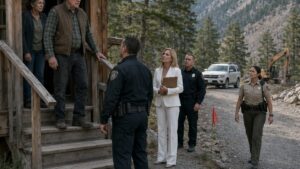
She Stood Barefoot Before the Saw While the HOA Tried to Remove Her Brother’s Only Way Out
Chapter 1: The Saw Was Already in the Ramp
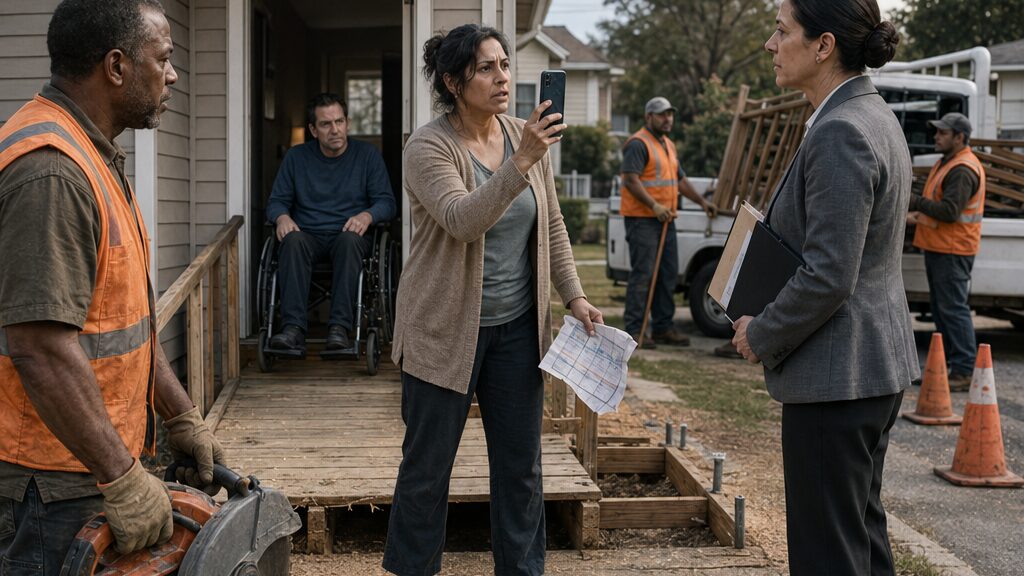
The saw was already biting into the ramp when Angela Martinez came out of the house barefoot.
At first, she thought the scream was coming from inside the walls. Then she saw the white truck idling at the curb, the orange cones on her walkway, and a man in a reflective vest bent over the lowest board with both hands wrapped around a power saw.
The railing on the left side was gone.
For one impossible second, Angela saw only pieces: the handrails stacked in the truck bed, the sawdust blowing against the boxwoods, the clipboard tucked against Carolyn Hill’s gray blazer, the front wheels of Jacob’s chair visible in the dark hallway behind her.
“Stop!” Angela shouted.
The man flinched, but the saw kept spinning.
Angela crossed the porch before she realized she had no shoes on. The medication schedule in her left hand crumpled against her palm. Her phone was in her right. She stepped off the porch, over the strip of ramp that had already been cut loose, and planted herself between the man and the next board.
“Turn it off.”
The worker lifted the saw an inch. The motor screamed in the space between them.
“Ma’am,” he said, “you need to step back.”
“Turn it off.”
Behind him, Carolyn Hill cleared her throat as if this were a meeting and not a demolition.
“Angela,” Carolyn said. “You were notified.”
The saw finally died.
The silence after it was worse. The truck engine rattled. A neighbor’s sprinkler ticked across a lawn two houses down. One of the workers stood beside the porch with a pry bar hooked under an anchor, his gloved hand frozen where it had been pulling the ramp out of the concrete.
Angela looked at the truck bed again. The handrails Justin had sanded smooth were stacked like scrap. Jacob had gripped those rails every morning since the ramp was finished, his fingers closing around them with the same concentration he once used when changing oil, hauling mulch, fixing the porch light that never stayed fixed.
“Put those back,” Angela said.
Carolyn pressed the clipboard tighter against her blazer. She had always dressed as if the neighborhood might inspect her back: ironed blouse, neat earrings, shoes that never carried mud. “The structure is non-compliant with exterior standards. The board denied the application.”
“My brother can’t get out of the house without it.”
“That does not change the fact that you built without approval.”
“I submitted everything you asked for.”
“The final decision was a denial.”
“You denied it because the stain was too dark.”
Carolyn’s mouth tightened. “That was one factor.”
“One factor?”
“The projection exceeds the visual line of the front elevation. The railing caps are inconsistent with the approved community profile. The stain does not match existing exterior elements.”
Angela stared at her. She wanted to answer cleanly. She wanted to sound calm enough that the phone in her hand would record something no one could twist later. But the cut edge of the ramp was in front of her toes, raw and pale where the saw had opened the wood, and behind her Jacob was trapped by three inches of threshold.
Three inches. A clipboard could cross it. A shoe could cross it. A person in a wheelchair could not.
“I want the removal order,” Angela said.
Carolyn extended a paper from beneath the clipboard. “Here is the enforcement notice.”
Angela took it without lowering her phone. She read the bold line first.
NOTICE OF CONTINUING VIOLATION.
She scanned the body. Section numbers. Exterior alteration. Failure to comply. Daily fines. Corrective action required.
She read it again.
“This authorizes a fine,” Angela said.
Carolyn’s expression did not change, but her eyes flicked toward the workers. “It authorizes enforcement.”
“No. It says corrective action is required. It says the owner may be subject to fines. It does not authorize you to send men onto my property and cut apart a medical ramp.”
The worker with the saw lowered it all the way then. The one with the pry bar stood up.
Carolyn’s chin lifted. “The association has authority under the covenants to remedy non-compliant exterior modifications after notice.”
“Then show me the signed order. Show me the board vote authorizing physical removal. Show me the court order if you think you have the right to destroy property I paid for.”
Carolyn looked at the phone.
Angela saw it and raised the screen slightly. The red recording dot glowed.
“Angela,” Carolyn said, softer now, “you are escalating this unnecessarily.”
“No. You escalated it when you sent a crew before breakfast.”
“We left a notice.”
“When?”
Carolyn’s fingers shifted on the clipboard.
Angela’s voice dropped. “When, Carolyn?”
“This morning.”
“This morning when the crew was already here?”
No one answered.
The truck engine idled on. One of the workers glanced toward the cab as if he wished he could disappear into it. Angela could hear Jacob breathing behind the screen door, controlled and uneven. He had been trying not to be seen lately. Trying not to need too much. Trying not to become the center of every conversation in the house.
Before the accident, he would have been out here first. He would have had his boots on and his coffee in one hand, making some dry remark about the HOA finally finding a hobby worse than mulch inspections. He used to laugh at their letters. He used to tape them to the fridge under a magnet shaped like a tomato and call them “the neighborhood newspaper.”
Then the truck hit him.
Then the surgeries.
Then the chair.
Then Angela had carried the first temporary plywood sheet across the porch because Jacob could not get over the threshold without her bracing the wheels and praying her back did not give out.
She had told him, the night he moved in, “This is your house as long as you need it.”
He had looked at her with his jaw tight and said, “Don’t say that if you’re going to make it sound temporary.”
So she had built the ramp.
Not pretty, maybe. Not what Carolyn would have chosen for the spring newsletter. But safe. Smooth. Wide enough. Angled right. With rails Jacob could grip, even when his left hand shook.
“Move aside,” Carolyn said, but her voice had thinned.
Angela did not move. “If that saw touches another board before you show me proper authority, this video goes to the county housing office, the Fair Housing counselor I called last week, and the attorney who told me to document every second of this.”
Carolyn blinked.
It was small, but Angela saw it. The first crack.
“Attorney?” Carolyn said.
“I said document. I did.”
“That does not change the denial.”
“Then stand here and say clearly that you are removing a wheelchair ramp after receiving medical documentation that my brother needs it to leave the house.”
Carolyn’s face colored. “The board received an application for an exterior modification. It was reviewed under the architectural standards like every other exterior modification.”
“Because you decided to treat it like a deck.”
“It is attached to the exterior of the home.”
“It is attached to a human being’s ability to leave.”
The worker with the saw took a full step back.
Then Jacob’s voice came from the doorway.
“Carolyn.”
Angela turned so fast the medication schedule slipped from her hand and landed in the sawdust.
Jacob had pushed himself forward to the very edge of the hall. The screen door was open behind him. His chair’s front wheels touched the threshold, stopping where the first section of ramp used to begin. Without it, there was a drop in front of him, small enough to look ridiculous, large enough to hold him prisoner.
He wore the blue sweater Angela had laid out before dawn because he had therapy at ten. His hair was still damp from the shower. One hand gripped the wheel of his chair so tightly the knuckles had gone pale.
Carolyn’s clipboard lowered.
“Jacob,” she said.
He did not smile. “You remember my driveway?”
Carolyn said nothing.
“You used to park across it during board cookouts because you said I had the only flat curb on this side of the street.”
Angela looked from Jacob to Carolyn.
Jacob’s eyes stayed on the woman in the gray blazer. “I served on that board for six years. We approved a fountain shaped like a pineapple for the Browns. We approved a mailbox that looked like a barn. We approved three different shades of beige and called it harmony.”
Carolyn’s lips parted, but Jacob kept going.
“But you’re telling my sister that a ramp is what ruins the neighborhood?”
The words did not come loud. That made them worse. Even the worker near the truck looked toward the doorway.
Carolyn’s face changed. Not into kindness. Not exactly shame. More like calculation breaking apart because it had suddenly found a person where a file was supposed to be.
“Jacob,” she said carefully, “no one is saying you do not need access.”
“Then why did your men cut it off?”
The question landed on the raw wood between them.
Angela bent, picked up the medication schedule, and smoothed it against her thigh. The page was smeared with sawdust now. Morning pills, therapy time, blood thinner warning, the notes she checked three times a day because she was terrified of missing something.
She held it up beside the phone.
“This is what was sitting next to the application you ignored,” she said. “This, the doctor’s letter, the contractor measurements, the ramp plan, the certified mail receipt. I sent all of it.”
Carolyn swallowed.
Ronald Brown, the crew supervisor, stepped away from the ramp and pulled off one glove. “Ma’am,” he said to Carolyn, “we were told this was an unapproved porch structure.”
“It is an unapproved structure,” Carolyn said.
Angela turned the phone toward him. “Were you told it was a medical accommodation?”
Ronald looked at Carolyn.
Carolyn did not answer fast enough.
“No,” Ronald said.
Carolyn’s head snapped toward him. “Mr. Brown—”
“I’m not cutting another board until someone above me clears this in writing,” Ronald said. His voice was plain, not heroic. A man protecting his business as much as his conscience. “I don’t have paperwork for a medical ramp. I have a work order that says remove unauthorized exterior addition.”
Angela felt her knees weaken, but she did not step back. Not yet. If she moved, the space between the saw and the ramp would open again.
Carolyn looked at the phone, then at Jacob, then at the two neighbors who had drifted to the sidewalk and were pretending not to watch.
“This matter is not finished,” she said.
“No,” Angela said. “It’s not.”
The crew began gathering tools. Ronald told one worker to leave the loose boards where they were. Another man lifted the handrails from the truck bed and set them carefully on the lawn, as if returning something breakable.
When the white truck finally pulled away, the front of the house looked wounded. Half the ramp remained. The lower boards lay across the grass. Anchor holes dotted the concrete like missing teeth. Orange cones still stood on either side of the walkway, bright and stupid in the sun.
Jacob remained at the threshold, unable to move forward and unwilling to roll back.
Carolyn took one step toward him, then stopped.
He looked at her for a long moment.
“Before you call it a violation again,” Jacob said, “look at me first.”
Chapter 2: The Folder They Never Bothered to Read
The first denial letter was still clipped to the doctor’s note.
Angela found it less than an hour after the crew left, wedged in the front pocket of the blue folder where she kept every printed email, every certified mail receipt, every marked-up drawing, every answer from the HOA that had sounded polite until it became a cage.
She stood at the kitchen table with the folder open and saw, with a cold tightening in her chest, how the pages had traveled together from the beginning. The medical letter was dated four weeks earlier. The denial was dated eight days after that. They had been in the same packet. Same staple mark. Same faint bend at the corner from when Angela had carried them into the HOA office and handed them to the clerk with both hands.
Carolyn had never mentioned the medical letter once.
Outside, the broken ramp lay under the front window. Angela could see the handrails on the grass, the pale bite mark where the saw had opened the wood, the orange cones Ronald had forgotten or chosen not to take.
Jacob sat at the kitchen island pretending to read a sports magazine upside down.
“You don’t have to stay in here,” Angela said.
He turned a page the wrong way. “Neither do you.”
“I need to make calls.”
“I can hear calls from the living room.”
“You can also tell me when you’re tired of listening.”
“I was tired when the saw started.”
She looked up.
Jacob’s mouth shifted as if he regretted saying it, but he did not take it back. The chair was angled slightly away from the front of the house. He had not looked at the ramp since Ronald’s crew drove off.
Angela opened the folder wider. The blue plastic spine made a soft cracking sound. She had bought it the day after the first HOA email, thinking organization would help. Color-coded tabs. Architectural request. Medical documentation. Contractor plan. Correspondence. Receipts. She had even labeled one tab “Neighbor Concerns,” though no neighbor had complained to her face.
Now it looked less like organization and more like a record of all the places she had waited.
Her phone buzzed. Carolyn.
Angela let it ring once, then tapped record on another device and answered on speaker.
“Angela Martinez.”
“Angela, this is Carolyn Hill.”
“I know.”
“I am calling to inform you that the association considers the ramp to remain in violation. The crew’s pause this morning does not constitute approval or waiver.”
Jacob’s hand tightened on the magazine.
Angela picked up a pen. “Are you confirming that the HOA sent a removal crew without reviewing the medical accommodation documents?”
“That is not what I said.”
“What are you saying?”
“I am saying the board denied an exterior modification request. You proceeded anyway. The association is entitled to enforce its covenants.”
“Please send that in writing.”
A short silence. “I will send a follow-up notice.”
“No. Send exactly what you just said. That the board denied an exterior modification request and is enforcing covenants despite receiving a doctor’s letter explaining wheelchair access.”
Carolyn exhaled softly. “You are making this adversarial.”
Angela looked through the window at the broken boards. “You sent a saw to my porch.”
“This could have been avoided if you had waited for approval.”
“My brother missed two physical therapy appointments waiting for your approval.”
Jacob looked down.
Angela wished she had not said it with him in the room. It had come out because it was true, and truth, she was learning, could still bruise the person it was meant to defend.
Carolyn’s tone cooled. “The association cannot be responsible for choices made before approval.”
“Send that in writing too.”
The call ended without goodbye.
Angela placed the phone on the table. Jacob set the upside-down magazine down.
“I only missed one,” he said.
“No, you missed two.”
“The second one was rain.”
“It was because I couldn’t get you down the porch safely in rain.”
He pushed the magazine away. “Don’t turn me into a list.”
Angela stopped with her hand on the folder.
“I’m not.”
“You are. Appointments missed. Medications taken. Transfer risk. Wheelchair access. Doctor’s letter. I can hear myself becoming evidence.”
The words were quiet, but they struck harder than Carolyn’s notice.
Angela closed her eyes for a second. “I don’t know how else to make them see it.”
Jacob’s face softened, then tightened again. “I know.”
Before she could answer, her phone buzzed with another call. Justin Adams.
She answered quickly.
“I just saw your message,” Justin said. “Tell me they didn’t actually cut it.”
“They cut the lower left board and pulled one anchor before I stopped them. Handrails came off.”
“Damn.” He caught himself. “Sorry.”
“Was it built wrong?”
“No.”
“Justin.”
“It was built to residential accessibility specs for the space you had. The slope was within what we discussed. The landing was safe. The rail height was right. The anchors were rated. Nothing about that ramp was unsafe.”
Angela gripped the pen until her fingers hurt. “They keep saying exterior standards.”
“That’s because they asked me exterior-standard questions. Stain, caps, projection, whether the rail profile could be modified. Nobody asked me whether the design was medically necessary. Nobody asked whether there was another safe access point. Nobody asked about threshold clearance.”
Angela opened the contractor tab. His drawing was still there, with neat measurements and a small note in his handwriting: minimum practical slope due to existing porch height.
“You thought they were reviewing the whole thing?”
“I thought you had cleared the medical part,” Justin said.
She looked at Jacob. He was staring at the table now.
“I thought I had,” Angela said.
Justin paused. “Do you want me to come by?”
“Not yet. I need a written statement from you. Built to code. Necessary measurements. What they asked you. What they didn’t ask you.”
“I can do that.”
“And photos from installation, if you have them.”
“I have before, during, after. Angela, listen. Don’t let them call it a deck. It’s not a deck.”
The words moved through the kitchen like a door opening.
After the call, Angela pulled every denial letter from the folder and laid them in a row across the table. Jacob watched despite himself.
First response: projection concerns.
Second response: railing cap inconsistency.
Third response: stain not compliant with approved community palette.
Final denial: unauthorized exterior addition not approved.
Angela took the medical letter and placed it above them.
None of the denials mentioned it. Not once. Not Jacob’s chair. Not his threshold clearance. Not his therapy schedule. Not the doctor’s line that said independent ingress and egress are medically necessary for ongoing recovery and emergency safety.
She read that line until the words blurred.
“You did everything they asked,” Jacob said.
Angela laughed once, but there was no humor in it. “No. I did everything I thought they asked.”
“You sent the doctor’s letter.”
“I didn’t write the words they needed to see.”
“What words?”
“Accommodation. Disability access. Fair Housing. I thought the facts would be enough.”
Jacob looked toward the window. “Facts usually need a lawyer before they start speaking English.”
Angela wanted to smile. She almost did.
Then she saw the corner of the final denial form.
At the top, in a small classification box she had not noticed before, someone had checked: DECORATIVE EXTERIOR DECKING / PORCH ADDITION.
Her skin went cold.
She pulled the paper close.
“What?” Jacob asked.
Angela did not answer. She took the doctor’s letter, the contractor plan, and the final denial and laid them side by side. There it was. Not ramp. Not accommodation. Not accessibility.
Decking.
“They changed what it was,” she said.
Jacob rolled closer. “Who did?”
Angela touched the classification box with one finger.
“I don’t know.”
Outside, the saw-cut board lay in the grass where Ronald had left it, pale wood exposed to the air. Angela stared at it through the glass and felt the shape of the problem change.
They had not simply said no.
They had renamed Jacob’s way out until it became something easy to deny.
Chapter 3: The Meeting Minutes With One Missing Word
Carolyn opened the emergency meeting by saying Angela was there to appeal an enforcement action.
Not to request access. Not to correct a mistake. Not to keep her brother from being trapped behind a threshold. An enforcement action.
Angela sat at the end of the long folding table in the HOA office with the blue folder against her forearms and a splinter from the cut ramp board in the pocket of her cardigan. She had picked it up before leaving the house, not because it proved anything, but because she could not stand seeing it in the grass.
The office smelled of coffee and copier toner. Framed photographs of the neighborhood hung crookedly on one wall: clean sidewalks, trimmed hedges, matching mailboxes, summer flags. In one photo, Angela could see her own house from years ago, before the ramp, before Jacob’s accident, before she learned how fast a community standard could become a locked door.
Carolyn sat across from her, clipboard open. Debra Wilson sat to Carolyn’s right with a laptop, her hands folded too tightly over the keyboard. Two other board members were present by speakerphone, their voices tinny and distant.
“For the record,” Carolyn said, “the owner at 1847 Cedar Bend installed an exterior structure after denial of architectural approval. The association initiated enforcement this morning. Work was paused after the owner disputed the association’s authority to remove the non-compliant structure.”
Angela opened the folder.
“For the record,” she said, “the structure is a wheelchair ramp.”
Carolyn looked over her glasses. “You will have a chance to speak.”
“I’m speaking now because you already changed the subject.”
Debra’s eyes flicked up.
Carolyn drew in a measured breath. “The board understands this is emotional for you.”
“It is practical for me. Emotional is what happens when practical gets ignored for four weeks.”
One of the speakerphone voices said, “Can we keep this orderly?”
Angela looked toward the small black conference phone. “That depends on whether anyone here is willing to use the word ramp.”
Debra typed something, then stopped.
Carolyn leaned back. “The application submitted concerned an exterior modification attached to the front elevation of the home. Under Article Seven, exterior changes require prior approval. Approval was denied. The owner proceeded.”
Angela slid a copy of the doctor’s letter across the table. “This was submitted with the application.”
Carolyn did not pick it up.
Debra did.
Angela watched her read the first lines. Watched her face still when she reached independent ingress and egress. Watched her glance toward Carolyn, then back to the page.
“Was this included in the packet reviewed by the board?” Angela asked.
Carolyn said, “All submitted materials were available.”
“That is not the same as reviewed.”
“The board cannot be expected to debate every attachment in detail when the architectural issue is clear.”
“The architectural issue is only clear because you treated a medical ramp like a porch decoration.”
Carolyn’s pen tapped once against the clipboard. “Mrs. Martinez, the board is not unsympathetic to your brother’s circumstances. But an individual hardship does not permit an owner to disregard community standards.”
“His access to the front door is not a hardship. It’s the reason the ramp exists.”
Debra looked at the laptop again. “Angela, may I ask—did the application form have a specific box for medical accommodation?”
“No,” Angela said. “It had exterior modification, landscaping, paint, fencing, and other. I checked exterior modification because the ramp is outside. Then I attached the medical letter, the contractor measurements, and a written explanation.”
Carolyn cut in. “Which were considered in the context of the requested modification.”
“Show me where.”
Carolyn’s eyes narrowed slightly. “Excuse me?”
“Show me where the minutes say the board considered wheelchair access.”
Debra stopped typing entirely.
Angela pulled out printed copies of the meeting minutes she had received the night before from the HOA portal. She had read them at midnight, two in the morning, and again at dawn. Three pages. A neat summary of old business, new business, seasonal planting approvals, mailbox compliance, irrigation repairs, and one line about her application.
1847 Cedar Bend exterior ramp/deck addition denied due to projection, railing inconsistency, and stain noncompliance.
Angela set the page in front of Carolyn. “Where is the medical discussion?”
Carolyn glanced at it. “Minutes are summaries. They are not transcripts.”
“Where is the word accommodation?”
No one answered.
The conference phone crackled. A board member cleared his throat. “Maybe it was discussed under attachments?”
Angela turned a page. “It wasn’t.”
Carolyn’s voice sharpened. “You are not in a position to dictate how the board records its internal deliberations.”
“No. But I am in a position to ask why my brother’s doctor wrote that he needed safe access and your minutes talk about stain.”
Debra pressed her lips together.
Angela saw the hesitation and pushed gently toward it.
“Debra, you signed these minutes.”
Debra looked up.
“Did the board review the doctor’s letter?”
Carolyn answered for her. “The board reviewed the application.”
Angela kept her eyes on Debra. “Did you read the letter before voting?”
Debra’s fingers moved over the laptop, but no keys clicked. “I remember seeing attachments.”
“That isn’t what I asked.”
Carolyn said, “This is inappropriate.”
Debra’s face flushed. “I don’t remember a separate accommodation vote.”
The room went still.
Angela felt the small payoff of truth, not enough to free Jacob, but enough to prove she had not imagined the gap.
Carolyn turned slowly toward Debra. “There was no separate vote required. The application was before the architectural committee.”
“But if it was a medical accommodation,” Debra said, quieter now, “shouldn’t it have been routed differently?”
Carolyn’s expression hardened. “We are not attorneys.”
“No,” Angela said. “But you sent a crew.”
The words hung over the table.
Carolyn closed the clipboard. “Here is where we are. The board is prepared to allow you seven days to remove the non-compliant structure voluntarily and submit a revised application for review. During that period, daily fines will be suspended.”
“My brother cannot leave the house for seven days.”
“You may use alternative means.”
“What alternative means?”
Carolyn did not answer.
“What alternative means?” Angela asked again.
A board member on speakerphone said, “Could a temporary portable ramp be used?”
Angela looked down at her hands. She pictured the folding aluminum ramp she had tried before Justin built the wooden one. Too steep for the porch height. Slippery in rain. Jacob’s chair tipping backward while he pretended not to be scared because she was already scared enough.
“No,” she said. “Not safely.”
Carolyn slid another paper forward. “If you decline voluntary compliance, the association may assess fines and legal fees against your property. Continued refusal may result in further enforcement.”
Angela looked at the paper but did not touch it.
There it was again. The old part of her, the part that believed a neat answer could unlock a locked mind, wanted to gather every page, put them in perfect order, speak more politely, find the sentence that would make Carolyn nod. She could feel herself reaching for that habit like a railing.
Then she remembered the saw.
She pulled her hand back from the paper.
“I want the intake log,” Angela said.
Carolyn blinked. “What?”
“The intake log. The record showing how my application was entered, classified, and routed.”
“That is an internal administrative record.”
“It concerns my property and my application.”
Carolyn’s tone cooled. “We will review whether such a record is available.”
Angela gathered her papers. “Do that.”
The meeting broke with nothing resolved. Carolyn stood first. The speakerphone voices disconnected one by one. Debra remained seated, staring at the minutes on her laptop.
Angela zipped the blue folder slowly. She could feel Carolyn watching, waiting for her to leave.
In the hallway outside the HOA office, Angela heard footsteps behind her.
“Angela,” Debra said.
Angela turned.
Debra held the printed minutes against her chest. She looked smaller away from the table, less like a board member and more like a neighbor who had let a meeting become something she could no longer defend.
“I shouldn’t be telling you this,” Debra said.
Angela waited.
Debra glanced back toward the closed office door, then lowered her voice.
“Ask for the intake log,” she said. “And not just the final one. Ask for the original entry.”
Chapter 4: The Log That Changed the Ramp Into a Deck
Angela opened the intake file at 6:17 that evening and saw the word that had trapped her brother inside.
Decorative.
It sat in the description field beside her address, clean and harmless-looking on the HOA records portal: Decorative deck/ramp addition, front elevation, owner-installed after denial.
For a moment, she did not move. The laptop screen glowed blue-white across the kitchen table. Outside the front window, the half-removed ramp cut a crooked line through the lawn. The bottom rail lay where Ronald’s crew had left it, its end scratched from being dragged toward the truck and then carried back like evidence someone had suddenly become afraid to hold.
Jacob was in the living room. She could hear the television on low, though he had not changed the channel in twenty minutes.
Angela leaned closer to the screen.
There were two entries.
The current one was dated the day of the final denial.
The original one was three weeks older.
She clicked it.
Original submission: front access ramp for wheelchair use. Medical documentation attached. Contractor drawing attached. Owner requests urgent review due to mobility limitation.
Angela’s throat tightened.
She scrolled down.
Modified by: Compliance Chair.
Date modified: four days after submission.
New classification: Decorative deck/ramp addition.
She sat back so fast the chair scraped the tile.
Jacob called from the living room, “What broke now?”
Angela did not answer. She pressed print.
The printer in the corner stuttered awake, dragging the page out in slow, mechanical bursts. Each inch felt like a held breath. When the sheet finally dropped into the tray, Angela picked it up with both hands as if it might disappear.
The original entry had said exactly what she had thought she was asking for.
Someone had changed it.
She walked into the living room. Jacob sat angled toward the television, but his eyes were on the front window. The screen showed a cooking show with the sound too low to follow.
“Jacob.”
He looked at the paper before he looked at her. “That bad?”
She handed it to him.
He read slowly. Since the accident, reading took more effort when he was tired. His eyes tracked the lines, then returned to the modified field.
“Compliance Chair,” he said.
“Carolyn.”
He lowered the page. “She changed access ramp into decorative deck.”
Angela nodded once.
Jacob looked toward the porch. “That’s how she got it in front of architecture.”
“That’s how she got to talk about stain instead of you.”
He looked down again.
Angela wished the discovery felt like victory. It did not. It felt like finding out the door had been locked from the other side all along.
Her phone rang before she could say more. Unknown number.
She answered.
“Angela Martinez?”
“Yes.”
“This is the county housing accessibility office returning your message. I’m the counselor on duty.”
Angela straightened. “Thank you for calling back.”
She put the phone on speaker and grabbed the blue folder from the table. Jacob’s chair rolled a few inches closer.
The counselor’s voice was careful, practiced, not warm exactly, but attentive. Angela explained quickly: the application, the medical letter, the denial, the saw, the removal crew, the intake log. She heard herself speaking too fast and forced herself to slow down.
“Do you have proof the association received the medical documentation before denial?” the counselor asked.
“Yes. Certified mail receipt. Email confirmation. The portal entry says medical documentation attached.”
“And they categorized it as architectural?”
“They changed it to decorative deck/ramp addition.”
A pause. Paper shifted on the other end.
“That may be significant,” the counselor said. “I can’t give legal advice, but generally, when a housing provider or association receives a disability-related accommodation request, they should evaluate it under that framework. They can discuss reasonable conditions. They cannot simply ignore the disability-related need and process it as if it were ordinary cosmetic work.”
Angela looked at Jacob. His jaw was tight.
“So they violated something?” Angela asked.
“They may have failed to follow proper accommodation procedure,” the counselor said. “But you’ll need to establish notice, necessity, and that the requested modification is reasonable. Keep everything. Do not rely on phone conversations. Ask for written confirmation. Ask who made the classification change and why.”
Angela’s eyes moved to the blue folder. For the first time all day, its overstuffed tabs did not look pathetic.
They looked ready.
“I have the certified mail receipt,” she said. “The doctor’s letter. The contractor’s drawing. The sample board request. Emails. Photos of the ramp before and after they cut it.”
“Good. You should also send a written demand that the association pause enforcement pending review of the accommodation request.”
“Demand?”
The word felt too sharp in her mouth.
“Yes,” the counselor said. “Polite, factual, clear. Do not ask them to be kind. Ask them to follow the proper process.”
Jacob’s eyes lifted.
Angela wrote the sentence down.
Do not ask them to be kind.
When the call ended, she stayed standing by the table with the pen in her hand. She had spent weeks writing emails that began, Thank you for your time, and I understand the board has standards, and I appreciate your attention. She had sanded her sentences smoother than Justin had sanded the railings. No sharp edge, no accusation, no demand. She had believed if she sounded reasonable enough, someone would choose to be reasonable back.
Outside, the broken ramp answered her.
Jacob rolled into the kitchen doorway. “You’re doing the face.”
“What face?”
“The one where you’re about to alphabetize a fire.”
Despite herself, Angela laughed once.
Then the laughter left.
“I waited too long,” she said.
Jacob did not answer.
“I kept thinking the next email would fix it. The next attachment. The next revision. Meanwhile you missed therapy, and I let them decide whether you could leave.”
“You didn’t let them.”
“I did, a little.”
He looked away.
The silence between them was not angry, but it was full.
Angela opened a new document on the laptop. Her hands hovered over the keyboard.
Jacob said, “Don’t put me in it too much.”
She turned. “What?”
“The letter. Don’t make it sound like I’m helpless.”
“It’s about access.”
“It’s about me.”
“Yes.”
“I don’t want to be the paragraph that makes people uncomfortable enough to vote yes.”
Angela stepped away from the laptop. “Jacob, they are already using your silence to vote no.”
His face hardened.
“That’s not fair.”
“No,” she said. “It isn’t. None of this is.”
He backed his chair slightly, as if distance could end the conversation. “You have the papers. Use those.”
“I will. But the papers aren’t trapped in the doorway. You are.”
He looked at her then, sharp with hurt.
Angela hated herself a little for saying it, but she did not take it back. The old version of her would have softened it immediately, apologized until the truth dissolved. Instead she let it stand between them, ugly and necessary.
Jacob turned toward the front window. The last light of evening caught the uneven edge of the ramp.
“I spent years on that board,” he said.
Angela waited.
He rubbed his thumb along the wheel rim. “I know how they talk when the homeowner leaves the room.”
She felt the sentence open under her feet.
“What does that mean?”
“It means Carolyn isn’t scared of your folder. She’s scared of precedent.”
“Precedent for what?”
“For every exception becoming a fight. For every standard becoming negotiable. For the board looking like it lost control.” He looked back at her. “People like rules because rules let them say no without sounding cruel.”
Angela stared at him.
“Then come to the hearing,” she said.
His mouth closed.
“Tell them that.”
“No.”
“Jacob—”
“No.”
“Why?”
“Because I am not going into that room in this chair so Carolyn can look sorry in front of everyone and still call it procedure.”
Angela folded the printed intake log and slid it into the blue folder. “Then I’ll go without you.”
“You should.”
“And they’ll keep talking about you like you’re an attachment.”
He flinched.
The laptop chimed.
A new email appeared from Carolyn Hill.
Subject: FINAL COMPLIANCE DEADLINE.
Angela opened it.
Pursuant to the continuing violation at 1847 Cedar Bend, the association requires full removal of the non-compliant exterior structure by Monday at 9:00 a.m. If removal is not completed, the association reserves all rights to resume enforcement, assess costs, and pursue additional remedies.
Angela read it once. Then again.
Jacob watched her face. “What?”
She turned the laptop toward him.
The kitchen went very still.
Outside, the broken handrail lay in the grass, darkening as the sun went down.
Angela picked up the printed intake log and placed it on top of the blue folder.
“Monday,” she said.
Jacob’s face closed.
And for the first time since the saw started, Angela understood that protecting him might mean asking him to stand in front of people when all he wanted was to disappear.
Chapter 5: The Brother Who Helped Write the Rules
Angela found Jacob’s old HOA newsletter in a cardboard box behind the water heater, its glossy cover curled from years of damp.
He was smiling in the photo.
That was the part that stopped her.
Not the headline about the annual picnic. Not the red-white-blue bunting draped over the clubhouse porch. Not Carolyn Hill standing beside him with a paper plate in one hand and a name tag on her blazer. It was Jacob, younger by almost a decade, standing straight-backed with sunglasses hooked in the collar of his shirt, one hand resting on a folding chair as if he had just made everyone laugh.
Angela crouched on the concrete floor and stared at the picture until the washing machine clicked behind her.
She had come downstairs looking for the original home purchase documents, thinking there might be an old copy of the covenants. Instead she found a stack of newsletters tied with twine. Cedar Bend Community Voice. Summer edition. Fall edition. Compliance reminder. Holiday lights. Architectural harmony.
And there, in the second newsletter, was her brother under a caption: Board Member Jacob Martinez helps keep Cedar Bend beautiful.
Beautiful.
Angela carried the newsletter upstairs.
Jacob was outside in the driveway beside the damaged ramp rail, his chair positioned on the flat concrete near the garage. He had refused help getting there, using the back door and the narrow side path Justin had warned was not safe for daily use. The effort had left him pale, but he pretended to study the loose rail as if he had rolled out there for inspection.
Angela held up the newsletter.
He saw it and looked away.
“Where’d you find that?”
“Behind the water heater.”
“Should’ve left it there.”
She stepped closer. The evening air smelled faintly of cut wood and hot pavement. The orange cones were still by the front walk. Someone passing by had slowed their car earlier, pretending to check a phone while looking at the broken ramp. The neighborhood had begun doing what neighborhoods did: watching without arriving.
“You were on the board with Carolyn,” Angela said.
“I told you that.”
“You didn’t tell me you were on the cover of the newsletter helping keep Cedar Bend beautiful.”
His mouth tightened. “It was a picnic.”
“It was a philosophy.”
He looked at her then. “Careful.”
“No. I’m tired of careful.”
Jacob reached for the damaged rail and ran his thumb over the place where a screw had been stripped out. His hand lingered there, touching the torn wood with an expression Angela could not read.
“Carolyn wasn’t always like this,” he said.
Angela waited.
“She was organized. That’s what people liked. Meetings started on time. Notices went out. Nobody could say the board played favorites.”
“And you?”
“I liked things clear.”
“That’s not an answer.”
His thumb moved along the rail again. “After Mom died, everything felt like paperwork. Funeral forms, insurance forms, closing accounts. The HOA was easy. You had rules, you followed them, you got an answer. I was good at that.”
Angela’s anger shifted, not leaving, but finding a new shape.
Jacob looked down the street. “We approved stupid things sometimes. Pineapple fountain. Barn mailbox. A pergola too tall by six inches because the owner brought cookies and everyone liked him.”
He gave a dry laugh. It ended quickly.
“But anything that looked like an exception? We made people prove it. Extra forms. Extra measurements. Extra delay. Carolyn used to say, ‘We have to be careful about precedent.’ I agreed with her more than I want to admit.”
Angela held the newsletter lower. “Accessibility requests?”
“There weren’t many.”
“That you noticed.”
He closed his eyes.
The words had landed. She saw it.
“I remember one,” he said. “A handrail. Back steps. The owner wanted black metal because it was cheaper and faster. We told him bronze to match fixtures. Delayed it three weeks.”
“Did he need it?”
Jacob opened his eyes. “His wife had fallen.”
Angela looked toward the front of the house. The space where the lower ramp section had been removed seemed larger in the fading light.
“Jacob.”
“I know.”
“No, I don’t think you do.”
His face hardened again, defensive because shame had found him. “You think I don’t know what it’s like to be the person waiting now?”
“I think you know exactly what it’s like, and that’s why you don’t want to go to the hearing.”
He pushed the damaged rail away. It scraped against the driveway.
“I don’t want to sit in front of people I used to argue with and tell them I need a ramp to leave my sister’s house.”
“Our house.”
“You know what I mean.”
“No,” Angela said. “I don’t, actually. Because when you moved in, you made me promise not to make it sound temporary. Now every time I call it your house too, you act like I’m doing you a favor.”
He looked at her, wounded and angry.
She had been afraid of that look. For months she had arranged herself around his pride the way she arranged the furniture around his chair. Give him room. Don’t hover. Don’t say the wrong thing. Don’t mention the missed appointment unless necessary. Don’t ask whether he is scared unless he says it first.
All that care, and still the ramp was broken.
“I am not asking you to perform helplessness,” she said. “I am asking you to tell the truth.”
“My truth makes your argument messier.”
“Good. It should be messy. Their version is clean because they erased you.”
He looked at the newsletter in her hand.
Angela stepped closer and set it on the flat part of his lap. “Carolyn panicked when she saw you this morning.”
“She didn’t panic.”
“She did. Not because of me. Because of you. Because you know how the board works.”
His fingers touched the edge of the old photo. He did not pick it up.
“I helped write some of those enforcement guidelines,” he said.
Angela felt a chill despite the warm air.
“The ones she’s using?”
“Some of the language. Not this exact situation. But the part about consistent exterior standards. The part about remedying unapproved modifications after notice.”
Angela let that settle. Across the street, a curtain moved.
“So you think you deserve this,” she said.
His head snapped up. “Don’t put words in my mouth.”
“Then tell me I’m wrong.”
He did not.
The silence that followed was not empty. It was full of sawdust, old votes, missed therapy, a handrail delayed for another woman who had fallen years before Angela ever needed one.
Jacob looked down at his legs. “When I was on the board, I thought people exaggerated because they wanted what they wanted. Wider driveway. Different fence. Shed too close to the line. We heard so many stories. After a while, they all sounded like tactics.”
“And now?”
“Now I wonder how many of them were just tired.”
Angela sat on the edge of the driveway, not caring that the concrete was still warm against her clothes. She set the blue folder beside her. For once, she did not open it.
“I need you at the hearing,” she said.
He shook his head.
“If you can’t speak, come anyway.”
“No.”
“Jacob.”
“I said no.”
“Why?”
His voice came out low. “Because if I go, I have to look at Carolyn and Debra and whoever else is there and admit that I helped make it easy for them not to see me.”
Angela’s anger softened so suddenly it almost became pity, and she knew he would hate that, so she kept it out of her face.
“You don’t have to fix everything you ever voted for,” she said. “But you can help fix this.”
He stared at the broken rail.
A car slowed at the curb. The driver glanced toward the ramp, then accelerated.
Jacob’s mouth twisted. “They’re all watching now.”
“Let them.”
“You hate being watched.”
“I hate being polite while people cut apart our front porch.”
He almost smiled.
Almost.
Angela reached for the newsletter, but Jacob held it down with one hand.
“Leave it,” he said.
She stood.
“Okay.”
He looked at the photo again, at the man he used to be beside the woman who had sent a saw to his sister’s house.
Angela picked up the blue folder. “The deadline is Monday. The hearing is before that if Debra can force it. I’m going whether you come or not.”
“I know.”
She took a step toward the house, then stopped.
The line came before she could soften it.
“Then help me undo the part of this you helped build.”
Jacob did not answer.
But when Angela reached the door, she looked back and saw him still holding the old newsletter open, his thumb pressed over the caption that called him helpful.
Chapter 6: The Final Notice on the Front Door
Carolyn was taping the final notice over Angela’s doorbell camera when Angela opened the door.
For one sharp second, the two women stared at each other through the gap between the door and the half-empty space where the ramp should have been. Carolyn’s hand was still raised, a strip of clear tape stretched between her fingers. The notice covered half the camera lens, its bold header facing outward toward the street like a warning meant for neighbors as much as for Angela.
FINAL COMPLIANCE NOTICE.
Angela lifted her phone.
“Take it off the camera.”
Carolyn lowered her hand. “Good morning, Angela.”
“Take it off.”
“This notice must be visibly posted.”
“Not over my camera.”
Carolyn hesitated, then peeled the tape back with careful, irritated fingers and moved the notice to the glass beside the door. The paper crinkled loudly in the quiet morning.
It was Monday. Nine o’clock was twenty minutes away.
On the sidewalk, two neighbors had paused with a dog that was no longer sniffing anything. Across the street, another garage door stood open though no one came out. The neighborhood had learned the shape of the conflict and now pretended not to gather around it.
Angela stepped onto the porch. This time she wore shoes. The blue folder was tucked under one arm. Her phone recorded in her right hand.
“Are you here with a court order?” she asked.
Carolyn’s face tightened. “The association has already provided notice.”
“That wasn’t my question.”
“I am here to document noncompliance.”
“Are you here with a court order?”
“No.”
“Are you here with written authorization from the board specifically approving physical removal of a medically necessary ramp?”
Carolyn looked toward the curb.
Angela followed her gaze.
The white truck was back.
Ronald Brown stood beside it with two workers and a stack of orange cones. No saw was running yet, but the equipment was in the truck bed: saw, drill, pry bars, gloves, a coil of caution tape. The sight of it made Angela’s stomach clench so hard she nearly lost her breath.
Behind her, inside the house, Jacob waited in the hallway.
He had not said whether he would come outside if the crew started.
Carolyn said, “If the structure remains in violation after the deadline, the association reserves the right to proceed.”
“The deadline hasn’t passed.”
“It will.”
“And the HOA attorney has reviewed the medical documents?”
Carolyn’s eyes flicked once. Too fast for most people, but Angela had spent days watching for cracks.
“Counsel is aware of the matter,” Carolyn said.
“That’s not an answer.”
“Counsel is aware.”
“Has counsel reviewed the original intake log showing you changed the request from front access ramp for wheelchair use to decorative deck addition?”
The neighbors with the dog stopped pretending.
Carolyn’s face went still. “Internal administrative records are not relevant to the fact that approval was denied.”
Angela stepped down as far as the broken ramp allowed. The exposed threshold behind her felt like a warning at her back.
“They are relevant if you denied the wrong thing.”
Ronald approached from the curb, work gloves in one hand. “Mrs. Hill.”
Carolyn did not look away from Angela. “Mr. Brown, please wait until nine.”
Ronald stopped at the walkway. His gaze moved to Angela, then to the notice on the door, then to the broken lower ramp section lying beside the lawn.
“I need to see the written authorization before my crew touches anything,” he said.
Carolyn turned then. “You have the work order.”
“I have a work order that says remove unauthorized exterior addition.” He held up a folded paper. “It doesn’t say medical ramp. It doesn’t say accommodation dispute. It doesn’t say board vote after homeowner objection.”
“You were contracted by the association.”
“And I’m telling the association I need clear paperwork.”
Angela stared at him. He was not smiling. He was not taking her side exactly. But he had moved the line, and the saw was still in the truck.
Carolyn’s voice hardened. “Your company accepted the job.”
“My company also carries insurance.”
The small cluster of neighbors heard that. Angela saw one of them look at the notice again.
Carolyn drew herself taller. “This is precisely why associations have procedures. Homeowners cannot simply create confusion at the moment of enforcement and expect contractors to disregard valid work orders.”
Angela opened the blue folder and pulled out the intake log. “There was no confusion until you created it.”
“Angela, I strongly suggest you lower your tone.”
“My tone didn’t cut the ramp.”
The neighbor with the dog coughed into his hand.
Carolyn flushed.
At the doorway behind Angela, Jacob’s chair creaked.
Angela did not turn. If she looked at him, she might lose the steadiness she had fought all weekend to build.
Carolyn took a paper from her clipboard. “If removal is delayed due to your interference, the association may bill you for standby crew costs, legal fees, and continuing fines. Those costs may attach to the property.”
There it was. Not the saw this time. The lien.
Angela felt fear move through her body, clean and physical. Mortgage. Insurance. Prescriptions. Groceries. The savings account already thinned by the ramp, the hospital bed rental, the shower chair, the thousand small purchases that came after a life changed shape.
For one second, the old instinct rose in her: negotiate, soften, ask what would satisfy them, find a way to survive the day.
Then Jacob spoke from behind her.
“Carolyn, did the attorney review my doctor’s letter?”
Carolyn’s eyes shifted past Angela.
Jacob had rolled into view, stopping at the threshold again. He wore a collared shirt Angela had not seen since before the accident. His face was pale, but his voice held.
Carolyn gripped the clipboard. “Jacob, this is not the appropriate forum.”
“It’s my front door.”
“It is Angela’s property.”
“It’s my home.”
Angela closed her fingers around the folder.
Carolyn seemed about to answer, then thought better of it.
Ronald looked from Jacob to the broken ramp. The neighbors were not hiding anymore.
A car pulled up behind the white truck.
Debra Wilson got out with a stack of papers pressed to her chest. She had not dressed like a board member. No blazer, no badge, no clipboard. Just jeans, a sweater, and a face that looked as if she had not slept.
Carolyn saw her and stiffened. “Debra.”
Debra walked up the sidewalk, past Ronald, past the orange cones, and stopped near the base of the torn ramp.
“Carolyn, don’t restart this.”
“This is not your decision to make individually.”
“No,” Debra said. “It was supposed to be the board’s decision. That’s the problem.”
Carolyn’s eyes narrowed. “We are not discussing internal records on the sidewalk.”
Debra held out the papers. “The minutes from the architectural committee. The original intake entry. The revised entry. And the notice authorizing fines, not physical removal.”
Angela’s pulse thudded once, hard.
Carolyn did not take the papers.
Debra’s voice shook, but she did not lower it. “I signed minutes that didn’t say what we actually failed to review. That’s on me. But this was never voted on correctly.”
The words spread across the sidewalk.
Ronald folded his work order and put it in his back pocket.
The neighbor’s dog whined softly.
Carolyn looked at Debra, then Angela, then Jacob at the threshold.
For once, no one moved toward the ramp.
Chapter 7: The Vote They Tried Not to Take
Carolyn began the hearing by sliding a form across the clubhouse table and asking Angela whether she was prepared to agree to voluntary compliance.
The room went quiet so quickly that Angela heard the old refrigerator humming behind the kitchenette. She looked at the form, then at the damaged ramp board she had placed beside the blue folder. The board still carried the saw mark from Monday morning, pale and raw through the darker stain, its screw holes torn wide where Ronald’s crew had tried to pry the rail loose.
Jacob sat beside her in his wheelchair.
He had not said a word since they arrived.
The clubhouse was too bright. Fluorescent lights flattened every face. Folding chairs filled the back half of the room, more occupied than Angela had expected. Neighbors sat with arms crossed, purses in laps, phone screens dimmed in their hands. Ronald stood near the doorway in work boots, looking uncomfortable but present. Debra sat at the board table with her stack of printed records squared neatly in front of her.
Carolyn’s clipboard was open. Her face was composed, but Angela could see the stiffness around her mouth.
“Before we proceed,” Carolyn said, “the board is offering the owner one final opportunity to resolve the violation without further escalation. Voluntary compliance would include removal of the unapproved structure and submission of a revised architectural application.”
Angela did not touch the form.
“My brother is sitting next to me,” she said. “Are you asking me to voluntarily remove his way out of the house?”
Carolyn’s eyes flicked toward Jacob, then away. “I am asking whether you intend to comply with the governing documents.”
Angela opened the blue folder. “I intend to ask why you changed the request.”
A murmur moved through the chairs.
Carolyn tapped her pen once. “This hearing concerns the violation notice.”
“No,” Angela said. “It concerns whether the violation notice exists because the HOA processed the wrong request.”
Debra looked down at her papers.
One of the older board members at the table shifted in his chair. “Let’s keep this focused.”
Angela pulled out the original intake log and placed it beside the saw-cut board. “Original entry: front access ramp for wheelchair use. Medical documentation attached. Contractor drawing attached. Owner requests urgent review due to mobility limitation.”
She placed the modified entry next to it.
“Four days later: decorative deck/ramp addition.”
Carolyn’s voice cooled. “Administrative descriptions are not determinations.”
“Then who changed it?”
No one moved.
Angela looked at Carolyn. “Your name is on the modification.”
Carolyn folded her hands over the clipboard. “As compliance chair, I route applications according to the governing categories available. The structure altered the exterior appearance of the home.”
“It also allowed Jacob to leave.”
“That need could have been addressed through a properly submitted accommodation request.”
Angela almost laughed, but the sound would have come out sharp enough to cut. “I submitted the doctor’s letter with the application because your form didn’t have an accommodation box.”
“There are proper channels.”
“Where?”
Carolyn looked at the board members. “Homeowners may contact the board.”
“I did. Seven emails. Two certified packets. One sample board. Three revised drawings. You answered stain, rail caps, and projection. Not once did you say, ‘Angela, please use a different channel.’”
The room shifted again, a collective discomfort passing from chair to chair.
Carolyn’s cheeks colored. “The association has to be careful. If we allow homeowners to bypass architectural review by attaching medical documents to exterior projects, we create a precedent.”
The word landed exactly where Jacob had said it would.
Precedent.
Angela saw Jacob’s hands move on his wheels. His left thumb rubbed the rim once, twice.
Carolyn continued, steadier now because she had reached the argument she understood. “We have property standards for a reason. Every resident bought into this community knowing those standards. If one visible front-yard structure is allowed outside the approved profile, the board must be prepared to answer why others are denied.”
Angela opened her mouth.
Jacob spoke first.
“I used to say that.”
Every face turned toward him.
Angela’s breath caught.
Jacob looked at Carolyn, not at the room. “Not those exact words every time. But close enough.”
Carolyn’s expression tightened. “Jacob, you don’t have to—”
“Yes,” he said. “I do.”
His voice was not loud. Angela had worried he would sound weak. He sounded tired, which was different. Tired carried weight. Tired made the room lean in.
“I served on this board for six years,” Jacob said. “Some of you remember that. Some of you probably remember me being difficult about mailbox posts and shed roofs and whether porch lights matched the approved list. I liked rules because they made decisions feel clean.”
He looked down at the ramp board on the table.
“But clean decisions can still hurt people.”
No one interrupted.
Angela kept her hands still on the folder, afraid any movement might stop him.
“A few years ago,” Jacob said, “a homeowner asked for a back-step handrail after his wife fell. It was black metal. Cheaper, faster, probably what they could afford. We delayed it because bronze matched the fixtures better. I voted with the delay.”
Debra closed her eyes briefly.
“I don’t know whether his wife fell again,” Jacob said. “I never asked. That was the point. The rule let me not ask.”
Carolyn’s face had gone pale beneath the makeup. “That situation is not before us tonight.”
“No,” Jacob said. “This one is. And this time I’m the person on the other side of the rule.”
Angela swallowed hard.
Jacob turned slightly so the room could see him more clearly. “I didn’t want to come here. Not because Angela’s wrong. Because she’s right. Because I know how it feels to sit at that table and convince yourself you are protecting the neighborhood when all you are protecting is the comfort of not having to make an exception.”
Carolyn set down her pen. “The board is not refusing access.”
“You sent men to cut it off.”
A neighbor in the back whispered, “That’s true,” and was hushed by someone beside her.
Carolyn lifted her chin. “The removal was paused.”
“Because Angela stood in front of the saw,” Jacob said. “Not because you looked at me.”
The room went still again.
Angela felt something twist behind her ribs. Pride, grief, fear. All of it together.
The older board member cleared his throat. “Mrs. Hill, did counsel review the accommodation issue?”
Carolyn’s hand moved to the clipboard, then stopped. “Counsel was informed there was a dispute regarding an unapproved exterior structure.”
“That isn’t what he asked,” Debra said.
Carolyn turned to her.
Debra’s voice trembled but held. “Did counsel receive the medical letter, the original intake entry, and the revised classification before the removal work order was issued?”
Carolyn’s silence answered before she did.
“The matter was moving quickly,” Carolyn said. “We had a continuing violation. The board has been under significant pressure from residents about selective enforcement.”
“Residents?” Angela asked. “Which residents complained about Jacob’s ramp?”
Carolyn looked at the papers.
Angela waited.
“One homeowner asked whether the ramp had been approved,” Carolyn said.
“One.”
“That is still a compliance inquiry.”
“So one person asked a question, and you sent a crew.”
Carolyn’s composure cracked. “You built after denial.”
“After you denied a deck I never requested.”
The sentence hit harder than Angela expected. She saw it in Debra’s face, in Ronald’s lowered eyes, in the way Carolyn’s fingers pressed into the clipboard.
The older board member leaned back. “It seems the classification is an issue.”
“It is more than an issue,” Debra said. She pulled her own copy of the records forward. “We did not vote on a disability accommodation. We voted on an architectural denial. The minutes reflect that. The notices reflect that. The work order reflects that. Continuing enforcement under that record exposes the association.”
Carolyn’s eyes flashed. “Now you’re an attorney?”
“No,” Debra said. “I’m the secretary who signed minutes that left out the most important word.”
Angela looked at her.
Debra did not look away.
Carolyn gathered herself. “If the board is inclined to reconsider, the association can offer conditional approval. The ramp may remain if restained to approved palette, railing caps replaced, and the owner waives any claim related to the attempted enforcement or damage.”
Angela stared at her.
There it was. The quiet settlement. The path that would get Jacob down the ramp but leave the saw mark unspoken. The old Angela might have reached for it, terrified that any refusal would make her seem unreasonable. She could almost feel that version of herself whispering: Take it. Take the ramp. Take the access. Do not risk more.
Jacob’s chair shifted beside her.
She looked at the torn board.
“No,” Angela said.
Carolyn blinked. “No?”
“I’ll discuss reasonable design changes that don’t affect safety. Lighter stain. Different caps. Justin already said those can be done. But I will not waive damage caused by a removal you had no authority to start. And I will not agree to a process that lets you do this to the next person who attaches the wrong word to the right need.”
Carolyn’s mouth tightened. “That is not a cooperative position.”
“It is the first honest position I’ve taken.”
The words surprised even Angela.
The room seemed to hear them.
She had been cooperative for weeks. Soft, precise, grateful, patient. She had thanked them for delays that hurt Jacob. She had apologized for urgency that should have been obvious. She had thought perfect papers could carry what her voice was afraid to demand.
No more.
Debra lifted her hand. “I move that the board withdraw the violation notice, suspend all enforcement related to the ramp, classify the request as a disability accommodation effective from the original submission date, pay for repair of damage caused during attempted removal, and create a separate accommodation review procedure within thirty days.”
Carolyn turned sharply. “Debra.”
Debra kept her hand raised. “I also move that reasonable aesthetic modifications be coordinated with the contractor only if they do not reduce safety or access.”
The older board member looked from Carolyn to Jacob to the board on the table. Then he raised his hand slightly.
“I second for discussion.”
Carolyn’s face closed.
Angela’s heart began to pound.
For the first time since the saw cut into the ramp, the question was no longer whether Carolyn would allow Jacob a way out.
It was whether the board would vote in public to admit that they had tried to remove one.
Chapter 8: The Lighter Stain Still Held His Weight
The same white truck returned three days later, but this time the men carried lumber instead of saws.
Angela stood on the porch with the blue folder under one arm and watched Ronald Brown lift the first new board from the truck bed. It was lighter than the original, a warm cedar shade that matched the approved community palette Carolyn had referenced in three separate emails. The railing caps were different too, squared and plain, the kind the HOA could photograph without flinching.
The slope was unchanged.
That was the part Angela kept looking at.
Justin had arrived before the crew and checked the measurements twice, crouching by the porch with his level, his pencil behind one ear. “They can have their caps,” he had said. “They can have their stain. They don’t get to make it steeper.”
Jacob had heard from inside the doorway and said, “Put that on a plaque.”
Justin had smiled, but only briefly. Everyone was careful around the ramp now, as if the boards remembered what had happened.
The vote had passed late that night in the clubhouse. Not unanimously. Carolyn voted no on paying for repairs and abstained on the accommodation process, which Debra said was not how abstentions worked but wrote down anyway. The violation was withdrawn. Enforcement was suspended. The ramp was approved as a disability accommodation with cosmetic revisions that could not interfere with safety. The HOA would cover damage from the attempted removal. A written accommodation procedure would be drafted within thirty days.
Angela had taken the papers home without feeling victorious.
Victory, she learned, could still leave a damaged board on your lawn.
Now Carolyn stood at the edge of the walkway in a cream blouse and low heels, holding no clipboard. That almost made Angela more uneasy. Without it, Carolyn’s hands looked unsure of what to do.
Ronald directed the workers quietly. No engine was left idling. No orange cones blocked the porch except the two needed to keep neighbors from stepping too close. When the first broken board came up, Angela felt the sound in her teeth.
Jacob sat just inside the doorway, watching.
“You don’t have to supervise,” Angela said.
“I’m not supervising.”
“You have been staring at Ronald’s drill for twelve minutes.”
“I like to know who’s touching my exit.”
Angela nodded. “Fair.”
Carolyn approached the porch after the second new board was set. She stopped at the bottom, where the unfinished ramp met the driveway.
“Angela.”
Angela looked down at her.
Ronald’s drill paused. So did the worker beside him. Across the street, someone closed a mailbox very slowly.
Carolyn folded her hands. “The association regrets that this matter became more difficult than necessary.”
Angela waited.
Carolyn seemed to hear the emptiness of her own sentence. A faint flush rose in her cheeks.
“I regret,” she tried again, “that the removal began before the accommodation issue was fully reviewed.”
Jacob made a small sound from the doorway. Not quite a laugh.
Angela did not turn.
“Before it was reviewed at all,” Angela said.
Carolyn’s eyes moved to Jacob, then back. “Yes. Before it was reviewed properly.”
The apology sat between them, stiff and inadequate, but not nothing.
Angela could have taken it apart. She could have reminded Carolyn that “more difficult than necessary” was not the same as “wrong.” She could have asked whether Carolyn regretted the saw, the notice, the threat of fees, the way she had looked everywhere but at Jacob until he forced her to.
Instead, Angela opened the blue folder.
Carolyn’s shoulders tightened.
Angela pulled out the withdrawal letter, folded in thirds, and held it up. “This is the part I needed.”
Carolyn looked at it.
“And the new procedure,” Angela said. “Not just for Jacob. For the next person who submits the wrong form because you never gave them the right one.”
Carolyn’s mouth pressed into a line. For a moment, the old argument rose in her face: precedent, standards, control. Then she looked toward the workers replacing the boards she had ordered removed.
“The board will review the draft at the next meeting,” she said.
“Debra said I could submit comments.”
“Yes.”
“I will.”
“I assumed you might.”
For the first time in days, Angela almost smiled.
Carolyn stepped back as Justin waved Ronald forward with the final rail. The new handrail was smooth beneath Justin’s palm. Angela watched him set it into place, watched Ronald drive the screws carefully, watched the structure become whole again piece by piece.
It did not look exactly like the old ramp.
That bothered her less than she expected.
The old ramp had been built in a hurry after too many delays. It had carried Jacob into sunlight, yes, but it had also carried Angela’s belief that if she followed enough steps, someone would eventually do the right thing. The new ramp held something different. Not trust. Not forgiveness.
Record.
Resistance.
Repair.
When the work was finished, Justin tested the rail with both hands and leaned his weight into it. Ronald walked the full slope once, then again, eyes down, checking every seam.
“All set,” Justin said.
Jacob did not move.
Angela turned toward him. He sat at the threshold, one hand on each wheel, looking at the place where the repaired ramp began. For days, that space had been a drop. A small absence with enormous power.
“You want help?” Angela asked.
Jacob shook his head.
She stepped aside.
The first push was slow. His front wheels crossed the threshold and touched the new board. His hands tightened, then released, then pushed again. The chair rolled forward. The ramp did what it was built to do: held, sloped, carried, asked nothing.
Angela walked beside him but did not touch the chair.
Halfway down, Jacob stopped.
Everyone else went still.
“You okay?” Angela asked.
He nodded, but his eyes were on the rail. He placed his left hand on it. The grip was steady enough.
At the bottom, he rolled onto the driveway and turned back toward the house.
For a moment, he looked almost surprised by the view. Not because the house had changed, but because he was seeing it from outside without being lifted, angled, pushed, apologized over, or warned to be careful.
Ronald looked away first.
Justin cleared his throat and began gathering tools.
Carolyn stood near the walkway, watching Jacob with an expression Angela could not name. Regret, maybe. Or discomfort at seeing, too late, what had always been visible.
Jacob looked at Angela. “The stain is lighter.”
“I noticed.”
“The neighborhood survived.”
“So far.”
He smiled then, small but real.
Angela felt the day loosen around her.
When the workers began loading the damaged materials, Jacob raised a hand. “Leave that one.”
Ronald stopped with the saw-cut board in his grip.
Angela looked at Jacob. “Why?”
He rolled closer to the board. The raw cut still showed where the saw had bitten before Angela stepped in front of it.
“Not for anger,” he said.
Ronald lowered it gently onto the grass.
Jacob touched the torn screw hole with two fingers. “For memory.”
Angela understood.
Later, after the truck left and Carolyn walked back down the sidewalk alone, Angela carried the damaged board into the garage. She set it against the wall near the folded temporary ramp they would never use again.
Inside, she opened the blue folder one last time that day. The withdrawal notice went behind the medical letter, behind the intake log, behind Justin’s repair statement, behind the printed photo of Jacob at the threshold.
She almost closed the folder, then stopped.
From the front window came the soft sound of wheels on wood.
Jacob had gone out again.
Not for therapy. Not for proof. Not because anyone was watching. He rolled down the ramp, turned at the bottom, and sat in the driveway with his face tilted toward the afternoon sun.
Angela stood inside and let him have the moment without her.
When he came back up, he paused beside the door.
“They called it an eyesore,” he said.
Angela looked at the lighter boards, the approved caps, the rail that still held his weight.
Then she folded the withdrawn notice into the blue folder, closed the cover, and held it against her chest.
“No,” she said. “They called it a rule because they didn’t want to call it a wall.”
The story has ended.