They Ordered the Old Veteran Out of the Aisle Before Learning Why He Chose That Seat
Chapter 1: The Wheelchair Across the Brass Line
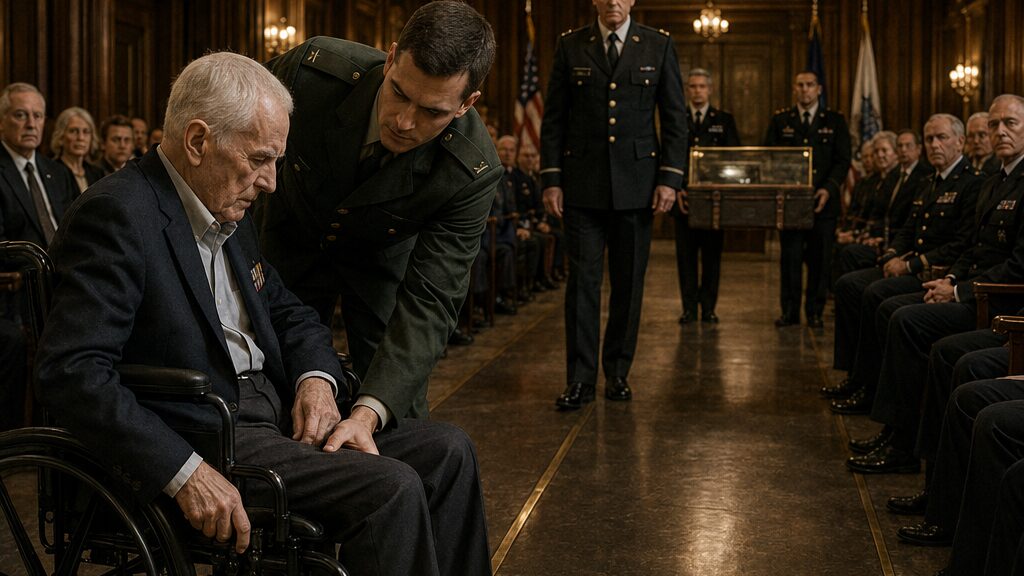
Captain Tyler Johnson released the right brake on Edward Wilson’s wheelchair without asking.
The small metal lever clicked beneath the low murmur of the ceremonial hall.
“Sir,” Tyler whispered, bending close enough that Edward could smell coffee on his breath, “you’re blocking the commanding officer’s route. I need you back in the designated wheelchair section now.”
Edward looked down at Tyler’s hand on the chair.
Beyond it, a narrow brass line ran through the polished floor, straight between two banks of dark wooden seats. American flags and old unit standards rose on both sides of the aisle. Under the chandeliers, uniformed guests stood shoulder to shoulder, waiting for the memorial procession.
Edward closed his right hand over the brake and pushed it down again.
The second click was louder.
Tyler’s mouth tightened. “Sir, the procession begins in less than two minutes.”
Edward wore an old service coat over a pale shirt. The coat no longer fit cleanly across his shoulders, and the ribbons above his pocket had faded at different rates. He had almost left it at home. Susan had said the dark fabric made his face look tired.
He had told her tired was not the same as absent.
Now she sat six rows behind him, blocked by the curve of standing shoulders. She had been speaking to a volunteer when Edward left the wheelchair bay at the rear wall and moved toward the aisle.
He had not told her he was going.
Tyler glanced toward the entrance. A silver-haired officer had appeared beneath the archway, accompanied by an aide. Conversations thinned. Chairs stopped scraping. The room began settling into the silence expected before rank entered.
“Mr. Wilson,” Tyler said, lower now, “this is not optional.”
Edward kept his eyes on the far end of the aisle.
A junior enlisted usher stood there holding one end of a glass-covered field case. Another usher supported the opposite end. Inside lay a weathered medical bag, its canvas darkened with age, its leather straps cracked and flattened.
Edward had seen photographs of it.
He had not seen the real thing in forty-six years.
“Will that case come down this aisle?” he asked.
Tyler blinked, following his gaze. “Yes, sir.”
“Down this line?”
“Yes.”
Edward looked at the brass strip beneath his left wheel. It marked the center of the procession route, though years of shoes had dulled it near the entrance.
Tyler exhaled through his nose. “That doesn’t change the clearance requirement.”
“No,” Edward said. “It doesn’t.”
He lifted his hand from the brake.
For an instant Tyler seemed relieved. Then Edward gripped both wheel rims and began turning the chair himself.
The first push sent a sharp pull through his left shoulder. The second moved him only a few inches. His chair had been angled partly across the aisle, and reversing without room required him to drag one wheel while forcing the other forward.
Tyler reached for the handles.
Edward said, “Don’t.”
It was not loud. Nearby guests still turned.
Tyler froze with both hands suspended behind the chair. From the side, it likely appeared that a young officer had offered help and an old man had refused it. Edward could feel the interpretation spreading through glances.
A woman in the front row leaned toward her companion. One of the surviving unit veterans lowered his eyes.
Edward pushed again.
The wheel crossed the brass line.
The movement drew the room’s attention more completely than any command could have. He heard Susan’s voice from behind the seats.
“Dad?”
He did not look back.
Tyler stepped closer, careful now not to touch the chair. “To your left, sir. The rear bay is along the wall.”
“I know where it is.”
His shoulder trembled. He shifted his grip so the weakness would look like adjustment rather than strain.
The field case remained at the far end of the aisle.
The ushers holding it had not moved.
Tyler glanced at them, then at the approaching senior officer. “Please continue.”
Edward pushed once more.
The chair caught against the edge of a temporary carpet runner. His right wheel slipped, then stopped. The jolt drove his palm against the rim. He heard a soft intake of breath from somewhere beside him.
Before Tyler could reach for the handles again, a voice came from the aisle.
“Captain.”
Tyler straightened so quickly his jacket pulled tight across his shoulders.
The silver-haired officer had stopped ten feet away.
Lieutenant General Jonathan Nelson stood without his aide now. The aide had halted behind him, holding a folder against his chest. Jonathan’s dress uniform carried the weight of rank, but his expression did not.
His eyes were fixed on Edward.
For a moment neither man spoke.
Edward had last seen Jonathan at a hospital dedication eleven years earlier. Jonathan had still been dark-haired then, still walking too quickly, still surrounded by people who wanted his attention.
Now he approached at a measured pace.
Tyler stepped aside. “General, we had an aisle obstruction. I was relocating the guest before the procession.”
Jonathan did not answer him.
He stopped directly in front of Edward’s chair.
The entire hall had gone still enough that Edward could hear the faint buzz of the chandelier bulbs overhead.
Jonathan looked down at the brass line, at Edward’s wheels, then toward the rear bay. His gaze returned to Edward’s face.
“Edward.”
Edward gave a slight nod. “Jonathan.”
The use of the first name altered the air around them. Tyler’s posture changed. The aide lowered the folder by an inch.
Jonathan took one step closer and bent at the knees.
A general lowering himself in the center aisle created a different kind of silence. It was not ceremony. It was the room realizing it had misunderstood the scene but not yet knowing how.
Jonathan settled beside the wheelchair until his face was level with Edward’s.
“You came,” he said.
“I said I would.”
Jonathan’s eyes moved to the far end of the aisle, where the field case waited.
Then he looked at the empty space beside Edward. “Did they move John’s place again?”
Edward’s fingers closed around the brake.
Across the aisle, Tyler stared at the medical case as if seeing it for the first time.
Susan had reached the end of the row but stopped there, one hand braced against a chair. Her anger had not left her face. It had simply made room for confusion.
Jonathan’s voice softened.
“You were promised the aisle.”
Chapter 2: The Apology Written Before the Truth
The apology was already on the table when Edward entered the side reception room.
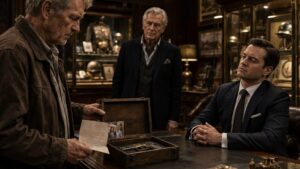
It lay on cream foundation stationery beside a sealed bottle of water and a box of tissues. The first line began with the words, On behalf of the Heritage Foundation, we deeply regret—
No one had yet asked Edward what had happened.
Katherine Anderson stood behind the table in a navy suit, one hand resting lightly on the back of a chair. “Mr. Wilson, please come in. Ms. Wilson, of course, you’re welcome as well.”
Susan pushed Edward’s wheelchair through the doorway harder than necessary. The front casters struck the threshold.
“I can manage,” Edward said.
“You’ve managed enough for one morning.”
She parked him facing the table and set both brakes. Edward noticed she used more force than needed. It was what she did when worry had nowhere useful to go.
Jonathan remained in the hall. He had delayed the procession, spoken quietly to the ushers, and instructed that the field case stay where Edward could see it. Edward had watched it pass along the brass line from the side of the aisle rather than from the rear wall.
It had not felt like keeping a promise.
It had felt like watching someone else carry it.
Katherine sat opposite him. “What happened out there should not have happened.”
Edward looked at the letter. “Which part?”
Her eyes flicked toward Susan.
“The confusion regarding your seating,” Katherine said. “And the manner in which it was addressed.”
“Manner,” Susan repeated.
Katherine folded her hands. “Captain Johnson was acting under a strict safety directive. That does not excuse any failure to communicate respectfully.”
“He released my father’s brake.”
Katherine’s expression held. “I understand there was physical contact with the chair.”
“It wasn’t contact with the chair,” Susan said. “It was control of the chair.”
Edward pressed the right brake with his palm though it was already locked.
Katherine noticed.
For the first time, the smoothness left her face. “Mr. Wilson, did Captain Johnson move you against your will?”
“No.”
Susan turned. “Dad.”
“He released one brake. I replaced it.”
“That is not the same as no.”
“It is the answer to the question she asked.”
Katherine drew the apology letter closer, aligning it with the edge of the table. “We would like to offer you a prominent place at the rescheduled portion of today’s program. General Nelson has offered to escort you personally.”
“No.”
Katherine paused. “You would not need to return to the rear section.”
“No escort. No announcement.”
“Mr. Wilson, the foundation would like the opportunity to correct—”
“You can correct the seating chart.”
Susan stared at him. “That’s all you’re going to say?”
Edward looked toward the closed door. On the other side, muffled movement carried through the wall: equipment being repositioned, guests being told the ceremony would resume, chairs scraping across the floor.
“The event is delayed,” he said. “People came for a memorial, not for me.”
Katherine’s face showed relief too quickly.
Susan saw it.
“You haven’t asked why he was in the aisle,” she said.
Katherine glanced down at a folder. “His assigned location was wheelchair bay C, along the rear wall.”
“That isn’t what we were sent.”
Susan reached for Edward’s coat, which she had folded over her arm. He caught the sleeve.
“Leave it.”
She looked at his hand. “You moved without telling me. You let that man lean over you in front of half the room, and now you want me to leave it?”
“It’s a seating mistake.”
“You don’t move six rows through a crowded hall for a seating mistake.”
Katherine lifted a page from the folder. “The registration system shows wheelchair bay C.”
Susan pulled the coat free.
Edward’s hand remained suspended for a moment before returning to the brake.
She searched the inner pocket and removed a stiff white card. “This is what arrived last week.”
Katherine accepted it.
The printed line read:
ACCESSIBLE AISLE POSITION — EAST CENTER
UNOBSTRUCTED VIEW OF MEMORIAL PROCESSION
Katherine read it twice.
Then Susan reached into the outer pocket and found a second card, creased down the middle. It was the card handed to Edward at registration that morning.
WHEELCHAIR BAY C — REAR WALL
Katherine set the cards side by side.
The room changed.
Not enough to resolve anything. Enough to make the apology letter look premature.
“I was told there had been a final floor-plan adjustment,” Katherine said.
“By whom?” Susan asked.
“I’ll need to determine that.”
“Before or after you finish apologizing?”
Edward turned the brake beneath his palm until the metal edge pressed into his skin. “Susan.”
She stepped away from the table.
Katherine gathered both cards. “I will investigate this personally.”
“The original request included the field case?” Susan asked.
Katherine opened the registration folder and scanned the page. Her mouth tightened.
“Yes.”
Edward looked at her.
She read aloud, reluctantly. “‘Guest requests accessible seating with direct line of sight to restored medical field case during processional entry.’”
Susan turned toward him. “Why?”
Edward stared at the water bottle. A line of condensation had formed beneath it, slowly soaking the corner of the apology letter.
“Because I requested it.”
“That isn’t an answer.”
“It is the one I have.”
The door opened before Susan could respond.
Tyler stood in the hallway with a clipboard. His face had lost the hard urgency it carried in the aisle. Now it looked carefully emptied.
“Katherine, the incident documentation requires your signature.”
She rose. “Not now.”
“It has to be entered before the command review.”
Edward saw the top page when Tyler shifted the clipboard.
At 1103 hours, guest Edward Wilson refused multiple lawful instructions to vacate the marked emergency and processional route—
Susan saw it too.
“Multiple?” she said.
Tyler looked at her. “Ma’am, I gave Mr. Wilson more than one opportunity to relocate.”
“You touched his chair before you knew why he was there.”
“I knew he was inside the clearance boundary.”
“You knew his seat had been changed?”
Tyler’s eyes moved to the two cards on the table.
Only for a second.
It was enough.
Katherine took the clipboard. “Leave this with me.”
“The report is accurate,” Tyler said.
Edward studied him. Beneath Tyler’s controlled tone was something more brittle than certainty. Fear, perhaps. Not fear of Edward. Fear of a record that would continue existing after the room emptied.
Edward said, “You told me where to move.”
“Yes, sir.”
“I chose not to explain.”
Susan made a sharp sound of disbelief.
Tyler’s shoulders lowered slightly, as if Edward had handed back a portion of the ground beneath him.
Katherine looked between them. “That does not settle the handling of the chair.”
“No,” Edward said. “It doesn’t.”
Tyler left without another word.
In the parking area twenty minutes later, Susan opened the rear door of her car and folded Edward’s coat onto the seat. The ceremony had resumed without them. Through the stone walls came the faint vibration of recorded music.
Edward positioned his chair beside the passenger door.
Susan did not open it.
“Why did Jonathan ask about John?”
Edward looked toward the building’s tall windows.
“He served in the unit.”
“And John?”
Edward rested his right hand on the brake.
Susan picked up the memorial program that had slipped from his coat. “You wrote something in here.”
“Give it to me.”
She unfolded it before he could reach.
Near the restored list of unit members, beneath the name John Martinez, Edward had written one line in careful block letters.
John—this time I will be where they carry you.
Susan read it silently.
When she looked up, her anger had changed shape.
“What happened the first time?”
Chapter 3: The Name Missing From the Procession
Every memorial program in Edward’s desk had John Martinez’s name underlined.
Susan found six of them before Edward rolled into the room and told her to stop.
They lay across the desktop in a fan of different years: unit reunions, hospital dedications, a county memorial service, the opening of a medical training wing. John’s name appeared in different places and typefaces, but each time a straight blue line ran beneath it.
Some lines were faded. One had been drawn so hard the pen tore the paper.
“You keep these in the locked drawer,” Susan said.
“It wasn’t locked.”
“The key was in the lock.”
“That is not the same thing.”
She turned one program toward him. “This one is twenty-three years old.”
Edward moved beside the desk. Morning light fell across the worn arms of his wheelchair. Without the service coat, he looked smaller than he had in the hall.
Susan picked up another program. “John’s name isn’t in this one.”
Edward’s gaze settled on the page.
The omission had once taken him three years to correct. He had written letters to offices that no longer existed, called men who remembered pieces but not dates, and mailed copies of orders to clerks who returned them with requests for different forms.
“He was assigned elsewhere that week,” Edward said.
“But he wasn’t?”
“No.”
“Then why leave him off?”
“Paper moves more neatly than people.”
Susan waited.
Edward reached for the program. She did not release it.
“You asked what happened,” she said. “I’m still asking.”
“I attended a ceremony. There was a seating error. It is being reviewed.”
“And John?”
Edward tightened his grip on the page. “The ceremony was for the unit.”
“That isn’t what you wrote.”
He pulled the program free. The paper bent between their hands.
Susan let go first.
“You could have told Captain Johnson why you needed the aisle.”
“I did not need it.”
“You left the place they assigned you.”
“I wanted to see the case.”
“You needed to see it.”
Edward placed the program back on the desk, aligning its edges with the others. “There is a difference.”
Susan crossed her arms. “You have spent my whole life deciding that words mean only what you allow them to mean.”
He looked at her then.
The remark struck because it was not entirely fair and not entirely wrong.
An hour later, they drove to the military heritage archive.
Edward had not agreed to go. Susan had called Katherine, obtained the archive appointment, and put his folded chair into the car while he was still saying the matter was finished.
At the archive, a civilian archivist wheeled out a gray storage box and placed it on a low table. The room smelled of dust, cardboard, and the cold air used to preserve old paper.
“We pulled the evacuation-unit materials associated with yesterday’s rededication,” the archivist said. “General Nelson requested access to the same collection six months ago.”
Edward looked up. “Jonathan did?”
“He was involved in restoring the field case to the unit display.”
The archivist opened the box.
Inside were photographs, typed rosters, transport logs, and thin folders marked with dates. Susan sat beside Edward and removed the first photograph carefully.
It showed young men standing around a canvas medical tent. Edward recognized himself near the edge, thinner than memory permitted, one hand raised against the sun. John stood beside him with a roll of bandage looped around his neck.
Susan found him without asking.
“That’s John.”
Edward said nothing.
She turned to the next photograph.
Four stretchers lay in a narrow line between two rows of equipment crates. The passage was barely wide enough for the men carrying them. At the far end, smoke had blurred the hills into a dark wall.
The arrangement resembled the ceremonial aisle with its chairs pressed close on either side.
Susan placed the photograph down.
The archivist removed an early unit roster. “This is the list originally supplied for the memorial project.”
John Martinez’s name was absent.
A later sheet bore several handwritten corrections. John’s name appeared at the bottom with a reference number beside it.
“General Nelson submitted the supporting documents for restoration,” the archivist said. “He was very specific that the field case and corrected roll be presented together.”
“Why together?” Susan asked.
The archivist glanced at Edward.
Edward’s right hand rested on the wheelchair brake.
“The case belonged to the medical section,” the archivist said. “According to the transfer record, Specialist Martinez had custody before the final evacuation.”
“Final?” Susan asked.
The archivist opened another folder. “There was a route collapse during withdrawal. The records are incomplete.”
Edward’s fingers pressed harder.
Susan saw the movement. “What do they say?”
The archivist hesitated. “Mr. Wilson may prefer—”
“I asked.”
The document was a typed summary with corrections made in dark pencil. Several names had been struck through and rewritten.
Susan read slowly.
The evacuation route narrowed after equipment damage. Two casualties were transferred. One medic remained behind with Specialist Martinez. Communications failed. Recovery attempts continued until the route was declared impassable.
Her finger stopped beneath the final line.
Last confirmed medical personnel with Martinez: Specialist Edward Wilson.
The room seemed to contract around the table.
Susan turned toward her father. “You were with him.”
Edward looked at the photograph of the stretchers.
The brass line in the memorial hall had been straight and polished. That older route had not been straight. It bent between crates, broken equipment, and men calling for space that did not exist.
The archivist quietly moved away, giving them privacy without announcing it.
Susan lowered her voice. “Did he die there?”
Edward’s thumb moved against the brake lever.
“Yes.”
“And you were the last one with him?”
“Yes.”
“Then what did you mean when you wrote that this time you would be where they carried him?”
Edward watched the young man in the photograph standing beside him. John’s grin had always arrived before the joke. Even in still images, he appeared on the edge of saying something.
The official procession had carried the restored case down the center of a room filled with polished shoes and folded hands. No smoke. No shouting. No one forced to choose which body could be moved first.
Susan touched the edge of the old report.
“Dad, did you leave him?”
Edward’s hand closed around the brake until his knuckles whitened.
He could have told her the route collapsed.
He could have said orders were orders, weight was weight, and wounded men did not become lighter because someone had promised them otherwise.
All of those things were true.
None was the sentence he had carried.
“I promised I would bring him through,” Edward said.
He looked at John’s missing name, restored in pencil at the bottom of the roster.
“I did not.”
Chapter 4: The Report That Made Tyler Right
The fire marshal’s tape placed Edward’s left wheel seven inches inside the required clearance.
Tyler stood in the memorial hall while a civilian inspector read the measurement aloud and marked it on a diagram. Temporary blue tape ran parallel to the brass line, making the aisle look narrower than it had during the ceremony.
“Minimum width was not maintained,” the inspector said. “If the procession had begun with the chair in that position, the route would have failed inspection.”
Tyler kept his face still.
Across the empty hall, stacked chairs waited against the wall. Without uniforms and guests, the room seemed less dignified and more mechanical. Every aisle had a number. Every door had a measured swing. Every seat occupied space that could be defended on paper.
Katherine stood near the rear wheelchair bay with a clipboard. Jonathan watched from the front row, arms folded.
“So the order to relocate him was correct,” Tyler said.
“The clearance instruction was correct,” the inspector replied. “How it was carried out is outside my determination.”
Tyler looked down at the seven-inch mark.
For two days, he had replayed the click of Edward’s brake in his head. He remembered the old man’s hand closing over the lever, calm and exact. He remembered Jonathan lowering himself beside the wheelchair while every person in the hall watched Tyler become the visible mistake.
Now the tape offered something solid.
Seven inches.
A rule did not become false because someone important disliked its application.
Katherine crossed the room. “We also need to determine why Mr. Wilson was placed in the aisle.”
“He left his assigned bay,” Tyler said.
“After his requested seat was changed.”
“He still entered a restricted route.”
Jonathan spoke without raising his voice. “Both statements can be true, Captain.”
Tyler met his gaze. “Yes, sir.”
The answer came automatically, but the old warning in his personnel file felt suddenly present.
Six months earlier, an evacuation drill at a recruiting event had stalled because a vendor display blocked an exit. No one had been injured. The report had still described the failure as preventable and assigned it to Tyler’s planning team. His supervisor had told him that another safety lapse would establish a pattern.
A pattern could end a promotion before the board ever discussed merit.
The inspector moved toward the rear bay. “There’s another issue.”
He sat in one of the folding chairs beside the wheelchair space and looked toward the ceremonial entrance.
From that position, the field-case route disappeared behind the standing rows.
Katherine shifted. “Guests were expected to remain seated during the procession.”
“They didn’t,” Jonathan said.
“They were instructed to.”
“But they didn’t.”
The inspector raised a hand to indicate the sightline. “Even seated, the center display table blocks the lower half of the aisle. A wheelchair user would not have had an unobstructed view.”
Tyler looked at Katherine.
She opened the planning folder and removed a message printed three weeks before the ceremony. A volunteer coordinator had noted the same obstruction during a rehearsal and recommended moving the accessible section two rows forward.
A handwritten response appeared beneath it.
No revision possible without reducing reserved donor seating.
Tyler recognized the initials beside the decision.
His own.
He remembered the discussion. Katherine had said the foundation board expected the front sections filled according to sponsorship level. Tyler had argued that the program would last less than an hour and that ushers could manage any individual requests.
No one had mentioned Edward Wilson by name.
At least that was what Tyler told himself until Katherine turned another page.
Attached to the seating list was Edward’s request for a direct view of the restored field case.
Tyler had seen it during the final review.
He had marked the request as accommodated because the rear bay technically faced the aisle.
The difference between facing and seeing had seemed too small to delay the floor plan.
Now Jonathan was watching him.
“Did you know about the sightline concern?” Jonathan asked.
Tyler could have answered that Katherine knew. That the foundation approved the layout. That the fire marshal’s clearance rule left few options. All of it would have been accurate.
“Yes, sir.”
“And Mr. Wilson’s request?”
“Yes, sir.”
Katherine’s expression changed, not with surprise but recognition. She had been waiting to learn whether he would say it aloud.
Jonathan looked toward the seven-inch mark. “Then your report is incomplete.”
“My report concerns his refusal to leave the route.”
“It says he refused multiple lawful instructions without cause.”
“He did not state a cause.”
“You knew one existed.”
Tyler’s jaw tightened. “I knew he wanted a view. I did not know why.”
Jonathan took a step closer. “Would the reason have changed the width of the aisle?”
“No, sir.”
“Would it have changed how you touched his chair?”
Tyler did not answer.
The inspector rolled up the measuring tape and left them in the hall.
Later, in the administration office, Tyler opened the incident report on his computer. The cursor blinked after the final sentence.
Guest behavior created unnecessary delay and public disruption.
He deleted public disruption.
Then restored it.
He added a line stating that the original seating request had been modified by event planners. The sentence remained on the screen for nearly a minute.
If he submitted it, the review would expand beyond Edward’s conduct. His initials on the rehearsal note would become part of the file. The earlier evacuation warning would be attached. The promotion board would see two events, two blocked routes, two preventable planning failures.
Tyler removed the line.
He submitted the report unchanged.
That evening, Edward sat at his kitchen table with the archive photograph beside him. Susan had left after making dinner he had not asked for and placing three labeled containers in the refrigerator.
The doorbell rang.
Jonathan entered carrying no aide, no uniform cap, and no folder. He remained standing until Edward nodded toward a chair.
“The safety measurement supports Tyler,” Jonathan said.
Edward traced the edge of the photograph. “It should.”
“You were inside the clearance line.”
“I knew I was.”
Jonathan leaned forward. “The rear bay could not see the procession.”
“That does not make the aisle wider.”
“No.”
Edward looked up. “Then do not ask me to pretend the rule was wrong because I disliked where it put me.”
“The rule is not the only issue.”
“It is the issue Tyler understood.”
“He knew your requested seating had been changed.”
Edward’s hand settled on the wheelchair brake. “Did he?”
“The planning record shows it.”
“That is not what I asked.”
Jonathan was quiet.
Edward studied his face. “You want me to testify against him.”
“I want you to describe what happened.”
“You saw what happened.”
“I did not hear everything.”
“You heard enough to kneel in the middle of a ceremony.”
Jonathan’s mouth tightened. “I should have stopped it sooner.”
“You stopped what you could see.”
“And you are protecting a man who handled you like equipment.”
Edward turned the photograph facedown. “I am not protecting him.”
“Then why refuse the review?”
“Because everyone has already decided what story they want. Katherine wants a misunderstanding. You want an injustice corrected by command. Susan wants a reason that will make my silence sensible.”
“And Tyler?”
Edward looked toward the dark window.
“Tyler wants seven inches to be the whole truth.”
Jonathan’s phone vibrated. He read the message and set it on the table.
“The preliminary audit found the missing seating note,” he said. “Tyler’s report does not mention it. They will examine whether he altered the account by omission.”
Edward’s hand did not move from the brake.
Jonathan stood. “The review board asked for your statement.”
“No.”
“Edward.”
“No statement.”
Jonathan remained beside the table, waiting for anger or explanation. Edward offered neither.
At last Jonathan picked up his coat.
At the door, he stopped.
“They will review the report without you,” he said. “But without your voice, Tyler’s version may remain the only complete account in the file.”
Edward looked again at the overturned photograph.
“Then it will not be the first incomplete account they kept.”
Chapter 5: What Edward Could Not Carry Home
Jonathan placed the original field report on Edward’s lap and said, “You have refused to read this for forty-six years.”
They sat in the rehabilitation garden behind the veterans’ clinic, where a paved path narrowed between two stone benches before widening near a dry fountain. Edward had chosen the garden because Jonathan’s office smelled of polished wood and official decisions.
The folder on his knees was thin.
Too thin for what it contained.
“I read the summary,” Edward said.
“You read the casualty notation.”
“That was enough.”
“No. It was easier.”
Edward’s right hand rested on the brake.
Jonathan sat on the bench across from him. He wore a plain dark jacket, but rank remained in the way he held still, as if stillness itself were an instruction others should obey.
“The review board wants to correct Tyler’s report,” Jonathan said. “Katherine has acknowledged the seating failure. We can make a public statement before the rescheduled ceremony.”
“We.”
“The command and the foundation.”
“You mean you can explain me.”
Jonathan looked toward the folder. “There are people in that hall who should know what you did.”
“What did I do?”
“You stayed with John after the route was ordered closed.”
Edward’s fingers tightened around the brake lever.
The path between the benches had become too narrow.
A stretcher would have caught there. Two men carrying it would have turned sideways. Someone would have shouted for those ahead to move, though there had been nowhere to move.
Jonathan leaned forward. “Open it.”
Edward did not.
“You keep saying you failed him,” Jonathan said. “The record does not say that.”
“The record was typed by a man who arrived after.”
“It includes statements from three people who were there.”
“Three people who left.”
“Because they were ordered to evacuate.”
“So was I.”
The dry fountain clicked as its automatic pump tried to start, found no water, and stopped.
Jonathan reached for the folder. Edward pulled it closer.
“You want the words?” Edward asked. “You read them.”
Jonathan opened the report.
His voice lost its command cadence as he began.
“Route degradation increased at fourteen-twenty hours. Medical personnel were instructed to withdraw remaining ambulatory casualties. Specialist Martinez sustained additional injury during equipment collapse.”
Edward stared beyond him.
John had been conscious then. That was the part the report would not preserve. Conscious enough to know the route was failing. Conscious enough to make jokes with breath he needed for other things.
Jonathan continued. “Specialist Wilson moved two casualties to the transfer point. At fourteen-twenty-six, he was ordered to remain at the point due to structural instability.”
Edward heard the old voice again.
Stay here.
Not Jonathan’s voice. Jonathan had been young then, barely more than a boy, carrying messages through smoke.
Stay here, Wilson. The path is going.
Edward had stayed.
For ninety seconds.
The report said so.
“Read that part again,” he said.
Jonathan stopped.
“Read it.”
“At fourteen-twenty-six, Specialist Wilson was ordered to remain at the transfer point.”
“The next line.”
Jonathan’s eyes lowered. “Specialist Wilson remained for approximately ninety seconds before returning toward Martinez’s position without authorization.”
There it was.
Ninety seconds.
Not an hour. Not a lifetime. Long enough to obey. Long enough to hear the route breaking. Long enough to imagine that someone else would reach John first.
Edward had spent decades trying to reduce those seconds into something smaller than a decision.
Jonathan continued quietly. “Wilson reached Martinez and attempted extraction. Additional collapse prevented movement through the primary route. Wilson remained until retrieval personnel removed him under direct order.”
“Removed me how?”
Jonathan did not answer.
“Read it.”
“Specialist Wilson resisted withdrawal and was physically carried from the unstable section by two personnel.”
Edward looked at the path.
His hands remembered John’s jacket under his fingers. The cloth had torn near the shoulder. Edward had tried dragging him, then lifting him, then clearing debris that shifted faster than he could move it.
John had watched him work.
Not accused him. That would have been easier.
“You promised,” John had said.
Edward had answered, “I know.”
John’s hand had found the strap of the medical bag between them.
“Don’t let them lose my name.”
The retrieval men had come minutes later. Edward had fought them when they pulled him back. He had struck one in the chest. He had called them cowards for doing what he had failed to do during those ninety seconds.
Jonathan closed the report.
“You went back,” he said.
“After I stayed.”
“You obeyed an order.”
“For ninety seconds.”
“The route was collapsing.”
“So was John.”
Jonathan’s voice hardened. “You saved two casualties before returning.”
“And measured his life against theirs.”
“You were a medic. You made triage decisions.”
“I was his friend.”
The words stopped both of them.
A physical therapist passed at the far end of the garden, walking beside a patient using parallel bars. Neither looked toward the benches.
Jonathan placed the report on his knee. “John’s death was not caused by your hesitation.”
“You cannot know that.”
“The collapse made extraction impossible.”
“When I went back.”
“Yes.”
“Not when I stopped.”
Jonathan inhaled slowly. “You believe ninety seconds is the difference.”
“I know it is the only part that belonged to me.”
For years, people had told Edward what came after: that he had returned, that he had stayed too long, that he had saved others, that no one could have moved John through the destroyed route.
Those facts had formed a wall around the one fact he kept.
He had hesitated.
Jonathan looked older than he had in the hall. “I have used your story,” he said.
Edward turned toward him.
“At training events. Medical-unit addresses. I never used your name, but I told young officers about a medic who refused to leave a wounded man.”
“You told them the useful part.”
“I thought it honored you.”
“It made me easier to admire.”
Jonathan lowered his eyes to the report.
Edward released the brake, rolled forward a few inches, then locked it again before the narrowest part of the path.
“You want to correct the ceremony,” he said. “You want to stand in front of that room and tell them Captain Johnson moved a man who once did something brave.”
“That is not all I want.”
“It is what they will hear.”
“Then tell them yourself.”
Edward almost laughed. “You have been telling me for forty-six years that the story says I am innocent.”
“I am saying the story is not the sentence you gave yourself.”
Edward looked at the folder.
Perhaps that was true. Perhaps innocence and guilt were poor tools for measuring a moment in which every choice had harmed someone.
But Tyler’s report had done the same thing. It had selected the fact that protected its writer and removed the fact that complicated him.
Seven inches. Multiple instructions. Unnecessary delay.
A clean story.
Edward reached for the report and opened it to the line about the ninety seconds.
“If I speak,” he said, “this stays.”
Jonathan frowned. “The full report?”
“The hesitation.”
“Edward, no one is asking you to accuse yourself.”
“I am not interested in being cleared by leaving out the part that hurts.”
Jonathan’s face changed. Admiration gave way to something less comfortable and more honest.
“What do you want the review to do?” he asked.
“Listen before it arranges me.”
“And Tyler?”
“Let him answer for what he chose.”
Jonathan nodded once.
Edward closed the folder.
“I will attend the review,” he said. “But if anyone calls John’s death a lesson in perfect courage, I leave.”
Chapter 6: The Seat of Honor Behind Everyone
Edward’s name was printed in gold on a reserved card placed where he could not see the aisle.
Katherine stood beside the chair as though the lettering itself were evidence of repair.
The memorial hall had been reset for the rescheduled ceremony. The center rows were straight again. Donor cards rested on the first four seats of each section. At the rear wall, the wheelchair bay had been widened by several inches and decorated with a small arrangement of white flowers.
The gold card read:
EDWARD WILSON
HONORED UNIT REPRESENTATIVE
Edward sat in his wheelchair directly in front of it.
From that height, the shoulders of the empty folding chairs formed a wall between him and the brass line.
Katherine waited for his reaction.
Susan stood behind him with both hands on the wheelchair handles but did not touch them. Since the archive visit, she had asked before helping with nearly everything. The care in that restraint sometimes felt heavier than her old impatience.
“The report against you will be corrected,” Katherine said. “The foundation’s written apology will acknowledge the seating change and Captain Johnson’s failure to obtain consent before handling your chair.”
“And the aisle?” Edward asked.
“We created additional space here.”
“The aisle.”
Katherine glanced toward the brass line. “It remains within the required ceremonial dimensions.”
Edward looked at the rows. “Can I see the case from this seat?”
“Guests will be instructed to remain seated.”
“They were instructed last time.”
“We will reinforce the announcement.”
Susan moved around the chair and crouched slightly, testing the view from Edward’s height. The top of the entrance arch was visible. The floor was not.
“He still won’t see it,” she said.
Katherine’s patience thinned at the edges. “This is the largest accessible area we can create without restructuring the reserved sections.”
“Reserved for whom?” Edward asked.
“Foundation sponsors, surviving unit families, and invited officials.”
“Which of them need the aisle?”
“That is not the issue.”
“It became the issue when I occupied it.”
Katherine folded her hands. “Mr. Wilson, we are trying to recognize you without compromising safety.”
Edward touched the gold card. Its paper was thick enough to stand without support.
“Recognition appears to take less room than access,” he said.
Katherine looked toward Susan, perhaps expecting her to soften him.
Susan did not.
They moved to the conference room adjoining the hall. On the table lay three documents: the revised incident finding, the foundation apology, and a new seating protocol.
The finding removed the words unnecessary disruption from Edward’s file. It stated that he had entered a restricted route after an unannounced seating reassignment and that staff response had failed to respect mobility-device consent.
Tyler’s name appeared twice.
The protocol added a requirement that ushers explain seat changes verbally to accessible guests. It did not require preservation of sightlines. It did not alter the donor rows. It did not prohibit staff from placing wheelchair users behind standing attendees.
Katherine slid a pen toward Edward. “Your signature only confirms receipt.”
Edward read the last page again.
“You have corrected my case,” he said.
“Yes.”
“But not the arrangement.”
“The circumstances were unusual.”
“No. John was unusual to me. The chair was not.”
Katherine leaned back. “We host hundreds of guests. We cannot redesign every ceremony around individual preferences.”
Susan said, “Being able to see the ceremony is not an individual preference.”
“The hall has physical limitations.”
“So do I,” Edward said. “Only mine are not allowed to inconvenience donors.”
Katherine’s face flushed. “That is unfair.”
“Is it inaccurate?”
For the first time, she looked away.
She had worked with veterans for twelve years. Edward knew that because her biography appeared in every foundation program. She had raised money for memorial restoration, tracked lost records, and spent evenings calling families whose names had been misspelled on plaques. Her respect was real.
So was the seating chart.
“The board will not approve removing front-row sponsorship places,” she said. “Those commitments fund the restoration work.”
Edward looked through the conference-room window at the hall. The brass line shone between rows built too close to it.
There was always a reason.
The route had to remain open. The donors had to remain visible. The ceremony had to begin on time. The old man could be honored as long as honoring him required no one else to move.
Susan put a hand on the table. “Dad, sign the receipt.”
Edward looked at her.
“They cleared your report,” she said. “They apologized. Jonathan got the review scheduled. You don’t have to fix the whole building.”
“No.”
Her voice softened. “You barely slept after the archive. Your shoulder has been worse since the ceremony. Take the correction.”
“Which correction?”
“The one they are offering.”
He heard what she meant beneath the words: Come home. Let your body stop paying for every unfinished thing.
Edward looked at the gold card Katherine had brought into the room. His name was large. John’s did not appear anywhere.
For most of his life, he had accepted arrangements he disliked because objecting required explanation. Silence had felt cleaner. It preserved privacy, spared others discomfort, and allowed him to mistake endurance for control.
At the ceremony, his silence had given Tyler the whole story.
In the old report, other men’s words had almost given Edward one too.
He picked up the pen.
Susan exhaled.
Edward signed the receipt for the corrected incident finding. He did not sign the protocol acknowledgment.
Katherine pointed to the blank line. “That document also requires confirmation.”
“I received it.”
“Then why not sign?”
“Because it describes the same room with kinder instructions.”
Katherine’s shoulders dropped. “What are you asking for?”
“A review in the hall.”
“The board review is scheduled here.”
“Move it.”
“To the ceremonial floor?”
“With the chairs exactly as they are.”
Katherine stared at him. “For what purpose?”
“So everyone can see what I could not.”
He took the gold reserved card from the table and placed it on top of her folder.
Susan looked at him for a long moment.
“You’re going to tell them about John,” she said.
Edward’s hand moved to the wheelchair brake.
This time he did not press it.
“I’m going to tell them why the aisle was never only theirs.”
Chapter 7: The Truth Spoken Without a Salute
“Do not move the chairs.”
Edward’s voice crossed the memorial hall before Katherine could signal the ushers.
The room had been arranged exactly as it was for the abandoned ceremony. Donor cards remained in the front rows. The rear wheelchair bay sat behind them. Temporary blue tape marked the required clearance beside the brass line.
Foundation board members occupied one side of the hall. Jonathan sat with two command representatives on the other. Tyler stood near the aisle in uniform, his hands held behind his back.
No one had been told where Edward wanted to begin.
Susan stopped his wheelchair at the rear bay, then moved beside him.
Edward looked toward the entrance. From where he sat, the field-case pedestal was invisible behind the rows of chairs.
“This is the place they gave me after they corrected the mistake,” he said.
Katherine shifted near the front. “Mr. Wilson, the revised arrangement was intended for the rescheduled ceremony, not this review.”
“That is why I asked you not to change it.”
He released the right brake.
The small click carried farther than it had on ceremony day.
Edward rolled forward until the first row of standing-height chair backs blocked everything below the entrance arch. He stopped.
“From here, I can see who enters,” he said. “I cannot see what they carry.”
A board member leaned sideways to test the view.
Edward moved forward again, passing the gold reserved card still fixed to the rear chair. He reached the second row, where the aisle narrowed.
“At this point, I could see the top of the case if everyone stayed seated.”
He continued until his left wheel touched the blue tape.
“And here I could see all of it.”
Tyler watched the wheel cross the marked boundary.
Edward rested his hand on the brake but did not set it.
“The fire marshal measured my chair seven inches inside the required clearance. Captain Johnson was right about that.”
The sentence unsettled the room more than an accusation would have.
Tyler raised his eyes.
Edward looked directly at him. “He was also right that I had left my assigned place without permission.”
Susan stood near the rear, very still.
Katherine opened the incident folder. “Mr. Wilson, the board has already acknowledged that the assigned place did not meet your request.”
“I know.”
“Then you do not need to accept blame for the resulting confusion.”
“This is not confusion.”
Edward turned his chair so he faced both sides of the hall.
“I knew where they put me. I knew the aisle was restricted. I moved because the field case belonged to John Martinez, and I had promised myself I would see it carried through.”
Jonathan lowered his head.
Edward continued before anyone could shape the moment for him.
“John was a medic. He was my friend. His name was left off the unit record for years because the papers placed him somewhere else on the day he died. The case was restored with his name. That is why the aisle mattered.”
One of the surviving unit veterans pressed both hands against his knees.
Edward could feel the older story waiting in the room—the one Jonathan had told at training events, the one in which a medic went back without hesitation and refused to leave a wounded man.
He looked at Jonathan.
“Ninety seconds,” Edward said.
Jonathan’s face tightened.
“That was how long I stayed at the transfer point after I was ordered not to return. I had already moved two casualties. The route was failing. John was still behind it.”
No one moved.
“For ninety seconds, I followed the order.”
The words did not release anything. They entered the room and remained there.
“Then I went back. By the time I reached him, I could not bring him through. Men carried me out. For years, people told me that going back was courage. Maybe it was. But the hesitation was mine too.”
Jonathan began to rise. “Edward, the field report makes clear—”
Edward lifted one hand.
Jonathan stopped.
“I am not asking to be cleared of being human.”
The general slowly sat again.
Edward turned toward Tyler. “Captain Johnson had a rule to enforce. He had a route to protect. He was correct about the measurement.”
Tyler’s hands shifted behind his back.
“He was wrong when he touched my chair before he had my consent. He was wrong when he decided that because I did not explain myself, I had no reason. And he was wrong when he left the seating change out of his report.”
A command representative opened the file.
Tyler spoke for the first time. “That omission was mine.”
Katherine looked at him.
He kept his eyes on Edward. “I saw the discrepancy before I submitted the report. I believed adding it would make the safety instruction look less justified.”
“Would it?” Edward asked.
“No.”
“Then why leave it out?”
Tyler swallowed. “Because it made my planning look worse.”
The answer was plain, almost small. It carried no excuse large enough to hide inside.
Edward nodded once. “That choice is yours to answer for.”
Tyler’s face showed the impact more clearly than if Edward had condemned him.
A board member asked, “What correction are you requesting, Mr. Wilson?”
Edward looked at the rows.
“Not a special seat with my name on it.”
Katherine closed the apology folder.
“Accessible guests should be able to see what everyone else came to see. Their locations should be planned before donor cards are printed. And no one should move a wheelchair as though it were an empty chair.”
The board member glanced toward the front rows. “Removing seats would reduce capacity.”
“Yes.”
“And sponsorship commitments may be affected.”
“Yes.”
Edward let the silence hold.
Respect that cost nothing had filled enough programs.
Jonathan stood again, more carefully this time. “The command is prepared to recognize Mr. Wilson’s service and his role in restoring Specialist Martinez to the unit record.”
Edward turned toward him. “John’s name was restored because several people kept the documents. Do not turn this into another clean story.”
Jonathan’s mouth closed.
For a moment, rank had nowhere useful to go.
Then he stepped out of the aisle and returned to his seat.
Edward looked at Katherine. “You asked what I wanted the institution to see.”
He pointed toward the rear bay.
“That a person can be honored in words and still be placed where no one has to notice what he cannot see.”
Katherine followed his hand. Her expression no longer carried defense, only calculation stripped of comfort.
She walked into the front section and removed the donor card from the first aisle chair.
Not the chair itself.
Not yet.
Edward turned to Tyler.
The captain stood rigidly beside the brass line, waiting for a judgment that would come from someone above him.
Edward pointed to the first chair narrowing the turning space.
“Captain.”
Tyler stepped forward. “Sir.”
“Remove that one.”
Tyler looked at Jonathan.
Jonathan did not move.
Tyler looked back at Edward.
Then he bent, folded the chair, and carried it out of the aisle.
Chapter 8: The Aisle Wide Enough for Memory
There was no chair marked special guest when Edward returned to the memorial hall.
He checked twice.
The rear wall no longer held a separate wheelchair bay. Instead, spaces had been built into three different rows, each with a clear view of the brass line. Several front seats were gone. The aisle widened near the center into a turning area marked by the pattern of the floor rather than temporary tape.
Susan stood behind Edward with his service coat folded over her arm.
“They removed more than one chair,” she said.
“Looks that way.”
“You sound disappointed.”
“I am checking whether the building survived.”
She smiled but did not reach for the wheelchair handles.
The rescheduled rededication was smaller than the first ceremony. Some donors had declined the new seating arrangement. Others had accepted places farther back. Katherine moved among the rows with a clipboard, but the gold reserved cards were gone.
Jonathan was already seated, not positioned at the head of the aisle. When he saw Edward, he rose and waited.
Tyler approached from the side.
He stopped several feet away, then lowered himself until he and Edward were at eye level. There was no audience gathered closely enough to make the action ceremonial.
“Mr. Wilson,” he said.
“Captain.”
Tyler’s uniform carried no visible sign of what the review had cost him. Edward had learned through Katherine that Tyler had acknowledged the omitted information, accepted a formal reprimand, and withdrawn his promotion packet rather than challenge the finding.
None of that appeared in his face as clearly as fatigue.
“The new access plan has three locations,” Tyler said. “The front space has the clearest view. The middle has more turning room. The rear is closest to the exit.”
Edward waited.
Tyler did not point or reach for the chair.
“Where would you like to sit?”
The question was ordinary.
That was why it mattered.
Edward looked along the aisle. The front space sat beside the brass line but did not cross it. A wheelchair could turn there without entering the processional route. From the middle space, the field case would remain visible even if the guests stood.
“The middle,” Edward said.
Tyler nodded. “Would you like assistance?”
“No.”
Tyler stepped aside.
Edward released the brakes and moved forward under his own strength. Susan walked near his left shoulder, carrying the coat. She did not hurry him when his hand slipped slightly on the rim.
At the middle row, Jonathan knelt beside the turning space with a small strip of removable floor marker in his hand. He had been helping an usher align the boundaries.
Edward stopped.
Jonathan looked up. “It was crooked.”
“You finally found a problem rank could solve.”
Jonathan smiled once. “Only after the captain handed me the tape.”
Tyler, standing several feet away, looked down but did not hide his expression.
Edward positioned his chair in the open space. Nothing blocked the entrance. Nothing required him to sit apart from the other guests.
Katherine approached with the revised program.
John Martinez’s name appeared in the unit list in the same type and size as every other name. No special box surrounded it. No paragraph used his death to decorate the institution.
Edward ran one finger beneath the name.
“You approved the final wording?” Katherine asked.
“Yes.”
“We included the accessibility policy in the program notes.”
“I saw.”
“The board is reviewing the remaining halls.”
“That will take longer than printing an apology.”
“Yes,” she said. “It will.”
The lights dimmed before Edward could answer.
Guests settled. Jonathan returned to his place. Tyler moved to the entrance, where he gave a quiet signal to the ushers.
The ceremonial narrator began reading the history of the medical evacuation unit.
Edward heard only pieces.
His attention remained on the archway.
When the glass-covered field case appeared, the old pressure returned without warning. His hand closed around the brake.
The cracked leather strap lay across the dark canvas. John’s name was printed on a small plate beneath it.
For an instant the widened aisle vanished.
Edward saw crates, broken equipment, and a route narrowing beneath smoke. He heard an order to stay at the transfer point. He felt ninety seconds gathering around him again, each one preserved because he had refused to let any later courage touch it.
The ushers began walking.
Edward’s right hand tightened.
He could leave before the case reached him. He could turn the chair toward the side door and call it fatigue. Susan would understand. Jonathan would not stop him. No one would make his departure a public failure.
Susan stood beside him.
Not behind.
She did not touch his shoulder or ask whether he was all right.
The case advanced along the brass line.
Edward looked at John’s name.
The promise had changed over the years. At first, it had meant bringing John’s body through the failed route. Later, it meant correcting a roster, preserving a case, underlining a name every time it appeared.
Somewhere along the way, Edward had made punishment part of remembering.
John had asked not to be lost.
He had not asked Edward to remain trapped beside him.
The field case reached the turning space.
Tyler stood near the entrance, watching the route rather than Edward. Katherine remained at the side wall. Jonathan kept his head lowered.
No one paused the ceremony.
No one announced Edward’s name.
The case simply passed where he could see it.
Edward lifted his hand from the brake.
He pushed once, rolling beside the brass line for the length of the widened space. Susan matched his pace.
The movement was not part of the program. It did not interrupt the ushers or narrow their route. For a few seconds, Edward traveled alongside the case rather than watching it leave him.
At the end of the row, he stopped.
John’s name moved ahead beneath the glass.
Edward did not follow farther.
He did not need to.
Susan looked down at him, waiting.
Edward released the wheel rim and let his hand rest open on his knee.
“Walk beside me,” he said.
She did.
The story has ended.