They Took the Rifle From His Bench Before Asking Why He Came Back
Chapter 1: They Marked His Lane Before Hearing His Name
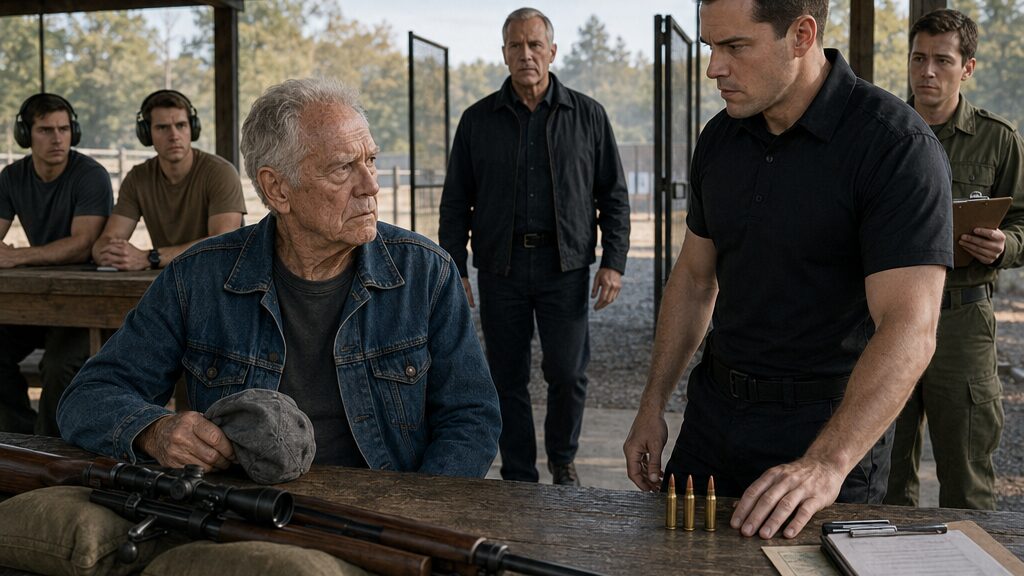
Kevin Davis took the ammunition before Ronald Adams could touch the bolt.
His gloved hand crossed the wooden bench, closed around the worn cardboard sleeve, and slid the three cartridges beyond Ronald’s reach. The motion was quick and practiced, as if he were clearing a dangerous object from a child.
“Don’t load that rifle.”
Ronald kept his left hand on the stock. His right hand held his gray cap beneath the bench, fingers folded hard around the brim.
The range had not changed as much as people claimed. The roof over the firing line was newer. The lane numbers were printed in cleaner black stencils. Electronic lights had replaced the old red flags. But the morning still carried the same mixture of cut grass, gun oil, damp timber, and dust waiting to rise.
Two young shooters at the next bench stopped arranging their magazines. Behind Kevin stood a uniformed liaison with a clipboard pressed to his chest.
Ronald looked at the cartridges now resting beside Kevin’s radio.
“I heard you,” he said.
Kevin’s eyes moved from Ronald’s lined face to the scoped bolt-action rifle on the sandbags.
“This is a controlled qualification line. You can’t set up on an active bench without current clearance.”
“I reserved lane six.”
“That doesn’t make you cleared.”
“The front desk checked me in.”
“The front desk checks names against reservations. I check people against range requirements.”
Kevin wore black tactical pants and a close-fitting range shirt with SAFETY COORDINATOR printed across the chest. He was perhaps thirty-five, solidly built, with a clipped voice designed to travel through hearing protection. The voice carried now, although the line was not yet hot.
Ronald had arrived forty minutes early to avoid exactly that.
He placed the rifle’s bolt, still separate from the action, on the bench where Kevin could see it.
“Rifle is clear.”
“I can see that.”
“You reached over the muzzle side of a secured firearm.”
Kevin’s face tightened.
“The muzzle is downrange.”
“That doesn’t make reaching across another shooter good practice.”
One of the trainees glanced away, pretending to study his scope.
Kevin drew himself straighter. “Sir, I’m not going to debate procedure with you.”
Ronald felt the small pulse begin in his right thumb. It traveled into the cap brim, a fine movement that might have passed unnoticed if he had not been gripping the cloth so tightly.
He loosened his fingers.
Kevin noticed anyway.
“Are you here alone?”
Ronald looked at him.
“That’s a simple question.”
“So was whether I had a reservation.”
The liaison shifted the clipboard from one hand to the other. He was young enough that the uniform still appeared to be wearing him. A blank inspection form lay on top, with several lanes already marked in blue ink.
Kevin lowered his voice, though not enough to make the exchange private.
“Do you know where you are?”
The words settled differently than the others.
Ronald turned his head slowly. Beyond the firing line, white target frames stood at one hundred yards beneath a low berm. The far-left frame leaned two degrees because the ground under it had washed out. The emergency cut-off switch had been moved from the support column to the control booth. The old wind marker was gone.
He knew exactly where he was.
He had known the place before the roof, before the digital timers, before Kevin Davis had been old enough to shave.
“I know where I am,” Ronald said.
Kevin nodded toward the liaison. “Mark lane six closed pending evaluation.”
The young man hesitated.
“Reason?”
Kevin kept his eyes on Ronald. “Unfit participant.”
The pen touched the paper.
Ronald’s grip closed around the cap again.
He could have spoken then. He could have named the former commanders, instructors, and safety boards that had once met in the concrete office behind them. He could have told Kevin which shallow groove beneath the bench had been cut by a loose bipod during the winter qualification of 1989. He could have explained why his name appeared in the oldest range manuals stored in the director’s cabinet.
Instead, he watched the liaison write two words about him before either man had asked why he had come.
“Who made the determination?” Ronald asked.
“I did.”
“Based on what?”
“Expired credentials, questionable physical control, no current medical declaration, and refusal to cooperate.”
“You haven’t asked for my credentials.”
Kevin pointed toward a plastic visitor badge clipped to Ronald’s jacket. “That is not a shooter clearance.”
Ronald set the cap on his knee and reached into the inside pocket of his faded denim jacket.
Kevin’s hand moved toward the holster at his belt, not drawing, merely preparing.
Ronald stopped.
The trainees saw it. The liaison saw it. Kevin seemed to realize too late what his gesture implied, but he did not lower his arm.
Ronald removed a narrow laminated card and placed it flat on the bench.
The edges had yellowed. The photograph showed him with dark hair, a narrower face, and an expression that had never belonged on an identification card. Beneath the photograph, faded block letters read:
RONALD ADAMS
RANGE SAFETY EVALUATOR
PERMANENT INSTRUCTOR ACCESS
A red authorization mark crossed the lower corner.
Kevin picked it up.
For the first time, uncertainty interrupted his expression.
Then he turned the card over and found the issue date.
“This expired more than thirty years ago.”
“The card did.”
“And the authorization with it.”
Ronald looked at the three cartridges. Their brass cases caught the morning light through the open side of the shelter.
“I didn’t show it as authorization.”
“Then what did you show it for?”
“So you might ask my name before writing something about me.”
The liaison’s pen stopped.
Kevin placed the card beside the cartridges, face down.
“This doesn’t change the situation. Your rifle will be secured until the director reviews it.”
“It belongs in that case when it’s transported. It belongs on this bench when it’s inspected.”
“It belongs wherever range control says it belongs.”
Kevin signaled to the senior lane marshal near the control booth. The marshal began walking toward them with a hard-sided rifle case.
Ronald rose.
The movement took longer than it once had. His knee resisted halfway, and the bench edge pressed into his palm. He felt the trainees watching him—not with mockery now, but with the strained attention people gave an old man near something heavy.
Kevin reached as if to help.
Ronald straightened before the hand touched him.
“Leave the rifle where it is.”
“Sir—”
“It is cleared. The bolt is separate. The ammunition is in your possession. There is no safety reason to remove it before the director arrives.”
“The safety reason is that I said the lane is closed.”
“That is authority. It is not a reason.”
Color rose along Kevin’s neck.
The senior marshal stopped several feet away, case in hand, waiting for an order neither man seemed willing to repeat.
A voice came from behind the line.
“Why is lane six shut down?”
The voice was calm, almost conversational, but it carried farther than Kevin’s commands had.
Andrew Jackson stepped through the gate from the administrative building. Gray showed close along the sides of his hair. He wore a black range jacket without decoration except for a small director’s badge at the chest.
Kevin turned immediately.
“Credential and control issue. I was securing the firearm pending review.”
Andrew’s gaze moved to the rifle, the three cartridges, the old card lying face down, and finally the man standing beside the bench.
He stopped.
The question on his face vanished before it reached his mouth.
For several seconds, Andrew Jackson did not speak at all.
Then his shoulders drew back as though an old command had passed through him.
Chapter 2: The Salute That Solved Almost Nothing
Andrew raised his right hand.
The salute crossed the wooden bench between them, held above the scoped rifle Kevin had ordered removed.
Every person on the firing line went still.
Ronald looked at Andrew’s fingers aligned near his brow, at the familiar discipline in the elbow, at the effort the older man made not to let surprise alter the gesture. Ronald had taught him that much when Andrew had been a lieutenant who rushed commands and apologized to equipment after dropping it.
Ronald did not return the salute.
He had no hat on his head, no uniform on his shoulders, and no desire to turn a procedural dispute into a ceremony. He merely gave Andrew a small nod.
Only then did Andrew lower his hand.
“Mr. Adams,” he said.
Kevin looked from one man to the other. “You know him?”
Andrew ignored the question for a moment.
“You should have called me when you arrived.”
“I made a reservation.”
“That isn’t what I said.”
“It’s what I did.”
A faint, almost embarrassed smile touched Andrew’s face and disappeared. “Yes. It would be.”
The tension along the line changed shape. The trainees who had watched Ronald as a possible danger now watched him as a hidden answer. The liaison’s clipboard lowered a few inches.
Ronald disliked the change nearly as much as the first one.
Andrew picked up the old card and turned it over. His thumb moved across the faded red mark.
“I haven’t seen one of these in years.”
Kevin’s voice was quieter now. “It’s expired.”
Andrew looked at him. “I can read the date.”
“I followed the current procedure.”
“You labeled him unfit before completing an assessment.”
“He refused to answer basic questions.”
“He is Ronald Adams.”
Ronald’s jaw tightened.
Andrew heard himself and stopped.
The name meant something to him. It did not have to mean anything to Kevin. Ronald did not want it used as a substitute for facts.
Kevin folded his arms. “Being known to the director doesn’t establish current clearance.”
“No,” Ronald said. “It doesn’t.”
Andrew turned toward him. “We can reopen the lane under my authority.”
“No.”
The answer came sharply enough that one trainee blinked.
Andrew lowered his voice. “Ronald, let me handle this.”
“You just tried.”
“I’m correcting what happened.”
“You saluted me in front of half the line.”
“You deserved recognition.”
“I deserved a question.”
The words left a silence that no command voice could have produced.
Ronald reached for his cap and placed it loosely on his head. Only after Andrew’s hand was fully down did the trembling in his fingers ease enough to hide.
Andrew looked toward the liaison. “Strike ‘unfit participant.’ Note administrative review.”
Kevin stepped closer. “The note was based on observed condition.”
“Then document the condition, not your conclusion.”
“He was about to load without a current clearance.”
“The bolt was out,” Ronald said.
Kevin turned on him. “You had ammunition on the bench.”
“Three cartridges on a cold line with the action open.”
“You also have a visible tremor.”
There it was, said aloud.
Ronald felt Andrew’s eyes move toward his right hand.
He placed it flat on the bench.
The tremor did not disappear. It never obeyed when watched. A slight movement passed between the base of his thumb and the first knuckle, small enough to dismiss, large enough for a trained observer to remember.
Andrew’s face changed.
Kevin saw the change and pressed forward.
“I asked if he was alone. I asked whether he understood where he was. He wouldn’t cooperate.”
“You asked me whether I knew where I was,” Ronald said. “That is not the same question.”
Kevin exhaled through his nose. “You were holding a precision rifle on a crowded qualification morning.”
“I was sitting beside a cleared rifle on a reserved bench.”
“You’re splitting language.”
“Language is what you wrote on the clipboard.”
Andrew set the card down.
“Office,” he said. “All three of us.”
Ronald looked toward the targets. The sun had climbed above the shelter roof, brightening the center of lane six. He had chosen the early slot because the wind usually remained low until noon. The small red streamer near the berm barely moved.
Kevin gathered the cartridges. He counted them, frowned, and counted again.
“Only three?”
Ronald did not answer.
Inside the range office, Andrew closed the door but left the blinds open toward the firing line. He did not want the meeting to look secret. Ronald understood the choice and resented that he understood it.
The office still held the same steel cabinets, though they had been painted gray. Framed photographs covered one wall: qualification classes, safety teams, opening ceremonies. Ronald did not look closely enough to see whether his younger face appeared among them.
Andrew gestured toward a chair.
Ronald remained standing.
“Please sit.”
“I’ve been sitting.”
Kevin stayed near the door. The liaison waited outside with the clipboard, visible through the glass.
Andrew rubbed his jaw. “Your reservation came through as private veteran access. No note about live-fire qualification.”
“It isn’t a qualification.”
“What is it?”
“Three rounds.”
“That doesn’t answer the question.”
“It answers how many.”
Kevin shifted his weight. Andrew gave him a look, but Ronald had already heard the impatience.
Andrew opened a file drawer and removed a thick binder marked RANGE CONTROL—LEGACY PROCEDURES. He placed it on the desk.
“You helped write the first version of this.”
“Parts of it.”
“You trained me under it.”
“I corrected you under it.”
Andrew almost smiled again. “Frequently.”
Kevin’s expression stayed guarded, but he looked at Ronald differently now—not respectfully, exactly, but as if the old man had become more complicated than the category prepared for him.
Andrew opened the binder. Several pages carried handwritten annotations in dark ink.
Ronald recognized his own lettering before he recognized the words.
Maintain dignity during suspension. Explain the specific observed risk. Remove equipment only when immediate control requires it.
The note appeared in the margin beside a paragraph on temporary shooter restrictions.
Andrew looked at Kevin.
Kevin read the line. His mouth hardened.
Ronald said, “He had grounds to stop the lane.”
Andrew’s head came up.
Kevin looked equally surprised.
Ronald continued. “He did not have grounds to speak to me as if I were lost.”
“No,” Andrew said. “He did not.”
Kevin’s gaze dropped briefly to the binder. “I could have handled the language better.”
“That is not an apology,” Andrew said.
“I didn’t ask for one,” Ronald replied.
The door opened a few inches, and the liaison leaned in.
“Director, front desk says the current access system shows no medical declaration attached to Mr. Adams’s reservation. Insurance requires one for supervised live fire over age seventy if there’s an observed control issue.”
Andrew’s frustration flashed. “He is not a walk-in.”
“The system doesn’t distinguish.”
“Then I’ll authorize—”
“No,” Ronald said again.
Andrew stopped.
Ronald moved to the chair at last and sat, not because Andrew had asked but because his knee had begun to ache.
“My old card does not replace the current rule.”
“We can make an exception.”
“Then the rule means nothing.”
“You wrote the rule before online declarations existed.”
“I wrote it because people with authority always believe their reasons are special.”
Andrew looked stung.
Ronald regretted the edge in the words but did not withdraw them.
Kevin stepped toward the desk. “Then he needs an evaluation before the rifle returns to the bench.”
Andrew’s eyes narrowed. “You seem eager to prove your original judgment.”
“I’m eager not to have a preventable incident during an inspection month.”
Ronald looked at him. “Inspection?”
Kevin did not answer.
Andrew did. “Our insurer is reviewing the qualification program. There was a procedural near-miss in March.”
Kevin’s face closed.
So there was pressure behind the black shirt and clipped commands. Pressure did not excuse what had happened. It did, however, give it a shape.
Andrew closed the binder.
“We’ll do an equipment check, cognitive verification, and supported grip assessment. If Ronald clears them, lane six reopens under supervision.”
Ronald looked at the three cartridges in Kevin’s palm.
“And if I don’t?”
“The rifle is released to a designated person or returned cased without firing.”
Ronald’s right hand moved against his knee.
Kevin saw it.
This time he did not point immediately. He waited until Andrew followed his gaze on his own.
Then Kevin spoke quietly.
“Sir, I understand who he was to you. But is respect worth pretending we can’t see that?”
Chapter 3: The Rule He Wrote Turned Against Him
Kevin placed the old binder on the inspection-room table and read Ronald’s own rule back to him.
“Any visible loss of reliable control requires immediate suspension until the shooter demonstrates safe handling under current conditions.”
The handwriting beneath the typed clause was Ronald’s.
No exemptions for familiarity, position, or prior qualification.
Andrew stood by the locked equipment cabinet, arms folded. The range medical volunteer prepared a blood-pressure cuff near the sink. Kevin kept his voice neutral now, stripped of the public authority he had used at the bench.
Ronald wished he would sound arrogant again. It had been easier to oppose him then.
“Do you dispute the procedure?” Kevin asked.
“No.”
“Do you dispute that I observed a tremor?”
“No.”
“Has it been medically evaluated?”
Ronald looked at the gray cap on the table.
The brim moved slightly though no one touched it. His right fingertips rested beside it, transmitting a faint rhythm through the cloth.
“Not formally.”
Andrew uncrossed his arms. “Ronald.”
“What?”
“You told me last year it was stiffness.”
“Last year it was smaller.”
The medical volunteer glanced up but said nothing.
Kevin opened a fresh evaluation form. “How long has it been worse?”
Ronald watched the pen hover.
“Six months.”
Andrew stepped away from the cabinet. “And you didn’t include that in your reservation?”
“The form asked whether I had a diagnosed condition affecting firearm control.”
“That isn’t what I asked.”
“No diagnosis exists.”
Kevin’s pen stopped.
It was a technically accurate answer. Ronald heard the cowardice in it as soon as the words settled.
The medical volunteer wrapped the cuff around his left arm. “Any dizziness? Confusion? New medication? Weakness on one side?”
“No.”
“Vision changes?”
“Nothing beyond age.”
She took his pressure twice, then asked him to identify the date, location, lane assignment, and emergency procedures. Ronald answered without pause. When she asked where the nearest trauma kit was located, he told her not only its current position but that the seal on the lower compartment had been installed backward.
Kevin checked. It had.
The smallest trace of satisfaction appeared on Andrew’s face.
Ronald saw it and disliked it.
Knowledge was not control. Memory was not steadiness. Being right about a trauma kit did not make his hand safe.
The equipment examination came next.
Kevin brought the rifle in cased, opened it on the padded counter, and invited Ronald to inspect it. The bolt remained separate. The chamber flag was in place.
Ronald checked the bore, stock, sling mounts, scope rings, trigger guard, and action screws. He found a trace of dust beneath the rear scope ring and a shallow mark where Kevin’s case latch had pressed the stock.
“Serviceable,” Ronald said.
Kevin nodded. “Agreed.”
It was the first unqualified agreement between them.
They moved to a dry-handling station at the rear of the room, facing a reinforced blank wall. Ronald inserted the bolt only after confirming the empty chamber twice. He cycled the action, set the safety, released it, and repeated the sequence.
His hands knew the order without thought.
“Supported position,” Kevin said.
A padded rest stood waist-high. Ronald settled the rifle into it, brought the stock to his shoulder, and aligned his eye behind the scope.
The circular field steadied.
The crosshair rested on a black square fixed to the wall.
For several seconds, his right hand behaved.
Andrew exhaled.
Kevin watched without comment.
Ronald lifted his finger away from the trigger and lowered the rifle.
“Again,” Kevin said.
The second attempt was also clean.
The third brought a slight flutter through the crosshair, but Ronald corrected it.
Kevin marked the form.
“Unsupported standing.”
Andrew spoke. “That isn’t required for a bench-rest firing plan.”
“It is required to demonstrate safe transfer and control if the shooter has to clear the bench.”
Ronald said, “He’s right.”
Andrew’s jaw set, but he stepped back.
Ronald lifted the rifle from the padded rest.
The weight had once been nothing. Now it arrived slowly, accumulating in his forearm and shoulder. He brought the stock into position, controlled his breathing, and centered the black square.
The crosshair moved left.
He brought it back.
It moved down and left again, not a sweeping failure, merely a persistent drift made of small corrections arriving later than they should.
“Hold,” Kevin said.
Ronald held.
The tremor increased.
The scope’s field trembled with it. His right wrist felt detached from intention, as though some thin mechanism inside had begun taking instructions from elsewhere.
“Set it down,” Kevin said.
Ronald continued for one breath.
Then two.
“Ronald,” Andrew said.
He lowered the rifle onto the rest.
No one spoke while Kevin removed the bolt and replaced the chamber flag.
The medical volunteer offered Ronald a paper cup of water. He took it with his left hand.
Kevin wrote on the form.
Ronald could hear the pen.
“Unsupported control inconsistent after fourteen seconds,” Kevin said. “Supported control acceptable for limited duration.”
Andrew moved closer to the table. “Then supervised bench fire remains possible.”
“Not without fatigue testing.”
“He is firing three rounds, not a full course.”
“You don’t know that three rounds are safer than thirty if control fails on the first.”
Ronald placed the paper cup down.
“Do the fatigue test.”
Andrew looked at him. “You don’t have to prove anything to him.”
“This isn’t proof.”
“Then what is it?”
Ronald glanced at the binder.
“Procedure.”
Kevin arranged a series of light handling tasks: lifting the cased rifle from table height, carrying it six steps, placing it down, opening the latches, verifying clear condition, and returning it to the supported station. None was difficult alone. Together they made the tremor visible sooner.
By the final repetition, the brim of Ronald’s cap quivered beneath his fingers when he tried to lift it from the table.
Kevin did not mention the cap.
That restraint irritated Ronald more than a comment would have.
A knock sounded at the inspection-room door.
The front-desk clerk entered with a woman in a navy business suit carrying a slim black portfolio. Her visitor badge identified her as the range’s insurance inspector.
Andrew’s expression changed instantly.
“You were scheduled for Friday.”
“My route opened this morning.” Her gaze moved from the rifle to the evaluation form. “Am I interrupting an incident review?”
“No incident,” Andrew said.
“Suspended authorization,” Kevin said at the same time.
The inspector looked between them.
Ronald saw Kevin realize what his answer might cost. He had chosen accuracy anyway.
She held out her hand for the form.
Kevin gave it to her.
Her eyes paused at the old access card clipped behind the current paperwork, then at the legacy binder open to Ronald’s handwritten clause.
“Who authorized the shooter?”
“No live fire was authorized,” Kevin said.
Andrew said nothing.
The inspector read the note from the firing line.
“‘Unfit participant.’ Who wrote this?”
“The liaison, under my direction,” Kevin answered.
“On what completed assessment?”
Kevin’s face tightened. “None at that point.”
She looked at Ronald. Not through him, not around him—at him.
“Mr. Adams, were you informed of the specific observed risk before your equipment was removed?”
“No.”
“Were you asked the purpose of your visit?”
“No.”
Kevin stared at the floor for one second, then raised his head again.
The inspector turned the page. “You brought your own ammunition?”
“Yes.”
“How much?”
Kevin opened his palm and displayed the three cartridges.
The inspector’s brows drew together.
Qualification shooters arrived with boxes. Recreational shooters brought more than they needed. Three cartridges were not preparation for practice. They were a number with a reason behind it.
She studied Ronald’s face.
“Why would a suspended shooter come to a range with exactly three rounds?”
Chapter 4: Three Cartridges for a Promise Nobody Requested
Before Ronald could answer the inspector, the front door opened hard enough to strike the rubber stop.
Anna Miller stood in the inspection-room entrance with one hand still wrapped around the handle. She had come without a coat despite the chill lingering inside the concrete building, and a strand of dark hair had worked loose near her cheek. Her eyes went first to Ronald, then to the open rifle case.
“Why did the range call me instead of you?”
Ronald looked at Andrew.
Andrew lifted both hands slightly. “The reservation listed Ms. Miller as the designated contact for the firearm.”
“I listed her in case I died.”
Anna stepped into the room. “That was thoughtful.”
The inspector closed her portfolio but did not leave. Kevin moved away from the table, giving Anna a clear path to the case.
She stopped when she saw the rifle.
For one moment, anger left her face. Her fingers hovered over the stock without touching it.
“You brought Dad’s rifle.”
Ronald felt every person in the room hear the word.
Andrew looked at the three cartridges in Kevin’s palm. The inspector’s question had been answered only enough to become larger.
Anna turned back to Ronald. “You said you were having it cleaned.”
“It was cleaned.”
“Last month.”
“It needed to be checked again.”
“For what?”
Ronald put the gray cap on his head. The brim sat lower than usual, shading his eyes.
Anna looked at it and went still.
“That was his too.”
“No. He gave it to me.”
“I know who gave it to you.”
The cap suddenly felt heavier than the rifle.
Kevin laid the three cartridges on the table in a straight line. He did it carefully, without the possessive motion he had used at the bench.
Anna counted them.
Her mouth tightened.
“No.”
Ronald said nothing.
“You came here for that?”
Andrew glanced between them. “For what?”
Anna ignored him. “You told me you stopped.”
“I said I might.”
“You said last year was the last year.”
“I said it should be.”
“That is not the same thing, Ronald.”
The use of his first name, spoken with the familiarity of a child who had once called him Uncle Ron, changed the room. He wished she had called him Mr. Adams.
The insurance inspector looked toward Andrew. “Would a private conversation be appropriate?”
Anna answered before he could. “It stopped being private when somebody called me to collect a secured firearm.”
Andrew led the inspector and the medical volunteer into the adjoining office. The liaison remained near the open door. Kevin began to follow, then paused.
“Do you want the ammunition secured elsewhere?”
Anna looked at Ronald.
“No,” Ronald said. “Leave it.”
Kevin placed the cartridges beside the worn cardboard sleeve and stepped out. He did not close the door completely.
Anna rested both hands on the table.
“How many years?”
Ronald watched the cartridges.
“Twenty-two.”
Her laugh carried no humor. “Twenty-two years of you deciding this was what he wanted.”
“It started the year after he died.”
“I remember when it started. I was there the first time.”
“You were not on the line.”
“I was in the parking lot because you told me it was something you had to do alone.”
Ronald remembered her at twenty-three, sitting in a small red car with both hands on the steering wheel. He had returned from the range and shown her the target: three holes close enough to cover with a quarter. She had looked at it without understanding what he expected her to say.
He had mistaken silence for approval.
Anna touched the rifle’s stock now, tracing a pale scratch near the comb.
“Three rounds on the same date every year,” she said. “Same rifle. Same distance.”
“Same target size.”
“Of course.”
“Your father believed consistency showed where the error was.”
“My father also changed his mind sometimes.”
Ronald looked up.
Anna’s expression sharpened. “You think that sounds disrespectful?”
“No.”
“You look like it does.”
“I’m listening.”
“You’ve been listening for years. You just never answer.”
The words landed too close to what Kevin had accused him of, and Ronald’s first instinct was to reject them because of the resemblance.
Instead, he took off the cap.
Anna’s gaze followed it.
“Dad bought that after your last instructor course together,” she said. “He said you hated every cap that didn’t come from an issued box.”
“It wasn’t a gift.”
“He told me it was.”
“He left it in my truck.”
“With a note.”
Ronald said nothing.
Anna shook her head. “You can turn anything kind into an administrative mistake.”
The senior lane marshal passed outside carrying a target frame. Wood scraped briefly against the porch railing. Beyond the wall, a command sounded over the range speaker, followed by the mechanical click of a line preparing to go hot.
Ronald aligned the cap’s folded brim with the edge of the table.
“It was supposed to be the last group,” he said.
Anna’s face softened, but only for an instant. “Because of your hand?”
He did not answer quickly enough.
She looked toward the partly open door. “Did they know?”
“They observed it.”
“That is not what I asked.”
“No.”
“You came with a shaking hand and didn’t tell the range.”
“It is not constant.”
“Neither was Mom’s confusion at first.”
“This is not that.”
“I didn’t say it was. I said you know what hiding a change does to everyone around you.”
Ronald’s right thumb moved against the cap. He pressed it still with his left hand.
Anna saw.
“You were going to shoot anyway.”
“I was going to assess it at the bench.”
“Alone?”
“There were range officers present.”
“Officers you wouldn’t tell.”
“I know when a rifle is unsafe.”
“You know when other people’s rifles are unsafe.”
The distinction opened between them like a cut.
Ronald looked at Christopher’s rifle. The walnut stock had darkened where two different men’s hands had carried it over decades. Christopher’s cheek had polished one side near the comb. Ronald had never refinished it.
“I owed him one final group.”
Anna stepped back.
“No. You decided you did.”
“He pulled me clear.”
“I know how he died.”
“You know the report.”
“I know what you told me, which changed depending on how old I was and how much you thought I could handle.”
Ronald felt heat rise beneath his collar.
“This is not the place.”
“It became the place when you put three rounds on that table.”
She picked up one cartridge, holding it between finger and thumb.
“You call this a promise. Who asked you to make it?”
“Some promises are understood.”
“By whom?”
“By the people who were there.”
“My father is dead. You are the only person left who claims he asked.”
Ronald rose too quickly. The chair legs scraped the floor, and his knee nearly failed beneath him. He caught the table edge.
Anna reached toward him.
He steadied himself before she touched him.
The movement hurt her. He saw it.
She placed the cartridge back with the others.
“I asked you to stop,” she said. “Not because I wanted him forgotten. Because every year you disappear for this, and every year you come back farther away.”
“It is one morning.”
“It has never been one morning.”
The range speaker announced a cease-fire. The silence afterward made the room feel exposed.
Anna moved to the rifle case and shut one latch.
Ronald put his hand over the other.
“What are you doing?”
“Taking it home.”
“It is not yours.”
Her eyes lifted to his.
“It was left to me.”
“You asked me to maintain it.”
“I asked you because I trusted you.”
“I have maintained it.”
“I’m not talking about the metal.”
Ronald removed his hand.
Anna closed the second latch, but she did not lift the case. Her anger had changed into something more careful.
“He wrote to you before his final deployment,” she said.
Ronald’s breathing slowed.
“I know.”
“You sent the letter back to me unopened.”
“It belonged with his papers.”
“You told me it was probably routine.”
“It probably was.”
“You never read it.”
“No.”
Anna reached into her bag and removed a yellowed envelope sealed inside a clear protective sleeve.
Ronald recognized Christopher’s block handwriting immediately.
RONALD ADAMS had been written across the front with a pressure that had nearly cut the paper. In the upper corner was a date twelve years before Christopher’s death.
Anna placed the envelope beside the three cartridges.
“You built twenty-two years around a final request,” she said. “But you refused to read the one thing he actually asked of you.”
Chapter 5: What His Silence Had Cost the Living
“That letter was written before his final deployment,” Anna said. “Not before he died.”
Ronald stared at the date until the numbers lost shape.
Christopher had written it when Anna was eleven, before the training commands, before the instructor assignments, before the morning when a timber barrier failed and one man left the range alive because another had moved first.
“It changes nothing,” Ronald said.
Anna’s hand flattened on the envelope.
“It changes the story you’ve been telling yourself.”
“I never claimed it was a last letter.”
“You treated it like one. You returned it without opening it, then spent two decades honoring words you invented because the real ones frightened you.”
Ronald placed the gray cap over the envelope.
The gesture was instinctive. Cover the paper. Narrow the problem. Decide later.
Anna looked at the cap and let out a breath.
“There,” she said. “That is what you do.”
“What?”
“You put something over the truth and call it discipline.”
Ronald turned toward the classroom window. The target line beyond the glass was empty during cease-fire. Two trainees waited behind the painted safety boundary while the senior marshal checked frames downrange.
Christopher had taught Anna to wait behind lines too. As a child, she had trailed them through empty ranges carrying a stapler too large for her hand. He had never allowed her beyond the boundary until every rifle was cleared twice.
Ronald touched the cap.
“What do you think is in it?”
“I know what is in it.”
“You opened a letter addressed to me?”
“Twelve years after you returned it. Yes.”
He faced her.
She did not apologize.
“What did he say?”
Anna pushed the cap aside.
The envelope remained sealed. Ronald looked from it to her.
“You said you opened it.”
“I opened the outer packet you mailed back. This is the original envelope. I stopped when I saw your name.”
“Then you don’t know.”
“I know the note he left with it in his file.”
She took a folded photocopy from the protective sleeve and slid it across the table.
The writing was Christopher’s, looser than the address on the envelope.
If Ron sends this back unopened, keep trying. He thinks carrying things alone is the same as carrying them well.
Ronald read it twice.
A dull sound came from the range as a target stand settled into the earth. For one startled second, memory put him somewhere else.
A winter training morning. Frozen ground. Christopher beside him with a spotting scope. A timber side barrier weakened by rain and rushed repairs. The crack had sounded small at first. Ronald had turned toward it instead of away. Christopher had caught the back of his vest and pulled.
The barrier came down where Ronald had been standing.
Christopher avoided the first beam and was struck by the second.
Reports reduced the moment to angles, load failure, response time, and one fatal injury. Ronald had supplied measurements because measurements could be answered. Anna had asked what her father’s last words were.
There had been no last words.
Only Christopher’s hand closing on Ronald’s vest, then letting go.
“I should have seen the weakness,” Ronald said.
Anna sat across from him. “You inspected it that morning?”
“I signed the line open.”
“Did the investigation blame you?”
“The investigation blamed failed material and an undocumented repair.”
“That is not what I asked.”
Ronald folded the photocopy along an existing crease.
“No.”
“But you blamed yourself.”
“I was responsible for the line.”
“And he was responsible for pulling you away?”
Ronald looked at her.
“That is what he chose,” she said. “You made his choice into your sentence.”
“He had a daughter.”
“So did you, almost.”
The words stopped him.
Anna’s eyes filled, but her voice remained steady. “That note was not asking you to shoot his rifle every year. It was asking you to stay.”
Ronald looked at the sealed envelope.
“I stayed.”
“You came to graduations and stood near exits. You fixed my porch without telling me you were coming. You sent birthday cards with no message inside. When Mom died, you arranged the funeral detail and left before dinner.”
“I handled what needed handling.”
“You handled tasks.”
She leaned forward.
“You never told me what happened in your own words. You never let me ask whether you were angry with him for saving you. You never let me say I was angry too.”
Ronald’s head came up.
Anna’s tears had not fallen.
“I was twenty-three,” she said. “Everyone told me Dad was brave. Nobody asked whether I hated that brave thing for taking him away. You would have understood. But you looked at me like grief was a weapon you had to clear before I entered the room.”
Ronald tried to answer. His throat closed around the first word.
She waited.
Silence had always given him time to choose the correct thing. Now it showed him how many times he had chosen nothing.
He picked up the envelope.
The tremor made the paper whisper against the protective sleeve.
Anna did not reach to help.
Ronald broke the seal with his left thumb.
Inside was one sheet, folded in thirds. Christopher’s handwriting filled less than half the page.
Ron—
If this assignment stretches longer than they say, check on Anna and Virginia. Not as an officer. Not as somebody making good on a duty. Just stay close enough that they can call you without feeling like they owe you.
You are good at making people safe and bad at letting them know you care. Work on the second part.
And stop pretending you hate the cap.
—Chris
Ronald read the last line until it blurred.
There was no request about rifles. No instruction about annual groups. No grand final obligation.
Just stay close.
Anna rose and walked to the window. She gave him privacy without leaving.
Ronald lowered the letter.
“I thought the shots kept the day from becoming ordinary,” he said.
Anna faced the glass. “It was never ordinary.”
“If I stopped—”
“He would still be dead.”
The sentence was not cruel. That made it harder.
Ronald looked at the three cartridges on the adjoining table through the open classroom door.
“I believed completing the group meant I had not failed him again.”
Anna turned.
“Again?”
“I signed the range open.”
“You did not break the barrier.”
“I missed what was wrong.”
“And now your hand is changing, and you were going to make everybody else miss what was wrong because you couldn’t bear the meaning of stopping.”
Ronald closed his eyes.
Her words carried Kevin’s concern, Andrew’s mistake, and his own handwritten rule. Different people had approached the same truth from directions he disliked.
When he opened his eyes, Anna had returned to the table.
“I’m taking the rifle,” she said.
Ronald folded the letter carefully.
“For how long?”
“Permanently.”
His left hand tightened around the paper.
“It requires maintenance.”
“I can arrange maintenance.”
“You do not have secure storage.”
“I bought a safe last month.”
“You planned this.”
“I hoped I wouldn’t need to.”
The old answer rose in him: the rifle is safer with me. The maintenance records are with me. Your father asked me to care for it.
Christopher had asked him to care for Anna.
Ronald placed the letter back on the table.
A figure appeared in the classroom doorway.
Kevin stood there without his gloves. His hands looked younger without them.
“I’m sorry to interrupt.”
Anna moved closer to the rifle case.
Kevin kept his eyes on Ronald.
“The inspector has reviewed the preliminary assessment. Supported control was acceptable. She’ll allow a full supervised test if you agree to the stop conditions.”
Ronald studied him. “Why are you offering?”
“I’m not offering an exception.”
“That is not an answer.”
Kevin looked toward the three cartridges, then at the opened letter.
“No,” he said. “It isn’t.”
Chapter 6: The Younger Man’s Fear Wore the Face of Authority
“I filed the suspension before I asked you one personal question,” Kevin said.
They stood at the quiet end of the firing line, beyond the active qualification benches. The insurance inspector had set up a temporary assessment station with a padded rest, an unloaded training rifle of similar weight, and the same clipboard that had carried the words unfit participant.
The phrase was still visible beneath a clipped page of stop conditions.
Ronald read them once.
Immediate stop upon unsafe muzzle movement.
Immediate stop upon loss of trigger-finger discipline.
Immediate stop upon shooter request.
Final authorization remains with range control.
Kevin waited beside him. Andrew stood farther back with Anna and the inspector, near enough to observe but not hear every word.
“You asked whether I knew where I was,” Ronald said.
“I did.”
“You believed I was confused.”
“I believed it was possible.”
“You spoke as if you hoped it was.”
Kevin accepted that without flinching.
“I wanted the situation simple.”
“Old man. Old card. Shaking hand.”
“Yes.”
Ronald looked downrange. The targets on this end had been left blank. No audience waited behind them, no score would be recorded.
Kevin rested one hand on the edge of the clipboard.
“My father was Army,” he said. “Twenty-four years. When his left arm started going numb, he called it a pinched nerve. When his vision blurred, he said his glasses were wrong.”
Ronald said nothing.
“He took my brother hunting anyway. He missed a step getting out of the stand and discharged the rifle into the ground. The fragments hit my brother below the knee.”
Kevin’s voice remained even, but his fingers pressed whitening marks into the clipboard.
“My brother kept the leg. My father lost everything he thought made him himself within six months. Driving. Shooting. Work. He spent the rest of his life insisting the accident happened because people distracted him.”
“And you decided every old man with a rifle was your father.”
“No.” Kevin looked at him. “I decided I would never be the person who stayed quiet because respect made the truth uncomfortable.”
Ronald glanced toward Andrew.
Kevin followed his gaze. “That’s what I thought he was doing when he saluted you.”
“He was.”
“And I used that to justify how I treated you before he arrived.”
Ronald turned back.
Kevin continued, “I was already on probation. In March, I let a shooter continue after a weak-side control warning because he was a retired police captain and the line was behind schedule. His muzzle crossed the bench divider during a malfunction. Nobody was hurt.”
“But someone could have been.”
“Yes.”
“So today you needed to show everyone you would not hesitate.”
Kevin’s jaw tightened. “Yes.”
“You used me to show it.”
“Yes.”
The apology was not in the word. The responsibility was.
Kevin lifted the top page of the clipboard. Beneath it remained the original notation.
“I was right to stop the lane,” he said. “I was wrong to decide what kind of man you were while I did it. And I was wrong to make the correction public before I made the question private.”
Ronald studied him.
“That is closer.”
“To an apology?”
“To accuracy.”
A brief breath passed through Kevin that might have been relief.
Ronald picked up his gray cap from the bench. He held it by the brim, watching the edge.
The tremor was slight.
Kevin watched too.
“You use that to measure it,” he said.
Ronald looked at him.
“The cap. You watch the brim.”
“It shows small movement.”
“How long have you been doing that?”
“Long enough.”
Kevin did not ask for a number. “Then tell me when it changes.”
Ronald’s first impulse was to say he would know without announcing it. He felt the old answer form and let it pass.
“I will.”
The assessment began with the supported rest.
Ronald checked the training rifle clear, set his body behind the stock, and placed his right hand lightly around the grip. The inspector started a timer.
For the first thirty seconds, the sight remained steady on the black center square. Ronald controlled his breath at the bottom of each exhale. The trigger finger stayed indexed along the receiver.
“Release,” Kevin said.
Ronald lowered the rifle.
The inspector noted the result. “Again after movement.”
He carried the rifle between two marked tables, placed it down, verified clear condition, lifted it, and returned to the rest. His knee objected before his hand did. By the third cycle, heat had gathered beneath his jacket.
He settled behind the stock again.
The crosshair held.
Twenty seconds.
Twenty-five.
At thirty-two, the right edge of the sight began to pulse.
Ronald tightened his grip.
The movement worsened.
“Pressure increasing,” Kevin said.
“I know.”
“Trigger finger remains safe.”
“I know.”
“Do you want to stop?”
“No.”
The inspector’s pen moved.
At forty seconds, the crosshair broke the edge of the square, returned, then broke again.
“End test,” Kevin said.
Ronald held for one more breath.
Kevin did not raise his voice.
“Mr. Adams. End test.”
Ronald released the grip and lifted his finger clear. He engaged the safety, opened the action, and set the rifle down.
His hand continued trembling after the weight was gone.
Anna watched from beyond the boundary. She did not look vindicated. That made Ronald feel the failure more plainly.
The inspector approached.
“Supported control is acceptable for a limited duration when rested,” she said. “Fatigue reduces consistency. A single supervised live-fire attempt may be permitted if all stop conditions are accepted and the shooter retains the right to withdraw at any point.”
Andrew stepped forward. “We can clear the line and use lane six.”
The inspector looked at him. “Spectator management is your decision. The standard is not.”
Andrew nodded.
Anna came closer. “One attempt means what?”
“Dry alignment first,” Kevin said. “Then, if stable, one live cartridge loaded at a time. Any deviation ends the attempt.”
“The rifle is mine,” Anna said.
Ronald looked at her.
She met his gaze. “Legally.”
The inspector said, “Then your consent is also required.”
Anna folded her arms. “I consent to the assessment. Not to him forcing the outcome.”
Ronald felt the rebuke, but beneath it was something he had not expected: she had not taken the choice from him.
Kevin placed the stop-condition form on the bench.
“If you sign,” he said, “you agree there will be no argument after a stop call. Mine, the inspector’s, or yours.”
Ronald read the conditions again.
Andrew stood near his shoulder. “You do not owe anyone this.”
The sentence was meant kindly. Ronald heard the remaining assumption inside it—that proceeding would be pride, withdrawing would be wisdom, and Andrew could already see which man Ronald ought to become.
“You still want to decide for me,” Ronald said.
Andrew stepped back.
Ronald took the pen in his right hand.
The tremor made the tip scratch lightly before the ink flowed. He could have changed hands. He did not. He signed slowly enough that every letter remained readable.
RONALD ADAMS.
Kevin reached for the clipboard.
Ronald kept it.
Beneath his signature, he added one sentence. The final word tilted upward when his hand shook, but the line remained clear.
No exceptions for who I used to be.
He returned the clipboard to Kevin.
Kevin read the sentence once and clipped it above the words he had written that morning.
Beyond them, lane six waited under the long wooden roof.
Chapter 7: The Hardest Shot Was the One He Refused
The same two trainees who had watched Kevin take the cartridges now watched Ronald sit behind the rifle.
They stood beyond the painted safety line with their hearing protection hanging around their necks. No one had asked them to remain. Qualification had resumed on the far lanes, but lane six had become the place where attention collected.
Ronald adjusted the wooden stool by half an inch.
The rifle rested in the padded support. Its bolt lay open. The three cartridges stood in a straight line beside the worn sleeve, their brass cases bright against the dark bench.
His gray cap remained in his right hand.
Kevin checked the lane before approaching.
“Rifle and chamber verified clear.”
“Verified,” Ronald said.
“Dry alignment first. No ammunition handled until I authorize it.”
“I read the conditions.”
Kevin did not react to the edge in Ronald’s voice.
“I know.”
The insurance inspector stood behind Kevin with the clipboard. Andrew waited several feet farther back. Anna held the rifle case against her leg, one hand resting on the handle.
Ronald looked at her.
She did not smile. She did not tell him to stop.
That was harder than being ordered.
He set the cap on the bench beside the cartridges and lowered himself behind the stock.
The wood touched his cheek in the same place it had touched Christopher’s. The familiarity was exact enough to be unkind. He adjusted his shoulder, placed his left hand beneath the rear of the stock, and kept his trigger finger straight along the receiver.
“Begin dry alignment,” Kevin said.
Ronald closed the bolt on the empty chamber.
The movement was clean.
He brought his eye behind the scope.
The target waited at one hundred yards: a plain black square centered on white paper. No commemorative marking. No name. No date. Andrew had offered to prepare the old target style, but Ronald had refused.
A target was a target.
The crosshair settled near the upper-left edge, drifted inward, and stopped.
Ronald breathed.
The stock rose slightly with his chest, then lowered. At the bottom of the exhale, the crosshair rested in the center.
His hand remained steady.
Behind him, no one spoke.
He held for five seconds, then ten.
The faint pressure in his thumb did not spread.
For one dangerous moment, relief felt like proof.
“Dry alignment stable,” the inspector said.
Kevin waited another five seconds.
“Release.”
Ronald opened the bolt and sat back.
Andrew moved closer. “You looked solid.”
Kevin glanced at him.
Andrew stopped speaking.
Ronald flexed his right fingers beneath the bench. The tremor had not vanished. It had merely waited.
Kevin pointed to the cartridges.
“Do you choose to continue?”
The wording mattered. Ronald recognized the effort behind it.
“Yes.”
Kevin lifted one cartridge from the line and placed it in a shallow plastic tray. He did not hand it directly to Ronald.
“One round only. You control the loading. Any unsafe movement ends the attempt.”
Ronald reached toward the tray.
His fingers stopped above the brass.
The cap brim moved in the breeze beside his wrist. He watched it for a second, then picked up the cartridge.
Steady.
He brought it toward the open action.
A pulse traveled through the base of his thumb.
The cartridge clicked softly against the receiver.
No one called a stop.
Ronald held it there.
The pulse came again, stronger this time, carrying into his index finger. The cartridge shifted between his fingertips.
He could put it into the chamber quickly. Once seated, the rifle would bear the weight. The supported position had passed. He needed only a few seconds.
He heard Christopher’s voice from no single memory.
Don’t outrun what you can see.
Ronald drew the cartridge back.
Kevin’s posture changed, ready but not advancing.
“Do you want to pause?”
Ronald set the round in the tray.
“Again.”
The inspector looked at Kevin.
Kevin said, “You have not violated a stop condition.”
“That was not my question.”
Kevin held Ronald’s gaze. “One more dry alignment is permitted.”
Ronald cycled the empty bolt again.
He settled behind the scope.
At first, the crosshair was as steady as before. It rested inside the square with only the natural movement of breath.
Then the tremor entered.
It did not arrive dramatically. The sight began to pulse in a small horizontal rhythm, barely crossing the center. Ronald changed the pressure of his right hand.
The rhythm widened.
He relaxed his grip.
The crosshair steadied for half a second, then dipped low.
“Finger remains indexed,” Kevin said.
Ronald heard the words as information, not praise.
He tried once more to find the old balance between shoulder, cheek, hand, and breath.
The rifle no longer answered in the old language.
Andrew came close enough that Ronald could hear his shoes against the concrete.
“I can clear the spectators,” he said quietly. “We can finish without everyone standing over you.”
Ronald stayed behind the scope.
Andrew continued, “No one needs to know whether you fired.”
The offer was kindness. It was also concealment.
Ronald lifted his head.
The trainees looked away too late.
Anna remained where she was.
If Andrew cleared the line, Ronald could load the cartridge, wait for a steadier moment, and perhaps place one round into the black. He could return another day for the remaining two. He could alter the ritual and still call it completed.
He had spent twenty-two years proving to a dead man that he remembered.
Now the living were waiting to see whether he remembered what he had taught them.
Ronald opened the bolt.
He removed it from the rifle and placed it on the bench.
Andrew lowered his voice further. “You don’t have to decide this second.”
“I already did.”
Ronald sat upright.
His right hand closed once around the gray cap. The familiar movement tightened the cloth until the brim folded inward.
Then he stopped.
He opened his fingers and laid the cap flat beside the three unfired cartridges.
The tremor continued in his empty hand.
Without the cap hiding it, the movement looked smaller.
Kevin stepped forward. “Are you withdrawing?”
Ronald looked at the target one last time.
“No.”
Kevin waited.
Ronald turned toward him.
“I am stopping.”
The distinction reached Kevin slowly. He nodded.
Ronald lifted the cartridge from the plastic tray and placed it back beside the other two. Their bases formed an uneven line. Anna came to the bench but did not correct them.
“You should put them away,” Ronald told her.
She picked up the worn cardboard sleeve.
“Are you sure?”
“No,” he said. “Put them away anyway.”
Anna inserted the first cartridge, then the second. When she reached for the third, Ronald covered it with two fingers.
The tremor passed through them both.
He had expected shame. Instead, he felt the weight of the decision settling into a place that had been occupied for years by obligation.
“I thought the promise was the rounds,” he said.
Anna waited.
“It was the person beside me.”
Her face tightened.
Ronald removed his fingers.
She placed the final cartridge in the sleeve and closed the worn flap.
There was no applause.
The trainees stayed silent. One lowered his eyes. The other looked at the open bolt and the empty chamber as if seeing an action more difficult than a shot.
Andrew stood with his arms at his sides.
“I’m sorry,” he said.
“For what?”
“For thinking clearing the line would protect your dignity.”
Ronald looked at him.
“It would have protected your memory of me.”
Andrew accepted that.
Kevin remained near the clipboard. The original words—unfit participant—were visible beneath Ronald’s signed conditions.
Ronald lifted the bolt and held it out.
Kevin took it with both hands.
“Rifle clear and disabled,” Kevin said.
“Verified.”
Kevin started writing.
Ronald watched the pen move and felt the morning repeat itself: another man standing over a clipboard, deciding what the page would say about him.
“Stop.”
Kevin raised the pen.
Ronald stood slowly. This time, when his knee resisted, he kept one hand on the bench until it passed. No one reached for him.
“Do not write that I failed the assessment.”
Kevin looked at the inspector.
She said, “The final notation should reflect the shooter’s decision.”
Ronald pointed to the blank line.
“Then record it in my words.”
Kevin positioned the clipboard on the bench.
Ronald looked at the rifle, the open cap, and Anna holding the three rounds.
“Write: Shooter recognized declining control and voluntarily withdrew under the safety standard.”
Kevin wrote the sentence exactly.
When he finished, he turned the clipboard so Ronald could read it.
Ronald did.
Then he signed beneath the words with his shaking right hand.
Chapter 8: Respect Returned in the Way They Behaved
Andrew placed the ceremony announcement in front of Ronald at sunset.
Ronald read the first line, took the pen from beside the folder, and crossed out his own name.
Andrew leaned back in his office chair.
“You could have told me you disliked it before marking the only printed copy.”
“I did tell you.”
“You said you didn’t want a fuss.”
“This is a fuss with a podium.”
The page announced a veteran recognition event the following week. It described Ronald as a distinguished former Army instructor whose historic contribution to the range would be honored before qualification began.
Ronald crossed out distinguished too.
Anna sat beside him with the closed rifle case near her feet. His gray cap rested on the desk between them. He had not picked it up since leaving lane six.
Andrew took the paper.
“The staff saw what happened.”
“That does not require a ceremony.”
“The way Kevin treated you has to be addressed.”
“Then address how people are treated.”
“I am trying.”
“You are trying to replace a bad label with a flattering one.”
Andrew looked toward the office window. Kevin stood outside speaking with the insurance inspector. The clipboard was tucked beneath his arm.
“What do you want?” Andrew asked.
Ronald had spent years believing the correct answer to that question was nothing.
He looked at Anna.
She did not answer for him.
“I want the reservation form changed,” he said. “Ask what assistance a shooter needs without assuming age means incapacity. Ask about changes in control without treating the answer like a confession.”
Andrew reached for a notepad.
“I want current assessments for anyone with an observed safety issue. No automatic exception because someone served, taught here, or knows the director.”
Andrew’s pen paused.
“And no public conclusion before a private question,” Ronald said.
“That should already be standard.”
“It was already written in the old binder.”
Andrew nodded once. “Then we failed our own standard.”
“We all did.”
Anna turned slightly toward Ronald.
He kept his eyes on Andrew.
“I withheld information because I did not want the range deciding what my hand meant. Kevin decided before asking. You decided recognition settled it.”
Andrew wrote each point down.
“What would you call the procedure?”
“Nothing with my name.”
“I expected that.”
“Call it veteran access if you need a title. But it applies to anyone whose age, disability, or appearance makes staff believe they already know the answer.”
Andrew looked at the crossed-out announcement.
“No ceremony.”
“No ceremony.”
“A staff briefing?”
“Yes.”
“May I explain why the procedure changed?”
“Explain what happened. Leave out the salute.”
Andrew almost objected, then folded the announcement in half and placed it in the wastebasket.
A knock sounded.
Kevin entered with the liaison and the clipboard.
He wore the same black range shirt, but the command posture had left his shoulders. He placed the board on the desk and turned it toward Ronald.
The original notation remained visible on the first sheet.
UNFIT PARTICIPANT.
A single line had been drawn through it—not erased, not torn away.
Below it, Kevin had written:
Shooter voluntarily withdrew under safety standard after recognizing declining control. Equipment secured by agreement. No safety violation occurred.
Ronald read the entry.
“You left the first words.”
Kevin nodded. “The inspector said the record should show both the error and the correction.”
Ronald looked at the liaison.
The young man held the pen he had used that morning.
“I should have asked for the observed facts before writing it,” he said.
“Yes,” Ronald replied.
The liaison waited, perhaps expecting forgiveness or instruction.
Ronald pointed to the corrected line.
“Next time, do that first.”
The young man nodded.
Kevin unclipped Ronald’s old range card from the paperwork. He had placed it inside a clear protective holder. Beneath it was a new access card with no firing authorization attached.
“Facility access,” Kevin said. “Not shooter clearance. It gets you through the gate and into the archive, classroom, or observation area. Live fire still requires current approval.”
Ronald examined it.
The distinction was precise.
“Good.”
Kevin’s mouth shifted as if the single word mattered more than he wanted it to.
Andrew stood. “The revised procedure will be reviewed next week. The inspector has agreed to recommend approval.”
“No announcement,” Ronald reminded him.
“No announcement.”
Anna lifted the rifle case.
“What happens to the bench reservation?”
Kevin answered. “Lane six remains available until closing.”
Ronald looked at him. “For what?”
Kevin’s eyes moved to the cap and then to Anna.
“Whatever you came back to do that does not require firing.”
They walked to the range as the last qualification group packed its equipment. The firing line had emptied except for the senior marshal sweeping spent brass into a pan.
Lane six remained as Ronald had left it. The padded rest had been removed. Late sunlight stretched across the scratched wood.
Anna set the rifle case beneath the bench.
Ronald placed the cap on top.
For years, he had carried the three cartridges in the inner pocket of his jacket until the moment he arranged them beside the rifle. Anna removed the worn sleeve from her bag and laid it next to the cap.
“What should we do with them?” she asked.
Ronald sat.
The question had followed him all day. Once, the answer would have been obvious: fire them, preserve the target, mark the date.
Now the cartridges were no less connected to Christopher because they remained whole.
“Keep them with the rifle,” Ronald said.
“In the safe?”
“Yes.”
“For next year?”
Ronald looked toward the black square still hanging at one hundred yards.
“No.”
Anna sat beside him.
He picked up the cap, then stopped before putting it on. He placed it on the bench between them instead.
“I should have read the letter.”
“Yes.”
“I should have stayed closer.”
“Yes.”
Her answers were neither cruel nor gentle. They were true.
Ronald folded his hands.
“I do not know how to repair twenty-two years.”
“You don’t.”
He turned toward her.
“You start with next week,” she said.
“What happens next week?”
“I have a porch rail that moves when the weather changes.”
“I fixed that rail.”
“You repaired one side and left before dinner.”
Ronald looked down at his hands.
“I can come Tuesday.”
“I work Tuesday.”
“Thursday.”
“Thursday is fine.”
“And dinner?”
Anna’s expression softened. “That would be the part you usually miss.”
He nodded.
Footsteps approached from behind the line.
Kevin stopped several feet from the bench. He no longer had the clipboard.
“I can leave you alone,” he said.
Ronald shook his head.
Kevin looked at the empty rifle case beneath the table and the closed sleeve beside the cap.
“I wanted to ask something without making an assumption.”
“Go ahead.”
“Why did you come back?”
That morning, Ronald would have answered with a reservation time, a lane number, or the quantity of ammunition. He would have offered a fact narrow enough to prevent anyone from reaching the thing underneath.
Andrew stood farther back near the gate, but he did not salute.
The range was quiet. No one was waiting for Ronald to prove who he had been.
He rested one hand beside the gray cap.
“I came back because a man saved my life here,” Ronald said. “I thought firing three rounds each year was how I kept faith with him.”
Kevin listened.
Ronald looked at Anna.
“I was wrong about the form of the promise.”
Kevin nodded slowly. “What was the promise?”
Ronald did not look toward the targets.
“To take care of the person beside me.”
Anna placed her hand on the bench, close to his but not covering it.
The tremor moved through Ronald’s fingers.
This time, he did not hide them.
The story has ended.