When the Stadium Elevator Failed, the Only One Who Never Questioned Him Stayed
Chapter 1: The Elevator That Would Not Move
The elevator screen flashed OUT OF ORDER in bright red letters.
John Campbell stared at it for three full seconds before looking away.
He had driven nearly two hours to get to the stadium. His ADA ticket sat folded inside his jacket pocket. The accessible entrance was directly ahead.
And it might as well have been a wall.
Fans streamed past him toward the gates. Jerseys, foam fingers, team colors. Everyone seemed to know exactly where they were going.
His wheelchair remained still.
Beside him, the massive black-and-tan service dog sat silently.
Watching.
Waiting.
John rubbed the back of his neck.
“Great timing,” he muttered.
The dog tilted its head.
A temporary barrier blocked the elevator doors. Beyond it, the staircase climbed sharply toward the seating level.
A stadium employee stood nearby answering questions.
John rolled forward.
“Excuse me.”
The employee looked down.
“Oh. Sir.”
He immediately glanced at the wheelchair.
Then at the elevator.
Then back to John.
The look told John everything.
“We’ve got maintenance working on it.”
“How long?”
The employee hesitated.
“Not sure.”
John nodded once.
That answer usually meant nobody knew.
The employee shifted awkwardly.
“We might have it fixed soon.”
“Might.”
“Yes, sir.”
John thanked him anyway.
The dog rose smoothly and moved alongside the chair as John rolled away from the entrance.
The crowd noise felt louder now.
He hated moments like this.
Not because of the inconvenience.
Because of what came next.
People staring.
People trying too hard to help.
People treating him like a fragile object.
Or worse.
People assuming things.
He parked near a concrete wall overlooking the concourse.
The dog settled beside him.
A few minutes later another employee approached.
“You waiting for elevator access?”
John nodded.
“We can maybe get some people to carry the chair.”
“No.”
The answer came instantly.
The employee blinked.
“It was only a suggestion.”
“I know.”
The employee offered an apologetic smile and left.
John immediately regretted sounding sharp.
But he couldn’t help it.
Being carried was the one thing he refused.
Not after rehab.
Not after the months spent relearning how to move through the world.
Not after promising himself he would never become cargo.
The dog nudged his arm.
John scratched behind its ears.
“Sorry.”
The dog’s tail thumped once.
The simple gesture loosened something inside him.
Not much.
Just enough.
The first time they’d met had been during one of the worst periods of his life.
Doctors.
Therapists.
Medication adjustments.
Nightmares.
People asking how he felt when he barely knew how to answer.
The dog had never asked questions.
It simply stayed.
Now it sat beside him with the same calm certainty.
Around them, thousands of strangers hurried toward their seats.
John checked the time.
Kickoff was getting closer.
Still no elevator.
A maintenance worker eventually emerged from a service hallway.
Several waiting fans immediately approached him.
John listened from a distance.
The worker shook his head.
“No timeline yet.”
A man groaned.
Someone cursed.
The worker disappeared again.
Hours.
It could take hours.
The realization settled heavily in John’s chest.
A woman nearby began arguing with customer service.
Another family demanded refunds.
People were frustrated.
Annoyed.
Inconvenienced.
John understood.
But none of them were trapped.
If they got tired of waiting, they could climb the stairs.
He couldn’t.
The dog rested its head against his leg.
John looked down.
“Guess it’s you and me.”
The dog’s ears twitched.
A small smile touched John’s face before disappearing.
Across the concourse, a mother guided her son through the crowd.
The boy noticed the wheelchair.
His eyes lingered.
His mother gently turned him away.
John pretended not to notice.
The game-day energy continued building.
Music echoed through speakers.
Announcements rolled across giant screens.
The world kept moving.
He remained stuck.
A voice suddenly broke through the noise.
“Excuse me.”
John looked up.
A woman stood several feet away.
Middle-aged.
Confident posture.
Sharp expression.
She glanced at the wheelchair.
Then at the dog.
Then at the ADA ticket visible near his hand.
Her eyes narrowed.
“You waiting for accessible seating?”
John nodded.
Something about her tone immediately put him on edge.
The woman folded her arms.
“Interesting.”
John felt the dog rise beside him.
Not aggressive.
Alert.
The woman studied him for another moment.
As though examining a puzzle.
Or a lie.
Then she took a step closer.
“I’ve seen people abuse those accommodations before.”
John’s stomach tightened.
The dog moved quietly behind the wheelchair.
Watching her.
Waiting.
Chapter 2: A Crowd Looking For A Fraud
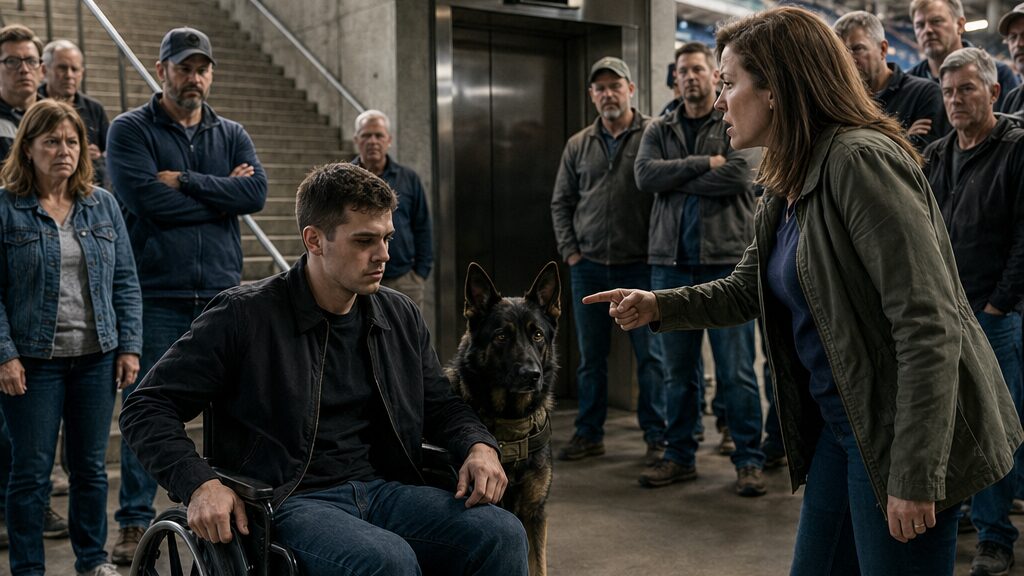
“What exactly is that supposed to mean?”
John kept his voice calm.
Years ago he might have snapped.
Now he simply sounded tired.
The woman pointed toward the ADA ticket.
“It means people fake disabilities all the time.”
John stared at her.
The dog remained standing behind the wheelchair.
Still.
Silent.
“You don’t know me.”
“No,” she said. “I don’t.”
“But I know what scams look like.”
John looked away.
There it was.
The familiar feeling.
Not anger.
Not surprise.
Just exhaustion.
The woman seemed almost disappointed by his lack of reaction.
“You’re awfully young.”
John said nothing.
“Most veterans your age aren’t retired.”
Still nothing.
The crowd moved around them.
Some people slowed.
A few openly listened.
The woman seemed encouraged by the attention.
“My name’s Angela.”
John didn’t answer.
Angela took his silence as permission to continue.
“I volunteer with community programs.”
John rubbed a thumb against the wheelchair armrest.
“Congratulations.”
Her expression tightened.
“I care about people who actually need help.”
The emphasis wasn’t subtle.
The dog shifted position.
Now fully behind John’s chair.
Blocking direct access.
Angela noticed.
“See?”
She pointed.
“That’s another thing.”
John closed his eyes briefly.
Here we go.
“What thing?”
“The dog.”
Several nearby fans slowed.
A man carrying drinks paused.
A teenager glanced over.
Angela lowered her voice but not enough.
“Everyone buys those vests online now.”
The silence that followed felt heavy.
John looked at the floor.
He had heard every version of this conversation before.
Parking lots.
Stores.
Airports.
Restaurants.
People convinced they could identify fraud by instinct.
The younger he looked, the more certain they became.
“You don’t know what you’re talking about.”
His voice remained quiet.
Angela seemed irritated by that calmness.
“I know enough.”
The dog stepped closer to John’s chair.
Its body language changed slightly.
Protective.
Nothing more.
One of the nearby employees noticed.
“Ma’am.”
Angela turned.
“Everything okay here?”
“Fine.”
The employee looked uncertain.
He glanced at John.
“You need anything, sir?”
John shook his head.
“No.”
The employee lingered.
For a moment John thought he might intervene.
Instead he left.
The crowd kept growing.
People always sensed tension.
It attracted them.
A phone appeared.
Then another.
Someone began recording.
John immediately noticed.
His stomach dropped.
Not again.
Angela noticed too.
Instead of backing down, she straightened.
“If you’re legitimate, then why not explain?”
Because I shouldn’t have to.
The answer stayed inside his head.
He had learned long ago that explanations rarely satisfied people who had already reached a conclusion.
The more you defended yourself, the more suspicious they became.
So he remained silent.
Which often looked like guilt.
A trap with no exit.
Angela pointed toward the inaccessible seating level.
“There are people with real disabilities who need those accommodations.”
The words struck harder than she realized.
Real disabilities.
John stared at the staircase.
The steep concrete steps blurred for a moment.
He remembered physical therapy.
The endless exercises.
The falls.
The frustration.
The nights spent staring at a hospital ceiling.
Real disabilities.
The dog nudged his hand.
Grounding him.
Bringing him back.
John took a slow breath.
“Please leave me alone.”
Angela blinked.
The request seemed to surprise her.
Then she frowned.
“That’s not an answer.”
“No.”
His eyes met hers.
“It’s a request.”
For the first time uncertainty flickered across her face.
Not guilt.
Just hesitation.
Then a voice from the crowd spoke up.
“Maybe he’s got a point.”
Angela turned.
A man wearing stadium staff credentials stood nearby.
The same employee from earlier.
“He has ADA credentials.”
Angela folded her arms.
“Anyone can get credentials.”
The employee sighed.
“Ma’am.”
“I’m just asking questions.”
The phrase landed like a hammer.
John had heard it before.
Questions that weren’t really questions.
Questions that only moved in one direction.
The employee looked uncomfortable.
He eventually retreated.
The moment he left, the crowd grew bolder.
A few spectators whispered.
Others openly stared.
Someone zoomed in with a phone camera.
John wished he had never come.
The game hadn’t even started.
And already he wanted to leave.
The dog remained pressed close behind him.
A silent wall.
A steady heartbeat.
The only thing in the entire stadium that felt safe.
Angela looked from the dog to John again.
Then her eyes narrowed.
She pointed.
“That vest looks fake.”
The words hung in the air.
Several heads turned.
Someone nearby nodded.
And for the first time, John realized this wasn’t ending anytime soon.
Chapter 3: The Friend Who Never Left
The crowd eventually drifted away.
Not because they lost interest.
Because kickoff was approaching.
Screens lit up.
Music blasted through the stadium.
People chose football over confrontation.
For now.
John rolled toward a quieter waiting area near a service stairwell.
The broken elevator remained unchanged.
The red warning message still glowed above the doors.
OUT OF ORDER.
The dog walked beside him without pulling on the leash.
Every few seconds it glanced up to check his position.
The habit was so familiar that John barely noticed it anymore.
He stopped near an empty stretch of wall.
For the first time all afternoon, nobody was staring.
Nobody was recording.
Nobody was questioning him.
The silence should have felt like relief.
Instead it felt fragile.
Like something temporary.
The dog sat.
John rested both hands on the wheels.
The adrenaline from the confrontation was fading.
That wasn’t always a good thing.
Sometimes anger held panic at bay.
When anger left, other things rushed in.
The dog noticed first.
It always did.
Its nose pressed gently against his wrist.
John exhaled.
“I’m fine.”
The dog continued staring at him.
He almost laughed.
“You never believe me.”
The dog remained unconvinced.
A voice echoed through nearby speakers.
Pregame announcements.
Crowd participation prompts.
Nothing unusual.
Yet John’s shoulders tightened anyway.
The dog noticed.
Of course it noticed.
Years earlier, after the injury, doctors had introduced the possibility of a service animal.
John hated the idea.
He hated needing help.
Hated depending on something.
Or someone.
He had fought it for months.
Then he’d met the dog.
Everything changed after that.
Not immediately.
Trust took time.
The dog had earned it one quiet day after another.
One nightmare.
One panic attack.
One impossible morning.
At a time.
Now it understood him better than most people ever had.
Footsteps approached.
John looked up.
A woman stood several yards away.
The same woman he’d seen earlier with her family.
Betty.
Though he didn’t know her name yet.
She appeared embarrassed.
“Sorry,” she said.
“I wasn’t trying to eavesdrop.”
John nodded politely.
She pointed toward an empty section nearby.
“Mind if I sit?”
He hesitated.
Then shrugged.
She sat carefully.
Neither spoke for several moments.
The dog watched her.
Not suspicious.
Evaluating.
Betty smiled weakly.
“Beautiful dog.”
John reached down and scratched behind its ears.
“Yeah.”
The dog leaned into the touch.
The movement looked almost human.
Betty noticed.
“He really loves you.”
The comment caught John off guard.
Most people asked about training.
Or certifications.
Or commands.
Not love.
His eyes stayed on the dog.
“He’s the reason I leave the house.”
The words slipped out before he could stop them.
Betty’s expression softened.
Neither said anything afterward.
The silence wasn’t uncomfortable.
Just honest.
A nearby announcement suddenly blasted through the speakers.
John flinched.
Only slightly.
But the dog reacted instantly.
Its head rose.
Attention sharpening.
Betty noticed that too.
“Is everything okay?”
John forced a smile.
“Yeah.”
The lie sounded thin.
The dog moved closer.
Pressing against the side of the wheelchair.
A practiced maneuver.
Betty watched carefully.
Understanding dawning.
Not fully.
But enough.
“This isn’t just a service dog, is it?”
John looked down.
The answer felt heavier than it should.
“No.”
Betty waited.
When he didn’t continue, she simply nodded.
Strangely, he appreciated that.
No demands.
No interrogation.
No assumptions.
Another announcement echoed through the stadium.
Louder this time.
The crowd roared in response.
John swallowed.
His heartbeat quickened.
The dog placed its head across his knee.
Grounding.
Anchoring.
Stay here.
Stay now.
The message required no words.
Betty quietly stood.
“I’ll give you some space.”
John nodded.
She started walking away.
Then paused.
“Whatever happened earlier…”
She glanced toward the concourse.
“It didn’t seem right.”
John looked away.
He didn’t trust himself to answer.
Betty continued toward the seating area.
The dog remained beside him.
The stadium noise swelled.
Lights flashed.
Thousands of voices merged into one giant pulse.
John lowered a hand onto the dog’s head.
Its fur felt warm beneath his fingers.
Steady.
Real.
The one thing that never changed.
The one thing that never asked him to prove anything.
The one thing that stayed.
He leaned down slightly.
His voice barely audible beneath the noise.
“You’re the only friend I have left.”
Chapter 4: Echoes Nobody Else Could Hear
The stadium lights suddenly strobed across the upper decks.
John’s hand tightened around the dog’s collar.
The reaction was immediate.
Not panic.
Not yet.
Just the first warning.
The crowd erupted somewhere beyond the concrete walls. Tens of thousands of voices merged into a single wave of sound.
The dog rose.
Alert.
Focused entirely on him.
John stared at the floor.
Three breaths in.
Three breaths out.
The techniques still worked most days.
Most days.
A booming voice echoed from the stadium speakers.
“ARE YOU READY?”
The response from the crowd shook the building.
John felt the vibration through the wheels of his chair.
His shoulders stiffened.
The dog nudged his leg.
Once.
Twice.
Grounding behavior.
Trained.
Deliberate.
He placed a hand on its head.
“I’m okay.”
The dog ignored the statement.
Nearby, a maintenance worker crossed the concourse carrying tools. The broken elevator remained untouched.
The red warning message still glowed above the doors.
OUT OF ORDER.
John focused on it.
A simple object.
A simple problem.
Stay here.
Stay now.
The crowd roared again.
For a moment another sound slipped underneath it.
Not real.
A memory.
Metal.
Shouting.
Something striking concrete.
John blinked hard.
Gone.
The dog stepped closer.
Its body pressed lightly against his wheelchair.
Another practiced intervention.
The animal knew the sequence better than he did.
A few yards away, Betty had returned.
She stood near a railing, pretending to check her phone.
John noticed she wasn’t really looking at the screen.
She was watching him.
Not with curiosity.
With concern.
That somehow felt worse.
Concern invited questions.
Questions invited explanations.
Explanations invited memories.
He didn’t want any of them.
A sharp whistle echoed from the field.
John flinched.
The dog immediately placed its front paws against the side of the wheelchair.
Interrupt.
Refocus.
Breathe.
Betty’s eyes widened.
She finally understood that this wasn’t ordinary service-animal behavior.
The dog wasn’t assisting mobility.
It was monitoring him.
Protecting him.
A stadium employee approached.
“Sir?”
John looked up.
“The accessibility manager wanted me to let you know they’re still working on alternatives.”
Alternatives.
John almost laughed.
The employee shifted awkwardly.
“We haven’t forgotten about you.”
John nodded.
“I know.”
The employee left.
The dog remained standing.
Watching.
Waiting.
Never relaxing completely.
Betty slowly walked closer.
“You don’t have to answer this,” she said carefully. “But has he done that before?”
John looked down at the dog.
“Every day.”
Betty frowned.
“He knows when something’s wrong?”
“Before I do.”
The answer slipped out.
Betty didn’t respond immediately.
She watched the dog.
The dog watched John.
And suddenly the relationship between them looked different.
Not owner and pet.
Not handler and service animal.
Something closer to partnership.
Another wave of cheers exploded from inside the stadium.
John’s heartbeat jumped.
The dog instantly pushed its head beneath his hand.
Interrupting the spiral before it could deepen.
Betty noticed again.
Her expression changed.
Something from earlier no longer fit.
The assumptions.
The accusations.
The story everyone had been telling themselves.
Pieces were beginning to break apart.
Footsteps echoed behind them.
Angela appeared.
John felt his stomach drop.
Not because he feared her.
Because he was tired.
Deeply tired.
Angela stopped several feet away.
Her eyes moved between John and the dog.
Then to Betty.
Then back.
“There you are.”
John said nothing.
Angela crossed her arms.
“I’ve been trying to find someone who can actually verify that dog.”
Betty immediately frowned.
“Maybe leave him alone.”
Angela looked surprised.
“I’m not harassing anyone.”
“Looks like you are.”
Angela’s jaw tightened.
“I care about accessibility abuse.”
The words sounded rehearsed now.
As though she had repeated them several times.
Maybe she had.
Maybe she truly believed them.
John almost wished she were simply cruel.
That would have been easier.
Instead she looked like someone convinced she was helping.
Which made the situation harder to hate.
And harder to stop.
Angela pointed toward the dog.
“If it’s legitimate, proving it shouldn’t be a problem.”
John closed his eyes.
The dog pressed against him again.
His pulse was climbing.
The noise.
The crowd.
The confrontation.
The lights.
Everything felt closer now.
Tighter.
Angela noticed his silence and mistook it.
“You see?”
She turned slightly toward a few nearby spectators.
“That’s what I’m talking about.”
The small audience began growing again.
Not many.
Just enough.
A handful became a dozen.
A dozen became more.
Phones appeared.
John stared at the floor.
The dog moved behind the wheelchair.
Blocking anyone from approaching.
A protective wall.
The crowd murmured.
Angela pointed.
“Look at that.”
Nobody spoke.
For the first time uncertainty entered the faces around her.
The dog’s behavior didn’t look fake.
It looked purposeful.
Professional.
Focused.
And somehow that made Angela push harder.
“If he’s hiding something, people deserve to know.”
John’s hands shook slightly.
Not from anger.
From pressure.
Too many voices.
Too much noise.
Too many eyes.
Then the stadium lights dimmed.
The pregame show began.
A deep bass note rolled through the structure.
The concrete floor vibrated.
The dog immediately snapped to full attention.
Every muscle in its body tightened.
John felt cold.
Because the dog knew.
The animal had recognized something before he had.
And when the giant stadium speakers powered up for the main presentation, John realized he was no longer sure he could hold himself together.
Chapter 5: The Cost Of Coming Home
The explosion of sound hit like a physical blow.
Not a real explosion.
A stadium effect.
Music.
Pyrotechnics.
Crowd noise.
But John’s body didn’t know the difference.
His hands flew to his ears.
The world vanished.
The stadium disappeared.
The crowd disappeared.
Concrete became dust.
Light became fire.
His breath caught halfway inside his chest.
The dog moved instantly.
No hesitation.
No command.
Years of training took over.
The animal slammed against his wheelchair and forced itself into position.
Ground.
Cover.
Protect.
John barely registered it.
The sound kept coming.
His vision narrowed.
Someone was shouting.
Or maybe several people.
The voices blurred together.
The crowd that had gathered around him stepped backward in alarm.
Phones lowered.
Faces changed.
Confusion replaced certainty.
The dog barked once.
A sharp command bark.
Not at John.
At everyone else.
Stay back.
The wheelchair shifted.
One wheel caught awkwardly against the concrete.
John lost balance.
The next moment he was on the ground.
Curled tightly.
Hands pressed against his head.
Trying to stop sounds that weren’t there.
The dog immediately dropped across him.
Heavy.
Protective.
Creating a barrier between him and the world.
The entire scene froze.
People stared.
Nobody knew what to do.
Angela’s mouth opened.
Then closed.
For the first time since she’d arrived, she said nothing.
John trembled beneath the dog’s weight.
Fragments flashed through his mind.
Voices.
Names.
Faces.
People laughing before deployment.
People making promises.
People who never came home.
The dog remained perfectly positioned.
Not moving.
Not leaving.
A living shield.
Betty pushed through the edge of the crowd.
“Oh my God.”
Nobody answered.
A stadium employee rushed forward.
The dog growled.
Low.
Controlled.
Warning.
The employee stopped immediately.
“He needs help.”
Another worker shook his head.
“Look at the dog.”
The animal wasn’t attacking.
It was working.
Protecting.
Waiting.
Several spectators exchanged uneasy glances.
The entire argument from earlier suddenly felt absurd.
Nobody faked this.
Nobody trained a dog to do this for attention.
The reality was impossible to ignore.
John’s pant leg had shifted during the fall.
A prosthetic attachment became visible.
Then more.
A collective silence spread through the crowd.
People noticed.
One after another.
The wheelchair.
The protective dog.
The reaction.
The prosthetics.
The pieces finally connected.
Angela stared.
The certainty drained from her face.
She looked almost lost.
As if the story she’d been telling herself had shattered too quickly.
The dog continued its work.
Keeping pressure against John’s body.
Reducing stimulation.
Blocking movement around him.
A woman in the crowd quietly lowered her phone.
Then another.
The mood had changed completely.
No one wanted footage anymore.
They wanted answers.
John struggled to breathe evenly.
The stadium sounds slowly became real again.
Not explosions.
Not memories.
Just a game.
Just speakers.
Just a crowd.
The dog sensed the shift.
Its posture relaxed slightly.
Not much.
Just enough.
A stadium medic approached cautiously.
The dog watched but didn’t react.
Permission.
A small sign that the danger was passing.
The medic knelt nearby.
“We’re not going to touch him.”
The reassurance wasn’t for John.
It was for the dog.
Several people exchanged surprised looks.
The medic understood.
This wasn’t the first service animal he’d seen.
The dog finally lifted its head.
John’s breathing steadied.
Slowly.
Painfully.
He opened his eyes.
The first thing he saw was the dog.
Of course it was.
Always the dog.
Its gaze never left him.
Then he became aware of the crowd.
The silence.
The staring.
The shame hanging in the air.
His stomach twisted.
Not because they knew.
Because they had seen.
The thing he worked hardest to hide.
Weakness.
Fear.
The parts of himself he couldn’t control.
A small object slid across the concrete nearby.
Nobody noticed at first.
Then Betty pointed.
A military identification card.
It had fallen from John’s jacket during the collapse.
The card lay face-up.
Visible.
Unmistakable.
And suddenly the crowd had something they could no longer explain away.
Chapter 6: What Loyalty Looks Like
The dog refused to move.
Even after John was breathing normally again.
Even after the medic backed away.
Even after the stadium noise settled into distant background sound.
The animal remained stretched partly across him.
Guarding.
Watching.
Waiting for danger that nobody else could see.
John hated that dozens of strangers were witnessing this.
He wanted to disappear.
Instead he lay on cold concrete while everyone stared.
The military identification card remained a few feet away.
No one touched it.
No one needed to.
They had already seen enough.
A stadium employee carefully picked it up and handed it to the medic.
The medic glanced at the card.
Then at John.
His expression changed immediately.
Respect.
Recognition.
No questions.
No suspicion.
Just understanding.
The contrast hurt more than John expected.
Because it proved how quickly people could change once they had proof.
The dog finally shifted.
Not completely off him.
Just enough for John to sit upright.
A hand touched his shoulder.
The medic.
“You with me?”
John nodded.
His throat felt dry.
The medic offered a bottle of water.
John accepted it.
The simple act exhausted him.
Around them, nobody spoke.
The crowd that had once leaned forward eagerly now seemed desperate to look anywhere else.
Angela stood frozen near the back.
She looked smaller somehow.
Not physically.
Emotionally.
Like certainty had been carrying half her weight.
The dog sat directly beside John.
Close enough that their shoulders touched.
John rested a hand against its neck.
Steady.
Warm.
Present.
A nearby spectator finally broke the silence.
“That dog knew before it happened.”
Nobody answered.
Because everyone had seen it.
The signs.
The positioning.
The interventions.
The warning bark.
The protective cover.
The dog hadn’t reacted to the crisis.
It had anticipated it.
Betty stepped forward.
Her eyes remained fixed on the animal.
“He’s done this before, hasn’t he?”
John hesitated.
Then nodded.
The answer felt strangely difficult.
Betty swallowed.
“Many times?”
A pause.
“Enough.”
No one spoke afterward.
The single word carried more weight than a long explanation ever could.
Enough.
Enough episodes.
Enough bad nights.
Enough memories.
Enough pain.
The crowd slowly began understanding that this afternoon wasn’t unusual for him.
It was familiar.
Routine.
Part of a life they had never imagined.
Angela took one hesitant step forward.
Then stopped.
The confidence that had driven her earlier was gone.
In its place stood uncertainty.
And something that looked dangerously close to regret.
John looked away before their eyes could meet.
He wasn’t ready for apologies.
Maybe he never would be.
The dog leaned against his leg.
Grounding him again.
The movement triggered a memory.
Hospital corridors.
Therapy rooms.
Months of learning how to exist after everything changed.
The dog had been there through all of it.
Not because it understood war.
Because it understood him.
A stadium employee approached quietly.
“The accessibility manager is on the way.”
John nodded.
The employee lingered.
Then glanced at the dog.
“That’s an incredible animal.”
John looked down.
The dog’s ears twitched.
“It’s the reason I’m here.”
The words slipped out before he could stop them.
Several people heard.
No one laughed.
No one challenged him.
For the first time all day, nobody questioned what he meant.
Across the crowd, Angela lowered her head.
The silence stretched.
Then Betty spoke softly.
Not to John.
Not really.
More to herself.
“My son’s twenty.”
Everyone looked toward her.
She wiped at her eyes.
“He complains when his internet goes down.”
A weak laugh escaped her.
Then disappeared.
Her voice broke.
“My son’s home playing video games…”
She looked at John.
Then at the prosthetics.
Then at the dog beside him.
“…and this kid gave up his legs for us.”
No one answered.
Because there was nothing to say.
The words settled over the crowd like a weight.
Not praise.
Not celebration.
Just perspective.
And for the first time all afternoon, John wished people would stop looking at his injuries and see something else.
Something harder to explain.
The loneliness.
The empty chair at every holiday gathering.
The names that still lived inside his head.
The reason he had whispered those words to the dog.
You’re the only friend I have left.
The dog nudged his hand.
As if reminding him it was still there.
Still listening.
Still staying.
John closed his eyes briefly.
Then opened them again.
The crowd wasn’t looking at him with suspicion anymore.
But that didn’t make the attention easier.
If anything, it felt heavier.
Because now they understood enough to feel sorry for him.
And he wasn’t sure which feeling he hated more.
Chapter 7: Leaving Through The Same Broken Door
“Mr. Campbell?”
The voice came from behind the crowd.
People stepped aside.
The stadium accessibility manager approached carefully, as though afraid one wrong movement might make everything worse.
John was back in his wheelchair now. The dog sat pressed against his side.
The manager stopped several feet away.
He looked at the broken elevator.
Then at John.
Then at the crowd.
His expression carried the uncomfortable realization that the situation had become much bigger than a maintenance problem.
“I’m sorry,” he said quietly.
John nodded once.
The apology wasn’t really about the elevator anymore.
The manager seemed to understand that.
“We should have handled this better.”
John looked toward the flashing OUT OF ORDER sign.
The same sign that had greeted him when he arrived.
The same sign still glowing now.
Hours later.
The manager followed his gaze.
“We can get you to your vehicle through a service route if you’d like.”
For a moment John’s first instinct was the same one it always was.
No.
Refuse help.
Handle it yourself.
The habit was automatic.
A reflex built over years.
The dog leaned lightly against his leg.
Grounding.
Waiting.
John surprised himself.
“Okay.”
The single word felt strange.
The manager looked relieved.
“I’ll arrange it.”
He walked away.
Several spectators began drifting back toward the game.
The crowd was shrinking now.
The spectacle was over.
Only the weight of it remained.
Betty lingered nearby.
She offered John a small smile.
Not pity.
Not admiration.
Just kindness.
The sort of thing he had forgotten existed outside military circles.
“Take care of yourself,” she said.
John almost gave the automatic answer.
You too.
Goodbye.
End of conversation.
Instead he paused.
“You too.”
Something about the exchange felt different.
More real.
Betty nodded and left.
The dog watched her go.
Then returned its attention to John.
Always back to John.
A few minutes later another figure stepped forward.
Angela.
John saw her coming and immediately looked away.
Part of him hoped she would change her mind.
She didn’t.
The closer she came, the less certain she appeared.
Gone was the confidence.
Gone was the certainty.
What remained was a woman carrying the consequences of being wrong.
She stopped beside the wheelchair.
Neither spoke.
The silence stretched.
Finally Angela exhaled.
“I owe you an apology.”
John stared at the floor.
The dog remained still.
Watching.
Not hostile.
Just attentive.
Angela clasped her hands together.
“I thought I was doing the right thing.”
John believed her.
That was the problem.
If she had been cruel, this would have been easier.
Cruel people were simple.
Angela wasn’t.
She had seen something suspicious.
Filled in the blanks.
Then refused to stop when the evidence stopped supporting her assumptions.
“I’ve seen people fake things before,” she said.
“I know.”
His voice surprised even him.
Angela looked up.
“You do?”
John nodded.
“People tell me that every time.”
The words landed harder than he intended.
Angela swallowed.
For the first time she seemed to understand that today hadn’t been unique.
Not for him.
Just another version of something familiar.
Another accusation.
Another test.
Another stranger demanding proof.
“I’m sorry,” she repeated.
This time there was no defense attached.
No explanation.
Just the words.
John looked at her.
Really looked at her.
The shame in her face appeared genuine.
But something inside him resisted.
Not anger.
Exhaustion.
The kind that accumulates over years.
You forgive one person.
Then another.
Then another.
And eventually you realize the problem isn’t any individual.
It’s how quickly people assume.
How eagerly they decide who deserves help.
John glanced down at the dog.
Its head rested calmly against his knee.
No judgment.
No expectations.
Just presence.
Angela followed his gaze.
“That dog saved you.”
John shook his head slightly.
“No.”
She frowned.
“What do you mean?”
The answer came before he could stop it.
“He keeps saving me.”
Silence followed.
Angela’s eyes filled briefly.
She looked away.
For the first time all afternoon, she seemed unable to find words.
Eventually she stepped back.
“I hope things get better.”
John almost laughed.
Not because the statement was wrong.
Because it was impossible to answer.
Instead he nodded.
Angela left.
The dog watched her disappear into the crowd.
Then looked back at him.
The manager returned with a staff member.
“We’re ready.”
John placed his hands on the wheels.
The service corridor waited beyond a nearby security door.
A different route.
A quieter route.
As they began moving, the dog walked beside the chair.
Exactly as it had all day.
The crowd noise faded behind them.
Concrete hallways replaced bright stadium lights.
For the first time in hours, the air felt still.
The manager walked ahead.
The staff member held open doors.
No one spoke much.
John found himself oddly grateful for that.
Near the exit, the manager glanced back.
“Can I ask you something?”
John nodded.
“You came here alone?”
The question hung in the air.
The truthful answer would have sounded pathetic.
The easy answer would have been a lie.
John looked down at the dog.
The dog looked back.
Waiting.
Always waiting.
“No,” John said.
The manager looked confused.
John reached down and scratched behind the dog’s ears.
The dog’s tail moved once.
A small motion.
A familiar motion.
The manager’s expression softened.
He understood.
Outside, evening sunlight stretched across the parking lot.
John rolled toward his vehicle.
The dog stayed close.
The same way it always did.
The same way it had through hospitals.
Through sleepless nights.
Through panic attacks.
Through empty apartments.
Through memories that refused to stay buried.
John stopped beside the vehicle.
For a moment he looked back toward the stadium.
The elevator was hidden now.
The crowd was hidden.
The arguments were hidden.
Yet something had changed.
Not the world.
Not completely.
Maybe not even the people inside it.
But something inside him.
A crack in a wall he had spent years building.
Betty’s kindness.
The medic’s patience.
Even Angela’s apology.
None of it erased the loneliness.
None of it erased the names he still carried.
The friends who never came home.
The guilt.
The memories.
But for the first time in a long while, he found himself wondering whether isolation had become another injury he was protecting instead of healing.
Veteran support groups had called.
Emailed.
Reached out.
He had ignored every one.
Maybe because staying alone felt safer.
Maybe because loneliness eventually became familiar.
The dog nudged his hand.
John smiled faintly.
“You probably knew that already.”
The dog stared back.
Patient as ever.
John opened the vehicle door.
Then paused.
The future still looked uncertain.
The wounds were still there.
Tomorrow would still be difficult.
But for once, he didn’t feel quite as invisible.
He looked down at the dog.
“Come on.”
Together they moved forward.
The story has ended.