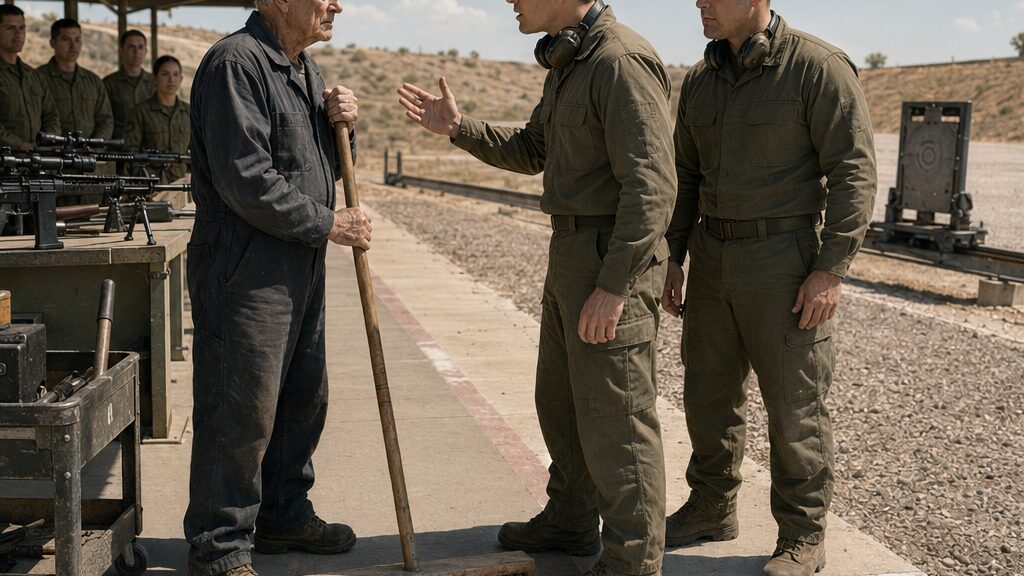
They Mocked the Old Man Holding a Broom Until the Range Went Quiet
Chapter 1: The Old Man Who Would Not Move
“Move him before somebody trips over the janitor.”
Staff Sergeant James Torres said it loudly enough for the trainees behind him to hear.
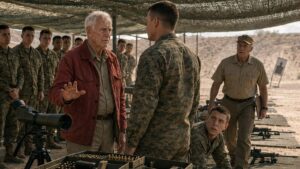
A few faces turned. One young soldier looked away at once. Another let out a breath that might have been a laugh. Rifles rested in neat rows on the shooting platform, their black barrels pointed safely downrange, while Gary Allen stood across the entrance to Lane Four with both hands around the scarred handle of a push broom.
The broom head lay over the painted red boundary line.
Gary did not move it.
The sun had not yet reached its full heat, but the concrete already radiated through the soles of his work shoes. His dark coveralls were clean except for pale dust at the knees. Near his right thumb, three faded notches cut across the broom handle.
James stepped closer.
“We have forty-two shooters to qualify before sixteen hundred,” he said. “Maintenance was supposed to finish an hour ago.”
“Maintenance did finish.”
“Then clear the lane.”
Gary looked past him toward the steel target carrier at the far end of Lane Four. Its rectangular face sat slightly left of center. Not much. Two inches, perhaps less from this distance. Enough.
“The lane stays cold until the carrier is checked under load.”
James glanced toward the target, then back at Gary. “It was checked yesterday.”
“Not hot.”
Alexander Harris stood beside James with his arms folded. Taller, broader, and usually quieter, he followed Gary’s gaze toward the carrier. Behind them, trainees waited in helmets and protective glasses. The interruption had made an audience of everyone.
James spread one hand toward the firing line.
“You sweep brass. We run the range.”
Gary’s fingers tightened around the wood. A tremor moved through his right hand, small but visible. He shifted his grip until the handle steadied against his palm.
James noticed.
His mouth bent into a thin smile. “The only thing you’re qualified to stop is dust.”
This time the laugh was unmistakable, though it came from only one man near the back.
Gary felt the words strike where they were meant to strike. Not at his work. At his age. At the shaking hand. At the coveralls that carried no name tape, rank, or history.
He had worn enough things with his name on them.
He planted the broom more firmly across the line.
“This lane stays cold.”
James’s expression hardened. “On whose authority?”
“Maintenance stop.”
“That requires a documented fault.”
“You have one.”
“I have an old man standing in my lane.”
For a moment, the range seemed to contract around them. The targets, berms, rifles, and watching faces became one narrow corridor leading back through years Gary had spent refusing to revisit.
He could have explained the offset. He could have named the guide assembly, the mounting plate, the way morning alignment lied once the rail absorbed heat. He could have said he had seen the same angle before.
Instead he said, “Cycle it manually.”
James stared at him.
“Why?”
“Because it’ll pull left before it seats.”
The armorer, who had been checking a weapon at the next table, lifted his head.
James looked toward the control shelter. “Alexander.”
Alexander hesitated, then went to the panel. “Clear downrange?”
“Clear,” James said.
The trainees shifted back from the line. Alexander pressed the manual return control.
Far downrange, the target face began sliding along its rail.
Gary watched the top edge, not the center.
Halfway home, it drifted left.
Only slightly.
James saw it and said, “Guide roller.”
Gary kept watching.
The carrier slowed as it approached the stop.
“There,” he said.
A low metallic tick traveled up the lane.
It was not loud. A fingernail against steel would have made more noise.
But Alexander released the switch.
His folded, mildly amused expression disappeared. He looked from the carrier to Gary, then down to the broom handle. His eyes paused on the three notches near Gary’s thumb.
James turned toward the armorer. “What was that?”
“Could be the stop pin,” the armorer said. “Could be normal play.”
“It isn’t,” Gary said.
James faced him again. “And you know that from sweeping?”
Gary let the insult pass.
“The carrier is walking left. Static alignment won’t show you why. Heat it and the mount will open farther.”
“Then write the fault.”
“I did.”
“Write the technical basis.”
Gary’s grip shifted once more. The old instinct rose in him: say only what could be proved, never what memory insisted was true. Certainty had injured people before. So had hesitation.
“I haven’t seen it under heat load.”
James gave a short, disbelieving laugh. “You just shut down a qualification lane over something you won’t even claim is defective.”
“I claimed it needs checking.”
“That is not the same thing.”
“No.”
The honest answer seemed to anger James more than an argument would have.
He looked at the waiting trainees, then at the clock mounted outside the shelter. Every minute was becoming visible on his face.
“You’re obstructing scheduled training,” he said. “If the override inspection clears this lane, I’m filing the report myself.”
Gary nodded once.
“And if it passes,” James continued, “you will be removed from the range.”
Alexander stepped nearer. “James, the carrier did pull.”
“Which is why we’ll inspect it.” James did not take his eyes off Gary. “Properly. By qualified personnel.”
Gary looked down at the broom head stretched across the red line. Dust had gathered in its bristles. A spent casing from the previous day lay trapped beneath one corner, bright against the concrete.
He nudged it free with his boot but left the broom where it was.
James turned to the duty officer. “Call Operations. Tell them I want an official override inspection on Lane Four.”
Then he pointed at Gary.
“And tell them why.”
Chapter 2: A Stop Order With No Rank Behind It
Deborah Thompson held Gary’s stop order by one corner as though the blank space beneath it might stain her fingers.
“There is no technical report attached.”
James stood across from her desk, still wearing his range cap. Through the office window, he could see Gary’s broom leaning against the outside wall. It looked abandoned there, bristles flattened, handle casting a narrow shadow across the walkway.
“He refused to provide one,” James said.
Gary sat in the chair near the filing cabinet. He had removed his work gloves and folded them on one knee. His hands looked older without them.
“I provided the observed condition,” he said.
Deborah read aloud. “‘Carrier face displaced left during manual return. Abnormal contact sound before seating. Recommend inspection under operating temperature.’”
She looked over the page. “That is an observation, not a diagnosis.”
“Yes.”
James exhaled. “This is what I’ve been dealing with.”
Deborah ignored him. She had managed range operations long enough to know that two men speaking calmly could consume more time than two men shouting.
“Gary, did you inspect the guide rollers?”
“Visual only.”
“Mounting bolts?”
“Couldn’t access them without taking the lane down.”
“Which you did.”
“For safety. Not disassembly.”
“Did you measure the displacement?”
“From the firing line.”
“With what?”
Gary glanced toward the window.
James followed his eyes to the broom outside.
“You used a broom?”
“I used the line marks.”
Deborah lowered the paper. “That answer is not helping you.”
Gary said nothing.
James leaned forward, palms on the desk. “I need the lane today. Not next week, not after someone searches every maintenance theory he refuses to explain. Today. If there is a fault, I’ll shut it down myself. But I cannot cancel qualification because a part-time employee heard a noise.”
Gary looked at him. “You heard it too.”
The words were quiet, which made James feel as if the room had shifted against him.
He straightened. “I heard a tick.”
“The carrier pulled left.”
“A loose roller can do both.”
“Yes.”
James waited for more. None came.
Deborah pushed the stop order toward Gary and placed a pen beside it. “Add a statement that the lane is unsafe for operation.”
Gary did not reach for the pen.
“You closed it,” she said. “If you believe it is unsafe, sign the statement.”
“I believe it requires a heat-load inspection.”
“That is not what I asked.”
“It is what I know.”
James gave a humorless laugh. “He wants the authority without the responsibility.”
Gary’s jaw tightened, barely.
Deborah saw it. So did James.
For the first time, James wondered whether the old man’s silence was restraint or calculation. Perhaps Gary enjoyed forcing everyone else to make the decision. Perhaps age had taught him how to hold up a system without ever placing his own name beneath the consequences.
The door opened, and the armorer stepped in with a tablet tucked under one arm.
“I checked the guide housing,” he said. “Left roller has play. Not enough to explain all of the drift.”
James turned. “All?”
The armorer glanced toward Gary. “It moved in the direction he said it would.”
“That was visible.”
“Not before the cycle.”
James looked at him sharply.
The armorer continued. “I would have expected right-side drag from the wear pattern. He called left.”
The room went still.
Outside, a gust tipped the broom away from the wall. The handle struck the siding once before settling at an angle.
Deborah looked at Gary. “How did you know?”
Gary rubbed his thumb across the side of his forefinger.
“The face didn’t lead the movement,” he said. “The top bracket did.”
The armorer’s brows lifted.
James saw the reaction. “Meaning?”
“Meaning,” the armorer said, “he wasn’t guessing from the target. He was watching the mount.”
Gary looked down at his gloves.
James felt his certainty weaken, and resentment rushed in to fill the space it left. A man who knew that much could have said it on the range. Could have prevented the spectacle, the delay, the call to Operations.
Unless the spectacle was the point.
Deborah opened a folder on her computer. “Gary has filed six maintenance concerns in the last eleven months.”
James looked at her. “Six?”
“Three electrical, two drainage, one target system.” She scrolled. “All confirmed.”
“Then why is he sweeping lanes?”
Gary answered before Deborah could. “Because lanes need sweeping.”
It was not self-pity. That made it harder for James to dismiss.
Deborah opened one of the older reports. “These are unusually detailed for maintenance tickets.”
James stepped around the desk.
On the screen, Gary had described a drainage failure by the angle of soil collapse and the sequence of water pooling. Another report identified intermittent voltage loss by the delay between relay engagement and motor response.
No flourish. No claim to expertise. Only exact observations.
“Where did you learn this?” James asked.
Gary picked up the pen.
For a second, James thought he would sign.
Instead, Gary drew a line through the sentence Deborah had added: I certify that Lane Four is unsafe for all operation.
Below it he wrote: I certify that the observed condition has not been tested under heat load and should not be cleared until it is.
He signed his name beneath that.
Deborah stared at the page. “You understand this may not protect the closure.”
“It isn’t meant to protect the closure.”
“What is it meant to protect?”
“The truth.”
James looked toward the window again. The broom remained tilted against the wall, ordinary and ridiculous beside the range signs.
A knock sounded. The maintenance clerk entered carrying a thick binder with a cracked plastic cover.
“You asked for historical target-carrier procedures?”
Deborah took it. “Anything for the original Lane Four installation.”
The clerk left. Deborah opened the binder, turning past yellowed inspection sheets and diagrams copied so many times their lines had faded.
James checked the wall clock. “The inspector will be here in forty minutes.”
Deborah did not answer.
She had stopped on a page near the center.
“What?” James asked.
She rotated the binder toward him.
A paragraph had been underlined in blue ink decades earlier:
Do not certify guide alignment from a cold cycle alone when lateral displacement begins at the upper mounting point. Confirm under operating heat or remove the lane from service.
James read it twice.
The phrasing was not merely similar to Gary’s report.
It was almost exact.
At the bottom of the page, the space where an author or approving technician should have been listed was empty.
Deborah looked across the desk at Gary.
“Did you write this?”
Gary’s eyes settled on the old words.
He did not answer.
Chapter 3: The Marks Cut Into the Broom
Alexander laid the broom beside the exposed carrier rail and found that the first notch matched the distance from the painted boundary to the outer guide.
He thought it was coincidence until the second notch aligned with the center bracket.
The third matched the permitted lateral tolerance.
He crouched on the hot concrete, one hand on the wooden handle, and looked toward the maintenance shed where Gary was sorting tools.
The broom was not a secret instrument. It had no hidden compartment, no engraved insignia, no evidence of importance except three shallow cuts darkened by years of dirt and oil. Anyone else would have used a tape measure.
Gary had apparently used whatever was already in his hand.
Alexander carried the broom into the shed.
Gary did not look up. “Put it back.”
“What are the marks?”
“Marks.”
“I figured that part out.”
Gary placed a socket into a drawer.
Alexander set the broom across the workbench. “They line up with Lane Four.”
“They line up with several things.”
“The third one is the lateral tolerance.”
Gary closed the drawer.
Outside, the range remained quiet while the inspection team worked. No shouted commands. No rifle reports. Only tools striking metal and the occasional radio call from the control shelter.
Alexander touched the first notch. “How long have you been checking the carriers?”
“I maintain the lanes.”
“That isn’t what I asked.”
Gary picked up his gloves but did not put them on. His right hand trembled once, then stilled against the bench.
Alexander lowered his voice. “You called the drift before the carrier moved. You knew where to look. Now I find an old manual written in your language and a measuring guide cut into your broom.”
“It’s not a measuring guide.”
“What is it?”
“A broom.”
Alexander almost smiled, then saw Gary’s face and did not.
He had stood beside James that morning. He had heard the joke about dust. He had watched Gary absorb it and had done nothing because challenging James in front of trainees would have weakened the acting range lead.
That had been the explanation he gave himself.
Now it sounded like an excuse.
“Did you write the procedure?” Alexander asked.
Gary looked past him toward the doorway. “Parts of it.”
The answer landed more heavily than Alexander expected.
“You were maintenance back then?”
“No.”
“What were you?”
Gary pulled on one glove, working each finger into place.
“Range safety.”
Alexander waited.
Gary put on the other glove.
“For how long?”
“Long enough.”
“You trained people here?”
Gary looked at him then. The restraint in his face was not emptiness. It was pressure held behind a closed door.
“I trained crews on this range before you were old enough to be issued a rifle.”
There was no pride in it. No challenge.
Alexander glanced down at the broom between them.
“Why didn’t you say that this morning?”
“Would it have changed the carrier?”
“It might have changed how James spoke to you.”
“That is James’s business.”
“It became everyone’s business when he did it in front of the line.”
Gary lifted the broom and returned it to the wall.
“Then everyone learned something about him.”
“And nothing about you.”
“That was not the task.”
Alexander felt irritation rise, mixed with something closer to shame. “You make it hard to help you.”
Gary faced him. “I didn’t ask you to.”
A vehicle door slammed outside. The installation safety inspector had arrived.
Alexander followed Gary toward Lane Four, but Deborah intercepted him near the records office. She held several photocopied pages.
“Come here,” she said.
Inside, the air-conditioning rattled above shelves of binders. Deborah spread the pages over a table.
“We found the first edition of the target-system procedure,” she said. “Allen is listed as a contributing instructor on the routing sheet.”
“So why is his name missing from the final manual?”
Deborah slid another page forward.
The document was an incident summary from twenty-nine years earlier. Most names had been redacted in the copy, but Gary Allen remained visible in a block marked Personnel Actions.
Alexander read the first lines.
A target carrier had failed during qualification. A steel assembly had jumped its track. One trainee suffered a serious leg injury. Training was suspended for eleven days.
“Was Gary blamed?”
“Keep reading.”
The findings section had been copied poorly. Several sentences vanished into gray bands, but fragments remained:
Prior indication of lateral displacement…
Observed by SFC Allen…
Reporting delay…
Alexander stopped.
Deborah folded her arms. “That phrase appears twice.”
“Do we have the full investigation?”
“Not here. Records may have it, assuming it survived digitization.”
“What happened to him?”
“He left range instruction within the year. After retirement, he came back through civilian maintenance.”
Alexander looked through the office window.
Gary stood near Lane Four with the safety inspector and armorer. James was speaking, pointing toward the guide housing. Gary remained a step outside the group, holding his broom upright. From this distance, he looked exactly as James had described him: an old maintenance man waiting for qualified people to decide what mattered.
Except the qualified people were using words Gary had written.
Alexander picked up the incident page.
“Did he cause the accident?”
“I don’t know.”
“Did he warn them?”
“I don’t know that either.”
Deborah tapped the phrase with one finger. “I know there was a delay.”
Outside, the inspector called for a cold cycle. The carrier began to move.
Alexander watched Gary’s hand slide higher on the broom handle until his thumb rested over the three notches.
The old man’s eyes did not follow the target face.
They fixed on the upper mount.
Alexander looked again at the document.
Beside Gary’s name, beneath the faded heading for personnel actions, two words remained sharply legible.
Reporting delay.
Chapter 4: The Warning He Once Kept Quiet
“Was a trainee injured because you stayed silent?”
Deborah asked the question from the bottom row of the empty bleachers, where the shade cut across the concrete in a hard diagonal. Gary stood two steps below her with the broom in his right hand. Beyond the safety fence, the inspector and armorer worked around Lane Four’s carrier housing.
Gary’s thumb pressed against the highest notch in the handle.
“Yes,” he said.
Deborah’s face changed, but only slightly. She had expected denial, qualification, perhaps anger. The clean answer left her with nowhere to place her prepared questions.
“How badly?”
“Broken leg. Torn artery. He kept the leg.”
The carrier downrange moved through another cold cycle. Its motor hummed evenly. No metallic tick followed.
Deborah glanced toward it. “The summary says you observed lateral displacement.”
“I did.”
“And delayed reporting it.”
“Yes.”
“Why?”
Gary looked at the empty firing positions. The benches had been cleared, but dark shapes remained where rifles had rested that morning. Forty-two trainees waited somewhere beyond the office buildings for a decision.
He remembered another group waiting almost thirty years earlier. Different faces. Same impatience. Same heat building in the rails.
“There was a young lieutenant running his first qualification,” he said. “He had already lost half a day to a power fault. Command was watching his numbers.”
Deborah waited.
“I saw the carrier favoring left. Not enough to fail the tolerance check. I told myself we would finish one relay and inspect it during the break.”
“You told anyone?”
“I told the technician to watch it.”
“Officially?”
“No.”
“Did the technician report it?”
“No.”
The broom trembled against the concrete. Gary shifted his grip until the wood settled.
Deborah looked at his hand, then away. “You were the senior safety instructor.”
“Yes.”
“So the decision was yours.”
“Yes.”
A dry click sounded from Lane Four as the armorer removed a panel. Gary’s shoulders tightened before he could stop them.
Deborah noticed.
“You heard the same sound then?”
“Close.”
“Close is not the same.”
“No.”
“Then how do you know this is the same fault?”
“I don’t.”
Her frustration surfaced. “Gary, you shut down a scheduled qualification, refused to explain your experience, and now you admit your judgment is tied to an accident you have carried for three decades. Do you understand how that looks?”
He looked toward the carrier. “Yes.”
“It looks like guilt.”
“Yes.”
“It looks like you may be reacting to a memory instead of a mechanical condition.”
“Yes.”
Deborah stood. “Stop agreeing with me and give me something I can use.”
Gary’s jaw tightened.
She stepped down until they were on the same level. “I knew you had served. I knew you had worked ranges. I did not know this. You let me defend your maintenance calls without telling me the one fact that could make command question every call you have made.”
“I did not ask you to defend me.”
“That is not the point.”
“It is part of it.”
“No. This is what you do.” Deborah pointed toward the broom, then toward Lane Four. “You make the smallest statement you can make, and everyone else has to discover what it costs.”
Gary’s fingers closed over the notch.
The accusation was unfair in the way accurate things often were.
He had spent years calling silence discipline. He had told himself explanations invited pity, that old service did not entitle him to special treatment, that a man should be measured by the task in front of him. All of that was true.
It was also useful cover.
Deborah lowered her voice. “Why did you come back here?”
“The job was open.”
“That is not an answer.”
“It paid enough.”
“Still not an answer.”
Gary watched the inspector lean over the guide housing. The same type of housing. Not the same unit. Metal replaced, procedures revised, people retired. Yet the top bracket had leaned left that morning exactly as it had before.
He said, “I thought if I kept the lanes clean, checked what people stopped checking, maybe that would be enough.”
“Enough for what?”
He did not answer.
Deborah’s expression softened, but her voice did not. “The old report did not remove your name because you were a maintenance worker. It removed your name from the final procedure after the accident. Do you know why?”
“I asked them to.”
That surprised her.
“They wanted to keep your inspection language.”
“It was good language.”
“But not your name.”
“No.”
“Because you were ashamed?”
“Because the procedure mattered more.”
“And because you did not want anyone asking what happened.”
Gary looked down at the broom head.
One relay, he had told himself then. Twelve shooters. A few minutes. The lieutenant would recover his schedule. The technician could inspect during the target change.
The carrier had bound on its return. The mounting plate opened under heat. When the assembly jumped, a steel arm crossed the maintenance trench where a trainee had been sent to clear a target cable.
Gary could still remember the sudden silence after the machinery stopped. Not the shouting that followed. The silence first.
“I was protecting the lieutenant,” he said. “That is what I called it.”
Deborah sat again.
“He had a wife expecting a child. He had already been warned about delays. I thought a shutdown would end his assignment.”
“So you took the risk for him.”
“I took it for everyone standing near that lane.”
He swallowed.
“They just did not know I had.”
A radio crackled near the office. The duty officer’s voice announced that the cold inspection was complete.
Deborah pulled a folded paper from her pocket. “Full disclosure could reopen the old liability review. It could also cost you this position.”
Gary nodded.
“You may be removed before the end of the day.”
He nodded again.
“Does that not concern you?”
“It concerns me.”
“Then show it.”
Gary looked at her.
For a moment she seemed less like an operations manager and more like a woman exhausted by forms that turned human decisions into boxes.
“I cannot protect you from what you refuse to say,” she told him.
“I know.”
“No, Gary. I do not think you do.”
James appeared at the top of the bleachers with the inspector’s preliminary sheet in his hand. Alexander followed several paces behind, his face unreadable.
James came down quickly.
“The guide roller was loose,” he said. “No fracture, no visible deformation, and static alignment is back within tolerance.”
Gary looked at the paper but did not reach for it.
James continued, “The inspector approved a reduced-load heat test. If it holds, Lane Four reopens.”
“The upper mount?”
“Passed visual inspection.”
“Visual will not show heat expansion.”
“The bolts are torqued.”
“Cold.”
James’s mouth tightened. “You have made your objection.”
“Not enough.”
Deborah looked at Gary.
The words hung between them.
Not enough now.
Not enough then.
James folded the clearance sheet. “Test begins in twenty minutes.”
He turned toward the range.
Gary’s thumb pressed so hard against the notch in the broom handle that the old cut whitened beneath it.
Chapter 5: The Inspection That Proved Too Little
The installation safety inspector signed the limited clearance at 2:14 p.m.
James watched the pen leave the page.
The signature should have felt like relief. Instead, his eyes went to the sentence boxed near the bottom:
Authorization limited to reduced-load operational heat test. Personnel will remain outside mechanical hazard area.
Not a reopening. Not yet.
But close enough to save the day if the carrier held.
The inspector handed the sheet to Deborah. “One cycle at half sequence, then inspect. Any abnormal lateral movement, stop immediately.”
James nodded. “Understood.”
Gary stood near the painted boundary with the broom across his body. The old man had said little since returning from the bleachers. Whatever Deborah had asked him, it had left his face more closed than before.
James pointed toward the equipment rack. “Clear the line.”
Gary did not move.
“We have conditional authorization.”
“You have authorization to test.”
“That requires the lane.”
“It requires the lane cold until everyone is positioned.”
James felt Alexander watching him.
He stepped forward, picked up the broom near its bristles, and moved it away from the red boundary. The handle dragged once across the concrete before he laid it beside the LIVE RANGE sign.
Gary’s gaze followed it.
There was no anger in his expression. That was worse.
James said, “The inspector is in charge of safety now.”
Gary looked at the signed sheet. “Paper does not change the mount.”
“No. Inspection does.”
“Static inspection.”
“We are doing the heat test you requested.”
“Not the way I requested it.”
The control shelter radio sounded.
James answered. The duty officer’s voice came through clipped and formal.
“Confirm status. Command wants an estimated restart time.”
James looked at the waiting lanes. Three remained operational, but redistributing forty-two shooters would push qualification beyond daylight. The unit’s deployment certification packet was due the next morning.
“Estimate sixteen hundred,” he said.
A pause.
“Be advised, cancellation due to local management decision will be reflected in the after-action review.”
Local management decision.
His decision.
James acknowledged and set down the radio.
On the shelf beneath it, his phone vibrated. The message came from the senior instructor responsible for recommending the permanent range appointment.
Need this completed today. Another missed event will raise questions about your readiness to lead full-time.
James turned the screen facedown.
He thought of his father sitting in a kitchen chair two nights earlier, unable to open a bottle of water. The old man had once repaired engines by touch in the dark. Now he became angry when anyone offered help, then angrier when no one did.
James had driven home with that anger still inside him.
This morning he had seen Gary’s shaking hand and heard refusal in every short answer. Another old man demanding control while denying weakness.
The resemblance had not been fair.
It had been useful.
Alexander entered the shelter. “We can move the test to Lane Two’s spare controller and isolate the full bank.”
“That adds an hour.”
“It reduces the load.”
“We are already at reduced load.”
“Gary thinks the expansion is in the upper mounting hardware.”
“Gary thinks many things he will not certify.”
Alexander leaned against the doorframe. “He wrote the original inspection language.”
James looked at him. “Contributed.”
“He trained crews here.”
“And delayed reporting a fault before an injury.”
The words came out sharper than James intended.
Alexander’s expression changed. “You saw the record?”
“Deborah told me enough.”
“Then you know why he is concerned.”
“I know why he might see the same accident in every loose roller.”
Alexander glanced toward Gary. “Or why he might recognize it.”
James looked at the clock.
Every option now carried a cost. Cancel, and he would appear incapable of managing a recoverable fault. Continue, and any failure would belong to him.
He told himself leadership meant deciding with incomplete information.
That was true.
It did not mean every decision was leadership.
The inspector entered and checked the control settings. “Half sequence. Empty target faces. No one beyond the shelter.”
James nodded.
Outside, Michelle stood with her medical bag near the rear barrier. The armorer watched the carrier rail through binoculars. Deborah held the clearance sheet on a clipboard.
Gary remained beside the fallen broom.
James went to him. “Tell me exactly what you want.”
“Full mounting-plate removal.”
“That takes the lane down for the day.”
“Yes.”
“Based on what?”
“Upper-point drift.”
“The bolts passed torque.”
“Cold.”
“You keep saying that.”
“Because heat is the question.”
James lowered his voice. “And if we strip the mount and find nothing?”
“Then you lose a day.”
“I lose more than a day.”
Gary met his eyes. “That changes your risk. Not theirs.”
James looked toward the trainees waiting behind the far fence.
“There will be no personnel downrange.”
“Machines throw parts farther than trenches.”
“The inspector approved it.”
Gary bent, picked up the broom, and examined the handle where James had dragged it. A thin split had opened below the lowest notch.
James saw it.
For an instant, he almost apologized.
Instead he said, “Stand clear.”
Gary rested the broom against the shelter wall. “The first cycle may pass.”
James paused.
“The second is where it opens,” Gary said.
“How can you know that?”
Gary’s face went still. “Because the first one passed before.”
The answer carried more than mechanics. James felt it, but the radio crackled again before he could respond.
The inspector raised one hand. “Ready.”
James entered the shelter.
Alexander took position beside the emergency panel. Deborah and Gary remained outside the marked hazard area.
“Begin half sequence,” the inspector ordered.
James pressed the control.
The carrier moved forward, returned, then moved again. Its motor tone rose as the rail warmed. The target face remained centered through the first pass.
James let out a breath.
The armorer called, “No visible displacement.”
The inspector marked the sheet.
The second cycle began.
Halfway downrange, the carrier hesitated.
Then the target face shifted left.
Not an inch.
Several.
Alexander’s hand moved toward the emergency control.
The motor continued to climb.
Chapter 6: When the Range Went Quiet Again
The second metallic tick sounded like a small hammer striking the inside of Gary’s chest.
Louder than before.
The target face kept moving, angled left while the upper bracket pulled against the rail. The motor’s whine sharpened.
“Stop the cycle,” Gary said.
Inside the shelter, James stared through the reinforced window.
The inspector leaned toward the control display. “Displacement is above the cold reading.”
“Stop it,” Gary repeated.
James’s hand hovered over the switch. “Let it reach the return point. We need the full measurement.”
“No.”
The word carried across the range.
Several trainees behind the fence turned toward Gary. Deborah lowered her clipboard. Michelle moved closer to the medical bag.
The carrier jerked.
Alexander reached for the emergency control, but James held up one hand.
“Five more seconds.”
Gary saw the top mounting plate flex.
He was no longer looking at Lane Four.
For one breath he saw a younger man in a safety vest crouched near a target cable. He saw a lieutenant checking his watch. He heard himself say, One more relay.
The old silence had lasted less than a second before metal came off the rail.
Gary dropped the broom head to the painted boundary and held the handle level, aligning the highest notch with the carrier’s original centerline.
The target had already drifted beyond it.
“Alexander,” he called. “Look at the mark.”
Alexander looked.
The motor pitch rose again.
“James,” Alexander said, “it’s opening.”
James’s jaw tightened. “Continue.”
Gary stepped into the shelter.
The inspector turned. “You need to remain outside.”
Gary moved past him.
James blocked the control panel with one shoulder. “Do not touch this equipment.”
“The mount is binding.”
“We are measuring it.”
“You are loading it.”
“We need proof.”
Gary looked through the window at the bent line of the target face.
He had once wanted proof too.
Proof enough that no one could accuse him of overreacting. Proof enough to justify delaying a schedule. Proof enough to make the decision belong to the machine instead of to him.
The proof had come loose at speed.
Gary put his hand on the red emergency stop.
James caught his wrist.
For an instant they stood locked together: James’s grip firm, Gary’s hand trembling beneath it.
“You are not in charge,” James said.
Gary looked at him. “Neither is that carrier.”
A hard knock sounded downrange.
The entire guide housing shuddered.
Gary drove his palm onto the stop.
Power cut.
The motor died.
Across the range, all movement ceased.
No voices. No radio. No wind loud enough to matter.
The target face hung crooked on the rail.
Then, three seconds after shutdown, the upper mounting plate snapped sideways against its bracket.
The carrier jumped several inches.
A steel retaining cap struck the inside of the housing with a violent clang.
James released Gary’s wrist.
The inspector stared through the window. “Clear the area.”
Alexander was already on the radio. “All lanes cold. All lanes cold. Cease movement and remain behind barriers.”
The command passed across the firing line. Red lights came on above the shelters.
Gary stepped outside and retrieved the broom.
The split in the handle widened when he lifted it, but the wood held.
He placed the broom head against the boundary and extended the handle toward the target, using the notches to show the line of travel.
“The upper plate expanded away from the backing surface,” he said. “The roller did not cause the drift. It followed it.”
The armorer lowered his binoculars. “Retaining cap is loose.”
“Because the mount opened under heat.”
The inspector looked at Gary. “How did you know the second cycle would do it?”
The question traveled farther than he intended.
The trainees behind the fence heard it. So did Deborah. So did James.
Gary felt every waiting face.
He could answer with mechanics. Thermal expansion. Load sequence. Bracket geometry. All true.
Not all the truth.
His right hand shook against the broom handle. He pressed his thumb into the oldest notch, the one cut almost thirty years earlier.
“I heard that sound before,” he said.
Deborah’s shoulders lowered.
James looked from her to Gary.
Gary continued before silence could close over him again.
“Same type of carrier. Same upper-point drift. It passed a cold check. I saw it move left during morning setup.”
The inspector asked, “What happened?”
“I did not stop the range.”
No one shifted.
Gary looked toward the crooked target.
“There was pressure to finish qualification. A young officer was already behind schedule. I believed one more relay would give us time to inspect without damaging his record.”
His voice remained even. The broom did not.
“I told a technician to watch it. I did not file the stop. I did not make the danger clear to the people standing near it.”
James’s face had gone pale beneath the brim of his cap.
“The carrier failed,” Gary said. “A trainee was in the maintenance trench. He survived. He carried the injury. I carried the decision.”
The inspector glanced at Deborah. “Was this in the historical file?”
“Part of it,” she said.
“Why was he allowed to work here?”
Gary answered. “Because I was not removed from service for knowing the equipment. I was removed from instruction because I failed to use what I knew when it mattered.”
“That is not exactly what the record says,” Deborah said.
“It is what happened.”
Alexander stood near the emergency panel, radio forgotten in his hand. “You came back because of that?”
Gary looked down at the broom.
“I came back because the lanes still opened every morning.”
The answer was not noble enough to excuse him. He did not want it to be.
James stepped out of the shelter.
“You should have told me.”
Gary met his eyes. “Yes.”
The agreement struck harder than blame.
James looked toward the trainees, then toward the damaged carrier. “You should have told me on the line.”
“Yes.”
“And I should have stopped when the displacement exceeded tolerance.”
“Yes.”
The inspector began issuing instructions for mechanical isolation and evidence photographs. Deborah wrote rapidly on the clipboard. The armorer moved toward the lockout cabinet.
James stood apart from them.
His phone vibrated again inside the shelter.
No one else seemed to hear it.
He went in, read the message, and returned with the device in his hand. Gary could not see the screen, but he saw the struggle in James’s face.
The duty officer called over the radio. “Range lead, confirm whether remaining lanes can continue.”
James picked up the handset.
Three lanes were still functional. The fault was isolated to Lane Four. A narrow interpretation of the inspector’s order might have allowed qualification to resume elsewhere after review.
James looked at the bent target face.
Then at Gary’s trembling hand.
Then at the trainees who had watched him joke about the janitor that morning.
“All qualification is cancelled,” he said into the radio.
A burst of static answered.
The duty officer asked, “Cancelled by safety authority or Operations?”
James looked at Deborah.
She did not rescue him.
He pressed the transmit key.
“Cancelled by range lead decision.”
Another pause.
“Confirm you are accepting responsibility for schedule failure.”
James’s eyes remained on Gary.
“Confirmed.”
He lowered the handset and turned to Deborah.
“Put my name on it,” he said.