The Manager Pointed at the Veteran’s Muddy Bag Before Reading the Envelope He Carried
Chapter 1: The Puddle Beneath the Chandelier
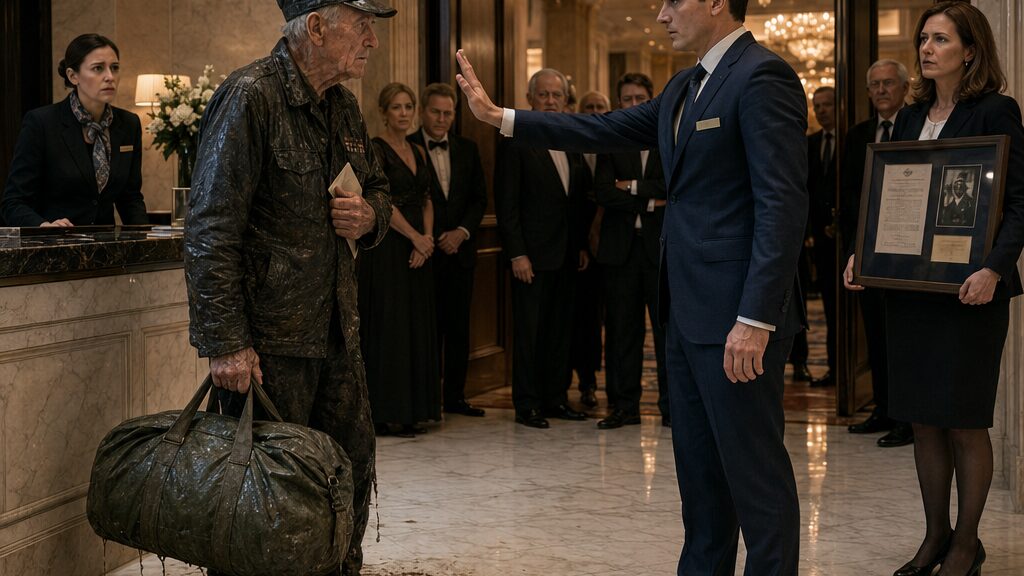
Charles Hall stepped out of the rain and brought a line of muddy water across the hotel’s white marble floor.
The chandelier above him caught the drops as they fell from the brim of his old service cap, one after another, bright for half a second before they struck the stone and disappeared into the growing mess around his boots. His left hand held the strap of a battered green duffel bag. His right hand held a folded envelope so carefully that it looked less like paper than something breakable.
The lobby went quiet in stages.
First the front-desk assistant stopped typing. Then two women in dark dresses turned away from the ballroom doors. Then a man in a black suit, passing with a tray of champagne glasses, slowed just long enough for one glass to tremble against another.
Charles noticed all of it. He had spent most of his life noticing rooms before they noticed him.
The hotel lobby had been made for soft shoes and clean hands. Gold light spread over the marble. Tall vases of white flowers stood beside velvet ropes. On the far wall, a framed sign announced the evening’s remembrance gala in polished lettering. Beyond the open ballroom doors, Charles could hear the low test of a microphone, the tuning scrape of a violin, and the murmur of guests who had arrived dry, early, and expected.
His own jacket clung to his shoulders. Rainwater ran from the cuff of his sleeve and dropped onto the envelope.
He shifted it closer to his chest.
“Sir.”
The word came sharp enough to stop him.
A younger man in a navy suit crossed the lobby toward him, one hand lifted as if Charles were a vehicle edging through the wrong entrance. His hair was neat, his shoes bright, his name badge polished at the lapel: Jacob Wright. Charles read it without meaning to. Old habit. Know who is speaking before you answer.
Jacob stopped three feet away and looked Charles over, from the wet cap to the stained trousers to the duffel bag hanging like a dead weight from his hand.
“This entrance is for registered guests,” Jacob said.
Charles nodded once. “Yes.”
“Are you with the event?”
Charles raised the envelope.
Jacob did not take it.
“I was asked to come,” Charles said.
His voice was quiet. Too quiet for the lobby, perhaps. People were listening now, pretending not to. One of the women near the ballroom touched her necklace and looked at the muddy water spreading under Charles’s shoes.
Jacob glanced at the envelope, then back at Charles’s bag.
“Do you have identification?”
Charles felt the answer in his inside pocket, folded beside an old bus receipt and a handkerchief. He could have taken it out. He could have said the name clearly. He could have explained that the rain had stopped the shuttle three blocks away, that the bag could not be left in a cab, that the envelope had been sealed twice because his hand had shaken the first time.
Instead, he held out the envelope another inch.
“This is for the remembrance committee.”
Jacob’s expression tightened. Not anger yet. Calculation.
“Sir, I’m the event manager. I need you to answer the question.”
Charles looked past him toward the sign on the wall. Remembrance Gala. Honoring Service, Preserving Memory. The words were too clean. Every word in that lobby was clean.
A drop from the duffel struck the floor.
Jacob heard it.
His eyes went down. So did everyone else’s.
The bag had begun to leak along the seam, dark water gathering at the bottom where the canvas had worn thin. A thread of mud slid from one corner, ran over the marble, and touched the edge of Jacob’s polished shoe.
Jacob stepped back.
“Sir, you can’t bring that inside.”
Charles tightened his fingers on the strap.
“It stays with me.”
“That bag is leaking all over the floor.”
“I see that.”
“Then you understand the problem.”
Charles looked at the puddle. In the shine of the marble, the chandelier wavered inside it, broken into gold pieces. He could feel the weight of the bag pulling down on his shoulder and the small ache in his wrist where age had made the bones less patient. He shifted the strap but did not set it down.
Behind the desk, Ashley Moore watched with both hands flat on the counter. She was young, maybe late twenties, with a hotel scarf tied too tightly at her throat. Her eyes moved from Jacob to Charles, then to the envelope.
“Mr. Wright,” she said softly, “there might be a coordinator list for—”
Jacob did not turn. “I have it handled.”
Charles lowered the envelope by half an inch.
Jacob’s gaze sharpened at the movement, as if the lowering of the paper proved something about him.
“Sir,” Jacob said, his voice dropping into a tone meant to sound respectful while giving no room at all, “we have donors, families, military representatives, and press inside. We can’t have unverified individuals walking in with wet bags. If you were invited, someone can confirm it. Until then, I need you to step away from the main entrance.”
“I am not asking to walk in.”
“You’re standing in the entrance.”
Charles looked at the open ballroom doors. He had not realized he had stopped directly beneath the arch. Old habit again. Pause where the room can be seen. Pause before crossing into a place where people are seated.
“I can wait,” he said.
“Not here.”
The words landed harder than Jacob may have intended. A man near the flower arrangement looked away quickly. A woman whispered something to the person beside her. The violin inside the ballroom drew one clean note and stopped.
Charles felt the envelope soften at its damp edge. He moved it under his jacket.
Jacob pointed down at the puddle.
“This is exactly what I mean. This floor was just finished for the event. We have guests arriving. Someone could slip.”
The gesture was small, controlled, professional. It was also public.
Charles followed the line of Jacob’s finger to the muddy water around his boots, to the bag that had crossed more miles than anything in that lobby except the men it had once belonged to. He heard, for one quick second, a different floor under him. Not marble. Metal. Rain on canvas. Somebody laughing because the world had become mud all the way to the horizon.
He closed that sound away.
“You’re right about the floor,” Charles said.
Jacob blinked, as if agreement had wrong-footed him.
Charles pulled a handkerchief from his pocket. It was clean only in the way old cloth can be clean, washed thin and folded square. Slowly, with a stiffness that made his shoulder pinch, he bent toward the puddle.
Ashley moved before Jacob did.
“Sir, please don’t,” she said, coming around the desk. “I can call someone.”
Charles paused with one hand on his knee.
For a moment, Ashley stood close enough to see his face fully. Not just old. Not just wet. The lines around his mouth were set, but not from anger. His eyes were tired in a way that made her lower her voice without knowing why.
“You’re not here for help,” she said.
Jacob turned. “Ashley.”
She looked at the envelope. “He’s trying to give us something.”
Charles straightened with effort. “Only to the committee.”
Jacob’s jaw tightened. The guests near the ballroom were not pretending anymore. Even the photographer by the entryway had lowered his camera but not his attention.
“We are not opening unidentified correspondence in the lobby,” Jacob said. “And we are not allowing uninspected bags into the ballroom.”
“It is not unidentified,” Charles said.
“Then identify yourself.”
There it was. A simple request. A reasonable request. Charles could feel the room waiting for him to obey it.
His name had been said over radios, typed on medical tags, shouted in smoke, written on forms, printed on envelopes from government offices that arrived too late. Tonight, it sat behind his teeth like a stone. Because once he said it, the next name would come. James Davis. And after James, Catherine. And after Catherine, the years.
Charles folded the envelope back against his chest.
Jacob saw refusal.
“Service entrance,” Jacob said.
The words drew a small breath from the guests. Not a gasp. Something more polite and worse.
Charles looked at the ballroom doors one more time. Then he nodded.
Ashley’s face changed. She looked as if she wanted to object but had not yet found the version of herself who could do it in front of her manager.
“The side corridor is this way,” Jacob said, already turning his body so Charles would have to follow.
Charles lifted the duffel. The wet strap creaked. The bag left the floor with a soft sound, like mud releasing a boot.
He had taken three steps toward the side corridor when a woman’s voice cut across the lobby.
“Wait.”
Charles stopped.
A woman hurried from the ballroom entrance carrying a framed display under one arm, the glass reflecting chandelier light in bright, broken strips. Her dark jacket was open, her badge twisted, and her face held the alarm of someone who had been searching for the wrong problem.
“Mr. Wright,” she said, looking from Jacob to Charles, then down at the bag. “Why is Charles Hall standing out here?”
Jacob’s posture stiffened. “You know him?”
The woman shifted the frame so the front faced them. Inside was a copied letter, a faded photograph, and a printed card with Charles’s name in large type.
“He is supposed to be on tonight’s program,” she said.
The lobby went silent again, but this time it was not because Charles had entered.
It was because the room had begun to understand that the old man with the muddy bag had not been the mistake.
Chapter 2: The Name Missing From the List
Lisa Adams held the framed display under the chandelier light, and Charles saw his own name shining behind glass while Jacob Wright searched the printed guest list and failed to find him.
The moment stretched long enough for the lobby to become uncomfortable with itself.
Jacob ran one finger down the clipboard page, then back up again, slower the second time. His mouth tightened at the corner. He turned the page, though the motion had the stiff impatience of a man who already knew the answer and disliked it.
“Charles Hall is not on my active check-in list,” he said.
Lisa stared at him. “Then your list is wrong.”
“My list came from the final event file.”
“I sent the correction this afternoon.”
“It did not come through my desk.”
“Jacob, I’m the archive coordinator for this program.”
“And I’m responsible for the room, the guests, and the safety of the event.” His eyes cut briefly to the duffel. “Including what enters it.”
Charles stood between them with the envelope inside his jacket and the duffel hanging from his left hand. The bag had stopped dripping in a steady rhythm and now released water only when he shifted his weight. Each drop seemed louder than it should have been.
Ashley returned from the desk with a stack of printed badges. She looked through them quickly, trying not to seem as anxious as she was.
“There’s no badge for Hall,” she said.
Lisa turned to her. “Check the late additions.”
“These are all the badges we were given.”
“I made a call two days ago,” Lisa said. “I confirmed he was coming.”
Charles looked at the framed display in her hands. Under the glass was a photograph he had not seen in years, or had seen too often to admit. Three young men stood beside a transport truck under a pale foreign sky. One had his helmet pushed back and a grin too wide for the heat. James Davis had always smiled like he was daring misery to lose first.
Charles looked away before the photograph could find him.
Jacob noticed.
“Mr. Hall,” he said carefully, as though using the name cost him something, “if this is a misunderstanding, we can resolve it. But you need to cooperate.”
Charles said nothing.
Lisa stepped toward him. “I’m sorry. I told them to expect you at the front. I didn’t know the weather had gotten so bad.”
Charles gave her a small nod. “Wasn’t your weather.”
The answer confused her for a second. Then she understood he did not intend blame.
Jacob closed the clipboard. “We still need the bag inspected.”
Charles’s hand closed around the strap.
“No.”
The word was not loud, but it changed the space around him.
Jacob’s professional calm thinned. “Then we have a problem.”
Lisa lowered the framed display. “That bag is his property.”
“And this is a private event in a private hotel. A soaked duffel with unknown contents cannot go into a crowded ballroom because someone’s name appears in an archive display.”
Ashley looked at Charles’s sleeve, at the water gathering along the seam, at his hand where it gripped the strap hard enough to pale the knuckles. She remembered the envelope. She also remembered Jacob’s hand held out, palm down, refusing even to touch it.
“He tried to show you something,” she said.
Jacob turned slowly. “Excuse me?”
Ashley swallowed. Her job felt suddenly small and necessary, like a match in a dark stairwell.
“When he came in. He held out an envelope.”
“I saw the envelope.”
“You didn’t read it.”
“That is not your call to assess.”
“No,” Ashley said, quieter now. “But it happened.”
The guests nearest the ballroom heard that. So did the photographer. So did the uniformed liaison who had appeared near the entryway, drawn by the pause in the ceremony schedule.
Jacob’s face flushed faintly at the edges. “Ashley, return to the desk.”
She did, but not before glancing at Charles.
He gave her the smallest nod.
It made her feel worse, not better. A thank-you would have been easier than that quiet permission not to save him.
Lisa tucked the framed display against her side and faced Jacob. “Charles Hall was invited because he served with James Davis. The Davis family is represented tonight. His attendance matters.”
At the name, Charles shifted.
Jacob caught it again. He was beginning to notice that Charles reacted less to disrespect than to memory.
“James Davis,” Jacob repeated.
Charles’s eyes lifted, not to Jacob but to the ballroom doors.
From inside came a faint announcement: guests being asked to take their seats in five minutes. The event was moving without him. That, too, felt familiar.
Lisa softened her voice. “Mr. Hall, Catherine Davis is here. I thought you knew.”
Charles’s grip tightened on the duffel so fast the canvas groaned.
“No,” he said.
Lisa looked stricken. “I wrote that in the letter.”
Charles pulled the folded envelope out from his jacket. The outer paper was addressed to the remembrance committee, water marked along one corner. He looked at it as if it had betrayed him.
“I only read the time,” he said.
Jacob stared at him. “You traveled here without reading the full invitation?”
Charles did not answer.
It sounded foolish when Jacob said it. Maybe it was. There were many kinds of cowardice that could hide inside discipline. Charles had opened the letter three days ago in his kitchen, seen the name of the hotel, the date, the formal language. Then he had seen James Davis printed in the second paragraph and folded the paper before the rest of it could reach him.
He had come because not coming had finally become heavier than the bag.
Lisa reached for the envelope. “May I?”
Charles held it out. She took it carefully, as though some part of him might come loose with it. She read fast, then slower.
“You were asked to bring any personal materials related to James Davis for possible inclusion in the family archive,” she said. Her face shifted. “And to meet privately with Catherine before the ceremony, if you were willing.”
A sound moved through Charles, too low to be speech.
Jacob looked from the envelope to the duffel. “Personal materials?”
Charles took the envelope back.
Lisa’s eyes moved to the bag. “Is that why you brought it?”
Charles did not answer quickly enough.
Jacob stepped back and signaled to security near the corridor. “Until the contents are verified, the bag stays out of the ballroom.”
“No,” Charles said again.
“This is not negotiable.”
“It does not leave me.”
“Then we classify it as an unattended or uninspected item, and you remain outside the event space.”
Lisa stared at him. “Jacob.”
“I’m not being difficult,” he said, but the speed of his answer showed that he knew he was. “I’m doing the job everyone expects me to do until something goes wrong. If that bag contains archive materials, it can be inspected privately. If it contains personal effects, it can be checked. If he refuses both, I have to act.”
Charles looked at the security staff member approaching from the side hall. The man did not look eager. That made it worse. Charles had always disliked being handled by men who were only following a procedure they did not fully believe in.
He set the duffel down at his own feet before anyone could reach for it.
The bottom hit the marble with a wet thud.
The sound traveled.
Lisa flinched.
Charles bent, slow and careful, and wrapped the strap once around his hand. Not to lift it. To make clear that it remained attached to him.
“You can look at me,” he said. “You can look at my coat. You can look at my shoes. You can call whatever list you need. But nobody opens this bag in a hotel lobby.”
Jacob’s eyes hardened. “Then you can wait by the service entrance.”
Ashley, back behind the desk, looked down at the badge stack and then at the ballroom doors. Her hand hovered over the phone. She did not pick it up.
Lisa stepped closer to Charles. “Mr. Hall, please. If Catherine is here, we can arrange a private room.”
At the sound of that name again, Charles seemed to fold inward without moving.
Behind Lisa, a woman had appeared at the edge of the corridor.
She was in a plain dark dress, not formal enough for the donors and not casual enough for staff. Her hair was pinned back loosely, and she held a program booklet in one hand. She had come out because she had heard her father’s name spoken in a lobby where strangers were arguing about a wet old man.
Her eyes went first to Lisa. Then to Jacob. Then to Charles.
Last, they fell to the duffel bag.
The color left her face.
There were faded initials near the side pocket, half-hidden by mud and water. J.D.
The woman took one step forward.
“Where did you get that?” she asked.
Charles did not move.
Lisa turned. “Catherine—”
But Catherine Davis was no longer looking at Lisa.
She was looking at the old man’s hand wrapped around the strap as if he had been holding on to her father for decades.
“Why,” she asked, voice thin with disbelief, “did you come here carrying that bag now?”
Chapter 3: The Bag No One Wanted Opened
Catherine Davis recognized the initials before she recognized the man.
J.D.
The letters were faded almost to the color of the canvas, stitched near the side pocket in thread that had once been black. Mud had filled the lower curve of the D, and rainwater shone along the seam, but she knew them. She had seen those letters in one photograph her mother kept in a shoebox, a photograph of a young soldier sitting on a barracks step with a duffel across his knees and a grin that made him seem impossible to lose.
Her father had been younger in the photograph than she was now.
The old man holding the strap did not deny it.
That was what made the hallway tilt beneath her.
“Where did you get that?” she asked again.
Charles Hall looked at her, and for one second she saw the answer move behind his eyes. Not the words. The weight of them.
Then he looked down.
Catherine let out a small laugh with no humor in it. “No. Don’t do that.”
Lisa moved between them slightly. “Catherine, this is Charles Hall. He served with—”
“I know who he is.”
The words startled even her. She had not known she would say them until they came out.
Charles lifted his eyes.
Catherine held the program booklet so tightly it bent in the middle. “My mother had your name written on the back of a photograph. Charles Hall. The one who was there. The one who might know.”
The hallway behind the ballroom was narrow and service-lit, with beige walls and carts tucked against one side under white cloths. It smelled of coffee, floor polish, and rain carried in by Charles’s coat. The sounds of the gala were muffled here, reduced to microphone checks and chair legs moving on carpet.
Jacob had followed them halfway into the corridor, not close enough to seem involved, not far enough to miss anything. He stood near the corner with his phone in one hand and the posture of a man measuring risk.
Catherine saw him watching and hated him for being there. Then she hated herself because he was not the person she had waited years to confront.
She looked back at Charles. “My mother wrote to two men after my father died. One letter came back undeliverable. The other never answered.”
Charles’s hand tightened around the strap.
“I received it,” he said.
Catherine’s breath caught.
Lisa looked at him sharply. Ashley, who had drifted to the hallway entrance with a stack of replacement place cards she did not need, stopped walking.
Catherine stepped closer. “You received it.”
“Yes.”
“My mother waited for years.”
Charles closed his eyes once. Not long. Long enough.
“I know.”
The simple admission did more damage than denial would have.
Catherine looked at the duffel, then at his face. He was soaked through. His collar was limp. Mud had dried in the creases of his boots and started to crumble onto the service hallway floor. He looked old enough to be pitied. That angered her, too, because pity was trying to enter a room where fury had waited too long.
“You know,” she repeated.
Charles said nothing.
The silence widened.
Lisa touched Catherine’s arm. “Maybe we should sit somewhere private.”
Catherine pulled away, not violently, but enough. “Private is what everyone always said. Private records. Private grief. Private service. Private condolences from men who never came to the door.”
Charles flinched at that, and Catherine saw it. Some part of her wanted to stop. Another part, older than the evening, would not let her.
“My mother kept his boots in the hall for a year,” she said. “Did you know that? She said somebody from the unit might come and tell us something that wasn’t in the telegram. Something real. Then she packed them away because she got tired of dusting around an empty hope.”
Charles looked at the duffel.
Catherine followed his gaze. “Is that his?”
“Yes.”
Lisa whispered, “Mr. Hall…”
But Charles had said the word, and now the hallway had changed. The bag was no longer a problem for hotel policy. It was no longer mud on marble. It was no longer an old man’s suspicious luggage.
It was her father’s.
Catherine felt the program booklet slip slightly in her hand.
Jacob took one step forward. “If the bag contains family materials, we can arrange—”
“Be quiet,” Catherine said.
Jacob stopped.
Nobody corrected her.
She crouched before the duffel without asking permission. Charles’s hand moved at once, not fast but final, pulling the strap closer to his knee.
Catherine looked up at him.
“You kept it.”
“Yes.”
“For how long?”
He did not answer.
“How long?”
Charles’s jaw worked once before he spoke. “Since the day after.”
The day after.
The phrase moved through her with a force that made the hallway lights seem too bright. The day after her father became a framed photograph. The day after uniforms came to the porch. The day after her mother stopped wearing lipstick because, as she once told Catherine, color felt like a lie.
“You had this the whole time,” Catherine said.
Charles’s face had gone still in a way that felt less like calm now and more like punishment.
“Yes.”
Lisa pressed a hand to her mouth.
Ashley looked down.
Jacob’s phone buzzed. He silenced it without looking, but his eyes had sharpened. Catherine could almost see him realizing that the old man in the lobby was not merely an inconvenience. He was a story that could ruin the event if handled badly.
That, somehow, made her angrier.
“You were going to bring it into the ballroom?” Catherine asked. “Put it on a table with the programs and the flowers?”
“No.”
“Then why bring it?”
Charles looked at her fully. His eyes were red at the rims, though whether from rain, age, or what he was holding back, she could not tell.
“For you.”
The answer should have softened something. It did not. Not yet.
“For me?” Catherine stood. “My mother died three years ago.”
Charles lowered his head.
“She died asking less about him near the end,” Catherine said. “Not because she stopped loving him. Because she got tired of needing answers from men who had already decided she didn’t deserve them.”
“That isn’t what happened.”
“Then tell me what happened.”
Charles opened his mouth.
Nothing came.
Catherine laughed again, smaller this time, and more wounded. “Of course.”
Lisa turned toward the ballroom as a chime sounded. The ceremony was already delayed. A voice came through the speakers, blurred by the closed doors, asking guests to remain seated.
Jacob heard it and glanced at the time. “We need to make a decision.”
Catherine spun toward him. “This is not a scheduling issue.”
“No, but it is now happening in an operational corridor during an active event.”
Ashley’s eyes flashed. “Mr. Wright.”
Jacob looked at her, then at Catherine, then at Charles. He seemed to realize he had chosen the worst possible words. His face tightened with something like shame, but he pressed on because pressing on was what he knew how to do.
“I’m saying we should move this to a private room.”
Catherine looked back at Charles. “Fine. Open it.”
Charles shook his head.
“Open it.”
“No.”
“It was my father’s.”
“Yes.”
“Then you don’t get to say no.”
Charles took that without protest, which only made the refusal more infuriating.
His fingers stayed wrapped around the strap.
“There are things inside,” he said slowly, “that should not be seen standing in a hallway.”
“Because they’re painful?”
“Yes.”
“Good,” Catherine said. “Then maybe they belong in the same world the rest of us had to live in.”
Charles’s eyes changed. Pain moved there, but not surprise. That was when Catherine understood something she had not wanted to understand: he had expected this from her. Maybe not the words, maybe not the hallway, but the blow. He had walked through the rain and into that lobby already believing he had earned whatever came next.
That knowledge did not absolve him.
It only made him harder to hate cleanly.
Lisa stepped beside Catherine. “There’s an archive display room just off the ballroom. We can close the door. No guests.”
Charles looked at the duffel, then toward the sound of the crowd. His hand loosened slightly.
Catherine saw it and moved fast, reaching for the zipper.
Charles caught the strap and pulled the bag back before she touched it.
The movement was not rough. It was protective. Instinctive.
Catherine froze.
For the first time, she wondered if the thing he was protecting was not himself.
Jacob, from the corner, saw the same movement. His eyes narrowed, not with suspicion now but with calculation. If this became public, if the daughter of a memorialized soldier accused an invited veteran in the hallway, if guests began recording, if the hotel owner representative asked why security had not intervened earlier—his clean event would become something else entirely.
Catherine did not care.
She looked at Charles and asked the question that had lived in her family so long it had become furniture.
“Did my mother die waiting for what you kept in there?”
Charles’s face emptied.
The ballroom doors opened behind them, spilling warm light into the service corridor. A few guests turned their heads. The photographer lifted his camera halfway and then thought better of it.
Charles did not look at them.
He looked only at Catherine.
And still, with the duffel strap wrapped around his hand like a sentence he had never finished serving, he gave her no answer.
Chapter 4: The Framed Letter Proved Too Little
Lisa placed the framed letter under the archive-room lights and saw, with a sinking coldness, that the line everyone needed had been cropped out.
The display looked beautiful from a distance. That was the problem. Behind glass, under careful lighting, James Davis had become orderly. A sepia photograph. A service date. A printed caption. A copied paragraph from a letter flattened into history. The gold frame matched the ballroom’s donor plaques, and the small table beneath it had been draped in navy cloth.
But the copy inside the frame had been trimmed to fit the layout.
Lisa leaned closer until her reflection hovered over the glass. There, cut at the bottom edge of the copied page, was half a sentence she had noticed weeks ago and then trusted would survive the design process.
If anything happens, Charles Hall knows where I left the rest—
The rest was gone.
Behind her, Catherine stood with both arms folded tight, not looking at the display so much as guarding herself from it. Charles remained near the door with the duffel at his feet, one hand still twisted through the strap. Jacob stood just inside the room, phone in hand, pretending to check messages while watching every face.
The archive display room had been intended as a quiet stop before dinner. Three walls of framed photographs. A table of unit records. White cards with neat summaries. A guest book no one had signed yet. Now the small room felt like a place where evidence had been arranged too prettily to tell the truth.
Lisa touched the frame’s edge. “This should have included the full line.”
Catherine stepped closer. “What full line?”
Lisa hesitated.
Charles said, “Don’t.”
It was not sharp. That made it harder to ignore.
Catherine turned on him. “You don’t get to decide what I hear anymore.”
Charles’s eyes stayed on the glass. Rain still clung to the gray hair near his temples. Under the room’s light, the mud on his trousers looked darker, almost black. The duffel sat beside him, slumped and swollen, as if it had absorbed not water but years.
Lisa swallowed and read from memory, because she had handled the original before it went to conservation storage.
“If anything happens, Charles Hall knows where I left the rest. He’ll make sure it gets home.”
Catherine did not move.
The room seemed to take that sentence and hold it.
Jacob looked up from his phone. Ashley, who had come in carrying dry towels and then stopped at the doorway, looked down at the duffel.
Catherine’s voice came out smaller than before. “My father wrote that?”
Lisa nodded. “In a letter to his wife. It was never mailed. It was found in a packet of unit materials that came to the archive last year.”
“Last year,” Catherine repeated.
“I contacted you after we verified the handwriting.”
“You contacted me about the ceremony. Not this.”
Lisa felt heat rise in her face. “I didn’t want to send incomplete information before I knew whether Mr. Hall would respond.”
Catherine looked at her. “So everyone was waiting on him again.”
Charles lowered his head.
Lisa had no defense that did not sound like procedure, and procedure suddenly felt obscene. She had spent months building an evening meant to honor memory. She had labeled photographs, cross-checked names, argued for family seating, corrected ranks, and pushed donors to use “served with” instead of “served under.” She had thought precision was respect.
Now Charles Hall stood six feet away from a frame that proved he mattered and still explained almost nothing.
Jacob’s phone buzzed. He turned slightly away, but Lisa saw the screen before he angled it down. Incident note draft. Disruptive conduct. Unverified bag. Guest access delayed.
“What are you doing?” she asked.
Jacob locked the phone. “Documenting the situation.”
Catherine gave a short, bitter laugh. “Of course you are.”
“It protects the event and the hotel,” Jacob said.
“It protects you.”
His jaw tightened. “You don’t know what my responsibility is tonight.”
“No,” Catherine said. “I just know what you did in the lobby.”
Jacob’s eyes flicked toward Charles, then away. “I followed policy based on the information I had.”
Ashley, from the doorway, spoke before she could talk herself out of it. “You had the envelope.”
Jacob turned. “Ashley.”
“You had it offered to you,” she said. “That’s not the same as not having information.”
The room went still.
Lisa watched Jacob absorb the words. For a second, something unguarded moved across his face. Not remorse. Not yet. Fear, perhaps. The fear of a clean record gathering a stain.
Then his phone buzzed again, and whatever softness had appeared vanished.
“The owner representative is asking why the ceremony is delayed,” he said. “We have ten minutes before this becomes a public problem.”
“It already is one,” Lisa said.
“No,” Jacob said, voice low. “Right now it is private. It can stay that way if we move carefully.”
Catherine looked at Charles. “Is that why you won’t open it? To keep things private?”
Charles’s hand slid along the strap once, thumb pressing into the worn canvas. “Some things don’t belong under lights.”
“My father belongs under lights tonight, apparently.”
“That is not what I meant.”
“Then say what you mean.”
His mouth moved, but again the words did not come. Lisa saw the cost of it in the lines around his eyes. She also saw Catherine misread that cost as refusal.
The duffel shifted.
It happened because Charles had gripped the strap too hard and the old canvas, wet and exhausted, slipped against the polished floor. The bag tipped sideways, not fully open, but enough for the zipper teeth to part near the top where age had weakened them.
A small packet showed through.
It was wrapped in dry brown paper and bound with string. Dry, impossibly dry, protected inside oilcloth beneath the wet canvas. On the corner, in dark, careful writing, was one word.
Catherine.
Catherine saw it.
So did Lisa.
Charles moved faster than Lisa had thought he could. He pulled the bag upright, one knee bending, one hand closing over the torn seam. The packet disappeared back into shadow.
“Wait,” Catherine said.
Charles zipped the bag with a hard jerk. The metal teeth caught, skipped, then closed.
“That had my name on it.”
He did not answer.
“It had my name.”
“I know.”
“You know?” Her voice broke on the second word. “You brought something here with my name on it and still stood in that lobby saying nothing?”
Charles looked at the framed letter, then at her. For the first time since Lisa had met him, anger moved through him. Not at Catherine. Not at Jacob. At himself, perhaps, though it came out only as a tightening of his shoulders.
“That part,” he said, “was never for the ballroom.”
Catherine stepped toward the duffel. “Then where was it for?”
Charles kept his hand on the zipper.
Lisa reached for the table behind her, steadying herself against the draped edge. She had believed the framed letter would fix the first wrong thing. Show Jacob that Charles had a place. Show Catherine that there was a reason. Show Charles that the record had not forgotten him.
Instead the frame had done what frames do. It held one piece still while the living parts cut themselves on the edges.
Jacob slipped his phone into his pocket. “We need to decide now. Either the bag is inspected, stored, or removed from event space.”
Charles looked at him then, and the quiet in his face changed. “Removed?”
“From event space,” Jacob said. “Not necessarily from the property.”
Catherine shook her head slowly. “You still think this is about your ballroom.”
Jacob’s face flushed again. “I think if someone gets hurt, if something goes missing, if an unverified item causes panic, every person in this room will ask why I ignored it.”
Lisa noticed the phrasing. Not why it mattered. Not what it meant. Why I ignored it.
A chime sounded through the wall. The ceremony microphone clicked on, then off. Guests murmured beyond the ballroom doors, a restless ocean of polite impatience.
Ashley set the dry towels on a side chair. One slid off and landed near the duffel. Charles looked at it, then at the dark water still falling occasionally from the bag’s lower seam.
Lisa suddenly saw the whole night in layers: the clean towel, the muddy bag, the cropped sentence, the unopened packet, Charles’s hand closing everything away. Every object in the room was trying to say what the people could not.
She stepped between Jacob and Charles.
“The ceremony can wait five more minutes.”
Jacob gave her a look. “That is not your decision.”
“No,” Lisa said. “But neither is his story.”
Charles’s eyes lifted to her.
She had meant to defend him. She saw at once that even defense could become another form of taking control.
Catherine stood with one hand pressed against her own ribs, staring at the bag as if the packet might burn through the canvas.
“Mr. Hall,” Lisa said more softly, “no one here can make you open it in this room. But if that packet is for Catherine, then she deserves to know why you kept it.”
Charles’s fingers loosened and tightened again. A soldier’s hand. An old man’s hand. A man who had spent too long making silence look like strength.
From the ballroom, a voice announced that the program would begin shortly.
Charles bent, lifted the duffel, and winced before he could hide it.
Catherine saw the wince. Her anger did not soften, but something in it faltered.
Charles turned toward the door.
Jacob stepped into his path. “Where are you going?”
Charles looked at him, then past him to the corridor.
“Somewhere without glass,” he said.
Catherine took one step after him. “No. You don’t walk away again.”
Charles stopped.
His back remained to her. Water had darkened the old jacket between his shoulders. Mud stained one sleeve where the envelope had rubbed against it.
After a long moment, he said, “I have been walking toward this room for thirty-two years.”
No one spoke.
Then Charles looked down at the duffel in his hand, at the seam he had just forced shut over the packet with Catherine’s name.
“But that part,” he said again, quieter than before, “was never for the ballroom.”
Chapter 5: The Man Who Believed He Deserved It
Ashley found Charles in the maintenance corridor with the duffel braced against his leg, and the first thing she said was not comfort but warning.
“Mr. Hall, he wrote a report.”
Charles looked up from the envelope in his hand.
The corridor was narrow and dimmer than the guest spaces, lit by flat ceiling panels that hummed above utility doors and stacked banquet chairs. Somewhere behind the wall, the ballroom crowd shifted and murmured. Somewhere ahead, a service elevator opened and closed with a tired mechanical sigh. The smell of coffee had given way to detergent, metal, and rainwater trapped in Charles’s coat.
Ashley stood a few steps away, twisting her hotel scarf in one hand.
“Mr. Wright,” she said. “He wrote that you were disruptive and refused security procedure. The owner representative is asking whether you should be removed before the program begins.”
Charles folded the envelope along its original crease. “He would not be the first man to write something incomplete.”
Ashley’s face pinched. “That doesn’t make it right.”
“No.”
“He can have you escorted out.”
Charles slid the envelope inside his jacket. The corner had taken a smear of mud from his sleeve. He noticed it and wiped at it with his thumb, which only spread the stain thinner.
Ashley watched the gesture. “You could tell them what’s in the bag.”
“I could.”
“Or let Ms. Davis see the packet with her name.”
Charles looked at the duffel. Its canvas had darkened almost black where rain had soaked it through. The initials J.D. were hidden now against his leg.
“That packet is hers,” he said.
“Then why not give it to her?”
The question was young and honest enough to hurt.
Charles looked down the corridor. At the far end, Lisa stood speaking quietly with Catherine outside the archive-room door. Catherine’s arms were still folded, but her head was lowered now, as if anger had become too heavy to keep at eye level. Jacob stood apart from them, phone in hand, shoulders rigid.
“Because once I give it,” Charles said, “I can’t pretend the years before it were anything else.”
Ashley did not answer. She seemed to understand that he had not meant to say that much.
A service door opened, and Jacob came through before the silence could close again. His suit was still neat, but his face had lost some of the lobby polish. He looked at Ashley first.
“You should be at the desk.”
She held his gaze. “The desk has three people at it.”
“You were not assigned here.”
“No.”
Jacob waited.
Ashley did not move.
For a moment, Charles thought Jacob might order her away again. Instead the younger man exhaled through his nose and turned to him.
“Mr. Hall, the hotel owner representative wants an answer. The event is behind schedule. Security has asked whether you intend to submit the bag for inspection.”
“No.”
“Then I can’t clear it for the ballroom.”
“I’m not asking you to.”
Jacob blinked. “You were invited to the ceremony.”
“I was invited to bring something to a daughter.”
“That daughter is currently standing outside a ballroom full of people waiting for a memorial program to begin.”
Charles’s eyes lifted. “Yes.”
Jacob looked almost irritated by the agreement. He checked the corridor behind him, lowering his voice.
“I am trying to prevent this from becoming worse for everyone.”
Ashley gave a small, disbelieving sound.
Jacob turned on her. “You think this is simple because you don’t answer for any of it.”
She went still.
He stopped, hearing himself too late.
The service elevator opened again, empty. The doors waited, then closed.
Jacob rubbed a hand over his mouth. For the first time all evening, he looked less like a manager and more like a man who had slept badly for years.
“My father,” he said abruptly, then stopped.
Charles did not move.
Jacob’s eyes went to the floor. “He served. Not like—” He stopped again, annoyed at the comparison before it fully formed. “He came back different. Not dangerous. Just… not predictable. He’d go into nice places and forget where he was. He’d argue with hosts, spill things, lose track of what he was saying. People stared. My mother would smile like nothing was wrong, and I would want to disappear through the floor.”
Ashley’s expression changed.
Jacob saw it and hardened, but not completely. “So yes, when a wet man came through the lobby with an unverified bag and guests watching, I saw a problem. I saw the evening falling apart. I saw people taking pictures. I saw the hotel owner asking why I stood there and let it happen.”
Charles looked at him for a long moment.
“And then you made sure it did,” Charles said.
Jacob’s face closed.
The words had been calm. That made them impossible to dismiss as anger.
Charles looked down at the mud on his sleeve. The smear on the envelope corner had dried now. Brown against cream paper. He remembered other stains that had dried before anyone could clean them. He remembered telling himself that stillness was useful, that silence kept others from having to carry what was his.
But Catherine’s question had followed him into the corridor.
Did my mother die waiting for what you kept in there?
Jacob shifted. “I’ll withdraw the incident note if you let us store the bag outside the ballroom. You can attend the ceremony. Lisa can arrange a private transfer afterward.”
Charles almost smiled. It did not reach his mouth.
“You want the bag gone so the room can look right.”
“I want the room safe.”
“You want it clean.”
Jacob’s eyes flashed. “Clean matters when you are responsible for other people.”
“Yes,” Charles said. “It does.”
For a moment, no one spoke.
Then Charles bent and lifted the duffel. Pain caught him in the shoulder, sharp enough that he had to pause. He hated that Ashley saw it. Hated more that Jacob did.
“You don’t need to carry it,” Jacob said.
Charles straightened. “That is exactly what I need to do.”
Catherine had begun walking toward them. Lisa followed half a step behind. The ceremony chime sounded again through the wall, softer from here but insistent. A door opened somewhere, and the warm buzz of the ballroom briefly filled the corridor before shutting off.
Catherine stopped several feet away. “Are you leaving?”
Charles looked at her.
He could have said yes. There was still time to step into the service elevator, cross the loading dock, and vanish into the rain with the duffel and the envelope and the years intact. Some part of him had been doing exactly that since the day after James died. Leaving without leaving. Carrying without delivering. Keeping the promise alive by never testing whether it could be forgiven.
“No,” he said.
Catherine’s jaw tightened, as if she had prepared herself for the opposite answer.
Charles turned to Lisa. “Is there an empty chair?”
Lisa frowned. “In the ballroom?”
“Near the podium.”
“There’s a reserved row. I can move—”
“Not for me.”
Lisa understood before he finished. Her hand went to the badge hanging from her neck. “For James.”
Charles nodded once.
Catherine’s eyes filled suddenly, but no tears fell. “You don’t get to put him in a chair and make this noble.”
“I know.”
“Do you?”
Charles looked at the duffel. “I know more about making things look proper than I wish I did.”
Jacob glanced toward the ballroom doors. “Changing the stage setup now will delay us again.”
Lisa turned on him. “Then delay us.”
Jacob looked from her to Catherine, then to Charles. The old man’s coat was still wet. The bag was still muddy. The envelope was stained. None of it could be made presentable in time.
For once, Jacob did not argue immediately.
Charles shifted the duffel to his other hand. “You said your father got confused in rooms like this.”
Jacob’s face tightened. “That was not an invitation to discuss him.”
“No,” Charles said. “It was an explanation.”
Jacob looked away.
Charles continued, quiet enough that only those in the corridor could hear. “You were ashamed because other people stared.”
Jacob said nothing.
“I was ashamed because nobody did.”
That made Catherine look at him sharply.
Charles’s hand moved to the envelope inside his jacket, but he did not take it out.
“When James died,” he said, “there was noise, paperwork, transport, heat, rain, names to account for, men to keep moving. Then I came home with what he trusted me to carry, and everybody called me fortunate. Lucky. Blessed.” His mouth tightened. “I believed them enough to hate myself.”
Catherine’s face changed, but she did not speak.
Charles looked at her fully. “Your mother wrote. I read it. I put the letter beside the bag. I told myself I would answer when I could say something useful.”
“And then?”
“Then useful never came.”
The silence after that was not forgiveness. It was only the first honest thing large enough to stand among them.
Jacob’s phone buzzed again. He did not look at it.
Lisa wiped under one eye quickly, almost angrily, and turned toward the ballroom. “I’ll place the chair.”
“The bag goes with it,” Charles said.
Jacob started to object.
Charles turned to him. “Not because it is safe. Because it is James’s.”
Jacob held his stare. His pride fought visibly with the part of him that had heard too much to keep the same position cleanly.
“If that bag enters the ballroom,” he said, “it stays beside the chair. It does not move through the guest rows.”
Charles nodded. “Agreed.”
“And the incident note—” Ashley began.
Jacob looked at her, then at his phone. Slowly, he opened it, tapped once, and deleted something.
“That report was premature,” he said.
It was not an apology. Not enough. But it changed the air.
Lisa hurried toward the ballroom doors. Catherine remained where she was, staring at Charles as if the man in front of her had become both smaller and more difficult to accuse.
Charles lifted the duffel.
This time, when the weight pulled at his shoulder, Catherine saw him bear it and did not look away.
“Ms. Adams,” Charles called.
Lisa stopped at the door.
“Put one empty chair beside the podium,” he said, voice steady now. “Not for me.”
Lisa nodded.
Charles looked at Catherine, then at the closed ballroom doors.
“For James.”
Chapter 6: The Empty Chair Beside the Podium
Charles walked into the ballroom still damp, carrying the duffel past the same guests who had watched him drip mud onto the marble.
Conversation thinned as he entered. Forks paused above salad plates. Heads turned in careful increments, polite enough to avoid appearing rude and obvious enough to prove that everyone remembered. The ballroom had been arranged in rounds of white linen and gold-rimmed plates, with a small stage at the front and a podium beneath a screen showing James Davis’s young face.
Beside the podium sat an empty chair.
The sight of it stopped Charles just inside the doors.
It was an ordinary hotel chair with a navy cover and a white sash tied at the back. Nothing military. Nothing ceremonial except its placement. The smallness of it nearly undid him.
Lisa stood near the stage, one hand pressed against the podium as if holding the evening steady by force. Ashley waited just inside the ballroom doors with a stack of programs clutched against her chest. Jacob stood near the front aisle, his eyes moving from the duffel to the guests to the empty chair and back again.
Catherine walked ahead of Charles.
Not beside him. Not yet.
She reached the front row and stopped by the empty chair, facing the room. Some guests recognized her. Others recognized only that something unscheduled was happening. The ceremony photographer lowered his camera after one glance at Catherine’s face.
Charles carried the duffel down the aisle.
Halfway there, Jacob stepped into his path.
It was a small movement, almost instinctive. A manager’s body blocking disruption before his mind decided whether to allow it.
The room noticed.
Charles stopped.
Jacob looked at the bag. A faint dark line had formed beneath it, not dripping freely now, but still marking the carpet with rain. His face tightened. His hand lifted an inch.
Then he saw Catherine standing beside the empty chair.
Whatever instruction he had prepared died before it reached his mouth.
He stepped aside.
Charles continued.
No one applauded. No one spoke. That was a mercy.
At the front, he lowered the duffel beside the empty chair. The bag slumped against the chair leg like a tired animal. Mud darkened the carpet beneath it. A donor in the front row shifted, looked at the stain, then at Catherine, and became very still.
Charles stood with one hand on the chair back.
Lisa moved to the podium. “Ladies and gentlemen,” she began, but her voice caught. She steadied it. “Thank you for your patience. Before our prepared program continues, there is a correction we need to make.”
Charles looked at the screen.
James Davis smiled down from the projected photograph, helmet pushed back, eyes narrowed against sunlight. Not the framed version. Not the cropped archive version. The man himself, or as close as a room like this could hold.
Lisa continued, “Tonight’s display includes a letter from James Davis. The printed excerpt is incomplete.”
A murmur moved through the room.
Catherine turned slightly toward Charles. Her face was controlled, but her hands were clenched at her sides.
Lisa picked up a folder from the podium. “Mr. Hall, I can read the missing line if you prefer.”
Charles looked at the folder. Then at the envelope inside his jacket. Then at Catherine.
For thirty-two years he had let others speak around the empty place. Officers. Clerks. Chaplains. Archive staff. Paperwork. He had told himself that was dignity. He had told himself words would only dirty what was already broken.
But silence had not preserved James.
It had kept Catherine waiting.
“No,” Charles said.
Lisa stepped back.
Charles did not go to the podium at once. First he bent, slowly, and touched the top of the duffel. The canvas was cold under his hand. Beneath it lay the brown packet with Catherine’s name, the things he would not put under ballroom lights: a watch stopped at the wrong hour, a photograph folded twice, a letter written in a hand that had tried to be steady, a small cloth patch James had joked was luck until luck became a cruel word.
Charles straightened and faced the room.
“I’m not part of your program,” he said.
His voice was low. The microphone did not catch it at first. Lisa reached toward the stand, but Charles shook his head. She adjusted nothing.
The guests leaned in.
“I was asked to bring materials related to James Davis,” Charles said. “That is what the invitation said. Materials. That’s a clean word.”
Catherine’s eyes flicked to him.
Charles touched the chair back again. “This bag was his.”
The room shifted. People looked at the duffel differently now. Charles could almost see the change move across their faces, table by table. The muddy canvas stopped being a mess and became something they were ashamed to have judged.
He did not want their shame. It was too easy a gift.
“James gave it to me the day before he died,” Charles said. “Not in a dramatic way. He shoved it at me because the strap had torn and I had needle thread in my kit. He told me if he forgot to get it back, I should make sure it found home.”
A faint sound came from Catherine, not quite breath.
Charles continued before his courage could thin. “He said a lot of things that day. Most of them ordinary. He complained about coffee. He asked whether anybody had seen his clean socks. He said his daughter had learned to write the letter C and was using it on every wall in the house.”
Catherine pressed a hand to her mouth.
Charles looked at her then, not the room.
“I remembered that,” he said.
The ballroom faded at the edges. There was only Catherine, the empty chair, the bag, and the envelope.
Charles took the folded envelope from inside his jacket. Its corner was stained with mud. He held it up, not high, just enough for Catherine to see.
“This contains two things. One is a copy of the line your father wrote before he died. The other is mine.”
Catherine’s eyes sharpened. “Yours?”
“Yes.”
Lisa’s hand tightened on the folder she held. Jacob stood near the aisle, very still.
Charles looked at the envelope. “I wrote it many times. Never sent it.”
He could feel the room wanting the full story now. Wanting the wound opened neatly enough to understand. He would not give them all of it. Some truths belonged to Catherine. Some belonged to James. Some, even now, belonged only to the men who had not walked out.
He stepped closer to Catherine.
“I will read the first line,” he said. “The rest is yours if you want it.”
Catherine stared at him. Her anger was still there, but it had changed shape. It no longer knew exactly where to strike.
Charles unfolded the envelope with hands that did not obey him fully. The paper crackled. For one panicked second he thought he might drop it, and the room would watch him chase old grief across the carpet.
Catherine reached out.
Not to help. Not quite.
But her hand hovered near the page until his fingers steadied.
Charles nodded once.
He opened the inner sheet. The handwriting there was not James’s. It was his own, copied from the archive line and followed by words he had written in the dark of his kitchen before sealing the envelope and nearly not coming.
He looked at Catherine, then down at the first line.
“Catherine Davis,” he read, his voice rough but clear enough now for the front tables to hear, “your father did not leave you behind.”
The words moved through the ballroom and changed it.
Catherine closed her eyes.
Charles stopped there.
Lisa looked at him, expecting more. So did the guests. So did Jacob.
Charles folded the paper halfway, then looked at Catherine. “The rest should not be read by strangers unless you ask it.”
Catherine opened her eyes. They were wet now, and furious still, but not only furious.
“You waited thirty-two years to tell me one sentence?”
Charles held the paper between them.
“No,” he said. “I waited thirty-two years because I was afraid that if I gave you what he left, you would see I came home with more of him than I deserved.”
The room gave no sound.
That was the sentence he had not meant to say publicly. It had escaped anyway, plain and damaged and true enough to leave him bare.
Catherine looked at the duffel. Then at the empty chair. Then at the projected image of her father, smiling as if time had no right to touch him.
Lisa lowered her head.
Jacob looked down at his polished shoes.
Charles folded the page fully and held it out to Catherine.
She did not take it at first.
For a long moment, the envelope hung between them, no longer proof, no longer invitation, no longer excuse.
Then Catherine lifted her hand.
Her fingers touched the edge of the paper.
Charles let go before she had to pull.
But as Catherine looked down at the envelope, her face changed again, and Charles realized that receiving the truth was not the same as accepting it.
She held the page against her chest and whispered, almost too softly for anyone else to hear, “I don’t know what to do with this.”
Charles looked at the empty chair beside the podium, at the muddy duffel resting against its leg.
“Neither did I,” he said.
Chapter 7: The Envelope Was Not for Forgiveness
Catherine stopped Charles before he could read another word.
Her hand closed around the envelope, not gently, not harshly, but with a finalness that made the front row draw breath. The paper bent slightly under her fingers. Charles let it bend. He had held it for too many years to fight her for the shape of it now.
“Not here,” she said.
The microphone on the podium carried nothing. Her voice was too low. Only Charles, Lisa, and the few nearest guests heard her.
Charles nodded.
Catherine looked toward the ballroom, at the tables, the donors, the projected photograph of her father smiling with a youth she could not reach. Her face had gone pale, but her eyes were steady.
“I don’t want them to have the rest before I do.”
“No,” Charles said. “They won’t.”
The ceremony had lost its script. Everyone in the room seemed to understand that, even if no one knew what should replace it. Lisa stepped to the podium and said something careful about a brief pause, about honoring the family’s privacy, about continuing in a moment. Her words were professional, but her hand trembled against the folder.
Charles bent for the duffel.
Catherine moved at the same time.
He stopped.
For a few seconds they stood on either side of the bag, both reaching, neither touching it. The empty chair between them held the silence like a third person.
“It’s heavy,” Charles said.
Catherine looked at him. “I know.”
He almost said that she did not. Then he saw that she meant something else.
Together, they lifted it.
The old canvas sagged between them. Water no longer dripped from it, but the wet smell rose as they carried it through a side door into a smaller room off the ballroom. Lisa followed with the framed folder. Ashley came last, quietly closing the door behind them before any curious guest could drift too close.
The side room was plain compared with the ballroom: beige walls, stacked chairs, a table with extra linens, a mirror above a narrow counter. Someone had left a tray of unused water glasses beside a folded tablecloth. The room looked temporary, unimportant, and for that reason Charles could breathe in it.
Catherine set her end of the duffel on the table.
Charles kept one hand beneath the bottom until she had stepped back. Habit. Protect the weak seam. Protect what was inside.
Then he withdrew his hand.
The bag belonged to her now. He had not known until that moment how much his body would resist the truth.
Catherine placed the envelope beside it. “Open it.”
Charles looked at her.
She shook her head once. “Not because I can’t. Because you know how it was packed.”
He nodded and unzipped the duffel.
The sound was small and rough. The old metal teeth caught twice, then released. Inside, beneath a layer of oilcloth, the brown paper packet lay dry and square, tied with string. Beside it were other things wrapped separately: a field notebook, a cloth patch, a folded shirt sealed in plastic, a watch with a cracked face, and a photograph inside a clear sleeve.
Catherine’s hands rose to her mouth, then dropped before they got there.
Charles lifted the packet with her name on it and placed it before her. He did not open it.
“That was his,” he said. “Packed before the last run. I added the outside paper later because the first wrapping started to come apart.”
Catherine touched the string. “My mother never saw this.”
“No.”
The word stood between them, plain and unforgivable.
Catherine did not cry. Charles had expected tears, perhaps because he had imagined this moment wrongly for so long that he had made it easier than it deserved to be. Instead, she looked down at the packet with an expression so controlled it frightened him.
“Did she ask you for it directly?”
Charles looked at the mirror across the room. His reflection seemed older there than it had in the lobby.
“She asked me if he said anything at the end.”
“And did he?”
“Yes.”
Catherine’s fingers tightened on the string.
Charles made himself continue. “Not like people want. Not a message with music under it. He was tired. Angry about the heat. Worried about his boots, of all things. Then he said your name. He said he had not fixed the porch step. He said your mother would curse him for leaving it.”
A sound broke from Catherine then, half laugh and half wound.
Charles looked down. “I didn’t know how to tell her that. It seemed too small.”
“It sounds like him,” Catherine whispered.
That pierced him more cleanly than anger.
Ashley stood near the door with her hands clasped. Lisa looked at the floor, no longer trusting herself with any record or document.
Catherine pulled at the string but stopped before it loosened. “Why now?”
Charles took a slow breath. “Because I am old enough that carrying it started to look like keeping it. And because Lisa’s letter came, and I saw James’s name printed as if he had become safe to talk about.”
Catherine looked up. “That isn’t the whole answer.”
“No.”
The silence waited.
Charles placed both hands on the table, palms down, because if he did not hold still, he might reach for the duffel again. “I believed your mother would look at me and see the man who came back with her husband’s bag. I believed you would grow up and see the same thing. So I gave you both nothing and called it sparing you.”
Catherine’s eyes shone now.
“That was not kindness,” she said.
“No.”
“It was not dignity.”
“No.”
“You let us wonder.”
Charles closed his eyes once. “Yes.”
The answer did not defend itself. Catherine seemed to need that, though it did not soften her completely.
A knock sounded at the door.
Ashley turned, opened it a few inches, and found Jacob standing outside without his phone in his hand.
“The program is continuing,” he said. “Lisa, they need you for the next segment.”
Lisa looked at Catherine.
Catherine nodded without looking away from the packet.
Lisa left reluctantly. Ashley stayed by the door until Jacob’s eyes moved past her to Charles.
“I need to speak with Mr. Hall,” Jacob said.
Catherine’s face hardened. “Not now.”
Charles lifted one hand. “It’s all right.”
Jacob stepped into the room, then seemed to realize there was no polished role waiting for him inside it. No clipboard, no policy, no clean sentence. He looked at the open duffel and then quickly away, as if he had entered a bedroom without permission.
“I owe you an apology,” he said.
Charles looked at him. “Do you?”
Jacob swallowed. “Yes.”
“For what?”
The question unsettled him.
“For refusing to read the envelope. For assuming you were a disruption. For how I spoke to you in the lobby.”
Charles waited.
Jacob’s face tightened. “And for trying to make this about my event when it was not.”
Catherine looked down at the packet. Ashley watched Jacob with open surprise.
The apology was not graceful. It was not complete. But it cost him something.
Jacob glanced toward the ballroom. “I can say it publicly. Before the program ends. I should correct the record.”
Charles shook his head.
Jacob frowned. “Mr. Hall—”
“That would be for you.”
Jacob stopped.
Charles’s voice stayed even. “You want the room to know you know better now. Maybe later there is a way to say what needs saying. But not while she is opening her father’s bag.”
Jacob looked at Catherine. Shame moved across his face, this time without defense.
“You’re right,” he said.
Charles studied him. “Open the door for people before you decide whether they belong.”
Jacob nodded once, as if taking an order he deserved.
He stepped back out.
When the door closed, Catherine pulled the string loose.
Inside the packet was a folded letter, a small photograph, and a child’s drawing faded nearly colorless. Catherine touched the drawing first. A crooked C filled half the page, heavy and dark, the work of a small hand pressing too hard.
“My mother kept saying I wrote on the walls,” she said.
Charles gave the faintest smile. “He was proud of the damage.”
Catherine’s mouth trembled. She covered it with one hand, then lowered the hand and let herself look.
She did not offer forgiveness. Not then. Not as she unfolded the letter. Not as she read the first line and sat down hard in one of the stacked chairs. Not when Charles turned away to give her privacy and she said, “Stay,” with a roughness that sounded almost angry.
So he stayed.
He stood beside the open duffel while she read what had always been hers.
When she finished, she folded the letter carefully along its old creases. “I need time.”
“I know.”
“I don’t know what I feel about you.”
“I know that too.”
“But this comes with me.”
Charles looked at the duffel. The bag that had been weight, shield, proof, punishment.
“Yes,” he said.
Catherine placed the letter back inside the packet and held it against her chest. “Not because it fixes anything.”
“No.”
“Because it’s mine.”
Charles nodded. “Yes.”
By the time they returned to the lobby, the puddle beneath the chandelier was gone. The marble had been cleaned until it reflected the gold light again. For a moment, Charles felt a strange panic, as if the room had erased what it had done.
Then he saw Ashley kneeling near the entrance, laying a folded white towel just inside the door where the rain could reach it. Not hidden by a plant. Not pushed to the side. Placed openly, waiting for the next person who came in wet.
She looked up when she saw him and stood quickly.
“I thought,” she said, embarrassed, “it might help.”
Charles looked at the towel. “It will.”
Catherine stood beside him, holding the packet and the duffel now zipped in her other hand. The strap hung from her shoulder awkwardly. It did not fit her yet. Maybe it never would. But she carried it.
Jacob came from the ballroom entrance. He did not speak. He simply walked ahead of Charles to the lobby doors and opened one, holding it against the wind.
Outside, the rain had softened to mist.
Charles stopped beside him.
Jacob looked straight ahead. “Mr. Hall.”
Charles waited.
“I’ll do it differently next time.”
Charles looked at the towel, then at Catherine, then at the open door.
“Make sure there is a next time,” he said.
Jacob nodded.
Charles stepped through the doorway without the duffel in his hand.
The absence pulled at his shoulder like an old injury, but after three steps, it became something else. Not relief exactly. Not forgiveness. A lighter kind of pain.
Behind him, Catherine remained in the lobby with her father’s bag. Ashley stood near the towel. Jacob held the door open until Charles had fully passed into the mist, and for once, no one had to ask him to make room.
The story has ended.