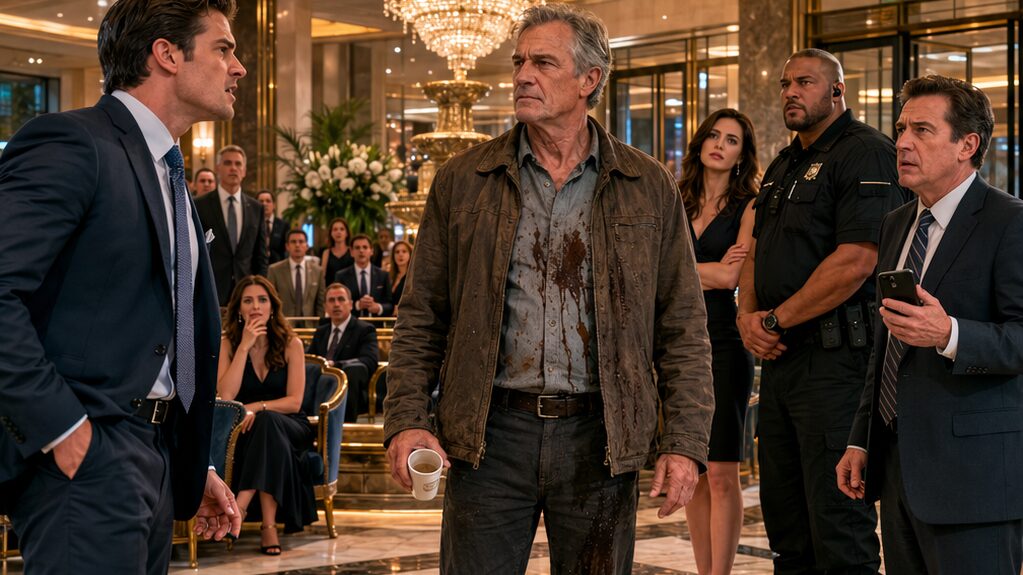
The Man Covered in Coffee Who Shut Down a Luxury Hotel and Exposed Everything Hidden Behind Its Golden Lobby
Chapter 1: The Traveler Nobody Wanted in the Lobby
The man with the worn canvas travel bag did not belong in the lobby.
At least that was what everyone seemed to decide within the first ten seconds.
Ryan Campbell crossed the polished marble floor beneath a ceiling covered in gold-leaf accents and crystal chandeliers. A pianist played softly near a fountain. Guests in tailored suits moved between meetings while attendants carried designer luggage toward private elevators.
Ryan’s clothes looked as though they had survived a long bus ride.
That was intentional.
His faded jacket had once belonged to a maintenance worker from another property. His shoes were scuffed. His gray hair was uncombed. He carried no visible signs of wealth.
He paused beside a decorative pillar and watched.
People revealed themselves quickly when they believed nobody important was watching.
The young receptionist noticed him first.
Her smile appeared automatically, then vanished almost immediately.
“Can I help you?” she asked.
The words were polite.
Her tone was not.
Ryan smiled.
“I’d like to check in.”
The receptionist glanced at the worn bag.
“Do you have a reservation?”
“I do.”
Her fingers moved across the keyboard.
She frowned.
“What name?”
“Campbell.”
She typed again.
Nothing appeared on her face except growing impatience.
“I’m not finding it.”
Ryan knew perfectly well the reservation existed.
He had personally created it through a private corporate channel.
The receptionist sighed.
“Sir, are you sure you’re at the right hotel?”
Nearby, another employee laughed quietly.
Ryan noticed.
He noticed everything.
He pulled a small notebook from his pocket.
The receptionist’s expression tightened.
“What are you doing?”
“Taking notes.”
“About what?”
Ryan smiled again.
“Customer service.”
She looked away first.
Interesting.
Ryan made a brief mark in the notebook.
Not because he needed to remember.
Because reactions mattered.
People behaved differently when consequences felt possible.
A few minutes later another employee approached.
A janitor.
The man pushed a cleaning cart and looked to be in his sixties.
He noticed Ryan standing alone.
“Sir,” he said gently, “have they helped you yet?”
Ryan turned.
The janitor’s uniform carried the name tag LARRY SMITH.
“Not yet.”
Larry frowned.
“They should.”
The simple answer surprised Ryan.
No hesitation.
No calculation.
No concern about appearance.
Just basic respect.
Larry walked to the desk.
“Can someone assist this gentleman?”
The receptionist immediately looked annoyed.
“We are.”
“It doesn’t seem like it.”
Larry’s voice remained calm.
The receptionist turned away.
Larry returned.
“I’m sorry,” he said quietly. “Some people around here see expensive shoes before they see people.”
Ryan studied him.
“How long have you worked here?”
“Almost twelve years.”
“Twelve years as a janitor?”
Larry smiled.
“Somebody has to keep the place clean.”
Ryan nodded.
Another note entered the notebook.
Larry noticed.
“What are you writing?”
“Something worth remembering.”
The janitor chuckled.
“Hopefully it’s good.”
“It is.”
For nearly an hour Ryan wandered through the property.
Nobody offered assistance.
Two employees redirected him away from guest areas despite his valid reservation.
A concierge ignored him entirely.
One waiter asked whether he was looking for the public restroom.
Every interaction became another observation.
Another note.
Another quiet disappointment.
Ryan had spent decades building hotels.
He understood luxury.
Most executives misunderstood it completely.
Luxury was not marble.
It was not chandeliers.
It was not imported wine.
Luxury was making people feel welcome.
Everything else was decoration.
By midafternoon Ryan had already learned enough to make him uneasy.
The problem was larger than one rude receptionist.
The culture felt wrong.
People were evaluating value before offering respect.
That was dangerous.
Because cultures always spread downward from leadership.
He sat alone near the lobby fountain.
Across the room Larry continued working.
Several staff members greeted wealthy guests enthusiastically.
Nobody approached Ryan.
Then the atmosphere shifted.
A sleek black sports car stopped outside.
Employees straightened immediately.
The doorman rushed forward.
The concierge abandoned a conversation midway through a sentence.
Ryan followed their gaze.
A young man stepped through the entrance wearing an expensive suit.
Confidence surrounded him like perfume.
Beside him walked an attractive woman carrying a designer handbag.
The young man’s name was Michael Hall.
Ryan recognized him from corporate files.
Not because Michael worked for the company.
Because Michael’s family had recently invested in several luxury developments connected to the hotel.
The woman beside him was Sarah.
They entered laughing.
Michael enjoyed the attention.
That much was obvious.
He slowed his pace whenever employees greeted him.
He liked being seen.
Ryan watched him carefully.
People who demanded recognition often revealed more than they intended.
Michael’s eyes eventually landed on Ryan.
The smile disappeared.
“What’s this?” he asked.
Sarah followed his gaze.
“A guest?”
Michael laughed.
“That?”
The word hung in the air.
Ryan remained seated.
Michael approached.
Several employees watched nervously.
Nobody intervened.
“Hey.”
Ryan looked up.
“Yes?”
Michael gestured toward the entrance.
“I think you’re lost.”
“No.”
“You sure?”
“Quite sure.”
Sarah smirked slightly.
Michael glanced around.
People were watching.
Ryan could see the calculation happening.
This wasn’t about him.
This was a performance.
Michael wanted an audience.
“You know,” Michael said, “places like this have standards.”
Ryan nodded.
“They should.”
A few employees laughed.
Michael’s confidence grew.
“What room are you staying in?”
“I haven’t checked in yet.”
“Because they won’t let you.”
Ryan said nothing.
The silence irritated Michael.
People like Michael expected reactions.
Fear.
Anger.
Embarrassment.
Anything that confirmed their power.
Ryan offered none.
Michael’s smile tightened.
“What are you writing in that notebook?”
“Observations.”
“About what?”
“People.”
For a brief moment Michael looked uncomfortable.
Then Sarah touched his arm.
A tiny gesture.
Encouragement.
Permission.
The insecurity vanished.
The performance resumed.
Michael grabbed a coffee from a nearby table.
The cup steamed in his hand.
Ryan noticed Larry across the lobby looking over.
The janitor’s expression changed.
Concern.
He understood something was about to happen.
Ryan slowly stood.
“Young man,” he said quietly, “you should go enjoy your afternoon.”
The words sounded almost like advice.
Michael heard something else.
Dismissal.
Laughter erupted from a nearby group.
Not directed at Ryan.
At Michael.
Just a little.
Just enough.
His face reddened.
Ryan saw it instantly.
The fear underneath the arrogance.
The terror of looking foolish.
Then Michael made a choice.
He stepped forward and threw the coffee directly into Ryan’s chest.
The hot liquid exploded across the faded jacket.
Gasps echoed through the lobby.
The pianist stopped playing.
Silence swallowed the room.
Coffee dripped slowly from Ryan’s clothing onto the polished marble floor.
Nobody moved.
Nobody spoke.
Ryan lowered his eyes to the stain spreading across his shirt.
Then he looked back up.
His expression did not change.
That frightened Larry more than anger ever could.
Chapter 2: A Public Lesson for the Wrong Man
Coffee slid from Ryan’s jacket sleeve and splashed onto the floor.
Nobody rushed to help him.
Nobody handed him a towel.
For several long seconds the entire lobby simply stared.
Michael’s breathing was slightly elevated.
Not from guilt.
From adrenaline.
He had expected laughter.
Maybe applause.
At the very least, approval.
Instead he found uncertainty.
Even Sarah looked uncomfortable now.
“Michael,” she said quietly.
“What?”
“Maybe that was too much.”
He shrugged.
“He’ll survive.”
Ryan wiped coffee from his hands with a folded handkerchief.
The movement was calm.
Methodical.
Controlled.
The absence of anger unsettled people more than shouting would have.
Larry abandoned his cleaning cart and hurried across the lobby.
“Sir, are you alright?”
“I’m fine.”
“You were assaulted.”
Ryan glanced toward Michael.
The younger man crossed his arms.
“I touched him with coffee. That’s not assault.”
Larry stared.
“You threw it on him.”
“So what?”
The argument might have continued.
Instead another figure arrived.
Charles Walker.
Hotel manager.
Perfect suit.
Perfect smile.
Perfect timing.
He approached quickly while scanning the room.
Ryan recognized the expression immediately.
Not concern.
Damage control.
Charles looked first at Michael.
Only first.
That detail mattered.
“Michael,” he said carefully. “Is everything alright?”
Ryan almost smiled.
There it was.
Priority.
Status first.
Facts second.
Michael nodded.
“This guy has been bothering people.”
Charles finally looked at Ryan.
Not really looked.
Assessed.
Judged.
Categorized.
The manager saw stained clothing and a worn travel bag.
His decision happened instantly.
“I’m going to ask you to leave.”
Larry blinked.
“What?”
Charles ignored him.
Ryan tilted his head.
“You’re asking me to leave.”
“Yes.”
“After I had coffee thrown on me.”
Charles forced a professional smile.
“We want to avoid disruption.”
The statement hung in the air.
Ryan noticed several employees looking away.
Nobody appeared surprised.
That bothered him more than Charles’s decision itself.
Because it suggested familiarity.
Patterns.
Habits.
This had happened before.
Maybe not coffee.
Maybe not Michael.
But something close.
Something tolerated.
Larry stepped forward.
“Sir, he didn’t do anything wrong.”
Charles’s expression hardened.
“Larry, return to your duties.”
“I’m just saying—”
“Return. To your duties.”
The janitor fell silent.
Ryan saw embarrassment cross his face.
Not fear.
Resignation.
The expression of a man accustomed to being ignored.
Security arrived moments later.
Two guards.
Large men.
Professional-looking.
Neither asked questions.
Neither requested explanations.
Charles pointed.
“Escort him outside.”
Ryan stared at them.
Then at Charles.
Then at Michael.
The hierarchy had revealed itself completely.
No investigation.
No concern.
No curiosity.
Only appearance.
One guard approached.
“Sir, please come with us.”
Ryan allowed them to take his arm.
Guests watched openly now.
Some looked uncomfortable.
Others seemed entertained.
Michael appeared relieved.
His audience remained.
His status remained.
The story remained under his control.
Or so he believed.
As security guided Ryan toward the entrance, Larry moved closer.
“Please,” he whispered. “File a complaint.”
Ryan glanced at him.
“A complaint?”
“Someone needs to.”
Ryan studied the man’s face.
There was genuine frustration there.
Not because Ryan had been mistreated.
Because Larry had seen it before.
The realization landed heavily.
“How often?” Ryan asked quietly.
Larry hesitated.
Too long.
“Enough.”
That answer told Ryan everything.
Enough.
Not once.
Not rare.
Enough.
Ryan nodded.
“Thank you.”
The guards continued escorting him.
Outside the revolving doors they released him.
One looked uncomfortable.
The other avoided eye contact.
Ryan stood on the front steps.
Behind the glass, life resumed.
People returned to conversations.
Employees returned to work.
The incident was already becoming a story someone else would tell.
A poor traveler removed from a luxury hotel.
Order restored.
Problem solved.
Ryan looked down at the coffee stain spreading across his shirt.
Then he looked back at the building.
His building.
A hotel he had spent years praising in executive meetings.
A hotel he had trusted.
A hotel he had never truly seen.
Because reports could lie.
Numbers could lie.
Awards could lie.
People behaved differently when they thought power wasn’t watching.
Ryan reached into his pocket and removed a phone.
Not to make a call.
Just to look at it.
The screen contained messages from executives, assistants, and board members.
He ignored them all.
This inspection had been his idea.
His disguise.
His experiment.
And now he understood the flaw in it.
He had stayed silent too long.
Observation had become permission.
If he walked away now, nothing would change.
Tomorrow another guest would be ignored.
Another worker would be dismissed.
Another manager would choose status over decency.
Ryan slipped the phone back into his pocket.
Decision settled over him.
He was finished observing.
Across the lobby windows he spotted Larry watching from inside.
The janitor looked worried.
Ryan gave him a small nod.
Then he walked along the side of the building.
Away from the entrance.
Away from public view.
Toward an area hidden behind decorative hedges and delivery access routes.
Years ago, during construction, Ryan had personally approved modifications to the service corridors.
He remembered every layout.
Every access point.
Every maintenance entrance.
Nobody stopped him.
Nobody recognized him.
The irony almost made him laugh.
The owner of the property moved through its shadows like an intruder.
Ahead stood a steel door marked AUTHORIZED PERSONNEL ONLY.
Ryan stopped before it.
For a moment he considered simply revealing who he was.
One phone call.
One credential.
One executive order.
Everything would end.
Instead he remembered Charles’s face.
The receptionist.
The guards.
The laughter.
The word enough.
The problem was larger than one incident.
It deserved a clearer answer.
Ryan opened the service door and stepped inside.
The corridor beyond led deep into the hidden machinery of the hotel.
And for the first time all afternoon, he was no longer interested in watching.
Chapter 3: The Doors That Would Not Open
The chain rattled through Ryan’s hands.
Heavy.
Cold.
Industrial.
He found it exactly where he remembered.
Maintenance equipment rarely changed location because maintenance workers valued practicality over appearances.
Within minutes he stood inside the main entrance vestibule.
Guests barely noticed him at first.
They were too busy talking.
Too busy assuming the situation was over.
Ryan looped the thick iron chain around the massive front door handles.
One turn.
Then another.
Then a heavy lock snapped shut.
The metallic sound echoed through the lobby.
Heads turned immediately.
“What is he doing?” someone asked.
Ryan ignored them.
He walked to the second set of doors.
Secured those as well.
Now people were paying attention.
Security spotted him.
One guard pointed.
“Hey!”
Ryan continued moving.
The guard hurried forward.
“So he got back inside,” Michael muttered from across the lobby.
Sarah looked nervous.
“Maybe we should leave.”
Michael laughed.
“He’s making a fool of himself.”
But uncertainty had already crept into his voice.
Ryan reached another access point and secured it too.
The guard arrived.
“What are you doing?”
Ryan looked at him calmly.
“Closing the building.”
The guard stared.
“What?”
“Temporarily.”
The answer made no sense.
Which was precisely why it worked.
Confusion spread faster than fear.
The guard reached for the chain.
Ryan spoke before he touched it.
“If you force that door open, you’ll trigger a security response from corporate systems.”
The guard froze.
“How would you know that?”
Ryan didn’t answer.
Instead he walked away.
That frightened the guard more than any explanation.
Within minutes Charles appeared.
The manager looked furious.
“What is happening?”
“He locked the doors.”
“What do you mean he locked the doors?”
Charles saw them himself.
His face drained slightly.
Guests had begun gathering near the exits.
Questions multiplied.
Employees whispered.
The atmosphere was changing.
Mockery was becoming concern.
Ryan moved deeper into the building.
Security followed.
Not too closely.
Because something felt wrong now.
This was no longer normal guest behavior.
Ryan navigated service hallways without hesitation.
Left turn.
Right turn.
Restricted access door.
Equipment room.
Every movement suggested familiarity.
One security guard finally stopped.
“How does he know where he’s going?”
Nobody answered.
Because nobody knew.
Ryan arrived at a utility corridor.
Behind him came hurried footsteps.
Charles.
Security.
Two department supervisors.
And eventually Michael.
The young man had followed despite Sarah’s objections.
His curiosity had overcome caution.
Ryan stopped beside a secured maintenance cabinet.
Entered a code.
The lock opened instantly.
Silence followed.
Only three people in the building should have known that code.
Charles certainly wasn’t one of them.
Ryan opened the cabinet.
Inside rested control schematics and emergency access diagrams.
The manager stared.
“Who are you?”
Ryan closed the cabinet.
Still no answer.
That was answer enough.
The first real fear appeared in Charles Walker’s eyes.
Guests were beginning to ask difficult questions now.
Phones emerged.
Videos started recording.
Not because anyone knew Ryan’s identity.
Because uncertainty was becoming a spectacle.
Meanwhile Ryan continued toward the building’s central electrical control room.
The deeper he moved, the more nervous everyone became.
He finally stopped before a reinforced utility door.
The heart of the hotel.
Power distribution.
Backup systems.
Emergency controls.
The building breathed through this room.
Charles stepped forward.
“You cannot go in there.”
Ryan looked at him.
The manager felt strangely exposed under that gaze.
“You had several opportunities today,” Ryan said quietly.
“What?”
“To make better decisions.”
Charles felt his stomach tighten.
Ryan opened the door.
The control room lights hummed overhead.
Panels covered the walls.
Monitors tracked every major system in the hotel.
Security finally entered behind him.
“What do we do?” one asked.
Nobody knew.
Because Ryan didn’t act like a trespasser.
He acted like a man inspecting his own property.
The thought arrived suddenly.
Impossible.
Yet once it appeared, it refused to leave.
Ryan studied the main breaker assembly.
Years ago he had personally argued against relocating it.
Too expensive.
Too inefficient.
The memory returned clearly.
Charles watched him.
Then looked at the panel.
Then back at Ryan.
A terrible possibility began forming.
Before he could speak, Ryan grabbed a maintenance tool from the wall.
“What are you doing?” Charles demanded.
Ryan turned.
For the first time, genuine disappointment showed in his face.
Not anger.
Disappointment.
“I came here hoping to be wrong.”
Then he swung the tool.
Metal crashed.
Sparks burst.
A second strike followed.
An alarm screamed somewhere deep inside the building.
The room filled with shouts.
Then everything went dark.
The hotel vanished into blackness.
Only emergency systems remained dormant and waiting.
For one long second nobody moved.
Nobody spoke.
The luxurious world outside disappeared as completely as a blown candle.
And somewhere in that darkness, a question finally took hold of everyone present.
Who exactly was the man they had just humiliated?
Chapter 4: Panic Behind the Gold Walls
Emergency lights flickered to life.
The luxurious lobby became a strange shadow of itself, washed in pale red illumination and uneasy silence.
For a few seconds nobody moved.
Then the shouting started.
Guests demanded answers.
Phones lit the darkness.
Employees rushed in different directions, colliding with one another in hallways they suddenly knew far less well than they claimed.
Charles Walker stood frozen inside the electrical control room.
His heartbeat pounded against his ribs.
Ryan Campbell had vanished.
Not disappeared entirely.
Just walked away.
Calmly.
As though darkness itself belonged to him.
“Find him,” Charles snapped.
Security hurried after Ryan.
The order sounded confident.
The manager did not feel confident.
Something had shifted.
Not merely power.
Understanding.
The man they had dismissed as a drifter had entered secured areas, opened restricted systems, and moved through the property with alarming familiarity.
Charles followed security into the corridor.
“What are you waiting for?”
One guard looked uncertain.
“Sir… who is he?”
“I don’t know.”
The answer sounded weak.
The guard noticed.
Everyone noticed.
Far away, another alarm began sounding.
Guests trapped behind chained exits were growing angry.
Several demanded refunds.
Others threatened legal action.
Conference organizers wanted explanations.
A foreign delegation scheduled for a private dinner threatened to leave permanently.
Within twenty minutes the outage had become a financial disaster.
Charles returned to his office.
His assistant rushed toward him.
“The regional operations team is calling.”
“Tell them we’re handling it.”
“They’ve called six times.”
Charles swore under his breath.
His phone vibrated again.
Another call.
Then another.
Then another.
People who normally communicated through formal channels were suddenly demanding immediate answers.
He accepted one call.
A corporate executive appeared on screen.
“What happened?”
“Electrical malfunction.”
The executive narrowed his eyes.
“Interesting.”
“What?”
“We received a report that a guest caused it.”
Charles hesitated.
“A disruptive individual.”
“Why is corporate security requesting his description?”
The question hit harder than expected.
“Corporate security?”
“Yes.”
The executive leaned closer.
“Who exactly did you remove from the lobby today?”
The call ended before Charles could formulate a response.
For the first time, genuine fear settled into his stomach.
Across the building, Michael Hall was no longer enjoying himself.
The darkness had transformed the incident.
Earlier, everything had felt amusing.
Now guests were openly discussing lawsuits.
Sarah sat beside him in a dim lounge area illuminated by emergency lights.
“You should leave.”
Michael laughed nervously.
“Why?”
“Because this is connected to you.”
“He locked doors and broke equipment.”
“You started it.”
Michael looked away.
The accusation irritated him because it sounded true.
His entire life had been built around avoiding that feeling.
He checked his phone.
Three missed calls from his father.
Two messages.
Call me immediately.
The second message arrived moments later.
What happened at the hotel?
Michael stared.
He had not told anyone.
Yet somehow people already knew.
His confidence shrank another degree.
Meanwhile Ryan sat alone in a private maintenance office deep inside the building.
The room contained no luxury.
Just a metal desk, filing cabinets, and decades of forgotten paperwork.
He preferred it.
Luxury often distracted people from truth.
A maintenance supervisor had once used the office.
The man had retired years earlier.
Ryan remembered interviewing him.
The memory felt strangely vivid tonight.
Back then, Ryan had spent hours listening to workers.
Not executives.
Not investors.
Workers.
People who actually understood hotels.
When had he stopped doing that?
The question lingered.
His phone finally vibrated.
Ryan looked down.
Not surprise.
Expectation.
The first call came from corporate security.
The second from legal counsel.
The third from the company president.
Ryan ignored all three.
Instead he opened a locked drawer built into the old desk.
Inside sat archived inspection files.
His earlier visit to the office had not been random.
Years ago he had ordered certain reports preserved locally instead of digitized.
Most executives never bothered reading them.
Ryan did.
He began turning pages.
Complaint reports.
Staff concerns.
Guest incidents.
Ignored recommendations.
His expression darkened.
Not because he found one shocking event.
Because he found many.
Patterns.
Months of patterns.
Employees redirecting ordinary guests away from premium spaces.
Complaints quietly dismissed.
Staff rewarded for prioritizing wealthy customers.
Several anonymous reports mentioned the same thing.
People judged first.
Served second.
One name appeared repeatedly.
Charles Walker.
Ryan closed the folder.
The problem was deeper than Michael.
Much deeper.
A knock interrupted his thoughts.
Larry stood in the doorway.
The janitor looked exhausted.
“I figured you might be here.”
Ryan smiled slightly.
“Why?”
“You walk like somebody who knows the building.”
Ryan laughed quietly.
Larry entered.
Neither man spoke for several moments.
Finally Larry glanced toward the folders.
“You found them.”
“You knew about these?”
“I wrote some.”
Ryan looked up.
That surprised him.
Larry shifted uncomfortably.
“They never listened.”
“Why keep writing them?”
Larry shrugged.
“Because somebody should.”
The answer stayed with Ryan.
Not because it was dramatic.
Because it was honest.
A few minutes later another call arrived.
Then another.
Then another.
Ryan finally answered one.
A senior financial partner appeared on screen.
The man’s voice carried immediate concern.
“Are you safe?”
Ryan looked toward Larry.
The janitor’s eyes widened.
No ordinary traveler received calls like this.
“I’m safe.”
“We’ve informed several institutions.”
“Already?”
“Nobody wants uncertainty involving your properties.”
Ryan ended the call.
Larry stared.
“Who are you?”
Ryan didn’t answer.
Not yet.
Instead he handed Larry one of the inspection files.
The janitor scanned several pages.
His face tightened.
“They buried all this.”
“Yes.”
Larry looked down.
Years of frustration sat in those pages.
Years of warnings.
Years of being ignored.
The emergency lights flickered again.
Somewhere else in the building another problem had emerged.
Ryan rose.
The time for observation was ending.
The time for answers was approaching.
Then Charles burst through the doorway.
His suit was wrinkled now.
His confidence damaged.
His composure nearly gone.
“Who are you?” he demanded.
Ryan looked at him quietly.
Before he could answer, Charles’s phone rang.
The manager glanced at the screen.
His face immediately lost color.
The caller identification displayed a name he never expected to see.
A direct line from the Central Bank.
Chapter 5: The Empire Behind the Disguise
The room became silent.
Charles stared at the phone in his hand as though it might explode.
Nobody spoke.
Even the ringing seemed unnatural in the cramped maintenance office.
Ryan remained calm.
Larry looked between them.
Charles swallowed.
Then answered.
“This is Charles Walker.”
A voice responded immediately.
Professional.
Direct.
Not interested in introductions.
“We need to speak with Mr. Ryan Campbell.”
Charles felt his mouth go dry.
His eyes moved toward Ryan.
Slowly.
Almost unwillingly.
The older man said nothing.
The voice continued.
“Is he with you?”
Charles couldn’t answer.
Not because he lacked words.
Because every decision from the afternoon suddenly replayed in his head.
The receptionist.
The coffee.
Security.
The removal order.
The humiliation.
One possibility remained.
Impossible.
Yet no longer avoidable.
Charles finally managed to speak.
“Who is this?”
A brief pause followed.
Then the answer came.
“This is the office of the President of the Central Bank.”
Larry’s eyes widened.
Charles gripped the phone tighter.
“We need confirmation that Mr. Campbell is safe.”
The manager looked directly at Ryan.
For the first time all day, he truly saw him.
Not the jacket.
Not the travel bag.
Not the appearance.
The man.
The calm.
The confidence.
The complete absence of fear.
Charles handed over the phone with trembling fingers.
Ryan accepted it.
“Good evening.”
The voice immediately softened.
“Mr. Campbell. We’ve been trying to reach you.”
“I’m aware.”
“We heard there was an incident.”
“There was.”
“Do you require assistance?”
Ryan glanced toward Charles.
Then toward Larry.
“No. Not yet.”
The call ended shortly afterward.
Nobody moved.
Charles looked physically ill.
Larry seemed unable to process what he had witnessed.
Finally the janitor spoke.
“Mr. Campbell?”
Ryan nodded.
“Yes.”
Larry sat down heavily in the nearest chair.
Not because he was impressed.
Because several moments from the afternoon suddenly made sense.
The notebook.
The observations.
The questions.
The strange calm.
The knowledge of the building.
All of it.
“You own this place.”
Ryan looked around the room.
“This hotel.”
A pause.
“Several hundred others as well.”
Larry stared.
Then laughed once.
Not from humor.
From disbelief.
“I offered directions to the owner.”
“You offered respect to a stranger.”
Ryan’s answer carried more weight.
The janitor fell silent.
Meanwhile Charles stood motionless.
The reality settling over him felt worse than anger.
Anger could be defended against.
Disappointment could not.
A knock interrupted them.
Another executive entered.
Then another.
Word had spread.
Someone had accessed corporate records.
Someone had made calls.
The truth was moving through the building.
Fast.
The first executive arrived carrying a tablet.
He stopped immediately upon seeing Ryan.
“Sir.”
No hesitation.
No uncertainty.
Just recognition.
Charles felt the last of his hope disappear.
The executive turned toward him.
“You didn’t know?”
Charles couldn’t answer.
The silence answered for him.
Within thirty minutes the maintenance office transformed into an emergency command center.
Senior staff arrived.
Regional directors joined video conferences.
Legal advisors appeared remotely.
Security personnel moved through corridors with renewed urgency.
The power outage had become secondary.
The identity behind it had become the real crisis.
Ryan listened more than he spoke.
That unsettled everyone.
People expected shouting.
Instead they received questions.
Simple questions.
Difficult questions.
“How many guest complaints were dismissed last year?”
Silence.
“How many employee reports were unresolved?”
More silence.
“How many investigations were closed without interviews?”
Nobody answered immediately.
Because nobody knew.
Or perhaps because they suddenly realized they should have known.
Michael Hall learned the truth in the lobby.
A department head hurried through the crowd.
Michael intercepted him.
“What’s happening?”
The man hesitated.
Then answered.
“The owner.”
“What owner?”
“The owner of the company.”
Michael laughed.
Then stopped.
The employee wasn’t joking.
“Who?”
“The man from earlier.”
The world tilted.
Michael felt it physically.
A sensation like missing a step in darkness.
“No.”
“It’s true.”
The employee kept walking.
Michael remained frozen.
Sarah looked at him.
“You threw coffee at the owner.”
Michael said nothing.
Because hearing it aloud made it real.
Hours earlier he had believed himself powerful.
Now he understood how little power he actually possessed.
The realization was unbearable.
Back in the maintenance office, Ryan reviewed corporate reports.
One document caught his attention.
An internal culture assessment.
Incomplete.
Unfinished.
Never submitted.
Ryan opened it.
The first page described employee concerns.
Favoritism.
Status bias.
Management pressure.
Everything he had seen firsthand.
The author line caught his attention.
Prepared by: Larry Smith.
Ryan looked up.
The janitor shifted uncomfortably.
“I never sent it.”
“Why?”
Larry shrugged.
“No one asked.”
The answer irritated Ryan more than he expected.
Not at Larry.
At himself.
The report had existed.
The warning had existed.
The truth had existed.
Leadership simply failed to listen.
Ryan closed the file.
His disguise had revealed many things.
Including something about himself.
He had spent years relying on reports instead of relationships.
Numbers instead of conversations.
Distance instead of presence.
The realization stung.
An assistant entered.
“Sir, all department heads are available.”
Ryan nodded.
The room quieted immediately.
Every eye focused on him.
He stood.
The coffee stain remained faintly visible on his shirt.
Nobody seemed able to look away from it.
A reminder.
Not of humiliation.
Of judgment.
Ryan looked around the room.
Then spoke.
“Gather everyone.”
No raised voice.
No dramatic speech.
Just certainty.
“Every department head. Every manager. Every supervisor.”
The assistant nodded.
Ryan’s expression hardened slightly.
“The meeting begins in thirty minutes.”
Nobody questioned the order.
Because for the first time all day, everyone understood exactly who had been standing in their lobby.
And nobody knew what judgment would follow.
Chapter 6: The Culture He Never Intended to Build
More than fifty employees filled the conference hall.
Managers sat in the front rows.
Supervisors lined the walls.
Department heads whispered nervously to one another.
Nobody touched the refreshments.
Nobody checked their phones.
The tension was too heavy.
Ryan entered without announcement.
Conversation stopped instantly.
He walked to the front of the room.
The stained shirt remained unchanged.
He had deliberately refused a replacement.
The coffee mark belonged there.
A reminder for everyone present.
Ryan looked across the room.
Then asked a simple question.
“Who here can tell me the exact moment a guest stops deserving respect?”
Silence.
No one moved.
No one answered.
The question hung over the room.
Ryan waited.
Ten seconds.
Twenty.
Thirty.
Nothing.
Finally Charles lowered his eyes.
Several managers shifted uncomfortably.
The answer did not exist.
That was the point.
Ryan nodded slowly.
“I thought so.”
He stepped away from the podium.
No prepared presentation appeared.
No slides.
No charts.
Just conversation.
Which made it harder.
“I arrived this morning carrying one bag.”
His voice remained calm.
“A receptionist dismissed me. A concierge ignored me. Multiple employees redirected me. Security removed me.”
Nobody interrupted.
“The interesting part isn’t that these things happened.”
Ryan looked directly at Charles.
“It’s that nobody seemed surprised.”
The room remained silent.
Because nobody could deny it.
Ryan opened a folder.
Several reports slid onto the table.
“I spent years believing our systems would identify problems.”
He tapped the paperwork.
“They did.”
Another pause.
“I simply wasn’t listening.”
That admission caught people off guard.
Executives rarely blamed themselves.
Ryan did.
Not completely.
But enough.
The room shifted slightly.
Defensiveness weakened.
Attention sharpened.
A manager finally spoke.
“Sir, we never knew—”
Ryan raised a hand.
“I know.”
The manager stopped.
Ryan continued.
“You didn’t know who I was.”
His gaze swept the room.
“That’s exactly the problem.”
Several people looked away.
Because they understood.
Respect had been conditional.
Dependent on identity.
Dependent on status.
Dependent on appearance.
Ryan turned toward Larry.
The janitor sat near the back, clearly wishing he were invisible.
“Larry.”
The older man looked up.
“How many years?”
“Twelve.”
“Stand up.”
Larry reluctantly obeyed.
Ryan held up one of the reports.
“Who wrote this?”
“I did.”
The room stirred.
Many had never seen the document.
Ryan opened another.
“And this?”
Larry nodded.
A third.
“And this?”
Another nod.
Ryan looked around the room.
“Twelve years.”
Nobody spoke.
“Twelve years of reports. Concerns. Warnings.”
His voice sharpened slightly.
“How many of you read them?”
Silence returned.
This time heavier.
Because the answer was obvious.
None.
Ryan placed the reports down.
The small payoff arrived quietly.
Not through punishment.
Through recognition.
For the first time in years, Larry’s voice had weight inside the building.
Not because of rank.
Because of truth.
The janitor looked deeply uncomfortable.
Yet several employees were staring at him with newfound respect.
Then another surprise emerged.
Not from Ryan.
From Larry.
The janitor cleared his throat.
“I wasn’t the only one.”
The room turned.
Larry looked toward several employees.
“They reported things too.”
A housekeeper lowered her eyes.
A maintenance worker nodded slightly.
A front-desk clerk looked embarrassed.
“We all did.”
Ryan studied them carefully.
Another pattern revealed itself.
The culture had not failed because everyone was corrupt.
It had failed because decent people stopped believing they would be heard.
That realization mattered.
Because it changed the solution.
The hotel wasn’t beyond saving.
But it was dangerously close.
Ryan walked slowly toward the windows overlooking the darkened city.
“When I was young,” he said quietly, “my family couldn’t afford hotels.”
The room listened.
Not because of the story.
Because of who was telling it.
“The first hotel that treated us with dignity changed my life.”
He turned back.
“I built this company because of that memory.”
No dramatic pause followed.
No speech.
Just a simple truth.
“And today I walked through one of my own properties and saw the opposite.”
The words landed harder than shouting.
Charles looked physically exhausted.
Michael sat near the back now.
No longer confident.
No longer special.
Just another man forced to listen.
Ryan finally faced him.
“Michael.”
The young man stood slowly.
Ryan did not ask why he threw the coffee.
He already knew.
Fear.
Status.
Insecurity.
Those answers changed nothing.
“What happened today began with you.”
Michael nodded.
His voice barely emerged.
“Yes.”
“But it did not end with you.”
The room understood exactly what that meant.
This was larger than one bad decision.
Larger than one spoiled heir.
Larger than one manager.
It was culture.
And culture infected everything.
Ryan looked toward the executives.
Then toward Charles.
Then toward every supervisor in attendance.
A difficult choice waited before him.
Close the branch.
Rebuild it.
Start over.
The room waited.
Nobody knew which path he would choose.
Ryan finally checked the time.
Almost midnight.
His decision settled.
Not complete.
But close.
He returned to the front of the room.
“Before midnight,” he said, “every leadership position in this hotel will be reviewed.”
A collective breath moved through the room.
Ryan’s eyes settled briefly on Larry.
Then moved away.
“Some people will leave.”
Silence.
“Some people will stay.”
More silence.
“And some people will be asked to lead.”
Nobody spoke as the meeting ended.
Because one question remained unanswered.
If the old leadership was finished, who could possibly be trusted to take its place?
Chapter 7: The Man Who Opened the Right Door
Luxury vehicles began arriving just before midnight.
Their headlights swept across the hotel’s glass facade while employees gathered in the restored lobby.
Power had been restored nearly an hour earlier.
The chandeliers glowed again.
The marble floors shined again.
The fountain flowed again.
Everything looked exactly as it had that afternoon.
Yet nothing felt the same.
Staff stood in uneasy clusters.
Guests spoke quietly.
Managers waited with the rigid posture of people expecting consequences.
Near the back of the lobby, Michael Hall sat alone.
Sarah had left hours earlier.
She hadn’t argued.
Hadn’t cried.
Hadn’t even blamed him.
She had simply looked at him and asked one question.
“Would you have treated him differently if you knew who he was?”
Michael never answered.
Because he knew the answer.
And so did she.
Now he watched employees move around him without the attention he once commanded.
For the first time in years, nobody seemed interested in impressing him.
Across the lobby, Charles Walker stared through the windows.
His tie was gone.
His sleeves were rolled up.
He looked less like a hotel manager and more like a tired man confronting years of choices.
The realization hurt.
Not because he had made mistakes.
Because many of them had felt reasonable at the time.
Prioritize valuable guests.
Protect important relationships.
Avoid conflict.
Maintain image.
One compromise at a time.
None had seemed catastrophic.
Together they had become a culture.
And culture had finally come due.
The main entrance opened.
Conversation faded.
Ryan Campbell entered the lobby.
This time nobody saw a shabby traveler.
Nobody saw a mysterious intruder.
Nobody saw a disruption.
They saw the owner.
The real one.
Yet Ryan still wore the same stained shirt.
The coffee mark remained visible.
No expensive suit had replaced it.
No symbolic transformation.
Only the truth.
He walked slowly through the lobby.
Employees watched him pass.
Some looked ashamed.
Some nervous.
A few appeared hopeful.
Ryan noticed all of it.
He stopped beside the fountain.
The same place where he had sat earlier while being ignored.
The irony was impossible to miss.
Hours ago he had been invisible.
Now every eye followed him.
The change bothered him more than it satisfied him.
Because respect that appeared only after recognition wasn’t really respect.
It was caution.
Fear.
Self-preservation.
The distinction mattered.
Ryan turned toward the assembled staff.
“Thank you for staying.”
His voice carried easily through the room.
No microphone needed.
Nobody interrupted.
“The decisions tonight aren’t about revenge.”
A few people visibly relaxed.
Others did not.
Ryan continued.
“They’re about responsibility.”
That brought the tension back.
Because responsibility demanded something harder than punishment.
It demanded honesty.
One by one, Ryan addressed leadership failures.
Several supervisors were removed from their positions.
Others were placed under review.
Charles listened quietly.
When Ryan finally reached him, the lobby became perfectly still.
Charles stepped forward.
He did not argue.
Did not defend himself.
The fight had left him hours ago.
Ryan studied him for a long moment.
“You cared more about protecting appearances than protecting people.”
Charles nodded.
“Yes.”
“You ignored warnings.”
“Yes.”
“You created a culture where status mattered more than character.”
Charles lowered his eyes.
“Yes.”
The admission carried no drama.
Only exhaustion.
Ryan considered him carefully.
Charles had caused harm.
Yet Ryan no longer saw a villain standing before him.
He saw a man who had slowly become what he once promised himself he would never become.
That didn’t excuse anything.
But it explained it.
“You are no longer manager of this hotel.”
Charles closed his eyes briefly.
Then nodded.
No argument.
No plea.
Just acceptance.
The decision settled across the room.
Final.
Necessary.
Ryan moved on.
Eventually his gaze found Michael.
The young man stood.
For the first time all day, he looked his age.
Not powerful.
Not impressive.
Just young.
And frightened.
Ryan approached.
The entire lobby seemed to hold its breath.
Michael swallowed.
“I’m sorry.”
The words emerged quickly.
Too quickly.
Ryan heard the difference.
An apology offered after consequences wasn’t meaningless.
But it wasn’t enough.
“What are you sorry for?”
Michael hesitated.
The question caught him unprepared.
“For the coffee.”
Ryan waited.
Nothing else came.
The silence stretched.
Finally Michael understood.
His shoulders dropped.
“Not just the coffee.”
Ryan said nothing.
Michael looked around the lobby.
At the employees.
At Larry.
At the receptionist.
At people he had barely noticed before.
“I treated people like they existed for me.”
The words sounded painful.
Because they were true.
Ryan nodded once.
That was all.
No lecture followed.
No dramatic humiliation.
Some lessons arrived naturally once illusions disappeared.
Ryan left Michael standing there and walked toward Larry Smith.
The janitor looked alarmed immediately.
As though he would rather face a room full of angry executives than become the center of attention.
Ryan almost smiled.
“Walk with me.”
Larry obeyed.
Together they crossed the lobby.
Past the front desk.
Past the elevators.
Toward a quiet seating area overlooking the entrance.
For a moment neither spoke.
Then Ryan asked, “Why did you keep writing reports?”
Larry blinked.
“What?”
“You knew nobody was reading them.”
Larry shrugged.
“I hoped somebody eventually would.”
Ryan nodded.
“And why help me?”
“You looked like you needed help.”
The answer arrived so quickly that Ryan laughed.
“No other reason?”
Larry looked confused.
“What other reason would there be?”
The simplicity struck him harder than any speech.
Years of corporate meetings had conditioned Ryan to expect complicated answers.
Strategies.
Incentives.
Calculations.
Larry offered none.
Just decency.
Ryan sat.
Larry remained standing.
“Sit down.”
Reluctantly, Larry did.
Ryan folded his hands.
“Do you know why this company exists?”
Larry shook his head.
“Not really.”
Ryan looked toward the entrance.
The same doors that had once been chained shut.
The same doors through which thousands of strangers passed every year.
“When I was young, my family traveled for a funeral.”
Larry listened quietly.
“We couldn’t afford much. One hotel turned us away before we even entered.”
The memory felt vivid despite the decades.
“The next hotel welcomed us.”
Ryan smiled faintly.
“The manager gave my mother a discount she never asked for.”
Larry remained silent.
“He treated us like people.”
Ryan looked at him.
“That’s why this company exists.”
Not profit.
Not prestige.
Not expansion.
People.
The answer had become buried beneath years of growth.
Yet it remained the foundation.
Ryan leaned back.
“I have one final question.”
Larry visibly tensed.
“What question?”
“Why have you never applied for management?”
The janitor laughed immediately.
“Because that would be ridiculous.”
“Why?”
“I’m a janitor.”
Ryan waited.
Larry slowly realized what he had just said.
The same assumption.
Different direction.
Status defining worth.
His face changed.
Ryan noticed.
“So,” Ryan said softly, “you believe titles determine value too.”
Larry opened his mouth.
Then closed it again.
The realization landed.
For the first time that evening, he had no answer.
Ryan stood.
“Come with me.”
They returned to the center of the lobby.
Everyone watched.
The uncertainty returned instantly.
Ryan stopped beside the fountain.
Then faced the crowd.
“There is one final decision.”
The room grew silent.
Larry looked increasingly uncomfortable.
Ryan ignored it.
Instead he addressed the employees.
“Today I learned many things.”
His gaze moved through the lobby.
“I learned where we failed.”
A pause.
“I learned what we tolerated.”
Another pause.
“And I learned who remembered why we exist.”
Ryan turned toward Larry.
The janitor’s eyes widened.
“No.”
The word escaped before he could stop it.
Several employees smiled despite themselves.
Ryan continued.
“For twelve years Larry Smith has served this hotel.”
Larry shook his head.
“Ryan—”
“Tonight you’re going to let me finish.”
The janitor stopped.
The lobby listened.
Ryan spoke carefully.
Not because the decision required drama.
Because it required truth.
“When nobody was watching, he treated people with dignity.”
He looked around the room.
“When nobody listened, he spoke anyway.”
Another pause.
“When everyone else measured worth by appearance, he didn’t.”
Ryan faced Larry directly.
“I need leaders who understand that.”
Larry stared at him.
The realization arrived one piece at a time.
Disbelief.
Fear.
Resistance.
Understanding.
“No.”
Ryan smiled slightly.
“That’s exactly why.”
The lobby remained silent.
No applause.
No cheers.
Just attention.
The moment felt too important for anything else.
Ryan extended his hand.
“Effective immediately, Larry Smith is the new General Manager of this hotel.”
Larry looked at the hand.
Then at Ryan.
Then around the room.
For years he had opened doors for other people.
Cleaned floors.
Written reports nobody read.
Done the right thing because it was right.
Not because it would be rewarded.
His eyes became suspiciously bright.
“You are making a mistake.”
Ryan shook his head.
“No.”
For the first time all day, the owner looked completely certain.
“I finally stopped making one.”
Larry slowly accepted the handshake.
Around them, the lobby remained quiet.
The same golden lobby.
The same marble floors.
The same doors.
Yet somehow it felt different.
Not because power had changed hands.
Because for the first time that day, the right person had been invited through the right door.
The story has ended.