They Stopped the Old Man With the Coffee Cart Outside the Briefing About His Own Command
Chapter 1: The Invitation Beneath the Stacked Paper Cups
The lobby screen announced Robert Hall’s past before anyone in the building looked closely enough to recognize his face.
OPERATION LANTERN: LESSONS FOR MODERN COMMAND
The title glowed above a photograph of armored vehicles moving through a narrow mountain corridor. The image had been taken from too far away to show the people who had died there. Smoke lay across the road like a gray sheet, hiding the last checkpoint and the broken stone wall where Sergeant Frank Wright had made his final stand.
Robert stopped beneath the screen.
A young major passed close enough to brush his sleeve. The officer glanced at Robert’s faded brown coat, plain trousers, and polished but old shoes, then stepped around him without apology.
“Veterans’ tour meets downstairs, sir,” the reception clerk called.
Robert looked toward the desk. “I am not here for the tour.”
The clerk’s smile remained in place, but its warmth disappeared. “Then I’ll need your identification.”
Robert crossed the lobby slowly. His left knee had stiffened during the drive, and he disliked how the pain shortened his stride. At seventy-eight, he had learned that people often interpreted careful movement as uncertainty.
He placed his driver’s license and folded invitation on the counter.
The clerk scanned the paper first.
The invitation bore only one name: R. Hall.
Robert had asked Christopher Green to remove every title. No rank, no retired designation, no list of former commands. Christopher had objected twice. Robert had refused twice.
Now the clerk turned the invitation over as though the missing information might be printed on the back.
“This conference is restricted.”
“I understand.”
“Your name should have a clearance code.”
“It may be in the system.”
She entered the name. Her fingers paused.
“Nothing is showing.”
Robert glanced past her toward the security doors. “Try the invited-consultant list.”
“That is a separate system.”
“I expect it is.”
The clerk looked at him more carefully, perhaps hearing something in his tone that did not match his clothes. Then the lobby phone rang, and the moment vanished. She answered it while feeding a blank badge into the printer.
The machine produced a thin plastic card:
R. HALL
VISITOR
No access stripe appeared beneath the name.
“You’ll need to wait while security checks this.”
Robert took the badge. “Where?”
She pointed toward a row of chairs beneath the screen.
He sat directly below the photograph of Operation Lantern.
For thirty-seven years, people had called the operation a success. The civilian convoy had crossed the ridge. Two hundred and fourteen people had escaped before the eastern road collapsed. The official history praised timing, discipline, and decisive command.
It devoted one sentence to the rear guard.
Seven personnel lost during acceptable delay action.
Robert had read that sentence until the words no longer looked like language.
Across the lobby, two officers discussed the day’s schedule.
“Green wants the Lantern section moved before lunch.”
“Why?”
“Some outside consultant requested the raw archive.”
“Who?”
The first officer shrugged. “Probably another historian who thinks commanders had unlimited time and perfect maps.”
Robert lowered his eyes.
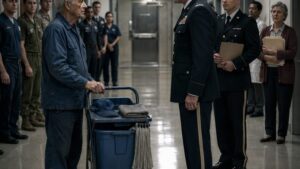
A metal rattle sounded near the service corridor. A woman in a dark conference-services jacket struggled to steer a beverage cart through the doorway. One front wheel twisted sideways and squealed against the tile. A silver coffee urn rocked dangerously beside a clear water pitcher.
Robert stood before he had decided to.
“Hold the door,” the woman called toward a catering assistant carrying two cardboard boxes.
The assistant tried, lost his grip on one box, and caught it against his knee. Paper cups spilled across the floor.
The woman closed her eyes for half a second. “Of course.”
Robert reached the cart and steadied the urn.
“I have it,” he said.
She looked up, startled. “Sir, you don’t need to—”
“The wheel is binding.”
“It has been binding for three months.”
“That seems long enough to qualify as tradition.”
The corner of her mouth moved. “Conference-services tradition.”
Together they angled the cart through the doorway. The wheel released with a protesting squeak.
“I’m Jennifer Martinez,” she said. “And I owe you a cup of whatever is still inside that urn.”
“Robert.”
The catering assistant crouched to collect the cups, then rose too quickly. His face tightened, and he pressed a hand to his lower back.
Jennifer noticed at once. “You’re done lifting.”
“I can finish.”
“You can finish by going to medical before you make it worse.”
The assistant looked toward the clock. “The command room setup is in fifteen minutes.”
Jennifer’s jaw set. “I know.”
Robert gathered the clean cups and returned them to their plastic sleeve.
“Where is the room?”
“Third corridor, past security.”
“I am going that direction.”
Jennifer studied his visitor badge. “You’re attending?”
“That was the plan.”
She looked at the cart, then at the security doors. “I shouldn’t ask.”
“You have not.”
“The urn is full.”
“I have moved heavier things.”
The answer came too quickly. Robert saw the question rise in her face and disappear when an impatient colonel approached.
“Coffee should have been inside ten minutes ago,” the colonel said to Jennifer.
“We had a staffing problem.”
“I don’t need the reason.”
“No, sir.”
He walked away without looking at Robert.
Robert watched Jennifer straighten the stack of cups he had already aligned.
“Does that happen often?” he asked.
“Only on days ending in y.”
He slipped his invitation beneath the upper sleeve of cups so it would not fall from his coat pocket while he pushed.
Jennifer took the handle beside him. “We can do it together.”
The cart rolled through the first security door after she scanned her service badge. Robert’s temporary badge flashed red, but Jennifer was already explaining the catering emergency to the junior specialist at the station.
“He stays with the cart,” she said.
The specialist glanced at Robert. “He staff?”
“He is helping me.”
“That wasn’t my question.”
Robert reached for his invitation, then stopped. Jennifer had already begun arguing that the coffee belonged inside a room full of generals who would blame her, not security, if it arrived late.
The specialist relented with a warning.
Beyond the checkpoint, the building changed. The carpet grew thicker. Framed photographs replaced informational posters. Robert recognized faces that had once been young enough to call him sir without irony. Several were gone now.
One photograph showed the doctrine center’s former command room. The table ran east to west beneath a wall map of the Lantern corridor.
In the present building, the same room waited ahead with its doors open.
Voices carried into the hall. Senior officers were taking their places around a polished table now turned north to south. Folders lay before them in exact rows. On the far wall, a digital map displayed the mountain corridor where Frank Wright had vanished into smoke.
Robert’s grip tightened on the cart handle.
Jennifer mistook the movement for pain. “I can take it from here.”
“No.”
The word was quiet but firm.
She followed his gaze toward the map. “You know the operation?”
Robert pushed the cart another few feet. The bad wheel cried out.
“I knew some of the people.”
A uniformed captain stepped into the doorway.
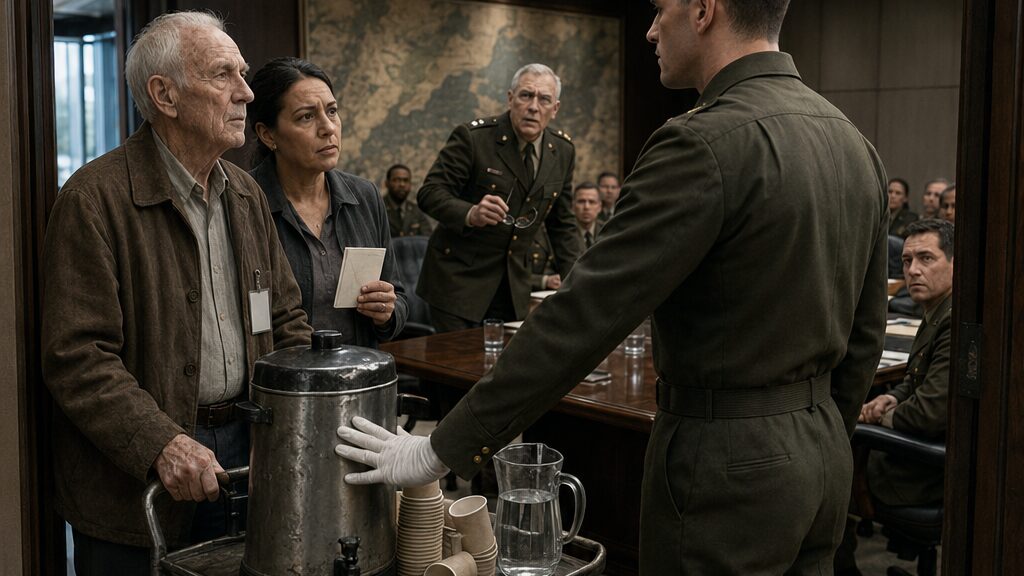
He was tall, sharply groomed, and young enough that Operation Lantern belonged to history rather than memory. White security gloves covered his hands. His eyes moved first to Jennifer’s badge, then to Robert’s blank visitor card, then to the cart between them.
He raised one hand.
The gesture stopped the dented urn inches from his palm.
“Not through here,” he said.
Chapter 2: The Hand That Stopped the Cart
The captain kept his gloved hand against the coffee cart as though Robert might use it to breach the room by force.
“Service access is around the east corridor,” he said.
Jennifer leaned sideways to see past him. “Captain, this is the conference setup.”
“I know what it is.”
“The east corridor door is locked for the security sweep.”
“Then wait until it opens.”
Inside the command room, conversations softened. Several officers looked toward the doorway, first at the delay and then at Robert.
The captain’s attention remained fixed on Robert’s badge.
“Sir, are you with the veterans’ tour downstairs?”
“No.”
“Did someone separate you from your group?”
“I did not come with a group.”
The captain exhaled through his nose. “Then step away from the cart.”
Robert did not move. “I am helping Ms. Martinez.”
“I can see that.”
The words carried an edge sharper than their meaning.
Jennifer reached beneath the cups and found Robert’s invitation. “He is also attending the conference.”
The captain took the paper from her. His name strip read WRIGHT.
Robert stared at it one moment too long.
Captain Wright unfolded the invitation and read it.
“R. Hall,” he said. “No rank. No office. No clearance code.”
“My temporary badge failed to print the code.”
“That means you do not have access.”
“It means the printer failed to show it.”
A few officers inside had fully turned in their chairs. Robert recognized the ritual of public discomfort: people watched because something improper was happening, but no one yet knew whose behavior was improper.
Wright held up the invitation. “This could have been copied from any guest packet.”
Jennifer’s face hardened. “It came from the front desk.”
“The front desk issued him a general visitor badge. That does not authorize this room.”
“Then call and verify it.”
“I am handling security.”
“You are blocking the coffee.”
“I am preventing an unidentified individual from entering a restricted briefing.”
Robert felt the cups tremble under his hand. Wright’s palm had pressed the cart backward just enough for the bad wheel to turn sideways. The water in the pitcher tapped against the glass.
He steadied the cups one stack at a time.
Wright watched him do it.
“Sir, I am asking you politely to step back.”
“No,” Robert said. “You are instructing me.”
A few heads turned more sharply inside.
Wright’s cheeks colored. “Then I am instructing you to step back.”
Robert released the cups and looked through the open doorway.
The room had been renovated since his last visit. New screens. New ceiling panels. A polished table large enough for twenty officers. Yet the eastern wall still held a faint rectangular discoloration where the old operations map had hung for years.
“That table used to face east,” Robert said.
Wright glanced into the room. “What?”
“The long side faced the map. The communications desk stood beneath that clock, before the wall was rebuilt.”
Silence gathered near the doorway.
At the head of the table, Lieutenant General Christopher Green stopped speaking.
Robert had last seen him eleven years earlier at a funeral where neither man had said what he had come to say. Christopher’s hair had gone white at the temples, and the narrow young officer Robert remembered had thickened into command. But the habit remained: when startled, Christopher removed his glasses before turning toward the sound.
He removed them now.
Their eyes met across the room.
Christopher rose halfway from his chair.
Robert gave the smallest shake of his head.
It was not enough to be visible to anyone who did not know him well. Christopher knew him well enough.
He sat back down.
The decision struck Robert with an unexpected force. He had asked for no ceremony, no escort, no announcement. Christopher was honoring that request.
But he was also allowing the doorway scene to continue.
Wright followed Robert’s gaze and saw only a stranger staring at a senior commander.
“You need to leave this corridor.”
Jennifer stepped between Wright and the cart. “His name is on the list.”
She held up her phone. A conference-services page showed the invited consultants.
R. Hall — Special Review Session.
Wright read it, then looked at Robert.
“That proves someone with that initial and surname was invited.”
“How many R. Halls are scheduled today?” Jennifer asked.
“That is not the standard.”
“No. The standard is verification.”
Wright handed the invitation back as if it had become dirty. “The standard is exact credential matching. His badge does not match the access requirement.”
Robert accepted the paper. “You can call General Green’s office.”
Wright’s eyes narrowed. “You know General Green?”
“I know who chairs the conference.”
“That information is on the screen in the lobby.”
Robert folded the invitation along its original crease.
The smart choice would have been simple. He could give his full name. He could tell Wright to contact the retired-officer registry. He could say one sentence and watch every posture change.
Four-star General Robert Hall, retired.
But then the apology would come because of the stars. Jennifer would remain “just catering.” The next old man without a title would still be guided downstairs.
And beneath that lay the less honorable reason.
If Robert entered as General Hall, Operation Lantern would follow him into the room before he was ready to face it.
Wright pointed down the hall. “Ms. Martinez, take your volunteer to the service corridor. Leave the cart there. Staff will move it once the sweep is complete.”
“His invitation is valid.”
“It is unresolved.”
“You have not resolved it.”
Wright’s voice dropped. “Do not tell me how to run a secure threshold.”
Jennifer drew breath to answer.
Robert touched two fingers to the cart handle. “Ms. Martinez.”
She looked at him.
“It is your cart. Do as he directs.”
“That is not the point.”
“No,” Robert said. “It is not.”
The distinction landed. Jennifer’s anger did not disappear, but she stepped to the side.
Wright moved his hand from the urn. A brown drop of coffee had leaked from the valve and marked the white leather near his thumb.
Robert turned the cart carefully. The bad wheel shrieked against the carpet.
Inside the room, someone whispered. Another officer shifted as if preparing to stand.
Christopher remained seated.
Yet his right hand had closed around his glasses.
Robert pushed toward the service corridor. He had gone six steps when he heard Christopher speak behind him.
“Colonel Flores.”
Benjamin Flores, seated near the projection controls, turned. “Sir?”
“Retrieve the sealed attendance file for Operation Lantern.”
Benjamin hesitated. “The historical file?”
“The original.”
“That archive is not part of today’s release package.”
“It is now.”
Wright glanced back toward the room.
Christopher did not look at Robert again.
“And Colonel,” he added, his voice low enough that only those nearest the doorway could hear, “no one announces any name until I have seen that file.”
Chapter 3: A Name the Guard Had Heard Before
Hall.
Jeffrey Wright stared at the folded invitation in the old man’s hand and saw the name beneath a different image: black letters engraved on a brass plate under his grandfather’s photograph.
SERGEANT FRANK WRIGHT
OPERATION LANTERN
DID NOT RETURN
The photograph had hung in his grandmother’s hallway for twenty-eight years. Frank stood beside a transport truck, sleeves rolled to his elbows, smiling as if someone beyond the frame had just insulted his cooking.
Jeffrey had been seven when he first asked what happened.
A general left him there, his grandmother had said.
Later, his father had softened the wording but not the conclusion. Command made the decision. Frank paid for it.
Now an old man named Hall stood behind a catering cart outside a conference devoted to that operation.
Jeffrey told himself it was coincidence.
He also knew there were coincidences a security officer could not afford to trust.
“Captain?”
The junior security specialist stood in the alcove holding a tablet. Jeffrey followed him away from the doorway, though he kept Robert in sight. The old man had stopped beside the service entrance with Jennifer. He was not arguing. That calm made Jeffrey more uneasy than anger would have.
“What did you find?” Jeffrey asked.
“The invitation is authentic.”
Jeffrey looked at the tablet.
The digital record showed the same abbreviated name.
R. Hall — Special Review Session.
“Who issued it?”
“General Green’s office.”
“Which staff member?”
“The authorization is under the general’s personal credential.”
Jeffrey’s mouth went dry.
“Access code?”
“Removed before printing.”
“Removed by whom?”
The specialist scrolled. “Requested by invitee. Approved by General Green.”
Jeffrey looked back toward Robert.
The old man had taken a paper cup from the stack and was wiping coffee from the urn valve with a napkin. His movements were slow but exact. Jennifer spoke to him in a low voice, visibly furious on his behalf.
“Run the retired-officer registry,” Jeffrey said.
“I need a full first name.”
“Search Hall against Operation Lantern.”
“That could return hundreds of records.”
“Do it.”
The specialist glanced toward the main room. “The briefing is already delayed.”
“Then work faster.”
Jeffrey heard the sharpness in his own voice. The specialist heard it too.
Three weeks earlier, an unauthorized contractor had crossed a restricted floor using a duplicated maintenance badge. No classified material had been lost, but the investigation had stained everyone assigned to access control. Jeffrey’s evaluation board met next month. One more lapse would end any chance of promotion.
The old man’s badge had no clearance stripe. The name was incomplete. He had arrived pushing a cart.
Those were facts.
The memory of the brass plate was not.
The specialist tapped through the registry. “There are six Halls connected to Lantern.”
“Living?”
“Three.”
“First names?”
The specialist’s finger stopped.
Before he could answer, Jennifer approached the alcove.
“You have your verification,” she said.
Jeffrey locked the tablet screen. “The credential mismatch remains.”
“His invitation came from the conference chair.”
“And the conference chair ordered the historical file reviewed before any identity was announced.”
“That sounds as if he knows exactly who this man is.”
“It sounds as if he has questions.”
Jennifer looked past Jeffrey toward the room. “You could ask him.”
“I will not interrupt a lieutenant general because a visitor chose to remove his own credentials.”
“You interrupted the entire conference to keep him out.”
Jeffrey stepped closer. “Ms. Martinez, return to your duties.”
Her expression changed—not fear, exactly, but recognition. She understood he was using rank to end the conversation.
“You called him my volunteer,” she said. “As if helping me made him less entitled to be heard.”
“That is not what I said.”
“It is what you meant.”
She walked away before he could answer.
Jeffrey looked down. A thin line of coffee had run from the stain on his glove to the polished toe of his boot.
He removed the glove and wiped the leather with his thumb.
In the hallway, Robert watched him.
Not with satisfaction. Not even accusation.
With recognition.
That was worse.
The specialist cleared his throat. “Captain, I found the likely record.”
Jeffrey held out his hand for the tablet.
The screen showed no photograph, only a partially restricted entry.
HALL, ROBERT
LANTERN COMMAND ELEMENT
STATUS: RETIRED
ADDITIONAL RECORDS SEALED
The rank field was hidden beneath an archive restriction.
Jeffrey read the name twice.
Robert Hall.
His grandmother had spoken it only once. She had been sitting at the kitchen table after receiving a letter from the Army. Jeffrey remembered the envelope because she had torn it into strips so small they looked like pale threads.
General Hall says Frank volunteered, she had said. General Hall gets to come home and tell us what Frank chose.
Jeffrey had never seen the letter.
“Should I update the access log?” the specialist asked.
The correct answer was yes.
The invitation was authentic. The authorization came directly from Christopher Green. The registry connected Robert Hall to Operation Lantern.
Jeffrey could escort the old man inside and document the credential anomaly afterward.
Instead, he handed back the tablet.
“Not yet.”
“Sir?”
“The badge still fails exact matching. Mark identity pending.”
“But we have—”
“We have a likely record without visible rank or current authorization.”
“We have General Green’s credential.”
Jeffrey looked at him until the specialist lowered the tablet.
“Identity pending,” Jeffrey repeated.
“Yes, sir.”
The choice settled in Jeffrey’s chest with the hard finality of a locked door.
He walked toward Robert.
Jennifer had moved the cart against the wall. The dented urn stood between them, its metal surface reflecting fractured shapes from the corridor lights.
Robert folded his invitation and slipped it back beneath the cups.
Jeffrey stopped close enough that no one inside the conference room could hear him clearly.
“Robert Hall,” he said.
The old man’s hand became still.
Jeffrey watched his face for surprise and found none.
“My grandfather was Sergeant Frank Wright.”
Something changed in Robert—not his posture, not his expression, but the silence around him. His gaze dropped to Jeffrey’s bare hand, then to the name strip above his uniform pocket.
“Frank,” Robert said.
The use of the first name struck like an insult.
“You remember him.”
“Yes.”
Jeffrey stepped closer. “My family remembers you.”
Jennifer started toward them, but Robert lifted one finger, asking her to wait.
The small gesture irritated Jeffrey. Even dressed like a lost visitor, the old man moved as though people were accustomed to obeying him.
“You have had plenty of time to tell your version,” Jeffrey said.
Robert looked through the conference doorway toward the map glowing on the far wall.
“No,” he said. “I have had plenty of time to avoid it.”
Jeffrey had expected denial. He had prepared himself for authority, excuses, perhaps the cold language of necessity.
The admission unsettled him.
He lowered his voice.
“My grandfather never came home from your operation.”
Robert met his eyes.
For a moment Jeffrey thought the old man would finally defend himself.
Instead, Robert placed one hand on the coffee cart to steady its trembling wheel.
“I know,” he said.
Chapter 4: The Story Printed Without the Dead
The slide reduced Frank Wright’s death to four words.
ACCEPTABLE DELAY LOSSES: SEVEN
Robert stood in the side briefing room with an untouched paper cup in his hand while the phrase glowed on the monitor. Beneath it, a clean blue arrow traced the civilian convoy’s escape through the mountain corridor. No smoke obscured the route. No disabled transport blocked the eastern bend. No names appeared anywhere on the map.
Christopher closed the door behind them.
Benjamin Flores remained at the archive terminal, one hand resting on the keyboard. He had the tense stillness of a man watching years of careful work begin to loosen at the seams.
“You approved this?” Robert asked.
Benjamin glanced at Christopher before answering. “The language comes from the official after-action summary.”
“That was not my question.”
“I approved its use in the doctrine package.”
Robert set the cup beside the terminal. Coffee trembled near the rim but did not spill.
Christopher stepped closer to the screen. “The session was designed around command timing, not casualty review.”
“Then you designed it around half an operation.”
“It is a teaching conference.”
“So was Lantern.”
Benjamin shifted in his chair. “Sir, with respect, every operational history is selective. If we include every contested memory, every family objection, every later interpretation—”
“Sergeant Wright is not an interpretation.”
The room went quiet.
Through the wall came the muted cadence of the main conference. Someone had resumed speaking to fill the delay. Robert could not make out the words, only the practiced rise and fall of military instruction.
Christopher folded his glasses and placed them on the table.
“You asked for anonymity,” he said. “You asked me not to announce you. You asked that the invitation carry no rank.”
“I did.”
“And now you are surprised that the institution followed the record you left it.”
Robert looked at him.
Christopher did not retreat.
There had been a time when the younger man would have softened any disagreement before offering it. Years of command had removed that habit.
Benjamin turned from the terminal. “There is a longer casualty annex, but it remains restricted.”
“Why?” Robert asked.
“Medical details, communications intercepts, identities of local sources.”
“Frank’s decision is not a medical detail.”
“No. But the recording around it is embedded in material that was never cleared for public release.”
Robert picked up the cup. He brought it halfway toward his mouth, smelled the burnt coffee, and lowered it again.
Christopher watched him.
“You came because you wanted to know what we taught,” he said.
“I came because you wrote that the conference would examine the moral limits of command.”
“It does.”
“Not if the dead are converted into a timing variable.”
Benjamin stood. “General—”
Robert’s eyes moved to him.
Benjamin stopped, realizing he had used the title before the room outside had been told.
“I apologize,” he said.
“For remembering?”
“For speaking out of turn.”
Robert looked back at the monitor. “That is how this happens.”
Benjamin’s face tightened. “How what happens?”
“A room learns to fear the wrong mistake.”
No one answered.
Christopher moved to the terminal and opened another section of the presentation. A timeline appeared. At 0435, the command element ordered withdrawal. At 0442, the first civilian vehicles entered the western pass. At 0510, the corridor closed.
Between 0435 and 0510, the display showed a narrow gray bar marked DELAY ACTION.
Thirty-five minutes.
Frank’s remaining life had been given the width of Christopher’s thumb.
Robert touched the screen beside the gray bar.
“Who wrote this summary?”
“The first version came from the post-operation review board,” Benjamin said. “It has been revised several times.”
“By whom?”
“Doctrine staff. Historians. Legal review.”
“Anyone who was there?”
Christopher answered. “You were asked.”
Robert removed his hand from the screen.
The old paper cup softened slightly under his grip.
Christopher opened a folder on the terminal. “There were three requests for your testimony over twenty years. You declined all three.”
“The operation remained classified.”
“Parts of it.”
“The parts that mattered.”
Christopher’s voice stayed level. “And when those parts were declassified, you still declined.”
Robert looked toward the closed door.
Beyond it, Jeffrey Wright stood somewhere in the corridor carrying a family’s version of the same silence.
Benjamin spoke carefully. “The official record says the rear guard remained in position after communications failed.”
“That is true.”
“It says the command element continued the evacuation because returning would have endangered the convoy.”
“That is also true.”
“It does not say you returned.”
Robert’s hand tightened around the cup.
Christopher was the one who answered.
“Because Robert asked us to remove it.”
Benjamin stared at him.
The monitor’s light flattened every expression in the room.
“You ordered that section removed?” Benjamin asked Robert.
“I requested that my actions after the convoy cleared not be included in the command citation.”
“That is not the same as removing it from the operational history.”
“It became the same.”
Christopher leaned against the table. “You said a commander did not deserve credit for trying to recover men he had ordered to remain.”
“I still believe that.”
“And so the record kept the order and lost the attempt.”
“The attempt failed.”
Christopher’s jaw moved. “Failure is still part of the truth.”
Robert set the cup down. The coffee remained untouched.
For years he had told himself that silence protected Frank from becoming a footnote in Robert Hall’s story. A dead sergeant’s courage should not be used to polish a general’s grief.
But the blank spaces had not stayed blank. Institutions disliked emptiness. Families disliked it more. Others had filled the silence with cleaner explanations.
Abandonment.
Acceptable losses.
Command success.
Benjamin returned to the keyboard. “If we revise the presentation during the conference, we create problems beyond doctrine.”
“What problems?” Robert asked.
“Family claims. Requests for amended citations. Questions about whether information was improperly withheld. Questions about command accountability.”
“They should ask those questions.”
“Perhaps. But we cannot answer them responsibly in one afternoon.”
Christopher looked at Robert. “And yet we cannot continue the session as written.”
Benjamin exhaled. “Sir, this curriculum has been used for nine years. Lantern is taught as a model of disciplined withdrawal under pressure. If we reopen the command narrative in front of this audience without completing review, the lesson collapses.”
Robert studied the blue evacuation arrow.
“Then perhaps the lesson should collapse.”
A knock sounded.
The military archivist entered carrying a sealed gray case. A red inventory strip ran across its lid.
“Colonel Flores,” the archivist said, “the original attendance and communications package.”
Benjamin signed the release tablet. “Anything outside the indexed file?”
“One item.”
The archivist placed the case on the table and opened it. Inside were paper rosters, magnetic recordings, contact sheets, and a smaller envelope marked UNPROCESSED AUDIO—EASTERN CORRIDOR.
Benjamin stared at the label.
“This was not in the digitized archive.”
“It was attached to a damaged field recorder recovered after the site reopened. The transfer was incomplete. No full transcript was produced.”
Robert felt the room narrow around the envelope.
Christopher reached toward it, then stopped. “Do we know whose voices?”
The archivist consulted the inventory sheet.
“One is identified as Sergeant Frank Wright.”
Robert looked at his untouched coffee.
The archivist continued.
“The other is listed as command call sign Lantern Actual.”
Chapter 5: The Voice From the Evacuation Corridor
“You get them through, sir. That is the order I am giving you now.”
Frank Wright’s voice emerged from the archive speaker beneath a wash of static.
Robert gripped the edge of the table.
The recording had stripped away the years. Frank was no longer a name beneath a photograph or a casualty line on a screen. He was thirty-six again, breathing too fast, speaking over distant impacts with the stubborn calm he used whenever he had already decided something dangerous.
The secure archive room held only Robert, Christopher, Benjamin, Jeffrey, and the military archivist. Jennifer waited outside with the cart because no one had told her where else to put it.
Jeffrey stood opposite Robert.
His face had changed at the first sound of his grandfather’s voice. The anger remained, but it had lost its certainty.
On the recording, a younger Robert answered.
“That is not your order to give, Sergeant.”
“Then consider it a recommendation from a man with a better view.”
A burst of interference swallowed several seconds.
The archivist adjusted the playback controls. “The recorder casing was damaged. We recovered only fragments.”
Frank returned through the static.
“Second bus cleared the bend. We still have movement east.”
Robert heard himself say, “Your extraction vehicle is turning back.”
“No. Keep it with the medical convoy.”
“That is a direct order.”
“And I am telling you it will never reach us before the road closes.”
Jeffrey looked at Robert. “He refused you?”
“He understood the ground better than I did.”
The admission seemed to offend him. “You were commanding the operation.”
“Yes.”
“Then the decision was yours.”
“Some decisions belong to the person standing where the map ends.”
Christopher said nothing. Benjamin watched the speaker as though the machine itself had taken command of the room.
The recording continued.
Frank called distances. Ammunition. Vehicle counts. He reported two wounded soldiers still capable of moving and one who was not. No fear entered his voice until he mentioned the civilians.
“If we fold now, they see the convoy from the eastern rise.”
Robert’s younger voice became harder. “You have held long enough.”
“Not yet.”
“You do not decide what long enough means.”
“No, sir. The families in those buses do.”
A scraping noise crossed the audio.
From outside the archive room came the squeak of the coffee cart’s bad wheel as Jennifer repositioned it in the corridor.
Robert turned his head.
For an instant, the sounds overlapped—the damaged field recorder and the stubborn wheel, both carrying weight through a narrow passage.
On the recording, Frank breathed close to the microphone.
“You get them through, sir.”
Then came the sentence that had opened the playback.
“That is the order I am giving you now.”
A younger Robert answered after a long pause.
“I will come back.”
Frank gave a tired laugh. “Generals always say that when sergeants are busy.”
The static thickened.
Jeffrey moved nearer the speaker.
“What happened next?”
No one answered.
The archivist advanced the file. A burst of sound filled the room—metal striking stone, a shouted coordinate, an engine laboring at high speed.
Then silence.
The digital counter continued for four empty seconds before the recording ended.
Jeffrey stared at the speaker.
“That is it?”
“That is all that transferred,” the archivist said.
“There was more.”
“Possibly.”
“Where is it?”
“The original medium is too damaged for further recovery with our equipment.”
Jeffrey turned to Benjamin. “You expect me to believe this sat in an envelope for thirty-seven years?”
Benjamin kept his voice controlled. “It was inventoried as damaged and unprocessed.”
“Convenient.”
“Captain,” Christopher warned.
Jeffrey ignored him. “The recording proves my grandfather stayed. It proves Hall left.”
“It proves the convoy was still moving,” Robert said.
Jeffrey swung toward him. “And then the part where you supposedly returned disappears.”
Robert did not correct the use of his surname.
The old instinct urged him to absorb the accusation. Commanders did not defend themselves to the families of the dead. They listened. They accepted whatever shape grief took.
But Frank’s voice still seemed present in the speaker, refusing once more to be simplified.
Robert said, “The recording was made before I turned back.”
Jeffrey gave a bitter laugh. “Of course it was.”
Christopher stepped between them. “There are vehicle logs.”
“Written by whose staff?”
“Captain—”
“His staff. His headquarters. His operation.”
Robert looked at Jeffrey’s clenched hands.
“Let him ask.”
Jeffrey’s eyes stayed fixed on Robert. “Did you order my grandfather to remain?”
“I ordered the entire rear guard to withdraw at 0435.”
“Did he?”
“No.”
“Did you leave?”
“I continued west with the civilian convoy.”
“There it is.”
“Until the last bus crossed the cut.”
Jeffrey waited.
Robert could feel Christopher watching him. For decades, Robert had avoided precisely this sequence—the moment when explanation began to resemble defense.
He had thought silence cleaner.
It was not clean. It had merely left the dirt for others.
“At 0458,” Robert said, “I transferred convoy control to my deputy. I took the armored recovery vehicle east with three volunteers.”
Jeffrey’s expression did not change. “Where is that in the official account?”
“It is not.”
“Why?”
“Because I asked that it be removed from the citation and later refused to give testimony.”
“You removed the evidence that made you look brave?”
“I removed what made failure look like courage.”
Jeffrey struck the table with his palm.
The speaker jumped.
“My grandfather died while you decided how history should judge you.”
The archivist stepped back. Benjamin moved toward the door, but Christopher raised a hand to stop him.
Robert looked at the speaker rather than Jeffrey.
“We reached the first checkpoint after the road had begun to collapse. The recovery vehicle lost a track. We continued on foot.”
“How far?”
“Less than a mile.”
“Did you find him?”
“We found two members of the rear guard alive.”
“My grandfather?”
“No.”
“His body?”
“No.”
The word stayed between them.
Jeffrey’s anger faltered. What remained beneath it was younger and less controlled.
“So you came back with a story.”
“Yes.”
“And my family got a letter.”
“Yes.”
“Signed by you.”
“Yes.”
Jeffrey stepped away from the table as if proximity had become dangerous.
Benjamin opened a vehicle log on the terminal. A handwritten entry appeared beside a time stamp.
LANTERN ACTUAL EASTBOUND. RECOVERY ATTEMPT AUTHORIZED AGAINST ADVICE.
Below it were three witness signatures.
Jeffrey read them.
His face tightened again, but now the anger had nowhere simple to land.
“These could have been added later.”
Benjamin said, “The ink and paper were authenticated when the file was transferred.”
“Then why was none of it released?”
Robert answered before anyone else could.
“Because I let the absence stand.”
Jeffrey looked up.
Robert met his eyes.
“I told myself your grandfather’s decision should not become evidence in my defense. I told myself command meant carrying blame without explanation. Some of that was principle.”
“And the rest?”
Robert heard the squeaking wheel again outside.
“The rest was cowardice.”
Jeffrey’s breathing slowed.
The archive room door opened. Jennifer stood beside the cart, uncertain whether she was permitted to interrupt.
“General Green,” she said, “the officers in the main room are asking whether the conference is continuing.”
Christopher looked at Robert.
The title had not yet been spoken publicly, but the room had moved beyond hiding.
Christopher crossed to the door and opened it fully. Beyond the corridor, the main conference doors remained visible, guarded by officers who were pretending not to watch.
“We can close the session,” Christopher said. “Or we can open those doors and correct it.”
Robert looked at the coffee cart. The cups were still stacked where he had steadied them. His invitation remained tucked beneath the upper sleeve.
For thirty-seven years he had allowed other people to speak into his silence.
Christopher waited.
“If those doors open,” he said, “the whole room hears the rest.”
Chapter 6: When the Room Finally Knew His Name
The first image projected onto the conference-room wall showed Robert Hall thirty-seven years younger, standing beside the same long table when it still faced east.
No one in the room spoke.
In the photograph, Robert wore field fatigues with rolled sleeves and held one hand over the Lantern corridor map. Christopher stood near the communications desk, lean and dark-haired, listening with the severe attention of a junior officer who feared missing a single word.
The man in the image and the elderly visitor at the doorway shared the same level gaze.
That was enough.
Recognition moved through the room without sound.
Robert remained outside the threshold.
Jennifer stood beside him with both hands on the coffee cart. Jeffrey was a few feet behind them, his face drained of the certainty that had held him upright all morning.
Benjamin advanced to the next archival image.
A command roster appeared.
HALL, ROBERT — LANTERN ACTUAL
COMMANDING GENERAL
The line was followed by Robert’s signature.
Christopher walked from the head of the polished table toward the doorway. Every officer watched him cross the room.
He stopped in front of Robert.
For a moment, neither man spoke.
Christopher’s eyes moved over the faded coat, the blank visitor badge, and the invitation beneath the cups. Regret tightened his face.
“General Hall,” he said.
Chairs moved behind him.
Some officers stood at once. Others rose more slowly, confusion giving way to embarrassment. A folder slid from the table and struck the carpet. No one bent to retrieve it.
Robert disliked the movement immediately.
The room had watched an old man be blocked. Now it stood because a title had been supplied.
He looked at Jennifer.
“Would you bring the coffee in?”
She glanced at Christopher.
Robert noticed and said, “It is your cart.”
Jennifer took the handle.
This time she did not walk behind Robert. She pushed beside him.
The bad wheel squealed as they crossed the threshold.
The sound cut through the formal silence and made the scene human again.
Robert entered without salute or announcement. The dented urn passed within inches of Jeffrey’s earlier position. Cups rattled lightly against one another.
Christopher turned toward the assembled officers.
“For those who have not yet understood,” he said, “this is General Robert Hall, retired. He commanded Operation Lantern and later served as—”
“That is enough,” Robert said.
Christopher stopped.
Robert faced the room. Several officers remained rigidly upright. A few looked toward Jeffrey, who had not entered.
“Please sit.”
No one moved at first.
Robert waited.
They sat unevenly, the way people did when ceremony had overtaken judgment and no one knew which rule applied.
Jennifer parked the cart beside the projection wall. The historical image remained above it: young Robert at the east-facing table, old Robert beneath it, the same room arranged around two different versions of memory.
Benjamin handed Robert a wireless control.
Robert did not take it.
“Show the casualty slide,” he said.
Benjamin hesitated, then returned to the terminal.
ACCEPTABLE DELAY LOSSES: SEVEN
A murmur moved through the officers.
Robert looked at the phrase until everyone else had looked at it too.
“This is what you were going to teach?”
Benjamin stood. “Sir, the language comes from—”
“I know where it comes from.”
Robert turned toward the doorway.
Jeffrey remained outside, his bare hand hanging beside the glove he had removed. The junior security specialist stood behind him.
“Captain Wright,” Robert said.
Jeffrey’s shoulders stiffened.
“Come in.”
Christopher’s expression sharpened. “General, before he does, I need to address his conduct.”
“Later.”
“He disregarded verified authorization. He concealed the result of a credential check. He publicly obstructed an invited participant.”
The officers’ attention shifted toward Jeffrey.
Robert saw the instant transformation: the room had found a new lowest-ranking figure.
Christopher continued. “Captain Wright, report to the deputy commandant’s office and surrender your access authority pending investigation.”
Jeffrey swallowed. “Yes, sir.”
He turned.
Robert raised his hand.
The gesture was almost identical to the one Jeffrey had used against the cart—palm outward, quiet, final.
Jeffrey stopped.
“No,” Robert said.
Christopher looked at him. “Sir?”
“He stays.”
“General, this is a security matter.”
“It is also the reason the truth arrived in this room.”
Christopher lowered his voice. “That does not excuse what he did.”
“I did not say it did.”
Robert let his hand fall.
Jeffrey stood motionless in the doorway.
Robert addressed him directly. “You verified the invitation.”
Jeffrey’s jaw tightened. “Yes.”
“And chose not to report it.”
“Yes.”
“Because of the badge?”
“At first.”
The room remained still.
Robert waited.
Jeffrey looked toward the projected roster, then at the casualty slide beside it.
“Because of the name,” he said.
A colonel near the table shifted impatiently, but Robert did not allow the moment to move past.
“What name?”
“My grandfather’s.”
Christopher looked from Jeffrey to Robert.
Robert said, “Tell them.”
Jeffrey’s throat worked.
“My grandfather was Sergeant Frank Wright. He died during Operation Lantern.”
The casualty phrase remained on the wall above him.
Acceptable delay losses.
The words seemed uglier now that one of the dead had a grandson standing beneath them.
Christopher’s anger changed shape. “Why was this not disclosed before the conference?”
Jeffrey answered without looking at him. “I was not assigned because of it. I did not know Mr. Hall was attending.”
“General Hall,” an officer corrected.
Robert turned toward the speaker.
“No,” he said. “Captain Wright did not owe basic respect to a general. He owed it to the man he believed was pushing coffee.”
The officer lowered his eyes.
Jennifer stood beside the cart, one hand resting on the dented urn.
Robert looked again at Jeffrey. “Your grandfather has been discussed in this building for decades without being allowed into the room as a person.”
Jeffrey’s expression tightened.
“I heard the recording,” he said. “I saw the vehicle log.”
Several officers glanced toward Benjamin, surprised that evidence had already been reviewed.
Christopher stepped closer to Robert. “Then let us proceed properly. We can suspend the conference, assemble a review panel, and—”
“That is how another decade disappears.”
“Robert.”
It was the first time Christopher had used his name.
Robert looked at the assembled officers. Their folders contained the clean version. Their screens carried the blue arrow and the gray bar. Many had come expecting a lesson in decisive withdrawal.
He could give them that lesson. He could accept the honored seat, describe the operation in controlled language, and let Frank become noble background to a general’s return.
The room was ready to admire him.
That was precisely why he did not trust it.
Jennifer reached beneath the cups and removed the folded invitation. She held it out.
Robert took it and placed it on the cart.
R. Hall.
A name without rank. A name that had failed to open a door.
He turned to Christopher.
“Open the archive audio to the full room.”
Christopher studied him. “Are you certain?”
“No.”
The answer unsettled several officers more than certainty would have.
Robert moved to the empty place at the end of the table but did not sit.
“Captain Wright remains,” he said. “Ms. Martinez remains. No one closes the doors.”
Christopher looked toward the security staff.
“Leave them open,” he ordered.
Benjamin brought up the archive file. The speaker indicator appeared on the wall.
Before he could begin playback, Christopher faced Jeffrey again.
“Your actions will still be reviewed.”
“I understand, sir.”
Robert said, “After he hears what was denied to his family.”
Jeffrey looked at him.
Robert raised the paper cup he had carried from the side room. The coffee had gone cold. He set it unopened beside the dented urn.
“This meeting is not about the decision I made,” he said. “It is about the decision Sergeant Wright made after mine.”
Benjamin’s hand hovered over the playback control.
Christopher stood beside the head chair, but the room’s center had shifted elsewhere—to an old man beside a service cart, a young captain at the doorway, and a dead sergeant whose voice was about to enter at last.
Robert looked at Jeffrey.
“He stays,” he said. “His grandfather has been absent from this room long enough.”
Chapter 7: The Order No Commander Could Carry Alone
“This meeting is not about the decision I made,” Robert said. “It is about the decision Sergeant Wright made after mine.”
Benjamin lowered his hand from the playback control.
The projected casualty slide remained behind Robert, its four cold words hovering over the dented coffee urn. Jeffrey stood inside the doorway now, but only barely. One polished shoe rested on the conference-room carpet; the other remained in the corridor.
Robert understood the posture. Jeffrey had entered because ordered, not because he believed he belonged among the officers who had just watched his certainty collapse.
“Play the last clear exchange,” Robert said.
Frank’s voice returned through the speakers.
“You get them through, sir. That is the order I am giving you now.”
A few officers shifted at the sound of a sergeant issuing an order to a general. Frank’s tired laugh followed, then the promise Robert had carried for thirty-seven years.
“I will come back.”
The recording ended in static.
Robert let the silence remain.
“Sergeant Wright was given an order to withdraw at 0435,” he said. “He acknowledged it. Then he reported that enemy observers had reached the eastern rise. If his position folded, they would have seen the civilian convoy.”
Benjamin replaced the casualty slide with the route map. The blue arrow curved through the pass.
“There were two hundred and fourteen civilians on that road,” Robert continued. “Forty-three were children. Three buses carried patients who could not walk. The convoy had no alternate route.”
An officer near the middle of the table asked, “Why was the rear guard not reinforced?”
“Because every available vehicle was carrying civilians or wounded personnel. Sending another unit east would have reduced the escort on the convoy and placed more people inside a closing corridor.”
“So Wright chose to remain?”
“He proposed it.”
Jeffrey’s voice cut across the room. “And you approved it.”
Robert turned toward him.
“Yes.”
The word did not soften itself.
Jeffrey stepped fully across the threshold. “You could have refused.”
“I did refuse.”
“But he stayed.”
“He gave me his assessment. I gave him the order again. He explained what would happen if he obeyed.”
Robert looked at the map, though he no longer needed it.
“I had three choices. Force the rear guard to withdraw and expose the convoy. Send reinforcement that could not reach them in time. Or accept Frank’s plan.”
“You accepted it,” Jeffrey said.
“I did.”
Several officers looked down at their folders.
Robert had seen that movement at casualty briefings. People searched paper when a living face became too difficult.
“He was not expendable,” Robert said. “He was not abandoned because command forgot him. He understood the price before I permitted him to pay it.”
Jeffrey’s expression hardened. “That sounds better in this room than it did in my grandmother’s kitchen.”
“It should not.”
The answer stopped him.
Robert walked to the coffee cart and placed one hand beside the cold paper cup. From the archive case, the military archivist removed a clear evidence sleeve and passed it to Christopher.
Inside lay a folded, dirt-stained page.
Christopher handed it to Robert.
The field note was smaller than Robert remembered. Frank had written it on the reverse of a vehicle-maintenance form. The pencil marks had faded, but the final lines remained legible.
EASTERN RISE OCCUPIED. CONVOY STILL MOVING.
WE HOLD UNTIL LAST BUS CLEARS.
Below that, in tighter handwriting:
TELL THEM WE CHOSE THE TIME.
Robert placed the sleeve on the coffee cart rather than the command table.
Jeffrey stared at it.
“Is that his writing?” Robert asked.
Jeffrey approached slowly. “I have birthday cards.”
He stopped beside the cart, close enough to read but not touching the sleeve.
“The W leans left,” he said.
Robert nodded.
Jeffrey read the final sentence again. His mouth tightened.
“Why did my family never see this?”
“The note remained in the restricted recovery file.”
“You could have sent a copy when it was declassified.”
“Yes.”
“Why didn’t you?”
Christopher shifted as if preparing to intervene.
Robert raised a hand without looking at him.
Jeffrey deserved the answer from the man who had failed to give it.
“After Lantern, I wrote to every family,” Robert said. “Your grandmother answered mine.”
“What did she say?”
“That generals had the privilege of explaining decisions after the men who carried them were dead.”
Jeffrey looked toward the projected map.
“She was right.”
“She was grieving,” Christopher said.
Robert faced him. “Both can be true.”
He returned his attention to Jeffrey.
“I began another letter when the first records were released. I wrote that Frank volunteered. I wrote that I returned. I read it and heard a commander arranging the facts so he might be forgiven.”
“So you sent nothing.”
“I told myself silence prevented me from using your grandfather’s courage as my defense.”
Jeffrey’s eyes lifted to his.
“And what do you call it now?”
Robert looked at Frank’s note.
“Cowardice after the war.”
No one in the room moved.
The confession did not absolve him. Robert felt that clearly. It did something more difficult: it removed the last respectable name from his avoidance.
“I knew where your family lived,” he said. “I knew the classification had changed. I knew the official history had reduced Frank and six others to a gray bar on a timeline. I still waited for a way to speak that would not expose me to judgment.”
Jeffrey’s voice was quieter. “You let us believe he had no choice.”
“Yes.”
“My father believed Frank asked for extraction and was denied.”
“I know.”
“How?”
“Your father wrote to the review board.”
Jeffrey looked as if he had been struck.
Robert did not turn away.
“I read the letter. I drafted a response. I never sent it.”
Jeffrey gripped the edge of the cart. The stacked cups shifted, and Jennifer reached out instinctively to steady them. Jeffrey noticed her hand and released his grip.
Christopher said, “Captain, General Hall is accepting responsibility for an institutional failure that involved more people than—”
“No,” Robert said. “Do not widen the circle to make my part smaller.”
Christopher fell silent.
Robert lifted Frank’s field note from the cart.
“Your grandfather was not ordered to disappear. He was not a passive loss. He made a professional judgment, argued it to his commander, and accepted a duty no one should reduce to a sentence about delay.”
Jeffrey’s eyes remained on the note.
“Did he know you were coming back?”
“I told him.”
“Did he believe you?”
Robert remembered the laugh beneath the static.
“I think he hoped I would have better sense.”
A few strained breaths moved through the room, not laughter but recognition of the man inside the recording.
Robert continued.
“When the last bus cleared, I transferred command and went east. We recovered two soldiers alive. We found evidence that Frank’s position held until 0507. The corridor closed three minutes later.”
“Did he save the convoy?” Jeffrey asked.
“Yes.”
The answer was not ceremonial. It was factual, and that gave it weight.
Jeffrey lowered his head.
Robert placed the note back beside the dented urn.
“There will be a review of Captain Wright’s conduct today,” he said. “There should be. He verified my invitation and concealed the result. He treated Ms. Martinez as if her role made her judgment irrelevant. He treated an unidentified old man as someone whose dignity could wait for credentials.”
Jeffrey accepted each sentence without protest.
“But this room does not correct one failure by preserving another.”
Robert looked toward Benjamin.
“The Lantern package will be withdrawn.”
Benjamin’s face tightened. “Sir, I can initiate a historical review, but withdrawal requires doctrine command approval.”
Christopher answered, “It has mine.”
Robert looked at him. “That is the beginning.”
He faced the assembled officers.
“The revised record will name every member of the rear guard. It will include Frank Wright’s field assessment, the recovered audio, the convoy timeline, and the fact that the command account remained incomplete because I refused to testify.”
Christopher nodded once.
Robert continued. “My full statement may be released on two conditions.”
Benjamin opened a notebook.
“First, Sergeant Wright’s decision is not presented as obedience without agency. He argued. He chose. He understood the ground better than the headquarters that issued his orders.”
Benjamin wrote quickly.
“Second, this center changes its access procedure. A failed credential triggers verification before removal when there is no immediate threat. Civilian staff may initiate that verification without being dismissed because of their position.”
Jeffrey looked toward Jennifer.
She met his gaze but offered no reassurance.
An officer near Christopher said, “General, access policy is separate from the historical review.”
“No,” Robert replied. “It is the same lesson.”
He touched the blank badge clipped to his coat.
“A room full of leaders watched a man become worthy of respect only after his rank appeared on a screen. If that is the lesson you carry from today, then Frank has been absent for nothing.”
Christopher looked around the table.
“We will implement both conditions.”
Robert folded his hands behind his back. The posture returned without thought, an old command habit made slower by age.
“No temporary memorandum,” he said. “A written procedure. Training. Audit.”
Christopher gave a weary, almost rueful nod. “Written procedure. Training. Audit.”
Benjamin closed the presentation file titled Operation Lantern: Lessons for Modern Command.
The blue arrow vanished from the wall.
Jeffrey remained beside the coffee cart, staring at his grandfather’s note.
Robert did not offer forgiveness. Jeffrey had not asked for it, and Frank’s truth did not belong to Robert alone.
Instead, he pushed the evidence sleeve across the dented metal surface until it rested before Jeffrey.
“You should read the entire file,” Robert said.
Jeffrey looked at him. “Will you be there?”
The question carried no challenge now. Only uncertainty.
Robert considered the habit that had brought him into the building without title, escort, or willingness to speak. He had mistaken disappearance for humility and punishment for responsibility.
“Yes,” he said. “This time I will be there.”
Chapter 8: The Doorway Left Open After the Briefing
Jeffrey approached Robert without gloves and began his apology with the wrong words.
“I did not know who you were.”
They stood in the conference corridor after most of the officers had left. Jeffrey had placed his uniform coat over one arm, covering the captain’s bars on his shoulders. The gesture was not enough to make him anonymous, but Robert understood the intention.
Jennifer packed unused cups onto the coffee cart behind them. The damaged wheel gave a final squeak each time she shifted its weight.
Robert looked at Jeffrey.
“That cannot be the reason you are sorry.”
Jeffrey’s face tightened. “Sir, I meant—”
“I know what you meant.”
Robert removed the blank visitor badge from his coat. Its plastic edge had cracked near the clip.
“You believed I was an elderly catering helper with a bad credential. You were wrong before the photograph appeared.”
Jeffrey glanced toward Jennifer.
“Yes,” he said.
“You verified the invitation.”
“Yes.”
“And withheld it.”
“Yes.”
“Why?”
Jeffrey took longer this time.
“Because I wanted the name to be guilty.”
Robert let the answer stand.
Jeffrey looked down the empty corridor. “The security review will recommend I lose access authority.”
“That is not my decision.”
“I know.”
“Do you agree with it?”
Jeffrey pressed his lips together. “I agree that I should not control a door while I am deciding who deserves to pass through it.”
Jennifer stopped packing cups.
Robert saw her hear the difference.
Jeffrey faced her. “Ms. Martinez, I dismissed you because I thought your job made your judgment less important than mine.”
She folded a paper napkin in half before answering.
“You also called him my volunteer like it was an insult.”
“Yes.”
“He was helping me.”
“I know that now.”
“You knew it then.”
Jeffrey accepted the correction. “Yes.”
Jennifer placed the folded napkin beside the urn. “An apology is not a favor you give the person you embarrassed. It is a promise about the next person.”
Jeffrey nodded.
She resumed packing.
Robert picked up the cold cup he had carried through the day. He had still not drunk from it.
“Your grandfather would have liked her,” he said.
Jeffrey looked toward the cart. “You remember that much?”
“I remember he distrusted any officer who walked past work without seeing who was doing it.”
A faint expression touched Jeffrey’s face and disappeared.
Christopher emerged from the conference room carrying Frank’s archive file.
“The review team is ready,” he said. “Benjamin will supervise the historical correction. Captain Wright has been assigned to assist after the security investigation concludes.”
Jeffrey looked surprised.
Christopher’s voice remained formal. “Assisting is not absolution. You concealed verified access information. That will remain in the finding.”
“Yes, sir.”
“You will also help contact the families of all seven members of the rear guard.”
Jeffrey swallowed. “Yes, sir.”
Christopher handed the file to Robert. “I would like you to chair the doctrine board permanently.”
Robert did not take the file.
“No.”
Christopher’s eyebrows rose. “You have objected to the record for less than a day and already changed the curriculum.”
“I objected to it for thirty-seven years. I spoke for less than a day.”
“That is precisely why we need you.”
“You need a process that does not depend on an old man appearing at the correct doorway.”
Christopher lowered the file. “At least serve through the revision.”
“I will give testimony. I will answer questions. I will sit with the families if they agree.”
“But not chair.”
“No.”
Christopher studied him, disappointed but unsurprised.
Robert added, “Do not turn my return into another reason the institution avoids changing itself.”
After a moment, Christopher nodded.
Jennifer tried to push the cart toward the service corridor. The front wheel locked sideways.
Jeffrey stepped forward. “May I?”
She considered him, then moved her hands from the handle.
He crouched beside the wheel. A thread of carpet fiber had wound around the axle. Jeffrey worked it loose with his fingers, then straightened the bent metal guard enough for the wheel to rotate.
The cart rolled without squeaking.
Jennifer tested it twice.
“That should have been fixed months ago,” Jeffrey said.
“Yes,” she replied. “It should have.”
Several weeks later, Robert returned to the doctrine center carrying no invitation.
The revised visitor desk had two lines painted on the floor: VERIFIED and VERIFICATION PENDING. A failed badge no longer sent a visitor immediately toward the exit. It triggered a call, a seat, and a named staff member responsible for resolving the discrepancy.
Behind the desk, a printed instruction read:
IDENTITY MAY BE UNCLEAR. DIGNITY IS NOT.
Robert paused before it.
He had objected when Christopher proposed using his words. Christopher insisted the sentence belonged to the day, not to any one person. Robert had allowed it only after Jennifer approved.
His new badge printed correctly.
ROBERT HALL
HISTORICAL REVIEW CONSULTANT
No rank appeared.
This time, the absence was not a hiding place.
At the conference corridor, Jeffrey waited beside the open door. He had regained no access authority yet. His assignment badge identified him only as REVIEW STAFF.
Jennifer approached from the opposite direction with the same coffee cart.
The wheel moved silently. The urn still bore its dent.
Christopher had offered to replace it. Jennifer refused.
“It works,” she had said. “And people remember this one.”
Jeffrey stepped aside and held the conference door.
Jennifer stopped before crossing.
For a fraction of a second, the old arrangement returned: a uniformed officer controlling the threshold, a civilian worker behind a cart, an elderly man waiting nearby.
Then Jeffrey looked at Jennifer.
“After you.”
She pushed the cart through first.
Robert followed.
No one stood.
He had asked them not to.
Around the east-facing table sat historians, officers, civilian staff, and relatives of the rear-guard team. Jeffrey’s father had declined to attend the first session but had submitted Frank’s letters and family photographs. The empty chair reserved for him remained at the table without explanation.
On the wall, the revised title read:
OPERATION LANTERN: COMMAND, CHOICE, AND THE COST OF DELAY
The casualty slide was gone.
In its place appeared seven names.
Frank Wright’s was not larger than the others.
Benjamin opened the session by reading the corrected timeline. He described the order to withdraw, Frank’s field assessment, the convoy’s movement, and Robert’s failed return. He did not call the operation clean. He did not call it simple.
When the audio played, no one interrupted Frank’s voice.
“You get them through, sir.”
Jeffrey sat with his hands flat on the table.
Robert watched him hear the words not as an accusation inherited from his family, nor as proof offered by a general, but as the voice of a man making a choice under pressure.
After the recording, Robert answered questions for two hours.
He said when he did not remember.
He said when the official record was wrong.
He said when responsibility remained his even though the choice had been Frank’s.
When the session ended, Christopher brought the corrected archive file to the head of the table.
“Where should this be kept?” he asked.
Robert looked toward the glass display cabinet prepared for it.
“No.”
Christopher waited.
Robert carried the file to the coffee cart.
The dented urn stood above a small brown stain that no amount of polishing had removed. Robert placed Frank’s corrected record on the cart’s lower shelf, where officers and catering staff alike would pass it on the way out.
“Here,” he said. “Until everyone who works in this building has had the chance to read it.”
Christopher almost objected. Then he looked at Jennifer.
She nodded.
One by one, people left the room. Some stopped at the cart. Some did not. No one was ordered to.
Jeffrey remained near the doorway.
Robert poured the last coffee from the urn into a paper cup. It was stronger than the cup he had left untouched weeks earlier and only slightly less bitter.
He drank it anyway.
Then he placed the empty cup beside Frank’s file, buttoned his faded coat, and walked out through the open door without anyone asking who he was.
The story has ended.