They Mocked the Tremor in the Old Veteran’s Hand Until the Desert Wind Changed
Chapter 1: The Old Rifle at Lane Seven
“Keep him off the firing line.”
Matthew Hill did not lower his voice.
The words carried from the range office to the concrete pad where Joseph Carter stood beside a scarred rifle case. Two trainees in dark tactical shirts turned to look. So did the young assistant instructor holding a clipboard near Lane Seven.
Joseph’s right hand rested on the case handle. At rest, the fingers trembled just enough to make the brass latch tick against the wood.
Matthew pointed at him. “Andrew, observation area only. Until we know who he is and why he brought that.”
Joseph looked at the locked case, then at Matthew.
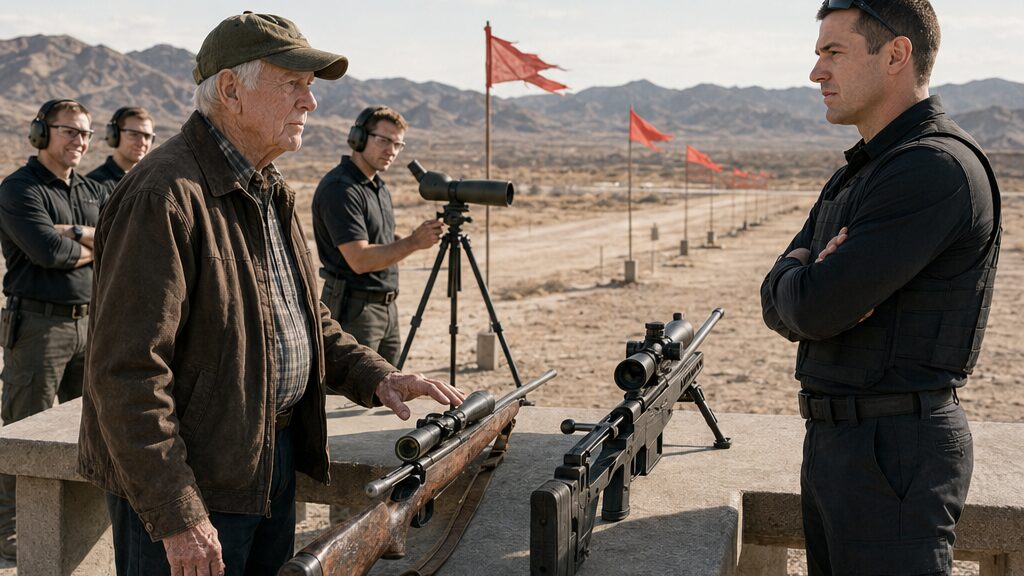
The range director was younger than Joseph had expected. Early thirties, broad through the shoulders, clean-shaven, with a radio clipped high on his vest and clear shooting glasses pushed onto his head. Everything on him looked selected for a photograph: dark uniform, fitted gloves, polished watch, boots without desert dust in the seams.
Joseph wore a faded cap, a plaid work shirt, and an old brown jacket he had owned longer than Matthew had been alive.
“Timothy Baker invited me,” Joseph said.
Matthew glanced toward the parking lot. “Timothy isn’t here.”
“He said seven.”
“It’s seven-twenty.”
Joseph checked the wall clock through the open office door. It ran four minutes fast.
Matthew folded his arms. “We have sponsors arriving. A charity event to qualify. And live-fire demonstrations starting in less than an hour. I don’t put unknown people on an active range because they give me a first name.”
Joseph nodded once.
That seemed to irritate Matthew more than an argument might have.
“Andrew,” Matthew said, “get him seated.”
The assistant instructor hesitated. He was lean, late twenties, and wore his authority less comfortably than Matthew did. “Sir, he’s on the guest card.”
Matthew crossed to the sign-in board. A handwritten card had been clipped beneath the morning roster.
JOSEPH CARTER — 0700 — LANE 7.
“No credentials listed.” Matthew tapped it. “No equipment inspection. No medical clearance. Guest card means guest.”
Joseph could have taken the folded letter from his coat pocket. Timothy’s signature was at the bottom, along with the county association seal and a line identifying Joseph as the requested long-range evaluator.
He left it where it was.
The range spread beyond them in pale lanes cut into the desert floor. Steel frames and paper targets stood in front of a sandy backstop. Farther out, red flags hung at measured intervals, meant to show the wind between the firing line and the long targets.
The nearest flag barely moved.
The second leaned left.
The third snapped hard to the right.
Joseph watched them for several seconds.
That pattern was wrong.
Not the wind. The installation.
One flag was lower than the others, caught in a pocket of air behind a low berm. Anyone reading the sequence from the line would believe the crosswind weakened halfway downrange when it actually climbed above the obstruction.
Andrew lifted Joseph’s case before Joseph could stop him.
The younger man adjusted his grip at once. “Heavier than it looks.”
“Most things are,” Joseph said.
Andrew looked at him, uncertain whether the remark was meant as humor.
They walked toward the shaded observation shelter. Gravel shifted beneath Joseph’s worn boots. His left knee resisted the first few steps, then loosened. He kept his pace measured. Behind him, the trainees resumed laying out magazines, spotting scopes, and sleek rifles with adjustable stocks.
A truck near the equipment bay carried the range’s new logo across its doors. Beyond it, workers were fastening banners to temporary fencing.
VETERANS PRECISION FUNDRAISER.
The word precision had been printed larger than veterans.
Joseph looked away.
At Lane Seven, Andrew set the rifle case on a wooden bench.
“You can wait here,” he said. “I’ll find out what happened to Mr. Baker.”
Joseph studied the firing line instead. Sand had collected in the corners where the concrete met the lane dividers. Fresh numbers had been stenciled above each position. The old lane markers were still visible beneath the paint.
He knew the distance from Lane Seven to the western edge of the backstop without measuring it.
He also knew where the old drainage channel crossed beneath the access road and why the steel target at six hundred yards should never be used when the south wind exceeded fifteen miles per hour.
Andrew followed his gaze. “You been here before?”
Joseph did not answer immediately.
A worker was tightening the red flag at the two-hundred-yard marker. He had fixed it to a short post behind the berm.
“That one needs another three feet,” Joseph said.
Andrew looked downrange. “What?”
“The flag behind the second berm.”
“It passed inspection yesterday.”
“It’s reading the curl, not the lane.”
Andrew shaded his eyes. “Wind station shows nine from the southwest.”
“Here.”
Joseph pointed to the pale dust slipping along the ground beyond the first hundred yards. Then he pointed farther out, where a strip of dry grass bent in the opposite direction above the berm.
“Up there, it’s more.”
Andrew looked from the grass to the flag.
“You can’t tell the exact speed from that.”
“No.”
Matthew’s voice came from behind them. “Then don’t tell my staff the equipment is wrong.”
Joseph turned.
Matthew had brought one of the trainees with him, a muscular man carrying a long black case. The trainee’s expression held the polite interest people used around demonstrations they expected to end badly.
Joseph nodded toward the misplaced flag. “Equipment is reading what you asked it to read. You put it in the wrong air.”
Matthew stared at him. “You walked in ten minutes ago.”
“Twenty.”
“And from a bench, without opening your rifle, you’ve decided you know this range better than the people who run it.”
Joseph looked back toward the flag. “That post used to be on top of the berm.”
For the first time, Matthew’s expression shifted.
Only slightly.
“Used to be?”
“Before the washout.”
Andrew left the shelter and walked several yards toward the control station. He raised a handheld wind meter, then looked at the digital display mounted beside the lane. After a moment, he climbed the berm access path.
Matthew watched him go.
The trainee with the black case gave a quiet laugh. “Maybe the old guy built the place.”
Matthew did not laugh.
Joseph’s fingers had begun trembling again. He placed his palm flat on the rifle case. Beneath the lid, the wooden stock lay wrapped in an oil-darkened cloth. His thumb found the shallow depression in the case lining directly above the groove worn into the stock.
He had not intended to shoot that morning.
He had told himself the rifle came because Timothy had requested it for comparison during the course review. That was not the whole reason. The whole reason had sat with him during the two-hour drive, silent and unhelpful.
Andrew returned with dust on one knee.
“The post is in the old sleeve,” he said. “There’s another mount above it. Three feet higher.”
Matthew’s jaw tightened. “Which one matches the current plan?”
“The upper one.” Andrew held out the inspection sheet. “Diagram shows the upper mount.”
The trainee stopped smiling.
Matthew took the sheet and read it. “Have maintenance move it before the demonstration.”
Andrew nodded.
It was a small correction. No one had been hurt. No round had been fired.
Joseph felt no satisfaction.
He had seen too many small corrections ignored because no immediate harm followed them.
Matthew handed back the sheet. “That doesn’t change your status.”
“I didn’t ask it to.”
“No, you just started directing my staff.”
“I pointed at a flag.”
“You questioned an inspected course in front of trainees and guests.”
Joseph glanced at the empty road. “Your guests aren’t here yet.”
Engines sounded beyond the entrance gate.
Three dark vehicles appeared through the rising dust, followed by a white sponsor van.
Matthew looked toward them, then back at Joseph.
The range director crossed to the sign-in board, pulled Joseph’s handwritten card from beneath the clip, and tore it once through the middle.
“You’re not an active participant,” he said. “You’re not an evaluator until somebody with authority tells me you are. You stay behind the yellow line, and that case stays closed.”
He dropped the torn card into the waste bin.
The sponsor convoy rolled through the gate as the first half of Joseph’s name settled faceup among empty coffee cups.
Joseph watched it fall.
Then he placed both hands on the old rifle case and decided he would not leave.
Chapter 2: Safety Rules Nobody Wanted to Hear
The trainee’s hand closed around the rifle before the red light went out.
“Stop.”
Joseph’s voice cracked across the briefing shelter with enough force to freeze every person beneath it.
The trainee released the grip at once.
For a second, nobody moved. The rifle lay on the equipment table with its muzzle pointed safely downrange, but the chamber flag had been removed, and a maintenance worker was still visible beyond the side berm near the target track.
Matthew turned from the sponsor representative. “What happened?”
Joseph pointed with two fingers. “The line isn’t clear.”
The trainee flushed. “I wasn’t loading.”
“You removed the chamber flag.”
“I was checking the optic.”
“While a man was downrange.”
The worker appeared above the berm carrying a tool bag. Andrew saw him and pressed the cease-fire control even though the range was not yet live. A buzzer sounded. The red light remained on.
Matthew walked to the table. “Bolt open?”
The trainee nodded.
Matthew checked anyway. His gloved hand worked the action, his eyes moving from chamber to magazine well. The rifle was unloaded.
He replaced the empty-chamber flag and laid the rifle down.
“No harm,” the trainee said.
Joseph looked at him. “That’s not the same as no mistake.”
Matthew’s face hardened, but he addressed the trainee rather than Joseph. “Hands off all weapons until the line is visually cleared and the command is given.”
“Yes, sir.”
“Say the rule.”
“No handling while personnel are downrange.”
Matthew nodded. “Good.”
The correction was clean and immediate. Joseph respected that.
Then Matthew turned to him.
“You don’t issue commands on my range.”
“Someone had to.”
“I was six feet away.”
“You were facing the sponsor.”
The sponsor representative, standing beside a table of brochures, pretended to examine the event schedule.
Matthew lowered his voice. “You made your point.”
Joseph had not intended to make one. That was the trouble with safety: people heard insult where there should have been procedure.
He stepped back from the table.
Under the shelter, rifles rested in padded cradles beside boxes of ammunition and electronic timers. The morning schedule had been written on a whiteboard. Practice blocks that had originally allowed twenty minutes between rotations had been crossed out and replaced with ten.
Joseph read the changes twice.
“You’ve compressed the transitions,” he said.
Matthew followed his gaze. “We’re behind.”
“Then start the demonstration later.”
“The sponsor has a departure window.”
“So does the wind.”
Matthew gave a dry laugh. “You planning to correct the sky too?”
Joseph did not answer.
A woman in a navy polo approached from the medical table. Her badge identified her as Laura Martinez, volunteer safety officer. She looked first at Matthew, then at Joseph’s right hand.
The tremor had returned after the sharp command.
“You’re Joseph Carter?” she asked.
“Yes.”
“Timothy listed you for a functional clearance.”
Matthew looked at her. “He isn’t firing.”
“Then the assessment costs us three minutes and confirms your decision.”
Laura’s tone made agreement sound less like surrender.
She led Joseph to the end of the equipment table. “Any diagnosis affecting balance, vision, cognition, or grip?”
“No.”
“Medication that causes dizziness?”
“No.”
“Pain?”
“Left knee.”
“Hand tremor duration?”
“Seven years.”
“Worse at rest?”
“Yes.”
“Improves when you reach for something?”
“Usually.”
Matthew remained nearby, listening while pretending to review the schedule.
Laura placed an empty plastic cartridge box on the table. “Pick it up.”
Joseph did.
His fingers trembled as they approached it, then steadied when his thumb and forefinger closed around the edge.
“Set it on that mark.”
He placed it inside a circle drawn on a paper pad.
Laura asked him to repeat the motion with his left hand, then tested his grip, eye tracking, shoulder movement, and ability to hold a supported position using an inert wooden training stock.
The tremor diminished when Joseph settled his elbow against the bench.
Laura stepped back. “The tremor alone doesn’t disqualify him.”
Matthew crossed his arms. “It doesn’t qualify him either.”
“No,” she said. “That requires equipment inspection, supervised handling, and a live-fire assessment if he’s participating.”
Joseph appreciated the distinction.
Competence was not something a doctor could pronounce into existence. Neither was incapacity.
Matthew tapped the altered schedule. “We don’t have time for an unscheduled assessment.”
Joseph traced one finger along the latch of his closed case.
In his coat pocket, the old range card pressed against his ribs. Timothy had mailed it with the invitation. The card was faded, its corners softened by years, with Joseph’s original notes on wind limits and lane closures written in narrow block letters.
He could place it on the table and end at least part of the argument.
He did not.
A familiar pickup truck stopped outside the shelter.
Deborah climbed out before the engine had fully settled.
Joseph’s stomach tightened.
She shut the door harder than necessary and walked toward him with her purse tucked beneath one arm. She had his late wife’s direct stride and none of her patience for concealment.
“What are you doing here?” Joseph asked.
“I called your house. Then I called the hardware store. Then I found your note under the sugar bowl.”
“I left a note.”
“You wrote ‘range’ and a time.”
“It seemed sufficient.”
“It was not.”
Her gaze dropped to the rifle case.
Joseph saw the change in her face. It was not fear exactly. It was recognition mixed with old resentment.
“You brought it,” she said.
“Timothy asked me to.”
“Timothy asks a lot from people when he wants a ceremony.”
“It isn’t a ceremony.”
Matthew stepped closer. “Ma’am, are you his daughter?”
Deborah looked at Joseph before answering. “Yes.”
Matthew’s manner softened in the way people’s manner did when they believed a family member might confirm their worst assumptions.
“We’re sorting out a registration issue,” he said. “He won’t be firing unless we verify his invitation and complete the proper checks.”
“Good.”
The word landed harder than Joseph expected.
Deborah touched his sleeve. “Let’s go.”
“No.”
“You drove two hours alone with a rifle you haven’t used in years.”
“Eleven months.”
“That does not help.”
Several trainees had begun pretending not to listen.
Joseph kept his voice low. “I came to inspect the long course.”
“You’re retired.”
“So are bad habits, until someone brings them back.”
Her eyes narrowed. “This isn’t about habits. It’s about you needing to prove you can still do something.”
Joseph looked past her toward the wind flags. The corrected flag now stood at the proper height. All three showed a stronger crosswind than the electronic display had earlier.
“I haven’t opened the case,” he said.
“Not yet.”
She took a breath and lowered her voice. “I came because I don’t want to get a call saying you fell, or your hand slipped, or somebody let you do this because they thought an old veteran would make good footage.”
Joseph’s embarrassment burned more deeply than Matthew’s mockery had.
Not because Deborah was entirely wrong.
He had asked himself the same questions before dawn, alone in his kitchen, his right hand shaking above the coffee cup.
Laura interrupted quietly. “His hand isn’t the decision. Function is.”
Deborah looked at her. “And you tested him?”
“Partly.”
“Did he tell you about his knee?”
“Yes.”
“Did he tell you he doesn’t admit when he’s tired?”
Joseph said, “Deborah.”
“There. That voice. Like I’m twelve and interrupting a briefing.”
The sponsor representative checked his watch. Matthew saw it.
“We need to move,” Matthew said to Andrew. “Briefing in four minutes. First practice rotation immediately after. Cut the equipment review to five.”
Joseph turned. “Five isn’t enough.”
Matthew ignored him.
Andrew’s phone vibrated against the clipboard. He glanced at the screen, then answered.
“Andrew Wilson.”
His expression changed as he listened.
“Yes, sir. He’s here.”
Matthew looked over.
Andrew turned away from the noise of the shelter, but the voice on the phone was loud enough that Joseph heard Timothy’s strained breathing between words.
“No,” Andrew said. “Mr. Hill listed him as a guest.”
A pause.
Andrew looked directly at Joseph.
Then he looked at Matthew.
“Understood.”
He lowered the phone slowly.
“That was Timothy Baker,” Andrew said. “He’s stuck behind an accident on the county road.”
Matthew waited.
Andrew held the phone against his chest. “He said Joseph Carter isn’t a guest.”
The shelter had gone quiet again.
“He’s the evaluator we’ve been waiting for.”
Chapter 3: The Challenge Beneath the Red Wind Flag
Matthew laid Joseph’s wooden-stock rifle beside the range’s newest precision system and turned to the trainees.
“Which one would you trust?”
The question was not presented as a joke, which made the laughter worse.
The modern rifle rested on a black mat beneath the long-range shelter, its synthetic chassis fitted with an adjustable cheekpiece, bipod, oversized optic, and digital wind display. Joseph’s rifle looked narrow beside it. The walnut stock was dark with age and handling, the finish worn pale near the grip.
Joseph stood behind the yellow line while Matthew kept one hand near the open action.
Both rifles had been inspected. Both were unloaded. Bolts were open. Chamber flags were visible.
Matthew had followed every procedure after Andrew’s announcement, but the set of his shoulders said compliance was not acceptance.
Timothy had confirmed the invitation by phone. He had also told Matthew that Joseph had helped draft the range’s original long-course safety standards.
That information had not improved the morning.
“The current course was rebuilt three years ago,” Matthew said. “New targets. New instrumentation. New equipment standards. Whatever Mr. Carter knew about this place, it isn’t enough to put him in charge of a live-fire evaluation without demonstrating current ability.”
Joseph looked toward the far flags.
The red flag at three hundred yards strained west. The next hung slack for half a breath, then lifted.
A reversal was forming beyond the middle berm.
Andrew stood near the control panel. Deborah and Laura remained under the shelter behind him. The sponsor representative had joined the group, along with two trainees and several charity volunteers who sensed a conflict worth watching.
Matthew gestured toward the rifles. “Modern system or fifty-year-old wood?”
“Thirty-eight,” Joseph said.
Matthew glanced at him.
“The stock,” Joseph added. “Thirty-eight years.”
One trainee smiled.
Matthew did not. “That distinction matter to the wind?”
“No.”
“To the target?”
“No.”
“Then we agree equipment has a service life.”
“So do instructors.”
The smile disappeared from the trainee’s face.
Matthew folded his arms. “Timothy says you designed the original wind protocol.”
“Helped.”
“He says your name is on the old cease-fire procedures.”
“It was.”
“And you haven’t been back here in nineteen years.”
Joseph said nothing.
That silence pulled attention toward him more effectively than any denial.
Matthew nodded as though Joseph had confirmed an argument. “Standards change because people learn. We don’t run a modern course from memory.”
“No,” Joseph said. “You run it from conditions.”
He pointed downrange.
“The west flag will drop. The two beyond it will turn within thirty seconds.”
Matthew checked the digital display. “Station says southwest at eleven.”
“At the line.”
“The remote sensors update every five seconds.”
“The air doesn’t.”
A few heads turned toward the flags.
Matthew glanced at his watch. “Thirty seconds?”
“Less now.”
They waited.
Joseph could hear canvas snapping above the sponsor tent and the fine hiss of sand crossing concrete. His hand trembled beside his leg. He let it. Fighting the movement at rest only made his shoulder tighten.
The three-hundred-yard flag sagged.
Farther downrange, a pale ribbon tied to a target frame flicked east. The next red flag twisted around its pole, freed itself, then pointed in the opposite direction.
Andrew leaned toward the spotting scope.
“Far flags are turning,” he said.
The digital display still showed southwest.
Five seconds later, the numbers changed.
Nobody laughed.
Matthew’s jaw shifted once. “Good observation.”
“It’s why the timed stage should wait.”
“The demonstration isn’t running yet.”
“The practice rotation is.”
“With experienced shooters.”
“Experience doesn’t move the air.”
Matthew stepped closer. “You’ve questioned my flags, my schedule, my equipment, and my authority since you arrived.”
“I questioned a flag and a transition time.”
“In front of staff, sponsors, and participants.”
Joseph looked at the modern rifle. “That seems to be what concerns you.”
A low murmur moved through the volunteers.
Matthew heard it.
“Fine,” he said. “Let’s remove interpretation.”
He pointed toward Lane Seven.
“Five rounds. Three hundred yards. Supported position. Standard charity qualification target. You call your own wind.”
Laura spoke immediately. “Only after functional clearance is complete.”
“It is,” Matthew said. “You said he wasn’t disqualified.”
“I said a live-fire assessment had to be supervised.”
“I’m supervising.”
Deborah moved beside Joseph. “You don’t have to do this.”
He knew that.
That was what made the choice difficult.
If he fired because Matthew had insulted him, then Matthew would control more than the range. He would control Joseph’s reasons.
Joseph studied the target line. Paper silhouettes had been fixed to square frames. The lane was clear. The backstop was sound. The neighboring positions were cold. Andrew had corrected the flag height.
A five-round group would answer the narrow question of function.
It would not answer why Joseph had come.
It would not answer nineteen years.
“It isn’t a contest,” Joseph said.
Matthew’s expression hardened. “Then consider it your assessment.”
Joseph looked at Laura.
She met his gaze without encouragement or pity. “Any dizziness?”
“No.”
“Pain affecting position?”
“No.”
“Can you stop if your grip or vision changes?”
“Yes.”
She nodded. “Supervised assessment permitted.”
Andrew activated Lane Seven. “Range remains cold until equipment and position checks are complete.”
Joseph crossed the yellow line.
The walk to the bench felt longer with people watching. His left knee caught once. He paused rather than disguising it, shifted his weight, and continued.
At the mat, he opened the rifle case.
The smell of old oil and walnut rose from the cloth.
His hand trembled as he lifted the rifle free. Matthew watched the movement closely. So did Deborah.
Joseph placed the rifle on the mat with the muzzle downrange. He checked the open action, chamber flag, optic mounts, sling attachment, stock, and bore. Then he inspected the ammunition box and read the label before removing a single cartridge.
Matthew glanced at his watch.
Joseph ignored him.
He checked the target designation against the lane card.
“Lane Seven, target three?” he asked.
Andrew confirmed it.
“Backstop?”
“Clear.”
“Adjacent lanes?”
“Cold and cleared.”
Joseph settled behind the rifle. His left elbow found the mat. His shoulder lowered. When his right hand closed around the grip, his thumb slid into the shallow groove polished into the stock by decades of repetition.
The tremor diminished.
Not vanished.
Controlled.
The wood fit him in places no manufactured adjustment could reproduce.
Andrew crouched behind the spotting scope. Matthew stood at his shoulder.
“Shooter ready?” Andrew asked.
“Not yet.”
Joseph watched the flags.
The near flag showed wind from the southwest. The middle flag had begun to recover. The far flags still leaned east. The reversal was passing through the course like a slow door swinging shut.
Matthew said, “You predicted it. Now shoot it.”
Joseph kept his cheek away from the stock.
“Not yet.”
A trainee shifted impatiently.
Matthew looked toward the sponsor representative, then at the timer clipped to Andrew’s board. “You have sixty seconds for the assessment.”
“No,” Joseph said.
Matthew’s voice sharpened. “That’s the course standard.”
“For a stable call.”
“You don’t get to wait all day for perfect air.”
“There is no perfect air.”
“Then begin.”
Joseph looked up from the rifle. “I won’t fire on your countdown.”
The shelter went still.
Matthew’s face reddened beneath the edge of his glasses. “Are you refusing the assessment?”
“I’m waiting for the condition I called.”
“That isn’t how a timed match works.”
“This isn’t the match.”
Andrew remained behind the scope, one hand near the range control. His eyes moved between the two men.
Joseph returned to the flags.
The middle one lifted.
The far flag loosened, snapped west, then held.
The reversal had completed.
Joseph lowered his cheek to the stock.
“Now.”
Andrew’s voice became formal. “Lane Seven live. All other lanes cold. Shooter may commence.”
Joseph closed the bolt on the first round.
The world narrowed without becoming empty. He remained aware of Andrew behind him, the yellow line, the neighboring lanes, the angle of the flag, the pressure of the stock against his shoulder.
He exhaled.
The first shot broke.
The rifle came back firmly but cleanly. Joseph opened the bolt, kept the muzzle downrange, and loaded the second round only after confirming his position.
He did not hurry the sequence.
Five rounds took less than a minute and longer than Matthew wanted.
After the last shot, Joseph opened the bolt, verified the chamber, and inserted the flag before lifting his face from the stock.
Andrew remained over the spotting scope.
“Well?” Matthew asked.
“Paper’s moving too much to call the group,” Andrew said. “I can see impacts, but not cleanly.”
Matthew looked at Joseph. “You want to tell us?”
Joseph folded the empty ammunition box closed.
“The paper can answer you.”
Andrew made the line cold. A maintenance worker activated the target carrier. Far downrange, the square frame began moving along its track.
The red flags snapped hard above it.
Halfway back, a gust caught the lower corner of the target. Paper tore with a sharp, dry sound. The sheet folded across itself, hiding the center as the carrier rattled toward Lane Seven.
Chapter 4: Five Holes and Nineteen Missing Years
The target reached Lane Seven folded across its own center.
The lower corner hung by a strip of paper, snapping against the frame while the carrier motor clicked to a stop. From where Joseph stood, only two ragged holes near the fold were visible.
Matthew moved first.
He stepped past Andrew, caught the paper before another gust could tear it loose, and flattened it against the backing board with both palms. The shelter had gone so quiet that Joseph could hear the paper crackle under Matthew’s gloves.
The group sat slightly right of center.
Five holes. Close enough that two edges touched, but not so close that chance could be mistaken for mastery. The cluster was compact, credible, and displaced almost exactly where Joseph’s correction for the completed wind reversal should have put it.
Andrew bent over the spotting table and pulled a measuring gauge from its case.
Matthew took it from him.
He measured once.
Then again.
The sponsor representative leaned forward. One trainee shifted closer until Laura raised a hand and kept him behind the marked line.
Matthew checked the target number against the lane card. “Target three.”
Andrew nodded. “Lane Seven.”
“Five rounds?”
“I watched all five.”
Matthew looked toward Joseph.
The old rifle rested with its bolt open, chamber flag inserted, muzzle aligned safely downrange. Joseph had stepped back from it. His right hand trembled beside his thigh again, more visibly now that the supported position was gone.
Matthew’s eyes moved from the hand to the target.
“Two and three-eighths,” he said.
One of the trainees let out a breath through his teeth.
At three hundred yards, in shifting wind, it was a strong group. Not impossible. Not theatrical. Strong enough that nobody present could dismiss it as luck or sentiment.
The sponsor representative asked, “Is that qualifying?”
Matthew took longer than necessary to answer.
“Yes.”
The word altered the shelter.
No one applauded. The change was smaller and more honest than applause. Folded arms came loose. The trainee who had laughed at Joseph’s rifle stopped leaning against the post. Andrew straightened behind the spotting scope and looked at Joseph with something beyond surprise.
Matthew removed the target from the frame and held it by the unbroken edge.
“You were right about the displacement,” he said.
Joseph nodded toward the far flags. “The air was right about it.”
A few people smiled, but Joseph did not.
Andrew studied the torn corner. “You waited until the reversal finished.”
“Yes.”
“If you’d fired when the timer started—”
“The group would have opened.”
Matthew’s mouth tightened. “Or he would have corrected during the string.”
Joseph looked at him. “That would have been a different assessment.”
The answer was not an insult, but Matthew heard the limit in it. Joseph had completed the task that was actually safe and meaningful, not the one Matthew had tried to turn into a spectacle.
Andrew touched the edge of the cluster with one fingertip. “The shooting wasn’t the first thing he got right.”
Matthew glanced at him.
Andrew withdrew his hand. “He waited.”
The sponsor representative looked between them. “Mr. Carter, would you be willing to do that again when the cameras are ready?”
Joseph closed the ammunition box. “No.”
The representative blinked. “We could use the footage for the fundraiser.”
“The target is there.”
“The moment would be stronger live.”
“The moment is finished.”
Timothy Baker arrived before the representative could answer.
His pickup stopped crooked beside the shelter, dust rolling around the tires. He climbed out stiffly, one hand holding the door for balance, and hurried toward the line with his shirt half untucked.
“I’m sorry,” he called. “County road was blocked from the overpass to the cattle turnoff.”
He saw the target in Matthew’s hand and slowed.
Then he saw Joseph’s open rifle case.
A complicated relief crossed his face. “You fired.”
“Assessment,” Matthew said.
Timothy took the paper, studied the group, and gave a short laugh that carried no amusement. “Of course.”
Joseph’s expression hardened. “Don’t.”
Timothy stopped.
“Don’t what?”
“Turn it into a story.”
The sponsor representative looked interested. “There’s a story?”
Timothy glanced at Joseph, then at the gathered volunteers. He had spent years organizing veteran events and knew how to recognize a room waiting to be given meaning.
“This man helped write the original long-range standards for this facility,” he said. “He trained instructors who trained half the people running ranges in this county.”
Joseph began wrapping the rifle in its cloth.
Timothy continued, carried by good intentions. “His wind notes were used here before they had electronic stations. There’s a photograph in the old office—”
“That’s enough.”
Joseph’s voice was not loud, but Timothy fell silent.
Matthew watched the exchange closely.
The sponsor representative said, “Why wasn’t that in the program?”
“Because I didn’t come for the program,” Joseph said.
Timothy stepped nearer. “You came because I asked you to evaluate the course.”
“I came to look.”
“And now they’ve seen what they needed to see.”
Joseph secured the first latch on the case. “Have they?”
He looked toward the whiteboard where the shortened practice schedule remained. The five-minute equipment review was still written beneath the sponsor logo. The afternoon timed stage was still planned for shifting wind.
The target had answered one question.
It had not repaired the others.
Timothy lowered his voice. “Let me introduce you properly at lunch. Nothing excessive. Your history, the old standards, maybe the reason the charity committee wanted you here.”
“No.”
“Joseph.”
“No ceremony.”
“It isn’t a ceremony. It’s context.”
“Context delivered after a good target becomes praise.”
Timothy’s face tightened. “You think I invited you to decorate the event?”
“I think you like fixing old absences in public.”
The remark struck more deeply than Joseph intended. Timothy looked down at the target.
For years he had sent holiday cards, invitations, clipped articles about former students. Joseph had answered some and ignored more. Timothy’s persistence came partly from respect and partly from guilt that the range had continued without speaking Joseph’s name.
Matthew returned the measuring gauge to its case. “You said he helped write the original standards.”
“Yes,” Timothy said.
“How long ago?”
“More than twenty years.”
“And he left nineteen years ago?”
Timothy’s eyes shifted toward Joseph.
That was answer enough.
Matthew noticed.
“So this isn’t just an inspection visit,” he said.
Joseph closed the second latch.
“It is today.”
Matthew looked at the group, then at the target. His public certainty had been damaged, but not erased. A man like him did not surrender authority simply because he had been wrong once. He searched instead for the boundary of what the proof could establish.
“You demonstrated current shooting ability,” he said. “That doesn’t automatically validate old course doctrine.”
“No.”
“And it doesn’t give you operational control.”
“No.”
The agreement unsettled him more than resistance might have.
Matthew held out the target. “Then we continue the scheduled evaluation.”
Joseph accepted the paper, folded corner and all.
The volunteers began moving toward the sponsor tent. Their conversations were low, full of glances back at Lane Seven. Andrew remained near Joseph while Matthew took Timothy aside.
“You knew the group would hold,” Andrew said.
“I knew what the wind was doing.”
“That’s not the same thing.”
Joseph slipped the target beneath the cloth lining of the rifle case. “No.”
Andrew looked at the worn stock before Joseph covered it. On the wall of the control shelter behind them hung several faded photographs in mismatched frames. One showed a younger group of instructors kneeling beside the old range sign.
Andrew stepped closer to it.
A man in the back row wore a plain shooting jacket and held Joseph’s rifle across his knees. The face was younger and leaner, but the right thumb rested in the same pale groove.
“That’s you,” Andrew said.
Joseph shut the case.
Before he could answer, Deborah called from the office doorway.
She held a gray file folder in both hands.
Timothy saw it and went still.
Deborah looked first at the photograph, then at her father.
“What happened nineteen years ago?”
Joseph did not move.
She opened the folder and turned the first page toward him. Beneath an official date and a block of typed findings was his signature.
Above it, in faded capital letters, were the words:
INSTRUCTION SUSPENDED VOLUNTARILY.
Chapter 5: The Victory Joseph Would Not Accept
The sponsor representative set a camera release beside Joseph’s lunch and asked him to recreate the five-shot group before the light changed.
Joseph pushed the paper back across the folding table.
“No.”
Around them, the sponsor tent hummed with restrained excitement. Volunteers had carried the torn target inside and propped it against a display board. People stopped to look at it as though the five holes had transformed the morning into something simple: arrogance punished, old skill restored, lesson complete.
The representative kept his smile. “It wouldn’t need to be identical. We’d film your hands, the old rifle, the target coming back. Thirty seconds, maybe forty-five.”
“The first target was an assessment.”
“This would help fund the veteran program.”
“It would be a performance.”
“We are running a public event.”
Joseph looked through the open side of the tent toward the firing line. The red flags no longer agreed with one another. Heat lifted from the sand in wavering sheets. The afternoon crosswind had strengthened and begun pulsing through the berm gaps.
“The long stage needs to be delayed,” he said.
The representative’s smile faded. “Matthew says the experienced team can demonstrate it safely.”
“Experienced people still use the same air.”
Timothy sat across from Joseph, his untouched coffee cooling between his hands. “We can discuss the stage after the media piece.”
Joseph turned to him. “That is the discussion.”
Timothy lowered his voice. “The footage could cover the remaining charity costs.”
“So could a safe event.”
“No one is proposing an unsafe event.”
Joseph looked at the revised schedule clipped to the tent pole. The long-range demonstration had been moved forward, not delayed. Transition time remained cut in half.
He rose.
Deborah, seated at the end of the table with the gray incident folder inside her purse, watched him without speaking. She had asked her question outside the office. Joseph had not answered it. The silence now occupied every space between them.
At the equipment bay, Matthew was inspecting a modern rifle with a synthetic stock. His hands moved efficiently over the mount screws and action. Whatever else he was, he knew his equipment.
Joseph waited until Matthew finished and replaced the chamber flag.
“The afternoon stage should be postponed,” Joseph said.
Matthew kept one hand around the synthetic grip. “We’re switching to staff shooters.”
“The wind is building.”
“They’ve trained in worse.”
“The target carrier is lagging on Lane Four.”
“Maintenance lubricated it.”
“The second transition gives them six seconds to move, settle, identify, and fire.”
“They’ve rehearsed it.”
“In calmer conditions.”
Matthew finally looked at him. “You made your point this morning.”
“This is another point.”
“No. This is you discovering that people listen after a good group and deciding you should run the day.”
Joseph felt the old impulse to withdraw. Let the younger man have the line. Let the written report carry the criticism later. No raised voices. No public struggle for authority.
He looked at the rifle in Matthew’s hands.
The stock was adjustable at every contact point. Clean, strong, designed for different shooters. Matthew’s fingers gripped it hard enough to whiten at the knuckles.
“You know the wind is wrong,” Joseph said.
Matthew’s eyes flicked toward the range.
That was enough.
“You know it,” Joseph repeated.
Matthew set the rifle down. “The gusts are above forecast.”
“Then change the plan.”
“If we cancel the feature demonstration, the sponsor leaves with nothing but a torn paper target and a story they didn’t schedule.”
“Better than leaving with an incident.”
Matthew stepped closer. “Do you think I don’t understand risk?”
“I think you’re balancing it against something you haven’t named.”
For several seconds, Matthew said nothing.
Then he walked into the range office and motioned for Joseph to follow.
Inside, the air conditioner rattled without cooling much. Event maps, invoices, and permit notices covered the desk. Matthew opened a drawer and removed a white envelope stamped with the county seal.
He placed the letter in front of Joseph.
The notice stated that the facility’s operating lease would enter termination review if outstanding maintenance and insurance requirements were not funded within thirty days.
A handwritten note in the margin listed the amount expected from the sponsor contract.
Joseph read it twice.
Matthew leaned against the desk. “The range has six employees. Andrew’s one of them. Two have children. The charity program uses this property at cost. If the sponsor signs, we replace the carrier system, repair the western berm, and keep the gates open.”
“If they don’t?”
“We lose the long-range lease first. Maybe the rest by fall.”
Joseph folded the letter along its existing crease.
“You shortened equipment checks.”
“Because the sponsor’s flight moved.”
“You advanced the demonstration.”
“Because the wind is expected to worsen.”
“That is not a safety argument.”
“No. It’s a survival argument.”
The honesty changed the shape of Matthew’s arrogance without excusing it. He was not rushing the range because he thought rules were beneath him. He was rushing because he believed every minute of control brought the facility closer to being saved.
Joseph knew that kind of reasoning.
The harm rarely began with someone wanting harm. It began with a worthy goal placed on the wrong side of a procedure.
Matthew tapped the closure notice. “The staff shooters are qualified. We remove the charity participants from the timed stage. We keep the sponsor schedule. That is the compromise.”
“The wind remains.”
“So we adjust holds.”
“The stage requires movement between positions while the call is changing.”
“They can handle it.”
“Maybe.”
Matthew’s face tightened. “You don’t close a range over maybe.”
“You don’t keep one open with it either.”
Outside, a burst of laughter rose from the sponsor tent. Someone had placed the torn target on an easel beside Joseph’s old photograph.
Matthew heard it.
“They’ve decided you’re the truth now,” he said. “That fast. One group and one old picture.”
Joseph looked through the office window. Timothy was speaking to several volunteers, his hand resting on the target frame.
“They’re wrong.”
Matthew studied him. “You could let them be wrong in your favor.”
“That’s still wrong.”
For the first time, some of the hostility left Matthew’s expression.
“You really won’t do the filmed shot.”
“No.”
“Even if it helps the range?”
“Not while the course needs attention.”
Matthew picked up the closure notice and slid it back into the envelope. “Then I’ll run the demonstration with experienced staff. You can submit your objections in the evaluation.”
He opened the office door.
Joseph did not follow immediately.
On the desk lay the original timed-stage plan. In the bottom corner, someone had written: transitions reduced per sponsor window.
The phrasing struck him with physical force.
Not because it was identical to anything from nineteen years earlier.
Because it did not need to be.
Deborah appeared in the doorway after Matthew left. She had heard enough to understand the choice.
“You look like you’ve seen that page before,” she said.
Joseph folded the stage plan closed.
Matthew stood outside the office, addressing the staff with renewed certainty. The demonstration would proceed with two experienced trainees. Start time would remain unchanged.
Then he turned back and held up the county envelope so Joseph could see it.
“If the sponsor walks,” he said, “this notice takes effect.”
The range timer sounded from the equipment bay, calling staff to the next briefing.
Joseph looked from the closure letter to the flags bending above the long course.
Protecting the shooters might cost the range its future.
Protecting the range might repeat the very mistake he had never named.
Chapter 6: What His Silence Cost Before
Deborah placed the incident report on top of the rifle case.
“Did every lesson you taught other people come too late for us?”
The firing line was empty now. Evening light stretched the lane dividers across the concrete, and the day’s heat remained trapped beneath the shelter roof. Joseph sat on the bench at Lane Seven with the rifle case between them.
The gray folder looked heavier than the rifle.
He did not open it.
Deborah stood with her arms folded, not in Matthew’s posture of authority but in the guarded stance she had used since her mother’s funeral whenever Joseph answered grief with logistics.
“You asked what happened,” he said.
“I asked two hours ago.”
“There were people around.”
“There were always people around when you had something easier to say.”
Joseph looked toward the targets. Most had been lowered. A single paper frame remained at three hundred yards, twisting in the cooling wind.
Deborah pulled the report from its folder and opened to the marked page.
“Training injury during accelerated qualification sequence,” she read. “Equipment failure during positional transition. Instructor Carter had expressed concern regarding schedule compression.”
She looked at him.
“You expressed concern.”
“Yes.”
“To whom?”
“The officer in charge.”
“Privately?”
Joseph’s right hand trembled against his knee.
“Yes.”
“And then?”
“The exercise continued.”
Her face changed before she asked the next question. “Did you continue it?”
“I stayed on the line.”
The answer settled between them.
Joseph opened the rifle case. He did not know why. Perhaps because the closed lid felt like another refusal.
The walnut stock lay beneath the cloth, dark and worn. His thumb moved toward the shallow groove and stopped above it.
Nineteen years earlier, he had stood beneath another shelter while a superior insisted the qualification remain on schedule. The wind had risen. A mounting screw on one training rifle had been reported loose and marked for later inspection. The shooters were tired from repeated transitions.
Joseph had known the sequence should stop.
He had said so in the office.
Then the superior had reminded him of visiting evaluators, delayed certifications, and a unit deployment schedule that could not move.
Joseph returned to the line.
During a rushed transition, the loose mount shifted. The trainee tried to recover the sight picture while moving into position, lost balance, and fell across the edge of the concrete bay. The rifle remained pointed safely downrange. No shot struck anyone.
The injury came from metal, weight, momentum, and a sequence that should never have continued.
A shattered wrist. Torn shoulder. Months of rehabilitation. A career redirected.
“The weapon didn’t discharge improperly,” Joseph said.
Deborah stared at him. “Is that what they told you?”
“It is what happened.”
“That isn’t what I asked.”
Joseph looked at the stock.
His thumb had pressed into that groove before the exercise. He remembered feeling the worn wood beneath it while deciding whether to walk back into the office and demand a halt.
He had chosen not to.
“I did not cause the equipment failure,” he said.
The distinction sounded smaller aloud than it had inside him for nineteen years.
Deborah sat on the opposite end of the bench.
“But you knew they were rushing.”
“Yes.”
“You knew something was wrong.”
“Yes.”
“And you didn’t stop it.”
“No.”
The word left him with no defense attached.
Deborah looked down at the rifle. “Afterward, you quit.”
“I suspended my instruction.”
“You never went back.”
“No.”
“You told Mom it was time.”
Joseph remembered the kitchen table, his wife’s hands wrapped around a mug, the practiced lie of retirement offered as though age had made the decision.
“I told her enough to end the questions.”
Deborah laughed once, bitterly. “You always did.”
He looked at her.
She wiped at one eye with the heel of her hand, angry at the moisture. “Do you know what that rifle looked like from our side? It stayed in the cabinet. You cleaned it every month. You wouldn’t sell it. You wouldn’t shoot it with anyone. You wouldn’t explain why you stared at it.”
“I wasn’t staring.”
“You were somewhere else whenever you touched it.”
Joseph rested his thumb in the groove.
The tremor eased against the wood.
“This was the rifle I carried when I taught the old course,” he said. “I kept it because I wanted to remember the standard before I lowered it.”
Deborah’s eyes moved from his hand to his face.
“It wasn’t a trophy?”
“No.”
“Then why didn’t you say that?”
He had no answer that did not expose the flaw more completely.
Because the rifle could hold memory without asking him to confess. Because wood did not accuse him of pride. Because silence had once looked like control, and afterward it became habit.
“The paper answered the range today,” Deborah said. “It cannot answer for nineteen years.”
Joseph closed his eyes briefly.
The wind moved through the empty shelter, lifting one corner of the report.
“I thought leaving was the responsible thing,” he said.
“Was it?”
“At first.”
“And after?”
He looked toward the office where Matthew’s staff had gone home to prepare for the morning demonstration. The sponsor equipment remained under locked covers. The shortened course plan was still taped to the wall.
“After, it was easier.”
Deborah absorbed that.
Not nobility. Not sacrifice.
Avoidance.
She reached toward the rifle but did not touch it. “I came today because I wanted you to sell this.”
Joseph turned to her.
“I had already called a dealer,” she said. “I thought if it was gone, maybe you’d stop measuring your life against whatever happened here.”
“You arranged a sale without asking me?”
“I arranged an appraisal.”
His anger rose quickly, cleanly, grateful for somewhere to go. “It is not yours.”
“No. Neither was the silence, but we all lived with it.”
Joseph stood too fast. His left knee buckled against the bench. Deborah caught his arm, and he pulled away more sharply than he intended.
The old instinct returned: close the case, load the truck, leave before the morning demonstration. Submit a written report. Let Matthew decide what to do with it.
He began wrapping the rifle.
Deborah watched him secure the cloth. “Where are you going?”
“Home.”
“And the demonstration?”
“Matthew knows my objection.”
“So did the officer nineteen years ago.”
Joseph’s hands stopped.
She did not raise her voice.
“That isn’t humility,” she said. “Leaving quietly because you said it once. It’s the same silence with better manners.”
Footsteps sounded on the gravel behind them.
Andrew came into the shelter carrying a clipboard and a rolled weather report. He had changed out of his tactical shirt, but his expression remained fixed in the day’s tension.
“Mr. Carter.”
Joseph closed the first latch of the case.
“What is it?”
“Matthew changed the start time.”
Deborah stood.
Andrew unrolled the forecast on the bench. “Stronger gusts are expected after nine, so he moved the sponsor demonstration forward thirty minutes.”
“To when?” Joseph asked.
“Seven-thirty.”
Joseph looked toward the far target frame turning in the wind.
Andrew’s voice dropped. “He also cut the staff walkthrough. We report at six-forty-five and go live after one dry sequence.”
The rifle case remained half latched beneath Joseph’s hands.
The old choice had returned with a different face and the same clock.
This time, morning would not allow him to hide inside a written objection.
Chapter 7: The Command He Failed to Give
The range timer sounded while the red flag at three hundred yards snapped in the wrong direction.
Joseph saw the other two signs almost at once.
The target carrier on Lane Four hesitated halfway through its return cycle, shuddered, then continued. At the movement station, one of Matthew’s trainees rolled his right shoulder and flexed his fingers before taking hold of the inert practice rifle. Fatigue, small enough to hide from anyone who wanted the schedule to work.
Nineteen years disappeared.
Joseph stood beside his closed rifle case behind the yellow line. His thumb had been resting above the worn groove hidden beneath the lid. He lifted his hand away.
“Cease-fire.”
The command crossed the range before the starting buzzer completed its second tone.
Andrew struck the control switch.
Red lights came on above every lane. The trainee at the movement station stepped back from the table. No ammunition had been loaded. No bolt had been closed.
Matthew turned from the sponsor platform.
“Who called that?”
Joseph raised his empty right hand.
The wind shook it visibly against the red flag.
“I did.”
Matthew walked toward him, fast but controlled. The sponsor representative followed several steps behind, carrying a tablet loaded with the demonstration schedule. Laura came from the medical station.
“We weren’t live,” Matthew said.
“You were about to be.”
“The stage was in dry preparation.”
“The timer had started.”
“For position checks.”
“The trainee thought otherwise.”
The man at the movement station looked down. “I was preparing for the first sequence.”
Matthew glanced at him. “Had you touched ammunition?”
“No.”
“Had you closed an action?”
“No.”
“Then procedure held.”
“The procedure stopped because Andrew hit the switch,” Joseph said.
Matthew’s face tightened. “Because you issued a command you do not have authority to issue.”
Joseph pointed downrange.
“Lane Four carrier is lagging. Your second shooter is compensating for fatigue in his firing shoulder. The middle wind has reversed while the far lane is still holding southwest.”
Matthew checked the flags. “We adjusted the stage for staff.”
“You shortened the walkthrough.”
“They know the course.”
“Knowing it is why they’ll move faster than the conditions allow.”
The sponsor representative glanced at the time. “Are we discussing a delay or a cancellation?”
Matthew answered without looking away from Joseph. “A brief delay.”
“No,” Joseph said. “A redesign.”
The word traveled through the assembled volunteers.
Matthew lowered his voice. “You already opposed the stage. Now you’re finding reasons to stop it.”
“I found the reasons before the timer.”
“The carrier completed its cycle.”
“After hesitation.”
“The trainee hasn’t declared fatigue.”
“Ask him.”
Matthew turned.
The trainee straightened. His hesitation lasted less than a second, but everyone saw it.
“My shoulder is tight,” he said. “Nothing I can’t work through.”
Laura approached him. “How many full-speed rehearsals yesterday?”
“Eight.”
“And this morning?”
“Three dry.”
She pressed along the upper shoulder and asked him to raise the arm. His first movement was smooth. The second slowed near eye level.
“Not cleared for a rapid positional sequence until reassessed,” she said.
Matthew looked toward Andrew. “Carrier status?”
Andrew checked the control screen. “Lane Four logged a seven-second interruption.”
“Reset it.”
“It may reset.”
“That isn’t what I asked.”
Andrew met his eyes, then looked at Joseph.
“I can reset the system,” he said. “I can’t certify the fault is gone.”
The sponsor representative closed the schedule on his tablet. “Mr. Hill, we need a decision.”
Matthew faced Joseph again. “You’ve made this public.”
Joseph heard the accusation beneath the words. You could have spoken privately. You could have allowed me to preserve control.
He had believed the same thing once.
“I did it privately before,” Joseph said.
Deborah stood near the rear of the shelter. Her arms were at her sides now.
Matthew glanced toward the sponsor, then back at Joseph. “This is not the time for your history.”
“It is the reason I stopped the line.”
The range had become still except for the flags.
Joseph stepped forward, leaving his rifle case behind him.
“Nineteen years ago, a qualification was behind schedule,” he said. “The wind was worsening. A rifle mount had been marked for inspection. The shooters were tired.”
Timothy lowered his head.
“I told the officer in charge that the sequence should stop. I told him inside an office where nobody else had to hear it.”
Matthew’s posture changed slightly.
“He overruled you?” Laura asked.
“Yes.”
“And you returned to the line?”
“Yes.”
Joseph did not look toward Deborah, though he felt her attention more sharply than the crowd’s.
“The equipment failed during a rushed transition. The rifle stayed pointed downrange. No round struck anyone. The trainee fell and suffered injuries that changed his career.”
The sponsor representative asked, “Were you found responsible?”
“No.”
Matthew seized the distinction. “Then this is not the same situation.”
“No,” Joseph said. “This time I spoke before someone had to be injured to prove me right.”
Silence spread from the shelter to the sponsor platform.
Matthew looked toward the movement station. His trainee still held one shoulder lower than the other. Lane Four’s carrier had stopped again, this time short of its home position.
The red flag cracked above them.
Joseph continued, quieter now. “I left instruction because I believed resigning was accountability. Some of it was. The rest was hiding.”
Timothy’s eyes lifted.
“I came back because you asked whether my hands still worked,” Joseph said to Matthew. “They do. That was the easy question.”
Matthew’s jaw worked once.
The sponsor representative stepped between them, not physically but with the authority of the contract in his voice. “We cannot film or fund a demonstration over an unresolved safety objection.”
Matthew looked at him. “We can replace the shooter and isolate Lane Four.”
“Would that satisfy the evaluator?”
All eyes returned to Joseph.
He disliked the title more each time someone used it.
“Not with the current timing,” he said. “The wind call can change between the first and second position. The course rewards movement before observation.”
Matthew gave a bitter breath. “So your solution is to turn a tactical stage into bench rest.”
“No.”
Joseph walked to the whiteboard and uncapped a marker.
He reduced the sequence from three firing positions to two. He removed Lane Four. He added a mandatory wind confirmation before each position and replaced the fixed countdown with a readiness window. The shooter could lose time by waiting, but could not be penalized for refusing a bad condition.
Matthew watched the revised plan take shape.
“That removes the speed demonstration,” he said.
“It measures whether the shooter recognizes when speed is wrong.”
“The sponsor came to see performance.”
Joseph capped the marker. “This is performance.”
The representative read the changes. “How long to reset?”
Andrew said, “Fifteen minutes.”
Matthew looked at the closure notice lying inside the open office behind them. Joseph followed his gaze.
Six jobs. A charity program. A range already close to failing.
Matthew had real things to lose.
The sponsor representative spoke carefully. “We continue only if both of you approve the revised stage. Otherwise, today’s demonstration ends here and the funding review remains unresolved.”
Matthew turned away from the group.
For several seconds, he studied the desert beyond the targets. When he faced them again, the anger had not vanished. Neither had the pressure. But something in his stance had loosened.
“I’ll shoot it,” he said.
Andrew stared at him. “You?”
“My trainee is not cleared. The course is mine. If the revision is valid, I should be able to demonstrate it.”
Joseph understood what Matthew was asking beneath the challenge.
Teach me without making me kneel.
“That is acceptable,” Joseph said.
Matthew nodded toward the whiteboard. “You call the stage?”
“No.”
Matthew frowned.
Joseph retrieved the old range card from his coat pocket. Its edges were rounded, the ink faded where his thumb had crossed it over the years. He wrote the revised wind limits on the blank reverse side and held it out.
Matthew accepted it.
“You wanted control,” he said.
Joseph looked toward the flags.
“This time, you call the wind.”
Chapter 8: What the Target Could Not Say
The timer expired without Matthew firing a shot.
A sharp electronic tone marked the end of the first readiness window. Matthew remained behind the rifle with the bolt open, his cheek lifted from the stock.
The sponsor representative looked toward Joseph.
Joseph said nothing.
At two hundred yards, the red flag had dropped. Beyond it, the farther flags still leaned hard west. Matthew had recognized the split condition and refused to guess his way through it.
Andrew reset the timer.
Matthew rose from the first position, keeping the muzzle downrange, and stepped back behind the marked line. His face showed no triumph. Waiting had cost him the clean opening he had promised the sponsor.
It had also proved that he understood the revision.
“What did you see?” Joseph asked.
“Near wind collapsed. Far wind didn’t.”
“And the target?”
“Paper was lifting on the right edge.”
Joseph nodded. “Again.”
On the second attempt, Matthew settled more slowly.
The new stage looked less impressive than the original plan. No rapid sprint between three positions. No dramatic timer pressure. No synchronized target carriers.
Only observation, preparation, and two controlled strings separated by a fresh wind call.
The far flag loosened.
Matthew waited.
When the condition stabilized, he closed the bolt and fired. His first group landed inside the qualification area, wider than Joseph’s but clean. At the second position, he paused again before adjusting for the changed crosswind.
The timer still had nine seconds remaining when his final shot broke.
Andrew called the line cold. The target returned without hesitation.
Matthew’s group qualified by less than an inch.
He looked at it for a long moment.
Then he turned to the staff rather than the sponsor.
“Beginning today, no timed transition starts without a separate condition confirmation,” he said. “Equipment review returns to the full interval. Medical or fatigue concerns are assessed before assignment, not after.”
Andrew took out his clipboard.
Matthew continued. “No one gets labeled unsafe from appearance. Function is tested. Procedure is documented.”
Only then did he look at Joseph.
“I should have done that yesterday.”
It was not a polished apology. It did not erase the torn guest card or the laughter beside Lane Seven.
Joseph preferred it that way.
“You should have,” he said.
Matthew accepted the answer.
The sponsor representative requested an hour with the staff. When he returned, he carried a revised proposal instead of the camera release.
The company would fund the charity event and essential target repairs, but the larger sponsorship would remain conditional for six months. The range had to submit its revised procedures, complete independent inspections, and establish a safety-centered instructional program.
Matthew read every condition before signing.
The celebration afterward was subdued. Volunteers shook hands. Timothy tried twice to arrange Joseph beside the torn target for photographs. Joseph stepped away both times.
Near the presentation table, a junior shooter received the charity prize: a spotting scope and a paid year of supervised range instruction.
Joseph added a handwritten card to the box.
Observe before acting.
Confirm before committing.
A clock measures time, not judgment.
The young shooter read it twice and tucked it beneath the carrying strap.
Timothy approached while the chairs were being folded.
“There is still room on the office wall,” he said. “The old photograph could go beside today’s target.”
“No.”
Timothy sighed. “I expected that.”
“Put the revised procedure there.”
“That is not the same as recognizing you.”
“It is the part that matters tomorrow.”
Timothy looked toward the sponsor board, then nodded. “What about the training requirement? They need an instructor for the fundamentals program.”
“Matthew has instructors.”
“They need someone to review them.”
Joseph saw the trap hidden inside the reasonable request.
“A permanent position?” he asked.
“One Saturday a month.”
“No ceremony?”
“I can remove the banner myself.”
Joseph considered the firing line. Matthew and Andrew were inspecting Lane Four’s carrier with the maintenance worker. Laura stood beside them, adding notes to the assessment form. No one was rushing.
“One morning,” Joseph said. “Monthly.”
Timothy smiled.
“Do not make me regret it.”
“I’ll try to regret it quietly.”
Joseph gave him a look.
Timothy’s smile faded. “Still learning.”
Several weeks later, Joseph returned to Lane Seven before sunrise.
The sponsor banners were gone. In their place, a plain white board listed the day’s fundamentals: safe handling, supported positions, wind observation, and the authority of every participant to call a cease-fire.
Matthew had written the final line himself.
Deborah arrived with coffee and placed one cup beside Joseph’s closed rifle case.
“I didn’t call the dealer again,” she said.
“I assumed not.”
“You could ask.”
“Did you?”
“No.”
“Then I assumed correctly.”
She shook her head, but there was less distance in it.
A group of students gathered beneath the shelter. Andrew checked their equipment. Laura reviewed the readiness forms. Matthew stood at the back rather than the front, listening while Joseph explained how a wind flag could tell the truth and still mislead someone who placed it in the wrong air.
He spoke without hurry.
He also spoke before anyone had to ask.
During the break, Deborah sat beside him at the bench.
“The target proved your hands remembered,” she said.
Joseph watched his right hand tremble above the coffee cup. “That was never the hardest part.”
“What was?”
He looked toward Matthew, who had stopped a student from rushing an equipment check and was making him begin again.
“Speaking before there was proof.”
Deborah touched the lid of the rifle case. “And this?”
“It stays with me.”
“I know.”
A junior shooter lingered near the bench after the others returned to the briefing area. His attention had fixed on the open case and the scarred walnut stock inside.
“What happened there?” he asked, pointing toward the pale groove below the bolt.
Joseph’s hand hovered above the wood.
The tremor was visible. The student noticed it, then looked away quickly, embarrassed.
Joseph rested his thumb in the groove. The movement settled under contact, not perfectly, but enough.
“Years of putting my hand in the same place,” he said.
“Does it make you shoot better?”
“It reminds me where to begin.”
The student leaned closer.
Joseph could have closed the case. Once, he would have protected the meaning by keeping it private.
Instead, he moved his hand aside.
The worn groove caught the morning light.
“Come see,” he said.
The story has ended.