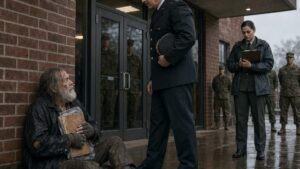
The Young Instructor Mocked His Trembling Hands Until the Old Man Corrected Every Shot
Chapter 1: The Maintenance Man Beside the Precision Rifle
“Who cleared the maintenance man onto an active firing line?”
The question carried farther than Brandon Hill intended, or perhaps exactly as far. Two trainee soldiers stopped beside the ammunition table. The armorer looked up from an open case. Even the civilian event coordinator, walking the gravel path with a clipboard pressed to her chest, turned toward the scarred wooden bench at lane four.
Edward Carter did not turn immediately.
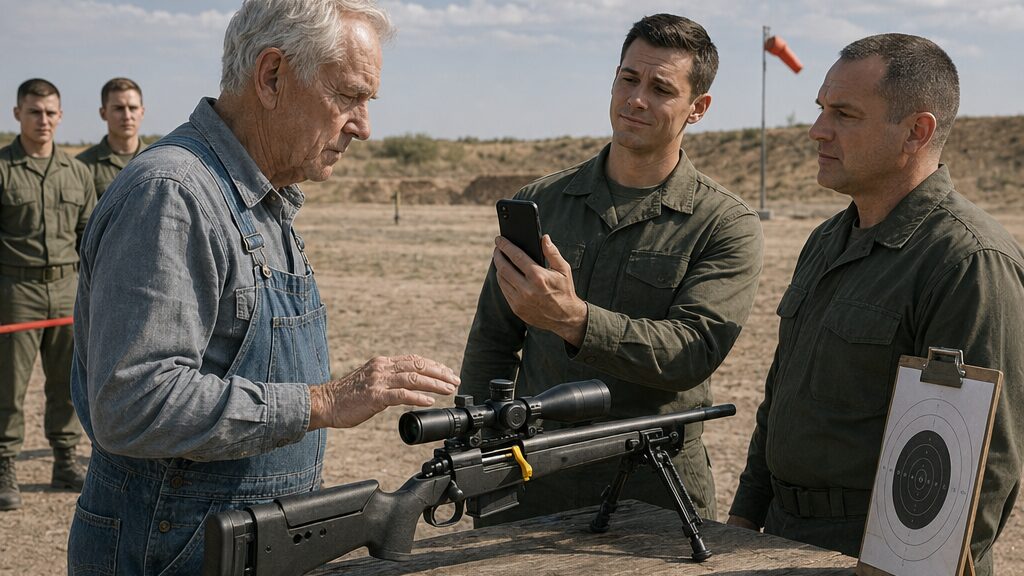
He stood behind the yellow boundary line in faded denim overalls and an old gray shirt, studying the rifle without touching it. His work gloves were tucked into the front pocket of his overalls. Sawdust still clung to one knee from the memorial bench he had been repairing fifty yards behind the firing line.
The rifle lay pointed safely downrange, its bolt open and a bright chamber flag visible. Above it, a black scope caught a stripe of morning light. Beside the rifle rested a paper target marked with a loose group high above the center ring.
Edward looked first at the chamber flag, then at the red range flag snapping across the open field. Only after that did he face Brandon.
“I’m behind the line,” he said.
Brandon was twenty-eight, broad-shouldered, cleanly uniformed, and carrying the restless energy of a man who had already been asked twice that morning why qualification scores were falling. A smartphone sat in his left hand. He had been using it to record promotional clips for the next day’s veterans’ charity event.
“You were leaning over government equipment.”
“I was looking at the target.”
“That’s usually how it starts.”
One of the trainees smiled. Not much, but enough.
Gregory Williams stood across the bench with his arms folded. As the range safety NCO, he should have ended the exchange before it became entertainment. Instead, he watched Edward’s eyes move from the target to the wind flag, then to the scope’s elevation turret.
“Mr. Carter is repairing the memorial bench,” Gregory said.
Brandon glanced toward the half-finished bench beneath the shade awning. Richard Garcia’s name had been routed into the back rail, the letters still pale against the darker wood.
“Then he ought to repair the bench.”
Edward could have walked away. Anna had told him that morning to finish the work, leave Richard’s sealed letter in the truck, and come home before anyone asked questions. He had agreed because agreeing was easier than explaining why he had accepted the job at all.
He turned toward the bench.
Behind him, Brandon spun the elevation turret. Three quick clicks, then another two.
The sound stopped Edward.
He looked back at the paper target. The shots sat high and slightly right, their spread angled in a way the crosswind did not justify. The wind was moving left to right but losing strength near the berm. The rifle’s elevation cap sat a fraction above the witness mark.
Brandon noticed him looking.
“What now?”
Edward pointed at the target, not the weapon. “That group wasn’t fired on the setting you just recorded.”
The smiles disappeared, though only for a moment.
Brandon picked up the range log. “You read the log from back there?”
“No.”
“Then you don’t know what was recorded.”
“I know the group.”
Brandon gave a soft laugh and looked toward the trainees as if Edward had supplied the morning’s missing entertainment. “He knows the group.”
Edward felt the familiar pull to say nothing more. Silence had served him for years. Silence prevented arguments from becoming performances. It kept old accomplishments from sounding like pleas for recognition.
It also allowed foolishness to harden into fact.
The event coordinator approached Gregory. “We still have the media rehearsal at ten, correct?”
“If the rifle holds zero,” Brandon answered before Gregory could speak.
“It held zero yesterday,” Gregory said.
“Yesterday’s ammunition wasn’t this lot.”
Edward glanced toward the open ammunition can. Different lot numbers could shift impact. Not usually enough to explain what he saw, but enough that a careful instructor would verify before blaming the optic.
Brandon caught the glance. “You inspect ammunition too?”
Edward ignored the tone. “Was the barrel allowed to cool between groups?”
The younger trainee looked at Brandon before answering.
Brandon said, “We know how to run a rifle.”
That ended the trainee’s response.
Gregory unfolded his arms. “How many rounds since the last cooling break?”
“Not enough to matter.”
“That wasn’t the question.”
For the first time, irritation crossed Brandon’s face without being arranged for an audience. He set the log down harder than necessary.
Edward saw more than arrogance then. There were shadows under Brandon’s eyes. His jaw remained tight even when he was not speaking. On the ammunition table lay three failed qualification sheets, each marked for review. Tomorrow’s charity event would bring donors, visiting officers, and former service members to a range struggling to produce results.
Pressure did not excuse contempt. It did explain its direction.
Edward stepped toward the memorial bench.
A gust lifted dust along the firing line. The red flag snapped hard, relaxed, then snapped again.
“Wait,” Gregory said.
Edward stopped.
Gregory pointed to the rifle. “You checked the chamber flag before you crossed toward the bench.”
“I check before I go near any firing point.”
Brandon raised his phone. “Maybe we should document this. Range safety advice from the carpenter.”
The lens faced Edward.
He looked at the small black circle and felt something close inside him. Years earlier, men with clipboards had listened while others called his methods slow, rigid, outdated. Edward had let them. He had believed the work would defend itself after he left.
The work had no voice.
Brandon angled the phone to include the rifle. “All right. Tell us what trained personnel missed.”
Edward looked past him to the target carrier. “Bring the last group in.”
Gregory hesitated, then signaled the operator.
The motor whined. The target moved toward them on its cable, paper fluttering beneath the frame. When it reached the line, Edward remained behind the boundary until Gregory declared the rifle clear and opened access.
Only then did Edward approach.
He did not touch the rifle. He lifted the paper by one corner. Three rounds formed an uneven diagonal above the scoring ring. A fourth hole sat farther right.
“Which was the called flyer?” he asked.
The younger trainee pointed to the fourth hole.
“Why?”
“I broke the shot late.”
Edward nodded. “That one belongs to you. The other three belong together.”
Brandon lowered the phone slightly.
Edward studied the grease-pencil note at the bottom of the target: distance, ammunition lot, wind estimate, and recorded correction. The correction written there did not match the turret position.
The mismatch was small. Small errors were the ones that survived loud rooms.
“You wrote two clicks down,” Edward said.
Brandon looked at the log. “That’s what I made.”
Edward’s eyes went to the fresh mark on the turret. “No. You moved it up.”
One trainee leaned closer. Brandon’s expression tightened.
“The direction arrows are printed on the housing,” he said.
“I know.”
“Then you know clockwise moves impact down on this optic.”
“From the shooter’s side.”
Silence stretched across the bench.
Brandon looked at the turret, then at the page. His thumb hovered over the adjustment as if tempted to correct it before anyone could study the position.
Edward saw that motion and disliked the satisfaction that rose in him. He had not come to catch a young man making a mistake. He had come to finish Richard’s bench, read a letter he had avoided for six months, and decide whether memory was easier to honor in wood than in words.
He placed the target down.
“The wind accounts for the right drift,” he said. “Not the height.”
Brandon lifted the phone again, defensive confidence returning now that witnesses were watching. “And the maintenance man can tell all that from paper?”
“The paper is the part that doesn’t care who is speaking.”
A few heads turned at that.
Gregory’s eyes narrowed—not in suspicion now, but concentration.
Brandon stepped aside and gestured grandly toward the rifle. “Then go ahead. Since you’re already teaching.”
Edward’s right hand trembled once at his side. It had done that for four years, worse when tired, almost absent when given a deliberate task. Brandon noticed. The phone tilted toward it.
“There it is,” Brandon said softly enough to sound almost sympathetic. “Maybe we should start with something lighter.”
Edward tucked his hand against his overalls.
The old response waited inside him: let the young man have his moment, finish the bench, go home. Dignity did not require correction.
But the target lay between them, carrying an error someone would blame on the rifle, then the ammunition, then the trainee. Tomorrow, under more pressure, another shortcut would be easier.
Edward met Brandon’s eyes.
“Your elevation is four clicks high.”
Brandon’s smile thinned.
Then he placed the rifle directly in front of Edward.
Chapter 2: Four Clicks While the Phone Recorded
Brandon aimed the smartphone at Edward’s hands.
“Let’s see whether four clicks from shaking fingers can fix what trained soldiers couldn’t.”
The trainees stood behind the boundary line. The armorer remained near the equipment case. The event coordinator had stopped pretending to review her clipboard. Even workers at the memorial canopy watched from the shade.
Edward did not move toward the rifle.
“Is the line cold?” he asked.
Gregory looked downrange. “The line is cold.”
“Has every weapon been cleared?”
“Yes.”
Edward pointed toward lane five, where a trainee was kneeling beside an open rifle case. “That one hasn’t been verified.”
The trainee looked up. A rifle rested in the foam with its action closed.
Brandon exhaled sharply. “It’s cased.”
“That is not the same as clear.”
Gregory crossed to lane five, opened the action, inspected the chamber, and inserted a flag. When he returned, his expression had changed by a degree.
“Line is cold,” he repeated. “All weapons clear.”
Edward stepped across the boundary.
He removed the gloves from his pocket and folded them beside the paper target. Without them, the tremor in his right hand was more visible. Brandon’s phone followed it.
Edward checked the rifle’s muzzle direction, chamber flag, bolt position, and magazine well. Only then did he bend toward the scope.
The turret rose beneath his fingers.
He paused with his thumb and forefinger resting on the knurled edge. The wind flag pulled right, dropped, then lifted halfway. His hand trembled against the metal.
Someone behind him whispered.
Edward turned the turret.
Click.
The sound seemed louder than it should have been.
Click.
Brandon’s expression remained fixed.
Click.
Gregory looked from the turret to the target notation.
Click.
Edward withdrew his hand.
“That’s it?” Brandon asked.
“That is the correction.”
“You haven’t checked parallax.”
“It was checked before the last group.”
“How would you know?”
“The fourth hole.”
Brandon looked at the called flyer again. Edward did not explain. A late break with a poor sight picture would have widened differently if the parallax setting were badly wrong. The evidence was imperfect, but sufficient for a confirmation round.
Edward stepped back behind the line.
“Who is firing?” Gregory asked.
“The rifleman who fired the group,” Edward said.
The younger trainee glanced at Brandon.
Brandon smiled toward the phone. “No. Our guest made the correction. Our guest can prove it.”
Edward felt every pair of eyes settle on him.
He had fired for qualification, instruction, evaluation, and competition. He had shot in heat that blurred the target and cold that stiffened the trigger finger. None of that made a public challenge wise.
“This does not require a contest,” he said.
“It requires proof.”
“One confirmation round will prove the adjustment.”
“Then fire one.”
Edward looked at Gregory. “Permission to occupy lane four?”
Gregory gave it formally.
That mattered. Brandon noticed that it mattered.
Edward settled behind the rifle slowly. Age had made lowering himself to the bench less graceful than he preferred. His left knee complained. The stock had been adjusted for a shorter shooter, and he corrected the position without altering it, drawing the rifle into his shoulder and establishing a stable cheek weld.
The tremor remained in his fingers until he placed them where each had a purpose.
“Range going hot,” Gregory called.
The words moved down the line through the required confirmations. Edward waited through every response.
Only when Gregory issued the command did Edward close the bolt on a single round.
He studied the wind flag through the edge of his vision. His breathing slowed. The scope reticle settled, drifted, returned. He did not force it still. No rifle was truly still. The work lay in understanding the movement and choosing the moment inside it.
The shot cracked across the range.
Edward opened the bolt immediately, ejected the casing, and left the action open.
“Clear,” he said.
Gregory verified it.
The target traveled back.
The new hole sat just left of center, level with the scoring ring’s middle line.
The younger trainee leaned forward. “That’s where he said it would go.”
Brandon kept the phone raised. “One round.”
“One correction,” Edward said.
“One lucky break.”
Edward rose from the bench. A small, shameful warmth moved through him. He had missed the clean certainty of a correct call. Worse, he enjoyed the silence that followed Brandon’s dismissal.
That was pride, no matter how quietly it stood.
He reached for his gloves.
Brandon blocked them with two fingers. “Three rounds.”
Gregory said, “Hill.”
“If he can diagnose the rifle, three rounds shouldn’t trouble him.”
Edward looked at the phone, then at the trainees. Brandon had made retreat appear like fear and agreement appear like vanity. It was an old kind of trap.
“What does a group prove that the confirmation did not?” Edward asked.
“That the first wasn’t luck.”
Edward studied him. “And if the group is centered?”
Brandon’s gaze flickered toward the failed qualification sheets.
“Then I’ll concede the adjustment.”
“Only the adjustment?”
“That is all you claimed.”
It was not. Edward had also claimed, by implication, that the range had begun trusting explanations before evidence. But he had said too little for anyone to hear that.
He sat again.
Gregory repeated the safety sequence. This time Brandon did not interrupt it.
Three rounds were issued. Edward loaded only after the line went hot.
The first shot broke in a lull.
The second came after a longer wait, when the wind shifted and weakened near the berm.
Before the third, Edward held his breath too long. The reticle pulsed with his heartbeat. A younger version of himself would have forced the shot to preserve rhythm.
He lifted his finger from the trigger.
Behind him, someone shifted impatiently.
Edward breathed again, reset his position, and waited.
The third shot followed.
He cleared the rifle and stepped away before looking downrange.
Brandon reached for the target control.
“Let the shooter bring it in,” Edward said.
Brandon’s jaw tightened, but Gregory nodded to the younger trainee who had fired the earlier group.
The target came back slowly.
Three new holes formed a compact triangle within the center ring. Not one hole. Not magic. A disciplined group, small enough to deny accident and ordinary enough to remain believable.
The trainee stared at it.
The armorer folded his arms.
Brandon lowered the phone.
No one cheered. The silence was more complete than applause would have been.
Edward looked at his own group and felt no triumph, only the return of an old responsibility. A centered target could expose an error. It could not explain why three trainees had failed on the same rifle.
He picked up his gloves.
The junior shooter—the youngest on the line, his face still flushed from watching—said, “Can I try it now?”
Brandon answered quickly. “Yes. Same setting. Let’s settle this.”
Edward turned. “He should dry-fire first.”
“He already completed drills.”
“When?”
“This morning.”
Edward looked at the shooter’s shoulders. They were raised. His breathing remained shallow and fast. The public challenge had made him eager to prove himself before he was ready.
Brandon motioned him forward.
The junior shooter lay behind the rifle. Gregory ran the commands. The young man closed the bolt, settled his cheek, and fired too soon after inhaling. His second shot came even faster. The third broke with his trigger hand tightening around the grip.
Edward heard the errors before the target returned.
Brandon watched through binoculars, then lowered them without speaking.
The paper traveled in.
All three shots had missed the scoring ring. They formed a diagonal spread, high left to low right.
The same rifle. The corrected optic. A completely different result.
The junior shooter stared at the target as if it had accused him personally.
Brandon looked toward the ammunition can.
Edward looked at the young man’s rigid elbow and clenched firing hand.
The rifle had been corrected.
The problem had not.
Chapter 3: The Rifle Was Not the Whole Problem
The junior shooter’s target came to rest beside three earlier failures, and Gregory saw the same diagonal wound across all four sheets.
Different shooters. Different mornings. Nearly identical spread.
Brandon pulled the newest target free before anyone else could study it.
“He rushed because everyone was watching.”
Edward stood behind the line with his gloves back in his pocket. “He rushed because no one stopped him.”
Brandon turned. “You’ve made your point.”
“I have not made one.”
“That rifle grouped for you.”
“Yes.”
“So the equipment is serviceable.”
“For that ammunition, under that wind, at that moment.”
Brandon gave a sharp laugh. “Convenient.”
Gregory stepped between them before the exchange widened. “We’re pausing live fire.”
The event coordinator approached at once. “For how long?”
“Until we review the last qualification strings.”
“We have a rehearsal in forty minutes.”
“We have a pattern we don’t understand.”
Her eyes moved to the workers under the memorial canopy, then to the visitors gathering near the parking area. “Tomorrow’s schedule cannot move.”
Gregory did not answer. He watched Edward instead.
The old man was looking at the junior shooter, not the target.
The young soldier had withdrawn from the group and was rubbing his trigger hand against his trousers. Shame had folded his shoulders inward. Brandon had turned away from him to argue with the event coordinator.
Edward approached the boundary line but did not cross.
“May I speak to him?” he asked Gregory.
Gregory nodded.
Edward called the shooter over. “Show me your firing hand.”
The young man hesitated, then held it out.
“Not like a medical inspection. Make the grip you used.”
The fingers curled hard. The thumb pressed inward. The tendons stood out along the wrist.
Edward said, “You’re trying to stop the rifle from moving.”
“It was moving.”
“It always moves.”
Brandon heard and turned back. “He knows that.”
The junior shooter’s eyes remained on Edward.
Edward lifted his own right hand. The tremor showed immediately, a small rhythmic movement in the fingers.
“Movement is not failure,” he said. “Forcing it still usually becomes failure.”
He asked Gregory to confirm the rifle at lane four remained clear. Gregory checked the open action and chamber flag, then allowed them forward.
Edward did not touch the weapon.
“Get behind it,” he told the shooter. “No ammunition.”
The young man settled into position.
“Close your eyes. Build the position without chasing the target.”
Brandon stepped closer. “He has been trained.”
“Then this will take less time.”
The answer was not rude. That made it harder to oppose.
Edward watched the shooter inhale. His shoulders lifted.
“Breathe lower.”
The young man tried again.
“Your elbow is carrying weight it should be giving the bench.”
Edward pointed but did not move him. The shooter shifted his elbow inward.
“Now place your finger where the pressure moves straight back. Do not squeeze the whole hand to move one finger.”
The chamber flag rocked slightly in the breeze above the open action.
“Dry press,” Edward said.
The shooter did.
The rifle moved sharply at the break.
“Again.”
The second movement was smaller.
By the fifth, the muzzle barely dipped.
A trainee behind Gregory whispered, “That’s different.”
Brandon heard him. “Dry fire isn’t a qualification.”
“No,” Edward said. “It is where you discover why the qualification failed.”
The junior shooter opened his eyes. Some of the shame had left his face.
Gregory felt his own certainty shift. He had assumed Edward’s skill belonged to the rifle—to wind calls, optics, old muscle memory. But Edward had corrected the young man without firing a round or placing a hand on the weapon.
This was not merely a shooter.
It was an instructor’s economy: observe, isolate, correct one thing at a time.
Brandon lifted the failed target. “Ammunition still matters. We changed lots yesterday.”
“It does,” Edward said.
“And the barrel heat mattered.”
“It may have.”
“Then stop acting as though one grip correction explains the entire range.”
Edward looked at him for a long moment. “I did not say it did.”
The refusal to overclaim unsettled Gregory more than certainty would have.
He gathered the targets and carried them into the range office. The room smelled of dust, solvent, and stale coffee. Qualification records filled two binders beside the desk. An adjustment log lay open beneath a clear plastic cover.
Gregory worked backward through the week.
The first failed group had been recorded at 0905. The optic check beside it carried Brandon’s initials and a time of 0840.
The rifle’s maintenance sheet showed it had been signed out to the armorer until 0915.
Gregory read both entries again.
Impossible.
He checked the serial number. Same rifle.
The door opened behind him. Brandon entered and closed it.
“We’re not turning this into an investigation over clerical mistakes.”
Gregory tapped the page. “You signed an optic check on a rifle that was still with the armorer.”
“I checked the spare.”
“This serial number is not the spare.”
“Then I wrote the wrong number.”
“Did you?”
Brandon looked toward the window. Outside, Edward had returned to Richard’s bench. He ran sandpaper along the carved name with slow, even strokes while the junior shooter practiced dry presses under another trainee’s observation.
Brandon lowered his voice. “Scores dropped. The event coordinator wanted a fix. The armorer said the rifle was fine. I was trying to keep the program moving.”
“That isn’t an answer.”
“It’s the answer you’re going to get until we know what happened.”
Gregory turned another page. Several corrections had been entered without times. Two lines had been written over. On one target, the documented elevation shift was two clicks down. A faint pencil note in the margin read: Verify direction from firing position. Every click must answer to a shot.
The handwriting was older than the rest.
Initials sat beneath it.
R.G.
Gregory had seen those initials in archived manuals: Richard Garcia, former range commander, the man whose memorial event had drawn tomorrow’s guests.
Below Richard’s note, in different handwriting, someone had added a sentence:
Never let the shooter pay for the instructor’s guess.
Gregory read it twice.
He returned to the firing line carrying the binder.
Brandon followed, expression set.
The event coordinator was speaking to Edward. “Sir, I appreciate what you did, but you cannot continue instructing personnel without authorization.”
Edward brushed sawdust from the bench rail. “I understand.”
“Then you need to leave the firing area.”
Anna Carter had arrived from the parking lot and stood near the tools, watching her father with concern sharpened by recognition. She had likely seen this before—Edward accepting removal rather than explaining why he belonged.
Gregory opened the binder.
“Mr. Carter,” he called.
Edward looked up.
Gregory held the page where Richard’s initials sat beneath the rule. “Who taught you to say that?”
Edward’s gaze moved to the handwriting.
For the first time that day, his composure changed. Not much. His hand stopped over Richard’s carved name.
Brandon stepped between them. “This is finished. He is not assigned here, and he is undermining instruction in front of civilians.”
The event coordinator nodded. “Mr. Carter, please collect your tools.”
Edward looked at the junior shooter, then at the failed targets, then at the binder in Gregory’s hands.
He could have answered one question and changed the entire balance of the range.
Instead, he put his work gloves on.
“I came to finish the bench,” he said.
Gregory watched him lift the toolbox. The same silence that had appeared dignified that morning now felt like a door closing while something dangerous remained inside.
As Edward passed, Gregory lowered his voice.
“Richard Garcia wrote your words in this manual.”
Edward stopped.
Gregory turned the page toward him. Beneath Richard’s initials was an older notation, almost faded away.
E.C. reviewed.
Edward looked at it without touching the paper.
Then he walked toward the memorial bench, leaving Gregory with a new question larger than the first:
What had Edward Carter helped build here—and why had he allowed ev
Chapter 4: The Rule Written in Richard’s Margin
“Why did Richard Garcia copy your exact words into a twenty-year-old range manual?”
Gregory held the binder open between them.
Edward stood beside the unfinished memorial bench with one gloved hand wrapped around the handle of his toolbox. The penciled sentence lay beneath Richard’s initials, faded but unmistakable.
Never let the shooter pay for the instructor’s guess.
Anna watched from the gravel path. She had arrived expecting to find her father sanding wood, not surrounded by soldiers and failed targets. The set of his shoulders told her he was already halfway gone.
Edward looked at the page, then at Gregory.
“Richard wrote down many things.”
“Not with your initials beside them.”
Brandon remained several steps away, arms folded. The event coordinator had returned to the office to rearrange the rehearsal schedule, but the trainees still lingered near the firing line. They pretended to clean equipment while listening.
Edward lowered his toolbox onto the bench.
“That review mark could belong to anyone.”
Gregory tapped the letters. “E.C.”
Anna closed her eyes briefly. “Dad.”
Edward did not look at her.
Brandon stepped closer. “So you were assigned here?”
“Once.”
The single word shifted the air more effectively than any speech could have.
Gregory glanced down at the manual. “In what capacity?”
Edward removed one glove finger by finger. His right hand trembled in the open air.
“I reviewed range standards.”
“For how long?”
“Long enough.”
Brandon gave a humorless laugh. “That means what? A temporary inspection? Civilian consultant?”
Edward’s gaze moved toward the firing line. The red flag had been lowered during the pause. Without live fire, the range felt exposed—benches, cables, berms, and errors all visible without noise to cover them.
“Richard and I wrote the first version of that qualification sequence,” he said.
Gregory’s eyes narrowed. “The breathing pauses?”
“And the correction log.”
“The mandatory cooling intervals?”
“Yes.”
Brandon looked at the failed targets on the table. “Those standards have been revised.”
“They should be.”
The answer caught him off guard.
Edward continued, “A standard that cannot survive revision was never much of a standard. But a revision should solve a problem. It should not hide one.”
Brandon’s jaw tightened.
Anna stepped beside her father. “You told me you were repairing a bench.”
“I am.”
“You did not tell me you were inspecting the range.”
“I did not say I was.”
“That is not the same thing.”
Edward put the glove back on.
Gregory saw the retreat happen in real time. Edward’s face remained calm, but every movement closed the subject: glove, toolbox, eyes lowered to the unfinished rail.
“Mr. Carter,” Gregory said, “did Richard ask you to come here?”
Edward pressed his thumb against a rough edge in the carved name.
“Yes.”
The answer was barely audible.
Anna stared at him. “When?”
Edward did not reply.
“When did he ask you?”
He looked toward the parking area, where his truck sat beneath a line of trees. “Before he died.”
Anna’s expression changed. “The letter.”
Brandon’s attention sharpened.
Gregory asked, “What letter?”
Anna kept her eyes on Edward. “The one he has carried in the truck for six months.”
Edward’s gloved hand stopped over the wood.
“You told me it was personal,” she said. “You said you would open it when you were ready.”
“It is personal.”
“And it brought you here.”
He looked at her then. The concern in her face was not accusation. That made it harder.
Richard’s letter had arrived three days before the funeral. Edward had recognized the handwriting and placed it unopened in the glove compartment. He had driven with it through winter, spring, and half the summer. Each time Anna asked, he said there was no proper moment.
The truth was simpler. An unopened letter could not require anything of him.
Gregory closed the binder carefully. “Why did you leave?”
Edward looked toward Brandon, then the trainees.
“That is not relevant to today’s rifle.”
“It may be relevant to the program.”
“No. The records are relevant. The targets are relevant. What happened years ago is not an excuse for what is happening now.”
Brandon stepped forward. “You walk in wearing work clothes, refuse to identify yourself, correct me in front of my shooters, and now you want to pretend your history has nothing to do with it?”
Edward’s eyes hardened. “My history did not make you write an inspection time for a rifle that was not here.”
The words landed cleanly.
Brandon looked at Gregory. “You showed him the log?”
“He saw the targets. I saw the log.”
“You had no right to discuss internal records with a civilian.”
“He is the reviewer named in the original manual.”
“He was.”
Edward heard the emphasis. It should not have mattered. Instead, it found the old bruise precisely.
He had once stood in that same office while younger officers described accelerated qualification as modernization. Richard had argued beside him until both men were removed from the review board. Richard stayed and fought from within. Edward resigned.
He had called it principle.
Some nights he knew it had also been pride.
The event coordinator returned carrying a revised schedule. “The public demonstration remains at noon tomorrow. The senior inspecting officer confirmed attendance. We cannot cancel without losing the charity presentation.”
Gregory said, “We have unresolved equipment and training discrepancies.”
“Then resolve them before noon.”
“Live fire should remain suspended until we do.”
Her grip tightened on the clipboard. “You have until nine tomorrow morning. After that, the range will proceed under command guidance.”
Brandon nodded once, as though the deadline restored something to him.
Edward felt the trap closing. By morning, every disputed entry could be explained as haste, every target blamed on ammunition, every failure converted into a rehearsal problem. The event would move forward because too many people needed it to.
Anna touched his sleeve. “Come home.”
He looked at Richard’s name carved into the bench.
“You finished what you came to do,” she said.
“No.”
“The bench is close enough.”
Edward ran his thumb along the unfinished edge. “Richard disliked close enough.”
“That never stopped either of you from leaving things unfinished.”
The words were quiet. Gregory looked away.
Edward picked up his toolbox, then set it down again.
“Wait here,” he told Anna.
He walked toward the parking area.
The envelope lay in the truck’s glove compartment beneath the registration papers. His name was written in Richard’s uneven hand. The seal had softened through months of heat.
When Edward returned, no one spoke.
He sat on the memorial bench. The wood creaked beneath him. Anna stood at one end, Gregory at the other. Brandon remained several yards away, close enough to hear and unwilling to appear interested.
Edward opened the envelope.
The letter was only two pages. Richard had never wasted paper.
Edward read in silence until he reached a paragraph marked by a heavy underline.
The notebook is yours to keep or burn. Do not give it back because they remember our names. Give it back only if they remember why we wrote it.
Edward turned the page.
The final line waited at the bottom.
Do not give them the notes unless they still respect the first rule.
Anna watched his face. “What is the first rule?”
Edward folded the letter along its old crease.
Across the range, Brandon picked up the failed targets and carried them into the office.
Edward looked after him.
“Tomorrow,” he said, “we find out whether they remember.”
Chapter 5: Brandon’s Shortcut Had a Reason
The fresh scratches around the elevation turret were too narrow to have come from fingers.
Edward saw them as soon as Gregory opened the equipment room at six the next morning. Under the fluorescent light, three bright marks cut through the scope’s matte finish beside the witness line.
“Tool marks,” Gregory said.
Edward leaned closer without touching the rifle. “Recent.”
“The armorer used a coin during the last service.”
“Not there.”
Gregory opened the adjustment log. “Brandon said the turret had not been changed after yesterday’s group.”
Edward studied the marks. Someone had gripped the adjustment with pliers or a multitool, likely in haste. The damage was minor. The intention behind it was not.
On the worktable lay ammunition from two lots. Edward selected one cartridge from each box and rolled them beneath his fingertip, comparing them visually before handing them back.
“Different lots may shift impact,” he said. “Not enough to excuse the records.”
Gregory looked toward the closed door. “You are defending part of his explanation.”
“I am separating what is true from what is useful.”
Outside, the range was empty except for workers setting chairs beneath the charity canopy. The quiet gave the equipment room the feel of an interview chamber.
Gregory lowered his voice. “The senior officer arrives before noon. If Brandon altered the optic and falsified the check, his instructor assignment is finished.”
“That decision is not mine.”
“Your assessment will influence it.”
Edward’s hand trembled beside the table. “Then my assessment should be accurate.”
The door opened.
Brandon entered in uniform, carrying two cups of coffee. He stopped when he saw the rifle beneath the light.
“You started without me.”
Gregory said, “We found tool marks.”
Brandon placed the cups down. “The armorer has adjusted that optic dozens of times.”
“The marks are fresh.”
“So?”
“So you said it had not been touched.”
Brandon looked at Edward. “And now he is conducting the investigation?”
“I am examining a rifle.”
“You are doing more than that.”
Edward met his gaze. “Then tell us what happened.”
For several seconds, Brandon seemed ready to refuse. He looked younger without yesterday’s phone in his hand. Fatigue showed plainly around his eyes.
“The first two groups opened up after we changed ammunition,” he said. “I corrected for the shift.”
“Did you record it?” Gregory asked.
“I meant to.”
“That is not an answer.”
“No.”
The word came out hard.
Brandon continued before Gregory could speak. “The next shooter still failed. I moved the optic again. Then the group shifted the other direction, so I moved it back.”
“With pliers?” Edward asked.
“The cap was tight.”
“How many clicks?”
“I don’t remember.”
Gregory stared at him. “You don’t remember?”
“I was running six shooters, answering the event coordinator, and trying to prove the rifle wasn’t defective before the armorer took it out of service again.”
“You signed the check while it was still with the armorer.”
“I signed the sheet early.”
“That is a false record.”
“It was going to be checked.”
“But it had not been.”
Brandon’s face flushed. “Qualification numbers were already down. Command wanted an explanation. The last instructor got removed after two bad cycles, and everyone knew this event was my evaluation whether they called it that or not.”
The admission filled the room.
Gregory’s voice softened without losing its edge. “So you changed the optic until the targets looked better.”
“I changed it because the ammunition shifted.”
“Partly,” Edward said.
Brandon turned toward him.
Edward indicated the two boxes. “The lots are not identical. At this distance, with this rifle, they could account for a modest vertical change. The heated barrel could widen a group. Neither explains repeated diagonal spreads across different shooters.”
For the first time, Brandon did not answer immediately.
Edward saw the truth arrive before the words.
“You knew,” he said.
Brandon looked away.
“You knew the equipment was not the whole problem.”
“I knew the shooters were inconsistent.”
“That is not the same thing.”
“They were failing.”
“And you were their instructor.”
The room tightened.
Brandon gripped the edge of the table. “You think I don’t know that? This is the first assignment I have had where people looked at me and saw more than another young soldier waiting his turn. I earned this position. I shoot well. I know the material. But every failed target became my name in somebody’s report.”
Edward recognized the fear beneath the anger. Years earlier, he had felt a version of it when revised schedules treated careful instruction as obstruction. He had answered by withdrawing before anyone could diminish him further.
Brandon had answered by controlling every variable he could reach, including those he did not understand.
“Fear may explain the first shortcut,” Edward said. “It does not excuse the next one.”
Brandon’s eyes narrowed. “You had the luxury of walking away.”
The statement struck deeper than Brandon knew.
Gregory said, “He helped write the standards.”
“I know who he is now.”
Edward looked at him sharply.
Brandon pulled out his phone. On the screen was an archived training article with a grainy photograph. Richard stood beside a younger Edward near the same firing line.
“A trainee sent it to me last night,” Brandon said. “Retired evaluator. Former instructor. The man whose methods everyone keeps quoting without knowing his name.”
Edward felt no satisfaction.
Brandon lifted the phone. “You knew exactly what would happen yesterday. You let me talk. You let me record it. You waited until a crowd formed, then proved me wrong.”
“I asked you to stop the contest.”
“But you never said who you were.”
“No.”
“Why?”
Edward thought of Richard’s unopened letter and the years he had let others describe his departure.
“Because identity should not be required before you listen to a concern.”
Brandon laughed once. “That sounds noble.”
“It was also pride.”
The answer silenced him.
Edward continued, “I did not want to sound like an old man asking the room to care who he used to be.”
Gregory watched both men. Each had protected his status in a different direction. One by manipulating the evidence. The other by refusing to offer context until the conflict became unavoidable.
A voice sounded from the range loudspeaker outside. Workers were testing the public-address system.
Brandon picked up his phone. His expression had changed from defensive to resolved.
“What are you doing?” Gregory asked.
“Correcting the schedule.”
He walked out before either man could stop him.
At the firing line, the event coordinator stood beside the microphone reviewing the noon program. Brandon took the second microphone from its stand.
“Attention to tomorrow’s—” She corrected herself. “Today’s demonstration staff.”
Brandon switched on his microphone. His voice carried across the empty chairs and through the equipment-room doorway.
“At noon, the range will conduct a long-distance accuracy demonstration.”
Gregory stepped outside. “Hill, turn that off.”
Brandon continued.
“The demonstration will compare current training procedures with the methods used by former Army range evaluator Edward Carter.”
Workers stopped moving chairs.
Edward stood in the doorway.
Brandon looked directly at him from across the firing line.
“Mr. Carter has agreed to show whether the old standards still perform under today’s conditions.”
Edward had agreed to nothing.
But the announcement had already gone beyond the room, beyond the men who understood the dispute, and into the expectations of everyone arriving at noon.
Chapter 6: A Challenge Edward Would Not Accept
Brandon placed two fresh targets downrange and asked the crowd whether Edward’s hands were steady only when no one important was watching.
The microphone made the insult cleaner than it deserved to be.
Nearly a hundred people occupied the folding chairs beneath the charity canopy. Veterans sat near the front. Donors and civilian guests stood along the rope barrier. The senior inspecting officer watched from beside the event coordinator, his expression unreadable.
Edward remained behind the firing line in his overalls.
His work gloves were tucked into his pocket.
On lane four, the scoped rifle rested with its action open and chamber flag inserted. A second rifle sat safely cased beneath the bench. Brandon stood beside both targets displayed on an easel: Edward’s centered group from the previous day and a blank sheet labeled CURRENT STANDARD.
The phone that had recorded Edward’s hands was mounted on a small tripod.
“This was not the agreed program,” Gregory said under his breath.
Brandon kept his eyes forward. “There was no agreed program.”
“You were ordered to resolve the discrepancies.”
“I am resolving them publicly.”
“You are protecting yourself publicly.”
Brandon’s jaw flexed, but he raised the microphone again.
Edward walked to the yellow line.
The crowd quieted.
Brandon offered him the microphone. Edward did not take it.
“Before any demonstration,” Edward said, “who verified the ammunition lot?”
The question did not carry far enough. Brandon held out the microphone again.
Edward took it reluctantly.
“Who verified the ammunition lot?”
The armorer raised a hand. “I did.”
“Barrel condition?”
“Clean and inspected.”
“Wind call?”
Brandon pointed toward the flags. “Eight to ten, shifting.”
Edward studied them. The nearest flag pulled steadily right. The far flag near the berm dipped, then lifted in the opposite direction for two seconds.
“Not one wind,” he said.
Brandon smiled toward the audience. “That is why it is a demonstration.”
Edward looked at the blank target, then at the young shooter waiting beside lane five. The same soldier he had coached through dry fire now stood in full view of the crowd, shoulders already high.
“Why is he on the line?”
“He will fire the current-standard group. You will fire the traditional-method group.”
The junior shooter glanced at Edward, uneasy.
Edward placed the microphone on the bench.
“No.”
A murmur moved beneath the canopy.
Brandon lifted his own microphone. “You decline?”
“I decline this arrangement.”
“Yesterday you had no difficulty firing when only trainees were watching.”
Edward’s right hand trembled beside his thigh. Brandon saw it and allowed the crowd to see him seeing it.
Edward turned toward Gregory. “Has the line been cleared for live fire?”
Gregory checked both ends. “Not yet.”
Brandon said, “We are three minutes behind schedule.”
The event coordinator spoke quietly to the senior officer. Several donors near the aisle began checking their phones.
“Then recover the three minutes somewhere that does not involve the firing sequence,” Edward said.
Brandon motioned the junior shooter forward. “Take your position.”
The young soldier crossed the line before Gregory issued the command.
At lane five, a worker was still retrieving a cable cover several yards forward of the sheltered area.
Edward’s open hand rose above the rifle.
“Stop.”
He did not shout. The word cut through the range anyway.
The junior shooter froze with one hand near the rifle.
Gregory saw the worker and stepped forward. “Cease movement. Line remains cold.”
Brandon lowered the microphone. “The weapon is clear.”
“The line is not,” Edward said.
“He had not loaded.”
“That is not the standard.”
“The worker is behind cover.”
“That is not the standard either.”
The red range flag snapped hard above them.
For the first time, the crowd’s impatience shifted toward unease. The senior officer looked from the worker to Brandon, then to Gregory.
Gregory took the microphone.
“Mr. Carter is correct. The line was not fully confirmed. The demonstration will pause.”
The declaration cost him. Edward could see it in the way Gregory squared his shoulders before facing Brandon.
Brandon spoke through clenched teeth. “You are canceling the event over a technicality.”
Gregory met his gaze. “I am stopping a sequence that began before my command.”
The event coordinator hurried forward. “How long?”
“As long as required.”
People began leaving the rear rows. A donor folded a program and placed it on an empty chair. The visible unraveling pressed on Brandon more effectively than accusation.
He turned on Edward.
“This is what you wanted.”
Edward looked at him. “No.”
“You arrived, exposed the records, stopped the demonstration, and now everyone gets to remember that the old methods were safer.”
“The old methods failed too.”
Brandon stared.
Edward picked up the microphone.
Years earlier, he had refused to stand before a review board and explain why accelerated standards would damage instruction. He had submitted a written objection, resigned, and let Richard fight the rest. When officials later called Edward inflexible, he said nothing. He had told himself that dignity did not require defense.
Richard had spent years repairing what Edward had abandoned.
“My name is Edward Carter,” he said to the crowd. “I helped review an earlier qualification program on this range.”
Faces turned toward him. He resisted the urge to shorten what came next.
“I left when I would not approve a faster standard. I believed leaving was the honest choice. Afterward, I allowed people to say I had become outdated because correcting them would have required me to return and finish the argument.”
Anna stood near the memorial bench. Her arms were folded tightly, but she did not look away.
Edward continued, “That silence was not all humility. Some of it was pride.”
Brandon lowered his microphone.
“The current problem is not that every new method is wrong,” Edward said. “The ammunition contributed. Barrel heat contributed. The optic was adjusted without a complete record. The shooters were rushed. More than one person allowed pressure to become procedure.”
His eyes moved to Gregory.
“And more than one person waited too long to speak.”
Gregory accepted the rebuke with a slight nod.
The senior officer approached the line. “Can this demonstration proceed safely?”
“Yes,” Edward said.
Brandon looked at him sharply.
“But not as a contest.”
The officer waited.
Edward pointed to the junior shooter. “He should not be used to prove one instructor right and another wrong.”
“What do you propose?”
Edward looked at Brandon. The young man’s public confidence had stripped away, leaving anger, fear, and an opportunity he could still reject.
“One rifle. One shooter. A complete safety sequence. Every adjustment recorded before it is made. Every coaching decision explained.”
Brandon said, “By you.”
“No.”
Edward removed his work gloves and folded them on the bench.
“By the assigned instructor.”
The crowd stirred again.
Brandon’s face tightened. “You expect me to perform your method for an audience after you have questioned my records?”
“I expect you to teach your shooter.”
“And what will you do?”
“Watch.”
“That is convenient.”
Edward shook his head. “If the rifle requires a confirmation group after the line is properly prepared, I will fire it. But the qualification belongs to the shooter, and the instruction belongs to you.”
The senior officer looked at Brandon. “Can you conduct the sequence under those conditions?”
Brandon glanced toward the emptying chairs, the tripod-mounted phone, the junior shooter, and the failed targets displayed where everyone could see them.
He had wanted Edward exposed before an audience.
Now the same audience waited for him to choose between accountability and refusal.
Edward placed one hand beside the untouched turret.
“One demonstration,” he said. “You stand beside me and teach every step aloud.”
Brandon looked at the microphone in his hand.
For several seconds, he could not make himself answer.
Chapter 7: The Target That Taught the Instructor
Brandon took his place beside the rifle, raised the microphone, and discovered he could not make the first command leave his mouth.
The crowd had gone quiet again. Not the startled silence that had followed Edward’s group the day before, but a waiting silence—heavier because everyone now understood that the next mistake would not belong to the equipment alone.
The junior shooter stood behind the yellow line with his hands at his sides.
Gregory waited near the control panel.
Edward remained beside lane four, his folded work gloves resting on the wooden bench. He did not look at Brandon impatiently. He did not prompt him. He simply waited.
Brandon glanced at the tripod-mounted phone. Its screen showed all of them: the old man in overalls, the shooter he had rushed, the safety NCO he had resisted, and himself holding authority he had spent two days trying to defend.
He lowered the microphone.
“Range personnel,” he said, his voice carrying without amplification. “Confirm all weapons clear.”
Gregory inspected the adjacent lanes. The armorer verified the cases. Each chamber was checked, each flag visible.
Brandon waited for every response.
“Confirm downrange area clear.”
Gregory raised binoculars, scanned the berm and target line, then answered.
“Downrange clear.”
Only then did Brandon lift the microphone again.
“The line is cold. Shooter, remain behind the boundary.”
The junior soldier obeyed.
A few people who had begun to leave returned to the rear of the canopy.
Brandon looked at Edward. “What distance?”
“The scheduled qualification distance.”
“That is not the demonstration I announced.”
“No,” Edward said. “It is the work your shooter came here to do.”
Brandon’s mouth tightened. He had expected Edward to claim the rifle and put another group in the center while the crowd watched. That would have been humiliating, but simple. Skill against skill. One man better than another.
Instead, Edward was leaving him with the shooter whose failure had exposed everything.
Brandon opened the adjustment log to a clean page.
“Current optic setting,” he called. “Elevation zero reference confirmed. Windage zero reference confirmed.”
He wrote both entries down.
Edward said nothing.
Brandon checked the flags. The nearest showed a steady rightward wind. The far flag moved less, then briefly leaned left as air curled near the berm.
“Initial wind correction,” Brandon said.
His hand hovered over the turret.
“How much?” Gregory asked.
“Two clicks left.”
Edward’s eyes moved to the far flag.
Brandon saw it.
“One click,” he corrected. “We begin with one and confirm.”
He wrote the decision before touching the optic.
Then he turned the turret.
Click.
The sound carried along the firing line.
Brandon recorded it immediately.
“Shooter to the line.”
The junior soldier approached and settled behind the rifle. His shoulders were already rising.
Brandon crouched beside him.
“Do not chase the target,” he said. “Build the position first.”
The words sounded borrowed. They were. But he did not hide that.
The shooter closed his eyes, shifted his elbow, and allowed the bench to carry more of his weight.
“Open your eyes.”
The reticle was slightly off center.
“Move the position,” Brandon said. “Not the rifle.”
The shooter adjusted his body.
Edward watched without intervening.
Brandon guided him through the grip. “Only enough pressure to control the stock. Your trigger finger moves by itself.”
The young man nodded.
“Show me a dry press.”
Gregory confirmed again that the rifle remained clear.
The shooter pressed. The muzzle dipped.
Brandon nearly said, Again, faster.
He stopped himself.
“What changed when the trigger broke?” he asked.
“My hand tightened.”
“Then remove the extra work.”
The next dry press was cleaner.
Brandon looked toward Edward, expecting approval or correction. Edward gave neither. His face remained composed, but his attention was complete.
That was worse than criticism. It required Brandon to judge the work himself.
After three stable dry presses, Brandon stood.
“Prepare for live fire.”
The safety sequence moved down the line without interruption. Ammunition was issued only after the range went hot. The shooter loaded one round.
“Take your time,” Brandon said.
The young man inhaled.
“Lower breath.”
His shoulders dropped.
The rifle fired.
Brandon opened his mouth to call for another round, then remembered the sequence.
“Open action. Clear.”
The shooter obeyed.
Gregory verified the rifle.
The target came back far enough for binocular confirmation. A single hole sat inside the scoring ring, slightly right of center.
The junior shooter released a breath that became almost a laugh.
Brandon felt relief rise through him, followed at once by the temptation to claim it.
He looked at Edward.
Edward was watching the shooter.
“Good first shot,” Brandon said. “It proves only the first shot.”
The young soldier nodded. His expression steadied.
They sent the target back.
The second round landed lower but still inside the ring.
Before the third, the wind shifted. The near flag weakened while the far flag lifted left.
Brandon saw the change and reached for the elevation turret.
His fingers stopped above it.
Wrong control.
He pulled his hand back.
The mistake had been small enough that most of the crowd would not have understood it. Edward had.
Brandon looked at the log.
“Wind changed,” he said aloud. “No elevation adjustment.”
He studied the flags again.
“Windage correction: one additional click left.”
He wrote it down.
His fingers returned to the correct turret.
Edward spoke for the first time since the sequence began. “What will that correction answer to?”
Brandon looked at the paper target downrange.
“The next shot.”
“And if the next shot disagrees?”
“I record it before changing anything else.”
Edward nodded once.
Brandon turned the turret.
Click.
The phone recorded the sound. So did the crowd’s silence around it.
The junior shooter settled behind the rifle again. His breathing remained controlled until the reticle began to drift. Anxiety tightened his grip.
Brandon saw it.
“Come off the trigger.”
The shooter obeyed.
“Reset.”
They waited through one full breathing cycle, then another.
The third shot broke.
It landed near the first, just inside the scoring ring’s right edge.
The fourth tightened toward center.
One shot remained.
The crowd had forgotten the contest Brandon promised. They watched the shooter’s breathing, Brandon’s hand near the log, Edward’s stillness behind them.
The far flag changed again.
Brandon did not touch the scope.
“Hold the existing correction,” he said. “The change is not stable yet.”
Edward’s eyes stayed on the flags.
Ten seconds passed. The wind returned to its previous direction.
Brandon felt something inside him loosen. Not because he had guessed correctly, but because he had waited long enough to know it was not a guess.
“Final round,” he said.
The young soldier fired.
Gregory cleared the line and brought the target in.
The paper traveled toward them, fluttering at the bottom. Brandon could see holes but not their exact relation. The junior shooter stood rigid beside him.
When the target reached the bench, Gregory unfastened it and laid it flat.
Five rounds sat within the qualifying area. The group was not as tight as Edward’s. One hole touched the edge of the inner ring. Another sat farther right. But it qualified.
The junior shooter stared down at it.
“My first one,” he said.
Brandon looked at the failed targets displayed on the easel. He remembered blaming the rifle, the ammunition, the shooter’s nerves, the schedule—anything that preserved his image as the one variable beyond question.
He turned toward Edward.
“I knew the optic wasn’t all of it,” he said.
The microphone was still live.
The admission reached the crowd.
“I thought if I kept adjusting, I could find a setting that made the numbers improve before anyone decided I was the problem.”
Edward studied him. “Were you?”
“Part of it.”
The words cost Brandon more than an apology would have.
Edward picked up his work gloves but did not put them on. He reached beneath the memorial bench and removed a narrow package wrapped in brown paper. Anna, standing near the canopy, recognized it before anyone else did.
Richard’s notebook.
Edward placed it beside the adjustment log.
Brandon looked at the package but did not reach for it.
“Richard and I kept the notes for instructors,” Edward said. “Not for display. Not for proving the past was better.”
“Why did you come back?”
Edward rested his trembling hand on the brown paper.
“To decide whether these still belonged here.”
Brandon looked at the qualifying target, then at the clean entry he had written before every correction.
“Do they?”
Edward did not answer.
He slid the notebook to the center of the bench, where Brandon could see it but not yet take possession.
Around them, the crowd remained quiet. The old man had proven he could shoot. The younger instructor had proven he could change. Neither fact alone answered Richard’s question.
Edward placed one bare hand on the notebook.
“The target tells us what happened today,” he said. “What happens tomorrow tells us whether you learned it.”
Chapter 8: One Final Click Before He Left
Edward returned three weeks later expecting to find Richard’s notebook sealed behind glass.
Instead, it lay open on the range desk beneath a clear protective cover, its pages marked with fingerprints, pencil notes, and one faint coffee ring.
He stopped in the office doorway.
Gregory looked up from a stack of qualification sheets. “You’re early.”
“I was told eight.”
“It is seven fifty-five.”
“Then I am not early.”
Gregory smiled and turned the notebook toward him.
Beside one of Richard’s wind-reading diagrams, a newer note had been added in Brandon’s handwriting:
Correction recorded before adjustment. Shooter told why.
Edward read it twice.
“You let them write in it.”
“Richard wrote in it,” Gregory said. “You wrote in it. Seemed dishonest to pretend it became sacred when useful people died.”
Edward looked at him.
Gregory’s smile disappeared. “Too direct?”
“No.”
From the firing line came Brandon’s voice.
“Chambers open. Flags inserted. No one crosses until every lane is verified.”
Edward stepped outside.
The memorial bench stood beneath the awning, finished now, Richard Garcia’s name darkened with oil and worn smooth at the edge where Edward had corrected the carving. Above the firing line, a new wooden sign had been mounted.
RESPECT THE WEAPON, THE LINE, AND THE PERSON BESIDE YOU BEFORE PROVING ANYTHING.
Anna read it from beside Edward.
“That is the first rule?”
“It is now.”
“You never told me the old wording.”
“The old wording was longer.”
“How much longer?”
“Richard wrote it.”
She laughed softly. Edward did too, though the sound surprised him.
On lane four, Brandon was instructing two new trainees. His smartphone rested on a tripod, but the lens faced the full firing line rather than any single person. A recording indicator glowed on the screen.
“This video is for instructor review,” Brandon told them. “Not promotion. If I shorten a command, miss a verification, or change a setting without logging it, you mark the time.”
One trainee looked uncertain. “We correct the instructor?”
“You correct the procedure. If I take that personally, Sergeant Williams corrects me.”
Gregory called from the office, “Enthusiastically.”
Brandon noticed Edward and straightened. For a moment, the old stiffness returned to his shoulders. Then he dismissed the trainees to inspect their unloaded equipment and walked over.
“Mr. Carter.”
“Brandon.”
The use of his first name registered. Brandon glanced toward Anna, then back to Edward.
“The senior officer approved the revised log system,” he said. “Every adjustment, ammunition change, weather exception, and interrupted string gets recorded.”
“Who reviews it?”
“Gregory weekly. Armorer monthly. Outside review each quarter.”
“Outside by whom?”
Brandon hesitated just enough to reveal the prepared answer.
“You, if you accept.”
Edward looked toward Anna.
She folded her arms. “Do not involve me. I only drove.”
“You insisted on driving.”
“You brought three toolboxes.”
“One was a lunch box.”
Brandon almost smiled. Then he held out a folder.
“Honorary senior instructor appointment. No administrative burden. Your name would remain on the program.”
Edward did not take it.
“I am retired.”
“It would be recognition, not full duty.”
“That is what honorary means.”
Brandon lowered the folder slightly. “I thought you might want the record corrected.”
The firing line quieted as the trainees began their equipment checks. Wood smoke from a charity grill drifted faintly across the parking area, mixing with dust and gun oil.
Edward looked at Richard’s name on the bench.
For years, he had imagined correction as a single public act: the right person admitting the old decision had been wrong, the institution restoring what it had taken, the record finally using accurate words.
Now the offer felt less like justice than another place to hide. A title could make him visible without requiring him to be useful.
“No honorary appointment,” he said.
Brandon’s expression closed before he could stop it.
Edward continued, “One morning each month. New instructors only. No ceremony and no name on the public schedule.”
Brandon looked up.
“You would teach?”
“I would observe first.”
“That sounds worse.”
“It often is.”
Anna touched Edward’s arm. “One morning becomes two. Two becomes a committee. Then I find you sleeping in the truck because someone scheduled sunrise wind drills.”
“I have never slept in the truck.”
“You fell asleep holding a sandwich at a rest stop.”
“That was lunch.”
Her concern remained beneath the humor. Edward saw it.
“I am not returning to what I left,” he told her. “I am doing one part correctly.”
Anna studied his face. “And when they ask for more?”
“I will answer instead of disappearing.”
That was the promise she needed, though not the one she expected. Her hand slipped from his arm.
“All right,” she said. “One morning.”
Brandon offered the folder again.
Edward pushed it gently back. “Put the agreement in the training calendar. That is enough.”
A trainee called from lane four. “Instructor, ready for optic verification.”
Brandon turned.
The rifle lay pointed downrange, action open, chamber flag visible. The trainee held the adjustment log and waited with a pencil.
Brandon approached the bench. Edward followed at a distance, Anna beside him.
The target from the previous confirmation group hung downrange. Wind moved lightly from left to right, steadier than it had been during the charity event.
Brandon examined the paper through the spotting scope.
“One click right,” he said.
The trainee looked at the log.
“Reason?”
“Mean group is left of center under stable wind.”
“Record first?”
Brandon glanced toward Edward.
Edward said nothing.
Brandon wrote the correction in the log, added the time and wind condition, and signed his initials. He passed the page to the trainee for verification.
Only then did he place his fingers on the turret.
Click.
The sound was small beneath the open sky.
The trainee inspected the setting and initialed the entry.
Brandon stepped back without looking for approval.
Edward reached into the front pocket of his overalls and drew out his work gloves. His right hand trembled as he pulled the first glove on. The tremor had not vanished. It had never needed to.
Near the tripod, the phone continued recording Brandon as he began the complete safety briefing from the first command, giving each word enough time to mean something.
Edward walked toward Richard’s bench.
The notebook was not a relic. Brandon was not suddenly wise. The range would make other mistakes, and Edward would still be tempted to answer difficulty with absence.
But the adjustment had been recorded. The trainee had been told why. One clean click had answered to one deliberate decision.
Edward sat on the finished bench and ran his gloved thumb across Richard’s name.
Then he listened as the line went hot the right way.
The story has ended.