He Paid To Save The Lake Cabin. The Contractor Came Back Asking For More.
Chapter 1: The Room Behind Him Had No Walls
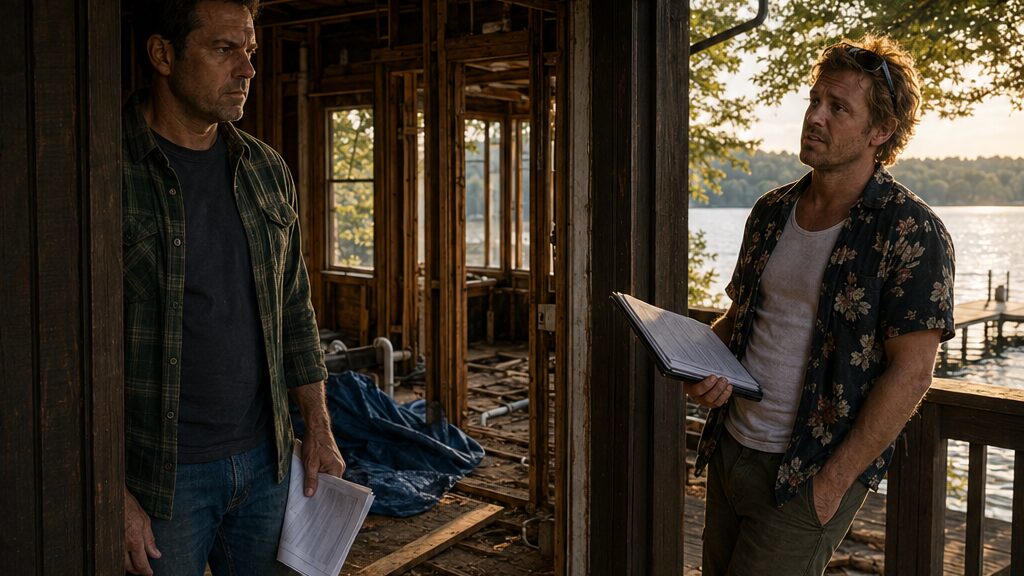
Jonathan Wright stood on the porch rail side of the doorway with one hand in his pocket and the lake shining behind him, asking for another eight thousand four hundred dollars while Christopher Young had exposed pipes over his shoulder and no kitchen wall behind his back.
For a moment, Christopher did not answer.
The cabin held its breath around him. The old pine floor ended where Jonathan’s crew had cut it open three weeks earlier. Bare studs ran along the kitchen like ribs. A blue tarp breathed in and out against the torn exterior section whenever wind came off the water. Where the sink had been, two copper pipes stuck out of the wall, capped and useless. The cabinet boxes were gone. The subfloor showed stains from the last rain that had pushed through the temporary covering.
Jonathan looked past him once, then looked away as if the room were somebody else’s problem.
“I told you,” Jonathan said. “Materials are locked until I release the balance. That’s how suppliers work now.”
Christopher kept the signed contract folded in his left hand. He had carried it all day, creasing it against his palm, waiting for Jonathan to show up after twelve unanswered calls. Now that the man was here, wearing a black floral shirt open over a white tank top, sunglasses pushed into his hair, Christopher felt a strange embarrassment before he felt anger. Jonathan looked like he had come from a boat. Christopher looked like he had spent the afternoon guarding a wound in the house.
“We paid the material draw already,” Christopher said.
Jonathan smiled without showing his teeth. “You paid the original draw. Things changed.”
“The contract says fixed price.”
“The contract was based on normal conditions.”
Christopher turned his head slightly, not enough to take his eyes off Jonathan, but enough to see the open room behind him. Normal conditions. That was what Jonathan called it now. Three weeks earlier, when storm water had run under the back wall and warped the cabinets, Jonathan had stood in this same doorway and said he could save the place before the next rain. He had tapped the jamb with his knuckles, confident and quick, telling Christopher he knew lake cabins, knew the moisture problems, knew how to rebuild without turning it into a six-month disaster.
Christopher had believed him because he had wanted to.
The cabin had taken years to become theirs. Weekend savings, careful repairs, secondhand furniture, Amy’s thrift-store dishes, the little table by the window where they ate breakfast when the lake was still gray. Christopher had promised Amy the storm damage would not swallow the whole thing. He had promised he would handle it.
Jonathan reached into the folder under his arm and slid out a sheet.
“I’m trying to keep your job moving,” he said. “But if you keep holding up payment, I can’t protect your place on the schedule.”
Christopher looked down at the page but did not take it.
The number was printed in bold near the bottom.
$8,400.00.
Below it, in smaller type, was a phrase he had not seen before: continuation installment.
“You’re calling this a continuation installment now?”
“That’s what it is.”
“It was a kitchen repair, wall reconstruction, subfloor replacement, and cabinet install. You took twelve thousand when we signed. Then another twelve when you said the cabinets and sheathing had to be ordered.”
“And they did.”
“Where are they?”
Jonathan’s eyes hardened for half a second, then eased back into the expression Christopher had come to recognize. Calm, but not honest. Patient, but only because patience cost him nothing.
“They’re not sitting on my truck, Christopher. This isn’t a grocery pickup.”
Christopher unfolded the contract. The paper fluttered once in the air coming through the opened wall.
“I’m going to ask this once,” he said. “Point to one thing in this room that matches what we already paid for.”
Jonathan gave a short laugh. “That’s not how construction works.”
Christopher stepped aside.
The gutted kitchen opened between them.
The sunlight from the lake cut across the bare studs. Dust lay on the floor where the crew had stopped sweeping. A broken strip of old backsplash leaned in the corner. The temporary plastic sheet over the exterior gap had come loose at one staple, and every few seconds it snapped softly against the frame.
“Point to one thing,” Christopher said again.
Jonathan did not look into the room long enough to choose.
“You’re emotional,” he said.
Christopher almost laughed. The word landed softer than an insult and worse than one. Emotional. As if the missing wall were a mood. As if twenty-four thousand dollars had left because Christopher had failed to stay calm.
He pulled out his phone and opened the photos. The first was dated twenty-one days earlier, taken the afternoon Jonathan’s crew finished demolition. The second was from that morning. Same studs. Same pipes. Same old dust shape below the window.
Christopher held the phone up beside the room.
“Tell me what changed.”
Jonathan’s jaw shifted.
The lake behind him looked too peaceful. A boat moved far out, trailing a white line through the water. Somewhere downshore, someone laughed. That made Christopher angrier than he wanted it to. The rest of the world was still having its weekend.
Jonathan lowered his voice. “You don’t want to turn this into a fight.”
“It became a fight when you asked me to pay for materials twice.”
“No,” Jonathan said. “It becomes a fight when you stop payment, interfere with my schedule, and then try to accuse me of theft because you don’t understand delays.”
Christopher heard the word theft and realized Jonathan had supplied it himself.
“I didn’t say theft.”
“You’re implying it.”
“I’m asking for receipts.”
Jonathan took a breath through his nose. For the first time since arriving, his casualness thinned. Underneath was something tighter, restless.
“I can get you receipts when the supplier releases the order.”
“The order you said was already paid for.”
“The order that can’t move until the account is current.”
Christopher looked at the paper again. “The account is current under the contract you signed.”
Jonathan’s face went still.
For years, Christopher had avoided scenes like this. He hated arguing with mechanics, clerks, managers, anyone who spoke like they knew the rules of a world he didn’t. He would pay a little more to leave. Apologize for asking. Tell himself it wasn’t worth making it worse.
That habit stood beside him now, as real as another person in the doorway. It wanted him to take the invoice, ask for a few days, shut the door, and figure out how to explain to Amy later.
Instead, Christopher folded the contract once and held it against his thigh.
“I’m not paying this today.”
Jonathan’s smile did not return. “Then you’re delaying the job.”
“The job has been delayed for three weeks.”
“By supply issues.”
“Show me the supplier.”
Jonathan tucked the invoice back under his thumb, then changed his mind and placed it on the porch rail between them. The paper lifted at one corner in the breeze.
“You have until Friday,” he said.
Christopher did not pick it up.
Jonathan stepped backward toward the stairs, then stopped as if remembering something useful.
“And Christopher? If you keep refusing to release payment, I’ll file a lien. I don’t like doing that, but I will protect my business.”
The word lien moved through the doorway and settled somewhere in the damaged room.
Christopher had heard the term, but only as a thing that happened to other people who did not pay their bills. He thought of the cabin deed in the small fireproof box at home. He thought of Amy’s face when he would have to tell her that the repair contractor was now threatening the property itself.
Jonathan walked down the steps with the easy balance of a man leaving someone else’s mess. At the bottom, he glanced once toward the dock, toward the water, toward anything except the exposed room.
The revised invoice stayed on the porch rail.
Christopher stood in the doorway until Jonathan’s truck started beyond the trees. Then he reached for the paper, and for one weak second, his hand shook so badly that he almost missed it.
At the bottom, beneath the bold number, Jonathan had written in blue ink:
Sign it by Friday, or I file.
Chapter 2: The Contract Said Fixed Price
Amy Garcia found the revised invoice before Christopher had decided how to tell her about it.
It was lying on the cabin table beneath a coffee mug he had not touched, the blue ink facing upward like it had been written for her. She stood over it in her work clothes, hair still clipped back from the drive, reading the number silently. Christopher had been outside trying to staple the loose tarp tighter against the exterior opening. When he came in, the staple gun was still in his hand.
Amy did not look up right away.
“Eight thousand four hundred,” she said.
Christopher set the staple gun down too carefully. “He says it’s to release materials.”
“He said that about the second payment.”
“Yes.”
“Christopher.”
One word, but it pulled the room smaller.
Behind her, the gutted kitchen looked worse in morning light. The damage had no drama now, no golden lake behind it, no confrontation to sharpen it. It was just their cabin missing pieces. A place where breakfast should have been was now a room of sawdust, pipes, plastic, and exposed decisions.
Amy picked up the invoice. “How much have we paid him?”
He had rehearsed a few versions. None of them survived her face.
“Twenty-four.”
“Twenty-four hundred?”
He did not answer quickly enough.
Amy lowered the invoice. “Christopher.”
“Twenty-four thousand.”
She closed her eyes for a second, and he hated that more than if she had yelled.
“The first twelve was the deposit,” he said. “The second was supposed to cover cabinets, exterior sheathing, subfloor materials, plumbing rough-in supplies. He said if we waited, we’d lose the order window.”
“And you didn’t tell me?”
“I thought it was handled.”
“That’s not what I asked.”
He looked at the table because the contract was there, spread beside the invoice like it could defend him if he arranged it correctly. Fixed price. Scope of work. Payment schedule. Jonathan Wright’s signature at the bottom, confident and slanted.
“I didn’t want you worrying before there was a reason.”
Amy gave a small, humorless laugh. “The kitchen has no wall.”
“I know.”
“Do you?”
The question did not sound cruel. It sounded tired. That made it worse.
Christopher opened his phone and started laying out what he had: the contract, bank confirmations, text messages, photos from the day demolition ended, photos from that morning. Amy sat across from him and pulled the material list closer. She used a pen from her purse to underline each item that should have existed somewhere in the room.
Cabinet boxes. None.
Back wall sheathing. None.
Subfloor panels. None.
Copper pipe and shutoff assemblies. Maybe some caps, but not what the list described.
Moisture barrier. None.
Exterior trim. None.
“Call the bank,” she said.
“I don’t think they can reverse it.”
“Call them anyway.”
He called from the table with the speaker low. The bank representative was polite in the way people were polite when they already knew their answer would disappoint you. The first payment had cleared weeks ago. The second had cleared nine days earlier. Because Christopher had authorized both transactions, the bank could open a dispute record, but they could not promise recovery.
“Do you have invoices proving the goods or services were not provided?” the representative asked.
Christopher looked at the room.
“I have the room,” he said.
“I understand, sir. Documentation will help.”
After the call, Amy drove with him to the hardware store printed on one of Jonathan’s earlier text messages. It was twenty minutes inland, a big metal building that smelled like lumber, fertilizer, and hot dust. Christopher showed the employee Jonathan’s company name, the material list, and the dates Jonathan claimed the order had been placed.
The employee typed carefully. Then typed again.
“Could be under another name,” the employee said.
“Try Wright Renovation,” Christopher said. “Jonathan Wright. Maybe lake cabin job.”
More typing.
Amy stood beside Christopher, arms folded, her face unreadable.
The employee frowned at the screen. “I’ve got a small purchase six weeks ago under Wright. Fasteners, blades, contractor bags. Nothing like cabinets. No sheathing order. No special-order kitchen materials.”
Christopher felt something open under his ribs. Not relief. Not yet. A fact. One clean fact.
“Could it be at another branch?”
“Sure. But not through this account.” The employee glanced toward the back of the store, then lowered his voice. “And if he told you it was locked here waiting on payment, I can tell you it isn’t.”
Amy’s hand tightened around the folded material list.
On the drive back, she did not speak for several miles. The road followed the lake through trees and cabin signs, past mailboxes shaped like fish, past old docks and new decks. Christopher kept both hands on the wheel.
“I should have told you before I paid the second draw,” he said.
“Yes,” Amy said.
“I thought if I questioned him, he’d walk off the job.”
“He walked off anyway.”
That landed quietly and stayed.
Back at the cabin, Christopher laid the contract and photos on the table again. Amy took pictures of the documents with her own phone, then made him forward every text from Jonathan. She was not angry in a loud way. That would have been easier. She became exact. Dates. Amounts. Promises. Screenshots.
He watched her build a folder, and shame moved through him like heat.
“I was trying to fix it before you saw how bad it got,” he said.
Amy looked up from her phone. “This is our cabin, not your mistake to hide.”
He nodded, but the nod did not undo anything.
Near evening, Christopher drove back to the hardware store alone because he realized he had forgotten to ask for a printed note or anything that showed the search had happened. The same employee was near the contractor desk, stacking order slips.
“I can’t give you private account records,” the employee said before Christopher asked. “But I can print a statement that there’s no order under your name and no special-order materials matching that job number, if that helps.”
“It does.”
The employee hesitated after printing it.
Christopher folded the page. “What?”
The employee glanced toward the store entrance, then back at him. “You’re not the first person to ask about him.”
Christopher’s grip tightened on the paper.
“Who else?”
“I can’t give names.” The employee looked uncomfortable now, as if he regretted speaking. “But if you’re dealing with Jonathan Wright, start saving everything.”
Chapter 3: The Neighbor Who Recommended Him
Donald Carter still had Jonathan Wright’s business card in an old drawer by his porch door, but the address printed beneath the logo was not the address on Christopher’s contract.
Christopher stood with the card between his fingers while Donald stared at it like it had crawled out of the drawer by itself.
“That’s an older one,” Donald said.
“The license number’s the same.”
“Contractors change offices all the time.”
“The contract says Rock Mill Road. This says Cedar Basin.”
Donald reached for the card, then stopped short of taking it. His porch looked over a narrow bend of the lake where the water ran darker under the trees. Two fishing rods leaned against the railing. Half of his dock had newer boards than the other half, the color mismatch obvious once Christopher noticed it.
“You told me he was reliable,” Christopher said.
Donald looked toward the dock. “He did work for people around here.”
“That’s not the same thing.”
“I didn’t know he’d do this to you.”
The sentence came too fast.
Christopher had not meant to come at him hard. He had walked down the lake road that morning with the printed hardware store statement folded in his pocket and a plan to ask calm questions. But the card, the different address, the way Donald’s face changed when the drawer opened—it all pressed against the part of him that had stayed polite with Jonathan for too long.
“What did he do for you?”
Donald rubbed his thumb along the porch railing. “Dock repair. Some boards. A brace. Nothing like your kitchen.”
“Did he finish?”
Donald’s mouth tightened.
The answer was in the pause.
“Mostly.”
“Donald.”
“He got in over his head,” Donald said, sharper now. “That happens. Storm season hit everybody at once. Materials were backed up. Crews were short.”
Christopher heard the phrase as if Jonathan had spoken it through him.
“Materials delayed,” Christopher said.
Donald looked at him.
“That’s what he told you?”
Donald’s shoulders dropped a little. “Something like that.”
The lake road was quiet except for a mower somewhere beyond the trees. Christopher could see his own cabin roof through gaps in the shoreline, the blue tarp on the back wall barely visible from this angle. From here, it might have looked like a normal repair. From here, people could still pretend.
“How much did you pay him?”
Donald gave a small laugh that held no humor. “Not twenty-four thousand, if that’s what you’re asking.”
“How much?”
“Enough.”
Christopher put the card on the porch table. “Why did you recommend him?”
Donald’s face reddened under the sun. “Because he showed up when other contractors wouldn’t. Because he talks like he knows what he’s doing. Because he fixed enough of my dock that I thought maybe the rest was just delays.”
“Did he ask you for more money?”
Donald looked away again.
Christopher sat down in the chair opposite him without being invited. The porch boards creaked.
Donald exhaled. “He said the lumber price changed. Said if I wanted marine-grade boards instead of standard, he needed the difference. I paid some of it.”
“And then?”
“He came twice after that.”
“Twice.”
“He had a guy with him. They replaced part of the walkway.”
Christopher looked at the mismatched boards again. The newer section ended before the far corner, where one support still sagged slightly toward the water.
Donald followed his gaze. “It’s safe enough.”
“That’s not what I asked.”
Donald’s jaw worked. For a moment, Christopher saw not a liar but a man cornered by his own embarrassment. Donald had built his life on the lake as the person who knew people: who to call for septic, who sold good firewood, who plowed driveways before dawn. Recommending Jonathan had not only cost money. It had threatened the small authority Donald carried around like a tool belt.
“I didn’t want to start something I couldn’t finish,” Donald said finally. “And I didn’t want to tell folks I’d been taken.”
The words loosened something in Christopher and tightened something else.
“So you passed him to me.”
Donald flinched. “I thought your job would be different.”
“Why?”
“Because yours was bigger.”
Christopher stared at him.
Donald heard himself then. He looked down at his hands. “That came out wrong.”
“No,” Christopher said. “It came out clear.”
He stood before anger made him say more than he needed to. At the porch steps, Donald called after him.
“Chris.”
Christopher stopped but did not turn.
“He said the same thing to me about lien rights,” Donald said quietly. “Not officially. Just enough to make me think he could make trouble if I pushed.”
Christopher turned then.
Donald swallowed. “I should have told you that.”
“Yes,” Christopher said. “You should have.”
He walked back along the lake road with Jonathan’s old business card in one pocket and the hardware store statement in the other. The trees threw broken shade over the gravel. At his own cabin, the tarp snapped against the exposed wall in the wind, a flat, impatient sound.
Inside, Amy had taped plastic over the kitchen opening again. It made the room look temporary in a way that hurt to see. Temporary meant it would end. None of this felt like it knew how to end.
Christopher sat at the table and opened the state licensing lookup on his phone. He typed Jonathan’s name first. Too many results, none clearly his. He typed the license number from the business card.
A record appeared.
Expired.
Christopher’s pulse moved into his throat.
He checked the category, then checked it again, slowly this time, reading each line until the words became impossible to soften.
The license number Jonathan had printed on his card had expired before Christopher ever signed the contract, and even when active, it had not covered the structural repair Jonathan sold him for the cabin wall.
Chapter 4: The License Number Came Back Expired
The county inspector would not step past the plastic sheet until Christopher moved the extension cord off the bare subfloor.
“Don’t touch that wall yet,” the inspector said.
Christopher froze with one hand on the plastic.
The inspector was standing in the kitchen opening, clipboard tucked under one arm, looking not at the missing cabinets or the exposed studs but at the capped pipes and the wiring looped too low across the open bay. His boots stayed on the old finished floor, as if crossing into the gutted half of the room required a kind of permission Christopher did not have.
“I was just going to show you where the back wall was opened,” Christopher said.
“I can see enough from here.”
Amy stood behind him near the table, arms crossed tight against herself. They had driven to the county office that morning with printed pages in a folder: contract, photos, the expired license lookup, the hardware store statement. The clerk had taken the documents carefully, asked whether any structural work had been performed, and then called someone from inspections. Christopher had expected a form, maybe a phone number. He had not expected a county truck in the driveway before lunch.
Now the inspector pointed with the end of his pen.
“Who capped those lines?”
“The contractor’s crew.”
“Was a plumbing permit pulled?”
Christopher looked at Amy. “He said permits weren’t needed for repair.”
The inspector’s eyes moved from the pipes to the open exterior section covered by tarp. “People say a lot of things when they don’t want paperwork.”
Christopher felt the paper folder under his arm grow heavier.
The inspector crouched near the edge of the torn subfloor, not stepping on it. He used his pen to point under the wall cavity where a strip of darkened wood ran behind the studs. “Was that here before?”
“I don’t know.”
“That’s a problem.”
“Water damage?”
“Maybe. Maybe old. Maybe made worse by opening the wall and not closing it properly.” The inspector stood. “But I’m not signing off on any continuation work with exposed conditions like this and no permit record.”
Amy’s face changed. “So we can’t fix it?”
“You can fix it,” he said. “But if you intend to file a complaint or claim damages, don’t cover anything until it’s documented. Photos from every angle. Dates. Measurements. Any materials on site. Any materials missing. Keep the room as it is until a qualified contractor evaluates it.”
Christopher stared at the gutted wall.
Keep the room as it is.
The room had been unbearable because it was unfinished. Now the unfinishedness had become evidence, and evidence had to remain visible. The tarp would keep snapping. The pipes would keep sticking out. The missing wall would keep proving something he did not want proved inside a place he had promised to protect.
The inspector wrote a note on his clipboard, then looked at the contract.
“This license number you brought in,” he said. “It doesn’t cover this work.”
“It expired,” Christopher said.
“That too. But even active, it wouldn’t cover structural reconstruction like this.”
Amy took a slow breath through her nose.
Christopher felt a hollow click inside him, another piece falling into place without making the picture cleaner. Jonathan had not merely failed to finish. He had sold authority he did not have.
“What happens now?” Christopher asked.
“You file your complaint with the licensing board. County can document what we see. If work was done without required permits, that becomes part of the record. But I’m going to be clear with you.” The inspector handed back the contract. “This doesn’t get your money back by itself.”
“I know.”
But he had not known. Not really. Some part of him had believed the expired license would make the situation obvious enough that someone would step in, make a call, order Jonathan to return the money and repair the cabin. The inspector’s bluntness stripped that away.
The clerk at the county office had been just as careful later, sliding forms through a glass window, showing Christopher where to attach documentation. She did not say he had a strong case. She did not say he would win. She said, “Make copies of everything,” and “Don’t submit originals unless requested,” and “If there’s a lien threat, keep the envelope.”
On the drive back, Amy held the folder on her lap.
“You’re quiet,” she said.
“I keep thinking one thing will be enough.”
“To stop him?”
“To prove I’m not making this up.”
Amy turned toward him. “Who are you proving that to?”
Christopher kept his eyes on the road.
Jonathan called before he could answer.
His name appeared on the dashboard screen. Christopher almost let it ring out. Then he thought of the clerk’s advice, tapped record on Amy’s phone, and answered through the car speaker.
“Christopher,” Jonathan said, voice smooth. “You’ve been busy.”
Christopher’s hands tightened on the wheel. “We went to the county.”
“Yeah, I heard.”
Amy looked sharply at the speaker.
Jonathan gave a small laugh. “Small place. People talk.”
“You did work that required permits.”
“I did demolition and prep. You stopped the job before the rest could be handled.”
“You stopped showing up.”
“You stopped releasing funds.”
Christopher could hear wind on Jonathan’s end, maybe from outside, maybe near the lake. He pictured him in that floral shirt, sunglasses in his hair, standing somewhere clean.
“The license number on your card is expired,” Christopher said.
Silence held for half a second.
“That old thing?” Jonathan said. “Christopher, you’re reaching.”
“It’s on the contract.”
“It’s administrative. You think every contractor keeps every number updated on every piece of paper? Come on.”
“The county says it doesn’t cover structural work.”
“The county always says something when homeowners go in there panicked.”
Amy’s mouth tightened.
Jonathan’s voice dropped. “You’re making this expensive for both of us.”
Christopher pulled into the cabin driveway and stopped. The blue tarp snapped at the back of the house, loud enough to hear through the closed windows.
“Is that a threat?”
“It’s reality. You file paperwork, this drags out. You bring another contractor in, they’ll tell you everything needs to be redone because that’s how they make money. You want the cabin fixed, I can fix it. But I’m not doing it while you accuse me and hold payment.”
“You already have twenty-four thousand dollars.”
“And I have costs.”
“Show them to me.”
Another pause.
“I’m sending you something,” Jonathan said. “Read it before Friday. If you want this job moving, sign it.”
The line went dead.
Christopher and Amy sat in the car without moving. A few seconds later, his phone buzzed.
A document arrived as an attachment.
Continuation Agreement.
Christopher opened it only far enough to see the first page. Jonathan Wright’s company name at the top. A space for Christopher’s signature near the bottom. Several dense paragraphs in between.
Amy leaned over.
“What is it?”
Christopher scrolled once, then stopped on a sentence that made the air in the car feel thinner.
Owner acknowledges prior site conditions and releases contractor from claims related to existing damage, delays, or incomplete access.
Christopher looked up at the cabin. The damaged room waited behind the plastic, unchanged because now it had to be.
Jonathan had not sent a plan to fix the kitchen.
He had sent a way to make Christopher sign away the damage.
Chapter 5: He Wanted The Waiver Signed First
Jonathan arrived on Friday with the continuation agreement clipped to a board, as if the problem had always been Christopher’s missing signature.
He came down the gravel path just after four, wearing the same sunglasses pushed into his hair and a clean short-sleeved shirt that looked too casual beside the torn-open cabin. Christopher watched him through the doorway. Behind Christopher, the kitchen remained stripped to studs and pipe. In front of him, the lake flashed gold through the trees.
Amy stood at the table with the original contract already open.
Jonathan noticed her first. His smile adjusted.
“Amy,” he said. “Glad you’re here. Maybe we can get this settled.”
She did not return the smile. “Settled or fixed?”
“Both, if everybody stays reasonable.”
Christopher stepped onto the porch but did not close the door behind him. He wanted the room visible. He wanted the open wall and the bare subfloor in the same frame as the paper Jonathan had brought.
Jonathan placed the clipboard on the porch rail, beside the revised invoice still creased from where Christopher had folded it into the evidence folder.
“The continuation agreement just clarifies scope after delay,” Jonathan said. “Standard protection. Gets the job restarted.”
Christopher looked at the first page. “The word damages appears nine times.”
“That’s normal.”
“The word refund doesn’t appear once.”
Jonathan’s expression cooled. “Because this isn’t a refund conversation. This is a finish-the-job conversation.”
Amy reached for the clipboard.
Jonathan’s hand moved slightly, as if to stop her, then he let it go.
She read in silence at first. The tarp snapped around the side of the cabin. Somewhere beyond the dock, water knocked softly against a float. Christopher kept his eyes on Jonathan, watching the little movements: the flex in his jaw, the impatient tap of one finger against his thigh, the quick glance toward the driveway whenever gravel sounded under the trees.
Amy turned a page.
Then another.
When she spoke, her voice was quiet. “This says we accept all prior work as satisfactory.”
Jonathan folded his arms. “It says you acknowledge existing site conditions.”
“No,” Amy said, turning the page toward Christopher. “It says we accept all prior work as satisfactory and release claims related to prior delays, damage, missing materials, and access disputes.”
Christopher took the page. There it was, hidden in the middle of a paragraph long enough to make most people stop reading.
Jonathan sighed. “You’re reading that like I’m trying to trick you.”
“Are you?” Amy asked.
He looked offended then, and for one strange second Christopher almost believed the offense was real.
“I have crews, suppliers, insurance, truck payments, fuel, people calling me every hour because storm season hit hard,” Jonathan said. “You think I wanted this job stalled? You think I enjoy coming out here to argue on a porch?”
Christopher said nothing.
Jonathan turned to him. “You hired me because nobody else could start fast. I started fast. Then conditions changed. That wall had more damage than expected. Your subfloor was worse. Material pricing moved. And instead of working with me, you went around town trying to build a case.”
“Did you order the cabinets?”
Jonathan blinked.
Christopher held up the hardware store statement. “Did you order them?”
“I told you, suppliers—”
“Not suppliers. You. Did you order them?”
Jonathan looked from the paper to Amy, then back at Christopher. “Not every order goes through that store.”
“Which store?”
“I don’t have to give you my entire vendor list.”
“You do if you billed me for materials.”
Jonathan’s face tightened. “Careful.”
There it was again. The small pressure. Not enough to sound like a threat if repeated to someone else. Enough to make Christopher feel the old urge to step back and smooth everything over.
Amy set the agreement down flat on the rail. “If this was just about finishing, the release wouldn’t be in here.”
Jonathan looked at her for longer than Christopher liked.
Then he said, “You both need to decide whether you want to be right or you want a kitchen.”
The words hit the exposed room behind them like a slap.
Christopher saw, in one sharp flash, the trap Jonathan had built. Pay more, sign away the past, maybe get partial work. Refuse, and the cabin stayed open while Jonathan framed him as the difficult homeowner. Either way, Christopher’s fear did the labor.
He picked up the continuation agreement, held it between both hands, and tore nothing. He did not crumple it. He did not perform anger for Jonathan’s benefit.
He laid it back on the rail.
“I’m not signing this.”
Jonathan stared at him.
“I’m not paying another dollar without receipts for the materials already billed. I’m not accepting prior work as satisfactory. I’m not releasing damages on a room you left open for three weeks.”
Jonathan’s mouth opened, then closed.
Christopher forced himself to add the part that felt hardest. “And I should have questioned this earlier. That’s on me. But my delay doesn’t make your invoice true.”
Amy looked at him then. Not relieved exactly. Not healed. But present with him in a way she had not been the day before.
Jonathan’s cheeks had gone faintly red.
“You’re making a mistake.”
“I already made one,” Christopher said. “I’m trying not to make another.”
Jonathan picked up the clipboard. The paper edges slapped once against the board.
“Fine. I’ll file the lien notice. I’ll also make it clear you refused access and refused continuation payment.”
“The room is open,” Christopher said. “You can see it from here.”
“And I can see a homeowner who doesn’t understand how construction works.”
Christopher stepped back into the doorway. “Then explain it in writing.”
Jonathan laughed once, short and hard. “You think paperwork fixes houses?”
“No,” Christopher said. “But it shows who broke their promise.”
For a second, neither man moved. The lake behind Jonathan gleamed through the trees. The gutted room behind Christopher smelled of raw wood, dust, and damp plastic. Between them, the porch rail held two versions of the truth: the original contract and the waiver Jonathan had wanted signed first.
Jonathan took the waiver and the revised invoice, but Christopher had already photographed both.
As Jonathan turned toward the steps, he looked back at Amy.
“You know,” he said, “the longer he drags this out, the more expensive that cabin gets.”
Amy’s face did not change. “Then he’s not the only one who should have thought about that.”
Jonathan left without answering.
Christopher waited until the truck disappeared before his legs understood they were allowed to weaken. He sat on the porch step, the phone still in his hand, the photo of the waiver bright on the screen.
Amy sat beside him.
“You did not apologize,” she said.
“I wanted to.”
“I know.”
The two words were not forgiveness, but they were close enough to make his chest hurt.
His phone buzzed before either of them stood. An unknown number. A voicemail notification appeared a moment later.
Christopher put it on speaker.
A woman’s voice came through low and careful, as if she had already looked over her shoulder before calling.
“This is Michelle Walker. Donald Carter gave me your number. If this is about Jonathan Wright, don’t sign anything. I mean it. Don’t sign a thing until you talk to me.”
Chapter 6: The Woman Who Stayed Silent
Michelle Walker opened the laundry room door only halfway at first, as if the unfinished space might embarrass her if it were seen all at once.
Christopher stood in the hall of her lake cottage with his hands at his sides, waiting. Amy had wanted to come, but Michelle had asked to meet him alone first. “It’s easier if I only have to be ashamed in front of one person,” she had said on the phone, and Christopher had understood too well to argue.
The door swung wider.
The room beyond had been frozen mid-demolition so long that dust had settled into the exposed floor seams like gray grout. A utility sink sat disconnected in the corner. Drywall was cut away behind the washer hookups. A stack of unopened tile boxes leaned against one wall, but the labels were for a bathroom, not a laundry room. In the center of the floor, a rolled moisture barrier still wore its shipping wrap, sun-faded at the edges.
Michelle did not step inside.
“He said the tile was temporary storage,” she said. “Said mine was coming.”
Christopher looked at the cut wall, the capped drain, the place where cabinets should have gone. It was smaller than his kitchen, less dramatic. Somehow that made it worse. A modest room, a practical job, the kind a person hired out because it was supposed to be manageable.
“How long?” he asked.
“Four months.”
The number sat between them.
Michelle gave a tight smile without humor. “After a while you stop saying ‘unfinished’ and start saying ‘closed off.’ It makes it sound like a choice.”
Christopher thought of the plastic sheet over his kitchen opening.
She led him back to the small dining table where a folder waited. The documents inside were arranged carefully: contract, check copies, texts, photos, a printed agreement with Jonathan’s company name at the top.
Christopher recognized the format before she turned it toward him.
Continuation Agreement.
“He sent this to you too,” Christopher said.
“After I asked why no materials had arrived.” Michelle tapped one paragraph with her finger. “That part about accepting prior work? Mine says almost the same thing.”
Christopher read it anyway. The wording was not identical, but the purpose was. Accept prior site conditions. Release contractor from delays, damages, or material shortages. Proceed under revised scope.
“Did you sign?”
“No.” She looked toward the laundry room. “But I almost did.”
“What stopped you?”
Michelle sat down slowly. “My sister read it. She said it sounded like I was agreeing that he hadn’t done anything wrong. I got angry at her for saying that.”
“Why?”
“Because if she was right, then I had let him do it to me.”
Christopher looked down at the folder.
Michelle watched his face. “That’s the part nobody tells you. The room is bad, the money is bad, but the worst part is realizing you helped him by trying not to look foolish.”
The words landed so directly that Christopher could not answer.
She turned over another page. “I paid him for a washer wall rebuild, cabinets, waterproof flooring, and plumbing corrections. He did demolition, capped a line, left, came back twice, then said materials were delayed. Same phrase Donald said he used with you.”
Christopher looked up. “Donald saw this?”
Michelle’s face closed a little.
“Michelle.”
She folded her hands on the table. “I showed Donald the photos two months ago.”
Christopher felt the room shift.
“He knew?”
“He knew I was upset. He knew Jonathan had not finished. I don’t know what he let himself know beyond that.”
“He recommended Jonathan to me after seeing your laundry room?”
Michelle looked tired now, not defensive. “Donald likes being the person who knows a guy. He also likes not being the person who brought trouble to the lake road. I think he convinced himself Jonathan had just messed up my job.”
“And his dock.”
Michelle nodded. “And his dock.”
Christopher sat back. The pattern did not arrive like lightning. It arrived like weight. Donald had not set out to harm him. That almost made it harder. Harm did not always need malice. Sometimes it needed one person staying quiet because the truth made them look small.
Michelle slid a photo across the table. “This is from the week after demolition.”
Then another. “This is six weeks later.”
The room looked nearly the same.
Christopher took out his phone and opened his own paired photos: his kitchen after demolition, his kitchen three weeks later. He placed the phone beside Michelle’s prints.
Two unfinished rooms. Two homes near the same lake. Two sets of dates pretending time had passed.
Michelle stared at them.
“That’s how he does it,” she said softly.
“What?”
“He doesn’t have to make the work look finished. He just has to make you feel like stopping him will make it worse.”
Christopher thought of Jonathan’s voice: You need to decide whether you want to be right or you want a kitchen.
Michelle gathered the papers, then hesitated before handing him copies.
“I don’t want my name dragged through the lake association,” she said. “I don’t want people asking why I waited, why I paid, why I didn’t know better.”
“I won’t use anything without asking.”
“I know.” Her eyes met his. “But that’s also what keeps him safe.”
The honesty in that cost her something. Christopher could see it.
He took the copies carefully. “I’m filing a complaint.”
“I figured.”
“Will you?”
Michelle looked toward the hallway. “I don’t know.”
He wanted to push. He wanted to tell her that if she stayed silent, Jonathan would keep doing it. The words rose hot and ready, then stopped against the memory of Amy’s face when she found the invoice. Christopher had hidden too. He had no right to ask courage from someone as if it were a bill due on demand.
So he said, “I didn’t tell Amy about the second payment until she found the invoice.”
Michelle’s expression softened with recognition.
“I’m not proud of that,” he said. “But I’m done letting him use it.”
Michelle looked at the copies between them for a long moment. Then she pulled one more page from the back of the folder and added it to his stack.
“What’s this?”
“Text from Jonathan after I refused the waiver. He said I was in breach because I denied access. He never came back after that.”
Christopher read the message.
The wording was close to what Jonathan had threatened him with.
Refused access. Delayed payment. Owner interference.
Not original. Practiced.
By the time Christopher returned to the cabin, evening had turned the lake dull silver. Amy was at the table, sorting photos into labeled envelopes. She looked up when he came in, and he placed Michelle’s copies beside his own.
“Same waiver,” he said.
Amy’s face tightened, but she did not look surprised.
Christopher was about to tell her about Donald when tires sounded on the gravel outside. For one startled second, he thought Jonathan had come back.
But it was a delivery driver at the steps with a certified envelope.
Christopher signed for it and stood under the porch light while Amy came up behind him.
The return address was from a filing service.
Inside was a preliminary lien notice from Jonathan Wright’s company, claiming unpaid continuation funds and owner-caused delay.
The date on it was Friday. The same day Christopher had refused to sign the waiver.
Chapter 7: The Photos Showed Nothing Changed
Jonathan’s written response arrived with Christopher’s name misspelled and the damage described as “owner-caused delay.”
Christopher read the sentence three times at the cabin table before the words settled into meaning. The preliminary lien notice lay beside it, clipped to the complaint packet from the county office. Amy stood across from him, sorting photographs into piles by date, but her hands stopped when he pushed the paper toward her.
She read silently.
Then she said, “He’s saying you stopped him from working.”
Christopher looked through the doorway at the gutted kitchen. The tarp had pulled loose again at one corner. The plastic sheet inside the room shivered every time wind moved across the lake.
“He was here Friday,” Christopher said. “He could have walked in.”
“He brought a waiver.”
“He’s calling that access.”
Amy placed the response beside the original contract, as if proximity might shame one of them into becoming true. “Then we show the dates.”
They spent the morning building a timeline across the cabin table. Contract signed. First payment. Demolition. Second payment. Jonathan’s texts about materials. The first date Christopher photographed the gutted room. The date three weeks later when the room looked almost exactly the same. The hardware store statement. The expired license lookup. Michelle’s waiver. Michelle’s photos. Donald’s business card with the different address.
The more they arranged, the less it felt like a rescue and the more it felt like admitting how long Christopher had let uncertainty protect Jonathan.
He almost removed the second payment confirmation from the stack before Amy saw him touch it.
“Leave it,” she said.
“I know.”
“You were going to move it.”
“I wasn’t going to hide it.”
She looked at him.
Christopher slid the paper back into the center pile. “I just hate how it looks.”
“It looks like you trusted him.”
“It looks like I paid him after he had already stopped showing up.”
“It looks like both.”
That was the part he had not wanted anyone to say in a room where he could hear it.
By noon, Steven Harris walked through the cabin door carrying a flashlight, moisture meter, and the expression of a man who had already decided not to soften bad news. He was broad-shouldered, gray at the temples, and wore work boots that he wiped twice on the mat before stepping in.
“I’m not here to fix anything today,” Steven said.
“I know,” Christopher said. “Just assessment.”
“Good. Because if there’s a complaint, you don’t want me tearing into evidence before pictures are done.”
The word evidence still sounded wrong inside the cabin. Evidence was for courtrooms, not places where Amy had once hung dish towels over the oven handle.
Steven stood at the edge of the gutted room and took in the exposed wall, the capped pipes, the floor cut, the tarp moving on the outside. He did not whistle. He did not curse. He went quiet in a way that made Christopher’s stomach tighten.
“Who opened the exterior wall?”
“Jonathan’s crew.”
“Did they flash the opening before they left?”
“They stapled the tarp.”
Steven looked at him.
Christopher felt heat rise in his face. “That’s what they left.”
Steven stepped closer, shining the flashlight behind the plastic and along the lower plate. “Take a picture of this before I touch it.”
Christopher lifted his phone.
Steven pointed to a dark line below the exposed framing. “Water’s been getting behind there. Not just against the tarp. Behind the old edge.”
Amy moved nearer. “Can it dry out?”
“Maybe. Maybe not without replacing more than he planned. But that’s not the worst part.”
Christopher lowered the phone. “What is?”
Steven reached toward a section of pipe, then stopped and used the flashlight instead. “See that coupling?”
Christopher saw copper, a cap, and a fitting he did not understand.
“It’s temporary work dressed like finished rough-in,” Steven said. “If someone closed that wall and tied the sink back in without correcting it, you could have a leak inside the wall cavity. Slow one. The kind you find when the floor starts softening.”
Amy put one hand against the table.
Christopher photographed the coupling. His fingers felt too large for the phone.
“So the room didn’t just stay unfinished,” he said.
Steven looked at him. “Some of what was done made the next repair harder.”
The sentence carried no drama. That made it worse.
For an hour, Steven moved through the damaged space with Christopher photographing every point he named: unsupported subfloor edge, improperly protected opening, questionable plumbing cap, cut sheathing left exposed under the tarp, missing moisture barrier, no visible delivered cabinets, no stacked subfloor panels, no new exterior trim, no material labels except scraps from demolition. Each photo became another small fact. None of them fixed the cabin.
When Steven finished, he stood by the table and wrote notes in block letters.
“I’ll give you a formal assessment,” he said. “But I’m not writing what I can’t stand behind. I can document what’s visible, what’s unsafe to cover, and what has to be corrected. I can’t tell you where your money went.”
“I know.”
Steven looked at him over the paper. “Do you?”
Christopher almost answered too quickly. Then he looked at Amy, at the photo piles, at the lien notice. “I’m learning.”
Steven’s bluntness eased by half an inch. “Good. Because the next contractor you hire should scare you a little with details. Not with threats. With details.”
After Steven left, Christopher sat alone in the gutted room for the first time since demolition. He did not step on the cut subfloor. He sat on an overturned bucket near the doorway, looking at the paired photos Amy had printed.
Photo one: the room after demolition.
Photo two: the room three weeks later.
Same open studs. Same missing cabinets. Same pipe caps. Same space where the back wall should have been secure.
Only one thing had changed. Christopher had gone from trying not to see it to arranging it in a folder.
His phone rang.
The small claims intake clerk confirmed their appointment and reminded him to bring copies for each party. “And if mediation is scheduled first,” the clerk said, “be prepared that both sides may present witnesses.”
“Witnesses?” Christopher asked.
“Anyone named by either side.”
That word followed him into the next morning.
Mediation was held in a county building that smelled faintly of paper, floor cleaner, and old coffee. Christopher arrived with Amy and a box of documents. Michelle had agreed to let him use copies of her waiver and photos if her name was handled carefully through the complaint process. Steven’s assessment was clipped on top of the inspection notes.
Jonathan was already in the hallway when they got there.
He wore a collared shirt this time. No sunglasses, no floral print. He looked more tired up close under fluorescent lights, and less casual, but not less certain. A folder rested under his arm. He saw Christopher’s box and gave a small shake of his head.
“You brought a scrapbook,” he said.
Christopher did not answer.
Jonathan opened his folder and handed a page to the clerk near the door. The clerk glanced at it, checked the appointment sheet, and said, “Your listed witness is here?”
Christopher looked up.
At the end of the hallway, Donald Carter stood beside a vending machine with his hands clasped in front of him. He would not meet Christopher’s eyes.
Jonathan looked back, and this time his smile did show teeth.
“I told you,” he said softly. “People around here know how difficult this job got.”
Chapter 8: The Doorway Was Bright When He Returned
Jonathan told the mediator that Christopher had changed his mind after the work got hard, and Christopher opened the photo folder before the sentence was finished.
He did not interrupt. He did not raise his voice. He slid the first pair of photographs onto the table and turned them so the mediator could see the dates.
“This one is the day demolition ended,” Christopher said. “This one is three weeks later.”
The mediator, a gray-haired woman with reading glasses low on her nose, leaned forward. Her finger moved from one date stamp to the other, then across the exposed studs, the capped pipes, the missing cabinets, the same torn edge of subfloor.
Jonathan shifted in his chair. “Pictures don’t show schedule interruptions.”
“No,” Christopher said. “They show what was there after I paid for materials.”
Amy sat beside him, hands folded over a copy of the contract. Michelle was not in the room, but her documents were. Steven’s assessment was. The hardware store statement was. The expired license lookup was. Christopher had spent the night before arranging everything until the story no longer depended on outrage. It could stand on dates.
Jonathan leaned forward. “The homeowner refused continuation payment. He refused the agreement necessary to restart. He denied access after creating a hostile environment on site.”
The word hostile touched something old in Christopher, the same place emotional had. Words that made resistance sound unreasonable. Words that asked him to shrink.
He placed the continuation agreement beside the contract.
“This is what he asked me to sign before restarting.”
The mediator read the highlighted paragraph. Her expression did not change much, but she read it twice.
Jonathan cleared his throat. “Standard liability language.”
Amy slid Michelle’s agreement forward. “Then why did another homeowner receive almost the same language after asking about missing materials?”
Jonathan looked at the page.
For the first time that morning, his face lost its prepared shape.
“That’s unrelated,” he said.
The mediator looked at Christopher. “Who is the other homeowner?”
“She provided documents for the licensing complaint,” Christopher said. “She did not want to appear today, but the pattern is part of the complaint packet.”
Jonathan’s voice hardened. “So now we’re bringing in gossip.”
Christopher felt Amy tense beside him. He kept his eyes on the mediator.
“I’m bringing in documents.”
The mediator turned to the next page. “There is also an assessment from a licensed contractor.”
Steven’s notes were not dramatic. They were worse than dramatic. They were plain. Exposed opening improperly protected. Plumbing rough-in not suitable for enclosure. Possible water intrusion after demolition. Material list items not observed on site. Additional corrective work required before completion.
Jonathan leaned back. “Of course another contractor says it needs rework. That’s how he gets the job.”
Christopher looked at him then. “He told me he couldn’t fix anything until it was documented. That’s why the room stayed open longer.”
Jonathan’s jaw tightened. “Because you chose process over progress.”
“No,” Christopher said. “You offered progress only if I released you from the damage.”
The room went quiet enough for the air vent to become loud.
The mediator made a note, then looked toward the door. “Mr. Carter?”
Donald entered as if the floor had become uncertain under him. He did not sit immediately. He looked at Jonathan first, then at Christopher, then at the documents spread across the table.
Jonathan’s voice softened. “Donald can explain I was recommended in good faith. He knows I’ve done work in the area.”
Donald lowered himself into the chair. His hands were rough, knuckles enlarged from years of lake repairs and winter work. He stared at them.
“Mr. Carter,” the mediator said, “did you recommend Mr. Wright to Mr. Young?”
Donald swallowed. “Yes.”
“Based on your own experience?”
“Yes.”
Jonathan gave a small nod, as if the matter were moving back into place.
The mediator asked, “Was your own work completed?”
Donald’s eyes closed briefly.
Jonathan turned his head. “Donald.”
Donald opened his eyes and looked at Christopher. There was shame in his face, but not only shame. There was the exhaustion of holding a door shut too long.
“He told me the same thing about materials,” Donald said.
Jonathan went still.
Donald kept going before he could lose nerve. “On my dock. Said lumber was delayed, then said price changed. I paid more. He came back a couple times, did part of it, left part unfinished. I told myself it was safe enough.”
The mediator wrote slowly.
Jonathan’s voice was low. “That’s not what you told me you were coming here to say.”
Donald looked at him. “I know.”
“Donald,” Jonathan said, warning inside the name.
Donald flinched, but he did not stop. “Michelle showed me her laundry room before Christopher ever hired him. I knew there’d been trouble. I didn’t want to admit I’d recommended a man who’d done that kind of work.”
Christopher felt the words hit the table and spread through every document on it.
That was the truth deeper than the license number, deeper than the missing cabinets. Jonathan had not needed everyone to lie for him. He had only needed them to stay embarrassed separately.
The mediator folded her hands. “We are not here to decide the licensing complaint today. But the complaint packet, the documented scope, the condition photos, and these repeated agreement terms are relevant to settlement.”
Jonathan’s face had gone flat. Not defeated. Calculating.
In the end, the settlement was not clean enough to feel like victory. Jonathan agreed to withdraw the lien notice, refund part of the second payment through a structured plan, provide written acknowledgment that no cabinet materials had been delivered to the site, and cooperate with the licensing board’s review. The mediator made no promises about collection if he failed to pay. The licensing board would proceed on its own timeline. The county records would remain part of the complaint.
Christopher signed only after reading every line twice.
Outside the building, Jonathan walked past him without the easy lakefront smile. At the door, he stopped.
“You still won’t have a kitchen for a while,” he said.
Christopher looked at him. “I know.”
That answer seemed to irritate Jonathan more than an argument would have.
Weeks later, Steven removed the first unsafe board from the cabin wall while morning light filled the doorway.
Christopher stood where he had stood the day Jonathan asked for more money, but the room behind him no longer felt like an accusation he had to hide. The gutted wall was still there. The pipes were still exposed. The repair would cost more than the refund covered. Amy had already moved money from another account, and some plans for the year had quietly disappeared.
But the tarp was gone. Proper sheathing waited stacked near the table. Steven had marked studs in pencil and explained each step before touching anything. No promises without details. No urgency used as a weapon.
Amy came up beside Christopher with two cups of coffee. She handed him one and looked through the open doorway toward the lake.
“Still hurts to look at,” she said.
“Yes.”
“But it looks different.”
Christopher watched Steven pry loose a damaged strip Jonathan’s crew had left behind. The board came free with a dry crack. Under it, the hidden dark line of water damage showed clearly in the light.
“It’s honest now,” Christopher said.
Amy leaned her shoulder lightly against his.
Across the lake road, Donald stood at the edge of his own half-repaired dock, phone in hand, speaking to someone Christopher could not hear. Michelle had filed her complaint two days after mediation. Donald had given a statement the day after that.
The cabin was not saved all at once. It would not return the money, the sleep, or the easy trust Christopher had spent before he knew its value. But as Steven carried the unsafe board out through the bright doorway, Christopher did not step aside to hide the room.
He stood there and let the work begin where the damage had been visible all along.
The story has ended.