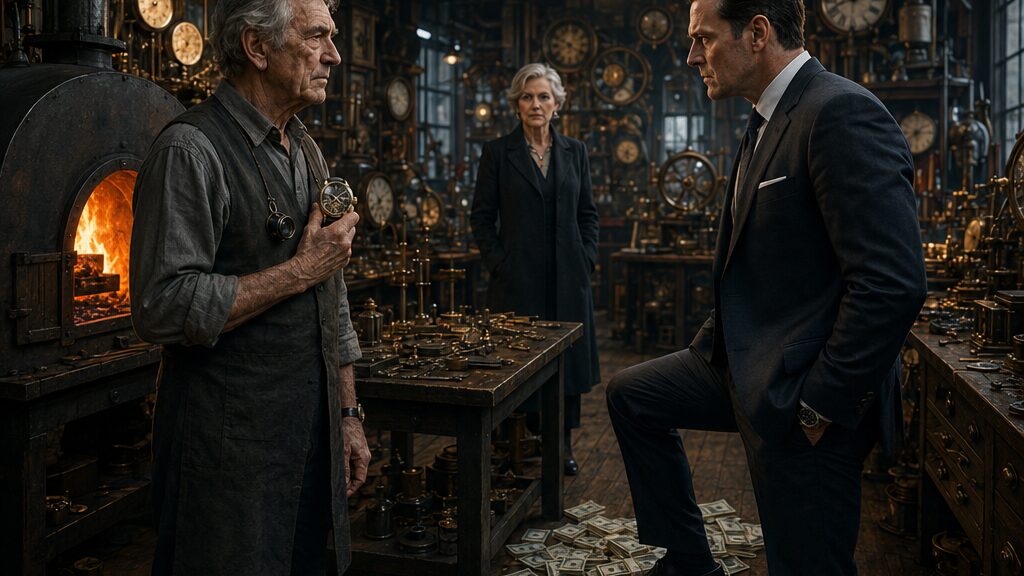
The Day the Last Tourbillon Stopped Ticking and a Tycoon Lost Everything He Thought Money Could Buy
Chapter 1: The Watch That Refused Every Buyer
“No.”
James Hall did not raise his voice. He never needed to.
The man across the workbench blinked as if he had misheard.
“Mr. Hall, that’s eight million dollars.”
“No.”
The collector stared at the watch resting beneath the magnifying lamp. Hundreds of tiny polished gears moved in perfect harmony beneath the sapphire crystal. The exposed tourbillon rotated with slow, hypnotic precision.
Tick.
Tick.
Tick.
The sound was barely audible, but in the silent workshop it seemed louder than a clock tower.
The collector swallowed.
“Then ten million.”
James returned his attention to the movement.
His fingers, bent by decades of labor, adjusted a component thinner than a fingernail clipping.
The collector waited.
Nothing.
Finally he shook his head.
“I don’t understand you.”
Most people didn’t.
The workshop sat at the end of a narrow street that had somehow escaped modernization. Luxury towers had swallowed almost every neighboring block. Glass and steel surrounded the old brick building like predators circling wounded prey.
Inside, however, time moved differently.
Every wall held clocks.
Every shelf carried gears.
Every drawer contained decades of unfinished ideas.
The collector stared at the Tourbillon one final time.
“What are you waiting for?”
James tightened a screw.
“Completion.”
The collector frowned.
“It looks complete.”
James finally looked up.
“No.”
The answer ended the conversation.
A few minutes later the collector left.
The door closed.
Silence returned.
Tick.
Tick.
Tick.
James sat alone with the watch.
He should have felt satisfaction.
Instead he felt pressure.
The offers had become larger every year.
Five million.
Seven million.
Ten million.
The numbers meant nothing anymore.
The watch remained unfinished.
That was all that mattered.
A bell above the door rang again.
This time it was Charles Baker.
Charles entered carrying coffee and impatience.
“You turned down another one.”
James nodded.
“You know,” Charles said, setting down the cup, “most people retire before eighty.”
“I’m not most people.”
“No argument there.”
Charles looked at the Tourbillon.
Like everyone else, he could not stop himself.
The watch seemed alive.
Every gear had been handmade.
Every bridge polished by hand.
Every imperfection removed through years of repetition.
Charles had once spent six months helping James polish a single component.
Six months.
For a part nobody would ever see.
At the time he had thought his teacher was insane.
Now he wasn’t entirely sure he had been wrong.
“Ten million?” Charles guessed.
James said nothing.
Charles laughed.
“That means more.”
He leaned against the bench.
“You know what people say?”
“I try not to.”
“They say you’re protecting the watch because you’re planning to sell it after you die.”
James frowned.
“After I die, it won’t matter.”
Charles studied him.
The old man always said things like that.
Simple sentences.
Heavy meanings.
Impossible to argue with.
The ticking continued.
Charles finally sighed.
“You could save the workshop.”
James looked around.
Dust.
Tools.
Wood.
Metal.
Memories.
“The workshop isn’t dying.”
“The city says otherwise.”
That caught James’s attention.
Charles immediately regretted speaking.
The old man hated rumors.
Unfortunately this one wasn’t merely a rumor.
Charles pulled out his phone.
A headline appeared.
PROPERTY ACQUISITION EXPANDS DOWNTOWN REDEVELOPMENT PROJECT
James took the phone.
His eyes moved slowly.
The redevelopment company had purchased three more blocks.
One of them sat directly behind the workshop.
The fourth block remained unlisted.
Their block.
James handed the phone back.
“They’ve been trying for years.”
“This time feels different.”
James returned to work.
Conversation finished.
At least for him.
Charles watched him.
The stubbornness would have been admirable if it weren’t so frustrating.
“You should prepare.”
“For what?”
“For losing.”
The ticking seemed louder.
James set down his tools.
For a moment Charles thought he had finally broken through.
Instead James asked a different question.
“Do you remember your first day here?”
Charles blinked.
“What?”
“Your first day.”
“Of course.”
“You wanted shortcuts.”
Charles groaned.
“I was twenty.”
“You wanted to finish watches quickly.”
“Because customers wanted them quickly.”
“And what did I tell you?”
Charles sighed.
“That time enters the work.”
James nodded.
The answer mattered.
The old lesson still mattered.
Then he returned to work.
Conversation over again.
Charles left an hour later.
Outside, evening shadows stretched across the street.
The workshop remained lit.
The old man remained at the bench.
The ticking remained constant.
Three days passed.
Then another offer arrived.
Then another.
Each larger than the last.
Each rejected.
The city buzzed with speculation.
Journalists called.
Collectors visited.
Investors sent representatives.
Everyone wanted the watch.
Nobody understood why.
Then the letters began arriving.
Official letters.
Acquisition notices.
Property surveys.
Development requests.
The pressure was no longer distant.
It was standing at the front gate.
One afternoon a survey team appeared outside.
They measured sidewalks.
Photographed walls.
Marked utility lines.
James watched through the window.
Tick.
Tick.
Tick.
The watch continued.
The team left before sunset.
Hours later Charles arrived carrying fresh paperwork.
His expression alone told James enough.
“It’s official.”
James accepted the envelope.
The document confirmed what everyone already suspected.
The surrounding properties had been sold.
Their block stood alone.
An island.
A target.
At the bottom sat a familiar name.
Gary Mitchell.
Charles pointed to it.
“He’s buying everything.”
James recognized the name.
Everyone did.
Hotels.
Office towers.
Luxury districts.
Entire neighborhoods.
Gary Mitchell purchased cities the way other people purchased shoes.
James folded the document.
Nothing changed in his expression.
But something shifted behind his eyes.
Not fear.
Calculation.
For the first time in years, the future felt uncertain.
That evening he worked later than usual.
The Tourbillon rested beneath the lamp.
The final adjustments remained unfinished.
Its ticking filled the workshop.
Steady.
Patient.
Alive.
Near midnight a vehicle stopped outside.
Not unusual.
Then a second vehicle arrived.
Then a third.
James looked through the front window.
Black cars.
Expensive.
Purposeful.
A man stepped out.
Tall.
Perfect suit.
Perfect confidence.
The sort of confidence money often mistook for permanence.
He approached the workshop door.
The bell rang.
James recognized him immediately from newspapers.
Gary Mitchell.
The tycoon paused at the threshold.
His eyes went straight to the watch.
Then he smiled.
Not with admiration.
With possession.
As if he were already deciding where it would belong.
And that smile told James something far more important than the property documents ever could.
Gary Mitchell had not come for the building.
He had come for the watch.
Chapter 2: The Man Who Bought the Ground
Gary Mitchell entered with three lawyers.
The lawyers looked at contracts.
Gary looked only at the Tourbillon.
His gaze never left it.
Not even when one of the attorneys cleared his throat.
“Mr. Hall, thank you for meeting us.”
James remained seated.
“I didn’t agree to a meeting.”
The lawyer forced a smile.
Gary chuckled.
“I like him.”
The tycoon stepped closer.
The watch reflected in his eyes.
Not wonder.
Not appreciation.
Calculation.
Everything about Gary seemed measured.
The suit.
The watch on his wrist.
The polished shoes.
The carefully controlled smile.
He looked like a man who had spent a lifetime proving he belonged in rooms that once excluded him.
“You know who I am?” Gary asked.
“Yes.”
“Then you know why I’m here.”
James looked at him.
“No.”
Gary laughed again.
The lawyers didn’t.
“We’ve acquired the surrounding properties,” one attorney explained. “We’re discussing redevelopment opportunities.”
“Then discuss them.”
The attorney hesitated.
Gary stepped forward.
“You own the last piece.”
“The workshop.”
“The land.”
James said nothing.
The distinction mattered to him.
Not to Gary.
The tycoon walked slowly around the room.
His eyes moved across tools, cabinets, clocks, and workstations.
The workshop fascinated him.
Not because he loved it.
Because he wanted to own it.
“Do you know what’s interesting?” Gary asked.
James continued working.
“No.”
“Everyone talks about the watch.”
The Tourbillon ticked softly between them.
Gary leaned closer.
“They call it priceless.”
James adjusted a gear.
“No such thing.”
Gary smiled.
“There it is.”
“There what is?”
“The story.”
He spread his hands dramatically.
“The mysterious old craftsman who rejects every offer.”
One lawyer nodded.
Clearly he had heard the speech before.
Gary continued.
“People love stories.”
“I’m making a watch.”
“No. You’re making a legend.”
The ticking continued.
Gary stared at the movement beneath the crystal.
For a moment something genuine crossed his face.
Admiration.
Then it disappeared.
Replaced by ambition.
“I want it.”
James looked up.
“No.”
The answer arrived instantly.
Gary seemed amused rather than offended.
“Name a number.”
“No.”
“Twenty million.”
“No.”
One of the lawyers shifted uncomfortably.
The negotiations were apparently moving faster than expected.
Gary smiled.
“You don’t even hesitate.”
“I already have.”
That answer confused him.
James returned to work.
“I spent years deciding.”
Silence followed.
For the first time Gary appeared genuinely curious.
“What makes it different?”
James said nothing.
The silence returned.
And once again it created more frustration than any argument could have.
An hour later Charles arrived.
The moment he entered, he understood something was wrong.
The lawyers.
The paperwork.
Gary Mitchell standing beside the workbench.
Charles froze.
Gary noticed him.
“Former apprentice?”
Charles nodded cautiously.
Gary extended a hand.
“Gary Mitchell.”
Everyone knew that.
Charles shook it anyway.
The grip was firm.
Practiced.
Winning.
Gary immediately liked him more than he liked James.
Charles looked like someone who understood numbers.
Compromise.
Reality.
The things Gary respected.
“You worked here long?”
“Twelve years.”
“Then explain something.”
Charles already disliked the direction of the conversation.
Gary pointed toward the Tourbillon.
“Why doesn’t he sell?”
Charles glanced at James.
The old man ignored them.
Finally Charles answered honestly.
“Because it’s important to him.”
Gary laughed.
“Everything’s important until the right price appears.”
Charles didn’t answer.
Because once, years ago, he had believed the same thing.
Gary turned back toward James.
“You’re sitting on a fortune.”
“No.”
“Then what am I looking at?”
James carefully positioned another gear.
“My final watch.”
Something changed.
Only slightly.
But Charles noticed.
The word final carried weight.
Gary noticed too.
“Your last one?”
James nodded.
The room grew quieter.
Even Gary seemed thoughtful.
Then ambition returned.
“Then it’s worth even more.”
The moment vanished.
Charles looked away.
That response bothered him.
More than it should have.
Gary spent another hour touring the workshop.
As he moved through the building, his questions revealed something unexpected.
He wasn’t interested in craftsmanship.
He was interested in legitimacy.
Museum partnerships.
Luxury branding.
Collector networks.
Cultural influence.
The workshop was not merely real estate.
It was a shortcut.
A door.
A symbol.
When he returned to the main room, his confidence seemed sharper.
“I have an idea.”
Nobody responded.
Gary continued anyway.
“We preserve the workshop.”
Charles blinked.
James remained silent.
“We renovate it. Build a museum. Public tours. Global publicity.”
The proposal sounded reasonable.
Until Gary reached the important part.
“The Tourbillon becomes the centerpiece.”
His smile widened.
“My company logo alongside yours.”
The workshop suddenly felt colder.
Even Charles stiffened.
James slowly raised his eyes.
“No.”
The answer carried more force this time.
Gary’s smile weakened.
“Why not?”
“Because it isn’t yours.”
“You said you won’t sell.”
“I won’t.”
“I own the property.”
“You own the ground.”
The distinction returned.
Gary’s expression hardened.
For the first time irritation appeared.
A small crack beneath the polished confidence.
One lawyer stepped forward.
“Mr. Hall, redevelopment plans may affect occupancy rights.”
There it was.
The threat.
Professional.
Legal.
Clean.
But a threat nonetheless.
Charles felt his stomach tighten.
Gary looked almost disappointed.
As if he preferred admiration to resistance.
“You don’t understand,” Gary said quietly.
“I understand.”
“No.”
His voice sharpened.
“I built everything I have.”
James met his gaze.
“So did I.”
The silence that followed felt dangerous.
Gary finally smiled again.
But this smile looked different.
Less friendly.
More determined.
He reached into his jacket.
The lawyers immediately straightened.
A prepared document appeared.
Then another.
Then a final page.
Gary placed them on the workbench beside the Tourbillon.
A number sat at the bottom.
Charles stared.
His breath caught.
The offer was absurd.
Enough money to buy buildings.
Enough money to retire generations.
Enough money to save the workshop forever.
Gary tapped the paper.
“You’ll never see a larger offer.”
The ticking filled the room.
James looked at the number.
Then at the watch.
Then at Gary.
“No.”
The smile disappeared completely.
Chapter 3: Every Price Has a Limit
By morning, half the city knew about the offer.
By afternoon, most of the city knew James had rejected it.
By evening, people were calling him a fool.
The criticism arrived from every direction.
Collectors.
Business owners.
Journalists.
Even strangers.
Charles heard it everywhere.
At coffee shops.
On buses.
Online.
Ten different versions of the same question.
Why would anyone refuse that much money?
He wished he had an answer.
Unfortunately, he wasn’t entirely sure himself.
The next morning he arrived at the workshop to find two reporters outside.
They immediately approached.
“Mr. Baker, is it true the offer exceeded twenty million?”
Charles kept walking.
“Do you think Mr. Hall is acting rationally?”
He entered the workshop and shut the door behind him.
The ticking welcomed him.
Steady.
Unchanging.
Unlike everything outside.
James sat at his bench exactly where he always sat.
The Tourbillon rested beneath the lamp.
Charles stared at it.
“People think you’re insane.”
James nodded.
“Maybe.”
That answer irritated him.
“You don’t care?”
“I care.”
“Then explain.”
James continued working.
The familiar silence returned.
Charles felt old frustrations resurfacing.
Twelve years.
Twelve years of learning from a man who could build miracles but struggled to explain himself.
“You keep expecting everyone to understand.”
James stopped.
For several seconds the ticking filled the room.
Then he quietly asked:
“Do you?”
Charles had no answer.
The question lingered long after the conversation ended.
Later that afternoon, city officials held a redevelopment meeting.
Residents packed the hall.
Developers occupied the front rows.
Journalists filled the back.
Gary Mitchell entered last.
As always, attention followed him.
His presentation was flawless.
New investment.
Tourism.
Economic growth.
Cultural revitalization.
The audience applauded repeatedly.
Then someone asked about the workshop.
Gary smiled.
“The workshop has tremendous potential.”
Charles immediately disliked that answer.
Potential usually meant transformation.
Transformation usually meant destruction disguised as improvement.
“We hope to work cooperatively with Mr. Hall,” Gary continued.
The statement sounded reasonable.
The audience approved.
Only Charles noticed what was missing.
No mention of ownership.
No mention of pressure.
No mention of branding.
Gary understood public perception far better than James ever would.
After the meeting, reporters surrounded Gary.
Questions.
Photos.
Interviews.
Meanwhile James quietly left through a side exit.
Nobody noticed.
The contrast bothered Charles.
One man controlled the room.
The other controlled the craft everyone claimed to admire.
Yet only one of them understood attention.
That evening Charles returned to the workshop.
The old building felt different.
Smaller.
More vulnerable.
He wandered through storage rooms he hadn’t entered in years.
Cabinets.
Shelves.
Boxes.
Forgotten projects.
Dust-covered records.
The deeper he explored, the more he realized how much history lived inside the building.
History nobody else seemed to value.
In the back archive room he found a cabinet locked with an ancient brass key.
Curiosity overcame him.
The key still hung nearby.
James had never hidden it.
Charles opened the drawer.
Inside sat notebooks.
Design sketches.
Correspondence.
Workshop journals.
He carefully examined several.
Then something unusual caught his eye.
A thin folder marked with a symbol he recognized immediately.
The same symbol engraved on an internal component of the Tourbillon.
Charles opened it.
Inside were decades-old papers.
Technical notes.
Measurements.
Design revisions.
At the bottom sat a photograph.
A younger James stood beside another watchmaker.
The man was older.
Stern.
Proud.
His hand rested on James’s shoulder.
Mentor.
Teacher.
Family.
Something.
Charles had never seen the picture before.
He turned it over.
A date.
A signature.
Nothing more.
Yet the discovery changed something.
For the first time, the Tourbillon felt connected to another story.
Another person.
Another promise.
Before he could investigate further, footsteps approached.
Charles quickly closed the folder.
James appeared in the doorway.
Their eyes met.
Neither spoke.
James noticed the open cabinet.
The photograph.
The folder.
For a moment disappointment crossed his face.
Not anger.
Disappointment.
Charles felt worse.
“I’m sorry.”
James looked at the folder.
Then at him.
Finally he nodded.
“Put it back.”
Charles waited.
Expecting explanation.
None came.
Once again silence won.
But this time the silence felt heavier.
Because now he knew something existed behind it.
Something important.
Days later, billboards appeared across the city.
A luxury exhibition.
Exclusive invitation.
One centerpiece.
The Last Tourbillon of James Hall.
Charles stared at the advertisement in disbelief.
Gary had moved quickly.
Very quickly.
The exhibition promised elite collectors.
Media coverage.
Private viewing opportunities.
The watch had become a marketing campaign.
People began talking about it everywhere.
Demand exploded.
Attention multiplied.
Pressure intensified.
When Charles showed the poster to James, the old man studied it quietly.
His jaw tightened.
Only slightly.
But enough.
For the first time, Charles sensed genuine hurt.
Not because people wanted the watch.
Because they were turning it into something it was never meant to be.
“What is it?” Charles asked.
James looked at the poster.
Then at the ticking Tourbillon.
For several seconds he seemed ready to speak.
Ready to explain.
Ready to finally reveal the truth.
Instead he folded the poster and set it aside.
The opportunity disappeared.
That night the workshop felt unusually silent.
The ticking sounded louder than ever.
Near closing time, an email arrived.
Private viewing confirmed.
Attendance mandatory.
Host: Gary Mitchell.
The event would take place inside a restored exhibition hall.
The watch would be displayed publicly for the first time.
Charles read the message twice.
Then a third time.
His stomach tightened.
Because one line had been added at the bottom.
A special announcement regarding the future ownership and legacy of the Tourbillon.
Charles looked up.
James had already read it.
The old watchmaker stared at the screen.
Motionless.
The ticking continued.
And somewhere in the city, Gary Mitchell was preparing an exhibition that would force the question James had avoided for years.
Why had the watch never been for sale?
Chapter 4: The Promise Hidden Inside the Gears
The sealed letter sat between James and Charles like a loaded weapon.
Charles had placed it on the workbench before sunrise.
Neither man had touched it.
The workshop was quiet except for the Tourbillon.
Tick.
Tick.
Tick.
The sound seemed sharper now.
Every second carried them closer to Gary’s exhibition.
Closer to whatever announcement he intended to make.
Charles stared at the yellowed envelope.
“You knew I’d find it eventually.”
James continued polishing a component.
“Maybe.”
“Who was he?”
James did not answer immediately.
Charles was beginning to recognize the difference between silence and resistance.
This was resistance.
“He taught me,” James finally said.
The answer surprised him.
It was more than James usually gave.
“Your mentor?”
A nod.
“His name?”
James’s hands stopped.
For a moment Charles thought he might answer.
Instead he said quietly, “The name doesn’t matter.”
“It matters to you.”
The old man looked at the watch.
The Tourbillon rotated beneath the crystal.
Steady.
Patient.
Alive.
“Yes,” James said.
“It matters.”
Charles waited.
Nothing else came.
The familiar wall returned.
Hours later frustration finally overcame him.
“You keep doing this.”
James glanced up.
“Doing what?”
“Acting like people should understand things you refuse to explain.”
The words hung in the air.
James looked away.
Not angry.
Not offended.
Just tired.
Charles immediately regretted his tone.
But he wasn’t wrong.
The entire city was talking about the watch.
Speculating.
Inventing stories.
And James allowed it.
The old watchmaker picked up the envelope.
For several seconds he turned it over in his hands.
Then he carefully slid it back across the bench.
“Not yet.”
Charles stared at him.
“Not yet?”
“Not yet.”
The answer irritated him.
But something in James’s voice stopped the argument.
There was fear there.
Real fear.
Not fear of Gary.
Not fear of losing money.
Fear of something hidden inside the letter.
That realization changed everything.
Because James Hall was not afraid of many things.
By afternoon another visitor arrived.
Patricia Martin.
Unlike most visitors, she ignored the Tourbillon when she entered.
Her attention went straight to James.
“You’re still here.”
James smiled faintly.
“So are you.”
Charles watched with surprise.
The old man rarely smiled.
Patricia noticed.
“I heard about the exhibition.”
James nodded.
“I tried stopping it.”
“I know.”
Patricia looked around the workshop.
The clocks.
The tools.
The decades of labor preserved inside the building.
Her expression darkened.
“They don’t understand what they’re touching.”
“No.”
Charles frowned.
“You know about the watch?”
Patricia hesitated.
Then looked toward James.
The old man gave no sign.
No permission.
No refusal.
Finally she answered carefully.
“I know enough.”
Which meant she knew something.
Not everything.
But something.
Before Charles could press further, Patricia’s phone rang.
She listened briefly.
Then closed her eyes.
“What?”
She looked at James.
“Gary gained access.”
The room went still.
Charles immediately understood.
The exhibition.
The private viewing.
The watch.
Patricia nodded.
“He has permits. Sponsors. Media agreements. Everything.”
James absorbed the news without visible reaction.
But Charles saw his fingers tighten.
A tiny movement.
Easy to miss.
Not easy to ignore.
Patricia stepped closer.
“James.”
The old man met her eyes.
“Tell them.”
The request shocked Charles.
Patricia wasn’t asking.
She was pleading.
“Tell them before it’s too late.”
Silence.
Again.
Always silence.
Finally Patricia left.
The workshop felt emptier afterward.
Charles looked at James.
“She knows.”
“A little.”
“What does she know?”
James returned to work.
The answer never came.
The next day Charles arrived early.
He found James sitting alone beside the Tourbillon.
Not working.
Just listening.
Tick.
Tick.
Tick.
The old man seemed distant.
Lost somewhere between memory and regret.
On the bench beside him lay several gears.
Disassembled.
Carefully arranged.
Charles recognized them immediately.
They belonged to the earliest version of the watch.
Prototype components.
James noticed him looking.
“These were the first.”
Charles picked one up.
The metal was worn from decades of handling.
“You kept them?”
“Every failure.”
The answer surprised him.
James rarely kept anything unnecessary.
“Why?”
The old man studied the tiny gear.
“Because mistakes teach longer than success.”
For once Charles understood exactly what he meant.
They spent the next hour assembling parts in silence.
A rare peaceful moment.
Then the phone rang.
James ignored it.
Charles answered.
The caller represented Gary’s team.
The message was simple.
The watch must arrive at the exhibition venue by tomorrow afternoon.
Attendance expected.
Media confirmed.
Collectors confirmed.
International guests confirmed.
Everything was moving forward.
Whether James cooperated or not.
When Charles ended the call, the workshop felt smaller.
The walls closer.
The ticking louder.
The deadline had become real.
That evening Charles finally opened the archive cabinet again.
Not secretly.
Not this time.
James watched him.
Said nothing.
Charles found the photograph.
The notebooks.
The folder.
Then another document hidden beneath them.
A workshop ledger.
Inside were years of records.
Repairs.
Purchases.
Design notes.
Near the back he found repeated references to the same project.
The Tourbillon.
But something else appeared beside every entry.
A single sentence.
Repeated dozens of times.
Not for ownership.
Not for ownership.
Not for ownership.
Charles stared.
Every entry carried the same note.
Year after year.
Decade after decade.
His pulse quickened.
He turned another page.
Same sentence.
Another page.
Again.
The realization unsettled him.
The watch had never been intended as property.
Not from the beginning.
Not from the middle.
Not from any stage of its creation.
The idea seemed absurd.
Yet there it was.
Written repeatedly in James’s own hand.
Charles looked up.
The old man stood beside the workbench.
Watching.
Waiting.
Not hiding anymore.
“What does it mean?”
James looked toward the Tourbillon.
For a moment Charles thought he would finally answer.
Instead the workshop door opened.
A courier entered carrying a sealed package.
“Delivery for Mr. Hall.”
The package bore Gary Mitchell’s company logo.
James accepted it.
Inside sat a luxury invitation.
Heavy paper.
Gold lettering.
The Last Tourbillon Exhibition.
Special guest of honor: James Hall.
At the bottom was a handwritten note.
Looking forward to introducing your masterpiece to the future.
— Gary Mitchell
Charles looked from the note to James.
The old watchmaker’s face revealed nothing.
But when he folded the invitation, his hands were trembling slightly.
For the first time, Charles realized something painful.
James wasn’t afraid of losing the watch.
He was afraid of surviving long enough to watch it become something else.
The following afternoon, the exhibition hall opened for preparation.
Workers moved display cases into position.
Security guards checked entrances.
Collectors began arriving from overseas.
And standing beside the central display platform, smiling for photographers, was Gary Mitchell.
Then he turned.
Across the room he spotted James.
The smile widened.
Because beside him, already resting beneath bright exhibition lights, sat the Tourbillon.
Chapter 5: The Scar Across the Tourbillon
The crowd gathered long before the presentation began.
Collectors filled the front rows.
Journalists occupied every available corner.
Camera flashes burst across the hall.
At the center of everything stood a glass display case.
Inside rested the Tourbillon.
The watch looked almost unreal beneath the lights.
Its gears shimmered.
Its movement rotated gracefully.
Its ticking remained faint but constant.
The sound somehow survived the noise around it.
James stood several feet away.
Watching.
Not admiring.
Watching.
As if guarding something alive.
Charles remained beside him.
“You don’t have to stay.”
“Yes, I do.”
The answer came immediately.
For the first time, James sounded certain about something beyond the watch itself.
Across the hall, Gary moved through the crowd.
Shaking hands.
Posing for photographs.
Accepting compliments.
The exhibition had become exactly what he wanted.
A social event.
A cultural event.
A stage.
And he occupied the center.
Eventually the lights dimmed.
Conversations faded.
Gary stepped onto the platform.
Applause followed.
He accepted it naturally.
Like a man accustomed to being celebrated.
“Thank you for joining us.”
His voice echoed through the hall.
“Tonight we honor one of the greatest pieces of craftsmanship ever created.”
More applause.
Gary gestured toward the Tourbillon.
“The work of James Hall.”
People turned toward the old watchmaker.
James did not move.
Did not wave.
Did not smile.
The audience quickly looked back at Gary.
The easier story.
The louder story.
Gary continued.
“We stand at the intersection of tradition and the future.”
Charles felt immediate dread.
The phrase sounded rehearsed.
Dangerously rehearsed.
Gary launched into a presentation about investment, preservation, innovation, and legacy.
The words flowed smoothly.
The audience nodded.
Yet the longer he spoke, the less he discussed craftsmanship.
And the more he discussed ownership.
Partnership.
Brand value.
Market reach.
Status.
Eventually a large screen illuminated behind him.
A digital rendering appeared.
The Tourbillon.
Modified.
The crowd murmured.
Charles frowned.
Then saw it.
A company logo engraved onto the watch case.
Visible.
Permanent.
His stomach dropped.
Across the room James became completely still.
Gary smiled.
“We are pleased to announce a proposed future collaboration.”
The murmurs grew louder.
Collectors exchanged looks.
Even some supporters appeared uncomfortable.
Gary either didn’t notice or didn’t care.
The distinction hardly mattered.
He pointed toward the rendering.
“Imagine bringing this masterpiece to a global audience.”
Charles looked at James.
The old man’s face had gone pale.
Not angry.
Worse.
Hurt.
As if something deeply private had been dragged into public view.
The crowd sensed it too.
The atmosphere shifted.
Subtle.
But unmistakable.
Gary pressed forward.
“The future belongs to those willing to adapt.”
Then he turned toward James.
“Don’t you agree?”
Silence.
Hundreds of people waited.
Cameras focused.
Reporters leaned forward.
James remained motionless.
Tick.
Tick.
Tick.
The watch answered for him.
The crowd laughed nervously.
Gary smiled.
“Still stubborn.”
The remark drew more laughter.
This time sharper.
Charles hated it.
Because for the first time the audience wasn’t admiring James.
They were treating him like an obstacle.
A difficult old man refusing progress.
Exactly the image Gary wanted.
Then Gary did something unexpected.
He stepped off the platform.
Walked directly to the display case.
Opened it.
The room fell silent.
Even Charles hadn’t expected that.
Gary lifted the Tourbillon.
The audience gasped.
James took a step forward.
Not many.
Just one.
Enough.
The gesture alone revealed how much the watch mattered.
Gary noticed.
And smiled.
That smile terrified Charles.
Because it revealed what Gary truly wanted.
Not the watch.
Control.
Recognition.
Victory.
“Imagine,” Gary said, holding the watch high, “what this could become.”
The audience watched.
No one moved.
Gary reached into his pocket.
A small engraving tool appeared.
At first many people thought it was part of the presentation.
Then realization spread.
Slowly.
Uneasily.
James took another step.
“Don’t.”
The single word echoed through the hall.
The first command anyone had heard from him all evening.
Gary looked surprised.
Then pleased.
Finally.
A reaction.
“You can stop this right now.”
The challenge hung between them.
The room watched.
James said nothing.
Gary’s smile faded.
The insecurity beneath it surfaced.
Raw.
Visible.
“You know what your problem is?” he asked quietly.
James remained silent.
“You think refusing the world makes you better than it.”
The accusation landed because part of Gary believed it.
Part of him genuinely saw himself as the practical man facing an unreasonable idealist.
And that made him dangerous.
Before anyone could react, Gary pressed the tool against the watch case.
A sharp metallic scrape sliced through the room.
The sound felt wrong.
Like a scream.
The audience gasped.
Someone shouted.
A reporter lowered his camera in shock.
The scratch was small.
Barely visible from a distance.
But it existed.
Permanent.
Real.
The first scar.
James stared at it.
The ticking continued.
Tick.
Tick.
Tick.
Then something changed.
Not in the room.
In James.
The old man stepped forward.
No anger.
No shouting.
No threats.
Only certainty.
“Give it to me.”
For the first time all night, Gary hesitated.
Then handed over the watch.
Perhaps believing he had already won.
Perhaps believing the old man would surrender.
Perhaps not understanding what he had just destroyed.
James accepted the Tourbillon.
Held it gently.
Listened to the ticking.
One final time.
Then he turned away from the crowd.
Away from the cameras.
Away from Gary.
And began walking toward the rear exit leading back to the workshop.
Charles followed.
The audience followed.
Even Gary followed.
Nobody spoke.
Nobody understood.
But everyone knew something irreversible had begun.
Chapter 6: The Last Tick
The furnace room was silent except for footsteps.
Dozens of people crowded the doorway.
Collectors.
Reporters.
Security guards.
Curious guests.
All following James through the workshop like witnesses to a judgment.
The old watchmaker walked ahead of them carrying the Tourbillon.
The scratched case reflected the workshop lights.
The scar was tiny.
Almost invisible.
Yet it seemed larger than the watch itself.
Gary entered last.
Still confident.
Still expecting control.
The furnace glowed at the far end of the room.
Orange light flickered across old brick walls.
Heat rolled through the air.
James stopped before it.
The crowd gathered behind him.
No one spoke.
Even the ticking sounded different now.
Not comforting.
Not steady.
Fragile.
Like a heartbeat approaching its final moment.
Charles stood nearby.
His pulse raced.
Something inside him already knew what was coming.
He simply refused to believe it.
“James,” he said softly.
The old man looked at him.
Then at the crowd.
Then at the watch.
For the first time in years, he began to speak.
“When I was young, I believed a perfect watch could outlive me.”
The room remained motionless.
“I spent decades trying to build one.”
The Tourbillon rested in his palm.
Its gears turned.
Its balance wheel danced.
Its ticking continued.
“I thought the work was the legacy.”
Charles had never heard him speak this much.
Neither had anyone else.
James looked toward the archive shelves visible through the open doorway.
Toward years of records.
Toward the hidden letter.
Toward memories he had protected through silence.
“I was wrong.”
Gary crossed his arms.
Impatience flickered across his face.
“Nobody wants a speech.”
James ignored him.
The old man reached into his jacket.
A folded piece of paper emerged.
The letter.
The sealed letter.
Now opened.
Charles stared.
He had never seen it opened.
Never seen its contents.
James unfolded it carefully.
The paper trembled in his hands.
Not from fear.
From age.
“My teacher wrote this before he died.”
The room became still.
“He told me something I hated.”
James smiled faintly.
A sad smile.
“He said every masterpiece eventually finds a buyer.”
The crowd listened.
“But he said dignity must not.”
Charles felt something tighten in his chest.
James looked down at the letter.
Then continued.
“He asked me to finish the watch. Not as property. Not as an investment. Not as a trophy.”
His eyes moved across the audience.
“Only as proof.”
Silence.
“What kind of proof?” someone asked.
James looked at the Tourbillon.
“That there is still one thing money cannot own.”
The ticking continued.
Tick.
Tick.
Tick.
Gary laughed.
The sound felt small.
Almost desperate.
“You destroyed your own future for a philosophy.”
James met his gaze.
“No.”
Then he looked around the workshop.
At the clocks.
The benches.
The tools.
The life he had built.
“I protected it.”
Gary stepped forward.
“You think anyone will remember this place?”
The question carried genuine frustration.
Genuine disbelief.
Because Gary truly could not understand.
To him, value existed only when measured.
Sold.
Displayed.
Owned.
James finally understood that.
The realization brought a strange peace.
He turned toward the furnace.
Charles felt panic.
“Wait.”
James paused.
Charles struggled for words.
For arguments.
For reasons.
For anything.
Instead he found himself asking the question that had haunted him since the beginning.
“Was it ever for sale?”
James smiled.
A real smile this time.
Small.
Gentle.
“No.”
The answer settled over the room.
Simple.
Absolute.
Decades of mystery reduced to a single truth.
The Tourbillon had never been waiting for a buyer.
It had been waiting for a choice.
James stepped closer to the furnace.
The heat illuminated his face.
Orange light danced across the crystal.
The watch continued ticking.
Its final seconds.
Gary suddenly understood.
His expression changed.
Confidence vanished.
“Don’t.”
The word escaped before he could stop it.
James looked back.
Not angry.
Not triumphant.
Simply finished.
Gary took another step.
“You can’t be serious.”
No response.
“You’ll destroy millions.”
Still silence.
The old man raised the watch.
For one final moment everyone saw it.
The masterpiece.
Years of labor.
Thousands of invisible decisions.
A lifetime condensed into metal and motion.
Then James released it.
The Tourbillon disappeared into the furnace.
Gasps filled the room.
A few people shouted.
Charles closed his eyes.
The sound came a moment later.
Metal striking fire.
Then nothing.
No ticking.
No movement.
No possibility of return.
The room felt suddenly empty.
James reached into his pocket.
The purchase contract emerged.
Then another offer.
Then another.
Years of wealth.
Years of temptation.
He fed them into the furnace.
The papers curled.
Blackened.
Vanished.
Gary stared in horror.
As if watching his own reflection burn.
Then phones began vibrating.
One.
Two.
Ten.
Dozens.
The sound spread through the crowd.
Notifications.
Messages.
Emails.
Patricia Martin entered the furnace room carrying a tablet.
Her face was pale.
Determined.
Too late.
Yet somehow exactly on time.
Gary looked toward her.
Confused.
Then worried.
Patricia stopped beside the furnace.
Looked at the flames.
Then at James.
She bowed her head slightly.
A gesture of respect.
Nothing more.
Nothing less.
When she finally spoke, her voice carried through the room.
“The International Art Council has voted.”
Gary frowned.
“What?”
Patricia looked directly at him.
“Unanimously.”
His phone vibrated again.
And again.
And again.
The screen illuminated with incoming alerts.
Patricia’s eyes never left him.
“The consequences begin now.”
Chapter 7: What Money Could Not Buy
Gary looked down at his phone.
The first message came from a museum director.
The second came from a collector.
The third came from an auction house.
Then dozens more followed.
His expression shifted from confusion to disbelief.
“What is this?”
Nobody answered immediately.
Patricia Martin stepped forward and held up her tablet.
The screen displayed an official document bearing the seal of the International Art Council.
The room watched.
“The council has issued a permanent cultural blacklist,” Patricia said.
Her voice remained calm.
Professional.
Absolute.
“Effective immediately, no institution affiliated with the council may purchase, display, authenticate, sponsor, insure, certify, or facilitate transactions involving your private collection.”
Gary stared at her.
Then laughed.
A short laugh.
A nervous laugh.
“You can’t do that.”
“We already did.”
The silence that followed felt heavier than the furnace heat.
Gary looked around the room.
At the collectors.
The journalists.
The museum representatives.
Many avoided his gaze.
Others were already reading notifications on their own devices.
The reality spread faster than any argument could.
His collection had not physically changed.
The paintings still existed.
The sculptures still existed.
The artifacts still existed.
But value depended on recognition.
And recognition had just vanished.
“This is absurd,” Gary said.
“No,” Patricia replied. “This is consequence.”
His phone rang.
He answered instantly.
The call lasted less than thirty seconds.
When it ended, his face had become noticeably paler.
Another call arrived.
Then another.
Then another.
One of his lawyers approached quietly.
The conversation lasted only a few moments.
Gary’s shoulders stiffened.
For the first time since entering the workshop, he looked genuinely afraid.
Charles watched in silence.
A strange emptiness filled the room.
The watch was gone.
The victory did not feel triumphant.
Not yet.
James stood before the furnace.
The orange glow reflected in his eyes.
He did not look at Gary.
He looked into the flames.
At the place where decades of work had disappeared.
Charles walked toward him.
“Do you regret it?”
The question escaped before he could stop himself.
James took his time answering.
“No.”
But his voice was soft.
Not victorious.
Not relieved.
Simply honest.
Charles nodded.
For the first time, he understood.
The old man had not destroyed the watch because he hated it.
He had destroyed it because he loved what it represented more than the object itself.
There was a difference.
A painful one.
Patricia approached.
She stood beside James for a moment.
Neither spoke.
Finally she said, “I should have acted sooner.”
James shook his head.
“No.”
“We might have prevented this.”
He looked toward the furnace.
“No.”
Patricia followed his gaze.
Slowly, she seemed to understand.
The watch had always been heading toward a final test.
Whether anyone liked it or not.
Gary’s actions had merely forced the choice into daylight.
A reporter broke the silence.
“Mr. Hall.”
James turned.
The room immediately focused on him.
“What happens now?”
The old watchmaker considered the question.
Then glanced around the workshop.
The benches.
The tools.
The clocks.
The unfinished projects.
A lifetime remained here.
Not in the furnace.
Here.
“I keep working.”
The answer surprised many people.
Not Charles.
Not Patricia.
Because neither of them had ever believed the watch was the true center of James Hall’s life.
The work was.
The discipline.
The craft.
The values.
The watch had been proof.
Nothing more.
Hours later the crowd finally dispersed.
The reporters left.
The collectors left.
The officials left.
Even Patricia departed after promising to return soon.
Only three people remained.
James.
Charles.
Gary.
The tycoon stood near the doorway staring at his phone.
Every few minutes another message arrived.
None appeared to improve his situation.
Eventually he lowered the device.
The confidence was gone.
The polished image.
The perfect certainty.
All of it.
For the first time he looked tired.
Human.
He studied the furnace.
Then looked at James.
“You really threw it away.”
James nodded.
“You could have been rich.”
A faint smile touched the old man’s face.
“I was.”
Gary looked confused.
Then frustrated.
Then simply exhausted.
Without another word he left.
The door closed behind him.
Charles listened to the fading footsteps.
Neither he nor James spoke for several minutes.
The workshop felt strangely peaceful.
The ticking of dozens of clocks filled the silence.
Yet one sound was missing.
The Tourbillon.
Its absence lingered.
Charles noticed James listening too.
Not searching for the sound.
Acknowledging its absence.
Like saying goodbye.
The following weeks transformed the city.
The consequences arrived one piece at a time.
A museum cancelled its partnership with Gary’s company.
Then another.
An auction house withdrew support.
Then several more.
Luxury investors began distancing themselves.
Cultural institutions stopped returning calls.
Projects stalled.
Relationships dissolved.
The blacklist itself did not destroy him.
It revealed how much of his influence depended on acceptance from people he desperately wanted to impress.
The collapse accelerated.
News articles appeared.
Financial analysts questioned future ventures.
Property sales increased.
Assets began disappearing.
Months later a photograph circulated online.
Gary standing beside a mansion marked for sale.
The image spread everywhere.
People treated it as karma.
Charles found little satisfaction in it.
The truth felt more complicated.
Gary had not been defeated by a watchmaker.
He had been defeated by his inability to understand what could not be purchased.
One evening nearly six months later, Charles arrived at the workshop carrying a small package.
James sat at the familiar bench.
Working.
As always.
The old man looked older now.
But lighter somehow.
Charles placed the package on the table.
“What’s this?”
“Open it.”
Inside rested a newly manufactured gear.
Tiny.
Perfectly machined.
James examined it.
“It isn’t handmade.”
“No.”
“It’s imperfect.”
“Probably.”
James looked up.
Charles smiled.
“It’s mine.”
Understanding appeared immediately.
The gear belonged to a watch Charles had begun building himself.
His first serious project in years.
James turned the gear over in his fingers.
Examining it carefully.
Searching for flaws.
Finding many.
Finally he nodded.
“It’s terrible.”
Charles laughed.
“I know.”
“Good.”
The answer surprised him.
James placed the gear on the bench.
“You can improve terrible.”
For several seconds neither spoke.
Then Charles noticed something.
The old archive cabinet stood open.
Inside, the mentor’s photograph remained visible.
For years James had hidden it.
Now he didn’t.
The change felt important.
Small.
But important.
“What changed?” Charles asked.
James followed his gaze.
The photograph.
The letter.
The records.
The past.
Nothing hidden anymore.
After a moment he answered.
“I stopped protecting the wrong thing.”
The words settled quietly between them.
Outside, evening shadows stretched across the street.
The workshop remained standing.
The redevelopment project had adjusted its plans.
The old building survived.
Not because of contracts.
Not because of money.
Because too many people finally understood what it meant.
The clocks continued ticking.
Steady.
Patient.
Alive.
Charles listened.
Years ago he had believed the Tourbillon was the masterpiece.
Now he knew better.
The masterpiece had never been the watch.
It had been the choice.
The choice to lose everything visible in order to preserve something invisible.
As darkness settled beyond the windows, James returned to his bench.
Another project waited.
Another lesson.
Another day of work.
The furnace was cold now.
The Tourbillon was gone.
Yet the workshop felt fuller than it had before.
Because some things survived destruction.
And some values became strongest only after being tested.
The clocks continued their quiet rhythm.
Time moving forward.
Nothing stopping.
Nothing returning.
Exactly as it should.
The story has ended.