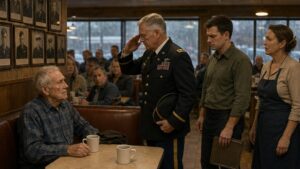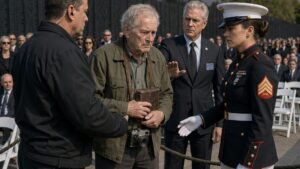
The Night They Pulled Open Gary Walker’s Shirt and Misread What He Had Carried Home
Chapter 1: The Photograph Gary Would Not Leave Behind
Gary Walker had the photograph halfway off its hook when Jeffrey Taylor turned the dead bolt on the tavern’s front door.
The click carried farther than it should have.
Conversations thinned. A cue ball rolled once across green felt and stopped. Behind the bar, the young server lowered a rack of glasses without setting it down.
Jeffrey stood between Gary and the exit, broad shoulders filling his dark work jacket.
“Where do you think you’re taking that?”
Gary kept one hand beneath the frame. The other rested against the wooden wall so the neighboring photographs would not shift. Timothy Lewis looked out from behind dusty glass, twenty-three years old, sleeves rolled above his elbows, one side of his mouth lifted as though someone just outside the picture had said something foolish.
A square paper tag hung from the frame’s lower corner.
LOT 17.
“They’re selling these?” Gary asked.
Jeffrey’s eyes moved from the empty hook to the frame. “Put it back.”
The memorial wall had occupied the rear half of Miller’s Tavern for as long as most regulars could remember. Photographs, unit patches, reunion notices, handwritten names. Nothing valuable in the way auction houses meant valuable. The worth was in knowing which man had limped home, which woman had driven ambulances stateside, which face belonged to the empty stool someone still refused to take.
Tonight, small numbered tags had appeared on nearly everything.
Gary had noticed Timothy’s before he noticed the renovation notice by the register.
He lowered the frame but did not return it to the hook.
“It isn’t yours to sell.”
A few people glanced toward Virginia Miller, who stood near the office doorway with a ledger pressed to her chest. She looked tired enough to be older than sixty-eight. Her eyes met Gary’s, then dropped to the figures on the page.
Jeffrey stepped closer. “It belongs to the business.”
“No.”
“You planning to walk out with it?”
Gary looked at Timothy’s face. The photograph had been cropped close, leaving only Timothy and the blurred door of a field tent. That was how Gary remembered hanging it decades ago. Yet something about the paper troubled him. The contrast was too sharp. The lower edge was too clean.
He said, “I’m taking it down.”
“That’s called stealing.”
The word stirred the room. One of the longtime regulars shifted on his stool. The off-duty bartender folded his arms but did not intervene.
Gary could have explained that he had placed the photograph there when the tavern still smelled of fresh varnish and Virginia’s father served drafts from behind the same counter. He could have said Timothy’s name before anyone asked.
Instead, he heard himself say, “Move.”
Jeffrey’s expression hardened. “You don’t give orders in here.”
“I asked once.”
“No, you told me the property wasn’t ours. Now you’re carrying it toward the door.”
Gary had not been walking toward the door. He had barely moved. But the frame was in his hands, and Jeffrey had witnesses.
The error was Gary’s. He knew that. He had seen the number and acted before speaking to Virginia. The old habit had returned whole: do the necessary thing first, explain only if explanation became unavoidable.
Jeffrey reached for the frame.
Gary turned his body, not fast, only enough to keep Jeffrey’s hand from closing over Timothy’s face.
The movement changed the room.
Jeffrey caught Gary by the upper arm. “Don’t.”
Gary’s shoulder burned beneath the pressure. He set the frame flat on the bar before either of them could drop it.
“There,” he said. “It’s safe.”
Jeffrey did not release him.
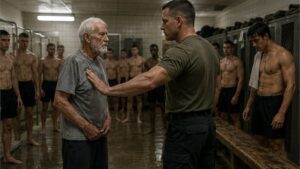
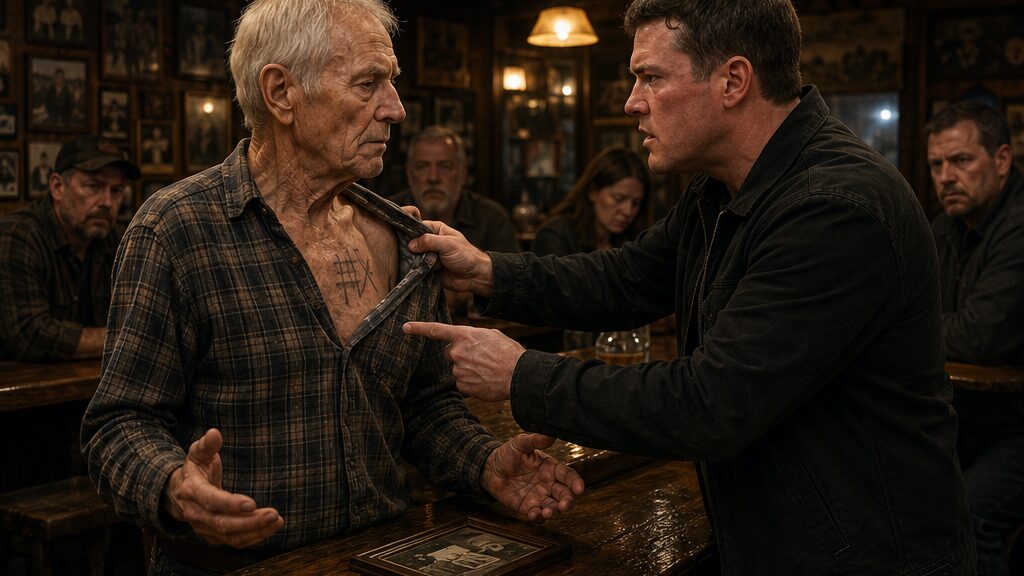
Gary wore a faded plaid shirt over a gray undershirt. Two buttons at the collar had been gone for years. When Jeffrey pulled him around, the loose fabric slid from Gary’s left shoulder.
The first lines of the tattoo appeared above the undershirt: blue-black squares blurred by time, a slanting break through the grid, two initials near his collarbone.
Jeffrey stared.
Then his grip moved from Gary’s arm to the shirt itself.
“What’s this supposed to be?”
Gary went still.
Jeffrey tugged the collar down.
The cloth scraped across Gary’s skin, exposing the grid, the broken line and the small letters T.L. The tavern’s amber light settled over the pale scars crossing the ink.
The young server turned her face away.
Jeffrey pointed at the tattoo as though he had found the answer to a question no one else had asked.
“That’s not any unit insignia I’ve ever seen.”
Gary looked at the hand gripping his shirt. Jeffrey was younger by more than forty years, stronger, frightened in a way Gary recognized only because the fear wore authority like borrowed clothing.
“Let go,” Gary said.
“You walk in here, take something off a veterans’ wall, then flash some made-up mark like people are supposed to back off?”
“I didn’t flash anything.”
“You know what we had in here last month?” Jeffrey’s voice rose. “Man wearing ribbons he bought online. Got free drinks for weeks. Then a donation jar disappeared the same night somebody stole two shadow boxes.”
Virginia said, “Jeffrey.”
He did not turn.
One of the regulars murmured that Gary had been coming there longer than Jeffrey had been alive. Jeffrey heard him.
“Then he should know better.”
His finger came closer to Gary’s chest.
Gary had spent years imagining what he would do if someone called the tattoo false. In those private rehearsals, he walked away. Sometimes he laughed. Once, in a bad winter, he struck the man.
None of those imagined responses accounted for Timothy’s photograph lying beneath a wet ring on the bar.
Gary reached past Jeffrey, slowly enough that no one could mistake the motion, and slid the frame away from the spilled beer.
Jeffrey tightened his hold.
Gary looked directly at him.
“You are right about one thing,” he said.
The room seemed to lean toward the words.
“It was never an insignia.”
Jeffrey’s face shifted, satisfaction arriving too quickly. “Then what is it?”
Gary did not answer.
He would not explain Timothy with his shirt in another man’s fist.
He would not turn a promise into a defense offered under pressure.
Jeffrey waited, then gave the collar a final contemptuous pull before releasing it.
The fabric hung crookedly over Gary’s shoulder. A seam had split near the neck.
“Put the picture back,” Jeffrey said.
Gary buttoned what remained of the shirt. His fingers did not shake until the last button missed its hole.
Virginia came from the office. “Gary, let me hold it until we sort this out.”
He studied her face. She had known him for thirty-one years, though knowing was too generous a word for the quiet exchange of coffee, holiday cards and nods across a room.
“You approved the sale?”
Her silence answered.
“We’re not selling stories,” Jeffrey said. “We’re selling fixtures and donated property to pay for renovations.”
“That picture isn’t a fixture.”
“It was donated.”
Gary turned to Virginia. “Was it?”
“I don’t have the original records in front of me.”
Jeffrey took the frame and placed it behind the bar. “You’re done here.”
Virginia’s mouth tightened. “Jeffrey, that’s enough.”
“No. He tried to take property. He refused to identify himself. He got physical.”
Gary looked at him.
Jeffrey looked away first, but only for a moment.
“I turned,” Gary said.
“You moved toward me.”
“I moved the picture.”
“I’m issuing a ban. We’ll send it in writing.”
A ban from Miller’s Tavern should not have mattered. Gary had not sat there for a drink in nearly seven years. He had come because the typed renovation notice in the weekly paper mentioned the memorial collection being “reconfigured through private sale.”
Still, the word landed with an old, bureaucratic force. Access denied. Route closed. Return prohibited.
Gary drew his shirt over the tattoo.
“Give me the photograph.”
“No.”
“Then take the tag off it.”
“No.”
Virginia said his name, but she did not stop Jeffrey when he unlocked the door.
Outside, the night air cooled the exposed strip of skin above Gary’s undershirt. Through the window, he watched Jeffrey lift Timothy’s frame and carry it toward the office.
As the frame turned beneath the ceiling lamp, light flashed across the back.
Gary saw a white commercial lab sticker.
He stepped closer to the glass.
The photograph he had hung forty-three years earlier had been printed on thick matte paper and mounted by hand on brown fiberboard. He remembered the uneven glue along the lower edge. He remembered trimming the left side himself with Virginia’s father’s office scissors.
The picture Jeffrey carried had a machine-cut backing and a barcode.
It was a reproduction.
Someone had replaced the original.
Chapter 2: The Ban Written Before Morning
The trespass notice was taped over Gary’s mail slot before sunrise.
He found it when the paper struck the front door and failed to slide through. The red heading showed through the frosted glass.
NOTICE OF PROHIBITED ENTRY.
The delivery driver’s taillights were already disappearing at the end of the block when Gary opened the door. The page had been sealed inside a plastic sleeve to protect it from dew. Jeffrey had signed at the bottom in thick black ink.
Gary peeled the tape carefully so it would not strip the paint.
Inside, he laid the notice on the kitchen table beside the newspaper. The front page carried nothing about Miller’s Tavern. That should have been a relief.
His phone buzzed before he sat down.
A message from a former city coworker contained no greeting, only a link and the words: Is this you?
Gary did not open it.
He took the notice to the bathroom and set it on the sink. In the mirror, his shirt hung open at the torn collar. The skin where Jeffrey had gripped him was darkening into the shape of fingers.
He removed the shirt.
The tattoo had faded unevenly. The upper squares were little more than gray shadows. The broken line remained darker where the needle had passed twice. T.L. sat near the collarbone, compact and stubborn.
Gary touched the skin beside the initials, never the letters themselves.
The doorbell rang.
He covered the tattoo with a clean work shirt before answering.
Nicole Brown stood on the porch holding her phone and a paper cup. She wore the same green coat she had worn at the tavern, though Gary had not known her name then.
“I was two tables behind you,” she said.
“I remember.”
“You looked right at me.”
“I looked at the room.”
“That’s close enough.”
She offered the coffee. He did not take it.
Nicole lowered her hand. “Someone posted a video.”
“So I’ve been told.”
“It doesn’t show you taking the photograph off the wall. It starts when Jeffrey already has your shirt.”
Gary looked past her toward the neighboring houses. Curtains were open. A dog pulled at its leash across the street.
“That should help him,” Gary said.
“Help him?”
“It leaves out the part where I had the frame.”
“It also shows you never threatened him.”
Gary picked at a loose thread near his cuff. “Does it show me explaining myself?”
“No.”
“Then people will do that part for me.”
Nicole’s expression suggested she disliked the accuracy of this.
She followed him into the kitchen after he stepped aside. On the table, she saw the trespass notice.
“He delivered that himself?”
“Must have.”
“Before six?”
“He likes a complete job.”
Nicole placed her phone face down. “The comments are split between people calling Jeffrey a bully and people saying you faked the tattoo.”
Gary filled the kettle.
“You should tell them you served.”
“No.”
“Why not?”
“Because I don’t owe strangers a service record because a man pulled my shirt open.”
“That isn’t what I meant.”
“It’s what they’ll hear.”
The kettle clicked against the stove grate. Gary turned on the flame.
Nicole noticed an old frame backing propped between a stack of utility bills and a sugar tin. Brown fiberboard, hand-cut, one corner softened by age.
Her gaze lingered.
Gary moved the bills in front of it.
“You said the picture in the bar wasn’t the original,” she said.
“I didn’t say it to you.”
“You said it outside. Quietly.”
He took two cups from the cabinet despite himself.
Nicole opened the video. “You need to see what people are seeing.”
The freeze-frame filled the screen.
Jeffrey’s hand clutched Gary’s plaid shirt. His finger hovered inches from the tattoo. Gary’s shoulder was bare, his face turned toward the bar with an expression he did not recognize as his own.
Not fear.
Something worse: acceptance.
The caption read, OLD MAN CAUGHT TAKING VETERANS’ MEMORIAL CLAIMS MANAGER DISRESPECTED HIS “UNIT TATTOO.”
The quotation marks were doing most of the damage.
Nicole played the clip.
Jeffrey’s voice came first. “That isn’t a military insignia.”
Gary heard himself answer, “It was never an insignia.”
Then Jeffrey demanded to know what it was.
Gary’s silence lasted only four seconds in the room. On the screen it felt deliberate, almost theatrical.
The clip ended before Jeffrey released him.
“Who posted it?” Gary asked.
“A customer. Jeffrey shared it with a statement saying you became confrontational after he stopped a theft.”
Gary set the phone down.
Nicole said, “The video contradicts that.”
“It contradicts one word.”
“It shows your hands.”
One rested on the bar beside Timothy’s photograph. The other hung open at Gary’s side.
No raised fist. No grab. No threat.
A small truth, isolated inside a larger uncertainty.
“Why are you helping?” he asked.
“I volunteer in the library’s local-history room. Virginia asked me last month if we could advise her on the memorial wall before the sale.”
“And did you?”
“I told her not to sell anything until we knew where it came from.”
The kettle began to whistle. Gary removed it from the flame.
Nicole glanced again at the hidden fiberboard. “There’s no donor list displayed at the tavern.”
“There used to be a ledger.”
“Virginia says several old records were damaged in a pipe leak.”
Gary poured the water. “Convenient.”
“She’s not pretending the tavern is healthy. They had two thefts this year. Then that man with the fake ribbons. Jeffrey caught him using photographs from somebody else’s deployment.”
Gary pushed a cup toward her.
Nicole wrapped her hands around it. “That’s why he was looking at your tattoo.”
“That explains his suspicion.”
“It doesn’t excuse what he did.”
“No.”
The answer came harder than Gary intended.
For a moment the kitchen held only the hum of the refrigerator.
Nicole’s eyes moved to his collar, where the bruise remained hidden. “Will you let me see the backing?”
“No.”
“Will you tell me Timothy Lewis’s connection to the photograph?”
Gary looked at her.
She lifted her phone again, not the video this time. A photograph of an inventory sheet appeared on the screen.
“Virginia let me copy the preliminary catalog before Jeffrey decided I was taking sides. The frame is listed as ‘Unknown Army personnel outside medical station, donor unrecorded.’ Someone wrote initials in pencil beside it.”
She enlarged the corner.
T.L.
Gary sat.
The chair gave a soft wooden complaint beneath him.
“Timothy Lewis?” Nicole asked.
Gary lifted his coffee and found it too hot to drink.
He could have answered yes. One syllable. A name returned to its owner.
Instead he said, “Where is the ledger?”
“If it survived, probably in the tavern storage room.”
“Get the inventory corrected.”
“With what source?”
“The initials.”
“Initials aren’t enough.”
“They were enough for the price tag.”
Nicole absorbed that without flinching. “Help me establish who donated it.”
“No.”
“Gary, someone has already decided the photograph’s worth without knowing the man in it.”
His gaze returned to the old frame backing behind the bills.
Tucked beneath its loose paper edge was a triangular scrap of photograph. A shoulder. Half a sleeve. The faint border of another man who had once stood beside Timothy and later cut himself away.
Nicole followed his gaze but did not rise.
Gary covered the scrap with his hand.
She said, more softly, “Why did you remove your name?”
He folded the trespass notice in half.
Then again.
Outside, a car slowed in front of his house. Someone held a phone toward the porch before driving on.
Silence, Gary understood, had not kept the night inside Miller’s Tavern.
It had only left empty spaces for other people to fill.
Chapter 3: The Man Missing From the Picture
Nicole placed the magnified photograph under the local-history room’s reading lamp and pointed to the man at its far left.
“That’s you.”
Gary remained standing.
The room smelled of paper, dust and the lemon oil used on the long oak table. Sunday light came through narrow upper windows. The enlarged image showed four young soldiers outside a field medical station. Timothy stood near the center, grinning toward someone beyond the camera. At the edge, half turned away, was Gary at twenty-four.
No tattoo showed above his open collar.
He had forgotten the photograph contained that much sky.
Nicole slid a second sheet beside it: the tavern’s cropped version. Timothy alone, the canvas doorway behind him, everyone else removed.
“The negative was filed with a box donated to the county historical collection in 1988,” she said. “No names. Just ‘medical support personnel, overseas.’ I matched the tent seam and the shadow.”
Gary touched neither page.
“You said the original in the tavern was replaced,” Nicole continued. “This doesn’t prove when. But it proves the displayed image came from this frame.”
“It proves someone owned scissors.”
“It proves you were there.”
“That isn’t the same as proving I donated it.”
Nicole leaned back. “Then tell me who did.”
Gary looked toward the locked archive cabinets. All those lives arranged in acid-free folders, each awaiting the right label.
He disliked archives. They made absence appear orderly.
“Timothy didn’t donate it,” he said.
“No.”
“He was dead.”
Nicole’s face changed, not dramatically. Her attention sharpened.
Gary sat across from her.
“I brought the print to Miller’s. Virginia’s father put it on the wall.”
“When?”
“Forty-three years ago.”
“Why isn’t your name in the ledger?”
“I didn’t give it.”
“And you cropped yourself out.”
Gary studied the magnified image. Young Gary was smiling. Not broadly, but enough.
“Yes.”
“Why?”
“Because the picture wasn’t about me.”
Nicole waited.
Gary knew the technique. A librarian’s patience could be as intrusive as a shouted question.
He said, “You wanted provenance. You have it.”
“I have an unsupported statement from a man publicly accused of stealing the object.”
“Then don’t use it.”
Her hand flattened on the table. “You removed yourself from the record, and now you’re angry the record can’t defend you.”
The words struck cleanly because they contained no cruelty.
Gary stood too quickly. The chair legs scraped.
Nicole did not apologize.
He gathered the cropped reproduction and the enlargement, aligning their edges with unnecessary care.
“Where did you find the negative?”
“In a contact sheet envelope. There are markings on it.”
She produced a cream paper sleeve covered in pencil notation. Dates. Exposure numbers. A rough grid used to identify locations in a sequence of field photographs.
Gary saw the shape before he understood that he had moved his hand to his collar.
The grid was not identical to the tattoo. The proportions differed. One line ran east instead of north.
But the visual echo was enough.
Nicole noticed.
“Is that what the tattoo is?”
“No.”
“You looked as if—”
“It isn’t.”
The answer came so sharply that a volunteer at the far desk looked up.
Gary lowered his voice. “The tattoo wasn’t on me when that picture was taken.”
“I can see that.”
“You don’t need more.”
“I need enough to keep Virginia from selling an unidentified photograph as decorative military memorabilia.”
Gary slid the contact sheet back across the table. “Then label Timothy.”
“With only a last name and initials?”
“Timothy Lewis.”
Nicole wrote it down.
“Rank?”
“No.”
“Unit?”
“No.”
“Location?”
“No.”
Her pencil stopped. “You understand how little that gives me.”
“It gives you his name.”
“And leaves every claim resting on yours.”
Gary reached for his coat.
Nicole said, “Virginia is finalizing the catalog this afternoon.”
He stopped.
“She agreed to let us examine the storage records,” Nicole continued. “Jeffrey will be there.”
“I’m banned.”
“From customer areas. Virginia said you may enter the rear room for catalog review if I accompany you.”
Gary looked at her. “She said that?”
“She also said donated property remains tavern property unless an agreement states otherwise.”
The small satisfaction he had felt at naming Timothy disappeared.
By three o’clock, Gary stood in the tavern’s abandoned rear room beneath a fluorescent tube that flickered every few seconds. The walls showed pale rectangles where framed items had already been removed.
Virginia sorted damp ledgers at a folding table. Her reading glasses hung low on her nose.
“I should’ve spoken sooner Friday,” she said without looking up.
Gary waited for the rest.
It did not come.
Jeffrey entered carrying a cardboard file box. His gaze went first to Gary, then to the bruise visible above Gary’s collar.
He set the box down.
“Catalog papers,” he said.
The room contracted around the three words.
Nicole found a ledger from the year Gary remembered. Several pages had fused at the edges. On the surviving sheet, donations were listed by object rather than person.
Photograph, medical unit personnel.
No donor.
Virginia traced the line. “Dad was terrible with names.”
“He knew mine,” Gary said.
“Yes.”
“Then he left it out because I asked him to.”
Virginia looked up.
Nicole’s pencil stopped again.
Jeffrey stood near the door, arms folded. “So you admit you gave it away.”
Gary faced him. “I placed it here.”
“That’s a donation.”
“I placed it where men who knew Timothy could see him.”
“And now most of those men are gone.”
The statement was blunt, but not false.
Jeffrey opened the file box and pulled out the reproduction. “The original was removed during the pipe leak twelve years ago. We had copies made from county negatives because water damaged several prints.”
Gary examined the back. The lab sticker carried the date.
So there had been no theft of the original. No secret replacement. Only a preservation decision made without him.
“Where is the damaged print?” he asked.
Virginia looked toward a stack of archival sleeves. “If it wasn’t discarded, it may be there.”
They searched for twenty minutes. The old print did not appear.
Nicole laid the uncropped enlargement beside the reproduction.
Virginia drew in a breath when she saw young Gary at the edge.
“That’s you.”
Gary said nothing.
Jeffrey came closer. His attention moved between the photograph and Gary’s face, matching jawline, eyes, the slight tilt of the head.
For the first time since Friday, uncertainty entered his posture.
“You were there,” he said.
Gary did not accept the offered recognition. “I told you the photograph wasn’t yours to sell.”
Virginia removed her glasses. “Gary, even if you donated it, the legal ownership probably did transfer.”
The sentence was gentle. Its effect was not.
“We can correct the caption,” Nicole said. “We can document the source. But provenance alone may not stop the sale.”
Gary looked at Timothy’s image. He had believed that establishing the truth of the photograph would restore his right to take it. Instead, truth had merely made the loss official.
Jeffrey picked up the enlarged contact sheet again.
His eyes settled on the open collar of Gary’s younger self.
“You don’t have it,” he said.
Gary knew what he meant.
Jeffrey touched the area above the young man’s left chest, careful not to point this time.
“The tattoo,” he said. “It isn’t there.”
No one in the room moved.
Jeffrey looked from the image to the faded lines hidden beneath Gary’s shirt.
“So when did you put it on?”
Chapter 4: The Grid Was Not a Badge
The corner of Gary’s statement caught fire before the sink filled with water.
He held the page above the basin and watched the flame travel through the date typed at the top. The paper browned inward, curling around words he had not read in thirty-eight years.
At the last second, he dropped it.
Water struck the burning edge with a hiss. Gray pulp clung to the stainless steel, but most of the page survived, including the hand-drawn grid near the bottom.
Gary stared at it while smoke thinned beneath the kitchen light.
Jeffrey’s question had followed him home from the tavern’s storage room.
So when did you put it on?
Gary had answered by fastening his coat and leaving. He had not looked at the uncropped photograph again. He had not told Nicole that the young man smiling beside Timothy had gone home without the tattoo and returned to civilian life carrying the grid in a notebook folded small enough to fit behind his wallet.
The doorbell rang at six forty-three.
Nicole stood outside with Virginia. Virginia held a cardboard folder against her chest. Neither woman tried to enter until Gary stepped aside.
Nicole smelled the burned paper before she saw it.
“What were you destroying?”
“Nothing useful.”
Virginia placed the folder on his table. “That’s usually what people say about useful things.”
Gary turned the damaged statement facedown.
Virginia remained standing. She looked smaller outside the tavern, without the office door or the bar to brace her authority against.
“I owe you an apology,” she said.
Gary put the kettle on but did not light the burner. “Which part?”
Her eyes tightened. “For not stopping Jeffrey.”
“You said his name.”
“I should’ve done more.”
“Yes.”
The word left no room for comfort. Virginia nodded as though she had expected that.
Nicole opened the folder. Inside were auction estimates, repair invoices, payroll summaries and photographs of water damage along the tavern’s rear wall.
“The wall sale isn’t only for renovation,” she said.
Virginia lowered herself into a chair. “We are eleven weeks behind with two vendors. The insurance covered part of the pipe damage, not the mold remediation. The lender gave me until the end of next month to show a recovery plan.”
Gary looked at the projected sale totals. Most individual objects were valued at less than a hundred dollars. Together they made a number large enough to keep several people employed through summer.
“How long?” he asked.
Virginia understood. “Six weeks, maybe less, if the sale gets canceled and the lender refuses another extension.”
Gary had wanted the truth to make the problem simple. The photograph belonged to Timothy. Therefore it should not be sold. But on the table, Timothy’s face now sat among invoices for refrigeration, wiring and wages.
“Jeffrey knows?”
“He built the plan,” Virginia said. “He took over after I missed two deadlines.”
“That why he locks doors behind old men?”
“No.” Her answer came fast. “It explains why he sees every missing glass, unpaid tab and unverified story as something that could close us. It does not explain his hand on your shirt.”
Gary sat opposite her.
Nicole turned the damaged statement over before he could stop her.
The remaining page carried an old military heading, most of it obscured by water and age. Beneath it, Gary’s younger handwriting had drawn a square grid. A broken line ran diagonally from the lower right to a point marked in ink.
T.L.
Nicole did not touch the page.
“This is the tattoo.”
“It’s the shape.”
“From what?”
“A field map.”
Virginia inhaled quietly.
Gary reached for the paper, but Nicole held its dry edge in place.
“You burned the part that said where.”
“It doesn’t matter where.”
“It matters if you expect anyone to understand.”
“I don’t.”
“Then what are we doing here?”
The question sharpened the room.
Gary looked at the auction estimates again. “You’re trying to save the photograph.”
“I’m trying to understand what should be preserved and why.”
“They aren’t the same thing.”
“No,” Nicole said. “Preservation without context is how a dead man becomes decoration.”
Gary’s hand moved to the open collar of his shirt. Beneath the cloth, he found the raised point where the broken line ended. He traced the route but stopped before the initials.
“The tattoo came after I returned,” he said. “Months after.”
Virginia glanced at the statement. “Is it an official map reference?”
“It was.”
“So Jeffrey was right that it wasn’t a unit mark.”
Gary looked at her.
She flinched at her own phrasing. “I mean technically.”
“Technically is where people hide when the rest is harder.”
Nicole pushed the damaged page toward him. “What does the line mean?”
Gary folded it along an old crease.
“It means I left one place and came back to it.”
“When?”
He placed the page inside the cardboard folder and closed it.
“That is enough.”
Nicole’s chair scraped backward. “No, it is enough for you. It is not enough for Timothy Lewis, whose name was missing from his own photograph.”
Gary stood.
“So write his name.”
“His name and what?”
“Soldier.”
“Which tells people almost nothing.”
“It tells them what they came to see.”
Virginia said, “Gary.”
He turned toward her.
“The buyers aren’t all collectors,” she said. “Some are families. Some are former service members. We were going to let people submit claims before anything left.”
“You put numbers on the frames first.”
“I needed an estimate.”
“You put a price beneath his face before you found his name.”
Virginia’s lips pressed together. She did not defend herself.
That silence was different from Gary’s. Hers did not claim dignity. It admitted injury.
Nicole gathered the papers. “We could remove the wall from the sale and digitize it.”
“With what money?” Virginia asked.
“The library has a small preservation grant.”
“Small.”
“We could prioritize the photographs.”
“And tell the server who loses shifts that history took her hours?”
Nicole looked down.
Gary had noticed the young server on Friday. She had turned away when Jeffrey pulled his shirt, but she had not left. Perhaps she could not afford to.
He had been thinking of the wall as though it stood apart from the people working beneath it. As if protecting the dead required no payment from the living.
Virginia rose. “I will remove Timothy’s photograph from the catalog until we settle its history. I cannot promise the whole wall.”
Gary’s first impulse was relief. It came too quickly and felt too much like selfishness.
“One frame won’t solve the problem,” he said.
“No.”
“And leaving the rest up might close the place.”
“Yes.”
The shape of the conflict changed. Jeffrey remained responsible for what he had done, but he was no longer the whole barrier. Gary could not defeat debt by proving an old photograph mattered.
Virginia took the folder. “There’s a community review Thursday before the final catalog goes out. You can speak.”
“I’m banned.”
“I own the tavern.”
“Jeffrey signed the notice.”
“I can suspend it.”
Gary thought of entering beneath the same memorial wall while strangers looked from his face to his collar.
“No.”
Nicole stepped toward the door, frustrated enough to abandon persuasion. “Then give me something I can use without you.”
Gary saw Timothy in the photograph as he had looked before the grid acquired meaning: laughing, impatient, alive in a way memory had gradually replaced with its ending.
Nicole’s hand reached the doorknob.
“Timothy was alive when I left him,” Gary said.
She stopped.
Virginia did not move.
Gary kept his eyes on the burned edge of the statement.
No one asked the next question immediately.
That restraint made it worse.
At last Nicole turned. “Why did you leave?”
Gary folded the surviving map line inside the ruined page until Timothy’s initials disappeared.
He had answered one question.
The larger one now stood in his kitchen, waiting.
Chapter 5: What Jeffrey Changed in His Statement
The liquor-control inspector placed Gary’s torn plaid shirt inside a clear evidence bag and set it between him and Jeffrey.
The broken collar lay flattened against the plastic. One loose thread curled near the seal.
Gary had worn that shirt to repair fences, clear storm drains and bury his brother. Reduced to evidence, it looked cheaper than he remembered.
The inspector sat at the end of a narrow table in the licensing office. Virginia occupied one side. Jeffrey sat opposite Gary, close enough to see the bruise fading above Gary’s undershirt.
“This review concerns staff conduct, physical contact with a patron and the accuracy of the incident report,” the inspector said. “It is not a determination of ownership regarding the photograph.”
Jeffrey’s jaw worked once.
Gary looked through the bag at the torn seam.
The inspector opened a file. “Mr. Taylor, your written statement says Mr. Walker reached toward you aggressively after you confronted him.”
“He turned into me.”
“That is not what you wrote.”
Jeffrey glanced at Virginia. She did not help him.
“I was trying to keep him from leaving with the frame.”
The inspector rotated a tablet. The customer’s video paused on Gary’s open hands.
“Where is the aggressive reach?”
“The clip starts late.”
“I know. I am asking about the portion it does show.”
Jeffrey’s shoulders lifted beneath his dark jacket. “He moved his arm across me.”
“To protect the photograph?” Gary asked.
The inspector raised a hand. “You will both have an opportunity.”
Gary leaned back.
Jeffrey stared at the evidence bag rather than at him. “I thought he was going for my wrist.”
“Did he touch you?”
“No.”
“Did he threaten you?”
“Not in words.”
Virginia closed her eyes.
The inspector made a note. “Threats generally require conduct or language more specific than an unwillingness to answer questions.”
Jeffrey’s face reddened, though his voice stayed controlled. “We had items stolen. We had a man lie about serving and use that lie to get money from customers. Then Mr. Walker removed a frame and told me it wasn’t ours.”
“All of which may explain why you stopped him,” the inspector said. “It does not explain why you pulled open his clothing.”
Jeffrey looked at Gary then, briefly.
“I saw the tattoo.”
“And?”
“I thought he was using it.”
Gary’s hand tightened on his knee.
The inspector asked, “Using it how?”
“To make people assume he had a right to the picture.”
“I did not mention it,” Gary said.
“No,” Jeffrey replied. “You just stood there refusing to answer while half the room started acting like I was attacking a war hero.”
The last two words carried bitterness, but beneath it Gary heard something else: panic at having lost control of the room before he knew why.
The inspector turned to Gary. “Do you want Mr. Taylor removed from his management role?”
Jeffrey looked up sharply.
Virginia’s fingers closed around the edge of the table.
Gary could have said yes and watched the fear become consequence. He could have demanded compensation, termination, a public apology. All were available to him because Jeffrey had chosen force where questions would have been enough.
“What happens to the license?” Gary asked.
“That depends on the owner’s corrective plan, the accuracy of the reports and whether the contact is deemed an isolated act or a management failure.”
“If he is fired?”
“That would be considered.”
Virginia said nothing, but Gary could see the answer in the unpaid figures she had shown him. Jeffrey had built the restructuring plan. Removing him might protect the tavern legally while weakening it financially.
Gary looked at the shirt.
“I’m not asking you to fire him.”
Jeffrey’s expression changed—not gratitude, not yet. Confusion.
The inspector said, “That is your preference, but not your decision.”
“I know.”
“You also declined to give a full statement about why you removed the photograph.”
“That part is separate.”
“It became relevant when Mr. Taylor described your conduct as deceptive.”
Gary’s gaze moved to Jeffrey. “He can describe it however he likes.”
“No,” the inspector said. “He cannot. That is the purpose of an official statement.”
The words landed harder on Jeffrey than anything Gary had said.
The inspector slid Gary a blank form. “Your refusal to provide a complete account leaves gaps. Gaps are where competing versions gain weight.”
Gary thought of Nicole’s kitchen accusation: You removed yourself from the record, and now you’re angry the record can’t defend you.
He did not pick up the pen.
Across the table, Jeffrey said, “He still hasn’t explained the tattoo.”
The inspector’s eyes cooled. “His tattoo is not under review.”
“It’s why everyone thinks they know what happened.”
“No,” Gary said. “Your hand is why.”
Jeffrey looked away.
The meeting ended without resolution. The inspector retained the shirt and scheduled a final review after the Thursday community meeting. Outside, the parking lot shone with a thin film of old rain.
Virginia walked ahead to take a call.
Jeffrey remained by the building entrance while Gary moved toward his truck.
“You could’ve asked for my job,” Jeffrey said.
Gary stopped but did not turn. “Yes.”
“Why didn’t you?”
“Because losing it wouldn’t teach you what to do with the next man.”
Jeffrey came down one step. “You think I need teaching?”
“I think you thought being in charge meant nobody could see you hesitate.”
The remark found its place. Jeffrey’s face closed.
“You don’t know anything about what I’m trying to hold together.”
“I know what fear looks like when it grabs somebody else’s shirt.”
Jeffrey’s hands opened at his sides.
For a second Gary expected anger. Instead Jeffrey said, “The man with the fake ribbons knew things. Dates, units, names. More than I did. Virginia trusted him. People bought him drinks. Then the donation jar vanished, and everybody asked why I hadn’t stopped it.”
“You decided never to be fooled again.”
“Yes.”
“So you made sure no one else got the chance to be honest.”
Jeffrey absorbed that in silence.
Gary reached his truck.
Behind him, Jeffrey said, “The report wasn’t exactly right.”
Gary turned.
Jeffrey’s gaze had fallen to the pavement. “You moved. I thought you were reaching for me. After I watched the video, I knew you weren’t.”
“When did you watch it?”
“Friday night.”
“And when did you write the statement?”
“Saturday.”
The betrayal was small beside what had happened in the tavern, but more deliberate.
Gary opened the truck door. “Then you know what needs correcting.”
Jeffrey gave a humorless breath. “If I amend it now, the inspector will think I lied.”
“You did.”
“I described what I believed in the moment.”
“After the moment, you knew better.”
Gary climbed into the truck and closed the door.
At home, the licensing form remained blank on his kitchen table until nearly ten. He tried to write why he had taken Timothy’s photograph, but every sentence moved too near the grid.
The telephone rang.
Virginia’s voice came through, low and strained. “Jeffrey submitted a request to amend his statement.”
Gary looked at the untouched form.
“What did he change?”
“The part about you reaching toward him. And the claim that you threatened him.”
“Did he say why?”
“He wrote that the video caused him to reconsider his memory.”
Careful language. Possibly lawyered. Possibly sincere.
Virginia continued, “He did it before the inspector contacted him again.”
Gary set the pen beside the blank page.
Jeffrey had corrected the record without knowing what the tattoo meant, without proof Gary had served honorably, without certainty that the old man he had humiliated was anything more admirable than stubborn.
It was not enough.
But it was not nothing.
Chapter 6: The Promise Gary Turned Into Punishment
Timothy’s voice vanished each time the cassette reached the damaged section.
Gary rewound it with a pencil, pressed Play and listened again.
Static. Rotor noise. A young man breathing too quickly.
Then Timothy, distant but unmistakable: “Take the two litter cases first. I can hold—”
The tape warped into a low mechanical groan.
Gary stopped it before the next clear sentence.
Nicole sat at the kitchen table with both hands around an untouched cup of coffee. Virginia stood near the counter, reading the labels on Gary’s spice jars because there was nowhere else to look.
It was Wednesday night. The tavern had closed early so Virginia could prepare for the community meeting. Jeffrey was not there. Gary had insisted on that, though he no longer knew whether he had excluded Jeffrey from privacy or punishment.
Nicole nodded toward the recorder. “You said there was a final transmission.”
“There is.”
“And you don’t want us to hear it.”
“No.”
“Does Timothy’s family have a copy?”
Gary pressed Eject. The cassette rose slowly from the machine.
“His widow has the official transcript. Not this.”
Virginia turned from the counter. “How did you get it?”
“I recorded radio checks for after-action reports. This was copied before the original went into storage.”
“Were you allowed to keep it?”
“No.”
Nicole’s eyebrows lifted.
Gary almost smiled. “History gets untidy when people are alive.”
He placed the cassette in its cracked case.
On the table lay the uncropped photograph. Timothy at the center. Gary on the left, smiling toward him. Two other soldiers blurred by motion.
“I cut myself out because of that,” Gary said.
Nicole looked at the image. “Because you were smiling?”
“Four hours later, he was still on the ground.”
The kitchen seemed to lose its ordinary dimensions. The refrigerator hum became generator noise. Rain against the window became rotor wash striking canvas and mud.
Gary kept his eyes on the photograph.
Their medical station had received three wounded men after dusk. The weather had been turning for hours. One evacuation aircraft made it in before the ceiling dropped, but it could not take everyone.
Timothy had stayed beside two litter cases at the secondary point while Gary guided the first aircraft from the radio post.
“The pilot said one more trip,” Gary said. “Twenty minutes out and back.”
Virginia sat down.
“Then the weather closed the route. Fire came in near the southern marker. Command ordered us to pull to the main station.”
Nicole asked, “Timothy was still at the secondary point?”
“With two wounded men.”
“Why didn’t he come back with you?”
“He could have carried one or left both. He wouldn’t.”
Gary opened the damaged statement. The map grid lay between them.
He placed his finger at the lower-right square.
“This was the medical station.”
He followed the broken line northwest.
“This was the secondary point.”
At the end waited T.L.
“I told him the next aircraft would use my signal. I told him I’d guide it in.”
His finger moved backward along the same route.
“Command ordered us out before dawn. We withdrew east. I argued until the radio battery failed. Then I went.”
Virginia’s voice was barely audible. “Did you return?”
“In the morning.”
The line in the tattoo appeared broken because Gary had made two routes occupy the same skin: the path away and the path back, interrupted at the place where the hours between them could not be crossed.
“We reached the position after sunrise,” he said. “One of the wounded men was alive. Timothy wasn’t.”
Nicole’s gaze fell to the initials.
“He stayed by choice,” she said.
Gary’s hand closed over the map.
“I left by order.”
“Both can be true.”
“For him, choice. For me, order. People prefer those words because they sound clean.”
“What would you call it?”
“A promise with a time on it.”
The cassette lay near his elbow.
Nicole said, “What does he say after the damaged part?”
Gary’s throat tightened.
He could hear the words without playing them. Timothy had not accused him. That was the cruelty Gary had preserved most faithfully.
“He says he knows I’ll come back.”
Virginia covered her mouth.
Gary looked at the smiling young man in the photograph. “I did. That did not make the promise true.”
No one answered.
For decades, Gary had told himself that silence kept Timothy from becoming a convenient story about sacrifice. He had refused memorial speeches, unit reunions and interviews. When people called Timothy brave, Gary left the room. When they called Gary lucky, he did the same.
But the silence had performed another function. It had kept Gary at the secondary point long after everyone else departed. It had made every day after the evacuation an extension of the delay.
Nicole touched the edge of the photograph. “Timothy’s family knows he stayed with the wounded?”
“They know the official version.”
“Does it say he chose to remain?”
“It says personnel were unable to complete evacuation.”
“That erases him.”
Gary looked at her.
She did not soften the accusation. “You thought you were keeping yourself out of the story. You also kept his decision out.”
The sentence opened something Gary had defended too long to name.
Virginia said, “Why tattoo the map?”
“So I wouldn’t let time improve what happened.”
“Improve it?”
“Turn it into courage. Mine or his. Turn it into something people could praise and leave behind.”
Nicole tapped the contact sheet envelope. “But Timothy’s decision was courage.”
“It was also a man being left in bad weather with two dying soldiers.”
“Those truths don’t cancel each other.”
Gary rose and carried the cups to the sink though none were empty.
His own humiliation at the tavern suddenly seemed connected to a deeper willingness. When Jeffrey called the tattoo false, Gary had not only refused to defend himself. Some part of him had accepted the accusation as overdue.
He said, “When he pulled my shirt, I wanted the room to believe him.”
Virginia stared.
“Not all of me. Enough.”
“Why?” Nicole asked.
“Because being mistaken for a fraud felt closer to the sentence I’d given myself than being thanked.”
The admission left him unsteady. He braced one hand against the counter.
Virginia said, “Jeffrey had no right.”
“No.”
“You are not responsible for what he did.”
“No.”
Both answers were true. Neither absolved Gary from what he had done with the years afterward.
Nicole pushed the photograph toward him. “Tomorrow, if you speak, it cannot only be about stopping the sale.”
“I know.”
“And it cannot be about proving Jeffrey wrong.”
“I know.”
“Timothy’s widow may not want any of this public.”
Gary looked at the cassette.
The story did not belong solely to the man who survived it. Timothy had a family that had already endured official language, condolences and strangers’ versions of meaning.
Gary found the old number in an address book kept inside the kitchen drawer. He had not called it in nine years.
His finger rested above the final digit.
Virginia and Nicole waited without urging him.
Gary dialed.
A woman answered after four rings.
He said his name. There was a silence long enough for him to wonder whether she had put down the receiver.
Then Timothy’s widow said, “I know who you are.”
Gary looked at the map, the photograph and the cassette he had guarded more carefully than the truth.
“There’s a meeting tomorrow,” he said. “They want to know what the mark on my chest means.”
Her breathing changed.
Gary closed his eyes.
“I am asking what you will allow me to tell them.”
Chapter 7: The Correction Made Before the Truth
Before Gary’s name was called, Jeffrey stood behind the wooden bar with a sheet of paper trembling once between his hands.
Every chair in Miller’s Tavern faced him.
The memorial wall remained tagged for sale. White numbers hung beneath photographs, patches and framed letters. Timothy’s frame still carried LOT 17, though Virginia had crossed the number out with one dark stroke.
Gary sat near the back in the torn plaid shirt the inspector had returned that afternoon. He had not repaired the collar. The fabric rested unevenly against his neck, exposing nothing unless he chose to move it.
Nicole occupied the chair beside him. She had brought a folder from the library but left it closed on her lap. Virginia stood near the office doorway. The liquor-control inspector sat at a small table with a recorder. A local reporter had claimed the last stool at the end of the bar.
No one held a drink.
Jeffrey looked toward the inspector.
“I asked to read this before the meeting starts.”
The inspector nodded.
Jeffrey lowered his eyes to the page.
“My original incident statement said Gary Walker reached toward me aggressively and created a reasonable fear that he intended to strike or restrain me.” His voice sounded flatter than it had during the confrontation. “After viewing the customer video, I knew that description was not accurate.”
A murmur passed through the chairs and died quickly.
Jeffrey continued. “Mr. Walker moved his arm to protect the photograph from being damaged. He did not touch me. He did not threaten me. I used physical force when it was not necessary.”
His hand tightened on the paper.
“I also pulled open his shirt in front of customers. I did that because I believed the mark on his chest was being used to support a false claim of military service. Mr. Walker had not mentioned the tattoo. I exposed it.”
Gary watched Jeffrey’s mouth form the words.
No excuse followed.
Jeffrey looked up, but not at Gary.
“I reviewed the video Friday night. I filed my first written statement Saturday. I knew by then that part of my account was wrong.”
Virginia closed her eyes briefly.
The inspector asked, “Why did you wait to amend it?”
Jeffrey folded the sheet once, then flattened it again.
“Because I thought changing it would make me look uncertain. And because if Mr. Walker turned out to be lying about the photograph, I wanted my judgment to look justified.”
The room remained silent.
It was not forgiveness. It was not courage large enough to erase what came before. But Jeffrey had made the correction without knowing what Gary intended to say, without knowing whether the tattoo belonged to a veteran, a fraud or a guilty old man who had taken what was not legally his.
The inspector switched off the recorder. “The amended statement will be added to the review.”
Jeffrey came around the bar and pinned a copy to the bulletin board beside the register. He used four brass tacks, one in each corner.
Then he returned to the office wall and stood there with his hands at his sides.
Virginia faced the room. “This meeting was scheduled to discuss the memorial collection, the proposed sale and the incident involving Gary. Those matters are connected, but they are not the same.”
The debt-restructuring representative explained the tavern’s deadlines. The figures were dry and unforgiving. Without the sale or another approved recovery plan, Miller’s could lose vendor credit within weeks. The young server sat in the front row, listening with her arms folded tightly.
Nicole described the library’s preservation grant. It could cover scanning, archival sleeves and limited storage, but not the tavern’s repairs. She proposed transferring original photographs and written histories to the local archive while the tavern retained high-quality copies.
A longtime regular objected. “That wall belongs here.”
Virginia answered before Nicole could.
“The wall has been here. That does not mean we have cared for it properly.”
She touched the crossed-out number beneath Timothy’s frame.
“We put prices on items before confirming names. That was my decision.”
The room shifted again, not toward resolution but toward a more honest division of responsibility.
Then Virginia called Gary.
He rose slowly.
The torn collar caught beneath his coat. He removed the coat and placed it over the back of his chair.
Several phones lifted.
Gary remained beside the chair.
“Put them away,” he said.
The reporter spoke first. “This is a public meeting.”
“You can write what I say. You do not photograph what I show.”
One customer lowered his phone. Then another. Nicole turned hers completely off and set it on the closed folder.
The reporter hesitated.
Virginia said, “Those are the terms.”
At last the reporter placed the phone facedown on the bar.
Gary walked to the front.
Timothy’s photograph hung above his left shoulder. In the cropped image, Timothy appeared alone outside the field medical station, smiling at someone the viewer could not see.
Gary looked at Jeffrey.
“You said the tattoo was not an insignia.”
Jeffrey’s face tightened. “Yes.”
“You were right.”
A few people stirred.
Gary raised one hand to the torn collar. This time, no one touched him. He drew the fabric aside himself.
The faded grid appeared beneath the tavern lights.
He placed his finger at the lower-right square.
“This was a medical station.”
He moved along the broken line.
“This was a secondary evacuation point.”
His finger stopped beside the initials.
“Timothy Lewis stayed there with two wounded soldiers when the aircraft could not take everyone. He could have returned with us. He chose not to leave them.”
Gary could feel every eye on the exposed skin, but the gaze no longer felt like a hand.
“We were told another aircraft would come. I promised to guide it in. Weather and incoming fire closed the route. Command ordered us to withdraw.”
He traced the line backward.
“I left.”
The reporter leaned forward. “Were you ordered to?”
“Yes.”
“Did you return?”
“In the morning.”
“And did you rescue the survivors?”
Gary let the shirt fall partly closed.
“One wounded man survived.”
The reporter asked, “Does that make this a mark of heroism?”
“No.”
The answer cut through the room.
“It marks a place where a man made a choice, and another man made a promise he could not keep on time. It is not a badge. It proves no rank. It asks no one for a free drink.”
Jeffrey lowered his head.
Gary continued. “I had it put on after I came home because I did not want years to make the event cleaner than it was.”
He looked toward Timothy’s photograph.
“I cropped myself out because I was smiling. I believed that if people saw me beside him, they might tell the story as though we stood equal in it. Later, I told myself silence honored him.”
Nicole watched without taking notes.
“It did not always honor him,” Gary said. “Sometimes it only kept me inside the punishment I had chosen. His family knew he died there. They were not always told clearly that he stayed because two wounded men could not move.”
The room held that distinction carefully.
“His widow gave permission for me to say that much. She did not give permission for his final transmission to be played, published or turned into a piece of entertainment. It will not be.”
The reporter closed her notebook halfway. “What did he say?”
Gary covered the tattoo.
“That belongs to his family.”
No one pressed further.
He turned to Jeffrey.
“What you did Friday was wrong whether I served or not. Whether the photograph was mine or not. Whether this tattoo meant anything or nothing.”
Jeffrey met his eyes.
“I know.”
Gary nodded once.
He did not say that knowledge was forgiveness. It was not.
He faced the room again. “The photograph should not be sold without Timothy’s name and his family’s consent. But keeping every frame on this wall while the people working under it lose their jobs is not remembrance either.”
Virginia looked at him with surprise.
Gary touched the crossed-out sale number.
“Move the originals somewhere they can be cared for. Leave copies here if the tavern stays open. Record the names before the stories disappear.”
The debt representative began asking practical questions. Nicole opened her folder. Virginia removed the paper tag from Timothy’s frame completely and placed it on the bar.
Then she walked along the wall and stopped.
She did not remove the other sale numbers.
The compromise had begun, but the debt remained.
Chapter 8: The Shirt Returned Without Being Touched
Three weeks later, Gary found his plaid shirt folded on the local-history archive table.
The torn collar had been repaired with small, uneven stitches. Whoever had done the work had matched the faded blue thread as closely as possible but had not hidden the original split. A pale line still ran through the fabric.
There was no apology note.
Nicole stood at a scanner near the far wall, feeding a photograph into a protective sleeve. “Jeffrey brought it Saturday.”
Gary lifted the shirt.
“He sew it?”
“He said the tailor wanted to replace the collar. He told her not to.”
Gary ran his thumb over the repaired seam.
“Why?”
Nicole glanced at him. “You would have to ask him.”
The archive tables were covered with objects from Miller’s memorial wall. Each had been assigned a folder, a digital file and a temporary caption. Some captions were only names. Others contained questions in brackets.
Unknown location.
Family confirmation pending.
Donor unidentified.
The incompleteness no longer looked orderly. It looked honest.
“Jeffrey has been here every weekend,” Nicole said. “Scanning, carrying boxes, calling numbers from the old ledgers.”
“Court ordered?”
“No.”
“Virginia?”
“She asked once. He kept coming.”
Gary folded the shirt again.
On the nearest table lay the uncropped photograph of Timothy, Gary and the two other soldiers. A typed caption rested beneath it.
Timothy Lewis, Army medical support soldier, remained with wounded personnel during a failed extraction. Gary Walker, pictured at left, returned the following morning and rescued one survivor.
Gary read the last sentence twice.
Nicole watched his face. “That is a draft.”
“It is wrong.”
“The survivor was recovered.”
“Not by me alone.”
“The records list your team.”
“Then write the team.”
She handed him a pencil.
Gary did not take it immediately.
For most of his life, his answer to inaccurate praise had been withdrawal. Refuse the interview. Leave the reunion. Remove himself from the picture. Let silence serve as correction.
The blank margin waited.
He picked up the pencil.
Timothy Lewis chose to remain with two wounded soldiers when the first evacuation could not carry them. Gary Walker followed an order to withdraw and returned with the recovery team after the route reopened. One wounded soldier survived.
Gary stopped.
Then added:
The delay and its consequences were carried differently by everyone involved.
Nicole read over his shoulder. “That last sentence is not archival language.”
“It is accurate.”
She considered it. “We can keep it as an oral-history note.”
“No recording.”
“Written attribution, then.”
Gary nodded.
A shadow crossed the doorway.
Jeffrey stood there holding a cardboard tray of coffee. He wore no dark work jacket, only a gray sweatshirt with the sleeves pushed up. He placed the tray on a side table rather than approaching Gary.
“I was told you might come,” he said.
Gary held up the shirt. “This yours?”
“The repair was.”
“You left the tear.”
“I thought covering it completely would be another decision I had no right to make.”
Gary looked at the uneven stitches. “You don’t sew.”
“No.”
“That part is obvious.”
Jeffrey accepted the remark without deciding it was forgiveness.
He moved to the table and examined the revised caption. “Nicole said you should approve Timothy’s file.”
“It called me his rescuer.”
“I wrote that.”
“Why?”
“The survivor came back with your team.”
“That is not the same sentence.”
Jeffrey nodded. “No.”
He took a red editing pencil from a jar and struck through his original wording beneath Gary’s revision.
“There’s something else at the tavern,” he said. “You should see it.”
Gary put the repaired shirt beneath his coat instead of changing into it.
At Miller’s, the memorial wall had become a pattern of gaps and new reproductions. The originals already transferred to the archive were marked with small cards explaining where they could be viewed. The tavern had kept copies in plain black frames rather than presenting them as objects for sale.
Behind the bar, Jeffrey’s amended incident statement remained pinned beside the register.
Its paper had curled at the lower corners.
Gary read enough to confirm it was unchanged.
“You could take that down,” he said.
Jeffrey stood several feet away. “The license review is complete.”
“That wasn’t my question.”
“I know.”
He did not remove it.
The tavern had not been saved by a miracle. Virginia had secured a short extension from the lender after reducing the renovation plan and documenting the archive transfer. Two employees had lost some hours. The rear room remained closed. A bucket still stood beneath the damaged section of ceiling.
Survival looked less like victory than a series of bills moved to later dates.
Virginia came from the office carrying Timothy’s cropped photograph.
“The archive keeps the uncropped original record,” she said. “I thought this copy could stay here, if you agree.”
Gary examined the new caption fixed to the back.
Timothy Lewis chose to remain with wounded men awaiting evacuation. This cropped image was donated by Gary Walker, who removed himself from the displayed version. The full photograph and history are preserved at the local archive.
No hero. No abandoned man. No clean ending.
Gary took the frame to the wall.
The hook remained where it had always been. He hung the photograph and adjusted it until Timothy’s face sat level.
Jeffrey did not help.
That restraint mattered.
Later, Gary returned to the archive alone with the uncropped photograph. He placed it in its new frame and carried it to the designated wall. In this version, Timothy smiled at someone outside the image, and young Gary stood at the edge, smiling too.
For years, Gary had believed one face had to disappear for the other to be honored.
He set the frame on its hook.
The repaired plaid shirt rested against his chest beneath his coat. The seam was still there. So was the tattoo. Neither had become proof of anything simple.
Gary stepped back until both young men fit inside his view.
Then he left the full photograph in the archive and the cropped one in the tavern, each carrying an honest caption, each telling a different part of the same unfinished life.
The story has ended.