They Rushed the Old Man’s Wheelchair Until His Faded Tattoo Changed the Entire Diner
Chapter 1: The Wheelchair Blocking the Breakfast Rush
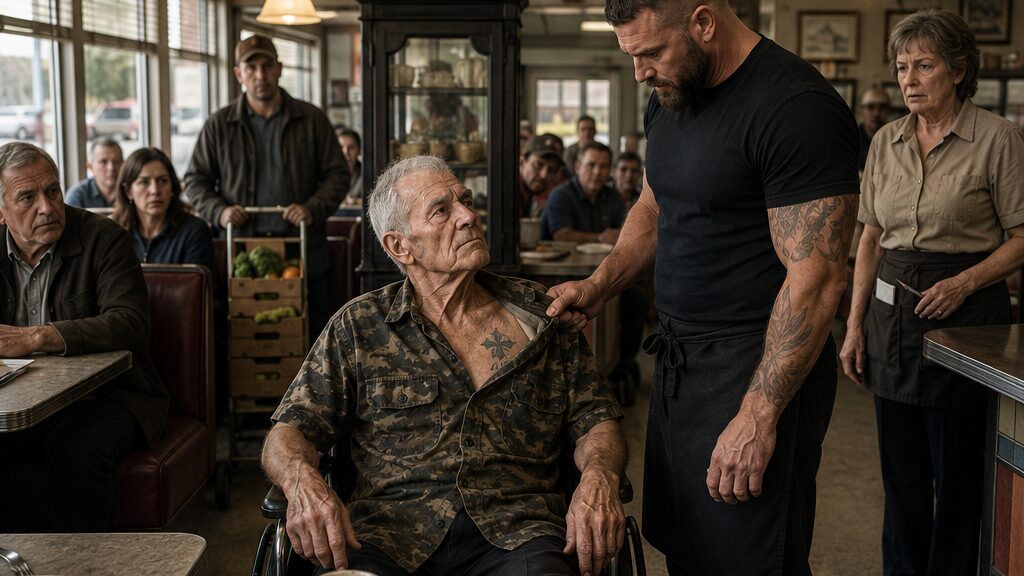
Mark Walker grabbed the handles of Charles Mitchell’s wheelchair while Charles still had a coffee mug halfway to his mouth.
The sudden pull tipped the hot surface toward his chin. Charles caught the mug against his chest before it spilled, but the chipped rim struck his lower lip.
“Hold on,” he said.
Mark had already shifted the chair six inches.
It was not far. That was not the point.
The wheels squealed against the diner’s cracked tile, and the movement sent a familiar bolt through Charles’s lower back, sharp enough to whiten the room around the edges. He set the mug down on the table, farther away than he liked, and locked both brakes with the practiced pressure of his palms.
Behind Mark, a delivery driver stood wedged between a handcart of produce boxes and a decorative cabinet filled with ceramic roosters. The center aisle had never been wide. Forty years ago, three men could pass through it shoulder to shoulder if they turned sideways and laughed about gaining weight. Now one wheelchair made everybody act as though the building had been designed correctly and the chair had arrived maliciously.
“We just need you over by the window for a minute,” Mark said.
He wore a black T-shirt stretched across a thick chest and arms marked with dark ink. His beard was clipped close, his head nearly shaved. He was not shouting. Somehow that made the way he stood over Charles worse.
“I’m eating here.”
“I see that.”
“Then you see the problem.”
The morning waitress paused beside the register, coffeepot in hand. Two regulars in the nearest booth stopped talking. The delivery driver stared at the top produce box as if the word TOMATOES required his full attention.
Janet Green came from behind the counter, wiping her palms on her apron. “Charles, honey, we’re in the middle of the rush. The order has to get through.”
Charles looked at the plate in front of him. One egg remained untouched. Half a piece of toast rested in a smear of yellow. He had been in the diner twenty-three minutes.
He had chosen the center booth because the window tables caught too much glare and the rear corner smelled faintly of mop water. Once, long before Mark had helped manage the place and before Janet had replaced the brown vinyl seats with green ones, the center booth had been where the men from the 412th gathered whenever they could get three schedules and one battered truck to cooperate.
Charles had not sat there in thirty-one years.
He had told himself that fact did not matter.
“I can finish in five minutes,” he said.
“The truck’s on a schedule,” Janet replied.
“So am I.”
Janet exhaled through her nose. She looked toward Mark, and Charles saw the decision pass between them before either spoke.
Mark released one handle, stepped around the chair, and reached for the brake beside Charles’s right thigh.
Charles caught his wrist.
The diner went still.
Mark looked down at the old hand around him. Charles’s fingers were thin and knotted, the veins raised beneath spotted skin. They had once closed around slipping men, torn straps, blood-slick buckles, the edge of an aircraft door. Now they trembled from the effort of holding a younger man’s wrist.
“Don’t move me without asking,” Charles said.
Mark’s jaw tightened. “I did ask.”
“No. You told me what you were doing.”
The delivery driver shifted his weight. A wheel on the handcart creaked.
Mark pulled his wrist free. “Fine. Will you move?”
“When I’m done.”
“That aisle has to clear now.”
Charles reached for the mug. It sat beyond the easy range of his shoulder, where the waitress had placed it after refilling it. His fingers touched the handle but could not close around it.
Mark noticed. For one brief second, embarrassment softened his face.
Then Janet said, “We can carry your plate over.”
Charles let his hand fall.
“That isn’t the same thing.”
“What isn’t?” Janet asked.
“Choosing.”
The word landed harder than he intended. Janet’s expression changed from strained patience to offense.
“No one’s trying to take your choices,” she said. “We’re trying to run a business.”
Mark stepped behind him again.
Charles heard the soles of his boots on tile. He knew what came next. The knowledge moved through his body before thought did. His shoulders braced. His left hand locked on the wheel rim.
The chair jolted backward.
Pain cut across his spine.
Charles twisted violently, striking Mark’s forearm away from the handle. The movement pulled open the top of his faded camouflage shirt. Two buttons had been missing for years, and the fabric slipped apart across his chest.
Mark froze.
His eyes dropped.
Just below Charles’s collarbone, faded blue-black lines formed a four-point flight cross. Beneath it sat the number 412. Around the lower edge, four initials had blurred into the weathered skin.
Mark’s face emptied.
Charles dragged the shirt closed, but Mark caught the edge of the fabric.
“Where did you get that?”
The question was low, almost too low for the room. His fingers held the shirt near Charles’s sternum, not quite touching the tattoo, but close enough that Charles felt the heat of his hand.
“Let go.”
“Where did you get it?”
The two regulars had turned fully in their booth now. Janet stood with the apron bunched in one fist. The morning waitress lowered the coffeepot to the counter without taking her eyes off them.
Mark pulled the shirt aside another inch.
Charles looked first at Mark’s hand, then at his face.
The young man was not simply curious. There was recognition in him, but recognition poisoned by anger.
“Ask before you touch a man’s dead,” Charles said.
Mark’s fingers loosened, though he did not release the cloth.
“What does that mean?”
Charles looked down at the tattoo. Time had softened the sharp corners. The first initial was barely legible. The last had spread into a bruise-colored shadow.
“Ryan,” he said. His voice sounded distant even to him. “Joseph. Gregory.”
Mark released the shirt.
Charles covered the mark with both sides of the fabric.
“And the fourth?” Mark asked.
Charles buttoned the one remaining button near his throat.
He did not answer.
Mark took one step back. His posture changed—not relaxed, not respectful, but straighter, as if some forgotten instruction had passed through him.
“Say Gregory’s last name.”
Charles stared at him.
“Say it.”
“Walker.”
Something moved behind Mark’s eyes. It might have been disbelief. It might have been fear.
“My father’s name is Gregory Walker.”
Charles’s hand tightened on the wheel rim.
For a moment the diner vanished beneath the throb of rotor blades, the slap of loose webbing, and a voice shouting through smoke.
Mark leaned closer again, but this time he did not touch him.
“He has that same mark,” Mark said. “Same number. Same cross.”
Charles could hear his own breathing.
Mark’s expression hardened around the recognition.
“He said the man with that mark left one of them behind.”
Chapter 2: Four Initials Beneath the Faded Cross
“Why is my father’s name under a cross with dead men?”
Mark’s question carried farther than he intended. A woman near the window lowered her fork. The delivery driver stopped pretending to study the tomato box.
Charles pulled his shirt closed until the tattoo disappeared.
“Your father isn’t dead.”
“You just called them your dead.”
“I said the mark belongs to them.”
“That’s not an answer.”
“No.”
Mark looked toward Janet, as if she might explain the old man in front of him. Janet only folded her arms.
Charles released the wheel brakes.
Mark immediately stepped aside.
It was the first thing he had done since touching the chair that felt like a question rather than a command.
Charles turned himself toward the booth. His plate had been moved to the far edge to clear space for the produce cart. The chipped mug remained out of reach.
He could have asked for it.
Instead, he put both palms to the wheels and rolled toward the front door.
“Wait,” Mark said.
Charles kept moving.
The delivery driver pulled the handcart back to let him pass. He murmured an apology without looking up. Charles nodded once. Ordinary courtesy, offered late, still had its use.
Mark came around the tables and blocked the door.
This time he stopped two feet away.
“If you served with him, prove it.”
Charles looked at the broad shape filling the exit.
“Move.”
“My father doesn’t talk about that unit. Not really. But I know the tattoo. I know what he called it.”
“What did he call it?”
Mark hesitated.
Charles saw the boy beneath the beard then—not softness, exactly, but the old posture of a child waiting outside a closed bedroom while a grown man woke fighting a war no one else could see.
“The four who came apart,” Mark said.
Charles’s hands went still on the wheel rims.
That had been Gregory’s phrase. Not an official name. Not something written in a report. He had first said it in a hospital corridor, laughing so hard morphine had turned the sound into sobbing.
The four who came apart and kept flying.
Charles looked at Mark more carefully.
The resemblance had been hidden by the beard. Now he saw Gregory in the set of the mouth and the small pale line beside the left eyebrow.
“What did he tell you?” Charles asked.
“That someone made a choice.”
“Everyone made choices.”
“He said one man chose who came home.”
Janet shifted behind them. “Mark, maybe take this outside.”
Mark did not look away from Charles. “You wanted proof. Give me something he couldn’t have told anybody.”
Charles glanced around the diner. Every face that had looked away when Mark moved his chair was now watching for a story.
They had earned none of it.
“Outside,” Charles said.
Mark pushed the door open and held it. He did not touch the chair.
The parking lot smelled of hot asphalt and diesel from the delivery truck. Charles rolled beneath the diner’s striped awning, where the shade cut the glare. Mark followed and let the door close behind him.
“November seventeenth,” Charles said. “Hill marker six. Field call sign Mercy Four.”
Mark’s expression changed.
Charles continued before he could speak.
“Your father hated canned peaches. Joseph traded him a package of crackers for every cup that came in the ration boxes. Ryan tied red thread around the instrument switches because he said labels were for men who didn’t know their own hands.”
Mark’s anger loosened, replaced by something less stable.
“My dad keeps red thread in his garage.”
Charles looked toward the highway.
“He always did.”
Mark took out his phone. “I’m calling him.”
“No.”
“You don’t get to tell me that.”
“I’m not telling you what to do. I’m telling you I won’t stand here for it.”
“You’re sitting.”
The words escaped before Mark could stop them.
The silence afterward was worse than the insult.
Mark looked down. “I shouldn’t have said that.”
“No.”
“I’m sorry.”
Charles studied him. The apology was immediate, but it did not clean the thing it followed. Mark seemed to know that.
The diner door opened behind them. Janet stepped out with the chipped mug in one hand.
“You forgot your coffee.”
Charles looked at the mug, then at the hand offering it. Janet had not brought the plate.
“I didn’t forget it.”
She set it on the metal patio table beside him. “The truck’s through.”
“Good.”
Janet glanced at Mark. “You need to come back inside.”
“In a minute.”
“We have customers.”
Mark’s eyes stayed on Charles. “This is about my father.”
“This is about a man who was eating breakfast,” Charles said.
Janet’s mouth tightened, but she went back in.
Mark waited until the door closed.
“What’s the fourth initial?”
Charles did not answer.
“Is it yours?”
The question struck closer than Mark knew.
Charles turned his chair toward the parking spaces.
Mark moved to follow, then stopped himself.
“My father said Joseph was alive.”
Charles’s hands tightened on the rims.
“He said there was time to go back.”
A truck roared past on the highway, rattling the diner windows.
“Was there?” Mark asked.
Charles rolled two feet, then halted.
The easiest answer would have been no. The safest answer would have been to say Mark had heard only a damaged man’s memory. Charles had used both answers in letters he never mailed.
Instead he said, “Joseph was alive when we left.”
Mark inhaled sharply.
“And you were in charge?”
Charles watched a strip of paper tumble beneath a parked car.
“I gave the order.”
Mark’s face closed.
The small respect that had entered his posture disappeared beneath something older, inherited, and fierce.
“You left him.”
Charles felt the sentence enter the place where he had stored it for thirty-one years.
He could have told Mark about the weight alarm. The fuel leak. The six wounded men packed across a floor built for fewer. The gunfire walking toward them through the grass.
He could have told him what Joseph had shouted.
Instead Charles reached for the mug, took one cold swallow, and placed it carefully on the table.
“Call your father,” he said.
Mark’s thumb hovered over his phone.
Charles turned toward the sidewalk.
“Ask him about the order,” he added. “Then ask why he begged me to break it.”
Chapter 3: The Story Gregory Refused to Finish
Gregory Walker dropped the phone when Mark said Charles Mitchell was alive.
The device struck the vinyl floor beside his rehabilitation chair and skidded beneath a side table. Gregory stared at it without reaching down.
Mark heard the clatter through the speaker, then the scrape of a cane.
“Dad?”
A rehabilitation nurse retrieved the phone and returned it to Gregory. Her voice came faintly through the line. “Here you go.”
Gregory did not thank her.
“Where?” he asked.
“Green’s Diner.”
“No.”
“I saw the tattoo.”
“No.”
“He knew Mercy Four. He knew about the red thread.”
Gregory’s breathing grew rough.
Mark stood in his apartment kitchen, one hand braced on the counter. He had left the diner early after telling Janet he was sick. That was easier than saying an old man in a wheelchair had named the room his father kept locked inside himself.
“He said Joseph was alive when they left,” Mark continued.
The line went silent.
“He admitted he gave the order.”
“I know what he did.”
“Then tell me.”
“You don’t want that story.”
“I’ve had half of it my whole life.”
Gregory laughed once, without humor. “Half is more than some men could carry.”
Mark closed his eyes.
On the refrigerator, beneath a hardware-store magnet, hung a photograph of Gregory at sixty. He stood beside a truck, one sleeve rolled high enough to reveal the faded flight cross on his upper arm. Mark had grown up seeing the number 412 without understanding it. One of the initials below it had been inked over until it looked like a dark thumbprint.
“Why did you black one out?” Mark asked.
Gregory did not answer.
“Was it Charles?”
The silence sharpened.
“He asked why you begged him to break the order.”
Gregory’s cane struck something hard. Once. Twice.
“That coward.”
The word came quietly.
Mark’s grip tightened around the phone.
“He didn’t look like a coward.”
“You think cowards look a certain way?”
“No. I think men who lie usually defend themselves.”
“Mitchell was always good at carrying blame where people could see it.”
“What does that mean?”
“It means he left Joseph on the ground.”
“Was Joseph alive?”
“Yes.”
“Could they have gone back?”
Another silence.
Gregory said, “He could have stayed.”
The answer was not the same.
Mark heard the difference, but anger filled the space before doubt could.
“I want you to meet him.”
“No.”
“Dad—”
“I said no.”
The call ended.
By the time Charles reached his apartment, the ache in his spine had spread into both hips.
The VA transportation driver set the brakes on the van lift and asked whether he needed help to his door. Charles declined. He always declined the first offer. Sometimes there was a second.
There was none that day.
Inside, he hung the camouflage shirt on the back of a chair. The missing buttons exposed the tattoo even without a body beneath it. He turned the shirt inward.
His answering machine showed three new calls.
He listened to none of them.
He heated soup, left it untouched, and sat near the window until the light moved off the opposite building. Once, he reached for the drawer that held his address book. His hand stopped on the knob.
Silence had weight. People who called it emptiness had never carried enough of it.
The next morning, Janet found an official envelope taped inside the diner’s front door.
She opened it behind the counter while the waitress filled sugar jars. By the second paragraph, the color rose in her face.
“What is it?” Mark asked.
“A county notice.”
He took the page.
A delivery driver had reported that the center aisle did not provide sufficient clearance during service hours. The cabinet, movable tables, and storage practices would be reviewed. A county accessibility inspector would visit within ten business days.
Mark read the notice twice.
Janet snatched it back. “He did this.”
“Who?”
“You know who.”
“Charles?”
“He comes in once, causes a scene, and the next morning this appears?”
“The notice says a delivery driver reported it.”
“You believe that?”
Mark looked toward the center booth. The chair had been pushed tightly against the table, leaving the aisle wider than yesterday. Janet must have moved it before opening.
“You told him to move while he was eating,” Mark said.
“I told him we had a delivery.”
“You told me to move him.”
“I told you to clear the aisle.”
Mark looked down at his hands.
He remembered the resistance in Charles’s thin wrist, the shirt opening, his own fingers gripping the fabric.
Janet mistook his silence for agreement.
“We’re carrying renovation debt already,” she said. “If they make us tear out fixtures, we’re done. And now he gets to act like some decorated saint because he has a tattoo.”
“He never said anything about decorations.”
“People saw what happened. One of the regulars posted about it.”
Mark looked up sharply.
“What did they post?”
“Not names. Yet.”
The bell above the door rang. Two customers entered, and Janet folded the notice beneath the register.
By noon, Charles’s description had traveled farther than his name. An old veteran in a wheelchair. A unit tattoo. A diner that tried to move him before he finished eating.
Mark watched strangers glance toward the center aisle as if expecting the story to still be sitting there.
At three, he called Gregory again.
This time his father answered after one ring.
“You tell Mitchell I know he’s hiding behind that chair now,” Gregory said.
Mark looked through the diner window at the empty parking space where the VA van had waited.
“He wasn’t hiding yesterday.”
“You didn’t know him yesterday.”
“Maybe neither did you.”
Gregory’s breath caught.
Mark regretted the line, but he did not take it back.
“The county’s inspecting the diner,” he said. “Janet thinks Charles reported us.”
“He would let her think it.”
“What’s that supposed to mean?”
“He was always willing to be blamed when blame kept people from asking the next question.”
“Then come ask it yourself.”
“No.”
“Why not?”
For several seconds, Mark heard o
Chapter 4: A Free Meal Was Not an Apology
The handwritten sign sat on Charles’s usual table before he reached the door.
VETERANS EAT FREE.
The red marker had bled through the paper in places, making the letters look wounded. Someone had drawn a small flag in the corner and taped the page upright against the sugar dispenser.
Charles stopped his wheelchair just inside the diner.
The morning waitress saw him and immediately looked toward Janet.
That was enough.
“Take it down,” Charles said.
Janet came from behind the register with a smile prepared in advance. “It’s just for today.”
“Take it down.”
A few customers turned. Not as many as before, but enough.
Janet lowered her voice. “We thought it might help make things right.”
Charles looked from the sign to the center aisle. The ceramic-rooster cabinet still narrowed the passage. A stack of soda crates sat against the opposite wall. Nothing had changed except the paper.
“Who’s we?”
Janet’s smile thinned. “The diner.”
“The diner wrote it?”
“You know what I mean.”
“I do.”
He rolled toward the table. The sign stood where his chipped mug had sat two days earlier, bright and impossible to ignore.
Janet moved beside him. “Sit down. Breakfast is on us.”
“I can pay.”
“That isn’t the point.”
“It usually is when someone puts a price on an apology.”
Her cheeks colored. “No one is trying to buy you.”
Charles reached for the paper, but the edge was beyond his comfortable range. Janet plucked it up first, folded it once, and set it beneath the chipped mug.
Then she slid the mug closer to him without asking.
The gesture was meant as kindness. Charles knew that. It was also the same decision made for him in a softer voice.
He placed two fingers against the handle and pushed the mug back to its original spot.
Janet stared at it.
“I thought you couldn’t reach.”
“I can decide where I want it.”
She lowered herself into the booth across from him. “Did you file that complaint?”
“No.”
“The county notice came the morning after you were here.”
“I know when it came.”
“Then you understand how it looks.”
Charles watched the waitress guide another customer around the produce boxes stacked near the kitchen door.
“It looks like your aisle is too narrow.”
“We’ve been open twenty-seven years.”
“That does not make it wider.”
Janet’s mouth tightened. “The inspector could make us remove fixtures. We’re already paying for the roof. Mark’s put money into this place. I’ve put everything into it.”
Charles glanced toward the kitchen pass-through. Mark was nowhere in sight.
“You think I don’t understand what a bill can do?”
“I think you came in, got angry, and now the county is involved.”
“I came in to eat.”
“And now people online are calling us anti-veteran.”
There it was.
Not the chair. Not the grabbing. Not the choice taken from him.
The veteran.
Charles rested his hands on his thighs.
“Would it have been acceptable to move me if I had never served?”
Janet opened her mouth, then closed it.
The bell over the door rang. The delivery driver entered carrying a clipboard. He stopped when he saw Charles.
Janet stood quickly. “You.”
The driver’s eyebrows rose.
“Did you report us?”
He shifted the clipboard to his other hand. “I reported the aisle.”
“Why?”
“Because I couldn’t get the cart through without somebody moving a customer.”
“You could have talked to me.”
“I did. Last month. And the month before.”
Janet looked at him as if he had produced a weapon.
The driver nodded toward Charles. “What happened the other day was the first time I saw someone get hurt by it.”
Charles said nothing.
Janet’s shoulders lowered, but only slightly. “You could have warned me you were filing.”
“I did warn you.”
The driver continued toward the kitchen, leaving the words behind him.
For several seconds, Janet stood between Charles and the counter. The anger had nowhere clean to go now.
“I’m sorry,” she said at last.
Charles looked at the folded sign beneath the mug.
“For which part?”
Her eyes followed his.
“For assuming it was you.”
“That’s one part.”
Janet drew in a breath, but the kitchen door swung open before she answered.
Mark walked out carrying a trash bag. He saw Charles, saw Janet, then saw the corner of the sign beneath the mug.
His expression changed.
He set the bag down, crossed the diner, and pulled the sign free.
Janet stood. “Mark.”
He unfolded it, read it, and tore it down the middle.
“What are you doing?” she demanded.
“Not turning him into advertising.”
“It was an apology.”
“No, it was a promotion.”
Mark tore the halves again and dropped them into the trash bag.
Charles studied him. The bruise of anger from their last conversation remained in Mark’s face, but something had shifted around it.
Mark looked at Charles. “I shouldn’t have touched your chair.”
“No.”
“Or your shirt.”
“No.”
“I thought—”
“I know what you thought.”
“That doesn’t excuse it.”
“No.”
Mark nodded once. He did not ask whether the apology was accepted.
That helped more than the apology.
Janet returned behind the counter, her movements sharp and controlled. The waitress placed a plate before Charles and set the chipped mug to his right, close enough to reach but not pressed against his hand.
Charles noticed the small pause before she chose the spot.
Mark remained by the table.
“My father agreed to come,” he said.
Charles’s appetite disappeared.
“When?”
“Friday. After closing.”
“No.”
Mark’s brow furrowed. “You told me to ask him.”
“I told you to ask about the order.”
“He wants to hear it from you.”
“He has heard enough from me.”
“He hasn’t heard anything from you in thirty years.”
The diner sounds tightened around Charles—the scrape of forks, the hiss from the grill, the register drawer snapping shut.
Mark leaned one hand on the opposite booth, careful not to touch the wheelchair.
“He said you wrote once.”
Charles looked up.
“Did he?”
“He said the envelope was empty.”
A memory opened with terrible precision: a hospital writing desk, Gregory’s address, Charles’s hand holding four pages while the empty envelope waited. He had mailed the envelope because not mailing anything felt like cowardice. He had removed the pages because mailing the truth felt worse.
“I’m not meeting him,” Charles said.
“Why?”
“Because I said no.”
“You were willing to let me think you left a man behind.”
Charles’s voice hardened. “What you think is not always mine to repair.”
Mark took the sentence without flinching.
“No,” he said. “But what you let my father carry might be.”
Charles looked away first.
At home that evening, he opened the drawer beside his telephone.
The old address book lay beneath expired coupons and a box of batteries. Its cover had cracked along the spine. He turned to W and found Gregory Walker’s address written in blue ink, then crossed out, then rewritten twice.
Behind the page were envelopes.
Dozens of them.
Some had stamps. Some had never been sealed. Each bore Gregory’s name in Charles’s hand.
He lifted the first and felt the folded pages inside.
Then the second.
The third.
Thirty years of answers, written and withheld.
Chapter 5: The Man Who Carried the Wrong Blame
Gregory Walker entered the closed diner on a cane and stopped three feet inside the door.
“You look smaller than the man I hated.”
Charles had positioned his wheelchair at the center booth. The lights above the counter were on, but the front windows had gone dark enough to reflect everyone inside: Charles, Mark near the register, Janet behind the counter, and Gregory holding himself upright with one white-knuckled hand.
“You look older,” Charles said.
Gregory gave a dry laugh. “That what you wrote in all those letters?”
Mark’s eyes moved to Charles.
Charles kept his hands resting on his knees. “You know about them.”
“I know about one empty envelope.”
“There were others.”
“Then where are they?”
“In a drawer.”
Gregory’s jaw worked.
He wore a dark overshirt with the left sleeve rolled to the shoulder. The faded 412 tattoo showed above his biceps. The flight cross had blurred, but the number remained clear. Beneath it, one initial had been covered by a dark block of ink.
Charles did not need to ask which one.
Janet poured coffee into three mugs.
“No,” Gregory said when she approached him.
She stopped.
“I didn’t ask for anything.”
Janet set the pot down and stepped back. The correction was deserved, but Charles saw the way she received it—not as instruction, but as proof that every gesture had become dangerous.
Mark pulled out a chair for his father.
Gregory ignored it.
“You told my son I begged you to break the order.”
“I told him to ask why.”
“I’m asking.”
Charles looked at Mark. “This should be between us.”
“No,” Gregory said. “He inherited it. That makes it his now.”
“That was never my choice.”
“You made plenty of choices.”
The words struck the room silent.
Charles looked down at the tattoo beneath Gregory’s sleeve. “Joseph was alive when we lifted off.”
Mark’s face tightened, though he had already heard it.
Gregory nodded. “Say the rest.”
“The aircraft was overloaded.”
“Say the rest.”
“Six wounded aboard. One critical. Fuel leaking from the left line. Fire moving toward the landing zone.”
“Say what you did.”
Charles felt the old vibration in his bones—the aircraft shuddering under weight, warning tone hammering through the cabin.
“I ordered departure.”
Gregory’s cane struck the tile.
“You left him.”
“I ordered departure.”
“Same thing.”
“No.”
Gregory stepped closer. “He was on his feet.”
“He was holding pressure on Ryan’s leg.”
“He could have made the door.”
“Not before the next burst.”
“You don’t know that.”
“I knew the weight.”
“You always knew numbers better than men.”
Charles gripped the wheelchair rims.
Mark moved half a step forward, then stopped. He seemed uncertain whom he might need to restrain.
Gregory pointed at Charles’s chest. “You put their names on your skin and made yourself the grave.”
Charles’s hand rose involuntarily to the top button of his shirt.
“You blacked mine out,” he said.
Gregory touched the darkened initial on his arm.
“I got tired of carrying you.”
“That wasn’t my initial.”
Gregory’s hand froze.
Mark looked between them. “Whose was it?”
Neither man answered.
Janet shifted near the counter, and the small sound of her shoe seemed indecently loud.
Gregory lowered his sleeve.
“You dragged one more man aboard after giving the order,” he said. “Tell him that part.”
Charles’s back tightened before the memory reached him.
Mark stared. “What man?”
“A wounded radio operator,” Gregory said. “Mitchell went back out for him after the pilot told us we were too heavy.”
Charles’s voice sharpened. “He was three yards from the skid.”
“And you took a round of metal through your lower back getting him.”
“It was shrapnel.”
“You couldn’t move your left leg.”
“It moved enough.”
Gregory turned to Mark. “He pulled himself into the aircraft by the door strap. We lifted with him half outside.”
Mark looked at Charles’s wheelchair as if seeing it for the first time.
“You were hurt there?”
Charles said nothing.
Gregory’s laugh was bitter. “That is what he does. He gives you the piece that makes him guilty and hides the piece that makes him look brave.”
“I was not brave.”
“No. You were disobedient.”
Charles looked up.
The word brought something cold into the room.
Gregory stepped closer to the booth. “Joseph told you to go.”
Mark’s head turned sharply.
Charles remained still.
“He ordered you to lift,” Gregory continued. “He told you the wounded came first. You waited.”
Janet’s hand closed around the coffeepot handle.
“How long?” Mark asked.
Gregory answered without looking at him. “Long enough.”
Charles heard the impact again—not the first burst, but the one after. Metal punching the tail. A body dropping behind him. Blood on the canvas webbing.
“One of the wounded died after we took fire,” Gregory said. “A man who was alive when Joseph told us to leave.”
Mark’s expression shifted from astonishment to accusation and then to something less certain.
“You delayed?” he asked Charles.
“Yes.”
“Why?”
Because Joseph had been standing in the grass.
Because Ryan was screaming.
Because Gregory had been shouting that there was room when there was not.
Because Charles had believed that one more second could make an impossible choice stop being impossible.
“I thought I could bring everyone home,” he said.
Gregory struck the cane against the floor again. “And when that failed, you decided to carry all of it by yourself.”
Charles’s voice went low. “You wanted me to go back.”
Gregory’s face changed.
Mark caught it.
“What does he mean?”
Gregory looked toward the dark windows.
Charles could have stopped. For decades, he had stopped here.
Instead he said, “After takeoff, your father begged me to order the pilot around.”
Mark turned to Gregory. “You knew the aircraft couldn’t land again?”
Gregory’s mouth tightened.
“You knew?” Mark repeated.
“I knew Joseph was still down there.”
“That isn’t what I asked.”
Gregory’s cane trembled against the tile.
Charles watched the man he had once trusted with every mechanical sound an aircraft could make. The anger remained, but beneath it sat the old terror: not of what Charles had done, but of what Gregory had asked him to do.
Gregory looked back at Charles.
“You obeyed Joseph too late,” he said.
“Yes.”
“And you disobeyed him first.”
“Yes.”
The admission did not lighten anything.
Charles opened the top button of his shirt. He did not expose the tattoo. He only loosened the cloth enough to breathe.
“Joseph gave the order,” he said. “I disobeyed him before I obeyed him, and both choices cost us.”
Chapter 6: What Joseph Ordered Them to Carry
“Name the six wounded men.”
Charles’s demand stopped Gregory before he could answer the last confession with another accusation.
“What?”
“The six we carried out. Name them.”
Gregory stared at him.
Mark stood near the counter, arms folded tightly across his chest. Janet had turned off the exterior sign, leaving the diner suspended in its own pale light.
Gregory looked toward the booths, as if the names might be written there.
“The radio operator,” he said.
“Name.”
Gregory’s jaw tightened. “Ryan knew him.”
“Name.”
“I don’t remember.”
Charles nodded once. “The man with the chest wound.”
Gregory said nothing.
“The one who died after we took fire.”
“Stop.”
“Name him.”
“I said stop.”
Charles’s hands pressed into his knees. “You have spent thirty years telling the story of the man we left. You cannot name the men we brought home.”
Gregory’s face reddened.
“That does not make Joseph less important.”
“No. It makes the story smaller than what happened.”
Mark uncrossed his arms.
Charles looked at him. “Joseph was not the only man making a choice that night.”
The diner’s refrigerator motor clicked on. Its low hum filled the pause.
“Joseph had the casualty sheet,” Charles continued. “Names, injuries, hometowns. Everything we had been able to get before the radio went down.”
Gregory’s eyes lifted.
“He gave it to me before we loaded the last two.”
“That list burned,” Gregory said.
“After the crash landing.”
Mark looked from one man to the other. “You crashed?”
“Hard landing,” Gregory said automatically.
Charles almost smiled. Gregory had corrected that phrase for years. A crash destroyed an aircraft. A hard landing merely tried.
“The fuel line failed thirteen miles out,” Charles said. “We put down in a dry field. The rear caught fire.”
“And the list was gone,” Mark said.
Charles nodded.
He remembered the paper folded inside his vest. He remembered tearing at the straps around the chest-wound casualty. He remembered heat coming through the floor. Later, in the hospital, he had searched every pocket of what remained of his uniform.
Nothing.
“Joseph told me to carry it,” Charles said. “Not because it was official. Because he said no mother should have to learn her son had been on our floor from a clerk who mispronounced his name.”
Gregory lowered himself into the chair Mark had pulled out earlier.
“He said that?”
Charles looked at him. “You were tightening the rear harness.”
“I don’t remember.”
“You remember what protects the wound you chose.”
Gregory flinched.
The cruelty of the line arrived in Charles only after it had crossed the table. He could have taken it back. He did not.
Gregory rubbed both hands over the top of his cane.
“Joseph told us to leave,” he said. “I know that.”
Mark turned toward him.
Gregory kept his eyes down. “He said the weight alarm was right. Said the wounded came before crew.”
His voice had changed. The anger no longer carried it cleanly.
“What exactly did he say?” Charles asked.
Gregory shut his eyes.
For years, Charles had heard Joseph’s words in fragments, sometimes in Joseph’s voice, sometimes his own.
Gregory spoke quietly.
“Take the living who cannot walk. The rest of us know the way.”
Janet made a small sound behind the counter.
Charles looked at the covered windows. “That was the order.”
Mark said, “And you waited.”
“Yes.”
“For the radio operator?”
“For Joseph.”
Gregory’s hands tightened on the cane. “Then I told you to circle back.”
“You screamed it.”
“I thought we could lose weight.”
“We had men tied to the floor.”
“I know.”
“You told me to put down anyway.”
“I know.”
The words came out broken this time.
Mark stepped closer to his father. “You never told me that.”
Gregory looked up at him. “What was I supposed to tell a boy? That I wanted seven men risked for one because the one was mine?”
“Joseph was yours?”
“He was all of ours,” Gregory snapped.
Then the anger failed.
He looked suddenly old, not because of the cane or the tremor, but because the truth had been waiting longer than his strength.
“I kept saying we had room,” Gregory said. “We didn’t. I knew we didn’t.”
Charles remembered Gregory at the open door, one hand on the frame, trying to look back through smoke. He remembered pulling him away as the aircraft banked.
“You blamed me,” Charles said.
“I did.”
“I let you.”
“You disappeared.”
“Yes.”
“Why?”
Charles looked down at his hands.
This answer had filled thirty years of letters without surviving a single envelope.
“Because hatred was easier to receive.”
Gregory stared.
“You could hate the man who gave the order,” Charles said. “You could spit his name and still wake up knowing you would have turned back. If I told you Joseph ordered us out—if I told you the wounded lived because we obeyed—then you might have thanked me.”
His throat tightened around the word.
“I could not bear that.”
Mark pulled out the chair across from Gregory but did not sit.
“Why not?” he asked.
Charles looked at the floor between his wheels.
“Because one man died after I delayed. Joseph died after I left. Gratitude would have made me choose which death mattered.”
Gregory leaned back. His eyes shone, but no tears fell.
“So you let me make you the villain.”
“I made myself available.”
“That is not nobility.”
“No.”
“It is pride.”
Charles absorbed the word.
He had called it duty. Restraint. Respect for the dead. Gregory named it more plainly.
Pride had allowed him to decide what others could survive hearing. Pride had made silence look like sacrifice.
Mark finally sat.
“What are the initials?” he asked.
Charles touched the fabric over the tattoo.
“Ryan. Joseph. Gregory.”
“And the fourth?”
Charles met Gregory’s eyes.
“Mine.”
Gregory frowned. “You said the dark one wasn’t yours.”
“It wasn’t. You covered Joseph.”
Gregory’s hand moved to his upper arm.
The truth of it settled into his face. The dark block had spread over the second initial years ago, blurring its place among the others. He had erased Joseph because seeing the name had hurt. Then memory had rearranged the mark until he believed he had erased Charles.
Mark understood at the same moment.
“You did not even know who you were trying to remove,” he said.
Gregory looked away.
Charles unbuttoned his shirt enough to reveal the faded cross. The four initials curved beneath the number, uneven and softened by age.
“I put us there because the list was gone,” he said. “Four men to remember six. Then I spent thirty years remembering only the ones I could blame.”
No one spoke.
The diner no longer felt like a courtroom. It felt like what it had once been before the booths were replaced and the aisle narrowed: a place where tired men sat after carrying things too heavy to take home alone.
Charles buttoned his shirt.
“Tomorrow morning,” he said to Mark, “bring your father back.”
Gregory looked up sharply.
“Why?”
“Because I will tell it once from the beginning. You will correct me when I lie. I will correct you when you do.”
Mark glanced toward Janet.
“No customers,” Charles said. “No sign. No newspaper. No phone held up in my face.”
Janet nodded slowly.
“And no free breakfast,” Charles added.
A faint, unwilling smile touched Gregory’s mouth and vanished.
Charles rolled back from the table.
“Bring everyone who needs to hear it,” he said. “But neither of us gets to edit out what we did.”
Chapter 7: Ask Before You Touch a Man’s Dead
Janet unlocked the diner at six-thirty and found Charles waiting alone in the center aisle.
He had positioned his wheelchair exactly where it had blocked the delivery cart three days earlier. The tables were empty, the grill cold, and the ceramic-rooster cabinet still narrowed the passage behind him.
“You’re early,” Janet said.
“I wanted to see the room before everyone filled it with intentions.”
She set her keys on the counter. A folded sheet of paper protruded from her apron pocket.
Charles noticed it. “What is that?”
“Nothing.”
“Then throw it away.”
Janet pulled out the page. At the top, in large letters, she had written LOCAL VETERAN SHARES UNTOLD STORY.
Charles held out his hand.
She hesitated before giving it to him.
He read only the heading. Beneath it were notes about inviting a reporter, offering complimentary breakfasts, and displaying photographs from the 412th.
He folded the paper once.
“You heard what I said last night.”
“I did. I thought maybe people should know.”
“Which people?”
“The community.”
“Why?”
Janet looked toward the front windows. “Because what happened here made us look terrible.”
Charles placed the paper on the table.
“So this is repair work for your reputation.”
“That isn’t fair.”
“No. It is accurate.”
Her face tightened, but she did not argue.
Charles pointed toward the trash can behind the counter. “No reporter. No promotion. No sign.”
Janet took the page and dropped it into the bin.
“What do you want, then?”
“Coffee.”
She reached for a mug, then stopped.
“Where?”
Charles indicated the right side of the table, close enough for him to reach without leaning.
Janet placed the chipped white mug there.
“Thank you,” he said.
The bell above the door rang.
Mark entered first, holding the door for Gregory. He did not touch his father’s arm until Gregory nodded. Gregory moved slowly with the cane, each step measured and resentful of being witnessed.
Behind them came the morning waitress and the delivery driver. Janet had invited no customers. Charles had allowed those two because each had been part of what happened, one through silence and one through action.
Mark carried a small camera bag.
Charles looked at it.
“It stays closed,” Mark said. “Unless you say otherwise.”
Charles nodded.
Gregory lowered himself into the booth opposite him. For a moment, neither man spoke.
Then Charles began.
He did not start with gunfire.
He started with breakfast.
“Joseph hated powdered eggs,” he said. “Ryan covered them in pepper until they turned gray. Gregory stole toast from anybody who looked away.”
Gregory’s mouth shifted.
“You stole mine,” he said.
“You left it unattended.”
“You distracted me.”
“That does not make it yours.”
Mark looked between them, surprised by the ordinary shape of the exchange.
Charles continued. He named the men in the order they had entered the aircraft, not the order in which they were injured. He described Ryan at the controls, Gregory at the rear harness, Joseph outside with the casualty sheet tucked under his vest.
When Charles reached the last loading attempt, Gregory interrupted.
“You were already on the skid when Joseph shouted.”
“No,” Charles said. “I was on the ground.”
“You had one foot up.”
“I had not reached the skid.”
Gregory frowned.
Charles turned to Mark. “This is what memory does. It moves a man three feet to make the choice easier to understand.”
He returned to the scene.
Joseph had pressed the folded casualty list into Charles’s hand. Six names. Six injuries. Six families who did not yet know where their sons had gone.
The aircraft’s weight alarm sounded.
Joseph looked at the wounded men tied across the floor and then at the smoke moving through the field.
“Take the living who cannot walk,” Charles said. “The rest of us know the way.”
Gregory’s fingers closed around the top of his cane.
“That was not the whole sentence,” he said.
Charles stopped.
The diner held its breath.
Gregory looked down at the table. “He said, ‘Do not trade six mothers for one friend.’”
Charles felt the words pass through him.
He had remembered the first part for thirty-one years. The second had been present only as pressure, a shape behind the voice.
“You are right,” Charles said.
Gregory looked up sharply.
Charles turned toward Mark. “Write that down. I left it out.”
Mark did not reach for anything.
“You said no recording.”
“I said no camera.”
Mark took a small notebook from the bag.
Charles continued.
He described giving the departure order, then breaking his own command by going back for the radio operator. He described the shrapnel entering his back. He did not call the act brave. He called it disobedience under pressure.
Gregory interrupted again.
“You did not crawl the whole way.”
Charles looked at him.
“I dragged you the last foot,” Gregory said.
Charles had no memory of that.
“Then write that down too,” he told Mark.
The story moved forward through corrections.
Gregory had not begged to turn back immediately after takeoff. He had waited until the landing zone disappeared beneath smoke.
Charles had not refused because he was calm. He had shouted so loudly the pilot threatened to remove him from command.
Ryan had not died in the field, as Gregory had once told Mark during a fevered night. Ryan had survived the landing and died years later.
Each correction removed a little of the clean shape they had imposed on the past.
At last they reached the hard landing.
Charles described fire beneath the rear floor and the casualty list disappearing with his ruined vest.
“I searched the wreckage,” Gregory said.
“For how long?”
“Until they pulled me away.”
Charles had not known.
Gregory stared at the chipped mug. “I thought you blamed me for losing it.”
“I blamed myself.”
“That was always your favorite arrangement.”
The line was sharp, but not cruel.
Charles accepted it.
Mark set down the notebook.
“What did the tattoo replace?” he asked.
“The list,” Charles said. “At first.”
He unfastened the top buttons of his shirt. The fabric parted enough to show the faded cross and the number beneath it.
Mark took one step closer, then stopped.
“May I?” he asked.
His hand hovered inches from Charles’s chest.
The room returned to the moment when those same fingers had gripped his shirt while strangers watched.
Charles felt the old instinct to cover the mark.
Instead he nodded.
Mark touched only the edge of the fabric, holding it aside without touching Charles’s skin.
Charles pointed to the initials.
“Ryan. Joseph. Gregory. Charles.”
“You said they were your dead,” Mark said.
“They were the men I was afraid to lose.”
Gregory looked at the dark block on his own tattoo.
“And did you?” he asked.
Charles buttoned his shirt.
“Not all at once.”
The answer settled through the diner.
Mark stepped back. His shoulders drew straight. His right hand began to rise toward his brow.
Charles caught the movement.
“No.”
Mark’s hand stopped.
“I thought—”
“I know.”
Charles pointed past him toward the ceramic-rooster cabinet.
“Move that instead.”
Mark looked at the cabinet, then at the narrow aisle it created.
He lowered his hand.
Without speaking, he walked to the display, wrapped both arms around it, and dragged it away from the wall. The legs scraped over the tile. Janet moved quickly to help, but Mark paused until she took the opposite side.
Together they carried it into the storage room.
When Mark returned, the aisle looked strangely wide.
Nothing patriotic had happened.
No one had applauded.
Charles could turn his chair in a full circle without striking a table.
Gregory watched him test the space.
Then he tapped the chipped mug with one finger.
“Pour me some coffee,” he said. “The way Joseph used to.”
Charles looked at the pot on the warmer.
Gregory’s request was not forgiveness. It was not even kindness.
It was ordinary.
Charles rolled toward the counter.
Chapter 8: The Space They Finally Made
Six weeks later, Charles entered the diner and stopped where the ceramic-rooster cabinet used to stand.
The space was empty.
No flag display had replaced it. No framed photograph of Charles hung on the wall. The handwritten veterans sign had not returned.
A wheelchair could pass through the center aisle without anyone moving a chair.
Charles rolled forward slowly, testing the distance out of habit.
Mark came from the kitchen wiping his hands on a towel. He saw Charles looking at the cleared wall.
“The inspector wanted thirty-six inches,” he said. “We gave it forty-two.”
“Showing off.”
“A little.”
Mark did not reach for the wheelchair. He moved one chair inward and waited until Charles chose his route.
The renovation had been modest. Two tables had been removed. The soda crates now lived in the storeroom. A section of counter near the register had been lowered. Janet complained daily about losing four seats, but she no longer called the aisle wasted space.
Gregory sat in the center booth.
His cane rested beside him. The left sleeve of his shirt was rolled down, covering the tattoo.
“You’re late,” he said.
“I am three minutes early.”
“You used to be earlier.”
“You used to have hair.”
Gregory touched the top of his head as if checking.
Charles positioned his chair at the table.
The morning waitress approached with the chipped white mug. She held it without setting it down.
“Here or to your right?” she asked.
Charles pointed to the right.
She placed it there, handle turned outward.
“Thank you.”
The exchange lasted only seconds. No one watched it happen.
That mattered.
Janet emerged from behind the register carrying a small brass plaque, still wrapped in tissue paper.
“I want you to see this before Mark mounts it,” she said.
Charles unfolded the paper.
The plaque read:
THIS AISLE WAS REDESIGNED FOR EVERY PERSON WHO NEEDS ROOM.
No unit number. No name. No mention of the confrontation.
Charles ran his thumb over the engraved letters.
“Where are you putting it?”
“Low on the wall by the entrance.”
“Why low?”
“So a person in a chair can read it.”
Charles handed it back.
“That will do.”
Janet looked relieved, then caught herself. “The inspector approved everything yesterday.”
“Good.”
“It cost more than I wanted.”
“Most corrections do.”
She nodded. “Still worth doing.”
That was as close as they had come to discussing the day she blamed him. Charles found he did not need more.
Mark brought coffee for Gregory and set the pot between them.
During the past six weeks, he had driven Gregory to the diner four times. On two visits, Charles and Gregory had spoken only about aircraft maintenance and bad coffee. On another, they argued for twenty minutes over whether Ryan had cheated at cards.
The fourth meeting had been recorded.
Not for the diner. Not for social media. Not for a public tribute.
A private unit archive maintained by former service members had agreed to store the audio. Charles and Gregory had named the six wounded men as far as memory allowed. Where memory failed, they said so.
That had been Charles’s condition.
No polished heroism. No certainty manufactured after the fact.
Mark placed a small camera bag on the booth.
Charles looked at it.
“We can leave it closed,” Mark said.
“What do you want?”
“A photograph of the tattoos for the archive.”
Gregory stiffened.
Mark kept both hands visible on the table.
“The audio mentions them,” he continued. “The archivist asked whether there was an image. I said I would ask.”
Charles looked toward the front windows.
The first time Mark saw the tattoo, he had taken hold of Charles’s shirt and demanded proof. Now the camera remained zipped inside the bag.
Charles reached for the top button of his shirt, then stopped.
“What would the caption say?”
Mark had prepared an answer. Charles could see that.
He also saw Mark discard it before speaking.
“Whatever you tell me it should say.”
Gregory rubbed his covered arm.
Charles looked at him. “Do you want yours photographed?”
“No.”
Mark nodded. “Then we don’t do it.”
Gregory’s fingers remained on his sleeve.
The refusal sat between them for several seconds.
Then Gregory began rolling the fabric upward.
The faded cross emerged, followed by the number 412 and the block of dark ink covering Joseph’s initial.
“I do not want it fixed,” he said.
Mark frowned. “Fixed?”
“Do not clean the image. Do not make the letters clearer than they are.”
“I won’t.”
“It should look like what we did to it.”
Charles unbuttoned his shirt.
Mark opened the camera bag but did not lift the camera.
Charles exposed the tattoo, then glanced at Gregory’s arm.
“Together,” he said.
Gregory shifted across the booth. Charles moved his wheelchair closer.
Their two marks were different now. Charles’s had faded evenly, the four initials barely surviving. Gregory’s bore the dark patch where grief had tried to erase one name and nearly erased the wrong man instead.
Mark raised the camera halfway.
“Ready?”
Charles looked at Gregory.
Gregory nodded.
“Now,” Charles said.
The shutter clicked once.
Mark lowered the camera immediately.
“Do you want to see it?”
“Yes,” Charles said.
Gregory said, “No.”
Mark turned the screen toward Charles alone.
The frame contained no faces. Only Charles’s weathered chest, Gregory’s aging arm, two versions of the same mark, and the space between them.
Charles handed the camera back.
“Caption it with all four names.”
Mark nodded.
“And the six wounded,” Gregory added.
“If we confirm the last two spellings,” Charles said.
“We will.”
Mark closed the bag.
The diner began filling for lunch. A mother pushed a child in a mobility chair through the entrance. She did not have to ask anyone to move. The chair passed beneath the new plaque and into the wide aisle.
No one knew her story.
No one needed to.
Charles reached for the coffee pot. It was heavier than he expected, but he lifted it with both hands.
Gregory pushed his mug forward.
Charles poured until the coffee neared the chipped rim.
“Joseph used to stop lower,” Gregory said.
“Joseph was wasteful.”
“He said coffee below the line meant the diner did not trust its tables.”
Charles added another half inch.
A thin stream spilled into the saucer.
Gregory looked at it. “Perfect.”
Mark slid into the opposite side of the booth.
Charles set down the pot.
For months, every conversation with Mark had bent toward Gregory, Joseph, the aircraft, or the tattoo. Mark had become the son of a survivor before Charles had learned much else about him.
Charles nodded toward the black shirt beneath Mark’s apron.
“You said you were an Army mechanic.”
“Eight years.”
“Why did you leave?”
Mark looked surprised.
Then he began to answer.
Charles listened.
No one mentioned the war again before the coffee cooled.
The story has ended.