He Carried A Sealed Navy Letter For Sixty Years, But The Family Tried To Close The Door
Chapter 1: The Door Opened Only Wide Enough To Refuse Him
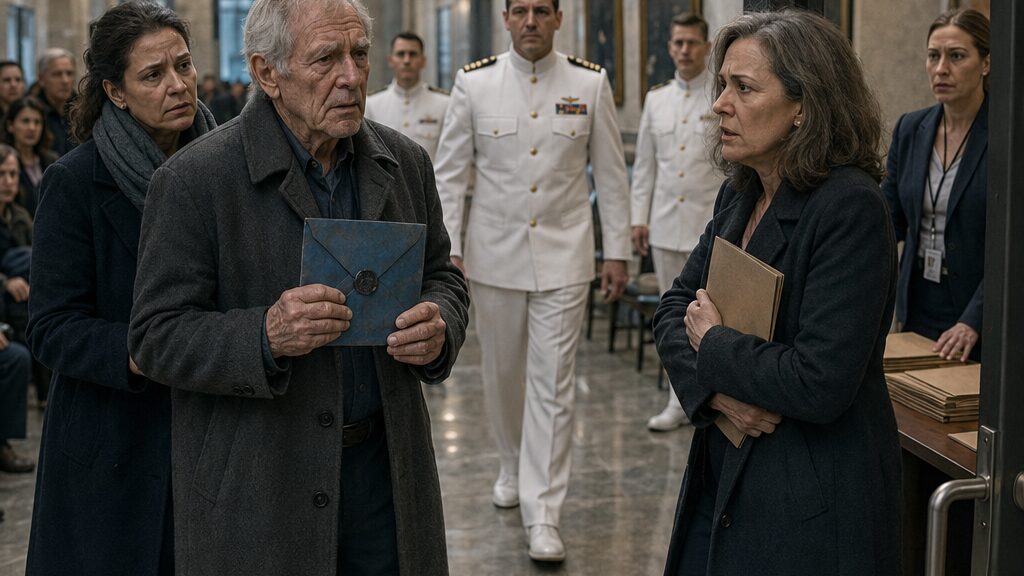
Raymond Harris had the letter in his hand before he stepped through the glass doors, as if the building might refuse him unless it saw what he carried.
The Naval Heritage Records Hall was brighter than he expected. Polished stone floors reflected the white uniforms at the far end of the corridor. Rows of folding chairs lined the walls. A long table stood beneath framed portraits of sailors whose faces had been fixed forever at twenty, twenty-two, twenty-five. On the table lay stacks of cream-colored envelopes, each one marked for a family that had come to receive delayed service records, personal effects, or memorial files that history had misplaced.
Raymond did not look at those envelopes for long.
His own was smaller, older, and blue.
The corners had softened from being handled across too many years. The seal had browned. The handwriting across the front had faded but had not vanished.
For Carol Moore.
Below that, in a cramped second line written by a younger man under impossible pressure:
If not Carol, then our child.
Raymond’s thumb covered the second line as he walked.
“Dad,” Kimberly whispered beside him, close enough that he could feel her hand hovering near his elbow without touching it. “We can ask at the desk first. Let them look up the family packet.”
“No,” Raymond said.
His voice came out thinner than he wanted. He had saved most of it for the person he had come to find.
Families stood in small clusters near the check-in rope. Some held printed confirmations. Some carried framed photographs. A woman in a navy dress dabbed her eyes with a folded tissue while a records attendant explained a form to her. An old man in a ball cap stood with his hand on a younger man’s shoulder, both staring at the table as if it were an altar.
Raymond scanned faces until he found the one he had studied on a computer printout two weeks earlier.
Laura Moore stood near the security door, one hand curled around a folder from the records office, the other on the strap of her purse. She was in her early sixties, with Carol’s mouth and Patrick’s watchful stillness around the eyes. Raymond knew that stillness. He had seen it once under a steel-gray sky, in a face covered with smoke and saltwater, when a young sailor was trying not to let fear be the last thing another man saw.
Kimberly followed his gaze. “Is that her?”
Raymond nodded.
“Then let me talk first.”
He shook his head and crossed the last few feet alone.
Laura had turned toward the records attendant, ready to pass through the security door into the consultation rooms. The attendant checked the name on her folder.
“Moore family packet,” the attendant said. “You’ll be in Room Three.”
Raymond stopped behind the rope.
“Mrs. Moore?”
Laura turned.
Not sharply. Not rudely. Just with the guarded patience of someone who had already been asked too many questions that morning.
“My name is Laura Moore,” she said. “Not Mrs.”
Raymond tried to lift the letter, but his hand trembled. He steadied it against his coat.
“I knew Patrick Moore.”
The name changed her face. Not softened it. Changed it the way a closed window changes when someone passes behind the curtain.
For one second, Raymond thought the door had opened.
Then Laura’s fingers tightened on her folder.
“You knew my father?”
“Yes, ma’am.”
“My father died before I was born.”
“I know.”
The records attendant looked between them. “Sir, are you with this family?”
“No,” Laura said before Raymond could answer.
Raymond swallowed. The hallway noise thinned until all he heard was the quiet scrape of his own breath.
“I came to give you something,” he said.
Laura’s gaze dropped to the blue envelope. She did not reach for it.
“What is that?”
“A letter.”
“From who?”
Raymond’s fingers closed slightly around the edges. “From him.”
The records attendant shifted. Behind the security door, a junior officer glanced over through the narrow window. The door was partly open, held by a slow hydraulic hinge that gave every choice a few extra seconds before it shut.
Laura stared at the envelope as if it had been placed too close to a wound.
“That’s not possible.”
“He asked me to bring it.”
“My father has been dead for sixty years.”
“Yes.”
“You expect me to believe you walked in here with a letter from a man who died six decades ago?”
“No,” Raymond said. “I expect you to decide whether you’ll take what belongs to you.”
Laura’s face hardened. “What do you want?”
Kimberly made a small sound behind him. Raymond did not turn.
“I want to finish what I told him I’d do.”
“That’s not an answer.”
“It’s the only one I have.”
The security door had almost closed. The attendant caught it with her fingertips, uncertain whether to hold it for Laura or let the building separate them.
Laura stepped back half a pace.
“We don’t know you. My father is dead. My mother is dead. Whatever you brought here, I don’t want it.”
The words did not strike Raymond all at once. They arrived one by one, each finding an old place to land.
He looked down at the letter.
He could still see Patrick’s hands. One bare, one wrapped badly at the knuckles. Young hands. Strong hands. Hands that had shoved the envelope against Raymond’s chest with a force that did not match how little blood was left in him.
Raymond held the letter flat on his palm.
“He gave it to me when he knew he wasn’t going home.”
Laura’s eyes flicked up.
For a moment, nobody in the line moved. The records attendant stopped breathing through her mouth. The door hinge sighed, soft and mechanical.
Laura looked at the envelope again, and something like fear passed across her face.
Then she stepped backward through the doorway.
“No,” she said.
It was not loud. That made it worse.
Raymond moved one inch forward, not enough to cross the rope, only enough that his shoe touched its base.
“Miss Moore—”
“Don’t call me that.”
“Laura.”
Her chin lifted.
“My mother waited her whole life for the Navy to tell her something true,” she said. “Strangers came with stories. Men came with rumors. Papers came with black ink over half the words. She died with a box full of things people claimed would help.” Her voice tightened. “You don’t get to walk in here today and sell me one more piece of him.”
“I’m not selling it.”
“Then why now?”
Raymond had no clean answer. Not one short enough for a doorway. Not one honest enough that he could bear saying it while strangers listened.
He looked past her into the consultation corridor. There were more tables inside, more official envelopes, more families being led toward rooms where the past would be handed back under fluorescent lights.
“I just found you,” he said.
Laura’s mouth trembled once, then firmed.
“No. You found an event. You found a public place. You found me where I couldn’t shut the door in private.”
Raymond’s shoulders bent, not from age this time.
Kimberly stepped closer. “He’s been looking for your family for years.”
Laura’s eyes went to her. “And you are?”
“His daughter.”
“Then take him home.”
The attendant cleared her throat. “Ms. Moore, your appointment time—”
Laura turned to the attendant, her voice controlled but sharp. “Please make sure this man does not have access to my family packet.”
The attendant hesitated.
“Please,” Laura repeated.
The junior officer behind the door opened it wider, alerted now by the tone if not the words.
Raymond did not move.
The blue letter rested in his palm like something alive but exhausted.
Laura looked at it one last time. Her eyes stopped on Patrick’s name. Raymond saw the recognition. Not belief. Recognition. The name was not just history to her. It had lived in a house. It had sat at a table through absence. It had been spoken by a woman who aged beside an empty chair.
That was why she was afraid of it.
The security door began to close again.
Raymond lifted the envelope slightly, no higher than his heart.
“He didn’t ask me to keep it,” he said.
Laura’s face folded for half a second, so quickly that someone younger might have missed it.
Then she let the door close between them.
Chapter 2: The Letter Waited Beside The Official Envelopes
Kimberly saw the tremor before her father did.
It started in his right hand, the one holding the letter. A small twitch at the knuckle, then a deeper shake that moved through his wrist and made the faded envelope flutter against his coat. He pinned it with his left hand, trying to make the motion look deliberate. That was Raymond Harris’s old trick: turn weakness into procedure, pain into posture, fear into silence.
Kimberly stepped in front of him before the security clerk could.
“Dad, sit down.”
“I’m fine.”
“You are not.”
“I said I’m fine.”
His voice stayed quiet, but she heard the steel under it. The same steel that had carried him through three missed appointments, two hidden prescription bottles, and the morning drive he had insisted on making even after the nurse at the clinic told him travel could wait until his blood pressure stopped acting like a warning siren.
The hallway had begun to notice them.
Families who had looked away during Laura Moore’s refusal were now looking back. Not openly at first. A glance over a shoulder. A pause in conversation. A child being guided closer to a chair. The records attendant at the check-in table whispered to the security clerk, who kept his hand near the radio clipped to his belt.
The sealed blue letter remained in Raymond’s hand.
Kimberly wanted to hate it.
She had seen it in dresser drawers, cigar boxes, coat pockets, glove compartments, and once beneath his pillow after a fever left him calling out to someone who was not there. It had been part of her childhood without explanation. Not a family heirloom. Not a photograph. Not a thing he displayed. A thing he guarded.
When she was little, she had thought it was a love letter from before her mother. When she was older, she had thought it was a Navy document he could not throw away. After her mother died, she stopped asking. Raymond had a way of making questions feel like trespassing.
Now the letter sat in his palm beside the official envelopes on the records table, and for the first time Kimberly understood that it had been weighing on him longer than she had been alive.
“Sir,” the records attendant said gently, “I need you to step away from the family check-in area.”
Raymond did not look at her. His eyes were fixed on the security door.
“Sir,” she repeated.
Kimberly turned. “He needs a minute.”
The attendant’s expression softened, but not enough. She was young, maybe early thirties, wearing a navy blazer and a name badge that swung whenever she moved. Her job was to guide grief into rooms on schedule.
“I understand,” she said. “But this is a restricted appointment area. If he isn’t listed with a registered family, he can wait in the public seating section or speak with records assistance downstairs.”
“He has been speaking with records assistance,” Kimberly said. “For years.”
The attendant glanced at Raymond. “Then they can help him file a supplemental inquiry.”
Kimberly almost laughed. It would have come out wrong.
“A supplemental inquiry,” she said.
The clerk shifted near the rope.
Raymond turned at last, not to the attendant, but to Kimberly.
“Don’t make this harder.”
That stopped her more effectively than anger would have.
“Me?” she said.
He looked tired then. Not old. Not stubborn. Tired in a way that made the bones of his face seem closer to the skin.
“I have to finish it.”
“You found her,” Kimberly whispered. “She said no.”
“She hasn’t heard it yet.”
“She doesn’t want to hear it.”
His eyes dropped to the envelope. “It’s not mine to decide that.”
Kimberly lowered her voice. “And what about what’s not yours to spend? Your strength? Your heart? The years you gave this? Dad, you could barely make it from the parking lot.”
A family at the end of the table stopped talking. Kimberly felt their attention but did not care.
Raymond’s mouth tightened. “Lower your voice.”
“No.”
The word surprised both of them.
Kimberly breathed through it. “No, I won’t lower my voice if whispering is how we got here.”
The security clerk took one step closer. “Ma’am—”
She turned on him. “He’s a veteran. He’s not dangerous.”
“I didn’t say he was.”
“You were about to treat him like he was.”
The clerk’s face flushed. “We have protocols.”
Raymond gave a dry, broken little sound. “Everybody does.”
The attendant looked toward the far end of the hall, and Kimberly followed her gaze.
A senior naval officer in a white dress uniform had emerged from a doorway beyond the portraits. Two junior officers walked just behind him. The hallway seemed to straighten around him. Conversations lowered. People made space before he asked for it.
Kimberly knew enough to understand that he was in charge of the event. She also knew enough to recognize the look on his face. Controlled concern. Public management. A man measuring a disturbance and deciding how quickly to contain it.
Raymond saw him too.
The letter disappeared halfway into the inside pocket of his gray overcoat.
Kimberly touched his arm. “Dad.”
“Not now.”
“Let me take you home. We can write to her. We can send it certified. We can ask the records office to—”
“No.”
“You don’t get to just say no.”
“I do today.”
It was the wrong thing to say. Not cruel, but wrong. It carried too many years inside it—years when Kimberly had watched him leave dinners early to call county clerks, skip birthday lunches to chase addresses, spend grocery money on photocopies and postage, sit awake with a blue envelope under the lamp as if the dead might change their instructions if he stared long enough.
Her anger rose, then broke against the sight of his hand pressed over his pocket.
“You never even told me his name until last month,” she said.
Raymond’s eyes stayed on the approaching officer.
“I couldn’t.”
“That’s not the same as shouldn’t.”
His jaw moved as if he had almost answered.
The records attendant stepped forward. “Captain Clark,” she said, relief evident despite her effort to hide it.
The officer stopped a few feet from Raymond. He was younger than Kimberly expected, maybe late forties, his uniform immaculate, his face composed into the kind of politeness that could become an order without changing shape.
“I’m Matthew Clark,” he said. “I’m overseeing today’s memorial release. What seems to be the issue?”
The attendant answered before Kimberly could.
“This gentleman approached a registered family member and attempted to give her an item. The family member declined contact and asked that he be kept from her packet.”
Matthew’s gaze moved to Raymond. “Sir, are you here with a registered family?”
“No.”
“Do you have an appointment with records staff?”
“No.”
Kimberly stepped in. “He came because the records office notified families connected to Patrick Moore. We saw the public notice. He’s been trying to find the Moore family for decades.”
Matthew’s expression did not change, but his attention sharpened. “And your relation to Patrick Moore?”
Raymond’s hand remained inside his coat.
“I served with him.”
Matthew waited.
Raymond said nothing more.
The silence grew awkward, then official.
Matthew lowered his voice. “Mr.—?”
“Harris,” Kimberly said. “Raymond Harris.”
“Mr. Harris,” Matthew said, “I respect that today may have personal meaning for you. But this area is for registered families. If you have material relevant to a service record, you can submit it through the proper channel.”
Raymond looked toward the security door again.
“She won’t take it from the proper channel.”
“That is her right.”
“I know.”
“Then I need you to respect it.”
Raymond’s face changed almost imperceptibly. Kimberly had seen that expression only a few times: when a doctor used the word decline, when the VA misplaced a form, when a neighbor once thanked him for his service and asked what war he had been in before looking away halfway through the answer.
He drew the blue envelope from his coat.
The old paper looked impossibly fragile under the hallway lights.
Matthew’s eyes flicked down to it.
“Sir,” he said, more firmly, “I’m going to ask you to hand that over or put it away.”
Raymond held the letter with both hands now.
“No,” he said.
The junior officers behind Matthew shifted forward.
Kimberly felt the whole hallway tighten.
Raymond did not raise his voice. He only lifted the envelope enough for Matthew to see the faded handwriting.
“Then I’m standing in the wrong place,” he said, “with the right man’s letter.”
Matthew extended his hand.
“Mr. Harris,” he said, “give it to me.”
Chapter 3: The Officer Saw A Name He Was Not Expecting
Matthew Clark’s white sleeve filled Raymond’s vision, bright as a hospital sheet, and for a moment Raymond was not in the records hall at all.
He was looking at another sleeve.
Not white. Gray with seawater. Torn at the cuff. A young arm reaching for him through smoke, shoving hard against his chest, harder than a dying man should have been able to shove.
Raymond blinked once and stayed where he was.
The two junior officers had moved close enough that he could see their shoes on the polished floor. One was watching his hands. The other watched Kimberly. Behind them, families sat frozen in their rows of folding chairs, official envelopes resting unopened in laps.
Matthew’s hand remained out.
“Sir,” he said, “this doesn’t need to become difficult.”
“It already is,” Raymond said.
Kimberly drew in a breath beside him.
Matthew’s eyes settled on the envelope. “If that letter belongs to the Moore family, then the records office can document it and contact Ms. Moore through approved channels.”
Raymond shook his head.
“Why not?”
“Because he didn’t give it to the records office.”
The officer’s jaw tightened. Not anger yet. Procedure resisting grief.
“Mr. Harris, you cannot approach registered families against their wishes.”
“I know.”
“And you cannot disrupt a memorial release.”
“I know that too.”
“Then help me understand why you’re still standing here.”
Raymond looked past him to the closed security door.
“Because he died asking for Carol.”
The hall went quiet enough for the sentence to travel.
Matthew’s expression shifted. Not recognition. Not belief. But the first fracture in certainty.
Kimberly stepped closer to Raymond’s side. “Dad, please sit down.”
He wished she would stop sounding like that. Like he was already half gone.
Matthew lowered his hand. “Who died?”
Raymond lifted the letter so the name faced outward.
Matthew read it.
Patrick Moore.
The officer did not react at first. Then his eyes narrowed, not at Raymond, but at the handwriting. He glanced toward the document table where the cream envelopes waited in precise stacks.
“Patrick Moore has a family packet here today,” Matthew said.
“Yes.”
“How did you know that?”
Raymond’s mouth went dry. “Because I looked until his name came back.”
“That isn’t an answer.”
“No.”
One of the junior officers murmured, “Captain?”
Matthew raised two fingers slightly, stopping him without turning.
The gesture pulled at Raymond’s memory again: an officer stopping movement down a passageway, men holding position, the air full of metal and orders. He pushed the memory down. The letter was enough. The hallway was enough.
The security door opened behind Matthew.
Laura Moore stood there with her records folder clutched against her chest.
“What is he still doing here?”
Her voice cut through the official quiet with something rawer than irritation. She had been crying, Raymond saw now, though she had cleaned the evidence from her face. Her eyes were red at the edges, and that made him feel worse, not better.
Matthew turned. “Ms. Moore, we’re handling the situation.”
“No,” she said. “You’re letting him stand here with my father’s name in his hand.”
Raymond lowered the letter slightly.
Laura came closer but stopped on the other side of the rope, as if it marked more than restricted space.
“You don’t get to do this in public,” she said to Raymond. “You don’t get to make people look at me while you say his name.”
“I didn’t come for them.”
“You came here.”
“Yes.”
“On this day.”
“Yes.”
“When cameras are in the lobby and officers are everywhere and every family here is already carrying something.”
Raymond did not defend himself. He could not. She was not wrong.
Kimberly said, “He didn’t know how else to reach you.”
Laura looked at her. “He knew my name well enough to ambush me.”
“He found it two weeks ago.”
Raymond closed his eyes briefly.
Kimberly stopped.
Laura caught it. “Two weeks?”
Raymond opened his eyes.
“You found me two weeks ago and still chose this?” Laura asked.
“I found a notice for today.”
“You found my address?”
“No.”
She searched his face, wanting a lie she could throw back at him.
“I found your name connected to the packet,” Raymond said. “The records office wouldn’t give me more.”
“So you came here to corner me.”
“I came here before I couldn’t come at all.”
That landed differently than he intended. Kimberly looked at him sharply.
Matthew did too.
Laura’s anger wavered, then returned with a harder edge because it had nearly become concern.
“How much do you want for it?” she asked.
Kimberly flinched.
Raymond looked down at the letter. The question should have insulted him. Instead it exhausted him. After sixty years, even offense required strength.
“He didn’t ask me to sell it.”
Laura’s hand tightened around her folder.
“Then what did he ask?”
Raymond’s fingers found the old seam of the envelope. He did not open it.
“He asked me to bring it to Carol.”
“My mother.”
“Yes.”
“She died twelve years ago.”
“I know that now.”
“You know that now,” Laura repeated. “Convenient.”
Matthew stepped slightly between them. “Ms. Moore—”
“No. If he gets to stand here and say my father gave him some sacred letter, I get to ask why he kept it until my mother was in the ground.”
The words struck the hallway harder than shouting would have.
Raymond could feel Kimberly looking at him. The question had lived in her too. She had simply loved him too much, or feared him too much, to say it like that.
“I looked,” Raymond said.
Laura’s face did not soften. “For sixty years?”
“Not every day.”
“At least that’s honest.”
Kimberly said, “He searched old Navy records. County offices. Returned letters. He called people with the wrong Moore family for years.”
“And yet here he is with it still sealed.”
“Yes,” Raymond said.
Laura looked at him then. Really looked. “Why?”
He could have told her about burned mail sacks and changed streets, widows who remarried, towns that folded into suburbs, clerks who would not speak to a man without paperwork, and years when he had no money for travel. All of it true. None of it enough.
Instead he said, “Because I failed the first time.”
Laura’s eyes sharpened. “What first time?”
Raymond’s throat closed.
Matthew noticed. The officer’s posture changed again, less commanding now, more cautious. He looked at the envelope as if it had become evidence of something no official packet could organize.
Raymond turned the letter slightly in his hand. On the back, near the seal, there was a mark most people would miss: two initials pressed into the paper where Patrick had leaned too hard with the pencil before changing his mind.
P.M.
And beneath them, nearly invisible, a small drawing of a porch light.
Laura stared at it.
Her face went still.
Raymond saw the recognition before she spoke.
“My mother used to say that,” she whispered.
Kimberly looked from Laura to Raymond. “Say what?”
Laura did not answer her. She looked at the envelope, at the tiny mark, at the half-faded shape that no stranger should have known to put there.
Raymond’s voice was barely above a breath.
“He called her his porch light.”
Laura’s folder slipped a fraction in her hand.
No one moved.
Then one junior officer took another step forward, perhaps because silence made him nervous, perhaps because protocol had not yet caught up with the room.
Matthew lifted his hand without looking away from the letter.
The officer stopped.
So did the clerk. So did the attendant. So did the hallway itself.
Matthew’s raised hand held the room back, not as command against Raymond now, but as a boundary around him.
Laura’s eyes filled, but she did not let the tears fall.
“If this is real,” she said, each word forced through a door she did not want open, “why did you wait until everyone was dead?”
Chapter 4: Sixty Years Late Was Not An Answer
Laura would not sit down.
The consultation room was too small for all of them and too clean for what had followed them inside. A square table stood under a framed photograph of a destroyer at sea. Four chairs waited around it. On the table, beneath the flat white light, Raymond placed the sealed blue letter as carefully as if the wood might bruise it.
Laura stayed by the door with her hand on the handle.
“Explain the sixty years,” she said.
Matthew Clark stood near the wall, his cap tucked under one arm, the shine of his uniform muted in the little room. Kimberly hovered behind her father’s chair, one hand on the chair back, watching the color in Raymond’s face with the fixed attention of someone counting breaths.
Raymond lowered himself into the seat. It took him longer than he wanted. The chair made a small plastic complaint under his weight.
Laura noticed.
Her eyes flicked to Kimberly, then away.
“Don’t use age to make this softer,” she said.
Raymond looked at the letter. “I wasn’t going to.”
“Good.”
The word carried no victory. Only defense.
Matthew closed the door, but not fully. He left it open two inches, a thin strip of hallway light cutting across the floor. Protocol still wanted a witness. Grief wanted privacy. Neither got all it wanted.
Raymond rested both hands on the table, not touching the letter.
“I was twenty,” he said.
Laura’s expression tightened. “That’s not an explanation.”
“No.”
“Then start with one.”
He nodded once, accepting the rebuke. “Patrick gave me the letter after the attack. He had it inside his shirt. It was already sealed. He made me say Carol’s name back to him.”
Laura’s hand gripped the door handle harder.
“He said Carol?”
“Yes.”
“And you waited until after she died.”
Kimberly said softly, “Laura—”
Laura turned on her. “No. Don’t help him step around it. If he gets to bring my father back into a room, I get to ask where he was when my mother was alive.”
Kimberly looked wounded, but she did not argue.
Raymond had thought the first refusal at the threshold was the hard part. He had been wrong. The hard part was the chair across from him, empty because Laura refused to give the room even that much trust. The hard part was the letter between them, still sealed, still younger than him and older than her.
“I tried after I came home,” he said.
“When?”
“First year.”
Laura laughed once, without humor. “The first year.”
“I had an address.”
“For my mother?”
“For Carol Moore. A street in Norfolk. It came from Patrick’s wallet.”
“My mother lived in Norfolk before I was born.”
Raymond nodded. “I went there in uniform.”
Kimberly’s hand tightened on the chair.
Raymond did not look at her. He could feel the question forming in her. You never told me.
Laura left the door and came two steps closer. “What happened?”
“There was a woman at the house.”
“My mother?”
“No.”
“Who?”
“I don’t know. Older. Maybe an aunt. Maybe a landlady. Maybe someone who thought she was protecting her.”
Laura’s face changed by a fraction. Family memory moving behind her eyes.
“What did she say?”
Raymond looked down at his hands. The skin there had gone thin enough to show blue lines, but he could still remember them young, clenched around the envelope outside a small rented house with peeling white paint and a porch light burning at noon.
“She said Carol had gone away,” he said. “Said men from the Navy had already been there. Said Carol didn’t need another sailor bringing bad luck to the door.”
Laura’s jaw worked.
“I asked where she went,” Raymond said. “She told me if I cared about Carol Moore, I’d leave her alone.”
“And you did?”
The question came quietly. That made it worse.
Raymond looked up. “Yes.”
Laura stared at him. “You had a letter from my dying father, and one woman told you to leave, so you left?”
“I was twenty-one.”
“So was my mother when she had me.”
Kimberly took a breath as if to speak, then stopped herself.
Raymond accepted the blow. It was fair. Not complete, but fair.
“I told myself I would find her another way.”
“Did you?”
“I wrote to the old address. The letters came back.”
“How many?”
“Three.”
“Three.”
“I asked at the base. They had nothing current. Patrick’s file was incomplete. The name Moore was common. Carol’s family moved. Records changed.”
Laura finally pulled out the chair across from him, but she did not sit. She stood behind it, both hands on the back.
“That sounds very official,” she said. “Very tidy.”
“It wasn’t.”
“No, Mr. Harris. It was tidy enough for you to keep the letter and live your life.”
Kimberly’s voice sharpened. “You don’t know what his life was.”
Laura looked at her. “No. I know what my mother’s was. I know she worked two jobs and kept one photograph of a man she wouldn’t talk about unless she’d been up too late. I know she never remarried. I know she used to turn on the porch light before sunset even when we couldn’t afford the bill, and when I asked why, she said some people needed help finding their way home.” Her eyes moved to the blue envelope. “So forgive me if I’m not gentle with the stranger who says he had his hand on the map.”
The room held still.
Raymond’s throat tightened around the image of Carol Moore turning on a porch light year after year, not knowing the man who had named her that had died trying to send his last words home.
“I’m sorry,” he said.
Laura’s hands slipped off the chair back. “That doesn’t tell me why.”
The strip of hallway light at the door shifted as someone passed outside. The ceremony continued somewhere beyond them: names being checked, packets being received, families given fragments of those they had lost.
Matthew spoke for the first time since closing the door.
“Ms. Moore, I can request archived handwriting verification through the records office. If the letter is relevant to your father’s file, we can compare it to known samples.”
Laura did not look at him. “I’m not touching it until I know.”
Raymond’s hand moved toward the letter, then stopped. He had almost taken it back. Habit. Protection. Cowardice wearing the coat of duty.
Kimberly saw the movement.
Her face went pale in a different way.
“You went to Norfolk?” she asked.
Raymond kept his eyes on the table.
“Dad.”
“Yes.”
“When?”
“After I came home.”
“And you never told Mom?”
He closed his eyes briefly. “No.”
Kimberly stepped away from the chair as if she needed air.
“All these years,” she said. “All the phone calls, all the names, all the times you said you never got close.”
“I didn’t get close enough.”
“That’s not the same.”
“No,” Raymond said. “It isn’t.”
Laura watched them, and something in her anger altered. It did not soften. It sharpened into understanding that the letter had not only harmed her house.
Raymond reached into his coat and took out a small folded paper, newer than the envelope but worn at the creases. He opened it and slid it across the table. Not to Laura. To the center, beside the letter.
It was a list of addresses. County offices. Returned mail dates. Phone numbers with lines through them. Moore families in three states. Carol Moore, Carol Taylor, Carol Anderson, Carol Martinez, each marked wrong, deceased, unknown, no relation.
Laura leaned over despite herself.
Raymond said, “The promise was not forgotten.”
She read the list without touching it.
For the first time, she looked less certain of the shape of her accusation.
Then she saw the top line, the oldest one, written in faded ink.
Norfolk. June 1966. Door refused.
Her face closed again.
“You wrote it down like a completed errand.”
Raymond looked at the line. He had not seen it that way until she said it.
“I wrote it down so I wouldn’t lie to myself that I had done more.”
“And did it work?”
No.
The answer filled the room, though he did not say it.
Laura pushed the chair back with a hard scrape. “I’ll ask records to verify the handwriting. If it matches my father’s, I’ll decide what to do with it.”
Kimberly turned. “You’re leaving?”
“I am stopping this before he turns one sealed envelope into a confession he doesn’t have to finish.”
Raymond stood too quickly. The room tilted. His hand caught the edge of the table, and the letter jumped from the movement but did not fall.
Kimberly reached for him. “Dad.”
He shook his head once, small and stubborn.
Laura saw the weakness. Saw him refuse help. Saw him choose pride even now.
Her voice dropped.
“What else are you not saying?”
Raymond looked at her across the unopened letter.
Matthew stepped toward the door. “Ms. Moore, I’ll arrange the comparison.”
Laura picked up her family folder, but not the blue envelope. She pointed to it as if it were both evidence and wound.
“I will verify the handwriting before I touch that,” she said. “And if it is his, Mr. Harris, you are going to tell me what else you carried besides paper.”
Chapter 5: The Photograph Matched The Thing He Remembered
Laura came back with a photograph Raymond had never seen, and Kimberly knew from the way her father stopped moving that it had struck him harder than any accusation.
The records archive room smelled faintly of paper, dust, and machine-warmed plastic. A scanner hummed on a side counter. Boxes waited on metal shelves behind a locked mesh partition. Matthew had arranged a temporary review table under the supervision of a records attendant, who kept glancing at the sealed blue letter as though it might violate policy by existing.
Laura laid the photograph faceup on the table.
“This was in my mother’s things,” she said. “Not in the Navy packet. Hers.”
Raymond did not touch it.
In the photograph, Carol Moore stood on a small porch beside Patrick. She was young, narrow-shouldered, unsmiling in the way people sometimes were for cameras then. Patrick’s arm hung close to her back without quite wrapping around her. He had the tense posture of a man trying to look formal while happiness betrayed him at the corners of his mouth.
Kimberly looked from the photograph to the letter. For the first time all day, the sealed envelope seemed less like an object and more like a voice waiting behind a wall.
Laura watched Raymond. “Do you recognize her?”
“Yes.”
“You never met her.”
“No.”
“Then how?”
Raymond’s eyes stayed on the photograph. “He described her.”
“That could mean anything.”
“He said she looked like she was always listening for rain, even indoors.”
Laura’s face flickered.
Kimberly felt the air tighten.
Raymond added, “He said she didn’t smile for cameras because she thought pictures should tell the truth.”
Laura looked down at the photograph. Carol’s unsmiling face stared back at them from another century.
Matthew stood beside the table with a thin folder of copied service material. His uniform seemed too bright for the room. Or maybe the room had grown too intimate for uniform.
The records attendant, careful and quiet, placed two photocopied sheets beside the photograph.
“We found three samples of Patrick Moore’s handwriting,” she said. “One enlistment form, one personal effects inventory, and one margin note from a training record. The formal comparison will take time, but visually…”
She stopped before saying too much.
Laura reached into her purse and removed a clear plastic sleeve. From it, she took a smaller scrap of paper, yellowed at the edges. She handled it with care that contradicted all her anger.
“My mother kept this behind the photograph,” she said.
On the scrap was a line of handwriting, dark and cramped.
If it’s a girl, Laura. If it’s a boy, let him have your father’s stubborn chin.
Kimberly stared at it.
Laura’s voice tightened. “She told me she chose my name alone.”
Raymond closed his eyes.
“Did he know?” Laura asked.
“Yes.”
Her hand trembled over the scrap. “That I existed?”
“That you were coming.”
The words did not comfort her. They unsettled her.
“Then why wasn’t that in the official record?” she asked Matthew.
Matthew looked at the papers before him. “Personal family details often didn’t appear in service records.”
“That’s a very clean sentence for a dirty thing.”
He accepted that without defending himself. “Yes, ma’am.”
Kimberly saw something pass over his face then. Not guilt for what he personally had done, but recognition of the limits of the system he represented. The folders, the forms, the delayed packets, the careful language. None of it had turned on a porch light for Carol.
Laura slid the scrap near the envelope but did not let them touch.
“If this letter is his,” she said to Raymond, “tell me something that isn’t written anywhere.”
Raymond breathed slowly through his nose.
Kimberly almost interrupted. He had been standing too long. His left hand had drifted toward his ribs, where pain sometimes hid until it made itself known. But his eyes were clear, fixed on the photograph.
“His right hand,” Raymond said.
Laura glanced at Patrick’s hand in the photograph.
“What about it?”
“He broke two fingers before he shipped out.”
Laura looked at Matthew. “Is that in the records?”
Matthew checked the copied medical pages. “I don’t see it.”
Raymond said, “He said he broke them fixing Carol’s porch rail because he was too proud to borrow the right tool.”
Laura’s mouth parted.
Kimberly saw the photograph again. Patrick’s right hand rested against his trouser seam. The fingers were straight enough, but stiff. One knuckle sat higher than the others.
Laura turned the photograph over.
There, in Carol’s handwriting, was a note:
Patrick after fixing the porch rail with the wrong hammer. He said the light worked better after he bled on it.
Laura pressed her fingers to the back of the photograph, right below the words.
No one spoke.
It was the kind of proof that did not end anything because it opened too much.
Matthew set another page on the table.
“This may be relevant,” he said.
Raymond looked up sharply, as if the tone alone had found him.
Matthew hesitated. “It’s a casualty-action summary. Heavily summarized. It states that Seaman Patrick Moore was killed during an emergency evacuation after assisting another sailor out of a compromised compartment.”
Kimberly’s eyes moved to her father.
Raymond’s face had gone still.
Laura noticed.
“Another sailor,” she said.
Matthew looked at Raymond. “The report doesn’t name the sailor in this copy.”
Raymond’s hand closed over the edge of the table.
Kimberly felt, with sudden cold certainty, that she was standing near a door her father had kept shut longer than the letter.
“Dad?” she said.
He did not answer.
Laura’s eyes narrowed. “Was it you?”
The room seemed to shrink around the question.
Raymond looked at the blue envelope.
Kimberly wanted him to say no. Not because she believed it, but because she wanted one less weight inside his chest. One less reason for the way he had spent her childhood disappearing into silence whenever a door slammed or a siren rose too fast in the distance.
Matthew spoke carefully. “Mr. Harris, you don’t have to answer that here.”
Raymond gave him a tired look. “That’s been the trouble.”
Laura leaned forward. “Did my father die saving you?”
Raymond’s mouth moved once, but no sound came.
Kimberly touched his sleeve. “Sit down.”
He did, slowly, without looking away from the envelope.
Laura’s anger had changed again. It was no longer only about the letter, or the years, or her mother. It had found a new shape, sharper and more dangerous: the possibility that Raymond had not merely failed to deliver Patrick’s last words. The possibility that he had walked through the life Patrick never got to live.
The records attendant stepped back from the table, uncomfortable with being present and unable to leave.
Matthew closed the folder halfway. “This room can be held for another hour,” he said. “After that, I have to return it to scheduled appointments.”
Laura did not acknowledge him.
She looked only at Raymond.
“You told me he gave you the letter because he knew he wasn’t going home,” she said. “You didn’t tell me why he knew.”
Raymond’s hands rested empty on the table. The letter lay inches away, still sealed, still waiting for the one person who had a right to open it.
Kimberly knew her father’s silences. She knew the stubborn ones, the ashamed ones, the ones made from habit, the ones made from pain. This silence was older than all of them.
Laura picked up the photograph and turned it so Patrick faced Raymond.
“Look at him,” she said.
Raymond did.
The young sailor in the photograph looked back with his stiff hand, his guarded happiness, his life still unfinished.
Laura’s voice came low.
“Did my father die saving you?”
Chapter 6: He Finally Said The Part That Was His
Raymond tried to leave the letter with the records clerk just after the last families had gone.
The hallway that had been crowded all morning now sounded too large. Folding chairs sat crooked against the walls. The document table had been cleared of most official envelopes, leaving pale rectangles in the dust where packets had waited. Somewhere down the corridor, a vacuum cleaner started and stopped. Ceremony had ended; the building was becoming a building again.
Raymond stood at the records counter with the blue envelope in both hands.
“If Ms. Moore decides she wants it,” he said, “you can call her.”
The clerk looked uncertainly toward Matthew, who had remained at the far end of the hall speaking to a junior officer.
Kimberly stepped in front of her father before the clerk could answer.
“No.”
Raymond looked at her.
She did not raise her voice. She did not touch him. She only stood between him and the counter, tired enough that her anger had gone quiet.
“No,” she said again.
“Kimberly.”
“Don’t.”
“I’m giving her the choice.”
“You’re leaving before she can make it.”
His face tightened. “She knows where it is.”
“She asked you a question.”
Raymond looked away.
Kimberly moved with him, not letting him turn his body toward the exit. “Was leaving it at a desk what Patrick asked you to do?”
The name struck him. She saw it land.
“That isn’t fair,” he said.
“No. It isn’t. I learned from you.”
His eyes flicked back to hers, and for a moment she saw not her father but the young man buried inside him, the one who had been carrying another man’s envelope before he ever learned how to be a husband, a father, or an old man with failing blood pressure and too many secrets.
“You think I want to run?” he asked.
“I think you’ve been calling it endurance when it was running. Not all of it. But some.”
The clerk lowered his eyes to the counter.
Raymond’s hands tightened around the letter. “You don’t know what happened.”
“No,” Kimberly said. “Because you never trusted me with it.”
The hallway behind them changed. A door opened.
Laura stepped out of the consultation room holding Patrick’s photograph against her chest. Matthew followed, carrying the service folder. Laura stopped when she saw Raymond at the counter.
Her face closed.
“You were leaving.”
Raymond did not deny it.
Kimberly stepped aside.
The blue envelope remained in his hands, but something had shifted. All day he had held it like a duty. Now he looked like a man caught trying to put down a weight without admitting it had crushed him.
Laura came closer, slowly. “I thought you wanted to finish what you promised.”
“I do.”
“Then why are you giving it to a clerk?”
The question moved through the empty hall with more force than any shout that morning.
Raymond looked at the cleared document table. “Because believing me is your burden now. Not mine.”
Laura’s eyes sharpened. “That sounds almost noble if I forget you still haven’t answered me.”
Matthew remained a few paces back. For once, he did not intervene.
Raymond turned the envelope over. His thumb passed once over the porch-light mark.
“He pushed me,” he said.
Laura did not move.
Kimberly’s breath caught.
Raymond looked down the hallway, but what he saw was not polished floor. It was steel wet under his hands. Smoke leaning sideways. A warning bell that would not stop. Patrick’s face too close to his, young and furious and terrified because there was no time left to be either.
“There was a compartment fire after the hit,” Raymond said. “Not the kind they put in clean reports. We were moving men out. I went back because I thought someone was behind us. Patrick caught up to me. He had the letter inside his shirt. I remember being angry at him for that. Of all things.”
His voice thinned.
Laura held the photograph harder.
“The passage shifted. Something came loose. I don’t know what. I only remember him hitting me in the chest. Both hands.” Raymond touched the front of his coat as if he still felt it. “He shoved me through the hatch.”
Kimberly covered her mouth.
Raymond continued because stopping now would be another kind of leaving.
“When I turned back, he was down. I tried to get to him. He told me not to. I did anyway. He cursed at me for it.”
A faint, painful almost-smile crossed his face and vanished.
“He still had enough strength to be mad.”
Laura’s eyes filled.
“He gave me the letter,” Raymond said. “Made me say Carol’s name. Made me say I’d tell her he didn’t stay away in his heart. Those were his words. Not mine.”
The vacuum cleaner stopped somewhere down the hall.
Raymond swallowed.
“He said, ‘Don’t let her think I wanted the ocean more than that porch light.’”
Laura closed her eyes.
Kimberly turned her face away, but Raymond saw her shoulders shake once.
“I told him I would,” Raymond said. “Then I was pulled out. I don’t remember by who. I woke up with the letter under my shirt because I’d put it there, same as he had.”
Laura opened her eyes.
“You survived.”
“Yes.”
“And he didn’t.”
“No.”
“Because he pushed you.”
Raymond did not hide from it.
“Yes.”
Laura stared at him for a long time.
The anger did not leave her face. It became something more difficult to hold. Grief mixed with arithmetic. One life through a hatch. One life left behind. One letter crossing sixty years in the wrong hands and the right hands at the same time.
“Why didn’t you say that first?” she asked.
“Because it sounds like asking you to forgive me.”
“Isn’t it?”
Raymond shook his head.
The answer surprised even him. He had thought, somewhere deep and shameful, that maybe the door would open and Carol’s family would say the thing he had not been able to say to himself. You did what you could. You kept your word. You can rest.
But Laura had not opened the door. And she had been right not to do it easily.
“No,” he said. “Not anymore.”
Laura’s mouth tightened.
“Sixty years late is not loyalty,” she said.
Raymond looked at the envelope, then set it on the cleared document table.
The sound was small. Paper against wood.
“No,” he said. “It’s the part I have to answer for.”
He took his hand away.
For the first time since Kimberly could remember, the letter lay near him and did not touch him.
Raymond’s empty palm remained open on the table.
Laura looked at it, then at the envelope.
“I believe you knew him,” she said. “I believe he gave you that letter. I believe my father died pushing you through that hatch.”
Raymond nodded once.
“But belief does not give my mother back the years she waited,” Laura said. “It does not give me a father. It does not make you brave for every day you couldn’t knock again.”
“No.”
Kimberly stepped toward him, but he lifted his empty hand slightly, asking her not to.
Laura’s voice broke at the edge. “And if I open that, I have to hear him choosing us after we spent our whole lives thinking he had already left.”
Raymond said nothing.
Matthew finally moved. Not forward. Only enough to stand between the hallway and the four of them, shielding the moment from the remaining staff without making it public.
Laura wiped beneath one eye with the heel of her hand, angry at the tear.
“Did he suffer?” she asked.
Raymond’s face changed.
Matthew looked down.
Kimberly closed her eyes.
Raymond answered carefully, giving truth without turning memory into a spectacle.
“He was afraid for you. Not for himself by then.”
Laura breathed through her mouth once, sharply.
“He knew about me?”
“Yes.”
“My mother’s note said he did.”
“He knew,” Raymond said. “He made me say that too.”
Laura looked at the letter.
The hallway doors clicked as someone locked the entrance from the inside. The day had narrowed to the cleared table, the blue envelope, the photograph in Laura’s hand, and Raymond standing without the thing that had shaped his life.
Laura reached toward the letter, then stopped with her fingers hovering above it.
Raymond stepped back.
The motion was small, but everyone saw it. He was no longer guarding the envelope. No longer offering it like proof. No longer holding it out as if his own release depended on how quickly she took it.
“It belongs to you,” he said.
Laura’s fingers touched the faded blue paper.
She did not pick it up at first. She pressed two fingertips near Patrick’s name, as if checking whether the dead could still leave warmth behind.
Then she lifted the letter.
The old seal cracked under her thumb.
Chapter 7: The Promise Was Finished Without Making The Loss Smaller
Laura read the first line and stopped breathing.
Not because the words were dramatic. They were not. The paper was thin and cramped, the pencil faded to a soft gray that made every letter look as if it had been fighting to remain. She had expected a farewell, maybe an apology, maybe some grand sentence that would explain why a dead man could still rearrange a living room sixty years later.
Instead, Patrick Moore had written:
Carol, if this reaches you, turn the porch light off before you read the rest.
Laura pressed one hand to the table.
Raymond looked away.
Kimberly did not move. Matthew stood near the hallway, his cap held at his side, no longer an officer managing a disturbance but a man keeping others from walking into something private.
Laura swallowed once. The sound was small and painful.
“My mother never turned it off,” she said.
No one answered.
She bent over the letter again.
The handwriting slanted harder after the first line, as if Patrick had been writing under pressure even before the moment Raymond carried in his memory. Some words had blurred where damp had touched the paper, but most remained legible.
I am writing this before I know whether I will get another chance. If I come home, I will tear this up and let you call me foolish. If I do not, I need you to know the thing I was too proud to say clearly before I left. I wanted that house. I wanted the rail fixed right. I wanted your coffee too strong and your silence when you were mad. I wanted to hear the baby cry in rooms I had painted badly.
Laura’s hand covered her mouth.
The baby.
Not a baby. Her.
All her life she had been told Patrick had known there might be a child. Might. Maybe. A rumor softened for a daughter who asked too many questions at bedtime. But the letter did not speak of possibility. It spoke of rooms. Paint. Crying. A life imagined so plainly it hurt more than absence.
Kimberly stepped closer to Raymond. “Dad,” she whispered.
Raymond’s eyes were fixed on the empty place where the letter had lain. His right hand had curled slightly, fingers closing around nothing.
Laura kept reading.
If it is a girl, I hope she has your stubbornness and not mine. If it is a boy, I hope he learns early that silence can be another kind of selfishness. Tell the child I did not leave because I wanted the sea more than home. I left because I thought duty was a door I could walk through and then walk back from. I know now doors close behind men faster than they think.
Her eyes flooded before she could stop them.
She turned the page carefully. The fold resisted, old fibers whispering under her thumb.
There was more. Less steady now.
If Raymond Harris brings this, believe him enough to let him hand it to you. He is younger than he acts. He will try to make a promise sound like an order because he does not yet know how frightened he is. Do not let him carry my fear as if it belongs to him.
Laura looked up.
Raymond still would not meet her eyes.
The sentence changed the room more than the handwriting comparison, more than the photograph, more than the service report. Patrick had known something in Raymond before Raymond had spent sixty years proving it true.
Laura’s anger did not vanish. It had nowhere to vanish to. It had lived too long in her mother’s bills, in unanswered questions, in porch lights burning through hard months. But it shifted, and beneath it was something she had not known she was allowed to feel.
Pity, maybe.
No. Not pity.
Recognition.
“He wrote about you,” she said.
Raymond’s jaw tightened. “He shouldn’t have.”
“He did.”
“He was dying.”
“That doesn’t make it less true.”
His eyes came to hers then, and for the first time that day she saw not the stranger at the threshold, not the man who had waited too long, not even the veteran with the old blue envelope. She saw a twenty-one-year-old who had been given an impossible thing by another twenty-one-year-old and had mistaken survival for debt.
Laura read the last paragraph aloud because keeping it inside herself felt too heavy.
“Carol, if I do not come back, do not let the Navy make me cleaner than I was or smaller than I was. I was scared. I loved you. I wanted to come home. Tell our child the porch light was the last thing I tried to see when I closed my eyes.”
Her voice broke on the final words.
Kimberly turned away, shoulders shaking once before she straightened.
Matthew lowered his head.
Raymond took one step back from the table. The movement was slow, but it was not retreat. It was surrender.
Laura folded the letter along its old creases, not sealing it, only giving it shape again. Her fingertips lingered over Patrick’s name. She thought of her mother standing in a kitchen with one hand on a light switch, choosing every evening to spend a little more money they did not have. She had always thought it was grief hardened into habit. Now it was grief answering a sentence she had never received.
Laura looked at Raymond.
For a moment she wanted to punish him with every year. She wanted to ask why he had not tried harder, why one door in Norfolk had been enough to stop him then but not enough to stop him now, why her mother had died before this paper reached her hands.
All those questions were still real.
But so was the open palm he had left on the table.
So was the cracked seal.
So was the sentence Patrick had written about Raymond carrying fear that did not belong to him.
“Raymond,” she said.
His name sounded unfamiliar without anger in it.
He looked at her.
“I don’t forgive the years,” she said.
He nodded.
“I don’t know if my mother would have.”
“I know.”
“But she would have read it.”
His face changed. Barely. Enough.
Laura slid the letter into the clear sleeve that had held the porch photograph. She placed Patrick’s photograph behind it, so the old image and the old words rested together.
Then Raymond’s knees softened.
Kimberly caught him under one arm before he could reach for the table. Matthew moved at once, but Kimberly was already there, braced and frightened.
“Dad.”
“I’m all right.”
“You are not.”
Laura stood, letter in hand. “Call someone.”
“No,” Raymond said, sharper than he had sounded all evening.
The force of it startled them.
He closed his eyes, embarrassed by his own command. When he opened them, he looked at Kimberly first.
“Not here,” he said more quietly. “Please. Not around this.”
Kimberly’s face tightened with anger and fear. “You don’t get to choose whether your body becomes inconvenient.”
“I know.”
“No, you don’t.”
Raymond leaned against the table, breathing carefully. “Then let me choose one thing I still can.”
Matthew stepped closer. “There’s a medical office two doors down. No spectacle. Just a chair and a corpsman.”
Raymond looked ready to refuse. Kimberly’s hand gripped his sleeve.
“Please,” she said.
That word did what argument had not.
He nodded once.
They moved slowly through the hallway. The chairs were mostly empty now. The official envelopes were gone. A cleaner paused near the far wall and then pretended not to see them. Matthew walked ahead, not clearing a path like an officer, simply making sure no one interrupted.
Laura followed with the letter against her chest.
The medical room was small. Raymond sat while a corpsman checked his pulse and blood pressure, speaking in low practical phrases. Kimberly stood beside him, arms folded tightly, furious tears held in place by sheer will. Raymond did not protest again.
When the corpsman finished, he said Raymond needed rest, food, and follow-up care. Kimberly gave a short laugh that had no humor in it.
“I’ve been saying that since sunrise.”
Raymond looked at her. “I’m sorry.”
It was not enough, and both of them knew it. But it was not nothing.
Laura stood by the door. “My father is buried at the veterans cemetery forty minutes from here.”
Raymond turned his head.
“My mother had his marker placed there when the Navy confirmed the remains,” Laura said. “She never visited much. Said she had done her waiting at home.”
Kimberly looked at Raymond. “Not tonight.”
“Tomorrow,” Laura said. “If he’s able.”
Raymond’s eyes went to the clear sleeve in her hand.
Laura held it carefully now, not like evidence, not like danger. Like something entrusted.
“I want him there,” she said. “Not as a hero. Not for a ceremony.” She paused. “As the man who came back carrying what my father couldn’t.”
Raymond looked down at his empty hands.
The next morning, the cemetery grass was still damp when they reached Patrick Moore’s marker.
There were rows upon rows of white stones, each one catching the pale light. The cemetery caretaker pointed them toward the section and then withdrew. Matthew did not come. No officers. No event. No folded flag, no speech, no audience.
Just Laura, Kimberly, and Raymond.
Raymond walked slowly, leaning once on Kimberly’s arm and not pretending he did not need it. That was new. Kimberly noticed. She said nothing.
Laura stopped before the marker.
Patrick Moore’s name was carved cleanly into stone. Beneath it, dates too short for the life he had described in his letter.
Laura knelt and placed the photograph and letter sleeve against the base for a moment. Not leaving it there. Letting it touch the place.
“My mother kept the porch light on,” she said to the stone. Her voice did not shake until the end. “You should know that.”
Raymond removed his cap.
For a while, nobody spoke.
Then Laura stood and turned to him.
“He wrote that you’d try to make a promise sound like an order.”
Raymond gave the faintest breath of a laugh, gone almost before it existed. “He knew me about two months.”
“Apparently enough.”
“Yes.”
She held the sleeve out, then stopped before he took it.
No. That was not right.
She drew it back to her chest.
Raymond understood before she spoke.
“It’s yours,” he said.
Laura nodded.
The letter had crossed the war, the ocean, wrong addresses, locked doors, fear, pride, and sixty years of one man’s stubborn hand. Now it belonged where it had always been going.
Raymond’s fingers opened at his side.
There was no envelope in them. No folded paper. No proof. No task he could point to when silence came for him later.
Kimberly slipped her hand through his arm.
Laura looked at him across the marker. “Thank you for bringing it.”
The words were quiet. They did not absolve everything. They did not pretend time could be repaired.
Raymond accepted them for what they were.
“I told him I would,” he said.
This time, the sentence did not sound like a burden. It sounded finished.
When they walked back toward the cemetery gate, Raymond moved slowly but without reaching for his coat pocket. Halfway down the path, his empty hand brushed against his side, searching by habit for the old blue weight that was no longer there.
He noticed.
So did Kimberly.
He let the hand fall open and kept walking.
The story has ended.