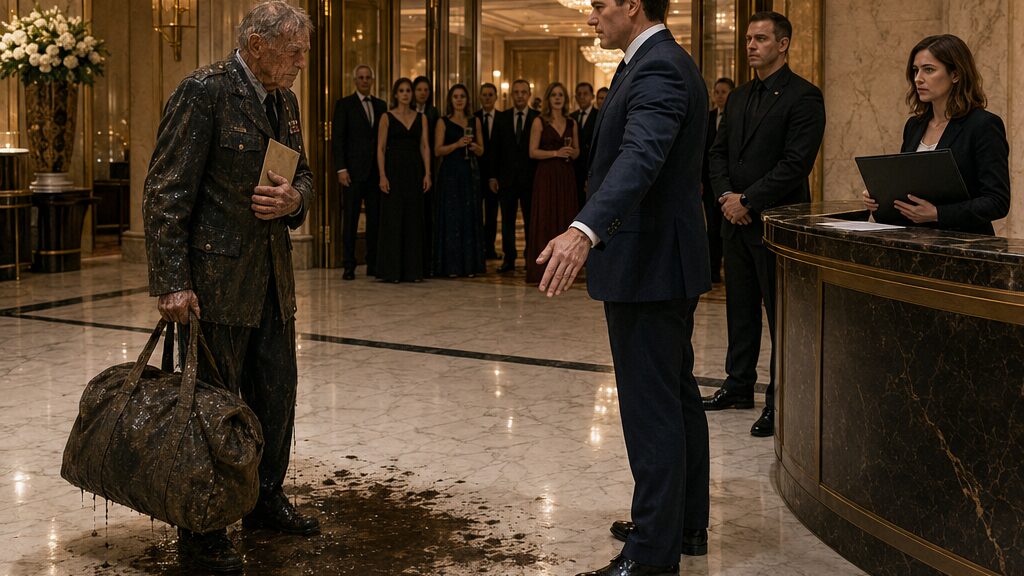
The Muddy Veteran Who Would Not Let Them Read The Letter In The Lobby
Chapter 1: The Mud Reached The Marble First
The duffel bag dripped before Raymond Miller could say his name.
A dark bead slid from the bottom seam, gathered itself fat and heavy, then fell onto the white marble floor of the hotel lobby. Another followed. Then another. By the time Raymond shifted his weight off his bad knee and drew a breath, the water had already carried a thin brown thread of mud across the polished stone.
The front desk clerk looked down first.
Then the man in the navy suit did.
Raymond had known, before stepping through the brass-framed doors, that he would look wrong in this place. The lobby ceiling was high enough to swallow sound. Chandeliers hung over cream walls and gold-edged mirrors. Guests in black dresses and dark jackets moved toward the ballroom with little folded programs in their hands. Somewhere past the reception desk, silverware rang faintly against plates.
He stood near the entrance in an old Army dress jacket gone damp at the shoulders, trousers clinging cold to his legs, shoes leaving half-moons of dirty water behind him. His right hand held the duffel strap. His left hand pressed a sealed envelope flat against the inside of his coat.
The man in the navy suit stepped in front of him.
“Sir,” he said, and the word carried no welcome. “You can’t come through here like that.”
Raymond looked past him toward the ballroom doors. A sign on an easel read Veterans Legacy Banquet in raised silver letters. Below it, in smaller print, were names Raymond did not try to read. His eyes had already found what he needed: a table near the entrance with name cards, folded programs, and a framed photograph of men in uniform from long ago.
“I’m looking for Angela Perez,” Raymond said.
The suited man’s gaze moved over his wet jacket, his mud-darkened cuffs, the old duffel sagging near his shin. “Are you a guest of the hotel?”
“No.”
“Are you checking in?”
“No.”
The man’s mouth tightened. “Then I need you to step outside while we figure out where you’re supposed to be.”
Raymond shifted the duffel higher in his hand. It gave a tired creak. More water fell.
A woman near the front desk drew in a soft breath. A couple stopped on their way to the ballroom. Raymond felt the pause moving outward, one face becoming three, then six. He had been stared at before by people who did not know what to do with age, mud, or silence. He had learned not to answer every stare. Some things only grew when fed.
“My name is Raymond Miller,” he said. “Angela Perez is expecting something.”
“Angela Perez is part of tonight’s program.” The suited man folded his arms now, making himself wider. His name tag caught the chandelier light: Gregory King, Events Manager. “That does not mean anyone can walk into a private banquet carrying—”
He stopped and looked down again.
The stain had spread.
It was no longer a drip. It had become an uneven dark mark, widening between Raymond’s shoes and the front of Gregory’s polished black loafers. Muddy water slipped along the faint veins in the marble as if the floor itself were remembering a crack.
Gregory pointed at it.
“Do you see that?”
Raymond did not answer. He had seen it before Gregory had. He had seen worse things spread on cleaner surfaces.
“Sir,” Gregory said, louder now, because the people near the ballroom were listening, “this is a private event. We have donors arriving, families, honored guests. You are tracking mud through the main lobby.”
Raymond’s fingers tightened on the envelope beneath his coat. The paper was dry. That was what mattered first. The duffel could drip, his jacket could cling, his bad knee could tremble from the walk between bus stop and hotel entrance, but the envelope had stayed dry.
“I need to give this to Angela,” he said.
Gregory’s eyes dropped to Raymond’s coat. “Give what?”
Raymond did not move his hand.
Gregory extended his palm. “Let me see it.”
“No.”
The word came out quiet enough that a nearby guest leaned forward to catch it.
Gregory blinked, surprised less by the refusal than by its firmness. “Excuse me?”
“It isn’t yours.”
A thin silence opened.
The front desk clerk looked from Raymond to Gregory and back again. Behind the desk, a younger woman in a black staff jacket had stopped sorting folders. Her eyes stayed on Raymond longer than the others did, not soft exactly, but uncertain, as if something about his name had touched the edge of memory.
Gregory turned his head without taking his eyes off Raymond. “Could we get security over here, please?”
The word security moved through the lobby faster than Raymond expected. A man in a dark blazer near the hallway straightened and began walking toward them. A guest with a pearl necklace whispered behind her hand. Someone else lifted a phone chest-high, not quite recording, not quite innocent.
Raymond looked at the phone and then at the ballroom doors.
For a moment, he almost said Ronald Johnson’s name.
It rose in him with the taste of old metal and rainwater. Ronald would have laughed at the chandeliers. Ronald would have said, Ray, you look like you lost a fight with a drainage ditch. Ronald would have made the clerk smile before anybody could decide he did not belong.
But Ronald was not there to make anything easier.
Raymond kept the name behind his teeth.
The security guard reached Gregory’s side. He was broad-shouldered, careful-eyed, not eager. That made Raymond look at him twice. Men who were not eager could still do harm, but sometimes they could be reasoned with.
“Everything all right?” the guard asked.
Gregory gestured at the floor. “This gentleman has entered a private event area without confirmation and is refusing to show what he’s carrying.”
Raymond lifted his eyes. “I’m carrying a bag.”
“And something inside your coat,” Gregory said.
The guard looked at Raymond’s left hand.
The envelope seemed suddenly heavier than the duffel.
“It’s a letter,” Raymond said.
“Then show it,” Gregory said.
Raymond shook his head once.
Gregory’s face colored. Not much, but enough. Raymond knew that look too. A younger man with witnesses had been denied obedience, and now the denial mattered more to him than the original problem.
“Sir, you don’t get to stand in the middle of my lobby, damage my floor, refuse a reasonable request, and then expect access to a private event.”
Raymond heard my lobby more sharply than anything else.
The younger woman behind the desk came around with a blue banquet folder hugged to her ribs. “Mr. King,” she said, low but urgent.
Gregory did not turn. “Emily, not now.”
“I think I saw his name.”
Gregory’s shoulders stiffened.
Raymond looked at her fully then. She was young, perhaps early thirties, with a strand of hair loose near her cheek and a staff badge pinned slightly crooked from hurry. She opened the folder against the reception counter, flipping past printed seating charts and sponsor lists.
Gregory stepped toward her. “The guest list is closed.”
“I know,” Emily said. “But there was an addendum from the foundation office. A handwritten one.”
Raymond felt the lobby tilt inward. Handwritten. Not printed. Not official enough for a man like Gregory. Maybe just official enough for the dead.
Guests had stopped pretending not to watch now. Raymond could feel their eyes on his wet collar, his old stripes, the duffel, the spreading stain, the envelope hidden beneath his hand.
Emily turned a page, then another. Her finger paused.
Gregory glanced down, irritated. “What?”
Emily looked from the folder to Raymond.
Her voice changed.
“There’s a note here,” she said. “It says Ray Miller is expected tonight.”
Chapter 2: The Name That Was Almost Erased
Emily Davis found the handwritten note wedged behind the VIP seating chart, as if someone had meant to hide it or save it from being lost and had somehow done both.
The paper was smaller than the others, torn from a yellow legal pad and clipped at an angle. The handwriting was hurried but firm. Ray Miller. Personal delivery before tribute. Angela Perez contact on arrival. Do not discard.
Do not discard.
Emily read that part twice while Gregory King stood close enough to cast a shadow over the folder.
“That is not a registration,” he said.
“It came from the foundation packet.”
“It is not on the printed list.”
“It was clipped to the printed list.”
Gregory reached for the note, but Emily kept her finger on the plastic sleeve. She did not mean to challenge him. Not openly. The movement happened before she thought better of it, and his eyes sharpened when he saw it.
Out in the lobby, Raymond Miller stood where they had left him, near the side corridor now instead of the center of the floor. The security guard had not touched him, but his presence had made a boundary around the old man. Raymond’s duffel rested by his leg on a towel the front desk clerk had placed there after Gregory snapped for housekeeping. The towel was already brown around the edges.
Raymond had not sat down.
That bothered Emily.
Most people, when given a chance to wait, took it. They slumped, complained, demanded water, asked for a manager, pulled out a phone. Raymond stood with one hand at his coat as though the envelope beneath it had a pulse.
Gregory tapped the printed list. “We have donors, honorees, family members, press from the local station, and a foundation representative who expects this to run clean. I cannot admit a man based on a nickname.”
“Ray could be short for Raymond.”
“It could also be anybody.”
“He knew Angela Perez’s name.”
Gregory lowered his voice. “Half the lobby knows Angela Perez’s name. Her father’s photo is on the program table.”
Emily glanced toward the ballroom entrance. Gregory was not entirely wrong. Angela’s family had been mentioned in staff briefing. Ronald Johnson’s photograph was part of the tribute display. The foundation had built the evening around families whose losses had become public service stories. Everything had been rehearsed: entrances, lighting cues, meal service, the order of speakers.
Nothing had included an old man dripping mud on the lobby floor.
Gregory pulled a tablet from the counter and opened the incident log. Emily watched his thumb move too fast.
“What are you doing?”
“Documenting.”
“Before we confirm?”
“Because if we don’t document and someone slips on that floor, or a donor complains, o
Chapter 4: The Bag That Would Not Stop Dripping
The housekeeping supervisor reached for the duffel, and Raymond’s hand closed around the strap so hard his knuckles lost their color.
“I can carry it, sir,” the supervisor said, already bending.
“No.”
The word cracked sharper than he meant it to. Everyone in the service corridor stopped moving.
A laundry cart stood against one wall, stacked with folded white towels. The corridor smelled of detergent, damp wool, floor polish, and the sour earth of Raymond’s bag. Somewhere behind a swinging door, dishes clattered in the kitchen. The formal music from the ballroom came through the wall as a muffled, elegant pulse, as if another world were breathing beside this one.
Raymond forced his fingers to loosen one at a time.
“I’ll carry it,” he said, softer.
The supervisor straightened slowly, offended but cautious. “Mr. King said anything wet has to be bagged and tagged. We can’t have contaminated items near food service.”
“It isn’t contaminated.”
Gregory stood at the corridor entrance with the removal notice still in his hand. “You don’t know that.”
Raymond looked at him. “I know what’s in my own bag.”
“Then you should have no problem allowing staff to inspect it.”
Raymond felt Angela’s gaze on him from near the wall. She had not followed them all the way into the service corridor, but she had come far enough to see the towel beneath the duffel turning dark again. Emily hovered between Gregory and Raymond, still holding the banquet folder as though paperwork might keep people from hurting each other.
The security guard had taken a position by the door. Not blocking Raymond. Not yet. But close.
Raymond looked down at the duffel.
It had been green once. Army green, heavy canvas, brass zipper, Ronald’s last name stenciled in black across one side. Time and water had blurred the letters until JOHNSON looked like something seen through smoke. Mud had dried into the seams and reopened with the rain. The bottom sagged from the things inside, not many, but enough.
A drop fell from the zipper pull onto the towel.
Emily saw the name first.
Her mouth parted slightly. “That says Johnson.”
Angela took a step forward before stopping herself.
Raymond turned the bag so the stenciling faced his leg.
“That was my father’s?” Angela asked.
Raymond did not answer fast enough.
Her face tightened. “You had his bag?”
“I had some of his things.”
“For thirty-six years?”
The corridor seemed too narrow for the question.
Raymond bent slowly, ignoring the pull in his back, and lifted the duffel onto the laundry cart himself. The cart wheels squeaked under the sudden weight. “Not all that time in this bag.”
Gregory seized on the gap. “Where did it come from tonight?”
Raymond kept one hand on the canvas. “Veterans storage room across town. Basement level. Place flooded this morning.”
Emily frowned. “The foundation storage facility?”
Raymond nodded.
Gregory looked at her sharply. “You knew about a flood?”
“I got one email this afternoon,” Emily said. “It said some archives had water damage. I thought the foundation was handling it.”
“They were,” Raymond said. “Badly.”
That drew every eye back to him.
He did not regret saying it, though he had not meant to say it aloud. A little anger had escaped. Not at these people. At himself. At the soaked cardboard boxes stacked along concrete walls that morning. At the young volunteers who had not known which old papers mattered because no one had told them every scrap of a life mattered to somebody. At his own hands, too slow now, shaking as he lifted Ronald’s things out of brown water.
Emily stepped closer. “You went there today?”
“I was called.”
“By who?”
Raymond wiped a smear of mud from the zipper with his thumb. “A volunteer found my number taped inside an old inventory lid. Said if anything happened to Box R.J., call Ray Miller.”
Angela’s eyes flickered.
“Box R.J.,” she repeated.
Raymond nodded.
“Why would your number be in my father’s storage box?”
He looked at the duffel instead of her. “Because I put it there.”
The sentence changed the air.
Gregory glanced down the corridor toward the lobby, where guests were still arriving. He checked his watch. “This is not the place to unpack a storage dispute.”
“It’s not a dispute,” Emily said.
“It is an uncontrolled situation involving damaged property, a guest family, and a man already refusing staff direction.”
Raymond ran his hand over the top of the duffel. Mud lined the wrinkles of his skin. He had washed twice at the storage facility sink before coming, but the dirt had stayed around his nails, in the seams, in the places old hands did not easily surrender.
Emily reached toward the zipper, then stopped. “May I?”
Raymond looked at Angela.
Angela’s arms were folded, but not like Gregory’s. Hers were holding herself together.
Raymond unzipped the bag only a few inches.
A smell came out first: wet canvas, old paper, mildew, and something faintly metallic from aging buckles. He parted the opening enough for Emily to see the top layer.
An old field jacket lay folded inside, darker where water had touched it. A wrapped packet of letters sat beneath it, sealed in plastic that had fogged from damp. There was a small Bible with swollen pages, a rolled cloth bundle tied with cord, and a dented metal cup wrapped in a towel.
Emily’s expression changed.
Not solved. Not relieved. Just quiet.
Angela moved close enough to see the jacket.
Her hand rose to her mouth, then fell. “My mother said he had a jacket with a torn cuff.”
Raymond looked down. The left cuff was there, frayed where shrapnel had cut cloth instead of skin one week before the day that mattered.
“He did,” Raymond said.
Angela stared at the jacket as if it might accuse her too.
The supervisor, chastened now, brought more towels without being asked. Raymond accepted one. That was harder than refusing the first offer had been. He laid it over the open duffel gently, covering Ronald’s things from the corridor light.
Gregory’s phone vibrated.
He glanced at the screen, and his face tightened in a new way.
“What is it?” Emily asked.
Gregory did not answer her. He turned the phone slightly toward himself, but Raymond saw enough: a photo taken from across the lobby. Himself in wet uniform. Gregory pointing at the floor. The dark stain between them like evidence.
Below the photo, text was already gathering in a private banquet message thread.
Who is this man?
Is he part of the program?
Did security let him in?
Gregory’s thumb moved fast over the screen.
Emily saw his expression. “Is that from the guests?”
Gregory lowered the phone. “It’s nothing that can’t be contained.”
Angela looked at him. “Contained?”
Gregory’s patience snapped thin. “Ms. Perez, with respect, your father’s tribute begins in twenty minutes. The foundation expects a clean program. Donors are asking questions. If this photograph spreads beyond the room, the hotel becomes the story instead of Ronald Johnson.”
Raymond heard Ronald’s full name in Gregory’s mouth and felt the envelope press against his ribs.
Angela’s eyes sharpened. “My father is not a program.”
“No,” Gregory said, forcing control back into his voice. “But tonight has been planned for months. And right now, the first thing people are seeing when they walk in is that.”
He pointed toward the lobby, where the stain had been.
Raymond did not look. He knew the gesture. He had already stood inside it once tonight.
Emily did look, and her face fell.
“They’re still cleaning it,” she said.
Raymond closed the duffel and took the towel from the supervisor. “I’ll go.”
Angela turned to him. “That’s it?”
“No,” he said. “But I won’t have Ronald’s name used for a fight in a hallway.”
The anger in Angela’s face faltered again, and it hurt him worse than if she had shouted.
He lifted the duffel from the cart before anyone could stop him. The weight pulled his shoulder down. His knee buckled, just a little. The security guard moved forward by instinct, then stopped when Raymond found his balance.
Gregory watched the movement, and for the first time a trace of uncertainty crossed his face. It did not last.
He stepped into the lobby and spoke into his phone, voice low and clipped.
Raymond heard only part of it.
“Yes. Before the donor speech. Quietly, if possible. No, he cannot remain visible.”
Emily followed Gregory a few steps, then turned back with the banquet folder clutched to her chest. Her eyes went to the duffel, then to the envelope beneath Raymond’s coat.
“I’ll find out who wrote that note,” she said.
Raymond nodded.
Angela looked at the covered bag. “What else of my father’s is in there?”
Raymond’s hand tightened on the strap.
The true answer was not much. A jacket. Letters. A few pocket things. A cup. The Bible Ronald kept because his mother had given it to him. And one small object Raymond had never managed to send back because returning it felt like admitting the rest of the man was gone.
He could not say that yet.
Gregory’s voice came from the lobby, harder now.
“Make sure security understands. He leaves before the donor speech starts.”
Chapter 5: When The Banquet Needed A Clean Story
Gregory King saw the photo on three different phones before the first salad plates reached the ballroom.
In one version, Raymond Miller looked smaller than he had in person, hunched beneath the chandelier light with the duffel hanging from his hand. In another, Gregory himself appeared with one arm extended toward the floor, finger aimed at the muddy stain. The angle made it look worse than it had felt while happening. Not inaccurate, exactly. Just stripped of all the reasons Gregory had believed he was right.
A donor’s wife whispered near the ballroom entrance, “Is he part of the tribute?”
A man in a tuxedo answered, “I thought he was being removed.”
Gregory kept walking.
He had learned early in hotel work that embarrassment moved faster than service. A delayed appetizer could be repaired. A broken microphone could be replaced. But once guests began telling each other a story, the hotel lost control of the evening. And tonight was not a wedding where family drama could be hidden behind music. It was a veterans legacy banquet with local cameras, donors, foundation board members, and families who expected reverence.
A reverent evening did not include mud on marble.
The hotel owner stood beside the manager’s station near the ballroom service door, holding a folded program like a warning.
“What happened in the lobby?” the owner asked.
“We have an unconfirmed individual claiming a connection to the Johnson family.”
“The old veteran in the photo?”
Gregory kept his voice even. “His registration is irregular.”
“He looks like he slept in a ditch.”
“He says a storage facility flooded.”
The owner closed his eyes briefly. “Please tell me he is not going into that ballroom.”
“I’m handling it.”
“That foundation contract is three years of annual events, Gregory. Three. Years. They are already nervous about moving from the memorial hall to a hotel. They think places like this care more about donors than families.” He opened his eyes. “Do not prove them right in front of cameras.”
Gregory felt the unfairness of that settle under his collar. He had arrived before sunrise. He had personally checked the ramp access, meal restrictions, tribute lighting, microphone height for elderly speakers, quiet room seating, and the framed photos. He cared. That was the thing no one saw. He cared so much that disorder felt like disrespect.
“I’ll keep it quiet,” he said.
“Quiet is good. Invisible is better.”
The owner moved away before Gregory could answer.
For a moment, Gregory watched through the ballroom doors as Angela Perez stood near the front table, speaking with the veterans foundation representative. Her smile was composed, but her hands were too still around her program. Behind her, on a large display, Ronald Johnson’s photograph waited under soft light. The printed story beneath it was clean: service, sacrifice, family, legacy.
There was no room in it for Raymond Miller and his dripping bag.
Gregory returned to the side corridor. Raymond was standing near the service laundry room with Emily and Angela several feet away. The duffel had been wrapped in two towels now, but moisture still worked through the white cotton in ugly patches. Raymond looked tired enough to fold, yet when Gregory approached, the old man straightened.
That made Gregory dislike him more than he wanted to admit.
Pride in the wrong place created problems.
“Mr. Miller,” Gregory said, “I’ve arranged a private room near the service exit. We can provide a meal, dry towels, and transportation wherever you need to go after Ms. Davis contacts the foundation.”
Emily’s head turned sharply. “Transportation?”
Gregory did not look at her. “You will not be asked to stand outside. But you cannot enter the ballroom tonight.”
Angela stepped forward. “You don’t decide that.”
“With respect, Ms. Perez, until the foundation verifies his role, I am responsible for guest access.”
“He has my father’s belongings.”
“And that is exactly why this needs to be handled privately.”
The word privately landed between them with two different meanings.
Raymond looked at the service hallway behind Gregory. Beyond it were swinging kitchen doors, rubber mats, stacked crates, a route built for carts and staff and things guests were not meant to see.
“I came through the front door,” Raymond said.
“Yes,” Gregory replied. “And now I am offering you a more appropriate place to wait.”
Raymond’s eyes moved past him to the lobby, then the ballroom. “Appropriate for who?”
Gregory felt Emily’s gaze on him. The question was simple enough to sound innocent and pointed enough to irritate.
“For the event,” he said.
“For the floor?”
Gregory’s jaw tightened. “For everyone.”
Raymond adjusted his grip on the duffel. “Not for me.”
Gregory lowered his voice. “Mr. Miller, I am trying to give you a respectful option.”
Raymond looked at the towels wrapped around Ronald’s bag. “No. You’re trying to make me disappear without calling it that.”
Emily looked down.
That stung because it was too close to true.
Gregory glanced toward Angela, expecting support from someone who clearly did not want Raymond there either. But Angela was watching Raymond now with a different kind of anger, one complicated by the jacket in the duffel and the envelope she had refused.
“I don’t want a scene,” Angela said.
“Neither do I,” Gregory replied.
She looked at him. “That doesn’t mean he goes out the service door.”
Before Gregory could answer, the foundation representative appeared at the corridor entrance. She carried a stack of cue cards and wore the expression of someone who had been looking for Angela and found a problem instead.
“We’re five minutes from opening remarks,” she said. “Angela, they’re ready for you after the first welcome.”
Angela nodded but did not move.
The representative’s eyes went to Raymond. She paused. “Are you Mr. Miller?”
Gregory’s shoulders tightened.
Raymond nodded once.
The representative frowned, searching memory. “Ray Miller?”
Emily moved instantly. “You know the name?”
“Only from an old donor card.” The representative shifted the cue cards to one hand. “Ronald Johnson’s file had a note in it. Something about a personal delivery. I thought it had been resolved years ago.”
Angela’s face went pale in a way grief sometimes made people pale, as if blood had gone inward to protect something.
“What donor card?” she asked.
The representative looked from Angela to Gregory, suddenly aware she had stepped into something deeper than scheduling. “It was in your father’s archive packet. Not part of tonight’s public display.”
Gregory felt the evening slipping further out of his control. “Can we review this after the program?”
“No,” Angela said.
The representative hesitated. “I can get the card.”
Emily was already moving. “Where?”
“Foundation box behind the check-in table.”
Gregory caught Emily’s arm lightly as she passed. “We are not pulling archive materials in the middle of opening remarks.”
Emily looked at his hand on her sleeve.
He released it.
Her voice was quiet. “Then don’t.”
She went anyway.
Gregory watched her disappear toward the check-in area, then turned back to find Raymond watching him without triumph. That bothered him most. If Raymond had smirked, argued, performed wounded dignity for the witnesses, Gregory could have placed him somewhere in his mind. Difficult guest. Manipulative guest. Liability.
But Raymond only stood there, muddy and exhausted, as if refusing to help Gregory dislike him.
The ballroom microphone gave a soft pop. A voice welcomed guests to take their seats.
Angela did not move.
“Ms. Perez,” the representative said gently. “They need you inside.”
Angela’s eyes stayed on Raymond. “Did my father ask for him?”
Raymond’s mouth tightened.
The representative said, “The card may say.”
Gregory looked toward the lobby. The housekeeper had finished with the marble. Under the chandelier light, the floor looked clean from a distance. But when Gregory shifted, he could still see a faint dull patch where the mud had been, a shadow in the shine.
Emily returned carrying a small archival card in a protective sleeve.
She was breathing faster than the short walk required.
“It was behind Ronald Johnson’s donor biography,” she said.
The representative reached for it, but Emily looked first at Angela, then at Raymond.
“What does it say?” Angela asked.
Emily swallowed.
“Ronald requested that no public tribute be completed until Ray Miller delivered what he carried for the family.”
The ballroom applause began for the opening welcome, bright and distant.
Angela stared at the card as though the past had just reached through the hotel wall.
Chapter 6: The Man Who Would Not Use The Letter As A Weapon
“The letter would stop this right now,” Emily said.
Raymond looked at the sealed envelope lying on the folded towel between them and did not touch it.
They had put him in the green room beside the ballroom, not the service exit. Angela had insisted, the foundation representative had gone silent in a way that favored no one, and Gregory had accepted the compromise with the expression of a man swallowing broken glass. The room was small, with a sofa no one sat on, a mirror rimmed with lights, a rack of unused banquet coats, and a side table where Emily had placed the towel.
The duffel sat on the floor beneath the table, wrapped but still damp.
Through the wall came the opening speech, softened into rhythm and applause.
Emily stood across from Raymond, the old donor card in one hand and the banquet folder in the other. She looked younger now than she had in the lobby, or maybe only less certain. Certainty aged people fast in a place like this.
“If Angela reads it,” she said, “Gregory can’t call you disruptive. The foundation will have to recognize you. Everyone will know you were supposed to be here.”
Raymond kept his eyes on the envelope.
“That’s not what it’s for.”
“What if it protects you?”
“It wasn’t written for that either.”
Emily lowered the folder. “Mr. Miller, he’s still trying to have you escorted out. The only thing stopping him is that card.”
Raymond glanced toward the door. Gregory’s shadow passed once across the frosted glass, paused, then moved on.
“I know.”
“And you’re just going to wait?”
“I’ve done worse things than wait.”
The sentence quieted her.
Raymond regretted it. Not because it was false, but because it sounded like an answer when it was only a door he did not want opened.
He sat at last, not because he wanted to, but because his knee had begun trembling beneath his weight. The chair was too low, the cushion too soft. He felt trapped by comfort. Across from him, the mirror reflected an old man in a damp uniform jacket with mud dried at the cuffs and a face that looked more like his father’s than his own.
Emily placed the donor card beside the envelope. “Ronald Johnson trusted you.”
Raymond laughed softly once. It was a dry, broken sound. “Yes.”
“You say that like it hurts.”
“It should.”
Emily did not press him. That made the silence worse.
Raymond reached inside his coat and took out a small packet bound with an old rubber band. The paper edges were worn soft. Emily watched as he set it beside the towel.
“What are those?”
“Letters I wrote.”
“To Angela?”
He nodded.
“But never sent.”
“No.”
“How many?”
“Enough to make a coward look busy.”
Emily’s face changed at that. She did not know what to do with an old man who named his own failing before anyone else could. Neither did Raymond. For years he had called it patience, respect, timing. He had told himself Angela’s mother deserved peace, then that Angela deserved a better day, then that an old wound should not be reopened by a stranger. Each reason had been partly true, and none of them had been clean.
The microphone beyond the wall rose in volume.
The foundation representative was speaking now about legacy, duty, families who carried memory forward. The words were not wrong. They were only too polished for what memory actually did to a person. Memory did not sit framed on easels. It soaked through boxes in a basement. It left mud in the lines of your hand. It waited on hotel tables in envelopes nobody wanted to open.
The door opened.
Angela stepped in without knocking.
Emily straightened. “Ms. Perez.”
Angela’s eyes went first to the envelope, then to the packet of unsent letters.
“What are those?” she asked.
Raymond covered them with his palm, too late.
“Things I should have mailed.”
Angela closed the door behind her. The applause from the ballroom dulled.
“How long?” she asked.
Raymond did not pretend not to understand. “Years.”
“How many years?”
“First one was the year after your mother’s second letter.”
Angela took the answer like a slap she had expected and still could not absorb. “You wrote back and kept it?”
“I wrote. I didn’t send.”
“Why?”
He looked at her hands. They were gripping her folded program hard enough to bend it.
“Because the first letter explained too much and not enough. The second one asked forgiveness like I had a right to ask. The third sounded like a report. After that, I kept thinking I’d find the right words.”
“My mother needed any words.”
“I know.”
“No.” Angela stepped closer. “You don’t get to say that softly and make it decent. She waited by the mailbox after she pretended she stopped waiting.”
Raymond closed his eyes for half a second.
There it was. Not Gregory pointing at mud. Not guests staring. This was the stain he had carried in cleaner rooms than this one.
“When Ronald gave me that envelope,” he said, “he asked me not to let anybody make his death into blame. Not the Army. Not his family. Not me. He knew what grief does when it needs a target.”
Angela’s voice trembled. “So you decided the target would be nobody?”
“No.” Raymond opened his eyes. “I decided it would be me. Then I hid from that too.”
Emily looked down at the donor card.
Angela’s anger shifted. It did not leave. It became less certain of its own shape.
“Were you with him?” she asked.
“Yes.”
“When he died?”
Raymond’s hand moved to the envelope, then stopped short of touching it. “Near enough.”
“That is not enough.”
“I know.”
“Then say it.”
The command was quiet.
Raymond looked at the sealed letter. He could feel Ronald’s hand under his, not in memory’s gentle way, but in the hard, practical way of that day: Raymond pressing paper against a crate, Ronald’s fingers cold and stubborn around the pencil, both of them pretending the medics were wrong because pretending gave Ronald five more minutes of being a father.
“He was awake,” Raymond said. “He knew what he was asking.”
Angela’s breath caught.
“He said your name first. Then your mother’s. Then mine, because I was the only one close enough to hear him.”
Angela turned away, one hand over her mouth.
Raymond did not follow the movement. He kept his gaze on the towel. “He made me promise to bring the letter myself. Not mail it. Not give it to an officer. Me.”
“Then why didn’t you?”
Because he had come home to a country that thanked him at the airport and did not know what to do with him after. Because the first week he woke hearing Ronald try to breathe. Because by the time he found Angela’s mother’s address, he had convinced himself that arriving would only make her lose Ronald twice. Because every year made the promise heavier and his courage smaller.
Raymond said the least cowardly part first.
“I was ashamed.”
Angela turned back.
“I was ashamed I lived long enough to carry it,” he said. “Then I was ashamed I waited. After that, shame became the only thing I had practiced.”
Angela looked at him for a long time.
The ballroom host’s voice came through the wall, clear enough now to hear Angela’s name.
“And now, to speak on behalf of the Johnson family legacy…”
Angela looked toward the door.
Emily stepped forward. “You don’t have to go out there this second. I can ask them to wait.”
Angela’s face hardened again, but not at Raymond this time. At the timing. At the room full of people expecting her grief to walk on cue.
Gregory appeared at the door before she could answer. He knocked once while opening it, which made the knock useless.
“Ms. Perez, they’re calling you.” His eyes moved to Raymond, then the envelope on the towel. “Mr. Miller, security is waiting in the corridor. We need to resolve this now.”
Emily moved between the table and Gregory. “The donor card confirms—”
“The donor card confirms an unresolved archive note,” Gregory said. “Not permission for him to remain during the program.”
Angela reached for the envelope.
Raymond’s heart slammed once, hard.
Her fingers hovered above the sealed edge. She looked at him, and for the first time her anger was not the only thing in her face.
“If I read this,” she said, “I read it for my father. Not for you.”
Raymond nodded. “That’s how it should be.”
Gregory stepped into the room. The security guard’s shape appeared behind him in the hall.
Angela broke the seal just as Gregory said, “Mr. Miller, it’s time to leave.”
Chapter 7: The Stain Everyone Tried To Polish Away
Gregory reached Raymond at the ballroom threshold just as Angela stepped out with the opened letter shaking in her hand.
The security guard stopped behind Gregory, close enough that Raymond could hear the soft scrape of his shoe on the marble. Inside the ballroom, a hundred faces were turned toward the empty space where Angela should have been speaking. The host stood near the microphone, smiling too long, buying seconds with both hands folded over his cue cards.
“Mr. Miller,” Gregory said, “you need to come with us now.”
Raymond did not move.
Angela looked down at the letter again. Her lips moved once, not speaking, only trying to hold shape around words that had traveled too far and waited too long. The envelope lay open against her program. Ronald Johnson’s handwriting covered the old page in uneven lines, darker in some places where the pencil had pressed harder.
Gregory lowered his voice. “This has gone on long enough.”
Raymond looked past him toward the lobby.
The floor had been polished. The towels were gone. The housekeeper had cleared away the bucket and spray bottle. From a distance, the marble shone again beneath the chandelier, smooth and white and expensive.
But near the place where Raymond had stood, a faint dull shadow remained. It was not brown anymore. Not really. It was a blur in the shine, visible only when the light hit from the side. The kind of mark a person could ignore if ignoring it mattered enough.
Angela saw him looking.
Then she looked too.
Something in her face changed.
Gregory followed their gaze and frowned as if the floor had betrayed him by remembering.
“Ms. Perez,” he said carefully, “the room is waiting.”
Angela folded the letter once, then unfolded it again. Her fingers had become unsteady. “They can wait another minute.”
“The program—”
“My father waited thirty-six years,” she said.
The words did not rise. They did not have to. They crossed the threshold into the ballroom, and the first row heard them. A woman near the front table turned. The foundation representative stood halfway between the stage and the door, frozen with one hand on the back of a chair.
Raymond felt the situation tipping toward something he had feared from the moment he stepped inside. A public reckoning. A room hungry to know who had wronged whom. A dead man’s words becoming ammunition.
He took one step toward Angela.
His knee protested. The duffel pulled his shoulder. Still, he moved.
“Angela,” he said.
She looked at him.
“Don’t.”
Her eyes filled, but anger held them open. “Don’t what?”
“Don’t make him do this in front of strangers.”
Gregory stared at him, confused by the rescue.
Angela’s mouth tightened. “You think I’m protecting him?”
“No.” Raymond glanced at Gregory, then back to her. “I think you’re hurting enough to use the nearest man who deserves some of it.”
Gregory went still.
Emily, standing just inside the green room doorway, drew in a small breath.
Angela looked down at the letter. “You don’t know what he deserves.”
“I know what I deserve.”
That quieted her.
The ballroom had gone fully silent now. The host no longer pretended. Phones lowered and lifted. Chairs creaked. The framed photograph of Ronald Johnson stood on the display table under warm light, his young face looking past them all with the careless certainty of a man whose picture had not yet learned grief.
Angela turned toward the ballroom.
Raymond knew, before she spoke, that he could not stop everything. Some truths, once unsealed, had to breathe.
She walked three steps inside, not to the microphone, not to the stage, only far enough that the front tables could see the letter in her hand.
“My father wrote this before he died,” she said.
No one moved.
Angela’s voice thinned, then steadied. “I’m not reading all of it.”
Raymond closed his eyes briefly in gratitude so sharp it hurt.
Angela looked at the page and read one line.
“I trust Ray with what I cannot carry home myself.”
A sound moved through the ballroom, not applause, not a gasp exactly, but the collective shift of people having to rearrange what they thought they had seen. Faces turned toward Raymond. Some softened. Some looked ashamed too quickly, as if wanting credit for changing sides.
Raymond did not want their faces.
He looked at the floor instead.
Gregory looked at the letter, then at Raymond’s duffel, then at the faint shadow on the marble. His mouth opened once and closed. For the first time all evening, he seemed without a procedure.
Angela folded the letter carefully. “He also asked that his family not turn grief into blame.”
Her voice almost failed on the last word.
Raymond felt the sentence pass through him. He had known it was there. He had read Ronald’s version once, decades ago, before sealing it again and telling himself he had only read enough to confirm its owner. But hearing Ronald’s daughter speak it aloud made the shame in him shift. Not disappear. Shame did not vanish because a sentence arrived. But it moved from hiding place to daylight.
Angela turned back to him.
“You should have brought it.”
“Yes,” Raymond said.
“You should have answered my mother.”
“Yes.”
“You let her think things.”
“Yes.”
The room held each answer.
Raymond did not dress them up. He did not explain the hospital, the orders, the nightmares, the way he had driven twice to Angela’s childhood street and kept going because a girl on the sidewalk had laughed and he had not been able to make his body stop the car. Those things were true, but they were not a defense against a woman waiting at a mailbox.
Angela’s face broke for the first time, not completely, just enough that the daughter showed through the speaker’s dress and the banquet lighting. “Did he suffer?”
Raymond heard every person in the ballroom stop breathing around the question.
He would not answer that for them.
He stepped closer and lowered his voice. “That belongs to you, not this room.”
Angela stared at him. Then, slowly, she nodded.
Gregory shifted behind him. “Ms. Perez, I’m sorry, but we still need to—”
Raymond turned.
The movement was slow, but it stopped Gregory more effectively than any shout could have. Raymond saw the manager as he had not allowed himself to see him before: young, tired around the eyes, trapped inside a suit cut to make authority look effortless. A man afraid of a ruined evening, a ruined contract, a ruined career. A man who had turned fear into control and control into disrespect.
“You were wrong,” Raymond said.
Gregory’s face flushed. “Mr. Miller—”
“You were wrong,” Raymond repeated, still quiet. “But I’m not going to hand you this room’s anger so I can feel clean.”
Gregory looked toward the watching guests. Some were waiting for him to be punished. Raymond could feel it. Outrage wanted a neat place to land.
Raymond would not give it one.
“You pointed at the floor,” Raymond said. “You looked at my bag. You looked at my coat. You decided all that told you enough.”
Gregory swallowed.
“It didn’t.”
“No,” Gregory said. The word came out rougher than he intended. “It didn’t.”
Angela looked from Gregory to Raymond, and Raymond could see her wanting to speak, wanting to make the room understand what had been done. He shook his head once.
Not to silence her. To ask her not to turn her father’s letter into a weapon he had specifically refused to leave behind.
She looked down at the folded page in her hand and understood enough to stop.
Gregory drew a breath. “I owe you an apology.”
Raymond adjusted the duffel strap on his shoulder. The damp canvas dragged at his uniform. “An apology is easy after witnesses arrive.”
The words struck Gregory harder than any accusation.
Raymond looked toward the front doors, beyond the place where the stain had been. “It means something if the next old man comes through the front door and you don’t make him prove he belongs by bleeding his whole life onto your floor.”
No one applauded.
That was good.
Raymond did not want applause. He wanted the room to sit with the silence after the sentence. He wanted Gregory to feel it without being crushed by it. He wanted Angela to hold her father’s letter without turning it into a public blade. He wanted Ronald’s name to survive the evening without becoming another polished story cleaned of mud.
Gregory looked at the faint mark on the marble.
Then he looked at Raymond.
“I understand,” he said, and this time he sounded afraid that he might not yet, but willing to begin.
Angela moved to Raymond’s side. She did not touch him. Not yet.
“The letter says he wanted you to tell me the rest,” she said.
Raymond felt his throat tighten.
“I will,” he said. “Not at the microphone.”
Angela nodded.
The host remained by the stage, useless cue cards in hand. The foundation representative wiped under one eye and pretended she had not. Emily stood near the green room door, the folder lowered at her side.
Raymond turned away from the ballroom before the room could decide what kind of ending it wanted.
At the threshold, Gregory stepped aside.
The movement was small. Not enough to repair the evening. Not enough to erase the incident report, the pointing finger, the stain, the old humiliation of being weighed by appearance and found inconvenient.
But it was the first thing Gregory had done all night that made room instead of taking it.
Raymond stopped beside him.
“Tomorrow morning,” Raymond said, “I want to see what changes.”
Gregory looked at him. “What changes?”
Raymond met his eyes. “That’s what you have to decide before I come back through that door.”
Chapter 8: The Front Door Stayed Open Longer
Gregory King was waiting in the lobby the next morning without his arms crossed.
Raymond noticed that first.
The second thing he noticed was the front door. One brass-framed panel stood open though the morning air was cool enough to make the chandelier crystals tremble faintly overhead. A bellman held it for an elderly couple moving slowly from a taxi, and no one hurried them. Their luggage was scuffed. The woman’s cane clicked unevenly against the marble. The bellman smiled and waited as if waiting were part of the job, not a favor.
Raymond stood outside for a moment with Ronald’s duffel in his hand.
It was lighter now.
Not by much. Angela had taken the letters, the Bible, the field jacket with the torn cuff, and the metal cup wrapped in a fresh towel. The sealed letter was no longer sealed. It rested in Angela’s purse upstairs, folded with care after a night of reading only what she could bear. Raymond still carried the duffel because Angela had asked him to bring it down. There was one item left inside, and she had not yet told him what she wanted done with it.
The marble where he had dripped mud had been cleaned again.
Under the daylight, there was no visible stain.
That should have pleased everyone.
Gregory stood near the spot anyway, looking at it as if he could still see what the polish had hidden. His suit was dark gray today, less formal than the navy one from the night before. His name tag was pinned straight. His face looked as if he had not slept much.
Raymond stepped inside.
Gregory did not move to block him.
“Mr. Miller,” he said.
“Mr. King.”
The greeting sat between them, plain and undecorated.
Emily stood behind the front desk with a folder open in front of her. She looked tired too, but when she saw Raymond, her shoulders eased. The security guard was there as well, near the wall, speaking quietly with the front desk clerk. No one stared. Or rather, they noticed and then chose not to turn noticing into a scene.
Gregory held out a single page.
Raymond did not take it immediately.
“What is it?”
“Guest access procedure,” Gregory said. “Temporary until ownership approves the permanent version. But active as of this morning.”
Raymond looked at the page.
The top line read: Unconfirmed Elderly, Disabled, Veteran, Or Distressed Guest Arrival Protocol.
He read slowly. Not because he could not understand it, but because he wanted Gregory to stand there while he did.
Offer seating before questioning.
Ask name and purpose privately when possible.
Do not require disclosure of private documents in public lobby.
Contact event liaison before removal unless immediate safety risk exists.
Preserve dignity.
Raymond’s eyes stopped on the last two words.
They did not fix everything. Words on paper never did by themselves. He knew enough about institutions to know a page could be displayed, ignored, filed, forgotten, rewritten after the next inconvenience. But the page existed. Emily’s initials were in the corner as preparer. Gregory’s signature was at the bottom.
Raymond handed it back.
“That last line,” he said. “Keep it where people can see it.”
Gregory nodded. “I will.”
“Not in a binder.”
“No,” Gregory said. “Not in a binder.”
The apology came after that, not before. Raymond respected him a little for the order of it.
“I am sorry,” Gregory said. “For the way I spoke to you. For pointing at the floor. For making a private burden public before I understood anything about it.”
Raymond looked toward the front doors, where the elderly couple had reached the reception desk. Emily came around to greet them herself, not loudly, not performatively. She offered the woman a chair before asking for the reservation name.
Gregory saw Raymond watching.
“I thought control was respect,” Gregory said. “Last night I used it as cover.”
Raymond rested both hands on the duffel handle. “You were scared.”
Gregory’s mouth tightened. “That doesn’t excuse it.”
“No.”
“I keep thinking about the photo,” Gregory said. “How it looked.”
“How it looked wasn’t the worst of it.”
“I know.”
Raymond studied him. “Do you?”
Gregory’s eyes moved to the clean marble. “I think I’m starting to.”
That was all Raymond had wanted from him this morning. Not a speech. Not a performance in front of guests. A beginning that cost him something because it required him to look at what he had done without making himself the center of forgiveness.
The elevator opened.
Angela stepped out wearing the same green dress beneath a dark coat. Her hair was pinned back less neatly than the night before. Grief had loosened something in her face. Not softened it exactly. Made it more human, less arranged for public handling.
She carried Ronald’s field jacket over one arm.
Raymond’s grip tightened around the duffel.
Gregory stepped back at once, giving her space. That, too, Raymond noticed.
Angela came to him but did not speak immediately. She looked at the open front door, the page in Gregory’s hand, Emily helping the elderly couple at the desk. Then she looked down at the duffel.
“I found something in the inside pocket,” she said.
Raymond already knew.
He had known from the way she held the jacket. From the carefulness in her fingers. From the fact that she had not come down empty-handed.
Angela reached into the pocket and took out a small cloth patch, faded almost gray at the edges. It had been Ronald’s unit patch once, removed from a torn sleeve and tucked away. Raymond had kept it after the field hospital because Ronald had closed his fingers around it and said, not for the uniform, Ray. For the girl. So she knows I belonged somewhere, but not more than I belonged home.
Angela held it out.
Raymond did not take it.
“That’s yours,” he said.
“My father wanted me to have the letter.” Her voice trembled, but she did not look away. “The jacket too. The Bible. The cup. Those were pieces of him I can understand.”
Raymond looked at the patch in her palm.
Angela’s fingers curled slightly around it. “This one feels like it belongs to the part of him that knew you.”
The lobby moved around them in quiet morning rhythms: wheels over marble, low voices at the desk, the distant hiss of the coffee machine from the lounge. No one announced the moment. No one framed it.
“I kept too much,” Raymond said.
“Yes,” Angela answered.
The honesty of it stung, then settled.
“But maybe not this,” she said.
Raymond looked at her then.
Angela’s eyes were wet. “I don’t forgive thirty-six years because one letter asked me to be merciful. I can’t do that by morning.”
“I wouldn’t ask you to.”
“I know.” She swallowed. “That’s why I’m giving this to you.”
He took the patch.
It weighed almost nothing. That was the cruelty of small things. They could carry what bodies could not.
Angela folded the field jacket over her arm. “Will you tell me the rest sometime?”
Raymond looked at the open door. Sunlight lay across the entrance where rain and mud had come in the night before.
“Yes,” he said. “But I’ll tell it plainly.”
“No polishing?”
His eyes went to the clean marble.
“No polishing.”
For the first time, Angela almost smiled. It did not last, but it had existed.
Gregory walked to the front door before Raymond moved. He opened it wider and held it there. Not with ceremony. Not with a flourish. Just with one hand on the brass handle, looking at Raymond as a man waiting to do correctly what he had done wrongly before.
Raymond adjusted the emptying duffel on his shoulder.
Emily gave him a small nod from the desk.
The security guard nodded too.
Angela stood beside the faint place where the stain had been, holding her father’s jacket. She was not healed. Neither was Raymond. Healing, he thought, was another word people polished too quickly. Some things did not become clean. They became bearable because someone finally stopped pretending there had never been a mark.
At the threshold, Raymond paused beside Gregory.
“You don’t have to hold it for me,” he said.
“I know,” Gregory replied.
Raymond looked at the open door, then at the young manager’s uncrossed arms.
He stepped through the front entrance slowly, not hidden, not hurried, not escorted out through a service hallway. Behind him, the door stayed open long enough for the next guest to enter without touching it.
The story has ended.