When The Old Army Medic Sat Alone With A Tray, They Misread Her Silence
Chapter 1: The Table Went Quiet Before She Looked Up
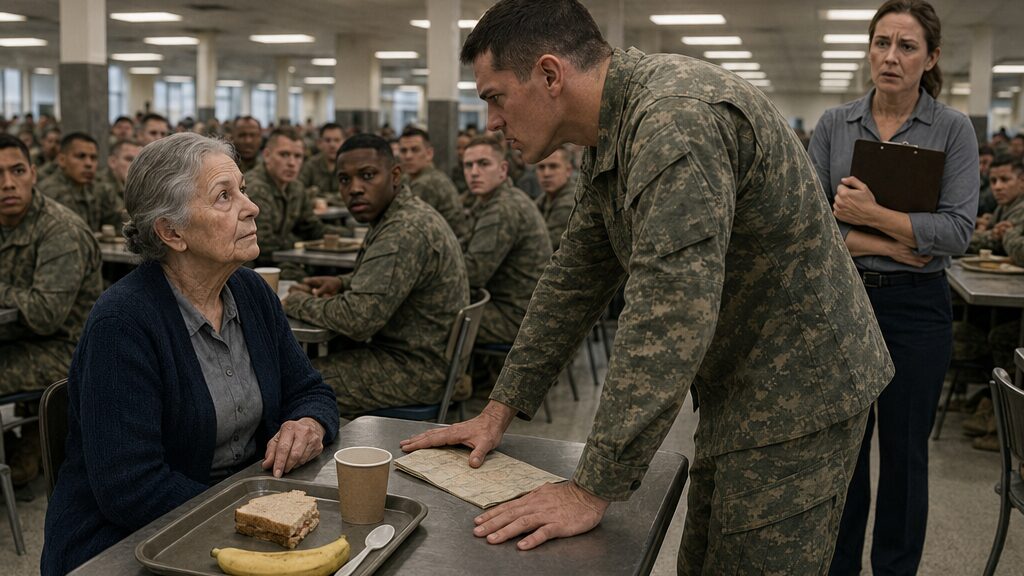
Patrick Lee’s palm came down on Deborah Thompson’s table before she had lifted the paper cup to her mouth.
The cup trembled once against the tray. A pale ring of coffee shook against the rim. Deborah kept her fingers around it, not tightly, not defensively, only steady enough that no one watching could say she had startled.
The dining hall at Fort Rell usually had its own rhythm at noon: boots scraping under metal tables, trays sliding along rails, young voices trying to sound older than they were, someone laughing too hard near the soda machine. That rhythm thinned all at once around Deborah’s table, as if Patrick’s hand had not struck metal but a bell.
“You want to explain this?” he said.
He was in uniform, sleeves neat, jaw tight, haircut so fresh the skin showed pale around his ears. He stood over her with both hands planted now, shoulders squared, the posture of a man trying to make a table into a witness stand.
Deborah looked first at his hands. Young hands, but not soft. The knuckles were nicked. One thumbnail was bruised purple near the edge, the kind of small injury a soldier ignored until it grew out. His left hand pinned a folded sheet of old paper beside her tray.
The paper did not belong in the dining hall.
It belonged in a file, a box, a drawer that stuck in damp weather. It belonged somewhere dim and quiet, not beside stewed carrots, a plastic spoon, and a roll wrapped in cellophane.
Deborah recognized the fold before she recognized the form.
A vertical crease down the middle. A second crease across the lower third. Browned edges. A faint water stain spreading like a cloud near the top corner.
She did not reach for it.
Patrick mistook that for uncertainty. He leaned closer.
“You can read, can’t you?”
At the next table, two young soldiers stopped moving. One had a fork halfway to his mouth. A dining hall worker behind the serving line slowed with a pan of rice in her hands. Near the wall, Michelle Baker held her clipboard against her chest and watched with the expression of someone measuring whether a situation had already become too large for ordinary correction.
Deborah finally set the paper cup down.
“Lower your voice,” she said.
The words were not sharp. That seemed to irritate him more than if she had snapped.
“My voice?” Patrick said. “That’s what bothers you?”
He lifted the folded sheet and opened it with a quick motion. The paper made a dry, tired sound. Too rough, Deborah thought. He handled it like evidence, not like something that had survived.
He turned it toward her.
“Frank Hernandez,” he said.
The name traveled through her body before it reached her face.
She could have looked away. She could have said she did not know what he meant. She could have asked him where he found the paper, who gave it to him, what right he thought he had to unfold the dead during lunch.
Instead, Deborah looked at the line he jabbed with his finger.
The ink had faded. The printed boxes were familiar in the cruel way old rooms are familiar in dreams. Intake time. Condition. Treatment. Transfer instruction. Medic signature.
Her signature sat at the bottom, younger and narrower than the hand she had now.
D. Thompson.
Patrick tapped the name hard enough to make the paper bow.
“That’s you, isn’t it?”
Someone behind him whispered. A chair leg scraped.
Deborah’s tray sat between them, suddenly shamefully ordinary. A cup of coffee. Half a sandwich. A banana she had taken because the young worker had smiled and said they were ripe today. Once a month, on the same date, she came to this dining hall and bought the same kind of lunch. She sat at whatever table was open, though she preferred the one near the second support column because she could see the entrance and the clock without turning her head.
For eleven years, no one had asked why.
For eleven years, she had been just an old woman with exact change, a navy cardigan, and a careful walk.
Patrick had found the one thing she had not carried in with her and still somehow placed it on her tray.
“Yes,” she said.
His mouth tightened with satisfaction, but it did not look like relief.
“So you admit it.”
“I said it is my signature.”
“That’s not all it says.”
He turned, not fully, but enough to include the tables around them. His voice rose just enough to make Michelle take one step forward.
“It says he was stable. It says he was cleared. It says he was moved after you signed off.”
Deborah watched a young woman at the next table look from Patrick to the paper, then to Deborah’s gray hair. The look was small, involuntary, and familiar. Age made people arrange conclusions quickly. Old meant confused. Quiet meant caught. Alone meant undefended.
Patrick leaned in again.
“My family had one page,” he said. “One. And your name was on it.”
The anger in his face shifted at the word family. It lost some of its polish. Something hurt and old showed through, though he was too young to have earned it himself.
Deborah saw then that this was not only about a record.
“You should have brought this to records,” she said.
“I did.”
That answer unsettled her more than his raised voice had.
Patrick saw it and pressed harder.
“They said older field sheets are incomplete. They said half the archive was copied twice and filed wrong. They said I should request a review.” He bent closer until the shadow of his body crossed her tray. “But you come here. Every month. Sitting like nobody knows what you did.”
Michelle moved between two tables now. “Specialist Lee.”
Patrick did not turn.
Deborah kept her hands visible. One beside the cup, one resting near the edge of the tray. She remembered doing that in field tents too, keeping hands visible so panic would not spread. A medic’s hands could frighten people if they moved too quickly.
“You’re making a scene,” Michelle said.
“He made a grave,” Patrick said, and pointed at the paper. “She signed it.”
The dining hall went still.
Not silent. Never silent. There was the buzz of lights, the hum of refrigerators, the clatter of something dropped in the kitchen and quickly picked up. But human sound thinned down to breath.
Deborah looked at Patrick for a long moment.
His anger wanted her to answer in a way that would fit it. Deny. Apologize. Break. Defend herself. Show the room something clear enough for him to hate.
She could have said Frank had been conscious when he left her station. She could have said there had been incoming fire, three wounded at once, one litter strap broken, one radio failing, one officer shouting for transport decisions no one had enough hands to make. She could have said that stable was never the same as safe.
But Frank’s name had not been spoken in this room for years. Not by her. Not aloud.
So Deborah looked down at the field sheet and let the crease blur for half a breath.
Patrick took her silence as victory.
“You don’t even remember him, do you?”
That struck more cleanly than the palm on the table.
Deborah lifted her eyes.
Michelle had stopped moving. Jacob Nelson, who had just entered from the side corridor with a covered coffee, stood near the doorway, his expression hardening into official attention. Soldiers watched openly now. No one had rescued the old woman. No one had stopped the young man. The room had chosen witness over courage.
Deborah touched the edge of her tray and pushed it a few inches aside so the field sheet was no longer crowded by lunch.
Only then did she place two fingers beside the paper, not on Patrick’s hand, not on the signature, but near the name.
Frank Hernandez.
She did not raise her voice. She did not call Patrick disrespectful. She did not tell the room what she had been, what she had done, or how many men had lived long enough to write home because she had refused to stop working.
She said, “That page is not where his story ended.”
Chapter 2: The Signature Everyone Thought Explained Everything
Michelle Baker closed the dining hall office door with care, but the blinds beside it stayed open.
Deborah noticed before anyone else did.
Through the slats, the lunch crowd had become a blurred wall of uniforms and turned heads. Patrick stood outside with the field sheet still in his hand, though Michelle had asked him twice to surrender it. Jacob Nelson stood near him, speaking low, his covered coffee forgotten on the edge of a filing cabinet.
The office was too small for the amount of attention pressing against it. A desk, two guest chairs, a cabinet labeled supply requests, a microwave with a cracked handle, Michelle’s clipboard laid flat as if paperwork could make a room steadier.
“Ma’am,” Michelle said, then hesitated at the word. “Mrs. Thompson—”
“Deborah is fine.”
Michelle looked relieved and more nervous at once. “Deborah. I’m sorry that happened out there.”
Deborah sat in the guest chair nearest the door. She had not asked for water. Her tray remained on the table in the dining hall, and she found herself thinking of the banana growing warm under the lights.
Jacob entered without knocking. He carried the folded sheet in a clear plastic sleeve now. That changed the look of it. A moment ago it had been paper, wounded and handled. In plastic, it looked cold, official, accusing in a cleaner voice.
Patrick followed him in.
Michelle stopped him with a hand raised. “Specialist Lee, I asked you to wait outside.”
“With respect, she’s not the only person attached to that record.”
“You are not helping your case,” Jacob said.
Patrick’s jaw worked. He stayed in the doorway anyway.
Jacob looked at Deborah. He was old enough to have learned patience and young enough to trust process. The rank on his chest gave him the room without him having to demand it.
“I’m Master Sergeant Jacob Nelson,” he said. “I need to understand what we’re dealing with.”
Deborah nodded once.
He placed the plastic sleeve on Michelle’s desk. He did not slide it toward Deborah, but he angled it so she could see. That small courtesy made her chest tighten more than Patrick’s anger had.
“Is this your signature?”
“Yes.”
Patrick gave a short laugh from the doorway. “That was faster than in the dining hall.”
Jacob turned his head. “Enough.”
The word landed with authority, but Deborah heard the restraint inside it. Jacob was not defending her. Not yet. He was defending order.
Michelle glanced at the hallway. “Specialist Lee found the document in family materials, from what he told me. He brought it during the lunch period because he recognized Mrs. Thompson from previous visits.”
“Recognized me?” Deborah asked.
Patrick’s eyes flicked to her. “You sit at the same table.”
There it was. The small monthly ritual she had believed belonged only to her had been visible all along.
Jacob pulled a chair from the wall and sat opposite Deborah. “Mrs. Thompson, were you active duty medical personnel at the time this field intake sheet was created?”
“Yes.”
“What unit?”
Deborah looked at the plastic sleeve. “Forward surgical support attached to the 214th. Temporary assignment.”
Patrick’s face changed. Not softened, but sharpened.
“So you do remember.”
“I remember the unit.”
“And him?”
Michelle said, “Specialist—”
“I want to hear her answer.”
Deborah kept her gaze on Jacob. “I remember Frank Hernandez.”
The office held still around the name.
Jacob drew the sleeve closer and examined the form. “Condition marked stable. Transfer instruction…” He lowered his head. The fluorescent light reflected on the plastic, and he tilted it away. “Returned to holding for transport.”
Patrick stepped fully into the room. “Holding sent them back forward if transport filled. That’s what my grandfather said. They were short on vehicles. If someone looked stable, they got moved down the list.”
Deborah’s fingers curled once against her skirt, then relaxed.
Jacob caught it. His eyes were more observant than his voice allowed. “Mrs. Thompson?”
“Stable did not mean uninjured,” she said.
“No one said uninjured,” Patrick replied. “Dead is more than injured.”
Michelle looked pained. “This is exactly why we need to slow down.”
Patrick’s face colored. “My family slowed down for thirty-eight years.”
The number struck Deborah strangely. Thirty-eight years had passed, and yet Frank was still twenty-one when she thought of him. Twenty-one, with dust caught in his eyelashes, insisting that his brother was worse with horses than he was and nobody believed it because his brother lied better.
She pushed the memory away. She had done that so often it had become a private reflex, like tucking in a sheet.
Jacob asked, “Did Frank Hernandez die after this intake was logged?”
“Yes.”
Patrick’s eyes flashed. “There. That’s the whole thing.”
“No,” Deborah said.
Her voice remained quiet, but something in it made Jacob stop reading.
Patrick looked at her as if she had denied weather.
“No?”
“No,” Deborah said again. “It is not the whole thing.”
Michelle’s phone buzzed on the desk. She silenced it without looking.
Jacob tapped the plastic sleeve lightly. “Then help me understand the missing part.”
Deborah looked at him. She could feel the old habit rising, stern and familiar: say only what is necessary. Protect the family. Protect the dead. Let the living misunderstand if misunderstanding keeps the wound closed.
But the blinds were open, and beyond them young soldiers were still watching. The accusation had already left the paper. It was in the room, in the hallway, in Patrick’s hands, in whatever he would say next.
“I was the medic on duty when he came through,” she said.
Patrick’s expression shifted again, satisfaction mixed with something that looked almost like dread.
“He was conscious?” Jacob asked.
“For part of it.”
“Did you sign the transfer instruction?”
“Yes.”
“Did you mark him stable?”
Deborah looked at the word through the plastic. Stable. Such a thin word for a living body under bad light.
“I signed the sheet,” she said.
“That is not the same answer,” Jacob said.
“No.”
Patrick moved closer. “You’re playing with words.”
Deborah turned to him then. “I have spent most of my life being careful with words.”
“Must be convenient.”
The old Deborah, the one who had learned to keep her face still under worse than insult, did not move. The woman inside her, tired and seventy-four and suddenly angry at a boy who thought grief gave him ownership of cruelty, almost did.
Michelle stepped between them just enough to break the line of Patrick’s stare. “Specialist Lee, you filed something?”
“I submitted a written complaint before I came back in,” he said.
Michelle froze. “To whom?”
“Chain of command. Records review. Dining facility incident report too, since everybody wants procedure.”
Jacob’s face hardened. “You filed before this conversation concluded?”
“I filed because conversations like this disappear.”
Deborah felt the office change around her. Until then, it had been a contained embarrassment, a painful misunderstanding that might still be folded back into private hands. A complaint made it official. An official thing did not care whether it understood you before it moved.
Michelle exhaled slowly. “That means there will be a review.”
Patrick did not look sorry. But Deborah saw his fingers flex near his trouser seam.
Jacob stood and reached for the sleeve. “Then we handle it properly.”
As he lifted the plastic, the old paper slid a fraction inside. The lower fold caught against the sealed edge. Michelle reached to straighten it and stopped.
“Wait.”
Everyone looked at her.
She bent over the desk, not touching the paper now, only following something with her eyes. “There’s another line.”
Patrick frowned. “What line?”
Michelle adjusted the lamp on her desk and angled the plastic. A narrow strip of faded ink, hidden for years beneath the crease, came into view near the transfer section.
Jacob leaned down beside her.
Deborah stayed seated.
She did not need to read the line to know where it was. She remembered pressing the fold with the side of her hand because the table had been slick and someone had been shouting for another bandage roll.
Michelle whispered the words once to herself, then looked up.
Jacob said, “Read it aloud.”
Michelle’s mouth opened, but the first sound did not come easily.
Chapter 3: The Fold In The Paper Hid More Than Ink
Michelle read the hidden line and stopped halfway through Frank Hernandez’s fate.
“Observed ambulatory response… return pending transport availability…”
Her voice thinned on the last words, not because they were hard to pronounce, but because everyone in the records annex understood what they appeared to mean.
The room had no windows. Boxes of older files sat on gray shelves behind a locked half-gate. A records clerk stood with one hand still on a cart handle, pretending not to listen and failing. The air smelled of toner, cardboard, and dust warmed by old machines.
Patrick stared at the copy spread flat beneath a clear weight.
“Return pending transport availability,” he repeated.
Deborah stood on the other side of the table, her cane folded in her tote bag because she had not wanted to carry one into a military records office. Pride had made her leave it there. Pride now made her knees ache in silence.
Jacob looked from the enlarged copy to Deborah. “Mrs. Thompson.”
“Deborah,” she said, though she was not sure why she corrected him then.
He nodded once. “Deborah. Do you know why that line was hidden under the fold?”
“Yes.”
Patrick gave a hard breath. “Finally.”
She looked at him but did not answer the way he wanted.
Michelle had spent the morning requesting access, signing temporary custody forms, and persuading the records clerk that a dining hall incident had become an administrative matter. She had arrived with her clipboard as if it were a shield, then abandoned it on a chair when the copier jammed twice trying to enlarge the brittle field sheet.
Now she stood with her arms folded tight.
Jacob pointed to the earlier section. “Condition stable. Conscious intermittently. Treated for shock and chest trauma.” His finger moved lower. “Return pending transport availability.”
Patrick’s face was pale with anger. “He was hurt, and you sent him back.”
“No,” Deborah said.
“You signed it.”
“Yes.”
“You wrote stable.”
Deborah looked at the line. The fold had preserved the ink almost better than the rest. That seemed unfair. The part hidden longest had survived clearest.
“I did not write all of those words.”
Patrick stared at her. “So now someone forged it?”
“No.”
Jacob’s patience sharpened. “Then tell us what you mean.”
Deborah heard the old tent again. Canvas snapping. A generator coughing. Someone crying for his mother in a language she did not know. Frank’s hand closing around her sleeve with surprising strength for a man who had lost so much blood.
She had not thought of the exact pressure of his fingers in years.
Or she had thought of it every month and called it something else.
“The form passed through more than one hand,” she said.
“That is not unusual,” Jacob replied. “But your signature certifies the entry.”
“Yes.”
Patrick stepped closer to the table. “So your signature sent him back.”
Deborah’s eyes moved to the records clerk, who lowered her gaze too late. To Michelle, whose concern had become guilt. To Jacob, who wanted a clean sequence because clean sequences could be acted upon. Then to Patrick, who looked less like an accuser now and more like a man begging the wrong door to open.
“Frank asked me to write something down,” Deborah said.
The sentence changed the room more than denial would have.
Patrick’s anger faltered. “What?”
Deborah pressed her fingertips lightly against the edge of the table. “He asked me to write something down.”
“Where?” Patrick demanded.
She looked at the field sheet. “Not there.”
Jacob’s brows drew together. “Was it part of the medical record?”
“No.”
“Then what was it?”
Deborah’s mouth closed.
She had not meant to say even that much.
The silence that followed was different from the dining hall silence. There, people had watched because there was a scene. Here, they watched because something almost living had moved under the paper and disappeared again.
Patrick noticed the retreat and took it as proof.
“You see?” he said to Jacob. “Every time there’s an answer, she hides the next part.”
Michelle turned to him. “She just gave us more than she had to.”
“She gave us half a sentence.”
“Maybe because you keep treating her like she’s on trial in a hallway.”
“She should be.”
The words came too quickly. Patrick knew it as soon as he said them. His jaw tightened, but he did not take them back.
Deborah felt the sting of them, then felt something under the sting that surprised her.
Pity.
Not the soft kind. The tired kind that came when a young person picked up a burden handed down to him and called it justice because no one had taught him what else to do with it.
Jacob straightened. “This is enough for today.”
“It’s not enough,” Patrick said.
“It is for an informal records inquiry.”
“My family was told Frank died after evacuation.”
Deborah looked up.
Patrick’s eyes were on the paper, not on her. “They were told he died after evacuation. That he was already on the way back. That everything possible was done.” His voice roughened. “Then I find this. Stable. Return pending transport availability. Her name. And she’s been sitting in our dining hall like it’s nothing.”
“Our?” Deborah asked before she could stop herself.
Patrick looked at her.
The single word had come out softly, but it had found its mark.
He flushed. “I serve here.”
“So did many people before you.”
“I know that.”
“No,” Deborah said. “You know records. That is not the same thing.”
Michelle’s eyes widened slightly. Jacob watched Deborah with a new attention, as if her restraint had finally shown its edge.
Patrick stepped back from the table.
For the first time since the dining hall, he looked uncertain rather than only angry. The uncertainty lasted less than a breath.
“My mother still keeps his picture in the hallway,” he said. “My grandfather kept the folded flag in a closet because he couldn’t look at it and couldn’t throw it away. Nobody would talk about him except to say he was brave and the Army did what it could.” He pointed at the sheet. “And then this says he was stable enough to be returned.”
Deborah could have told him that bravery and fear often shared the same cot. She could have told him that families liked clean endings because the alternative kept eating. She could have told him that Frank had not asked whether he would be remembered as brave.
Instead, she said, “Your grandfather was Frank’s brother?”
Patrick’s face changed.
For a moment, he was not a soldier in a records annex. He was a boy who had stood beneath a hallway photograph and learned a dead man’s face before he understood the war that took him.
“His younger brother,” Patrick said. “Frank Hernandez was my grandfather’s older brother.”
Chapter 4: The Man On The Page Had A Younger Brother
Deborah opened the kitchen drawer and found the meal tickets before she found the phone number.
They lay beneath a stack of rubber-banded envelopes, three pale rectangles with the old dining hall stamp faded almost to gray. Blank tickets. Unused. The kind they had once handed to temporary medical staff who slept badly, ate quickly, and learned to recognize people by the way they carried their trays.
She had kept them for no good reason except that some things stayed when explanations did not.
Her apartment was small enough that the refrigerator hum filled the silence. On the table, the copied field sheet lay under a glass so the old crease would not curl back into itself. Michelle had insisted Deborah take the copy. Jacob had insisted nothing original leave records. Patrick had insisted on nothing except standing there with his face emptied by the words younger brother.
Frank Hernandez was his grandfather’s older brother.
Deborah sat down slowly.
The chair complained under her, a dry wooden creak. She smoothed the copy with two fingers, following the fold that had hidden the line for thirty-eight years. Return pending transport availability. It sounded official enough to injure anyone who loved the dead.
She had known Frank’s brother as a name only.
Tommy.
Not Thomas in Frank’s mouth. Tommy. The kid who lied about being afraid of horses. The kid who stole Frank’s socks and never admitted it. The kid Frank wanted told that he had not cried.
Except he had.
Not at first. First he had joked with the kind of effort that frightened medics more than screaming did. He had asked whether the dust on his face made him look older. He had said Deborah’s bandage work was ugly but probably government-approved. He had gripped her sleeve when the stretcher shifted and asked if the other men had made it in.
Then, later, when the tent went red around the edges and the generator coughed twice before catching again, he had said Tommy’s name.
Deborah pushed the memory back, but it did not go far.
The copied field sheet waited on the table like a person refusing to leave.
Her landline sat beside the napkin holder. She still kept one because cell phones felt too easy to misplace and too hard to answer with dignity. Michelle had written Patrick’s mother’s number on a sticky note after Deborah asked if she had it in the complaint file.
“You don’t have to call her,” Michelle had said.
Deborah had not answered.
Now she lifted the receiver.
The dial tone sounded too loud in the kitchen.
She pressed three numbers, then stopped. Her finger hovered over the fourth. Patrick’s mother had grown up in a house where Frank’s photograph stayed in the hallway. She had inherited the absence secondhand. What right did Deborah have to arrive by telephone and place a different weight into that house?
She set the receiver down without completing the call.
The click seemed final until the phone rang under her hand.
Deborah flinched, then disliked herself for it. She waited through a second ring before answering.
“Yes?”
“Deborah?” Michelle’s voice came tight and low. “I’m sorry to call this late.”
Deborah glanced at the wall clock. It was not late. It was only the kind of hour when old decisions began to make noise.
“What happened?”
There was a pause, and Deborah heard the muted bustle of the dining facility office behind Michelle—drawers, a distant voice, the beep of a microwave.
“Specialist Lee posted a statement.”
“Posted where?”
“Internal community board first. Someone copied it into a family readiness group.” Michelle’s breath caught, not with tears but with frustration. “It says old silence protects old failures.”
Deborah closed her eyes.
The phrase landed with the ugly neatness of something Patrick had sharpened before throwing.
“Does he use my name?”
“Not in the first line.”
“That means yes.”
Michelle did not deny it. “He says a retired medic who still uses the dining hall signed a document connected to Frank Hernandez’s death. He says the base owes the family a public answer before the memorial lunch.”
Deborah looked at the blank meal tickets on the table. The memorial lunch. She had forgotten, or pretended to forget, that the dining hall had hung the notice near the entrance last month. A simple observance for past service members connected to the installation, names rotating each year as families submitted them.
Frank’s name had finally rotated back.
That was why Patrick had the paper now. That was why grief had walked into the dining hall in uniform and found her seated under the clock.
“Deborah?”
“I’m here.”
“Jacob is handling the administrative side. He told Patrick to take the post down.”
“Will he?”
Another pause.
“No.”
Deborah opened her eyes.
The kitchen looked unchanged. The narrow counter. The drying rack with one plate. The small framed print above the toaster that she did not remember buying. Everything ordinary, and still the room had tilted.
Michelle said, “I should have stopped him sooner in the dining hall.”
“That is not yours to carry.”
“Maybe some of it is.”
Deborah heard in Michelle’s voice the first crack in neutrality. It did not comfort her. It made the problem larger. Once other people began blaming themselves, silence no longer contained damage. It spread it.
After they hung up, Deborah sat a long time with the receiver still near her hand.
Then she stood, took the old meal tickets, and placed them beside the copied field sheet.
The tickets were not from the day Frank died. They were from after, when she had returned through the same stateside installation on temporary reassignment, hollowed out and given three meal slips because someone at a desk had mistaken survival for appetite.
She had used none of them.
Years later, after retiring, she had come back once on the date printed in her memory rather than any calendar. She bought a lunch she barely tasted and sat where no one knew her. The next year, she did it again. After a while, ritual became easier than confession.
Once a month now, she came to the dining hall because the place was still full of young voices and metal trays and people who believed time was ahead of them. She came because Frank had been twenty-one. She came because she had grown old and he had not. She came because someone should sit quietly where the living ate.
The phone number waited on the sticky note.
Deborah lifted the receiver again.
This time she dialed through the sixth digit before hanging up.
Her hand stayed on the phone.
“Coward,” she said softly.
The word did not sound like Patrick’s accusation. It sounded like her own.
A knock came at the door.
Deborah turned, startled by the firmness of it. Not a neighbor’s tap. Not the delivery driver’s rhythm. Three controlled knocks, then stillness.
She folded the sticky note under the meal tickets before crossing the room.
Michelle stood in the hall with her clipboard tucked under one arm and a manila folder held against her chest. Her hair had loosened from its clip. She looked like someone who had won an argument she wished had never started.
“I found something,” Michelle said.
Deborah looked at the folder.
“No,” she said before she knew she would.
Michelle’s expression shifted. “You haven’t seen it yet.”
“I know what it is.”
“I don’t think you do.”
Deborah’s hand tightened on the door edge.
Michelle lowered her voice. “It was misfiled under transfer logs, not medical intake. The records clerk almost missed it because the date was stamped wrong.” She held the folder out a little, not forcing it into Deborah’s hands. “It has your name on it. And Frank Hernandez’s.”
Deborah stared at the manila folder as if it had been dug out of earth.
For thirty-eight years, she had believed that page had been destroyed.
Chapter 5: The Record Cleared Her And Still Wasn’t True
“This could end it tonight,” Michelle said.
She had placed the manila folder on Deborah’s kitchen table, but neither of them had opened it yet. The copied field sheet, the blank meal tickets, and the sticky note with Patrick’s mother’s number had all been pushed aside to make room. Deborah noticed Michelle notice the number. Michelle looked away from it with deliberate kindness.
Deborah sat opposite her.
The kitchen light was too bright for the hour. It shone on the folder’s bent corners and on Michelle’s clipboard, which sat on the spare chair like an uninvited witness.
“Jacob can attach this to the review,” Michelle continued. “The complaint loses its footing. Patrick may still be angry, but he won’t have a case that you sent anyone back improperly.”
Deborah touched the folder’s edge.
“Only for me,” she said.
Michelle’s face tightened. “That matters.”
“It matters. It is not enough.”
“Deborah, he humiliated you in front of half the dining hall.”
“I was there.”
“He put your name into a statement people are passing around without knowing anything.”
“I know.”
“Then let the record do what records are for.”
Deborah looked at the meal tickets half-hidden beneath the copy. “Records do not hold everything they are asked to hold.”
Michelle exhaled through her nose, then opened the folder herself. Her movements were careful, almost ceremonial, but Deborah heard the paper shift and felt thirty-eight years come forward.
Inside was a transfer log, a carbon copy badly faded. Not a medical form. A movement sheet. Names in columns. Times. Litter numbers. Transport status. One section marked delayed due to route closure. Another marked priority adjustment by command authority.
Frank Hernandez appeared halfway down.
Beside his name, in a hand that was not Deborah’s, was the note: held at aid station pending transport; not returned to field line.
Michelle pointed to it. “He wasn’t sent back.”
“No.”
“And the delay was route closure, not your medical decision.”
“No.”
Michelle turned a page. “There’s more. The review note from later says the field intake wording was inconsistent with movement records. It says your treatment decision met standards under conditions.” She looked up. “This clears you.”
Deborah read the line without leaning closer.
Treatment decision met standards under conditions.
It was the sort of sentence that sounded strong to anyone who had not been there. To Deborah, it had the thinness of a sheet over a body.
Michelle’s voice softened. “Why don’t you look relieved?”
Because the record was true.
Because the record was not the truth.
Deborah folded her hands in her lap to keep from touching the paper too much. “There was an officer that night. He needed space in the station. Needed movement. Needed words that made movement possible.”
“Did he pressure you?”
“Yes.”
“To mark Frank stable?”
Deborah nodded slowly. “Stable for holding. Stable enough that he was not first out. Stable enough that someone who wanted speed could read it another way.”
“But you didn’t send him back.”
“No.”
“Then Patrick is wrong.”
“Patrick is not wrong that the words wounded his family.”
Michelle sat back.
The refrigerator clicked on. For a few seconds, the hum filled the kitchen.
Deborah could see Frank as he had been when the tent quieted around him—not fully quiet, never fully, but with a pocket of stillness near his cot. His face had lost the joking shape. His eyes had been clear and frightened and embarrassed by the fear.
“Don’t tell Tommy I sounded like this,” he had whispered.
Deborah had bent closer because the generator swallowed soft voices.
“Like what?”
“Like I wanted my mama.”
“You can want your mama,” she had told him.
He had gripped her sleeve. “No. Tommy’ll hear that forever.”
He had coughed then. She had wiped his mouth. He had turned his face as if apologizing for making more work.
“Tell him I asked if he still owed me five dollars,” Frank had said. “Tell him I said he was worse with horses. Tell him…” He had swallowed. His eyes had filled, and he had been angry at them for filling. “Tell him I wasn’t scared.”
Deborah had not lied to him. Not exactly. She had said, “I’ll be careful.”
He had taken that for promise.
So had she.
Michelle watched her from across the table. “Deborah?”
Deborah returned to the kitchen with effort.
“I changed wording,” she said.
Michelle’s shoulders stilled.
“What wording?”
“Not the treatment. Not the times.” Deborah looked at the transfer log. “After. A summary line. The family message that moved through command. They wanted concise language. I said he remained conscious, brave, and concerned for his brother. I left out the rest.”
Michelle’s face softened, then clouded. “That isn’t falsifying medical treatment.”
“No.”
“It isn’t what Patrick accused you of.”
“No.”
“Then why are you holding it like guilt?”
Deborah gave a small, humorless smile. “Because mercy can turn into pride if you keep it long enough.”
Michelle did not answer.
Deborah stood and went to the counter. She filled the kettle though she did not want tea. Her hands needed a task. The water sounded loud against the metal.
“Frank’s brother grew old with a clean sentence,” Deborah said. “Brave. Conscious. Concerned for him. All true. Not complete.”
“You were trying to spare him.”
“Yes.”
“And now?”
Deborah turned off the tap. “Now his grandson thinks the clean sentence was a curtain.”
Michelle looked down at the folder. “Maybe both things can be true.”
Deborah turned.
That was the problem. At twenty-nine, in a tent full of blood and orders and young men trying not to die, she had believed truth and kindness were enemies. At seventy-four, she had learned they could be worse than enemies. They could become tangled so tightly that pulling one free tore the other.
Michelle’s phone buzzed on the table.
She looked at the screen and closed her eyes briefly.
“Patrick?” Deborah asked.
“Jacob.” Michelle read silently. “Patrick refuses to accept the supplemental record unless you answer at the memorial lunch. He says if the dining hall heard the accusation, the dining hall should hear the answer.”
Deborah returned to the table.
Michelle said quickly, “Jacob won’t let him force you into anything.”
“He already has.”
“No. He can request. He can complain. He cannot make you perform grief for a room.”
Deborah liked her for that sentence.
She sat again and looked at the folder that could clear her without healing anything.
“What does Jacob want?” she asked.
“Administrative review before the lunch. A short correction, probably. He wants to contain it.”
“Containment is not the same as repair.”
Michelle studied her. “What do you want?”
Deborah almost said peace. But peace had been her excuse for too long.
“I want to speak to Patrick before the room hears anything.”
Michelle blinked. “Privately?”
“Yes.”
“He may not come calmly.”
“Then he will come as he is.”
“And if he refuses?”
Deborah slid the transfer log back into the folder with the field copy. For the first time since Patrick’s palm hit the table, she allowed herself to touch the page without flinching.
“Tell him I will attend the memorial lunch,” she said. “Tell him I will not let him use the room to punish me. And tell him if he wants the truth about Frank Hernandez, he sits across from me before anyone else arrives.”
Michelle held her gaze.
“What exactly will you tell him?”
Deborah folded the folder closed.
“What I should have trusted his family to carry.”
Chapter 6: Before The Memorial, She Finally Said His Name
Patrick arrived early and found Deborah already seated at the same table.
The dining hall had not opened yet. The lights were on, but the serving line was still covered, the chairs still turned at odd angles from the night cleaning, the air carrying the faint smell of disinfectant instead of lunch. Without voices and trays, the room looked larger and less forgiving.
Deborah sat beneath the clock, navy cardigan buttoned, hands folded near the field sheet in its clear sleeve. Across from her, the chair had been pulled out.
Patrick stopped at the entrance.
Michelle stood near the office door with her clipboard against her side. Jacob waited farther back, close enough to intervene and far enough to pretend this was not being supervised.
Patrick looked at the chair, then at Deborah.
“You picked the same table,” he said.
“Yes.”
“Why?”
“Because this is where you asked the question.”
He hesitated. His uniform was neat, but his face showed he had not slept cleanly. Anger still held him upright. Under it, something frayed.
“I didn’t come to apologize,” he said.
“I did not ask you to.”
That seemed to leave him with nowhere to put the next sentence. He crossed the room and sat.
For the first time, the field sheet lay between them without his hand on it.
Deborah let that silence settle.
Patrick looked down at the sleeve. “They said there’s another record.”
“There is.”
“That it clears you.”
“It answers one accusation.”
His eyes lifted. “That’s not the same thing.”
“No.”
He swallowed. “So what is?”
Deborah placed the manila folder beside the field sheet but did not open it yet. “Your great-uncle was brought to our station after a route attack. He had chest trauma, blood loss, shock. He was conscious when I first treated him. Not all the time.”
Patrick’s mouth tightened at great-uncle, but he did not correct her.
“The intake sheet was started quickly,” she continued. “Too quickly. There were more wounded than hands. An officer wanted movement decisions. He wanted language that made the next choice easier.”
“You marked him stable.”
“I signed a sheet that used that word.”
His anger sparked. “That’s avoiding it again.”
“No,” Deborah said.
The firmness in her voice brought Michelle’s head up by the office. Deborah did not look away from Patrick.
“It is naming it exactly. Stable meant he was not dying in that minute. It did not mean safe. It did not mean healed. It did not mean unafraid. It did not mean I knew what would happen after I turned to the next cot.” Her hand rested beside the paper. “I let a word stand because the station needed movement and because I believed I could watch over the meaning later.”
Patrick’s eyes stayed on her.
“Could you?”
“No.”
The admission moved between them more heavily than defense would have.
Deborah opened the folder and turned the transfer log toward him.
“He was not returned to the field line. The later record shows that. Transport was delayed because the route closed. The wording on the intake was incomplete and easy to misread.”
Patrick leaned over the transfer log. He read the line once, then again, his brows drawn together. His hand lifted as if to touch the paper, then stopped.
“So he wasn’t sent back.”
“No.”
Patrick sat back. His face should have softened. Instead, grief rearranged itself into another question.
“Then why didn’t anybody tell us that?”
“Some did, in official words. Not enough. Not clearly. And not about the part that mattered most.”
His gaze sharpened. “What part?”
Deborah looked at Frank’s name until the letters steadied.
“He spoke about his younger brother.”
Patrick’s breath changed.
“Tommy,” Deborah said.
Patrick’s hand closed on his knee.
Deborah had not said the name aloud in years. It did not break the room. It made it smaller.
“He asked about him?” Patrick said.
“He talked about him. Corrected himself when he called him a kid, though he was one too. Said Tommy stole socks. Said Tommy lied better than he did. Said Tommy was worse with horses.”
Against his will, Patrick’s mouth shifted, not quite a smile. Something remembered on behalf of someone else.
“My grandfather hated horses,” he said quietly.
Deborah nodded. “Frank said he would deny that.”
Patrick looked down.
For a moment he was listening, not investigating.
Then Deborah reached the edge of what she had carried.
“Later, when he understood more than we wanted him to understand, he asked me not to tell Tommy he was scared.”
Patrick’s face closed.
Deborah continued before silence could become another hiding place.
“He was brave. That was true. He was also scared. That was true. He wanted his mother. That was true. He was ashamed of wanting her. That was not his shame to carry, but he carried it.” Her fingers touched the table, not the page. “He did not ask me to make him a hero. He asked me to be careful with his brother.”
Patrick stared at her.
“You lied.”
The word came low.
“Yes,” Deborah said.
Michelle shifted near the door. Jacob did not move.
Deborah accepted the word because it belonged in the room.
“I left things out,” she said. “I shaped the message. When command wanted a clean family notice, I gave them one I thought was kind. Conscious. Brave. Concerned for his brother. Those words were true. They were not enough.”
Patrick’s eyes shone, and he looked angry at that too.
“My grandfather spent his whole life thinking Frank died stronger than everyone else.”
“Maybe he did,” Deborah said. “Strength is not the absence of fear.”
“You don’t get to decide that for our family.”
“No,” Deborah said. “I did then. I should not have done it forever.”
His jaw trembled once before he set it hard again. “Why didn’t you come find them later?”
The question was not loud. It did more damage because it was not loud.
Deborah looked across the table at the young man who had humiliated her, and beneath him she could almost see a hallway photograph, a folded flag in a closet, a family learning how to speak around a missing name.
“Because I mistook silence for respect,” she said. “Then I mistook habit for duty. Then I grew old, and old lies can look like furniture if you leave them in place long enough.”
Patrick’s eyes dropped to the transfer log.
“You came here every month.”
“Yes.”
“For him?”
“For him. For the others. For myself. I am less certain now where one ended.”
He rubbed both hands over his face, a quick, rough motion that made him look younger. When he lowered them, the anger had not vanished. It had lost its target.
“I hated you yesterday,” he said.
“I know.”
“I wanted you to be the reason.”
“I know.”
“That’s not fair either.”
“No.”
The dining hall doors opened.
Both of them turned.
Jacob stood with one hand on the door handle. Beyond him, the first workers waited with carts. The memorial lunch would begin soon. People would enter this same room expecting a correction, or a confrontation, or whatever version of the story Patrick’s post had promised them.
Jacob looked from Patrick to Deborah.
“It’s time,” he said.
Patrick pushed back his chair but did not stand fully. He looked at the field sheet, then at Deborah.
She waited.
She would not ask him for mercy. She would not ask him for protection. She had asked enough of the wrong silence.
Patrick’s mouth opened as if an answer had come, but before he could give it, the doors swung wider and the dining hall began to fill.
Chapter 7: No One Clapped When The Truth Changed Shape
Soldiers filled the same room where Patrick had humiliated her, and Deborah could feel them trying not to look at the table first.
That made it worse somehow.
If they had stared openly, she could have understood it as curiosity. Instead, they glanced and corrected themselves, lowering their eyes to trays, cups, napkins, anything that would let them pretend they had not all heard versions of her name in the last two days.
The dining hall had been rearranged for the memorial lunch. One long table near the front held small framed photographs submitted by families. Frank Hernandez’s photograph stood near the center, a young man in uniform with a face too alive for the date beneath it. Beside the photographs sat folded programs, a guest book, and a small vase of white carnations someone had chosen because they were safe and formal and did not demand too much feeling.
Deborah sat at her usual table, but her tray remained untouched.
Coffee. Half a sandwich. A banana she had taken because habit was stronger than appetite.
The folded field sheet lay flat beside it now, held in its clear sleeve. The transfer log and review note were in the manila folder near Jacob’s elbow. Patrick sat two tables away, not with his friends, not with his unit, not with Deborah. Alone, spine straight, hands locked together.
Michelle moved through the room with the bulletin packet under one arm. Deborah saw the moment she reached into it and removed a single page.
The unofficial complaint summary.
Michelle folded it once, then again, and slipped it into her clipboard instead of posting it near the programs. No announcement. No apology. Just one small act of stopping harm from traveling farther.
Jacob stepped to the front.
Conversation faded. Chairs settled. The serving line workers stilled behind the counter.
“We’re here,” Jacob said, “to remember service members connected to this installation whose names remain part of its history.”
He looked at the photographs, not at Deborah.
Good, she thought.
Let the dead have the first room.
He spoke briefly about memory, about records, about families who kept names alive long after assignments changed and buildings were renovated. His voice was steady and formal. Deborah listened with her hands resting on either side of her tray, feeling the absence of the old paper’s weight even though it sat inches away.
Then Jacob paused.
“There has also been,” he said, “a question raised about one of those records.”
The room tightened.
Deborah did not look at Patrick.
Jacob placed one hand on the manila folder. “The question involved a field intake sheet connected to Frank Hernandez and to retired Army medic Deborah Thompson.”
A few heads turned despite themselves.
Deborah kept her eyes on Frank’s photograph. He looked nothing like the man on the cot, and exactly like him.
Jacob continued, “A supplemental transfer log has been located. It confirms that Frank Hernandez was not returned to the field line after treatment. His transport was delayed by route closure and availability, not by a medical decision to send him back forward.”
The words entered the room carefully. Deborah could almost feel people trying to rearrange what they had thought.
Patrick stood.
Not abruptly. Not theatrically. Still, the chair legs sounded too loud against the floor.
Jacob turned toward him. For one second, Deborah saw the question pass between them: Was Patrick about to reopen the wound or close part of it?
Patrick’s face was pale, but his voice carried.
“I spoke before I understood.”
No one moved.
He swallowed once. “I saw a page with a name and a signature, and I thought anger made me honest. It didn’t. It made me careless.”
Deborah looked down at her tray.
The banana had a small brown mark near the stem. She fixed her eyes on it as if it were the only steady thing in the room.
Patrick continued, “I accused Mrs. Thompson publicly. I was wrong to do that.”
The title sat oddly between them. Mrs. Thompson. Not Deborah. Not medic. Not the old woman at the table. It was not enough, but it was something, and because it was something, Deborah would not reject it.
He looked toward her then.
“I’m sorry for the way I came at you.”
The room waited for her to absolve him.
She did not.
She lifted her cup, took one careful sip of coffee gone lukewarm, and set it down.
“Thank you,” she said.
Only that.
Patrick’s face tightened, not with anger this time, but with the work of accepting that apology did not erase consequence. He sat down slowly.
Jacob opened the folder again. “The official record will be amended to reflect incomplete wartime documentation and corrected transfer context. The family will receive the amended statement.”
A murmur moved through the room, small and contained.
Then Jacob looked at another sheet in his hand.
Deborah knew that sheet before he read it. Not by sight. By shape.
“Mrs. Thompson’s service summary also notes—”
“No,” Deborah said.
Jacob stopped.
Her voice had not been loud, but the room heard it.
He looked at her, surprised. “Deborah?”
“No,” she repeated. “Not that.”
The paper in his hand lowered a fraction.
Michelle looked from Jacob to Deborah and understood first. Her expression softened with something like respect and regret.
Jacob said quietly, “It is relevant.”
“To whom?”
The question made the room more silent than the correction had.
Jacob did not answer at once.
Deborah pushed her tray aside, the same way she had when Patrick first laid the field sheet down. This time, the gesture did not make space for accusation. It made space for choice.
“If you read a list,” she said, “they will know what to do with me instead of what to do with the truth. They will nod. Some will feel better. Some will feel embarrassed. Then the room will be clean for everyone except Frank.”
Patrick stared at the table in front of him.
Jacob held the service summary in both hands. “You earned what is on this page.”
“Yes,” Deborah said. “And I am asking you not to use it to make this easier.”
No one clapped. No one saluted. No one rescued the moment by turning it into ceremony.
That was harder.
Jacob looked down at the paper once more, then folded it in half and placed it under the folder.
“Understood,” he said.
Deborah breathed out.
Then she stood.
A dining hall worker near the counter reached forward as if to help, then stopped when Deborah steadied herself with one hand on the table. Deborah appreciated the stopping.
She faced the room, though she did not look at everyone.
“Frank Hernandez was brave,” she said.
Patrick’s head lifted.
“He was also young. Those truths do not cancel each other.” Deborah’s fingers rested near the field sheet. “Some records were made too quickly. Some messages were made too cleanly. I helped make one cleaner than it should have been because I thought I was protecting his brother. I was wrong to keep deciding that after the war was over.”
She could feel Patrick listening.
“I will not tell this room every word a dying man said. Not because it is shameful. Because it belongs first to his family.” She looked at Frank’s photograph. “But the record will no longer suggest he was sent where he was not sent. And his family will no longer receive only the version that made the rest of us comfortable.”
The room held the words.
Not warmly. Not coldly. Carefully.
Deborah sat down before anyone could decide how to respond.
For a while, the lunch continued in a changed quiet. People moved through the serving line. Silverware touched plates. The photographs remained at the front, young faces among carnations and folded programs.
Patrick did not approach her immediately.
That, too, mattered.
He waited until the room had stopped watching him so closely. Then he picked up his tray. He carried it with both hands, slowly enough that every step looked chosen.
When he reached Deborah’s table, he did not sit.
“May I?” he asked.
The chair across from her stood empty, pulled back a little from where he had left it that morning.
Deborah looked at the folded sheet, flat now in its sleeve. She looked at Patrick’s tray, at his untouched sandwich, at the young hands no longer pinning paper to metal.
She did not answer yet.
Chapter 8: The Same Tray, A Different Silence
One month later, Deborah reached for her usual table and found a reserved card where her tray should have gone.
For a moment, she thought the table had been taken for an event. Then she read the card.
For anyone carrying more than lunch.
No name. No rank. No unit crest. Just careful block letters on a folded white tent card, placed beside a clean napkin and a paper cup turned upside down.
Deborah stood with her tray in both hands while the lunch crowd moved around her.
The dining hall sounded the way it always had: metal, voices, the soft rush of the soda machine, someone calling for extra napkins, young laughter rising and falling too quickly. Yet something shifted near her table. Not silence. Not attention. Space.
A young soldier started to pull out the chair across from the card, saw Deborah, and stopped.
“Ma’am,” he said, then moved to another table without making a show of it.
Deborah disliked the word ma’am less than she had expected.
She set down her tray.
Coffee. Half a sandwich. A banana.
The same, nearly.
No folded field sheet lay beside it. The original had been copied, corrected, and returned to storage. The transfer log had gone into the amended packet. The family notice had been rewritten in language that did not pretend pain had been simpler than it was.
Deborah had signed one statement. Not a confession. Not a defense. A statement of memory, written plainly enough that it did not turn Frank into a statue or into a wound.
She had not called Patrick’s mother.
Patrick had.
Michelle told her only because Deborah asked whether the family had received the packet. She did not share the call. She did not offer details. She only said Patrick had written a letter first, then read it aloud over the phone when his mother asked him to.
“He used your wording,” Michelle had said.
Deborah had asked which part.
Michelle answered, “That bravery and fear can sit in the same body.”
Now Deborah lowered herself into the chair and looked at the reserved card again.
She should have been irritated. The card was too close to kindness arranged by committee. But the handwriting was not Michelle’s. It was not Jacob’s precise block print either.
The letters leaned slightly forward, impatient even when careful.
Patrick.
Deborah took the paper cup and turned it right side up.
A worker from the serving line approached, wiping her hands on a towel. “Coffee still okay, Mrs. Thompson?”
“Yes, thank you.”
“Fresh pot just went on. I can bring some over.”
Deborah nearly said she could get it herself. The old reflex rose, proud and unnecessary. Then she saw that the worker was not offering pity. She was offering coffee.
“That would be kind,” Deborah said.
The worker smiled and went back.
Deborah unfolded her napkin and laid it across her lap. Her hands moved without urgency. For years, she had arrived at this room carrying a private sentence: Sit. Eat. Remember. Leave before anyone asks too much.
Today, the sentence did not fit.
Across the room, the wall where notices were posted looked cleaner than before. Michelle had reorganized it after the memorial lunch. Official events on one side. Community messages on the other. A small line at the bottom now read: Questions about historical records should be directed to the records office, not resolved in public spaces.
Deborah had seen it when she entered and almost laughed.
Not because it was funny. Because it was Michelle’s apology written as procedure.
The lunch crowd shifted near the entrance.
Patrick came in carrying a tray.
He saw her at once. His steps slowed, then resumed. He no longer moved like a man proving he had the right to cross a room. He moved like someone aware of the floor.
When he reached the table, he stopped where he had stopped a month earlier.
“Mrs. Thompson.”
“Specialist Lee.”
He glanced at the reserved card. “Too much?”
“Yes.”
His face fell slightly.
“But not wrong,” she said.
He absorbed that, then nodded.
His tray held coffee, a sandwich, and an apple. Not a banana. She noticed and did not know why she noticed.
“I can sit somewhere else,” he said.
“I know.”
He waited.
Deborah looked at the chair across from her. During the memorial lunch, she had let him sit after a pause long enough for both of them to understand it was permission, not absolution. They had eaten almost silently then. Not comfortably, but honestly. Near the end, Patrick had said his grandfather used to keep spare socks in every drawer and accuse everyone else of stealing his. Deborah had said Frank would have considered that proof of guilt. Patrick had almost smiled. That had been enough for one day.
Now another day had arrived asking for something quieter and more difficult.
“You may sit,” Deborah said.
Patrick placed his tray down carefully, as if any sudden movement near her table had been permanently forbidden. He took the chair.
For a while they ate without speaking.
The silence was not empty. It had edges, but it did not cut.
After a few minutes, Patrick reached into his breast pocket and took out a folded envelope. He did not put it on the table. He held it in both hands.
“My mother wrote back,” he said.
Deborah set her cup down.
“You do not have to show me.”
“I know.”
He looked at the envelope, then at her. “She said my grandfather would have hated knowing Frank was scared. Not because he’d think less of him. Because he’d think he should have been there.”
Deborah closed her eyes briefly.
There it was. The wound beneath the wound. The reason she had chosen the clean sentence and kept choosing it long after the war had ended. She had wanted to spare Tommy shame, and perhaps had given him loneliness instead.
Patrick continued, “She said maybe he knew anyway.”
Deborah opened her eyes.
“Brothers often do,” she said.
Patrick nodded, though his face tightened.
“She also said thank you. Not for hiding it.” He swallowed. “For staying with him.”
Deborah looked down at her tray.
The sandwich blurred slightly, then steadied. She did not wipe her eyes because no tears fell. At her age, grief sometimes moved without spilling.
“I did not stay as long as I wanted,” she said.
“Did anyone?”
The question was not accusation this time. It was something he had earned the hard way.
“No,” Deborah said. “Not often.”
They ate a little more.
Around them, the dining hall continued its ordinary work. A tray dropped near the return station and three people laughed. Someone complained about the coffee. A young soldier walked too quickly and was told to slow down by a dining hall worker who sounded like she had said it a thousand times.
Deborah felt the room’s life press around Frank’s absence and, for once, not insult it.
Patrick nodded toward the notice board. “Michelle changed the rules.”
“Michelle changed the sign.”
“That too.”
“She did more than that,” Deborah said.
He looked toward the office window, where Michelle was speaking with a worker over a stack of forms. “I apologized to her.”
“Good.”
“She said she accepted it but she’d still write me up if I tried anything like that again.”
Deborah took a sip of coffee. “Also good.”
Patrick’s mouth moved, almost a smile.
Then his expression grew serious. “Jacob said the amended record will take a while to move through the archive.”
“Records enjoy taking their time.”
“He asked if you wanted a copy when it’s final.”
Deborah looked at the place beside her tray where the folded sheet had once sat.
For thirty-eight years, paper had held too much power over what she allowed herself to remember. One page accused. Another cleared. Neither had held Frank’s hand. Neither had heard him say Tommy’s name.
“Yes,” she said after a while. “But I do not need to carry it here.”
Patrick nodded.
The answer seemed to matter to him.
He unfolded his napkin, then refolded it, his hands restless. “Will you come next month?”
Deborah looked around the dining hall.
The question had been waiting inside her since she saw the reserved card. Not whether she was welcome now. That had been answered as much as it could be. The harder question was whether the ritual still needed her the same way.
“I don’t know,” she said.
Patrick looked up quickly.
She let him feel the uncertainty. She owed him honesty now, not comfort.
“I may come,” she said. “I may not come every month. Some things become duties because we are afraid to put them down.”
He looked at his tray. “I get that.”
“Yes,” she said. “I think you do.”
The worker brought fresh coffee and filled Deborah’s cup without comment. She offered Patrick more too. He accepted. Steam rose between them, briefly clouding the space where the old field sheet had once lain.
Deborah picked up the reserved card and folded it once.
Patrick’s shoulders stiffened.
She looked at him. “May I?”
“It’s yours.”
“No,” she said. “It is the table’s.”
He did not seem to know what to do with that, which pleased her a little.
She tucked the card against the napkin dispenser, visible but no longer occupying the center of the table. Then she placed her tray where she wanted it.
Not where accusation had made room.
Where lunch belonged.
Patrick ate half his sandwich before speaking again.
“Frank was worse with horses?” he asked.
Deborah looked at him over her cup.
“Terrible,” she said.
“My grandfather was worse.”
“So Frank claimed.”
“Can I tell my mother that part?”
Deborah considered. “Yes.”
“And the socks?”
“Especially the socks.”
This time, Patrick smiled fully, though it did not last long. It did not need to.
Deborah finished what she could of her lunch. The banana remained untouched. She slipped it into her bag for later, another habit she was not ready to examine.
When she stood, Patrick stood too.
She gave him a look.
He sat back down.
“Better,” she said.
He lowered his eyes, chastened and almost amused. “Yes, ma’am.”
Deborah lifted her tray. It was lighter than usual. Or she was.
At the return station, she emptied her cup and placed the tray on the stack. The sound of it settling among the others was ordinary, metal on metal, one lunch ending so the next could begin.
As she passed the table again, she saw Patrick still seated there, not guarding it, not claiming it, simply staying a few minutes longer than necessary.
The reserved card rested beside the napkin dispenser.
For anyone carrying more than lunch.
Deborah reached for her napkin, folded it carefully once, and left it on the tray.
Not the record.
The napkin.
Then she walked toward the door without looking back to check whether anyone watched her go.
The story has ended.