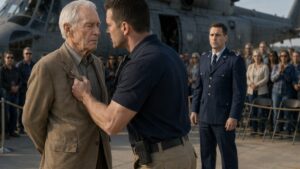
They Made an Old Army Medic Crawl Until Her Broken Training Handle Reached the Recruit
Chapter 1: The Woman Crawling Between Two Formations
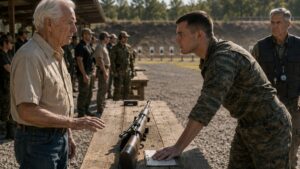
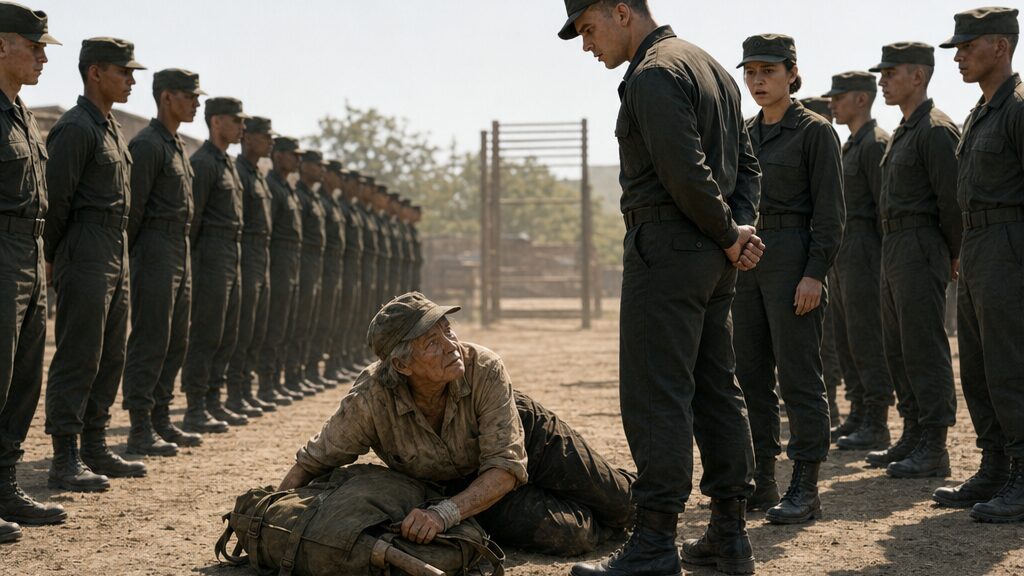
Christine Ramirez hit the dirt on her forearms before anyone thought to step out of formation.
The pack dragged her down first. It had always been heavier at the bottom, as if the years had settled there with the dust and old sweat and dried rain. The left strap cut beneath her collarbone. The canvas scraped against the back of her neck. Her knees found the training lane hard and hot, packed flat by hundreds of boots that had not yet learned what weight could do to a body after seventy-two years.
A murmur moved through the two lines of recruits.
Christine kept her fingers locked around the lower strap.
Do not let it fall open.
That had been the rule for longer than some of these soldiers had been alive.
A command cracked across the lane. “Hold formation.”
The boots stopped.
Christine drew one breath through her teeth and tasted grit. She could see the lane ahead through the blur of dust: a hundred yards, maybe less, marked by low posts and faded white stones. Beyond it stood the old training shed, painted newer now but still in the same place. The last time she had seen it, the door had hung crooked and the road had been muddy instead of dry.
She had made it farther than she expected.
Not far enough.
“Ma’am.”
The voice came from above her. Young, male, controlled, already irritated.
Christine planted one palm in the dirt and tried to push herself upright. Her elbow shook. The pack shifted, pulled her sideways, and the canvas thudded hard against her hip. She caught herself before her cheek struck the lane.
A few recruits sucked in air.
Nobody moved.
“Ma’am,” the voice repeated, closer now. “This is an active training lane. You need to stand up and move off the course.”
Christine turned her head just enough to see polished boots, dark trousers, a command clipboard hanging at one side. Above them, a man in a dark training uniform looked down at her with the stiff patience of someone being watched. His jaw was tight, his hair cropped close, his body squared to the formation as much as to her.
“I know where I am,” Christine said.
Her voice came out lower than she meant. Dust had dried her throat.
The officer’s eyes flicked to the pack. “Then you know you can’t be here.”
She pulled one knee under her. Pain ran from her hip to her spine, sharp enough to whiten the edges of the lane. She did not let the sound leave her mouth.
The first row of recruits stood ten feet away, rifles slung, chins forward, eyes not quite where they should have been. Some looked embarrassed. Some looked annoyed. A few looked at the officer because they knew his reaction would teach them what they were allowed to feel.
Christine recognized that look. Soldiers learned silence fast.
“I need the last stretch,” she said.
“What you need is medical assistance.” The officer lifted his hand, signaling toward the side of the lane. “Medic.”
“No.”
The word came out before she had room to soften it.
His eyebrows tightened.
Christine lowered her hand to the pack again. The old canvas had split once at the corner, and she had stitched it with black thread in a motel room in Oklahoma, hands cramping, lamp flickering. The patch held. It had to hold.
“I’ll move,” she said. “Just not without this.”
“Nobody said anything about leaving your bag.”
“It isn’t a bag.”
The officer looked past her, toward the formation, then back down. The glance was small, but Christine saw the shape of it: an old woman making him look uncertain in front of his soldiers.
His voice hardened. “I’m Captain Jacob Moore. I’m responsible for this lane, these recruits, and every person on it. Right now you’re creating a safety issue.”
Christine pushed again. Her right palm slipped. The pack pulled. She went down to one forearm.
This time someone stepped half an inch forward.
A young woman in the front rank.
Christine saw her only in pieces at first: dark hair tucked back, face held still by training, hands tense at her sides, name tape straight across her chest.
Nelson.
The letters struck Christine harder than the fall.
For a moment the lane disappeared. There was only a different strip of cloth, frayed at one corner, sewn crooked by a man laughing because he had never once lined up a name tape correctly. Samuel Nelson had said the Army could teach a person everything except how to sew straight under bad light.
Christine closed her eyes.
Not now.
“Ma’am, can you hear me?” Jacob asked.
“I can hear you.”
“Then follow my instruction. Remove the pack and step to the side.”
“No.”
The silence after that was worse than the murmur.
Jacob lowered himself halfway, not kneeling, not offering his hand. “You’re not one of my soldiers.”
Christine looked up at him then.
His face was younger than his voice wanted to be. Early thirties, maybe. Tired around the eyes. A man who had slept badly and buttoned himself into authority anyway.
“No,” she said. “I’m not.”
His mouth tightened.
A base medic jogged in from behind the formation, kit bouncing against one hip. Jacob lifted one hand to slow him, still watching Christine.
“Then you don’t get to decide what happens on my lane.”
Christine’s fingers dug into the pack. The canvas was warm now, sun-heated, but beneath the top flap something hard pressed against her palm.
The handle.
It had worked loose during the fall.
She slid her fingers under the flap and felt the cracked wood, narrow and smooth where hands had worn it down. One end had split years ago, then been wrapped and rewrapped until the tape went gray. She had told herself she would not take it out until the right moment. She had rehearsed that moment in cars, in motel rooms, at bus stations, in the parking lot before dawn.
None of those rehearsals had included her on the ground.
None had included Captain Jacob Moore looking at her as if dignity were something he could clear from the road.
The medic came closer. “Ma’am, I need to check you.”
Christine shook her head once.
Jacob exhaled through his nose. “This isn’t a negotiation.”
A recruit near the back whispered something. Another swallowed a laugh too quickly, not cruel enough to mean it, not brave enough to stop it.
Christine heard it.
So did Jacob.
Color rose under his collar. “Formation holds. Eyes front.”
The order snapped every face away except one.
Emily Nelson kept looking.
Christine pulled the handle free from the pack. It came out with a small dry scrape against the canvas, an old sound, one that belonged to folded litters and crowded aid stations and bodies heavier than they looked. The sun caught the crack along the wood.
Jacob’s hand moved toward it. “Ma’am, put that down.”
Christine did not lift it toward him.
She held it across both palms and turned it toward the young woman in the front rank.
Emily’s eyes dropped to the handle.
The blood left her face.
Christine saw the recognition arrive before the girl understood it. Not knowledge. Memory. The kind inherited through photographs, half-told stories, a child’s hand touching something on a shelf after everyone thought she had gone to bed.
Emily took one step out of line.
Jacob turned sharply. “Private Nelson.”
Emily did not answer.
Christine’s arms trembled under the handle’s small weight. The pack pressed into the ground beside her. Dust clung to the old canvas, to her sleeves, to the deep lines across her knuckles.
She had carried nearly everything wrong.
Too late. Too alone. Too stubborn.
But she had reached the right person.
Emily stared at the cracked wood as if it had spoken her name.
“My father had one of those,” she whispered.
Chapter 2: The Pack No One Wanted Touched
Jacob Moore saw the name strip just as the old woman’s hand closed over it.
NELSON.
The letters were faded, not printed in the crisp black of current issue but worn almost brown at the edges. The stitching had been repaired more than once. Dust sat in every thread. It looked less like a label than something that had survived being buried.
Private Emily Nelson stood half out of formation, eyes fixed on the pack.
Jacob felt the lane slipping out of his control.
“Private Nelson,” he said again. “Back in line.”
She flinched but did not move.
The old woman looked from Emily to him, and that made it worse. She was not confused. He had seen confusion in trespassers, protesters, lost family members, retired men who wanted to revisit old barracks that had been torn down twenty years ago. Confusion wandered. This woman had aimed herself like a bullet and collapsed only when her body refused the distance.
The medic crouched beside her. “Ma’am, I’m going to check your pulse.”
“Not the pack,” she said.
“I’m not touching the pack.”
Jacob stepped closer. “We need to clear this lane.”
Her eyes lifted to him. Brown, steady, bloodshot at the edges from dust and strain.
“Then clear it around me.”
A murmur rose, then died when Jacob turned his head.
He had an inspection in three hours. The training lane had been reset twice that morning because one squad kept missing timing marks. A visiting inspector would be asking about safety discipline, command presence, lane control. And now an elderly woman had crawled into the middle of the route carrying an old pack with one of his recruits’ names on it.
He could feel every set of eyes measuring him.
“Sergeant,” Jacob called without looking back.
The nearest training staff member moved toward him.
“Shift formation to the east boundary. Keep them facing away.”
The staff member hesitated just long enough to show the order was unusual. “Yes, sir.”
Boots moved in controlled disorder. Rifles shifted. Emily remained where she was until the staff member touched her arm and guided her back three paces, not quite into line, not quite away.
The medic took Christine’s wrist. “Pulse is fast. Skin’s dry. Ma’am, did you walk here?”
Christine did not answer.
Jacob crouched, keeping his voice low. “I need your name.”
She looked at the pack instead of at him.
“Ma’am.”
“Christine Ramirez.”
Something in the medic’s posture changed. “Ramirez?”
Jacob glanced at him. “You know her?”
“No, sir. Just—” The medic looked back at Christine. “Are you prior service?”
Christine breathed once, shallow and careful. “Army. Field medic.”
Jacob wished the medic had asked that before the formation heard anything.
His first words came back to him, too loud in memory.
You’re not one of my soldiers.
He stood, more abruptly than he intended. “That doesn’t change the safety issue.”
“No,” Christine said. “It changes what you should have asked first.”
The words were not sharp. That made them worse.
Jacob looked toward the recruits. Most were facing east now, but he could see the tension in their necks, the slight angle of listening. Emily had turned just enough to watch from the corner of her eye.
“Get a stretcher,” the medic called to his assistant.
Christine’s fingers tightened on the pack strap. “No stretcher.”
“Ma’am, you nearly passed out.”
“I said no.”
Jacob bent down again. “Mrs. Ramirez—”
“Not Mrs.”
“Ms. Ramirez, if you refuse medical care, we still have to remove you from the lane.”
“I’ll sit at the edge.”
“With help.”
“With the pack.”
He stared at her hand. The knuckles were swollen, the nails short and split. She held the strap with the desperation of someone holding skin closed.
“What’s in it?” he asked.
Christine’s face shut.
The answer was so visible in her silence that Jacob nearly stepped back.
“Captain,” the medic said quietly, “we can move her with the pack. It’ll be awkward, but we can.”
“No one opens it,” Christine said.
Jacob’s patience thinned. “Nobody is interested in your personal property.”
Emily’s voice came from behind him. “Then why does it have my name?”
Jacob turned.
She had broken formation fully now. Her squad leader whispered at her to stop, but Emily’s eyes were locked on the faded strip.
Christine looked at her, and for the first time since the fall, something like fear crossed the old woman’s face.
Not fear of Jacob.
Fear of the question.
“Private Nelson,” Jacob said, “you are out of formation.”
Emily swallowed. “Sir, my father’s name was Nelson.”
“There are a lot of Nelsons in the Army.”
“Samuel Nelson.”
The name changed the air.
Christine closed her eyes.
Jacob saw it. So did Emily.
The medic paused with one hand under Christine’s elbow. The assistant with the stretcher slowed at the edge of the lane.
Emily took one step forward. “Did you know him?”
Christine opened her eyes but did not answer.
Jacob moved between them without meaning to. “This is not the place.”
“It looks like she came here for me,” Emily said.
“You don’t know that.”
“She looked right at me.”
Jacob lowered his voice. “Private, you are emotionally involved and out of order.”
Emily’s mouth pressed into a thin line, training fighting blood. “Yes, sir.”
But she did not step back.
Christine tried to rise, and the attempt ended the argument. Her shoulder buckled. The medic caught her before she fell sideways. The pack slid half an inch, and she made a sound then, small and raw, reaching for it before she reached for herself.
Jacob grabbed the pack by its top handle to keep it from dragging her down.
Christine’s hand clamped over his wrist with surprising strength.
“Don’t.”
“It’s pulling you over.”
“Don’t take it from me.”
“I’m not taking it.”
“You don’t know what that means.”
Jacob stopped.
Her hand shook against his sleeve. The old pack hung between them, heavy enough to drag at his arm. Something inside shifted, dull and solid. Not clothes. Not random keepsakes. Something arranged and protected.
For the first time all morning, Jacob wondered if the safety issue had begun before she ever stepped onto his lane.
He helped lower the pack beside her instead of lifting it away.
Christine watched his hand until he released it.
The medic and assistant guided her to the edge of the lane, pack pressed against her side. Jacob walked beside them, aware of the recruits watching even with their faces turned. Dust trailed from the bottom seam like the pack was still shedding miles.
At the medic station, the air smelled of antiseptic and old coffee. Christine sat on the examination bench only because the pack sat against her knee. The cracked wooden handle lay across her lap.
Jacob stood just inside the door with his clipboard under his arm. He should have been writing the incident note already. Unauthorized entry. Training disruption. Heat exposure. Refusal of care.
Instead, he stared at the name strip.
“Ms. Ramirez,” he said, “I need to understand why you came through the lane.”
Christine looked toward the window. Through it, the formation was just visible beyond the glass, blurred by dust and distance.
“I told you,” she said. “I needed the last stretch.”
“To where?”
Her hand moved over the pack, almost smoothing it.
“To her.”
Jacob looked at Emily.
She had appeared in the doorway without permission, helmet tucked under one arm, face pale and stubborn.
Her voice barely carried into the room.
“My father’s name was Samuel Nelson.”
Chapter 3: A Wooden Handle With No Explanation
Emily Nelson touched the cracked handle before anyone gave her permission.
It lay on the metal desk in the training office, wrapped in a strip of gray cloth that did nothing to hide its age. The wood was darker where hands had held it. One end bore a split that ran beneath old tape. Along the curve, under a layer of dust, she could see a shallow groove worn by use.
She had seen that shape in a photograph.
Not in person. Never in person.
Her mother had kept the photograph in a box with folded certificates and letters Emily had not been allowed to read until she was older. In the picture, her father stood beside a canvas field litter with one hand resting on a wooden handle, grinning at someone outside the frame. He was younger than Emily was now. He had a crooked name tape and the same tired eyes she saw in herself on bad mornings.
The office door opened behind her.
“Private Nelson,” Captain Moore said, “you were told to wait outside.”
Emily pulled her hand back, but the feel of the wood stayed in her fingertips.
Christine Ramirez sat in the chair beside the wall, a paper cup of water untouched near her knee. The pack rested against her boots. She looked smaller indoors, but not weaker. Dust still marked one sleeve from elbow to cuff. A base medic had cleaned a scrape on her forearm and left a strip of white gauze there. She held that arm carefully, as if the pain belonged somewhere else and she had no time for it.
“I need to ask her one question,” Emily said.
“You need to return to your squad.”
“My squad doesn’t have my father’s pack.”
Jacob’s jaw tightened. Behind him, a woman in civilian clothes stepped into the office holding a thin file folder and a visitor badge. She had sharp eyes and the careful expression of someone used to delivering bad news through policy.
“I’m Karen Lopez,” she said. “Records and family liaison. Captain Moore asked me to check the visitor log and service database.”
Emily looked past her to Christine. “Did you know my father?”
Christine’s fingers closed around the edge of the pack.
“Yes.”
The word landed softly and still shook the room.
Emily waited. Nothing followed.
“How?” she asked.
Christine looked at the floor.
Jacob exhaled. “Private Nelson, this is exactly why—”
“No,” Emily said, before she could stop herself.
Jacob’s eyes cut to her.
She forced herself to stand straighter. “Sir. No, sir. She walked onto a restricted training lane carrying my father’s name. I think I’m already involved.”
For a second, Jacob looked like he wanted to remove everyone from the room by rank alone.
Karen opened the folder. “I found a Christine Ramirez. Army field medic. Dates match. Prior assignment records show overlap with a Samuel Nelson during a joint training rotation and later deployment support.”
Emily’s chest tightened.
Christine did not lift her head.
Karen turned one page. “There’s also a reference to an incident report involving Samuel Nelson, but the attached file isn’t available in the standard system.”
“Not available?” Jacob asked.
“Restricted, archived, or improperly scanned. Could be nothing more than old file damage.”
“Could be,” Christine said.
Everyone looked at her.
The two words had not been accusation. They had been memory.
Emily stepped closer to the desk. “This handle. What is it?”
Karen answered before Christine could. “It appears to be from an older field litter. They used wooden handles on some training equipment and transport frames. Not current issue.”
Emily stared at Christine. “Why would my father’s pack have that?”
Christine’s thumb moved over the pack strap.
“Because he carried people,” she said.
“My mother said he was logistics.”
“He was.”
“Then why—”
“People in logistics carry more than boxes.”
The quiet answer stopped Emily more effectively than a command. She looked down at the handle again, and suddenly the photograph changed in her mind. Her father’s grin was not just young and careless. His hand on the litter was not a pose. It was a habit.
Jacob moved around the desk, needing the room back under shape. “Ms. Ramirez, if you served with Samuel Nelson and came here to deliver property to Private Nelson, there were proper channels. You could have contacted the family liaison. You could have called ahead. You could have turned the pack in at the gate.”
Christine’s eyes lifted. “I tried the gate.”
Jacob glanced at Karen.
Karen’s expression tightened.
“The gate guard logged her as a civilian visitor without clearance,” Karen said. “She apparently requested the training lane by its old designation.”
“It has not been called that for years,” Jacob said.
“I know,” Christine said.
“Then why use it?”
“Because that was what he called it.”
Emily gripped the back of the chair in front of her. “My father?”
Christine looked at her then, and Emily wished she had not pushed so hard. The old woman’s face held something worse than sadness. It held a door braced shut from the inside.
“Yes.”
“Were you there when he died?”
The office went still.
Jacob looked at Emily sharply. Karen lowered the folder a fraction. Outside the door, training staff voices passed and faded.
Christine’s hand went to the wooden handle.
Emily regretted the question the instant she saw that movement, but she did not take it back. She had grown up with half answers. Training accident. Complications. He served well. He loved you. The words had built a wall around a blank space. Now an old woman had dragged that blank space into the dust and put it on a desk.
Christine’s mouth opened.
No sound came.
Jacob’s voice softened despite himself. “Ms. Ramirez.”
Christine stood slowly, one hand braced on the desk. The medic had told her not to move too fast; she moved as if disobeying pain was different from ignoring it.
“I served with Samuel,” she said. “That is what I can say here.”
Emily’s throat burned. “Here?”
Christine picked up the cracked handle and wrapped the cloth around it again.
“Not in an office full of people who want the short version.”
Jacob straightened. “That’s not fair.”
Christine looked at him. “No. It isn’t.”
The words passed between them, and Emily knew they were not only about the office.
Karen closed the folder halfway. “Captain, there is one more thing.”
Jacob turned. “What?”
Karen’s eyes moved briefly to Emily, then to Christine, then back to Jacob. Her voice dropped, but Emily heard every word.
“The archived index lists Christine Ramirez as the last attending medic assigned to Samuel Nelson before the report was sealed.”
Chapter 4: The File That Made Everyone Smaller
Samuel Nelson’s name had been reduced to one line in a yellowing index.
Christine stood over the records table and stared at it until the black letters stopped looking like letters at all. They were too neat. Too flat. Too easy to file away.
NELSON, SAMUEL. TRAINING FAILURE / INCIDENT NOTATION. ATTACHMENT UNAVAILABLE.
Her hand went to the pack at her feet.
The old canvas leaned against the leg of the table as if it were tired too. Karen Lopez had allowed it inside only after Christine refused to sit anywhere she could not touch it with her shoe. The cracked wooden handle lay wrapped in cloth on the table beside the file box. A clerk had offered to place it in an evidence sleeve, and Christine had looked at her until the offer disappeared.
Across the room, Captain Jacob Moore stood near the door with his arms folded. He had not said much since they entered the records room, but his silence had the shape of a defense. He watched every folder Karen opened as though one careless page might become another failure with his name attached.
Karen slid the index sheet closer to Christine. “This is all the accessible system shows. The physical archive may have more, but if the report was restricted or misfiled, I can’t promise anything.”
Christine did not touch the paper.
“That phrase is wrong,” she said.
Jacob’s eyes moved to her. “Which phrase?”
“Training failure.”
Karen’s mouth tightened. “That may not mean what it sounds like. Sometimes old notations were broad.”
“No,” Christine said. “It means exactly what someone wanted it to mean.”
The room cooled around the words.
Karen glanced toward the closed door. “Ms. Ramirez, I need to be careful about what gets discussed in front of people who don’t have clearance.”
Christine almost smiled. Not because it was funny. Because clearance had always been easier to protect than truth.
“People keep finding careful ways to leave him alone,” she said.
Jacob shifted. “No one is trying to leave anyone alone. We’re trying to confirm facts.”
“Facts.” Christine looked at the index again. “He went into the mud for a man whose leg was caught under a training frame. He didn’t fail training.”
Karen’s fingers stilled on the folder.
Jacob unfolded his arms. “You’re saying the notation is inaccurate.”
“I’m saying it is too small.”
The door opened behind them before anyone could answer. Scott Adams stepped in, cap tucked under one arm, his face carrying the wear of someone who had already heard enough to know he would not like the rest.
Karen stiffened. “Sergeant Adams, this is a records review.”
“I know.” He closed the door carefully. “Captain asked me to check with training staff about the lane designation Ms. Ramirez used at the gate.”
Jacob’s expression sharpened. “And?”
Scott looked at Christine first.
That small delay told her more than his answer.
“The old designation matches pre-renovation maps,” he said. “Same lane. Different name. Before my time, but not before the old binders.”
Christine looked down at the pack.
Samuel had called it the long road because nobody liked its official number. The long road to nowhere, he used to say when the recruits were tired. Then he would take extra weight from the smallest one and pretend he had done it by accident.
Jacob stepped closer to the table. “Do you know anything about this incident notation?”
Scott placed his cap on the edge of the table and did not sit. “I know stories. Not enough to call evidence.”
“Say what you know.”
Scott’s jaw worked once. “Older staff used to say Nelson took blame for breaking formation. Said he moved out of position during a lane exercise. There was an equipment collapse. Bad conditions. Confusion. By the time the report got written, the cleanest line was that he violated procedure.”
Christine’s throat closed.
The cleanest line.
Samuel’s life, reduced to a clean line so other people could keep walking.
Karen’s face had gone still. “Was that ever challenged?”
“Not formally,” Scott said.
Jacob looked from Scott to Christine. “Why not?”
Christine felt the answer inside her like an old piece of metal too deep to remove.
Because the injured man survived and got sent away before anyone asked him enough. Because the officer in charge rotated out. Because Christine had been told to recover first, to write later, to let command handle it. Because grief made a person easy to manage if they had already learned obedience. Because Samuel had made a request with blood in his mouth, and Christine had mistaken keeping the pack for keeping all of him.
She said none of that.
Scott did.
“Because correcting it would have made the unit look unsafe,” he said quietly. “And because Nelson was gone.”
Jacob’s face changed, not with sympathy yet, but with the first crack of discomfort. “That’s a serious accusation.”
“It’s a serious habit,” Scott said.
Karen looked at him sharply.
Scott did not apologize. “I’m not saying there was a conspiracy. I’m saying reports sometimes choose the version that lets tomorrow’s training happen.”
Christine sat down before her knees could betray her. The chair was hard plastic. The pack brushed her ankle. She gripped the table edge and pulled herself back into the room.
Karen opened another folder. “There’s a casualty supplement reference here, but the scan is missing. The title line says Samuel Nelson was removed from the lane after structural equipment failure.”
“Then why call it training failure?” Jacob asked.
No one answered.
Christine reached for the cloth-wrapped handle. Her fingers found the crack through the fabric.
“He was laughing before it happened,” she said.
The three of them looked at her.
She did not look back. If she did, she would stop.
“There was a young soldier who kept falling behind. Small kid. No breath, no confidence. Samuel took part of his load without making a show of it. That was his way. Then the frame shifted near the old washout. Everybody heard the wood split. Samuel moved first.”
Karen’s hand covered the folder edge.
Christine drew one breath. “He was not trying to be brave. He was trying to get there faster than fear did.”
The room held that.
Jacob looked toward the handle. “The field litter?”
Christine nodded once. “Part of it broke. He used the handle anyway. We both did.”
“You were the medic,” Jacob said.
“I was the medic.”
“Then you treated him?”
Christine folded her hands in her lap. They looked old now. Older than they had on the lane.
“I treated who I could reach.”
It was not the answer Jacob wanted. It was not the answer Emily deserved.
A sound came from the hall.
Not loud. Just the faint scrape of a boot sole stopping too fast outside the door.
Christine turned.
Through the narrow glass panel, Emily Nelson stood half-shadowed in the corridor, one hand at her side, the other clenched around nothing. Her face showed just enough to say she had heard the words that mattered and not the ones that might have held them together.
Jacob moved toward the door. “Private Nelson—”
Emily stepped back before he reached it.
The look she gave Christine through the glass was not anger yet.
It was worse.
It was a daughter realizing that the official story might have made her father smaller, and the only person who could make him whole again had been silent for years.
Chapter 5: The Promise Christine Refused To Share
Emily was waiting outside Christine’s motel door with the cracked handle in both hands.
Christine stopped three steps from the room.
The sun had dropped behind the low buildings beyond the parking lot, leaving the concrete washed in dull gold. Her shoulder ached from the pack. Her knees had stiffened during the ride from the base. Every part of her wanted the room, the chair by the window, the small sink where she could clean the dust out of the canvas seams before it settled deeper.
Emily stood between her and all of that.
She had changed out of formation gear but still looked like she was holding herself at attention. The handle lay across her palms, unwrapped now. Without the cloth, the crack seemed longer.
“You left this in the records room,” Emily said.
Christine looked at it. “No. I didn’t.”
Emily’s fingers tightened. “Then why did Karen give it to me?”
“Because she thought you should bring it.”
“Because everyone keeps deciding what I should get and when.”
Christine had no answer that would not sound like another door closing.
She moved past Emily and unlocked the motel room. The pack waited just inside, where she had left it after refusing help from the driver. She had set it upright against the bed. In the dim room, it looked almost human, slumped and patient.
Emily followed her in without being invited.
Christine let her.
The room smelled faintly of soap and dust. On the small table lay a damp washcloth, a travel sewing kit, and a cup of water gone warm. Christine lowered herself into the chair and pulled the pack close. She dipped the cloth into a bowl and began cleaning the bottom seam with careful strokes.
Emily closed the door. “Look at me.”
Christine kept wiping the canvas.
“I said look at me.”
“I heard you.”
“You heard me outside that records room too, didn’t you?”
Christine’s hand stopped.
Emily stepped closer. “You knew I was there.”
“I knew someone was.”
“You could have opened the door.”
“Yes.”
“But you didn’t.”
Christine resumed cleaning.
Emily laughed once, short and wounded. “You know what that feels like? It feels exactly like reading that report. A line that says just enough to keep me quiet and not enough to tell me anything.”
The cloth twisted in Christine’s fingers.
“Your father asked me not to come until you chose service,” she said.
Emily froze.
The words had escaped too soon. Not all of them. Never all. But enough to change the room.
“My father asked you?” Emily said.
Christine nodded.
“When?”
Christine pressed the cloth over a dark stain near the strap.
Emily’s voice lowered. “Was he dying?”
Christine shut her eyes.
The motel room vanished for half a second. Mud returned. Rain on canvas. Samuel’s fingers locked around her sleeve with strength he did not have left. His voice trying to be light because a man with a child learned to hide fear even at the end.
Not until she’s ready, Ramirez. Not because they tell her I was good. Because she knows what carrying means.
Christine opened her eyes.
“He was hurt,” she said.
Emily waited.
Christine could feel the girl’s patience breaking one second at a time.
“That’s it?” Emily asked. “He was hurt?”
“I am trying not to hurt you more than I have to.”
“You don’t get to decide that.”
Christine looked up then.
Emily’s eyes were bright, but she had not let tears fall. Christine recognized the discipline. Samuel had worn it badly; Emily wore it like armor fitted too young.
“No,” Christine said. “I don’t.”
“Then tell me.”
Christine set the cloth down.
The pack sat between them. Its old name strip faced Emily now. NELSON, softened by years of hands and dust.
“Your father made me promise that if you ever put on the uniform, I would bring you this pack. Not mail it. Not leave it at a desk. Bring it.”
Emily stared at the pack. “Why?”
“Because he said some things should arrive with the person who remembers the weight.”
Emily’s mouth trembled. She looked away, angry at her own face.
Christine should have stopped there. She had intended to stop there. But Emily’s earlier words had cut too close.
A line that says just enough to keep me quiet.
“I waited,” Christine said. “Too long.”
Emily looked back.
“I found your mother once,” Christine continued. “Years ago. I had the address. I sat across the street in a rental car for nearly an hour with this pack on the seat beside me.”
“What happened?”
“You were outside with a bicycle. Maybe nine. Maybe ten.” Christine swallowed. “You were laughing.”
Emily’s face changed.
“I drove away,” Christine said.
The room went quiet except for the low hum of the old air conditioner.
“You saw me,” Emily said.
“Yes.”
“And you left.”
“Yes.”
“Because I was laughing?”
“Because I thought maybe that meant your mother had given you something I had no right to disturb.”
Emily stepped back as if the floor had shifted. “You thought grief ended because a child laughed?”
Christine’s answer came too slowly. “No.”
“But you used it as an excuse.”
The words struck clean.
Christine did not defend herself.
Emily set the cracked handle on the bed. It landed softly, but Christine felt it like a dropped rifle.
“You let the Army write him small,” Emily said. “Then you let me grow up around the empty space because you were afraid I’d hate you.”
Christine looked at the pack.
“Yes.”
The admission moved through her like pain finally given a name.
Emily blinked, and this time the tears came. She wiped them away immediately, angry at both of them. “I don’t want a pack handed to me like a gift. I want the truth.”
“You deserve it.”
“Then say it where he was made small. Say it in front of Captain Moore.”
Christine’s breath caught. “Emily.”
“No.” Emily pointed toward the base, though it was miles away. “He made you crawl in front of everyone because he thought he knew what he was looking at. That report says my father failed because someone thought that was easier to write. I’m done with people making quiet decisions around me.”
Christine rested one hand on the pack.
She had carried it alone because Samuel had asked her to carry it. That was what she had told herself. But the older truth stood in the doorway now, wearing his daughter’s face: she had carried it alone because alone meant no one could ask where she had failed.
Emily picked up the handle again and held it out.
Christine did not take it.
“Keep it tonight,” Christine said.
Emily’s eyes narrowed. “Why?”
“Because if I hold it, I may hide behind it again.”
Before Emily could answer, a knock sounded at the door.
A training staff member stood outside with an envelope in hand. He looked uncomfortable, not unkind. His eyes flicked from Emily to Christine and then away.
“For Ms. Ramirez,” he said. “Captain Moore directed delivery.”
Christine took the envelope.
Inside was a formal incident report, printed clean and straight. Her name appeared in the first paragraph. Unauthorized presence on active lane. Refusal to comply. Disruption of scheduled training. Endangerment risk to recruits and staff.
At the bottom, Jacob Moore’s signature sat in fresh black ink.
Emily read it over Christine’s shoulder.
Neither of them spoke.
The pack stood between them, and for the first time since Christine had carried it across the gate, silence did not protect anyone.
Chapter 6: The Daughter Who Recognized The Weight
Emily buckled under the pack before she made it five steps.
The straps hit wrong, one biting high against her shoulder, the other dragging the weight low across her spine. She had lifted rucks before. She had marched with loaded gear until her hips burned and her feet went numb. But this pack did not sit like issued equipment. It pulled like it knew where grief lived in a body.
Her squad went quiet.
Emily caught herself with one hand against the barracks wall.
“Nelson,” someone said softly, “you good?”
She nodded too quickly. “I’m good.”
She was not.
The old canvas pressed against her back with stubborn, uneven weight. Inside were things Christine had not shown her yet. Maybe old cloth. Maybe sealed papers. Maybe nothing but years. The name strip rested near Emily’s left shoulder, close enough that if she turned her head, she could almost see the last letters of her own name.
Across the classroom, Christine Ramirez watched from a chair near the front wall.
She had come back to base because Emily had asked. No, because Emily had demanded. But when Emily had tried to carry the pack in from the parking lot, Christine’s hand had lifted automatically, ready to stop her.
Emily had said, “Let me.”
Christine had lowered her hand as if it cost her something physical.
Captain Moore stood by the classroom door, incident folder tucked under his arm. He had agreed to five minutes because Scott Adams had asked in a tone that did not sound like asking. Five minutes before Emily’s squad returned to lane review. Five minutes before the day folded back into schedules and inspections and official lines.
Emily took another step.
Her knees bent.
The room shifted. Not with laughter. Nobody laughed. That almost made it worse.
Christine leaned forward. “Take it off.”
Emily shook her head.
“Take it off before you hurt yourself.”
“You carried it across the lane.”
“I carried it wrong.”
Emily stopped.
The words hung there, plain and unexpected.
Christine looked down at her hands. “I carried it too long and called that keeping a promise.”
Jacob’s eyes lifted from the folder.
Emily slowly slid one strap off her shoulder. A recruit helped with the other before she could refuse. The pack came down onto a desk with a heavy, dull thud. Dust rose from the seams and drifted through the fluorescent light.
The sound made every person in the room look at it differently.
Jacob cleared his throat. “Private Nelson, this does not change the contents of the report.”
Emily turned on him. “Sir, the report says she endangered us.”
“She entered a restricted training lane during active formation.”
“She was trying to reach me.”
“Intent matters,” Jacob said, “but procedure still matters.”
“Procedure wrote my father down as a failure.”
The room went still.
Jacob’s face tightened. “You don’t know that.”
“No, sir. I know the people who could explain it keep choosing not to.”
Christine rose from the chair.
The movement was slow, but it cut through the room more sharply than Emily’s anger. She walked to the desk, one hand briefly touching its edge for balance.
“Don’t fight my cowardice for me,” Christine said.
Emily stared at her.
Christine’s voice remained quiet. “I let silence do damage. That part is mine.”
Jacob looked uncomfortable, as if he had walked into a room expecting a complaint and found confession instead.
A knock came at the open door. Karen Lopez stepped in with a folder pressed to her chest.
“I found a partial casualty supplement,” she said. “Not the full report. Just a scanned page from an old transfer file.”
Jacob took one step toward her. “Is it cleared?”
“Enough to confirm one detail.” Karen looked at Emily. “Samuel Nelson was not listed as abandoning position in the first field note. That language appears later.”
Emily’s hand tightened on the desk.
Christine closed her eyes.
Jacob’s voice lowered. “What did the first note say?”
Karen opened the folder, but she did not hand it over. “It says he moved toward an injured soldier during equipment failure.”
No one spoke.
A recruit in the back swallowed hard.
Emily looked at Christine. “That’s what you said.”
Christine nodded.
“Then why wouldn’t you just tell me everything?”
Christine looked at the pack, not at Emily. “Because the everything is not clean.”
Jacob glanced toward the hall. “I need to speak with Ms. Ramirez privately.”
“No,” Emily said.
Christine lifted one hand. “It’s all right.”
“It’s not.”
“No,” Christine said. “But it is time.”
They moved to the command office because Jacob would not discuss an open incident report in a classroom full of recruits. Emily followed until he turned and ordered her to wait outside. She stopped only because Christine looked back and gave the smallest shake of her head.
Through the half-open blinds of the office window, Emily watched them speak.
She could not hear every word at first. Jacob stood behind his desk. Christine stood across from him, refusing the chair. Scott leaned against the wall near the door, arms folded.
Jacob’s voice rose once, controlled but strained. “I am not disputing her service. I am saying reports can’t be rewritten by emotion.”
Christine’s answer was quieter.
Emily stepped closer to the door.
“You already wrote one by embarrassment,” Christine said.
Jacob looked down.
Scott did not move.
Emily felt the words land harder because Christine had not thrown them. She had simply placed them where they belonged.
Jacob opened the incident folder. “I mishandled the lane. I’ll note that in an addendum.”
“An addendum protects paper,” Christine said.
“What do you want?”
Christine did not answer immediately.
Emily held her breath in the hallway.
When Christine finally spoke, her voice had changed. It was still soft, but the hiding had gone out of it.
“Samuel asked me to tell her one thing if she ever wore the uniform,” she said. “Not that he died brave. Not that he followed every rule. Not that the Army owed him a clean sentence.”
Emily pressed her hand against the doorframe.
“What thing?” Jacob asked.
Christine turned her head slightly, and for a moment Emily thought she knew she was listening.
“That when the weight gets too much,” Christine said, “you don’t prove yourself by falling alone.”
Emily shut her eyes.
Her father’s voice did not come back. She had been too young when he left to keep much more than fragments. But the sentence found a place in her anyway, like it had been shaped for an absence she had carried without knowing its size.
Inside the office, Jacob said nothing.
Scott did. “If the record needs correction, it goes through command review.”
Jacob turned to him. “During inspection week?”
“That’s when command likes to pretend it remembers what integrity means.”
Jacob gave him a hard look.
Scott held it.
Karen appeared at the hallway corner, watching Emily now with something like apology.
Emily opened the office door the rest of the way.
Jacob’s eyes snapped to her. “Private—”
“I heard enough,” Emily said.
Christine looked tired suddenly. Not physically. Somewhere deeper.
Emily stepped into the office and faced her. “I don’t want to fight this for you. But I won’t let you disappear into another file.”
Christine’s hand touched the edge of the desk.
“I know.”
“Do you?”
The question was not cruel. It was pleading.
Christine looked from Emily to Jacob, then to the incident report on the desk. Her name was visible on the top page, straight and official and small.
She reached for the cracked wooden handle, which Emily had carried from the classroom without realizing she still held it. Emily gave it to her.
Christine’s fingers closed around the old wood.
Then she looked at Jacob Moore.
“Captain,” she said, “give me ten minutes on the lane. Same place. Same formation.”
Chapter 7: The Officer Who Had To Choose
Jacob Moore signed the incident report, then noticed the dust on his office floor.
It had gathered in a small crescent near the front of his desk, dull brown against the polished tile. Not much. A few grains fallen from Christine Ramirez’s pack when she had stood there holding that cracked handle and asking for ten minutes on his lane. He stared at it longer than he should have, pen still in his hand, his signature drying at the bottom of the page.
Unauthorized presence. Refusal to comply. Disruption. Endangerment risk.
Every phrase was defensible.
That was the problem.
He set the pen down and folded the report into the folder before he could change a word without knowing what he was changing it into.
A knock came once.
“Come in.”
Scott Adams entered with the same expression he wore before telling a squad their easy day was over. He glanced at the folder, then at the dust.
“You signed it,” Scott said.
“I documented the incident.”
“That isn’t what I said.”
Jacob leaned back. “She entered an active lane during formation.”
“She did.”
“She refused medical direction.”
“She did.”
“She disrupted training hours before inspection.”
Scott nodded. “She did all of that.”
Jacob waited.
Scott did not give him the relief of arguing those points.
Instead, he walked to the side of the desk and placed the cracked wooden handle on top of the incident folder.
Jacob stared at it. “Why do you have that?”
“Private Nelson left it with me when she returned to the classroom. Said she didn’t trust herself not to break something if she carried it any longer.”
“That’s not reassuring.”
“No,” Scott said. “It’s honest.”
Jacob looked at the handle. The wood was ordinary enough if a person refused to think about it. Old training equipment. Broken. Out of issue. Nothing that should have power over a command day.
Yet the moment it touched the folder, his report looked thinner.
Scott rested his hands on the back of the chair. “You want to know why old soldiers keep objects like that?”
Jacob did not answer.
“Because paper forgets weight,” Scott said.
Jacob’s jaw tightened. “I am not trying to forget anything.”
“You’re trying to survive an inspection.”
“That is part of my job.”
“So is noticing when you were wrong in front of people.”
Jacob pushed the folder away. “You think I don’t know that?”
“I think you know it privately.”
The words hit harder than accusation. Jacob stood and crossed to the window. The training lane stretched beyond the administrative building, pale and hard under the afternoon sun. Recruits moved in small groups near the barracks. Everything was on schedule now. The disruption had been contained. The lane had been cleared. The report had been written.
Command liked contained things.
His phone buzzed on the desk. He looked back.
Scott read the screen before Jacob reached it. “Inspector at the front gate.”
Jacob muttered a breath through his teeth. “Early.”
“Twenty minutes.”
“Of course.”
Scott did not move.
Jacob picked up the phone, confirmed the arrival with the gate, then ended the call. The room seemed smaller when he looked back at the folder.
“Not today,” he said.
Scott’s eyebrows rose. “Not today what?”
“Not a public correction. Not with an inspector on post. Not with a civilian veteran who collapsed on my lane and a recruit whose father is in an incomplete archive file.”
“You asked what leadership is measured by after being wrong.”
“I did not ask that.”
“No,” Scott said. “You just arrived at the question.”
Jacob turned on him. “You are making this sound simple.”
“It isn’t simple.”
“She could have called ahead. She could have gone through liaison. She could have told me who she was.”
“She could have.”
Jacob pointed toward the lane. “Instead she walked into active training with a pack heavy enough to put her on the ground.”
“And you made the whole formation watch her get smaller.”
The room went still.
Jacob looked away first.
Scott softened his voice without making it gentle. “Captain, I’m not saying you caused all of this. The old report, the family pain, whatever Christine Ramirez has been carrying—that was here before you. But today, when it reached your lane, you chose procedure first and person second.”
Jacob looked at the wooden handle on the folder.
He remembered her hand on his wrist.
Don’t take it from me.
At the time, he had thought she meant the pack. Maybe she had. Maybe she had meant the last thing in her life that still made her useful to a dead man. He did not know. He hated not knowing. It made every command feel premature.
A soft knock interrupted them.
Christine Ramirez stood in the doorway.
She looked more tired than she had in the morning but straighter somehow, as if deciding had given her back a piece of herself. Her gauzed forearm rested against her side. Emily was not with her.
Jacob glanced at Scott, then back to Christine. “Ms. Ramirez.”
“I was told the inspector arrived.”
“He has.”
“Then I’ll make this short.”
Jacob’s mouth tightened. “If this is about the ten minutes—”
“It is.”
“I can’t authorize an unscheduled formation event during inspection movement.”
Christine stepped inside. “You authorized a public mistake during scheduled training.”
Scott looked down.
Jacob felt heat move up his neck. “I came to the lane because you created a safety issue.”
“Yes.”
“And I had limited information.”
“Yes.”
“And you withheld information that would have changed my response.”
Christine looked at him steadily. “Yes.”
That stopped him.
He had expected defense. Outrage. A speech about service. Something he could resist.
Christine gave him none of it.
“I was wrong too,” she said. “I thought if I carried it alone, I was keeping faith. I was only keeping control.”
Jacob looked at the packless space beside her, surprised by its absence.
“Where is it?”
“With Emily.”
He absorbed that. “You gave it to her?”
“I let her stand near it.” Christine’s mouth pressed briefly, almost a smile and not one. “Giving is harder.”
She came closer to the desk and saw the incident folder under the handle. Her eyes rested on Jacob’s signature. She did not touch it.
Jacob said, “I can amend the report.”
Christine looked up. “To what?”
“To reflect your veteran status, the family connection, the medical circumstances—”
“That protects the page.”
His eyes narrowed slightly. The echo of her earlier words unsettled him.
“What are you asking for, Ms. Ramirez?”
“Not punishment.”
“I didn’t assume—”
“Yes, you did.” Her voice stayed calm. “You thought I came here to make you apologize in front of everyone.”
Jacob could not answer quickly enough.
Christine nodded once, as if his silence had been sufficient. “I don’t need you made small, Captain.”
Scott shifted near the wall.
Jacob looked at the floor.
“I need you to show them what should have happened after I fell,” Christine said.
Outside, a vehicle door closed. Voices moved past the building. Inspection party.
Jacob felt the clock tighten around him.
“If I call formation now,” he said, “command will ask why.”
“Tell them the truth.”
“That an elderly veteran disrupted training and I mishandled it?”
Christine’s eyes did not leave him. “If that is the truth you can stand beside.”
The sentence did what anger could not. It made him see the lane again: Christine on her forearms; recruits silent; Emily pale; his own voice using safety to hide embarrassment.
He picked up the incident report.
For one second he considered tearing it. The gesture would feel good. Too good. Too easy.
Instead, he took a blank addendum form from his drawer and wrote with careful pressure.
Initial response failed to identify prior-service status and personal emergency context before public corrective action. Formation will be reassembled for immediate leadership correction and controlled resolution.
Scott read it over his shoulder.
“That will raise questions,” he said.
Jacob signed it. “It should.”
Christine looked down at the new form but did not thank him.
The absence of thanks felt right.
A staff member appeared at the door. “Captain, inspection party is two buildings out.”
Jacob slipped both documents into the folder, then picked up the cracked handle and offered it to Christine.
She took it, but only after looking at his hand long enough for him to understand that objects could be mishandled too.
He stepped into the hall.
“Sergeant Adams,” he said, voice carrying now, “bring the formation back to the west training lane. Same alignment as this morning.”
Scott’s face did not change, but something in his shoulders eased. “Yes, sir.”
The staff member hesitated. “Sir, with the inspector—”
Jacob turned toward the open door and the hard strip of road beyond the building.
“Then he can watch,” Jacob said.
Chapter 8: The Last Hundred Yards In Silence
Christine returned to the place where she had fallen, and this time the formation parted before anyone ordered it.
The lane looked the same. Dust. White stones. Faded markers. Recruits in two lines with their boots set square and their faces trained forward. But as Christine stepped from the edge of the road with the cracked wooden handle in her right hand, the nearest soldiers shifted half a pace back. Not dramatically. Not enough to break discipline. Just enough to make room for an old woman to stand upright where they had watched her crawl.
That small space nearly broke her.
Emily stood at the head of the lane with the pack at her feet.
It had taken two recruits to move it from the classroom, though Emily had insisted on lifting it first. Now she waited beside it, chin tight, eyes red but steady. The old name strip faced outward.
NELSON.
Jacob Moore stood in front of the formation.
Behind him, near the administrative path, the visiting inspector and two staff members had stopped walking. No one announced them. No one needed to.
Jacob looked once toward Christine.
She gave him nothing to use. No anger. No permission. Only the handle resting against her thigh, the crack beneath her thumb.
Jacob faced the recruits.
“This morning,” he said, “I made an assumption on this lane.”
His voice carried cleanly. The formation held.
“I saw an elderly person where she was not supposed to be. I saw a safety problem. I saw a disruption to training.” He paused. “I did not ask fast enough what she was carrying or why she was willing to fall before letting it go.”
Christine lowered her eyes.
The words were not enough to heal anything.
They were enough to begin.
Jacob turned slightly toward her. “Ms. Ramirez is a former Army field medic. She came here carrying property connected to Private Nelson’s father, Samuel Nelson. My first response did not reflect the respect or judgment this situation required.”
No one clapped.
No one moved.
That was good. Christine could bear silence better than performance.
Jacob stepped back.
The lane opened in front of her, the last hundred yards stretching toward the old training shed. She looked at it and felt the years fold over each other.
Mud where there was dust now.
Rain where there was heat.
Samuel’s hand on her sleeve.
Don’t make her think standing tall means standing alone.
Christine closed her fingers around the handle.
Emily bent to lift the pack.
Christine moved before she could stop herself. “Wait.”
Emily froze, one strap in her hand.
The old reflex rose fast. Let me. I promised. I carried it this far. The words were ready, worn smooth from years of use inside her own head.
Emily looked at her, and in that look Christine saw the little girl on the bicycle, laughing in front of a house Christine had been too afraid to enter. She saw the recruit buckling under the pack that morning. She saw Samuel grinning beside a field litter, pretending the weight was nothing because someone smaller needed to believe the road could be finished.
Christine took one step back.
“Use both straps,” she said.
Emily swallowed and nodded.
She lifted the pack carefully this time. A recruit beside her raised his hands as if to help, then stopped, waiting for permission. Emily glanced at him. After a long second, she nodded.
He helped guide the strap over her shoulder without taking the weight away.
That mattered.
Christine saw it.
Emily straightened slowly. The pack pulled her down at first. She adjusted, breathed, shifted her feet. Her face tightened with effort, but she stayed upright.
Christine walked to her side and held out the cracked handle.
Emily looked at it. “Is that mine too?”
“No,” Christine said. “Not all of it.”
Emily’s eyes searched her face.
Christine turned the handle so the cracked end pointed toward the lane. “This was from the litter your father grabbed when the frame gave way. He and I both had our hands on it. So did another soldier for a while. That is the only reason anyone moved.”
Emily’s breath caught.
Christine made herself continue before fear closed her again.
“He was not trying to be remembered. He was trying to reach someone. The report made it sound like he stepped out of place. He did. But not to quit. Not to fail. He stepped out because someone else had gone down.”
Emily looked toward the lane.
Christine lowered her voice. Not private. Just not a speech.
“When he knew he wasn’t leaving that road the way he came onto it, he asked me about you.”
Emily shut her eyes once.
“He said if you ever chose service, I was to bring you the pack. Not because he wanted you to carry his life.” Christine’s hand tightened around the handle. “Because he wanted you to know that weight is not proof you belong. Letting someone help you carry it is.”
The formation remained still, but its silence had changed. It no longer pressed against Christine. It held the space open.
Emily reached for the handle.
Christine almost kept hold of it.
The impulse was small and fierce. One more second. One more piece of Samuel that did not have to leave her hand.
Emily did not pull.
She waited.
Christine let go.
The release ran up her arm and left an ache behind.
Emily held the pack on her shoulders and the handle across both palms. Then she looked at Christine.
“Walk with me,” she said.
Christine shook her head before the words reached all the way in. “This is for you.”
“No.” Emily’s voice trembled but did not break. “Beside me. Not behind me.”
Christine looked at Jacob.
He stood at the edge of the lane, folder under one arm, face still. His eyes held apology, but he did not step into the moment. He had finally understood that correction was not the same as ownership.
Scott Adams gave one quiet order. “Make room.”
The two lines widened.
Christine stepped beside Emily.
The first few yards were the hardest. Her knees remembered falling. Her palms remembered dirt. Every boot in her peripheral vision threatened to become the morning again.
Then Emily adjusted the pack with a soft grunt, and Christine reached out without thinking to steady the lower strap.
Emily let her.
They walked that way.
Not fast. Not ceremonial. Not to music, not to applause, not to anyone’s command cadence. The dust rose around their boots and settled on the canvas. The cracked handle rested against Emily’s forearms. Christine’s hand stayed near the strap, touching only when the weight shifted too sharply.
Halfway down the lane, Emily whispered, “Did he know I loved him?”
Christine kept her eyes on the white stone ahead.
“Yes.”
“How?”
Christine felt Samuel’s grip again, weaker than it had any right to be, his voice scraping through pain and rain.
“Because he said only a loved child could make a man that scared to leave.”
Emily’s step faltered.
Christine steadied the strap.
This time neither of them apologized for needing the other to stay upright.
At the end of the lane, the old training shed waited with its door closed. Christine had thought she needed to reach it to complete the promise. She understood, standing there beside Samuel’s daughter, that the shed had never been the destination.
Emily eased the pack down onto the ground.
Not dropped. Set down.
She rested the cracked handle across the top of it and placed one hand over the faded name strip.
Christine stood beside her, empty-handed.
The emptiness hurt.
Then it widened into something she could breathe inside.
Behind them, Jacob spoke quietly to the inspector. Christine did not turn to hear. She saw only the lines of recruits stepping aside as Emily lifted the pack again, lighter now because it was no longer being carried by one person’s silence.
Christine touched the handle once more, not to take it back, only to feel the crack under her fingers.
Then she and Emily walked the last few steps together, leaving no speech behind them, only footprints in the dust where the formation had made room.
The story has ended.