The Young Soldier Opened Her Black Bag Before The Whole Formation Went Silent
Chapter 1: The Woman At The Cone Line
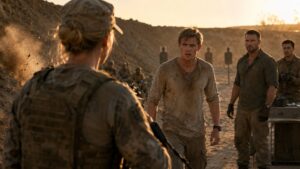
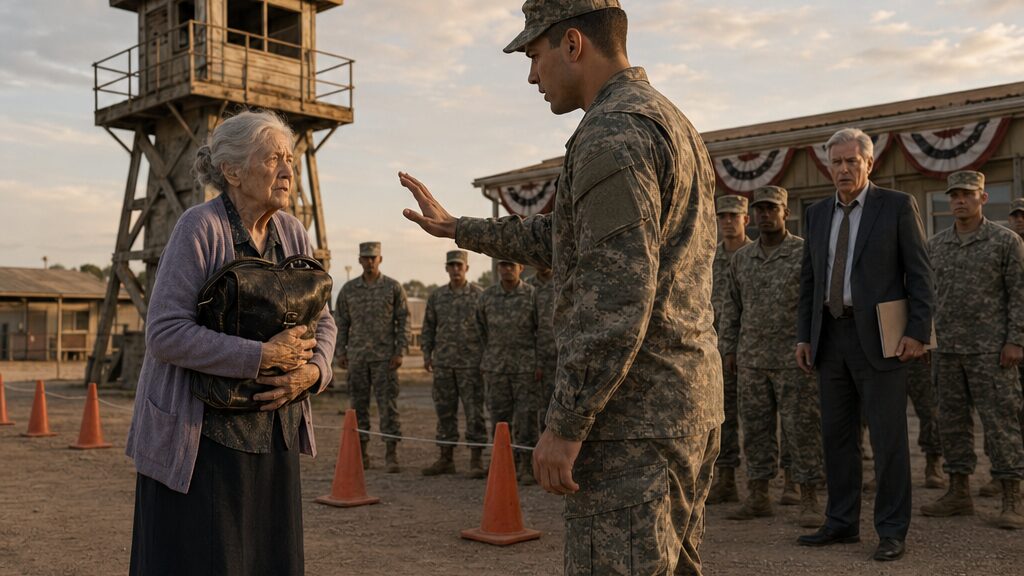
The young soldier pointed at Donna Thompson’s black bag before he asked her name.
“Ma’am, what’s in there?”
His voice carried farther than it needed to. It cut across the dusty training yard, past the orange cones, past the line of young soldiers pretending not to stare, and all the way to the old guard tower leaning behind the maintenance building like a memory nobody had bothered to take down yet.
Donna tightened both hands around the cracked leather strap.
The bag hung from her left shoulder, heavy enough to drag her lavender cardigan crooked. The strap had worn a shallow groove into the heel of her palm during the walk from the gate. She had stopped exactly where the cones made a crooked barrier across the gravel lane, not because she did not know where she was going, but because someone had moved the entrance twenty yards east from where it used to be.
“I need operations records,” she said.
The soldier blinked once. He was broad in the shoulders, his sleeves sharp, his cap low, his boots clean except for a thin rim of dust around the soles. His name tape read GARCIA. His face was young enough that Donna could see him trying to look older inside it.
“Operations records are not accessed through the yard,” he said. “Visitors check in at the public table.”
“I’m not here for public seating.”
Behind him, a few soldiers in formation shifted their weight. One of them looked at Donna’s shoes. Another looked at the bag. A third gave the small half-smile young people gave when they had not yet learned that age did not make a person deaf.
Ryan Garcia noticed them noticing. That seemed to make him stand straighter.
“Ma’am, this is a restricted area during ceremony setup.”
Donna looked past his shoulder at the tower. Its upper windows were boarded. The ladder had been removed. Sunlight struck one side of it and left the other in shade. Tower Four had always looked smaller in daylight. At night, in rain, with radios failing and boys screaming out beyond the range road, it had seemed high enough to hold the whole world.
“I know what area this is,” she said.
Ryan’s jaw flexed. “Then you know you can’t be here without clearance.”
Donna could have told him that she had typed clearance rosters before his parents were old enough to sign enlistment papers. She could have told him that the access lane under his boots used to carry trucks through black mud when the paved road washed out. She could have told him that the cone line was wrong by almost half the yard.
Instead she slid one hand along the bag strap and felt for the old folded pass tucked beneath the leather loop. It had gone soft at the corners. The plastic sleeve had yellowed. A faded photograph of a younger woman stared out from under a cloudy film.
Ryan saw it before she could hide it.
“What’s that?”
“Old pass.”
“Let me see it.”
Donna hesitated too long.
His eyes sharpened. Not cruel. Not yet. Just certain that hesitation meant concealment.
She took the pass out and placed it in his hand. Not handed. Placed. There were habits she had not lost.
Ryan held it up, squinting. The print was nearly gone. The base name could still be read if a person already knew what it said. The photo showed Donna with dark hair pinned back, face thinner, eyes fixed forward in the old official way. The name had faded worst of all. Only the last letters remained clear.
“Thompson?” he said.
“Yes.”
“This expired before I was born.”
“I expect so.”
A small laugh escaped somewhere behind him. Ryan did not turn, but Donna saw his neck color above the collar.
“Ma’am, I’m trying to be respectful,” he said, louder now, “but walking up to a restricted military area with an expired pass and an unknown bag is not how this works.”
The bag pulled at her shoulder. She should have called ahead. Michelle Baker in archives had returned one message two weeks ago and left another that Donna had not answered. Charles Moore’s office had sent a polite email about the ceremony, the decommissioning, the preservation committee. Donna had printed it, folded it, and left it on her kitchen table. She had told herself that a voice on the phone would ask too many questions. She had told herself it was better to come in person.
Now a dozen soldiers watched her stand like a trespasser outside a place where she had once known every key.
“I’m looking for the operations office,” she said.
Ryan pointed toward the building with patriotic bunting draped along the rail. “Public guests go around front.”
Donna followed the direction of his finger, then shook her head once. “That building used to be payroll. Operations was behind the range board.”
“That was a long time ago.”
“Yes.”
“You can’t just wander because you remember old buildings.”
The sentence landed gently because he did not know how hard he had thrown it.
Donna looked at him then. Not at his uniform. Not at the watching soldiers. At him. She saw a man trying to hold a line because he feared what would happen if anyone saw him step back from it. She knew that feeling. She had lived inside versions of it for most of her service. Rules saved lives. Rules also gave frightened people somewhere to hide.
“I’m not wandering,” she said.
Ryan lowered the pass. “Then explain the bag.”
Her hand closed around the strap again. The leather had been black once, polished enough to catch light. Now it was dull, creased, and split where the buckle had rubbed for years. The bag had been under her bed, in a cedar box, then in the back of her closet. It had smelled of old canvas when she opened it that morning. For a moment she had almost shut it again.
“It’s for the archive,” she said.
“What is?”
She did not answer.
Ryan’s patience thinned visibly. A clipboard lay under his arm. A radio crackled at his shoulder. From the center of the yard, someone called for the formation to hold. The ceremony chairs stood in rows near the bunting, empty and bright in the sun. Tomorrow, visitors would sit there and listen to names pronounced carefully from printed programs. Today, everyone seemed to have time to watch one old woman fail at a cone line.
“Ma’am,” Ryan said, “I need you to open the bag.”
Donna’s thumb found the seam near the buckle. Under the leather, wrapped in cloth, the old roll waited.
“Not here.”
The answer came too quickly. Ryan heard it. So did the soldiers.
“Why not here?”
“Because the ground is dirty.”
Another small laugh moved through the formation, not loud enough to accuse anyone of it. Donna kept her face still.
Ryan stepped closer. “This is not about dirt. This is a security inspection.”
“It is about dirt,” Donna said.
For the first time, irritation broke through his controlled expression. “I have an inspection team arriving, a ceremony area to secure, and an unidentified visitor refusing a lawful request. You may not think this is serious, but I do.”
Donna looked again at Tower Four. The boarded windows. The missing ladder. The faded warning sign on the fence below it.
“I think it is serious,” she said softly.
He heard softness as evasion.
“Then open it.”
“No.”
The word was not loud. It did not shake. It simply stood there.
Ryan’s eyes flicked to the formation, to the gate guard, to the bunting, to the operations building where someone in a suit had just stepped briefly onto the porch and gone back inside. His authority had become a performance, and now backing down would look like losing.
“Bring it to the center,” he said.
Donna did not move.
Ryan turned his body slightly, making room for the path between the cones. “If you won’t cooperate here, we’ll do it where my people can witness it.”
A few soldiers straightened, embarrassed by being named as witnesses.
Donna felt the strap cut deeper into her palm. For one foolish second, she wanted to turn around, take the bag back through the gate, drive home, and put the cedar box exactly where it had been. The promise had waited this long. It could wait a little longer.
Then wind pushed dust against her shoes, and she remembered Linda Nelson’s hand closing around her wrist in rain so hard it felt like gravel.
No one outside the gate.
Donna stepped between the cones.
Ryan walked beside her, one pace too close, as if age might bolt if not guarded. The formation watched. The tower watched. The bag bumped once against Donna’s hip.
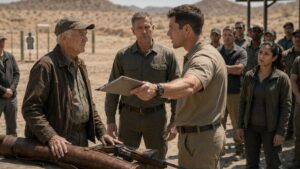
At the center of the yard, Ryan stopped and held out his hand.
“Open it,” he said.
Donna looked down at the black bag, then at the dust under his boots.
“If you do this,” she said, “do not unroll what you find on the ground.”
Ryan’s face hardened at the warning.
“Ma’am,” he said, loud enough for every soldier to hear, “open the bag.”
Chapter 2: The Map He Unrolled In The Dust
Ryan Garcia reached for the bag before the old woman could change her mind.
The leather was softer than he expected. Not expensive-soft. Old-soft. The kind of leather that had been handled by the same hands for so many years it seemed less like an object than something alive and tired. For a second, his fingers caught on the cracked strap, and he felt the resistance of Donna Thompson’s grip.
She let go.
That made him feel worse, though he could not have said why.
The soldiers stood in two loose rows behind him, silent now that the inspection had become real. Ryan had meant only to end the disruption quickly. Show the contents. Clear the bag or confiscate it. Move the elderly woman to the public entrance. Get the formation reset before the operations director came back out and asked why the yard looked like a bus station.
He opened the buckle.
Inside lay a folded dark blouse, a small tin of breath mints, a pair of thin gloves, and something wrapped in plain gray cloth.
“Is that all?” he asked.
Donna did not answer.
He lifted the cloth bundle. It was heavier than paper and stiff in the middle, tied with a narrow strip of faded fabric. Something about the way she watched his hands made him suddenly aware of the dust on his gloves.
“Sergeant,” one of the soldiers murmured, “maybe take it inside.”
Ryan ignored him. He had already made the moment public. Pulling back now would only make the formation think the old woman had won some contest he had never meant to start.
He untied the strip.
The cloth loosened.
A roll of canvas slid partly into view, its edges yellowed, its surface marked with old red grease pencil and dark lines that had bled faintly through the fabric. It smelled like closed drawers and damp canvas. Ryan pinched one corner and began to unroll it.
Donna moved.
Not fast, but fast enough that everyone saw it. One hand came out and caught the edge before it touched the dirt.
“Please,” she said.
That one word did what her refusal had not. It made the air around the formation shift.
Ryan looked at her. Her eyes were not angry. They were fixed on the canvas as if it were a person whose head he was about to lower into mud.
He should have stopped.
Instead he said, “Step back.”
Donna’s hand remained on the edge for one beat too long. Then she withdrew it and folded her fingers against her palm.
Ryan unrolled the canvas across the hard-packed ground.
At first he saw nothing that made sense. Lines. Boxes. Range numbers. A stamped corner blurred by age. Then his training caught pieces his pride had missed. Tower Four. South access lane. Emergency motor route. A hand-drawn arrow bending around the very patch of ground where the orange cones stood now.
His eyes moved from the map to the yard.
The old guard tower stood behind Donna’s shoulder, boarded, stripped, waiting for removal after tomorrow’s ceremony. The access lane shown on the map should have crossed behind the formation, past the fuel shed, through the cone line. Ryan had walked that area all week. He had never known it had a name.
Someone behind him whispered, “That’s this place.”
Ryan bent closer. A strip of paper had been rolled inside the canvas. He drew it out with two fingers. The paper was a roster, brittle and creased, listing names in typed columns. Some lines were checked in pencil. One name near the bottom had been circled so many times the paper had worn thin.
Linda Nelson.
Under it, in handwriting faint but clear, someone had written: tower signal held.
Ryan looked at Donna.
She did not look at him. She looked at the name.
Her face had not changed much, yet something in it had gone far away from the yard. The soldiers saw it. Ryan knew they saw it because no one laughed now, not even nervously. Dust moved over the edge of the canvas, and Donna’s fingers tightened at her sides.
“What is this?” Ryan asked.
The question came out less sharp than he wanted.
“Range-control sheet,” she said.
“This is government property.”
“It was never entered properly.”
“That doesn’t answer why you have it.”
“No,” she said. “It doesn’t.”
Ryan hated that answer because it sounded like surrender and refusal at the same time.
He looked at the map again, hunting for something that would put him back on firm ground. Unauthorized possession. Old records. Possible theft. Security violation. He could build a report from those words. Reports had edges. They held better than shame.
The gate guard had walked closer. A couple of the formation soldiers leaned to see. Ryan caught one of them staring not at the map, but at Donna, and the soldier looked away as if caught doing something indecent.
A vehicle door shut near the operations building.
Ryan turned and saw Charles Moore crossing the yard with a folder under one arm. He wore a dark suit despite the heat, his tie loosened slightly at the throat, his gray hair combed back in a way that looked official even from a distance. Two staff members trailed behind him and slowed when they saw the map on the ground.
Ryan straightened at once.
“Sir,” he called, “we have an unauthorized visitor with what appears to be an old range-control document.”
Charles did not answer immediately. He came closer, his eyes moving from Ryan to Donna to the canvas spread in the dust.
The change in him was small. A pause. A narrowing of the eyes. The folder lowering half an inch.
Donna had seen officers receive casualty updates with less expression.
Charles stopped at the edge of the map.
“Who unrolled this here?” he asked.
Ryan felt heat rise under his collar. “I did, sir. Security inspection.”
Charles looked at the dust across the canvas and then at Donna’s hands.
“Mrs. Thompson,” he said.
Ryan turned sharply.
Donna gave Charles a small nod, as if they had met at a desk, not in the middle of a training yard with soldiers watching.
“You received my message,” Charles said.
“I received it.”
“You didn’t answer.”
“No.”
There was no apology in it. No excuse.
Ryan’s embarrassment sharpened into irritation. “Sir, if she was expected, that information was not passed to yard security.”
“She was not expected today,” Charles said.
Donna’s grip returned to the bag strap, though the bag now hung open and half-empty at her side.
“I came before the tower came down,” she said.
Charles crouched slowly beside the map, careful not to place his knee on the canvas. He brushed no dust away. He only leaned close enough to read.
Ryan watched his face.
The operations director traced the old route with his eyes. When he reached the circled name, he inhaled once and held it.
“Linda Nelson,” he said.
Donna looked at the tower.
A soldier at the back of the formation shifted. Gravel cracked under his boot, and the sound seemed too loud.
Ryan tried to recover the rules of the moment. “Sir, should I secure the document?”
Charles did not look up. “No.”
“Sir?”
“No, Sergeant Garcia. You’ve done enough securing for the moment.”
The words were quiet. That made them worse.
Ryan stood still, feeling every set of eyes behind him. He wanted Charles to explain. He wanted Donna to explain. He wanted the old map to be either meaningless or clearly criminal, anything except this uncertain thing making him look like a man who had dragged someone’s grief into the dirt.
Charles reached toward the canvas, then stopped before touching it.
“Mrs. Thompson,” he said, “may I?”
Donna nodded.
He rolled the map carefully, not tight, not hurried, then slipped the roster back inside and wrapped the gray cloth around it. When he lifted it, he held it with both hands.
Only then did he look fully at Donna.
“Where did you get Tower Four’s route sheet?”
Chapter 3: The File That Remembered Less
Michelle Baker slid the official file across the archive table and said, “Your name is not in it.”
The sentence struck the table harder than the folder did.
Donna sat with the black bag in her lap instead of on the floor. She had refused the chair with arms because the bag would not fit beside her. Now it rested against her knees, closed again, the cracked strap looped twice around her wrist.
Across from her, Michelle kept one gloved hand on the file as if it might run if released. She was a tidy woman with dark-framed glasses and a pencil tucked behind one ear, the kind of archivist who could make caution feel like a locked door. Charles stood near the shelves, jacket off now, sleeves rolled once, watching both women with the strained patience of a man who needed this to become manageable.
Ryan remained by the archive room door.
He had not been invited in. He had not been told to leave. So he stood there with his cap in his hand and his eyes fixed somewhere between Donna and the bag.
Michelle opened the file. “Incident report, training cycle twelve, late summer, year classified at the time and later decontrolled. Severe storm during night movement. Communications interruption. Tower Four signal maintained. Emergency extraction completed by motor-pool personnel and range safety detail.”
Donna listened without moving.
Michelle turned a page. “Three minor injuries. One fatality later classified as service-connected. Commendation recommendation for unit response. No individual citation in this file.”
Charles rubbed his thumb along the edge of his folder. “That matches the summary I saw years ago.”
“It matches the summary,” Michelle said. “It does not match this.” She glanced at the black bag.
Donna said nothing.
Michelle’s eyes lifted. “Mrs. Thompson, the route sheet you brought is not attached to the incident report. It is not logged under Tower Four maintenance records. It is not in transportation. It is not in safety. If it came from this base, it left the records system without a transfer mark.”
Ryan shifted at the door. “That’s what I was trying to—”
Charles looked at him.
Ryan stopped.
Donna’s fingers pressed into the strap until the leather creaked.
Michelle softened her voice by a fraction. “I am not accusing you. I am telling you what the record says.”
“The record says less than it should,” Donna said.
It was the first time since they had entered the archive room that her voice carried any edge.
Michelle heard it and did not react badly. Instead she turned another page and placed a photocopied map beside the old canvas roll. The photocopy was clean, official, and wrong in a way Donna saw before anyone else had finished smoothing it flat.
Grid C-17.
Her throat tightened.
Michelle pointed. “This is the route reflected in the final report. South access lane to the west service gate, then north along the drainage road.”
“No,” Donna said.
All eyes moved to her.
She should have stopped there. One word had already opened more than she wanted.
Charles stepped closer. “No?”
Donna stared at the printed grid. C-17 had been a convenient lie, or a tired mistake, or an officer’s guess made after midnight when the radios finally came back and everyone wanted the story clean enough to survive morning. C-17 was where the trucks should have gone if the west service gate had not been chained. C-17 was where the report placed them because paper liked roads better than mud.
“Was the grid wrong?” Michelle asked.
Donna’s thumb moved over the bag strap.
Behind her eyes, the room changed. Archive shelves became wet trees. The fluorescent hum became radio static. A young voice kept saying Tower Four, Tower Four, I still have them. Donna could smell diesel and rain and canvas. She could feel a clipboard going soft in her hands.
“Mrs. Thompson?”
Donna blinked.
“It was a long time ago,” she said.
Michelle’s face tightened, not in anger, but disappointment. She had expected more from the moment than that. Perhaps they all had. The map had promised revelation. Instead it gave them an old woman who would not finish a sentence.
Charles let out a slow breath. “Donna, tomorrow’s ceremony already has a program. The tower removal is symbolic. Veterans, families, local officials. If we introduce an unresolved records dispute now—”
“It is not a dispute,” Donna said.
“Then help us understand it.”
She looked at him. Charles Moore had the careful tone of a man trying not to bruise something fragile. He did not understand that she was not fragile in the way he meant. She was brittle in the places where silence had dried too long.
Michelle tapped the file once. “The official record credits the rescue team. It notes Tower Four held signal long enough to redirect movement. Linda Nelson is listed as assigned to tower watch, but only in the duty appendix. There is no narrative detail. No witness statement from you.”
Donna’s mouth went dry.
Ryan looked at her then. Not with suspicion this time. With a question he did not know how to ask.
She could have given them the whole thing. She could have said Linda had stayed on the tower line when the storm blew rain sideways through the broken window. She could have said the lane was blocked and the map was the only reason the trucks found the recruits before the drainage ditch took them. She could have said she had marked the correction herself after the first report draft came down wrong.
But each truth pulled another behind it.
And behind all of them was the moment she had not moved quickly enough.
“I brought the map for the archive,” Donna said. “Not for a hearing.”
Charles frowned. “No one is calling it that.”
“Not yet.”
The room went quiet.
Michelle closed the incident file halfway, leaving one page exposed. “There is another option. We can accept the object as donated material pending review. We can preserve it, note possible relation to Tower Four, and keep it out of tomorrow’s public program until verification is complete.”
“Quietly,” Donna said.
Charles did not deny it. “Carefully.”
Donna looked down at the black bag. It had become easier, over the years, to mistake careful for kind.
From the hallway came muffled movement: staff carrying ceremony boxes, someone asking where the visitor badges were, a cart wheel squeaking over tile. Outside, the yard would be going back to order. Cones reset. Formation dismissed. Dust settling over the place where Ryan had unrolled the map.
Michelle reached for the canvas roll again. “May I examine the reverse side?”
Donna’s hand moved to stop her, then froze.
Charles noticed. So did Ryan.
Michelle noticed last. Her gloved fingers hovered above the cloth. “Is there a reason I shouldn’t?”
Donna shut her eyes briefly.
“No,” she said. “There is no reason.”
It was not true. But it was the only answer she could give without running.
Michelle untied the cloth and unrolled the map only as far as the table allowed. She placed small weights at the corners, gentle and precise. The front showed the old lane, the tower, the red grease-pencil marks. Then Michelle lifted one edge and turned the canvas carefully over.
For several seconds she only looked.
“What is it?” Charles asked.
Michelle did not answer him. She leaned closer, reading handwriting faded into the fabric backing, written in a cramped hand that had pressed hard enough to leave grooves.
Linda Nelson.
Below the name was a line of words.
Michelle read them aloud, quietly, as if the room itself had asked her not to.
“No one outside the gate.”
Chapter 4: The Man Who Remembered The Engines
Benjamin Campbell saw the black bag before he saw Donna’s face.
He stood in the open doorway of the old motor-pool shed with one hand braced on the frame, his gray work shirt spotted with oil at the stomach, his hair flattened on one side as if he had been under a hood all morning. The shed smelled of rubber, old fuel, and sun-warmed dust. Orange cones were stacked beside the wall in a leaning tower, their white bands cracked and peeling.
Benjamin looked at the bag hanging from Donna’s shoulder, and all the color left the hard lines around his mouth.
“I hoped that map had been burned,” he said.
Donna stopped on the threshold.
Behind her, Charles Moore shifted the folder under his arm. Michelle Baker held a flat archival case against her chest. Ryan Garcia stood a little apart from them, no longer close enough to touch Donna’s bag, but not far enough to pretend he had no part in why they were there.
Benjamin’s eyes moved from the bag to Ryan. “Who are you?”
“Sergeant Garcia,” Ryan said.
Benjamin gave a humorless breath. “Of course you are.”
Charles stepped forward. “Benjamin, we need to verify an old route. Donna brought a document tied to Tower Four.”
“I heard.” Benjamin wiped his hands on a rag already too dirty to help. “Half the base heard, after yesterday.”
Ryan’s jaw tightened, but he said nothing.
Donna looked past Benjamin into the shed. One side had been cleared for ceremony storage. Folding chairs leaned against a wall. A cart of flags stood covered in plastic. In the back, under a high window, an old engine block rested on a stand, black and patient.
“You kept the place,” she said.
Benjamin followed her gaze. “Somebody had to. They kept trying to turn it into supply overflow.” He looked back at the bag. “Guess everybody keeps something.”
The words carried no kindness.
Donna entered slowly. Her knees had stiffened overnight, and the concrete floor sent a chill up through her shoes. She had not slept. She had sat in the visitor quarters Charles arranged, the black bag on the chair across from the bed, Linda’s phrase turning itself over and over in her mind.
No one outside the gate.
Michelle set the archival case on a workbench. “Mr. Campbell, do you remember the storm-night incident involving Tower Four?”
Benjamin laughed once, low. “That what they call it now? An incident?”
“What would you call it?”
He looked at Donna. “A mess we were lucky didn’t take more people.”
The shed went still.
Charles opened his folder. “We have a final report. We have Donna’s route sheet. They don’t agree.”
“They never did,” Benjamin said.
Donna felt Ryan’s attention sharpen from across the room.
Benjamin walked to the stack of cones and kicked the bottom one lightly with his boot. “These things weren’t there then. We used barrels, chains, whatever wasn’t broken. Storm came down so hard you couldn’t see the tower light from the fuel cage. Radios cut in and out. Young recruits out on night movement, two trucks trying to turn around where they shouldn’t have been. One lane washed. One gate chained.”
Michelle opened the archival case and unwrapped the map only enough to show a corner. “Do you recognize this?”
Benjamin did not move closer.
“I recognize trouble,” he said.
Donna’s hand closed around the bag strap.
Charles said, “Benjamin.”
The retired mechanic looked at him with sudden anger. “You people always say names like that when you want old men to help clean up paper.”
Donna had known him younger. He had been lean, restless, always with a pencil behind his ear and grease under his nails. He used to whistle while checking engines. He had not whistled after that night. None of them had done the things they used to do in quite the same way.
“Linda was in the tower,” Benjamin said.
Donna’s eyes lowered.
Ryan looked from Benjamin to Donna. “Linda Nelson?”
Benjamin nodded. “She held the signal line when the board shorted. Kept calling positions. Kept them from sending trucks down the wrong washout. That much better be in your file.”
Michelle’s mouth tightened. “Her assignment is listed. The narrative is brief.”
“Brief,” Benjamin said. “That’s a polite word for buried.”
Charles glanced at Donna, but Donna kept looking at the concrete.
Benjamin came closer to the workbench at last. Michelle turned the map so he could see more of it. His fingers hovered over the red grease-pencil marks without touching.
“There,” he said. “That bend. That was Donna’s.”
Ryan’s head lifted.
Donna looked sharply at Benjamin.
He did not look at her. “She knew the old lane better than anyone. Transportation always did. If she marked this, she marked it because the official route was useless.”
Michelle leaned in. “Then why isn’t she in the report?”
Benjamin’s face closed.
The question had found the place he had been walking around.
“Reports don’t like clerks,” he said. “They like teams. Units. Supervisors. Men with signatures.”
Donna heard the bitterness in him, but also the evasion.
“That isn’t all,” she said.
Benjamin’s eyes snapped to her.
For the first time since she entered, the room seemed to notice she was not only a source of the old map, but a woman capable of contradicting the man who wanted to protect her in the wrong way.
Benjamin’s voice lowered. “Donna.”
She felt the warning in it. Not threat. Fear.
Michelle looked between them. “What isn’t all?”
Donna could have answered. The words lined up behind her teeth, each one carrying a name, a time, a mistake. She saw Linda in the tower with a field jacket over her head to keep rain off the handset. She saw Benjamin shouting over an engine that would not turn. She saw herself with the route board, knowing the west gate chain had not been logged, knowing the alternate lane would take longer, knowing the delay mattered.
She said nothing.
Benjamin took her silence as permission to fill it.
“Linda saved them,” he said. “That’s what matters. She kept the signal alive. Donna had the map, yes. But Linda was the one in the tower. If there’s a correction to make, put Linda’s name where it belongs and leave the rest alone.”
The words struck Donna more deeply than Ryan’s public suspicion had. Ryan had not known enough to hurt the right place. Benjamin did.
Donna looked at the stacked cones. Their hollow mouths faced the floor.
“You think I brought this to take from her,” she said.
Benjamin’s face changed. “No.”
“You do.”
“I think you brought it late.”
The room seemed to lose air.
Ryan shifted his weight, and the concrete clicked under his boot. Charles’s eyes cut toward him, but Ryan did not retreat. He was listening now with the same fixed attention he had given the map yesterday, only this time there was no procedure left to hide inside.
Donna’s throat worked once.
“I brought it before the tower comes down,” she said.
Benjamin’s anger faltered. “That tower should have come down thirty years ago.”
“No,” Donna said. “It should have been remembered correctly first.”
Michelle drew one careful breath. “Mr. Campbell, were you part of the motor-pool response?”
He looked down at his hands. Oil had settled into cracks no washing would ever clear. “I was supposed to clear the east service lane. I didn’t. Not in time.”
Donna closed her eyes.
There it was. Not the whole truth. But a door.
Benjamin went on, quieter. “Engine two stalled. Chain on the west gate jammed. We had boys out past the drainage dip, radios failing. Linda was calling from the tower, trying to keep signal. Donna had the route board. She knew where to send us.”
“Then she helped save them,” Ryan said before he could stop himself.
Benjamin looked at him then, hard. “You don’t know what people help with until you know what they carry afterward.”
Ryan’s face reddened.
Donna turned slightly toward the open shed door. Outside, the training yard waited under noon light. The old tower rose beyond the fuel shed, its boarded windows dark. She had thought coming here would make the years smaller. Instead everything had regained its original size.
Michelle folded the exposed corner of the map back under its protective cloth. “There is enough here to justify further review.”
“Review,” Benjamin repeated. “That word again.”
Charles said, “We have a ceremony in a few hours. The tower is scheduled for removal next week. We need to decide what can be responsibly acknowledged.”
Donna almost smiled at that. Responsibly acknowledged. Another way to place cones around memory.
Benjamin stepped closer to her, lowering his voice. “Donna, if you start this, they’ll ask why you didn’t speak then. They’ll ask why the correction sat in your hands. They’ll ask about the gate.”
She did not look at him. “I know.”
“They’ll ask about all of us.”
“I know.”
His voice dropped to a rough whisper. “If she tells it all, some of us won’t come out clean.”
Donna turned then and saw Ryan standing just outside the shed door, close enough to have heard every word.
He did not pretend otherwise.
Chapter 5: The Route Nobody Wanted Marked
Ryan found Donna moving the cones before anyone had given her permission.
She had set the black bag on the hood of a utility cart and was dragging one orange cone across the hard-packed dirt with both hands. The cone scraped in short, stubborn bursts. Each pull left a pale line in the dust. She stopped, looked toward the old guard tower, then nudged the cone a few inches with the side of her shoe.
“That’s not the safety boundary,” Ryan said.
Donna did not look at him. “No.”
He stood at the edge of the lane, caught between correcting her and watching the pattern emerge.
The training yard had been reset after morning work. Ceremony chairs faced the bunting. A portable speaker had been placed near the front row. Soldiers crossed in pairs carrying cables and cases. Beyond them, Tower Four waited under a bright midday sun, less dramatic than it had seemed yesterday and somehow more accusing for it.
Donna dragged another cone.
Ryan walked closer. “Mrs. Thompson, Mr. Moore said nobody touches the ceremony layout until he returns.”
“This isn’t the ceremony layout.”
“It is now.”
She glanced at him. “Then it is wrong now.”
The answer should have irritated him. It did, but not in the simple way it would have the day before. Yesterday, he would have heard defiance from an old woman who did not understand boundaries. Today he saw the map in his mind: red grease pencil, old tower marks, a route bending around the dead lane.
“You can’t just move equipment,” he said, but his voice lacked force.
Donna’s hands trembled when she lifted the next cone. Not from fear. From age, effort, and something harder to name. Ryan reached for it without thinking.
She held on.
For a moment they both had the cone.
“I can move it,” she said.
“I know.”
“You don’t.”
He let go.
She dragged it another two feet, then stopped and breathed through her nose. Ryan looked at the line she had made. It did not match the modern lane. It cut diagonally from the old tower toward the shed, then bent past a patch of ground where grass had begun to grow through cracked dirt.
He went to the utility cart, where the old map lay wrapped but not hidden. The black bag sat beside it, closed, its empty-looking sides folded inward. He did not touch either one.
“Was this the route?” he asked.
Donna looked toward Tower Four. “It became the route.”
“What does that mean?”
“It means the one on paper was impossible.”
“Because of the west gate?”
She nodded once.
Ryan looked toward the far fence. He had walked that section last week with a checklist. The gate there was ceremonial now, chained but decorative, a rusted reminder of older base geometry. “Nobody told us that gate used to be active.”
“Nobody tells you what they forgot.”
He had no answer for that.
A truck beeped near the operations building. Two soldiers turned their heads toward Donna and Ryan. Ryan felt their attention and the old reflex rose in him: take control, make it look orderly, explain later. He stepped toward the cones.
“Let me at least align them.”
Donna watched him place one cone along the line she had begun. He set it where the modern road curved.
“No,” she said.
He held back a sigh. “Mrs. Thompson—”
“Three feet left.”
Ryan looked at the ground. “That puts it off the lane.”
“There was no lane there then. There was mud. The truck had to stay high or sink at the rear axle.”
He moved it one foot.
“Three,” she said.
His neck warmed. He moved it another two.
Donna looked at the tower, then the cone. “There.”
The word was quiet, but it carried a kind of finality that made Ryan step back. He took out his phone, opened the photograph Michelle had allowed him to take of the map corner, and lined up the old markings with the yard. The cone sat exactly where the red grease-pencil bend began.
He looked at Donna.
She had not watched him check. She had already moved on to the next marker.
The smallness of it shamed him more than if she had demanded an apology. She did not need him to validate what she knew. She needed the yard to stop lying.
By the time Charles crossed from the operations building, six cones marked a ghost route from Tower Four toward the motor-pool shed. The line cut through the planned ceremony space, forcing two staff members to move a row of chairs.
Charles stopped short. “What is this?”
Ryan straightened. “Sir, Mrs. Thompson is reconstructing the route from the old sheet.”
“I can see what she’s doing. What I don’t see is why half my ceremony area has been rearranged.”
Donna lifted the black bag from the cart and settled the strap over her shoulder. “Because the route goes here.”
Charles looked at Ryan. “And you authorized this?”
Ryan could have stepped back into the safety of rank. He could have said he found her doing it. He could have said he was stopping her. The words assembled themselves easily.
“Yes, sir,” he said.
Donna turned her head slightly. It was the first time she looked surprised by him.
Charles’s eyes narrowed. “Sergeant Garcia, do you understand what you’re putting me in the middle of?”
Ryan swallowed. “A correction, sir.”
“A correction requires review.”
“Yes, sir.”
“Not cones across a ceremony space two hours before guests arrive.”
Donna’s voice came from beside them, dry and steady. “The recruits were two hours from freezing when we started arguing about gates.”
Charles looked at her. Whatever official response he had prepared did not survive the sentence.
Michelle arrived carrying a clipboard and a sealed sleeve. She paused at the cone line, looked from the old tower to the pattern on the ground, then opened her sleeve and removed a printed copy of the map.
“It matches,” she said.
Charles closed his eyes briefly.
“Michelle.”
“It does,” she said, not apologizing. “At least within the limits of the old scale. The official report’s grid does not.”
Ryan felt the air change around them. The mismatch was no longer an old woman’s claim. It was a physical line across the yard, bright orange, inconvenient, visible from the ceremony chairs.
Charles lowered his voice. “We have county officials coming. Families. Veterans. Press from the community page. If we reopen a decades-old incident during a tower decommissioning, we are no longer honoring history. We are admitting the base history was wrong.”
Donna adjusted the bag strap. “Those are not different things.”
Charles looked pained. “Donna, I am trying to protect the integrity of the event.”
“No,” she said. “You are trying to protect the smoothness of it.”
Ryan glanced at her. There was no triumph in her face. Only weariness.
Charles’s voice hardened slightly. “And you? What are you protecting by saying half and stopping? You brought the map. You moved the cones. You let us see enough to question the report, but not enough to understand what you want corrected.”
The words were not cruel. That made them harder to dismiss.
Donna looked down the cone line. The route seemed impossibly short in daylight. A few dozen yards of dust and gravel. The distance between a decision and its consequence.
Benjamin had come out of the motor-pool shed and stood near the doorway, arms folded, watching. When Donna saw him, he looked away.
Ryan followed her gaze.
Something in him tightened. “Mr. Campbell said the east lane wasn’t cleared.”
Charles turned. “Benjamin said what?”
Benjamin took off his cap and rubbed his forehead. “Don’t drag it out here.”
“It’s already out here,” Donna said.
The yard noise dimmed. A staff member carrying cables stopped near the chairs, then pretended to busy himself with the speaker stand. Two soldiers at the water cooler went quiet.
Donna did not raise her voice, but everyone close enough leaned in anyway.
“Linda did not die because the route failed,” she said.
Benjamin’s face crumpled for one second before he forced it still.
Ryan felt his stomach drop. He had thought the route was the secret. The wrong grid. The missing name. The old map. But Donna’s hand on the bag strap had gone white, and he understood that the route was only the beginning.
Charles asked softly, “Then why?”
Donna looked at the old tower, and for the first time since Ryan had met her, her restraint seemed less like dignity than a door she was holding shut with both shoulders.
“She died,” Donna said, “because I waited too long to speak.”
Chapter 6: The Promise Inside The Bag
Donna untied the cloth strip with fingers that refused to obey the first time.
No one reached to help.
That was the only mercy the archive room offered her. The others stood back while she opened the black bag herself and placed each thing on the table: the folded gloves, the tin of mints, the old roster, the gray cloth, the rolled canvas map. Last came the narrow strip of faded fabric that had held the map closed for years.
She laid it straight with the care of someone dressing a wound.
Michelle watched from the far side of the table, gloved hands folded. Charles stood near the door, his folder closed for once. Ryan remained by the shelves with his cap held in both hands. Benjamin had refused the chair and stood with his back against a cabinet, eyes fixed on the floor.
Donna touched the cloth tie. “This was Linda’s.”
No one spoke.
“It was around her wrist,” Donna said. “Not regulation. She kept saying it stopped the handset cord from rubbing her skin raw.”
The smallness of the detail nearly stopped her. Not the storm. Not the report. A strip of cloth around a young woman’s wrist. That was how grief survived longest: not as thunder, but as some ordinary thing that had no right to outlive the hand that used it.
Michelle slid the official file open beside the map. “Mrs. Thompson, I found something.”
Donna looked at the paper.
Michelle turned it toward her. “Draft grid notation. It appears on a carbon copy, not the final report. C-17 was typed first. Someone corrected it by hand to E-14, then the final reverted to C-17.”
Ryan looked up. “E-14 is the route she marked.”
“Yes,” Michelle said. “And the handwriting on the draft correction appears to match the correction marks on the back of the map.”
Donna did not need to look. She knew her own handwriting from that time: narrow, pressed too hard, slanting left when she was tired.
Charles asked, “Donna, did you correct the draft report?”
“Yes.”
Benjamin closed his eyes.
Michelle’s voice stayed careful. “Why didn’t the correction remain?”
Donna rubbed her thumb over the cloth tie. “Because corrections require someone to stand by them.”
The room held still.
Ryan’s face changed as the words reached him. He looked down at his cap.
Donna looked at the map. “That night, the west gate was supposed to be open. It wasn’t. The east lane was supposed to be clear. It wasn’t. The drainage road was supposed to hold. It didn’t. The official route became useless in pieces, and no one wanted to say all the pieces at once because each one had someone’s initials beside it.”
Benjamin flinched.
Donna did not look at him. If she looked, she might soften the truth before it left her.
“Linda called from Tower Four. She had the recruits’ position by light and sound. She could still see when the rest of us were guessing. I had the range board. I knew the only way that might still work. I marked E-14. I told the duty officer.”
Her voice thinned.
“And then?” Charles asked.
Donna swallowed. “He said the lane wasn’t approved.”
Ryan’s hands tightened around the cap.
“I told him it was the only lane. He said if a truck rolled there, it would be on whoever sent it. He was not wrong.”
Michelle’s eyes dropped to the map.
Donna remembered her younger hand gripping a pencil so hard it snapped. She remembered yelling once, then stopping because the room had turned toward her with that cold expectation of discipline. She had been a clerk, not command. Transportation, not range authority. A woman with a marked board, wet shoes, and no rank that made men move fast enough.
“I waited,” she said.
The word seemed too small to hold the damage.
“For what?” Ryan asked, almost whispering.
“For someone with authority to say what I already knew.”
No one answered.
Donna kept going before silence could tempt her again. “Linda did not wait. She stayed on the tower line and kept calling the route. She said, ‘No one outside the gate.’ She said it twice. Then the handset cut out. By the time they used E-14, the first truck had lost too much time trying to reach the west gate. The recruits came in. Most of them. Linda came down later.”
Benjamin’s hand covered his mouth.
Donna looked at him then. “You cleared what you could.”
“Not enough.”
“No.”
The word hurt him. It hurt her to say it. But mercy that lied was only another form of burial.
Michelle took off her glasses and wiped them with a cloth. “The report reduced the failed lanes to weather complications.”
“Reports like weather,” Donna said. “Weather has no signature.”
Charles’s face tightened. “Donna, if we add this to the public record, it will raise questions about decisions made by people who are no longer here to answer.”
“Yes.”
“It may also raise questions about why you kept the original route sheet.”
“Yes.”
“And why you didn’t appeal the report earlier.”
Donna looked at the black bag, emptied now, collapsed on itself like a body finally allowed to rest. “Yes.”
Ryan stepped forward. “But she did correct it. The draft proves that.”
Donna turned to him. “A correction you hide in a bag for thirty years is not courage, Sergeant.”
His face went still.
She had not meant to strike him. Perhaps she had. Her own shame was making her careless.
Ryan accepted the sentence without defense. That made it worse.
Charles moved to the table. “There may be a way to handle this responsibly. We can amend the archival record. Include the map. Note the route discrepancy. Add Linda Nelson’s role in maintaining tower signal. We can do this without putting you in front of the formation today.”
Donna heard the offer as kindness. That was its danger.
Charles continued, encouraged by her silence. “We can protect Linda’s memory without exposing every uncertainty. The ceremony can proceed. Later, after review, we can prepare a written addendum.”
“Without me,” Donna said.
“If that is what you prefer.”
“What I prefer has caused enough trouble.”
Michelle looked up.
Donna touched the cloth tie again. “Linda did not ask me to keep the map so it could sit in another folder.”
“What did she ask?” Ryan said.
Donna looked at him for a long moment.
Yesterday he had opened her bag in the dirt because he had wanted control. Today he stood with shame in both hands, still not forgiven, still not excused, but listening. That mattered. Not enough to erase what he had done. Enough to make the next choice harder.
“She asked me not to let anyone outside the gate,” Donna said. “I thought that meant the recruits. Then I thought it meant her. For years I told myself keeping the map kept her with me.” She looked at the official file. “But maybe I left her outside in a different way.”
Charles closed the folder slowly. “Donna, you do not owe the base public pain.”
“No,” she said. “I owe the truth a shape it can stand in.”
Benjamin pushed away from the cabinet. “If you speak, I speak.”
Donna looked at him.
He did not meet her eyes at first, then forced himself to. “I should have said the east lane wasn’t clear. I let the report call it weather. I let that be enough.”
Michelle picked up her pencil, then set it down without writing. For once, the archivist did not reach first for the record.
Charles glanced toward the window. Outside, the ceremony chairs were being filled. The formation would be called soon. The tower stood in view of every seat.
“We have minutes,” he said.
Donna gathered the map, the roster, and the cloth tie. She did not put them back in the bag yet. She looked toward Ryan.
He straightened as if bracing for an order.
Donna lifted the empty black bag by its worn strap and held it out to him.
“If you bring this to the formation,” she said, “you bring it as something entrusted, not seized.”
Ryan’s throat moved. “Yes, ma’am.”
“And you stand beside the woman you humiliated.”
His eyes lowered to the bag before he took it.
“I will,” he said.
Chapter 7: The Formation That Did Not Applaud
Ryan carried the black bag in front of the same formation that had watched him take it from Donna.
No one had told the soldiers where to look. That made it worse. Their eyes followed the bag anyway, down the center of the yard, past the bright orange cones Donna had arranged along the old route, toward the empty space beside the microphone stand.
The ceremony chairs were almost full now. Veterans sat with folded programs in their laps. Families fanned themselves with paper. Local officials murmured near the bunting. The base commander stood near Charles Moore, his expression careful and unreadable. Tower Four rose behind them all, boarded and stripped, no longer just a backdrop for speeches.
Donna walked behind Ryan with the map held in both hands.
She had put her lavender cardigan back on despite the heat. The cloth tie was wrapped around her wrist. Not as Linda had worn it, but close enough that every step reminded her why she had come.
Ryan stopped at the front and turned. For one second he looked at the formation instead of Donna, and she saw him take the weight of their attention. Yesterday he had used that attention to press her smaller. Today he stood inside it with the bag held carefully against his chest.
Charles stepped to the microphone.
“Ladies and gentlemen,” he said, his voice steady but not polished, “before we begin the planned portion of today’s decommissioning, there is a correction to make.”
A rustle moved through the chairs.
Donna watched Charles’s hand tighten around the edge of his folder. He had wanted to prepare a statement. She had refused the printed version. Printed words knew too well how to leave out the parts that trembled.
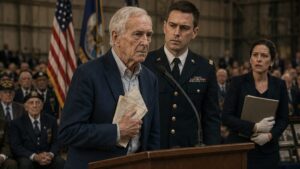
Charles turned slightly. “Mrs. Donna Thompson served in transportation and range control at this installation. She has brought forward material connected to Tower Four and to a training-night rescue that has been incompletely preserved in our records.”
Not wrongly. Not falsely. Incompletely.
Donna let the word stand. It was not enough, but it could open the door.
Ryan placed the black bag on a small table beside the microphone. He did not set it down casually. He lowered it with both hands. The gesture moved quietly through the formation. Donna saw one young soldier straighten his shoulders as if he had suddenly understood the bag was not luggage.
Charles continued, “The official account credits a unit response. It does not fully identify the route used, the personnel who maintained signal, or the correction attempted afterward.”
The base commander leaned toward Charles. “Careful,” he murmured.
The microphone caught it.
A few faces in the front row shifted.
Donna stepped forward before Charles could smooth over the moment. “Careful is how this got lost.”
Charles closed his mouth.
The yard went very still.
Donna did not look at the crowd as a crowd. She looked at the cones first. One by one, they marked the path nobody had wanted to admit was the only path left. Then she looked at Tower Four.
“My name is Donna Thompson,” she said. “I was not command. I was not decorated for what happened here. I was a transportation clerk who knew which roads washed out and which gates stuck when it rained.”
Her voice did not rise, but the microphone carried it to the back.
“On the night this tower mattered most, the west gate was chained. The east lane was blocked. The report said weather complicated the route. That was true. It was also not the whole truth.”
Benjamin stood near the motor-pool shed, cap in both hands.
Donna looked toward him. She had promised herself not to make him an offering. Mercy could not be built from another lie.
“Motor-pool could not clear the east lane in time,” she said. “Not because one man failed alone. Because the yard had been allowed to depend on lanes nobody checked until the storm made them necessary.”
Benjamin’s shoulders dropped as if a strap had been cut.
Donna turned back to the formation. “I marked the alternate route. E-14. I corrected the draft report. Then I did not stand by that correction when it disappeared.”
A movement came from the chairs. Discomfort. Surprise. The small restless shifting of people who had expected a dedication and received a confession.
Ryan stared at the ground.
Donna saw it and stopped.
Charles stepped half a pace toward the microphone, perhaps to protect her from the silence or protect the event from where she was taking it. “Mrs. Thompson is being modest. Her correction appears to have been essential to—”
“No,” Donna said.
The word stopped him.
She looked at Ryan then. “Don’t make it clean because it hurts.”
Charles’s face changed. He stepped back.
Donna breathed once. The cloth tie pressed against the thin skin of her wrist.
“Linda Nelson was in Tower Four,” she said. “She held signal when equipment failed. She kept calling positions while the rest of us argued with roads and gates and permission. She said, ‘No one outside the gate.’ She meant the recruits. She meant anybody waiting for us to decide whether the rule mattered more than the life in front of us.”
A young soldier in the formation lowered his eyes.
“The route worked,” Donna said. “Late, but it worked. The recruits came in. Most of what could be saved was saved. Linda was not saved. And afterward, the report remembered the team, the weather, the equipment, and the successful extraction. It did not remember her properly. It did not remember the route properly. It did not remember that a correction was made and then allowed to vanish.”
She looked at the black bag.
“I kept the map because I thought keeping it meant I was keeping faith. But a truth hidden in a bag is still hidden.”
The words cost more than she expected. Her hand trembled, and the canvas map shifted. Ryan saw it and moved, but stopped before touching her. He had learned at least that much.
Donna laid the map on the table beside the bag. Michelle came forward with the archival sleeve, but she did not interrupt. She waited.
Charles turned toward the crowd. His face had gone pale beneath the controlled public mask. “The archive will be corrected.”
The base commander stepped forward. “And the installation will review—”
Donna raised a hand.
The commander stopped, startled into silence by the small gesture.
“I’m not here to name a road after myself,” Donna said. “I’m not here to punish a dead officer, or an old mechanic, or a young sergeant who made a public mistake because he mistook control for care.”
Ryan’s face tightened.
She did not spare him from the truth. She did not offer him to the crowd either.
“This route should be taught,” Donna said. “Not as a hero story. As a warning. Check the gate before the storm. Listen to the clerk who knows the road. Do not let rank decide whose memory counts. And when an old person comes carrying something heavy, do not make them prove they were once worth your manners.”
No one clapped.
Donna was grateful.
The silence that followed was not empty. It was full of people deciding what to do with what they had heard. That was better than applause. Applause could end a thing too quickly.
Benjamin walked forward before anyone invited him. Each step seemed to cost him. He stopped near the microphone but did not take it.
“The east lane was mine,” he said, his voice rough enough that the microphone barely caught it. “I let weather take the blame for what I did not get clear. Linda kept calling. Donna marked the route. I remembered the engines because that was easier than remembering the delay.”
He looked at Donna.
“I’m sorry,” he said.
Donna nodded once.
Not forgiveness. Not refusal. A place to begin.
Michelle opened the archival sleeve and held it ready. Donna folded the canvas slowly. She placed the roster inside it, then the cloth tie beside Linda’s name for one breath before unwrapping it from her wrist. Her fingers hesitated there.
Ryan took one step, carrying the black bag closer.
Donna looked at him. He held it as if it belonged to someone else, which was finally correct.
She placed the folded map into Michelle’s hands.
Then she reached for the bag.
Ryan lowered it toward her, but Donna did not take the whole thing. She slid her fingers under the cracked shoulder strap, found the worn buckle, and pulled loose the old leather length that had been repaired twice and cut at one end.
The bag collapsed slightly without it.
Michelle looked at her questioningly.
“The bag goes with the map,” Donna said.
Charles asked, “And the strap?”
Donna folded it once into her palm.
“The strap is mine.”
Chapter 8: The Strap She Chose To Keep
Donna nearly took the black bag back when Michelle placed it in the archive drawer.
The drawer was too clean for it. Pale metal, white label, acid-free lining, a square of cotton support beneath the cracked leather. The bag lay open now, emptied of its long burden, its sides softened into folds. Beside it rested the canvas map in its sleeve, the roster flattened under a clear cover, and a temporary label written in Michelle’s neat hand.
Tower Four Route Sheet and Related Materials. Donated by Donna Thompson. Linda Nelson signal record pending correction.
Pending.
Donna hated the word and trusted it more than any promise made too quickly.
Michelle slid the drawer halfway closed, then paused. “Would you like another minute?”
Donna’s right hand tightened around the old strap. She had folded it small enough to fit inside her palm, but the buckle pressed against her skin.
“No,” she said.
Michelle nodded and closed the drawer.
The soft click sounded like a door shutting in a house Donna had lived in too long.
Charles stood behind them with his jacket over one arm. Without the ceremony posture, he looked older. Not weak. Just more honest about being tired.
“The official amendment will take time,” he said.
“Most things that matter do.”
“I’ll send you every draft.”
Donna looked at him. “Send Michelle’s draft.”
A quick, almost embarrassed smile crossed Michelle’s face.
Charles accepted the correction. “Michelle’s draft.”
Benjamin had left first. He had not asked Donna for forgiveness again. At the shed door, he had touched two fingers to the brim of his cap and gone back toward the motor pool alone. That, too, felt right. Some men needed a wrench in their hands before they could face what they had said.
Donna turned from the drawer. “I should go.”
Charles walked her to the hall. He did not offer his arm. Another kindness. The hallway outside the archive was busy with the broken-down remnants of ceremony: folded chairs on carts, empty water bottles in bins, staff voices lowered now by the knowledge that history had not behaved. Through the window, the orange cones still marked the route across the yard. No one had moved them yet.
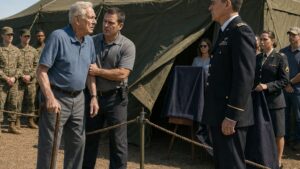
At the exit, Ryan waited.
He had changed nothing about his uniform, but he looked less arranged inside it. His cap was tucked under one arm. In his other hand was a clipboard with a sheet clipped to it, the paper covered in square, careful writing.
Donna stopped.
Ryan swallowed. “Mrs. Thompson.”
Charles paused behind her, then understood enough to step back. Michelle remained near the archive door.
Donna looked at the clipboard. “Another form?”
“Yes, ma’am.” His face colored. “But not for you.”
He turned it so she could see. At the top, in block letters, he had written: VISITOR ESCORT AND VERIFICATION PROCEDURE FOR VETERANS, FAMILIES, AND LEGACY RECORD DONORS.
Below were numbered steps.
Private escort when possible.
No public inspection unless immediate safety threat.
Contact operations before refusing entry.
Do not handle personal historical material without permission.
Offer seating. Offer water. Listen first.
The last two words were underlined.
Donna read them twice.
Ryan held the clipboard too tightly. “It is not official yet.”
“No.”
“I’ll route it through security. Mr. Moore said he would review it.”
Charles gave a small nod from the hall.
Ryan continued, “It doesn’t fix what I did.”
“No.”
He accepted that the way he had accepted the bag: with both hands, carefully.
“I’m sorry,” he said. “Not because I got corrected. Not because people saw it. I’m sorry because you told me not to unroll it in the dirt, and I heard an old woman making trouble instead of a veteran protecting something.”
Donna looked at him for a long moment.
The apology did not ask to be admired. It did not ask her to comfort him. That made it easier to hold.
“Sergeant Garcia,” she said, “you were afraid to look careless.”
His mouth tightened. “Yes, ma’am.”
“I was afraid to look guilty.”
He looked up.
She folded the strap once more in her palm. “Fear makes people choose the wrong silence and the wrong noise.”
Ryan’s eyes moved to the closed archive room behind her. “Do you forgive me?”
The question was too young. Too quick. Too human.
Donna could have given him peace she did not yet feel. She had done that too often with men who looked sorry after the cost had moved elsewhere.
“Not today,” she said.
He nodded, though the answer hurt him. “Yes, ma’am.”
“But I believe you can become the kind of man who would not do it again.”
His face changed then. Not relief exactly. Responsibility.
“That’s enough,” he said.
“No,” Donna said. “It’s a start.”
Outside, evening had lowered the heat without cooling the dust. The ceremony chairs were gone. The bunting still moved faintly along the rail of the operations building. Tower Four cast a long shadow across the yard, and the cones marked a path through it, bright and ordinary.
Donna walked slowly toward the gate.
Ryan followed at a respectful distance, not escorting as if she might wander, simply walking the same direction. Charles and Michelle stayed behind near the building. No one called after her. No one asked for a picture. No one saluted.
At the cone line, Donna stopped.
The same orange cone that had blocked her yesterday stood near the gravel, slightly scuffed where she had dragged it into the route. Beyond it lay the public walkway, the gate, the parking lot, her car, the road home, the cedar box that would be empty when she returned.
For a moment, she did not move.
She had thought peace would feel cleaner. Instead it felt like the archive drawer: correct, necessary, not warm. Linda’s name would be written where it belonged. The route would be taught. The tower would come down after being remembered. But absolution did not arrive on command. Perhaps it never did. Perhaps the best a person could do was stop making guilt the guardian of truth.
Ryan stepped forward.
He did not touch her elbow. He did not speak.
He bent, lifted the cone by its top, and moved it aside before Donna reached it.
The path opened without announcement.
Donna looked at the space where the cone had been, then at the young soldier standing beside it with dust on his boots and shame still teaching him.
She unfolded the old strap in her hand and ran her thumb over the cracked leather.
“No one outside the gate,” she said.
Ryan heard her. This time, he did not answer too quickly.
Donna walked through.
The story has ended.