The Old Veteran Stood Quietly While They Tried To Take His White Seat Card
Chapter 1: The White Card At Table Seven
“The card does not belong on this table.”
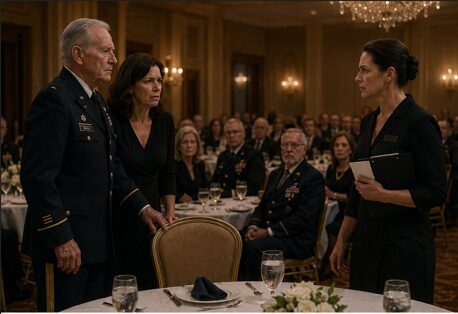
The woman in black said it softly enough to sound professional, but not softly enough to keep the nearby guests from hearing. She stood between the round tables with a small white card pinched in her fingers, her body angled over William Miller as if he had been caught taking something.
William did not answer at once.
His left hand rested beside his water glass. His right hand lay flat on the tablecloth, two fingers touching the edge of an empty bread plate. The chair beside him remained pulled back just enough for someone to sit, but no one had. On the plate, before the woman picked it up, the white card had sat clean and square under the chandelier light.
Now it trembled slightly in her hand.
Across from him, a man in a dark suit stopped cutting his salad. At the next table, two older veterans turned their heads without turning their bodies. The ballroom did not fall silent all at once. It thinned. Forks still touched china. A glass still clicked. Somewhere near the stage, a microphone gave a brief squeal and died.
Mary Miller leaned forward in her chair. “Excuse me?”
The woman looked at Mary, then back to William, as though Mary were an interruption she had expected. “I’m sorry for the inconvenience. This seat has not been authorized in the final arrangement.”
William lifted his eyes to her face. She was younger than Mary, perhaps early fifties, with hair swept back so tightly it looked almost severe. A small silver name badge on her black dress read Karen Wright. Event Coordinator. Her face carried the strained calm of someone who had already made up her mind and needed everyone else to accept it quickly.
William had seen that expression before on officers, clerks, doctors, funeral directors, and men who mistook a folded paper for the truth of a life.
He said nothing.
Mary’s hand moved toward the card. “That was placed there before we sat down.”
Karen drew it back half an inch. Not much. Just enough.
“It was placed there in error,” she said.
Mary’s cheeks colored. “You don’t know that.”
“I have the final list.”
William could feel the old wool of his dress jacket pressing at his shoulders. He had not worn it in years, and the material had a way of reminding him of every pound he had lost, every place his body had narrowed without asking permission. The collar sat stiff against his neck. A small row of decorations rested over his heart, modest under the light, but he did not look down at them. They were not why he had come.
The empty chair was why he had come.
Karen shifted the card to her other hand and glanced toward the stage. “We’re beginning the donor acknowledgment before the next course. I need to correct the seating now.”
Mary’s chair scraped the floor. “Correct?”
William moved two fingers against the tablecloth.
It was barely a gesture, but Mary stopped.
He did not look at her. If he did, he might see the anger in her face. Worse, he might see the hurt. She had driven him here, helped him into the uniform, watched him stand too long in the front hall with an envelope in his hand, and he had told her almost nothing. He had asked her only to come. She had come because daughters do that, even when silence becomes another person in the car.
Karen took the pause as permission to continue. “Mr. Miller, your assigned seat is here. That is not in dispute. But this additional place setting is not registered to a guest. We have a sponsor representative arriving late, and this chair needs to be released.”
Released.
The word landed on the white tablecloth between the water glasses and folded napkins.
William’s fingertips moved from the bread plate to the stem of his glass. He did not drink. He let the cold of it steady him.
Mary’s voice lowered. “This is a veterans memorial benefit.”
“Yes,” Karen said. “And we are grateful for everyone’s attendance.”
“You’re grateful,” Mary repeated, and there was enough steel in it that a woman at the next table looked away.
Karen’s mouth tightened. She was trying not to look embarrassed. That made everything worse. A person trying not to look embarrassed often looked for someone else to blame.
“This is not personal,” Karen said.
William almost smiled, not because it was funny, but because there were phrases people used when they were about to do something very personal indeed.
He looked at the empty chair.
The napkin had been folded into a white peak. The water glass was full. The salad plate had not been touched. A small butter knife rested at an exact angle beside the bread plate. The place looked prepared for someone delayed in traffic, someone caught in the lobby, someone who might arrive with an apology and a hand raised in greeting.
No one was coming.
Karen followed his gaze. “If you’re waiting for someone, our registration desk can help locate them.”
Mary inhaled sharply.
William gave another small motion of his hand, and again Mary swallowed her words.
The guests near Table Seven were no longer pretending not to watch. The silence had gathered into a shape. William could feel it at his back, along the side of his face, in the pause of the waitstaff near the ballroom doors.
Karen turned the card face down against her palm. “Mr. Miller, I need to ask you directly. Did someone at registration give you permission to hold this seat?”
His fingers curled once, then relaxed.
“No,” he said.
Mary turned toward him. “Dad—”
Karen’s expression changed. Not triumph, exactly. Relief. Her shoulders lowered as if the matter had finally arranged itself in her favor.
“Then I’m afraid we need to remove the place setting,” Karen said.
William looked at her hand, at the white edge showing between her fingers. A small square of card stock. A thing anyone could print, misplace, discard, reprint. A thing with no weight unless a person knew what it carried.
He pushed his chair back.
The sound was not loud, but in that thinned ballroom it carried.
Mary reached toward his sleeve. “Dad, don’t.”
William stood slowly. Not because he wanted the room to watch, but because his knees required patience and his back did not straighten quickly anymore. He placed one hand on the table as he rose. Karen took half a step backward before she seemed to realize she had done it.
The watching guests saw an old man in a dark uniform standing over a disputed chair.
William saw Karen’s hand around the card.
He did not raise his voice. “That chair is not mine.”
Karen blinked. “Then you understand why—”
“No.” William’s voice remained even. “You do not.”
The words held her in place for a moment. Behind her, a photographer lowered his camera without taking the picture. One of the banquet staff by the service doors looked from Karen to the empty chair, unsure which authority mattered more.
Mary’s eyes had gone wet, though she was trying to make them angry instead.
Karen drew herself back into her role. “Mr. Miller, I’m trying to handle this respectfully.”
William looked at the empty chair again. “Then do not take what you have not asked about.”
Color rose into Karen’s face. “I have asked. You said no one authorized you to hold it.”
“I said no one gave me permission.”
“That is the same thing.”
William looked at her then, fully. “Not always.”
For the first time, Karen looked uncertain. Only for a second. Then the stage lights brightened, and the master of ceremonies spoke into the microphone, welcoming everyone to the annual memorial benefit, thanking sponsors, inviting guests to enjoy the evening. The normal sounds returned at the edges, but the circle around Table Seven remained tight and watching.
Karen lowered her voice. “I cannot leave an unauthorized chair in place during the donor acknowledgment.”
Mary stood halfway, her hand gripping the back of her chair. “Please. Just give us a minute.”
Karen did not look at Mary. “I already have.”
William’s breathing stayed measured, but his hand on the table had tightened around the cloth enough to pull a faint crease toward him. He noticed it and let go.
A man from a nearby table leaned slightly toward another guest and whispered something William could not hear. Karen heard the whispering, though. It made her look toward the stage, then toward the sponsor tables near the front, then back to William with a new impatience.
“This doesn’t have to be uncomfortable,” she said.
Mary gave a short, broken laugh. “You’re standing over my father in front of half the room.”
Karen’s eyes flicked to the rows of decorations on William’s jacket. She did not sneer. She did not mock them. Somehow that made her next words worse.
“I understand this evening may be meaningful to him,” she said carefully, “but we have procedures for memorial placements.”
William felt Mary move beside him, felt the anger rising from her like heat.
He touched the table once.
Mary stopped again, but this time she looked at him as if the gesture had wounded her.
Karen saw it too. She mistook it for weakness, or confusion, or an old man controlling a daughter who only wanted to help. Her face settled into a firm administrative sympathy.
“I’ll have a staff member clear the chair before the next course,” she said, folding the white card against her clipboard. “You and your daughter may remain seated.”
William stayed standing.
Karen turned away first.
Mary whispered, “Dad, why won’t you just tell her?”
William did not answer. He watched Karen walk toward the service doors with the white card still in her hand, and for the first time that evening, the empty chair looked less like a promise and more like something already being carried away.
Chapter 2: The Invitation Mary Could Not Explain
Mary found her father dressed before she had even knocked twice.
He was sitting in the front room beneath the lamp with the green shade, wearing the dark formal uniform she had not seen outside a garment bag since her mother’s funeral. The jacket looked brushed and cared for, but it hung looser on him now. His shoes were polished. His silver hair was combed back with water. In his hands lay a sealed white envelope.
He did not open it.
He only looked at it.
Mary stood in the doorway with her car keys still in her hand. “Dad?”
William turned the envelope over once, hiding the front. “You’re early.”
“I’m on time. You’re the one who looks like you’ve been ready since noon.”
He smiled faintly, but it did not stay. The house was too quiet around him. No television, no radio, no kettle clicking in the kitchen. On the small table beside his chair sat a glass of water, untouched, and a folded invitation printed on heavy cream paper.
Mary stepped inside. “Are you sure you want to go?”
“Yes.”
“You can say no. I know you hate these things.”
“I don’t hate them.”
“You leave them early.”
“That is different.”
She crossed the room and picked up the invitation before he could stop her. He did not try. The paper announced the annual veterans memorial benefit at the King Foundation Ballroom downtown. Dinner, donor acknowledgment, remembrance program. Formal attire requested. Mary read the printed lines twice, then looked at the envelope in his lap.
“This came with it?”
William’s thumb shifted over the flap. “Yes.”
“What is it?”
“A card.”
“What kind of card?”
“The kind they expect me to bring.”
Mary waited. Her father had always been able to make silence feel like a locked room. When she was a child, she had thought it meant strength. When her mother was dying, she had learned it could also mean fear.
“Dad,” she said gently, “if there’s something I need to know before we walk into a ballroom full of people, tell me now.”
His eyes moved to the window. Outside, the evening had not yet darkened, but the glass already reflected him back at himself: an old man in a uniform he had once filled without thinking.
“You do not need to know everything to sit beside me,” he said.
Mary laughed under her breath, not amused. “That sounds exactly like something a person says before I absolutely need to know everything.”
He slid the envelope into the inner pocket of his jacket.
“Please don’t open it,” he said.
The request landed harder than an order.
Mary stared at him. “Why would I open it?”
“If someone asks.”
“If who asks?”
He reached for his cane, then seemed to decide against it and stood without it. She noticed the effort and hated that he noticed her noticing.
“It may be nothing,” he said.
“You dressed like this for nothing?”
His mouth tightened. “No.”
That was all he would give.
In the car, Mary tried three different roads into the same conversation. She asked whether he knew anyone at the benefit. He said, “Some names.” She asked whether he had been invited to receive something. He said, “No.” She asked whether this had anything to do with the old unit association letters he still kept in a shoebox in the hall closet. He looked out the passenger window and said, “You drive too close to the curb.”
“Fine,” she said. “Then we’ll talk about my driving all the way downtown.”
He almost smiled again, but the envelope pocket rose and fell with his breath.
The hotel stood under warm lights, all glass and polished stone. Men in suits and older veterans in formal jackets moved through the entrance with spouses, sons, daughters, friends. A photographer near the lobby asked people to pause under a banner. Mary guided her father past it before anyone could stop them.
At registration, a foundation assistant searched the tablet for William’s name.
“Miller,” Mary said. “William Miller.”
The assistant brightened. “Yes, here you are. Table Seven.”
William’s eyes lifted.
The assistant looked down again. “One guest accompanying. Mary Miller?”
“That’s me,” Mary said.
The assistant handed them two small printed cards and a program. William did not take his. He was looking past the desk into the ballroom, where tables glowed under chandeliers and each white cloth held folded napkins like little flags of surrender.
Mary saw the change in his face before she knew what caused it.
“What is it?”
He did not answer.
The assistant frowned at the tablet, tapping once, then twice. “That’s odd.”
Mary’s attention snapped back. “What’s odd?”
“There was a note attached earlier.” The assistant scrolled. “It’s not showing now. But Table Seven is correct.”
“What kind of note?”
“I’m sorry, I’m not sure. It just says revised seating confirmed.” The assistant glanced toward a woman in black speaking briskly to banquet staff near the ballroom doors. “The coordinator finalized everything about twenty minutes ago.”
William reached slowly into his jacket and touched the envelope but did not bring it out.
Mary lowered her voice. “Dad.”
He looked at the entrance to the ballroom. “We should sit.”
“Not until you tell me what the note was.”
His face had gone still in the way that meant she would get no answer.
They entered under a wash of sound: silverware, music, low conversation, the practiced warmth of people attending something solemn but expensive. Table Seven sat halfway between the stage and the side service doors. Four guests were already seated. Two places remained for William and Mary.
And one more place stood beside William’s chair.
A full setting.
Empty.
The napkin folded. The water glass filled. The plate untouched. A white card resting at its center.
Mary stopped behind her chair. “Is that what you meant?”
William stared at it for so long the nearby guests began looking at one another.
He pulled out Mary’s chair first, because even now he did small courtesies when his hands were steady enough. Then he sat. Only after that did he remove the sealed envelope from his jacket. He did not open it. He laid it near his plate, close to the white card already waiting there.
Mary leaned toward him. “Dad, whose seat is that?”
He touched the edge of the envelope as if checking that it was real. “It was supposed to be farther from the aisle.”
“What was?”
His eyes fixed on the empty chair.
“They moved it,” he whispered.
Chapter 3: The Woman Holding The Wrong List
Karen Wright saw the extra chair before she saw the old man.
It appeared on the printed table chart as a handwritten note in the margin: Table Seven — one held placement. Do not reassign. No guest name attached. No donor code. No registration number. Just a block of ink that had survived three rounds of revisions and somehow vanished from the tablet system.
She stood at the registration desk with the chart in one hand and her phone in the other while the ballroom behind her filled with people who believed an evening ran smoothly because the evening cared.
It did not.
Evenings like this ran because Karen caught mistakes before they became visible.
“Is there a problem?” the foundation assistant asked.
“No,” Karen said automatically.
There were six problems. The hotel had set two tables too close to the stage ramp. The photographer was irritating donors by asking for second poses. The salmon course was running eight minutes behind. One board member had brought an unlisted guest. The sound technician could not find the handheld microphone for the remembrance reading. And Matthew King’s sponsor representative was arriving late with a pledge large enough to keep next year’s veterans transportation program alive.
Karen looked again at the handwritten note.
Held placement.
She hated phrases like that. They sounded meaningful but gave no instruction. Meaningful did not tell a staff member where to place a chair or who was paying for the plate.
Her phone buzzed.
Matthew King: Need seat near front handled. Do not embarrass sponsor.
Karen closed her eyes for one second, then opened them.
Across the lobby, Matthew stood with two donors near the banner, smiling in the loose confident way of a man who had never had to carry a clipboard at his own event. He was handsome in a polished, expensive way, silver at the temples, tuxedo fitted perfectly. He caught her looking and lifted his eyebrows, not quite a question, not quite a warning.
She walked to him with the chart held against her side.
“Matthew,” she said, keeping her voice low. “The sponsor seat is being handled.”
“Good.” He glanced toward the ballroom. “I’m told Table Seven has space.”
“It has an extra held placement.”
“For whom?”
“That is what I’m checking.”
He smiled at the donors, then turned his body slightly so only Karen could hear him. “Is it a person?”
“It’s not registered to a person.”
“Then it’s a chair.”
Karen felt the headache begin behind her right eye. “It may be part of the memorial arrangement.”
“The memorial arrangement is on the stage,” Matthew said. “The empty boots, the table, the candle, all of that. It looks very tasteful.”
She did not like the phrase all of that. She liked less that she had no time to argue with it.
“This note says not to reassign.”
“Does the current system say that?”
“No.”
“Then use the current system.”
His voice stayed friendly. That was the trouble with Matthew. He did not need to threaten directly. The threat lived in the math around him: donor tables, operating budgets, grant renewals, transportation vans, staff salaries. Karen had built half the night around keeping men like him pleased enough to keep doing good for reasons that were not always good.
He softened his tone. “Karen, I know you care about these details. That’s why we trust you. But we cannot have a major sponsor’s representative stuck by the service doors because someone scribbled a sentimental note on an old chart.”
She looked down at the paper.
Do not reassign.
For a moment she saw another table, not in this hotel, not under chandeliers. A small kitchen table in a rented apartment, her father sitting at it in his old jacket while a bank clerk on speakerphone explained which form he had failed to submit. Her father had not argued. He had sat there nodding to a phone that could not see him, one hand on a stack of papers, as if politeness could make bureaucracy kind.
Karen folded the memory shut.
“This event cannot look disorganized,” Matthew said.
“It won’t.”
“Good.” He touched her elbow briefly, already looking back toward the donors. “I knew you’d fix it.”
Fix it.
Karen returned to the registration desk and opened the seating file again. Table Seven: William Miller, Mary Miller, four other guests, one vacant sponsor conversion pending. No held memorial chair. No Patrick White. No note. No instruction.
The assistant hovered nearby. “Do you want me to call the committee chair?”
Karen looked toward the ballroom. The committee chair was already seated at a front table beside two city officials and would take ten minutes to extract from conversation. The donor acknowledgment began in twelve. The sponsor representative had texted that he was five minutes away.
“No,” Karen said. “I’ll handle it.”
The assistant hesitated. “The older gentleman at Seven brought an envelope. He seemed to be expecting something.”
Karen kept her eyes on the tablet. “Did he say what?”
“No.”
“Did he show authorization?”
“No, but—”
“Then we follow the final list.”
The assistant’s face changed in the smallest way. Not defiance. Disappointment.
Karen did not have time to be wounded by it.
She walked to the side station where spare place cards, table numbers, and program inserts were arranged in neat stacks. On a tray near the edge lay the white card from Table Seven, or at least its twin, clean and unmarked on the back. Someone must have set it aside during setup, then placed another at the table. Or the hotel staff had copied the handwritten note into a physical card without entering it into the system. Or someone from the memorial committee had made an emotional decision and left her to absorb the logistical cost.
She picked it up.
The card felt too light to be causing this much trouble.
From the ballroom came a swell of laughter, then the first notes of dinner music. Guests were settling. Plates were moving. The room had entered that delicate stretch where any disturbance looked larger than it was.
Karen smoothed the front of her black dress and walked through the side entrance.
Table Seven was easy to find because of the empty chair.
The old man sat beside a woman who had his eyes and none of his stillness. His uniform was formal but aged, the fabric cared for, the shoulders slightly loose. He was looking at the white card on the plate as if he could hold it there by attention alone.
Karen paused once, long enough to consider starting with Mary instead.
Then she remembered Matthew’s message, the late sponsor, the missing microphone, the donors watching from the front, the chart in her hand that no longer matched the system everyone would blame her for.
She stepped to William’s side and reached for the card.
“Mr. Miller,” she said, “I’m sorry. This card does not belong on this table.”
Chapter 4: The Empty Chair No One Claimed
The banquet staffer reached for the empty chair as if it were nothing more than rented furniture.
William’s hand closed around the back of it before the young man could pull it away. The chair legs gave a short scrape against the ballroom floor and stopped. The staffer froze, one hand still extended, his eyes darting to Karen for instruction.
Karen stood two steps behind him with the white card tucked against her clipboard. “Mr. Miller, please don’t make this harder than it needs to be.”
William looked at the staffer, not at her. “Leave it.”
The young man swallowed. “Sir, I was told—”
“I know what you were told.”
Mary was on her feet now, her napkin fallen beside her plate. “Can we not do this here?”
But it was already here. It was in the way the nearest tables had quieted again, in the man across from William pretending to study the program, in the woman beside him touching her pearls with two nervous fingers. It was in the photographer at the edge of the aisle who had lifted his camera halfway, then lowered it again when Mary saw him.
William hated that most. Not the chair. Not even Karen’s voice. The watching.
He had come to sit quietly for one hour. He had come to keep a chair from being swallowed by a room full of people who said the right words into microphones and then rearranged what those words cost.
Karen stepped closer. “This chair is needed for a late-arriving sponsor representative. We can bring another if your guest arrives.”
“No guest is arriving,” William said.
The staffer blinked. Karen’s face tightened with weary vindication.
“Then you understand the problem,” she said.
William kept his hand on the chair back. The wood was smooth under his palm, polished for events like this, never meant to remember anybody.
Mary turned to him. “Dad.”
He did not look at her.
“Dad, please,” she said, lower now. “Tell her.”
Karen’s attention sharpened. “Tell me what?”
William felt the room lean toward the question. He had the sudden, old sensation of standing in front of men waiting for orders he did not want to give. He could stop this with more words. He knew that. He could take the envelope from inside his jacket. He could unfold the note. He could say the name that had lived behind his teeth for decades.
Instead, he said, “The chair is meant to remain empty.”
Karen waited for more. When he gave none, she glanced down at her clipboard. “We have an official memorial display at the front of the room. If you would like to pay respects there, I can have someone escort you.”
Mary made a sound that was almost a laugh and almost pain. “Escort him?”
The staffer slowly lowered his hand, relieved to no longer be touching the situation. Karen noticed and gave him a look. He straightened, but did not reach again.
William’s fingers remained around the chair. His knuckles had gone pale. He loosened them one at a time.
At the front of the ballroom, under two soft spotlights, the official memorial table stood exactly as Matthew had described it to Karen earlier. A folded cloth, an empty setting, a candle, polished boots beneath. Tasteful. Arranged. Distant enough that no one had to bump against it while passing bread.
That was for everybody, William thought.
This was not.
Mary leaned close to him. “I know you don’t want a scene.”
“Then don’t make one.”
The words came out harder than he intended.
Mary drew back. Her eyes flashed, but beneath the anger was hurt, clean and immediate. He had done that. Not Karen. Not the staffer. He had.
Karen took advantage of the opening. “Mr. Miller, I’m going to show you something.”
She slid a printed sheet from her clipboard and placed it on the edge of the table, careful not to disturb any glasses. Names were listed by table, neat and black. Table Seven showed William Miller. Mary Miller. Four other guests. One late sponsor conversion beside an empty slot.
No note. No warning. No held placement. No name.
Karen pointed to the line. “This is the final seating list.”
Mary looked at it, then at William. “That’s not what the woman at registration said.”
“The registration assistant may have seen an older note,” Karen said. “But this is what we’re working from now.”
William stared at the list. It did what official paper often did: proved something small and pretended it had proven everything.
Mary reached toward his jacket. “Show her the envelope.”
His hand moved before he thought. He caught Mary’s wrist, not tightly, but enough to stop her.
Mary went still.
The guests nearest them saw the motion. Karen saw it. The staffer saw it. William let go at once, but the damage had already entered Mary’s face.
“Don’t,” he said quietly.
Mary’s voice dropped. “Why not?”
He could not answer without opening the door he had kept shut all evening.
Karen’s posture softened in a way William mistrusted. Not kindness. Management. “Mrs. Miller, if there is documentation, I’m happy to review it.”
Mary shook her head. “It’s Ms. Miller.”
“My apologies.”
“No, you’re not.”
Karen absorbed that with a small breath. “I am trying to resolve a seating issue.”
“You’re trying to take a chair from him.”
“It isn’t his chair.”
Mary turned toward William with tears standing in her eyes now. “Then whose is it?”
The ballroom seemed to narrow around the question.
William looked at the white card in Karen’s hand. He could see only the back of it. Plain, blank, easily mistaken for trash if it slipped under the table.
Mary’s voice trembled. “Dad, is it Pa—”
“Mary.”
He said her name only once.
She stopped before the rest of it came out, but the first sound remained between them. Pa. Enough to change nothing for Karen. Enough to cut William where no one else could see.
Karen glanced between them. “If this is about a specific memorial request, I need the name and the authorization.”
William’s mouth went dry.
A waiter passed behind Karen with a tray of salads and slowed involuntarily, then hurried on. The ordinary machinery of dinner kept moving around them. That made the empty chair look even more fragile, as if it could be cleared between courses and vanish under the sound of forks.
William pulled the chair closer to the table. Not much. Just enough to put it back where it had been.
“This place stays,” he said.
Karen’s eyes hardened again. “Mr. Miller, with respect, you don’t have the authority to decide that.”
“With respect,” Mary said, “neither do you if you don’t know what it is.”
Karen lifted the list slightly. “I know what is on the official arrangement.”
William looked from the list to the chair, then to Mary’s wrist where his fingers had stopped her. A faint mark had not appeared, but he remembered the pressure of his hand. He remembered how quickly he had chosen silence over trust.
Mary saw him looking. Her anger faltered, then returned with grief behind it.
Karen turned to the staffer. “Leave it for now. I’ll confirm with the foundation table.”
The staffer nodded too quickly and withdrew.
“For now,” Karen repeated to William, as if granting him a favor. “But if there is no authorization, the chair will be removed before the donor acknowledgment ends.”
She took the printed list from the table, but not the white card.
William’s eyes followed it.
Mary waited until Karen had stepped away. Then she bent close, her voice low enough for only him. “You have to stop doing this.”
He sat slowly, his knees stiff, his hand still touching the empty chair.
“Doing what?”
“Making everyone guess where the pain is.”
He looked at her then.
Her face was pale under the ballroom light. She was angry, yes, but not for herself. That had always been the hardest thing to bear about Mary. She had inherited his stubbornness and her mother’s refusal to leave a wound alone just because someone had covered it.
“She deserves to know,” Mary said.
“No.”
“She’s going to take it.”
William looked at the empty place setting. The water glass was still full, untouched, absurdly bright. He remembered another canteen, passed hand to hand under a sun that made metal burn the skin. He remembered a young voice asking him to promise something that seemed simple because the impossible had not yet happened.
Mary placed both hands on the back of her own chair. “Dad, she deserves to know what you promised him.”
Chapter 5: The Name Mary Would Not Say
Mary opened the envelope because her father could not.
His fingers had found the flap twice and failed both times, the old paper slipping under his thumb as if it had become too heavy. They were standing in a service alcove just outside the ballroom, near stacked trays, folded linens, and a door that breathed out warm kitchen air each time someone passed through. Dinner noise moved through the wall in muffled waves.
“Give it to me,” she said.
William held the envelope a second longer.
“Dad.”
He let it go.
Mary had expected something official. A foundation letter. A seating authorization. A printed instruction that would make Karen Wright step back and look ashamed. She needed that, badly enough that her hands were rough when she opened the flap.
Inside was a folded note on old paper.
Not letterhead. Not a form. Not a certificate.
Just a note.
The creases had gone soft from years of being opened and refolded. The writing was uneven but careful, each line pressed hard enough that the pen had nearly cut the paper in places. Mary unfolded it and looked first for a signature.
Patrick White.
She had seen the name before. Once. Maybe twice. Not in stories, because William did not tell those. On the back of a photograph in the hallway closet. On a faded association program tucked inside a shoebox. A name that appeared around the edges of her father’s life and vanished whenever she asked.
William stood beside her, one hand braced against the wall. He was looking not at the note but at the floor.
Mary read the first line silently.
If they ever make a chair for the ones who don’t come back, save me one near somebody who remembers my name.
Her throat tightened so quickly she had to swallow before she could keep reading.
The note was not long. A few lines. A young man’s half-joke made serious by the age of the paper. He wrote about hating the front row at ceremonies. He wrote that if anyone set a place for him, he wanted it near the men who would not pretend he had been braver than he was. He wrote, Tell Miller I still owe him a cup of coffee, and if he gets old, he better drink one for me.
Mary lowered the paper.
“Patrick wrote this?”
William nodded once.
“When?”
His jaw shifted. “Before the last patrol.”
The kitchen door swung open. A banquet staffer stepped out carrying a tray of covered plates, saw their faces, and looked away at once.
Mary folded the note along one crease but could not make herself close it. “Why didn’t you tell me?”
He gave no answer.
She looked toward the ballroom entrance. “This doesn’t say the foundation has to leave the chair.”
“No.”
“It doesn’t authorize anything.”
“No.”
Her anger came back then, not as heat but as panic. “Dad, Karen is going to look at this and say it proves nothing.”
“It proves what it needs to.”
“To you. Not to them.”
He took that without flinching, which made her angrier. She wanted him to fight for himself. Then she hated herself for thinking the chair was about him.
Mary looked at the note again. The handwriting belonged to someone young. That was the worst part. It did not look like history. It looked like a person who thought he might still have time to be funny.
“What happened to him?” she asked.
William reached for the note, then stopped before touching it. “He was nineteen when I met him. Lied and said he was twenty because he thought nineteen sounded too much like a boy.”
Mary waited.
“He talked too much when he was scared. After a while I learned that meant I should listen closer.”
The ballroom music changed, a gentle instrumental version of something familiar. Through the open service gap, Mary could see guests lifting forks, laughing carefully, living inside an evening that had no idea what was happening ten feet away.
William’s voice stayed low. “He had a mother in Ohio. Two younger brothers. He kept a photograph of a dog he said hated everyone but him.”
Mary had never heard her father speak so many sentences about a man from the war.
“He wrote that note during a bad week,” William continued. “Men say foolish things when they are trying not to be afraid. I told him if he wanted a chair, he could come home and sit in one himself.”
“And he didn’t.”
William’s face closed.
Mary wished she had not said it so bluntly.
After a moment, he said, “I could not get him back.”
The words were plain. Too plain. They left no room for comfort.
Mary stepped closer. “That wasn’t your fault.”
His eyes moved to hers, tired and sharp. “You don’t know that.”
“I know enough.”
“No,” he said. “You know what daughters are told after the years make it safe.”
The note trembled in Mary’s hand. “Then tell me what isn’t safe.”
William looked toward the ballroom, toward the table they had left behind. “He asked me not to let them make him into a speech.”
Mary went still.
“He said if he didn’t come back, he wanted one ordinary place. Not a podium. Not a paragraph. A chair. A cup. A card. Somewhere somebody had to look at before they reached for the bread.”
Mary thought of the empty place setting at Table Seven. The full water glass. The white card Karen had taken like a mistake.
“So that’s why you came?”
William nodded.
“All these years?”
“The old unit association used to do it when they could. Different rooms. Different dinners. Sometimes it was just three of us in a church basement with bad coffee.” His mouth twitched, barely. “Patrick would have complained about the coffee.”
Mary let out a breath that hurt. “And tonight?”
“The foundation invited surviving members connected to the memorial fund. Someone remembered the old note. Someone said there would be a held chair.”
“Who?”
“I don’t know anymore.”
“Dad.”
“People die, Mary. Committees change. Files move. Names get shortened until they disappear.”
She looked at him then, really looked. Not at the uniform. Not at the medals she knew he would never use to ask for anything. At the old man who had carried a nineteen-year-old’s joke into a promise, then carried the promise so long that even his daughter had mistaken it for stubbornness.
“You should have told me in the car.”
“Yes.”
The admission startled her.
He looked at her wrist, where he had stopped her at the table. “And I should not have grabbed you.”
“You didn’t hurt me.”
“That is not the point.”
For a moment, anger and tenderness collided so hard she could not speak.
The service door opened again. This time Karen Wright stepped into the alcove, holding her clipboard like a shield. Matthew King was behind her, polished and impatient, his smile gone now that no donors were close enough to see it.
Karen looked at the note in Mary’s hand. “Is that the documentation?”
Mary lifted it. “It’s why the chair is there.”
Karen read the room before she read the paper. Her eyes moved from Mary’s face to William’s, then to the envelope. She seemed less certain than before, and Mary almost felt relief.
Then Matthew spoke.
“We’re minutes from the acknowledgment,” he said. “Whatever this is, we need the chair cleared now.”
Karen held out her hand for the note. Mary did not give it to her.
“It’s personal,” Mary said.
Karen’s mouth tightened, not cruelly, but professionally, and that was almost worse. “If it’s personal, then I’m sorry, but it doesn’t authorize an unregistered seat.”
William closed his eyes once.
Mary looked at her father, waiting for him to say the name, to put Patrick White into the air where they could no longer move around him.
But William only opened his eyes again and folded the envelope with slow care.
Karen stepped aside, making a path back toward the ballroom. “Mr. Miller, Ms. Miller, we need to return to Table Seven. The chair must be removed now.”
Chapter 6: The Sponsor Seat That Cost Too Much
Karen found the older chart under a stack of menus five minutes too late.
It had been folded into quarters and shoved beneath the final dinner counts, the kind of paper that looked obsolete simply because it had wrinkles. She almost threw it aside. Then she saw Table Seven circled in blue ink.
Empty Chair — Do Not Reassign.
The words sat there without explanation, without donor code, without the clean authority of the tablet system. But they were real. They had been written by someone before the final revision, before the sponsor conversion, before Karen had stood over William Miller with a white card in her hand and spoken as if paper could not be wrong.
She stared at the note until the letters blurred.
From the ballroom came the warm swell of the master of ceremonies thanking guests for their generosity. The donor acknowledgment was moving closer. At the foundation table, two board members were smiling toward the stage. Matthew King stood near the side entrance, checking his phone with the restless irritation of a man waiting for someone else to fix what he had complicated.
Karen folded the chart back open and looked at the revision marks.
There it was. A thin line through the held placement. Initialed beside it, not by her, not by the committee chair. A small note in the margin: Convert if needed for sponsor overflow.
No name.
No discussion.
Just convert if needed, as if memory were banquet space.
Her stomach tightened.
A foundation assistant stepped beside her. “You found it.”
Karen did not look up. “You knew?”
“I saw the old note at check-in. I tried to mention it.”
“You said there was a note. You didn’t say this.”
“I didn’t know what it meant.”
Neither did I, Karen thought, but she did not say it.
She picked up the white card from the side station. After the confrontation, she had set it down with spare place cards, face down, as if that made it less charged. Now she turned it over.
The front did not say Patrick White. It did not say fallen soldier. It did not say promise. It said only:
Held in Remembrance
Small black letters, centered.
Too simple. Too easy to ignore if a person was in a hurry.
Karen’s throat tightened unexpectedly.
Her father had hated events like this. He had not hated veterans, or flags, or ceremonies. He had hated the way people thanked him loudly and listened poorly. He had once sat through a hospital intake while a clerk called him “sweetie” six times and asked Karen whether he understood his own insurance forms. He had understood them. He had simply been slow turning the pages because half his fingers no longer bent right.
Karen had corrected the clerk that day. Sharply. Publicly. With the fury of a daughter who could still afford fury.
Then her father died, and Karen turned efficiency into armor. Rules did not tremble. Lists did not remember. Systems could be fixed if everyone stopped making them emotional.
She looked toward Table Seven through the side entrance.
William Miller sat with his hands folded now, but the empty chair was still beside him. Mary stood near him, one hand on the back of her own chair, body angled as if she could block the staff with herself if needed. Guests around them watched in short glances, pretending interest in the program.
Karen held the old chart, the white card, and the donor list at once. For the first time all night, she did not know which paper to trust.
Matthew appeared beside her. “Please tell me this is resolved.”
She handed him the donor list. “The chair was marked not to reassign.”
He glanced at it, then at the old chart in her other hand. “On an outdated printout.”
“It was carried into the physical setup. The place setting was intentional.”
“Was it in the final system?”
“No.”
“Then it wasn’t final.”
Karen looked at him. “Someone removed it.”
Matthew lowered his voice. “Karen, I’m going to be very clear. We are not losing a sponsor relationship over one symbolic chair.”
“One symbolic chair at a memorial benefit.”
“Yes,” he said, frustration breaking through the polish. “A benefit. The kind that requires money. The kind that pays for transportation, housing help, medical rides, all the unphotogenic things people expect us to fund after they leave rooms like this feeling noble.”
He was not entirely wrong. That was what made him dangerous.
Karen folded the chart along its worn crease. “You told me Table Seven had space.”
“It did.”
“It had a held placement.”
“It had an empty chair.”
“For a reason.”
Matthew looked toward the ballroom, then back at her. “Reasons don’t pay invoices.”
There it was, stripped bare. Not cruelty. Calculation. The kind that could keep a program alive and still crush one person under its wheel.
Karen thought of William’s voice: That chair is not mine.
She had taken the sentence as surrender. It had been protection.
The master of ceremonies laughed softly at something near the microphone, and the room followed. The sound made Karen flinch. She imagined walking to Table Seven now, card in hand, with half the room watching. She imagined saying she had made a mistake. She imagined Matthew’s face. The board’s questions. The donor representative arriving to find his seat vanished. The assistant’s disappointment turning into proof.
Then she imagined the old man’s hand on the back of the chair.
Not grabbing. Holding.
“Put the sponsor representative at the foundation table,” she said.
Matthew stared. “No.”
“There is a rotating seat beside the committee chair.”
“That seat is for program speakers.”
“The last speaker has already finished dinner and moved backstage.”
“He won’t like being moved.”
“He’ll live.”
Matthew’s smile returned, but now it was thin. “Careful.”
Karen felt the old instinct to smooth, to repair, to keep powerful people comfortable before they became problems. It had served her. It had also brought her to a table where she had nearly erased a dead man because an old one spoke too quietly.
“No,” she said. “I should have been careful earlier.”
Matthew’s eyes hardened. “Are you going to tell the room that?”
Karen looked at the white card.
She did not know.
That was the shame of it. Even now, with the truth in her hand, some part of her wanted a clean correction that left her image intact. A quiet switch. A whispered apology. No record of her standing over William Miller as if age were disorder.
The foundation assistant approached, tense. “They’re about to call the remembrance tables.”
Karen turned. “What?”
“The program change. The emcee is asking each table with honored veteran guests to stand during the donor acknowledgment. Table Seven is on his card.”
Karen’s pulse jumped. “Who gave him that?”
“The board packet. It must have been printed before the revision.”
Matthew let out a breath through his nose. “Wonderful.”
Karen looked across the ballroom.
William was still seated. Mary was watching the stage now, confused by the shift in program. The empty chair stood between them and the aisle, white napkin folded, water glass untouched, waiting under all that chandelier light.
Karen took one step toward the table, the white card in her hand.
At the microphone, the master of ceremonies said, “And now, would the
Chapter 7: The Veteran Finally Stood Up
Every face in the ballroom turned toward Table Seven before William had decided whether he could stand.
The master of ceremonies still held his smile at the microphone, one hand lifted toward their table as if he had announced something simple and harmless. “Table Seven, please stand so we may recognize your honored guests and families.”
Mary’s chair shifted beside William. “Dad.”
Karen was halfway down the side aisle with the white card in her hand, her face pale under the chandelier light. Behind her, Matthew King stopped near the foundation table, his mouth set hard, already calculating how much of the room understood that something had gone wrong.
William placed both palms on the tablecloth.
He did not want the room. He had never wanted the room. The room had weight: donors leaning forward, waiters stopped with trays, older veterans watching with the careful stillness of men who knew how quickly a ceremony could become a wound. Even the stage lights seemed to reach too far, turning the water glass beside the empty chair into a small bright eye.
Mary moved as if to help him.
William shook his head once.
She stopped, but he saw what it cost her.
He rose slowly. One breath for the knees. One for the back. One for the hand that wanted to close around the empty chair and keep it from every person who thought it was available.
A few guests began to clap, uncertainly, because clapping was what people did when a man in a uniform stood at a memorial dinner.
William lifted his hand, palm low.
The scattered applause died before it became anything.
At the side aisle, Karen looked down at the white card. She turned toward the stage with the desperate expression of someone trying to repair a break without letting anyone see the crack. The microphone stand waited there, bright and exposed.
She reached it before William expected her to. “Excuse me,” she said to the master of ceremonies.
The man stepped back, confused but smiling.
Karen took the microphone. “Ladies and gentlemen, I need to correct—”
“Not that way.”
William’s voice did not carry through the speakers. It did not need to. The people near Table Seven heard him. Then the next ring of tables heard the silence of those who had heard.
Karen froze with the microphone near her mouth.
William looked at her, then at the empty chair. “Not that way,” he repeated.
Mary turned toward him, tears standing openly now, her hand pressed against the back of her chair.
Karen lowered the microphone slowly. “Mr. Miller, I owe you—”
He shook his head.
The room waited. The master of ceremonies looked from Karen to William, uncertain whether to reclaim the microphone or vanish into the curtain behind him. Matthew stepped out from the foundation table with a practiced half-smile.
“Perhaps,” Matthew said, loud enough for the nearby tables, “we can all appreciate the meaningful symbolism of tonight’s memorial traditions while we continue the program.”
William looked at him.
Matthew’s smile faltered, but only slightly. “We’re all here for the same reason.”
“No,” William said.
The word was quiet. It cut cleanly.
Matthew blinked. “Excuse me?”
William’s hand moved to the back of the empty chair. He did not grip it this time. He rested his fingers there, as he might have rested them on a shoulder.
“Some came to be seen giving,” William said. “Some came to eat dinner. Some came because they were invited. Some came because a name was almost lost.”
Matthew’s face tightened. “Mr. Miller, this is hardly the place—”
“It is exactly the place.”
Mary drew in a breath.
William felt the old fear rise then, sharper than his stiff knees, sharper than Karen’s public mistake. It was not fear of speaking. He had spoken in worse places. It was fear of making Patrick small by turning him into an explanation for strangers with forks in their hands.
He looked at the empty plate. At the water glass. At the napkin folded for a man who would never use one.
Then he reached into his jacket and took out the old envelope.
The room seemed to lean again. He could feel the hunger in it, not cruel exactly, but eager. People loved a revealed object. A secret. A scene that told them where to place their feelings.
William did not open the envelope.
He laid it beside the empty plate.
“This chair is not mine,” he said. “It was never mine.”
Karen stood in the aisle with the white card pressed between both hands now, as if she feared it might fall.
William continued, each word chosen before he gave it to the room. “It belongs to a soldier who once asked for one ordinary place if he did not come home. Not a speech. Not a spotlight. Just a chair near someone who remembered his name.”
No one moved.
Mary’s hand covered her mouth.
William did not say Patrick’s name yet. The name was not a tool. It was not a key to win an argument. It had to be placed, not thrown.
Karen’s lips parted, but she said nothing.
Matthew tried again, softer this time, more careful because he sensed the room shifting away from him. “That is deeply moving. Truly. And the foundation honors all fallen service members through the official display at the front. Perhaps we could invite Mr. Miller to place the card there as part of—”
“No,” William said again.
Matthew stopped.
William turned his head toward the stage display: the polished boots, the folded cloth, the candle. Beautiful, distant, untouched by dinner.
“That table is for everyone,” William said. “This chair is for one.”
The distinction passed through the room slowly. He saw it land first on an older woman near the aisle, then on a veteran two tables away whose jaw tightened as if he had swallowed a memory. He saw the photographer lower his camera completely.
Karen took a step toward him. She held out the white card.
“I found the earlier chart,” she said, her voice strained but audible. “It said not to reassign the chair.”
William looked at the card but did not take it.
Karen swallowed. “I should have checked before I came to your table.”
Matthew looked toward the donors near the front, then made a small gesture with both hands, a host’s attempt to smooth the air. “Then we have our answer. The chair remains, and we can proceed with dignity.”
The word dignity sounded wrong in his mouth.
William looked at him for a long moment. “Proceeding is not the same as correcting.”
Matthew’s face reddened.
Mary whispered, “Dad.”
This time William heard the plea differently. Not don’t speak. Not don’t make trouble. Only stay yourself.
He had spent years believing silence kept him from making Patrick’s memory useful to other people. Yet silence had almost let them clear the chair. Silence had put Mary in the path of his pain. Silence had taught Karen that a soft voice could be moved aside.
He turned back to Karen.
“You made a mistake,” he said.
Karen nodded. “Yes.”
“You made it in public.”
Her eyes lowered.
Matthew shifted uncomfortably. William saw the temptation in that moment. He could let Karen stand there with the microphone and explain herself. He could let the room watch her shrink. He could give Mary the satisfaction of seeing humiliation returned to its sender.
But Patrick had not asked for that. And William had not come to teach a room how to punish a woman who had forgotten how to look carefully.
He picked up the envelope and held it, unopened, against his palm.
“I will not have this chair become your shame,” he said to Karen. “And I will not have it become his performance.”
Karen looked up.
William nodded toward the empty place. “Put the card where it was. Leave the plate. Leave the glass. Say nothing more than what is true.”
The master of ceremonies stood aside, humbled into usefulness at last.
Karen walked toward Table Seven. The aisle seemed longer with everyone watching. When she reached William, she held the card out again, but this time not as evidence, not as a claim, not as a rule.
William did not take it.
He opened his hand toward the empty plate.
Karen understood.
She placed the white card flat at the center of the untouched plate. The black letters faced up beneath the chandelier light.
Held in Remembrance
William looked at it until the room disappeared for one breath. He saw not the card but a young man grinning over bad coffee, pretending fear was only another joke he could tell better than anyone else.
Then Matthew stepped too close and said, in a low voice meant to be private but carrying farther than he intended, “Mr. Miller, we can arrange a photograph afterward. It would mean a great deal to the foundation.”
William turned his head.
Mary’s face hardened. Karen closed her eyes briefly, as if the words had struck her too.
William lifted the white envelope and rested it beside the card.
“No photograph,” he said.
Matthew opened his mouth.
William did not let him fill the space.
He picked up the card and held it out to Karen.
Her hands hesitated before accepting it.
William’s voice stayed even. “Then put it back yourself.”
Chapter 8: The Chair Left Properly Empty
Karen returned alone after the guests had begun collecting coats.
She was not carrying the donor list. She was not carrying the clipboard. In both hands, held carefully by the edges, she carried a new white card.
William was still at Table Seven.
Mary stood beside him with her purse over one arm, but she had not asked him to leave. Around them the ballroom had loosened into the tired disorder that followed formal events: napkins dropped beside plates, chairs angled away from tables, waiters clearing glasses two at a time. At the front of the room, the official memorial candle still burned. Near Table Seven, the empty chair remained exactly where Karen had placed it after William’s instruction.
Matthew King had disappeared into a knot of donors near the lobby doors, his smile restored and thinner than before.
Karen stopped beside the empty place setting. “Mr. Miller.”
William looked up.
For the first time that night, she did not stand over him. She pulled back the chair across from him and sat only after he gave the smallest nod.
Mary’s posture changed, wary but listening.
Karen placed the new card on the table. It was the same size as the first, but the lettering was darker, cleaner, printed from the hotel office after the program ended.
Held in Remembrance
Patrick White
William did not touch it.
His face gave away so little that Karen’s own began to tremble around the effort of staying composed.
“I didn’t put his name on it for the room,” she said. “I printed it because the file should have had it.”
Mary looked at her father.
William kept his eyes on the card. “Who told you the name?”
Karen nodded toward Mary. “Your daughter showed me the note. Only after I asked. I did not copy the note. I did not photograph it. I entered only what the chair required.”
William’s hand moved to the envelope in his jacket pocket, but he did not take it out.
Karen folded her hands in her lap. Without the clipboard, she looked smaller. Not weak. Human.
“I saw an old man where I should have seen a promise,” she said.
Mary’s expression shifted. The anger did not leave, but it changed shape.
Karen continued, voice low enough that the staff clearing nearby could not hear. “That is not an excuse. I had pressure tonight, and I let it decide what mattered. I used the final list like it was the truth because it made my job easier.”
William looked at her then. “Did it?”
Karen gave a tired, humorless breath. “No.”
For a moment, none of them spoke.
The kitchen doors swung open and shut. A waiter lifted plates from a nearby table. The photographer passed with his camera bag over one shoulder and glanced once toward William, then respectfully away.
Karen took a folded paper from her pocket. “The memorial committee will receive a corrected seating procedure tomorrow. Held remembrance placements will be listed in the system and on the printed chart. No donor conversion without two approvals. No public correction at tables unless safety is involved.”
Mary studied her. “You did that already?”
“I wrote it before I came back.” Karen looked at William. “It doesn’t undo tonight.”
“No,” William said.
Karen accepted the answer. Mary seemed to expect more, but William was glad Karen did not ask for a forgiveness that could be displayed like another program item.
Matthew approached then, moving with the careful confidence of someone reentering a room after deciding history had softened.
“Mr. Miller,” he said warmly. “Before you go, I hoped we might take one quick photograph near the memorial display. Just a simple shot. You, the foundation, the remembrance chair. It could help people understand the importance of supporting evenings like this.”
Mary’s hand tightened on her purse strap.
Karen stood. “Matthew.”
He ignored her gently. “No pressure, of course. But your presence moved a lot of people tonight.”
William looked at the empty chair, then at the official display near the stage, then at the new card with Patrick White’s name printed plainly for anyone close enough to read.
“No,” he said.
Matthew’s smile held. “I understand the hesitation, but visibility helps the mission.”
“Then photograph the chair.”
Matthew blinked. “The chair?”
“The chair is the mission.”
Karen looked down, hiding something that might have been shame or gratitude.
Matthew glanced toward Mary, perhaps hoping she would be more practical. She only stared at him until he adjusted his cuff and stepped back.
“Of course,” he said. “Whatever you prefer.”
When he left, Mary exhaled through her nose. “I thought you were going to let me say something.”
“I noticed.”
“You stopped me all night.”
“Yes.”
She looked at him. “I hated it.”
“I know.”
William reached into his jacket and removed the old envelope. He held it for a moment, then passed it to her.
Mary did not take it at first. “Dad?”
“I carried it long enough alone.”
Her eyes filled again, but this time she smiled through it, small and unsteady. She accepted the envelope with both hands.
Karen stepped back from the table. “I’ll leave you with it.”
William looked at her. “Mrs. Wright.”
She paused.
“Karen,” she said quietly.
He nodded. “Karen. Next time, ask before you move what you do not understand.”
Her face tightened, but she did not defend herself. “I will.”
Mary walked around the table to the empty chair. She set the old envelope beside the newly printed card, aligning its bottom edge with the plate as carefully as if the action had been taught to her. William watched her fingertips linger there.
“You want his name showing?” she asked.
William looked at the card.
Patrick White.
For years, the name had lived in boxes, in paper, in rooms where William sat alone. Seeing it under the ballroom light hurt. It also steadied something.
“Yes,” he said. “But not for strangers.”
Mary understood. She turned the card slightly inward, readable from the table, not from across the room.
Karen saw and said nothing.
When William finally stood to leave, Mary offered her arm. This time he took it. Not because he could not manage without it. Because refusing help was not the same thing as keeping dignity, and he was tired of confusing the two.
They walked slowly toward the lobby. At the ballroom doors, William stopped and looked back.
Most of the tables were half-cleared. The stage lights had dimmed. Staff moved quietly in black vests and soft shoes. No crowd remained to clap. No photographer stood waiting. No donor leaned in for proof of meaning.
At Table Seven, one chair was still pulled out beside the empty place setting. The water glass remained full. The white card rested on the plate with the old envelope beside it.
Held in Remembrance
Patrick White
William held the image for one breath, then another.
Mary’s hand rested lightly over his sleeve.
Across the room, Karen Wright stood near the service entrance, watching the staff work around the chair without touching it. When one young waiter reached toward the setting by habit, Karen crossed the floor and stopped him with a quiet shake of her head.
William saw that.
He did not wave. He did not smile for her. He simply turned and let Mary guide him out beneath the warm lobby lights.
Behind him, after the last guests had gone and the music had ended, the chair at Table Seven remained properly empty.
The story has ended.