They Put The Elderly Woman Before A Military Board, Then Opened The File Bearing Her Name
Chapter 1: The Woman In The Blue Coat Took The Reserved Seat
“That chair is not for visitors.”
Colonel Andrew King said it from the doorway as if the sentence itself should be enough to move her.
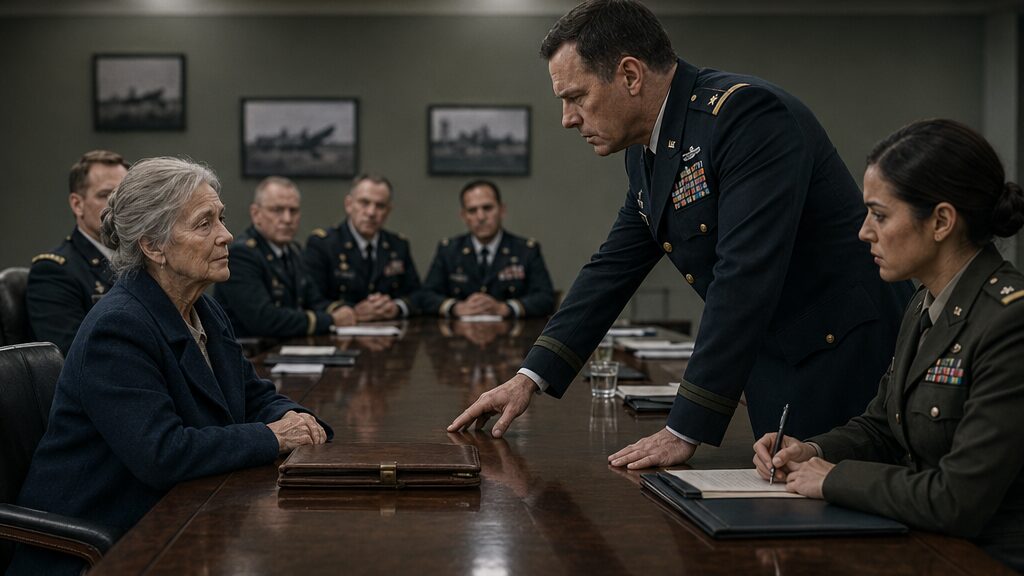
Carolyn Miller looked up from the long polished table. Her hands rested on a brown leather file in front of her, one palm over the brass latch, the other folded loosely on top as if she were keeping it warm. The coat she wore was dark blue and old enough to have softened at the elbows. A strand of gray hair had slipped loose near her temple. She did not look startled. She did not look embarrassed. She only turned her face toward the officer who had spoken and waited for him to finish becoming certain.
The boardroom had gone still around her.
Five officers sat along the opposite side of the table beneath a wall of framed institute photographs. A young legal aide had been arranging recording folders near the end seat. An enlisted attendant stood by the side credenza with a coffee pot held halfway between the machine and the cups. Every person in the room understood what Andrew meant. The chair at the head of the table had a white card before it, blank on one side from where Carolyn sat, but formal enough to announce that it belonged to someone expected.
Carolyn had taken it because the security clerk outside had looked at her printed invitation, frowned at the old seal, and pointed through the glass door with two fingers.
“Boardroom B,” he had said. “They’re already assembling.”
She had thanked him. She had walked slowly, not because she was weak, but because age had taught her not to hurry toward rooms full of people who believed time belonged to them. She had placed the file on the table. She had taken the chair that matched the instruction on the invitation folded inside her coat pocket.
Now Andrew King crossed the room in his dress uniform, polished shoes making hard sounds against the floor. He was broad through the shoulders, clean-shaven, with the kind of pressed restraint that suggested he trusted rules more than instincts. His eyes moved first to the brown leather file, then to Carolyn’s coat, then to her hands.
“Ma’am,” he said, not warmly, “this is a closed preparatory session for the institute’s command review board. Public attendees are processed in the auditorium.”
“I am not here for the auditorium,” Carolyn said.
Her voice was low. It did not carry any demand. That seemed to irritate him more.
Andrew stopped beside the chair immediately to her right. He did not sit. “Then someone gave you the wrong room.”
Carolyn slipped one hand into her coat and drew out the invitation. The paper had been folded into thirds. Its edges were softened from being handled more than once, but it was clean, cream-colored, and stamped in faded blue at the top.
Andrew took it with two fingers.
The young aide, whose nameplate read Sanchez, leaned slightly forward. Carolyn noticed the movement because she noticed most things in rooms like this: who leaned, who froze, who pretended not to watch, who glanced at the file instead of the face.
Andrew read the invitation once. Then he read it again with less patience.
“This format isn’t current,” he said.
“No,” Carolyn said. “It would not be.”
A low breath passed through one of the officers at the table. Not quite a laugh. Not quite hidden.
Andrew’s jaw tightened. “This authority line was discontinued before the current access system was installed.”
Carolyn nodded.
“You understand that doesn’t help you.”
“It explains why your clerk had trouble finding it.”
The enlisted attendant set the coffee pot down too carefully. Elizabeth Sanchez lowered her eyes to her notes, but the pen in her hand did not move.
Andrew held the invitation nearer the light as if age itself were evidence. “Where did you get this?”
“It was mailed to me.”
“By whom?”
“The institute.”
His eyes flicked to the brown file. “And that?”
Carolyn’s fingertips settled more firmly on the latch. “That was requested.”
“By the institute?”
“Yes.”
“Who at the institute?”
For the first time, Carolyn looked past him, toward the wall of photographs. Rows of former commandants stared out from polished frames. Some faces were familiar because she had known them young. Some because she had buried them older. Near the center of the wall was a gap where a new frame had been marked with a brass placeholder but not yet installed.
Her answer came after a breath. “Someone who remembered there was unfinished business.”
Andrew followed her gaze, saw only the wall, and returned to the conclusion he preferred. “Ma’am, I need you to stand and step away from the head chair.”
Carolyn did not move.
It was not defiance, not exactly. Defiance had heat in it. This was colder, sadder, almost weary. She looked at him as if measuring the distance between what he had been trained to do and what he had chosen to become.
“I was directed to this seat,” she said.
“By a clerk who made a mistake.”
“Clerks are often blamed for what officers fail to read.”
The room sharpened.
Andrew’s face changed only a fraction, but Carolyn saw it. A younger officer might have snapped. Andrew had discipline enough to lower his voice instead.
“Mrs. Miller—”
“Ms. Miller,” she said quietly.
“Ms. Miller,” he corrected, without apology. “This is a restricted facility wing. You have an obsolete invitation, no visible escort, and a sealed file you have not declared through records intake. I’m going to ask one more time for you to step away from that chair.”
Carolyn looked at the chair card. From her side, it still showed nothing. Blank white. No name. No rank. No protection.
That seemed fitting.
Once, a name card had followed her into every room before she entered it. People had stood too quickly, spoken too carefully, laughed too late. After retirement, she had learned the strange relief of being unannounced. A woman in a grocery line. A widow in a clinic lobby. An old body moving through public space without the noise of command around it.
She had told herself there was honesty in that.
But she had also used it as cover.
The brown file under her hand felt heavier than leather and paper. It had crossed decades to reach this table. Its corners were worn from field desks, archive boxes, and one night when she had kept it beside her bed because the names inside would not let her sleep. She had not brought it to prove who she was. That was the least important thing it contained.
Elizabeth Sanchez rose halfway from her seat. “Colonel King, I can contact guest coordination and verify the invitation chain before we—”
“Sit down, Lieutenant,” Andrew said.
The aide sat. Color rose in her face.
Carolyn turned her eyes toward the younger woman, not with pity, but with a kind of recognition. There were always rooms where courage first appeared as discomfort.
Andrew placed the invitation on the table, just outside Carolyn’s reach. “Until this is verified, you are not an invited participant.”
“I came because I was asked.”
“By a dead authority line.”
“Some authorities outlive the systems built to replace them.”
This time the sound from the board officers was unmistakable. A short, disbelieving exhale. A shifting of chairs. The old woman was either confused or difficult, and in institutional rooms those two sins were often treated the same.
Andrew lifted one hand toward the attendant. “Call security intake. Ask why an unescorted civilian was sent into a closed board session.”
The attendant hesitated.
Andrew turned. “Now.”
The attendant left quickly.
Carolyn watched the door close behind him. Her expression did not change, but a small tiredness gathered around her eyes. It was not fear of security. She had waited behind worse doors than this, in worse places, under ceilings that trembled with distant fire. What touched her was the ease of it—the way a room could agree to diminish someone before it understood them.
Andrew leaned over the table. He was careful not to touch the file, but his shadow fell across it.
“Ms. Miller, do you understand the seriousness of bringing unknown documents into a restricted review space?”
“Yes.”
“Then you understand why your cooperation matters.”
“Yes.”
“And yet you are choosing not to provide a direct explanation.”
Carolyn looked at his hand hovering near the file. A hand trained to guard things. A hand now preparing to turn suspicion into procedure.
“I am choosing not to make rank the price of courtesy,” she said.
The sentence landed oddly. It had enough weight to quiet the small movements in the room, but not enough detail to satisfy anyone.
Andrew straightened. “This is not about courtesy.”
“It usually is, before people decide it is about something else.”
The door opened. The attendant returned, followed by the security clerk from the front desk. The clerk looked less certain now. He glanced at Carolyn, then at Andrew, then at the chair card.
“She had an invitation, sir,” the clerk said. “It scanned as invalid, but the paper seal matched an archived institute format.”
“Archived from what year?”
“I couldn’t confirm.”
“Did she identify herself?”
“She said her name was Carolyn Miller.”
Andrew waited.
The clerk swallowed. “There was no active visitor profile under that name.”
Andrew turned back to Carolyn. Not triumphant, but close.
Elizabeth’s pen finally moved. Carolyn heard the scratch of it against paper.
“Very well,” Andrew said. He collected the invitation and placed it beside the brown file. “We’ll conduct a formal credential review before this board proceeds.”
One of the seated officers shifted. “Colonel, is that necessary?”
Andrew did not look away from Carolyn. “An elderly civilian with an obsolete pass and undeclared restricted-looking material is sitting in a reserved command chair. Yes, it is necessary.”
Carolyn’s fingers eased off the latch. She folded her hands in her lap.
At that small movement, Andrew seemed to believe she had yielded. He reached for the file.
Carolyn’s voice stopped him.
“Not yet.”
He paused.
“If you open it before you know why it was brought,” she said, “you will mistake the first page for the truth.”
Andrew stared at her. Behind him, Elizabeth stopped writing again.
The boardroom no longer felt amused. It felt awake.
Andrew stepped to the door and closed it himself. The latch clicked with a sound that moved through the table and into Carolyn’s bones.
“No one leaves,” he said, “until we know who she really is.”
Chapter 2: The Brown Folder Stayed Closed On The Table
Andrew’s palm struck the table beside the brown file hard enough to make the brass latch jump.
“Who gave an old woman access to restricted records?”
The words did what he intended them to do. They turned the room from uncertainty into witness. The board officers looked toward Carolyn with fresh suspicion, as if age had become part of the evidence. Elizabeth Sanchez’s eyes flicked from Andrew’s hand to Carolyn’s face. The security clerk stood near the door, wishing himself smaller.
Carolyn did not flinch.
Her hands were folded loosely on the table now, knuckles pale, the skin thin over old bones. The file lay inches from her fingers. Andrew’s palm remained planted beside it, claiming the space without claiming the object. He had not opened it yet. Some part of him still understood procedure.
“You asked a question,” Carolyn said.
“I did.”
“Then ask it properly.”
Andrew gave a short laugh, humorless. “Properly?”
“Yes.”
His face hardened. “Who authorized you to remove, transport, or possess material marked with what appears to be a restricted archive seal?”
The room waited.
Carolyn looked at the file as if it were not a thing she owned, but a thing she had been carrying for others.
“The same office that failed to finish reading it,” she said.
Andrew leaned closer. “That is not an answer.”
“It is the one you have earned so far.”
A board officer at the far end muttered something under his breath. Andrew’s shoulders tightened, but he did not turn. Carolyn could see him fighting to keep the room from slipping out of his control. That was the danger with temporary authority. It had to keep proving itself.
Elizabeth cleared her throat. “Colonel, may I examine the exterior markings before we proceed further?”
Andrew’s eyes remained on Carolyn. “For what purpose?”
“To establish whether the document is actually restricted, ceremonial, archival, or simply old.”
The word old hung there. Elizabeth had not meant it cruelly. Still, several eyes moved to Carolyn’s coat, her hair, her hands. Carolyn felt the old familiar separation between age and person, as if years were fogged glass through which the young saw only outline.
Andrew stepped back a fraction. “Exterior only.”
Elizabeth rose and came around the table. She did not reach immediately. She looked first at Carolyn.
“May I?”
Carolyn inclined her head.
The young aide touched the file with gloved care. It was dark brown, nearly black along the spine. The leather had cracked in narrow lines near the corners. Its brass latch was tarnished except where fingers had polished it over time. On the upper right corner was a faded stamp: RESTRICTED COMMAND ARCHIVE. Beneath it, in smaller letters, was a code Carolyn had not seen written in public for many years.
Elizabeth bent closer.
Andrew noticed. “What?”
She did not answer at once. She took a small reference card from her folder, compared it to the stamp, and frowned.
“This prefix is not in the current archive index,” she said.
“That supports my concern.”
“No, sir. It predates it.”
Andrew’s expression sharpened. “How far?”
Elizabeth looked at the stamp again. “Before the institute digitized command case materials. Possibly before the institute was formally reorganized.”
One of the officers sat straighter.
Andrew removed his hand from the table, then placed it back down more softly. “Old does not mean authorized.”
“No,” Elizabeth said. “But it means we should verify before characterizing it as stolen.”
Carolyn watched the younger woman return to her seat. The courage had not become loud, but it had become visible.
Andrew turned his attention back to Carolyn. “You heard the lieutenant. This predates the current index. That means there may be no easy way to confirm chain of custody.”
“There is a way.”
“Then provide it.”
Carolyn lifted her eyes to his. “You can check the name again.”
“My clerk already checked your name.”
“No,” she said. “He checked the visitor system.”
Andrew stared at her, and for a moment something like uncertainty moved behind his eyes.
Then pride closed over it.
“You keep implying knowledge of internal systems,” he said. “That raises rather than lowers concern.”
Carolyn gave no answer.
“Are you a former employee?”
Silence.
“Contractor?”
Silence.
“Family member of a former officer?”
At that, something changed in her face. Not enough for most people to notice. Andrew noticed. So did Elizabeth.
Carolyn’s gaze moved past him to the wall of photographs again. Her mouth tightened, then softened.
“We are all family members of someone,” she said.
Andrew exhaled through his nose. “This is not a philosophy seminar.”
“No,” Carolyn said. “It is starting to look like a memory test.”
A brief, uncomfortable stillness followed.
Andrew straightened and turned to the board. “For the record, the subject is refusing to establish identity beyond a name that does not appear in the active visitor system. She possesses an unidentified restricted archive folder with obsolete markings and has occupied a reserved chair without authorization.”
Elizabeth’s pen paused. “Colonel, ‘subject’ may not be the appropriate term.”
Andrew looked at her.
She lowered her voice but did not withdraw it. “She has not been detained or charged.”
Carolyn saw the cost of the sentence land in the young woman’s face. Elizabeth was not defending Carolyn exactly. She was defending the line before it disappeared.
Andrew’s tone cooled. “Noted.”
He turned back to Carolyn. “Ms. Miller, I am giving you a final opportunity to explain who you are and why this file is in your possession.”
Carolyn’s fingers moved slightly, a slow press against each other. She could say it now. Three words would end the insult, rearrange the room, bring men to their feet who had been comfortable watching her be diminished. Three words would also make the lesson smaller than the harm.
I commanded here.
No. Not here. Before here. Before this institute had its clean walls and polished doctrine and framed case studies. Before young officers learned decisions from binders instead of from the sound a radio made when a unit stopped answering.
She had spent years avoiding the convenience of those three words.
“I was asked to return what was unfinished,” she said.
Andrew’s patience broke in a quiet way. He reached for the latch.
Carolyn’s hand moved, not fast, but with enough precision that her fingertips landed on the file before his did.
“Colonel,” she said.
Her voice was gentle. That made the warning sharper.
Andrew looked at her hand. “Remove your hand.”
“The first page will not tell you the whole truth.”
“Then we will start with the first page.”
“You may not like where it leads.”
“That is not your decision.”
“No,” Carolyn said, and withdrew her hand. “That has been the trouble for a long time.”
Andrew opened the latch.
The sound was small. A click. Nothing more. But the room reacted as if a locked door had opened somewhere below the floor.
Inside the folder lay a stack of protected sleeves, each one yellowed at the edges. The top sheet was not a medal citation. It was not a letter of praise. It was a transfer record marked with the same old archive code stamped on the leather. Andrew lifted it by the corner.
Elizabeth leaned forward. “Sir, before you remove—”
“I’m reviewing the identifying page,” Andrew said.
He scanned the first lines. His eyes moved quickly at first, then slowed.
Carolyn watched his face, not the paper. She knew what he would see: operation title, old authority line, command classification, receiving institution. Enough to prove that the file belonged somewhere inside these walls. Not enough to explain why she had brought it herself.
Andrew’s brow creased.
“What is Operation Gray Harbor?” asked one of the board officers.
The question traveled through the room with strange force. Some of the older officers recognized the name vaguely. A training case. A leadership module. A difficult evacuation. A doctrine example polished by time until it no longer cut anyone who handled it.
Andrew did not answer. He turned the page.
Carolyn closed her eyes for half a second.
“Colonel,” she said, “that is enough.”
But Andrew had seen the corner of the photograph tucked behind the second sleeve. He pulled it free.
The image was black and white, creased once down the center. A younger woman stood beside a field command table, hair pinned tight beneath a cap, face lean with exhaustion, eyes fixed on something outside the frame. Around her stood officers and enlisted personnel, some blurred by motion. Behind them, a temporary operations map hung from the side of a vehicle.
Andrew held the photograph closer.
The room seemed to inhale.
Elizabeth looked from the picture to Carolyn.
Carolyn kept her gaze on the table. Her hands were still, but the tendons had tightened.
Andrew’s certainty did not vanish. It searched for another shape.
He turned the photograph toward her.
“Where did you get this?”
Chapter 3: A Photograph Changed The Shape Of The Room
Michael Nelson froze before he reached the table.
He had entered with a tablet under one arm and the worried speed of a junior officer summoned into a room where senior people had already decided someone would be blamed. The security clerk had found him in the records annex, told him Colonel King needed immediate archive verification, and lowered his voice when he added, “It’s about an old woman with a restricted folder.”
Michael had expected a mislabeled donation packet. Maybe a veteran’s family papers brought to the wrong office. Maybe another ceremonial mess no one wanted to own.
Then he saw the seal.
Not the stamp on the outside of the folder. The one on the transfer record Andrew had laid flat beneath the light.
Michael stopped so abruptly that Elizabeth looked up.
“Lieutenant Nelson,” Andrew said, “you were asked to verify a document, not admire it from the doorway.”
Michael forced himself forward. His face had gone pale under the boardroom lights. Carolyn watched him with the soft attention she gave to people who had been pushed into deeper water than they expected.
He set his tablet on the table, but did not touch the paper.
“Sir,” he said, “where did this come from?”
Andrew’s eyes narrowed. “That is what we are establishing.”
Michael glanced at Carolyn, then away. “This is a Gray Harbor seal.”
“You recognize it?”
“Yes, sir.”
“From where?”
“Foundational command case archive. Leadership Ethics Sequence Four. We use the declassified version for senior captain instruction.”
One of the board officers sat back. “That old evacuation case?”
Michael nodded. “Yes, sir. The disputed one.”
The word disputed landed harder than he intended.
Carolyn’s fingers curled once against her palm, then relaxed.
Andrew noticed that too. He was noticing more now, and each new detail made him more determined not to appear behind the truth.
“Explain disputed,” he said.
Michael swallowed. “The public training version frames it as a command-priority decision under collapsed communications. Several extraction points, insufficient lift capacity, worsening ground conditions.”
“A success,” said one of the officers.
Michael hesitated.
Andrew’s gaze sharpened. “Lieutenant.”
“It is taught as a success, sir.”
Carolyn looked down at the photograph Andrew had left on the table. The young woman in the image had not known yet what the word success would cost once other people began using it cleanly.
Andrew tapped the transfer record. “Can you authenticate this?”
“I can try.”
“Try now.”
Michael opened his tablet and connected to the institute archive system. The screen lit his face blue-white. Elizabeth moved her notes aside to give him space. Andrew remained standing. Carolyn remained seated in the chair he had told her was not for visitors.
Michael entered the archive prefix from the file stamp.
The system returned no active result.
Andrew’s expression settled into grim satisfaction. “No record.”
Michael shook his head. “No active record, sir. That prefix predates active indexing.”
Elizabeth spoke quietly. “As the exterior stamp suggested.”
Andrew ignored that. “Search the operation.”
Michael typed again.
This time the screen populated with a list of declassified teaching materials: Gray Harbor Overview, Command Compression Under Civilian Evacuation Pressure, Communications Failure Timeline, Ethical Burden in Extraction Prioritization. Nothing on the screen carried Carolyn’s name. Nothing on the screen carried any names at all except institutional authors.
Andrew looked at Carolyn. “Convenient.”
Carolyn said nothing.
Michael scrolled. “There is a sealed parent archive.”
“Open it.”
“I don’t have clearance.”
“Request temporary board access.”
Michael entered his credentials. The system asked for a command review reason. Andrew dictated one. Elizabeth recorded the wording.
Unauthorized restricted material presented by unidentified civilian subject.
Carolyn’s face remained composed, but Elizabeth’s pen slowed over the word subject.
Michael submitted the request.
The tablet displayed a spinning seal for several seconds. Then the screen changed.
ACCESS DENIED. SEALED AUTHORITY REQUIRED.
Michael frowned. “It rejected board override.”
“That should not happen,” Andrew said.
“For active disciplinary records, no. For sealed command archives, sometimes.”
Andrew’s patience thinned. “Search her name.”
Michael looked at Carolyn. “Ma’am, may I confirm spelling?”
Carolyn met his eyes. He was young enough that he still asked permission when procedure did not require it. That mattered.
“Carolyn Miller,” she said.
Her own name sounded strange in the room. Not because it was false. Because she had spent years hearing people say General, ma’am, Commander, Chairwoman, distinguished guest. Carolyn Miller belonged to mail, pharmacy labels, quiet signatures, the life after rooms stopped standing.
Michael typed.
The system returned three active visitor-adjacent entries. None matched. One was a civilian contractor from years ago. One a donor’s spouse. One a historical reference in a scanned program with no access rights.
Andrew folded his arms.
Then Michael changed the search field from active personnel to legacy authority.
Elizabeth saw him do it. Andrew did not.
He typed C. Miller.
The system froze.
Not failed. Froze.
The tablet held on a blank gray screen, then produced a black box with white text.
SEALED LEGACY COMMAND AUTHORITY. ADDITIONAL VERIFICATION REQUIRED.
Michael stopped breathing for a second.
Andrew leaned over his shoulder. “What does that mean?”
“It means,” Michael said carefully, “the name is linked to a sealed authority profile.”
“Whose?”
“It only shows the initial and surname at this level.”
Andrew’s eyes cut to Carolyn. “That proves nothing. C. Miller is not rare.”
“No, sir.”
“Continue.”
Michael’s hands moved less steadily now. He entered the operation code from the transfer record, then the C. Miller authority prompt. The system asked for secondary archive reference.
Elizabeth looked at the photograph lying near Andrew’s hand. “Would the photo have a reference number?”
Michael picked it up only after Carolyn gave the smallest nod.
The back of the photograph carried faded pencil writing and a stamped number. He entered it.
This time the system opened a metadata page.
No image appeared. No full biography. Only a title line, a date, a location, and a warning banner.
OPERATION GRAY HARBOR FIELD COMMAND IMAGE
RESTRICTED SOURCE MATERIAL
IDENTITY REFERENCES REDACTED BY ORIGINAL COMMAND ORDER
Andrew read the banner twice.
“Original command order,” Elizabeth said.
Andrew’s eyes were still on the screen. “Could have been ordered by anyone with command authority.”
Michael’s voice was low. “Not anyone, sir.”
Carolyn’s gaze moved to him.
Michael pointed to a line beneath the warning banner.
ORIGINAL REDACTION AUTHORITY: C. MILLER
The boardroom changed again. Not loudly. No one gasped. No chair scraped. But the air altered. Doubt, which had been placed on Carolyn like a weight, began moving across the table toward Andrew.
He felt it and fought it.
“A redaction authority is not identity confirmation,” he said.
“No, sir,” Michael replied.
“Then stop looking as if it is.”
Michael looked down. “Yes, sir.”
Carolyn saw the young officer retreat into obedience and felt an old ache. Institutions trained courage and compliance in the same people, then acted surprised when they collided.
Andrew picked up the photograph again. “This image could have belonged to her mother. An aunt. Someone whose papers she inherited. Someone she is impersonating.”
Elizabeth looked at him sharply. “Colonel—”
“No,” Andrew said. “We are not going to leap from a partial archive match to assuming a walk-in civilian is a sealed command authority.”
Carolyn lifted her head. “Is that what frightens you?”
Andrew turned on her. “What concerns me is that you seem content to let this room build a fantasy around you while you refuse to provide the simplest possible answer.”
“The simplest answer is often the one people misuse first.”
“You are obstructing a security review.”
“I am preventing a memorial record from becoming a mirror.”
The sentence confused several people. Elizabeth heard more in it than the words gave. Michael did too.
Andrew did not want meaning. He wanted control.
“Lieutenant Nelson,” he said, “search for authorization attached to this file’s physical transfer.”
Michael returned to the system. The file had a chain of custody number handwritten inside the folder’s inner flap. He entered it.
The tablet requested another override. He submitted under board authority.
This time a document heading appeared, but most of the page was blocked.
ARCHIVE CORRECTION PETITION — PENDING FINAL EXECUTION
OPERATION GRAY HARBOR COMMAND RECORD
AUTHORIZED DELIVERY: HAND CARRY ONLY
Andrew’s eyes flicked toward Carolyn’s hands.
Michael scrolled.
The next line was visible.
FINAL ARCHIVE CORRECTION MAY BE EXECUTED ONLY BY CAROLYN MILLER.
For the first time since he had entered the boardroom, Andrew did not speak immediately.
Carolyn looked at the brown file. The old leather no longer seemed merely suspicious, but it had not become proof enough to set anyone free. Not yet. It had only opened the next door.
Michael’s voice came out thin. “Sir.”
Andrew’s face closed.
He looked at Carolyn as if the question had become more dangerous, not less.
“What correction,” he asked, “was important enough to wait decad
Chapter 4: The Officer Who Needed Rules To Save Him
Andrew had heard the name Carolyn Miller all his life, but never with gratitude.
It had come out of his father’s mouth late at night, after long silences and the sharp clink of a glass set too hard on the kitchen table. Not always as an accusation. Sometimes as a question. Sometimes as a name spoken toward a wall because the living had no answer for what the dead had been ordered to endure.
Now that same name glowed on Michael Nelson’s tablet at the end of a restricted authorization line, and the old woman in the blue coat sat three feet away from it without claiming anything.
Andrew hated that most of all.
If she had bragged, he could have handled her. If she had demanded treatment, he could have filed her into the category he already distrusted: retired brass who believed old rooms still belonged to them, people who mistook history for permanent authority. But Carolyn Miller had not demanded anything. She had let the room insult her and then watched the evidence arrive on its own.
That made him feel less like a guard at the gate and more like a man who had been striking a locked door from the wrong side.
“Seal the file,” he said.
Michael looked up. “Sir?”
“Close it. Now.”
Carolyn’s gaze moved from Michael to Andrew. “You asked what correction waited decades.”
“And I am not taking an answer from a partially authenticated archive in a room with an unidentified civilian.”
Elizabeth Sanchez’s pen stopped again. “Colonel, the authorization line names her directly.”
“It names Carolyn Miller. It does not prove this woman is the Carolyn Miller connected to the record.”
One of the board officers shifted uneasily. “That seems increasingly unlikely to be coincidence.”
Andrew turned just enough to include the room in his authority. “Unlikely is not verification.”
His voice stayed level, but his pulse had begun to beat in his neck. Carolyn saw it. So did Elizabeth. So, Andrew feared, did everyone.
Michael closed the file with careful hands. The brass latch clicked. The brown leather folder was once again just an object on the table, but no one looked at it the same way.
Andrew stepped back from the table. “We suspend review until commandant-level identity verification.”
Carolyn spoke before he could continue. “You may do that.”
He disliked the permission in her tone. “This is not your proceeding.”
“No,” she said. “That is becoming clear.”
He picked up the tablet. Michael almost protested, then let it go. Andrew read the authorization line once more, searching for a flaw in the wording, a misfiled digit, anything that would return the room to the shape it had before the photograph emerged.
Final archive correction may be executed only by Carolyn Miller.
Only.
That word pressed hardest.
His father had hated words like that when they came from command documents. Priority. Necessary. Acceptable. Authorized. Words that sounded clean because somebody else had done the bleeding before the report was written.
Andrew remembered being twelve years old and finding his father in the garage with a footlocker open beside him. Inside were field letters, a cracked compass, and a folded clipping about Operation Gray Harbor. The article had praised decisive leadership. His father had crumpled it in one fist and said, “They made her a hero because the men who didn’t come back couldn’t object.”
Andrew had not known who her was then. Later, at academy lectures, he learned the name as doctrine. General Carolyn Miller. The commander who had made the impossible call. The woman whose evacuation model became required study. The case was presented without anger, without smell, without families.
He had sat in those lectures with his jaw locked, listening to instructors praise command burden while his father carried that burden as abandonment.
And now an old woman with that name sat under the same roof, refusing to say whether she was legend, fraud, or ghost.
Andrew handed the tablet back to Michael. “Take this to records annex. Pull the sealed access protocol. No copies, no downloads, no informal discussion.”
“Yes, sir.”
“I’ll go with him,” Elizabeth said.
Andrew’s eyes cut to her. “You’ll remain here as recorder.”
“With respect, Colonel, this proceeding now involves contested handling of archival material. A legal record should follow the verification.”
There it was again: quiet resistance, carefully framed.
Andrew wanted to tell her no. He also knew refusing would look like fear.
“You have ten minutes,” he said.
Elizabeth gathered her folder. As she passed Carolyn, she paused just long enough to say, “Ma’am, would you like water?”
The question was small. In the room it sounded almost dangerous.
Carolyn looked at her. “Thank you. No.”
Andrew waited until Elizabeth and Michael left. The door closed behind them, and the boardroom seemed larger, emptier, less protected by procedure.
Carolyn sat with the file in front of her. The officers avoided looking directly at her now. Andrew remained standing because sitting felt like surrender.
“You know,” he said, low enough that only she and the nearest officers could hear, “people have used old names to open doors before.”
“Yes.”
“Families. Collectors. Donors. People who think possession of paper gives them ownership of sacrifice.”
Carolyn’s eyes lifted slowly. “You speak as if you know that from somewhere other than policy.”
The words struck nearer than he wanted.
“My father served in the shadow of Gray Harbor,” Andrew said.
He had not meant to say it. Once spoken, it changed the air around him.
Carolyn’s face altered, barely. A tightening at the mouth. A new attention.
“Did he?”
Andrew regretted the opening but not enough to retreat. “He came home with a different story than the one framed in this building.”
“I imagine he did.”
“Do you?”
“Yes.”
That quiet answer irritated him more than denial would have.
He leaned over the table, but not as far as before. “Then maybe you understand why I don’t accept old seals and sad eyes as proof.”
Carolyn did not look away. “Your father’s anger is not a credential either, Colonel.”
The sentence landed cleanly. It did not mock him. It did not forgive him.
His face warmed.
Before he could answer, the door opened. Elizabeth returned first, moving quickly, her folder pressed to her side. Michael followed with the tablet held like something fragile.
“Colonel,” Elizabeth said, “we need to stop using the term unauthorized.”
Andrew turned. “Why?”
Michael swallowed. “The chain of custody exists. It was dormant because the final recipient field was locked under sealed legacy authority.”
“And?”
“The file was prepared for hand-carry delivery to the institute.”
Andrew’s eyes sharpened. “Prepared by whom?”
Michael hesitated, then looked at Carolyn. “The visible metadata still redacts origin authority. But the receipt condition says it becomes valid only when delivered by Carolyn Miller in person.”
The board officers looked toward Carolyn again, but this time with less suspicion and more discomfort.
Andrew reached for the tablet. “That still does not establish identity.”
Elizabeth stepped beside the table. “No, sir. But it establishes that the file is not random contraband.”
Andrew heard the implied accusation: and you treated it as if it were.
He set the tablet down. “Until the commandant’s office verifies identity, Ms. Miller remains under review.”
Elizabeth’s face tightened. “Under review is not under guard.”
Andrew turned toward the attendant at the door. “No one removes the file. No one removes Ms. Miller from this room.”
Carolyn’s eyes dropped briefly to the empty chair card in front of her. She had seen men use rules to hold back panic. She had done it herself. Orders could steady a room, or they could hide a frightened heart behind polished language.
“Colonel,” she said, “if you are trying to protect your father’s memory, this is a poor way to do it.”
The room went silent.
Andrew’s hand closed around the back of a chair. “You don’t get to speak about my father.”
“No,” Carolyn said. “Not yet.”
Not yet.
The words did not sound like a threat. They sounded like a door she had not opened because someone might be standing behind it.
Andrew turned away before the room could read his face. He took the form from Elizabeth’s folder, wrote quickly, and signed his name at the bottom.
Elizabeth looked at the page. “Colonel, this records Ms. Miller as a security risk pending commandant review.”
“That is accurate.”
“It is excessive.”
“It is official.”
Carolyn watched him sign. There had been a time when her own signature had turned men toward danger. She knew the comfort of ink. She knew the cowardice it could hide.
The phone on the boardroom wall rang once.
Everyone looked at it.
The attendant answered, listened, then straightened so quickly his shoulder struck the credenza.
“Yes, sir.”
He held the receiver away from his face and looked at Andrew.
“Commandant Hernandez’s office,” he said. “The instruction is: do not release that woman from the boardroom.”
Chapter 5: Her Name Was Written Under The Old Operation Seal
Eric Hernandez entered the boardroom fast, but stopped as if an invisible line had caught him across the chest.
His hand was still on the door when he saw Carolyn Miller seated at the head of the table with an attendant near the wall, a security clerk by the exit, and Andrew King standing beside a signed security-risk form. The commandant’s eyes moved from the brown leather file to Carolyn’s folded hands, then to her face.
For one suspended second, rank left the room and memory entered it.
Eric’s expression changed before he could control it.
“General Miller,” he said.
The words were not loud. They did not need to be.
Every chair in the room seemed to hold its breath.
Andrew turned toward him sharply. Elizabeth looked down at her notes as if the paper itself had confirmed what courage had not yet dared to say. Michael Nelson froze with both hands around his tablet.
Carolyn closed her eyes for the briefest moment.
When she opened them, she did not stand. “Commandant.”
Eric came fully into the room. He was older than Andrew but younger than Carolyn by decades, with silver beginning at the sides of his hair and the careful bearing of a man who understood that institutions had long memories when it suited them. He did not look at Andrew first. He looked at the attendant.
“Remove the security posture.”
The attendant stepped away from the door immediately.
Andrew’s face tightened. “Sir, identity verification was still pending.”
Eric turned to him then. “It is no longer pending.”
“With respect, sir—”
“No.” Eric’s voice remained controlled. “There is no respectful version of what I am seeing until I understand why retired General Carolyn Miller was held in this room under suspicion.”
The title moved around the table like a physical thing.
General Carolyn Miller.
Not a confused visitor. Not an old woman with a strange file. Not a possible impersonator hiding behind paper. The officers who had watched her dismissal now looked at the table, the wall, their own hands. One of them stood late, then seemed unsure whether standing made the moment better or worse.
Carolyn noticed and said nothing.
Andrew remained upright, but some of the force had gone from his posture. “Sir, Ms.—General Miller arrived with obsolete credentials and an undeclared restricted archive file. Her name did not appear in active visitor systems.”
Eric looked at the brown file. “Because her visit was not supposed to be processed as a visitor entry.”
Andrew paused.
Eric turned toward Elizabeth. “Lieutenant Sanchez, has the file been opened?”
Elizabeth rose. “Partially, sir. Exterior markings, transfer record, one photograph, digital metadata, and the archive correction line. Colonel King halted further review pending your office.”
“Was General Miller asked to identify herself?”
Andrew answered before Elizabeth could. “Repeatedly.”
Eric’s eyes moved to Carolyn.
She looked at the file instead of at him. “He asked me to defend myself with a title.”
“That is not the same question,” Eric said quietly.
Andrew’s jaw worked once.
Eric came to the head of the table, but did not take the empty seat beside Carolyn. Instead, he stood at attention.
The gesture was formal enough to change the temperature of the room, restrained enough not to become theater.
“Ma’am,” he said, “on behalf of the institute, I apologize for the manner of your reception.”
Carolyn looked at him. “Do not begin there.”
Eric absorbed that. “Where would you have me begin?”
“With the file.”
Michael stepped forward before anyone told him to. “Sir, the archive system produced a final correction restriction. It says execution may be completed only by Carolyn Miller.”
Eric nodded once, not surprised. “That restriction came from the original settlement agreement after declassification review. General Miller refused ceremonial transfer until the record could be corrected in full.”
Andrew looked from Eric to Carolyn. “Settlement agreement?”
Carolyn’s hands remained still. “Not legal settlement. Moral.”
Eric reached into his jacket and removed a thin access card. He placed it beside the file, not touching the leather itself.
“Lieutenant Nelson,” he said, “connect to the archive wall terminal.”
Michael moved quickly, grateful for an order that had a shape. The large display embedded near the photograph wall awakened. The institute seal appeared, followed by a secure prompt.
Eric entered his commandant code. The system asked for secondary authorization.
He turned to Carolyn.
The room watched her.
For the first time that day, Carolyn took something from beneath her coat: a small flat card in a worn plastic sleeve, so old its edges had clouded. It did not look impressive. No ribbon, no shine, no dramatic emblem. Just a faded credential with a magnetic strip and an embossed seal no current officer in the room had seen in use.
Andrew stared at it.
Carolyn placed it on the reader Michael held out to her.
The terminal hesitated. Then the screen changed.
SEALED LEGACY COMMAND AUTHORITY CONFIRMED
MILLER, CAROLYN
RANK AT RETIREMENT: GENERAL, UNITED STATES ARMY
COMMAND AUTHORITY: OPERATION GRAY HARBOR
INSTITUTE DOCTRINE ORIGIN: COMMAND ETHICS CASE SERIES
No one spoke.
The old photograph appeared beside the text. The young woman in the field command image looked out from the wall display, face sharpened by exhaustion and responsibility. The resemblance to Carolyn was undeniable now, not because age had preserved every feature, but because the eyes had not changed. The same gaze that had measured the boardroom all morning had once measured a map under impossible conditions.
Andrew’s hand lowered slowly to his side.
Michael looked as if he might step back and salute, then remembered he was holding a tablet and did neither. Elizabeth’s eyes were bright, but she kept her pen on the page.
Eric addressed the room. “General Miller’s decision at Gray Harbor shaped the institute’s command ethics curriculum for thirty-one years. Many of you have taught from her case study. Some of you have quoted it in promotion boards.”
The words found their targets. One officer swallowed. Another looked toward the framed wall.
Andrew did not sit. He seemed held up by the last remaining piece of his own certainty.
“Sir,” he said, voice rougher now, “if that is true, why was she not entered as the honored participant?”
Carolyn answered before Eric could.
“Because I did not come to be honored.”
The display light flickered across her face. She looked older beneath it, and somehow less fragile.
Eric’s mouth tightened. “General, the institute prepared a recognition session connected to the anniversary review. Your office confirmed delivery but declined the public reception.”
“I have no office.”
“Your correspondence channel, then.”
“A box at a post office and a neighbor who reminds me to check it.”
The sentence unsettled the room more than any title had. It pulled her back from the wall display and placed her again in the blue coat, at the table, old and human.
Andrew looked at her as if seeing both versions at once and knowing he had failed both.
Eric nodded toward the file. “The board believed the correction would be handled privately before the ceremony.”
“The board believed many things,” Carolyn said.
Her voice held no cruelty, but Eric’s face showed that it had found him.
She touched the brown leather file. “This record has been used for years to teach decisiveness. Burden. Command responsibility. It has been polished until no one can cut a finger on it.”
Andrew’s eyes lifted slightly.
Carolyn continued. “That is not why I signed the correction.”
Eric said, “The public version was limited by classification and family notification restrictions.”
“It was limited by convenience.”
The commandant did not answer.
Carolyn turned her gaze toward the wall of institute photographs. “You teach Gray Harbor under my name. You built a doctrine series from the order I gave. You placed officers in rooms and asked what they would have done if they were me.”
Her fingertips rested on the file latch.
“But my name was never the missing one.”
The silence that followed was different from the earlier silence. No longer suspicion. No longer uncertainty. It was the sound of a room discovering that the reveal it had just witnessed was not the end of its discomfort.
Andrew looked at the wall display, at the line bearing Carolyn’s rank, then at the brown file.
For one moment, he seemed ready to apologize.
Carolyn saw it and stopped him with a look.
Not yet.
She pointed toward the framed institute wall, where the official Gray Harbor case plaque hung beneath a clean summary of decisive command under crisis.
“My name was never the missing one,” she said again.
Chapter 6: The Apology She Would Not Accept Yet
“General Miller,” Andrew said, and the shame in his voice made the title sound like a wound.
Carolyn did not look up from the brown file. Most of the board officers had been dismissed. The security clerk had gone. Michael Nelson remained near the archive terminal, quiet and pale from what he had helped uncover. Elizabeth Sanchez sat with her notes open but her pen resting still across the page. Eric Hernandez stood at the side of the room, no longer commandant enough to fill it.
Andrew remained across the table from Carolyn.
He had asked to speak. Or rather, he had said he owed her an apology, and Eric had looked at Carolyn, and Carolyn had not refused. That was not the same as permission. Everyone in the room understood that now.
Andrew tried again.
“Ma’am, I apologize for the way I addressed you. I did not know you were—”
“That is why the apology is not ready,” Carolyn said.
The words stopped him cleanly.
Andrew’s mouth closed.
Carolyn lifted her eyes. “You are sorry because you found out I was a general.”
His face tightened. “I am sorry because I was wrong.”
“You were wrong before you knew that.”
Elizabeth looked down. Eric did not move.
Andrew absorbed the correction, but pride still had places to hide. “I had a responsibility to protect restricted material.”
“Yes.”
“I had reason to question an obsolete invitation.”
“Yes.”
“I had reason to verify your identity.”
“Yes.”
Her agreement left him with no easy defense.
She touched the file latch. “You did not have reason to call me an old woman as if that explained dishonesty. You did not have reason to turn a question into a performance. You did not have reason to make the room comfortable treating someone as less than a person until the record made her useful.”
Andrew looked away first.
That, more than the title, changed him.
Carolyn opened the brown file again. This time no one reached to stop her. The brass latch gave its small tired click. She removed the top sheets they had already seen and set them aside: transfer record, photograph, archive metadata, command authorization. Beneath them was another packet, thinner, tied with faded cotton tape.
Eric’s expression changed. “General.”
“This is why I came.”
“The review committee intended to process the correction in closed session.”
“I know.”
“We can still do that.”
Carolyn looked at him for a long moment. “Of course you can. That is what institutions do best with unfinished pain. They process it.”
Eric flinched as if the word had weight.
She untied the packet.
Inside were pages copied from old field logs and family correspondence, redacted in places, annotated in a hand that was hers but older than the tremor now living in her fingers. At the back was a list. Not long. That made it worse.
Andrew saw the first surname and stopped breathing.
Walker.
Not a headline name. Not a doctrine author. Just a name he had heard in his father’s garage, spoken with the aching familiarity of someone who had survived beside a man and then been told survival was the story.
Carolyn saw recognition move across Andrew’s face.
“You knew him?” she asked.
Andrew’s voice came slowly. “My father did.”
No one else spoke.
“He called him Walker,” Andrew said. “Said he carried two children to the last truck and went back because the radio team was still inside the schoolhouse.”
Carolyn’s hand settled on the page. “Yes.”
Andrew’s face changed again, not with anger this time, but with a boy’s old confusion returning to a grown man’s body.
“My father said command left them.”
Carolyn’s eyes held his. “Your father told the truth as he could bear it.”
“That is not an answer.”
“No,” she said. “It is the beginning of one.”
Eric took a slow breath. “General, some of the names were withheld because next-of-kin notices were incomplete and the operation remained under review.”
Carolyn turned to him. “And after review?”
Eric did not answer.
“And after the families asked?” she continued. “After declassification? After the institute began teaching officers to admire the decision without naming the people who paid for it?”
His face lowered.
Carolyn looked back at Andrew. “Gray Harbor was not clean. We had too many civilians at the south pier, a collapsing road north, and one schoolhouse still transmitting after the last scheduled lift. I made the call to move the remaining aircraft south.”
Andrew’s jaw tightened.
“Your father’s unit was ordered to hold until ground convoy reached them. The convoy did not reach them in time.”
His eyes flashed. “So he was right.”
“He was right that men were left waiting,” Carolyn said. “He was wrong if he believed they were forgotten by everyone.”
She turned the page and revealed a series of handwritten requests, each dated years apart. Petitions for correction. Appeals after classification changes. Notes to former commandants. Draft plaque language rejected and revised and rejected again.
Andrew stared at them.
Carolyn’s voice dropped. “I signed the order. I signed the first report. I accepted the commendation because I was told the institution needed a clean example of command under pressure. And then I spent the next decades trying to put back the parts they cleaned away.”
Her fingers trembled once. She pressed them flat.
“That is why I did not say my rank when you asked. I have had enough of rooms that become respectful only when a title enters them.”
Andrew looked at the list again. Walker’s name seemed to hold him there.
Elizabeth picked up her pen, then stopped. The moment did not want recording yet. It wanted to breathe.
Eric moved closer. “We can correct the archive tonight. Quietly. The anniversary board can proceed tomorrow with revised language. There is no need to expose every procedural failure in public.”
Carolyn’s eyes hardened with something that was not anger but had lived beside it for a long time.
“No need for whom?”
Eric held her gaze.
“The families deserve accuracy,” he said. “The institute deserves the chance to correct itself without spectacle.”
“The institute has had thirty-one years without spectacle.”
Andrew’s head lifted.
Carolyn reached for the final authorization sheet. “I did not come here to embarrass your commandant, Colonel King, or this board.”
Andrew looked at her, surprised to be included.
“I came because men like your father carried half a story home and were asked to live under the polished half. I came because officers in this room still thought the first page was the truth. I came because silence can become another kind of lie when everyone around it benefits.”
Her own words caught her. For a second the room saw not the general on the wall, but the old woman who had hidden from ceremonies because praise had become unbearable.
She took the pen Elizabeth offered without being asked.
Eric said softly, “General, once you sign, the public session must include the correction.”
“Yes.”
“And the board’s handling of your arrival becomes part of the review.”
Carolyn looked at Andrew. “It should.”
Andrew’s face went still.
She signed slowly, each letter deliberate. Carolyn Miller. No rank before it. No title after it.
When she finished, she slid the page toward Michael.
“Reopen the board session,” she said. “Tomorrow morning, the missing names are read before mine.”
Chapter 7: The Seat At The Table Was Never About Rank
Carolyn returned to the same chair Andrew King had tried to remove her from.
No one corrected her this time.
The white card before the seat had been turned around overnight. Someone had typed GENERAL CAROLYN MILLER in bold black letters and placed it in a clear holder polished free of fingerprints. Beside it sat the brown leather file, closed now, its brass latch dulled by age and handling. To Carolyn’s right, an empty chair had been added without a name card at all.
She looked at the printed title for a moment, then reached forward and turned the card facedown.
Across the table, Andrew saw the gesture and lowered his eyes.
The boardroom was fuller than it had been the day before. The same officers sat in their places, but now the air held no easy authority. Michael Nelson stood by the archive terminal with the correction packet loaded and ready. Elizabeth Sanchez sat with the official record open, not hiding the recorder this time. Eric Hernandez remained at the side of the room, hands clasped behind his back, commandant enough to convene the session, not enough to control what it would mean.
An enlisted attendant moved quietly along the wall, setting water glasses near the officers. He approached Carolyn last, careful, uncertain whether to address her by title.
Before he could speak, Andrew stood.
The movement stopped the attendant in place.
Andrew’s uniform was as precise as it had been the day before, but he looked less sealed inside it. His face carried the strain of a night without much sleep. He did not look at Carolyn first. He looked at the attendant.
“Before we begin,” Andrew said, “I owe you an apology.”
The attendant blinked. “Sir?”
“Yesterday, I ordered you around this room as if your only purpose was to help me turn suspicion into procedure.” Andrew’s jaw tightened, but he kept going. “I did not ask what you had seen. I did not treat your hesitation as judgment. I treated it as delay.”
The room stayed silent.
“I apologize,” Andrew said. “Not because anyone told me your service mattered. Because it already did.”
The attendant stood very still. Then he gave a small nod, the kind a person gives when accepting something fragile without yet trusting it.
Carolyn watched Andrew. Only then did he turn toward her.
“Ms. Miller,” he said.
A faint movement passed through the officers. Eric looked at Andrew sharply, but Carolyn did not.
Andrew continued. “Yesterday I apologized to General Miller. I should have apologized first to the woman I chose to humiliate before I knew anything else.”
Carolyn’s hands rested on the file. She did not rescue him from the discomfort.
“I questioned your documents,” he said. “That was my duty. I questioned your right to be treated decently. That was my failure.”
The words did not clean the room. Nothing that happened yesterday could be cleaned so quickly. But something in them did what the title had not done. It moved the apology out of rank and into conduct.
Carolyn nodded once.
“Accepted,” she said. “Begin there again when someone has no file to prove anything.”
Andrew swallowed. “Yes, ma’am.”
Not General. Not yet. Ma’am was enough.
Eric stepped forward. “The board will now enter the corrected archive record for Operation Gray Harbor into the institute’s official command ethics curriculum.”
Carolyn lifted a hand.
Eric stopped.
“The names first,” she said.
He hesitated only a second too long.
Carolyn looked toward the empty chair beside her. “That chair is not for me.”
The commandant followed her gaze. So did the room.
“The board prepared an honored speaker’s seat,” Eric said carefully. “We can adjust the order of ceremony.”
“This is not a ceremony.”
No one argued.
Michael touched the terminal. The wall display changed from the institute seal to the first page of the correction packet. The old operation seal appeared in the corner. Beneath it was a heading the public version had never carried:
SUPPLEMENTAL RECORD OF UNNAMED HOLDING TEAM AND CIVILIAN EXTRACTION SUPPORT
The room seemed to lean toward it.
Carolyn did not read. Not at first. She looked at Andrew.
“Your father carried a story home,” she said. “He carried the part he survived. That part was true. Today does not erase his anger.”
Andrew’s face tightened, but this time he did not defend himself against feeling it.
“It gives it company,” Carolyn said.
She turned to Michael. “Read them.”
Michael’s voice was unsteady on the first name. By the third, it steadied. By the fifth, the officers at the table had stopped shifting in their seats. The names were not many, but each one altered the polished case study behind them. The holding team. The radio personnel. The transport aide who stayed to keep the civilian count accurate. The soldier Andrew’s father had called Walker. Each name entered the room and took space away from the legend.
When Michael finished, no one applauded.
Carolyn was grateful.
Applause would have made the silence easier, and she did not want ease from them.
Eric cleared his throat. “These names will be added to the archive wall, the digital record, and all future curriculum materials. The Gray Harbor module will be revised to include the operational dispute, the delayed correction, and the effect on surviving unit families.”
Elizabeth’s pen moved across the page.
Andrew looked toward the wall where Carolyn’s old photograph had been displayed yesterday. “And my conduct?”
Eric did not answer immediately.
Carolyn did.
“It belongs in the lesson.”
Andrew nodded once, as if he had expected the blow and chosen not to step away.
Carolyn continued, “Not as a spectacle. Not as a punishment disguised as ethics. As a case note. A reminder that procedure without humility becomes another locked door.”
Eric looked at Andrew. “Colonel King’s handling of the credential review will be included in the internal board training record. His future assignment will depend on completion of corrective leadership review and direct service with intake personnel.”
Andrew’s face changed at the last phrase. Not relief. Not resentment. Something harder and more useful.
“Yes, sir,” he said.
Carolyn looked at him. “Learn at the desk where you placed your first judgment.”
He met her eyes. “I will.”
The session moved then, not smoothly but honestly. Elizabeth read the corrected language into the official record. Eric signed as commandant. Michael executed the archive entry. The terminal asked for final authority.
Everyone turned to Carolyn.
She took out the worn credential in its cloudy plastic sleeve. For a moment she held it between her fingers without placing it on the reader.
“I avoided this place for years,” she said.
The room waited.
“I told myself it was humility. Some of it was. Some of it was pride. Some of it was cowardice. I did not want to sit beneath my own photograph while the missing names stayed missing.”
Her voice did not break, but it lowered.
“Rank can make people stand. It cannot make them remember rightly. That is still a choice.”
She pressed the credential to the reader.
The terminal chimed once.
ARCHIVE CORRECTION EXECUTED.
The words appeared without drama, plain white letters on a dark screen. Carolyn felt the weight of the file change under her hand. Not disappear. Nothing disappeared. But it shifted, as if some part of it no longer needed to be carried by her alone.
When the session ended, officers stood because the commandant stood. Carolyn remained seated until the room understood that standing was not the point. Then she rose slowly, buttoned her blue coat, and lifted the brown file.
It was thinner now. The correction packet had been removed for permanent archive. What remained were copies, the old photograph, and a few pages too personal for the wall.
At the doorway, Andrew stepped aside.
“Ms. Miller,” he said.
She paused.
He did not salute. She was glad. Instead, he opened the door for her with the same care he should have offered before knowing anything.
Carolyn walked into the corridor. Behind her, through the open boardroom door, the empty chair remained beside the head of the table. No name card. No rank. Only space held for those who had waited too long.
By the entrance hall, two workers were fitting a temporary corrected plaque beneath the Gray Harbor display. The permanent one would come later, brass and formal and probably too polished. This one was simple, dark letters on a clean plate, the added names aligned beneath the operation title.
Carolyn stopped long enough to read every one.
Then she stepped out through the institute doors in the same blue coat she had worn when they mistook her for no one important, carrying the lighter brown file at her side while, behind her, the missing names finally stayed on the wall.
The story has ended.