They Put Yellow Tape in Front of the Old Veteran Who Remembered Why It Was There
Chapter 1: The Old Woman at the Yellow Tape
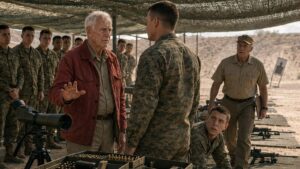
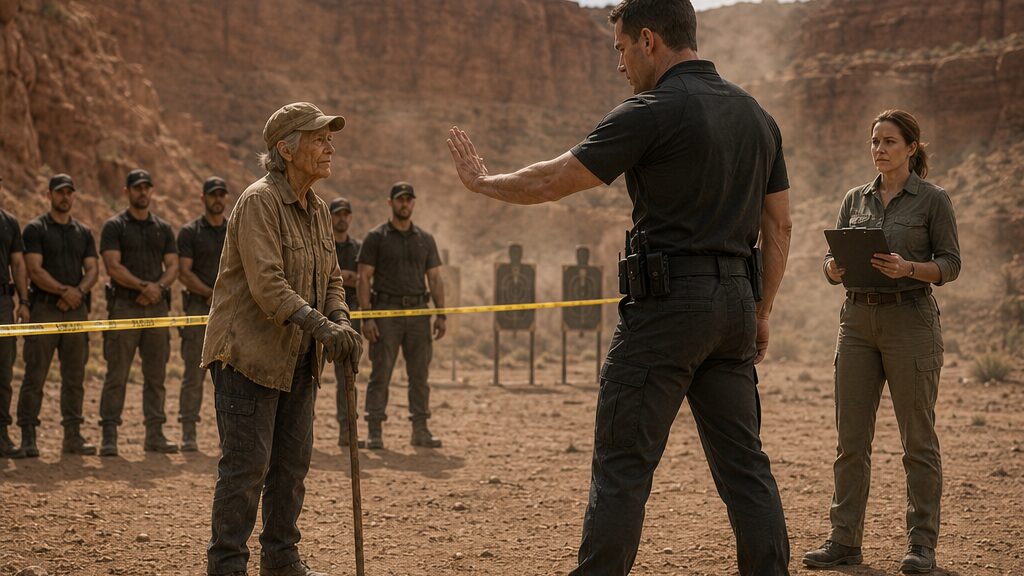
Margaret White’s cane struck the dust three inches from the yellow tape, and every rifle on the range seemed to turn with the sound.
No one raised a weapon at her. They did not have to. The canyon itself went still around her, red walls holding the heat, dry grit hanging in the morning air, the taped boundary shivering between two metal stakes like something official enough to be believed. On the far side of it, young men and women in dark training clothes paused beside barricades and target frames. One of them lowered a water bottle. Another looked toward the instructors.
Margaret kept her eyes on the tape.
It was too far forward.
She had known it from the moment the gate guard waved her through with the uncertain politeness people gave old women when they were not sure whether to help them or stop them. She had known it when the dirt road curved past the storage shed and the canyon opened in front of her. She had known it before she saw the new posts, because the wash breathed differently when a line was wrong.
The wind pushed dust against her boots. Her left knee trembled, not badly enough for anyone else to notice, but enough for the cane to matter. She wore the tan field shirt she had taken from the back of her closet before sunrise, the one Elizabeth always told her made her look like she was trying to disappear into the desert. The collar had gone soft from years of washing. The cuffs were frayed. Her cap shaded her eyes.
A younger instructor broke away from the group and came toward her fast.
“Ma’am,” he called, already annoyed, already certain. “You can’t be here.”
Margaret did not answer at once. She looked past him, past the tape, to the pale cut in the ground where the old wash bent under the canyon wall. Six paces. Maybe seven if the person pacing had longer legs than hers. The new boundary ran too close to the shelf where loose gravel gathered after rain.
“Ma’am,” he said again, closer now.
He was broad-shouldered, dark-clothed, clean in the way instructors liked to be clean before a demonstration. His sidearm sat high at his hip. A radio wire curled from his collar. His name patch read ADAMS.
Margaret looked at his face. Thirty-something. Focused. Hard around the mouth. Not cruel, she decided. Worse, perhaps. He was busy.
“I need to look at the wash,” she said.
His eyes dropped to her cane, then to her boots, then back to her face. The order of the glance told her enough.
“No, ma’am. This is a restricted lane. Live demonstration starts in twenty minutes. Visitor area is back behind the office trailer.”
“I’m not here for the demonstration.”
“That’s not the issue.”
“It is if the line is wrong.”
The nearest trainees heard that. A few looked toward the tape. One of the background instructors crossed his arms. A woman with a clipboard stood near a folding table beneath the shade canopy, pen paused above paper. Margaret saw the woman’s attention sharpen.
The man named Adams took one step closer. “Are you lost?”
Something in the canyon shifted inside her. Not anger. Anger was too hot, too wasteful. This was colder, a clean little cut under the ribs. She had been asked that question in grocery aisles, hospital corridors, parking lots, waiting rooms. Are you lost? Do you need someone? Is there somebody we can call?
She looked at the tape again.
“No,” she said.
His face tightened. “Then you need to step back.”
Margaret’s fingers adjusted around the cane handle. The old rubber tip pressed into powdery ground, and beneath the powder was a harder layer. She knew that feel. Caliche under dust. Bad footing if someone hit it wrong. Worse if a slope gave under speed.
Behind Adams, a trainee whispered, “Who is she?”
Margaret pretended not to hear.
Adams heard. His jaw flexed. He turned half toward the group, then back to her, and the publicness of the moment settled over them both. He could not let an old woman with a cane make him look uncertain in front of trainees, clients, staff, whoever else had come to watch the canyon pretend it was controlled.
“This area is taped off for a reason,” he said, louder now.
“Yes,” Margaret said. “It is.”
“Then respect the boundary.”
“I am.”
His eyes flashed with impatience. “Ma’am.”
The word had turned. It no longer meant courtesy. It meant problem.
Margaret let the silence sit between them. She had learned silence in rooms louder than this canyon. She had learned how not to answer the first insult, or the second, because most people revealed more when they believed they had the advantage. But silence also had a cost. She knew that too. The tape moved in the wind, a bright strip of plastic stretched across old ground, and for a second it was not new tape at all.
It was a line that should have held.
Adams stepped into her space.
“You need to go back to the office,” he said. “Now.”
Margaret turned her head toward the canyon wall, toward the narrow notch where the wash curved. “That isn’t Ridge Three anymore.”
The clipboard woman lifted her head.
Adams frowned. “What?”
“The marker.” Margaret nodded past him. “You have this lane marked off Ridge Three. It was Ridge Three before the wash cut north. After the flood, it became East Needle Wash.”
One of the background instructors gave a short laugh, not quite mocking, not quite comfortable. Adams did not look away from Margaret.
“Those markers are on the range plan,” he said. “You don’t need to worry about them.”
“I am worried about them.”
“Why?”
Because I was here when they changed. Because somebody should have been louder. Because six paces can be the difference between going home and not.
Margaret said none of that. Her throat had narrowed around the old words.
Instead she touched the cane tip to the ground inside the tape, then lifted it and set it down again at her own toe.
“One,” she murmured.
Adams moved quickly then. Not violently. Not enough for anyone to accuse him of anything. Just quickly enough to make the trainees straighten and the clipboard woman’s pen stop entirely.
He put his hand on Margaret’s shoulder.
It was meant to guide. That was what he would have said if asked. It was meant to turn her away, to manage the situation, to keep the demonstration clean. His palm was firm over the thin fabric of her shirt, and heat rose from his skin through the cloth.
Margaret looked down at his hand.
The canyon held its breath.
She had been touched like that once in a field hospital by a medic trying to move her before she finished giving coordinates. She had been touched like that by a lieutenant who thought urgency meant force. She had been touched like that by her own daughter last month at a curb, when the light changed and Margaret was moving too slowly.
She understood every kindness that could become control.
“Don’t make this harder,” Adams said.
Margaret looked up at him. His eyes were not cruel. She wished they were. Cruelty was simpler. Fear dressed as authority was harder to move.
“You’re standing in the wrong place,” she said.
A murmur went through the group behind him.
Adams’s hand stayed on her shoulder, but the pressure changed. “Excuse me?”
“The tape is six paces too far forward.”
He stared at her.
Margaret turned her face slightly, enough to see the clipboard woman watching from the shade. “East Needle Wash,” she said, louder now but still quiet enough that people leaned in rather than recoiled. “The safe line belongs behind the hardpan lip. Not here.”
Adams took his hand off her shoulder as if he had only just realized it was there.
The dust moved between them. Someone’s radio crackled. A trainee shifted weight from one boot to the other.
The clipboard woman lowered her eyes to the papers she carried. Her pen hovered, then stopped. Her mouth parted a little.
“What did you say?” she asked.
Adams turned sharply. “Janet.”
But Janet Green was not looking at him. She was looking at Margaret’s cane, then at the yellow tape, then back at the old woman’s face.
Margaret did not repeat herself right away. She watched Janet’s expression change from concern to calculation to something close to recognition, not of Margaret, but of a detail that had suddenly stopped behaving like a detail.
At last, Margaret set the cane down beside the tape again.
“Six paces,” she said. “You moved it six paces too far forward.”
Chapter 2: The Clipboard Did Not Have Her Name
Janet Green had three approved visitor lists clipped to her board, and Margaret White was not on any of them.
The first list carried the names of the client observers in clean black type. The second listed trainees, staff, and instructors assigned to the demonstration lane. The third was handwritten, a last-minute addition Kevin Miller had given her before the gate opened, with two background instructors and a county safety inspector expected after lunch.
No Margaret. No White. No elderly woman in a faded tan shirt who knew an old range name that was not printed on the current map.
Janet stood at the folding table beneath the canopy and felt the morning heat press against the back of her neck. Beyond the shade, Daniel Adams had moved Margaret away from the tape but not all the way back to the trailer. He stood between her and the lane, arms low but shoulders squared, the way instructors stood when they wanted to look calm while giving no ground.
Margaret had not raised her voice. That unsettled Janet more than if she had.
“Find her badge,” Daniel called.
“She doesn’t have one,” one of the background instructors answered.
“I know that. Find out how she got through the gate.”
Janet turned a page on the clipboard. The range map lay under the lists, laminated at the corners, marked with colored lines: red for live lane, blue for observation boundary, yellow for restricted movement. Someone had placed today’s yellow tape exactly where the printed line told them to place it.
Except Margaret had called it East Needle Wash.
Janet leaned closer to the map.
The current plan labeled the lane Ridge Three Demonstration Corridor. She traced the printed boundary with her pen. Nothing about East Needle. Nothing about an old wash. Nothing about a hardpan lip. The paper was crisp, approved, stamped, and clean enough to make doubt feel inconvenient.
Margaret stood in the sun with both hands resting on her cane. She did not look lost. She looked tired, which was different. Tired people knew where they were. They simply knew the cost of standing there.
Kevin Miller came out of the office trailer with his sunglasses on and his phone in one hand. He took in the scene in less than a second: trainees distracted, Daniel irritated, Janet bent over paperwork, an old woman near the tape.
“No,” he said before anyone asked him anything. “Absolutely not today.”
Daniel walked toward him. “Gate let her in.”
“Then gate made a mistake.”
“She says the line is wrong.”
Kevin looked toward Margaret, then back at Daniel. “The line is on the packet.”
Janet lifted the map. “She used a name that isn’t on this packet.”
Kevin’s sunglasses turned toward her. “What name?”
“East Needle Wash.”
His expression did not change, but he stopped tapping his phone against his thigh. “Where did she get that?”
No one answered.
Janet left the shade and crossed the dust toward Margaret. She felt Daniel’s attention follow her, sharp with warning. She ignored it for the moment.
“Ma’am,” Janet said, softer than Daniel had. “I’m Janet Green. I coordinate operations here. I need to ask how you know that name.”
Margaret studied her. The old woman’s face had lines so deep they seemed less like age than weather. Her eyes were clear.
“It was called that after the wash cut north.”
“When?”
Margaret looked past her to the canyon wall. “Long enough ago that your map forgot.”
Janet swallowed. “Were you assigned here?”
Daniel made a sound behind her, impatient.
Margaret’s fingers tightened around the cane handle. “When this was federal training land, before the private contract.”
Kevin stepped closer. “This land hasn’t been federal training land in years.”
“That’s right,” Margaret said.
“So whatever you remember may not apply.”
Margaret turned to him. “Ground remembers whether contracts change or not.”
One of the trainees heard that and looked down at his boots.
Kevin gave a tight smile that belonged in meetings, not canyons. “Mrs. White—”
“Margaret.”
“All right. Margaret. We’re not trying to disrespect you. But we have a client demonstration scheduled, liability procedures in place, and approved safety boundaries. We cannot delay because of a memory problem.”
The words struck the air cleanly.
Janet saw Daniel glance away, just for a second. Even he had heard it.
Margaret did not flinch. That was what made Janet feel ashamed. If Margaret had snapped, Kevin’s words would have turned into an argument. Because she did not, they remained exactly what they were.
“A memory problem,” Margaret repeated.
Kevin lowered his voice. “You know what I mean.”
“Yes,” she said. “I do.”
Janet looked back down at the map. The printed yellow boundary line was neat and bright. It did not care that an old woman’s mouth had gone pale.
“Let me check the archive binder,” Janet said.
Kevin’s head turned. “There’s no need.”
“It will take two minutes.”
“We don’t have two minutes for every walk-in correction.”
“She knew an old marker name,” Janet said.
Daniel cut in. “Knowing an old name doesn’t give her clearance.”
“No,” Janet said. “But it might explain how she got past the gate.”
Margaret’s gaze shifted to Janet. Not gratitude. Not yet. Just attention.
Kevin sighed, sharp and controlled. “Fine. Two minutes. Daniel, keep the lane clear.”
Daniel nodded, then pulled a folded incident form from the pouch on his vest. “I’m documenting the unauthorized entry.”
Margaret looked at the paper as he opened it.
Janet saw the old woman’s face change, though only slightly. A tightening at the corners of her mouth. A retreat behind the eyes. It was not fear of paperwork. Janet had seen that before in visitors who knew they had broken rules. This was something stranger. As if a form could bring back more than a consequence.
Inside the trailer, the air smelled of dust, coffee, printer toner, and old carpet glue. Janet opened the metal cabinet marked SITE RECORDS and pulled the archive binder from the bottom shelf. Its plastic cover had cracked along the spine. Most staff avoided it because the digital packet was faster, cleaner, and easier to defend.
Kevin stood in the doorway, blocking half the light. “The current packet is the legal packet.”
“I know,” Janet said.
“Then don’t make a production out of this.”
Janet flipped through old maps, training notices, maintenance logs. Ridge One. Ridge Two. Ridge Three. A washout report from years ago. A handwritten correction sheet, scanned and photocopied until the letters blurred.
Her pen stopped.
EAST NEEDLE WASH — FORMERLY RIDGE THREE NORTH CUT.
A small notation appeared beside it: boundary setback adjusted after erosion.
Janet’s skin prickled.
Daniel entered behind Kevin. “Anything?”
Janet did not answer immediately. Below the notation was a boundary code. Faded, but readable.
ENW-6.
She looked through the trailer window toward Margaret. The old woman stood exactly where Daniel had left her, not trying to sneak past, not arguing with trainees, not performing outrage. Her cane rested in front of her like a marker.
Janet turned the binder so Daniel could see.
His face tightened.
Kevin leaned in. “That doesn’t prove today’s line is wrong.”
“No,” Janet said. “It proves she didn’t invent the name.”
Daniel looked toward the window. For the first time since the confrontation began, uncertainty crossed his face and stayed longer than a blink.
Then he looked down at the incident form in his hand, and the uncertainty hardened into procedure.
“She still entered a restricted range without clearance,” he said.
Janet wanted to argue, but Kevin spoke first.
“Document it,” he said. “We’ll sort the old map later. For now she goes back behind the public line.”
Daniel wrote Margaret’s name on the form with block letters.
Janet watched the pen move. The act made the morning worse. Until then, the disrespect had been dust and tone and a hand on a shoulder. Now it had a document.
Outside, a car door slammed near the parking area.
Margaret turned before anyone else did.
A woman hurried across the dirt lot, one hand shielding her eyes from the sun. She was younger than Margaret but carried the same tightness around the mouth, the same habit of bracing before she spoke. She saw Margaret near the tape, saw Daniel with the form, saw Janet holding the old binder.
“Mom,” she called.
Margaret closed her eyes for half a second.
The woman reached her and took her by the arm, not roughly, but with panic hidden under care. “What are you doing here?”
“Elizabeth,” Margaret said.
Elizabeth Young looked toward the canyon. Her face changed as if the red walls had spoken before her mother could.
Then she lowered her voice, but not enough.
“Why would you come back to the place that took Betty?”
Chapter 3: Six Paces from the Old Wash
Margaret planted her cane in the dust and counted six paces under her breath while her daughter watched her as if each number were a symptom.
One.
The cane tip made a round mark in the powder.
Two.
Elizabeth stood too close, ready to catch her, stop her, guide her, manage her, love her into retreat.
Three.
Beyond the tape, Daniel Adams spoke with Kevin near the trailer. The incident form remained in Daniel’s hand. Janet Green had not put away the old binder.
Four.
The wash waited where it had always waited, though the canyon around it had shifted by inches, then feet, then years.
Five.
“Mom,” Elizabeth said. “Please stop.”
Six.
Margaret set the cane down and looked at the ground in front of her. The tape fluttered behind her shoulder now, bright and wrong.
“There,” she said.
Elizabeth’s breath came out hard. “There what?”
“The old setback.”
“You can barely walk across the parking lot some mornings.”
“That doesn’t change where the line belongs.”
“You hear yourself?”
Margaret turned to her daughter. Elizabeth’s face was flushed from the heat and fear. She had left work in a hurry; one side of her blouse was tucked in and the other was not. Her car keys were still clenched in her hand, metal teeth sticking between her fingers.
Margaret knew that grip. Elizabeth had held keys like that outside doctor’s offices, outside pharmacies, outside Margaret’s own front door after deciding the porch steps needed a rail whether Margaret wanted one or not.
“I hear myself,” Margaret said.
“I got a call from the gate guard saying you were wandering around a tactical range.”
“I wasn’t wandering.”
“That’s what they said.”
“They were wrong.”
Elizabeth looked at the tape, then at the armed trainees, then at the old canyon wall. “This is exactly why I didn’t want you driving out here alone.”
“I didn’t ask you to want it.”
The words came out sharper than Margaret intended. Elizabeth’s face closed a little.
For a moment, both women looked at the dust between them.
Margaret wished she could take the edge back without surrendering the point. It had always been difficult with Elizabeth, who loved in straight lines and expected danger to obey them. Margaret had raised her that way, perhaps. Keep the facts clean. Do not make a fuss. If something hurts, finish the task first.
Now Elizabeth used the lessons against her.
“Tell me why,” Elizabeth said.
Margaret looked toward the wash.
“I saw the tape from the road.”
“That’s not why.”
“It’s enough.”
“No,” Elizabeth said. “It isn’t. You do this every time. You give half an answer and expect everyone to know what the other half costs.”
The words landed harder than Kevin’s memory problem had.
Margaret tightened her jaw. “Not here.”
“Yes, here.” Elizabeth stepped closer. “Because you came here. You came back to this canyon after all these years, after refusing to even say Betty’s name in the house, and now strangers are writing reports on you like you’re some confused old woman.”
Margaret looked at Daniel’s form again. A white page against his dark vest. Block letters. A line waiting for official language.
“She was not taken by the canyon,” Margaret said.
Elizabeth stared at her.
Margaret had not meant to say that much.
The wind moved dust across the six cane marks, softening the edges. Margaret leaned down, too quickly, and her knee gave a warning pulse. Elizabeth reached for her, but Margaret lifted one hand.
“I’m fine.”
“You’re not fine.”
“I am standing.”
“That has never meant you were fine.”
There it was again. The other half.
Margaret straightened slowly. For years she had thought silence protected Elizabeth. No need to tell a child every detail of what military ground could do to bodies, friendships, sleep. No need to explain why a woman named Betty Hernandez appeared in Margaret’s dreams every August. No need to bring home the smell of dust after a hard landing, the sound of someone insisting the boundary was good enough, the shape of a mistake that could not be undone.
But Elizabeth had grown up around the silence anyway. Children did. They built rooms inside it.
“Betty trusted the line,” Margaret said.
Elizabeth’s anger faltered.
“The old one?”
“No.” Margaret looked at the yellow tape. “The wrong one.”
Behind them, a radio snapped with static. The demo schedule was still moving. Staff crossed between the trailer and the lane, carrying target stands, medical bags, coolers. The world had no respect for a half-confession.
Elizabeth followed her mother’s gaze. “Is that what this is? You think it’s happening again?”
“I think the wash changed. I think somebody moved a boundary to match a packet that doesn’t remember why it was set back.”
“Then tell them everything.”
Margaret almost smiled. Not because anything was funny, but because Elizabeth still believed explanation opened doors.
“They have a packet,” Margaret said.
“They also have ears.”
“Not always.”
“Mom.”
Margaret looked at the six marks fading in the dust. “I noticed late.”
Elizabeth went still.
The words were small, and the canyon did not echo them, but once spoken they could not be gathered back.
“With Betty?” Elizabeth asked.
Margaret did not answer. Not fully. Her throat had closed again, that old obedient gate.
Elizabeth’s eyes filled, though no tears fell. “You’ve been carrying her name longer than anyone remembers, and you still won’t let me know what you’re carrying.”
Margaret gripped the cane. “I came to check the line.”
“You came to punish yourself.”
“No.”
But denial came too quickly, and both of them heard it.
Kevin Miller approached from the trailer with Daniel beside him. Janet followed a few steps behind, binder pressed to her chest. Kevin had removed his sunglasses. His face looked managerial now, all concern arranged for witnesses.
“Mrs. White,” he said.
“Margaret,” Elizabeth snapped before her mother could.
Kevin paused, adjusted. “Margaret. We reviewed the archive notation. We appreciate your concern. At this time, the current approved range packet remains controlling.”
Janet shifted behind him. “Kevin—”
He lifted one hand, not looking at her. “We are not moving the tape ten minutes before a demonstration because of an old notation and a personal recollection.”
“Six paces,” Margaret said.
Daniel’s eyes flicked to the cane marks.
Margaret saw him notice. She also saw what he did with the noticing. His face tightened, and his attention moved from the ground to her hand, from her hand to her age, from her age to the incident form. He was building a safer explanation for himself.
“Ma’am,” Daniel said, “you need to stop approaching the lane.”
“I’m not approaching. I’m measuring.”
“That’s the problem.”
Elizabeth stepped between them. “She says the boundary is wrong.”
“She has not provided evidence that overrides the approved packet.”
Margaret looked at Daniel. “Your approved packet calls it Ridge Three.”
Janet said quietly, “The archive supports that part.”
Daniel did not turn. “The archive does not grant access.”
Kevin nodded. “Exactly.”
The words closed like a gate.
Margaret felt the old habit rise: say less, hold steady, do not give them the part they can mishandle. She could feel Elizabeth waiting for her to break that habit. She could feel Janet waiting for enough fact to justify stepping out of line. She could feel Daniel waiting for one more sign that the old woman was confused.
So she gave him one by accident.
She turned from them and counted the paces again.
Not aloud this time. Not fully. Just the movement: cane, boot, cane, boot. Her lips shaped the numbers. Her eyes stayed on the ground, following a line nobody else could see.
One. Two. Three.
“Daniel,” Kevin said, low.
Four. Five.
Daniel watched her with something like regret hardening into decision.
Six.
Margaret stopped at the old setback and pressed the cane into the dust until the rubber tip sank.
Daniel lifted the incident form against his clipboard and wrote another line.
Elizabeth saw it. “What are you doing?”
“Documenting continued restricted-area interference,” Daniel said.
Janet’s face tightened. “Daniel, wait.”
But he had already finished writing.
Margaret stood over the sixth mark, breathing carefully, her cane still planted like a small flag no one would honor. Daniel looked at the marks in the dust, then at her face, and Margaret knew exactly what he had decided.
To him, the counting was not memory.
It was proof she needed to be removed.
Chapter 4: The Line That Looked Safe on Paper
Daniel Adams read the second line he had written on the incident form and hated how weak it looked.
Continued restricted-area interference.
It sounded clean. It sounded defensible. It sounded like something a man could hand to a manager, an inspector, or a lawyer if anyone asked why he had stopped an elderly woman from walking into a live demonstration lane. It did not sound like a cane tapping six careful marks in the dust while half the range watched him decide what kind of man he was going to be.
He pressed harder with the pen.
Subject continued movement toward restricted boundary despite verbal direction.
Better.
Across the trailer, Janet Green stood over the archive binder with one finger holding down the old notation. Kevin Miller hovered beside her, phone in hand, speaking low to someone about a minor delay that would be resolved shortly. Outside the trailer window, Margaret White sat on a folding chair Elizabeth had dragged into the shade, though Margaret did not look like she had accepted rest. She sat upright, both hands on the cane, eyes fixed toward the canyon lane.
Daniel looked away first.
“You’re going to bruise the paper,” Janet said.
He glanced down. The tip of his pen had nearly torn through the form.
“I’m documenting what happened.”
“I know what you’re doing.”
“Then let me do it.”
Janet did not move from the binder. “She wrote the boundary code correctly.”
Daniel’s hand stopped.
The notation she had found was still open: EAST NEEDLE WASH — FORMERLY RIDGE THREE NORTH CUT. Boundary setback adjusted after erosion. ENW-6.
He had seen the code when Janet turned the binder. He had also seen Margaret’s cane marks. Six paces. ENW-6. Two pieces of old information reaching toward each other through dust and paper.
But old information was dangerous when it arrived at the wrong time. It could make a man hesitate in front of trainees. It could let a demonstration unravel. It could turn a safe procedure into a debate, and Daniel had learned what happened when debates entered live lanes.
The last time, a trainee had gone down with a torn knee and a cracked helmet after hesitating between two commands. Not because Daniel had been reckless. That was what the review had said. Communication overlap. Inconsistent lane control. No gross negligence. Still, the trainee had screamed before the medic reached him, and Daniel had heard that scream in every safety briefing since.
Kevin had hired him because he was strict.
Strict did not leave room for an old woman counting in the dust.
Janet closed the binder halfway. “Daniel, what if the packet is wrong?”
He looked at her then. “The packet is what we operate under.”
“That doesn’t answer the question.”
“It answers the only question that matters during a live event.”
“The event hasn’t started.”
Kevin ended his call and turned toward them. “The event starts when I say it starts, and right now it starts in twelve minutes unless the inspector decides to show up early and ask why the lane is full of drama.”
Janet’s face tightened. “The inspector should ask why the old map and current packet don’t match.”
“The current packet was approved.”
“By whom?”
“By people with more authority than an archive binder.”
Daniel capped his pen. “Kevin is right.”
Janet stared at him.
He felt the stare like heat. “Look, I’m not saying she’s lying.”
“No one said you were.”
“I’m saying she’s not cleared, she entered the boundary, and she’s fixated on an old line. We don’t know her condition. We don’t know when she was last here. We don’t know if her memory is accurate.”
Janet’s eyes flicked toward the window. “She knew the code.”
“She knew a code.”
“She knew the name.”
“Fine. She knew the name.”
“And you knew neither.”
That landed harder than he expected.
Daniel’s mouth tightened. He looked down at the form, then through the window again. Margaret was still watching the canyon. Elizabeth stood beside her, arms folded tight, speaking in short bursts Daniel could not hear. Margaret did not answer much. She gave the smallest possible motions: a head turn, a hand shift, a glance toward the tape.
It would have been easier if she had ranted. Easier if she had accused him of disrespect, demanded special treatment, threatened to call someone. Then he could have placed her neatly into a category.
Instead she sat like a woman waiting for younger people to catch up to something the ground had already told her.
Kevin tapped the current safety packet. “This is today’s world. Not hers.”
Janet opened the binder again. “Today’s world may be using yesterday’s wrong name.”
Daniel took the current packet from Kevin and laid it beside the archive binder. Ridge Three Demonstration Corridor. Observation boundary set at yellow line. Live movement lane marked in red. Emergency route clear. He scanned the signatures, dates, revisions. Everything in order.
Clean paper. Clean authority.
His eyes dropped to the old binder. The copied map showed a rougher canyon, hand-labeled, less polished. A dotted line sat farther back than the current yellow line. Not by much. Enough to irritate him.
Maybe six paces.
He turned the packet around. “The terrain survey from last month cleared the lane.”
Janet leaned over it. “Surveyor notes?”
“Appendix.”
She flipped. Her finger found a page of measurements and stamped initials. “This is for Ridge Three.”
“That’s the current designation.”
“But if East Needle Wash shifted—”
Kevin snapped the packet shut. “Enough. We are not making operational changes because someone remembered a name from before this facility existed as a private range.”
A dull sound came from outside.
Not loud. Not dramatic. A soft pouring hiss, like dry rice spilled onto a floor.
Daniel moved before anyone else. He stepped out of the trailer and looked toward the taped lane.
A thin slide of dust and pea-sized rock spilled down the canyon shelf just inside the yellow boundary. It ran for maybe two seconds, then stopped in a pale fan near a target stand. No one was under it. No one was close. A few trainees laughed nervously, the way people laughed after something almost mattered.
Margaret stood from her chair.
Daniel saw it immediately. She did not look surprised.
Elizabeth reached for her arm. Margaret shook her head once and took one step toward the tape.
Daniel’s body reacted before his thoughts did. He crossed the dirt and intercepted her halfway.
“Stop.”
Margaret looked at the slide, not at him. “That shelf wasn’t shedding this morning.”
“You don’t know that.”
“I know dust before a break.”
“You are not approaching the lane.”
“She’s right,” Janet said behind him.
Daniel turned. “Janet.”
She had followed with the binder open against her chest, old page exposed to the sun. “The archive setback was adjusted after erosion. That slide came from the same side of the wash she marked.”
Kevin strode up behind her. “A little surface dust falls off these walls every day.”
Margaret said, “Not there.”
Kevin looked at Daniel. “We’re moving forward.”
Daniel’s jaw tightened. The slide had been small. He knew small slides. Canyons moved. Dust fell. Loose rock shifted in heat. If he stopped every lane for a trickle of gravel, no course would run.
Still, he looked at the six cane marks in the ground.
The first three were nearly gone, blurred by boots and wind. The sixth remained deeper, pressed hard enough to hold its circle. It sat farther back from the tape than the current boundary, just where the old map’s dotted line would have placed it.
His radio crackled.
“Demo team ready for lane brief,” a background instructor said.
Kevin lifted his chin, waiting.
Janet waited too.
Margaret waited without asking him for anything. That was what made it worse. She had given him the line, the name, the number, the ground. She would not beg him to use them.
Daniel looked toward the client observers under the shade canopy. One of them checked a watch. The trainees were watching his face now, not the lane. His authority had become visible, and that meant any uncertainty in him was visible too.
He remembered the review board after the trainee injury. The way everyone had used calm voices. The way “could have paused sooner” had appeared in the final note without becoming a formal finding. The way no one blamed him enough to punish him, but everyone blamed him enough to remember.
He could not be the instructor who lost control again.
He turned to Margaret. “You need to return behind the public line.”
Janet exhaled sharply. “Daniel.”
He kept his eyes on Margaret. “If there is a survey discrepancy, we will review it after the demonstration.”
Margaret’s face changed, but only in the eyes. Some old door closing. Some old sentence not spoken.
Kevin clapped once, businesslike. “Good. Let’s reset. Five-minute hold, then lane brief.”
Margaret looked past Daniel to the pale fan of fallen dust.
“Five minutes can be a long time on bad ground,” she said.
He did not answer.
She lowered her cane and turned back toward the shade, moving slower now. Elizabeth walked beside her, anger and worry braided through every step. Janet remained near the tape, old binder still open, staring at the fresh slide as if paper and earth had begun arguing in a language she was only now learning.
Daniel forced himself to face the lane.
Another thin thread of dust slipped from the shelf and vanished in the heat before it touched the ground.
Chapter 5: The Name Margaret Would Not Say Aloud
Margaret touched the yellow tape and finally said Betty’s name where the canyon could hear it.
Not loudly. Not as an accusation. The tape rasped against her palm, cheap plastic warmed by the sun, and the name came out low enough that Elizabeth had to lean closer.
“Betty Hernandez.”
Elizabeth went still beside her.
The trainees were resetting under Daniel’s direction farther down the lane. Kevin had pulled the visiting observers toward the shade canopy with coffee and explanations. Janet stood near the office trailer, caught between the current packet and the archive binder, looking as though each page had become heavier than the clipboard could bear.
Margaret kept her hand on the tape.
It trembled in the wind. Years ago, the boundary had been rope instead of plastic. Before that, painted stakes. Before that, a man with a range flag and a voice that carried. Boundaries changed shape. That was why people forgot they were not decorations.
“Mom,” Elizabeth said. “Tell me.”
Margaret closed her fingers around the tape until it wrinkled. “She trusted what we gave her.”
“What happened?”
A command barked from the lane. Trainees shifted. Boots struck hardpan. The sound traveled cleanly across the canyon, and Margaret’s memory answered before she could stop it: boots, dust, a shouted correction, a second voice saying the line would hold.
She let go of the tape.
“We were running movement drills after rain,” Margaret said. “Not heavy rain. Enough to change the wash. Enough that the top looked dry and the lip underneath wasn’t.”
Elizabeth said nothing. For once, she did not fill the silence with worry.
“I saw it before the run,” Margaret continued. “Not all of it. Just enough. A new cut under the shelf. I told myself the lane officer had seen it too. I told myself the setback was probably already adjusted.”
“But it wasn’t.”
“No.”
The word had weight. Margaret had carried heavier things, but few had lasted as long.
“Betty was first through?”
Margaret looked at her daughter then. Elizabeth’s eyes were wet. Not because she knew Betty. She had been too young, known only the shape of absence around the name. But grief could be inherited without details. Margaret had given her that inheritance and called it protection.
“Second,” Margaret said. “She joked that first never had time to learn from anybody else’s mistake.”
Elizabeth pressed her lips together.
“The lip went under her. She didn’t fall far. That was the cruelty of it. Not far enough to look like a disaster from where the officers stood. Far enough for the ground to twist her wrong and send rock down after her.”
Margaret stopped.
Her palm still felt the tape.
“She lived,” she said, because that mattered. Because stories like this could become too easy in other people’s mouths. “She lived. But the service life she had built ended there. The work ended. The body she trusted ended. Her marriage went another year. Her laugh went sooner.”
Elizabeth’s hand moved toward Margaret’s sleeve, then stopped before touching. “And you blamed yourself.”
“I noticed late.”
“That isn’t the same.”
Margaret’s mouth tightened. “It was late because I made it late. I saw a wrongness and waited for someone with more authority to name it.”
Elizabeth looked toward Daniel, who stood with a radio at his shoulder, eyes on the lane.
“You were young too.”
“Young isn’t an excuse when someone else steps where you stayed silent.”
The words were sharper than she meant them to be, and they struck Elizabeth as much as Margaret. Her daughter looked down at the dust.
“For years,” Elizabeth said, “I thought Betty was a ghost you chose over us.”
Margaret’s hand loosened on the cane.
Elizabeth laughed once, without humor. “Not like that. I don’t mean you loved her more. I mean every time August came, every time you drove past this side of town and went quiet, every time I asked and you said, ‘It was service business,’ I thought there was no room for me in that part of you.”
Margaret looked at the ground. A line of ants moved along a crack near her boot, carrying pale crumbs of something too small to name.
“I did not want to give you pictures you couldn’t put down.”
“You gave me closed doors instead.”
The canyon seemed to widen around that.
Margaret had expected Daniel’s dismissal to hurt. Kevin’s paperwork. The old map. The tape. She had not expected Elizabeth’s truth to step out from behind Betty’s name and stand there, living and breathing.
“I’m sorry,” Margaret said.
Elizabeth looked at her then. No triumph. No relief. Only a daughter tired of loving through walls.
“Tell them,” Elizabeth said.
Margaret turned toward the lane. Daniel was checking positions. One trainee stood near the start point, helmet clipped, gloves on, waiting for the final brief. The pale slide under the shelf had spread slightly, a little tongue of dust no one else seemed to respect.
“If I tell them all of it, Betty becomes a tool,” Margaret said. “A story to win an argument.”
“If you don’t tell them enough, someone may step where she stepped.”
Janet approached before Margaret could answer. She carried the binder open, but her attention was on Margaret, not the page.
“Margaret,” she said. “The county safety inspector just checked in at the gate. He’s early.”
Kevin heard from the canopy and turned. “He’s what?”
Janet glanced back. “At the gate. Two minutes out.”
Kevin crossed the space fast, his smile already forming for a person not yet visible. “Then we keep this clean.”
Margaret looked at him. “Clean?”
“Yes. Clean. No public disputes in front of an inspector unless you want this place shut down for a week while people who don’t understand field conditions make decisions from behind desks.”
“People who don’t understand field conditions,” Elizabeth said flatly.
Kevin ignored her. “Janet, current packet on top. Archive binder closed unless requested. Daniel, hold the trainees steady and brief them away from this area.”
Janet did not close the binder.
Kevin noticed. “Janet.”
She looked at Margaret, then at the fresh dust slide, then back at Kevin. “If he asks about the delay, I’m not lying.”
“No one asked you to lie.”
“You asked me to make the old record invisible.”
“I asked you to follow procedure.”
Margaret watched Janet’s fingers tighten around the binder. There it was, the old shape. Not the same people. Not the same year. The same small bending in the air before a wrong line became official because everyone had a reason to wait.
A range vehicle appeared beyond the parking area, dust trailing behind it. The county safety inspector.
Kevin’s voice lowered. “Margaret, I am asking you respectfully to return to the public observation area. We will review your concern after the demonstration.”
“After,” Margaret said.
“Yes.”
She looked at Daniel. He was watching her now. Not openly. Not kindly. But watching.
“After is a word people use when before has become inconvenient,” she said.
Kevin’s face hardened. “You are interfering with a permitted training event.”
Elizabeth stepped forward. “She is warning you.”
“She is not staff.”
Margaret pressed the tape into her palm again. The plastic edge bit lightly into her skin. Not enough to cut. Enough to remind.
For decades, she had told herself dignity meant not dragging old pain into public, not demanding witness, not correcting every person who mistook quiet for emptiness. That restraint had kept her standing. It had also kept Betty’s name locked behind her teeth while maps changed and people aged and her daughter learned to fear silence.
The inspector’s vehicle rolled to a stop.
Daniel’s radio crackled. “Demo lane ready on your count.”
A background instructor raised one hand from the start position.
Kevin turned toward the lane and lifted his own hand, signaling for final readiness.
The yellow tape fluttered wrong in Margaret’s grip.
She let go of it, stepped past Elizabeth, and moved toward the start of the lane.
“Mom,” Elizabeth said.
Margaret did not stop.
Daniel saw her coming and spoke into his radio, sharp enough for everyone to hear.
“Stand by for countdown.”
The first trainee moved to the line while the tape still marked the wrong ground.
Chapter 6: Before the First Trainee Crossed
The first trainee’s boot lifted toward the taped lane just as Margaret’s cane struck the dust hard enough to stop the countdown.
The sound was not loud like a shot. It was small, wooden, final. A single crack against hardpan. But in a place built around commands, any unexpected sound that came at the right second could cut through habit.
“Hold,” Margaret said.
No one moved.
Daniel turned from the start point, radio still near his mouth. “Ma’am, step back.”
Margaret kept the cane planted. The trainee’s boot hovered, then returned to the ground behind the line. The young person looked from Daniel to Margaret, uncertain which authority would become real.
Kevin strode from the canopy with the county safety inspector beside him. Janet followed with both packets clutched against her chest. Elizabeth stopped several paces behind Margaret, one hand pressed to her own sternum as if holding herself back.
Daniel’s face darkened. Not with simple anger. Margaret could see the calculation under it, the terror of a public lane slipping out of his control again.
“You cannot enter the active lane,” he said.
“I haven’t.”
“You’re obstructing it.”
“I am stopping it.”
“On what authority?”
She looked at the yellow tape, then at his hand on the radio. “The authority of bad ground.”
A few trainees shifted. The inspector’s gaze moved toward the canyon shelf.
Kevin spoke before Daniel could. “We have a concerned former visitor with an old-site recollection. We’re handling it.”
Margaret did not look at Kevin. “No.”
The word was quiet. It reached anyway.
Daniel stepped toward her. “Margaret, I am giving you a final instruction. Move back.”
The use of her first name might have sounded respectful if his voice had not turned it into a restraint.
She lifted her cane and set it down one pace behind the yellow tape.
“One.”
“Don’t do this,” Daniel said.
She took another measured step.
“Two.”
The trainee at the start line looked down at the ground as if the numbers might appear there.
Daniel moved with her, parallel, blocking without touching. “You’re creating a hazard.”
Margaret took the third pace. “I know.”
Janet spoke quickly to the inspector, too low for Margaret to catch all of it. She heard “archive,” “former wash designation,” and “erosion adjustment.”
Kevin cut across her. “The current approved packet—”
The inspector raised a hand. Kevin stopped.
Margaret placed the cane again.
“Four.”
Daniel’s eyes darted to the shelf. A thin seam ran beneath the hardpan lip, visible only from this angle, shadowed under crusted dust. Margaret knew the seam. She had seen its kind open under pressure, then pretend innocence afterward.
“Five.”
Daniel saw it too.
She knew the instant he did. His shoulders did not drop; men like Daniel rarely let uncertainty show where others could use it. But his eyes changed. They left her face and fixed on the ground beyond the tape, where the pale fan of dust from the slide had reached farther than before.
Margaret stopped with the cane over the sixth mark.
“This is where the setback belonged after the wash cut north,” she said.
The canyon gave no answer. The people did.
A background instructor murmured, “That’s behind the current line.”
Janet stepped forward with the binder open. “The archive code is ENW-6. East Needle Wash. Boundary setback adjusted after erosion.”
Kevin’s voice sharpened. “Archive reference, not current operational control.”
The inspector looked toward the taped lane. “When was the last terrain survey for this wash specifically?”
Kevin hesitated.
Daniel heard the hesitation and hated it. Margaret saw that too. His jaw flexed once. He looked at Kevin, then at the trainee, then at the seam under the hardpan lip.
“Survey was filed under Ridge Three,” Janet said.
The inspector turned to her. “Not East Needle Wash?”
“No.”
Kevin said, “Because Ridge Three is the current designation.”
Margaret looked at Daniel. “Names matter when the ground changed under one of them.”
Daniel’s radio crackled again. “Lane is on hold. Confirm?”
Every face turned toward him.
This was the place where fear could become humility or force. Margaret had seen both. She had seen officers double down because the paper gave them cover. She had seen enlisted people stay quiet because they thought rank would notice. She had seen Betty Hernandez trust a line Margaret should have challenged sooner.
Daniel lowered the radio half an inch.
“Confirm hold,” he said.
Kevin spun toward him. “Daniel.”
Daniel did not look away from the seam. “Temporary hold.”
It was not surrender. Not yet. But it was the first useful thing he had done since placing his hand on her shoulder.
Margaret let out a breath she had not known she was holding.
Kevin stepped close enough to Daniel that only the front row could hear him clearly. “Do you understand what you’re doing? We’ve got clients here, an inspector here, and a delay on a permitted demonstration because an unauthorized woman walked in with a story.”
Margaret turned toward him then.
“Not a story,” she said.
Kevin’s eyes flashed. “Then what?”
“A warning.”
He opened his mouth, but she continued before silence could swallow her again.
“Years ago, this wash cut north after rain. The surface dried before the underside settled. The old boundary was moved back six paces because the lip failed under load.”
The inspector listened without interruption. Daniel did too.
“A trainee trusted the line,” Margaret said. “The people running the lane trusted the packet. I saw the undercut late and said too little too softly because I thought someone with more authority had already seen it.”
Elizabeth’s face tightened behind her.
Margaret did not turn. If she turned, she might stop.
“Betty Hernandez stepped where she was told to step. She survived. That matters. But what she lost started here.”
No one asked what Betty lost. Margaret was grateful. She had not come to unpack another woman’s life in front of strangers.
Daniel’s face had gone still.
Margaret looked at him, not Kevin now. “I did not come here to shame you.”
His eyes flicked to hers.
“I came because I know what it is to stand beside bad ground and wait for someone else to say stop.”
The words settled over the lane with more force than shouting would have. Daniel looked at the trainee at the start point. The young person stood rigid, trying not to appear frightened by uncertainty. Daniel’s face altered then, not dramatically, but enough. He saw the person waiting for his command, not the audience waiting for his authority.
Kevin tried one last time. “Inspector, with respect, we cannot validate a decades-old recollection in the middle of—”
A small crack sounded from the shelf.
Everyone heard it.
A narrow sheet of dust slipped down the canyon wall, followed by a handful of stones that bounced across the ground inside the current taped lane. The stones rolled exactly where the trainee’s second step would have landed.
No one spoke.
Daniel moved first, but not toward Margaret. He crossed to the lane, crouched near the fallen rock, and looked under the hardpan lip. The line of his shoulders changed as he saw the hollow there.
He stood and turned to Kevin. “We’re moving the tape.”
Kevin stared at him. “You don’t make that call alone.”
Daniel’s hand went toward the strap near his sidearm out of habit, not threat, a tightening gesture he seemed unaware of until Margaret’s gaze dropped to it. He followed her eyes, stopped, and let his hand fall away.
Then he walked to Kevin and took the roll of spare yellow tape from under the manager’s arm.
“No,” Kevin said.
Daniel held the roll, but he did not pull it free. He looked at the inspector. “I’m suspending lane movement pending boundary correction.”
The inspector nodded once. “Good.”
That single word ended Kevin’s argument more thoroughly than any speech could have.
Daniel turned back toward Margaret. For the first time all day, he did not stand over her. He stopped at a distance where she would not have to lift her chin too far.
“Where does the line belong?” he asked.
Margaret looked at the cane mark at her feet, the sixth one, deeper than the rest. She could feel every watching face, but the old humiliation had changed shape. It had not vanished. A hand on her shoulder could not be undone by one corrected decision. But something dangerous had been interrupted before it became permanent.
She lifted her cane, set the tip into the dust behind the wrong tape, and drew a short line across the ground.
“Here,” she said.
Daniel unwound the yellow tape with both hands and stepped toward the mark she had made.
Chapter 7: Where the Tape Was Placed Again
The canyon was quiet except for Daniel Adams unspooling new yellow tape by hand.
No countdown carried across the wash now. No trainee waited at the start line. The visiting observers had been escorted back to their vehicles with careful phrases about a boundary review and precautionary suspension. The county safety inspector had stayed long enough to photograph the shelf, mark the fallen stones, and tell Kevin Miller that no demonstration would continue until the lane designation matched the ground under it.
Kevin had not argued after that. Not loudly. His phone had absorbed the rest of his anger.
Margaret stood near the corrected line, her cane resting beside the sixth mark she had drawn in the dust. The sun had dropped low enough to turn the canyon walls the color of old brick. Shadows filled the wash where the first trainee’s second step would have landed.
Daniel pulled the tape from one stake to the next. He worked without asking a background instructor to do it for him. That mattered, though Margaret did not let herself make too much of it. A man could move tape and still learn nothing. People corrected objects all the time while leaving themselves untouched.
Janet Green knelt beside the old stake with the archive binder open on one knee and the current packet on the other. She had clipped them together with a black binder clip, as if paper could be made to admit kinship by force.
“ENW-6,” she said, writing carefully on a fresh correction sheet. “Temporary boundary restoration pending full terrain survey.”
Kevin stood behind her, arms folded. “Temporary,” he said.
Janet did not look up. “Pending full terrain survey.”
The inspector, standing near his vehicle, gave a small nod.
Daniel finished tying off the tape. The new line sat behind Margaret’s cane mark, farther from the hardpan lip, bright and almost gentle in the evening light. The wrong line’s old stakes remained in the dirt for the moment, empty and accusing.
Elizabeth stood near Margaret but did not hold her arm. That mattered too.
Daniel walked toward Margaret with his gloves tucked into one hand. Dust streaked his knees from where he had crouched at the shelf. His face looked younger than it had that morning, not softer exactly, but stripped of the polished certainty that had made him seem harder than he was.
He stopped a few feet away.
“Mrs. White,” he said.
Margaret waited.
He corrected himself. “Margaret.”
The name sounded different now. Not a handle. Not a tool. A person.
“I owe you an apology.”
Behind him, Kevin shifted. Janet’s pen paused.
Margaret looked past Daniel to the tape. “For which part?”
His mouth tightened, but he did not look away. “For putting my hand on you. For speaking to you like you were a problem to manage instead of a person to hear. For filing that report before I understood what I was writing down.”
She studied him. “Did you file it because you did not understand?”
Daniel swallowed.
That was the question he had hoped she would not ask. Margaret saw it, and for a moment she almost spared him. The old habit rose again, ready to smooth the edge, let the young man keep enough pride to walk away undamaged.
But smoothing edges had its own cost.
“No,” he said finally. “I filed it because understanding would have slowed me down.”
Janet lowered her eyes to the correction sheet.
Margaret nodded once. “That is a better answer.”
“It isn’t a good one.”
“No.”
His shoulders moved with a breath. “I thought if I kept control, everyone stayed safe.”
“Control can look like safety from a distance.”
“I know that now.”
Margaret looked at the tape again. “Do you?”
He followed her gaze.
The new boundary shivered between the stakes. Same color. Same plastic. Same official brightness. Only the placement had changed, but the space it gave back to the ground was the difference between warning and decoration.
“What will you do differently tomorrow?” Margaret asked.
Daniel looked at her then.
Not What do you feel? Not Are you sorry? Not Do you respect me now?
Tomorrow.
The word moved through him visibly. It required more than regret. It required procedure.
“I’ll halt the lane until the survey is complete,” he said.
“That is today.”
He nodded slowly. “Tomorrow I’ll require old designations to be cross-checked before tape goes out. If the map name changed, we verify the ground history before we brief the lane.”
Kevin made a small sound. “That will slow setup.”
Daniel did not turn. “Then setup slows.”
Janet wrote that down.
Margaret saw Kevin notice. A thing spoken beside paperwork could become more troublesome than a thing spoken in dust.
“And people?” Margaret asked.
Daniel’s brow tightened.
“When someone says the line is wrong,” she said, “what will you do differently with the person?”
He looked down at the gloves in his hands. The leather had dust caught in the seams.
“I’ll ask why before I decide what they are.”
Margaret held his eyes long enough to know he had not offered the sentence cheaply. Then she gave him the smallest nod.
It was not forgiveness, not fully. Forgiveness was often demanded too quickly by people embarrassed by consequence. But it was a place to begin.
Janet stood and approached with the correction sheet. “I need your old boundary code in the log.”
Margaret blinked. “Mine?”
“You named it. You marked it. The inspector wants the source of the field correction recorded.”
“I am not staff.”
“No,” Janet said. “You are the reason the log will be accurate.”
Kevin looked away toward the canyon wall.
Janet held out the clipboard. The page read: Boundary Correction Entry — East Needle Wash / ENW-6. Below it was a line for source note.
Margaret took the pen. Her fingers were stiff. For a moment, the letters blurred, not from tears but from the exhaustion of having kept them locked away for so long.
She wrote: Field correction based on prior wash setback after Hernandez incident. Verified by visible erosion.
She did not write Betty’s full story. She did not write grief into a form that had no room for it. She gave the record enough truth to keep the line honest.
Janet read it and grew very still.
“Hernandez,” she said softly.
Margaret capped the pen. “That is all the log needs.”
Janet nodded. “Then that is all it gets.”
Elizabeth came closer as Janet returned to the trailer. For the first time all day, her daughter’s hands were empty. No keys clenched between fingers. No phone ready to call someone. No grip reaching automatically for Margaret’s arm.
“Did coming back help?” Elizabeth asked.
Margaret looked toward the wash.
The evening shadow had covered the fallen stones. In the morning, the sun would expose them again. That was the way of canyons. Nothing stayed revealed all the time. You had to remember where to look.
“I don’t know if help is the word,” Margaret said.
Elizabeth waited.
“It did not give back what was lost.”
“No.”
“And it did not make me less late then.”
Elizabeth’s face bent with pain, but she did not interrupt.
Margaret touched the top of her cane. “But I was not late today.”
The words entered her quietly. No trumpet. No absolution. Just a fact, small enough to hold.
Elizabeth stepped beside her, not in front of her. “You could have told me sooner.”
“Yes.”
“I wish you had.”
“So do I.”
A long silence passed between them, but it was not the old silence. This one had doors in it.
Near the new tape, Daniel pulled the empty stakes from the wrong line. One by one, he worked them loose and laid them flat in the dust. No one applauded him. No one thanked him. That also mattered. Changed behavior did not need an audience to become real.
Kevin signed the inspector’s notice with a tight face. Janet returned the archive binder to the trailer, but not the bottom shelf. Margaret saw her place it beside the current packet.
The canyon cooled.
Margaret bent slowly and pressed her cane tip into the dust beside the corrected line. She made one final mark, deeper than the others, not as a claim but as a witness. The rubber tip left a clean circle near the tape.
Daniel watched from a distance.
Margaret lifted the cane and turned toward the parking area. Elizabeth walked beside her, matching her pace without trying to own it.
At the edge of the lot, Margaret paused once and looked back.
The yellow tape held in the right place. Behind it, the wash lay quiet, dangerous, remembered. Daniel stood beside the new line with his hands at his sides, not guarding it from her now, but guarding it because of her.
Margaret faced forward again.
This time, when she walked away from East Needle Wash, she did not feel as if she were leaving Betty behind. She felt, for the first time in years, that she had carried her to the line and set her down gently where the warning could remain.
The story has ended.