The Boy at the Marble Desk
The Boy at the Marble Desk
Part I — The Stain on the Floor
The first thing the hotel manager noticed was not the boy’s face.
It was the dirt.
A dark smear of mud had landed on the white marble just three feet from the reception desk, obscene in its smallness, like a stain on silk. For one suspended second, it seemed brighter than the chandeliers, sharper than the gold trim, more offensive than the rain streaking the revolving glass doors beyond the lobby.
Then the boy stepped forward, and the lobby saw him all at once.
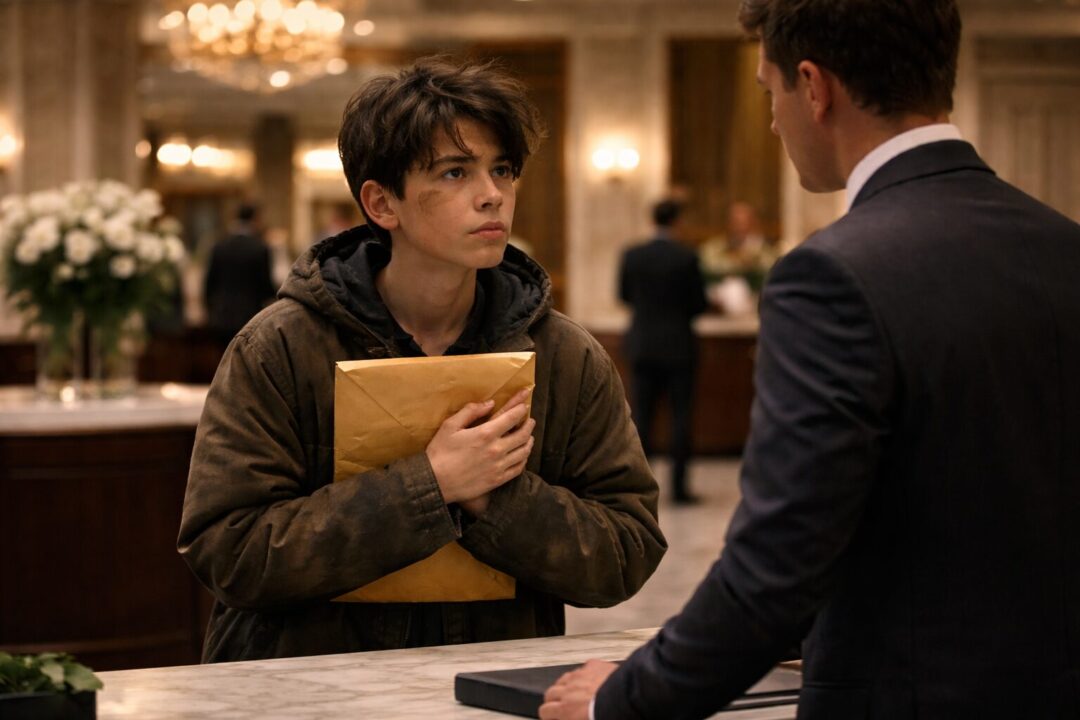
He could not have been more than thirteen. Thin. Slight. Dark hair falling messily across his forehead. One sleeve of his oversized jacket was blackened, as if it had brushed through smoke. There was soot on his cheek, dirt on his hands, and the kind of exhaustion in his posture that made him look as though he had been running for much longer than a child should ever have to run.
In both hands, he held a thick sealed envelope.
The lobby of the Marlowe Grand was full that night. A charity gala was unfolding upstairs, and the ground floor had the hushed gleam of power arranged to look effortless. Women in evening gowns crossed the marble like they had floated there. Men in tuxedos stood near the bar in low conversation. Bellmen moved with smooth, practiced precision. Every polished surface reflected a world where nothing truly ugly was supposed to appear.
And yet the boy had appeared.
Declan Shaw, front-desk manager for the evening shift, looked up from his terminal and felt something cold tighten in his chest. Not sympathy. Not concern. Something closer to alarm, sharpened by irritation.
The boy walked straight to the desk.
“I have to deliver this,” he said.
His voice was quiet, but not uncertain.
Declan let his gaze move once over the jacket, the dirty shoes, the streak of soot, and then back to the envelope. He had spent twelve years in luxury hospitality. He knew how to spot wealthy men trying to look ordinary, heirs trying to disappear into baseball caps, intoxicated politicians, desperate reporters, and strangers who mistook confidence for permission.
This boy looked like none of them.
“You can’t bring that in,” Declan said.
The child’s fingers tightened on the envelope. “I have to deliver it.”
Declan’s smile was immediate and bloodless, the kind he used when removing complications without making a scene. “Leave it here.”
“No.” The answer came quickly this time. “Not with you.”
That sharpened the silence around them.
Declan became aware of movement at the edges of the lobby—the pause of a bellman, the slight turn of a woman waiting for the elevator, the stillness of a doorman near the revolving entrance. Wealthy people were rarely loud about curiosity. They simply went quiet and let their attention become pressure.
The boy stood very still beneath it.
Rain hammered softly against the glass outside. The doors revolved again, letting in a strip of wet night air and a flash of headlights from the driveway. Somewhere upstairs, a burst of laughter drifted down and vanished into the gold-lit hush.
Declan folded his hands on the marble counter.
“This is private property,” he said in the calm voice he reserved for people he intended to remove. “You need to step away from the desk.”
The boy swallowed, but he didn’t move.
“Please,” he said. “Just one minute.”
Only then did Declan really look at his face.
There was fear there, yes. But not the fear of a child who had wandered into the wrong place and suddenly understood his mistake. This was something tighter, more desperate, more deliberate. The boy looked like someone trying to hold together the last thing he had been trusted with.
And yet Declan had already made his judgment. It had arrived too quickly to be corrected now, especially with eyes on him.
“You’re making a scene,” he said.
The lie of it hovered between them. The boy was barely speaking above a whisper. The scene existed because everyone in the lobby had decided he did not belong in it.
The boy glanced over his shoulder then, not at the guests, but at the doors. As if he was checking whether time had finally run out.
Then he looked back and said, with a steadiness that did not match his age, “Then call the owner.”
Something flickered through the guests nearest the desk. Not laughter. Something meaner. Amusement sharpened by class.
Declan felt it too, and it steadied him.
“Security is next,” he said.
The boy’s jaw tightened. For the first time, he looked less frightened than furious. Not with the tantrum of a child, but with the contained panic of someone watching a clock no one else could hear.
He lifted the envelope slightly against his chest.
“I was told to bring this by hand.”
“And I told you,” Declan replied, “to leave it here.”
Then he reached for it.
The boy jerked back as if Declan had gone for his throat.
“No!” The word cracked out of him raw and immediate, and several heads turned fully now. The sound seemed to startle even him. He took one step back from the desk, chest rising hard, eyes wild for the first time. “Don’t touch it.”
That changed the room.
Up until that moment, he had been a nuisance. A poor, dirty interruption at the polished edge of a wealthy evening. But panic gave the envelope gravity. Whatever sat inside it mattered enough to rip through the boy’s restraint.
Declan straightened, annoyed now at being challenged in public. “What exactly is in there?”
The boy said nothing.
Rain hissed against the windows. Somewhere beyond the doors, tires rolled slowly over the wet driveway. The doorman shifted his stance.
And then the black Rolls-Royce pulled into view.
Part II — The Arrival
The effect on the lobby was almost physical.
The doorman moved first, smoothing his jacket and stepping toward the entrance with sudden purpose. A bellman near the column set down the luggage cart he had been wheeling. Two guests who had been pretending not to stare at the boy drifted their attention toward the driveway with the elegant instinct of people who knew how proximity to power might benefit them.
Declan’s eyes flickered toward the glass. The car was impossible to mistake. Not because of the make—though that alone was enough—but because the Marlowe Grand had spent three days preparing for the woman inside it.
Maris Vale.
Investor. Board whisperer. The widow of a hotel magnate and the kind of patron whose displeasure could spread through an entire industry by breakfast. She was not scheduled to stay long that evening. She would arrive, attend the gala, speak to the committee chair, and leave. But the entire staff had been warned: no mistakes.
Declan turned back toward the boy and felt a fresh surge of irritation. Of all nights for this.
The revolving doors began to move.
The boy followed the sound with his eyes, but he did not run toward the entrance. He stayed exactly where he was, as if some internal law held him there. Mud darkened the edges of his sneakers. Rainwater had dried in streaks on his cuffs. Up close, Declan could see that the soot on his cheek was not decorative grime or street dirt. It looked finer than that. Ash, maybe. Smoke.
Where had he come from?
“Last chance,” Declan said quietly.
The boy drew in a breath. “Please.”
There was no drama in the word. Only exhaustion. Only urgency. It should have softened something in Declan. Instead, it irritated him more. Desperation made people unpredictable. Unpredictability was exactly what the Marlowe Grand was built to erase.
The doors opened wider.
Maris Vale entered without hurry.
She was in her early forties, elegant in a dark structured coat that looked almost severe against the hotel’s warm gold light. Her hair was pinned back simply. Diamonds, if she wore any, were too discreet to glitter. She moved the way truly powerful people often did—not performing importance, simply allowing the room to adapt around them.
Declan stepped out from behind the desk at once.
“Ms. Vale,” he began, his posture already adjusting into welcome.
She never looked at him.
Her gaze moved once across the lobby and landed on the envelope in the boy’s hands.
Everything in her face changed.
It was not dramatic. That was what made it devastating. A fraction of stillness. A tightening around the eyes. Recognition not just of an object, but of consequence.
She crossed the marble floor in a straight line.
Declan tried again. “Ms. Vale, I’m sorry, there’s been a—”
She passed him.
The boy looked suddenly smaller under the force of her attention, but he did not retreat. He held the envelope with both hands like something breakable and dangerous at once.
Maris stopped in front of him.
For a moment, the lobby became so quiet that the rain outside sounded close enough to touch.
“Where did you get that?” she asked.
The boy’s lips parted, but no answer came immediately. Up close, he seemed younger than before, the way frightened children always do. His face was pale under the soot. There was a scrape on one knuckle. His hair was damp. And beneath all of it sat the rigid discipline of someone obeying instructions he did not fully understand but had decided not to betray.
“I was told to run,” he said at last.
Not bring it. Not deliver it.
Run.
The word entered the room like a blade.
Maris’s eyes did not leave his face. “Who told you?”
The boy looked down at the envelope, then back at her. “Mr. Vale.”
Declan felt the ground of the evening tilt.
Julian Vale, Maris’s late husband, had been dead for almost a year.
No one spoke. The guests near the desk had the look of people who knew they were hearing something they had no right to hear and yet could not make themselves move away from it.
Declan found his voice first, though it came thinner than he intended.
“That’s impossible.”
Maris turned to him then.
Only her eyes moved, but the temperature of the room changed.
“Did I ask for your opinion, Mr. Shaw?”
He had never felt smaller in his perfectly tailored suit.
The boy held out the envelope with both hands.
Maris took it carefully, with the kind of attention people usually reserve for evidence or relics. The seal had been smeared by rain, but not broken. On the front, written in dark ink gone slightly feathered at the edges, were four words.
For Maris. Only Maris.
Her hand trembled.
It was almost imperceptible, and yet to Declan, standing too close, it felt more revealing than if she had collapsed.
“Who are you?” she asked the boy.
“Eli.”
“Your last name?”
He hesitated just long enough for the room to understand that names, too, could be dangerous things.
“Danner.”
Nothing changed visibly in Maris’s expression, but Declan saw the recognition land. Not complete—perhaps not yet—but enough.
“You came alone?”
Eli nodded.
“In this weather?”
Another nod.
She looked at the soot on his face then, at the blackened sleeve, the rawness in his eyes.
“What happened?”
He swallowed. “The garage caught fire.”
A murmur almost formed somewhere behind Declan and then died beneath Maris’s silence.
“Were you hurt?”
“No.”
It was the kind of answer children gave when they did not yet understand that surviving and being unharmed were not the same thing.
Maris looked toward the entrance, where her driver still waited beside the car in the rain, then back at the boy. She seemed to make several decisions at once.
“Come with me.”
Declan stepped forward before he understood he was doing it. “Ms. Vale, perhaps we should verify—”
This time she turned her whole body toward him.
The contempt in her face was almost polite, which made it worse.
“You nearly had security drag a child out of this lobby,” she said. “A child carrying something addressed to me.”
Declan opened his mouth, but she did not let him speak.
“You saw dirt and decided that was enough information.”
The words were not loud. They did not need to be. They spread cleanly through the silence, landing on every witness in the lobby.
Behind him, someone shifted. A guest looked away. The doorman stared fixedly at the rain beyond the glass, as if it had suddenly become the most fascinating thing in the city.
Maris turned back to Eli.
“Come,” she repeated, softer this time.
And Eli—dirty shoes, soot-streaked face, blackened sleeve, shaking hands—walked past the marble desk as the one person in the lobby no one could now afford to dismiss.
Part III — Ash and Ink
Maris did not take him upstairs to the gala.
She led him instead through a private corridor behind the main elevators, past a row of closed conference rooms and into a sitting suite reserved for private meetings. The room was smaller than the lobby but somehow more severe: dark wood paneling, old paintings, thick rugs that muted every step. A fire burned in the hearth. Someone had lit it before her arrival.
Only then, with the door closed, did Eli seem to allow himself to breathe.
He stood just inside the room, dripping rainwater onto the Persian carpet, unsure whether he was allowed to touch anything.
Maris removed her gloves slowly and set the envelope on a side table without opening it.
“Sit down,” she said.
“I’m fine.”
“You’re thirteen and covered in ash.”
He stayed standing.
Maris studied him for a long moment. Then, perhaps recognizing the uselessness of insisting, she crossed to a cabinet, poured water into a glass, and handed it to him. Eli took it in both hands and drank too fast, as if only now remembering thirst.
“When did you see my husband?” she asked.
Eli lowered the glass.
The fire crackled softly. Outside the tall windows, rain ribboned down the dark panes.
“This morning,” he said.
Maris went perfectly still.
“My husband died ten months ago.”
Eli looked at the floor. “I know what they said.”
It was such a child’s answer and yet not a childish one. Maris sat opposite him, every line of her body controlled.
“Then tell me the truth.”
He nodded once, as if he had expected the command.
And slowly, haltingly, the story came out.
Eli’s mother had worked as a cleaner years ago in one of Julian Vale’s old residential buildings on the south side, back before the name Vale had become synonymous with philanthropic galas and luxury acquisitions. Julian had noticed the boy once, Eli said, hiding in a stairwell after school with a library book he was too embarrassed to admit he’d borrowed because he was afraid of being asked to read aloud.
Julian had sat beside him on the concrete steps and asked what the book was about.
That had been the beginning.
Not of anything dramatic. Not adoption, not rescue, not secret inheritance. Something quieter. Julian had arranged scholarships under another name. Paid for tutoring. Left used books at the desk with notes tucked inside the covers. Checked in when he was in the neighborhood. He never did it in public. He never let it become a story about his generosity.
“He said people turn kindness into performance,” Eli said.
Maris closed her eyes briefly.
That sounded like Julian. Precisely like him.
“In the past year,” Eli continued, “he stopped coming himself. He sent things. Sometimes letters. Sometimes money for school. Once tickets to the science museum.” A tiny, disbelieving smile crossed his face and vanished. “He remembered I liked the planetarium.”
Maris felt something twist in her chest. Not jealousy. Something stranger. Grief discovering there had been rooms in the man she loved that she had never entered.
“This morning?” she asked again.
Eli’s fingers tightened around the glass. “A man came to our building. One of Mr. Vale’s old drivers. He knew my name. He said if anything ever happened—anything weird, anything bad—I was supposed to take the envelope from the storage locker and bring it straight to the Marlowe. Straight to you. No one else.”
Maris looked at the envelope on the table.
“What happened?”
“There was a fire in the garage behind our building.” Eli’s voice thinned. “I heard shouting outside. Then I saw the man who came for me yesterday. He told me to run before anyone saw me. He said not to let anybody take it.” Eli stared at the floor. “He pushed me out the side gate.”
The room seemed to narrow around the words.
“And the man?”
Eli did not answer.
Maris understood.
She looked at the sealed envelope for a long time before reaching for the letter opener on the desk. Her fingers were steadier now, though only because grief had hardened into focus.
Inside the envelope was a single handwritten letter and a key.
She read the first line and sat back as if struck.
Maris—
If this reaches you, then what I suspected has already begun.
She read the rest in silence. Once. Then again.
By the end, her face had gone white.
Eli watched her with the exhausted patience of someone who had spent the entire day carrying other people’s secrets and could no longer tell which truths belonged to him.
Maris folded the letter carefully.
“Your driver?” Eli asked. “The man outside?”
“Yes.”
“Can he be trusted?”
She looked at him then, fully, and something in her expression softened—not into comfort, exactly, but into respect.
“You asked the right question.”
Part IV — The Shape of a Man
By midnight, the police had been called—but not through hotel security. Maris made those arrangements herself.
By one in the morning, two lawyers were on their way.
By dawn, a safe-deposit box in Julian Vale’s name had been opened with the key Eli had carried through rain and smoke and the kind of casual contempt that can cut deeper than violence. Inside were copies of financial records, old partnership agreements, and one affidavit bearing Julian’s signature. Maris spent the early hours reading through documents that confirmed what the letter had only begun to suggest: Julian had discovered corruption in one of his own investment circles months before his death. He had hidden the proof in layers, trusting almost no one.
And for reasons Maris would spend years trying to understand, he had trusted one frightened, brilliant boy from a south-side building to become the final link in the chain if everything else failed.
By morning, the story of the lobby had already begun to travel through the hotel in muted fragments. A dirty child. An envelope. Maris Vale’s arrival. A front-desk manager put in his place. That was the version people would tell.
It was not the version Eli carried.
For him, the night would always remain physical: the smell of smoke in the alley behind the garage, the cold weight of the envelope under his jacket, the bright hate of the marble floor when he stepped into the lobby, the hand reaching for something that was never meant to be touched.
Before he left the suite that morning, Maris asked if he had family he could stay with.
“My aunt,” he said.
“And school?”
He gave a small shrug that meant more than words.
Maris looked at him a long time. In the daylight, he seemed older and younger at once. A child forced by circumstance into the posture of someone reliable.
“Julian saw something in you,” she said.
Eli stared at the window. “He saw me.”
It was the simplest sentence spoken in the room, and the one that stayed with her longest.
Weeks later, after statements were taken and records secured and names quietly began to surface in newspapers, Declan Shaw was no longer employed at the Marlowe Grand. Officially, it was a restructuring decision. Unofficially, there are mistakes luxury institutions will forgive, and mistakes that reveal the institution too clearly to ignore.
Maris never told Eli that part.
Some humiliations do not deserve to become a child’s burden.
Instead, she helped him return to school. Quietly. The way Julian had done things. Scholarships remained anonymous. Books arrived without ceremony. When Eli visited the planetarium that fall, the tickets appeared in his backpack inside an envelope with no signature.
He knew anyway.
Months later, on a cold evening with the city washed clean after rain, Eli stood once more in front of the Marlowe Grand. He had been invited this time. Properly. The doorman opened the glass door before he reached it.
The marble inside still shone. The chandeliers still cast their golden light. Wealth still moved through the lobby wrapped in silk and certainty.
But the room no longer seemed invincible to him.
He knew now how fragile power could be. How often it mistook polish for truth. How easily a person could be dismissed for the wrong shoes, the wrong address, the wrong amount of ash on a sleeve.
And he knew something else too.
Sometimes the most important thing in the room arrived looking like trouble.
Sometimes it came dirty, shaking, and out of breath.
Sometimes it stood at a marble desk and refused to let go.