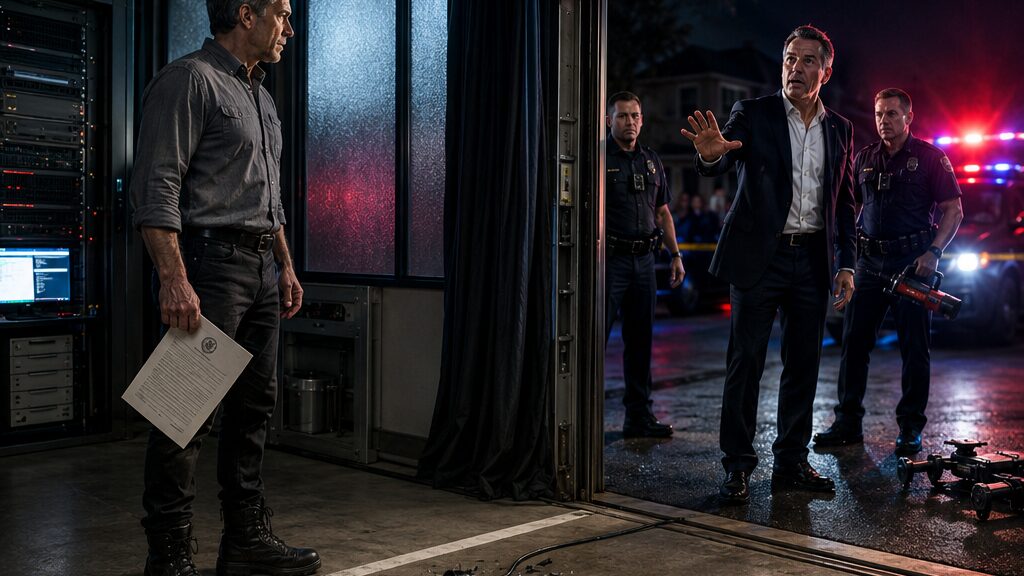
They Called His Locked Garage A Hostage Scene Until The Forbidden Line Broke Them
Chapter 1: The Curtains That Made The Street Call Police
“Can you confirm anyone has come out of that garage alive today, ma’am?”
Elizabeth Baker pressed the phone harder to her ear and looked across the street at the black curtains sealed behind the frosted glass. The dispatcher’s question made the ordinary evening tilt sideways. A lawn sprinkler ticked three houses down. A delivery van crept past and slowed, the driver staring at the wide gray garage with the cameras mounted under its eaves.
“I can’t,” Elizabeth said.
Her own voice sounded smaller than she wanted. She stood behind the lace curtain in her front room, one hand pinching the fabric, the other wrapped around her phone. Across the street, Patrick Torres’s property sat too still behind its locked iron gate. The house attached to the garage looked almost abandoned, but the garage itself was alive in ways that made people talk. A low vibration sometimes trembled through the pavement at night. Blue-white light leaked under the side door. The blackout curtains behind the frosted, bullet-resistant glass never opened.
The dispatcher asked, “Have you heard screaming?”
“No,” Elizabeth said. “Not screaming.”
“Threats?”
“No.”
“Do you see weapons?”
Elizabeth swallowed. “No. But I heard a crash earlier. Heavy. Like something hit the floor. And he’s been in there all day.”
There was a pause on the line. Across the street, one of Patrick’s cameras moved with a faint mechanical twitch. Elizabeth stepped back even though she knew it could not see through her wall.
The dispatcher’s voice stayed calm. “Who lives at the residence?”
“Patrick Torres. Alone, I think.”
“You think?”
“He doesn’t talk to anyone.”
That sounded accusing even to her, but she did not take it back. Nobody on the block really knew Patrick. They knew his garage doors were reinforced. They knew he had replaced ordinary windows with frosted glass thick enough to blur him into a shadow. They knew contractors had installed deadbolts heavy enough for a bank. They knew he came out only at odd hours, carrying sealed cases from his truck to the garage, wearing faded work shirts and dark trousers tucked over heavy boots.
Elizabeth had waved once, months ago. Patrick had looked at her, raised two fingers in a gesture too small to be friendly, and closed the gate before she could ask whether he needed help with the package at his feet.
Now the package, or something like it, was in her memory as proof.
“What kind of crash did you hear?” the dispatcher asked.
Elizabeth turned toward the window again. “Metal. Maybe furniture. Maybe someone falling.”
At the garage, the faint shadow of Patrick crossed behind the frosted glass.
Elizabeth froze.
He was there. Not moving much now. Just standing, legs apart, his boots visible as dark shapes under the curtain gap where the light inside hit the floor. The boots were the first clear thing she had seen all day. Heavy black combat-style boots. Planted. Waiting.
A shiver moved through her shoulder.
“Ma’am?” the dispatcher said.
“I see him.”
“Is he outside?”
“No. Inside the garage.”
“Is anyone with him?”
“I can’t tell. The curtains are shut. They’re always shut.”
Behind the glass, Patrick’s silhouette bent slightly over something waist-high. To Elizabeth, it looked like a table. Or a person. Or the kind of shape a frightened mind made when given shadow and silence.
Inside the garage, Patrick was not looking at a body.
He was looking at a terminal.
The room around him hummed with controlled heat. Server racks stood in two straight rows on rubber-isolated mounts, their indicator lights dimmed behind tinted covers. Locked steel cabinets lined the rear wall. Thick cables ran overhead in disciplined bundles, color-coded and labeled in his own handwriting. A bank of battery units sat behind a mesh panel with three independent cutoff switches. No network cable connected the project machine to the outside world. No wireless card. No cloud backup. No remote access. Nothing that could be reached, interrupted, scanned, or misunderstood by anyone who believed a locked door was an invitation.
On the main monitor, white text blinked over a progress bar.
FINAL OFFLINE BUILD: 87%
ESTIMATED TIME REMAINING: 01:46:12
Patrick checked the number, then the cameras.
Eight screens showed eight angles of his property. Gate. Driveway. Side fence. Garage apron. Street. Neighbor’s sidewalk. Rear wall. Threshold interior. On one screen, Elizabeth Baker stood behind her curtain across the street, phone at her ear.
Patrick watched her mouth move.
He did not turn on the intercom. He did not wave. He did not step outside and explain that the crash had been a dropped battery shield, that the curtains blocked glare from the build monitors, that the locks existed because he had learned what happened when people with uniforms decided curiosity was authority.
He watched Elizabeth watching him and let silence do what silence always did: protect him first, damage him second.
The terminal beeped once. He looked away from the screen and tightened a cable clamp that had vibrated loose when the shield fell earlier. The metal panel leaned against the workbench, dented on one corner. A harmless accident. A sound too heavy for a quiet street.
On camera six, Elizabeth’s front door opened.
She stepped onto her porch, still on the phone, staring at his gate like she expected someone to drag a chair against it from the inside. Two more neighbors emerged farther down. One held a dog leash. The dog pulled toward Patrick’s property and then stopped at the curb, uncertain.
Patrick exhaled through his nose.
“Don’t,” he said under his breath, though none of them could hear.
Outside, Elizabeth lowered her voice. “I don’t want to accuse him of something awful. I just don’t want to ignore it if somebody’s in there.”
The dispatcher asked another question. Elizabeth closed her eyes.
Then she said it.
“It could be a hostage situation.”
The moment the word left her mouth, the street changed. Not physically, not yet, but in the way a room changes after glass cracks. Elizabeth heard the dispatcher’s tone sharpen. She had not said there was a hostage. She had said could be. But could be was enough. Could be carried guilt if she stayed quiet. Could be explained why Patrick never opened the curtains. Could be made the crash mean something.
Patrick saw her lips form the word on the camera feed.
He did not need audio.
His hand went still over the keyboard.
On the monitor, the build climbed to 88%.
He moved to the garage’s inner side door and checked the deadbolt by habit. Then the lower bolt. Then the steel crossbar. Then the pressure contact on the main garage door. Not because he was afraid of Elizabeth. Not because there was anything illegal inside. Because once a frightened person gave a frightened word to a dispatcher, the street no longer belonged to ordinary sense.
A siren did not sound.
That made the first cruiser worse.
It rolled into view without warning, silent and official, black tires nudging the curb as it stopped short of Patrick’s locked gate. Its roof lights flashed red and blue across the frosted garage glass, turning the blackout curtains purple at the edges.
Elizabeth stepped backward on her porch, phone still pressed to her ear.
Patrick stood in the garage shadows, surrounded by humming machines and sealed cabinets, and watched the cruiser’s front camera point directly at his property line.
Behind him, the terminal refreshed.
FINAL OFFLINE BUILD: 89%
ESTIMATED TIME REMAINING: 01:38:44
Chapter 2: Just Open The Door For One Second
“Patrick, nobody wants this to become ugly again.”
Dennis Campbell smiled into the intercom camera like he was greeting an old friend through a doorbell on a holiday morning. The smile was wrong for the street. Wrong for the cruisers angled across both lanes. Wrong for the neighbors standing in small clusters under porch lights, whispering as if whispering made them less responsible for watching.
Inside the garage, Patrick stared at Dennis’s face on the monitor and felt the old scar under his ribs tighten.
Dennis had aged badly in the places that showed character. The suit jacket was neat, the hair trimmed, the jaw clean-shaven. But his eyes kept flicking toward the officers behind him, toward the neighbors, toward the bodycam on his own chest. Measuring the room he was performing for. Counting who could later say he had sounded reasonable.
Patrick pressed the intercom button. “Bring a warrant. Or leave.”
Dennis’s smile held. “That’s not how this has to go.”
“It’s the only way it goes.”
A patrol officer near the first cruiser shifted his weight. Another spoke softly into a shoulder radio. The gate between them remained shut, its black bars throwing long shadows over the concrete drive. A small engraved plate on the inside post read PRIVATE PROPERTY. NO ENTRY WITHOUT WARRANT. It was not large enough for theater. Patrick had made it large enough for evidence.
Dennis leaned closer to the intercom. “We received a serious call. Possible hostage situation. Welfare concern. You understand what that means, right?”
“I understand you don’t have a warrant.”
“Patrick.”
The way Dennis said his name made Elizabeth Baker flinch from across the street. She stood at the edge of her lawn now, wrapped in a cardigan, phone lowered. Her face had gone pale when the second cruiser arrived. By the third, people had stopped pretending they were checking mail or walking dogs. They were watching Patrick’s house with open fear.
Inside, Patrick watched all of them across eight screens.
The project terminal sat to his left.
FINAL OFFLINE BUILD: 91%
ESTIMATED TIME REMAINING: 01:21:03
Too slow.
He had planned for heat spikes, power dips, drive failure, battery rollover, memory corruption. He had not planned for a police negotiator turning his driveway into a stage.
Dennis lifted both hands at the intercom, palms out. “Look, I’m not here to jam you up. Just open the door for one second. Let us see nobody’s tied up in there, and everybody goes home.”
Patrick almost laughed.
One second. That was always the shape of it. One quick look. One harmless question. One step past the threshold. One officer just inside the door while another saw something he did not understand and called it suspicious. One second became a search, a seizure, a report full of careful verbs that never said mistake.
“No,” Patrick said.
Dennis tilted his head with practiced sadness. “You see how that sounds?”
“I hear how you’re trying to make it sound.”
Behind Dennis, a senior officer with tired eyes approached from the cruiser line. His name patch read Miller. Benjamin Miller, Patrick thought. He had seen him once in the footage from the previous case, standing near the rear of the scene, not participating much, not stopping anything either.
Benjamin spoke low enough that the intercom barely caught it. “Do we have a judge on this yet?”
Dennis kept his smile facing the camera, but his jaw tightened. “We’re working the scene, Miller.”
“That’s not what I asked.”
Dennis turned away from the intercom for the first time. “We have a potential hostage call and a resident refusing visual confirmation.”
“We have a resident refusing consent,” Benjamin said. “Different thing.”
The small exchange moved through Patrick like a draft under a door. Not relief. Never relief. But a shift. Someone outside knew the word consent still mattered.
Dennis stepped closer to Benjamin, lowering his voice. Patrick increased the gain on the exterior mic. Static hissed, then words emerged.
“Do not start splitting hairs in front of him,” Dennis said.
“I’m asking if there’s a warrant.”
“I said we’re working it.”
“You called tactical before legal?”
Dennis glanced sharply toward the intercom. Patrick knew he knew the mic might catch them. Dennis’s face rearranged itself back into concern. He turned to the garage.
“Patrick, you’re making my job harder.”
Patrick pressed the button. “Your job is not to enter my property without lawful authority.”
“My job is to make sure nobody is dying behind that glass.”
“Nobody is.”
“Then show me.”
“No.”
A murmur rolled across the neighbors. Patrick saw Elizabeth turn toward the sound, then back toward his garage. Her face held something worse than accusation now: doubt mixed with embarrassment, the first awareness that she had started something she could not control.
He could have helped her earlier. A sentence through the gate. A wave. A printed notice explaining work hours. He had done none of that. He had let the street create him from shadows.
The thought irritated him because it was not entirely unfair.
A tone chimed from the project terminal. Patrick turned.
A warning line had appeared beneath the progress bar.
THERMAL LOAD RISING — AUXILIARY COOLING RECOMMENDED
He crossed to the cooling panel and adjusted the manual intake. The garage answered with a deeper mechanical breath. On the exterior monitor, two officers looked up at the sound. One put a hand near his belt. Dennis noticed too.
“What was that?” Dennis called.
Patrick did not answer.
“Patrick, loud mechanical noise from inside the structure. Are you operating machinery?”
No answer.
“Are there other people in there with you?”
No answer.
Dennis let the silence stretch for the watching street. Then he turned halfway toward the neighbors, not speaking to them directly, but making sure they heard.
“This is exactly why we need eyes inside.”
Patrick’s hand tightened on the edge of the cooling panel.
On camera three, Elizabeth covered her mouth.
Benjamin Miller looked toward the garage, then toward Dennis. “We should pull people back and hold position until legal advises.”
Dennis’s expression hardened. “I’m not letting a possible hostage bleed out because you’re scared of paperwork.”
“That’s not what this is.”
“Then what is it?”
Benjamin did not answer fast enough.
Dennis used the pause. He raised his voice. “Set a wider perimeter. Bring two more units up. Nobody approaches the residence except on my command.”
The radios crackled. Engines moved. Another cruiser rolled into frame, then another, blocking both ends of the residential street. Red and blue light washed over Elizabeth’s windows, over the dog walker’s white fence, over the locked gate Patrick had built after men like Dennis taught him what ordinary locks were worth.
Patrick returned to the terminal.
FINAL OFFLINE BUILD: 93%
ESTIMATED TIME REMAINING: 01:07:16
Still moving. Still intact.
He opened the secure log and tagged the current video segment: NO WARRANT REQUESTED. CONSENT REFUSED. PERIMETER EXPANDED.
Outside, Dennis walked back to the command vehicle. He did not hurry. He wanted the walk seen. Wanted everyone to feel that patience had been offered and rejected.
At the rear of the vehicle, an officer lifted a long black tactical case from the cargo compartment and set it on the pavement.
The latches snapped open one by one.
Inside lay a compact police drone with folded arms, dark rotors, and a glassy thermal camera mounted beneath its nose like a second, colder eye.
Chapter 3: The Drone Above The Frosted Glass
The drone’s buzz vibrated against the bullet-resistant glass inches from Patrick’s face.
It hovered just outside the garage, close enough that its rotor wash trembled the edge of the blackout curtain. Through the frosted panel, it appeared as a dark mechanical blur with one bright lens pulsing beneath it. The sound filled the room differently than sirens. Sirens stayed outside. This pressed against the glass like an insect looking for a crack.
Patrick stood still until the range overlay stabilized on his monitor.
DISTANCE FROM PROPERTY LINE: 8.4 FEET INSIDE GATE
ALTITUDE: 6.1 FEET
DEVICE: UNAUTHORIZED AERIAL SURVEILLANCE
He saved the frame.
Outside, Dennis watched the drone feed on a tablet held by another officer. His face was lit from below, the fake softness gone now that the intercom was not in his hand.
“What are you seeing?” he asked.
The operator adjusted the controls. “Heat sources. Multiple.”
Dennis looked toward the garage. “How many?”
“Hard to say. Equipment heat. Maybe racks. Maybe people.”
“Maybe people,” Dennis repeated, louder.
Patrick heard it through the exterior mic and felt anger rise, clean and sharp. The garage was full of heat because machines produced heat. Battery units. Processors. Cooling lines. A lawful system doing lawful work behind a locked door. But on a screen in Dennis Campbell’s hand, heat became bodies if he wanted bodies. Silence became threat. Curtains became captivity.
Patrick turned from the glass and crossed to the surveillance wall.
Every camera feed had its own measuring grid. He had installed the system after the lawsuit, after a judge asked for distances and one officer claimed he “couldn’t recall exactly where everyone stood.” Patrick had made sure nobody would need to recall again. The gate camera measured from the curb. The driveway camera measured from the first hinge. The garage apron camera measured from the painted line at the base of the door.
He opened a folder labeled DISTANCE PROTOCOL and began exporting clips.
The secured phone in the steel tray buzzed once.
Not an incoming call. A reminder he had set months ago to replay one message whenever the exterior threat threshold was triggered.
Amy Ramirez’s voice filled the garage, calm, careful, recorded from a previous legal consultation.
“Patrick, if this department comes back, do not argue facts at the door. Do not explain the project. Do not invite them closer to clarify. Record distance, record commands, record whether federal presence is there. The injunction is strongest when the violation is clear. If you engage too early, they will claim consent, confusion, or emergency cooperation.”
The message clicked off.
Patrick stared at the phone.
Do not explain the project.
It was good advice. It had also turned him into the exact shape the neighborhood feared. A man behind curtains. A voice that said no. A property line with cameras instead of conversation.
The terminal chimed again.
FINAL OFFLINE BUILD: 95%
ESTIMATED TIME REMAINING: 00:48:32
THERMAL LOAD STABLE
He checked the build hash, then the auxiliary cooling. His hands were steady. That was one thing the last case had given him. Not peace. Not trust. But steadiness under intrusion. The body could learn that panic wasted time.
The drone rose, dipped, then slid sideways along the glass.
Patrick followed it on three screens. Its thermal lens angled downward, trying to peer through opacity with heat instead of sight. Its operator kept it just outside the garage wall but well inside the gate. Patrick marked the footage.
Outside, Elizabeth Baker stood behind the police tape now. She had not gone back inside. Her cardigan hung loose around her shoulders, and her hands kept knotting together at her waist. A neighbor whispered something to her. She shook her head once, almost angrily, then looked at Patrick’s garage as though willing it to open and absolve her.
Dennis noticed her.
He walked toward the tape line, tablet in hand. “Ma’am, you made the initial call?”
Elizabeth nodded.
“Did you say you heard a crash?”
“Yes.”
“And you’ve seen him moving inside but no one else come out?”
“I haven’t seen anyone else.”
Dennis softened his voice. “You did the right thing.”
Patrick watched her receive those words like a blanket placed over shaking shoulders. Her posture changed. Not much. Enough.
Dennis turned slightly so his bodycam caught both Elizabeth and the garage. “We have unexplained heat signatures inside. We have refusal to provide visual confirmation. We have a concerned neighbor reporting a heavy impact.”
Benjamin Miller stepped closer. “Dennis.”
Dennis did not look at him.
Benjamin lowered his voice, but Patrick’s microphones caught it. “Thermal through a structure like that is not confirmation of people. You know that.”
“It’s confirmation of concern.”
“That’s not a standard.”
“It is tonight.”
Benjamin looked toward the drone. “And how close is that thing?”
The operator hesitated.
Dennis snapped, “It’s not touching anything.”
“That wasn’t my question.”
Patrick leaned closer to the monitor.
There it was: the first real crack outside. Not help. Not courage exactly. But discomfort. Benjamin knew something about the line. Maybe not enough. Maybe too late. But his eyes kept moving to the gate hinges, the cameras, the engraved plate.
Dennis saw it too.
He walked away from Elizabeth and pulled Benjamin toward the command vehicle. Patrick increased the audio again.
“I need you steady,” Dennis said.
“I am steady.”
“You’re acting like he has some magic fence.”
Benjamin’s silence lasted half a second too long.
Dennis stared at him. “What?”
“I remember this address.”
“Everybody remembers this address.”
“No,” Benjamin said. “I remember the memo after the civil case.”
Dennis’s mouth tightened. “The memo said route contact through command. I am command.”
“It said legal review before approach.”
Dennis glanced toward the garage cameras. “Do you want that on your report? That you slowed a possible rescue because of old paperwork?”
Benjamin’s face flushed. He looked away first.
Dennis had found the weak place. Not stupidity. Fear. A man could know the right line and still step over it if someone made the cost of standing there feel personal.
Inside, Patrick tagged another clip: OFFICER REFERENCES CIVIL CASE. CAMPBELL DISMISSES.
The project terminal ticked upward.
96%.
The drone suddenly climbed above the garage door and angled toward the upper glass.
Patrick’s jaw locked.
The top panel reflected its own distortion back at itself: red-blue light, black rotors, the pale smear of neighbors across the street. The drone hovered there like a question Patrick had already answered.
He pressed the intercom. “Remove the drone from my property.”
Dennis looked toward the speaker, almost pleased. “Patrick, if you’re alone in there, this ends fast.”
“Remove it.”
“We are conducting a safety assessment.”
“You are conducting warrantless surveillance.”
“We’re trying to make sure nobody is being harmed.”
“No FBI present. No warrant. No entry.”
Dennis’s expression sharpened at the middle phrase.
There. Patrick saw it land.
No FBI present.
Dennis turned away too quickly, but not before the camera caught the flash of recognition.
Patrick saved that frame too.
For ten seconds, nobody spoke. The drone buzzed. The terminal hummed. Elizabeth watched from beyond the tape. Benjamin stood near the command vehicle with his hands on his belt and his conscience not yet large enough to move his feet.
Then the drone operator said, “Battery at thirty percent.”
Dennis looked at the garage door. The drone had not given him what he needed. It had given him heat, suspicion, and a recorded trespass if Patrick’s documents were what Dennis feared.
So Dennis changed tools.
“Bring me the flexible camera,” he said.
Benjamin’s head snapped toward him. “Dennis, don’t.”
Dennis’s voice stayed low, but every microphone Patrick owned caught it.
“We need eyes under that door.”
“You may already be too close.”
Dennis reached into the tactical case and pulled out a coiled black cable with a small lens at the end.
“Then I guess,” he said, “we find out how badly he wants to hide what’s inside.”
Chapter 4: The Old Lawsuit Under The New Sirens
Patrick unlocked the steel cabinet with the same key he used for nothing else in the garage.
The drawer did not contain a weapon. It contained paper.
The thick folder inside was sealed in clear plastic, squared at the corners, and heavy enough that it landed on the workbench with a muted slap. Red and blue light from the cruisers crawled over the plastic sleeve. For a second, the stamped federal seal on the top page flashed like an eye opening.
Patrick did not remove it yet.
Outside, Dennis’s voice carried through the speakers as he spoke to the officers near the command vehicle. “We’ve attempted contact. We’ve requested voluntary visual confirmation. Subject remains noncompliant.”
Subject.
Patrick’s hand rested on the folder.
That word had been in the first report too. Subject refused. Subject became agitated. Subject obstructed officers. Subject possessed unknown equipment. Subject’s property contained hazardous materials.
None of the sentences had said that the unknown equipment was labeled. None had said officers kicked open a side door after a neighbor reported “chemical fumes” that turned out to be coolant from an outdoor unit. None had said they stepped on exposed boards Patrick had laid out in order, cracked two storage drives, and left a cabinet open in the rain while they decided whether his battery backups looked suspicious.
The court had said enough of it.
Not all. Enough.
The injunction had taken eleven months, three depositions, two expert declarations, and more money than Patrick had ever admitted aloud. It had not made him whole. It had only drawn a line the department was supposed to recognize.
On screen, Dennis held the flexible camera coil and spoke with an officer whose shoulders blocked part of the bodycam view. Benjamin Miller stood nearby, not close enough to interfere, not far enough to pretend he was absent.
Patrick opened his secure phone and tapped Amy Ramirez’s contact.
No call. Not yet.
He opened the message thread instead. The last text from Amy was three months old.
If contact occurs, preserve distance evidence. Do not rely on verbal reminders alone. If they cross the restricted zone, document before disclosure.
Document before disclosure.
Patrick looked at the progress bar.
FINAL OFFLINE BUILD: 97%
ESTIMATED TIME REMAINING: 00:31:09
The software had reached the fragile part. Verification passes. Final assembly. Hash sealing. Any hard shutdown now could corrupt the local state and turn weeks of isolated work into a salvage operation. He had built redundancies, but not against a forced entry by men who thought every blinking light was a threat.
A heavy knock hit the gate.
Not the garage. The gate.
Patrick flinched anyway.
Dennis had returned to the intercom. The drone was back in its case, rotors still ticking as they cooled. He held nothing now, which made him look more reasonable for the cameras.
“Patrick,” he said, “we need to talk about what happens next.”
Patrick pressed the intercom. “You need to leave my property.”
“We’re not on your property.”
Patrick glanced at the grid overlay. “Several of you are eight feet inside the gate line.”
Dennis smiled faintly. “Your gate opens inward. The public-facing approach creates a practical access zone.”
Patrick felt a cold pressure behind his eyes. He had heard that kind of language before. Practical access. Safety sweep. Protective entry. Words that bent like wire.
“Do you have a warrant?” Patrick asked.
Dennis’s smile thinned. “Are you refusing to confirm no one is being held against their will?”
“I am refusing warrantless entry.”
“That wasn’t my question.”
“It’s my answer.”
Dennis stared into the camera. “You always do this.”
The words slipped out too fast. Not negotiator tone. Not bodycam tone. Real irritation.
Inside, Patrick went still.
Across the street, Elizabeth Baker had drifted closer to the tape line. She was near enough now that the exterior mic caught her asking an officer, “What does he mean, always?”
The officer did not answer.
Dennis heard her. He turned slightly, lowering his voice to another officer but not enough. “Prior incident. Same guy. Same kind of bunker nonsense.”
Elizabeth’s face changed.
Patrick saw it happen on camera five. Confusion first. Then embarrassment. Then something like suspicion turned in the other direction. She looked from Dennis to the garage and back again, realizing the police had come with a history she had not been told.
Benjamin stepped toward Dennis. “Careful.”
Dennis’s eyes cut to him. “You want to brief the whole block, Miller?”
“I want us to stop creating problems.”
“We have a locked structure, a possible hostage call, unexplained heat, and an occupant who has already shown hostility to lawful police contact.”
“Lawful is the part we need to be sure about.”
Dennis leaned in close enough that only Patrick’s microphones and Benjamin could hear. “You think he’s going to sue you personally if you stand there too long?”
Benjamin’s mouth tightened. He looked at the garage, and for a moment Patrick saw the shape of the man’s choice. Benjamin knew. Not everything, maybe, but enough. Enough to move. Enough to say no in a voice that would carry.
He did not.
He looked down at the pavement.
Patrick saved the clip.
The small payoff of being right did not warm him. It never had. Being right about cowardice only meant the world was built the way he feared.
He slid the plastic-wrapped folder to the edge of the workbench and broke the seal.
The top page was creased where his thumb had held it too often. The federal judge’s signature sat near the bottom in blue ink. The department name appeared in the first paragraph. The distance appeared in the second. Patrick did not need to read it. He knew the language the way he knew the location of every camera on his wall.
He lifted the folder, then stopped.
If he showed it now, Dennis would back up just enough to muddy the record. Claim confusion. Claim he had remained outside the restricted zone. Claim the drone did not count. Claim no device entered. Claim exigency never ripened because Patrick cooperated.
Amy’s voice echoed in memory.
The injunction is strongest when the violation is clear.
Patrick lowered the folder.
His own reflection stared back at him from the black monitor between camera feeds: tired eyes, graying hair, mouth set too hard. He saw the man Elizabeth saw. Not all of him, but enough to understand the mistake. He had become a locked shape behind glass and expected frightened people to respect the difference between privacy and danger.
He reached for the intercom.
For one dangerous second, he almost said, I am alone.
The words sat in his throat. Simple. True. Human.
Then Dennis spoke outside.
“Last warning before we treat this as an active rescue scene.”
Patrick’s hand left the button.
Dennis had made the choice for both of them.
He turned toward the street, projecting his voice with the practiced steadiness of a man giving everyone a chance to remember him as patient. “Patrick Torres, failure to cooperate with a welfare verification may force us to conduct a rescue entry. If there is anyone inside who can hear me, move away from the door.”
Elizabeth covered her mouth again.
A younger officer near the gate adjusted his gloves.
Benjamin said, “Dennis, do not say rescue entry unless—”
“Unless what?” Dennis snapped. “Unless we’re prepared to rescue someone?”
“There’s still no confirmation anyone else is inside.”
“Because he won’t give it.”
Dennis turned from him and pointed toward the tactical case.
“Camera under the door. Now.”
The officer carrying the snake camera knelt near the driveway, feeding the black cable out of its spool. The lens at the end was no larger than a coin, glossy and dark, with a ring of tiny lights around it. It dragged across the pavement in a slow curve, crossing red-blue reflections as it moved.
Patrick’s cameras caught every inch.
He opened a new recording marker and typed with two fingers.
DEVICE PREPARED FOR ENTRY. NO WARRANT DISPLAYED. FBI ABSENT.
Behind him, the project terminal updated.
FINAL OFFLINE BUILD: 98%
ESTIMATED TIME REMAINING: 00:19:27
Patrick picked up the injunction folder in his left hand.
With his right, he reached down and adjusted the lace of his heavy boot until it sat tight across his foot.
Outside, the snake camera’s black cable uncoiled across the driveway toward the bottom of the garage door.
Chapter 5: The Lens That Crossed The Line
The camera lens appeared under the garage door like a wet black eye looking into Patrick’s private room.
It came slowly at first, testing the gap beneath the weather seal. Tiny lights around the lens flickered against the sealed concrete floor. The cable flexed behind it in small pulses as the officer outside fed it forward.
Patrick did not move.
The lens nosed past the rubber strip and paused, half in shadow, half in the sterile light of the garage. It reflected the server racks, the steel cabinets, the bottom edge of the blackout curtains, and the toe of Patrick’s boot.
Outside, Dennis spoke loudly enough for the street to hear.
“We are attempting visual confirmation for safety. Patrick, do not interfere with emergency equipment.”
Patrick looked at the monitor wall.
Camera eight showed the interior threshold from above. The lens sat just inside the garage, but not yet past the painted yellow line Patrick had placed six inches beyond the door seal. He had painted that line himself after the injunction, not because the court required it, but because memory could be argued with. Paint could be photographed.
The lens crept forward.
Three inches.
Four.
The officer outside whispered, “We’re getting floor. Some kind of equipment. No persons visible.”
Dennis said, “Keep going.”
Benjamin’s voice cut in. “Stop there.”
The cable stopped.
For one second, the garage held its breath.
Patrick’s eyes went to the terminal.
FINAL OFFLINE BUILD: 99%
ESTIMATED TIME REMAINING: 00:11:02
The verification pass was running. The machine hummed with a higher pitch now, its cooling fans holding steady. On the rack nearest the door, amber status lights blinked in sequence. To a thermal drone, they might have looked like bodies. To a camera pushed under a door, they might look like secrets. To Patrick, they looked like work nobody outside had earned the right to interrupt.
Dennis’s shadow shifted beneath the door.
“Advance,” he said.
The lens crossed the yellow line.
Patrick waited one more heartbeat.
Not from hesitation. From discipline.
The overhead camera captured the lens fully past the mark. The timestamp burned in white at the lower corner. Camera two captured the officer’s gloved hands on the cable. Camera five captured Dennis pointing toward the door. Camera seven captured the gate line and the cruisers beyond it, all of them too close, all of them flashing authority over his concrete.
Only then did Patrick move.
His boot came down with the force of every swallowed explanation.
The crunch was small and enormous at once.
Glass popped under the sole. Plastic split. The tiny ring lights died in a burst of white sparks. The cable jerked like a nerve, but Patrick ground his heel down harder, twisting once until the lens became grit and black fragments smeared across the yellow line.
Static screamed from the officer’s receiver outside.
“Hey! He crushed it!”
Dennis’s voice exploded. “Patrick! Step away from the door!”
Patrick lifted his foot. Glass dust clung to the boot tread. A crescent of broken optics glittered on his side of the line.
He pressed the intercom.
“That was your warning.”
For the first time all evening, the street went completely silent.
Even the radios seemed to pause.
Then Dennis filled the silence with rage wrapped in procedure. “You just destroyed police equipment during an active emergency response.”
Patrick tagged the footage.
DEVICE CROSSED INTERIOR LINE. DEVICE DISABLED ON OWNER SIDE.
“Your equipment entered my property without a warrant,” Patrick said.
“You don’t get to decide what emergency responders can do during a hostage call.”
“There are no hostages.”
“Then you should have opened the door.”
Patrick almost answered. He almost said the thing that had been true from the beginning, the thing every neighbor wanted, the thing that would sound simple in a report after everything else had been made complicated.
I am alone.
But if he said it now, Dennis would use it as if it had been available all along, as if the illegal camera had extracted truth rather than crossed a line. Patrick had learned the order of things mattered. Consent after pressure was not consent. A fact forced through a violation was not cooperation.
So he said nothing.
Dennis turned toward the officers. “Breach team up.”
Benjamin stepped directly into his path. “No.”
The single word moved through the scene like a thrown object.
Dennis stared at him. “Excuse me?”
Benjamin’s face was pale, but his feet finally held. “We have no visible hostage. We have no warrant. The camera crossed into the structure. He disabled it after entry.”
“He destroyed department property.”
“Inside his garage.”
“During an emergency response.”
“Created by assumptions,” Benjamin said. “Not confirmation.”
Dennis’s jaw worked once. His eyes flicked toward the bodycams, the neighbors, Elizabeth at the tape line. He could not let Benjamin’s objection stand there in public. Not after the drone. Not after the camera. Not after Patrick had made him look like a man pressing his face against a locked window and calling it courage.
Dennis raised his voice. “Officer Miller, step back.”
Benjamin did not move.
Dennis pointed at the garage. “This subject has escalated from refusal to active destruction of police equipment. We have a reported possible hostage situation, unexplained heat signatures, mechanical noises, and now hostile action against a lawful safety device.”
Patrick watched the sentence assemble itself into a future report.
Subject escalated.
Hostile action.
Lawful safety device.
He opened another file window and pulled in the overhead clip of the lens crossing the yellow line. He placed it beside the gate-distance feed. His fingers moved fast now, no wasted motion, no tremor. The anger had left his hands and gone into sequence.
Outside, two officers approached the garage with a compact ram and pry tools. Not running. Not yet. But coming.
Elizabeth stepped under the police tape before an officer caught her arm.
“Wait,” she said. “I never said I saw anyone.”
Dennis ignored her.
“I only said I was worried,” Elizabeth said, louder. “I didn’t see a hostage.”
The words did not stop the officers, but they changed the street. Several neighbors looked at her. The dog walker stepped back from the curb. The watching crowd felt the first tug of shame, too late to undo the spectacle, early enough to make them afraid of what they had helped build.
Dennis turned on Elizabeth with the same soft voice he had used on Patrick. “Ma’am, you did the right thing. Please stay behind the line.”
“But if there isn’t—”
“We don’t know that because he refuses to cooperate.”
Patrick looked at Elizabeth on the monitor. Her face was wet now, whether from fear or embarrassment he could not tell. He felt no desire to comfort her. That bothered him less than it should have.
The terminal beeped sharply.
FINAL OFFLINE BUILD: 99%
HASH SEALING IN PROGRESS
DO NOT INTERRUPT POWER
A forced breach could trip everything. A stray impact could kill the cooling sequence. An officer stepping on the wrong cable could destroy what the police would later describe as “unidentified electronics.”
Patrick took the plastic-wrapped injunction folder from the workbench.
He moved to the center of the garage door, just behind the threshold, where the overhead light cut him into view if the door opened and kept him obscured if it did not. The crushed lens lay near his boot like a dead insect.
The officers outside set the ram near the side service door.
Benjamin put a hand out, but one of them moved around him.
“Last chance, Patrick!” Dennis shouted. “Open the door now!”
Patrick slid the first page from the plastic sleeve.
The paper was thick. The crease at the corner brushed his thumb. Federal ink, judge’s signature, department name, distance language. Not magic. Not rescue. A line he had paid for in money, sleep, and the humiliation of proving that men had stepped where they later denied standing.
He pressed the intercom one last time.
“Dennis.”
The negotiator turned toward the speaker.
Patrick’s voice was flat enough to cut through the sirens. “You should have brought the FBI.”
Dennis’s face changed before anyone else understood why.
Then he covered it with anger.
“Breach it.”
The officers lifted the ram.
Inside the garage, Patrick raised the massive signed injunction into the light.
Chapter 6: One Hundred Feet Without The FBI
“United States District Court,” Patrick read, his voice carrying through the intercom over Dennis’s breach command, “permanent injunction and order restricting warrantless approach, entry, surveillance, and contact by the named department within one hundred feet of the Torres property absent federal presence or signed judicial warrant.”
The ram did not swing.
It hung between two officers, chest-high, suddenly too heavy for the men holding it.
Dennis spun toward them. “I gave an order.”
Patrick kept reading. “The restriction applies specifically to welfare checks, hazard complaints, equipment-related calls, anonymous neighbor reports, and alleged emergency circumstances not supported by direct visual confirmation of imminent harm.”
Benjamin Miller stepped backward first.
It was only one step, but everyone saw it because his bodycam light moved with him. He looked down at his boots, then at the gate, then at the garage cameras mounted under the eaves. The calculation landed on his face in public.
He was inside the prohibited distance.
So were the others.
One by one, the officers nearest the door stopped looking at Patrick and began looking at the ground.
Dennis pointed at the paper. “That doesn’t override exigent circumstances.”
Patrick held the page higher. The federal seal caught the cruiser lights. “Read paragraph four.”
“I’m not litigating on a driveway.”
“You already are.”
Dennis took two steps toward the garage, then seemed to remember the distance and stopped. “You can wave paper around all night. We have a possible hostage call.”
“No,” Patrick said. “You have a neighbor who heard a sound. You have thermal equipment you misrepresented. You have a drone inside the gate. You have a camera lens crushed after it crossed my interior threshold. And you have no FBI.”
Elizabeth stood frozen behind the tape.
Benjamin turned to Dennis. “We need to back out.”
Dennis’s face flushed dark. “Nobody moves until I verify that document.”
Patrick tapped the monitor beside him and patched audio from his secured phone into the intercom. The call rang once, twice. The street listened to it ring. The sound was almost absurd, a small ordinary tone under the lights and tactical gear.
Amy Ramirez answered on the third ring.
“Patrick?”
“Recorded line,” he said. “Torres property. Local department on scene. No FBI present. They deployed a drone inside the gate, inserted a snake camera under the garage door, and have just ordered breach. I have read the injunction heading and paragraph four aloud.”
Amy did not swear. She did not gasp. Her caution was colder than panic.
“Are you physically safe?”
“For the moment.”
“Are they inside the structure?”
“Device only. Officers at the service door. Within one hundred feet.”
A pause. Paper shifted on Amy’s end, or maybe keys. “Do not open the door. Do not invite entry. State again that consent is refused.”
Patrick pressed the intercom button fully. “Consent is refused.”
The sentence rolled across the driveway.
Dennis looked at the officers, furious that they had heard it from someone else’s legal script.
Amy’s voice continued, audible through the speaker. “This is Amy Ramirez, federal liaison associated with enforcement of the Torres injunction. Any officer hearing this should preserve bodycam footage and withdraw beyond the restricted distance pending verification through federal channels.”
Dennis barked a humorless laugh. “Federal liaison? On a phone? That’s cute.”
Amy’s voice stayed level. “Commander Campbell, if that is you, your name appears in the compliance distribution from the prior matter.”
The street went quiet in a different way.
Not stunned. Listening.
Dennis’s mouth opened, then closed. His eyes flicked to his own bodycam.
Patrick saw the tiny movement and felt the power shift. Dennis was no longer performing for the neighbors. He was performing for the record.
“I am responding to a reported hostage emergency,” Dennis said carefully.
“Have you observed a hostage?” Amy asked.
Dennis did not answer.
“Has any person inside requested aid?”
No answer.
“Do you possess a signed warrant?”
Dennis lifted his chin. “We are in the process of securing legal authorization.”
“That means no,” Benjamin said.
Dennis turned on him. “Miller.”
Benjamin’s hands were open at his sides now. He backed another step away from the garage. “We need to clear the restricted zone.”
“You are undermining command.”
“I’m preserving the scene.”
The officer holding one end of the ram lowered it first. The other followed. Metal touched pavement with a dull sound that made Elizabeth flinch.
Dennis’s control cracked at the edges. “Pick that up.”
No one did.
Patrick felt no triumph. Only the hard, narrow focus of a man crossing a bridge that might still collapse. He placed the first page of the injunction against the inside of the frosted glass, text facing out, and turned on the narrow document light mounted above the threshold. The glass blurred his hand but not the bold heading. Cameras outside would catch enough. His own cameras would catch more.
Dennis stepped sideways, trying to read without moving closer. “This order was from a prior incident.”
“It says permanent,” Patrick said.
“Conditions change.”
“Paragraph four anticipated your excuse.”
Amy added, “The order was drafted in response to repeated claims of informal emergency access. False hazard calls and welfare checks are expressly included.”
Dennis’s lips pressed together.
Elizabeth whispered, “False hazard?”
Patrick saw her face on the monitor, the way she looked at the officers now instead of the garage. The story she had entered was changing under her feet. She had called because she was afraid of what might be hidden. She had not imagined there might be a document hidden too, one that made the police the ones standing where they should not.
Benjamin turned toward the nearest officers. “Back behind the tape. All of us. Now.”
Dennis rounded on him. “You do not give scene commands.”
Benjamin met his eyes. His voice was low, but it carried. “Then give the right one.”
For a second, Dennis seemed likely to fire him on the spot, or shove past him, or do something irreversible just to prove he could. Patrick could see the pressure inside him: bodycams, neighbors, prior lawsuit, broken camera, failed drone, the word FBI hanging over the street like a blade. Dennis had built the scene to make retreat look like weakness. Now the only lawful move was retreat.
That was why Patrick had waited.
Not because he was patient.
Because Dennis would rather be wrong with momentum than cautious in public.
A radio crackled from the command vehicle. An officer listened, then looked toward Dennis. “Dispatch says supervisor is asking if federal notification was made.”
Dennis closed his eyes for half a second.
There it was. The outside world entering the performance.
Amy’s voice came through again. “Patrick, confirm your project status and safety condition only if you choose.”
Patrick looked back at the terminal.
FINAL OFFLINE BUILD: 99%
FINAL PACKAGE COMMITTING
The screen’s white text reflected faintly on the sealed cabinet doors. Months of isolated work. No cloud. No outside server. No way to explain quickly to people who had arrived ready to misunderstand. His entire life, for the last year, had narrowed to making something that could run without trusting any network he did not control.
He pressed the intercom. “I am alone. I am uninjured. No one is restrained. No one is requesting aid. The equipment inside is lawful. You were told to bring a warrant or leave.”
Dennis seized on it. “He just confirmed after obstructing—”
“No,” Benjamin said. “He confirmed after we lowered the ram.”
That sentence mattered. Patrick saw several bodycams turn toward Benjamin. Saw Dennis realize it too.
Patrick added, “And after your camera crossed my threshold.”
He opened the overhead clip on the monitor facing the glass. The small display showed the lens sliding past the yellow line, then Patrick’s boot crushing it. He paused the playback on the frame before impact: the lens clearly inside, the yellow mark clearly beneath it.
Benjamin stared at the image.
“So it was inside,” he said.
Dennis did not look at him. “We are withdrawing to reassess.”
He made it sound like a choice.
The officers moved back, not quickly enough to look scared, not slowly enough to look confident. Boots retreated over concrete. The ram was carried away. The coil of cable dragged after them, ending in a ragged stump where the optics had been.
Dennis remained a few seconds longer than the others, as if those seconds preserved command.
Patrick held the injunction steady against the glass.
“Beyond one hundred feet,” Amy said through the speaker.
Dennis’s face tightened again, but he stepped back.
Then another step.
Then past the gate.
The red-blue lights still flashed, but something had gone out of them. They no longer filled Patrick’s garage like authority. They looked like warning lights on a machine that had overheated.
Inside, the terminal gave a single clean chime.
Patrick turned before he could stop himself.
The monitor refreshed.
PROJECT COMPLETE
FINAL BUILD VERIFIED
OFFLINE PACKAGE SEALED
For the first time all night, his hand loosened around the injunction.
Outside, Dennis saw the light change on Patrick’s face and looked past him toward the glowing terminal, unable to read the details through the frosted glass, able only to see that something inside had finished without him.
Chapter 7: The Project Finished While They Watched
Dennis was ordered back while the crushed camera lens still glittered under Patrick’s boot.
The order came through his radio, sharp enough that even Patrick’s exterior microphones caught the change in tone. Not a request. Not a suggestion. A supervisor’s voice cutting through the night and asking why federal restrictions had not been confirmed before tactical equipment was deployed.
Dennis turned away from the garage as if privacy could still save him.
It did not. His bodycam was on. So were the others. So were Patrick’s cameras, mounted under the eaves, measuring every retreating footstep until the officers crossed back behind the tape and stood on the public side of the line they should never have crossed.
The street remained blocked, but its shape had changed. Cruisers no longer looked like a wall closing around Patrick’s garage. They looked like vehicles parked too close to a mistake.
Patrick did not open the door.
He stood just inside it, the injunction still in one hand, the broken optics near his boot, the terminal glowing behind him.
PROJECT COMPLETE
FINAL BUILD VERIFIED
OFFLINE PACKAGE SEALED
The words should have given him relief. For months, he had worked toward that line of text with the narrow devotion of a man building a bridge alone. The final package had to be created offline, sealed locally, and verified without any outside network touching it. One corrupted pass, one forced shutdown, one officer stepping on the wrong cable and calling it clutter, and the whole build would have become a damaged thing he had to explain to people who already thought hidden work was suspicious.
It had finished.
The world outside had not touched it.
Patrick expected satisfaction to arrive like a clean breath.
Instead, he felt the weight of every camera still watching.
“Patrick,” Amy Ramirez said through the secured phone, her voice quieter now. “Confirm for me that the officers have withdrawn beyond the restricted distance.”
Patrick looked at the grid overlays. One by one, the red markers turned amber, then green as the bodies moved back.
“Most of them,” he said.
“Most?”
“Dennis is at ninety-four feet.”
Outside, Dennis stood near the front bumper of a cruiser, arguing into his radio with one hand pressed to his earpiece. He had backed away from the garage, but not enough. Whether by anger or instinct, he still wanted a few feet that did not belong to him.
Amy’s voice hardened. “Commander Campbell, if you can hear this, continue withdrawing.”
Dennis looked toward the garage. His mouth tightened. He took six slow steps backward.
Patrick watched the overlay turn green.
“One hundred point eight,” Patrick said.
“Good,” Amy replied. “Keep recording. Federal review will follow.”
Federal review.
The phrase should have sounded like consequence. It sounded like paperwork. Depositions. Statements. Men explaining what they meant instead of what they did. A broken camera would be invoiced. A violated line would become paragraphs. Dennis would not look afraid forever. People like him rarely did. They learned new language.
Patrick set the injunction on the workbench but kept it open.
Outside, Benjamin Miller approached the tape from the public side and stopped there. He did not lean over it. He did not call through the gate like a friend. His hands were visible, his shoulders drawn tight under his uniform.
“Mr. Torres,” he said.
Patrick did not answer immediately.
Benjamin glanced at the garage cameras. “I’m not asking to come closer.”
Patrick pressed the intercom. “Then speak from there.”
Benjamin accepted the rebuke with a small nod. “The scene is being held pending outside review. No one is entering your property tonight.”
“Your commander already ordered it.”
“I know.”
“Do you?”
Benjamin looked down once, then back up. “Too late, yes.”
That answer was not enough. It was more than Patrick expected.
For a few seconds, neither man spoke. The street noise filled the gap: radios lowered to murmurs, neighbors shifting on lawns, the mechanical tick of cooling cruiser engines. Behind Patrick, the server racks settled into their post-build hum.
Benjamin said, “I should have stopped it sooner.”
Patrick almost said yes.
He almost said it with the full weight it deserved. Yes, when the drone crossed the gate. Yes, when Dennis deflected the warrant question. Yes, when the cable uncoiled. Yes, when silence was still cheaper than courage.
Instead he said, “Then remember what sooner feels like.”
Benjamin absorbed that. His face moved slightly, not toward anger, not toward relief. Toward shame with nowhere to put itself.
“I will preserve my footage,” he said.
“You will be ordered not to.”
“I know.”
This time, Patrick believed he did.
A movement across the street drew his eye. Elizabeth Baker had stepped away from the cluster of neighbors. She stood alone near her mailbox, cardigan sleeves pulled over her hands. An officer tried to guide her back from the tape, but she shook her head and said something Patrick could not hear. The officer let her stand.
She looked smaller than she had from behind her curtain.
Patrick did not want to speak to her.
That was the honest thing. He did not want her apology, if she had one. He did not want her tears. He did not want to make her feel better about the word she had given the dispatcher. Hostage. A word that had moved men with drones and cameras toward his door. A word that turned his work, his locks, his silence, his boots, his curtains into evidence in the court of a frightened street.
Amy’s voice returned. “Patrick, are you still there?”
“Yes.”
“You do not have to engage anyone else tonight.”
He looked at Elizabeth on the screen.
That permission tempted him more than the police had.
He could close the door, seal the garage, archive the footage, and let lawyers turn the rest into controlled language. That was what he knew how to do. That was how he had survived the first time: document, refuse, endure, never offer more than the law required.
But the street would keep the shape it had made of him unless he chose one small opening.
Not entry.
Not trust.
Opening.
Patrick pressed the control that raised the main garage door six inches.
The motor groaned softly. Every officer’s head turned. Dennis’s did too, sharp and hungry for a mistake, but the door stopped low, leaving the deadbolt bar engaged and the interior shield locked. A strip of light spilled across the threshold, catching the crushed glass dust on the yellow line.
Patrick’s boots stood behind it.
Nothing else was visible except the lower edge of the server racks and the glow of the terminal reflected on the polished concrete.
Elizabeth took one step closer, then stopped herself.
Patrick pressed the intercom. “Mrs. Baker.”
Her hand flew to her throat.
“I never saw anyone,” she said quickly, voice breaking. “I need to say that. I never saw anyone tied up. I never saw anyone hurt. I heard the sound, and I saw the curtains, and I thought—”
“You decided,” Patrick said.
She flinched.
The words had no volume behind them. That made them worse.
Elizabeth wiped at one cheek with the heel of her hand. “Yes.”
A neighbor behind her shifted uncomfortably. Someone else looked away.
“I was scared,” she said.
Patrick looked at the fallen battery shield leaning against the workbench. The dented corner. The harmless metal crash that had become a siren line.
“Of what you saw?” he asked. “Or what you couldn’t see?”
Elizabeth’s lips parted, but no answer came.
That was answer enough.
Patrick could have stopped there. The cruel part of him wanted to. The wounded part wanted to leave her standing under the porch lights with her own imagination in her hands. But the terminal behind him still glowed PROJECT COMPLETE, and its quiet success made his silence feel different now. Not protection. Habit.
He reached down, picked up the dented battery shield, and held it low enough for the gap beneath the door to show only its bottom edge as it scraped once against the concrete.
“This fell,” he said. “That was your crash.”
Elizabeth stared at the strip of metal visible beneath the door.
“I didn’t know,” she whispered.
“No.”
“I’m sorry.”
Patrick did not answer.
The apology sat there between the garage and the street, unable to cross the line on its own.
Amy spoke softly through the phone, not over the intercom now. “That was enough, Patrick.”
Maybe it was. Maybe it was more than enough. He set the battery shield aside and looked at the completed build.
The project had succeeded because it had been sealed away from interference. His life had begun to imitate the system: offline, air-gapped, resistant to intrusion, safe only when unreachable. Tonight had proved the value of that. It had also proved the cost.
Dennis was near the command vehicle now, surrounded by officers who no longer looked at him for certainty. He caught Patrick watching and looked away first. Not defeated forever. Men like Dennis rarely ended in one night. But recorded. Checked. Forced behind the line.
Benjamin spoke again from the tape. “Mr. Torres, federal contact is requesting we keep the scene frozen until outside units arrive. We’ll be moving the vehicles back from the gate.”
Patrick said, “Do that.”
Benjamin nodded, then hesitated. “Your equipment. The project. It wasn’t harmed?”
Patrick looked at the terminal.
“No.”
The word surprised him. Not because it was untrue. Because he had given it freely.
Benjamin nodded again, more slowly this time. “Good.”
It was not forgiveness. It was not friendship. It was a small, inadequate word placed carefully at the edge of damage.
Patrick let it remain there.
The cruisers began to move back one by one. Their tires rolled over the red-blue reflections they had cast on the pavement. Neighbors retreated in clusters, quieter than they had gathered. Elizabeth stayed until the tape came down, then folded her arms tightly and walked back across the street without looking away from the garage until her porch steps forced her to.
Patrick lowered the door another inch, then stopped.
Not closed. Not open.
Half-closed was too generous a phrase for a six-inch gap under a locked reinforced door, but it was more than there had been before. Light remained visible from the street. The yellow boundary line remained visible from inside. The crushed lens remained exactly where it had died, a small glittering warning at the place outside authority had mistaken privacy for guilt.
He saved the final footage segment and labeled it with the time.
Then he turned off the intercom but left the property line camera running.
On the monitor, the street slowly emptied. Dennis’s cruiser reversed beyond the measured zone. Benjamin stood by the tape until the last officer stepped back. Elizabeth’s porch light stayed on across the street.
Patrick picked up the injunction, folded it along its old crease, and placed it beside the completed offline package.
For once, he did not lock the folder away immediately.
He stood in the hum of the garage, between the sealed project and the narrow line of light under the door, and let both remain visible.
The story has ended.