The Man Behind the Mask
The Man Behind the Mask
Part I — The Seat Beside Her
Tessa had barely lowered herself into the aisle seat when she felt the first wave of dread.
It had nothing to do with flying. She had been uncomfortable for weeks now, her lower back aching, her ankles swelling by late afternoon, her body no longer belonging entirely to her. At eight months pregnant, even a short flight felt like a negotiation with pain. What unsettled her was the man sitting beside her.
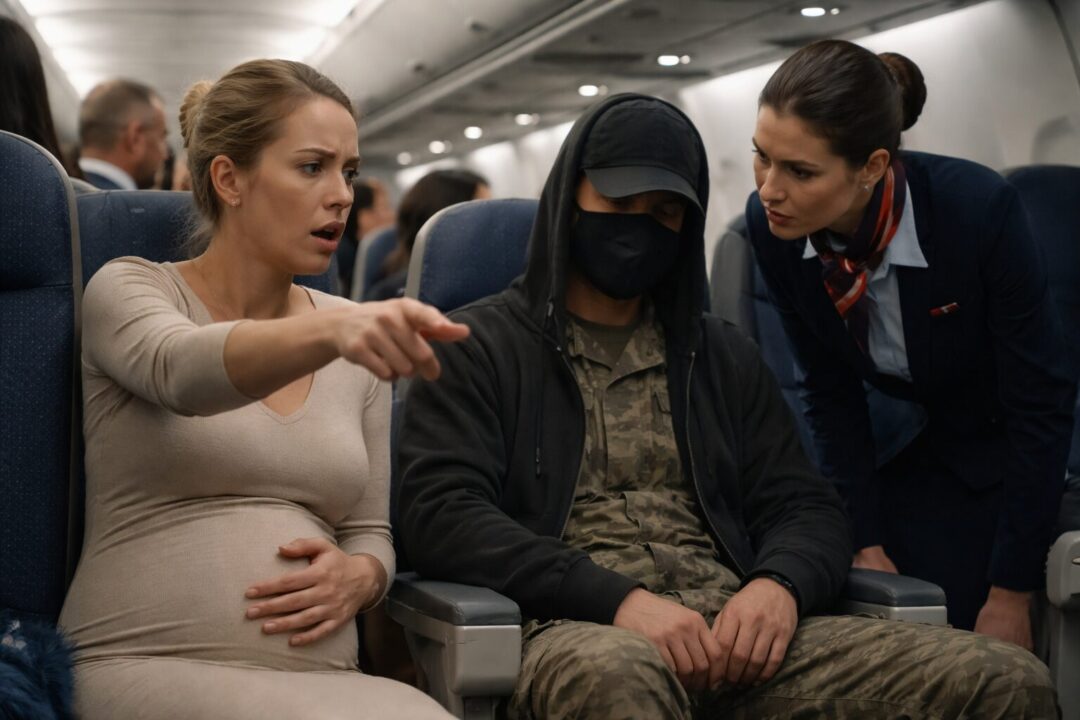
He wore a military uniform beneath a dark hoodie, as if he had dressed in a hurry and then tried to hide inside it. A baseball cap shadowed his face. A surgical mask covered the rest. His duffel bag sat by his boots, one hand resting on it like it contained something fragile or important. He had not said a word since taking his seat.
At first, Tessa told herself she was just tired. The cabin was crowded, the overhead bins were slamming shut, and people kept brushing past her shoulder in the narrow aisle. But the man beside her leaned slightly closer every few seconds, as if he wanted to speak and kept stopping himself. Once, his sleeve brushed the edge of her arm.
That was enough.
“I want another seat,” she said sharply, before the plane had even finished boarding. “Now.”
A few heads turned.
The man beside her did not move. He did not apologize. He did not even look at her fully, just kept his chin lowered beneath the brim of his cap.
Tessa’s chest tightened. The baby had been kicking all morning, and now her pulse began to drum under her skin. It wasn’t only fear. It was the humiliation of being trapped next to someone who made her uneasy while everyone around her pretended not to notice.
A flight attendant appeared almost immediately, her smile trained and calm, though her eyes sharpened when she took in the scene. “Ma’am,” she said gently, crouching beside the row, “what happened?”
Tessa did not bother lowering her voice. “He won’t show me his face. He keeps leaning toward me. I’m not staying here.”
The flight attendant turned to the man. “Sir?”
No response.
Tessa stared at him, anger rising now in defense of the fear. “See?”
The attendant tried again, a little firmer. “Sir, I need you to respond.”
Still nothing.
The people in the nearby rows had gone silent in the way strangers do when something private becomes public and no one wants to miss the ending. Tessa could feel them listening. Her face burned.
She had not always been this quick to react. Before the pregnancy, before long nights alone in a too-quiet apartment, before doctor visits and nursery boxes and the constant strain of waiting, she had been the sort of woman who second-guessed herself. Who made excuses for discomfort. Who laughed things off to avoid seeming difficult.
But loneliness had changed her.
So had worry.
Her husband had been away for seven months, deployed overseas with no certainty about when he would make it home. His calls had been brief and unpredictable. His messages came in bursts and then vanished for days. He had not been there for the scan where they first heard the heartbeat. He had not been there when she cried in the parking lot after finding out the baby was breech and then not breech and then fine after all. He had not been there when she painted one wall of the nursery and had to sit down on the floor halfway through because the room felt too empty.
She loved him. She missed him. Sometimes she resented him for being gone.
And today, all she wanted was to make it safely to her mother’s house for the final weeks before the baby came.
Instead, she was stuck beside a silent stranger in uniform who seemed to be hiding from the world.
“I said I want another seat,” Tessa repeated, one hand flattening protectively over the curve of her belly.
The flight attendant straightened. Her tone cooled into procedure. “Sir, if there’s an issue, I need to understand it now.”
The man finally lifted his head a fraction.
Tessa tensed.
Then, without answering, he rose.
The movement was sudden enough that both women recoiled. In the narrow aisle, his height felt imposing. The flight attendant stepped back. Tessa pressed herself against the armrest, heart kicking hard against the baby’s steady weight.
He did not step toward her.
Instead, he reached up and opened the overhead bin.
For one absurd second, Tessa thought he might be grabbing his bag to leave.
Then he pulled down a bouquet of red roses.
The entire row seemed to stop breathing.
Part II — A Face She Knew
The roses looked impossibly bright against the gray-blue cabin, like something from another world entirely.
Tessa stared at them, uncomprehending.
The man turned back toward her, bouquet in one hand. With the other, he tugged down the mask and pushed back the brim of his cap.
Recognition did not strike like lightning. It came in fragments.
The line of his mouth.
The faint scar near his eyebrow.
The tiredness in his eyes.
Then the full impossible truth landed all at once.
“Rowan?”
His name broke out of her as little more than a whisper.
He smiled then, small and nervous and unmistakably real. “Hi.”
Every emotion in her seemed to collide at once so violently she could not sort them. Relief hit first, so fierce it was almost pain. Then disbelief. Then anger, sharp as a blade. Then something dangerously close to joy.
The flight attendant looked between them, understanding blooming on her face with almost comical speed. Around them, the silent passengers shifted, a collective audience realizing the story had changed genres.
“You—” Tessa couldn’t finish.
Rowan stood there in the aisle, broad-shouldered and awkward, roses trembling slightly in his grip. He looked thinner than when she had last seen him in person. More worn. Older in a way only absence could make someone older. But it was him. It was truly him.
He glanced at the flight attendant, then back at Tessa, like a man who had rehearsed a hundred versions of this moment and forgotten all of them at once.
“I came home early,” he said.
Tessa’s throat closed.
That was all it took. Not a speech. Not an apology, not yet. Just those four words.
She had imagined his return so many times that the real thing felt almost cruel in its unreality. Sometimes she pictured seeing him at the front door. Sometimes in the hospital room after the baby was born. Never like this, trapped thirty thousand feet below the beginning of a flight she no longer cared about, with strangers listening to the sound of her life tilting under her.
The bouquet was wrapped in white paper, but something peeked from between the stems. Rowan noticed her eyes go to it and gently drew it free.
A hospital bracelet.
Not hers. His.
The one she had mailed him after their first appointment, on the day she learned she was pregnant. She had tucked it into a letter because she wanted him to have something real, something that had touched the same day she had whispered to an ultrasound screen that she wished he were there.
He had kept it.
Not in a drawer. Not folded into a box somewhere. He had carried it back to her.
Tessa’s anger flared brighter for a second precisely because the gesture hurt so much. Because it was tender. Because it was him. Because he had frightened her before turning her whole body to water.
“You scared me,” she said, her voice shaking now.
Rowan nodded immediately. “I know.”
No defense. No smile trying to smooth it over. Just that.
And because he admitted it so quickly, because his eyes looked equal parts hopeful and ashamed, she felt tears rise before she could stop them.
The flight attendant, who had become an unwilling witness to the most intimate moment of Tessa’s year, cleared her throat softly. “I’ll give you two some space.”
She stepped back, moving down the aisle with tactful speed, though not before giving Rowan a look that clearly said he had nearly caused a midair international incident.
A quiet, shaky laugh escaped Tessa despite herself.
That laugh seemed to undo Rowan more than her tears had. He exhaled for the first time like a man emerging from deep water and lowered himself awkwardly onto one knee in the aisle, making himself smaller, less threatening, less like the stranger she had believed him to be.
“I didn’t want to miss this,” he said.
The words were simple, but Tessa knew what sat behind them.
The missed appointments.
The half-heard phone calls through static.
The nights he had asked her what color they should paint the nursery and pretended the connection wasn’t breaking when it was.
The fact that he had been there for none of it and had probably hated that as much as she had.
He held out the roses. Tessa took them automatically, her fingers unsteady around the stems. The perfume reached her a second later, soft and lush and heartbreakingly alive.
For a moment neither of them spoke.
Then, because there was no graceful way through what she felt, Tessa leaned forward and hit him once in the chest with the back of her hand.
Not hard. Not enough to hurt. Just enough to make a point.
His mouth fell open.
“You idiot,” she whispered, tears spilling freely now. “You absolute idiot.”
A few of the passengers nearby smiled into their phones or their laps, relieved to finally understand they had permission to feel something other than concern.
Rowan gave a helpless little laugh. “That seems fair.”
It should have been easy then. A neat reunion. A softened face, a kiss, applause from strangers. That was the version short videos sold to the world.
Real life was harder.
Tessa was too overwhelmed to be instantly graceful. Her body still remembered the fear from seconds earlier. Her heart was racing for two different reasons. Love had arrived tangled with humiliation, with the sting of being seen at her most defensive, with the ache of all the months he had missed.
So instead of throwing herself into his arms, she looked down at the bracelet in his hand and cried harder.
Rowan’s expression changed. The nerves went out of it. The performance vanished. What remained was simply a man who had been away too long, seeing the cost of his absence written across the face of the woman he loved.
“I’m sorry,” he said quietly. “For the scare. For all of it.”
Tessa believed him.
That was the dangerous part.
Part III — What the Surprise Couldn’t Hide
The flight eventually took off, though Tessa would barely remember the first hour in any sensible order.
By then Rowan had taken the seat beside her properly, mask gone, cap off, hoodie unzipped. The disguise had been embarrassingly simple in hindsight. A ridiculous plan designed by a man who knew too much about logistics and too little about what pregnancy had done to her nerves.
She kept the roses on her lap for most of the climb. The hospital bracelet remained looped around her fingers.
“You really thought I wouldn’t panic?” she asked once the seatbelt sign went off.
Rowan winced. “I thought you’d recognize me sooner.”
She turned to look at him fully. “You hid your face.”
“I know.”
“You didn’t say a word.”
“I know.”
“You sat there like a serial killer on commercial leave.”
That startled a laugh out of him, abrupt and honest. “Okay,” he said. “That one might be true.”
Tessa tried not to smile and failed.
The tension loosened slowly after that, not because the fear had been unreal, but because he did not ask her to pretend it had been. He accepted every accusation she gave him. He let her say she had been angry he missed the doctor’s appointment last month. He let her say she hated making decisions alone. He let her tell him about the crib she built with a neighbor because she was too stubborn to wait for help.
He listened the way people do when they understand they have forfeited the right to interrupt.
Then he told her what he could.
That he had spent weeks trying to get home early.
That the paperwork changed every few days.
That he had landed only hours earlier and worked with the airline to book the same flight once he found out she was traveling to her mother’s before the due date.
That the flowers had been bought in a rush at the airport.
That the bracelet had stayed in his duffel through heat, dust, long nights, and too many false ideas of when home would begin.
By the time the drink cart came through, the edges of public spectacle had faded. Around them, strangers returned to their headphones and books and private boredom. The row was no longer a stage.
It was just a marriage again. Not healed all at once. Not magically simple. But physically side by side for the first time in months.
At one point, Tessa reached for the call button, and Rowan did it for her without thinking. The small familiarity of that movement nearly broke her more than the roses had.
Later, when the cabin dimmed, he placed a tentative hand over hers on the armrest. He waited, giving her time to refuse. When she turned her palm upward instead and threaded her fingers through his, he closed his eyes briefly like a man receiving absolution he had not expected to earn so quickly.
“I missed everything,” he said into the quiet.
She looked at their hands.
“You missed a lot,” she corrected.
It was not cruelty. It was truth.
He nodded. “Then tell me all of it.”
So she did.
Not every detail. There were too many details to fit inside one flight. But enough. The strange cravings. The night she thought the baby had stopped moving and spent an hour terrified before feeling the strongest kick yet. The old woman at the grocery store who touched her stomach without asking. The nursery wall she had painted twice because the first color felt wrong. The little sweater her mother bought too early. The way fear and love had started to feel like neighboring rooms.
Rowan listened to every word.
When she finished, he rested his forehead lightly against her shoulder and said nothing for a long time.
The reunion on the plane would be the part everyone else remembered if they ever told the story. The accusation. The mask. The roses. The reveal.
But that wasn’t what Tessa would carry most vividly years later.
It would be this quieter part.
The aftermath.
The moment after spectacle, when a person had to prove that love was not just surprise, not just timing, not just a grand entrance arranged around flowers and a hidden face. Love was staying in the hard conversation once the audience looked away.
By the time they landed, Tessa was exhausted in a different way. Not hollowed out by anxiety, but wrung through with feeling.
At the gate, Rowan stood first and reached for her bag. Then he hesitated, as if unsure whether he had fully returned to the role of husband or was still asking permission to come home.
Tessa saw the hesitation and understood it instantly.
She rose carefully, one hand on the armrest, the other on her belly. He moved toward her out of reflex, ready to help. This time she let him.
When she was standing, she looked at him for a long moment.
“You really are here,” she said.
“I really am.”
The words settled between them with more weight than any vow.
In the aisle, passengers were already crowding forward, impatient to leave. Beyond the windows, ground crews moved through the evening light. The ordinary world had resumed, indifferent to everything that had just happened.
Tessa held the roses against her chest.
Then she took his hand and placed it over the round curve of her stomach.
Right on cue, the baby kicked.
Rowan froze.
His whole face changed.
All the fatigue, all the worry, all the careful restraint he had been holding together since the reveal broke open into wonder. His eyes filled before he could hide it.
Tessa felt her own tears return, gentler this time.
“There,” she said softly. “Now you didn’t miss everything.”
He looked at her like he might never recover from loving her.
Around them the line moved, impatient and shuffling, but for one suspended moment the world narrowed to the warmth of his hand, the shift beneath her skin, and the certainty that even imperfect homecomings could still be holy.
He bent and kissed her forehead.
This time, when she leaned into him, there was no fear left in the gesture—only the ache of what had been lost, the fragile relief of what had been found again, and the quiet knowledge that love was sometimes messy enough to arrive wearing a disguise, carrying roses, asking to be forgiven on the way back home.