He Waited For One City Delivery, Then Tore Down The HOA Gate Everyone Feared
Chapter 1: The Whistle At The Narrow Bridge
The whistle split the morning before the sun had cleared the roofs.
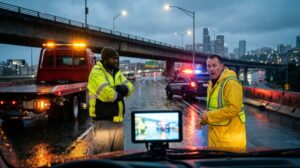
The landscaping truck stopped so hard that one of its orange cones rolled from the open tailgate and bounced across the asphalt. The driver leaned halfway out the window, one hand still on the wheel, staring at the man in the reflective vest who had stepped into the narrow bridge like he owned the county line.
George Carter lifted the whistle from his lips and pointed two fingers at the truck’s windshield.
“Engine off,” he said.
The driver blinked. “I’m just here for the Jackson place.”
“Engine off.”
William Mitchell stood at the edge of his driveway with a ceramic mug cooling in his hand. He had heard that whistle so many mornings it had begun to feel like part of the neighborhood’s plumbing: irrigation hiss, garage doors humming, George’s shriek at anyone with a trailer, ladder, dolly, pallet, or work boots.
The bridge was only forty feet long, with low stone sides and a painted sign naming it Cypress Crossing, though everyone just called it the bridge. It pinched the main lane between two landscaped ponds before the road widened again toward the houses and the greenway beyond. Whoever controlled that bridge controlled every delivery, every contractor, every moving van, every repair truck. George knew that better than anyone.
Two green trash cans stood along the curb near the bridge, not at the collection point, not near any house. Ready.
William noticed them because he noticed things like that now.
George walked around the landscaping truck with a clipboard tucked under one arm. His reflective vest was zipped over a polo shirt, and a plastic badge on a lanyard bounced against his chest. It did not say police. It did not say city. It said Gate Committee in block letters George had printed himself.
“You are entering a private residential aesthetic zone,” George said.
The driver looked down at him. “A what?”
“No commercial vehicles cross without clearance.”
“I came here last month.”
“Last month we had not updated our enforcement posture.”
William’s mouth tightened.
The landscaping driver searched the cab, pulled out a folded invoice, and held it toward George. “The homeowner booked us.”
George did not take it. “Not relevant.”
Across the street, a porch light clicked on. A curtain moved. Someone behind it watched and decided not to come outside.
William set his mug on the low brick wall by his driveway and walked toward the bridge.
He did not hurry. He never hurried when George was performing. Hurrying made George louder.
“Morning,” William said.
George turned as if he had been interrupted during official business. “This doesn’t concern you, William.”
“It concerns the road.”
“It concerns violation of community standards.”
The driver looked at William with the quick hope of someone who had just found the only other adult in the room. William gave him a small nod, then looked past George at the truck’s tires. Dry grass clung to the treads. A rake handle stuck out from the open back. Nothing about the truck threatened the bridge, the ponds, the ornamental palms, or the souls of the homeowners.
George snapped his clipboard shut. “If this vehicle proceeds, I’ll issue the homeowner a fine and notify the board of unauthorized commercial entry.”
The driver rubbed both hands over his face. “Man, I’m already late.”
“Then you should have checked compliance before arriving.”
William heard that same flat certainty and felt an old, familiar pressure behind his ribs. A year earlier, a medical supply van had waited on this same side of the bridge while George argued over delivery windows and tire load. The woman waiting for the supplies had stood on her porch in slippers, too embarrassed to shout. William had filmed thirty seconds of it, written down the van number, saved the email chain afterward.
He had done everything except step into the road.
“Let him through,” William said.
George’s eyes narrowed. “You’re not on the Gate Committee.”
“No,” William said. “That’s true.”
The driver exhaled, thinking that might be enough.
It was not.
George held up one finger, strode to his golf cart parked crookedly by the bridge, and reached into the back. William expected another sign, maybe a printed violation notice, maybe one of George’s orange plastic cones.
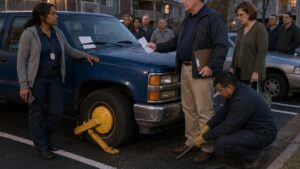
Instead, George dragged out a heavy metal parking boot.
It hit the pavement with a dense clang that seemed too serious for the morning, too serious for trimmed hedges and wet lawns and a landscaping truck with a rake hanging out of the back.
The driver straightened in his seat. “What is that for?”
“Immobilization,” George said.
William took one step forward. “George.”
George smiled without warmth. “Only if needed.”
The boot was painted yellow and black, scratched along the hinge, with a chain looped through its handle. It was not HOA stationery or polite enforcement. It was a threat you could bolt to a working man’s tire and turn his whole day into paperwork.
William glanced at the trash cans again.
There were three now. One had been tucked behind the stone sign, half hidden by ornamental grass.
George had planned for a blockade.
The driver muttered something under his breath and started to reverse. William lifted a hand.
“Wait,” he said.
The driver froze.
William stepped closer to the cab and kept his voice low. “Take a photo of the bridge, the trash cans, and him holding the boot. Send it to whoever scheduled you.”
The driver’s face changed. Not relief exactly. More like the faint return of balance.
George came closer. “Do not coach vendors on how to create false records.”
“Accurate records,” William said.
The driver raised his phone. George blew the whistle again, sharp and furious, but the driver still took the photo.
A garage door opened farther down the lane, then stopped halfway. No car came out.
George tucked the boot back into his golf cart, but he did it slowly, making sure William saw it was still there. “I’m warning you now,” he said. “Today is not the day for oversized commercial eyesores. We have fragile aesthetic pavement, and we have rules.”
William looked at him.
The phrase was too specific. Too rehearsed.
“Oversized commercial eyesores,” William repeated.
George’s jaw worked. “That is correct.”
The landscaping driver was allowed through after fifteen more minutes, but only after George photographed his plates and announced the homeowner would be reviewed. When the truck finally crossed the bridge, its tires made no more sound than any pickup. No stone cracked. No pavement shattered. The ponds did not rise in protest.
William walked back to his driveway, but his coffee had gone cold.
His phone buzzed before he reached it.
A message from Robert Lopez appeared on the screen.
Twenty minutes out. Dispatch says your HOA called about refusing entry.
William stood very still, the whistle’s echo still sharp in the morning air, and looked toward the bridge where George Carter was already lining the trash cans across the curb.
Chapter 2: The Sculpture Under The Gray Tarp
The photo arrived before William could unlock his front door.
The sculpture lay under a gray tarp on the back of the flatbed, chained down in three places, its shape massive and uneven beneath the canvas. It looked less like cargo than some sleeping animal dragged from a riverbed, all hidden weight and strapped tension. Behind it, the interstate blurred through Robert Lopez’s windshield.
A second message followed.
This is bigger than dispatch said. You sure about that bridge?
William stared at the photo longer than he needed to.
The city’s artist had called the piece Open Current, though the title was not on any public plaque yet. William had seen the clay model six months ago in a meeting room at city hall, a curling abstract form meant to stand near the greenway entrance beyond Cypress Crossing. The city wanted it where public walking trails met the old drainage easement. The HOA wanted the greenway to feel private without being legally private. That argument had been polite right up until the first survey flags appeared.
Then George had bought a louder whistle.
William carried his folder to the dining table and opened it under the pendant light. Route approval. Delivery invoice. Temporary access notice. City commission letter. Crane reservation. Installation diagram. He had printed duplicates and arranged them in clear sleeves because paper, when clean and dated, had always seemed to him like the civilized answer to shouting.
He had believed that for years.
His phone rang before he could answer Robert.
Rachel Allen’s name appeared.
William hesitated, then took the call.
“Are they already there?” Rachel asked, no greeting.
“Not yet.”
“I saw George moving the cans. Brandon’s golf cart is at the mailboxes. They’re going to make a thing of it.”
“They’ve already called dispatch.”
A small silence followed.
“William,” Rachel said, softer, “maybe reschedule. Let the city send a smaller truck.”
“There is no smaller truck.”
“There’s always another day.”
He looked at the top page in the folder. The delivery window was printed in bold. The crane crew would charge a full cancellation fee if the sculpture missed its slot. Robert would be marked late. The city would have to explain why public art could not enter a road the city itself had an easement to use.
“There shouldn’t have to be another day,” William said.
Rachel did not answer immediately. He could hear something in the background on her end, a dishwasher or washing machine, some ordinary household sound trying to compete with fear.
“You remember when my roof leaked?” she said.
William knew. A storm had peeled flashing from the back side of Rachel’s house. The repair company had sent a truck with a ladder rack. George had stopped it at the bridge and told them emergency work still required appearance clearance. Rachel’s ceiling had stained brown before the truck got through.
“You told me they delayed you,” William said.
“They didn’t just delay me.”
William pressed the phone closer.
Rachel lowered her voice. “George said the truck was oversized. Brandon said if I pushed it, the board could fine me for unapproved exterior work. Then George said there was a gate accommodation fee. Cash or transfer. He called it voluntary.”
William’s eyes moved from the city permit to the blank notepad beside it.
“How much?”
“Two hundred.”
“Rachel.”
“I know.”
“Do you have proof?”
“I have a screenshot of the transfer note. I have a photo of the receipt he gave me, but it doesn’t say HOA on it. It just says access accommodation.”
“Send it to me.”
“No.” The word came quickly, scared and hard. “Not with my name attached.”
“Rachel, if this is what he’s been doing—”
“I have kids who wait for the bus at that bridge. I can’t be the person George thinks embarrassed him.”
William closed his eyes. He had heard versions of that sentence from half the street. I can’t be the one. Not now. Not alone. Not with my house, my job, my kids, my mother, my driveway, my contractor, my mailbox, my peace.
“All right,” he said. “I won’t use your name.”
“You always say that like you can keep everything contained.”
That landed harder than he expected.
William looked toward the front window. Through the slats he could see the road sloping toward the bridge. George’s vest flashed between the shrubs.
“I’ll handle it,” he said.
Rachel’s reply was almost a whisper. “That’s what worries me.”
After the call ended, William sent Robert a photo of the route map and the city authorization.
Proceed to Cypress Crossing. Stay on the marked route. Do not sign any refusal form.
Robert replied with a thumbs-up, then a minute later:
Dispatch says HOA treasurer emailed them too. Says road surface can’t take load.
William opened his laptop.
The email from Brandon Miller was already waiting, copied to the board’s general address, written in the kind of calm language that made threats look like accounting.
Mr. Mitchell,
The Association does not recognize commercial sculpture access over decorative community pavement without prior engineering review. Any attempt to bring an eighteen-wheel vehicle across Cypress Crossing may result in owner liability for surface damage, bridge wear, landscape disruption, and emergency aesthetic mitigation.
Please instruct the vendor to hold outside the community.
William read the phrase twice.
Emergency aesthetic mitigation.
He almost laughed, but the sound never got out.
There was a time when he would have replied with citations, attachments, dates, and neutral phrasing. There was a time when he would have believed the right paragraph could make unreasonable people embarrassed enough to become reasonable.
Instead, he printed Brandon’s email and slid it behind the city permit.
The folder was thicker now. He should have felt stronger for that.
He did not.
Outside, another trash can scraped across asphalt.
William opened the bottom drawer of the sideboard and took out an older folder, the one he had not planned to bring. Inside were copies of complaints he had never filed all the way. A medical supply delay. A moving van turned back. A plumber fined for parking while unloading. Photographs of George pointing his whistle like a weapon. Notes in William’s own handwriting, each clean, careful page proving he had watched and waited.
The first page showed the medical supply van.
The woman on the porch had died the following spring. Not because of George, not directly, not in any way a court would recognize. But William still remembered the way she had stood in slippers, one hand braced against the doorframe, while George lectured the driver about scheduling windows.
William had documented it.
That had been the shape of his courage then.
He placed the old folder beneath the new one.
A deep horn sounded from the community entrance.
It rolled over the houses, low and mechanical, nothing like George’s whistle. A truck horn did not ask permission to be heard.
William stepped onto the porch.
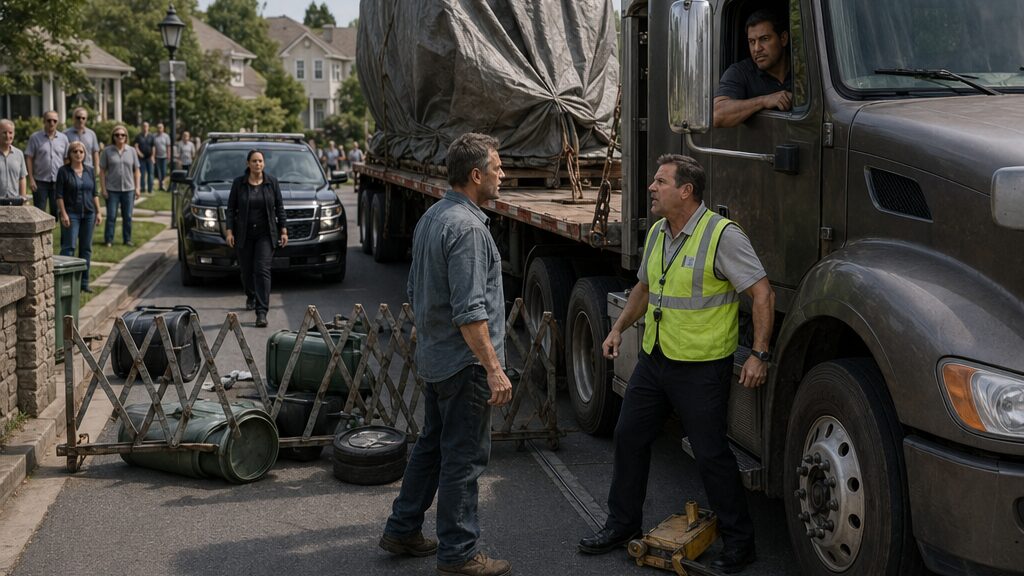
At the far end of Cypress Crossing, the nose of the 18-wheeler appeared beyond the palms, white cab gleaming, gray tarp rising behind it. The truck slowed as the bridge came into view.
George grabbed a trash can with both hands and dragged it into the lane.
Another can followed.
Then another.
Neighbors appeared at windows and garage doors, pulled by the sound and trapped by habit. Rachel stood across the street in her driveway, phone in her hand but down at her side.
William picked up the folder and walked toward the blocked road.
Chapter 3: Aesthetic Pavement And Other Lies
George slammed the parking boot against the front tire of Robert Lopez’s truck, and the sound rang under the bridge like a hammer striking a bell.
Robert leaned out of the cab. “Don’t touch my rig.”
George looked up at him, whistle between his teeth, reflective vest bright against the white truck. “Your rig is currently in violation of community access standards.”
“It’s on a public route,” Robert said. “I have delivery paperwork.”
“You have a commercial vehicle heavy enough to shatter fragile aesthetic pavement.”
The gathered neighbors shifted at the phrase. Someone behind William gave a short, disbelieving breath, but nobody laughed.
The truck filled the narrow approach, too large for the manicured lane, too real for George’s miniature border post. The gray tarp rose above the flatbed in a long, strapped mound. Chains crossed it, and beneath one lifted corner William could see the dark edge of metal sculpture, curved and thick as ship iron.
George had dragged five trash cans across the bridge. The steel scissor-gate, usually folded open beside the stone wall, had been pulled halfway out on its track, narrowing the gap further. Behind George, Brandon Miller stood in a pale shirt and board-approved calm, holding a tablet against his chest like it could make the scene procedural.
William stopped beside the truck’s front bumper.
“Robert,” he said, “don’t move the vehicle.”
Robert’s face was tight. “I’m not planning to. He’s got cans all over the road.”
George blew the whistle once, sharp enough to make a child on a nearby lawn cover both ears.
“This is an active enforcement area,” George said. “Residents need to stand clear.”
William turned toward him. “Take your hands off the tire.”
George smiled at the crowd rather than at William. “Notice the aggressive tone.”
“The tire, George.”
Robert held a clipboard out the cab window. “Here. City delivery authorization. Route sheet. Weight listed. Permit contact. You want paperwork? Take paperwork.”
George did not take it. He raised his phone and photographed the truck’s front plate, then the side number, then Robert’s face.
Robert pulled back slightly. “What are you doing?”
“Documenting noncompliance.”
“I haven’t done anything.”
“You entered a controlled aesthetic zone after denial of access.”
William stepped between George’s phone and Robert’s cab. “He was directed here by the city route.”
Brandon cleared his throat. “William, this can be discussed without blocking the lane further.”
William looked at the trash cans.
Brandon followed his gaze and showed no embarrassment.
“The lane is blocked because George blocked it.”
“It is temporarily secured,” Brandon said. “There’s a difference.”
A woman across the road lifted her phone, then lowered it when George’s head snapped in her direction.
William saw Rachel standing near her mailbox, pale and still. Her phone remained down.
George tapped the boot with his shoe. “This bridge was not designed for whatever monument you decided to drag through our neighborhood.”
“It’s not my monument,” William said. “It’s city property.”
“That remains to be established.”
“It’s in the paperwork.”
Brandon’s voice stayed smooth. “The Association has not recognized that paperwork as sufficient for access over community-maintained infrastructure.”
Robert stared at him. “Association? I’m delivering for the city.”
“You are trespassing with a commercial load,” George said.
“No, I’m sitting here while you play dress-up in traffic.”
A sound moved through the neighbors, not quite laughter. George heard it. His neck reddened.
He blew the whistle so hard the sound cracked at the end.
William felt the old pressure again, but now it had faces around it: Rachel at the mailbox, the driver above him, the people pretending they were only checking sprinklers or mail. Waiting to see whether this was another morning they would talk about later in kitchens, quietly, with the blinds half closed.
George pointed toward the tarp. “No one even knows what’s under there.”
“The city knows,” William said.
“I am speaking to the driver.”
Robert slapped the clipboard against the window frame. “You got the bill of lading, the destination, and the receiving contact. You don’t get to inspect cargo because you bought a whistle.”
George’s hand tightened around the boot handle.
Brandon stepped forward, finally. “Mr. Lopez, you should understand that if you proceed and there is any damage, your company may be included in a claim. We’ve documented the condition of this road.”
Robert’s anger faltered.
William saw it happen. The slight glance toward the side mirror. The quick calculation of employer, insurance, contract, liability. George did not need to be right. He only needed to make the cost of challenging him feel personal.
“Robert,” William said quietly, “do not sign anything they give you. Do not state refusal. Do not reverse unless dispatch orders it in writing.”
Robert looked down at him. “You paying if they come after me?”
The question was not hostile. That made it worse.
William held his gaze. “I’ll put my name on the complaint before yours.”
George turned toward the neighbors. “You’re all hearing this? William Mitchell is encouraging a commercial operator to ignore community preservation measures.”
A few eyes dropped.
William opened his folder and removed the city authorization, but George stepped closer before he could unfold it.
“You have had a problem with process for years,” George said. His voice was lower now, meant to sound reasonable to the crowd. “Every time the Association protects this community, you make it personal.”
“You made a bridge into a checkpoint.”
“I made sure trucks didn’t destroy what residents pay to maintain.”
“You made people pay to get repairs.”
George’s expression sharpened.
Brandon’s did too.
The silence that followed was different from the others. Not empty. Loaded.
Rachel’s hand moved around her phone.
George looked from William to the crowd. “Careful.”
William did not look away. “I am being careful.”
“No,” George said. “You’re being reckless.”
He bent toward the truck’s front tire.
Robert opened the cab door. “Hey. Don’t put that on.”
George fitted one jaw of the boot near the rubber. “This vehicle is immobilized pending board review.”
William moved, but Brandon stepped into his path with one hand raised.
“Don’t touch him,” Brandon said. “There are witnesses.”
William stopped inches from Brandon’s palm.
The trash cans blocked the bridge. The scissor-gate waited half-drawn. The massive sculpture sat trapped under gray tarp while George crouched at a working man’s tire, building a prison out of policy words.
George snapped the boot’s hinge wider.
Then he looked up at Robert and said, loud enough for every porch to hear, “Now it doesn’t move until we say it moves.”
Chapter 4: The Paperwork That Proved Too Little
William placed the city permit on the truck hood, and George blew his whistle directly over it.
The sound was so close that the paper trembled under William’s fingers. Robert flinched in the cab. A child on the sidewalk cried out and was pulled back by a parent. The whistle’s shriek bounced off the stone sides of the bridge and came back thinner, meaner, like it had been sharpened on the way.
William did not move his hand from the permit.
George lowered the whistle slowly. “You don’t get to stage a document display in an active enforcement area.”
“This is the delivery authorization,” William said. “City of Fairhaven Public Art Commission. Temporary access notice. Approved route. Receiving location.”
Brandon Miller stepped beside George, careful not to stand too close to the boot. “No one is disputing that the city may have commissioned something.”
Robert leaned out of the cab again. “You’re looking at it.”
Brandon ignored him. “The issue is whether this vehicle has permission to cross community-maintained infrastructure.”
William slid the route map on top of the permit. His hands were steady. That annoyed him. Steady hands could make a man feel righteous while he was still losing.
“The route uses Cypress Crossing,” William said. “The access point is marked. The greenway easement is behind the bridge.”
George tapped the map with the whistle. “That map does not override Association authority.”
“It was filed with the city.”
“The city doesn’t maintain our aesthetic pavement.”
Robert made a rough sound. “That phrase again.”
A neighbor laughed once, quietly, then stopped when George turned his head.
William spread the remaining pages against the hood: bill of lading, crane appointment, installation diagram, city contact. The gray tarp behind him shifted slightly in the wind, tugging against its straps. Beneath it, the sculpture waited with the indifferent patience of several tons of metal.
George pointed at the truck. “And if that thing cracks the decorative approach?”
“The approach is asphalt,” William said.
“With an aesthetic finish,” Brandon added.
William looked at him. “You’re a treasurer. You know what maintenance records say.”
Brandon’s expression tightened.
There it was, small and quick. Not fear exactly. Calculation.
George raised his voice for the neighbors. “This is why we have procedures. One resident decides rules are beneath him, and suddenly every homeowner pays for damage.”
William heard murmurs behind him. Not agreement. Not disagreement. People measuring which side might cost them more.
His phone buzzed.
He looked down. A city office number.
He answered immediately. “William Mitchell.”
A woman’s voice came through thin and rushed. “Mr. Mitchell, this is the mayor’s office returning your call. We have the installation permit in front of us.”
William turned slightly away from George’s whistle. “The truck is here. The HOA has blocked the bridge and is attempting to immobilize the vehicle.”
“Immobilize?”
“With a parking boot.”
There was a pause.
George stepped closer, trying to hear.
William put the call on speaker.
The woman said, more carefully, “The city recognizes the sculpture as municipal property under scheduled delivery. Mayor Amanda Davis is at an event across town, but she has been notified.”
Brandon’s eyes moved to George.
William said, “Can your office instruct them to clear the road?”
“We can confirm the cargo and the route,” the woman said. “I can email a letter to all listed parties. The mayor is trying to leave now.”
“That doesn’t answer the bridge control issue,” Brandon said loudly.
The woman paused again. “Who is speaking?”
“Brandon Miller, Cypress Crossing HOA treasurer. The Association maintains the bridge approach and gate system.”
“Mr. Miller,” she said, “the city’s position is that the delivery should not be obstructed.”
“With respect,” Brandon said, “your position is noted. The Association has liability exposure for heavy vehicles on community infrastructure.”
William could almost hear the woman choosing words from a narrow shelf.
“Mayor Davis will address that in person,” she said.
“When?” William asked.
“Soon. I’m sorry, I don’t have an exact arrival time.”
Robert knocked his knuckles against the cab door. “Soon doesn’t help me.”
The line clicked off after the assistant promised an email. A minute later, William’s phone chimed. So did Brandon’s tablet. The city letter arrived with a clean seal at the top and careful language beneath it.
George read over Brandon’s shoulder.
William watched their faces as they moved through the paragraphs. No triumph there. No surrender either.
Brandon looked up first. “This confirms city ownership of the cargo.”
“And the route,” William said.
“It does not concede that the HOA’s physical gate structure can be removed or bypassed without Association approval.”
George seized on that like a man grabbing a rail. “Exactly.”
Robert let his head fall back against the seat. “You’ve got to be kidding me.”
William felt heat rise in his chest, not wild, not explosive, just dense. A weight pressing outward. The documents had done what documents did. They proved what they were written to prove and no more. They did not move trash cans. They did not silence whistles. They did not make a man like George ashamed in front of a crowd.
Robert’s phone rang. He answered, listened, then closed his eyes.
“What?” William asked.
Robert covered the receiver. “Dispatch says if I can’t unload within the window, they may call it failed access. Crane company charges back. My company eats part, then I eat part. That’s how it goes.”
“You didn’t fail access,” William said.
Robert gave him a tired look. “Tell that to the people who bill by the hour.”
George heard enough to smile. “Then reverse out while you still can.”
Robert’s hand tightened around the phone.
William looked at the boot half-fitted near the tire, at the trash cans angled across the bridge, at Brandon’s tablet, at Rachel standing too still near the mailbox. He saw the old medical supply van again, not in memory’s soft blur but with sharp practical details: the driver’s embarrassed face, the clipboard, the woman’s slippers, George’s whistle cutting her voice to pieces.
William had gone inside that day and written everything down.
Everything except what mattered.
He folded the city letter and put it back in the folder. “Robert, stay put.”
George stepped between him and the tire. “The driver has been instructed to leave.”
“Not by the receiving party.”
“By the enforcement authority on site.”
“You are not enforcement authority.”
George’s smile vanished. “You don’t get to decide that.”
Brandon held up a hand toward both of them. “No one benefits from escalation.”
“You already escalated,” William said. “You put a boot on his tire.”
“Attempted protective immobilization,” Brandon said.
Robert laughed without humor. “Man, you people got names for everything.”
George looked up at him. “You want your company dragged into a damage claim? Reverse out. Now. Or I file personally against you and your dispatch for attempted destruction of community property.”
Robert’s face changed.
That threat landed where George had aimed it: not at law, not at truth, but at a man’s paycheck.
William stepped toward the truck, but Robert lifted one palm from the cab.
“William,” he said quietly, “don’t make promises you can’t cover.”
The words struck harder than George’s whistle.
Because William had promised, in his way. He had promised the city the delivery could happen. He had promised neighbors, silently, that he was keeping records. He had promised himself that if he waited long enough, the truth would arrive dressed properly and no one else would have to risk anything.
Now the truth was in a folder on a truck hood, and Robert Lopez was the one being threatened.
George straightened and pointed down the lane behind the truck. “Reverse out, driver. Last chance before I attach the boot fully and file the claim in your name.”
The engine idled under the words, deep and trapped.
William stood beside the permit, surrounded by proof that was not yet power, while Robert looked from the blocked bridge to his mirrors and began calculating the cost of leaving.
Chapter 5: The Neighbor Who Almost Spoke
Rachel Allen stepped off the curb with her phone raised, and for two seconds everyone at the bridge saw what courage might look like.
Then Brandon Miller turned toward her.
“Rachel,” he said, not loudly, “be careful. Public accusations without context can trigger legal exposure. For you and whoever encourages you.”
Her thumb froze above the screen.
George saw it and smiled.
William did not look at Rachel right away. He kept his eyes on Brandon because he had learned that people who issued soft threats hated being watched while they did it.
“She can record a public dispute,” William said.
Brandon adjusted his grip on the tablet. “No one said she couldn’t record. I said context matters.”
Rachel’s phone lowered a few inches.
A man near the mailboxes stepped back behind a hedge. Another neighbor crossed his arms and stared at the grass. The crowd had grown larger, drawn out by the truck horn, the whistle, and the sight of the enormous gray-tarped shape trapped before the bridge. They stood in driveways and along the sidewalks, close enough to hear, far enough to deny involvement later.
George pointed toward them with the whistle. “This is exactly why the Gate Committee exists. To prevent chaos before it spreads.”
Robert leaned out of the cab. “The only chaos out here is you and your trash cans.”
A few mouths twitched. Nobody laughed this time.
William turned toward the gathered neighbors. His voice stayed even, but it carried.
“Anyone who has been charged an access fee, delayed for a delivery, threatened over a work truck, or told a contractor couldn’t cross this bridge, say so now.”
No one moved.
The truck engine idled. Somewhere beneath the bridge, water moved through the drainage channel with a low, hidden rush.
William saw Rachel’s eyes flick toward George, then Brandon, then the bus stop sign near the corner. Her two children stood there on school mornings. Everyone knew it. George knew it too.
George spread both hands. “You hear that? Silence. Because this is not some neighborhood uprising. This is William’s personal resentment dressed up as public concern.”
William felt the words try to hook into him. Personal resentment. Tone problem. Difficult resident. Words Brandon had used in emails, polished until they looked like fact.
A woman near the sidewalk shifted. “My appliance delivery was delayed last summer.”
George turned so fast the woman’s shoulders lifted.
“Because they arrived without clearance,” he said. “And your refrigerator was delivered the same day after compliance was confirmed.”
“After my husband came home from work to argue with you.”
“That is not accurate.”
The woman looked down.
Another neighbor muttered, “Moving truck got turned around at my place.”
Brandon raised his tablet. “If residents have concerns, the board has a process.”
William almost laughed. Not because anything was funny, but because the word process had become a hallway with no doors.
George’s face had tightened. “Large vehicles have damaged this community before. Everybody forgets that part.”
He pointed toward the decorative curb by the bridge entrance. “Three years ago, a concrete truck came through here without proper control and cracked that corner. Who did they blame? Me. Who got shouted at during the annual meeting? Me. Who had to stand there while people said the Gate Committee was useless? Me.”
For a moment, the performance slipped. What showed underneath was not kindness, but it was human: embarrassment fossilized into authority.
William looked at the curb. The crack was still faintly visible, filled with a lighter seam of patch compound.
George seized the silence. “You think I enjoy this? You think I want to stand out here in this vest? I protect what people pay for.”
“Then why charge Rachel two hundred dollars to let a roof truck through?” William asked.
Rachel’s head snapped up.
George’s eyes flashed.
Brandon moved before George spoke. “William, naming residents in public without consent is inappropriate.”
Regret hit William fast and cold.
Rachel’s face had gone pale with betrayal, and he knew he had done exactly what she feared: dragged her private wound into the road because it helped his argument.
“Rachel,” he said.
She shook her head once.
George looked around slowly. “There was no fee. There may have been a voluntary accommodation for after-hours access, if a resident requested special handling.”
“It was raining through her ceiling,” William said, but the sentence no longer felt clean in his mouth.
Rachel’s phone was at her side now.
Brandon stepped closer to her. “You don’t have to answer anything.”
The kindness in his tone was the worst part. It gave her a safe place to retreat, and he knew it.
William swallowed. “I shouldn’t have used your name.”
Rachel did not reply.
Robert’s dispatch called again. He glanced at the screen and did not answer.
George noticed. “Your window is closing, Mr. Lopez.”
Robert stared through the windshield at the blocked bridge. The parking boot hung half-set against his tire, not locked yet but close enough to feel like a trap. His shoulders sagged.
William looked at the crowd and saw not cowards but people trained to survive one small humiliation at a time. A roof leak. A refrigerator. A moving truck. A medical van. Every incident isolated, explained, fined, filed. George had never needed everyone to agree with him. He only needed everyone to feel alone.
Brandon’s tablet chimed. He glanced at it and spoke low to George.
George nodded, then walked to the scissor-gate folded along the bridge wall.
William’s stomach tightened.
“George,” Brandon said, louder now, “as board treasurer, I recommend securing the bridge until city representatives arrive and liability is clarified.”
George took hold of the gate’s leading edge.
It was an expanding steel barrier on a narrow track, rarely used except during resurfacing work or community events. Its lattice arms clacked as he pulled. The sound made several neighbors step back.
Robert opened his door again. “If you close that, I’m done. I can’t sit here all day.”
George dragged the gate another foot. “Then reverse.”
William moved toward him.
Brandon lifted his tablet and began recording.
“William,” he said, voice smooth as wax, “please keep your hands visible.”
William stopped.
There it was: the frame being built around him. Angry resident. Public disruption. Board officers maintaining safety. Driver trapped by William’s insistence, not George’s obstruction.
Rachel crossed behind him.
For a second, William thought she was leaving.
Instead, she came close enough that her shoulder almost brushed his arm. Her eyes stayed on the ground. In her hand was her phone, screen lit.
She did not look at him when she whispered, “Don’t say my name again.”
Then she angled the phone toward him.
On the screen was a photo of a small paper receipt on Rachel’s kitchen counter.
ACCESS ACCOMMODATION — $200 — G.C.
The date matched the week of the storm.
Before William could speak, George yanked the scissor-gate fully across the bridge. The metal lattice locked into place with a hard, final snap.
Chapter 6: When The Gate Came Off Its Tracks
Robert climbed back into the cab and looked down at William through the open window.
“I’m sorry,” he said. “I can’t lose the truck over this.”
His voice was flat with defeat, and that did something to the crowd no whistle had managed. People looked away not because George commanded it, but because Robert sounded too much like them.
William stood between the truck and the closed scissor-gate with Rachel’s receipt glowing on his phone. The city permit was still on the hood. The trash cans leaned crookedly across the bridge. The parking boot crouched at the tire like a yellow animal with its jaw open.
Behind him, George’s whistle hung ready at his lips.
“Driver has made the sensible decision,” George said.
Robert started to pull his door closed.
William put one hand on the cab step. “Give me two minutes.”
Robert shook his head. “Dispatch gave me five before they mark it failed access. I got a crane crew waiting, a city contact who isn’t here, and two guys in golf clothes telling me they’ll put my name on a claim. I can’t fight your neighborhood.”
My neighborhood.
The phrase scraped through William.
He looked down the lane, past lawns trimmed to uniform height, past the mailboxes, past the neighbors standing in pieces of shade. He had lived here twelve years. He knew who had lost a freezer full of food waiting for appliance clearance, who had postponed a move because George disliked weekend trucks, who had carried boxes by hand from the bridge because a delivery van had been turned away.
He knew because they had told him quietly.
He had kept the quiet.
George stepped to the gate and gripped one of its steel crossbars. “You heard him. The truck reverses. The road remains secured.”
William looked at the hinge plates where the gate met its track. Four anchor bolts, paint worn around the base. Maintenance stickers half peeled. He had noticed them for years and never had a reason to care. Or he had always had a reason and called it restraint.
Brandon came closer with his tablet raised, lens fixed on William’s face. “For the record, William Mitchell is obstructing a safe resolution.”
William turned toward him. “You’re recording?”
“Yes.”
“Good.”
That made Brandon blink.
William held up Rachel’s receipt but kept the screen angled away from the crowd. “How many of these did you know about?”
Brandon’s eyes flicked to the phone. “I don’t know what that is.”
“An access accommodation receipt. Two hundred dollars. Initialed by George.”
George’s face darkened. “Private arrangement. Not board business.”
Brandon’s jaw tightened again. A different answer had tried to get out first and failed.
William saw it.
“You knew,” William said.
“I knew residents sometimes requested special access support,” Brandon replied. “That does not change the status of this bridge.”
“No. It explains why you need everyone scared of it.”
George blew the whistle.
This time William did flinch. Not from fear. From disgust. The sound was shoved into the space where thought should have been, the same way George shoved cans into roads and fees into emergencies and threats into working people’s schedules.
“Enough,” William said.
George lowered the whistle. “You are finished after today.”
“No,” William said. “I think this is the first honest day we’ve had out here.”
Brandon shifted the tablet. “That sounded threatening.”
William looked into the small black camera dot. His own reflection stared back from the glass, smaller and older than he felt.
“For the record,” William said, “Cypress Crossing connects to a public greenway easement established before this HOA existed. The city route uses that easement. The delivery is city property. The truck is blocked by trash cans, an unapproved boot, and a private gate being used to obstruct access.”
George laughed. “You don’t get to declare law in the street.”
“No,” William said. “But you don’t get to invent it here either.”
Robert’s engine rumbled deeper, then shifted. Reverse warning lights blinked white near the rear of the flatbed.
William heard the faint beep from the truck’s system.
The sound struck him harder than the whistle.
Robert was leaving.
The gray-tarped sculpture, the city’s curled metal promise of public space, would roll backward away from the bridge because George had made the cost of standing still too high.
And William, once again, would have documents.
“Robert,” William said.
The driver paused with his hand on the gear shift.
“Don’t reverse.”
George stepped into the lane. “He has made his decision.”
William walked to the scissor-gate.
The neighborhood held its breath in pieces. A gasp from one porch. A whispered warning. Brandon’s tablet following him. George’s whistle rising halfway to his mouth.
William put both hands on the steel lattice.
George’s voice sharpened. “Touch HOA property and you’re finished.”
The metal was hot from the sun. Rough where old paint had chipped. It rattled lightly under William’s grip, a cheap sound for something that had frightened so many people.
William looked through the gate at the open road beyond it.
He thought of the medical supply van. Rachel’s ceiling. Robert’s tired face. The contractor at dawn. He thought of every page in his old folder, each one clean and useless because he had mistaken recording harm for resisting it.
George reached for his whistle.
William pulled.
At first the gate only screamed along the track. Metal scraped metal, high and ugly. George shouted. Brandon barked something about vandalism. Robert leaned from the cab.
William planted one boot against the curb base and pulled again.
The first anchor bolt popped.
The sound was small, almost disappointing, but the gate lurched toward him. The lattice twisted. Someone cried out. George lunged for the frame, but the sudden shift made him stumble backward into a trash can.
William did not stop.
He gripped higher, shoulder burning, and drove his weight sideways instead of back. The second bolt tore free with a crack that traveled through the bridge stone. The gate buckled off the track, no longer a barrier but an argument losing shape.
“William!” Brandon shouted.
The tablet was still up.
Good.
William pulled the gate clear with both hands, dragging its steel feet across the asphalt. It fought him, catching, scraping, folding wrong. His palms stung. A sharp edge bit his thumb. He felt warmth there and ignored it.
George grabbed the far side. “Let go!”
For one second they stood on opposite ends of the barrier, George red-faced, vest blazing, whistle bouncing against his chest, William silent with the steel flexing between them.
Then William shoved.
Not at George. At the gate.
The twisted frame jumped from its track entirely. George released it and staggered back. William drove the lattice toward the grass with a final, brutal heave. It folded into itself as it fell, crossbars bending, wheels snapping sideways, the whole thing collapsing into a useless heap beside the bridge sign.
The crash rolled across Cypress Crossing and killed every voice.
One trash can spun slowly on its side.
The reverse lights on Robert’s truck went dark.
William stood breathing hard, hands open at his sides, blood running from his thumb onto the heel of his palm. He looked at the road. Open now except for the scattered cans and the boot at the tire.
George’s face had gone pale beneath the anger.
Brandon lowered the tablet just enough for William to see his smile.
Then George pointed at the mangled gate on the grass and found his voice.
“You’re going to jail,” he said.
Chapter 7: The Road Was Never Theirs
George pointed at the mangled gate on the grass and shouted so hard his voice broke.
“You’re going to jail.”
The words hung there while everyone stared at what William had done.
The scissor-gate lay folded into itself beside the bridge sign, one wheel still spinning weakly in the grass. A strip of chipped paint clung to William’s palm where the steel had bitten him. Blood ran from his thumb in a thin line, reached his wrist, and disappeared under his sleeve.
George saw it and found more volume.
“Destruction of community property. Criminal damage. Endangerment. You all saw it.”
Brandon lifted the tablet again, steadier now, as if the broken gate had given him back his script. “William, step away from the roadway. Do not touch anything else.”
William looked at the bridge.
The road was open, but nobody moved.
Not Robert. Not the neighbors. Not even George, who stood between the boot and the ruined gate with his whistle pressed against his chest like a badge that had stopped working.
Then a black city SUV turned into Cypress Crossing.
Its tires rolled past the line of mailboxes, past Rachel Allen standing pale with her phone clutched in both hands, past the neighbors who shifted aside as though authority had acquired weight and shape. The SUV stopped behind the 18-wheeler. The driver stepped out first. Then Mayor Amanda Davis opened the rear door herself.
She was shorter than William remembered from the public art meeting, dressed in a dark jacket over a plain blouse, hair pinned back, face set in the kind of anger that had already passed through surprise and become useful.
“What,” she said, looking from the truck to the trash cans to the boot to the crumpled gate, “is happening here?”
George surged toward her. “Mayor Davis, thank goodness. This resident has destroyed HOA property and interfered with a lawful safety action.”
Amanda looked at him, then at his reflective vest. “Who are you?”
George straightened. “George Carter. Gate Committee chair.”
“That is not an answer to what I asked.”
Brandon stepped forward before George could recover. “Mayor Davis, Brandon Miller, HOA treasurer. We have a situation involving an unauthorized heavy vehicle and possible damage exposure to community-maintained—”
Amanda held up one hand.
Brandon stopped.
She looked at Robert in the cab. “Are you Robert Lopez?”
“Yes, ma’am.”
“Are you transporting city-commissioned cargo for the Open Current installation?”
“Yes, ma’am.”
“Have you been prevented from reaching the installation site?”
Robert glanced at George, then at the boot still hanging open near his tire. “Yes, ma’am.”
Amanda’s face hardened.
George lifted the whistle slightly, caught himself, and lowered it.
“That truck will destroy the bridge approach,” he said. “We have aesthetic pavement standards. We cannot have eighteen-wheelers rolling through here because one resident wants a monument.”
Amanda turned to William. Her eyes dropped to his bleeding hand, then to the folder lying on the truck hood. “Mr. Mitchell.”
“Mayor.”
“You called my office?”
“Yes.”
“And you informed them the truck had been immobilized?”
“They were trying to.”
George snapped, “Because he refused to follow Association procedure.”
Amanda turned back to him. “Did you attach a parking boot to a truck carrying city property?”
George’s mouth opened.
Brandon answered instead. “The boot was not fully attached.”
Amanda’s gaze moved to him. “That was not the question.”
Brandon’s tablet dipped.
The crowd had drawn closer without realizing it. People stood along both sides of the bridge now, no longer pretending to check sprinklers or mail. Rachel remained near the curb, and William could feel her watching him, waiting to see if he would use her name again.
He would not.
Amanda walked to the front of the truck and inspected the boot. She did not touch it. She crouched enough to see the hinge, then rose and looked toward the trash cans.
“Move those cans,” she said.
No one moved.
George said, “With respect, Mayor, this is HOA property.”
Amanda looked at Brandon. “Produce proof.”
Brandon blinked. “Proof?”
“That your Association had authority to block a scheduled municipal delivery, immobilize the vehicle carrying it, and close a gate across an approved access route.”
“We maintain the bridge approach.”
“That is not what I asked.”
Brandon swallowed. “The HOA maintains certain shared aesthetic features and community access controls under our governing documents.”
“Does that include authority to obstruct a public easement tied to city installation access?”
Brandon looked down at his tablet.
The silence changed shape again. Not fear this time. Recognition.
Amanda stepped closer to him. “Mr. Miller, I reviewed the plat map on the way here. I also spoke to Public Works. Cypress Crossing includes a public access easement that predates your HOA’s gate committee, your scissor-gate, and that vest.”
George’s face flushed. “That easement is for trail maintenance.”
“And installation access for city-approved improvements connected to the greenway,” Amanda said. “Including the sculpture on that truck.”
George shook his head. “We were never told—”
William spoke before he could stop himself. “Yes, you were.”
Every face turned.
He reached into the folder with his uninjured hand and pulled out the printed notice sent months earlier, the one he had kept clean and flat in a sleeve. “The board received notice of the installation route. Certified copy. Brandon replied with a request for alternative access.”
Brandon’s lips pressed together.
Amanda looked at him. “You knew.”
Brandon’s eyes shifted toward George, then away. “We disputed the route.”
“You disputed it,” Amanda said, “and then you blocked it.”
George jabbed one finger toward the broken gate. “He tore down community property.”
“He removed an obstruction from a public easement after you attempted to immobilize city cargo,” Amanda said. “Do not confuse which part of this scene concerns me most.”
The words seemed to strike George physically.
For the first time all morning, he had no whistle ready.
Rachel stepped forward.
It was a small movement, but William saw the cost of it in her shoulders.
“Mayor Davis,” she said.
Her voice was not strong. It was enough.
Amanda turned. “Yes?”
Rachel held up her phone. “It wasn’t just today. They charged people to get trucks through.”
George wheeled on her. “That is false.”
Rachel’s hand shook, but she did not lower the phone. “You charged me two hundred dollars when my roof was leaking. You called it an access accommodation.”
Amanda looked at Brandon.
Brandon’s face had gone still in the way people go still when they are trying not to choose.
“Is there a receipt?” Amanda asked.
Rachel nodded. “Yes.”
George laughed once, too loud. “A private misunderstanding. She requested special handling.”
A neighbor near the mailboxes spoke up. “They delayed my moving truck.”
Another voice, from behind William: “My refrigerator sat outside the gate for three hours.”
Then the woman who had lowered her eyes earlier lifted her chin. “You threatened to fine me if the driver left tire marks.”
The crowd did not erupt. It did something more dangerous.
It became specific.
Amanda listened, face controlled, as one story became three, then five, each small enough to dismiss alone and too patterned to ignore together. George tried to interrupt twice, but without the whistle in his mouth, his voice was just a man’s voice, strained and defensive.
Brandon finally lowered the tablet.
Amanda noticed. “Keep recording, Mr. Miller. This part matters too.”
A faint murmur moved through the neighbors.
William looked at George then, expecting triumph to rise in him.
It did not.
What he felt was the ache in his hand, the weight of the old folder, and the ugly knowledge that all these voices had been waiting for a gate to break before they believed their own stories might matter.
Amanda stepped toward George. “You will remove that boot from the truck tire. You will move every obstruction from this route. You and the board will preserve all communications about access fees, delivery denials, bridge closures, and today’s events. If you interfere with this delivery again, I will ask city counsel and law enforcement to treat it as obstruction of municipal property access.”
George stared at her. “You can’t threaten me in my own community.”
Amanda’s voice dropped. “This road was never yours.”
For a moment, even the truck engine seemed to quiet.
George bent mechanically and pulled the boot away from Robert’s tire. It scraped the pavement as he dragged it back. Two neighbors moved the trash cans without being asked twice. Brandon stood uselessly beside the bridge, tablet hanging from one hand.
The lane opened fully.
Amanda turned toward the cab.
“Driver,” she said, clear enough for everyone to hear, “cross the bridge.”
Chapter 8: The Whistle Hanging In The Quiet
The crane lifted the wrapped sculpture above the street while George Carter stood beside the ruined gate with his whistle dangling against his vest.
No one had told him to stand there. He had simply stopped moving after the truck crossed the bridge, as if the road opening had taken with it whatever instruction usually carried him from one order to the next. The reflective vest still shone in the afternoon light. The whistle still hung bright and silver. Without the shriek behind it, both looked strangely small.
The 18-wheeler had moved slowly across Cypress Crossing, Robert Lopez leaning forward over the wheel, tires tracking straight between the stone sides. Every neighbor watched the pavement.
No crack split open. No decorative surface shattered. No bridge collapsed into the pond.
On the far side, near the greenway, the crane crew guided the sculpture from the flatbed with hand signals and clipped commands. The gray tarp snapped in the breeze. Chains tightened. Metal groaned softly as the hidden weight rose.
When the sculpture cleared the truck bed, a sound went through the crowd that was almost a cheer but not yet brave enough to be one.
Then someone laughed.
“Guess my couch delivery can make it,” a neighbor said.
Another neighbor, still holding a phone, said, “I’m ordering the biggest freezer they sell.”
This time the laughter spread.
Not cruelly at first. It came with relief, with the shock of seeing a monster turn back into a prop. The bridge was just a bridge. The road was just a road. The gate was a damaged thing in the grass. And George, who had once stopped vans with a whistle, now stood in silence while the largest delivery any of them had ever seen rolled exactly where he said it could not.
William stayed near the truck hood, a folded towel pressed around his thumb. Rachel had brought it to him without speaking. That was her first apology, or his, or neither. He took it with a nod and did not try to name what passed between them.
Robert climbed down from the cab after setting the brake. He walked toward William, cap pushed back, face lined with the strain of the morning.
“You all right?” he asked.
William looked at his hand. “It’ll close.”
“I wasn’t talking about your hand.”
William had no ready answer.
Robert glanced back at the bridge. “I was going to leave.”
“I know.”
“I mean, I was actually in reverse.”
“I heard it.”
Robert rubbed the back of his neck. “I’ve had people yell at me before. Guard shacks, receivers, job sites. You learn when a place isn’t worth it.”
William watched the crane swing the wrapped sculpture toward its base. “This place wasn’t worth it for a long time.”
Robert looked at him. “You changed that.”
William shook his head. “Not alone.”
“No,” Robert said. “But you stood where everybody could see you. That counts.”
It should have felt like praise. Instead it opened something sore.
William looked toward Rachel. She stood with Amanda Davis near the curb, showing the receipt on her phone. Brandon Miller stood beside them, no tablet now, only his hands clasped tightly in front of him while Amanda spoke to him with a city staffer taking notes. Rachel’s face was still tense, but she was not backing away.
Other neighbors had begun forming a loose line. Not an organized one. Not yet. But people were stepping forward, one at a time, phones in hand, old emails open, photos ready. A delivery denial. A fine notice. A message about gate access. A contractor’s invoice with a delay charge circled.
Amanda had made it clear: the city would review the access policies, but it would need records. It would need names. It would need residents to put in writing what they had only whispered.
That was the part applause could not do.
William walked toward George.
The crowd noticed. A few people quieted, hungry for a final humiliation. George noticed too. His chin lifted, but the gesture had no force left behind it.
“If you’re here to enjoy yourself,” George said, “go ahead.”
William stopped a few feet away. The crumpled gate lay between them like a dead machine.
“I’m not enjoying this,” William said.
George gave a hard little smile. “Could’ve fooled me.”
William looked at the whistle. “Why did you keep doing it?”
George’s eyes flicked toward the neighbors. “You think I’m explaining myself to them?”
“No,” William said. “To yourself.”
For a moment George seemed ready to spit back some polished line about standards, surfaces, preservation, procedure. Instead his eyes moved to the patched curb at the bridge approach.
“They laughed at me,” he said.
William waited.
“After that concrete truck cracked the curb. Annual meeting. People shouting about dues and incompetence and why have a Gate Committee if trucks can just come through. Brandon let them. Sat there with his spreadsheet and let me take it.” George’s mouth twisted. “After that, no one crossed without me saying so.”
The confession did not soften what he had done. It made it smaller. Meaner. A man taking one public embarrassment and handing it out for years in pieces small enough to call policy.
William looked at him for a long second.
“You made everyone pay for that meeting,” he said.
George’s face closed. “You broke the gate.”
“Yes,” William said.
The answer left no room for pride or denial.
Amanda called William’s name before George could reply. He turned away first. Not because he had won the exchange, but because there was work that mattered more.
By the sculpture base, Amanda had gathered Rachel, Brandon, the city staffer, and several residents. The tarp had been loosened from the sculpture but not fully removed. Beneath it, glimpses of dark metal curved upward, catching light in long edges.
Amanda looked at William’s bandaged hand. “You should have that cleaned properly.”
“I will.”
“You also need to provide a written statement.”
“I know.”
Her expression softened a fraction. “Not just about today.”
William looked at the people waiting with their phones.
“Everything?” he asked.
“Everything you have.”
The old folder seemed to grow heavier under his arm though he had left it on the truck hood. Medical van. Contractor. Plumber. Moving truck. Notes, dates, photos. His careful archive of moments when he had chosen not to make trouble.
Rachel stepped closer. “I’ll give mine too.”
William turned to her. “I’m sorry I used your name.”
She looked toward George, then back at him. “I’m sorry I made you carry it alone after I told you.”
“You were protecting your family.”
“I was protecting my quiet,” she said. “There’s a difference.”
That stayed between them, plain and unvarnished.
Behind them, one of the crane crew called for clearance. The wrapped sculpture lowered toward its base, inch by inch. The crowd moved back. Even George looked up.
The tarp slipped loose at the bottom, revealing the first clean curve of blackened steel. The sculpture was not smooth. Its surface held marks from the making, hammered textures and welded seams, all of them visible when the light crossed right. It rose in a twisting arc, open at the center, shaped like motion caught and held without being stopped.
Open Current.
William watched it settle into place.
The base bolts lined up. The crew guided it down. Metal met concrete with a deep, final note that traveled through the ground and into the soles of his shoes.
For a second, no one spoke.
Then Robert clapped once.
The sound startled a laugh out of someone, and then the applause came for real, rolling back toward the bridge, over the scattered trash cans, past the truck that had not turned around, past the gate that would not close again that day.
William did not clap. His hand hurt too much.
He opened the old folder instead.
The first page was still the medical supply van. He looked at it until the woman in slippers became more than guilt, more than evidence. She became the first name he would write down when Amanda’s staffer asked where to begin.
At the bridge, George stood apart from the cheering, one hand around the whistle but not lifting it.
William saw him, and for the first time that day, did not feel pulled toward him.
Rachel came to his side with her phone ready. Robert stood beside the truck, watching the road like he still could not quite believe it had let him through. Neighbors gathered around Amanda’s staffer, each waiting to turn a private inconvenience into public record.
Behind them, the road over Cypress Crossing remain