The Quiet Recruit Who Dropped the Barracks Bully Refused to Become His Replacement
Chapter 1: The Hand That Stopped the Locker
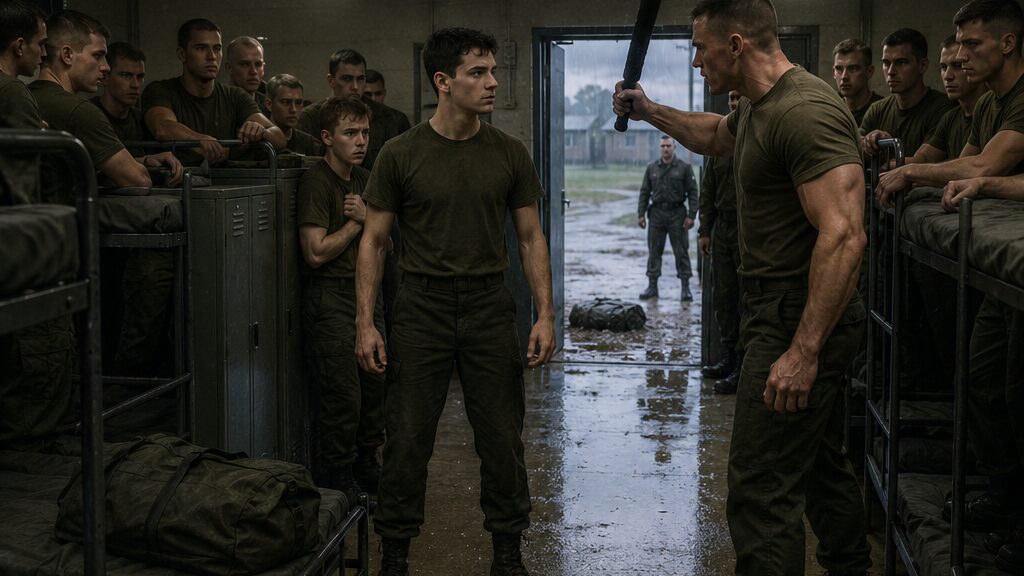
The locker door slammed beside Stephen Lewis’s head hard enough to shake three hanging uniforms from their hooks.
Before Ryan Davis could drive it shut a second time, a hand closed around his wrist.
The barracks went quiet in pieces. A card game stopped near the windows. Someone lowered a boot he had been polishing. The laughter around Ryan thinned until only rain remained, striking the open doorway and the metal roof beyond it.
Michael Hill stood beside him.
He was nineteen, narrow through the shoulders, and ordinary enough that most of the platoon had stopped noticing him after his first week. He spoke when addressed, finished his work without complaint, and kept his bunk so clean that even the inspectors had little reason to remember his name.
Ryan looked down at Michael’s hand.
Then he looked at Michael.
“Let go.”
Michael released him immediately.
The quick obedience brought a few uncertain laughs, but he did not step away. Instead, he moved half a pace sideways, putting himself between Ryan and Stephen.
Stephen’s back remained pressed against the lockers. His face had gone pale beneath the fluorescent lights.
“He said stop,” Michael said.
Ryan’s expression changed slowly. Not anger at first. Calculation.
He was twenty-two, broader than nearly everyone in the platoon, and already carried himself as if the leadership stripe had been sewn onto his uniform. The candidate list posted beside Paul Mitchell’s office had Ryan’s name at the top. Formal evaluations began in three days.
Until then, he had created his own tests.
Stephen had failed another one.
A wet cleaning rag lay at his boots. Ryan had ordered him to crawl beneath the bunks and wipe every bed frame while the room watched. When Stephen hesitated, Ryan had backed him into the lockers and explained that hesitation under pressure got people hurt.
Most recruits had laughed because laughter kept Ryan’s attention moving.
Michael had not.
Ryan glanced around the room, making certain everyone understood that the next moment mattered.
“You hear that?” he asked. “Quiet kid thinks he runs the barracks.”
Nobody answered.
Ryan smiled at Michael. “I’m correcting him.”
“He told you to stop.”
“He needs to learn.”
Michael’s eyes flicked once toward Stephen. “Not like this.”
The words were soft enough that Ryan had to lean closer.
“You an instructor now?”
“No.”
“You a candidate?”
“No.”
“Then stand aside.”
Michael did not move.
Near his bunk, his gear bag sat beneath the bed frame. It was plain dark canvas, scrubbed clean despite the muddy training grounds. Everything he owned that mattered fit inside it: spare clothing, a notebook, two letters he never unfolded in front of anyone, and a narrow envelope tucked beneath the lining.
Ryan followed Michael’s gaze, mistaking the brief glance for doubt.
“You worried about him?” Ryan asked. “He’s going to freeze during field evaluation. Somebody has to make him useful.”
Stephen swallowed. “I said I’d do it.”
Michael turned his head slightly. “You also said stop.”
Stephen looked down.
That seemed to anger Ryan more than resistance would have. Michael had made Stephen’s first refusal audible again. He had made the room remember it.
Ryan placed one hand against Michael’s chest and pushed.
Michael gave ground by a single step, absorbing the pressure without stumbling. He did not raise his fists.
A recruit near the back gave a nervous chuckle.
Ryan pushed again, harder.
Michael shifted just enough to stay upright. His hands remained open at his sides.
“Come on,” Ryan said. “You grabbed me. Finish what you started.”
“I stopped you from shoving him.”
“You challenged me in front of the platoon.”
“No.”
Ryan’s smile tightened. “No?”
“I told you to stop.”
The difference landed badly. A challenge would have made Ryan important. Michael spoke as though the matter were simpler than that—as though Ryan’s reputation, size, and place on the candidate list did not change what he had done.
Ryan turned to the room.
“You all seeing this? He thinks he can decide who gets corrected. Maybe he thinks he should lead you.”
No one laughed this time.
Several recruits looked toward the list beside the office door. Ryan noticed. Michael noticed him noticing.
The evaluation had not started, but the barracks had already become an audience. Ryan had spent weeks building that audience carefully—carrying extra weight during marches, shouting encouragement when instructors could hear, then selecting weaker recruits after hours and calling humiliation preparation.
Stephen had been useful because he rarely resisted.
Michael had changed that by standing still.
Ryan stepped close enough that their boots nearly touched. “Last chance.”
Michael’s face stayed calm, but his breathing had become deliberate. In through the nose. Out slowly. His right thumb pressed once against the side of his forefinger.
It was a small habit, almost invisible.
Count what you can control.
Distance. Hands. Doorway. Stephen behind him. Twenty witnesses. No immediate weapon.
Ryan mistook the silence for uncertainty.
“Move.”
Michael shook his head.
A restless energy moved through the room. The recruits who had cheered Ryan minutes earlier now avoided his eyes. They did not support Michael—not yet—but they had begun waiting to see whether Ryan’s authority had an edge.
Ryan saw it happening.
He walked past Michael.
For half a second, Stephen flinched, expecting Ryan to come for him again. Instead, Ryan crossed to Michael’s bunk, bent down, and dragged out the gear bag.
The metal buckle scraped across the floor.
Michael turned.
Ryan held the bag by one strap. “This yours?”
Michael said nothing.
Ryan swung it once, testing its weight.
Something hard shifted inside. The sound struck Michael more sharply than the locker slam had. His shoulders tightened, then settled.
Ryan saw the reaction and smiled.
“There he is.”
He carried the bag toward the doorway. Rain blew in across the threshold, spotting the concrete dark.
Stephen whispered, “Ryan, leave it.”
Ryan looked back. “You giving orders now too?”
Stephen’s courage vanished. He lowered his eyes.
Ryan faced Michael again. “Go fetch it, quiet kid.”
Michael remained beside Stephen.
The room waited.
Ryan’s smile faltered. He had expected anger or obedience. Either would have restored the shape of things.
Michael gave him neither.
Ryan hurled the bag through the doorway.
It turned once in the yellow light, struck the muddy training strip with a heavy wet thud, and slid into a shallow rut filled with rainwater.
The strap caught beneath it and tore.
Mud splashed across the canvas.
Michael watched it settle.
Then he turned his eyes back to Ryan and stayed exactly where he was.
Chapter 2: Three Seconds Beneath the Barracks Lights
Rainwater gathered around Michael’s gear bag while the barracks waited for him to break.
A truck rolled somewhere beyond the training strip, its tires hissing over wet pavement. Mud crept into the torn seam of the bag. One corner of his notebook had slipped outside and was already darkening.
Michael did not look again.
Ryan stood between him and the doorway, breathing harder than the effort of throwing the bag required.
“You deaf?” Ryan asked. “I said fetch it.”
Michael stayed in front of Stephen.
That refusal changed the room more than a shouted threat could have. The bag had been meant to make the choice simple: pride or surrender. Michael had refused the choice itself.
Ryan glanced toward the watching recruits. Some had begun looking at him with the careful stillness people used around a mistake that had not finished happening.
“Scared to turn your back?” he asked.
“No.”
“Then go.”
“No.”
Ryan’s jaw flexed. “That bag matters more to you than he does.”
“If it did, I’d be outside.”
A sound escaped someone near the bunks—not quite laughter, quickly smothered.
Ryan turned toward it. Nobody met his eyes.
Stephen shifted behind Michael. “I’m fine,” he said. “You don’t have to—”
Michael spoke without turning. “Stay there.”
The firmness in his voice silenced Stephen.
Ryan heard it too. “That how you want this to look? You giving commands?”
Michael’s thumb pressed against his forefinger again.
Distance. Ryan’s shoulders. Weight forward. Hands empty. Training batons mounted near the drill cabinet.
“Let him go,” Michael said. “This ends.”
Ryan laughed once. “It ends when I say it ends.”
He shoved Michael with both hands.
Michael stepped back, not resisting, but kept his body between Ryan and Stephen. His heel touched the leg of a bunk. Space narrowed around him.
Ryan shoved him again.
A metal frame rattled.
“Do something,” Ryan said.
Michael looked past him toward the open doorway. Mud streaked the bag like a handprint. He could feel the old instinct arranging the room into angles and openings. Ryan’s right knee carried too much weight. His left shoulder rose before every push. His chin stayed exposed.
Michael hated how easily he saw it.
He moved away from the bunk, returning to the center aisle where no one else would be trapped if Ryan lunged.
Ryan interpreted the movement as retreat.
“That’s what I thought.”
Michael’s gaze settled on him. “You’ve already lost.”
The room seemed to contract.
Ryan’s face emptied of everything but disbelief. “What did you say?”
Michael did not repeat himself.
He had not meant the fight. There did not need to be one. Ryan had lost when Stephen’s safety became less important than the room’s opinion. He had lost when a muddy bag mattered more than judgment.
But Ryan heard only contempt.
His eyes moved to the drill cabinet.
Michael saw the decision before Ryan took his first step.
“Don’t,” he said.
Ryan crossed the aisle and pulled a padded training baton from its bracket. It was designed for controlled drills, dense enough to bruise through clothing and dangerous when swung at the head.
Several recruits backed toward the bunks.
Stephen whispered Michael’s name.
Ryan slapped the baton against his palm. “Still think I lost?”
Michael’s hands remained open. “Put it down.”
“You grab me, challenge me, embarrass me, then tell me what to do?”
“You did the rest yourself.”
Ryan advanced.
Michael heard the rain, the fluorescent hum, the scrape of boots moving away. Beneath those sounds came something older: breath in a closed room, a voice telling him never to wait for the second strike, the hard certainty that mercy created openings.
He pressed his thumb harder against his finger.
One action. Then stop.
Ryan lifted the baton.
Paul Mitchell had taught them that training tools were to be treated like real weapons until the exercise ended. Ryan had repeated that rule loudly during formation.
Now he swung one at Michael’s head.
The baton crossed the space with a sharp rush of air.
Michael raised his left forearm and turned into the strike. The padded shaft struck near his wrist instead of his temple. Pain flashed to his elbow, but his right hand had already closed over Ryan’s grip.
He stepped forward.
Not back.
His wrist rotated over Ryan’s thumb. His shoulder drove beneath Ryan’s arm. The baton came free with a hard twist.
Ryan’s eyes widened.
Michael could have brought the weapon across Ryan’s ribs. The opening was clean. His body knew the line without thought.
He lowered it instead.
Ryan lunged to recover his balance.
Michael hooked Ryan’s planted leg with his own, turned his hips, and guided the larger man past the point where strength could help him.
Ryan left the floor.
His back struck the concrete with a flat, stunning crash.
The baton clattered once.
Three seconds, perhaps less.
Michael stood above him with Ryan’s arm trapped against his thigh. His heel could have pinned the shoulder. A downward strike would have been easy. So would the elbow lock that lived in his muscles like an old sentence.
For one bright, shameful instant, satisfaction moved through him.
The room had underestimated him. Ryan had chosen cruelty and paid for it. Michael felt the clean authority of complete control.
He released Ryan at once.
He stepped back and placed the baton on the floor.
Ryan stared at the ceiling, trying to pull air into lungs that had forgotten their rhythm.
No one moved.
Michael’s left hand throbbed. He flexed it once, then let it hang.
Ryan rolled partly onto one side. His face had gone red, not from injury but from the awareness of witnesses.
A laugh broke from the rear of the room.
It was startled, involuntary.
Another followed.
Within seconds, the same platoon that had cheered when Michael’s bag hit the mud erupted. Some slapped bunks. One recruit turned away, shoulders shaking. The laughter was not celebration of Michael. It was release—fear reversing direction so quickly that no one knew what else to do.
Ryan pushed himself upright.
“Shut up.”
The laughter grew.
Michael did not smile.
He looked at Stephen. “Are you hurt?”
Stephen shook his head, staring at him as if he had become someone else.
Ryan reached toward the baton.
Michael’s gaze dropped to his hand.
Ryan stopped.
That tiny movement silenced the nearest recruits. Michael saw fear replacing mockery and felt something colder than relief. This was how it began. A room chose the person it feared most, then called him a leader.
He stepped farther away from the weapon.
The barracks door opened wider behind them.
Senior Drill Sergeant Paul Mitchell entered carrying a rain-darkened folder beneath one arm.
The laughter died so abruptly that Ryan’s labored breathing filled the room.
Paul’s eyes moved across the scene: Ryan on the floor, the baton between them, Michael’s reddening wrist, Stephen against the lockers, the recruits pressed around the bunks.
Then he looked through the doorway at the mud-covered gear bag outside.
No one spoke.
Paul set the folder on the nearest bunk.
“A strike aimed at a trainee’s head can end a training career,” he said. His gaze moved from Ryan to Michael. “So can using skills you failed to disclose.”
Michael held still.
Ryan began, “Sergeant, he—”
“Not one word.”
Paul pointed at the floor.
“Every person in this barracks stays exactly where they are until I know who put him there and why.”
Chapter 3: The Story Everyone Wanted to Tell
Paul stopped the first explanation before Ryan reached his second sentence.
“Head-level baton strike,” he said, lifting the weapon from the floor with two fingers. “Unauthorized contact. Possible concealed training. By morning, one or both of you may be finished here.”
The words stripped the fight of its laughter.
Ryan sat against the locker row with one knee raised, recovering his breath. Michael stood near the center aisle, his left hand swelling where the baton had struck. Stephen remained behind him, though there was no longer anyone between them.
Paul ordered the recruits to face their bunks and write down what they had seen without speaking to one another.
“Not what you heard afterward. Not what helps your friend. Sequence, distance, words, actions.”
Paper appeared. Pens clicked.
Michael watched Stephen take a sheet with shaking fingers.
Paul noticed.
“You first,” he said to Stephen.
Stephen looked toward Ryan.
It lasted less than a second, but Paul saw it. So did Michael.
In the small interview room beside the barracks office, Stephen sat with his hands between his knees. Paul remained standing.
“What happened before Hill intervened?”
Stephen’s mouth opened, then closed.
Ryan’s promise had been simple. Stay close to me during evaluations. Do what I tell you. I won’t let the others bury you.
Stephen had believed protection could look like obedience.
“He was correcting me,” he said.
Paul’s face revealed nothing. “Correcting what?”
“I was slow cleaning beneath the bunks.”
“Was that an assigned duty?”
“No.”
“Did you tell him to stop?”
Stephen stared at the concrete floor. “I might have.”
Paul waited.
Stephen’s shoulders tightened. “It got loud. I don’t remember exactly.”
When Michael entered the room later, Paul placed the baton on the table between them.
“Where did you learn that disarm?”
Michael looked at the padded shaft.
“Different places.”
“That answer won’t survive a report.”
Michael said nothing.
Paul leaned forward. “You redirected a full swing, stripped the weapon at the thumb, took Davis’s balance, and put him down without losing your own. That is not instinct.”
“No.”
“Combat sports?”
“Yes.”
“Which ones?”
“A few.”
“Instructors?”
Michael’s thumb pressed against his forefinger beneath the table. “I’d rather not involve them.”
Paul studied him. At the barracks, his first glance had held something close to approval. Michael had stopped when Ryan fell. That mattered.
Now the approval was gone.
“You don’t decide what is relevant.”
Michael’s swollen hand rested in his lap. “I didn’t bring the baton.”
“That is not the only question.”
Paul sent him to the medical station.
Lisa Rivera was waiting behind a folding screen with an examination form. She had trained with the platoon long enough to recognize who joked through pain, who exaggerated it, and who tried to disappear.
Ryan was the first kind. He complained loudly while she checked his ribs, but the examination found little beyond bruising and a scraped elbow.
Michael was the third.
“Hand,” she said.
“It works.”
“That wasn’t the instruction.”
He placed it on the table.
A purple line had formed near his wrist. Lisa touched the area lightly.
“You blocked the baton here?”
“Yes.”
“Bare-handed?”
“Forearm.”
“You know that doesn’t make it less stupid.”
Michael almost smiled, but did not.
Across the station, Stephen changed his shirt for examination. When he lifted his arms, Lisa saw the marks.
Four fading bruises crossed the upper part of his left arm. Another yellowed mark lay near his shoulder.
She stepped toward him. “Those aren’t from tonight.”
Stephen pulled the shirt down. “Obstacle course.”
“The spacing doesn’t look like an obstacle.”
“I hit a frame.”
“More than once?”
He would not answer.
Lisa looked toward Michael. He had seen the bruises too, but his expression remained closed.
“Did Ryan do that?” she asked.
Stephen’s face hardened with embarrassment. “I said it was training.”
Paul entered before she could press further.
Lisa showed him the marks and gave their approximate age. Paul wrote the details without reacting.
That small discovery should have helped Michael. Instead, it fractured the story further.
Back in the barracks, statements had already begun to differ.
Two recruits wrote that Ryan had swung first. Three insisted Michael had baited him by saying he had already lost. One claimed Michael had stepped into range deliberately. Another said Ryan’s baton had been raised only to frighten him, not strike.
The sequence became whatever each witness needed it to be.
Those who had laughed at Stephen minimized the hazing.
Those who had laughed at Ryan exaggerated Michael’s calm until it sounded predatory.
By the time Paul finished the first interviews, the barracks had produced three versions of Michael Hill: a protector, a hidden weapon, and a quiet schemer who had waited for the chance to humiliate the strongest recruit in the room.
Michael heard fragments as trainees were moved past him.
“He knew exactly what Ryan would do.”
“Nobody moves like that unless they’ve done it before.”
“He didn’t even breathe hard.”
Stephen passed last.
Their eyes met.
Michael expected gratitude, apology, perhaps fear. Stephen gave him none of those. He looked away.
Paul returned carrying a clear evidence sack.
Inside was Michael’s gear bag.
Mud coated the canvas. The main strap had torn nearly through where it struck the training strip. The notebook was gone, but damp clothing pressed against the plastic. One edge of the inner lining had split.
“You’ll get this back after review,” Paul said.
Michael’s gaze fixed on the torn seam.
Paul noticed. “Something in there you failed to declare?”
“No prohibited items.”
“That wasn’t my question.”
Michael looked at him. “Nothing dangerous.”
Paul placed the bag on the desk and began inventorying its contents. Spare shirt. Socks. Hygiene kit. Two sealed letters. A length of repair thread. An empty notebook sleeve.
The torn lining resisted his fingers.
Michael’s breathing changed.
“Sergeant.”
Paul stopped and looked up.
Michael had obeyed every order that night, even the ones that increased the chance of his removal. Now tension had entered his voice.
“What is it?”
Michael’s jaw tightened. “Private paperwork.”
Paul opened the seam.
A narrow envelope slid onto the desk, its paper softened by years of folding. Muddy water had reached one corner.
Michael stared at it.
Paul removed the document and unfolded it carefully beneath the office light.
The top bore Michael Hill’s name and a date from three years earlier.
Halfway down the page, a disciplinary finding had been underlined in faded ink.
Paul read the line once, then again.
When he looked up, suspicion had replaced every trace of approval.
“Excessive continuation after threat ended,” he said.
Michael did not answer.
Paul set the notice beside the training baton.
“Now,” he said, “you’re going to tell me what you did after the other person was a
Chapter 4: What Michael Learned After the Threat Ended
Paul placed the disciplinary notice beside the training baton.
Under the classroom’s white lights, the two objects looked like parts of the same accusation.
“Why carry proof of your worst mistake?” Paul asked.
Michael sat opposite him at a scarred training table. His swollen left hand rested palm-down on his thigh. Beyond the windows, recruits moved through morning drills around the wet obstacle course, their boots striking the ground in ordered rhythm.
The notice’s damaged corner had begun curling as it dried.
Michael watched it lift and settle.
“So I don’t forget.”
Paul folded his arms. “Most people don’t need paperwork to remember seriously injuring someone.”
“I did.”
“Then tell me why.”
Michael’s first instinct was the one that had carried him through every question since enlistment: give only what was required. Facts created openings. Personal history became something other people could use.
The paper on the table proved that silence had openings too.
“I was sixteen,” he said.
Paul waited.
“The man raising me believed hesitation was dangerous.”
“Your father?”
“No.”
Michael offered nothing more about the relationship. Paul did not press the label.
“He trained you?”
“Since I was eight.”
“What kind of training?”
“Full contact. Grappling. Striking. Weapons when he thought I was old enough.”
“Certified instruction?”
“Some of it.”
“And the rest?”
Michael looked through the window. A recruit slipped from a wet beam and caught himself with both hands. An instructor ordered him back to the beginning.
“The rest was survival.”
Paul pulled out the chair opposite him and sat.
Michael had expected disbelief. Instead Paul’s voice became quieter.
“What happened when you were sixteen?”
“There was another boy training with us. Older. Bigger.”
“A match?”
“It started as one.”
The room came back in pieces Michael had spent years reducing to harmless shapes: bare concrete, taped hands, the smell of rubber mats, a voice telling them pain was information. The other boy had caught him above the eye. Michael had gone down. The guardian had not stopped them.
Michael had risen afraid.
Fear had sharpened everything.
“I put him down,” Michael said.
“How?”
“Leg sweep. Elbow afterward.”
“Afterward?”
Michael looked at the notice.
“He was already covering up. I struck him again.”
“How many times?”
“Three.”
Paul’s face remained hard, but not shocked. “Why?”
“Because I could.”
The answer sat between them.
Michael could have said he was afraid the boy would rise. He could have blamed the guardian shouting at him to finish. Both were true.
Neither was the whole truth.
“For a few seconds,” Michael continued, “I knew he couldn’t hurt me. I didn’t want that feeling to end.”
Paul leaned back.
Outside, a whistle cut through the obstacle course.
“What stopped you?”
“Nothing.” Michael’s voice tightened. “Someone pulled me off.”
The other boy had suffered a fractured cheekbone and damage to his shoulder. Michael had been removed from the training arrangement after an instructor from a licensed gym reported the incident. The disciplinary program that followed had not erased what happened. It had simply given his shame precise language.
Threat ended.
Force continued.
Michael had underlined those words himself.
Paul unfolded the bottom half of the notice. “This says you completed supervised de-escalation training for two years.”
“Yes.”
“It also says your later instructors considered you controlled enough to compete again.”
“I didn’t compete.”
“Why not?”
“I didn’t trust the reason I wanted to.”
Paul tapped the baton.
“And last night?”
Michael felt again the instant Ryan’s feet left the floor. The clean turn of weight. The impact. The silence that followed.
He could still find the satisfaction inside it.
“It felt good,” he said.
Paul’s stare sharpened.
“For how long?”
“One second. Maybe less.”
“That is not an answer most people would volunteer.”
“You asked.”
“I asked whether you lost control.”
“No.”
“You enjoyed putting him down.”
“Yes.”
Paul’s hand settled over the old notice. “Those are not always different things.”
“I know.”
The door opened.
A staff clerk entered, handed Paul a folder, and left without looking at Michael. Paul read the first page.
“Davis filed a formal complaint.”
Michael’s jaw tightened.
“He alleges you deliberately challenged him in front of witnesses, moved into striking range, and made a provocative statement because you knew he would react.”
“He chose the baton.”
“That does not answer the allegation.”
“I knew he might react.”
Paul looked up. “How early?”
“When he threw the bag.”
“And you remained in front of Lewis.”
“Yes.”
“Because Lewis was still threatened?”
“Yes.”
“Or because you wanted Davis to expose himself?”
Michael did not answer quickly enough.
Paul closed the folder.
That pause changed the air.
Michael had wanted Ryan stopped. He had also understood that Ryan could not tolerate being ignored. Somewhere beneath his protective purpose, he had known the room would eventually see what Ryan was.
He had not planned the strike.
But he had seen it coming.
“I could have moved Stephen out through the side aisle,” Michael said.
“Why didn’t you?”
“I thought Ryan would follow.”
“Thought?”
“I was certain.”
“You seem certain about a great deal you refused to tell anyone.”
Michael looked at the damaged bag on a second table. Paul had returned it after inventory. Mud had dried in rough brown plates across the canvas. The torn strap hung loose.
“You think silence is discipline,” Paul said. “It isn’t always. Sometimes it’s control by another name. You decide what everyone is allowed to know, then call that restraint.”
Michael’s eyes lifted.
Paul pointed toward the barracks. “Davis is already telling recruits you engineered the entire confrontation. Some believe him because you moved like a trained fighter and then refused to explain why.”
“He attacked me.”
“Yes.”
“I stopped.”
“Yes.”
“Then what else matters?”
“Judgment.”
The word struck harder than accusation.
Paul stood and carried the complaint folder to the window.
“Davis believes fear produces readiness. You believe secrecy prevents harm. Both of you keep deciding what other people can handle.”
Michael said nothing.
“Your methods are not equal,” Paul continued. “He chose violence. But you are not being examined only for the last three seconds. You are being examined for everything that placed you there.”
By midday, Ryan’s version had spread through the platoon.
Michael heard it while scrubbing mud from his bag at a utility sink near the obstacle course.
Ryan had not entered the room intending to use the baton, the story said. Michael had challenged him publicly, blocked his path, predicted the outcome, then executed a practiced takedown before Ryan could defend himself.
The lie worked because it contained pieces of truth.
Michael had been calm.
He had known Ryan was losing control.
He had moved into open space before the strike.
A pair of recruits passed behind him.
“He wanted everyone watching,” one murmured.
Michael kept scrubbing.
The mud thinned, but a dark stain remained along the side panel. Water seeped through the torn lining and touched the envelope Paul had returned in a plastic sleeve.
Michael removed the notice.
For three years, he had carried it beneath the lining where no one could see it. He had called that remembrance.
Looking at the exposed seam, he saw another possibility.
He had hidden it because he wanted the warning without the witness.
Footsteps approached.
Ryan stopped several feet away, his ribs stiff beneath his uniform.
They were alone except for distant trainees on the course.
“You knew,” Ryan said.
Michael continued rinsing the strap.
“You knew I’d swing.”
“I knew you might.”
Ryan gave a humorless laugh. “So you stood there and waited.”
“I stood between you and Stephen.”
“You wanted the room to see you drop me.”
Michael shut off the water.
Ryan’s face held anger, but beneath it lay something less stable. His leadership evaluation had been suspended. His name remained on the candidate list, though a red notation now marked it for review.
“I wanted you to stop,” Michael said.
“Same thing, isn’t it? You needed me to be the bad one so nobody asked what you are.”
Michael folded the wet cloth.
Ryan stepped closer. “They will ask now.”
“Yes.”
The answer unsettled him.
Michael placed the disciplinary notice inside the open top of the bag rather than beneath the torn lining.
Ryan saw the heading.
“Excessive force,” he read. “You’re finished.”
“Maybe.”
“You think admitting it makes you better than me?”
“No.”
“Then what?”
Michael met his eyes. “It makes it mine.”
For the first time, Ryan had no reply.
Paul summoned them both at dusk.
The training classroom now contained two command observers, Lisa’s medical report, the witness statements, Ryan’s complaint, and Michael’s old notice.
Paul remained standing.
“Tomorrow morning, we conduct a controlled reconstruction of the incident.”
Ryan’s confidence returned immediately. “Good.”
Michael looked at the baton secured on the table.
“You will both follow instructions,” Paul said. “No improvisation. No performance. We examine positions, timing, intent, and available alternatives.”
Michael’s hand pulsed beneath its wrap.
Paul faced him.
“You may refuse. If you do, the written statements and disclosed history will stand without challenge.”
The hidden notice. Stephen’s uncertain account. Ryan’s complaint. The room’s appetite for a simpler story.
Michael had spent years believing that refusing to display what he could do was the same as controlling it.
Now refusal would let other people define the moment for him.
Paul placed a reconstruction order on the table.
“Tomorrow,” he said, “you either show us why you stopped—or Davis tells us why you started.”
Chapter 5: The Witness Who Had Chosen Safety
“I lied.”
Stephen said it before Michael could ask a single question.
They stood in the laundry room between two rows of humming machines. Damp uniforms turned behind glass doors. The noise gave them privacy without comfort.
Stephen held Michael’s missing notebook against his chest.
Mud had dried along its edges.
Michael looked at it, then at him. “About what?”
“Ryan.”
Stephen’s voice nearly disappeared beneath the machines.
Michael waited.
“He wasn’t correcting me.”
“I know.”
“He said he was helping.”
“That isn’t the same thing.”
Stephen’s grip tightened on the notebook. “He told me the evaluations would bury me. Said the others could tell I was weak. He said if I followed his drills and stayed close to him, he’d make sure nobody targeted me.”
Michael leaned against a folding table, keeping distance between them.
“What drills?”
Stephen stared at the spinning uniforms.
“Extra carries. Holding stress positions. Cleaning while everyone watched. Sometimes he’d grab me when I was too slow.”
“The bruises.”
Stephen nodded.
Michael’s first impulse was anger—not only at Ryan. At Stephen for denying what had happened. At the recruits who had laughed. At himself for stepping into a situation whose roots he had not understood.
He let the anger pass without feeding it.
“Why did you tell Paul it was correction?”
“Because if Ryan comes back and I’m the one who ruined his slot—”
“He chose what ruined it.”
“That won’t matter in here.”
Stephen finally met his eyes. “You dropped him. You don’t know what it’s like to need somebody like him on your side.”
Michael’s wrapped hand curled once.
Stephen saw it and flinched.
Michael opened his fingers.
“I know more than you think.”
“That’s what everyone keeps saying about you.”
The bitterness in Stephen’s voice was small but real. Michael had protected him, yet the protection had also made Stephen the frightened recruit behind the dangerous one. The barracks had found a new arrangement without asking either of them.
Stephen held out the notebook.
“It fell out of your bag. I picked it up before Paul locked us down.”
Michael took it.
Several pages had fused together from rain. One had folded back, exposing lines written in his own hand during de-escalation training.
Distance before contact.
Exit before control.
Once danger ends, force ends.
Stephen had read them.
“You write rules to yourself?” he asked.
“Sometimes.”
“Because of what happened before?”
Michael looked at him.
Rumor had traveled quickly.
“Yes.”
Stephen waited for more, but Michael did not retreat into silence this time.
“I hurt someone after I had already stopped him,” he said. “That is why the rule is there.”
Stephen’s face changed. Not fear exactly. Recalculation.
“Did you want to hurt Ryan?”
“I wanted him away from you.”
“That isn’t what I asked.”
Michael looked down at the mud-stained page.
“For a second after he fell, I liked that he couldn’t control the room anymore.”
Stephen swallowed.
“Then why should I trust you?”
“You shouldn’t because I won one fight.”
Michael returned the notebook to the bag hanging from his shoulder.
“Trust what you see me choose next.”
The laundry-room door opened.
Lisa entered carrying a medical file. She stopped when she saw them together.
“I was looking for Stephen.”
His posture stiffened.
Lisa held the file against her side. “I amended my report.”
“What does that mean?” Stephen asked.
“It means I recorded that the bruises predated last night and were consistent with repeated gripping.”
Stephen looked toward the door.
“I didn’t name Ryan,” Lisa added. “That part has to come from you.”
“You saw them before.”
The accusation landed cleanly.
Lisa nodded. “Twice.”
“And you did nothing.”
“You said they came from training.”
“You believed me?”
“No.”
The machines continued turning.
Lisa looked down at the file. “I wanted to.”
Stephen gave a short, wounded laugh.
“I told myself you would report it if it was serious,” she said. “And I told myself staying neutral kept me from making things worse.”
“It kept Ryan off you.”
“Yes.”
The admission surprised all three of them.
Lisa placed the file on the folding table. “I’m done calling that neutral.”
Before Stephen could respond, voices rose in the corridor.
Ryan entered with several recruits behind him.
His timing was too exact to be accidental.
He stopped in the doorway and looked directly at Stephen.
“I owe you an apology.”
The recruits fell silent.
Ryan’s expression was controlled, his tone low enough to suggest sincerity.
“I pushed too hard. I thought I was helping you prepare. I should’ve listened when you said stop.”
Stephen stared at him.
Michael recognized the move. Ryan had taken the clearest accusation and admitted a smaller version of it. Now any correction Stephen made would look excessive.
Ryan continued. “I don’t want you caught in the middle of what happened between me and Hill.”
“There was no middle,” Michael said.
Ryan ignored him.
“You don’t have to protect me,” he told Stephen. “Just tell the truth.”
Several recruits watched Stephen with open expectation.
Ryan stepped back, granting him space like a favor.
The apology might have worked the day before. Stephen had spent weeks accepting pain in exchange for protection. Ryan was offering the arrangement again, dressed as mercy.
Stephen looked at the men behind him.
“Did you tell them to come?”
Ryan’s expression tightened. “They heard I was looking for you.”
“You wanted witnesses.”
“I wanted no misunderstanding.”
Stephen nodded slowly.
“That’s what you always want.”
He walked past Ryan.
Ryan caught his elbow—not hard, but automatically.
Every eye dropped to his hand.
Ryan released him.
Stephen rubbed the same area where the older bruises lay beneath his sleeve.
Michael stepped forward, then stopped himself. Stephen had not asked to be shielded.
“Where are you going?” Ryan asked.
Stephen’s voice shook. “To fix my statement.”
Ryan’s face hardened. “Think carefully.”
“I have been.”
Stephen left the laundry room.
Lisa picked up her medical file and followed.
The recruits in the doorway began moving aside, but Michael remained.
Ryan looked at him. “You did this.”
“No.”
“You turned him against the only person helping him.”
Michael adjusted the torn strap of his bag.
“You made help hurt.”
He passed through the doorway without touching Ryan.
Paul’s office stood at the end of the corridor. Stephen waited outside it with Lisa beside him, one hand raised to knock.
Michael stopped several steps away.
Stephen looked back.
“Tell him what happened,” Michael said.
“What if they don’t believe me?”
“Tell what you can live with afterward.”
Stephen faced the door again.
His knuckles struck once.
Paul opened it.
Stephen stepped inside and placed his written statement on the desk.
“I need to withdraw this,” he said.
Chapter 6: The Blow Michael Chose Not to Finish
“I’ll reenact the attack myself.”
Ryan offered before Paul finished explaining the reconstruction rules.
The formal training hall had been cleared except for floor markers, two command observers, selected witnesses, and a padded baton resting on a central table. Michael’s stained gear bag sat beside the boundary line where Paul had placed it.
Ryan glanced at it, then at Michael.
He expected a refusal.
Michael understood why. If he declined to face Ryan, doubt would remain. If he moved too efficiently, he would appear dangerous. If he hesitated, Ryan could claim the original takedown had been planned rather than necessary.
Paul stepped between them.
“No full-speed contact. We establish positions first.”
Ryan spread his hands. “I have nothing to hide.”
Stephen stood near the wall beside Lisa. He had replaced his original statement with a detailed account of the hazing, but his correction had not erased the first lie. The observers had both documents.
Michael walked to the marker representing his position near the bunks.
Paul placed Stephen behind him.
“Davis, doorway marker.”
Ryan took his place.
Paul read from the combined statements.
“Gear bag has been thrown outside. Hill remains between Davis and Lewis. Davis advances.”
Ryan stepped forward.
“Stop there.”
Paul measured the distance.
“Four feet. Hill, what options did you identify?”
“Move backward. Move left. Move Stephen.”
“Why did you not?”
“Backward put me against a bunk. Left opened Stephen to Ryan. Moving Stephen required turning away.”
Ryan scoffed. “You could’ve walked out.”
“Davis,” Paul said.
Ryan fell silent.
Paul turned to Michael. “Did you believe he would attack?”
“Yes.”
“When?”
“When he looked at the drill cabinet.”
“Before he touched the baton?”
“Yes.”
One observer wrote something.
“Why not retreat then?”
“Stephen was still behind me.”
Stephen lowered his eyes.
Paul placed the padded baton in Ryan’s hand.
“Raise it to the position you remember.”
Ryan lifted it near his shoulder, presenting the posture of someone threatening rather than striking.
Michael studied the angle.
“That isn’t where it was.”
Ryan smiled faintly. “Convenient.”
Paul consulted the witness diagrams. “Three statements place the baton above shoulder height. Two place Davis’s elbow farther back.”
Lisa spoke from the wall. “His elbow was level with his ear.”
Ryan turned. “You were across the room.”
“I had a clear line.”
Stephen added, “It was higher.”
The correction cost him effort. His voice cracked, but he did not withdraw it.
Paul adjusted Ryan’s arm.
The baton now pointed toward the side of Michael’s head.
“Slow motion,” Paul ordered. “Davis, begin the swing. Hill, respond at one-quarter speed.”
Ryan moved.
Michael raised his forearm and stepped inward.
The baton touched the wrapped area near his wrist. His right hand closed over Ryan’s grip. He rotated the thumb line and guided the weapon loose.
“Stop,” Paul said.
They froze.
Michael’s shoulder stood beneath Ryan’s extended arm. His right hip had moved past Ryan’s center. Ryan’s elbow pointed downward, exposed.
A memory entered Michael’s body before it reached his mind.
Twist. Drop weight. Break the arm before the second threat.
His grip tightened.
Ryan felt it.
For a moment neither moved.
“Continue,” one observer said.
Michael did not.
Paul’s voice cut across the hall. “Hill?”
Michael released the grip and stepped back.
Ryan lowered his arm. “He froze.”
“Yes,” Michael said.
Ryan looked surprised by the admission.
Paul approached the marker. “Why?”
Michael pointed to Ryan’s elbow.
“From that position, I was trained to drive the joint down while controlling the wrist.”
“What would that do?”
“Dislocate it. Possibly fracture it.”
The hall became quiet.
“Was that required last night?” Paul asked.
“No.”
“What did you do instead?”
Michael repositioned Ryan’s hand without force.
“I took the baton, moved under his center, and swept the planted leg.”
“Why was that safer?”
“He was already moving forward. Redirecting his weight required less impact than stopping it. He landed flat, not on the shoulder or head.”
Ryan pulled away. “You make it sound gentle.”
“It wasn’t.”
“No. It wasn’t.”
For the first time, the anger in Ryan’s voice was not theatrical. He looked toward the observers.
“He knew every choice before I made it. He stood there waiting. He wanted me to swing so he could do this in front of everyone.”
Michael’s eyes moved to the muddy bag.
Ryan followed his gaze.
“You didn’t care about the bag because you knew you were about to replace me.”
“I didn’t know that.”
“You said I’d already lost.”
“You had.”
Ryan stepped forward. “Before I swung?”
“Yes.”
“Then you judged the outcome before anything happened.”
Michael met his eyes. “I judged your choice.”
Paul raised a hand before Ryan could answer.
“Return to positions. Complete the sweep at controlled speed.”
Ryan took the baton again.
This time his posture carried no swagger. He knew exactly how quickly the floor could disappear.
He began the slow strike.
Michael blocked, stripped the baton, and stepped across Ryan’s line. His leg touched Ryan’s ankle without sweeping it.
“Here,” Michael said. “His balance was already gone.”
Paul examined their positions.
Michael could feel the next movements waiting inside him. The sweep. The fall. The arm control. The strike he had not thrown.
“After he landed,” Paul said, “what options were available?”
Michael answered without looking away from Ryan.
“Pin the shoulder. Lock the elbow. Strike the ribs. Strike the head. Use the baton.”
“And what did you do?”
“Released him.”
“Immediately?”
Michael hesitated.
Ryan noticed. “No.”
Paul’s attention sharpened. “Explain.”
Michael could have said the pause lasted less than a second. He could have described it as tactical confirmation that Ryan would not continue.
Both would have protected him.
Neither would have been complete.
“I liked it,” Michael said.
The observer’s pen stopped.
Ryan stared.
Michael continued before silence could become escape.
“When he hit the floor, the room stopped belonging to him. Everyone who had been afraid of him saw he could be beaten.”
Paul said nothing.
“For one second, I liked being the person they were afraid of instead.”
Stephen’s face tightened.
Michael looked toward him.
“That is why I stepped back. Not because stopping was effortless. Because it wasn’t.”
Ryan lowered the baton.
His accusation had depended on Michael hiding a violent motive. Michael had removed the hiding place himself.
“You expect that confession to excuse you?” Ryan asked.
“No.”
“Then why say it?”
“Because control that nobody can question is just another kind of power.”
Paul’s eyes remained on Michael, but he addressed the observers.
“Medical evidence shows Hill used one defensive block and one controlled takedown. No follow-up strike. No joint damage. Witness diagrams support a head-level swing initiated by Davis.”
Ryan’s face changed.
Paul picked up a second folder.
“Since Lewis withdrew his first statement, six additional trainees have amended theirs.”
A murmur moved along the wall.
Paul opened the folder.
“Three describe forced stress positions. Two describe public cleaning punishments. Four report that Davis called these incidents leadership tests.”
Ryan looked toward the witnesses. Several avoided him. One did not.
“They asked me to help them,” Ryan said. “This place demands toughness.”
“Toughness under authorized training,” Paul replied. “Not obedience to your private authority.”
“They would fall apart without pressure.”
Paul’s voice hardened. “Pressure reveals judgment. Yours.”
Ryan pointed at Michael. “And his judgment? He admits he wanted the room.”
“He admits the impulse and shows the choice that followed it.”
“That makes him better?”
“No,” Paul said. “It makes the evidence complete.”
The decision was delivered without ceremony.
Ryan would remain in training under restricted status pending further review. He was barred from informal supervisory duties and removed from leadership consideration. The sanction was not expulsion. He would have to return to the same barracks without the authority he had built there.
Ryan stood motionless while the clerk recorded the order.
His eyes went to Michael.
“You took it.”
Michael shook his head. “You threw it away.”
Ryan left under escort.
No one laughed.
Paul waited until the door closed, then faced the platoon.
“The candidate position remains open.”
Several recruits looked at Michael before Paul did.
The movement passed through the room like wind through grass. Michael felt the old arrangement forming again. Ryan had ruled through size and fear. Now the platoon had seen a stronger force.
Paul seemed to recognize the danger.
Still, he held out the leadership-candidate form.
“Hill.”
Michael looked at it.
“You showed situational awareness, defensive control, and willingness to submit your judgment to review,” Paul said. “You may take the vacant candidate position.”
The same recruits who had cleared away from Michael after the fight now watched him with expectation.
Stephen stood near the wall, waiting to see what kind of protection Michael would choose.
The muddy bag rested beside the boundary line.
Michael did not reach for the form.
Chapter 7: The Empty Name Beneath the Leadership List
Paul posted the revised candidate list before dawn.
Ryan Davis’s name was gone.
Beneath the printed heading, where a replacement could have been written, there was only an empty line.
The paper drew recruits from their bunks more effectively than any whistle. They gathered around it in silence, shoulders nearly touching, each of them pretending to study the official notation rather than the blank space below it.
Michael remained seated on the edge of his bunk.
His gear bag rested across his knees. He had repaired the torn strap with dark thread from his hygiene kit, pulling each stitch tight enough to hold but not tight enough to pucker the canvas. The mud stain along the side panel had survived two washings.
He had stopped trying to remove it.
The old disciplinary notice lay beside him in its plastic sleeve. When the strap was secure, he placed the notice inside the bag with his notebook and letters.
He did not slide it beneath the torn lining.
Stephen stood near the candidate list.
“They left it blank,” a recruit beside him said.
“For now,” another answered.
Several heads turned toward Michael.
He tied off the final stitch.
Paul entered the barracks carrying a clipboard. Conversation stopped.
“Formation outside in five minutes.”
Nobody moved toward the doorway.
Paul looked at the crowd around the list. “Is there a literacy problem?”
The recruits scattered.
Michael rose and shouldered his bag. The repaired strap held.
As he passed Paul, the drill sergeant said, “You owe me an answer.”
Michael stopped.
Two days earlier, in the training hall, Paul had held out the candidate form while the entire platoon watched. Michael had not taken it.
He had asked for time.
Paul had granted forty-eight hours.
“I have one,” Michael said.
“After formation.”
Outside, the rain had cleared, leaving the training strip ridged with drying mud. The platoon assembled beneath a pale sky. Ryan’s place in the second row remained vacant.
Paul led them through inspection, then sent them to the obstacle course in rotating groups.
Stephen’s group reached the high wall first.
It was the obstacle he had failed twice during the previous week. The wall was not exceptionally tall, but Stephen approached it as though it remembered him. He sprinted, planted one boot, caught the upper edge, and slipped back to the ground.
A recruit behind him laughed.
“Need your bodyguard?”
Stephen turned.
Michael stood with another group near the rope lane. He heard the comment but did not move.
The recruit offered his interlocked hands. “Come on. We’ll lift you before Hill decides somebody’s bullying you.”
Stephen looked at the offered help.
Then he stepped away from it.
“I can do it.”
“Sure you can.”
Stephen returned to the starting mark.
His second attempt carried more speed and less panic. He struck the wall, caught the top with both hands, and hung there with his boots scraping uselessly against the boards.
The recruit behind him began another joke.
Lisa cut him off. “Either spot him or be quiet.”
Stephen’s right arm trembled.
Michael saw the point where effort could turn into fear. He also saw Stephen searching for him.
Michael did not cross the course.
He raised one hand and pointed to his own knee.
Stephen understood.
He drew his knee higher, found the narrow seam between two boards, and pushed. His chest reached the top. A moment later he rolled over and dropped to the other side.
No one applauded.
Stephen stood, breathing hard, and looked back over the wall.
Michael had already turned toward his own lane.
The small distance between helping and taking over felt harder to judge than any strike.
After drills, Paul called Michael to the office doorway.
The candidate form waited on the desk.
“You could take the position,” Paul said. “Refusing because you fear responsibility would be another version of hiding.”
“I know.”
“Then why refuse?”
Michael looked through the open door at the leadership list. The blank line had become the center of the barracks even without a name on it.
“Because they watched me put Ryan down.”
“That is not your only qualification.”
“No. But it’s the reason they want me now.”
Paul leaned against the desk. “You think accepting means becoming him?”
“I think accepting today would teach them the same lesson he did.”
“Which is?”
“The strongest person gets the room.”
Paul studied him.
Michael continued before silence could close around the truth.
“I want to enter the next assessment.”
“Through the normal process?”
“Yes.”
“You may fail.”
“Yes.”
“You may discover that knowing when to stop a fight is not the same as knowing how to lead people.”
“I expect to.”
Paul’s mouth shifted slightly, not quite approval.
“And until then?”
“If someone is in danger, I’ll act.”
Michael glanced toward the barracks.
“But I won’t settle every argument because they know I can win one.”
Paul picked up the candidate form, drew a line through the offered appointment, and placed it in the folder.
“The position stays vacant.”
“For how long?”
“Until someone earns it without auditions in the barracks.”
The morning passed without Ryan.
He returned after midday under restricted status, carrying his bedding beneath one arm and a written order in the other.
Conversation stopped when he entered.
No escort remained with him. There was no announcement, no public reprimand. Paul had chosen a consequence that required Ryan to live inside what he had changed.
His name was no longer on the list.
No one moved to take his bedding. No one mocked him either.
Ryan crossed to his bunk and began arranging his things. His movements were stiff and exact. The silence around him no longer belonged to fear. It was the absence of an audience.
Stephen watched from across the room.
Ryan noticed.
For a moment, the old challenge returned to his face.
Then his eyes moved to Michael.
Michael was seated at his bunk, writing in the mud-stained notebook. He did not stand. He did not stare Ryan down. He simply remained visible.
Ryan looked away first, though there was no victory in it.
That evening Paul gathered the platoon beneath the candidate list.
“Some of you amended statements only after Lewis did,” he said. “Some of you encouraged what happened because attention aimed elsewhere felt like safety.”
No one shifted.
“Rivera has proposed a private reporting procedure for injuries and unauthorized corrective drills. It begins tonight.”
Lisa placed a locked form box near the office.
Paul looked toward Michael. “Anything to add?”
Every face turned.
Michael disliked the attention. For once, he did not hide from it.
“If somebody is being hurt, I’ll step in,” he said. “But I’m not taking Ryan’s place.”
A few recruits glanced at the blank line.
Michael adjusted the repaired strap on his shoulder.
“You don’t need another person to fear. You need to stop helping whoever wants the job.”
No one cheered.
Stephen nodded once.
Paul dismissed them.
Michael lifted his gear bag and walked toward the doorway. As he passed through the center aisle, recruits moved aside, creating the same clear path they had made after Ryan fell.
He stopped.
The open route led past everyone, a corridor built from caution.
Stephen stood near the lockers where Ryan had pinned him days earlier. His training shirt was streaked with dirt from the wall, and one forearm trembled from effort.
Michael stepped out of the cleared aisle and stopped beside him.
“You made it over,” he said.
“Eventually.”
“That counts.”
Stephen looked at the stained bag. “You could replace it.”
Michael rested a hand on the repaired strap.
“It still carries what I need.”
Behind them, the empty line remained beneath the leadership heading. Ryan sat at his bunk without an audience. Lisa secured the reporting box. Paul watched the room settle into something uncertain and unfinished.
Michael and Stephen walked out together onto the drying training strip.
No one cleared a path for them this time.
They did not need one.
The story has ended.