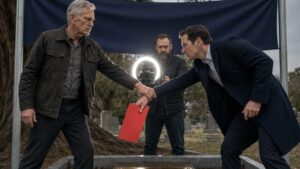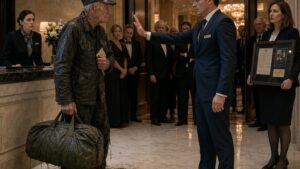
They Laughed at the Old Veteran Until His Inspection Exposed the Entire Range
Chapter 1: The Old Man Beyond the Safety Line
The steel target dropped before anyone fired.
Its heavy plate struck the wooden stop with a flat metallic crack, and a young Military Police soldier at the starting box lifted his rifle away from the course.
“Cease movement,” Michael Davis called.
The command cut through the museum courtyard, sharper than the recorded martial music playing near the public entrance. Spectators leaned forward behind the temporary barriers. Several active-duty MPs froze beside the portable walls arranged across the old stone paving.
At the edge of the crowd, William Harris stopped walking.
The worn rifle bag on his shoulder pulled against an old injury beneath his coat. He shifted the strap with his left hand, but the movement brought little relief. A repaired seam ran along the bag’s faded canvas side, its stitches darker than the original cloth.
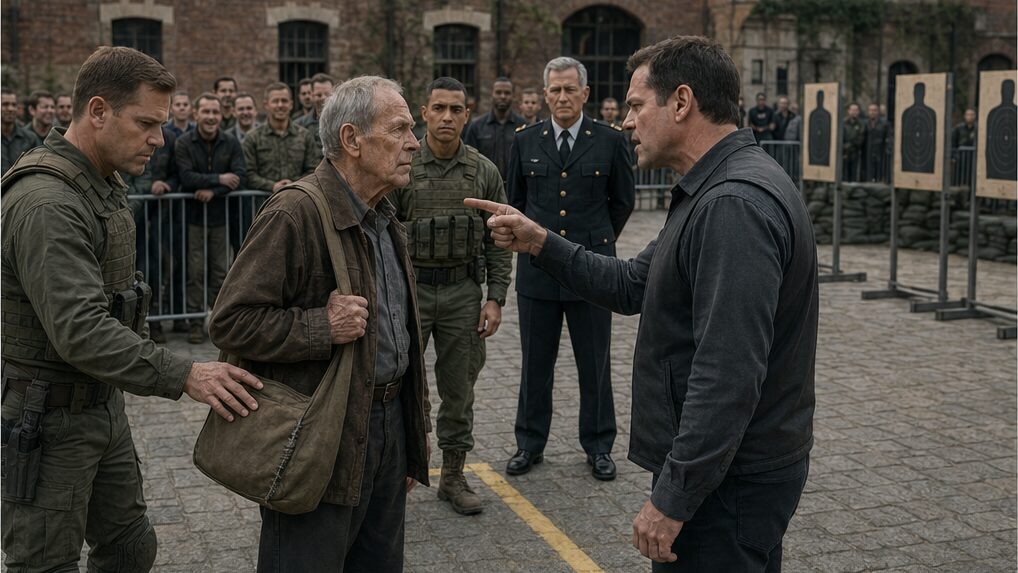
Beyond the painted safety line, Jeffrey Taylor strode toward Michael.
Jeffrey wore a civilian range vest over a pressed shirt, with a radio clipped high on his chest. He moved as if every eye in the courtyard belonged to him.
“What are you doing?” he demanded.
“Target moved before the start signal.”
“It fell off the reset hook.”
Michael kept his muzzle downrange. “Secondary lane hasn’t been confirmed clear.”
Jeffrey looked toward the command observation platform. Base Commander Christopher Wilson stood there with several senior personnel, listening without visible reaction.
The public event had been advertised as a demonstration of Military Police tactical precision inside the historic base museum courtyard. Old brick walls rose around the temporary course. Behind glass doors, retired uniforms and black-and-white photographs lined the museum galleries. Outside, steel targets, painted barricades, and bright boundary tape had turned the commemorative space into a working range.
Appearances mattered here.
Jeffrey knew it.
“The lane was cleared,” he said.
“I didn’t hear the clearance call.”
“You heard me give the start command.”
“That isn’t the same call.”
A few soldiers exchanged glances. William saw one suppress a smile, not because Michael had said anything amusing, but because Jeffrey’s patience was thinning in public.
Jeffrey stepped closer.
“You froze.”
“No, sir.”
“You stopped an active course because a plate slipped.”
Michael glanced past him, toward the far museum wall.
William followed the glance.
A volunteer in a museum jacket was moving behind the secondary barrier, carrying a folded sign beneath one arm. The barrier concealed most of the person from the firing box. Only a shoulder and the top of the sign appeared between two display panels.
Jeffrey turned and saw the volunteer too.
For half a second, his expression changed.
Then he faced Michael again.
“Reset the plate,” he ordered one of the assistants. “We’re running it again.”
No note was made on the course sheet.
No one called the secondary lane clear.
William’s fingers tightened around the rifle-bag strap.
Christopher had asked him to arrive without an escort and without ceremony. The invitation was folded inside the bag’s narrow side pocket, beneath a cleaning cloth and an old qualification card. It referred only to a private consultation concerning range standards.
William had agreed to the secrecy.
Formal inspections changed people. Voices became careful. Safety checks became theatrical. Records appeared exactly where they belonged.
He wanted to see the range when no one knew they were being judged.
He had seen enough to justify the arrangement.
He had not expected to see enough to regret it within five minutes.
Jeffrey pointed toward the staging area.
“Davis, step off the course.”
Michael did not move immediately.
“Sir, the secondary lane—”
“Step off.”
Michael lowered his rifle, cleared it under the supervision of the active-duty range officer, Gregory Smith, and moved behind the painted line.
Gregory avoided his eyes.
Jeffrey addressed the squad loudly enough for the spectators to hear.
“This is a confidence course. Hesitation spreads. One person loses trust in the sequence, everyone loses tempo.”
William looked again at the museum volunteer. The person had now disappeared through a side door, unaware of how close the course had come to restarting.
“Replace him,” Jeffrey said.
Another MP moved toward the firing box.
Michael stood rigid beside Gregory, his jaw set. He looked less ashamed than angry, but William recognized the restraint in his posture. It was the restraint of someone who had already learned that explaining himself would be called arguing.
Jeffrey took the course sheet from Gregory.
“Record it as refusal to execute.”
Michael turned. “I did execute the stop procedure.”
“You interrupted a cleared lane.”
“It wasn’t cleared.”
Jeffrey wrote something without looking at him.
William felt the old heat rising beneath his ribs.
Years had slowed his walk and put a tremor into his fingers. They had not softened his memory of young soldiers being punished for noticing what confident men wanted ignored.
He moved closer to the boundary.
A staff member near the entrance glanced at the worn bag and then at William’s lined face.
“Sir, museum visitors need to stay behind the rope.”
William did not answer. His attention remained on Michael.
The replacement shooter entered the starting box. Gregory began checking the line. Jeffrey stood near him, still holding the course sheet.
Michael spoke quietly.
“Request permission to submit a safety statement.”
“Denied until after the event.”
“That report will show I refused an order.”
“It will show exactly what happened.”
“No,” William said.
The word was not loud, but it carried.
Jeffrey turned.
So did the nearest MPs.
William stepped over the painted safety line. Pain moved through his shoulder as the rifle bag shifted against his coat, yet his pace remained steady.
Gregory raised one hand.
“Sir, stop there.”
William stopped only when he stood between Jeffrey and Michael.
Up close, he could see that Jeffrey’s confidence was not effortless. A pulse beat visibly near his temple. His gaze flicked once toward Christopher on the observation platform.
William knew that movement.
It belonged to a man performing for the person who could decide his future.
Jeffrey looked him over, from the old shoes to the worn rifle bag.
“This is an active range.”
“I can see that.”
“Then you can see you’re on the wrong side of the line.”
William turned his head slightly toward Michael.
The younger soldier stood waiting for punishment because he had noticed a human being behind a barrier.
William looked back at Jeffrey.
“The soldier stays on the course.”
Chapter 2: The Joke About William’s Shoulder
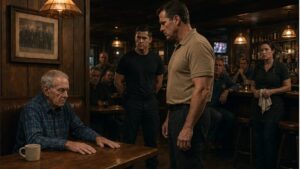
Jeffrey pointed at William’s right shoulder and smiled for the crowd.
“Careful, old man. That recoil might finish what old age started.”
Laughter broke from several soldiers near the equipment tables. A few civilians joined them, uncertain but willing. The sound bounced from the museum’s brick walls and died beneath the high windows.
William did not look toward those laughing.
He watched Jeffrey.
The years had changed Jeffrey’s face, thickened his neck, and placed authority in his voice. They had not changed the way he used humiliation. Even as a young trainee, he had discovered that a joke could make everyone else choose his side before a disagreement began.
William had corrected him for it once.
Clearly, not hard enough.
Michael stepped forward. “Mr. Taylor, he may have authorization.”
Jeffrey’s smile disappeared.
“You’re already off the rotation, Davis. Don’t make this worse.”
Gregory approached William with his palm out.
“Range credentials.”
William reached toward the side pocket of the bag.
Gregory moved faster and grabbed the bag near its repaired seam.
The canvas pulled tight.
William’s trembling hand closed around Gregory’s wrist.
The movement was so quick that Gregory stopped breathing for an instant.
William did not squeeze. He simply held the wrist away from the seam.
“Take your hand off my equipment.”
The laughter had ended.
Gregory’s face reddened. “I’m the active-duty range officer.”
“Then act like one.”
William released him.
Gregory stepped back and glanced at Jeffrey, searching for the authority he had momentarily lost.
Jeffrey gave a short, humorless laugh.
“He’s carrying a firearm onto a controlled course. Inspect it.”
William removed the bag from his shoulder and lowered it carefully onto an empty equipment table. The relief in his shoulder came with a deeper ache along his spine.
He opened only the narrow pocket and took out the folded invitation.
Gregory read it.
Christopher Wilson’s command letterhead was visible at the top. Beneath it, the message requested William Harris’s presence for a private consultation during the public range event.
Gregory read the final line twice.
“This authorizes consultation,” he said. “It doesn’t authorize entry onto a live firing line.”
“It brought me to the firing line.”
“It brought you to the museum courtyard.”
Jeffrey held out his hand. Gregory gave him the page.
Jeffrey scanned it, but William watched recognition arrive before he reached the signature. It appeared in the slight narrowing of his eyes, then vanished beneath practiced irritation.
“You know him,” Michael said.
Jeffrey folded the invitation once more than necessary.
“I know the type.”
William almost answered.
He could have spoken Jeffrey’s name the way he had spoken it across training ranges decades earlier. He could have described the young shooter who was talented, fast, and terrified of looking uncertain. He could have told the squad that Jeffrey had once stood under his instruction and waited for his approval.
But that would shift the question.
The range would no longer be judged on what had happened. It would become a dispute between an old instructor and a former student.
William held out his hand for the invitation.
Jeffrey kept it.
“Private consultation,” Jeffrey said. “That could mean the Commander wants advice on the museum displays.”
A few nervous laughs surfaced, weaker than before.
Jeffrey looked toward Christopher again. The Commander remained on the platform, his expression unreadable.
To Jeffrey, the silence looked like permission.
His club’s contract would be reviewed at the end of the month. William had seen that in the preliminary material Christopher sent him. Jeffrey needed today’s demonstration to look efficient, disciplined, and indispensable.
Instead, Michael had stopped the course.
Now an old man had crossed the line and contradicted him.
Jeffrey handed the invitation back.
“You can observe from the public side.”
“After the secondary lane is cleared,” William said.
“It was cleared.”
“No clearance call was made.”
Gregory shifted his weight.
Jeffrey turned toward him. “You confirmed it.”
Gregory hesitated only a moment. “Yes.”
William studied him.
“You saw the volunteer.”
Gregory’s gaze dropped toward the course sheet.
“I saw movement after the stop.”
“Before the restart order.”
Jeffrey stepped between them.
“This is not your inspection.”
William looked at the invitation in his hand.
That was the moment to correct him.
Christopher had trusted him to enter unnoticed. William had trusted that the truth would remain visible until he was ready to name it.
But Michael’s removal was already being written into an official record.
Silence no longer protected the inspection. It protected Jeffrey.
William knew that, and still he folded the invitation and returned it to the bag.
Gregory reached toward the zipper.
“I still need to inspect the weapon.”
William opened the main compartment himself.
Inside lay an old rifle, secured and cleared. Its dark receiver was worn pale at the edges. The grip had faded where the same hand had held it through years of training.
Gregory leaned closer and began to lift it by the fore-end.
William’s voice hardened.
“Muzzle downrange. Finger indexed. Action open.”
Five words, each one landing like a separate command.
Gregory corrected his grip before fully raising the rifle.
Several MPs who had laughed now watched in silence.
Jeffrey noticed.
His face tightened.
“This event is for active Military Police personnel and approved club instructors,” he said. “Not retired men looking for an audience.”
William’s anger moved closer to the surface.
He imagined Jeffrey years earlier, fast on the timer, impatient with slower trainees, always asking whether a rule mattered if the result was clean. William had believed experience would humble him.
Instead, success had taught him that results could erase methods.
William closed the bag.
“I didn’t come for an audience.”
“Then leave before you get one.”
Michael moved beside William. “Sir, I can escort him to the command office.”
Jeffrey picked up the course sheet.
“No. Escort him out of the courtyard.”
Michael stared at him.
Jeffrey wrote beneath the earlier entry.
“What are you adding?” Michael asked.
“Failure to comply with range authority.”
“I complied with the stop procedure.”
“You refused the course, challenged the range officer, and interfered with an event.”
“I reported a person in the secondary lane.”
Jeffrey finished writing.
“Now you’re delaying a lawful removal.”
He held the sheet toward Gregory.
“Add it to Davis’s misconduct record.”
Gregory accepted the page.
William saw Michael’s face change. Until then, the younger man had been fighting to remain on the course. Now he understood that the conflict could follow him beyond it.
Jeffrey pointed toward the museum arcade.
“Escort him out.”
Michael looked at William, then at the side exit beneath the arches.
“Yes, sir,” he said.
Chapter 3: The Soldier Ordered to Remove Him
“You can leave through the side gate,” Michael said quietly. “No need to walk past the crowd.”
He kept half a pace behind William as they entered the museum arcade. Gregory followed several yards back with the course sheet tucked beneath his arm.
The applause from the restarted demonstration had already begun behind them.
William carried the rifle bag on his left side now, keeping it between his body and the glass display cases. His right shoulder throbbed with each step. Reflections moved across the cases—old uniforms, polished helmets, faded photographs of MPs standing beside checkpoints in places the museum labels reduced to dates.
“You don’t have to spare me embarrassment,” William said.
“I’m not.”
Michael glanced back toward Gregory.
“I’m trying to keep this from becoming another entry in the report.”
William stopped beneath an arch.
“What was the exact command sequence?”
Michael looked at him.
“You saw it.”
“I saw part of it. Recite the sequence.”
Gregory came closer. “The escort doesn’t require a debrief.”
William ignored him.
Michael’s expression tightened, but he answered.
“Shooter loaded on command. I confirmed ready. Mr. Taylor called the course hot. The first plate dropped. I called cease movement.”
“What clearance preceded the start?”
“Primary lane clear.”
“Secondary?”
Michael was silent.
William waited.
“There wasn’t one,” Michael said.
Gregory folded his arms. “Secondary was already controlled.”
“By whom?” William asked.
“The course staff.”
“Name the person who confirmed it.”
Gregory’s jaw moved, but no answer came.
Michael looked from him to William.
“I saw the volunteer through the gap behind the barrier,” he said. “Carrying a sign. I called the stop because I couldn’t confirm where he was going.”
“Did Jeffrey see him?”
“Afterward.”
“And then?”
“He told the assistant to reset the plate.”
William nodded once.
Michael’s anger sharpened. “You already knew that.”
“I needed to know whether you did.”
“What does that mean?”
“It means you stopped for a person, not for a fallen target.”
The tension left Michael’s shoulders for a moment. Someone had finally stated the difference.
Then it returned.
“There’s no camera angle on the secondary lane,” he said. “The public recording faces the shooter. Mr. Taylor knows that.”
Gregory spoke from behind them.
“The official log shows the lane was clear.”
“Because you signed it,” Michael said.
“I relied on the course director.”
“You were the range officer.”
Gregory looked toward the courtyard. “The event had already been delayed twice. The Commander was watching. The public was waiting.”
William felt the old anger stir again.
Pressure had always arrived wearing respectable clothes. A schedule. A ceremony. A senior observer. A promise that the shortcut would last only a moment.
“Did you see the movement?” William asked.
Gregory did not answer.
That was answer enough.
Michael turned to William.
“Who are you?”
William adjusted his grip on the bag.
“Someone who saw the volunteer.”
“That’s not what I asked.”
“No.”
“You know the commands. You know the lane design. Taylor looked at you like he’d seen a ghost.”
Gregory stepped nearer. “Davis, complete the escort.”
Michael’s frustration broke through.
“You crossed the line for me. You challenged a civilian representative in front of the Commander. Now there’s a misconduct entry with my name on it, and you still won’t say why your word matters.”
William looked through the nearest display case.
A photograph showed a line of young MPs on an old training range, each waiting for the person ahead to move before stepping forward. The image had been taken long before Michael was born, but the painted line in the photograph looked nearly identical to the one across the courtyard.
William had spent his life believing actions should make explanations unnecessary.
Stand in the right place. Stop the unsafe command. Demonstrate the standard. Let others draw the correct conclusion.
But institutions did not always preserve actions. They preserved signatures.
Jeffrey had already begun writing his version.
“My word matters because I saw it,” William said.
Michael’s face closed.
“That won’t clear my record.”
“No.”
“Then why won’t you tell them the rest?”
William met his eyes.
“Because the rest changes how they behave.”
“They’ve already behaved.”
The sentence landed harder than Michael intended. He looked away immediately, but William did not.
The younger man was right.
Christopher had wanted the range unguarded by ceremony. William had wanted the same. Yet he had held the truth so tightly that Michael was now carrying the cost.
Still, William could not bring himself to explain in the arcade, with Gregory listening and Jeffrey controlling the courtyard behind them.
Not yet.
Michael exhaled through his nose.
“I thought you stepped in because you understood.”
“I did.”
“Understanding isn’t much use if you let them write the lie.”
Gregory removed a radio from his vest.
“This conversation is over.”
He pressed the transmit button.
“Escort proceeding to the east gate.”
A voice answered through static, too faint to distinguish.
Gregory pointed down the arcade.
“Move.”
William resumed walking.
His shoulder had begun to burn. The rifle bag bumped lightly against his knee, and each contact reminded him of the invitation folded inside it—the authority he had refused to use while Jeffrey’s account hardened into record.
They reached the junction leading to the side gate.
Michael stopped.
“Sir,” Gregory warned.
Michael looked at William.
“I’ll take you to the gate. But I’m submitting my statement whether they accept it or not.”
“You should.”
“And I’m naming the missing clearance call.”
“You should do that too.”
Michael gave a bitter laugh. “You make it sound easy.”
“No. I make it sound necessary.”
Footsteps entered the arcade from the command stairwell.
Gregory straightened before the man appeared.
Christopher Wilson came beneath the arch without aides or ceremony. His gaze moved first to William’s face, then to the bag hanging from his left hand.
He saw the way William was holding his right shoulder.
“I should have met you at the entrance,” Christopher said.
William’s reply was quiet.
“You wanted to know what happened when no one prepared for me.”
Christopher glanced toward Gregory.
“I know enough to regret the method.”
Gregory’s face had gone pale.
“Commander, sir, we were informed this individual entered the live course without proper authorization.”
Christopher looked at the course sheet beneath Gregory’s arm.
“And you were escorting him out?”
“Yes, sir.”
“No.”
The single word emptied the arcade of movement.
Christopher stepped beside William and faced Gregory.
“You were not escorting him out,” he said. “You were bringing my inspector to me.”
Chapter 4: The Inspection Hidden Inside the Spectacle
Christopher’s apology came before Gregory found his voice.
“I should have stopped this at the line.”
William shifted the rifle bag away from his aching shoulder. “Then you would have learned less.”
They returned through the arcade toward the command platform. Gregory followed with Michael’s course sheet pressed against his side, no longer carrying it like routine paperwork. Michael walked beside William, close enough to help if the older man stumbled, but careful not to offer.
The public demonstration had stopped again.
Spectators waited behind the barriers while the squad stood near the equipment tables. Jeffrey remained at the firing line, speaking into his radio with clipped impatience. When he saw Christopher approaching with William, his mouth tightened.
Christopher led them up the short platform steps.
On the command table lay course diagrams, score sheets, incident forms, and a folder William had reviewed before arriving. Three anonymous complaints described shortened clearance sequences. Two alleged that scores had been adjusted after public demonstrations. Another claimed soldiers who questioned Jeffrey were removed from favored rotations.
None had included enough proof for formal action.
That was why William had come unseen.
Christopher lowered his voice. “You were supposed to observe the unit, not become the event.”
“I crossed the line.”
“I know.”
“I chose to.”
Christopher’s gaze moved toward Michael. “And I chose to let the situation continue because I wanted an unfiltered view. That decision is mine.”
Michael stood rigid, unsure whether the admission helped him.
Jeffrey climbed onto the platform.
“Commander, the course has been interrupted twice. We have visitors waiting, and the club’s demonstration window is limited.”
Christopher looked at him. “The range is closed until I reopen it.”
Jeffrey’s eyes went to William.
“So he is the consultant.”
“Inspector,” Gregory said quietly.
Jeffrey gave him a sharp glance.
Then he laughed once, without humor. “Inspector of what? Museum procedures?”
William placed the rifle bag on the equipment table.
“Range discipline.”
The words changed the posture of everyone nearby.
Jeffrey looked toward the spectators, then back at Christopher. “You brought in an outside evaluator without informing the course director.”
“I brought in a retired Military Police evaluator to observe how the course operated when no one was rehearsing for him.”
“We were conducting a public event. Of course it was rehearsed.”
“The safety sequence should not require rehearsal to exist,” William said.
Jeffrey turned fully toward him.
For a moment, the years between them seemed to collapse.
“You still do that,” Jeffrey said.
William did not answer.
“You stand there, say five words, and let everyone else wonder what judgment you’ve already made.”
Michael looked between them.
Christopher asked, “You know each other?”
Jeffrey’s smile returned, but this one carried old resentment.
“He trained me.”
A murmur passed among the MPs nearest the platform.
Jeffrey continued before William could speak.
“Years ago. He taught firearms qualification and tactical transitions. He believed every pause revealed weakness unless it was his pause.”
“That isn’t what he said to me,” Michael replied.
Jeffrey ignored him.
“He recommended me for civilian instructional work. Signed the letter himself.” His attention stayed on William. “Now he walks in carrying an antique rifle and pretends this is an impartial inspection.”
William opened the narrow pocket of the bag.
His fingers touched stiff paper beneath the folded invitation. He drew out an old qualification card, its edges softened from years inside the canvas.
Jeffrey Taylor’s name was printed across the top.
Below it sat a perfect score.
William had kept the card because it marked the day Jeffrey had learned to slow down. Not permanently, as it turned out. Only long enough to impress the man holding the timer.
“You earned this,” William said.
Jeffrey glanced at the card. “I know.”
“You were one of the best shooters in the group.”
The acknowledgment unsettled him more than an accusation would have.
William laid the card beside the course sheets.
“I believed ability would teach you responsibility.”
Jeffrey’s jaw tightened. “Ability built this program.”
“It helped.”
“This unit’s times improved after my club took over the advanced sessions. Qualification failures dropped. Public support increased. You think that happens because I let every nervous soldier stop the line whenever something moves behind a wall?”
Michael stepped forward. “It was a person.”
“It was a volunteer outside the marked lane.”
“You didn’t know that when you ordered the restart.”
Jeffrey turned on him. “Your issue is already documented.”
Gregory looked down at the sheet.
William noticed.
“Let me see it.”
Gregory hesitated, then placed the document on the table.
The entry stated that Michael had entered the course, failed to confirm his lane, and halted after losing confidence during the opening transition. Beneath it, Gregory’s signature certified the sequence.
William read it twice.
Michael leaned over the edge of the table. “I never entered the course.”
Jeffrey pointed toward the starting box. “You crossed into the firing area.”
“I remained behind the start marker.”
“You accepted the rifle-ready command.”
“That isn’t entering the course.”
Gregory’s face had gone gray.
Christopher picked up the sheet. “Did you witness this sequence?”
“I witnessed most of it, sir.”
“That is not an answer.”
Gregory looked at Jeffrey, then at the squad.
“The event was moving quickly.”
William heard the defense beneath the words. Pressure. Timing. The Commander watching. The public waiting.
The same reasons men had offered for every shortcut William had ever regretted.
He looked at Jeffrey’s old qualification card.
Back then, Jeffrey had been fast enough to make instructors proud and defensive enough to make correction difficult. William had called it competitiveness. He had told himself maturity would finish the work training could not.
Then he had signed the recommendation.
Christopher placed the disputed sheet flat on the table.
“This entry is suspended pending review.”
Jeffrey shook his head. “So one old instructor walks in, takes the side of a soldier who refused a command, and the entire course becomes suspect?”
“The complaints existed before he arrived,” Christopher said.
“Anonymous complaints.”
“Four of them.”
“From people who couldn’t meet the standard.”
William closed his eyes for a moment.
He knew what he should do.
End the inspection. Present the missing clearance call. State that Jeffrey’s behavior and Gregory’s record required suspension. Keep the matter procedural.
Instead, anger pushed against his restraint.
Not anger at the shoulder joke.
Anger at the written lie.
Jeffrey saw the hesitation and mistook it for weakness.
“Run the course,” he said.
Christopher’s expression hardened. “This is not a competition.”
“No, sir. It is a competency question. He challenged my methods in front of the unit. Let the unit see the standard he claims we abandoned.”
William looked toward the tactical layout.
Portable walls formed a narrow passage across the courtyard. Steel targets waited behind angled barriers. The course demanded kneeling transitions, lateral movement, and a final shot from behind low cover.
His shoulder warned him before he moved.
Michael came closer. “You don’t have to prove anything.”
That was true.
It was also not the reason William opened the worn bag.
He removed the rifle carefully and placed it on the table with the action open. The receiver carried a pale diagonal scar near the ejection port.
Christopher studied him. “William.”
William looked at Jeffrey.
“I’ll run it.”
Chapter 5: When the Trembling Hand Became Still
Jeffrey started the timer before William had shouldered the rifle.
The electronic tone split the courtyard.
William remained behind the starting marker.
Several spectators gasped as the numbers began climbing on the display. Jeffrey stood beside the timer with one thumb pressed against its casing.
“Course is live,” he called.
“No,” William said.
He checked the chamber, verified the action, and looked toward Gregory.
“Range status.”
Gregory swallowed. “Primary lane clear.”
“Secondary lane?”
Silence.
William waited while the timer continued.
Christopher stepped to the platform rail. “Secondary lane status.”
Gregory lifted his radio and forced the full confirmation through the course staff. Only after two separate replies came back did he raise his hand.
“Both lanes clear.”
William shouldered the rifle.
The tremor in his left hand was visible now. A whisper moved through the crowd.
Jeffrey glanced toward the senior personnel near Christopher, as if the shaking proved the point he had made about William’s age.
William lowered his eyes to the receiver.
His thumb passed over the diagonal scar.
For an instant, the museum courtyard disappeared.
He saw another range, years earlier, its ground dark with rain. A young MP had been waiting at a barrier while an instructor pushed the sequence faster to recover lost time. The clearance call had been shortened. William had heard it and known it was incomplete.
He had hesitated.
Only a second.
Long enough to wonder whether correcting the instructor publicly would undermine him.
The young MP followed the order. A moving steel assembly released at the wrong moment and struck him across the leg. The injury ended his field career.
The rifle in William’s hands had fallen against the barrier when he ran forward. The receiver had taken the scar.
He had kept it unpolished.
Some marks were not meant to disappear.
His thumb stopped moving.
So did the tremor.
William straightened.
“Reset the timer.”
Jeffrey stared at him. “You failed to begin.”
“The course was not clear.”
“You received the start tone.”
“I did not receive the clearance.”
Christopher’s voice crossed the courtyard.
“Reset it.”
Jeffrey’s face reddened. He pressed the timer back to zero.
Michael stood behind the painted safety line, watching William’s hands.
This time, Gregory completed every call.
William settled the rifle against his shoulder.
The tone sounded.
He moved.
The first two targets appeared through narrow openings in the portable wall. Two controlled shots rang across the courtyard, spaced so closely they seemed joined. Both steel plates snapped backward.
William stepped laterally, never crossing his feet, and entered the passage.
His body was no longer quick in the careless way Jeffrey valued. It was economical. Nothing moved without purpose. The rifle remained aligned as he shifted from standing to a supported crouch.
Three targets.
Three impacts.
Jeffrey’s expression changed.
William reached the first transition point and changed position behind a waist-high barrier. Pain drove into his right shoulder when he lowered himself, but his breathing did not break rhythm.
He engaged the angled plate, rose, and advanced.
The crowd had gone silent.
At the edge of his vision, a strip of fabric moved.
A museum banner fixed to the brick wall had loosened at one corner. Wind pushed it outward, then across the opening toward the secondary lane.
William stopped.
The timer kept running.
“Course halt,” he called.
Jeffrey threw one hand up. “There is nothing in the lane.”
“Obstruction moving into sightline.”
“It’s cloth.”
“Course halt.”
William kept the rifle downrange and his finger indexed along the frame.
The banner snapped again. Its lower edge drifted across the narrow view between two barriers, briefly hiding the secondary target.
Jeffrey turned toward Christopher.
“This is exactly what I mean. He’s creating stops to control the conditions.”
Michael spoke from behind the line. “The sightline changed.”
Jeffrey rounded on him. “You are not participating.”
“No,” Michael said. “I’m observing.”
William remained motionless.
Every second increased his displayed time. He did not look at it.
Gregory stared at the banner, then raised his radio.
“Course remains halted. Secure the obstruction.”
An assistant moved along the museum wall outside the active lanes and fastened the loose corner. Gregory waited until the assistant cleared the area, then conducted the lane confirmations again.
“Course clear.”
Jeffrey pointed toward the timer. “The run is already invalid.”
Christopher came down from the platform.
“Under the MP safety standard, a confirmed environmental obstruction permits a controlled stop and restart.”
“This is my club’s course.”
“It is my base.”
Christopher looked at Gregory.
“Reset the timer at the transition.”
Gregory nodded.
Jeffrey stepped close to William while the position was marked.
“You think this proves discipline?” he asked quietly. “Stopping every time the world moves?”
William kept his eyes downrange.
“Knowing when to stop is part of moving.”
“You always needed the last word.”
“No. You always needed no one else to have one.”
For the first time, Jeffrey had no immediate answer.
The timer was adjusted to preserve William’s completed stage while recording the safety interruption separately.
William returned to the marked position.
Michael stood beyond the painted line, his face no longer uncertain.
William understood then that the run was not about beating Jeffrey.
It was not about the laughter or the shoulder joke or even the old recommendation card.
Michael needed to see someone stop under pressure and remain standing afterward.
The restart tone sounded.
William drove forward.
He crossed the final corridor, changed shoulders at the narrow barrier, and engaged two targets from opposite angles. His transitions were fast but not rushed, the rifle returning to the same line each time.
At the low cover position, his knee struck the stone harder than intended. Pain flashed upward through his hip. The front sight dipped.
He paused for half a breath.
Jeffrey leaned forward.
William rebuilt the position instead of forcing the shot.
The target appeared in the opening.
Steel rang.
He rose with difficulty, using the barrier for support only after the rifle was secure. The final target stood at the far edge of the courtyard, small against the old brick wall.
One round remained in the sequence.
William could hear his own breathing.
He could also hear the young MP from years ago being told to continue.
He placed his thumb briefly over the receiver’s scar.
Then he fired.
The final plate struck its stop.
Silence followed the echo.
William opened the action, cleared the rifle, and waited for Gregory’s inspection before lowering it.
No flourish.
No raised hand.
No glance toward the crowd.
Gregory approached the scoring display. He checked the recorded impacts, then checked them again against the course sheet.
Jeffrey stood beside him.
“There was a restart,” he said.
“Recorded separately.”
“He stopped the course.”
“For an obstruction.”
“He used a nonstandard rifle.”
“It met the approved configuration.”
Jeffrey reached for the scoring tablet, but Gregory drew it back.
The active-duty range officer looked toward Michael first.
Then toward William.
“Perfect score,” he said.
The words spread through the courtyard.
Gregory studied the clean procedural time, subtracting only the authorized halt interval. His eyes widened.
Christopher stepped beside him. “Result?”
Gregory turned the tablet so the Commander could see it.
“Zero misses,” he said. “No penalties.”
Jeffrey’s face had gone still.
Gregory looked again at the final time.
“And it is the fastest clean run recorded today.”
Chapter 6: The Score Was Not the Verdict
The applause began before William had closed the rifle’s action.
He raised one hand.
The sound weakened, scattered, and stopped.
William stood beside the equipment table with the rifle held safely across his body. His shoulder burned from the course. His knee had begun to stiffen. Sweat cooled beneath his collar.
Jeffrey recovered first.
“A good run,” he said loudly. “An impressive one.”
The praise was too smooth.
“But this event is not decided by one shooter’s score. It does not address Davis’s refusal to follow a course command, and it certainly does not determine a civilian contract.”
Several spectators nodded. The transformation they had witnessed could become entertainment if Jeffrey moved quickly enough—an old veteran surprising a crowd, nothing more.
William placed the rifle in the open bag.
He started to close it.
Then he saw Michael standing beyond the painted safety line, still removed from the squad.
William left the bag open.
“The score proves one thing,” he said. “The course can be completed without removing the safety sequence.”
Jeffrey folded his arms. “By someone who designed half the old sequence standards.”
“And stopped when the lane changed.”
“You stopped for a banner.”
“I stopped because I could no longer confirm what was beyond it.”
Michael’s gaze remained on William.
Christopher brought the disputed course sheet to the table.
“This is the issue now.”
Gregory stood on the opposite side, staring at his signature.
Christopher tapped the written sequence.
“It says Davis entered the course, failed to verify his lane, and panicked after movement began.”
Michael said, “That is false.”
Jeffrey looked at Gregory. “You witnessed the event.”
Gregory’s throat moved.
“I witnessed Davis receive the ready command.”
“Did he cross the start marker?” Christopher asked.
Gregory did not answer.
William closed his fingers around the bag’s repaired seam.
He could let the silence work.
He had done so for most of his life, waiting for uncomfortable men to fill it with truth.
But Gregory’s silence was not confession yet. It was shelter.
“Who instructed you to write the sequence that way?” William asked.
Jeffrey turned sharply. “That is an accusation.”
“It is a question.”
Gregory looked at the squad, then at the spectators still gathered behind the rope.
“Mr. Taylor said the report needed to reflect the course command.”
Jeffrey’s voice dropped. “Be precise.”
Gregory flinched.
Christopher did not.
“What did he tell you to change?”
Gregory drew a breath.
“He said Davis had functionally entered once he accepted the ready command. He told me to record the stop as loss of confidence after entry.”
Michael’s face hardened. “You knew I was behind the marker.”
“Yes.”
“And you signed it.”
Gregory lowered his eyes. “Yes.”
Jeffrey stepped toward the table.
“The distinction is administrative. Davis refused a lawful start command during a public demonstration. The wording does not change that.”
“It changes who failed the procedure,” William said.
Jeffrey looked at him with open anger now.
“Tell them the rest.”
William knew what he meant.
Jeffrey pointed at the old qualification card lying near the range forms.
“Tell them who recommended me. Tell them who wrote that I possessed exceptional judgment under pressure.”
Christopher looked at William.
Michael did too.
Jeffrey’s voice sharpened.
“This is not an inspection. It is an old man correcting his own embarrassment.”
The accusation landed because part of it was true.
William had spent years remembering the recommendation as a minor professional decision. Watching Jeffrey today had stripped away that comfort.
He faced the squad.
“I trained Jeffrey Taylor.”
No one moved.
“He was fast, accurate, and more capable than most people around him. I recommended him for instructional work.”
Jeffrey’s shoulders eased slightly, as if the admission had opened an escape.
William continued.
“I also saw that he treated correction as humiliation. I believed experience would change that. I signed the recommendation anyway.”
Jeffrey’s relief vanished.
“That was my error.”
Christopher asked, “Does that compromise your evaluation?”
“It makes me more responsible for stating it clearly.”
William looked at Michael.
“Davis did not lose confidence. He maintained awareness after the people directing him stopped looking.”
Michael’s jaw tightened, but this time it was to contain something other than anger.
William faced Gregory.
“You gave a civilian instructor’s version more weight than what you witnessed.”
Gregory nodded once.
“Yes.”
Christopher placed the course sheet before him.
“My authority cannot correct your signature. You will decide whether it remains.”
Gregory stared at the pen clipped to the board.
Jeffrey spoke quietly. “Think carefully.”
That choice made the final separation.
Gregory took the pen.
He drew one line through the misconduct entry, initialed the correction, and wrote beneath it that Michael had initiated a justified safety halt before crossing the start marker. He added that the secondary clearance had not been completed.
When he finished, his hand shook.
Christopher took the sheet.
“The club’s operational authority is suspended pending review. Gregory, you will submit a full corrective report before the range reopens.”
Jeffrey looked toward the spectators, measuring what remained of the performance.
William folded the old qualification card and returned it to the bag.
Christopher turned to him. “Your final recommendation?”
William could have ended it there.
Suspend Jeffrey. Retrain Gregory. Clear Michael.
All correct.
All insufficient.
He closed the rifle bag halfway, leaving the repaired seam visible.
“The range can replace an instructor,” he said. “It cannot order a soldier to trust it again.”
Michael looked up.
William handed Christopher the written findings he had begun before arriving, now marked with observations from the courtyard.
“Davis decides whether he returns to this course.”
Christopher studied him. “You are making reinstatement conditional on the soldier?”
“I am making trust conditional on the institution.”
Across the table, Michael stared at the corrected record.
The decision everyone had made for him was suddenly his own.
Chapter 7: The Path They Once Meant for Exile
Michael placed the removal notice on Christopher’s table and kept his hand over it.
“I won’t accept reinstatement under the same rules.”
The spectators had been dismissed from the museum courtyard. Without their voices, the temporary range looked smaller and less impressive. Portable walls cast long shadows across the stone. The steel targets had been lowered. Only the active squad, the command staff, Jeffrey, and Gregory remained near the painted safety line.
Christopher studied Michael.
“Your misconduct entry has been corrected.”
“The paper was corrected.”
Michael lifted his hand from the notice.
“The reason it happened hasn’t been.”
Gregory stood at the end of the table with a blank corrective-action form before him. He had removed his range vest. Without it, he seemed younger and less certain of where to put his hands.
Christopher said, “Tell me what would have to change.”
Michael looked toward the course.
“Any soldier who sees an unconfirmed hazard must have authority to halt the line. No retaliation. No automatic insubordination entry. The halt gets documented before the course restarts.”
Jeffrey gave a tired shake of his head.
“You cannot run advanced training if every participant has veto power.”
Michael faced him.
“It isn’t veto power. It’s responsibility.”
“It becomes an excuse the first time someone is afraid of the course.”
“Then investigate the halt afterward. Don’t punish the person before checking the lane.”
Jeffrey’s mouth tightened, but he did not answer.
William stood beside the equipment table, closing the rifle bag one section at a time. His fingers were trembling again. The steadiness that had carried him through the course had left as soon as the work ended.
He pressed the repaired seam flat beneath his thumb.
Christopher turned to him.
“You support this condition?”
William looked at the squad.
Several of the soldiers who had laughed earlier now avoided his eyes. Others watched Michael with the guarded attention of people wondering whether his refusal would improve their lives or make their next training day harder.
“Yes,” William said.
Christopher waited, expecting more.
William almost stopped there.
A single answer. A clean judgment. Let the regulation carry the meaning.
That was how he had spent most of his life.
But Michael had already shown him what silence cost when the wrong person controlled the record.
“My generation taught too many soldiers that obedience and discipline were the same thing,” William continued. “They are not.”
The squad remained still.
“Obedience follows an order. Discipline checks whether the order can be followed without abandoning the duty beneath it.”
Jeffrey looked away.
William’s hand rested on the rifle bag.
“I knew a young MP who followed an unsafe command because he had been taught that stopping would shame the instructor. His career ended on that range.”
Michael glanced at the scarred receiver visible through the half-closed bag.
William followed his gaze.
“I heard the incomplete clearance call,” he said. “I waited for someone else to correct it.”
The admission sat heavily in the empty courtyard.
Christopher’s expression changed. Until then, he had known the old incident only as part of William’s professional history. He had not known the hesitation.
William closed the compartment over the rifle.
“That is why Davis’s decision matters. He did what I failed to do.”
Michael lowered his eyes.
Christopher pulled the blank corrective form toward him.
“Effective immediately, any participant or range staff member may call a safety halt upon observing an unconfirmed hazard. No adverse action will be entered until the halt is reviewed by active-duty range authority.”
He pushed the form to Gregory.
“Write the full procedure. Include independent lane confirmation and protection from retaliation.”
Gregory picked up the pen.
“Yes, sir.”
“And the range remains closed until it is approved.”
“Yes, sir.”
Michael looked at the removal notice still lying on the table.
Christopher asked, “Will that be enough for you to return?”
“Not by itself.”
Gregory stopped writing.
Michael continued.
“I want the corrected report distributed to the squad. Not my name. The failure. Everyone needs to know why the course stopped.”
Christopher nodded.
“It will be done.”
Michael folded the removal notice once, then tore it through the center.
He did not smile.
“I’ll return when the range reopens.”
The relief in Gregory’s face was brief and painful.
Jeffrey waited until Christopher moved away to confer with the squad. Then he approached William near the equipment table.
The old qualification card remained between them.
“I was under pressure,” Jeffrey said.
William lifted the bag onto his left shoulder.
Jeffrey glanced toward Christopher.
“The contract review. The public event. Complaints from soldiers who never liked demanding instruction. It got out of control.”
“No,” William said.
Jeffrey’s eyes hardened. “I’m trying to apologize.”
“You are describing weather.”
“What do you want me to say?”
“The part where you chose.”
Jeffrey looked toward the empty course.
William waited.
It would have been easy to humiliate him now. The squad was near enough to hear. Christopher had suspended his authority. Gregory had corrected the record. Jeffrey had no power left to defend.
William remembered how Jeffrey had once used an audience to make correction feel like defeat.
He would not repeat the method.
Jeffrey spoke more quietly.
“I saw the volunteer.”
William said nothing.
“I knew Davis had a valid concern. I thought if I acknowledged it, the demonstration would collapse and the contract would be gone.”
“So you changed the report.”
“Yes.”
“And mocked me because it kept the room on your side.”
Jeffrey looked at the ground.
“Yes.”
William picked up the old qualification card.
Jeffrey watched him, perhaps expecting it to be torn.
William placed it on the table instead.
“You earned that score,” he said. “You also earned what happens next.”
“Is that all?”
“Losing authority is not the same as losing the chance to become accountable.”
Jeffrey looked at the card but did not touch it.
Christopher approached William as the squad formed near the painted line.
“The museum director offered to reopen the entrance,” he said. “There are people outside who heard what happened. We could recognize your service properly.”
William adjusted the bag strap against his painful shoulder.
“No.”
“Not for the score. For the inspection.”
“The inspection belongs in the report.”
Christopher accepted the refusal, though not easily.
“I should not have let it continue as long as I did.”
“No.”
Christopher looked surprised by the blunt agreement.
William added, “Next time, learn less.”
A faint line appeared at the corner of Christopher’s mouth, but it did not become a smile.
Michael stood at the edge of the courtyard where the escort route met the center path. Earlier, he had offered William the side gate so the old man would not be marched past the crowd.
Now he stepped away from that route.
He moved behind the painted safety line and cleared the path through the center of the courtyard.
William walked toward him carrying the same worn rifle bag.
The repaired seam remained intact.
Michael came to attention.
One by one, the MPs beside him straightened. Boots aligned against the stone. Hands rose in a rigid salute without command, applause, or spoken praise.
Gregory was the last to raise his hand.
William did not stop.
He did not look toward the observation platform or the museum windows. He walked between the lowered targets and across the line Jeffrey had treated as decoration.
At the far side of the courtyard, he turned his head once.
Michael was still saluting.
William gave him a small nod—not as an inspector approving a soldier, but as one man acknowledging that another had stopped when stopping mattered.
Then he carried the worn bag through the museum gate and left the range in silence.
The story has ended.