The Captain Rigged Her Combat Test Until One Small Mirror Exposed Everything
Chapter 1: The Failure Written Before the First Shot
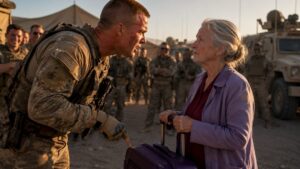
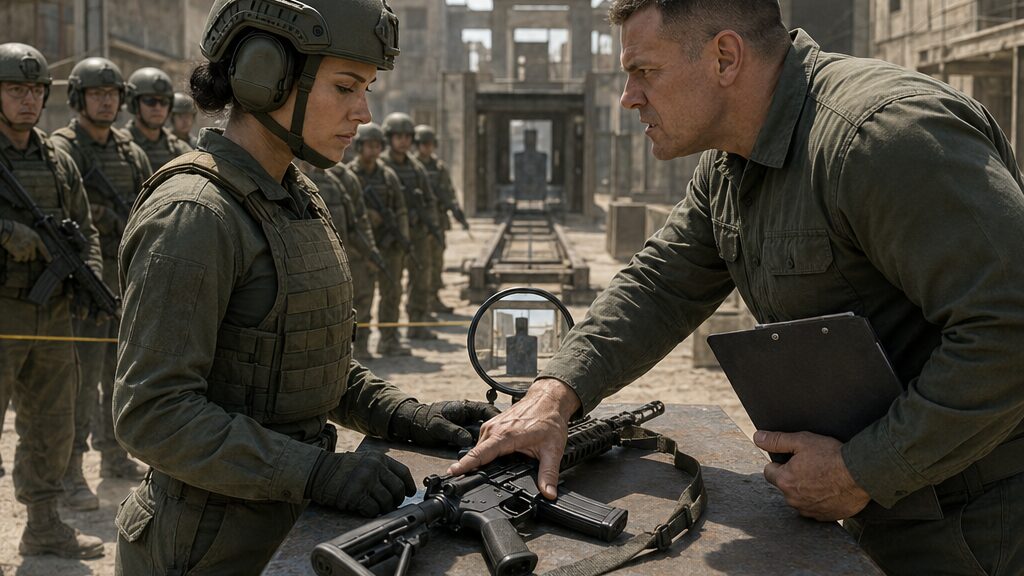
Captain Mark Carter slammed Catherine Wright’s M4 onto the steel bench hard enough to make the sling buckle jump.
“You’re too weak for that recoil,” he said. “Go back to a desk.”
The impact silenced the evaluation line.
Beyond the barrier, mechanized targets moved through the mock village: gray human silhouettes gliding between plywood storefronts, windows, and narrow alleys. Motors hummed beneath the concrete. Somewhere inside the course, a steel plate snapped upright and fell again.
Catherine looked first at the rifle, not at Mark.
The optic had shifted against the bench edge. Not enough to damage it, but enough that she would have to verify the mount before entering the lane. Her customized stock had been adjusted to her reach. Mark knew that. He also knew the weapon’s recoil was no greater for her than for anyone else using the same platform.
Behind him, Tyler Jones watched with two soldiers from Mark’s preferred group. Tyler had completed his run twenty minutes earlier. He had missed one moving target, entered a doorway before his partner signal, and received a score high enough to keep him first in line for the unit’s only open combat assignment.
Mark had called his run decisive.
Catherine had watched Amanda Lee record two timing warnings that never appeared on his final sheet.
“Permission to inspect my weapon, sir,” Catherine said.
Mark’s mouth tightened. “You need permission to pick it up now?”
“You struck the optic against the bench.”
A few faces turned away. Mark leaned over the score sheet on his clipboard and made a mark.
“Equipment uncertainty,” he said loudly enough for the platoon to hear. “Delayed response under pressure.”
Catherine lifted the rifle, kept the muzzle downrange, and checked the optic mount. Secure. She tested the action, confirmed the chamber clear, and returned the selector to safe.
On the far side of the bench lay a small articulated inspection mirror, the kind Amanda used to check cables and target housings without taking them apart. Its round glass caught a broken image of the line. Catherine saw one of her own eyes, calm beneath the rim of her helmet. Beside it, Mark’s torso stretched across the curved edge, broad and misshapen.
“Course card,” he said.
She handed it over.
The approved sequence was printed in narrow blocks: entry alley, Room One, roofline threat, intersection pair, final moving target. Catherine had memorized the identifiers and timing windows during the briefing.
Mark compared the card to nothing. He folded it once and tucked it beneath his clipboard.
“You won’t need to stare at paper if you know the course.”
“I do know it.”
“That sounded like a correction.”
“It was an answer.”
His pen scratched again.
Jason Moore stood three places back in the ready line. His expression did not change, but his gaze dropped to Mark’s clipboard. Catherine followed it for half a second.
The box beside overall result had already been checked.
FAIL.
Her run had not begun.
Mark noticed where she was looking and angled the clipboard toward his chest.
“Something distracting you?”
“No, sir.”
That was the response he wanted: no argument he could record, no anger he could display to the others as proof that she lacked control. Catherine had spent months giving him nothing except clean procedure.
She had once believed that was enough.
Amanda stepped from the control shelter holding a tablet. “Lane is loaded.”
“Standard sequence?” Catherine asked.
Mark answered before Amanda could. “Are you evaluating the technician now?”
Amanda’s eyes moved between them. “The file name is standard.”
“That wasn’t the question,” Catherine said.
Mark took one step closer. “You will enter when ordered, engage threats as presented, and stop inventing problems before they exist.”
The range officer raised a red flag at the tower. The village motors went still.
Mark pointed toward the start line. “Shooter ready.”
Catherine moved into position.
“Ready.”
The buzzer sounded.
The first silhouette rose behind a damaged vehicle shell. Catherine acquired it, fired twice, and moved. Two clean impacts rang from steel. She crossed the alley, paused at the mock doorway, checked the near corner, then entered.
The second target should have appeared one second after the door sensor registered her shoulder.
It appeared three seconds later.
Catherine had already reached the marked cover point. She turned within the approved firing arc, engaged it, and continued.
At the next threshold she stopped.
“Timing variance,” she called.
“Keep moving,” Mark shouted from the observation line.
“The second target was two seconds late.”
“Your hesitation was two seconds late.”
Amanda glanced down at her tablet. “She’s correct. Trigger signal registered at nine-point-four. Target rose at twelve-point-four.”
Mark did not look at her. “Mechanical lag. Continue.”
“Standard procedure requires a reset if target timing affects movement,” Catherine said.
He raised his clipboard. “Refusal to continue will be recorded as failure to obey a range command.”
There it was: not a mistake, not confusion, but a narrowing corridor. Stop and he would call it refusal. Continue and every irregularity became hers.
Catherine looked through the mock building toward the next alley. One of the targets ahead was already exposed when it should have been concealed. Its painted identification number faced partly away from her.
She could make out the last two digits.
Seventeen.
Her course card listed Twelve, Fourteen, Twenty-One, Twenty-Four, and Thirty.
No Seventeen.
“Proceed,” Mark ordered.
Catherine moved.
She cleared the next room without firing at the premature silhouette because its threat panel had not illuminated. Mark wrote something anyway. At the roofline station, a target rose on time. She placed two rounds center and heard the tower call the hits.
“Slow transition,” Mark said.
Her time was under the standard.
At the intersection pair, the left target stalled halfway, exposing only its shoulder. Catherine waited for positive identification, engaged the right threat, then fired when the left panel became visible.
“Failure to dominate the lane,” Mark announced.
The words were not for her. They were for everyone watching. He was building a version of the run faster than she could complete the real one.
Catherine exited the course at the interim checkpoint and placed the rifle on safe.
Amanda approached with the tablet. “The second delay wasn’t in the standard program.”
Mark cut across her. “Equipment variations are part of combat conditions.”
“Not during a scored standardization run,” Amanda said.
Mark’s face changed only slightly, but Catherine saw it—the brief calculation of how much pressure he could apply without making Amanda an open opponent.
“Are you certifying a fault?” he asked.
“I’m saying the delay command is in the sequence.”
“So the system functioned as programmed.”
“It wasn’t in the approved sequence.”
Mark turned to Catherine. “You’ve spent the entire run looking for reasons not to meet the standard.”
Catherine held his gaze. “I have met every published standard so far.”
Tyler gave a small laugh behind the barrier.
Mark tore the top sheet from his clipboard. “You hesitate, question commands, and blame equipment. Those are not isolated technical faults. They show a lack of combat aggression.”
He wrote again, pressing hard enough that the paper creased.
Catherine looked past him to the control monitor mounted beside Amanda’s shelter. The next lane was loading. Lines of text moved down the screen: target positions, activation times, route locks.
The final entry stopped her.
TARGET 17—MANUAL PATH ENABLED.
She knew every target on the approved diagram.
Seventeen was not one of them.
And someone had not merely added it to her course.
They had given it a path that required a human hand to activate.
Chapter 2: Every Correction Became Another Mark Against Her
The target inside Room One was already moving when Catherine crossed the threshold.
According to the lane status board, the room had been cleared.
The silhouette slid from behind a plywood wall at her left shoulder, its red threat panel glowing. Catherine pivoted within the marked arc, brought the muzzle level, and fired twice before the target reached the doorway.
Steel rang.
She returned the selector to safe before moving.
“Late acquisition,” Mark called from the elevated observation platform.
Catherine glanced at the digital timer reflected in the room’s plastic window. The reversed numbers showed one-point-one seconds from activation to impact.
The standard allowed two.
Mark’s pen moved across his sheet.
“Recorded time is within standard,” Amanda said through the range speaker.
“I’m evaluating judgment, not a stopwatch,” Mark answered.
Catherine exited into the alley. The mock village trapped sound between its false buildings. Boots on concrete, the hum of target rails, Mark’s voice from above—everything returned in thin echoes.
At the next corner, the instruction changed.
“Use the right-side approach,” Mark ordered.
Catherine shifted right.
“Why are you exposing yourself?” he shouted almost immediately. “Left side gives better cover.”
She stopped behind the vehicle shell. “You ordered right-side approach.”
“I ordered you to assess the approach. You chose poorly.”
Another mark.
The pattern was becoming clearer than the course itself. Mark did not need her to miss. He needed a record dense enough with subjective faults that any single challenge would appear petty.
She advanced through the second building, engaged a roofline target, and crossed the intersection only after both mechanical arms had locked. At every station, the actual performance and Mark’s narration moved farther apart.
Tyler’s score sheet lay on the ledge of the observation platform, held beneath a spare magazine. Catherine saw it when she climbed the exterior stairs toward the upper checkpoint.
The page was upside down, but the scoring columns were familiar.
Positive identification: full credit.
Controlled movement: full credit.
Command responsiveness: full credit.
Tyler had fired at an unlit target during his first room. Catherine had seen Amanda stop the course and reset it. Mark had called it “appropriate aggression under uncertain conditions.”
Catherine had waited for a threat panel to illuminate.
He had written hesitation.
At the top of the stairs, Mark blocked her path.
“Problem?”
“The scoring appears inconsistent.”
He smiled without humor. “You’re reading another soldier’s evaluation during your own assessment?”
“It was visible.”
“Loss of focus. Breach of professional boundaries.”
His pen scratched.
Catherine looked through the window behind him. The digital timer inside the control shelter showed her total run time. Mark’s handwritten sheet, reflected faintly in the pane, showed a different number—nine seconds slower.
“You added time,” she said.
The soldiers below went quiet.
Mark lowered the clipboard. “Choose your next words carefully.”
“The electronic total is four minutes, twelve seconds. Your sheet says four twenty-one.”
“Administrative time includes command delays.”
“Your command delays.”
His face hardened. “You see this as a contest between us. That is precisely why you are not ready for a combat assignment.”
Catherine felt the old instinct rise: say nothing, remember everything, preserve the clean line between his conduct and hers.
It had protected her file so far.
It had protected only her file.
Mark stepped aside and pointed down the rear stairs. “Continue.”
As she descended, Jason waited near the equipment rack, pretending to tighten his glove. He did not look at her.
“He changed your file,” he said quietly.
Catherine kept moving. “When?”
“After the briefing. I was in the control shelter signing for ammunition. He told Amanda he was correcting a route conflict.”
“Did you see the screen?”
“I saw your name and a new version number.”
“Will you state that?”
Jason pulled the glove strap hard. “I’m telling you so you know.”
“That wasn’t my question.”
His eyes met hers then. There was unease in them, but also something sharper.
“You knew what he did to Lisa,” he said. “You never asked anyone to stand up then.”
Catherine’s next breath caught against the inside of her vest.
Jason moved away before Mark could see them together.
The buzzer sounded for the close-quarters section.
Catherine entered.
The sequence was harder now, not because the targets demanded more skill, but because they violated the rhythm promised by the course card. A harmless silhouette appeared where a threat should have been. A target she was instructed to engage dropped before she reached the firing line. A door sensor triggered an alarm without activating anything.
She treated each irregularity as a safety problem, not an insult.
Identify. Confirm. Engage only within the arc.
At the last room, two targets rose nearly together. She fired controlled pairs, transitioned cleanly, and called the room clear.
The tower confirmed four center hits.
For several seconds, Mark said nothing.
It was the nearest thing to approval he had given her all morning.
Then he came down from the platform holding a typed form.
“You completed the section,” he said. “But completion is not qualification.”
Catherine read the heading before he covered it with his hand.
TRANSFER RECOMMENDATION.
“You prepared that before the final lane,” she said.
“I prepared for the likely outcome.”
“Desk assignment.”
“A role suited to your temperament.”
Behind him, Tyler shifted his weight. The combat slot had not been officially awarded, but his confidence suggested he had already been promised it.
Mark turned so the full platoon could hear.
“Technical accuracy does not compensate for hesitation, argument, and weak command response. In combat, indecision gets people killed. Effective immediately, I am recommending Catherine Wright be removed from operational consideration pending administrative review.”
No one smirked this time.
Catherine looked at Jason. He stared at the ground.
Mark had gone beyond failing her test. A single failed assessment could be repeated. A written judgment describing her as indecisive and resistant to command could follow her to another unit, another evaluator, another assignment.
He was not closing one door.
He was writing the explanation that would keep every later door closed.
Amanda emerged from the control shelter. “The final lane still has an unauthorized target entry.”
Mark faced her. “Load it.”
“I can reset to the approved file.”
“That is not what I ordered.”
“The system logs manual activation separately.”
“Then it will log that the range commander authorized an adaptive stress component.”
Amanda held the tablet against her chest. “It is not validated for this evaluation.”
Mark moved close enough that she had to tilt her head to keep looking at him.
“Your responsibility is system operation. Mine is training judgment.”
For a moment, Catherine thought Amanda might refuse.
Instead, she stepped back toward the shelter. Fear did not make her expression weak. It made it carefully blank.
Mark followed her to the door.
“Open target controls,” he said. “Final lane. Manual override.”
Amanda entered her code.
Mark reached past her and pressed something on the screen himself.
The course status light changed from green to amber.
Catherine could not see the command he had selected, but she saw Amanda’s hand stop above the console.
“That path isn’t forward of the line,” Amanda said.
Mark closed the control panel.
“It will be when I activate it.”
Chapter 3: The Target Outside the Safe Firing Arc
A motor started behind Catherine.
Not beside her. Not downrange.
Behind her.
The sound came from the narrow service corridor running along the backs of the mock storefronts—a rising mechanical whine followed by the chatter of a target carriage taking weight.
Catherine stood at the final firing mark with her M4 shouldered toward the approved lane. Twenty yards ahead, the alley narrowed between a false pharmacy and a roofless concrete shell. The platoon waited behind the painted safety line, slightly to her right.
Mark raised one hand.
“No one moves,” he ordered.
That command fixed every soldier in the exact area Catherine would sweep if she turned toward the sound.
She kept her muzzle forward.
“Unknown activation behind the firing line,” she called. “Cease fire.”
“Negative,” Mark replied. “Threats don’t wait for your preferred direction.”
“The course has a defined safe arc.”
“You have a threat. Engage it.”
The carriage accelerated.
Catherine could hear the target moving laterally behind the storefront wall, hidden from direct view. If it emerged where the sound suggested, it would cross a gap over her left shoulder.
A conventional turn would point her weapon across the platoon before the muzzle reached the target.
Mark knew it.
Catherine lowered the rifle by two degrees, maintaining the forward arc.
“Relocate personnel behind the line.”
“No.”
“Then the target cannot be safely engaged.”
Mark walked toward her from the observation position. “You wanted combat duty. This is combat uncertainty.”
“No live-fire standard authorizes firing across occupied space.”
“You are not being ordered to fire across occupied space. You are being ordered to solve the problem.”
The answer was polished enough to sound reasonable later. He would say he had tested her judgment. If she turned, the safety violation was hers. If she refused, he would call it paralysis.
The motor stopped.
For one breath, the village was silent.
Then it reversed.
Catherine tracked the sound in her head: distance, speed, direction. The carriage ran behind the left storefront, crossed a rear opening, then curved along something that had not been on the lane diagram.
At the edge of the firing point, the small inspection mirror remained attached to Amanda’s maintenance stand.
Catherine had noticed it that morning because it reflected Mark’s warped outline.
Now its handle rested against a coil of cable, the glass angled toward the storefront gap.
“Eyes forward,” Mark snapped.
“They are forward.”
“Then why aren’t you engaging?”
“No positive identification.”
“You heard the mechanism.”
“A mechanism is not a threat.”
His boots stopped less than an arm’s length behind her. Close enough that she could feel his presence through the tension in her shoulders.
“Your problem,” he said near her ear, “is that you think procedure can make decisions for you.”
Catherine did not answer.
The target carriage began another pass. This time she caught a sliver of movement through the gap between two walls—not the target itself, but the rail above it.
Bright scratches marked the mounting bracket.
Fresh metal showed beneath chipped paint.
The rail had been moved recently.
Not misprogrammed. Not accidentally activated. Physically repositioned.
The approved course kept all moving threats inside the forward fan. Someone had extended or redirected this rail so Target Seventeen could pass behind the shooter’s normal sightline.
Catherine shifted her left foot half an inch.
Mark saw it. “There. Hesitation.”
She settled again. “I am assessing the hazard.”
“You are freezing.”
The words carried toward the platoon. Catherine understood what he was doing: naming the failure before it occurred, as he had checked the box before her first shot. If she remained still, he would say he had predicted it. If she moved, he would claim his pressure had forced action.
Jason stood behind the line with his rifle slung. He looked from Catherine to the service corridor, finally recognizing the geometry.
“Sir,” he said, “we’re inside her turn.”
Mark did not take his eyes from Catherine. “You were ordered not to move.”
Jason’s jaw tightened.
Amanda stepped out of the control shelter. “The target path crosses rear sector three.”
“Return to your station,” Mark said.
“That sector isn’t certified for engagement.”
“It is not being used as a firing sector.”
“Then she cannot engage the target.”
Mark spun toward her. “One more interruption and I will remove you from range duty.”
The target motor surged.
Catherine reached down with her support hand, keeping the rifle stable and forward. Her fingers closed around the inspection mirror’s thin handle.
“What are you doing?” Mark demanded.
“Solving the problem.”
She lifted the mirror slowly, careful not to change the muzzle’s orientation. The round glass trembled at first, not from fear but from the vibration of the motor through the concrete. She braced the handle against the side of the rifle’s handguard without placing it near the action.
The mirror showed fragments: gray wall, strip of sky, Amanda’s maintenance stand.
She adjusted the angle.
Mark’s face appeared briefly, stretched along the edge.
Then the service gap came into view.
The target slid through the reflection backward, its red panel bright against the gray wall.
Catherine watched its path. The carriage traveled behind her, curved around the building, and entered a short diagonal section that brought the target parallel to the approved forward lane for less than two seconds. During that interval, she could keep the muzzle downrange and engage the reflected target as it crossed a legitimate impact area.
It was possible.
Barely.
The mirror did not create a safe shot. It revealed when the shot became safe.
Catherine let the target complete its pass without firing.
Mark laughed once. “You missed your opportunity.”
“I confirmed the route.”
“You had a visible threat.”
“Not yet inside the authorized arc.”
He leaned closer, voice rising. “This is exactly what happens when someone without combat instinct is given a weapon. You hide inside technical language because you are afraid to act.”
The motor reversed again.
Catherine saw the target return through the mirror.
Mark moved nearer, his boot touching the back of her heel.
It was a small contact, easy to deny, enough to disturb balance during a transition.
Catherine stepped forward into a more stable stance.
“Do not reposition unless ordered,” he shouted.
“You made contact with my firing stance.”
“Excuses.”
The target accelerated toward the diagonal section.
Catherine’s breathing slowed.
She no longer cared whether Mark gave her a passing score. The sheet had been decided. The transfer form had been prepared. Surviving the assessment quietly would not stop him.
But the trap had one weakness.
To expose her as unsafe, Mark had created a path that could be measured. To provoke a wild turn, he had left a brief moment when disciplined observation could prove that turning was unnecessary.
The mirror steadied.
Catherine brought the stock firmly into her shoulder. Her muzzle remained pointed through the alley toward the certified impact wall. Her support hand controlled both the rifle and the mirror angle. Her finger rested straight along the receiver.
Mark’s voice broke against the concrete walls.
“You don’t belong in combat!”
In the glass, the red panel entered the diagonal section.
Catherine disengaged the safety.
The target was still behind her body, but its reflected path now crossed the narrow, authorized lane ahead.
She raised the M4 toward that lane, never looking back.
The target moved faster.
In the mirror, it came fully into view.
Chapter 4: Three Rounds Through a Borrowed Reflection
Catherine cycled the action as the red panel crossed the mirror’s narrow field.
The target was moving in reverse in the glass, its true direction translated by reflection. She had watched one complete pass. She knew the carriage speed, the brief diagonal, and the instant when its steel face aligned with the certified impact wall.
Mark’s boot shifted behind her.
“Engage!”
She ignored his timing.
The target entered the safe lane.
Catherine pressed the trigger.
One report struck the false storefronts and returned from every wall at once. She corrected through the reflection and fired again. The target kept moving. Her third shot followed before it left the diagonal.
Three reports.
Not a burst. Three separate decisions, close enough to sound like a single hard tear in the silence.
Catherine placed the rifle on safe and lowered it without turning.
The target carriage rolled another foot and stopped.
No one spoke.
The little mirror still showed the gap behind her. Smoke thinned past its edge. Mark’s face occupied one curved fragment of the glass, pale and strangely elongated.
“Weapon down,” he said.
“It is safe.”
“I said down.”
Catherine kept the muzzle toward the impact wall. “Confirm the line is cold.”
Mark reached for the rifle.
Jason’s voice came from behind the safety stripe. “The line is not cold.”
It was the first time he had contradicted Mark where everyone could hear him.
Amanda lifted the range microphone. “Cease fire. Cease fire. All stations safe and clear.”
Only then did Catherine remove the magazine, lock the bolt open, inspect the chamber, and place the M4 on the bench with the ejection port visible.
Mark snatched the inspection mirror from her hand.
“You used unapproved equipment during a scored engagement.”
“It was an observation aid.”
“It was not issued for the course.”
“The target was not approved for the course.”
His jaw flexed.
“Unauthorized rapid fire,” he announced. “Failure to obey direct engagement commands. Improvised firing method outside validated procedure.”
He spoke quickly, stacking accusations before anyone could inspect what she had hit.
Amanda left the shelter and walked toward the stopped carriage. “We need to verify impacts.”
“The run is invalid.”
“Impacts still need to be logged.”
“I am the evaluator.”
“And I am responsible for the range record.”
Mark followed her, but Jason and the others had already begun moving toward the target lane after the all-clear. They did not crowd Catherine. They simply refused to remain where Mark’s version of the event could reach them before the evidence did.
The target stood at the end of the diagonal track, its red panel facing the group.
At first Catherine saw only one dark mark near the center.
Amanda put on gloves and leaned closer.
The mark was not one hole. Its edges were torn in three directions, a tight ragged shape no wider than the end of her thumb.
“Three impacts,” Amanda said.
Tyler stepped beside her. “Could be one strike and fragmentation.”
Amanda pointed without touching. “Three separate entry deformations.”
Jason crouched to sight across the plate. “Center.”
Mark arrived holding the mirror as though it were contraband.
“Accuracy is irrelevant if the method violates safety.”
Catherine looked back at the firing point. From here, the geometry was even clearer. The target had crossed behind her, then curved into the narrow forward diagonal. The platoon had remained outside the muzzle’s movement because the muzzle had never followed the target’s rear path.
“Pull the camera feed,” she said.
Mark rounded on her. “You are no longer giving instructions on my range.”
“The feed will show the firing arc.”
“The feed will show you performing a trick you prepared in advance.”
Catherine felt the accusation land more deeply than the others. Mark did not yet know about the notes she had kept or the records she had copied, but he understood the danger of appearing deliberate. If he could make the mirror look rehearsed, he could turn her precision into provocation.
Amanda was already moving toward the shelter.
Mark caught up with her at the door. “Delete the run and reload the approved course.”
She stopped.
The entire platoon heard him.
“Delete it?” Amanda asked.
“As invalid data.”
“The system retains invalid runs.”
“Then mark it corrupted.”
“It isn’t corrupted.”
Mark lowered his voice, but anger made it carry. “You told me the course had a mechanical issue. That compromises the data.”
“I said it had an unauthorized path.”
“You are making an accusation you cannot support.”
Amanda held the door frame. Catherine saw the fear in her face now. Not fear of Mark shouting. Fear that her login, her equipment, and her range could be made to carry his decision.
“I will preserve the raw file,” Amanda said. “If you want it removed, give me the order in writing.”
Mark stared at her.
For months, he had made paper serve him. Now paper had become a boundary.
He turned to Catherine instead.
“Secure her weapon.”
The range officer did not move.
Mark pointed. “Pending a safety investigation.”
Catherine stepped back from the bench. “The rifle is clear.”
The range officer approached and took possession of it, visibly checking the open action before placing it in a locked rack.
Mark lifted his clipboard. “You manipulated the lane, introduced equipment into an assessment, and fired without authorization. You are suspended from qualification.”
“You manually activated the target.”
“That is my authority.”
“You activated it outside the certified arc.”
“I introduced an adaptive threat to test whether you could function without controlling every condition.”
There was conviction beneath his anger. Catherine heard it. Mark believed command gave him the right to create uncertainty, and that anyone who questioned the boundary between uncertainty and danger was questioning command itself.
“You placed armed personnel inside the turn you expected me to make,” she said.
“I expected you to exercise judgment.”
“I did.”
Something shifted behind her.
Jason removed the magazine from his rifle.
He locked the action open, inspected the chamber, then let the bolt move forward with a hard metallic clack.
Mark looked at him. “What are you doing?”
“Clearing my weapon.”
“You were not ordered to clear.”
“I’m not continuing under a disputed firing command.”
For a moment, nobody joined him.
Then another soldier cleared a rifle.
Clack.
Tyler looked at Mark, then at the target. His hands remained on his weapon, uncertain.
A third rifle sounded.
Clack.
The noise traveled down the line until every soldier except Tyler had cleared. It was not applause. No one smiled. The synchronized metal sounded colder than approval—a unit withdrawing consent from the range conditions without abandoning discipline.
Tyler finally removed his magazine.
His clack came last and alone.
Mark’s face went still.
“You have all just participated in an organized refusal.”
Jason kept his rifle pointed downrange. “We cleared after cease fire.”
“You did it to challenge my authority.”
“We did it because nobody knows what the next manual command will activate.”
Mark raised the clipboard as if the sheets could restore the line.
An engine sounded beyond the village gate.
A dark command vehicle stopped outside the barrier. James Young stepped out before the driver had fully set the brake. He crossed the gravel with two staff members behind him, his gaze moving from the silent platoon to the locked rifle rack and then to the target stranded on its unauthorized rail.
“Who froze the range?” he asked.
“I did,” Amanda said.
Mark answered at the same time. “I have the situation controlled.”
James looked at neither of them first. He walked to the target and studied the overlapping impacts. Then he followed the rail with his eyes toward the rear corridor.
“Clear all systems,” he said. “No resets. No deletions. Preserve video, target commands, access logs, evaluation sheets, and weapon records.”
Mark stepped forward. “Sir, the soldier staged an unauthorized demonstration during a valid stress assessment.”
James looked at Catherine. “Did you know the target path before today?”
“No, sir.”
“Did you discuss using the mirror before the run?”
“No.”
“Why use it?”
“To identify the target without turning my muzzle across occupied space.”
“Did you fire while it was behind you?”
“I fired when its path entered the forward impact lane.”
James pointed to the observation tower. “Camera angle?”
Amanda answered. “One camera covers the muzzle. One covers the carriage.”
“Lock both files.”
Mark tried again. “This is being inflated into misconduct because she refuses adverse evaluation.”
James took the clipboard from him.
The failure box was checked. The transfer recommendation sat beneath it. The score sheet’s altered times were visible beside the printed electronic slips Amanda had begun attaching.
James read for several seconds.
Then he looked at Catherine.
“Your qualification is suspended pending review.”
Mark drew breath as if he had won.
James continued. “Captain Carter’s range authority is also suspended. No one enters the course until the system is examined.”
The satisfaction vanished from Mark’s face.
James handed the clipboard to a staff member and motioned Catherine toward the control shelter. Inside, the monitors still displayed frozen data. Target Seventeen’s manual path glowed amber on the central screen.
James closed the door, leaving Mark outside.
“You made a difficult shot,” he said. “That may prove skill. It does not prove motive, pattern, or corruption.”
Catherine said nothing.
His gaze sharpened. “I have already been told this is not the first evaluation you questioned.”
The room seemed to contract around the monitor glow.
“Who told you?”
“That is not the issue.”
“It matters whether the information is accurate.”
“Then make it accurate.” James lowered his voice. “If you possess earlier records and withheld them, your silence is now part of this investigation. Technical excellence will not protect you from that.”
On the screen, the target’s path remained drawn as a crooked amber line.
Catherine had spent months waiting for enough proof to make the line complete.
Now James was asking why she had allowed it to grow.
Chapter 5: The Soldier Catherine Protected Into Silence
James placed two forms on the briefing-room table and pushed them toward Catherine.
The first authorized a fresh assessment under a neutral evaluator.
The second opened a formal allegation of command misconduct and included a warning that her own failure to report could be examined.
“You can keep this narrow,” he said. “The course was irregular. We reset it, retest you, and investigate today’s decisions.”
Catherine looked at the signature lines.
“And the other evaluations?”
“If you allege a pattern, name it and support it.”
“Lisa Gonzalez.”
James did not react to the name. “Former member of this unit?”
“Yes.”
“Her file records a failed stress assessment and voluntary transfer.”
“That is not what happened.”
“Were you present?”
“I observed part of the run and saw the evaluation afterward.”
“Did you report discrepancies?”
“No.”
The word felt heavier spoken aloud than it had inside her own reasoning.
James folded his hands. “Why not?”
Catherine looked toward the dark window. Daylight had faded, turning the glass into a mirror. Her own face floated above the room behind her—calm, straight-backed, apparently untouched.
“She asked me not to.”
“What did she ask you not to disclose?”
Catherine’s eyes remained on the reflection.
“Mark crowded her during a confined-lane drill. He changed commands while a flash simulator malfunctioned. She had a panic response.”
James waited.
“She lowered her weapon safely. She did not fire. He ended the run and wrote that she became emotionally unstable while armed.”
“Was that false?”
“It was incomplete.”
“Incomplete is not the same as false.”
“He omitted the malfunction. He omitted his contradictory commands. He wrote that she endangered the line when she had already made the weapon safe.”
“And you have proof?”
“Copies of the course card. Her preliminary score sheet. Notes from other evaluations using the same language.”
“Copies obtained how?”
Catherine finally looked away from the window. “Some were left visible. Some soldiers gave them to me. One was in a discarded packet.”
James’s expression hardened. “You have been privately collecting personnel records.”
“I have been collecting discrepancies.”
“Without reporting them.”
“Yes.”
He tapped the formal-allegation form. “Then understand the risk. Captain Carter will say you have spent months constructing a case because you resented his standards.”
“He will say that either way.”
“Yes. But silence gave him time to say it first.”
The same truth had been waiting inside Jason’s accusation.
Catherine picked up her phone.
“I need to call Lisa.”
James rose. “This room is secured. I’ll give you privacy, but anything you submit must be voluntary and complete.”
When the door shut, Catherine found Lisa’s number and stared at it long enough for the screen to dim.
She had kept the promise exactly as Lisa had asked.
That had once felt honorable.
Now it felt like a locked door Catherine had stopped checking from the outside.
Lisa answered on the fourth ring.
“Catherine?”
“Yes.”
A pause. “What happened?”
Lisa had always heard pressure in the space around words.
“Mark altered my live-fire assessment today.”
“Are you hurt?”
“No.”
“Did anyone else get hurt?”
“No.”
“Then what does he say you did?”
Catherine looked at the two forms.
“Unsafe firing. Defiance. Planning a demonstration.”
Lisa gave a tired breath. “He likes words that keep working after he leaves the room.”
“There is an investigation.”
Another pause, longer this time.
“You want my file.”
“I want your permission to name what happened.”
“You already know what happened.”
“I know what I saw.”
“No. You know what I let you see afterward.”
Catherine tightened her grip on the phone. “I kept my promise.”
“I know.”
“You asked me not to report the panic response.”
“I know what I asked.”
“Then why does that sound like blame?”
“Because you never asked again.”
The words entered the room without force, and that made them harder to resist.
Lisa continued. “You treated one frightened conversation like a permanent order. I left. Months passed. People called me unstable because that was what his report said. You kept protecting the worst ten seconds of my life while he used them to define all the years before it.”
“I thought disclosure would hurt you.”
“It would have. It still will.”
Catherine closed her eyes.
“But that was supposed to stay my choice,” Lisa said. “Not yours.”
Outside the briefing room, footsteps crossed the corridor. Catherine watched their reflections pass through the window behind her face.
“Mark caused the conditions,” she said. “But you did panic.”
“Yes.”
“If we submit the whole record, he will use that.”
“I did panic. I also made my weapon safe. Both things are true.”
Catherine had built her case around contradictions in Mark’s records, trying to create a version of events with no vulnerable edges. Lisa was offering something less clean and more difficult: truth that did not require innocence to deserve fairness.
“What do you need from me?” Lisa asked.
“Your original evaluation, if you still have it. A statement. Permission to include the malfunction and panic response.”
“You have copies.”
“Not the signed original.”
“I kept it.”
Catherine had not expected that.
“Why?”
“Because for a while I wanted to burn it. Then I decided keeping it was the only way to remember that his version was paper, not memory.”
A knock sounded at the briefing-room door. James entered holding a new statement.
“Tyler Jones submitted this,” he said.
Catherine put the call on speaker with Lisa’s permission.
James laid the page before her.
Tyler claimed Catherine had discussed the inspection mirror before the test and had said Mark would “regret putting her on the final lane.” According to the statement, her three-shot engagement had been planned to humiliate him.
Catherine read it twice.
“I never said that.”
James pointed to the lower paragraph. “He also says Captain Carter warned him weeks ago that you might manufacture a confrontation.”
Mark had prepared his favored soldier as both beneficiary and witness.
Lisa’s voice came through the phone. “Who is Tyler?”
“The soldier promised the open combat slot,” Catherine said.
“Promised?”
“It was never official.”
“That doesn’t mean it wasn’t real.”
James pulled out a chair. “This statement creates a plausible argument that today was staged.”
“The target rail was physically moved.”
“That proves preparation. Not yet whose.”
“Amanda’s logs—”
“May prove access. They may also prove only that her credentials were used.”
Catherine looked at her reflection again. She had waited for perfect evidence because she believed perfect evidence could speak without exposing anyone.
Mark had used the waiting time to build people into his defense.
Jason feared standing beside someone who had not stood beside Lisa. Amanda feared being blamed through her own system. Tyler believed his opportunity depended on Mark’s judgment. None of them fit neatly into the record Catherine had imagined.
“Lisa,” she said, “I should have called you before this became necessary.”
“Yes.”
“I should have asked whether the promise still served you.”
“Yes.”
There was no absolution in Lisa’s voice. No punishment either.
A notification sounded on Catherine’s phone.
An email had arrived with two attachments: a scanned evaluation sheet and a signed statement.
Catherine opened the first file.
Lisa’s original score sheet contained handwritten notes in a different sequence from the official copy. The initial evaluator’s entry read: WEAPON SAFED AFTER SIMULATOR FAILURE. SUBJECT RECOVERED CONTROL.
Across the bottom, in Mark’s handwriting, the final version replaced it with: EMOTIONAL INSTABILITY CREATED AN UNACCEPTABLE ARMED RISK.
Lisa spoke quietly through the phone.
“Use my name.”
Catherine looked at the second attachment. It described the panic, the malfunction, Mark’s proximity, and the weapon she had made safe before her knees gave way.
“But use the whole record,” Lisa said.
Catherine placed the formal allegation beside the phone and signed it.
Chapter 6: The Record Proved More Than the Perfect Shot
Mark entered the command review carrying a document Catherine had never seen.
He placed it in front of James with the calm precision of a man arriving to correct an administrative misunderstanding.
“Adaptive Course Authorization,” he said. “Approved range-command discretion for stress variations.”
The document bore Mark’s signature and Amanda’s typed name beneath a technical certification line.
Amanda leaned forward from the opposite side of the table.
“I did not certify that.”
Mark did not look at her. “The authorization was prepared under my authority using your system assessment.”
“My name is not a system assessment.”
James raised one hand. “We will establish the document’s history before we establish anyone’s intent.”
The review was held in the simulation control room, emptied of ordinary personnel. Frozen screens showed Target Seventeen’s path. On the main table lay Catherine’s score sheets, Lisa’s original evaluation, electronic timing records, Jason’s statement, Tyler’s statement, and the mirror sealed in a clear evidence bag.
Catherine sat without her rifle, her combat qualification still suspended.
Mark looked across at her. “This is what happens when disagreement with evaluation becomes personal. Every difficult standard becomes sabotage. Every correction becomes prejudice.”
His voice was controlled now, stripped of the shouting he had used on the range.
“A unit cannot function if soldiers collect private files against their commanders and reinterpret training after the fact.”
James turned to Catherine. “You will have an opportunity to respond.”
Mark continued. “The target was an adaptive threat. Her answer was accurate but unauthorized. Accuracy does not erase disobedience.”
Catherine studied the new authorization. Its language was broad enough to sound familiar and careful enough to have been written after someone knew exactly what needed defending.
Amanda connected her tablet to the central display.
“The file was created at fourteen thirty-eight yesterday,” she said.
Mark’s eyes shifted toward the screen.
Catherine’s shots had been fired shortly after noon.
Amanda enlarged the metadata.
“The course authorization did not exist when Target Seventeen was activated.”
Mark folded his arms. “The written record documented an oral command decision.”
“Then why is my certification attached?”
“You confirmed the system could operate.”
“I confirmed the carriage could move. I did not certify the path for live fire.”
James examined the timestamp. “Can this establish who created it?”
“The account was Captain Carter’s.”
“Can accounts be accessed by others?”
“Yes.”
“Then the timestamp proves the document was created afterward. It does not, by itself, prove motive or authorship.”
Amanda’s mouth tightened, but she nodded. “Correct.”
The restraint gave her evidence more weight than an accusation would have.
She opened the access logs next. Her credentials had been used late the previous evening to alter Catherine’s course version. A camera outside the control shelter showed Mark entering after Amanda had left, but the interior camera had been offline for maintenance.
Mark leaned back. “I reviewed the course. That is within my authority.”
“Using my credentials is not,” Amanda said.
“You left an active session.”
“I logged out.”
“Then your system failed.”
“No. Someone entered my override code.”
James looked at her. “Who knew it?”
Amanda hesitated.
“Captain Carter had access for emergency operations.”
Mark spread his hands slightly. “There is no concealment in using authorized emergency access.”
“For a nonemergency scored assessment,” Catherine said.
James’s gaze stopped her before she continued.
Jason was called in next.
He stood at the end of the table, uncomfortable under Mark’s attention.
“You saw the course file changed?” James asked.
“Yes, sir.”
“Who changed it?”
“I saw Captain Carter at the terminal. I did not see every command.”
“Did you hear instructions during Catherine’s run?”
“Yes.”
“Were they consistent?”
“No, sir.”
Mark turned toward him. “Combat instructions change.”
Jason’s voice remained careful. “The scoring changed with them. She was marked down for following the first instruction and marked down again for not anticipating the second.”
“Did Catherine ask you to support her account?”
“No.”
“Did she discuss the mirror?”
“No.”
“Did she discuss allegations against me before the run?”
Jason looked at Catherine.
“She told me nothing,” he said. “That was part of the problem.”
The statement did not make her look flawless. Catherine felt James register it.
Tyler entered after Jason.
His confidence from the range was gone. He sat stiffly, hands flat on his knees.
James showed him his written statement. “Did Catherine tell you she intended to use the mirror?”
Tyler swallowed. “She mentioned it.”
“When?”
“Before the course.”
“Exact words.”
“She said the mirror could see around the storefront.”
Catherine remembered touching the maintenance stand during the equipment briefing. Amanda had explained that the mirror was used to inspect rear cables. Catherine had said it gave a clean view of the service gap.
That was not a plan.
James asked, “Did she say she intended to fire using it?”
“No.”
Mark’s head turned sharply.
“Did she say Captain Carter would regret placing her in the lane?”
Tyler looked down. “Not exactly.”
“Then why did you write that?”
“Captain Carter said that was what she meant.”
The room went still.
James let the silence remain.
“Were you promised the combat slot?” he asked.
Tyler’s face flushed. “He said I was the right fit.”
“Before all candidates completed qualification?”
“He said Catherine was unsafe. That she questioned orders and would fail when the course stopped being predictable.”
Mark spoke without waiting. “I offered professional assessment, not a guarantee.”
Tyler looked at him. Something in his expression changed—not allegiance becoming courage, but dependence becoming embarrassment.
“You said the slot was mine if I backed your evaluation,” he said.
Mark’s chair scraped the floor.
“That is false.”
Tyler flinched, then continued. “I believed her delays were dangerous. I believed what you said. But I never saw her plan the shot.”
His admission helped Catherine and implicated himself. That mixed cost made it difficult to dismiss.
James moved to the score sheets.
Lisa’s original lay beside Catherine’s current evaluation and three others she had collected. Different names. Different courses. The same phrases appeared repeatedly in Mark’s handwriting.
Lack of combat aggression.
Unstable under pressure.
Resistance to command correction.
The electronic data beneath each phrase told a less consistent story: acceptable reaction times, weapons made safe, targets correctly identified.
Mark looked at the pages. “Standard language exists because failures repeat.”
“Or because judgments do,” Catherine said.
James allowed that response.
He then closed the folder.
“I can remove Captain Carter from range authority based on procedural violations while a further review continues. Catherine can receive a neutral retest. The broader personnel materials can be sealed pending individual requests.”
Catherine understood the offer.
Mark would lose the range. She would get another chance. Lisa’s private panic would remain contained. The unit could call the incident a failure of procedure rather than a corruption of judgment.
It was more than Catherine had possessed yesterday.
It was also the same kind of narrow silence she had mistaken for protection before.
“No, sir,” she said.
James studied her. “Be precise.”
“I am requesting independent review of every evaluation affected by these alterations.”
“That will delay assignments and reopen completed personnel actions.”
“Yes.”
“It will also examine your handling of restricted documents and your failure to report.”
“Yes.”
Mark gave a quiet, bitter laugh. “She wants to burn the unit down to avoid one failed score.”
Catherine looked at him.
“I failed to report what happened to Lisa. I told myself I was honoring her request. After enough time passed, I was also protecting myself from having to explain why I had waited.”
James said nothing.
Catherine continued. “My silence should be reviewed. So should my qualification. I will not accept a pass based on yesterday’s shot.”
For the first time, uncertainty crossed Mark’s face. He had expected her to defend an identity built on perfect performance. By admitting failure where it was real, she left him less room to manufacture it.
“I request the approved course under a neutral evaluator,” she said. “The same standard available to every affected soldier.”
James opened a blank order form.
He signed the suspension of Mark’s range authority first. Then he authorized preservation of every assessment record and independent retesting for those whose scores were under question.
Finally, he looked at Catherine.
“Your live-fire performance yesterday remains evidence in the safety investigation. It is not a completed qualification.”
“I understand.”
“You will retest when the restored course is certified.”
Mark’s credentials were collected before he left the room. No one announced his removal. No one watched him as he surrendered the range access card.
Catherine watched the main screen instead.
Amanda cleared the unauthorized amber path from the display, but did not delete it. She saved it inside the investigation file.
The crooked line vanished from the active course.
A clean forward sequence appeared in its place.
Catherine had exposed the test that was designed to fail her.
Now she would have to stand on the line again and accept a judgment she could no longer blame on Mark.
Chapter 7: One Standard Applied Without Fear or Favor
Catherine found her failed evaluation clipped to the front of the new score packet.
The word FAIL remained boxed in Mark’s heavy ink. Beneath it lay a blank independent form, clean except for her name, the date, and the serial number of the restored course.
The neutral evaluator held out a hand. “You can remove the old sheet.”
Catherine left it where it was.
“No,” she said. “Keep both.”
The simulation village had been closed for a week. Amanda had inspected every rail, replaced two worn sensors, and restored the approved target sequence. Bright tamper seals now covered the control cabinet. Target Seventeen remained disconnected in the service corridor, its unauthorized path preserved for the investigation.
The inspection mirror sat inside Amanda’s open tool kit.
No one had placed it near the firing line.
Behind the barrier stood Jason, Tyler, and the rest of the platoon. They had been ordered to observe the standardized retest because their own evaluations would follow. No one joked. No one treated Catherine’s return as a performance.
James stood beside the control shelter, not on the evaluation line.
“Shooter ready?” the evaluator asked.
Catherine checked the optic mount Mark had struck against the bench a week earlier. Secure. She confirmed the chamber, seated the magazine, and faced the approved lane.
“Ready.”
The buzzer sounded.
The first target rose behind the vehicle shell.
Two controlled shots. Movement. Doorway. Near corner.
The course demanded speed, but it no longer demanded guessing. Every threat appeared inside a certified arc. Every harmless silhouette remained unlit. Commands came once, in plain language, and did not change after she obeyed them.
Catherine cleared the first room and crossed into the alley.
The timing display showed no unexplained delay.
At the observation platform, she passed the window where Mark’s handwritten numbers had once contradicted the reflected electronic clock. Today the evaluator entered her time only after the display locked.
No praise. No insult. Just a number.
Catherine continued.
A roofline target rose. She engaged it.
At the intersection pair, the right silhouette appeared first. The left mechanism began to lift, hesitated halfway, and stopped with its threat panel partly concealed.
Catherine halted behind cover.
“Cease fire,” she called.
The evaluator raised his hand immediately. “Cease fire confirmed.”
Behind the barrier, several soldiers shifted. The interruption had occurred at nearly the same point where Mark had accused her of lacking aggression.
Amanda checked her tablet. “Position sensor failed to confirm lock.”
“We can continue on single-target protocol,” the evaluator said.
Catherine studied the stalled mechanism. Its shoulder remained exposed, but its identification panel had not fully presented.
“Reset the lane,” she said.
The evaluator looked at her. “That will void the current time.”
“Yes.”
“You are within the passing window.”
“The target condition is not valid.”
For one second, Catherine felt the old pressure—the urge to prove she could overcome anything placed in front of her, to deny Mark even a shadow of justification.
Then James spoke from beside the shelter.
“Reset it.”
There was no irritation in his voice. No suggestion that caution required defense.
Amanda locked the system and sent a technician into the course. A loose sensor connection was reseated. The target rose and lowered twice without fault.
“Genuine mechanical failure,” Amanda confirmed.
The evaluator replaced Catherine’s timing sheet with a blank one.
No penalty. No argument.
Jason watched from behind the barrier. His expression changed slightly, as if he had just seen the difference between authority being obeyed and authority being trusted.
The course restarted.
Catherine passed the vehicle shell, cleared both rooms, and reached the intersection again. This time the pair activated correctly. She identified, engaged, and moved.
At the final lane, Target Thirty crossed the forward opening exactly as the approved diagram promised.
Catherine did not look toward the service corridor.
She did not need the mirror.
Two shots stopped the target inside the required zone. The evaluator called the line cold, inspected the weapon, and took the electronic results from Amanda.
He compared them to the blank sheet.
“Qualified,” he said.
That was all.
Catherine signed beneath the score. The old failed evaluation remained clipped above it, Mark’s conclusion facing the corrected record.
James approached after the weapon had been secured.
“The review board confirmed your combat eligibility,” he said. “Assignment decisions will be made after all affected soldiers receive their retests.”
Catherine nodded. “That is fair.”
Tyler stood several feet away, waiting for his own course card. He did not ask Catherine to forgive his statement. She did not offer reassurance he had not earned. But when he looked uncertainly toward the start line, she pointed to the printed sequence.
“Trust the card,” she said. “Stop if the course violates it.”
He accepted the instruction without mistaking it for friendship.
Amanda closed her tool kit. Catherine lifted the inspection mirror before the lid came down.
Its glass reflected her face without the curved distortion of the range bench. For the first time, she did not see Mark beside her.
She returned it to its fitted slot.
That afternoon, the remedial standards session took place on the training field.
Mark wore a plain uniform without a range badge. His authority remained suspended while the wider review continued. A neutral instructor supervised the physical assessment, but Catherine had been assigned to verify form for one station because the command wanted two observers on every recorded standard.
She almost refused.
Then she understood that refusal could also give Mark a special rule.
By the time he reached the push-ups, dirt darkened his sleeves and sweat had soaked the back of his shirt. The instructor counted aloud. Catherine stood to the side holding the clipboard, not over him.
Mark completed ninety-eight.
On the next repetition, his arms bent unevenly. His chest stopped above the required depth, and one knee touched the ground before he locked out.
“Ninety-eight,” Catherine said.
Mark looked up, breathing hard. “That was ninety-nine.”
“That repetition did not meet the standard.”
A week earlier, he would have heard humiliation in the correction because humiliation was how he had used standards.
Now there was nothing in her voice except the measurement.
He lowered himself again and completed the movement properly.
“Ninety-nine,” Catherine said.
The final repetition was slow but correct.
“One hundred.”
Mark remained on his hands for a moment. “Satisfied?”
Catherine looked at the blank beside the station result.
“This isn’t punishment because it applies to you,” she said. “And it wasn’t justice when it applied only to people you wanted to fail.”
She marked the station complete and handed the clipboard to the neutral instructor.
Mark’s score no longer belonged to her.
Across the field, Amanda’s tool case rested open beside the equipment table. The small mirror caught a fragment of sky and held it steady.
Catherine walked back toward the firing line, where the next soldier was waiting to be judged by the same course, the same clock, and the same rules.
The story has ended.