The Old Veteran Stood Beside A Barking Dog While Everyone Judged His Suitcase
Chapter 1: The Dog Sat Down Beside The Black Suitcase
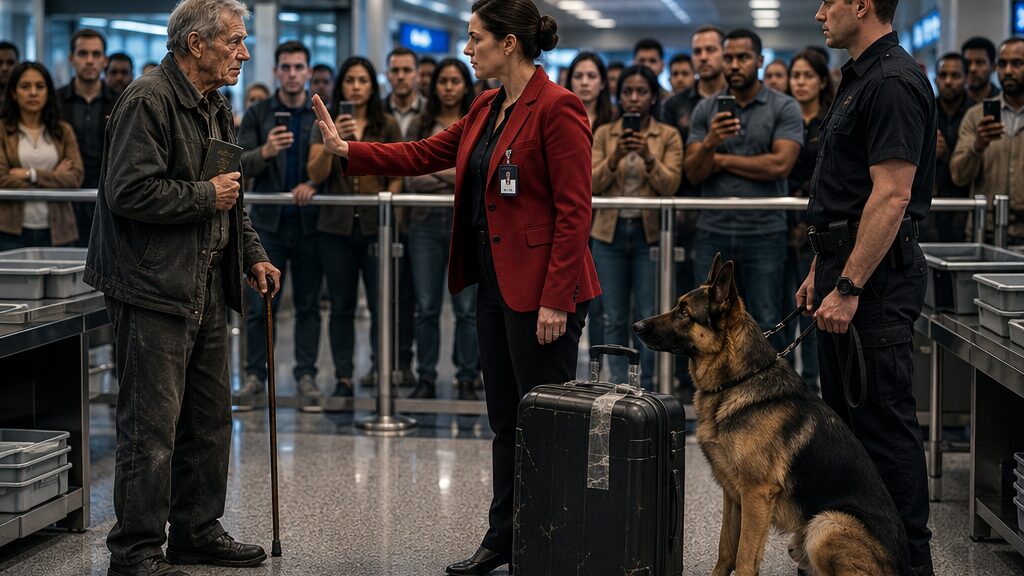
The German shepherd sat down beside Edward Sanchez’s black suitcase and would not move.
One second earlier, the dog had been walking past the inspection lane with its nose low and its ears sharp, guided by a uniformed handler through the ordinary shuffle of travelers, bins, belts, shoes, jackets, phones, hurry. Then it stopped beside Edward’s bag as if it had reached the end of a trail only it could see.
The line behind Edward went quiet in pieces.
First the woman with the stroller stopped complaining about the delay. Then a man in a gray suit lowered his phone from his ear. Then someone behind the barrier whispered, “That’s his bag,” not softly enough.
Edward stood with both hands visible, one curled around the handle of his cane, the other resting against the inside pocket of his worn field jacket. He had been reaching for the folded booklet there when the dog stopped. Now his fingers remained still against the fabric, feeling the softened corners through the lining.
The suitcase stood upright on its wheels between him and the dog. It was scuffed near the bottom from bus stations, airport shuttles, motel carpets, and the front step of a house Edward had sat outside twice without knocking. A strip of black tape covered a split near the handle. There was nothing remarkable about it except the way Edward looked at it.
“Sir,” the K-9 officer said, “please step back from the bag.”
Edward looked at the dog first.
The dog’s mouth opened slightly, tongue just visible, breathing steady. Not lunging. Not growling. Just sitting.
The handler’s nameplate read JONES. He was younger than Edward by forty years, maybe more, with a careful face and a leash held short but not tight. His eyes moved from the dog to the suitcase, then to Edward’s hands.
“Sir,” he repeated, firmer. “Step back.”
Edward moved one pace back.
It was not enough.
A woman in a red blazer came through the lane divider with the sharp walk of someone used to making space open before her. Her badge swung at her chest. Her hair was pinned back. Her eyes took in the dog, the suitcase, the old man, and the growing half-circle of delayed passengers.
“I’m Supervisor Wright,” she said. “Whose suitcase is this?”
Edward’s throat tightened before he answered. Not because the question was hard. Because of the way it was asked.
“Mine,” he said.
“Full name.”
“Edward Sanchez.”
“Do you know why the dog indicated on your luggage?”
“No, ma’am.”
The word came automatically, and he saw the tiniest flicker in her face, as if politeness from an old man either annoyed her or made her cautious. He did not know which.
The crowd behind the barrier thickened. A boy lifted himself on the metal rail for a better view. A woman near the stanchions raised her phone, then lowered it when Edward looked in her direction, then raised it again when he looked away.
Supervisor Wright noticed too.
“Sir, keep your attention here,” she said.
Edward returned his eyes to her.
His left knee had begun to ache from standing still. It always did when he had to pretend he was steadier than he was. He had woken before dawn to make this flight, had packed the suitcase himself with a towel under each item, had checked the zipper three times, had placed the folded booklet in his jacket instead of the front pocket because the front pocket had torn on the bus.
He had told himself he would not turn around this time.
“Do you have prohibited items in the bag?” Samantha Wright asked.
“No.”
“Sharp objects? Powders? Organic materials? Training aids? Chemical containers?”
Edward paused half a breath too long.
The handler saw it. The supervisor saw it. Several travelers saw only the pause and nothing before or after it.
“No prohibited items,” Edward said.
“That wasn’t what I asked.”
He drew the folded booklet from his jacket. His fingers were slow, and the paper resisted the cloth at first. Someone behind him made an impatient sound, the kind people made when an old person took too long at a card reader or a ticket kiosk.
Edward kept his gaze on the booklet until it was free.
“It may explain,” he said. “Some of it.”
Supervisor Wright did not take it immediately. Her eyes went to the booklet’s frayed spine, the yellowing tape along one edge, the corner soft from years of folding and unfolding.
“Hold it open,” she said.
Edward did.
The pages trembled only a little. He disliked that. He had learned years ago that people mistook trembling hands for a trembling mind.
William Jones leaned slightly to see, but kept his dog in place. The shepherd’s eyes stayed on the suitcase.
The booklet contained copies, stamps, an old inventory sheet, and a transfer notice with Army language that did not belong under the airport’s bright ceiling lights. Edward had reread it so many times that he knew which letters had faded, which ink smear crossed the date, which staple had rusted through the upper left corner.
Supervisor Wright scanned the top page without touching it.
“This is not current travel authorization,” she said.
“No, ma’am.”
“This is military property documentation.”
“Former military property.”
“That’s not a category in our passenger screening system.”
Edward heard a phone camera chirp.
It was a small sound. A tiny artificial click. But it moved through his body like a door closing.
He turned his head. A young traveler near the barrier held a phone chest-high, angled toward him. The traveler looked away too quickly.
“Sir,” Samantha said sharply, “do not engage with the crowd.”
Edward looked back at her.
“I wasn’t.”
“Then answer my question. What is in the suitcase?”
The answer sat behind his teeth, heavy and old. Gear. Records. A sealed packet. A collar that no dog wore anymore. A photograph he had never shown anyone. A promise he had postponed until postponement had become its own kind of lie.
Instead he said, “Items I’m delivering.”
“What kind of items?”
“Personal items.”
“Whose?”
Edward’s hand closed on the booklet.
“Mine to carry,” he said.
The supervisor’s face hardened.
The handler glanced at him, not unkindly, but with a warning in his eyes. In an airport, mystery had weight. Silence had consequences. Edward knew that. He had spent enough of his life around dogs, gates, fences, and commands to know that a withheld answer changed the air.
But there were things that should not be opened beneath fluorescent lights while strangers filmed from behind a rope.
Supervisor Wright stepped closer to the suitcase but did not touch it. “Mr. Sanchez, the K-9 has indicated on your luggage. You are now required to comply with secondary inspection.”
“I will comply.”
“You will step away from the suitcase.”
Edward already had.
“Farther.”
He looked at the bag.
The dog sat beside it, calm and certain, as if guarding it from the wrong side.
“Mr. Sanchez.”
Edward took another step back. His heel bumped the metal leg of a bench. He steadied himself with his cane and felt heat climb from his collar to his ears. Behind him, the line had fully stopped now. A security lane emptied. A family waited with their bins half-loaded. Someone whispered, “He won’t say what’s in it.”
That was how fast a life became a sentence in another person’s mouth.
He could tell them he had served. He could tell them what unit. He could say handler, trainer, retired, cleared, widower, old fool, sorry. He could open the booklet to the page that would make William Jones’s eyes change. He could say the dog was not wrong, only late.
He did none of that.
“I would like the bag opened in private,” Edward said.
Supervisor Wright’s eyebrows lifted, not with surprise, but with public patience stretched thin. “You don’t get to set the terms of an inspection.”
“No,” Edward said. “But I can ask.”
The softness of it made her angrier than if he had argued.
“Officer Jones,” she said, “maintain position. Mr. Sanchez, keep your hands where I can see them.”
Edward placed the booklet against his chest with two fingers spread over the cover.
The crowd watched him as if waiting for the old man to break into whatever shape would make their delay worth filming.
A boarding announcement rolled through the ceiling speakers, blurred by distance. Edward caught only the destination city and the word final. Not his flight yet. Not quite.
Supervisor Wright held out her hand.
“The document,” she said.
Edward gave it to her.
For a moment, the booklet left his fingers, and he felt more exposed than when the dog first sat down.
She looked through the first pages, then closed it halfway. “This bag may need to be opened, examined, and held until we can verify the contents.”
Edward’s cane pressed into his palm.
“Held?” he asked.
“If necessary.”
His eyes went to the suitcase again. Black tape on the handle. Scuffed wheels. The dog beside it, patient as memory.
“No,” Edward said, very quietly.
Supervisor Wright looked up.
Edward straightened as much as his back allowed. “You can inspect it. But you can’t take it away from me.”
Chapter 2: The Paperwork Looked Too Old To Matter
The first thing Samantha Wright noticed about the booklet was not the military language or the faded stamp. It was the care.
Edward Sanchez had not handed it over the way irritated passengers handed over boarding passes, licenses, exemption letters, medical cards, or crumpled printouts from websites they expected her to honor. He had released it slowly, thumb lingering at the spine, as if the booklet could feel abandonment.
That bothered her more than she wanted it to.
The secondary inspection desk sat ten feet from the lane, separated from the public by nothing more meaningful than a strip of retractable belt and the authority of people wearing badges. The dog still sat by the suitcase. Officer William Jones stood beside it, one hand on the leash, his shoulders square. The old man stood near the bench where she had placed him, cane upright, eyes lowered but not submissive.
Passengers watched from behind the barrier.
Samantha could feel their phones before she saw them.
“Mr. Sanchez,” she said, keeping her voice level, “this document appears to reference military working dog equipment.”
“Yes.”
“You’re transporting that equipment today?”
“Some retired items.”
“Retired items,” she repeated.
He nodded once.
She hated the answer because it sounded harmless and evasive at the same time.
The booklet’s first page had an inventory line, a unit abbreviation, an old serial number, and a government property stamp that looked too faded to satisfy anyone who liked forms clean and current. A photocopied transfer notice sat behind it. The date was years old. One section had been circled in blue ink, but the note beside it was handwritten, not official.
“This paperwork is incomplete,” Samantha said.
Edward’s jaw moved once before he answered. “It was complete when they gave it to me.”
“When who gave it to you?”
He looked at the suitcase.
There it was again. Not resistance exactly. Not panic. A door closing.
“Mr. Sanchez,” she said, “I need direct answers.”
“I’m giving the ones I can give out here.”
A man behind the barrier muttered, “Then take him somewhere else.”
Samantha pretended not to hear it. Pretending not to hear the public was one of the first skills airport work taught you. But she had never learned how to ignore being recorded. Not completely.
Two months earlier, at another checkpoint, a supervisor had waved a passenger through after an unclear bag check because the line was getting ugly and a holiday crowd was shouting. Nothing dangerous had happened, but the internal review had been brutal. The phrase failure to maintain procedural control had appeared in three separate emails. Samantha had not been the supervisor involved, but she had inherited the warning like a bruise.
Now a K-9 sat beside a suitcase, an old man gave partial answers, and twenty strangers were ready to turn ten seconds of her work into judgment.
She turned slightly toward William. “Officer Jones. Confirm indication.”
William looked down at the shepherd. “He stopped, sat, and held position.”
“Standard alert?”
William hesitated.
Samantha caught it immediately. “Officer?”
“He indicated,” William said.
“That wasn’t my question.”
The dog turned its head toward William’s voice, ears lifting. William lowered his hand and touched the leash clip, not to restrain the dog but to settle himself.
“It wasn’t aggressive,” he said. “No pawing. No change in breathing. No drive to get into the bag.”
“The dog sat.”
“Yes.”
“Which is an indication.”
“Yes.”
“But?”
William looked at Edward, then at the booklet in Samantha’s hand. “It felt more like recognition.”
Samantha kept her face still. “Recognition.”
“I know how that sounds.”
“Then don’t make it sound that way.”
Edward raised his eyes.
For one brief second, something moved across the old man’s face. Not relief. Recognition of recognition, maybe. Then it disappeared.
Samantha opened the booklet again because paper was safer than faces. “Mr. Sanchez, did you previously work with military dogs?”
“Yes.”
“What capacity?”
“Handler.”
The word was small. It landed anyway.
William looked at the suitcase again.
Samantha turned a page. “You are retired military?”
“Yes.”
“How long?”
“Long enough that most of the people who signed those forms are gone.”
The answer had a dryness that might have been humor if his hands had not been so tight around the cane.
Samantha heard another phone click.
She looked up sharply. “All recording must remain behind the barrier. Do not cross the lane.”
No one had crossed. That was the problem. They could shame a man perfectly well from where they stood.
Edward did not turn around this time.
Samantha felt a flicker of irritation, then uncertainty, then irritation again because uncertainty was useless in a live inspection. She could not build procedure around the ache in an old man’s eyes. The dog had indicated. The paperwork was old. The bag was unexplained. The passenger was withholding details.
Those were facts.
Still, when Edward said, “I asked for private screening,” she knew he had a point.
She also knew moving him now might look like she was hiding something from the crowd, and that thought disgusted her a little before she pushed it away.
“Mr. Sanchez,” she said, “if these are military items, why are they in a personal suitcase?”
“They were released.”
“To you?”
“Yes.”
“For what purpose?”
His fingers tightened again. “Delivery.”
“To whom?”
He did not answer.
Samantha closed the booklet. “That is not sufficient.”
“It is the truth.”
“It is not enough of the truth for this setting.”
At that, his eyes lifted fully to hers.
“No,” he said. “It is not enough for this setting.”
She understood the rebuke before she could refuse it.
William shifted his weight. “Supervisor Wright.”
“What?”
He had crouched now, one knee bent beside the dog but not touching the suitcase. “There may be residual odor on old bite sleeves, harnesses, training rewards. Depending on storage, depending on what’s packed with it—”
“Are you telling me the bag is clear?”
“No.”
“Then don’t.”
William stood.
Samantha knew that sounded harsher than necessary. She heard it after she said it, the way one hears a door slam after pushing too hard. Edward heard it too, but his expression did not change. That made it worse.
A secondary inspection officer approached from the operations hallway with a tablet. “Supervisor Wright? Operations is asking about a delay at lane four.”
Samantha did not look away from Edward. “Tell them we have a K-9 indication.”
“They know. There’s video circulating among passengers. Manager Hill wants to know if you need him on the floor.”
Of course he did.
Ronald Hill did not like surprises. He liked incident categories, clean timelines, and reports that could survive being forwarded. If there was video, he would come down. If there was an elderly passenger in it, he would come faster. If there was a dog beside a suitcase and a supervisor in a red blazer looking severe, he would arrive already thinking of liability.
Samantha handed the booklet back to Edward, but not directly. She placed it on the inspection desk between them.
He looked at it before picking it up. Just a flash of hurt. Ridiculous, she told herself. She had not thrown it. She had not damaged it. She had placed it on a desk.
Still, he picked it up as if rescuing it from a wet floor.
“Mr. Sanchez,” she said, “we’re moving this to secondary screening.”
“Private?”
“Controlled.”
“That wasn’t what I asked.”
“It’s what I’m authorizing.”
William’s dog stood when William gave the smallest leash signal, then sat again when the suitcase did not move. Its eyes remained fixed, not on the officers, but on the bag.
Samantha gestured to the secondary inspection officer. “Bring a cart.”
Edward stepped forward at once.
“Sir,” William said.
Edward stopped, but his voice changed. Not louder. Lower. “The suitcase rolls.”
“No one said it didn’t,” Samantha replied.
“Then I’ll roll it.”
“For safety reasons, you will not handle the bag until cleared.”
His face went pale beneath the airport lights.
The secondary inspection officer returned with a low metal cart. The wheels rattled as it crossed a seam in the floor. That ordinary sound made Edward flinch.
Samantha saw it. William saw it. The crowd probably did not. They only saw an old man resisting directions.
A man behind the barrier said, “Just open it already.”
Edward’s mouth tightened.
Samantha lifted her hand toward the crowd without turning. “Enough.”
The word came out with real authority, and for a moment she felt she had regained the scene. Then Ronald Hill arrived from the operations hallway in a dark suit jacket, phone in hand, eyes already moving over every visible risk.
“What do we have?” he asked.
“K-9 indication, incomplete military paperwork, passenger requesting private screening,” Samantha said.
Ronald looked at Edward, then at the suitcase, then at the watching travelers.
“And video,” he said.
“Yes.”
Ronald’s expression settled into the careful blankness of a manager preparing for a report. “Until cleared, that suitcase may need to be confiscated and held.”
Edward’s hand closed around the folded booklet.
Samantha saw the old man’s control falter for the first time.
“No,” he said.
Ronald turned to him. “Mr. Sanchez, this is not optional.”
Edward looked past them both to the black suitcase as the metal cart rolled beside it.
Chapter 3: Everyone Watched Him Choose The Suitcase
“Final boarding call for Flight 218 to Louisville,” the ceiling speaker announced, and Edward Sanchez heard his last good chance begin to disappear above him.
The words spread across the holding corridor, flattened by static and swallowed by the noise of wheels, bins, radios, and impatient travelers. He knew the gate number without looking at his boarding pass. He had traced the route on the airport map at home, then again on the shuttle, then once more from a bench near the entrance before his legs were ready to stand.
Gate B17. Eleven minutes away if he walked fast.
He did not walk fast anymore.
The black suitcase sat on a metal cart now, not five feet from him and somehow farther than it had ever been. A secondary inspection officer stood beside it. William Jones held the dog several paces back. Samantha Wright stood between Edward and the cart. Ronald Hill checked his phone as though Edward were a weather delay, a damaged scanner, a spill near concessions.
“Mr. Sanchez,” Samantha said, “we need to continue screening.”
“My flight,” Edward said.
“We’re aware.”
“I have to be on it.”
Ronald looked up. “Then cooperation would be in your interest.”
Edward’s eyes moved to him, then away. Men like Ronald Hill did not always mean to sound cruel. Sometimes they only believed efficiency was the same as decency.
“I have cooperated,” Edward said.
“You have withheld information about the contents of a bag that received a K-9 indication.”
“I asked to explain in private.”
“And we are moving to a controlled area.”
“With my suitcase on a cart I’m not allowed to touch.”
Samantha’s face tightened. “That is temporary.”
“Temporary can be long enough.”
Something in his own voice embarrassed him. It had come too close to pleading.
Behind the barrier, the crowd had shifted with the scene. Some travelers had lost interest and returned to their own delays. Others remained fixed on him. The young traveler with the phone pretended to scroll, but the camera angle had not changed. Edward could see himself on the screen in miniature: old man, cane, officers, dog, suitcase.
He looked like trouble.
Or he looked like someone trouble had already found.
Another announcement rolled overhead. He caught Louisville again. His chest tightened around the name of the city. From Louisville, a shuttle to the smaller regional airport. From there, a passenger services desk where Betty Lopez had said she would wait until four if his connection held.
He had not told her much. Only that he was coming. Only that he had something that should have come sooner.
She had been quiet on the phone for so long he thought she had hung up.
Then she had said, “You still have it?”
“Yes.”
“All this time?”
Edward had held the receiver with both hands though there had been no need. “Yes.”
Now Samantha was telling him the suitcase might not travel at all.
“We can rebook you if necessary,” Ronald said.
Edward almost laughed. It came out as a breath. “You can rebook a seat.”
No one answered that.
The dog gave a soft whine, not loud enough for the crowd to hear. William looked down at it, then at Edward.
“What’s in the bag that can’t be separated from you?” Samantha asked.
Edward’s hand went toward his jacket pocket, then stopped. He had the booklet again. Useless and necessary. Proof of everything except what mattered.
“Things that were trusted to me,” he said.
“What things?”
He looked at the crowd.
A woman near the barrier leaned closer. The young traveler’s phone lifted half an inch.
Samantha followed his gaze. For a fraction of a second, he saw that she understood. Not agreed. Understood.
Then Ronald said, “Mr. Sanchez, this is not a negotiation.”
The old anger rose in Edward so suddenly that he had to press his cane hard against the floor to keep from showing it. It was not anger at Ronald alone. It was anger at the cart, the phones, the dog sitting beside what it could smell but not explain, the young faces waiting for him to become a story they could send to someone else.
It was anger at himself for waiting years, for choosing the last possible day that courage and shame could still fit in the same suitcase.
“My flight is not casual,” he said.
Samantha’s eyes sharpened. “Why are you traveling?”
“To deliver the suitcase.”
“To whom?”
The name came up. Betty. It touched his tongue.
He saw her in his mind not as she must look now but as she had looked in the photograph: younger, hair pulled back, standing beside her brother in front of a pickup with a dog crate in the bed. Her brother’s arm around her shoulders. The dog’s head turned away at the last second, a blur of ears and open mouth.
Edward had carried that photograph in the suitcase for so long the edges had softened.
“To family,” he said.
“Your family?” Samantha asked.
He shook his head once.
“Whose family?”
His mouth opened.
Betty Lopez.
He could say it. A name was not a secret. A name would not open the packet. A name would not explain why he had mailed two letters and thrown away four more. It would not say why he had driven to her town once and parked outside the diner where she worked, then turned around before anyone saw him.
But the crowd leaned in. Ronald watched. The phone stayed up.
Edward closed his mouth.
Samantha’s patience thinned visibly. “Mr. Sanchez.”
“I won’t say it here.”
Ronald exhaled through his nose. “Then we proceed without that information.”
He turned to the secondary inspection officer. “Move the bag.”
Edward stepped forward before he decided to.
William moved too. Not aggressively, but enough that the dog rose with him. Samantha lifted a hand.
“Mr. Sanchez, stop.”
Edward stopped.
The suitcase cart had not moved yet. The secondary inspection officer’s hands hovered near the handle.
“I’m not leaving it,” Edward said.
“If you interfere with inspection, we’ll have to document noncompliance,” Ronald said.
The word landed ugly. Noncompliance. It made him sound like a problem in a report, not a man who had spent half the morning trying not to break.
Edward looked at Samantha. “Do what you have to write down. I’ll do what I have to live with.”
For the first time since the dog had sat, Samantha did not answer immediately.
The gate announcement came again, colder now because it was final. Passenger Sanchez was not named. He had checked in. He was simply one of the empty spaces they would close around.
A gate agent appeared at the end of the corridor, tablet in hand, looking from the officers to Edward. “Edward Sanchez?”
He turned.
“We’re closing the door in two minutes,” the agent said. “Can you proceed to the gate?”
Edward looked at the black suitcase.
Everyone watched the choice because the airport had made it visible. Flight or suitcase. Seat or promise. Ease or burden. To them it was a travel problem. To him it was a scale he had stood beside for years.
“No,” he said.
The gate agent hesitated. “Sir, if you miss this flight, there may not be another connection today.”
“I know.”
Ronald’s expression suggested he did not believe that Edward understood anything practical. “You are choosing to miss your flight over a bag that still requires clearance.”
Edward looked at him then, fully. “No. I’m choosing not to abandon it for the second time.”
The words came out before he could stop them.
Silence gathered, different from before.
Samantha heard the difference. William did too. Even the young traveler’s phone lowered a little, as if the scene had shifted away from entertainment and become something harder to hold.
Edward wished he could take the sentence back. Not because it was false. Because it was too true for that hallway.
Samantha’s voice softened by one degree. “Second time?”
He shook his head.
“No.”
“Mr. Sanchez—”
“No,” he said again, and the old firmness returned. “Not here.”
The gate agent looked uncomfortable now. “I’m sorry, sir.”
Edward nodded to her. She had done nothing wrong. That mattered to him, even now.
She stepped away, speaking quietly into her radio. A minute later, the boarding door somewhere beyond the corridor would close. The plane would push back. A seat would remain empty for a while, then become no one’s concern.
The suitcase remained on the cart.
Samantha turned to Ronald. “We can move him to private screening.”
Ronald’s eyes flicked to the crowd. “At this point we need full chain-of-custody documentation.”
“At this point,” William said quietly, “we need to understand what the dog actually indicated on.”
Ronald looked at him. “Officer Jones, the dog indicated on the suitcase.”
William did not back down, but he did not raise his voice either. “Yes. And I’d like to ask Mr. Sanchez one question before we move it.”
Samantha watched him, weighing the request. Then she gave a small nod.
William stepped closer to Edward, leaving the dog with the secondary inspection officer. His voice was low enough that the crowd could not use it.
“Sir,” he said, “did that suitcase belong to another handler?”
Chapter 4: The Name He Had Avoided For Years
Edward placed his palm flat on the black suitcase before anyone touched the zipper.
The private inspection room was hardly private. Its walls did not reach the ceiling, and through the gap above them came the airport’s endless noise: boarding calls, cart wheels, radio chatter, the hard laugh of someone who had not been stopped in front of strangers. But there was no crowd behind a barrier now. No raised phone. No young traveler turning Edward into a clip.
That should have made breathing easier.
It did not.
William’s question still hung in the air.
Did that suitcase belong to another handler?
Edward had not answered in the corridor. He had only looked at William long enough for the younger man to understand that the question had found something true. Then Samantha had ordered the room cleared except for essential staff, Ronald Hill had objected, and Edward had stood beside the cart while the suitcase rattled through a side door.
Now it sat on a stainless inspection table under white light.
Samantha stood opposite him with gloves on. William remained near the door with the dog outside, visible through the narrow window. Ronald stood at the back of the room with his tablet, too far away to seem involved and too close to be absent.
“Mr. Sanchez,” Samantha said, “I need your permission to open the suitcase.”
Edward looked at the zipper pulls. He had tied them together with a strip of brown cord, not for security but because the old latch no longer trusted itself.
“You have authority,” he said.
“That is not what I asked.”
He heard the difference in her voice. Still firm. Still guarded. But she had chosen permission when she could have chosen command.
Edward nodded.
Samantha cut the cord with small scissors. The sound was tiny, almost nothing, and it still made Edward’s fingers curl against the table edge.
She unzipped the suitcase slowly.
The first layer was a clean gray towel. Edward had folded it corner to corner because he did not like the idea of strangers seeing everything at once. Beneath it lay an old leather leash, a canvas muzzle, two folded cloth sleeves, a cracked training ball sealed in a clear pouch, and a harness with faded stitching. Each item had been wrapped separately. Each had a small paper tag in Edward’s handwriting.
William leaned closer despite himself.
“That would do it,” he said quietly.
Samantha looked at him.
“Odor memory,” William said. “Old training gear. Bite sleeve. Reward object. Depending on what it was exposed to, how it was stored…” He stopped before sounding too certain. “It explains interest.”
Ronald’s fingers moved across the tablet. “Explains interest. Does it clear the bag?”
“No,” Samantha said before William could answer.
Edward appreciated that. Not because she was wrong, but because she was not pretending the answer had become simple.
Samantha lifted one cloth sleeve carefully. “This was used by military dogs?”
“Yes.”
“You trained them?”
“Handled first. Trained later.”
William looked up. “Army?”
Edward nodded.
The dog outside the window gave one low sound, not a bark. Edward turned his head before he could stop himself. The shepherd’s ears were up, eyes fixed through the glass.
“He smells it,” William said.
Edward’s mouth pressed thin. “He smells a long time ago.”
No one spoke for a moment.
Samantha removed the second towel. Beneath it were smaller items: a sealed plastic envelope with photocopies, a flat tin, a folded collar with a worn metal ring, and a brown paper packet tied with string. The packet had a white label on it.
Betty Lopez.
Samantha read it silently, but Edward saw the name enter her face.
Ronald stepped forward. “That packet needs to be opened.”
Edward’s hand moved over it before he remembered where he was. He did not touch Samantha. He did not touch the packet. He only placed his hand in the air above it, a useless shield.
“No,” he said.
Ronald sighed. “Mr. Sanchez.”
“That is not mine to open.”
“It is in your suitcase.”
“I said it is not mine to open.”
Samantha held up one hand toward Ronald without looking at him. Her eyes remained on Edward. “Who is Betty Lopez?”
Edward looked down at the packet. The letters of her name were his own, written carefully two nights ago because the older label had blurred. He had gone through three labels before his hand stopped shaking enough.
“She is waiting,” he said.
“For the packet?”
“For what I should have brought her years ago.”
Ronald shifted impatiently. “That is not a security answer.”
Edward lifted his eyes. “No. It is the only answer I have that matters.”
Samantha’s expression tightened, but not in anger. “What is inside?”
“I don’t know everything.”
“That’s a problem.”
“I know.”
“You packed it.”
“I packed what was already sealed.”
“By whom?”
Edward’s throat worked.
The inspection room’s white light seemed to flatten everything: Samantha’s red blazer, William’s uniform through the glass, Ronald’s polished shoes, the black suitcase open like an accusation. Edward could smell old canvas now, faint but real, released from the layers. Dust, leather, storage, and something else no airport machine could name.
“By the man who should have delivered it himself,” Edward said.
William lowered his gaze.
Samantha touched the edge of the packet but did not lift it. “Was he military?”
“Yes.”
“A handler?”
Edward nodded.
“And you’re delivering it to his family.”
“His sister.”
“Betty Lopez.”
Edward closed his eyes for one breath.
“Yes.”
The small admission changed the room, but not enough. The suitcase was still open. The packet was still sealed. Ronald was still waiting for a procedure he could defend.
Samantha turned to William. “Can we screen the packet externally?”
“We can swab exterior surfaces,” William said. “X-ray if needed. But if the contents are dense or unclear—”
“Then we open it,” Ronald said.
Edward looked at him.
Ronald did not look away. “I understand this is personal. But we do not clear sealed unknown packets because someone says they are meaningful.”
“Do you?” Edward asked.
Ronald frowned. “Do I what?”
“Understand it’s personal.”
Samantha’s eyes flicked to Ronald. For the first time, she looked less like his subordinate than his obstacle.
Ronald chose his words more carefully. “I understand enough to know that if anything goes wrong, no one will care that we were trying to be sensitive.”
There it was. Not cruelty. Fear wearing a suit.
Edward had known men like that too. Men who mistook caution for courage because courage sometimes had to answer for itself.
Samantha leaned closer to the suitcase. “Mr. Sanchez, if we do not open the packet, we may not be able to clear it for travel.”
“It already missed the flight.”
“You missed the flight.”
Edward shook his head. “No. I stayed with it.”
William looked through the window at the dog, then back at the packet. “Supervisor Wright, we can run every noninvasive screen first.”
Ronald said, “And if that is inconclusive?”
Samantha did not answer him immediately.
Edward kept his hand near the suitcase but not on it. He had already lost the flight. He could feel the shape of that loss but not yet its full weight. Betty waiting. Betty checking the clock. Betty deciding, maybe, that he had done again what he had always done.
Stayed away.
Samantha picked up the sealed packet with both gloved hands. Edward’s breath caught.
She noticed and paused. “I’m not opening it yet.”
Yet.
Such a small word. Such a sharp one.
She placed the packet in a shallow tray and slid it toward William as he entered the room without the dog. William took it with more care than procedure required.
Ronald checked his watch. “We need resolution.”
Edward looked at the packet in William’s hands.
He could still stop this, he thought. He could tell them to open it. He could make the room easy for everyone except Betty. He could decide, one more time, that his own discomfort was heavier than another person’s right.
His fingers found the suitcase handle. The black tape was rough under his thumb.
Samantha asked, “Mr. Sanchez, if screening cannot clear it, will you consent to opening the packet?”
Edward looked at the white label with Betty Lopez’s name.
When he answered, his voice did not rise.
“No,” he said. “That is not mine to open.”
Chapter 5: The Supervisor Heard Fear In Her Own Voice
Samantha watched herself on the passenger’s video and heard a woman colder than she remembered being.
The clip was only twenty-three seconds long. It had been recorded from behind the barrier, angled past a stroller handle and the shoulder of a man in a gray suit. The image shook at first, then steadied on Edward Sanchez standing beside the bench, cane in one hand, folded booklet pressed to his chest. The dog sat beside the suitcase. William stood alert. Samantha saw herself step into frame in the red blazer.
Whose suitcase is this?
The sentence sounded loud. Not loud enough to be improper. Just loud enough to make an old man answer in public while strangers watched.
Ronald stood beside her in the operations office, arms crossed, eyes on the same screen. “It’s already being shared between passengers.”
“It hasn’t posted publicly?” she asked.
“Not that we’ve found. But that doesn’t mean it won’t.”
The office monitors showed six angles of the airport: lanes, corridors, baggage doors, the passenger services counter, the quiet room outside the chapel. On one screen, Edward’s black suitcase sat in the inspection room as a gray rectangle tagged ITEM HOLD PENDING. No name. No story. No hand resting on the taped handle.
Just item.
Samantha looked away from the monitor and back to the phone.
In the video, Edward glanced toward the person recording. Samantha heard her own voice snap: Sir, do not engage with the crowd.
She remembered thinking she had been controlling the scene.
Now it looked like she had been controlling him.
Ronald stopped the clip. “We need the report clean.”
“Clean or accurate?”
He looked at her. “Both, ideally.”
“That’s not always the same thing.”
His eyebrows lifted. “Careful.”
There it was, the warning beneath a manager’s calm. Samantha felt the familiar pressure settle between her shoulder blades. Not fear of Ronald exactly. Fear of being the name attached to a mistake. Fear of a report written by someone else. Fear of another email with phrases that followed a person for years.
Failure to maintain procedural control.
She had not been the one who failed before, but she had seen what happened to the supervisor who did. Quiet removal from schedule lead. Training review. People lowering their voices when she entered a room. Samantha had promised herself no one would ever say she got soft under pressure.
Then Edward Sanchez had stood in front of her with a booklet older than some of her officers and a suitcase that made a trained dog sit down like it had found a ghost.
William knocked once on the open office door.
Ronald turned. “Tell me you cleared it.”
“Not fully.”
Samantha stood. “What did external screening show?”
“No explosive trace. No narcotics trace. X-ray shows paper, fabric, metal ring, maybe photographs. Nothing shaped like a weapon. But the packet is layered and dense enough that we can’t identify every item.”
Ronald’s mouth tightened. “So inconclusive.”
“Technically.”
Samantha heard the word technically and knew he had chosen it for her.
William continued, “The dog’s response makes more sense now. The suitcase contains old bite sleeves and reward objects. The shepherd wasn’t alerting the way he would on a target odor. He was interested. Focused. Like the scent profile meant work.”
Ronald said, “Dogs don’t reminisce, Officer Jones.”
William’s jaw tightened. “No, sir. But they recognize trained scent associations.”
Samantha looked through the office window toward the inspection area. Edward sat alone now on a plastic chair outside the private room, the cane between his knees, hands folded over its handle. He was not watching the officers. He was looking at the floor near the suitcase cart as if he could still see it through the wall.
“Why didn’t you say this at the checkpoint?” Ronald asked William.
William looked at Samantha before answering. “I wasn’t certain.”
“And now?”
“I’m certain enough to say the public handling made it worse.”
The office went still.
Samantha felt the words strike before she knew whether she was angry at William or grateful to him.
Ronald’s voice cooled. “That is not your determination.”
“No, sir,” William said. “But it is my dog.”
Samantha watched him. William was not reckless. He was not dramatic. That made the statement harder to dismiss.
Ronald placed the phone on the desk. “The report will say passenger provided incomplete documentation for military training items, K-9 indicated, secondary screening initiated, passenger declined full inspection of sealed packet.”
Samantha said, “That makes him sound like he was hiding evidence.”
“He declined inspection.”
“He declined opening a packet addressed to someone else after external screening found no threat.”
Ronald turned to her. “And if we release it and there is a problem?”
“Then we answer for that.”
“Yes. We. Which is why we do not write feelings into reports.”
Samantha looked at the monitor again. ITEM HOLD PENDING. The suitcase had become exactly what Ronald needed it to be: an object in a category.
But she had seen Edward’s hand hover above the packet. Not grabbing. Not obstructing. Guarding. She had seen his face when she placed the booklet on the desk instead of handing it back. The flicker of hurt had been so small she could have ignored it. She had ignored it.
Her radio crackled.
“Supervisor Wright, passenger services has a caller asking about an Edward Sanchez. Says her name is Betty Lopez. She’s at the regional connection desk and says he hasn’t arrived.”
Samantha reached for the radio before Ronald could. “Copy. Ask her to hold. Do not provide incident details.”
Ronald looked sharply at her. “Why is someone waiting at the connection airport?”
Samantha already knew part of the answer. She did not know why it made her feel ashamed.
William said, “The label on the packet.”
Ronald picked up his tablet. “We need to verify identity before involving a third party.”
Samantha nodded automatically, but her eyes had gone again to Edward through the window. He had heard the radio. She could tell by the way his hand tightened on the cane.
Betty Lopez.
The name had reached him through a wall and changed his posture.
Samantha remembered her own voice on the video. Full name. Step back. Keep your hands where I can see them.
She had done her job. She still believed that.
But she had done something else too.
Ronald was still talking. “If she’s waiting, passenger services can advise that he’s delayed. No more.”
Samantha said, “I’ll speak with him first.”
“About what?”
“About why she’s waiting.”
“We don’t need his life story.”
“No,” Samantha said, looking at the monitor where the black suitcase sat reduced to an item. “But we may need enough of it to stop getting this wrong.”
Ronald’s expression hardened. “Do not create liability by inviting unnecessary statements.”
Samantha picked up the folded booklet from the desk. Edward had surrendered it again for copying, and she had not noticed until now that one corner was peeling apart where the tape had aged.
She smoothed it with her thumb.
Then she stepped toward the door.
Behind her, Ronald said, “Supervisor Wright.”
She stopped.
“If that suitcase leaves uncleared, it is on your report.”
Samantha looked through the glass at Edward Sanchez, sitting alone after missing his flight, guarding a promise everyone kept calling an item.
“Then the report should be real,” she said.
Before Ronald could answer, the radio crackled again from passenger services.
“Supervisor, Betty Lopez says she needs to know whether Mr. Sanchez still has the suitcase.”
Chapter 6: The Sealed Packet Was Not Evidence
Edward heard Betty’s name through the office radio and gripped the suitcase handle that was no longer in his hand.
His fingers closed on air first, then on the head of his cane. The mistake embarrassed him even though no one seemed to notice. The suitcase remained inside the inspection room, open but watched, its contents rearranged into trays and categories. He sat outside it like a man waiting for a doctor to say whether a body could be saved.
Samantha Wright came out of the operations office carrying his folded booklet.
She did not call him sir this time.
“Mr. Sanchez,” she said, “Betty Lopez is asking about you.”
Edward looked past her toward the office door.
“She called?”
“She’s at the connection airport. Passenger services has her on hold.”
He swallowed.
Samantha held out the booklet directly to him. Not on a table. Not between two fingers like something contaminated. Into his hand.
Edward took it.
That small correction landed harder than he expected.
“She wants to know whether you still have the suitcase,” Samantha said.
His eyes closed for a moment.
Of course Betty had asked that. Not whether he was all right. Not whether the flight was late. The suitcase first. The promise first. He could not blame her. He had taught her to doubt the man carrying it.
“I need to speak to her,” he said.
“We can arrange that.”
“No.” He looked toward the inspection room. “Not until I know what you’re doing with it.”
Samantha sat in the chair across from him. The movement surprised him. Supervisors did not often sit. They stood over things.
“External screening did not show a threat,” she said.
Edward watched her carefully.
“But the sealed packet could not be fully identified without opening it.”
“No.”
“I know your answer.”
“Then why say it again?”
“Because my manager wants it opened or held.”
Edward nodded once, as if a sentence had been passed exactly as expected. “Then hold me with it.”
“That is not how this works.”
“It seems to be how today works.”
Samantha’s face changed, almost a wince. She lowered her voice. “I need to understand enough to justify another option.”
He could hear the effort in that. Justify. Option. Words from her world. Not cruel words, but words that needed facts to shelter behind.
Edward looked at the booklet in his lap. He opened it to the page with the transfer line. His thumb found the blue circle he had drawn years ago around the item numbers. He had circled them on a kitchen table after the third letter from Betty went unanswered on his side.
“The gear was released to me when the program closed out that storage lot,” he said. “Most of it should have been destroyed. Some of it was authorized for training display, memorial use, family transfer.”
Samantha listened without interrupting.
“Some of the items belonged to a handler I served with. Some belonged to the dog we handled after.” He stopped. “Not after. During. The order of things matters.”
He hated how tangled it sounded. Years compressed badly. They did not line up cleanly in a hallway chair.
“What was his name?” Samantha asked.
Edward’s fingers tightened on the booklet.
He had said the name every morning once. Across kennels. Across radios. Across dust. Then for years he had avoided saying it unless paperwork forced him to.
“Not here,” he said.
Samantha glanced around. The corridor was quieter than the checkpoint but not empty. A passenger services clerk moved behind a counter. A cart passed at the far end. Airport voices leaked from every opening.
“There’s a chapel hallway,” she said. “Quieter. The suitcase will remain guarded.”
Edward stood too quickly and felt his knee protest. Samantha reached half an inch as if to help, then stopped herself. He was grateful for both parts.
William met them at the inspection room door. “I’ll stay with the bag.”
Edward looked at him. William did not add anything. He did not promise. He simply stood there with the steadiness of a handler near a kennel gate.
Edward nodded.
The chapel hallway was narrow and carpeted, tucked between passenger services and a room with frosted glass. The noise softened there. Samantha stood a respectful distance away, not blocking the exit.
Edward opened the booklet again but did not read from it.
“His sister is Betty,” he said. “Lopez. Her brother served with me. We were handlers. Different dogs at first, then the same unit, same rotations, same bad coffee, same jokes told too many times.”
Samantha said nothing.
“He was better with people than I was. Better with families. He wrote home. Sent pictures. I kept things in boxes and said I’d sort them later.”
He looked at the chapel door, at the plain metal handle polished by many hands.
“When he died, there were items that should have gone home. Not official effects. Those went through proper channels. These were smaller. Things that got left in lockers, kennels, storage. A collar tag. A photograph. A letter he wrote and never mailed, far as I know. A few things connected to the dog. I told myself I would bring them when I could face her.”
“And you couldn’t,” Samantha said.
Edward gave a small, humorless nod. “No. I could drive trucks through places people shot at. I could put my hand in a kennel with a scared dog. I could stand still when everything in me said move.” His mouth tightened. “But I could not knock on Betty Lopez’s door.”
The admission made his face burn. He looked down at his shoes, old black leather polished at dawn with a cloth he had nearly packed by mistake.
Samantha’s voice was careful. “Why today?”
Edward folded the booklet closed.
“Because she called me first.”
Samantha waited.
“Found my number through an old veterans group. Said she was downsizing. Moving in with family. Said she didn’t want to die wondering if I had forgotten.” He breathed in. “She didn’t say it cruelly. That was worse.”
“And the packet?”
“Some of it was sealed when it came to me. Some I sealed after. I don’t remember anymore where my fear ended and respect began.”
A boarding announcement sounded far away, another flight, another city. Edward listened until it faded.
“I should have delivered it years ago,” he said. “Every year I had a reason. Bad hip. Bad winter. Couldn’t find the address. Didn’t trust the mail. Didn’t want the wrong person signing for it. All true. None true enough.”
Samantha looked down.
For the first time, Edward saw not the supervisor from the checkpoint, but a younger woman trying to hold a hard shape because she feared what would happen if she softened.
“The packet is not evidence,” he said. “It is hers.”
Samantha nodded slowly. “I believe that you believe that.”
He almost smiled. “That’s not the same as believing me.”
“No,” she said. “But it’s not the same as doubting you either.”
The honesty was better than comfort.
Her radio crackled at her shoulder. Ronald’s voice came through clipped and impatient. “Supervisor Wright, status?”
Samantha pressed the button. “Speaking with passenger. External screening negative. Preparing recommendation.”
“Recommendation is hold pending full inspection.”
Samantha did not answer immediately.
Edward looked at her.
This was where she would become procedure again, he thought. Not because she wanted to. Because procedure was easier to defend than mercy when someone asked for signatures.
Samantha said into the radio, “Noted.”
Ronald’s voice sharpened. “That is not confirmation.”
“No,” she said. “It isn’t.”
She released the button.
Edward felt the air change.
“Mr. Sanchez,” she said, “you missed your flight. Betty Lopez is still waiting, but passenger services says she may leave within the hour if she doesn’t hear something real.”
Edward looked toward the inspection room. The suitcase was out of sight from here, but he could feel it like weight in his hand.
“I need to get to her,” he said.
“I can escort you to passenger services and help arrange a direct call. If we can document the external screening, the military paperwork, and your statement, I can recommend release of the suitcase without opening the packet.”
“Recommend.”
“Yes.”
“Your manager can refuse.”
“He can.”
Edward studied her face. “Why would you do that?”
Samantha did not answer quickly. When she did, her voice was low.
“Because I watched the video.”
He understood.
She had seen him the way others had seen him. Then she had seen herself.
“I don’t want a favor,” Edward said.
“It isn’t one.”
“I don’t want you fixing your conscience with my suitcase.”
The words surprised them both. They were sharper than he intended, but not untrue.
Samantha absorbed them. “Then let me write the real report. Not a clean one. A real one. What happened. What we screened. What we mishandled. What remains sealed and why.”
Edward’s first instinct was refusal. A report meant words. Words meant record. Record meant the name he had avoided, the years he had wasted, the shame he had kept folded smaller than paper.
His silence rose again, old and familiar.
Then he thought of Betty asking whether he still had the suitcase.
Not whether he still had excuses.
He looked at Samantha. “If I tell it, you don’t make him a headline.”
“Who?”
“The man whose packet it is.”
“No headline,” she said.
“And you don’t write him like a suspicious item.”
“I won’t.”
Edward nodded once, but the nod felt like something breaking loose, not settling.
“All right,” he said. “I’ll give you enough truth to write.”
Samantha’s radio crackled again before she could answer. A passenger services clerk spoke this time, voice hurried.
“Supervisor Wright, Betty Lopez says she can’t wait much longer. Her ride is outside, and she’s asking whether Mr. Sanchez is coming or whether she should stop expecting him.”
Edward gripped the booklet until the old tape creased under his thumb.
Samantha looked at him.
“I can escort you,” she said, “but only if you let me write the real report.”
Chapter 7: He Refused To Make Her The Villain
The young traveler found Edward before Samantha did.
He came from the edge of passenger services with his phone lowered now, both hands wrapped around it as if he had decided too late that it was heavier than it looked. He could not have been more than twenty-five. His backpack hung from one shoulder, and his eyes kept moving from Edward’s face to the black suitcase that William had just rolled out of the inspection room.
“Sir,” the young traveler said. “Mr. Sanchez?”
Edward turned slowly. The suitcase was ten feet away, still on the metal cart, its zipper closed again but not tied. William stood beside it, and the dog sat near his boot, calmer now, as if the room had finally learned what it had known from the start.
Samantha was speaking with Ronald near the operations door. Their voices were low, but Ronald’s posture was rigid. He had the look of a man trying to prevent a problem from becoming a precedent.
The young traveler lifted the phone a little, then lowered it again. “I recorded what happened earlier.”
Edward said nothing.
“I haven’t posted it,” the young traveler added quickly. “I mean, I almost did. People were asking. But then I heard some of what you said in the hall, and I thought maybe…” He stopped, ashamed of the sentence before finishing it. “Do you want me to?”
Edward looked at the phone.
There it was: a small black rectangle that could turn Samantha Wright into the villain of a thousand strangers by nightfall. It could show her sharp voice, Ronald’s impatience, the dog beside the suitcase, Edward standing like a suspect with his booklet pressed to his chest. It would not show the packet. It would not show Betty waiting at another airport. It would not show the years he had avoided a door because grief had made cowardice look like respect.
The young traveler mistook Edward’s silence for confusion. “I mean, if they treated you wrong, people should know.”
Edward’s hand tightened on his cane.
Samantha approached in time to hear the last words. She stopped several feet away. For once, she did not interrupt.
Edward saw the flicker in her face when she noticed the phone. Fear, yes. But not only fear for herself. Fear that the story had already left her hands, that the only version anyone would see would be the one she had earned in public.
Edward could have let it happen.
He was tired enough to want someone else to carry anger for him. A crowd could do that. A crowd could punish people while calling it justice. He had seen it in smaller ways all his life: men cheered for the hard choice after someone else had paid for it, families praised the quiet dead while ignoring the quiet living, strangers decided an old man was harmless or suspicious depending on which gave them a better story.
“Son,” Edward said, “did your video show what was in the suitcase?”
The young traveler blinked. “No.”
“Did it show why I was carrying it?”
“No, sir.”
“Did it show what she was afraid of?” Edward nodded once toward Samantha.
The young traveler looked at her, then back. “Not really.”
“Then it doesn’t show enough.”
Samantha’s eyes lowered.
The young traveler’s face reddened. “I’m sorry.”
“Don’t apologize for noticing,” Edward said. “Just don’t mistake noticing for understanding.”
The phone disappeared into the traveler’s pocket.
Samantha waited until he had gone before speaking. “You could have let him post it.”
Edward looked at the suitcase. “Yes.”
“Why didn’t you?”
“Because I know what it is to be remembered for the worst minute someone saw.”
She took that in without defending herself.
Behind her, Ronald walked toward them with his tablet tucked against his side. “We are not done. I have concerns about releasing sealed contents without opening them.”
Samantha turned. “External screening was negative. The K-9 behavior has a plausible source in the retired training equipment. The packet has an identified recipient, and the passenger has provided a statement.”
“A partial statement.”
Edward said, “A true one.”
Ronald looked at him. “Mr. Sanchez, I understand you feel wronged—”
“No,” Edward said, and the quietness of it stopped him. “You understand paperwork.”
Ronald’s mouth tightened.
Edward did not raise his voice. “That is not an insult. Paperwork matters. It keeps people honest when memory starts improving itself. But you keep trying to make the cleanest paper out of an unclean moment.”
Samantha looked at him, startled.
Ronald said, “I am trying to protect this airport.”
“Then protect it from becoming careless with people.”
The dog shifted beside William. A few travelers looked over from the passenger services line, sensing tension without knowing its shape. Edward saw Samantha notice them, saw the old instinct in her to regain control before the room did. But this time she did not step in front of him.
Ronald turned to her. “Supervisor Wright, my recommendation remains that the packet be held until full inspection.”
Samantha’s jaw set. “And mine is that we document noninvasive screening, retain copies of the military paperwork, verify the recipient through passenger services, and release the suitcase to Mr. Sanchez under escort.”
“That is a risk.”
“Yes.”
“For what?”
Samantha looked at Edward’s hand on the cane, then at the suitcase handle wrapped in black tape.
“For proportion,” she said.
Ronald stared at her for a long second. “You understand that if anything changes, this is your report.”
“I do.”
“And your judgment.”
“Yes.”
The word came out steady, but Edward heard what it cost her. Not heroism. Something smaller and more difficult: a person choosing to be answerable.
Ronald looked from her to William. “Officer Jones?”
William did not hide behind neutrality. “I support release under escort.”
Ronald gave a short, humorless breath. “Of course you do.”
William’s face remained composed. “My dog indicated. My dog also stopped escalating once the training gear was identified. That matters.”
Ronald looked as if he might argue, then seemed to decide the argument itself would become another kind of record. “Fine. But the report will reflect disagreement.”
“It should,” Samantha said.
Edward watched her then. Not softened into kindness. Not suddenly transformed into someone who had never harmed him. But different. A door had opened, and she was standing in it without pretending she had always been there.
She turned to Edward. “Mr. Sanchez, I owe you an apology.”
Ronald shifted uncomfortably.
Edward lifted one hand slightly. “Not here.”
Samantha stopped.
He saw embarrassment cross her face, then understanding. He had refused the crowd’s punishment. He would not accept the crowd’s comfort either.
She nodded. “All right.”
William rolled the suitcase closer. This time the wheels did not rattle as sharply. Or perhaps Edward was ready for the sound.
When the cart stopped, Edward reached for the handle.
Samantha did not stop him.
The black tape met his palm. The suitcase was his again, but not the same. Earlier it had been a thing he guarded against the world. Now it had pulled too many people into its orbit for secrecy to remain clean.
Samantha stepped beside him, not in front of him. “Passenger services can connect you to Betty Lopez. Her ride is waiting outside. If she leaves, we can arrange ground transport to meet her, but we need to move now.”
Edward nodded.
Then he looked at her. “Your apology.”
“Yes?”
“Don’t spend it all on me.”
She understood before he explained.
“The next old man who moves too slow,” Edward said. “The next woman with papers nobody wants to read. The next person who asks for privacy and sounds inconvenient. Spend it there.”
Samantha’s eyes held his. “I will.”
“That’s the apology.”
For a moment, the airport around them seemed to thin. No announcement, no video, no manager clearing his throat could enter the narrow space between what had been done and what might still be repaired.
Then the passenger services clerk waved urgently from the counter. “Supervisor Wright? Betty Lopez is still on the line, but she says she has to go.”
Edward’s hand tightened around the suitcase handle.
Samantha did not reach for her radio or ask Ronald for permission. She stepped to the other side of the cart.
“I’ll carry it,” Edward said.
“I know,” Samantha replied.
Then she took the front handle of the black suitcase herself, not to take it from him, but to lift it over the metal lip of the cart without dragging it.
When its wheels touched the floor, she looked at Edward and said, “Then we do this properly.”
Chapter 8: The Suitcase Was Finally Treated Like A Trust
Betty Lopez saw the black suitcase before she recognized Edward.
She stood in the quiet lounge beside the airport chapel, one hand gripping the strap of a worn purse, the other wrapped around a paper cup she had not drunk from. She was smaller than Edward remembered, though remembering was unfair. He had kept her in his mind as the woman in the old photograph: chin lifted, hair pulled back, standing beside her brother with the impatient smile of someone telling him to hurry before the camera timer ran out.
Now her hair was silver at the temples, and grief had settled into her face without making it hard. Not hard exactly. Careful.
Her eyes went to the suitcase as Samantha rolled it through the doorway.
Only after that did she look at Edward.
For a few seconds, neither of them moved.
The lounge had been cleared as much as an airport room could be cleared. A passenger services clerk waited near the door. William stood outside with the dog, visible through the glass but not entering. Ronald had stayed in operations, though Edward suspected he was watching some monitor somewhere. Samantha stood beside the suitcase, then gently set the handle upright and stepped back.
She did not introduce anyone. She did not explain the delay. She gave the room its silence.
Betty looked at Edward’s cane, his jacket, the folded booklet in his hand. “You missed your flight.”
“Yes.”
“Because of that?”
Edward looked at the suitcase. “Because I wouldn’t leave it.”
Betty’s mouth moved, but no words came. The answer had reached something older than the delay.
Samantha said quietly, “Ms. Lopez, the suitcase has been screened. The sealed packet was not opened.”
Betty’s eyes moved to her.
Samantha did not look away. “It should have been handled more privately from the beginning. It wasn’t. That was my decision.”
Edward saw Betty measure her. Not kindly. Not cruelly.
“Did you think he was dangerous?” Betty asked.
Samantha’s face tightened. “I treated the bag as a possible threat. I treated him as if his privacy mattered less than my control of the scene.”
The passenger services clerk looked down at her clipboard.
Edward felt the old impulse to rescue someone from discomfort, even someone who had caused his. He nearly said it was all right.
It was not all right.
So he let Samantha’s words stand.
Betty turned back to him. “You still have it.”
Edward nodded. “I still have it.”
“All this time.”
“Yes.”
There were many ways to apologize badly. Edward had practiced most of them in his head. I was busy. I was sick. I did not know how to find you. I thought you might not want it. I thought it would hurt you. I thought waiting would make me better at coming.
Every version began with I.
He placed the folded booklet on a small side table, then put both hands on the suitcase handle.
“I’m sorry I kept what should have come to you,” he said.
Betty’s eyes shone but did not spill. “Why?”
He looked at her then. Fully. No crowd, no barrier, no procedure, no dog sitting beside him like an accusation.
“Because if I gave it to you, I had to admit he was gone in a way storage couldn’t hide.” His fingers flexed on the handle. “And because part of me was angry he left me to do it. That’s an ugly thing to say.”
Betty closed her eyes.
Edward went on before silence could become his shelter again. “Your brother trusted me with things because I was there. I made that sound like duty. But I turned it into delay. Every year I told myself I was preserving it. I was really avoiding you.”
The room held still.
Betty looked at the suitcase. “Open it.”
Edward bent slowly. His knee complained, and before anyone could move to help, he steadied himself with one hand on the chair beside him. He untied nothing this time. The cord was gone. The zipper moved with a low rasp.
He lifted the top.
The gray towel lay folded across the contents. He removed it and set it aside. One by one, he took out the old training gear and placed each item on the low table: the leather leash, the folded collar, the canvas muzzle, the cracked ball in its clear pouch. He did not explain each one. He let Betty look.
When he reached the sealed packet, he stopped.
Her name faced upward.
Betty stared at it. Her hand lifted, then fell back to her side.
Edward picked it up with both hands and held it out.
“It’s yours,” he said.
Betty did not take it right away. “Did you read what’s inside?”
“No.”
“Never?”
“No.”
“Why?”
The question pierced more cleanly than accusation.
Edward looked at the packet. “At first, respect. Later, fear. After a while, I couldn’t tell the difference.”
Betty took it.
The paper had aged around the string. Her fingers worked at the knot, but grief made them clumsy. Edward almost reached to help, then stopped. This was not his to open. Not his to ease. Not anymore.
Samantha saw the aborted movement. Her eyes lowered.
Betty loosened the string and opened the packet herself.
Inside were photographs, a folded letter, a small cloth patch, and a flat metal tag on a short chain. Not a medal. Not a grand proof. Just the small debris of a life that official channels had not known how to hold.
Betty touched the photograph first.
Her brother stood beside a dog crate, one hand raised to block the sun, laughing at whoever had taken the picture. Edward remembered taking it. He had complained about the light. Her brother had told him to stop fussing like an old aunt and push the button.
Edward had not remembered that until now.
A sound escaped Betty, not quite a laugh and not quite a sob. “He sent me one from this day.”
Edward nodded. “He made me take six.”
“He always did that.”
“Yes.”
She unfolded the letter next. Edward turned away slightly, giving her what privacy the room could offer. Through the glass, William stood with his dog. The shepherd had lain down now, head between its paws, as if the work was finally done.
Betty read only the first lines before covering her mouth.
Edward kept his eyes on the suitcase.
There were still items inside: a flat tin with old unit photographs, a copy of the release paperwork, and a note in Edward’s own handwriting listing what he remembered and what he did not. He had almost removed that note before leaving home. It confessed too much. It said when he had received the items, when he had first tried to contact her, how many addresses he had crossed out, and one line he had written at two in the morning without intending to keep.
I let shame wear the uniform of patience.
Betty found the note last.
She read it once. Then again.
“You came before,” she said.
Edward looked up.
“You wrote here. You came to my town.”
He nodded.
“And left.”
“Yes.”
Her face tightened, and for a moment he thought this was the anger he deserved. He braced for it with the relief of a man finally hearing the sentence.
But when she spoke, her voice was softer than he expected.
“I thought you forgot him.”
Edward’s eyes burned.
“I didn’t.”
“I know that now.”
“No,” he said. “You know I kept things. That isn’t the same.”
Betty looked at him over the open suitcase. “Then tell me.”
He almost apologized again. The wrong apology rose first, the one that would protect him by making him small. I’m sorry for upsetting you. I’m sorry for the trouble. I’m sorry this took so long.
He pushed past it.
“Your brother was brave,” Edward said. “But that isn’t the part I remember most. I remember him cutting apples with a pocketknife and feeding slices to a dog that wasn’t supposed to beg. I remember him writing your name on envelopes before he wrote anything inside. I remember him telling me that if anything ever got left behind, I was to make sure it reached you because you would know what mattered and what was junk.”
Betty pressed the letter to her chest.
“And I failed that,” Edward said. “Not because I didn’t know. Because I knew exactly how much it mattered.”
The room blurred at the edges. He did not wipe his eyes. He had hidden enough.
Betty came around the suitcase slowly. For a moment he thought she would embrace him, and he did not know whether he could bear it. Instead she placed her hand on the taped handle.
Not on his hand. On the handle.
“You brought it,” she said.
“Late.”
“Yes.”
“I’m sorry.”
“Yes.”
The word did not absolve him. That was why it helped.
Samantha stepped back toward the door, but Betty turned to her. “You almost kept this?”
Samantha stopped.
“Yes.”
“Because of the dog?”
“Because of the dog, the paperwork, the sealed packet, and because I made assumptions faster than I made room.”
Betty looked through the glass at the shepherd. “Seems to me the dog was the only one who knew it was important.”
William heard that and looked down at his dog. He did not smile, but his hand moved once over the shepherd’s head.
Samantha’s face changed in a way Edward could not name. She did not defend herself. She did not ask Betty to understand airport security. She only nodded.
“I’m changing the report,” she said. “And the screening guidance for situations like this. Private first, when safety allows. Especially when personal effects are involved.”
Ronald appeared at the doorway then, as if summoned by the word report. He did not enter fully.
“Samantha,” he said.
She turned.
Edward saw the choice pass through her. Clean report or real report. Control or correction.
Samantha took the tablet from under her arm and opened the incident file. Edward could see the first line from where he sat.
Passenger noncompliant during K-9 secondary inspection.
Samantha looked at it for a long second.
Then she deleted the line.
Ronald said, “Be careful.”
“I am.”
She typed with both thumbs, slower than before, each word chosen where someone else might one day have to stand inside it.
Private screening mishandled after K-9 interest in passenger luggage containing retired military working dog equipment and sealed personal effects. Passenger requested privacy. Request was not honored soon enough.
Ronald’s mouth tightened, but he did not stop her.
Samantha added one more line.
Sealed packet released unopened to named recipient after noninvasive screening and identity verification.
She saved the report.
No one applauded. No one saluted. No announcement marked the moment. Outside the lounge, the airport continued moving people toward destinations, delays, reunions, losses, ordinary complaints.
Edward closed the suitcase after Betty removed what was hers. It was lighter now, but not empty. The old gear remained. The towel. The booklet. The spaces where the packet had been.
Betty held the letter in one hand and the photographs in the other. “My ride left,” she said.
Samantha answered before Edward could. “We’ll arrange another.”
Betty looked at Edward. “You’ll wait with me?”
He nodded. “If you want.”
“I do.”
Edward sat beside her in the quiet lounge, the black suitcase standing near his knee. For the first time in years, he did not angle it in front of him like a wall.
Through the glass, the shepherd rose and looked in. Its ears lifted toward the suitcase, then settled. William gave the leash a gentle touch, and the dog turned away.
Samantha stood at the doorway, tablet against her chest, watching only long enough to make sure no one needed her. Then she stepped back into the corridor and let the room belong to the people the suitcase had been waiting for.
Edward rested his hand on the taped handle one last time.
Not guarding it now.
Only saying goodbye.
The story has ended.