The Bank Sent Him To Steal Her House, But Anna’s Old Folder Turned The Raid Into Evidence
Chapter 1: The Orange Tape Crossed The Photographs
The first sound was not a knock.
It was the shriek of tape ripping from a roll.
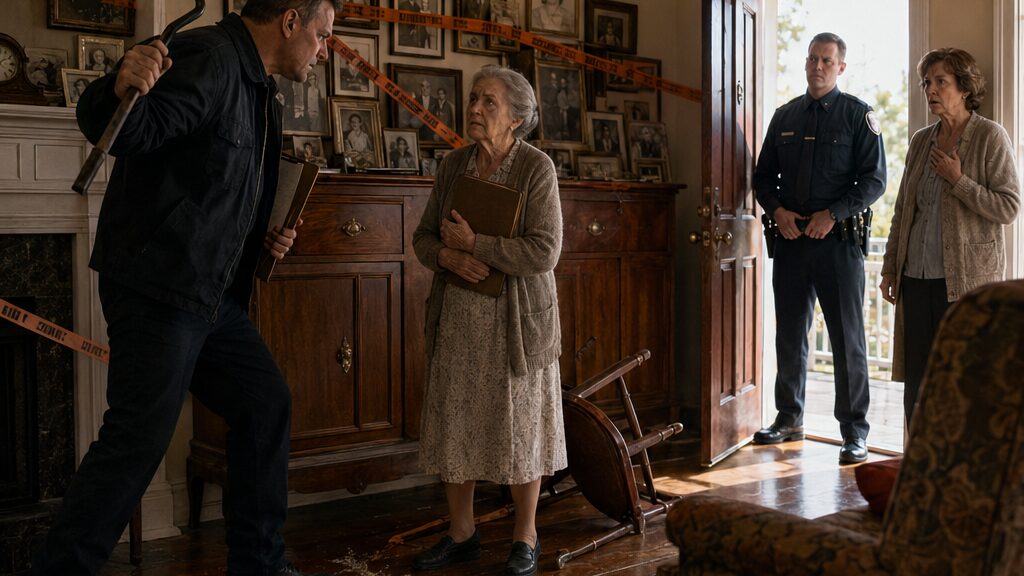
Anna Martin turned in her chair just as a thick strip of neon-orange tape slapped across the living room wall and cut straight through the faces in her wedding photograph. The tape stretched from the edge of the old walnut cabinet to the white trim beside the fireplace, bright as a warning flare against wallpaper she had dusted every Saturday for forty-three years.
Black letters repeated along it.
SEIZED BY BANK.
The man pressing it down used the heel of his hand, flattening the tape over the glass frame until her husband’s face blurred beneath the orange plastic.
“Stop,” Anna said.
Her voice was not loud. She had not needed to shout in this house for a long time.
The man did not turn.
He wore a dark work jacket with a contractor patch, heavy boots, and a hard expression that looked practiced rather than natural. A clipboard was tucked under one arm. A huge roll of the seizure tape hung from his wrist like an ugly bracelet.
Behind him, just inside the open front door, stood a uniformed police officer with one hand resting near his belt and the other holding folded papers. Morning light from the porch outlined him in gray.
“Officer,” Anna said, pushing herself up from the armchair. “There is a mistake.”
The contractor finally looked at her.
“Anna Martin?” he asked, though he said it as if the answer did not matter.
“Yes.”
“Then you’ve been served.” He tore another strip of tape with his teeth, pulled it long, and stretched it toward the bookshelf. “Bank has possession. Removal begins now.”
“This is my home.”
“They all are, until they aren’t.”
The officer stepped forward, his face controlled but not unkind. “Mrs. Martin, I’m Officer David Miller. We’re here to keep this civil. The order has been approved. Mr. Scott is authorized to secure the premises.”
“Secure?” Anna repeated.
Her eyes moved around the living room. Everything was in its place: the lace runner on the coffee table, the porcelain clock that no longer chimed, the row of framed photographs on the wall—her wedding, her son in a school uniform, her husband in his garden hat, her parents standing on this very porch when the house had first been painted blue.
The man with the tape slapped another strip over a shelf where her grandchildren’s old holiday pictures stood.
“My name is Brian Scott,” he said. “I am the assigned eviction contractor. I’m not here to argue your history. I’m here to clear the property.”
Anna took one step toward the secretary desk beside the fireplace. Her knees protested, as they always did in the morning, but her mind had gone sharp and cold.
“There is no loan,” she said. “There is no default. I paid this house off before my husband died.”
Brian pulled a sheet from under his clipboard clip and shook it once. “The bank disagrees.”
“The bank is wrong.”
“The court signed.”
“The court signed a mistake.”
Officer David unfolded the papers, glancing down. “Ma’am, the order lists a defaulted secured debt and authorizes immediate possession. If you have documents, you’ll need to take them to the court or contact the bank’s legal office.”
“I have documents here.”
Anna reached for the brass handle of the desk drawer. Brian moved faster. He stepped between her and the desk, not touching her yet, but filling the space like a door slammed shut.
“No delays,” he said.
“I am not delaying you. I am showing you the deed.”
Brian smiled, but there was no warmth in it. “Amazing how everyone suddenly finds a deed when the truck pulls up.”
Through the front door, Anna saw the truck at the curb. Not a bank vehicle. A plain white box truck with dents along the side. Two workers stood near it, looking bored, their arms folded. On the side window of the truck was a taped sign: RAPID PROPERTY RECOVERY.
The word rapid made Anna’s throat tighten.
Officer David looked toward the desk. “Mr. Scott, if she has identification or ownership papers, we can take a moment to—”
“We already took moments,” Brian cut in. “She had notices. She had court dates. She had warning windows. The bank vendor wants this empty by noon.”
“Noon?” Anna said.
Brian lifted the roll of tape. “I get paid when this place is empty.”
The sentence landed harder than the tape had.
Anna looked at Officer David, expecting some reaction—some small sign that he had heard the ugliness in it. His jaw shifted, but he kept his eyes on the order.
“Mrs. Martin,” he said, “please don’t interfere with the contractor’s lawful process.”
Lawful.
The word felt like something heavy placed over her mouth.
Anna’s fingers curled around the side of the desk. She could feel dust she had missed in the carved edge. That bothered her, absurdly, with the tape already crossing her husband’s face.
“My deed is in that drawer,” she said. “The tax receipts are there. Every letter they sent is there. You read that, and you will leave.”
Brian tore another strip of tape.
“You should have read your mail before today.”
“I did read it.”
“Then you should have answered it.”
Anna did not answer.
The first letter had come six weeks earlier in a windowed envelope with a bank name printed in severe blue letters. She had opened it at the kitchen table, read the phrase past due, then read the address line three times. The debt amount had been impossible. The loan number meant nothing. She had placed it inside the old folder with the deed, planning to call after lunch.
After lunch had become tomorrow. Tomorrow had become after she found her glasses. Then after Sarah Green stopped asking whether she needed help with forms. Then after Anna could bear the thought of explaining to a stranger that she was not confused.
Three more letters had joined the first.
She had told herself paper could not change the truth.
Now orange tape was proving paper could enter a room before truth ever stood up.
Brian turned toward the wedding photograph and tugged the taped frame from its nail. Anna made a sound before she could stop herself.
“Don’t touch that.”
He glanced at the photograph. “Personal items go in boxes unless abandoned.”
“It is not abandoned.”
“You are being removed from possession. That’s the whole idea.”
The frame tilted in his hand. Beneath the tape, Anna could still see part of her husband’s shoulder, the dark suit he had borrowed from his brother because they had spent their savings on the down payment. She remembered him whispering, We will own something no one can move us from.
“Put it back,” she said.
Brian looked at the picture, then at the wall, then at her. He seemed to enjoy the distance between her command and his ability to ignore it.
“Ma’am,” Officer David warned softly.
Anna turned on him. “He covered my husband’s face.”
The officer’s eyes flicked to the photograph. For one second, something human crossed him. Then Brian tapped the clipboard with two fingers.
“I’ve got six houses this week,” Brian said. “Every one has a sad picture.”
He handed the frame toward one of the workers now hovering in the doorway. “Start with the wall items.”
The worker hesitated. He was younger than Brian and would not meet Anna’s eyes.
Anna reached again for the drawer.
Brian shifted, blocking her with his shoulder.
“Do not interfere.”
“My folder,” she said. “Let me get my folder.”
“No.”
Officer David stepped between them now, but not enough. “Mrs. Martin, you need to stay seated while we sort this out.”
“Sort it out?” She let out a breath that almost became a laugh. “He is taping my walls.”
“We need to avoid escalation.”
“Then read my deed.”
The room held still for a beat.
Brian’s radio crackled on his belt. A voice asked if the upstairs should be cleared first.
“No upstairs until I mark the lower rooms,” Brian said into it. Then to Anna, “You want your documents? Fine. Point to the drawer. I’ll retrieve them.”
“No,” Anna said.
The word surprised even her with its firmness.
Brian’s eyes narrowed. “No?”
“That drawer belongs to me.”
“So did the house, according to you.”
Officer David’s shoulders tightened. “Mr. Scott.”
Brian ignored him and reached past Anna toward the desk handle.
Anna placed her palm flat against the drawer.
It was a small gesture. A frail-looking old hand on dark polished wood. Blue veins. A thin gold wedding band she had never removed. But Brian stopped as if he had encountered a lock.
For the first time, his face changed.
Not fear. Irritation.
“Lady,” he said, low enough that the workers outside could not hear, “you can make this easy, or you can make it embarrassing.”
Anna looked at the orange tape over her wedding photograph.
“You already made it embarrassing.”
Brian stared at her, then gave a short laugh through his nose.
He turned away from the desk and strode to the wall. With one hand, he seized the taped wedding photograph again, yanking it fully from the nail. The old hook pinged against the baseboard.
Anna took a step forward.
Officer David raised a hand. “Mrs. Martin.”
Brian held the frame out toward the worker in the doorway, the orange tape still stuck across the glass.
“Box it or break it,” he said. “I don’t care.”
Chapter 2: The Folder Everyone Thought Was Confusion
Anna opened the drawer before Brian could turn back.
Her hands trembled now—not from uncertainty, not from age alone, but from fury forced into fingers that still knew where everything belonged. The brass handle slid cold beneath her grip. The drawer stuck for half a second the way it always did in damp weather, then gave with a soft wooden scrape.
Inside lay the old brown folder.
Brian’s clipboard came down over it.
Not hard enough to crush her hand, but close enough that the metal clip snapped against the drawer front with a sharp crack.
“Enough,” he said.
Anna did not pull back. Her fingertips remained on the folder’s worn edge. The cardboard had softened over years of being opened and closed, its tab darkened by the oil of her thumb. MARTIN HOUSE was written across it in her late husband’s block letters.
Officer David moved closer. “Mr. Scott, step back.”
“I’m protecting the file integrity of the eviction,” Brian said.
“You’re blocking her hand.”
“She’s interfering.”
Anna looked at the officer. “That folder has the deed.”
Brian said, “That folder has whatever she put in it after ignoring official notices.”
The sentence found its mark. Anna felt heat climb into her face.
She slid the folder free anyway and held it to her chest. Loose papers shifted inside. A tax receipt corner poked out. So did the top of a bank envelope with red print across it.
Brian saw it.
“There,” he said. “Notice received.”
Officer David saw it too.
The room changed in a way Anna hated. Not visibly. No one stepped back or gasped. But the officer’s eyes moved from her face to the envelope, and she knew what he was thinking. She had seen that look at the pharmacy when she asked a question twice because the clerk had mumbled. She had seen it at the doctor’s office when she said she did not want Sarah called. She had seen it from people who made their voices softer right before they stopped believing her.
“I received nonsense,” Anna said. “Receiving nonsense does not make it true.”
Brian smirked. “That line work for the taxes too?”
Anna opened the folder with more force than she meant to. Papers slid against each other: the deed with its embossed seal, property tax receipts clipped by year, an old insurance document, four bank letters she had folded back into their envelopes after reading them at the kitchen table.
Officer David reached toward the top page. “May I?”
Anna hesitated.
It was foolish. She knew it was foolish even as her fingers tightened. But the folder was the last ordered thing in a room being marked for removal. Letting it leave her hands felt like letting the house itself be passed around for judgment.
“Mrs. Martin,” David said quietly, “I can’t read it through your fingers.”
Brian laughed once. “That’s convenient.”
Anna looked at him, then at the photograph still in the worker’s uncertain hands. She loosened her grip.
David took the deed.
Brian immediately angled his clipboard over it. “Order supersedes personal paperwork during removal. She can contest later.”
“Let me look.”
“You’re here to keep peace, not litigate a foreclosure.”
“I’m here to prevent a civil process from becoming something else.”
Brian’s jaw hardened. The radio on his belt crackled again. He grabbed it. “Start staging boxes at the front hall. Wall items first.”
“No,” Anna said. “No wall items.”
The younger worker stepped farther inside with an empty cardboard box. He avoided the strip of tape sagging over the bookshelf as if it might stick to him too.
Anna moved toward him. “Put that photograph back.”
Brian blocked her again, this time with less patience. “Lady, sit down.”
“My name is Anna Martin.”
“Fine. Anna. Sit down.”
“No.”
Officer David lifted the deed and frowned, but Brian spoke over the moment.
“Mrs. Martin, you had options before today,” Brian said, loud enough for the workers to hear. “Payment plan, court appearance, vacate notice. You chose none.”
Anna’s mouth tightened.
Sarah had told her to call.
That memory entered the room like an unwelcome witness. Sarah Green on the porch two weeks ago, holding a covered dish and pretending it was the reason she had come. I saw another envelope, Anna. Do you want me to sit with you while you call them? Anna had said no. Not harshly, but firmly enough. She had even added, I have handled paperwork longer than you have owned curtains.
Now the red letters in the folder seemed to glow.
Officer David turned one of the papers. “Mrs. Martin, why didn’t you respond to these notices?”
“Because they were wrong.”
“That still may have needed—”
“I know what it may have needed.” Her voice sharpened, and she regretted it at once. Sharpness from an old woman was too easily filed under confusion. “I was going to call.”
Brian tilted his head. “When? After we loaded the piano?”
Anna ignored him. “The loan number is not mine. The amount is not mine. I have never borrowed against this house.”
David looked back at the deed. “This says the property was transferred clear after final payment in—”
“Officer,” Brian snapped. “We are not doing a title search in her living room.”
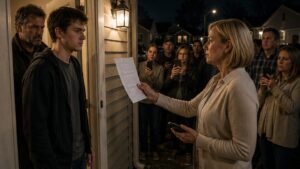
Before David could answer, a voice called from the porch.
“Anna?”
Sarah Green stood just beyond the threshold, one hand pressed to her cardigan, the other gripping the porch rail. She took in the truck, the workers, the tape across the walls, and the wedding photograph in the cardboard box.
“Oh, Anna,” she said.
Anna stiffened before she could stop herself. “Sarah, go home.”
Sarah did not move. “This is Elm Avenue. Why are they here?”
The word hung in the hallway: Avenue.
Brian barely looked at her. “Ma’am, step back from the premises.”
“I live next door.”
“Then you can watch from next door.”
Sarah’s face flushed. “That woman owns this house.”
“So she says.”
“So everyone says. This is 142 Elm Avenue.”
Brian tapped the clipboard. “The order has the property number.”
“Did I ask about the number?”
David’s eyes flicked down to the papers again, but a worker dropped a flattened box near the hall table, and the sound broke the thread of attention.
Brian seized it. “No neighbors inside. No interference. We clear from the front room first.”
He pointed toward the locked cabinet under the family photographs. It was narrow, dark, and old-fashioned, with carved doors and a small brass keyhole. Above it, the photographs were arranged in careful rows. At the center was the wedding picture, now absent, leaving a pale rectangle on the wallpaper where the sun had not reached.
“Start there,” Brian said. “Cabinet, shelves, frames. If it’s locked, we open it.”
Anna’s body reacted before thought did. She stepped between Brian and the cabinet.
“No.”
Brian looked at the cabinet with sudden interest. “Valuables?”
“Memories.”
“Same thing to people who owe money.”
“I owe nothing.”
David, still holding the deed, said, “Mr. Scott, slow down.”
Brian checked his watch. “No. Vendor requires occupancy cleared before noon or it rolls to contested status. Contested status means I don’t get completion pay until review. She had her review.”
Anna’s hand tightened around the folder. “You said that.”
“I’m saying it again because you don’t seem to hear well.”
Sarah made a small angry sound from the porch.
Anna’s shame, already warm in her cheeks, moved deeper. It settled beneath her ribs. The letters in the folder were not proof against her, but they felt like proof of something: that she had let fear sit at the kitchen table with her and call itself patience.
David handed the deed partly back, but Brian stepped to the hallway and pulled something from beside the door.
A crowbar.
Heavy. Dark iron. Its curved end caught the morning light.
Anna’s breath stopped.
“Not that cabinet,” she said.
Brian rolled his shoulders as if preparing for work he understood. “Locked items are opened for inventory.”
Sarah stepped one foot over the threshold. “You can’t just break her things.”
Brian turned on her. “Outside.”
Anna moved toward her chair, not to sit, but to get between the crowbar and the cabinet. Brian misread the motion, or chose to. His hand shot out and closed around her upper arm.
His grip was hot through her sleeve.
“Chair,” he said. “Now.”
“Let go.”
“Sit down.”
“You are hurting me.”
“Then stop pulling.”
But Anna had not pulled yet. Not until he began dragging her backward from the cabinet, away from the folder, away from the photographs, away from the locked doors that held the last album her husband had touched.
Then she pulled with everything she had left.
Chapter 3: The Chair Scraped Across The Polished Floor
The chair screamed across the polished floor when Brian shoved Anna toward it.
The sound was worse than a shout. It tore through the living room, through the tense silence of the workers, through Sarah’s gasp from the doorway. The chair legs carved two pale lines in the wax Anna had buffed by hand the previous Saturday, marks running like accusations beneath the orange tape.
Anna caught the chair arm before she fell.
For one sharp second, the room tilted. Brian’s hand was still clamped around her upper arm. The old folder pressed hard against her ribs. The deed slipped halfway out, its seal flashing.
Officer David stepped in. “Let her go.”
Brian did not release her immediately. “She’s resisting removal.”
“She said you were hurting her.”
“She grabbed at me.”
“I did not,” Anna said.
Her voice came out steady, but her breath had shortened. The place where Brian held her arm burned. She was aware of Sarah at the porch, aware of the worker with the wedding photograph still frozen beside the box, aware of every photograph on the wall watching her be handled like furniture.
David’s eyes dropped to Brian’s hand. “Let her go now.”
Brian released Anna with a small shove, just enough to make her grip the chair harder.
Sarah stepped fully into the doorway. “Look at her arm.”
“I said outside,” Brian snapped.
“You don’t own her doorway.”
“I am authorized to secure this property.”
“This property is her home.”
Brian’s face changed. Not anger exactly. Calculation. He turned to Officer David and lifted both hands as if he were the reasonable one.
“You see what’s happening? Neighbor interference, occupant noncompliance, physical resistance. If this isn’t controlled, my crew can’t work safely.”
David looked at Anna’s sleeve. “Mrs. Martin, may I see your arm?”
Anna almost said no.
The refusal rose automatically. She had said no to help carrying groceries. No to Sarah calling the bank. No to a railing in the hallway. No to the young man at the hardware store who had offered to load mulch into her trunk as if she were made of porcelain.
But Brian had touched her inside her own living room. If she hid the mark, she would be protecting him.
She drew back her sleeve.
Four red crescents were forming above her elbow where his fingers had pressed.
Officer David’s face tightened.
Brian pointed at the marks. “That’s from her twisting away. I was preventing a fall.”
“You were dragging her,” Sarah said.
“Were you inside when it happened?”
“I was watching from the porch.”
“Then you don’t know.”
Anna looked at the pale scrape lines beneath the chair. Her floor, marked because she had not answered letters. Her arm, marked because a man with a clipboard had decided speed made him powerful.
She straightened.
For a moment, Brian seemed to notice something and dislike it. Anna was not tall. Age had drawn her inward at the shoulders. But she had spent years lifting her husband from bed to chair after his stroke, years learning how to plant her feet before his weight shifted, how to use leverage when strength was not enough, how to keep both of them from falling when his body forgot what his mind still wanted.
Brian saw only an old woman.
Anna let him.
David turned to Brian. “No more physical contact unless I direct it.”
Brian gave a dry laugh. “Then direct her not to obstruct.”
“Mrs. Martin,” David said, and his voice softened in a way that made Anna bristle, “please sit down for now.”
“No.”
“Ma’am—”
“If I sit, he breaks that cabinet.”
Brian checked his watch again. The gesture was so small, so ordinary, that it chilled her more than his shouting. To him, this was still a schedule.
“I have a noon completion deadline,” he said. “Every minute costs me.”
Anna looked at him. “Costs you what?”
He snapped his clipboard up. “You think trucks are free? Crew is free? Vendor penalties are free? The bank doesn’t pay me to stand around while someone digs through memory boxes.”
“So this is about your money.”
“This is about a lawful order.”
“You just said it was about your deadline.”
“It can be both.”
David’s gaze shifted to the clipboard. “What happens at noon?”
Brian’s jaw worked. “The file changes status.”
“What status?”
“Contested.”
“Because she contests it?”
“Because we fail to complete.”
“And that affects your pay?”
Brian’s eyes hardened. “My contract is none of your business.”
Anna held the folder tighter. The room seemed to exhale around that answer. Even the young worker looked down at the box in his hands.
David said, “It became my business when you put hands on her.”
Brian leaned closer, lowering his voice, but not enough. “Officer, with respect, if you let every occupant run out the clock, no civil order in this county means anything.”
There it was: his private belief wearing public language.
Every occupant.
Not Anna. Not 142 Elm Avenue. Not a paid-off house with a wedding photograph under orange tape.
A category. A problem. A body in the way.
Anna moved one step toward the cabinet.
Brian noticed at once. “Do not.”
She kept walking.
David said, “Mrs. Martin, wait.”
“No,” she said, though she was not sure which man she was answering. “I have waited enough.”
Brian stepped after her. “If you touch sealed property—”
“It is not sealed.” She pointed at the tape. “It is vandalized.”
His face flushed.
Sarah spoke from the doorway, quieter now. “Anna, let Officer Miller read the deed. Please.”
Anna’s fingers closed harder around the folder. “I tried.”
“Then let him hold it.”
“I did.”
“Let him look again.”
The words stung because they were kind, and because Sarah was right. Anna’s pride had become another locked door in the room. Still, the cabinet stood beneath the photographs, and Brian’s crowbar waited near the hall table, and noon was a weapon he kept checking on his wrist.
Brian reached the crowbar before anyone else moved.
David’s hand lifted. “Mr. Scott.”
Brian grabbed the iron by its middle. “I’m opening the locked cabinet for inventory. That is authorized. If she wants to file complaints later, she can file them later.”
Anna stepped in front of the cabinet.
The wedding photograph was in the box now, face-up. The strip of orange tape still covered her husband’s eyes.
Brian pointed the crowbar toward the cabinet doors. “Move.”
“No.”
“You want to add obstruction to this?”
“You want to add breaking and entering?”
He laughed. “It’s not breaking if the court says open.”
Anna’s heart struck once, hard. Her left hand slid behind her to the cabinet, touching the cool brass keyhole. Inside, wrapped in blue cloth, was the final album her husband had arranged before his hands stopped obeying him. He had made her promise not to scatter the photographs. Keep the room together, Annie. Even if I go first, keep us together.
Brian raised the crowbar.
David moved, but Brian was already closer.
The iron lifted above the cabinet lock.
Anna’s fear went very quiet.
The room narrowed to the arc of the crowbar, the space between Brian’s wrist and shoulder, the angle of his balance, the polished floor beneath his boots, the folder slipping under her arm.
She saw him as she had once seen her husband mid-fall—not as a force too large to stop, but as weight moving in a direction.
Brian swung toward the cabinet.
Anna stepped into the path.
Chapter 4: The Crowbar Fell Outside The Door
The crowbar whistled toward the cabinet lock.
Anna did not reach for the iron where Brian expected her to. She did not throw up both hands or flinch back from the swing. She stepped in close, into the narrow space where the arc had less power, and caught his wrist with both hands.
The impact jarred through her shoulders.
Brian’s eyes widened.
For one strange second, they stood joined by the force he had meant for the cabinet. His arm trembled against her grip. The crowbar’s hooked end hovered inches from the brass keyhole, close enough that Anna could see a scratch in the metal where her husband had once missed with the key and laughed at himself.
“Let go,” Brian said.
Anna did not.
Her right hand locked over the tendons at the inside of his wrist. Her left braced against the back of his hand. It was not strength the way young men understood strength. It was placement. Pressure. Balance. The knowledge of joints learned in the long years after her husband’s stroke, when she had supported his weight from bed to chair, from chair to bath, from bath to the narrow hallway where he insisted on touching every photograph before sleep.
Brian pulled back.
Anna turned with him.
The crowbar clattered lower but did not fall.
“Mrs. Martin!” Officer David shouted.
“Tell him,” Anna said through her teeth.
Brian tried to twist free. Pain flashed across his face, then anger rushed in behind it.
“You crazy old—”
Anna shifted her thumb.
Brian’s fingers opened.
The crowbar struck the polished floor with a heavy clang.
No one moved.
Even the orange tape seemed to hold its breath.
Anna looked down at the iron. It lay between her and the cabinet like something dead. Brian lunged for it, but she moved first. With one small, hard kick from the side of her practical black shoe, she sent the crowbar sliding across the floorboards.
It scraped over the two fresh chair marks.
It hit the threshold, bounced once, and tumbled out the open front door.
The sound of it falling down the porch steps rang through the morning.
Metal on wood.
Metal on concrete.
Then silence.
Anna’s hands were still raised. Her fingers ached. Her heart pounded so hard she could feel it in the bruised place on her arm. She lowered her hands slowly.
“Not in my house,” she said.
No one answered.
The young worker holding the wedding photograph stepped back until his shoulder hit the doorframe. Sarah Green stood with one hand over her mouth. Officer David’s face had gone blank with the shock of a man forced to choose what kind of scene he was standing in.
Brian recovered first.
He stared at his empty hand, then at the doorway where the crowbar had vanished. Color rose darkly up his neck.
“She assaulted me.”
Anna looked at him.
“She assaulted me,” he repeated, louder, turning to David. “You saw that. She grabbed me, she attacked me, she disarmed me during a lawful eviction.”
“You were swinging a crowbar at her cabinet,” Sarah said.
“At property,” Brian snapped. “Not at her. She stepped into my work area.”
Anna bent carefully to retrieve the folder that had slipped from under her arm. Papers had spilled across the floor near a strip of orange tape that had curled loose from the baseboard. The deed lay open, its old seal facing up. A tax receipt had slid half beneath the chair.
Her knees hurt. Her hands shook now that the moment had passed. For one bitter instant, she wanted to gather every paper against her chest again and trust no one.
Then she saw the young worker set her wedding photograph into a cardboard box, still taped across the glass.
She left the deed where it was.
Officer David noticed.
Brian thrust his wrist toward him. “Look at this. She twisted my arm.”
David did look. Brian’s wrist was red. Not injured, not broken, but marked. Proof of contact. Proof Brian would use.
“She is a danger,” Brian said. “I want her removed. I want her charged with obstruction and assault.”
Anna straightened beside the cabinet. “He tried to break open my husband’s album.”
David’s eyes moved to the cabinet. “What’s inside?”
Anna’s answer caught.
The question was simple. Too simple. She could have said photographs. She could have said family things. She could have said nothing valuable, because that was what Brian wanted to hear.
But the cabinet held the final album her husband had arranged after his speech had mostly left him. He had used sticky notes with crooked dates. He had pointed to the chair, the fireplace, the porch, the old maple outside the window, placing their life in order with one working hand while Anna pretended not to see how tired he was.
The last page held only one photograph: the living room wall as it had been before illness rearranged them both. On the back he had written, in shaky letters, Keep us together.
Anna swallowed.
“Our life,” she said.
Brian rolled his eyes. “It’s inventory.”
“It is not inventory.”
“It is now.”
David stepped between them. “Nobody touches the cabinet.”
Brian laughed in disbelief. “You don’t have authority to suspend the process because she got sentimental.”
“I have authority to prevent injury.”
“There was no injury until she grabbed me.”
“You raised the tool.”
“She moved in front of it.”
“And you kept swinging.”
Brian’s mouth tightened. For the first time, his confidence faltered at the edges. Not enough to soften him. Enough to make him more dangerous.
He pointed at Anna. “She knew exactly what she was doing. Don’t let the age fool you. That was practiced.”
Anna said nothing.
It had been practiced. Not on men like Brian. On grief. On falling bodies. On mornings when her husband’s left leg refused to follow the rest of him. On nights when she caught him halfway down and held until both of them were crying—not because of pain, but because they both remembered when he had been the one who carried heavy things.
Brian’s radio crackled again. The voice from outside asked, “You need the bar back?”
Brian snatched it from his belt. “Stay outside.”
David held out one hand toward the workers. “Everyone outside the residence.”
“I’m not leaving my assigned property,” Brian said.
“This is not your property.”
“It’s under bank possession.”
David’s patience thinned. “Step to the porch.”
Brian gave him a sharp look. “Careful, Officer.”
Sarah inhaled.
David did not move.
For several seconds, the room balanced on that single word. Careful. As if Brian’s clipboard outranked the badge. As if the order in his hand could push everyone into place.
Then David looked down.
The deed lay open near his boot.
Anna saw the moment he noticed it. Not just as paper. As something avoided too long. The old seal. The property description. The line of careful typed letters. The document Brian had kept interrupting.
Brian saw it too.
“Don’t,” he said.
David crouched.
“Officer, I’m telling you, that document is irrelevant at this stage.”
David picked up the deed by its corner.
Anna held still.
It was harder than catching the crowbar. Harder than standing between iron and cabinet. Her whole body wanted to reach for the paper and pull it back where no one could dismiss it, crease it, misplace it, or use it against her.
But she did not move.
Sarah’s voice came softly from the doorway. “Let him read it, Anna.”
Anna kept her eyes on the deed.
Brian stepped forward. “Read the order. That’s the active document. Not her junk.”
David rose with the deed in his hand.
Brian’s voice sharpened. “Don’t read her junk—read the order.”
Chapter 5: The Wrong Word On The Order
Officer David read the eviction order aloud and stopped at one word.
His voice had been flat at first, official and tired, carrying the language of forms that had traveled through too many hands. “Court authorization for immediate possession of property located at one forty-two Elm—”
He stopped.
Anna heard the stop more clearly than she had heard the tape, the chair, the crowbar. It was a clean break in the machinery.
Brian noticed it too.
“Street,” Brian said quickly. “One forty-two Elm Street. Yes. That’s the property number.”
David looked down at the order again.
Then at Anna’s deed.
Then toward the front door, where the small brass plaque beside the porch frame caught morning light. It had been polished by Anna’s hand for years.
142 ELM AVENUE.
Sarah stepped closer from the threshold. “I told you.”
“Stay there,” David said, but his voice had changed. It no longer pushed her out of the room. It held the room still.
Brian reached for the order. “You’re making something out of nothing.”
David angled it away. “This says Street.”
“This is Elm.”
“This is Elm Avenue.”
“It’s the same property number in the same service zone.”
Anna laughed once, softly, and no one mistook it for humor.
“My husband used to deliver mail on weekends after the mill cut hours,” she said. “He knew the difference between a street and an avenue.”
Brian ignored her. “GPS brought us here.”
David turned on him. “GPS brought you to Avenue?”
Brian’s mouth closed.
The young worker on the porch shifted his weight. A cardboard box creaked in his arms.
“Answer me,” David said.
Brian adjusted his grip on the clipboard. “The vendor file had field notes. Sometimes municipal labels are inconsistent. Street, avenue, road, lane—these older neighborhoods are a mess.”
Sarah’s eyebrows rose. “No, they are not.”
Brian pointed toward her without looking. “Neighbor commentary is not evidence.”
Sarah stepped fully into the doorway now, her fear burned away by anger. “There is a 142 Elm Street.”
David looked at her.
Brian said, “Don’t.”
Sarah’s voice shook, but she kept going. “Across town. Near the old repair shops. Small brick house. Vacant for months after the roof damage. Everyone knows because the bank signs are still in the yard.”
The room seemed to tilt in a different direction.
Anna looked at David. David looked at the order again.
Brian’s jaw tightened. “There are duplicate addresses everywhere. That’s why we use parcel numbers.”
“Then show me the parcel number,” David said.
Brian flipped a page on the clipboard too fast. “It’s in the file.”
“Show me.”
“I don’t have to litigate this with you.”
“You do if you entered the wrong home.”
Brian’s face flushed. “We did not enter the wrong home. We entered the property approved by the vendor.”
Anna stepped forward. The folder was back in her hands, but she had stopped clutching it like a shield. “Read my deed.”
David looked at her.
“Please,” she added, and the word cost more than the grip had.
He unfolded the deed fully. The old paper made a soft crackle. Orange tape hung loose from the lower edge of the wall behind him, one end curled like a tongue.
“Property address,” David read. “One forty-two Elm Avenue.”
Brian exhaled hard. “Personal deed could be outdated.”
Anna’s eyes snapped to him.
David read again, lower on the page. “Recorded transfer. Paid in full. No open lien listed on this copy.”
“That copy could be old.”
Anna opened the folder and removed a clipped set of tax receipts. “Then read these.”
David took them.
Brian moved as if to interrupt, then stopped when David looked up.
“You’ve done enough stepping between documents,” David said.
The words settled over Brian’s face like a slap he could not report.
David read the tax receipts. Recent years. Same address. Same name. Anna Martin. 142 Elm Avenue.
The young worker set the wedding photograph box down gently on the floor.
No one told him to.
Sarah saw and moved toward it, but Anna gave a slight shake of her head. Not yet. First the truth had to stand on its own legs.
Brian flipped through his clipboard with growing irritation. Pages slapped against the metal clip. “Here. Work order. Property clearance. One forty-two Elm.”
“Street or Avenue?” David asked.
Brian looked down.
For the first time, he did not answer immediately.
David stepped closer. “Street or Avenue?”
Brian held the page out, but not far enough for Anna to read. “The bank vendor approved the field correction.”
“What field correction?”
“The original order listed Street. The access notes said Avenue was acceptable based on map confirmation.”
David stared at him. “Who wrote that?”
Brian looked at his clipboard.
Anna saw his thumb slide over a handwritten line near the margin.
“Who wrote it?” David repeated.
Brian lifted his chin. “It came through dispatch.”
“That is not an answer.”
“It is the answer I have.”
Sarah said, “You knew.”
Brian turned on her. “I knew I had an authorized job and a homeowner refusing compliance.”
“You knew there were two houses.”
“I knew old neighborhoods have bad labels.”
Anna’s voice came from a place so quiet everyone turned. “You knew enough to pause.”
Brian looked at her with contempt, but something behind it flickered. Pressure. Calculation. Fear perhaps, though not the kind that made a person kinder.
“I pause, I lose the slot,” he said. “I lose the slot, the bank marks noncompletion. Noncompletion means review, review means no payment until some desk clerk decides whether the old lady was convincing enough.”
David’s eyes hardened. “So you entered anyway.”
Brian caught himself. “I followed the file.”
“You entered anyway.”
“I followed the file.”
David looked around the room: the tape over the photographs, the scrape marks in the floor, the box containing Anna’s wedding picture, the crowbar lying outside beyond the open door.
Then he lifted his radio.
Brian took one step toward him. “What are you doing?”
David pressed the button. “Unit requesting supervisor to 142 Elm Avenue. Possible wrongful civil entry, address discrepancy on court order, property seizure in progress. Freeze the scene pending review.”
Brian’s mouth opened.
David did not lower the radio. “All removal activity stops now.”
The words seemed to move through the house wall by wall.
The worker at the doorway lowered his eyes. Sarah closed her hand around the porch frame. Anna stood so still that even her breathing felt borrowed.
Brian looked at David, then at Anna, then at the orange tape crossing the photographs.
“This is a mistake,” he said.
Anna finally picked up her wedding photograph from the box. The tape still covered her husband’s eyes. She held it against her chest, glass and all.
“Yes,” she said. “It is.”
David looked toward the porch, then back at Brian.
“Freeze the scene,” he repeated. “This may be an illegal entry.”
Chapter 6: The Bonus Hidden Behind The Clipboard
Officer David found the bonus checklist clipped behind the eviction order.
It had been hidden in plain sight, folded under a vendor cover sheet with boxes printed in narrow black lines. Brian tried to reach for it the instant David turned the page, but the officer shifted his shoulder and kept the clipboard away.
“Don’t handle evidence,” David said.
“Evidence?” Brian’s laugh cracked. “Now my paperwork is evidence?”
David did not answer.
Anna stood near the fireplace with Sarah beside her, not touching her, not hovering, simply there. The wedding photograph rested on the mantel, its glass still scarred by orange tape. No one had removed the tape yet. Anna had refused. She wanted it seen before it was peeled away.
The living room had changed without moving. The same furniture stood in the same places, but now every object seemed to be waiting for someone to admit what had been done to it.
David read the checklist silently.
Brian’s hands curled and uncurled at his sides. “That’s an internal vendor document.”
David looked up. “Completion bonus if property cleared before twelve.”
Brian said nothing.
“Timestamped photos required. Wall markings. Exterior lockout. Personal property staged.”
“That is standard.”
David tapped the paper. “Handwritten note: ‘Avenue ok per file.’”
Sarah’s face went pale with anger. “He wrote that?”
Brian snapped, “You don’t know what I wrote.”
David studied the handwriting, then the pen clipped to Brian’s jacket pocket. “Did you?”
Brian’s mouth tightened.
Anna watched him.
All morning, he had seemed made of hard surfaces: boots, clipboard, radio, tape, orders. Now the edges shifted. Not softened. Exposed. He looked, for a moment, like a man calculating how much truth he could afford.
“The note came from dispatch,” he said.
“Dispatch handwrote it on your clipboard?”
“I copied it.”
“From whom?”
Brian rubbed the back of his neck. “From the vendor portal.”
“Name?”
“I don’t know. A clerk. Amy something.”
David looked toward the porch where his supervisor had not yet arrived. The radio on his shoulder murmured low. Outside, the white box truck sat useless at the curb, its back door open, empty boxes stacked inside like a plan interrupted.
Anna spoke. “Call her.”
Brian turned. “What?”
“Call Amy something.”
David looked at Anna.
Her voice remained level. “If she told you my Avenue was acceptable, call her.”
Brian gave a sharp little smile. “That’s not how vendor communication works.”
“Then make it work.”
For the first time that morning, Sarah almost smiled.
Brian did not.
David held out his hand. “Call the number on the work order.”
“This is ridiculous.”
“Call.”
Brian stared at him, then pulled his phone from his pocket. His thumb moved too quickly over the screen. Anna could see he wanted privacy, wanted hallway distance, wanted the porch. David gave him none of it.
The call rang through the living room on speaker.
Once.
Twice.
Three times.
A woman answered, breathless. “Vendor support, this is Amy.”
Brian spoke first. “Amy Roberts?”
There was a pause. “Yes?”
“This is Brian Scott on the Elm file. I’ve got law enforcement here questioning the address note.”
Another pause.
David stepped closer. “This is Officer David Miller. You are on speaker. Do you have access to the property file?”
“I—yes, but I don’t know what—”
“The court order lists 142 Elm Street. Mr. Scott entered 142 Elm Avenue. Did the file authorize that change?”
Silence.
Brian shut his eyes.
Amy’s voice came back smaller. “There was a map issue.”
“What kind of map issue?” David asked.
“The system pulled Avenue when the field team searched the number. But the original foreclosure package was Street. I flagged it.”
Anna’s fingers tightened around the edge of the mantel.
David said, “You flagged it as wrong?”
“As needing address verification.”
Brian exploded. “That is not what you told dispatch.”
Amy’s voice shook. “I told dispatch it needed confirmation before entry.”
“No,” Brian said. “You said the Avenue hit was probably correct because the property number matched.”
“I said don’t proceed until title review confirmed it.”
David looked at Brian.
Brian pointed at the phone as if Amy were standing there. “You’re covering yourself.”
“I put a warning flag in the file,” Amy said. “I can see it. Yesterday at 4:42 p.m. Address mismatch. Do not complete lockout until verified.”
The room went very still.
Anna looked at the orange tape over the wall and felt something colder than anger. The system had not been blind. Somewhere, on a screen, a warning had existed. Someone had seen a red light. Someone had stepped around it.
David asked, “Why did the work order remain active?”
Amy’s breath trembled through the speaker. “Because I didn’t escalate it high enough.”
“Why not?”
Another silence.
When Amy answered, her voice was barely above a whisper. “We get penalized for stopping field work without a supervisor sign-off. I sent a note. I thought someone would catch it in morning review.”
Brian laughed bitterly. “There. You hear that? Bank error. Clerk error. Not me.”
Anna turned from the mantel.
“You saw the note,” she said.
Brian stared at her.
“You copied ‘Avenue ok per file’ instead of ‘do not complete,’” Anna said. “Those are not the same words.”
Brian’s face hardened again, but the hardness no longer fit him cleanly.
“I had a portal update that allowed dispatch,” he said.
Amy said through the phone, “No update authorized entry.”
Brian grabbed for the phone, but David lifted it away.
“Do not touch it,” David said.
Brian’s voice rose. “This woman attacked me with my own tool. You all saw that. You want to talk paperwork? Fine. Talk paperwork. But she is not some harmless old lady. She put hands on me. She kicked equipment out of a secured property.”
Anna did not flinch at the accusation. It came almost as a relief, because it was smaller than the truth.
“You brought the crowbar to my cabinet,” she said.
“You grabbed me.”
“Yes.”
The admission made everyone look at her.
She stepped away from the fireplace. “I grabbed you because you were about to break open the cabinet where my husband’s last album is kept. I kicked the crowbar out because you would have picked it up again.”
Brian seized on it. “That’s assault.”
David looked at Anna’s bruised arm, then at the cabinet, then at the crowbar still visible outside at the bottom of the porch steps.
“That’s something for the report,” he said. “So is the wrong address. So is the physical contact you initiated. So is the vendor note.”
Brian’s eyes sharpened. “You’re choosing her story.”
“No,” David said. “I’m preserving the scene.”
Amy’s voice came through the phone, strained. “Officer, I can email the warning flag.”
“Do that,” David said.
Brian looked suddenly older—not old like Anna, shaped by years and loss, but worn by being cornered. “You think I’m the only one who pushes these through?” he said. “You think the bank cares if I wait? They hire fast because fast keeps them clean.”
Anna watched him. There it was again: the almost-truth he used as a hiding place. He wanted the system guilty enough to make him innocent.
“You still had hands,” she said quietly. “You used them.”
No one spoke for several seconds.
Then Anna looked at the tape. Strip after strip, bright and ugly. Across shelves. Across photographs. Across the edge of the old cabinet. Across the baseboard near the deed.
She turned to David.
“Before anyone removes it,” she said, “photograph every piece.”
Sarah looked at her in surprise.
David lowered the phone. “Mrs. Martin?”
Anna lifted her chin. “Every strip. Every mark on the floor. Every box. My husband’s photograph with that tape across his face. I want it all photographed before anyone decides it looks better cleaned up.”
Chapter 7: The Plaque Above The Fireplace
Sarah held the last family photograph against the wall while Anna stood three steps back and decided whether the broken clipboard belonged in the room.
The photograph was small compared with the empty space above the fireplace. In it, Anna’s husband sat in the same armchair Brian had dragged across the floor, one hand raised in a half-wave, his smile uneven from the stroke but unmistakably his. The orange tape was gone from the glass now. Sarah had peeled it slowly two days earlier with warm water, a cotton cloth, and such careful anger that Anna had almost told her to stop before the tenderness became too much.
“Higher?” Sarah asked.
Anna did not answer.
On the mantel below the photograph lay the pieces of Brian Scott’s clipboard.
The metal clip had snapped when it hit the porch after Officer David finally removed it from the room as evidence and later returned the broken board. One corner was crushed. A strip of neon-orange tape remained stuck across the back, its black letters cut in half so only BANK showed on one piece and SEIZED on another.
Sarah shifted on the small step stool. “Anna?”
“A little to the left,” Anna said.
Sarah moved it.
“No. Back a hair.”
Sarah moved it back.
Anna nodded.
Sarah pressed the frame onto the nail, then stepped down carefully. She did not reach for Anna’s elbow though Anna saw her think about it. That restraint mattered. It had taken them both several days to learn it.
The living room smelled faintly of lemon oil and old paper. The scrape marks on the floor had not been polished away. Anna had tried once, then stopped. They were pale and stubborn beneath the chair, two lines leading backward from where Brian had shoved her. Officer David had photographed them. He had photographed every strip of tape, every box, the porch steps where the crowbar had landed, the bruise on Anna’s arm, the brass plaque beside the door that said 142 ELM AVENUE.
He had also photographed the cabinet before Anna unlocked it.
The key sat now in her palm.
Small, brass, warm from her skin.
Sarah looked toward the cabinet but said nothing. The carved doors had remained closed since the day of the raid. Not because anyone had ordered it. Because Anna had not been ready to see what Brian had almost broken open.
Now the photographs were back on the wall. The wedding picture had been rehung at the center. Her husband’s face was clear again. The tape had left one faint line on the glass if the light struck it from the side, but Anna had decided not to replace the glass.
Some marks told the truth.
A car door closed outside.
Sarah turned toward the window. “That might be him.”
Anna slipped the key into her cardigan pocket. “Let him in.”
Sarah opened the front door before the knock came. Officer David Miller stood on the porch in plain clothes, holding a large envelope in both hands. Without the uniform, he looked younger and more tired. He glanced once at the brass address plaque before stepping inside, as if he needed to remind himself of what he should have seen the first time.
“Mrs. Martin,” he said.
“Anna,” she said.
He took that in carefully. “Anna.”
Sarah stepped aside but stayed in the room. Anna was glad she did. She did not want to be alone with another apology that asked to be forgiven before it had finished speaking.
David held out the envelope. “Certified copy of your deed. The county office expedited it after the report. I thought you might want one that doesn’t have boot dust on the corner.”
Anna accepted it.
The envelope was stiff and new, too clean to mean as much as the old folder, but she held it with both hands anyway.
“Thank you.”
David looked around the room. His eyes paused on the wedding photograph, then on the floor marks, then on the pieces of clipboard resting on the mantel.
“The bank’s legal department confirmed the address error,” he said. “The order was for Elm Street. The property across town. Your home should never have been entered.”
Sarah made a sound under her breath, not quite satisfaction.
Anna opened the envelope only far enough to see the top line, then closed it again.
“What happens to him?” she asked.
David knew who she meant.
“Brian Scott’s contractor license is under review. The vendor suspended him pending investigation. There may be charges related to unlawful entry and false field confirmation. The bank clerk’s warning flag is part of the file.”
“May be,” Anna repeated.
David lowered his eyes. “I won’t tell you it’s finished.”
“I did not expect finished.”
He nodded once. “I also came to say something that isn’t in the report.”
Sarah folded her arms.
David looked at Anna directly. “I should have slowed it down before he touched your wall. Before he touched you. I trusted the order because it was easier than challenging the process in the room. That was wrong.”
Anna said nothing.
She had imagined his apology more than once. In some versions, she answered sharply. In others, she offered grace so clean it made everyone feel better. Now, with him standing in her living room and her husband’s photograph above his shoulder, neither version felt honest.
“You saw the tape,” she said.
“Yes.”
“You saw him cover my husband’s face.”
David’s jaw tightened. “Yes.”
“And you told me not to interfere.”
He did not defend himself.
That helped.
Anna set the new deed on the secretary desk beside the old folder. The folder looked more worn than ever, its tab bent, its papers reassembled but not perfectly aligned. For years she had treated it as something private, something that needed no witness. Now she saw it differently. A truth hidden too well could be mistaken for no truth at all.
“I should have called someone when the letters came,” she said.
Sarah turned toward her. “Anna—”
“No,” Anna said, not sharply. “I should have. Not because I was wrong. Because they were.”
David waited.
Anna looked at the cabinet.
“I thought if I asked for help, that would be the same as admitting I was getting old in the way people mean when they stop listening.”
Sarah’s face softened.
Anna pulled the brass key from her pocket and crossed to the cabinet. Her steps were slow, but the room allowed them now. No one hurried her. No one reached around her. No one told her where to stand.
The key turned with a small click.
Inside, the cabinet smelled of cedar and paper. Anna lifted out the album wrapped in blue cloth. Her husband had chosen the cloth from an old shirt he could no longer button after the stroke. She placed it on the coffee table and untied the knot.
The album cover was dark green, cracked at the corners.
Sarah sat beside her without asking. David remained standing near the fireplace.
Anna opened to the first page.
Photographs of the house appeared in careful rows: the porch unpainted, the maple tree young, Anna kneeling in a flower bed, her husband on a ladder with one foot placed recklessly where it should not have been. Page by page, the room rebuilt itself younger. Holidays. Birthdays. Quiet afternoons. A child asleep on the rug. Her husband in the armchair after the stroke, thinner but still stubborn, holding a mug with both hands.
At the last page, Anna stopped.
There was the living room wall, arranged almost exactly as it was now. Beneath the photograph, in shaky handwriting, were four words.
Keep us together, Annie.
Sarah wiped her cheek quickly, as if hiding it would help.
David turned away toward the fireplace.
Anna touched the words with one finger. She had kept the room together because she thought keeping meant preserving it untouched, unchanged, defended by closed doors and private folders. But Brian had come in anyway. The bank had come in anyway. The world had entered with tape and boots and wrong papers.
Untouched was gone.
Together remained.
She closed the album and looked at the broken clipboard pieces on the mantel.
Sarah followed her gaze. “You don’t have to keep those there.”
“Yes,” Anna said. “I do.”
David turned back.
Anna lifted the largest piece of clipboard. The wood was cheap pressed board, not real wood at all, but it had weight. Brian had carried it like a badge. He had used it to block her folder, to cover the deed, to make paper look stronger than a person standing in her own home.
Sarah frowned. “In the drawer, maybe. Or a box.”
“No.” Anna looked at the fireplace wall, at the photographs restored around the empty space above the mantel. “If I hide it, the room lies.”
Sarah’s protest faded before it became sound.
Anna had already called the carpenter from down the block, a role-only man who had repaired her porch rail the year before and never once called her dear. He had come that morning, measured the broken pieces, and returned with a simple wooden plaque made from oak dark enough to match the cabinet. He had not asked questions beyond where she wanted the hooks.
The plaque waited on the side table.
Sarah picked it up carefully. Across its front, beneath two small brass brackets where the broken clipboard pieces would sit, were the words Anna had written on a card and handed to the carpenter.
WRONG HOUSE. NEVER AGAIN.
David read them silently.
Anna took the two broken pieces of clipboard and fitted them into the brackets. SEIZED and BANK did not line up. That pleased her. The words had come into her home as a command. Now they sat broken, unable to complete themselves.
Sarah lifted the plaque toward the wall. “Here?”
“Under the wedding photograph,” Anna said.
Sarah hesitated. “Are you sure?”
Anna looked at her husband’s face, clear behind the faint tape line left on the glass. Then she looked at the final album on the coffee table, the old folder beside the new deed, the floor marks that would remain until they faded by use instead of scrubbing.
“I am sure.”
David stepped forward. “May I?”
Anna almost refused out of habit.
Then she handed him one side of the plaque and let Sarah take the other.
They lifted it together. Anna stood back, directing with small motions of her hand until it hung level beneath the photographs and above the fireplace. Not too high. Not hidden among the frames. Visible enough that anyone entering the room would see it before they sat down.
The broken clipboard rested on the oak like a captured weapon.
The warning beneath it was plain.
WRONG HOUSE. NEVER AGAIN.
David stepped back first. Sarah remained close, shoulder nearly touching Anna’s but not quite.
For a long moment, the three of them looked at the wall.
The room was not as it had been before. The scrape marks were still on the floor. The old folder no longer fit neatly in its drawer. The wedding photograph carried a faint scar in the glass. The living room had not escaped violation.
But the orange tape was gone.
The photographs were back.
The cabinet was open.
Anna reached for Sarah’s hand and held it, surprising them both.
Outside, a car passed slowly, then continued down Elm Avenue without stopping.
Anna looked up at the plaque once more.
“My husband told me to keep us together,” she said.
Sarah squeezed her hand.
Anna’s voice remained steady. “So I did.”
The story has ended.