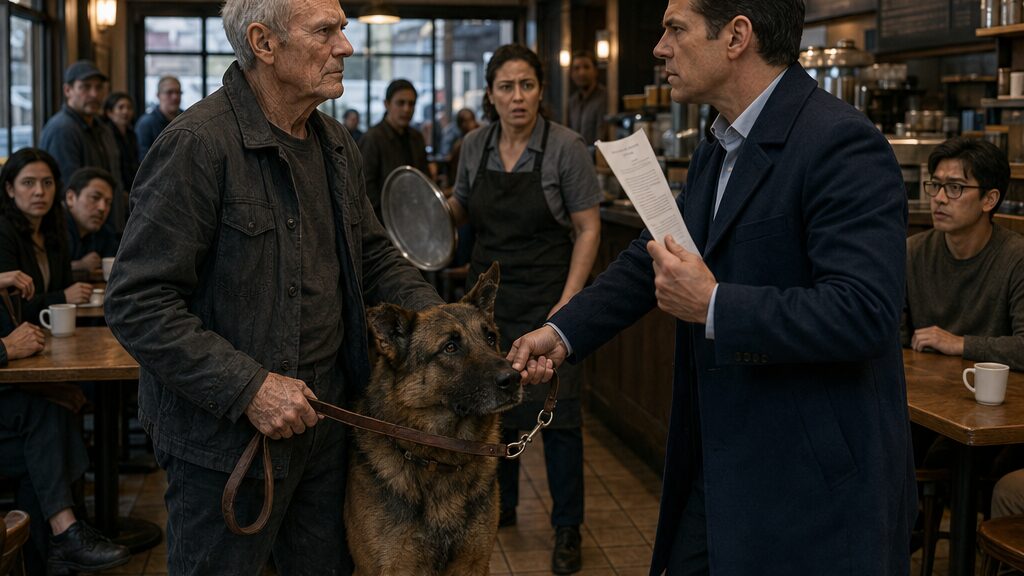
The Landlord Called His Military Dog Dangerous Until Both Veterans Nearly Fell
Chapter 1: The Whimper Before Daniel Woke
The dog whimpered three seconds before Daniel woke and knocked the water glass from the nightstand.
It struck the floor without breaking, rolled beneath the bed, and spilled a dark fan across the boards. Daniel came upright with his right hand jerking against his chest and the taste of metal at the back of his throat.
For one blind moment, the room was not his apartment.
Something hammered beyond a wall. Boots crossed gravel. A voice called a direction he could not understand. Daniel reached for the worn leather leash hanging from the bedpost and wrapped it once around his fist.
The dog’s paws twitched against the rug.
Another soft whine escaped its throat.
That sound brought the room back.
The curtains. The narrow dresser. The red digits of the clock reading 4:17. The radiator clicking beside the window.
Daniel lowered himself from the bed too quickly. The floor tilted. His knee struck the mattress, and he caught the bedpost before his shoulder followed.
The dog woke at once.
Its scarred head lifted. One ear stood higher than the other. It did not bark or scramble. It rose with the deliberate economy of an animal trained to distinguish fear from danger.
Daniel gave a small downward motion with two fingers.
“Stay.”
The word came out rough.
The dog stayed, but its eyes followed him.
Daniel tried to unwind the leash from his hand. His fingers would not obey. The leather jumped against his palm as though another person were tugging the other end.
He hated the shaking most when no one could see it.
There was no enemy in the room. No crowd. No reason to brace. Yet his hand moved with a violence all its own, betraying him before dawn.
The dog stepped forward only after Daniel’s knee weakened again.
It pressed its shoulder against his shin.
Daniel sank to the edge of the bed and buried his fingers in the thick fur behind its neck. The tremor did not stop at once. It traveled through his wrist, then lessened by degrees. The dog leaned harder, sharing its weight without looking at him.
“Bad one?” Daniel whispered.
The dog’s breath moved warm across his forearm.
Daniel worked his hand deeper into the fur until the last twitch faded. Beneath his fingers he felt the raised line of an old scar. He knew every one of them. The pale ridge near the shoulder. The notch in the left ear. The thin mark hidden under the collar where a piece of torn metal had once cut through skin.
The dog knew his scars too, though most of Daniel’s could not be touched.
Their breathing settled together.
Only then did Daniel notice the water moving toward the bedroom door.
He stood carefully, one hand on the dog’s back until his balance returned, and fetched a towel. By the time he had wiped the floor, the tremor was small enough to hide in a closed fist.
The dog watched him carry the wet towel toward the kitchen.
“You were dreaming,” Daniel said.
The dog followed at heel.
“You don’t get to deny it. I heard you.”
Its collar tag gave one quiet click.
Daniel filled the kettle, but he did not turn it on. The building pipes had begun their morning groan, and somewhere above him a chair dragged across a floor. Ordinary noises. He named them silently.
Pipe. Chair. Refrigerator.
The dog sat beside him, its flank touching his leg.
On the counter lay an envelope Daniel had not opened. A renewal reminder. The third one. The return address belonged to the clinic that had provided the letter for his housing file two years earlier.
He turned it facedown.
The forms asked questions that seemed simple until he read them.
Had he fallen in the last six months?
Did he require assistance with daily living?
Had his symptoms changed?
Daniel could answer the way they wanted and risk someone deciding he should not live alone. Or he could answer the way he had been answering—with silence—and remain exactly where he was.
He made coffee and took it to the small table near the window. The dog settled beneath his chair. Daniel rested his hand on its back while the sky paled behind the neighboring roofline.
At six, footsteps stopped outside his apartment.
The dog raised its head.
Daniel felt the change beneath his palm before he heard the paper slide under the door.
The envelope crossed the threshold and stopped against the rug.
The dog stood between Daniel and the door.
“Easy.”
Its body remained alert but controlled.
Daniel did not move immediately. Whoever had delivered the notice waited in the hall long enough for the old floorboard outside his door to creak twice.
Then the footsteps continued toward the stairs.
Daniel picked up the envelope. Jeffrey King’s name appeared in the upper corner, printed beneath the address of the apartment office.
The paper inside was folded once.
Mr. Moore,
Your presence is required at eight o’clock this morning at the coffee shop across from the property regarding an urgent lease compliance matter.
Daniel read the line twice.
Below it, in smaller type, was a reference to animal restrictions, tenant safety, and documented complaints.
The dog had returned to his side. Daniel felt its nose touch his wrist.
He thought of the maintenance worker in the hallway three days earlier. The open toolbox. The sharp smell of sealant. The worker backing toward the stairs while the dog stood across Daniel’s doorway.
Daniel remembered fragments of that morning and disliked every one of them.
He folded the notice before the memory could settle into shape.
“Coffee shop,” he said.
The dog watched him.
“Public place. That’s deliberate.”
He dressed in a dark shirt and the field jacket whose left cuff had been repaired twice. When he tried to fasten the watch on his wrist, his fingers began to shake again.
The dog stood beneath his hand.
Daniel pressed his palm into its fur until the buckle clicked into place.
At the door, he attached the worn leash to the collar. The leather was soft where years of use had darkened it. He tested the clasp, then rested two fingers against the dog’s neck.
“Close.”
The dog moved into position beside his left leg.
Daniel opened the apartment door.
The corridor was empty, but a fresh scrape marked the baseboard opposite his threshold. He stared at it. Something about its height troubled him.
On the landing below, another sheet of paper had been taped to the wall. It listed prohibited animals and liability procedures in language broad enough to mean almost anything.
Daniel looked back at the notice in his hand.
Near the bottom, beneath the meeting instruction, Jeffrey had underlined four words.
Removal of prohibited animal.
Chapter 2: The Notice Beside the Coffee Cups
Before Daniel could pull out the chair, Jeffrey King placed an eviction notice beside his untouched coffee and reached for the dog’s leash.
Daniel caught Jeffrey’s wrist.
The movement was fast enough to silence the nearest table.
“Don’t,” Daniel said.
Jeffrey looked down at Daniel’s hand, then at the dog. He wore a pressed blue coat and a pale shirt open at the collar, as if the meeting were important enough for authority but not important enough for formality.
“I was moving him away from the aisle.”
“You don’t move him.”
The dog stood against Daniel’s left leg, head level, eyes forward. A milk steamer hissed behind the counter. Cups struck saucers. People crowded shoulder to shoulder in the narrow shop, but the dog did not shift.
Jeffrey withdrew his wrist and straightened the papers he had brought.
“You’re already making this harder than it needs to be.”
Daniel remained standing.
Across the shop, Sarah Flores looked up from the register. She knew Daniel’s usual order and the corner table he preferred before the morning rush. Today every table was occupied, and a line curved past the pastry case.
Jeffrey tapped the notice.
“This is not an eviction yet. It becomes one if you refuse to correct the violation.”
“What violation?”
“The animal.”
Daniel glanced down at the dog.
“The retired military working dog?”
“The dangerous breed being kept in a building that does not allow dangerous breeds.”
A patron at the next table lowered a phone. Another turned in the chair.
Daniel felt heat rise along his neck.
Jeffrey had selected the coffee shop because he did not like private resistance. In the apartment office, Daniel could refuse and walk away. Here, Jeffrey had witnesses. Noise. Eyes. A stage disguised as neutral ground.
“Sit down,” Jeffrey said.
Daniel did not.
Jeffrey pushed a second sheet across the table. “Your accommodation record expired four months ago. We sent reminders.”
Daniel recognized the clinic letterhead attached to the copy. The date had been circled in red.
“He didn’t expire,” Daniel said.
“The document did.”
“My need didn’t.”
“I cannot manage a property based on statements I’m not permitted to verify.”
Daniel’s right hand tightened around the leash. The first tremor moved through his thumb.
The dog noticed. Its head turned barely an inch.
Daniel gave a small signal beside his thigh.
Settle.
The dog lowered onto the floor without touching the table or blocking the aisle. The leash went slack between them.
Jeffrey saw the movement but misunderstood it. “Good. At least you can control him when you choose to.”
Daniel looked at him until Jeffrey’s confidence thinned.
Sarah came from behind the counter, wiping her hands on a towel.
“Is everything all right?”
“No,” Jeffrey said before Daniel could answer. “But it will be handled.”
Sarah looked at the papers, then at the customers pretending not to listen. Her gaze stopped on the dog.
“Daniel, maybe it would be easier if you took him outside while you two talk.”
The words were gentle. That made them worse.
Daniel turned toward her.
Sarah’s expression changed at once. She had expected irritation, perhaps refusal. She had not expected the stillness that came over his face.
“He goes where I go,” Daniel said.
“I know. I’m just trying to keep the walkway clear.”
“He is under my chair.”
A customer squeezed past them carrying two drinks. Jeffrey moved aside. The dog did not.
Sarah lowered her voice. “People are getting nervous.”
“Because he’s lying down?”
“Because there’s an argument.”
“Then ask the man arguing to leave.”
Jeffrey gave a short breath through his nose. “This is exactly the problem. Every reasonable request becomes a confrontation.”
Daniel’s fingers began to jump against the leash. He moved his hand down and pressed it into the fur at the dog’s shoulder. The tremor weakened.
A woman near the window watched the movement. Her expression shifted from suspicion to uncertainty.
Jeffrey noticed that too.
“This animal blocked a maintenance worker in the second-floor corridor,” he said louder. “Another tenant heard growling. The worker believed he was going to be attacked.”
Daniel’s hand stopped.
“What worker?”
“The one repairing the pipe seal near your unit.”
“What did he say happened?”
“I just told you.”
“No. You told me what another tenant heard.”
Jeffrey’s jaw tightened. “He was prevented from doing his job.”
The dog’s scarred ear moved at the rising tone, but its body remained still.
Daniel remembered the worker’s boots near his doorway. A metal wrench dropping. The floor coming toward him.
After that, only pieces.
The dog standing across the threshold.
A voice from far away saying, Easy, easy.
Daniel had woken seated against the wall inside his apartment with the dog pressed across his knees.
He had told himself the worker had left because the repair was complete.
“Did the dog bite him?” Daniel asked.
“No.”
“Charge him?”
“He advanced.”
“How far?”
Jeffrey looked toward the people listening. “The issue is whether residents and workers feel safe.”
“The issue is what happened.”
“The issue is liability.”
There it was.
Not teeth. Not injury. Liability.
Jeffrey opened a folder and turned it toward Daniel. “The building’s insurer is conducting an inspection in forty-eight hours. I am required to show that reported hazards have been corrected.”
“And I’m the correction.”
“The dog is.”
Daniel pulled out the chair at last, not to sit but to anchor himself against its back. The room had begun to narrow at the edges. Too many cups striking counters. Too many voices compressed beneath the ceiling.
The dog rose without command and stood close enough for Daniel’s knee to touch its ribs.
Jeffrey slid a pen across the table.
“Sign this. You agree to remove the animal from the property by the inspection date. I’ll suspend further action.”
Daniel read the first paragraph. The language reduced the dog to unauthorized property. It required permanent removal and prohibited future entry.
“You want him surrendered?”
“I don’t care where he goes.”
Daniel lifted his eyes.
Jeffrey shifted. “That came out wrong.”
“No. It came out clean.”
Sarah stood beside the table, towel clenched in one hand. “Jeffrey, this could have been handled in your office.”
“I attempted to handle it for months. His paperwork lapsed.”
“You could still lower your voice.”
“I am not the one refusing a basic safety measure.”
Daniel pushed the paper back.
Jeffrey did not take it. “Think carefully.”
“I have.”
“If you refuse, I issue the formal notice today.”
Daniel’s hand slid along the dog’s back. Beneath the fur, the muscles remained calm.
“He carried me through a war,” Daniel said. His voice was quiet enough that Jeffrey had to lean forward. “You will not separate us now.”
The coffee grinder stopped.
For a second, the whole shop seemed to pause with it.
Jeffrey recovered first. “Military history does not override current requirements.”
“No. But facts should.”
“The fact is that your file is expired and your dog frightened a worker.”
“The fact is you haven’t told me what the worker actually said.”
Jeffrey gathered the papers, but left the eviction notice beside Daniel’s coffee.
“You have forty-eight hours. The inspector arrives Friday morning. By then, either the dog is gone or your tenancy ends.”
He looked down at the animal and then at Daniel.
“Choose which one you intend to keep.”
Chapter 3: What Stood Behind the Door
Sarah found the dent in the baseboard before Daniel had taken off his jacket.
“That’s where Jeffrey says the dog lunged?”
Daniel remained inside the doorway, one hand on the frame. The scar in the painted wood sat low—no higher than the dog’s chest—and curved inward as if struck by something metal.
Sarah crouched in the corridor and touched it.
“This wasn’t made by claws.”
“No.”
“What was the worker carrying?”
“A toolbox. Wrench. Sealant gun.”
The dog stood just inside the apartment. Its leash lay slack across the threshold, the worn leather marking the same line its body had held three mornings earlier.
Sarah rose and looked along the narrow corridor. “Show me where everyone was.”
Daniel disliked the word everyone. It made the event sound complete, witnessed, knowable.
“The worker was near the pipe access.” He pointed to the wall opposite his door. “I opened up because he knocked.”
“And then?”
Daniel removed his jacket and hung it carefully. “Then he came in.”
Sarah waited.
The dog looked up at Daniel.
“He did not come in?”
“No.”
“Why?”
Daniel went to the small table where he had placed the lease documents. “Because the dog was in the doorway.”
Sarah followed him inside. “Jeffrey says it moved toward him.”
“It may have.”
“Daniel.”
He sorted the papers although they were already aligned. Notices. Copies. The expired clinic letter. The unsigned renewal form he had taken from a drawer after returning from the coffee shop.
Sarah pulled out the opposite chair.
“What happened to you?”
“Nothing.”
“You keep answering questions I didn’t ask.”
Daniel’s fingers caught the corner of the form and bent it.
The dog moved close. Daniel touched its neck, and the stiffness in his hand eased.
Sarah watched.
“At the shop,” she said, “your hand stopped shaking when you touched him.”
“It comes and goes.”
“It came when Jeffrey raised his voice.”
Daniel sat.
Sarah’s face held no pity yet. He was grateful for that, though her patience was nearly gone.
“You came here because you think I need saving,” he said.
“I came because I asked you to leave my shop when you were the one being cornered.”
“You wanted the noise gone.”
“Yes.”
The direct answer surprised him.
Sarah folded the towel she still carried and placed it on the table. “I saw a crowded room and moved the person least likely to make trouble. That was easier than telling Jeffrey to stop. I was wrong.”
Daniel looked at the renewal form.
“What happened in this doorway?” she asked again.
The memory returned in broken pieces.
A metallic clatter in the corridor.
His vision flashing white.
His hand missing the edge of the counter.
The dog moving.
Daniel rubbed his thumb along the leash.
“I lost my balance.”
Sarah did not speak.
“I reached for the frame and missed. I went down inside the apartment.”
“Were you conscious?”
“Not the whole time.”
Her chair moved sharply against the floor. “And you didn’t tell anyone?”
“There was no one to tell.”
“The worker was right outside.”
“He left.”
“Because your dog wouldn’t let him through.”
Daniel’s jaw tightened.
Sarah leaned toward him. “That is why the dog blocked the door.”
“He was doing his job.”
“The dog or the worker?”
“Both.”
The answer landed between them.
Sarah glanced toward the threshold. The dog stood there now, facing the corridor without tension, simply occupying the narrowest point between Daniel and anyone who might enter.
“What did the worker do?”
“He stepped closer. The dog warned him.”
“Growled?”
“Once.”
“Did he bare his teeth?”
“No.”
“Did he chase him?”
“No.”
“Did he leave the doorway?”
“No.”
Sarah sat back. “Then Jeffrey’s complaint is missing the part where you were unconscious on the floor.”
Daniel flattened the bent page with his palm. “That part is not his business.”
“It becomes his business when you let him call the dog dangerous instead.”
Daniel’s hand began to tremble.
He curled it beneath the table.
Sarah saw anyway.
“You would rather lose your apartment than admit you fell.”
“I would rather decide who gets to know what happens to my body.”
“That choice is costing the dog his home too.”
Daniel stood so quickly the chair legs scraped.
The dog turned from the door.
Sarah did not retreat. “You promised him something, didn’t you?”
Daniel looked toward the dog.
The animal’s eyes remained on his face, waiting for the smallest instruction.
Daniel reached for the stack of papers, needing the conversation to become practical again. As he moved them, his phone lit beneath the expired clinic letter.
One missed call.
One voicemail.
The number was unfamiliar, but the message had arrived the morning of the corridor incident.
Daniel played it on speaker.
A man’s uncertain voice filled the room.
“Mr. Moore, this is the maintenance worker from the building. I wanted to check that you were all right. Your dog didn’t bite me or come after me. He just wouldn’t let me near you when you were down. I told the office there was a growl, but I don’t want anybody saying more happened than did. Call me if you need me to explain.”
The message ended.
Sarah stared at the phone.
“There,” she said. “That changes everything.”
“No.”
“It proves Jeffrey’s version is wrong.”
“It proves I was on the floor.”
“And alive because the dog kept the situation controlled.”
Daniel picked up the phone and deleted the notification from the screen, though not the voicemail.
Sarah’s disbelief hardened. “You’re not going to use it.”
“No.”
“Why?”
“Because then the next question is how often.”
The room became still.
Sarah’s voice lowered. “How often have you fallen?”
Daniel folded the unsigned form.
“That is not the question in front of us.”
“It is exactly the question.”
“No. The question is whether he has the right to remove the dog.”
“And your answer depends on telling the truth about why you need him.”
Daniel walked to the door and lifted the leash from the threshold. He wound it once around his palm, then unwound it when he saw Sarah watching.
The phone buzzed.
A message from Jeffrey appeared.
LOCKSMITH CONFIRMED FOR FRIDAY, 9:00 A.M. FAILURE TO REMOVE THE ANIMAL WILL BE TREATED AS REFUSAL TO CURE THE LEASE VIOLATION.
Sarah read it over Daniel’s shoulder.
“He’s serious.”
Daniel looked down at the dog, then toward the corridor where the baseboard still carried the dent from the worker’s falling tool.
The voicemail could protect the dog.
It could also expose the truth Daniel had spent months hiding.
Jeffrey had scheduled the locksmith for the deadline morning.
Chapter 4: The Paperwork Daniel Would Not Sign
Daniel signed his name wrong three times before the pen slipped from his hand.
The first attempt ended after the D. The second cut through the printed line and trailed into the margin. On the third, the letters crowded together until Moore looked like a word written by someone else.
He set the pen down before he snapped it.
The accommodation form lay across Jeffrey’s desk in the apartment office. Three pages. Boxes. Dates. Questions arranged with the clean confidence of people who believed every human difficulty could be reduced to ink.
Jeffrey sat opposite him beneath a framed photograph of the building taken when its brickwork was new. The dog was not allowed inside the office. Jeffrey had insisted on that before opening the door.
Now it waited in the corridor with Sarah.
Daniel could hear the faint click of its collar whenever someone used the stairs.
Without the dog’s body beside his leg, the tremor traveled freely through his right hand.
Jeffrey glanced at the ruined signature lines.
“This is why the form has a section for assistance.”
“I can write my own name.”
“I didn’t say you couldn’t.”
“You looked at it.”
Jeffrey folded his hands. A stack of insurance papers rested near his elbow, their corners squared. “I looked because the form has to be legible.”
Daniel pressed his palm flat against the desk. The shaking moved up his forearm.
The first page asked him to identify the animal and describe the work it performed. He had written mobility support, interruption of trauma response, physical stabilization.
The second page asked whether the need was continuous.
He had left the answer blank.
The third page asked about recent changes in condition, falls, loss of consciousness, and whether independent occupancy presented additional safety concerns.
Every box waited empty.
Jeffrey turned the form back toward him. “Complete it and I can send it to the insurer.”
“You can send what I gave you.”
“They will reject it.”
“Then tell them the dog is trained.”
“They know you say that.”
Daniel’s eyes lifted.
Jeffrey rubbed one thumb against the edge of the insurance packet. “That wasn’t meant as an insult.”
“It was shaped like one.”
A footstep passed outside. The dog’s collar clicked once, then stilled.
Daniel wanted to open the door. He wanted his hand in the scarred fur behind the dog’s neck. He kept both palms on the desk instead.
Jeffrey drew a breath.
“The insurer did not threaten cancellation because of your dog alone.”
Daniel waited.
“There are open items from the last inspection. The rear entrance has no ramp. The stair rail on the second floor does not meet the current height requirement. Two tenants reported the hall lighting. Then came the animal complaint.”
“So I’m the cheapest repair.”
Jeffrey’s face tightened. “You are the only item with a deadline I can meet before Friday.”
The honesty was uglier than a denial.
Daniel looked toward the framed photograph. The building’s front steps were visible even then, narrow and steep, built for bodies that never weakened.
Jeffrey opened the insurance packet and pointed to a paragraph marked in yellow.
“If coverage is suspended, I have thirty days to secure another carrier. The last quote was nearly double. I cannot absorb that.”
“You mean the tenants cannot absorb it.”
“I mean the building may not survive it.”
For the first time that morning, Jeffrey’s voice lost its public edge. He looked tired. Not ashamed. Not gentle. Simply afraid in a way he had converted into schedules, notices, and underlined clauses.
Daniel understood fear translated into control. That did not make it harmless.
“You could fix the rail,” Daniel said.
“I have estimates.”
“You could install the ramp.”
“I have estimates for that too.”
“But removing the dog costs you nothing.”
Jeffrey looked down.
The office door opened two inches.
Sarah’s face appeared in the gap. “Everything all right?”
“Yes,” Jeffrey said.
“No,” Daniel said at the same time.
The dog’s nose appeared beside Sarah’s knee.
Daniel’s hand jerked once against the desk.
Sarah noticed. “He needs the dog in here.”
“The office is not—”
“Big enough?” she asked. “Neither is the hallway.”
Jeffrey stared at the animal for a long moment, then pushed his chair back.
“Fine. On a short leash.”
Daniel did not thank him.
Sarah opened the door. The dog entered at a precise heel, passed Jeffrey without looking at him, and stopped beside Daniel’s chair.
Daniel lowered his hand into its fur.
The tremor eased so quickly Jeffrey’s eyes narrowed.
Not suspicion this time.
Recognition.
“That happens every time?” he asked.
Daniel kept his gaze on the form. “Enough.”
Jeffrey sat again. “Then write that.”
Daniel withdrew his hand.
The shaking returned in small waves.
Jeffrey reached into a drawer and removed another document. “There may be an alternative.”
Sarah remained near the door.
Jeffrey pushed the paper across the desk. It was not an eviction notice. It was a relocation agreement.
“I’ll waive the remaining lease term,” he said. “No penalties. I’ll return the full deposit. I can add one month’s rent as moving assistance.”
Daniel read the first lines.
The agreement required him to vacate before the inspection and remove the dog immediately from the property. There was a handwritten note offering contact information for another building farther from the center of town.
“You called them?” Daniel asked.
“I checked availability.”
“Do they take him?”
Jeffrey paused.
“No.”
Sarah shifted near the door.
Jeffrey continued, “But the money could cover temporary boarding until you arrange something.”
Daniel’s hand became still for a reason that had nothing to do with the dog.
“Boarding.”
“Temporarily.”
“A kennel.”
“If necessary.”
Daniel saw a row of chain-link runs under hard white lights. He heard metal bowls pushed across concrete. He remembered the retired K9 years earlier refusing food when separated from familiar voices, its body rigid at the back of an enclosure while men discussed whether it was suitable for civilian placement.
Daniel had stood outside that kennel and made a promise without paperwork or witnesses.
You’re not being left here.
He pushed the relocation agreement away.
Jeffrey leaned forward. “I’m trying to give you an option.”
“You’re giving me money to abandon him.”
“That is not what I said.”
“It’s what the paper does.”
“The building has other residents.”
“So did the places he served.”
Jeffrey’s mouth tightened. “That history cannot answer every current concern.”
“No. But neither can your insurance bill.”
Sarah stepped closer to the desk. “What happens if he submits the accommodation form today?”
“I request an expedited review.”
“And the locksmith?”
“Remains scheduled unless the insurer accepts a temporary exception.”
Daniel looked at the empty boxes again.
Recent changes.
Falls.
Loss of consciousness.
Independent occupancy.
He could answer them. He could give the insurer what it needed and allow strangers to measure his life by risk.
Or he could leave them blank and force Jeffrey to act without the truth.
The dog rested its chin against Daniel’s knee.
Jeffrey lowered his voice. “I am not trying to take your independence.”
“You’re asking me to prove I deserve it.”
“I’m asking whether you are safe.”
Daniel looked at him.
That question was worse than the accusation.
Safe meant observed. Evaluated. Possibly removed. Safe meant someone else deciding the limits of his own home.
He tore the form in half.
Sarah flinched.
Daniel tore it again and placed the pieces on Jeffrey’s desk.
“There,” he said. “Now it’s legible.”
He stood. The room swayed, but he refused the desk and placed one hand on the dog’s back until the floor steadied.
Jeffrey watched every movement.
“You have until tomorrow morning,” he said.
Daniel clipped the leash to the collar. “You already told me.”
“This is not pride anymore.”
Daniel turned toward the door.
Jeffrey’s voice followed him. “It’s evidence.”
Daniel walked out before his balance could answer for him.
That night, the dog’s whimper sharpened into a cry.
Daniel woke on the floor beside the bed with darkness pressed against his eyes. His right hand was wrapped in the leash. The leather had cut deep grooves across his palm, and one had opened enough to bleed.
The dog lay against his chest, trembling.
For several seconds, Daniel could not tell which of them had pulled the other out of the dream.
Chapter 5: The Same War in Their Sleep
Daniel woke again with the dog’s weight across his chest and less than four hours before the locksmith was due.
The bedroom lamp burned on its side, throwing light along the floorboards. His packed bag stood near the apartment door. He did not remember carrying it there.
The dog had stopped trembling, but its muzzle remained pressed beneath Daniel’s chin. Each breath warmed the skin above his collar.
Daniel raised his injured hand.
The leash still circled his palm.
He unwound it slowly. Dried blood darkened the worn leather in two places. The dog watched his fingers, then licked the deepest groove once.
“You’re not supposed to tend the handler,” Daniel murmured.
The dog’s tail struck the floor.
Daniel sat up. The room shifted, settled, then shifted again. He waited until the walls held their place.
On the chair beside the bed lay the relocation agreement Jeffrey had given him. Daniel had taken it without remembering why. Beneath it were the torn pieces of the accommodation form, retrieved from the office wastebasket after Jeffrey and Sarah had left.
He had taped the pages together during the night.
Most of the boxes remained empty.
The packed bag contained two shirts, medication, identification, the dog’s collapsible bowl, and the old blanket it preferred. Daniel had packed the leash first, then clipped it back onto the collar when the dog began following him from room to room.
There was no destination written on any piece of paper.
A motel might take them for a night. A shelter might take Daniel and refuse the dog. A boarding facility might take the dog and close a gate between them.
Daniel looked toward the bag.
Leaving before the locksmith arrived had seemed like a decision when darkness filled the room. In daylight, it looked like flight.
He pushed himself upright using the bedframe.
The dog rose immediately and moved beneath his hand.
Daniel stopped it with a small gesture.
“No.”
The dog remained close.
“I can stand.”
He took one step. His knee softened. The dog shifted toward him, but Daniel caught the dresser.
A metal tag clicked against the collar.
That sound opened an older room in his mind.
Concrete floor. Fluorescent lights. The dog younger, thinner, pacing behind chain-link after retirement processing. Too alert to lie down. Too tired to keep standing. A staff member explaining that the animal had become reactive during sleep and might require specialized placement.
Daniel had watched the dog turn in one tight circle after another.
He had placed his hand against the wire.
The dog had stopped.
Not calmed completely. Not healed. Stopped.
Daniel had spent weeks arranging the release. Forms, interviews, evaluations, promises about secure housing and medical care. The final signature had felt lighter than any medal he had ever held.
Outside the kennel, he had clipped on this same leash and said, “You came home with me.”
The dog had leaned against his leg so hard Daniel nearly lost his balance.
Daniel looked down now.
He had promised the dog would never be left in a cage because it had survived badly.
Yet he was preparing to disappear rather than admit they both still needed help surviving.
The knock came just after seven.
The dog moved to the door but did not bark.
Daniel checked the peephole.
Sarah stood in the corridor holding two paper cups and a small first-aid box.
He opened the door halfway.
Her eyes dropped to the bag.
“Where are you going?”
“Out.”
“With everything you own in one hand?”
“It’s not everything.”
“Where?”
Daniel reached for one of the coffee cups.
Sarah did not release it.
“Tell me where you’re going.”
“I’ll find somewhere.”
“You haven’t found somewhere.”
The dog stood between them without blocking Sarah, its head turned toward Daniel.
Sarah looked at the taped form on the table. “You put it back together.”
“I haven’t finished it.”
“You packed instead.”
Daniel took the cup from her this time. His injured hand shook beneath the cardboard sleeve.
Sarah entered without waiting for permission and closed the door behind her.
“You cannot carry that bag down those stairs.”
“I carried more than that for years.”
“That was not this morning.”
Daniel’s jaw tightened.
Sarah placed the first-aid box on the table. “Show me your hand.”
“No.”
“Then bleed on your own coffee.”
He looked down. A thin red line had reopened across his palm.
Sarah took the cup and set it aside. She cleaned the cut without speaking. The dog watched every movement but showed no tension.
When she finished, she nodded toward the taped pages.
“What answer scares you most?”
Daniel flexed his bandaged hand.
“Falls?” she asked. “Losing consciousness? Living alone?”
“All of them.”
“Because Jeffrey might use them?”
“Because anyone might.”
Sarah closed the first-aid box. “You think leaving without an address makes you harder to take apart.”
“It keeps the dog with me.”
“For how long?”
Daniel looked at her.
She did not soften the question.
“If you fall in a motel and no one knows where you are, what happens to him? If you sleep in your car, what happens when the police knock on the window? If you collapse on the stairs carrying that bag, what does he do?”
“He does what he always does.”
“And who helps him?”
The dog lowered itself beside Daniel’s chair.
A soft sound left its throat—not fear, not quite. A remembered whimper carried into waking.
Daniel placed his hand in its fur.
The dog’s body eased.
Sarah watched them.
“He dreams too,” Daniel said.
The words felt exposed as soon as they left him.
Sarah sat across from him. “About what?”
“The same noises. Metal. Engines. Sometimes a door slamming is enough.” Daniel’s fingers moved over the scar behind the dog’s neck. “He wakes before I do. Or I wake before he does. Depends which one gets there first.”
Sarah’s eyes lowered to the leash.
Daniel continued because stopping now would turn the truth back into shame.
“When they retired him, they thought he might not adjust. He wouldn’t sleep unless someone stayed where he could see them. If he did sleep, he came up fighting the air.”
“And you took him anyway.”
“He took me first.”
The dog looked up.
Daniel swallowed.
“He wakes from the same war I do.”
The apartment held the sentence without answering it.
Sarah pushed the repaired form toward him.
“Then write what is true.”
Daniel stared at the boxes.
His hand shook when he picked up the pen. This time he did not hide it beneath the table.
He checked yes beside recent falls.
Yes beside loss of consciousness.
Under additional assistance, he wrote that the K9 interrupted trauma episodes, provided physical stabilization, and maintained protective space during medical events.
The final question asked whether he believed he could continue living independently with reasonable accommodation and an emergency plan.
Daniel paused.
Then he wrote yes.
His phone rang.
Jeffrey’s name filled the screen.
Daniel answered.
“The locksmith is delayed,” Jeffrey said without greeting. Coffee-shop noise moved behind his voice. “There was a scheduling issue.”
“How long?”
“An hour, perhaps two. The inspector is already nearby.”
Daniel looked at the clock.
Jeffrey continued, “We will complete the decision at the coffee shop. It is better to have witnesses after yesterday.”
“Witnesses for what?”
“That I gave you every opportunity.”
Sarah heard enough to stand.
Daniel folded the completed form.
“You’ll have your witness,” he said.
He ended the call.
The bag remained by the door.
Daniel removed the dog’s bowl and blanket, returned them to their places, and unpacked the shirts. Last, he lifted the leash from the bag and clipped it to the collar.
His hand trembled around the leather.
He did not wrap it around his fist.
At the coffee shop, the morning crowd was thicker than usual. Jeffrey stood at the center table with a folder open before him. People shifted when Daniel entered, but no path fully cleared.
Sarah moved ahead to make room.
Daniel carried the signed form in his bandaged hand. The dog walked close at his left side, scarred head level, leash loose.
Jeffrey saw the paper.
“You’ve made your decision,” he said.
Behind Daniel, a server lost control of a metal tray.
It struck the tile with a crack that split the room in two.
Chapter 6: Four Locked Legs Beneath Him
The crashing tray sent Daniel sideways before Jeffrey finished saying the word eviction.
The sound became something larger inside Daniel’s skull.
Metal against stone. A concussive snap. Voices compressed into one sharp command. The coffee shop vanished behind a white flare, and his body moved before the room returned.
His right foot caught the leg of a chair.
The signed form flew from his hand.
The leash snapped taut.
The dog turned beneath him in a single practiced motion.
Its front legs planted wide. Its back legs locked. Its body came across Daniel’s fall, not resisting him, not pulling away, placing bone and muscle exactly where his weight would descend.
Daniel’s palm struck the dog’s back.
His other hand caught the edge of the table, but the table slid.
Someone shouted.
A cup shattered.
The dog did not move.
Daniel bent over it, breath trapped high in his chest. The floor tilted beneath the four fixed points of the animal’s legs.
“Give him space,” Sarah said.
Chairs scraped.
People moved the wrong way first, bunching toward the walls and narrowing the aisle.
Daniel heard Jeffrey’s voice close by.
“This is what I was concerned about.”
A hand closed around the leash near the clip.
The dog’s head turned, but its legs remained locked beneath Daniel.
“Let go,” Daniel said.
Jeffrey pulled once, trying to move the animal away from the fallen papers and broken cup.
Sarah struck his hand aside.
“Do not touch that leash.”
“I’m trying to clear the dog.”
“He is holding Daniel up.”
Jeffrey looked down as though the shape before him had only now become visible.
Daniel’s arms trembled with the effort of staying upright. The dog absorbed his weight without sound.
The leash lay stretched across its shoulder.
Daniel slid his bandaged hand into the thick fur behind its neck.
The tremor passed through his fingers, then weakened.
He felt the raised scar beneath his palm.
“Brace,” he whispered.
The command was unnecessary. The dog was already doing it.
Daniel drew one foot beneath him. His knee threatened to fold. The dog shifted half an inch, matching the change without breaking position.
The room had gone silent except for the hiss of the coffee machine and Daniel’s uneven breathing.
He pushed against the sturdy back.
One hand in fur. One hand on the table.
The dog held.
Daniel stood.
Not cleanly. Not without pain. But upright.
The leash loosened and dropped into a curve between them.
No one spoke.
A server crouched near the fallen tray, frozen with a towel in one hand. A child at the window table leaned against an adult’s arm. The patrons who had watched Jeffrey confront Daniel two mornings earlier now stared at the dog instead.
Not at its scars.
At its discipline.
The dog looked only at Daniel.
Jeffrey bent and retrieved the signed form from beneath a chair. A corner had landed in spilled coffee. Brown liquid climbed the paper toward Daniel’s handwritten answers.
Jeffrey held it by the dry edge.
“You lost consciousness?” he asked.
Daniel’s breathing had begun to slow. “Once that you know about.”
Jeffrey glanced toward the crowd.
Daniel saw the calculation return. The witnesses. The insurer. The meaning Jeffrey could assign to what everyone had seen.
“This demonstrates a larger problem,” Jeffrey said. “You are not physically safe living alone.”
Sarah stared at him. “That is what you took from this?”
“I took from this that he nearly collapsed in a public place.”
“And the dog prevented him from hitting the floor.”
“The dog cannot call emergency services. The dog cannot repair a stair rail. The dog cannot—”
“No,” Daniel said.
His voice was not loud, but Jeffrey stopped.
Daniel kept one hand in the dog’s fur. The other hung at his side, still shaking.
“No, he cannot fix your building.”
Jeffrey’s face hardened. “That is not what I meant.”
“It is what you’re using him to avoid.”
A murmur moved through the shop and died quickly.
Daniel looked toward the stained form in Jeffrey’s hand.
“I fell in my apartment three days ago. I lost consciousness. He blocked the maintenance worker because I was on the floor behind him.”
Jeffrey’s eyes narrowed.
“The worker left a message,” Daniel continued. “Said the dog never bit him. Never chased him. Warned once and held the doorway.”
“You withheld that information.”
“Yes.”
The admission changed the room more than an accusation would have.
Sarah looked at Daniel, but he did not turn toward her.
“I withheld it because I thought if you knew I had fallen, you would decide I could not live alone. I was right about that part.”
Jeffrey’s grip tightened on the paper. “Then you understand my concern.”
“I understand fear dressed as procedure.”
Jeffrey flinched.
Daniel’s legs remained unsteady. The dog leaned against his knee, no longer bracing his full weight but ready.
“I let the medical letter expire,” Daniel said. “I ignored the renewals. I tore up the first form because it asked questions I did not want anyone to answer for me.”
He looked around the coffee shop.
Faces turned away when he met them. Others held his gaze too long. Daniel felt the old urge to retreat, to give them nothing more.
The dog’s fur moved beneath his fingers.
Daniel stayed.
“My hands shake,” he said. “Sometimes they stop when I touch him. Sometimes they don’t. I lose my balance. Loud metal can put me somewhere I’m not. He interrupts that. He makes space. He braces me. At night, he wakes me before the worst part.”
The dog’s scarred ear angled toward his voice.
“And sometimes,” Daniel said, “I wake him.”
Jeffrey looked down at the form again.
“This does not erase the safety concern.”
“No. It tells you what the safety is.”
The words settled into the narrow aisle.
Sarah moved to Daniel’s other side but did not touch him.
Jeffrey glanced toward the front window. A car had stopped outside, its driver checking the building number. The inspector, perhaps. Or the locksmith.
The old urgency entered his face.
“If I submit this today, there is no guarantee of approval.”
“I know.”
“The insurer may require an assessment.”
“I know.”
“They may require an emergency contact, medical verification, modifications—”
“Then let them require what is lawful.”
Jeffrey lowered his voice. “And if they refuse?”
Daniel took the stained form from him.
His hand trembled visibly around the pages. He did not press it into the dog’s fur this time. He allowed Jeffrey to see it.
“Then I contest it.”
“You could lose the apartment.”
“Yes.”
“And you are willing to do that?”
Daniel looked at the dog beside him.
The leash rested loose between his hand and the collar.
“I am willing to lose the apartment,” he said. “I am not willing to lose him.”
Jeffrey’s eyes moved to the dog’s locked, steady legs, then to Daniel’s bandaged palm.
Daniel placed the completed form back into Jeffrey’s hands.
“File it,” he said. “Withdraw the demand that separates us. Or proceed and answer for it properly.”
Outside, the person in the parked car stepped onto the sidewalk carrying a black case.
Inside, no one applauded.
Jeffrey stood with the form in one hand and the eviction notice in the other, while Daniel remained upright beside the animal he had been ordered to remove.
Chapter 7: The Aisle That Opened Without Applause
No one spoke when Daniel turned toward the door.
The people nearest the aisle moved first. A chair slid beneath a table. A man drew his coat away from the dog’s path. The server who had dropped the tray stepped behind the counter, still holding the damp towel against her chest.
The movement traveled through the coffee shop until a narrow corridor opened between Daniel and the exit.
He had crossed wider spaces under worse conditions, but none had felt as exposed.
The dog walked at his left side. Its breathing was even. The worn leash curved loosely from the collar to Daniel’s bandaged hand, touching neither chair nor stranger.
Sarah remained half a step behind them.
Daniel did not look at the faces on either side. Awe could become pity with one changed expression. Pity could become ownership. He wanted neither.
His legs still felt hollow from the fall. Each step required attention, but the dog matched his pace without pressing against him.
They were three feet from the door when Jeffrey said, “Mr. Moore.”
Daniel stopped.
The dog stopped with him.
Jeffrey stood beside the center table, the eviction notice lowered against his leg. The completed accommodation form remained in his other hand. Coffee had stained one corner, but Daniel’s answers were still visible.
Outside the window, the person with the black case had crossed the street toward the apartment building. Not the locksmith. The inspection badge clipped to the person’s coat made that clear.
Jeffrey looked toward the window, then back at Daniel.
“The immediate removal order is suspended.”
A cup touched a saucer somewhere behind Daniel.
He did not turn around fully. “Suspended is not withdrawn.”
“No.” Jeffrey glanced at the form. “Not yet.”
Sarah stepped beside Daniel. “You were prepared to change his locks.”
“I was prepared to enforce the notice.”
“Without verifying the complaint.”
Jeffrey’s mouth tightened.
Daniel waited.
Jeffrey had always filled silence quickly when other people were watching. Now he seemed to understand that every defense would sound different after what the room had seen.
“I did not speak directly to the maintenance worker,” he said.
Sarah stared at him. “You based this on a secondhand complaint?”
“I received the incident report from another tenant and a summary from the maintenance service.”
“The worker left Daniel a message,” Sarah said. “He said there was no attack.”
Jeffrey looked at Daniel. “You had that message and withheld it.”
“Yes.”
The answer offered Jeffrey no escape and no victory.
Daniel shifted his weight. The dog moved closer, its shoulder barely touching his knee.
Jeffrey’s gaze followed the movement.
“I chose the quickest way to close the insurance item,” he said. “The animal complaint could be acted on before the inspection. The ramp and rail could not.”
“You chose what could not argue back,” Daniel said.
Jeffrey’s eyes dropped to the dog.
“No,” Daniel corrected. “You chose what you thought could not.”
The dog remained still.
Jeffrey folded the eviction notice once. The crease passed through the word violation.
“I will submit the accommodation request today,” he said. “The lock change is canceled. There will be a formal review of the complaint and your current needs.”
“My current needs are on the form.”
“The insurer may require medical verification.”
“I’ll provide what the law requires.”
“They may require an emergency plan.”
Daniel’s first instinct was refusal.
He felt it arrive in his chest before it reached his mouth. An emergency plan meant names, access, instructions taped where others could see them. It meant admitting that a closed door and a trained dog might not always be enough.
The dog looked up at him.
Sarah did not speak for him.
Daniel loosened his grip on the leash.
“We discuss the plan,” he said. “You don’t impose it.”
Jeffrey nodded once. “Agreed.”
“And the dog remains with me during the review.”
“Yes.”
“No boarding. No temporary removal.”
Jeffrey looked toward the inspector approaching the building entrance.
“Yes.”
Daniel studied him. “Why now?”
Jeffrey’s face showed the question had struck where Daniel intended.
“Because I saw the response,” he said.
“That should not have been necessary.”
“No.”
The admission was small. It did not repair the public threat, the hand on the leash, or the locksmith appointment. But it was not disguised as an excuse.
Daniel accepted it for what it was and no more.
He turned toward the door again.
Sarah reached past him and opened it. Outside, the morning air cut through the heat that had collected beneath his collar.
“Your corner table will be kept clear,” she said.
Daniel glanced back.
Sarah’s expression was careful. “Not empty. Clear. So no one stacks chairs against it or blocks the space underneath.”
The distinction mattered.
“I don’t need a special table.”
“No,” she said. “You need the table you’ve used for two years to remain usable.”
Daniel looked toward the corner near the window. There was enough room beneath it for the dog to settle without entering the aisle. He had chosen it for that reason long before Sarah noticed.
“All right,” he said.
She nodded and did not smile as if she had won something.
Daniel and the dog crossed the street together.
The inspector stood inside the apartment entrance, examining the rear access report while Jeffrey hurried from the coffee shop behind them. Daniel paused at the base of the front steps.
The steps had always been steep. That morning they looked accusatory.
The dog waited beside him.
Daniel placed one foot on the first riser. His leg held. On the second, the weakness returned.
A hand moved near his elbow.
Sarah had followed them across the street.
Daniel turned sharply.
She stopped before touching him. “May I?”
The old refusal rose again.
He looked at the stairs, then at the dog, then at Sarah’s open hand.
“Only to the landing,” he said.
She supported his elbow without lifting it. The dog climbed at Daniel’s pace, close enough to brace if needed but not forced to carry what another person could share.
At the landing, Daniel withdrew his arm.
“Thank you.”
Sarah nodded. “Coffee tomorrow?”
“If the corner is clear.”
“It will be.”
Several days later, a temporary handrail extension appeared on the second floor. It was plain metal, bolted firmly into the wall. The rear ramp remained a set of measurements marked in chalk, and the insurance review had produced more forms than answers.
Daniel signed them.
Not all at once. Not without stopping when his hand shook. But he signed.
A medical assessment was scheduled. An emergency plan sat on the kitchen table with Sarah’s number listed as a nearby contact—with her permission and his conditions written beside it.
Jeffrey had not become kind. He had become precise in a different direction. Notices arrived in envelopes instead of beneath doors. Questions were asked before conclusions were typed. When he passed the dog in the hallway, he gave it room without pressing himself theatrically against the wall.
That was enough for now.
One night, the dog whimpered beside the bed.
Daniel woke before the sound sharpened.
The room was dark, but it remained the room. Radiator. Curtains. Dresser. The faint line of streetlight beneath the door.
He lowered his hand into the scarred fur.
The dog’s trembling eased.
Daniel’s fingers were steady.
The worn leash hung from a hook beside the apartment door, no longer wrapped around the bedpost or his sleeping fist.
For a while, Daniel remained on the floor with the dog leaning into him. Their breathing found the same rhythm.
Then he reached for the phone on the nightstand.
The medical office’s confirmation message waited on the screen. In the past, he would have deleted it or let the appointment pass without response.
Daniel pressed confirm.
The dog rested its head across his knee.
“You came home with me,” Daniel whispered.
His hand moved once through the fur.
“This is how we stay.”
The story has ended.