They Locked His Gear Away Before Learning He Had Designed the Entire Base
Chapter 1: The Case He Was Not Allowed to Touch
The lid came down before Ronald Mitchell’s fingers reached the handle.
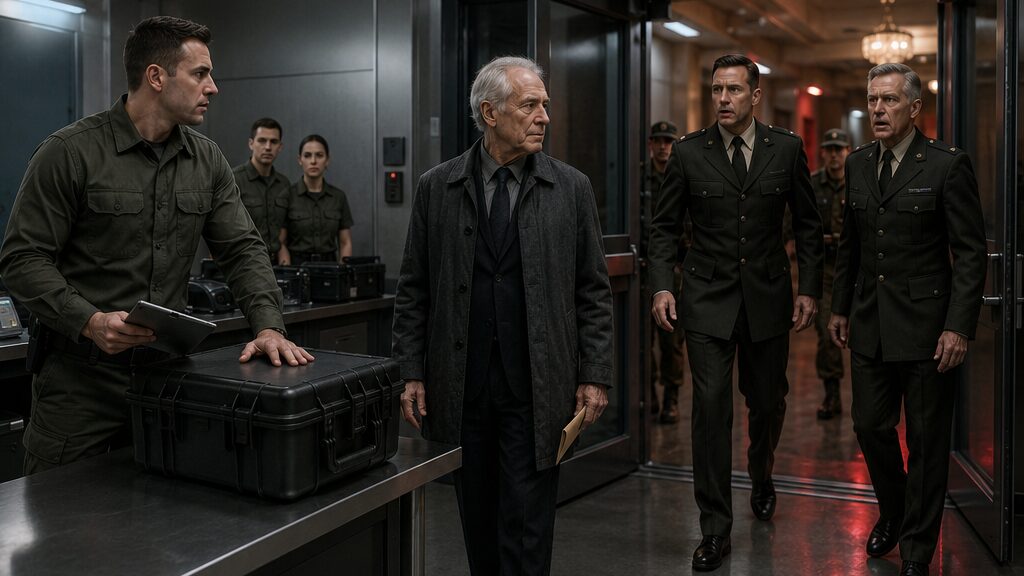
The tactical case closed with a metallic crack that traveled along the narrow service corridor and cut cleanly through the muffled music from the gala upstairs.
Brandon Perez kept one palm on the black lid. With the other, he turned the twin latches until each clicked into place.
“Your name isn’t on the daily visitor log,” he said, “and I don’t make exceptions for anyone.”
Ronald looked at the case, then at the quartermaster.
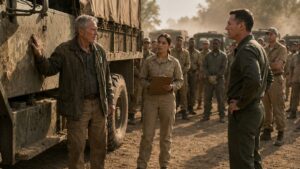
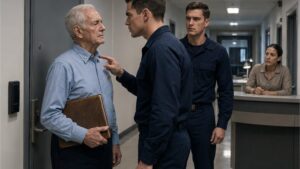
Brandon was perhaps thirty-five, broad through the shoulders, his uniform pressed with the hard precision of someone who checked every seam before leaving his room. A clipboard rested against his hip. Three colored tabs divided the pages. Nothing about him suggested carelessness.
That made the closed case more troubling.
Ronald withdrew his hand. “I’m not asking for an exception.”
“You’re asking me to issue restricted equipment without credentials.”
“I was told the case would be waiting here.”
“So are several cases.” Brandon nodded toward the steel racks behind the checkpoint. “For people whose names are on the list.”
Two junior personnel at a nearby equipment table slowed their work. One held a bundle of radio batteries without moving. The other, a logistics specialist with a narrow face and dark hair secured at the back of her head, glanced from Ronald to the case.
Ronald wore a plain dark suit beneath a faded field coat. The coat was older than most of the people in the corridor. Its elbows had been repaired twice, and a pale line marked where a shoulder patch had once been removed. Upstairs, uniforms glittered beneath chandeliers. Down here, under white security lights, Ronald looked like a guest who had taken the wrong elevator.
Brandon opened the visitor log on his clipboard and ran a finger down the page.
“Mitchell,” he said. “No Ronald Mitchell. No General Mitchell. No consultant Mitchell. Nothing.”
Ronald’s eyes paused on the gear case. A white inventory strip had been fixed beside the handle.
E-7A-041.
The number was correct.
“Check the exercise designation,” Ronald said.
“I checked the names.”
“The case was not assigned by name.”
Brandon’s expression tightened. “Restricted gear is issued to verified personnel, not mystery designations.”
Ronald reached inside his coat slowly enough that no one could mistake the movement. He removed a cream-colored envelope sealed with a narrow gray strip. There was no name on the front. Only a stamped code:
AEGIS NIGHT / CONTROL ACCESS
He placed it on the case.
“This authorizes verification.”
Brandon did not touch it.
“You can open it,” Ronald said.
“I can also refuse unidentified documents presented by unidentified civilians.”
“It contains the contact chain.”
“It could contain a dinner invitation.”
The words were controlled, but the junior personnel heard them. One looked down quickly. The logistics specialist did not.
Ronald studied Brandon for a moment.
The quartermaster was not merely enforcing a rule. He was performing the enforcement for the corridor, making certainty visible.
“No officer credentials,” Brandon said, “no gear, no briefing.”
A digital clock above the inner doors changed from 18:41 to 18:42. Beneath it, red letters displayed:
BRIEFING LOCK-IN: 18 MINUTES
Ronald’s gaze moved to the classified doors.
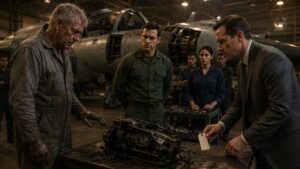
They were newer than the surrounding wall, reinforced panels set into a frame of dark composite material. A keypad and badge reader stood at shoulder height. Lower down, almost hidden beneath the metal trim, a small pressure sensor sat behind a perforated plate.
Ronald leaned slightly to see it.
Brandon shifted between him and the door. “Step back from the access panel.”
“That sensor is mounted too close to the lower hinge.”
Brandon stared at him.
“It will register the door’s weight before it registers a forced obstruction,” Ronald said. “You’ll get false pressure alerts whenever the frame expands.”
The logistics specialist turned toward the door.
Brandon’s hand left the case and settled near his radio. “How do you know there’s a pressure sensor there?”
“Because there should be one.”
“That wasn’t my question.”
“No,” Ronald said. “It wasn’t.”
The music above them rose briefly as a door opened somewhere near the stairwell. Brass and applause drifted down, then vanished when the door closed again.
Brandon picked up the envelope with two fingers, not to open it but to slide it back toward Ronald.
“You need to return to the gala level and speak to the event coordinator. If someone down here is expecting you, they can add your name through command channels.”
“The command channel is inside that envelope.”
“I’m not opening it.”
Ronald looked at the gray seal. “Why?”
“Because every person stopped at a checkpoint has a reason their paperwork should count more than the process.”
“And if the process contains a verification path?”
“It begins with identification.”
The radio batteries clicked as the junior worker finally set them down. Another soldier entered from the briefing side, saw the confrontation, and slowed near the wall. Ronald felt the scene hardening around Brandon. Each witness made it more difficult for the quartermaster to reconsider without appearing to surrender his authority.
Ronald had seen that happen in rooms far less secure and far more dangerous.
He could end it with six words.
He did not.
Instead, he placed the envelope back on the case. “The code is sufficient to initiate restricted verification.”
Brandon opened the visitor log again. “The log says otherwise.”
“The log says my name isn’t printed on a page.”
“That page is what keeps unauthorized people out of this room.”
“No,” Ronald said quietly. “Judgment does that. The page assists it.”
For the first time, something openly personal crossed Brandon’s face.
“You don’t get to lecture me about judgment while asking me to disregard a direct control document.”
“I asked you to verify another one.”
“You asked me to open an envelope you brought from outside the secure zone.”
Ronald glanced toward the gear racks. “That case came from inside.”
Brandon’s jaw set.
The logistics specialist stepped closer to the equipment table, as though the movement had another purpose. Her name tape read JONES.
She looked at the inventory strip on the case, then at a thin manifest clipped beneath her work sheet.
Brandon noticed.
“Specialist Jones, finish the radio issue.”
“Yes, Sergeant.”
She did not move away.
Ronald placed one hand lightly on the case lid. Brandon immediately covered the handle.
“Do not touch restricted equipment.”
“It was prepared for me.”
“That has not been established.”
The clock changed again.
BRIEFING LOCK-IN: 15 MINUTES
Ronald removed his hand.
He had come down from the gala because the protected elevator had been closed after a catering alarm. A coordinator had pointed him toward the service stairs without looking up from her tablet. It had seemed harmless. Easier, even. He had never liked ceremonial arrivals.
Now the wrong elevator, an absent name, and a sealed envelope had become a test no one had intended.
Jones lifted her manifest.
“Sergeant,” she said.
Brandon did not look at her. “Finish your assigned task.”
“The case number.”
His eyes shifted toward her.
Jones lowered her voice, but the corridor had become so quiet that everyone heard.
“E-7A-041 is on the restricted manifest.”
Brandon’s fingers tightened around the case handle. “Assigned to whom?”
Jones read the line twice, as if hoping a conventional rank might appear the second time.
Then she looked at Ronald.
“Sergeant,” she whispered, “that case was assigned to someone called Architect.”
Chapter 2: The Envelope Brandon Refused to Open
Brandon pushed the envelope across the case until its edge struck Ronald’s hand.
Above them, the countdown changed.
BRIEFING LOCK-IN: 13 MINUTES
“An operational designation is not identification,” Brandon said.
Jones still held the manifest. She had gone pale around the mouth, but she did not lower the page.
“It matches the case,” she said.
“It confirms that a case exists.”
“It confirms the designation.”
Brandon turned on her. “And does the man standing here have credentials bearing that designation?”
“No, Sergeant.”
“Then you have completed the relevant check.”
Jones’s fingers closed around the paper.
Ronald picked up the envelope but did not return it to his coat.
“The verification procedure for a restricted designation is printed in your checkpoint manual,” he said. “You contact exercise control, provide the case number, then authenticate the bearer through a challenge response.”
Brandon gave a humorless smile. “You’ve studied the manual.”
“I helped revise that section.”
A few heads lifted along the corridor.
It was a mistake. Ronald knew it as soon as he said it—not because the statement was false, but because it offered Brandon another fragment without the context needed to understand it.
The quartermaster’s suspicion sharpened.
“First you know the door sensors. Now you claim you revised our verification procedures.”
“I said I helped.”
“And yet you can’t produce a credential.”
“The envelope gives you the challenge chain.”
Brandon tapped the sealed strip with one finger. “Or it gives me a story.”
Ronald watched him carefully. “What happened to your last controlled issue?”
The question landed harder than Ronald intended.
Brandon’s face went still.
Jones looked down.
At the rear table, a worker began arranging batteries that were already aligned.
“That is not your concern,” Brandon said.
“It appears to be shaping this decision.”
“My decision is shaped by orders.”
“Orders written after an inventory discrepancy?”
Brandon stepped closer. They were nearly the same height, though Ronald’s shoulders had narrowed with age.
“Three months ago,” Brandon said, each word measured, “an officer bypassed the issue line because he was late for an exercise. He signed for two encrypted units and handed one to an aide without documenting the transfer. The unit disappeared for six hours.”
Ronald said nothing.
“The investigation did not damage his record. It damaged mine. My section was cited for weak control. My promotion review was delayed. And last week I was told, in clear language, that one more undocumented exception would end my assignment.”
“That explains caution,” Ronald said.
“It explains compliance.”
“It does not explain refusing to verify.”
Brandon’s eyes hardened. “You do not get to define the difference from the wrong side of the checkpoint.”
The words were not loud. That made them more effective. The watching personnel saw a quartermaster defending a line after being punished for someone else’s privilege. Ronald understood why they might sympathize with him.
That, too, was dangerous.
A rigid man with no reason was easy to correct. A rigid man with a wound could make his fear look like principle.
Ronald set the envelope back on the case.
“Call exercise control,” he said. “State the designation. Follow the challenge procedure. If I fail it, I leave.”
Brandon glanced at the clock.
BRIEFING LOCK-IN: 11 MINUTES
“If I initiate restricted verification every time someone recites a procedure, this checkpoint stops functioning.”
“Verification is its function.”
“My function is to deny access when the documents fail.”
“The documents have not failed. You have declined to examine one.”
Jones drew a breath. “Sergeant, the control number on the envelope begins with the same exercise prefix.”
Brandon looked at her fully now.
“Are you questioning my determination?”
“No, Sergeant. I’m pointing out—”
“You are assisting an unidentified visitor in disputing checkpoint authority.”
Her voice disappeared.
Ronald saw the change in her posture: shoulders drawn inward, manifest lowered, eyes fixed on the table. It was not obedience. It was retreat.
For an instant, the white corridor gave way to an older room in Ronald’s memory—a temporary command post, canvas walls shuddering under rotor wash, a field specialist standing over a map with one finger pressed to a route no one wanted to reconsider.
The specialist had spoken once.
Then, after a major told him to stay in his lane, he had spoken more softly.
Ronald had been in that room. He had carried enough rank to force a pause.
He had asked one question instead.
The route had remained unchanged.
“Specialist Jones,” Ronald said, “you were correct to identify the matching number.”
Brandon’s head snapped toward him. “Do not address my personnel.”
“She gave relevant information.”
“She has been instructed.”
Ronald looked at Jones. She did not look back.
He could name himself now. He could place Brandon at attention, open the door, retrieve the case, and enter the briefing with minutes to spare.
But the thought left a bitter taste.
If the only way a correct warning survived was through the arrival of a larger rank, then nothing in the corridor worked as designed.
“Your escalation chain,” Ronald said to Brandon, “requires you to preserve the disputed item, notify exercise control, and hold the bearer pending authentication. You should not issue the case. You should not admit me. But you should verify.”
Brandon stared at him.
Ronald continued, “That is the correct secure action.”
For one moment, uncertainty entered Brandon’s expression. His gaze moved to the envelope, the case number, the countdown.
Then someone behind the checkpoint asked, “Problem, Sergeant?”
The uncertainty vanished.
“No problem,” Brandon said. “Unauthorized visitor.”
He closed the log.
“Specialist Jones, contact secure storage. Tell them we have a restricted case requiring transfer.”
Jones hesitated. “The briefing begins in ten minutes.”
“Which is why it will not remain exposed at a public-facing checkpoint.”
“This corridor isn’t public-facing,” Ronald said.
Brandon reached for his radio. “You have demonstrated unusual knowledge of this facility. That increases the concern. It does not reduce it.”
Two equipment handlers arrived with a low steel cart. Brandon unlocked the case only long enough to check the tamper seal inside the rim, then locked it again and placed it on the cart. The authorization envelope remained on top.
Ronald took the envelope before they could move.
The case rolled away.
Its rubber wheels made almost no sound, but Ronald felt each turn of them. Through the storage-room window at the end of the corridor, he watched the case disappear behind reinforced glass.
Brandon reopened the log and made a notation beside the time.
“What are you writing?” Ronald asked.
“Attempted collection by an unverified person.”
“That description omits the matching manifest.”
“The manifest does not identify you.”
“It changes the nature of the attempt.”
“I will decide what belongs in my report.”
Ronald looked at Jones. Her hands were now moving quickly over the radio batteries, too quickly for the work to require.
The clock showed eight minutes.
“Has Anthony Carter entered the briefing room?” Ronald asked.
Brandon paused.
“You mean Colonel Carter?”
“Yes.”
“You’re on a first-name basis with the commander of the elite unit?”
“I asked whether he was inside.”
Brandon’s mouth pulled into a narrow line.
“Colonel Carter doesn’t take calls from unidentified civilians.”
The case vanished as the storage-room door closed.
Chapter 3: The Corridor Built Around an Old Failure
“That route was never supposed to be sealed.”
Ronald stood beneath the evacuation diagram twenty feet from the checkpoint, his head tilted toward a red line that ended at a reinforced junction.
Brandon had ordered him back to the gala. Ronald had taken six steps before noticing the change.
The diagram was mounted behind clear composite glass. Most visitors would have seen arrows, numbered corridors, and emergency assembly points. Ronald saw an absence.
A branch line that should have divided near Junction Four had been covered by a revision strip. The new route directed all evacuation traffic through a single pressure door.
Brandon came around the desk.
“Move away from the diagram.”
Ronald touched no part of it. “When was this revision approved?”
“That information is restricted.”
“It creates a choke point.”
“You have already been told to leave.”
“If the main corridor is obstructed, everyone in the eastern briefing section will be sent toward one door.”
Brandon lifted his radio. “Last warning.”
Jones had heard. Ronald saw it in the way she looked from the diagram to a terminal set into the equipment station.
“The original route split here,” Ronald said, indicating the junction without touching the glass. “One branch went around the communications vault and rejoined near the service lift.”
Brandon’s thumb rested on the radio switch. “How would you know the original route?”
Ronald looked at the revision strip.
Because he had drawn it at three in the morning on tracing paper spread across a folding table. Because a scarred field specialist had stood beside him and described how smoke moved through a corridor when frightened people stopped behaving like symbols on a plan. Because Ronald had promised that no future route under his authority would force every body toward a single answer.
He said only, “The geometry makes the intended design obvious.”
“That branch passes a protected zone.”
“It passed behind it.”
“Not according to the current plan.”
“The current plan is wrong.”
Brandon pressed the radio.
“Checkpoint Seven to security control. I have a non-credentialed visitor refusing to depart and attempting to obtain information from a classified evacuation diagram.”
Jones turned sharply. “Sergeant—”
“Stand by.”
A reply crackled through the radio. Brandon gave Ronald’s description and location.
Ronald’s jaw tightened.
His restraint had allowed the error to grow teeth. Brandon was no longer simply denying him access. He was building an official version of events in which every correct observation became evidence of intrusion.
Yet Ronald still did not state his rank.
Part of him called that discipline.
Another part had begun to recognize it as pride.
Jones moved to the terminal.
“What are you doing?” Brandon asked.
“Checking whether the diagram revision has a maintenance reference.”
“I told you to stand by.”
“You reported him for extracting classified information. I’m checking whether the information is on the archived facility page we’re authorized to view.”
Brandon took one step toward her. “Do not access unrelated records during an active security incident.”
Ronald looked at Jones. Her hands had stopped above the keyboard, but this time they did not retreat.
“The archive will show Revision Three,” he said. “Look at the lower-left approval block.”
Brandon swung back toward him. “Stop directing her.”
Jones entered the search.
The terminal took several seconds to respond. The countdown above the briefing-room doors changed to five minutes.
A soft chime sounded.
Jones leaned toward the screen.
“There’s an archived diagram,” she said.
Brandon’s voice dropped. “Close it.”
“It shows the split route.”
Ronald stepped no closer, but he could see the pale plan reflected in the terminal glass.
“Revision Three?” he asked.
“Yes.”
“Approval block?”
Jones scrolled.
Her eyes narrowed.
“The bypass branch was removed under a facilities-security amendment six months ago.”
“Approved by whom?” Ronald asked.
“The digital authorization says command facilities review.”
Brandon seized on the words. “Then the change was approved.”
“Approval does not make the geometry safer,” Ronald said.
“It makes it authorized.”
Jones looked between them. “There’s no evacuation simulation attached to the amendment.”
Brandon pointed at the terminal. “Close the record.”
She obeyed, but slowly.
Ronald looked again at the diagram. “The eastern section holds more personnel now than when this corridor was built. You removed the secondary route while increasing the load.”
“We did not remove anything,” Brandon said. “Facilities did.”
“And no one at this checkpoint asked what the change did to movement.”
“This checkpoint controls access and equipment.”
“It is also where the revised routes are posted.”
“That doesn’t make me an engineer.”
“No. It makes you the person standing beside a visible contradiction.”
The line struck Brandon harder than Ronald expected.
“You come down here without credentials,” Brandon said, “you recite internal procedures, identify concealed security hardware, challenge an approved facility plan, and direct my specialist to retrieve archived material. Then you tell me I’m failing because I won’t accept your conclusions.”
“I told you there is a safe verification path.”
“And I told you that you have no standing to demand it.”
There it was again: standing.
Not accuracy. Not risk. Standing.
The security alcove door opened farther down the hall. Two military police officers entered, moving quickly but without drawn weapons. Their eyes found Brandon first, then Ronald.
Personnel at the equipment tables stopped pretending not to watch.
Brandon straightened.
“Sir,” one of the MPs said to Ronald, “we need you to come with us while your status is reviewed.”
Ronald glanced at the clock.
Four minutes.
Behind the classified doors, Anthony would be looking at the exercise sequence. The first simulation phase would route a casualty team through the eastern section. The sealed junction had been designed as a decision point on paper, not as a physically restricted choke point. If the change had not reached exercise control, the team would train against a map that no longer matched the building.
Ronald could leave with security and let command discover the problem during the exercise.
He could identify himself to the MPs and watch Brandon’s authority collapse in front of everyone.
He disliked both choices.
The sealed envelope felt heavier inside his hand.
“Before we go,” Ronald said, “ask him to contact exercise control about Junction Four.”
Brandon gave a short breath of disbelief. “You are in no position to issue instructions.”
“I am not issuing one. I am giving you information that may prevent an unsafe simulation.”
“The exercise plan has already been approved.”
“So was the corridor change.”
The MPs exchanged a glance.
One asked Brandon, “Is there a safety concern?”
“There is an unauthorized visitor making unsupported claims.”
Jones spoke before her fear could stop her.
“The archived plan supports part of the claim.”
Brandon looked at her.
The corridor seemed to contract around that look.
“Specialist,” he said, “you are not part of this security review.”
“No, Sergeant.”
She lowered her eyes, but the words remained in the air. A partial warning, spoken and then abandoned.
Ronald saw the old canvas command post again. He saw a field specialist’s hand leave a map. He heard himself say, We’ll raise it after the first run.
There had been no clean after.
One of the MPs gestured toward the alcove. “Sir, we can sort this out inside.”
Ronald looked at the classified door, the modified diagram, and the storage-room window beyond which his case waited under lock.
His silence had begun as a refusal to use rank as a weapon.
Now it was helping the wrong story become official.
He reached into his coat and removed his phone.
Brandon’s posture sharpened. “You cannot make an unsecured call in this corridor.”
Ronald found Anthony Carter’s number.
The MPs took a step closer.
Ronald looked directly at Brandon.
“I’ll save you the trouble of escorting me.”
Chapter 4: The Call That Stopped the Briefing
Anthony Carter answered on the first ring.
Ronald watched the two military police officers close the remaining distance while Brandon stood beside the checkpoint, one hand still pressed to his radio.
“I’m downstairs at the gala,” Ronald said. “The coordinator says my suit doesn’t meet the dress code. I’ll just skip the dinner.”
There was silence on the line.
Not confusion. Recognition.
Anthony had served under Ronald long enough to understand the warning hidden inside polite surrender. Ronald never complained about inconveniences. He did not call to explain bruised pride. If he said he would leave, something had failed badly enough that departure seemed preferable to public correction.
“Sir,” Anthony said, his voice suddenly stripped of ceremony, “where exactly are you?”
“Checkpoint Seven. Outside the eastern briefing room.”
Another silence, shorter this time.
“Stay there.”
The line went dead.
Ronald lowered the phone.
Brandon’s expression shifted with the certainty of a man who believed he had just watched a trespasser deepen his mistake.
“You made an unsecured call after being ordered not to,” he said.
“I made a necessary one.”
“To whom?”
Ronald slid the phone back into his coat. “Exercise control.”
Brandon gave a tight, disbelieving smile. “Colonel Carter does not accept direct calls from unknown civilians.”
“No,” Ronald said. “He usually doesn’t.”
The MPs exchanged another glance. One lifted his radio to request confirmation.
Behind the classified doors, Anthony was already moving.
He left the briefing table so abruptly that his chair rolled backward into the wall. Around him, officers looked up from maps, tablets, and sealed folders. The exercise clock showed less than three minutes to lock-in.
“Hold the briefing,” Anthony ordered.
A planning officer frowned. “Sir, the simulation teams are staged.”
“Then they remain staged.”
He reached the secure console and opened the protected-arrival manifest. Ronald’s designation appeared exactly where Anthony expected it:
ARCHITECT — DV ROUTE C — DIRECT ESCORT
The status field showed ARRIVAL PENDING.
Anthony called the gala control desk.
“Where is the distinguished visitor escort?”
A coordinator answered with the strained breathlessness of someone surrounded by too many demands. “Route C was suspended after a catering alarm triggered the protected elevator lock. The guest was redirected to the service stairs.”
“Redirected by whom?”
“The floor coordinator, sir. We were told the alternate route led to the lower reception point.”
“It leads to Quartermaster Checkpoint Seven.”
The woman stopped speaking.
Anthony closed his eyes for half a second.
He had omitted Ronald’s name from the ordinary visitor log himself. The decision had seemed prudent. Ronald’s attendance was restricted to exercise leadership, and Anthony wanted no rumor spreading through the gala. The protected route was supposed to move him directly from arrival to the briefing room.
A changed elevator route, an uninformed coordinator, and a deliberately incomplete visitor record had placed Ronald in front of the one checkpoint least able to interpret ambiguity.
Anthony opened the emergency command channel.
“Activate Distinguished Visitor response at Checkpoint Seven. Halt all exercise movement. Base Commander to the lower secure corridor immediately.”
At the checkpoint, the digital clock reached zero.
Instead of displaying BRIEFING LOCKED, the screen went black.
Then every red fixture along the corridor illuminated at once.
A hard electronic tone struck the walls.
The Distinguished Visitor alarm was not like a fire alarm. It came in three measured bursts, followed by a command chime designed to clear traffic and bring security personnel to assigned positions. Doors opened along the service corridor. Military police emerged at a run. Radio traffic erupted in overlapping fragments.
“DV response—”
“Checkpoint Seven confirmed—”
“Clear eastern approach—”
“Command party inbound—”
The two MPs beside Ronald straightened instinctively.
Brandon looked toward the ceiling lights, then toward his radio.
“What did you do?” he asked.
Ronald’s eyes remained on the evacuation diagram. “I called Anthony.”
Brandon took a step back.
The alarm seemed to change meaning inside him. A moment earlier it had confirmed his suspicion that the stranger was dangerous. Ronald saw that interpretation form: a sophisticated intruder had triggered a security reaction, and Brandon had been correct to hold him.
“Secure the visitor,” Brandon told the MPs. “This may be a breach.”
Neither officer moved.
One was listening to his earpiece. His posture altered first. His shoulders squared. His hand dropped away from Ronald’s direction.
“Sergeant,” he said carefully, “the response is for reception, not detention.”
Brandon stared at him.
Down the corridor, personnel pressed themselves against the walls as a group of officers rounded the corner at a run.
Anthony led them. He had left his briefing folder behind. Beside him came George Brown, the Base Commander, still wearing formal dress uniform from the gala. His jacket was open at the throat, and one polished shoe struck the floor harder than the other as he accelerated.
Brandon’s clipboard slipped slightly against his palm.
Anthony reached Ronald first.
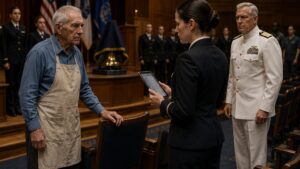
He stopped with military precision, breathing hard, and raised a rigid salute.
George halted beside him and did the same.
Every uniformed person in the corridor came to attention.
The sudden stillness after the alarm was more violent than noise.
Ronald returned the salute without haste.
Anthony lowered his hand. “Sir, I apologize. Your protected route was changed after the elevator lockout. The alternate-arrival instruction never reached this checkpoint.”
George’s eyes moved over Ronald’s faded coat, the envelope in his hand, the MPs, and Brandon standing beside the closed visitor log.
“We were told you were already inside,” George said.
Brandon’s face had lost its color.
“General Mitchell,” Anthony continued, “the exercise is waiting for you.”
The words traveled the length of the corridor.
Jones stopped breathing for a moment. One of the equipment workers looked toward the storage-room window, where the locked tactical case remained visible beneath white security lights.
Ronald did not look at Brandon immediately.
He looked instead at the diagram of Junction Four, then at Anthony.
“The exercise can wait,” he said. “That corridor cannot.”
Anthony followed his gaze. “What did you find?”
“A route that no longer matches your plan.”
George turned toward Brandon. His expression settled into command anger—the efficient kind that sought a single point of failure.
Brandon lowered his clipboard.
Ronald finally looked at him.
The quartermaster seemed prepared for punishment, but not yet for the question inside Ronald’s silence.
George stepped forward.
“You stopped him at his own briefing-room door?”
Brandon tried to answer. “Sir, his name was not on—”
George cut him off with one sharp turn of the hand.
Ronald saw the moment responsibility began narrowing toward the easiest target.
He also saw the locked case through the glass.
Whatever happened next could not be allowed to become merely a lesson about recognizing rank.
Chapter 5: The Architect Standing Outside His Own Door
“You don’t know who this is, do you?” George said. “You just stopped the architect of this entire base.”
The words struck Brandon harder than the alarm.
His eyes moved from Ronald to the reinforced briefing-room doors, then to the evacuation diagram he had ordered Ronald away from. The corridor around him seemed suddenly built from evidence.
George pointed toward the security alcove.
“Relieve Sergeant Perez of checkpoint authority. Remove him from the secure level pending investigation.”
One of the MPs stepped forward.
“No,” Ronald said.
The single word stopped him.
George turned. “Sir?”
“Not yet.”
Brandon looked up, startled less by mercy than by delay.
Ronald crossed to the checkpoint table and placed the sealed authorization envelope beside the visitor log.
“Open the page,” he said.
Brandon did not move.
George reached for the log, but Ronald kept his eyes on Brandon.
“You closed it,” Ronald said. “Open it.”
Brandon obeyed. His hand was unsteady now. He found the current date and laid the clipboard flat.
Ronald looked at the blank space where his name might have appeared.
“Was my name here when I arrived?”
“No, General.”
“Did I have conventional officer credentials?”
“No, General.”
“Then denying immediate access was correct.”
George’s anger faltered. Anthony looked toward Ronald, already understanding that the incident would not end cleanly.
Ronald touched the sealed envelope.
“What was not correct?”
Brandon swallowed. “I refused alternate verification.”
“You refused to inspect the authorization code.”
“Yes, General.”
“You also received information about the case designation.”
Brandon’s gaze moved toward Jones.
Ronald turned to her.
“What did you report?”
Jones stood rigid beside the equipment table. “The case number matched the restricted manifest, General.”
“Anything else?”
“The manifest listed the assignment as Architect.”
“And what happened after you said that?”
She glanced at Brandon.
He looked away first.
“I was told the designation did not identify the bearer.”
“That statement was technically true,” Ronald said. “What did you do then?”
Jones’s fingers pressed into the edge of the manifest.
“I stopped pushing the issue.”
“Why?”
Her answer took time.
“Because Sergeant Perez had already decided. And because I did not want my correction to become an insubordination complaint.”
The corridor remained silent.
Ronald nodded once. “Thank you.”
Brandon’s face tightened. “General, she was not responsible. I made the determination.”
“You did.”
“I had direct orders against undocumented exceptions.”
Ronald looked at him. “Verification is not an exception.”
“No, General.”
“Why did you treat it as one?”
Brandon’s eyes dropped to the log.
George shifted impatiently. “Sir, whatever his justification, he humiliated a distinguished visitor and delayed a classified operation.”
“That is the visible failure,” Ronald said.
George went still.
Brandon drew a breath. “Three months ago, an officer bypassed my control point. An encrypted unit disappeared. My section took the finding. My promotion review was delayed.”
Ronald waited.
“I was told another undocumented issue would end my assignment,” Brandon continued. “Senior officers expected me to bend procedures for them, then blamed me when the inventory failed. I decided I would not bend again.”
“And when the evidence did not fit the procedure you expected?”
“I treated the evidence as pressure.”
“Because it came from someone you believed had no authority.”
Brandon’s jaw worked before he answered. “Yes, General.”
Ronald looked toward Jones. “And when a junior specialist contradicted you?”
“I treated that as a threat to control.”
The admission changed him. It did not absolve him, but the polished certainty had cracked. Beneath it stood a frightened man who had mistaken inflexibility for safety and public dominance for recovered standing.
George folded his arms. “That does not excuse his conduct.”
“No,” Ronald said. “It explains the mechanism.”
Anthony stepped closer to the evacuation diagram.
“Sir, you said the route no longer matches our plan.”
Ronald turned toward him. “Your current exercise sends a simulated casualty team through the eastern section?”
“Yes.”
“During the second phase, the primary corridor is obstructed?”
Anthony’s expression sharpened. “Yes.”
“And Junction Four becomes the alternate route.”
“Yes.”
Ronald pointed to the revision strip. “Junction Four has been physically sealed from the communications-vault side.”
Anthony moved to the diagram. “That modification isn’t on our exercise map.”
Jones spoke carefully. “The archived record says facilities approved it six months ago.”
George’s attention shifted from Brandon to the wall. “Why was exercise control not notified?”
Anthony answered before anyone else could. “Because the facility amendment was classified under infrastructure protection, while our exercise map was pulled from the operational archive. The systems did not cross-update.”
Ronald looked at him. “And who approved maintaining separate records?”
Anthony’s face tightened. “I did, sir. To limit exposure.”
There it was: another reasonable choice, another isolated system, another gap created by people certain their own part was secure.
George frowned at the diagram. “The junction door can be opened manually.”
“From the vault side,” Ronald said. “Not from the route your casualty team will approach.”
“The simulation could be halted.”
“If someone recognizes the mismatch before the corridor fills with smoke and movement.”
Anthony looked toward the locked case in the storage room.
“Your control materials are in that case.”
“Yes.”
George turned on Brandon again. “Unlock it.”
Brandon retrieved the secure-storage key from his belt and walked toward the alcove. No one followed immediately. The walk itself had become part of his accountability.
He returned carrying the tactical case with both hands.
The case that had been his symbol of control now looked heavy.
He placed it on the checkpoint table and released the latches.
George took hold of the handle and rotated the case toward Ronald, almost ceremonially.
“General Mitchell.”
Ronald did not accept it.
He looked at Brandon. “Who is responsible for issuing this?”
“I am, General.”
“Then issue it correctly.”
Brandon checked the case number against the manifest, though everyone already knew it matched. He inspected the tamper seal, opened the authorization envelope at last, and removed a narrow authentication card.
His eyes moved rapidly across it.
“Challenge designation?”
“Architect.”
“Response?”
Ronald gave the required phrase.
Brandon compared it with the card.
“Identity verified,” he said, his voice low. “Case E-7A-041 released to General Ronald Mitchell.”
Only then did Ronald take the handle.
Inside lay a compact radio, protective equipment, an exercise controller’s vest, and several sealed map packets. Beneath them was a worn leather portfolio.
Ronald lifted it out.
The leather had darkened at the corners. Anthony recognized it. His face changed.
“I haven’t seen that in years,” he said.
Ronald opened the portfolio and removed a folded facility plan drawn before the base existed. Pencil corrections crossed the printed lines. One corridor had been redrawn three times.
At Junction Four, an old handwritten note remained visible:
SECOND ROUTE MUST REMAIN OPEN.
Beside it was a date.
Anthony read it and went quiet.
George leaned closer. “What happened that day?”
Ronald’s thumb rested over the faded numbers.
The gala music pulsed faintly through the ceiling, absurdly distant from the corridor below.
“This base was designed after a route failed,” Ronald said.
Anthony looked at him. “You told me the old exercise exposed a planning defect.”
“It exposed more than that.”
Ronald folded the plan once and carried it toward the classified doors.
“Open the briefing room,” he said. “Everyone involved comes inside.”
His eyes settled on Brandon, then Jones.
“Especially the people who were told not to speak.”
Chapter 6: What Silence Cost Before the Base Existed
“This base exists because a man without the right rank was correct, and men with the right rank refused to hear him.”
Ronald stood at the head of the briefing table with the old facility plan spread beneath his hands.
No one sat.
The elite-unit officers had been called back from their staging positions. George remained near the door, still in formal uniform. Anthony stood opposite Ronald, his face fixed on the handwritten date. Brandon and Jones occupied the far end of the table, separated by less than three feet and more than rank.
The visitor log lay beside the old plan.
Ronald had asked for it to be brought inside.
Two records now shared the table: one describing how people should move through a building, the other describing who was permitted to enter it. Both were orderly. Both had failed to contain the truth that mattered.
Ronald pointed to the marked evacuation route.
“The earlier exercise took place in a temporary training complex. The main passage was designed to carry two teams out during a simulated communications fire. A field specialist reviewed the route and warned that heat and smoke would push personnel toward the service wall.”
Anthony watched him. “The wall narrowed the exit.”
“Yes. The specialist requested a secondary route.”
“What rank was he?” George asked.
Ronald looked at him.
“That was the question everyone asked then too.”
George’s eyes dropped.
“He had spent eleven years maintaining field systems in structures that had never been designed for emergencies,” Ronald continued. “He understood airflow, crowd movement, and what people did when visibility disappeared. The officers reviewing the exercise understood the approved plan.”
Brandon’s gaze remained on the old pencil line.
“The specialist raised the warning during the final briefing,” Ronald said. “The operations major told him the route had already been certified. Another officer reminded him he was there to maintain equipment, not redesign the exercise.”
Jones’s hands tightened behind her back.
“What did you do?” Anthony asked.
Ronald did not answer immediately.
The room waited.
“I asked whether the primary route met the occupancy standard.”
Anthony’s expression changed slightly. He understood what Ronald was admitting: not silence exactly, but the safer question, the one that sounded responsible without challenging the people who had dismissed the warning.
“The answer was yes,” Ronald said. “So the briefing moved on.”
He traced the original corridor with one finger.
“During the exercise, a smoke machine malfunctioned and produced a heavier screen than expected. One team stopped at the service wall. The team behind them continued forward. Several people went down in the compression. No one died. That fact allowed the report to call it an incident instead of what it was.”
“What was it?” Jones asked.
“A warning we had chosen not to understand.”
No one moved.
“The field specialist had been correct,” Ronald said. “The route was wrong. But the plan had signatures, certifications, and approval blocks. He had experience and no authority anyone felt obligated to respect.”
Anthony looked at the note beside Junction Four. “You designed this base so every high-capacity route would have a secondary exit.”
“I designed it so no single approved answer could trap everyone depending on it.”
“And tonight’s exercise?”
“It was meant to test whether your unit would recognize conflicting information and escalate it before movement began.”
Anthony’s eyes narrowed. “The incorrect authorization sheet was deliberate.”
“The conflict was deliberate. The physical sealing of Junction Four was not.”
Anthony looked at George.
George said, “The facilities amendment was approved as part of vault hardening. I saw the security recommendation. I did not review the exercise-routing consequence.”
“And I separated the operational archive from facilities updates,” Anthony said. “To protect the exercise.”
Ronald nodded. “Each choice made sense inside its own boundary.”
Brandon looked toward the visitor log. “Like denying someone who wasn’t listed.”
“Denying access was reasonable,” Ronald said. “Refusing the verification path was not.”
Brandon absorbed the distinction without lifting his head.
Ronald turned to Jones. “You recognized the case number.”
“Yes, General.”
“You spoke once.”
“Yes.”
“And stopped.”
She looked at Brandon, then at the officers around the table.
“I thought I had done my duty by mentioning it.”
“What changed your mind?”
“When you pointed out the junction. The archived plan proved part of what you said. I still let Sergeant Perez report you as if nothing had been verified.”
Brandon flinched slightly.
Jones continued, “I was afraid that if I challenged him again, I would become the problem.”
Ronald looked at the old date on the map.
“That fear is how institutions train themselves not to hear.”
Brandon raised his eyes. “General, I silenced her. She should not carry the same responsibility.”
“She carries responsibility for her choice,” Ronald said. “You carry responsibility for making the correct choice harder.”
Brandon accepted the words with a short nod.
Anthony moved around the table and stopped beside the visitor log.
“You also knew who you were,” he said to Ronald.
The room shifted.
Ronald looked at him.
Anthony’s tone was respectful, but it was not submissive. “You could have identified yourself before the case was moved. Before security was called. Before the exercise clock reached zero.”
“Yes.”
“Why didn’t you?”
George looked uncomfortable with the question. Brandon looked almost alarmed that Anthony had asked it.
Ronald folded his hands behind his back.
“Because I did not want rank to settle an argument about judgment.”
“But rank settled it anyway,” Anthony said.
The truth was clean enough to hurt.
Ronald looked at the closed briefing-room doors. “Yes.”
“And the delay let the route problem remain unreported until minutes before execution.”
“Yes.”
Anthony waited.
Ronald had spent years teaching officers to identify the exact point where a reasonable intention became a dangerous choice. Now he could see his own point clearly.
“I told myself restraint was discipline,” he said. “Part of it was. Part of it was avoidance.”
No one interrupted.
“I did not want to become the senior officer who crushes a checkpoint decision by announcing his title. I also expected Sergeant Perez to recognize the procedure, Specialist Jones to persist, and the system to correct itself.”
Brandon said quietly, “It didn’t.”
“No.”
Ronald placed his palm on the old plan.
“I once failed to speak forcefully because I believed another officer should understand the warning without being challenged. Tonight, I nearly repeated that failure because I believed you should understand the purpose of verification without being told who stood before you.”
He looked at Brandon, then Jones, then Anthony and George.
“Your mistakes do not erase mine.”
The room’s tension changed. Ronald was no longer standing outside the failure as its judge. He had placed himself inside it.
Anthony looked at the exercise clock. “We can cancel.”
Ronald studied the current map displayed on the wall screen.
“No.”
George frowned. “Sir, with Junction Four sealed, continuing would introduce unnecessary risk.”
“The original sequence would. We will revise it.”
He pulled the current authorization sheet from the tactical case. It instructed teams to treat Junction Four as closed unless command granted access. On the wall map, however, the simulated casualty route depended on that junction once the primary corridor was blocked.
Ronald laid the sheet in front of Brandon.
“You wanted an unambiguous rule,” he said. “You will now work with two that conflict.”
Brandon read the page.
“The written authorization says the junction remains sealed.”
“The operational condition will say it must open.”
“Who will have release authority?”
“You will be the lead at the junction.”
Brandon stared at him.
George stepped forward. “General, Sergeant Perez has just been removed from checkpoint authority.”
“I prevented that order from being completed.”
“He is under investigation.”
“He is also the person who most needs to make this decision correctly.”
Brandon looked from Ronald to the map. “You want me to override the authorization sheet.”
“I want you to decide whether overriding it is required. Then I want you to explain the basis for your decision over an open command channel.”
“And if I decide wrong?”
“Then the exercise stops.”
Ronald turned to Jones.
“You will monitor the archive and report any contradiction you find directly to command. You will not wait for Sergeant Perez to agree.”
Her chin lifted. “Understood.”
Anthony studied Ronald. “And where will you be?”
“At the control station.”
“Observing?”
Ronald looked at the sealed junction on the map.
“No,” he said. “Responsible.”
He closed the old leather portfolio but left the marked plan on the table.
Brandon picked up the authorization sheet. His hands no longer shook.
Ronald slid the open tactical case toward him.
“Carry this.”
Brandon took the handle.
The case was no longer locked. Inside were the tools, plans, and communications equipment he had refused to release because he believed control meant keeping them closed.
The exercise alarm began its low preparatory pulse.
Ronald opened the briefing-room door and pointed toward the route.
“At Junction Four,” he said, “you will discover whether you learned a rule or understood one.”
Chapter 7: The Rule That Had to Be Broken Correctly
The exercise alarms began before Brandon reached Junction Four.
White training smoke rolled across the eastern corridor, softening the ceiling lights into pale disks. Through the haze, the junction door appeared as a dark rectangle crossed by a red magnetic lock indicator.
Brandon set the open tactical case against the wall and pulled out the route packet.
The authorization sheet lay on top.
JUNCTION FOUR REMAINS SEALED UNLESS RELEASED BY COMMAND FACILITIES.
Below it, the revised exercise map showed the simulated casualty team moving directly toward that same door once the primary corridor became obstructed.
Two rules. One passage. Less than four minutes before the team arrived.
“Junction lead in position,” Brandon reported into the radio.
Ronald’s voice came from the control station. “Confirm physical status.”
Brandon tested the handle. It did not move.
“Door sealed. Magnetic lock active. No local release visible.”
Nicole worked from an archive terminal in the adjoining security alcove. “The original maintenance drawing shows a manual release behind the lower access plate.”
Brandon crouched. Smoke gathered around his boots. He found the plate, removed two retaining clips, and exposed a recessed lever with a numbered security seal.
The seal matched the current facilities amendment.
“Manual release is sealed under active authorization,” he said.
“Exercise condition?” Ronald asked.
A controller’s voice cut into the channel.
“Primary eastern route now blocked. Simulated debris from Section Two through Section Four. Casualty team redirected toward Junction Four.”
Brandon looked at the locked door.
The old version of himself would have reported the contradiction and waited. Waiting would have protected the record. If the team reached the door and stalled, the written authorization would explain why he had done nothing.
The thought repulsed him because it still felt safe.
“Request command release for Junction Four,” he said.
George answered from the operations station. “Request denied. Facilities sheet remains controlling until the amendment can be authenticated.”
Brandon closed his eyes briefly.
There it was: the highest authority on the channel had given a direct order. The correct bureaucratic response was now simple.
The operational problem was not.
Nicole’s voice entered the channel. “Command, archive review confirms the amendment removed the bypass without an updated evacuation simulation.”
George replied, “Acknowledged. Hold the junction while engineering validates.”
“The casualty team is three minutes out,” she said.
“Specialist, hold your position.”
Nicole’s hesitation lasted less than a second.
“Respectfully, I am reporting a live contradiction under disputed-route escalation.”
Brandon looked toward the alcove. He could not see her through the smoke, only the blue light of the terminal on the wall.
She had not asked his permission.
He felt no anger.
“Junction lead,” Ronald said, “state the emergency principle governing contradictory access orders.”
Brandon knew the words. Ronald had recited them at the checkpoint while Brandon accused him of manipulation.
“When an authorized restriction creates an immediate conflict with life-safety movement,” Brandon said, “the responsible controller must escalate, document the basis, and take the least destructive action necessary to preserve safe passage.”
“Does that principle apply?” Ronald asked.
George broke in. “General, I have ordered the junction held.”
Ronald did not answer him yet.
Brandon stared at the red lock indicator. On his clipboard, refusing an undocumented visitor had once seemed like the purest form of duty. Now an approved sheet instructed him to preserve a locked door while people moved toward it through smoke.
The exercise team would not truly be injured. Controllers could stop the simulation.
But stopping it would teach the wrong lesson: that contradictions were harmless because someone above would eventually cancel the consequences.
Brandon keyed his radio.
“Command, Junction Lead. I assess that the sealed route creates an immediate movement hazard. The primary corridor is unavailable, the alternate team is committed, and the amendment lacks evacuation validation. I am initiating emergency release.”
George’s answer came at once. “Hold position, Sergeant.”
Brandon put his fingers around the sealed lever.
“I cannot comply without creating the condition the emergency principle was written to prevent.”
The channel went silent.
He had contradicted the Base Commander in front of the entire exercise network.
His promotion review, his assignment, and perhaps his career seemed to gather inside that silence.
Ronald spoke.
“Base Command, this is General Mitchell. I am assuming authority for Junction Four. Sergeant Perez’s assessment is operationally sound. Proceed with release.”
George’s breathing was faintly audible over the radio.
Then he said, “Authority transferred. Proceed.”
Brandon broke the numbered seal.
The sharp snap sounded small beneath the alarms. He pulled the lever.
Nothing happened.
The red indicator remained lit.
“Manual release failed,” he reported.
Nicole’s keyboard rattled in the alcove. “The vault-hardening amendment added a secondary magnetic circuit. It isn’t on the archived operational drawing.”
“How is it isolated?”
“I’m searching.”
A controller announced, “Casualty team ninety seconds from Junction Four.”
Brandon opened the tactical case wider. Beneath the radio equipment lay Ronald’s current facilities overlay, marked with power-control branches. He spread it on the floor and found the junction circuit.
The locked case had contained the answer all evening.
“Secondary circuit feeds from security panel Delta,” he said.
Nicole answered immediately. “I have Delta on the archive terminal, but remote isolation requires command authorization.”
“Request it.”
“I already did.”
George’s voice returned. “Remote isolation approved.”
Nicole entered the command. Somewhere behind the wall, a relay struck with a heavy mechanical knock.
The red light went dark.
Brandon pulled the lever again. The door shifted two inches and stopped against resistance.
He pushed his shoulder into it. The hardened panel moved slowly, scraping across a floor guide altered during the vault work.
“Door obstructed,” he said through clenched teeth.
Ronald’s voice remained level. “Can it be opened?”
“Yes.”
“Then open it.”
Brandon planted both feet and pushed. The door gave another foot. Smoke spilled through the widening gap into the unused bypass corridor.
Footsteps pounded beyond the haze.
The casualty team had arrived early.
Their lead controller appeared first, one hand raised against the smoke. Behind him, two personnel carried a weighted training litter while others maintained contact along the wall.
“Route open?” the controller called.
“Keep moving,” Brandon said.
The gap was barely wide enough for the litter. Brandon held the door while the lead pair angled it through. The frame groaned. The last team member cleared the threshold as the exercise clock reached the point when Junction Four would have become a simulated trap.
“Casualty team through,” the controller reported. “Secondary route functional.”
The alarm ended.
Smoke continued drifting for several seconds, but without the electronic pulse the corridor seemed suddenly enormous.
Brandon released the door. His arms trembled from the effort.
Nicole emerged from the alcove holding a printed archive record. She stopped beside the broken security seal and looked at him.
“I transmitted before you approved it,” she said.
“You were right to.”
He bent to gather the papers from the open case.
At the control station, no one spoke until Ronald came over the radio.
“Exercise phase complete. All personnel return to the briefing checkpoint.”
Brandon lifted the case. The lid remained open, the maps visible inside.
As he walked back through the thinning smoke, he passed the authorization sheet lying where it had fallen. He picked it up and carried it with him.
The rule had not been discarded.
It had been understood.
Chapter 8: The Name Added After the Doors Opened
George placed Brandon’s suspension order on top of the visitor log.
The paper covered the empty line where Ronald’s name should have been.
Above them, the gala had resumed. Music and the muted vibration of footsteps passed through the ceiling while the secure corridor below remained crowded with exercise personnel, opened map packets, and equipment awaiting return.
Brandon stood across from George without his checkpoint radio. Nicole remained near the terminal. Anthony held the preliminary exercise record. Ronald stood beside the open tactical case.
“The order removes Sergeant Perez from controlled-issue duties pending formal review,” George said. “Effective immediately.”
Ronald read the first paragraph but did not touch the paper.
“And Specialist Jones?” he asked.
“No adverse action.”
“She violated the immediate chain after being told to hold.”
“She was correct.”
“That was not my question.”
George looked toward Nicole. “Her action will be documented as an appropriate safety escalation.”
Ronald nodded. “Then the report has already learned something.”
George’s mouth tightened. He had spent the minutes after the exercise preparing to act decisively. Ronald recognized the instinct. A visible failure demanded a visible correction, especially with hundreds of guests upstairs measuring the base by polished floors, exact schedules, and senior officers who appeared to control every detail.
Anthony stepped forward.
“The gala program has reached the command presentation,” he said. “They can delay it ten minutes. We could introduce you there and explain that tonight’s exercise was conducted under your supervision.”
“No,” Ronald said.
Anthony had expected the answer but tried once more. “Your presence was listed only as a distinguished visitor. Most of the base does not know why you came.”
“They do not need a ceremony because a door opened late.”
“It would correct the impression created downstairs.”
“Whose impression?”
Anthony looked at the personnel along the corridor.
Ronald closed the tactical case halfway, then stopped and left it open.
“I was denied entry by a checkpoint system,” he said. “Taking a stage would turn that failure into a story about whether people recognized me. That is not the failure.”
George glanced at the suspension order. “Sergeant Perez still made choices requiring consequences.”
“Yes.”
Brandon looked directly at Ronald. “General, I do not expect you to stop the review.”
“I’m not stopping it.”
The words removed the faint hope from Brandon’s face, but he nodded.
Ronald continued, “You refused to inspect a valid authorization path. You treated a junior specialist’s relevant warning as a threat to your authority. You reported a safety observation as suspicious behavior because it came from someone you had already decided did not belong.”
“Yes, General.”
“You will write that decision chain yourself.”
Brandon glanced at the order.
“You will also help design the disputed-credential procedure that replaces the one you misused. It will preserve the checkpoint’s right to deny access while requiring independent escalation when a manifest, case number, or control designation partially matches.”
George said, “That assumes he remains assigned to this section.”
“It assumes the institution intends to learn from the person who demonstrated how the failure occurs.”
“Sir, retaining him could look like we are minimizing the incident.”
Ronald’s gaze shifted to him. “Removing him quickly could look like we have confused punishment with repair.”
George did not answer.
Ronald lifted the suspension order and placed it beside the log rather than over it.
“Review his assignment,” he said. “Do not decide tonight for the convenience of the gala.”
George’s expression changed. The reprimand was quiet, but it reached the pressure he had been trying not to name.
Anthony opened the exercise record. “My protected-arrival decision belongs in the review.”
“Yes,” Ronald said.
“I kept your identity off the standard log to limit exposure. When Route C closed, the alternate path had no usable authentication record.”
George added, “My facilities office approved the vault modification without testing its effect on evacuation movement.”
Ronald looked from one to the other.
“You will both sign the corrective report.”
George’s brows rose. “The checkpoint incident occurred under Sergeant Perez’s control.”
“The system that delivered me to his checkpoint belonged to command. The records that disagreed belonged to command. The sealed junction belonged to command.”
Ronald tapped the visitor log.
“If the report ends at this desk, the next failure will happen somewhere with no distinguished visitor alarm.”
Silence followed.
Then George picked up the suspension order and folded it once.
“Formal review, no immediate removal,” he said. “Shared command finding.”
Anthony signed the preliminary exercise sheet first. George signed beneath him.
Brandon looked toward Nicole.
“I told you that you were undermining checkpoint authority,” he said.
She waited.
“You were identifying evidence I did not want to reconsider.”
“Yes, Sergeant.”
“I will include that.”
Her reply was not forgiveness. “You should.”
Ronald saw Brandon accept the distance between them. Repair would not be created by one correct choice at Junction Four.
Anthony’s phone vibrated with another message from the gala.
“They’re asking whether you’ll at least attend the closing dinner.”
Ronald looked down at his faded coat. “Apparently my suit does not meet the dress code.”
A brief smile crossed Anthony’s face and disappeared.
George opened the classified briefing-room doors. “Then where would you like to go?”
Ronald looked at Brandon and Nicole.
“The briefing was interrupted before the exercise began. We should finish it.”
George stepped aside to allow Ronald through first.
Ronald did not move.
Instead, he picked up a pen from the checkpoint table and turned the visitor log toward himself. The blank line remained exactly as it had when Brandon searched it.
He wrote carefully.
Ronald Mitchell.
In the rank column, he left the space empty.
Beside the name, under operational designation, he wrote one word:
Architect.
He set down the pen.
Brandon lifted the tactical case, but Ronald took one side of the handle before he could carry it alone. Together they moved it from the checkpoint table.
Nicole gathered the revised route plans and stood beside them.
The three approached the briefing room at the same pace.
Ronald entered neither as the civilian who had been dismissed nor as the general whose title could force every door open. He entered as the man responsible for speaking before silence became harm.
Brandon walked beside him, carrying the consequences of the rules he had enforced without understanding.
Nicole carried the evidence she had once been afraid to repeat.
Behind them, the classified doors remained open.
The story has ended.