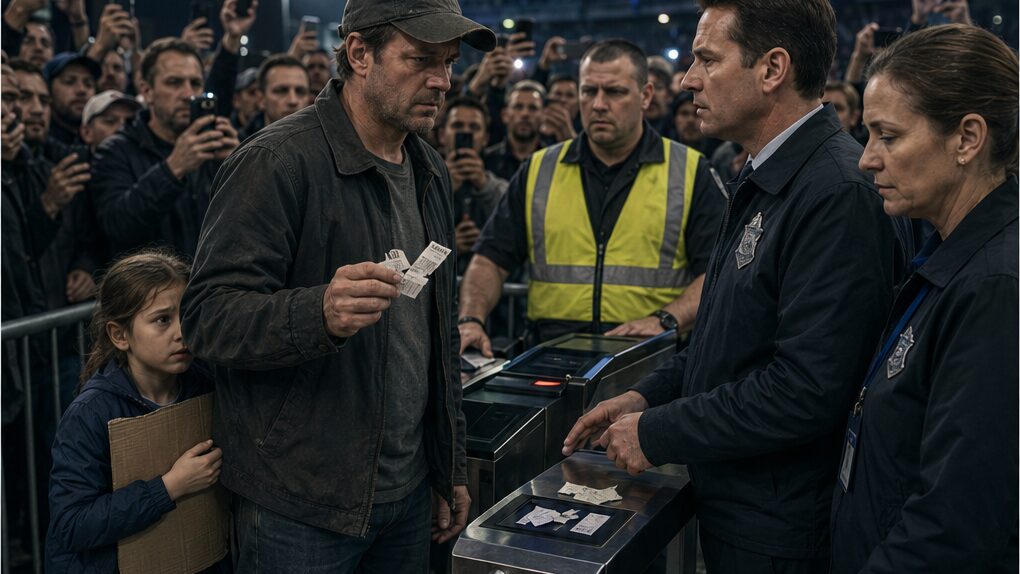
The Gate Manager Tore His Poor Dad Ticket, Then The Stadium Learned Who He Was Stealing From
Chapter 1: The Ticket He Could Barely Afford
Thomas counted the coins twice, then a third time, though there was nothing left to buy.
The quarters lay in a small line on the kitchen table, dull from pockets and vending machines and the bottom of his work bag. Beside them sat a folded printed ticket, facedown, as if looking directly at it might make it disappear. The apartment was quiet except for the old refrigerator clicking in the corner and Emily humming in the bedroom while she searched for the blue marker she had already used down to a soft, fuzzy tip.
Thomas touched the ticket with two fingers.
Not money. Not paper. A promise.
“Dad?” Emily called. “Does the stadium let signs in?”
“If they’re not too big,” Thomas said, sliding the coins into a jar by the sink. “And yours isn’t too big.”
“It has to be big enough for the players to see.”
“It’s big enough for the whole team.”
She came out holding the sign in front of her chest like a shield. The cardboard had been cut from a grocery box, and the edges still showed pieces of printed fruit from the old packaging. Across the front she had written GO CITY in block letters, then drawn a football that looked more like a brown lemon. In one corner, she had taped a little paper cutout of a man wearing Thomas’s old team cap.
“That you?” he asked.
She looked down at the drawing. “Maybe.”
The cap itself sat on the back of a chair. It had once been navy, but years of sweat, rain, and bus windows had faded it into something softer, almost gray. Thomas picked it up and ran his thumb along the cracked logo.
“You want me to wear this old thing?”
Emily nodded. “It makes you look like you’ve been a fan forever.”
“I have been.”
“Then you have to.”
He put it on, angling the brim lower than he needed to. Emily smiled with the kind of pride that made his chest hurt. She was wearing her cleanest jacket, the one with sleeves slightly too short now, and sneakers she had wiped with a damp towel until the white parts looked almost new.
Thomas wished he had bought her a jersey. He wished he had bought two hot dogs without needing to think about the price first. He wished the envelope under the breadbox did not hold only three small bills for the trip, the cheapest snacks, and the bus fare home.
Instead, he smiled.
“You ready?”
Emily looked at the folded ticket. “Can I hold it?”
The answer rose in him too fast. No. Not because she was careless. Because the ticket had been printed at the library three weeks ago, carried home in a plastic folder, flattened under a stack of old bills, checked every night before he slept. It was their one way through the gate. One bad crease, one damp hand, one spilled drink on the bus, and the scanner might not read it.
He saw her watching his pause.
“Just until the bus stop?” she asked, softer now.
Thomas hated that she knew how to shrink a request before he even refused it.
He picked up the ticket and slipped it into the inside pocket of his jacket. “I’m going to keep it safe. That’s my job today.”
Emily nodded too quickly. “Okay.”
He reached for the cap, took it off, and set it gently on top of her sign. “Then you keep this safe until we get there. That’s your job.”
Her face brightened again. “Deal.”
They locked the apartment door behind them. Thomas checked the knob twice. On the stairs, Emily walked carefully, both hands on the sign, the old cap balanced over the cardboard man like a crown. A neighbor’s television shouted pregame predictions through a thin wall. Somewhere outside, a car horn blared, and then another, as if the whole city had begun moving toward the same bright place.
At the bus stop, fans were already gathering in jerseys, face paint, shiny jackets, and new shoes. Thomas noticed shoes without wanting to. Clean white soles. Expensive boots. A boy Emily’s age wearing a stitched jersey with a player’s name across the back.
Emily noticed too, but she only lifted her sign higher.
A man in a bright jacket glanced at Thomas’s cap and gave a quick nod. “Big game.”
“Big game,” Thomas said.
The bus arrived packed with noise. They squeezed into a standing space near the rear door. Thomas held the overhead rail with one hand and kept the other flat over the pocket where the ticket rested. Each time the bus lurched, Emily leaned against him, her cardboard sign pressed between them.
“Dad,” she said after a while, her voice nearly swallowed by chanting fans. “Are our seats real close?”
The question should have been easy. The ticket said lower section. Not front row. Not luxury. But close enough that he had nearly stopped breathing when he first saw the listing, close enough that he checked the price again and again, certain he had misunderstood.
Close enough that he had eaten peanut butter sandwiches for lunches, skipped coffee, walked home twice in the rain instead of paying bus fare, and emptied a jar of coins that had taken months to fill.
He looked down at her. “They’re close enough to remember forever.”
Emily’s eyes widened.
Then she turned the sign toward herself and pressed Thomas’s old cap drawing more firmly onto the cardboard. “Then I’m going to hold this up when they run out.”
“You do that.”
He smiled, but his hand went back to his pocket.
The ticket had a crease across the barcode.
It was small, just a thin bend from where the paper had shifted under the breadbox. He had noticed it before they left. He had smoothed it with his palm on the table, then again against his jacket as if warmth could heal paper. The numbers were clear. The barcode was clear enough. It had to be.
The bus rolled out of traffic and turned onto the wide road leading toward the stadium. The crowd inside the bus rose with excitement. People pointed through the windows. Emily pushed onto her toes.
The stadium appeared between buildings like a second moon, white lights already burning against the late afternoon sky. Its glass sides flashed with giant moving images of players and roaring fans. Music thumped faintly even from blocks away.
Emily stopped breathing for half a second. “Dad.”
“I see it.”
“It’s bigger than on TV.”
“Most good things are.”
He wished he believed that every day.
They stepped off with the crowd and followed the river of fans toward the gates. Vendors shouted. Drums beat. Someone tossed a foam football over the heads of strangers. Emily stayed close, one hand gripping Thomas’s sleeve. He kept his palm over the ticket pocket until they reached the line marked VIP ENTRY.
Emily looked at the sign above them, then at him. “Are we allowed here?”
Thomas checked the ticket again. Section. Gate. Entry. He had checked a hundred times.
“Yes,” he said. “This is our gate.”
The line moved under bright metal barriers toward a turnstile and a scanner station. A man in a dark stadium jacket stood near the front, speaking into a small radio clipped to his shoulder. His hair was neat. His shoes shined. His badge read KEVIN.
Thomas and Emily reached the scanner mat.
Thomas took the ticket out carefully, unfolded it once, then again.
Kevin did not reach for it yet.
His eyes dropped to Thomas’s cheap shoes, the worn edge of his jacket, the faded cap on Emily’s sign.
Only then did he look at the ticket.
Chapter 2: The Rip Heard Across The Line
Kevin snatched the ticket so quickly the paper snapped in the air before Thomas could finish saying, “Here you go.”
For one breath, Thomas thought the man was only straightening it. Kevin held the page between both hands, glanced at the barcode, then at Thomas’s face, then past him toward the restless VIP line.
The scanner beside him blinked blue.
Kevin never placed the ticket under it.
He tore it in half.
The sound was small, almost nothing under the stadium music, but to Thomas it cut through everything. Emily’s fingers tightened on his sleeve. The handmade sign dipped from her chest to her waist.
“Sir,” Thomas said, too quietly.
Kevin held up the two pieces as if displaying a trick he had caught. “This section is for real fans, not broke dads.”
The line behind them shifted. Someone laughed once, unsure if it was allowed. A phone rose over a shoulder. Then another.
Thomas stared at the torn ticket. His mind did not move. He saw only the split barcode, the black lines broken through the middle, the lower section printed on one half and the seat number on the other. He had carried that paper like it was glass. Kevin had destroyed it like a napkin.
Emily whispered, “Dad?”
That brought him back.
He lowered his voice. “It’s okay.”
It was not okay. But Emily was looking up at him, and the crowd was watching his face, waiting to see if he would crack open. So Thomas bent down and picked up the smaller corner that had fluttered near the metal post. He took the two pieces Kevin still held only after Kevin shoved them toward him with a smirk.
“Scan it again,” Thomas said.
Kevin looked at him as if Thomas had misunderstood the shape of the world. “Again?”
“You didn’t scan it the first time.”
“I know fake paper when I see it.”
“It’s not fake.”
The man in the bright jacket from the bus was somewhere behind them. Thomas heard him murmur, “Just scan it.” But the line was mostly irritated now. The game was close. People had paid for their seats, their passes, their clean entrance without trouble.
Kevin turned the scanner toward Thomas just enough for the small screen to flash red.
INVALID – FRAUD FLAG
Thomas saw the words. So did Emily.
Her face changed, not because she believed Kevin, but because she understood that the machine seemed to. That hurt Thomas more than the insult.
Kevin tapped the screen. “There. System flagged. Move out of the line.”
“You scanned half a ticket after you tore it.”
“I scanned what you handed me.”
“That’s not true.”
Kevin’s smile thinned. “Careful.”
Thomas swallowed. His hands wanted to shake, so he pressed the torn pieces flat against his palm. “I bought this ticket months ago. I have the receipt.”
“Of course you do.”
“Please scan the number manually.”
“No.”
The refusal was too clean. Too fast.
Emily’s sign lowered another inch. The paper cap she had taped onto it bent under her thumb.
“Dad,” she said, barely speaking. “We can just—”
“No,” Thomas said, but gently. He crouched so his face was level with hers. “We’re not doing anything wrong.”
A woman behind them sighed loudly. “Some of us have suites to get to.”
Kevin used that. He lifted a hand toward the line as if apologizing on Thomas’s behalf. “Folks, we’ve got someone trying to push through with fraudulent tickets. We’ll clear it in a second.”
A few people groaned. The phone cameras rose higher.
Thomas felt heat climb his neck. He wanted to step aside. Not leave, not surrender, only step aside where fewer eyes could press into Emily. He had spent most of his life learning how not to make a scene. At work, in offices, at counters, in rooms where people decided quickly whether he belonged.
But this was not only him.
Emily had stopped looking at the stadium. She was looking at the torn paper in his hand.
“Sir,” Thomas said, forcing his voice to stay even, “my daughter is here for her first game. I saved for this. I’m asking you to check it properly.”
Kevin leaned closer. “And I’m telling you the VIP gate is not for stories.”
A man near the front laughed openly now, a rich, careless sound. “Try the cheap entrance.”
Thomas did not turn. He could not afford to turn. If he looked at everyone, he might see too much.
Kevin touched the radio on his shoulder. “Andrew, I need assistance at VIP entry. Possible fraudulent ticket holder refusing to clear.”
A security guard in a yellow vest looked over from the turnstile. He was broad-shouldered, younger than Thomas, with a tired expression that suggested the night had already given him enough problems. He approached with one hand near his belt, not threatening exactly, but ready.
“Problem?” Andrew asked.
Kevin pointed at Thomas without looking at him. “Fake ticket. He’s holding up the line.”
Thomas held out the torn pieces. “He ripped it before he scanned it.”
Andrew glanced at the paper, then at Kevin. “Was it scanned?”
“Flagged,” Kevin said.
“He tore it first,” Thomas repeated.
Kevin gave Andrew a look that carried weight. Not anger, not yet. Authority. The kind that told another worker which version of the truth would make the shift easier.
Andrew turned to Thomas. “Sir, let’s step aside.”
“We can step aside if someone checks the original purchase.”
“We need to clear the gate.”
“My ticket is real.”
“Sir.”
The word had changed. It no longer meant respect. It meant warning.
Emily slipped her hand into Thomas’s. Her palm was small and damp. “Dad, it’s okay.”
He looked down at her and saw what she was trying to do. She was trying to rescue him from wanting too much. Trying to make herself smaller so he would not have to fight.
That was the one thing he could not bear.
Thomas straightened. “It’s not okay.”
Kevin exhaled sharply, then stepped close enough that Thomas could smell mint gum. “Listen carefully. Take your kid and go before this gets worse.”
“I paid for these seats.”
“You paid someone for a fake. That’s not our problem.”
“You didn’t even look.”
Kevin’s eyes flicked to the cameras, the line, the VIP sign overhead. His jaw tightened. For the first time, Thomas saw something under the polished contempt. Not doubt. Pressure.
Kevin grabbed the torn pieces from Thomas’s hand, then shoved them back hard enough that one edge scraped Thomas’s palm.
“Move,” Kevin said. “Before security moves you.”
Chapter 3: The Receipt Nobody Wanted To Read
Thomas opened his worn wallet with fingers that wanted to become fists.
The wallet was cracked at the fold, soft from years of being sat on, emptied, refilled, and emptied again. He kept the receipt behind Emily’s school photo, tucked between an old bus card and a hardware store loyalty slip he never used. When he pulled it free, it unfolded in three neat lines, the paper thin but clean, the ink still dark enough to read.
“Here,” he said.
Andrew looked at it first.
Kevin reached faster.
Thomas pulled it back. Not far. Just enough.
Kevin’s face hardened. “You’re not helping yourself.”
“I’m showing proof.”
“You’re waving paper around after a fraud flag.”
“It has the purchase date. It has the order number. It has the seat.”
The crowd pressed closer without moving. Thomas felt them gather around the scene the way people gathered around a spill or a siren. One teenager held his phone sideways. A woman in sunglasses lifted hers more discreetly, pretending to check a message while the lens pointed at Emily’s face.
Thomas shifted his body to block her.
Andrew held out his hand. “Let me see it.”
Thomas hesitated. He hated that hesitation. Andrew had not torn the ticket. But he had also not stopped Kevin. The receipt felt suddenly more fragile than the ticket had ever felt.
“Please don’t take it from me,” Thomas said.
Something flickered in Andrew’s expression. Embarrassment, maybe. Or recognition.
“I won’t,” Andrew said.
Thomas held one edge while Andrew read the other.
Kevin clicked his tongue. “Receipts can be copied.”
Andrew did not answer at once. His eyes moved across the paper.
“Date’s from April,” Andrew said.
“That doesn’t mean it’s valid now,” Kevin snapped.
“It means I bought it from the stadium site,” Thomas said. “Not from anyone outside. Not from some guy on the street. From the stadium.”
A few people in line quieted.
Emily leaned against Thomas’s side, her sign tucked under one arm. The cardboard football bent where her elbow pressed it. She looked less like a child at her first game now and more like a child in a principal’s office, waiting for adults to decide how much trouble she was in.
Thomas hated every second she stood there.
Kevin turned to the line again. “People print fake receipts all the time. This is why we have scanner systems.”
“Then scan the order number,” Thomas said.
“It’s already flagged.”
“You keep saying that like it explains why you tore it first.”
A man behind them gave a low, surprised sound. Not quite support, but no longer laughter.
Kevin heard it too. His eyes narrowed.
From the right side of the line, a woman in a cream-colored coat stepped forward, irritation arranged neatly on her face. She held a phone in one hand and a glossy VIP pass in the other. Her hair was pinned back; her shoes looked too clean for pavement.
“Excuse me,” she said. “Can we please finish whatever this is? We were told this gate would be quick.”
Kevin’s expression changed so fast Thomas almost missed it. The hard edge softened into service. “I apologize, ma’am. We’re handling a fraudulent entry issue.”
The woman glanced at Thomas, then at Emily’s sign. Her eyes did not stay cruel, exactly, but they were impatient. “I understand, but kickoff is in twenty minutes.”
“Of course,” Kevin said. “Andrew, move them aside.”
Thomas looked at the pass in her hand because he needed somewhere to put his eyes.
Section 112.
His breath tightened.
He looked down at the torn ticket pieces in his palm. One half showed the same section. His thumb covered the row number, and he moved it slowly.
Row 6.
The glossy pass in the woman’s hand showed Row 6.
Thomas stepped closer, not toward her, but toward the truth. “Can I see your seat number?”
The woman drew the pass back. “Why?”
“Because I think it matches mine.”
Kevin moved between them. “Do not harass guests.”
“I’m not harassing anyone.”
“You are holding up a VIP entrance with fake documentation and now bothering a guest who paid for access.”
“I paid too.”
The words came out rougher than Thomas intended.
Emily looked up.
He forced himself steady. “Ma’am, please. Just the seat number.”
The woman’s irritation flickered into uncertainty. She looked at Kevin. “Is there some issue with my pass?”
“No,” Kevin said too quickly. “None at all.”
Thomas saw Andrew notice it.
Kevin turned back toward Thomas and reached for the receipt. “Give me that. We’ll dispose of the fake documentation and file the incident.”
Thomas jerked the receipt away.
“No.”
The word landed harder than he expected. It was not loud. It did not need to be.
Kevin froze.
Andrew’s hand hovered between them.
The line had gone very quiet.
Thomas folded the receipt once, then slid it behind the torn ticket pieces, holding both flat against his chest. “You’re not throwing away anything of mine.”
Kevin’s voice dropped. “You think you’re the first person to try this?”
“I think you’re trying to get rid of the proof.”
The man with the phone whispered, “Oh.”
Kevin’s face flushed. Not much, but enough. He looked past Thomas, past Emily, toward the turnstiles where the crowd kept swelling.
“Andrew,” Kevin said, “clear them now.”
Andrew stepped forward, reluctant but moving.
Thomas shifted Emily behind him, but the movement squeezed them against the metal crowd-control barrier. A shoulder from the passing line bumped the edge of Emily’s sign. The cardboard slipped from under her arm.
It hit the concrete faceup.
The little paper version of Thomas in the old team cap tore loose and skidded beneath the barrier.
Emily made one small sound, not a cry, not yet.
Andrew reached for Thomas’s arm.
And something inside Thomas, something he had kept folded smaller than the ticket all day, stopped folding.
Chapter 4: The Barrier Between Shame And His Child
Thomas stepped between Emily and Andrew so fast the metal barrier rattled against the concrete.
The sound cut through the gate noise, sharp enough to make heads turn from two lines over. Andrew stopped with his hand halfway out. Emily’s sign lay on the ground behind Thomas’s heel, the paper cutout of him caught beneath the lower rail of the barrier, trembling whenever the crowd shifted.
“Do not touch her,” Thomas said.
His voice did not rise. That made Andrew blink.
Kevin gave a short laugh, but it landed wrong. “Nobody touched your kid. You’re making this dramatic.”
Thomas bent without taking his eyes off Andrew and picked up Emily’s sign. The cardboard was scuffed now. The tape had lifted from one corner. The little paper version of him in the old team cap was torn at the shoulder.
Emily reached for it, but Thomas held it gently against his side.
“Stand behind me,” he said.
“I’m okay,” she whispered.
“I know. Behind me.”
She moved there, close enough that he felt her fingers touch the back of his jacket.
Thomas put the torn ticket pieces and the receipt in his left hand, pressed them between his thumb and palm, and took hold of the metal barrier with his right. Not to swing it. Not to threaten. Just to make himself part of something that would not be brushed aside by a hand on his arm.
The barrier scraped an inch when he shifted it.
The crowd reacted again.
“Sir,” Andrew said, lower now, “don’t do that.”
“Then call someone who can check my purchase.”
“We have a gate manager right here.”
“He tore my ticket before he scanned it.”
Kevin’s face tightened. “That is not what happened.”
A few phones had moved closer. The man with the bright jacket had stopped pretending not to record. Karen stood just beyond Kevin, VIP pass clutched to her chest, her irritation gradually giving way to something uncertain and uncomfortable.
Andrew looked at the torn paper in Thomas’s hand. “Kevin, did you scan it before it tore?”
Kevin turned his head slowly. “Excuse me?”
“I’m asking for the report.”
“It flagged.”
“Before or after?”
Kevin’s eyes flicked to the phones. “The paper was already compromised.”
“That’s a lie,” Thomas said.
The words came out before he could soften them for Emily. He felt her fingers tighten on his jacket. He wanted to look back, to tell her not to be scared, but he could not take his eyes off Kevin now. Too many things had shifted in the space of a minute. Kevin had gone from dismissive to angry, from smooth to careful.
And careful meant there was something to hide.
Kevin leaned toward Andrew. “Remove him from the gate.”
Andrew did not move immediately.
That pause was small, but Thomas saw it. So did Kevin.
“Andrew,” Kevin said, each syllable clipped. “You have a job.”
Andrew’s jaw flexed. “I’m trying to do it without making this worse.”
“He is blocking a VIP entrance.”
“I am standing where you told me to stand,” Thomas said. “You told me not to go through. You told me not to move forward. Now you’re saying I can’t stand here either.”
“You can stand outside the gate.”
“My ticket says I stand inside.”
Kevin’s smile vanished. “Your ticket says nothing now.”
Thomas looked down at the torn pieces in his hand.
The insult should have broken something. Instead, it clarified the scene. Kevin wanted the paper ruined. He wanted the proof to look like trash. He wanted Thomas to hold the remains and feel foolish enough to leave.
Thomas folded the pieces together carefully.
Kevin watched the motion with a flash of irritation. Then, while speaking to Andrew, he reached down as if brushing something from the scanner stand. His fingers closed around a tiny scrap near the base of the turnstile, a corner from the ticket that had torn loose. He slipped it toward his jacket pocket.
Andrew saw it.
“Why do you need that?” Andrew asked.
Kevin stopped.
The whole line seemed to inhale.
“What?” Kevin said.
“That piece.” Andrew nodded toward Kevin’s hand.
Kevin opened his palm, but the scrap had disappeared between two fingers. “Litter. We clear the gate.”
Thomas’s eyes went to Kevin’s jacket pocket. The smallest piece could have part of the barcode, part of the seat, part of anything. He held the rest tighter.
“That belongs to me,” Thomas said.
Kevin looked at him with open contempt now. “You are two seconds from a permanent stadium ban.”
Emily made a tiny sound.
Thomas felt it like a hook in his ribs. Permanent ban. The words did not matter to him, not really. He could go the rest of his life without another game. But Emily heard permanent. She heard punishment. She heard that her father had brought her here and might leave with something worse than no seats.
His old habit rose up: apologize, step aside, fix it quietly, protect the child from the blast.
He almost did it.
Then Emily whispered, “Dad, did we do something bad?”
Thomas turned his head just enough to see her.
Her eyes were wet, but she was not crying loudly. She had folded herself around fear, trying to carry it politely. That undid him more than tears would have.
“No,” he said. “We didn’t.”
Kevin cut in. “Then prove it somewhere else.”
Thomas faced him again. “Get your operations director.”
Kevin barked a laugh. “You don’t get to demand stadium executives because your scam didn’t work.”
“I get to demand the procedure you skipped.”
The line stirred. Someone behind Thomas said, “He’s right. Just get a supervisor.” Another voice answered, “Come on, kickoff’s soon.” The crowd had split into impatience and interest, and that made Kevin’s eyes move quickly, measuring which side was louder.
Andrew spoke into his shoulder radio. “Need a supervisor at VIP north gate.”
Kevin snapped his head toward him. “Cancel that.”
Andrew did not lower the radio. “We’ve got a disputed ticket and crowd buildup.”
“We have a fraudulent entry attempt.”
“And a torn ticket,” Andrew said.
Kevin stepped closer to him, voice low but not low enough. “You want to explain why you let a gate obstruction delay suite holders? Because I won’t carry that for you.”
Andrew’s face changed. The fear there was not cowardice. It was the fear of someone paid to follow orders by people who could make his rent impossible. Thomas recognized it.
He loosened his grip on the barrier, just for a second.
Kevin saw. “Good. Now move.”
Thomas looked back at Emily’s damaged sign. The little paper cap still hung by one strip of tape. He pressed it flat with his thumb and gave it back to her.
“Hold this,” he said.
Her hands closed around it.
Then he placed his right hand firmly back on the barrier.
“I will move,” Thomas said, “when a stadium operations director checks the original purchase record.”
Kevin stared at him.
The scanner blinked red beside them. The turnstile stayed locked. The crowd hummed with phones and mutters and the far-off roar of players warming up inside a place Thomas had promised his daughter she would see.
Andrew’s radio crackled.
A woman’s voice came through. “Operations responding. Hold position.”
Kevin’s face went still.
Chapter 5: The Director Who Heard The Wrong Beep
Linda arrived expecting noise, and found evidence.
That was the first thing Thomas noticed about her: she did not look at the crowd first. She did not look at the phones or the VIP sign or Kevin’s polished shoes. Her eyes went to Emily’s bent cardboard sign, then to the torn ticket pieces held flat in Thomas’s palm, then to the scanner still pulsing red beside the turnstile.
“What happened to the ticket?” she asked.
Kevin answered before anyone else could. “Fraudulent entry attempt. Guest became disruptive after the system rejected him.”
Linda looked at Thomas. “Did you tear it?”
“No.”
She looked at Andrew.
Andrew hesitated.
Kevin’s head turned slightly toward him.
Andrew said, “I did not see it before it tore.”
Thomas felt the gate tilt against him again. Not because Andrew had lied. Because he had not told the whole truth.
Emily stood behind Thomas, holding her sign against her chest. The paper cutout of the old cap had been pressed back down, crooked now. She had stopped asking questions, and that silence pressed harder than the crowd.
Linda stepped closer to the scanner stand. “Kevin, where is the incident slip?”
Kevin’s mouth tightened. “We were clearing the gate first.”
“So there is no incident slip.”
“I was about to file one.”
“You destroyed a physical ticket before documenting it?”
Kevin’s face hardened. “It was already fraudulent.”
Linda held out her hand toward Thomas. “May I see the pieces?”
Thomas did not move.
The moment stretched. He knew how he looked: a man gripping scraps like they were money, like they were identity, like they were the last proof he was not what Kevin had called him. Linda’s hand stayed open, not grabbing.
“I’ll keep them in view,” she said.
Slowly, Thomas placed the torn pieces on the flat top of the scanner stand. He kept the receipt in his hand.
“All of them,” Kevin said.
Thomas looked at him.
Linda did too. “Why?”
Kevin blinked. “For review.”
“You just said they were already reviewed.”
The words landed cleanly. Kevin had no quick reply.
Thomas removed the receipt from behind the school photo in his wallet again and placed it beside the torn ticket. He kept one finger on the edge until Linda nodded.
“I’m going to photograph these,” she said.
She took out a stadium-issued phone and captured the pieces, the receipt, the crease line, the broken barcode, the seat number split between halves. Thomas watched each photo as if the act itself was stitching something back together.
Kevin shifted impatiently. “Linda, kickoff is in less than fifteen. We need this area cleared.”
“I know what time kickoff is.”
“We have suite holders waiting.”
“And a torn ticket with no incident slip.”
A few people in line murmured.
Kevin lowered his voice. “This is not the place.”
Linda looked at the phones around them. “Apparently it became the place when the ticket was torn in public.”
For the first time, Thomas saw Kevin lose the crowd by an inch.
Linda picked up the scanner, tapped through screens, and held it away from Thomas. “Order number?”
Thomas read it from the receipt. His voice caught on the last two digits. He repeated them.
Linda typed. The scanner chirped once, then gave a low sound that was not the hard rejection from before. Her eyebrows drew together.
Kevin leaned closer. “It’ll show the same flag.”
“It shows a manual notation.”
Kevin’s jaw tightened. “Fraud notation, yes.”
“Manual,” Linda repeated.
Andrew looked up.
Thomas did not understand the system, but he understood that one word had changed the weight in the air.
Linda turned the scanner slightly. “This ticket was not auto-rejected. It was marked.”
Kevin folded his arms. “That happens when gate staff identify suspicious entries.”
“By whom?”
Kevin’s face went blank in a way that looked practiced. “The system will show.”
“It does.”
Linda’s thumb moved once.
She did not say the name at first. She looked at Kevin instead, and in that pause Thomas heard the distant crowd inside the stadium explode at something on the field, a warm-up catch, a player on the screen, a world going on without them.
Then Linda said, “It’s tied to your gate login.”
Kevin laughed once. “Of course. I’m the gate manager.”
“It was marked before this scan.”
“No. That’s impossible.”
“Four minutes before this dispute was called in.”
Kevin’s eyes flicked to the scanner, then to Karen, then back to Linda. “System lag. Happens all the time.”
Linda did not answer. She typed again.
Thomas felt Emily shift behind him. He wanted to say something, but he was afraid that any word might break whatever thin path had opened.
A beep sounded.
Linda’s face changed.
“What?” Thomas asked before he could stop himself.
She looked at him, then at Emily, then at the gate.
“This seat has already admitted a guest.”
The line erupted in low voices.
Kevin stepped in. “That proves it. Someone else entered with the valid ticket. He has a duplicate printout.”
“No,” Thomas said. “I never gave this to anyone.”
Kevin pointed at Karen. “Or he copied a seat assignment from another guest. That is why we remove people quickly before they harass legitimate pass holders.”
Karen’s face flushed. “Wait. Are you saying my pass is involved?”
“No, ma’am,” Kevin said, service voice returning with strain. “You’re fine.”
Linda turned to Karen. “May I see your pass?”
Karen hesitated. She looked annoyed again, but now the annoyance had fear mixed into it. “I was given this by your VIP staff.”
“Which staff member?”
Kevin cut in. “Linda, this is unnecessary.”
Karen looked from Kevin to Linda, then down at her pass. Her fingers tightened around the glossy edge. “I paid for a suite package.”
“May I see it?” Linda asked.
Slowly, Karen handed it over.
Linda scanned it. A green confirmation flashed, followed by a seat assignment.
Section 112. Row 6.
Thomas saw Linda’s eyes move to the torn pieces on the scanner stand.
Kevin spoke sharply. “There are seat transfers all the time.”
Linda said, “Seat transfers leave a transfer record.”
“Then check it later. Move him now.”
Thomas reached forward and placed the receipt beside the ticket pieces again, making sure the order number faced Linda. It was the only thing he could do. Not shout. Not beg. Keep the proof where it could be seen.
Linda photographed Karen’s pass beside the torn ticket.
Kevin stepped close enough that only those near the stand could hear. “You are turning a gate issue into a public incident.”
Linda did not look away from the screen. “No. I’m finding out why a public incident happened.”
Another beep.
She tapped again, then stopped.
“Kevin,” she said, “why does this guest credential show a same-day VIP override?”
Kevin’s neck reddened above his collar. “Because that’s how suite upgrades process.”
“Not from this terminal.”
Andrew shifted beside the barrier.
Kevin glanced at him. “Do not insert yourself.”
Andrew’s face tightened, but he stayed silent.
Linda looked toward the line. “Who handed you this pass?”
Karen did not answer at first. She looked at Kevin, and whatever arrangement had existed between politeness and convenience began to collapse.
“I was told there had been a last-minute availability,” she said.
“By whom?”
Karen lifted the pass, now looking smaller in her hand than before.
“By him,” she said, nodding toward Kevin. “Kevin personally gave me that exact seat assignment.”
Chapter 6: The Families Kevin Thought Would Leave
A mother from the next line stepped forward before Kevin could speak.
She had a child tucked against her side and a wrinkled envelope in one hand. The envelope looked like it had been opened and closed too many times, its flap softened, one corner crushed. She did not push to the front like someone looking for attention. She came forward like someone who had been waiting for permission to stop being embarrassed.
“He called my son’s ticket fake last month,” she said.
Kevin’s head snapped toward her. “Ma’am, do not involve yourself in an unrelated matter.”
“It was this gate,” she said. “Community seats. He said the barcode looked copied.”
Linda turned to her. “Do you still have the ticket record?”
The mother lifted the envelope. “I kept everything.”
Thomas looked at the envelope and felt something settle heavily in him. Until that moment, part of him had still clung to the smallest version of the truth: Kevin had singled him out, ruined this day, maybe made one ugly choice under pressure. That version was painful, but it was simple.
The envelope made it larger.
Behind the mother, another man raised his hand halfway. “My nephew’s scholarship pass got flagged at this entrance during preseason.”
Kevin took one step back toward the scanner stand. “This is ridiculous. People are piling on because they saw a scene.”
“No,” the mother said. “People are talking because you always make us leave before we can.”
The line went quiet in a different way.
Linda kept her voice controlled. “Andrew, move this group to the side holding area. Not out of the gate. Beside it.”
Kevin said, “You can’t hold VIP traffic for unverified complaints.”
“I can hold a gate for possible access fraud.”
The word fraud moved through the crowd like a match passed hand to hand.
Andrew began guiding people toward the space beside the metal barriers, an area used for bag checks and stroller tags. He looked at Thomas as if asking without words whether he would move.
Thomas looked down at Emily. Her face was tired now. Not bored tired. The kind of tired children get when adults have made the world too complicated.
“We’re going right there,” he told her. “Not leaving.”
She nodded.
He picked up the torn ticket pieces and receipt only after Linda said, “Bring them. Keep them visible.”
Kevin watched the papers move with Thomas. The small scrap he had pocketed earlier remained hidden, but now Andrew’s eyes kept drifting toward Kevin’s jacket.
In the holding area, Linda spread the documents on a narrow counter: Thomas’s torn ticket, his receipt, Karen’s glossy VIP pass, the mother’s envelope, and a printed complaint form another family had saved on a phone. Each item looked weak alone. Together they looked like a pattern trying to be born.
Kevin stood at the edge of the group, speaking into his radio in clipped phrases. “Need executive support at north VIP. Operations is detaining guests based on unverified claims.”
Linda looked up. “No one is detained. Everyone is waiting while I verify ticket records.”
“While kickoff approaches,” Kevin said.
The stadium erupted again, louder now. A countdown flashed on screens mounted above the concourse. Twelve minutes.
Emily saw it. Thomas saw her see it.
He crouched beside her. “You okay?”
She nodded, then shook her head, then looked ashamed of both.
“I’m sorry,” he said.
“You didn’t do it.”
“No. But I brought you here.”
“That was the good part.”
He looked at her sign, bent and scuffed. “Still is.”
She did not answer. She touched the torn paper cap on the cardboard and pressed the tape down again.
At the counter, Linda scanned the mother’s envelope code. Her face remained still, but her thumb paused at the result.
“Manual fraud notation,” she said.
Kevin laughed, but the sound was brittle. “That only means staff caught repeated abuse.”
The mother’s face flushed. “My son got those seats from his school.”
Linda typed again. “Scholarship allocation batch.”
Kevin’s mouth opened.
No words came.
Andrew stepped closer to Linda, voice low. “There were a few of these.”
Kevin turned on him. “Careful.”
Andrew’s hands flexed at his sides. “Families with paper tickets. Community tickets. Older fans who didn’t use the app. You told us to move them away from cameras and send them to the box office.”
Kevin’s eyes sharpened. “Because that is procedure when tickets fail.”
Andrew looked at the torn pieces on the counter. “You also told us not to rescan once you marked them.”
Linda’s head turned toward him. “You were instructed not to rescan?”
Andrew swallowed. His loyalty had been built from paychecks and chain of command, and Thomas could see him feeling each brick crack.
“Not in writing,” Andrew said. “But yes.”
Kevin pointed at him. “He’s trying to protect himself.”
“From what?” Linda asked.
“From mishandling removals.”
Andrew looked at Emily, then at the mother’s child, then at Thomas.
“I should have stopped today sooner,” he said. “I didn’t.”
It was not an apology yet. But it was a door opening.
Linda scanned Karen’s pass again. “This credential was issued through a VIP override, not a standard sale.”
Karen’s face changed. “I paid for that package.”
“To the stadium?”
Karen hesitated.
Kevin stepped toward her. “You do not need to answer questions in front of—”
“In front of who?” Thomas asked.
Kevin looked at him.
Thomas heard his own voice and almost did not recognize it. Calm still, but no longer small.
Karen lowered her eyes. “I paid through a private concierge contact. I was told the stadium released extra VIP access.”
Linda exhaled once through her nose. “Kevin, did you facilitate that contact?”
“I help guests,” Kevin said. “That is my job.”
“Did you facilitate that contact?”
His silence answered more than he wanted.
The mother beside Thomas shook her head slowly. “So he gave her our seats.”
“Not yours,” Kevin snapped. “You people keep acting like every seating issue is theft.”
You people.
The phrase hung there, ugly and useful.
Thomas felt Emily’s hand slide into his.
Kevin seemed to realize what he had said only after the phones lifted again.
He turned to Thomas, lowering his voice into something almost reasonable. “Look. This has gotten out of hand. I can fix your night.”
Thomas stared at him.
Kevin moved closer, angling his back toward the cameras. “Two upgraded seats. Better than what you bought. You and your daughter go in now. No more waiting. No more embarrassment.”
Emily’s hand tightened. The countdown screen changed. Eleven minutes.
Thomas imagined walking in. Sitting down. Letting Emily see the field before kickoff. Buying one overpriced lemonade if he had enough cash. Pretending the other families were not still behind the barrier with envelopes and children and proof no one wanted to read.
Kevin’s voice softened further. “Be smart. Don’t ruin this for her.”
That almost worked.
Not because Thomas trusted him. Because he loved Emily enough to be tempted by any door that led her away from this pain.
He looked down at her. “What do you want to do?”
Emily’s eyes moved from the stadium entrance to the mother’s child, then to the torn sign in her own hands.
“You said we didn’t do anything wrong,” she whispered.
Thomas closed his eyes for half a second.
When he opened them, he looked at Linda.
“We’re not taking a quiet upgrade,” he said. “Not unless every stolen seat gets checked. Not unless they all get back in.”
Kevin’s face emptied of its fake kindness.
Linda held Thomas’s gaze, and something in her own expression shifted from managing trouble to accepting responsibility for it.
Thomas placed the torn ticket pieces back on the counter, beside the other families’ papers.
“We’ll wait,” he said. “But nobody gets to call us scammers and then fix only the part people filmed.”
Chapter 7: The Seat Number That Exposed Everything
Linda read the same seat number three times, and each time Kevin looked less like a gate manager and more like a man listening for sirens only he could hear.
“Section 112,” Linda said, touching Thomas’s torn ticket with one gloved finger. “Row 6. Seat 14.”
She turned Karen’s glossy VIP pass slightly so the overhead gate light caught the print.
“Section 112. Row 6. Seat 14.”
Then she looked at the scanner log.
“Admitted at 5:42 p.m. under a VIP guest credential.”
Thomas felt Emily lean into his side. Her sign pressed against his leg, the bent cardboard edge scratching his jeans. Around them, the holding area had stopped being a side space and become the center of the gate. The line still moved in broken pieces beyond the barriers, but people slowed as they passed. Phones stayed up. A stadium countdown flashed above the concourse.
Nine minutes.
Kevin forced a laugh. “That is not unusual. Upgrades, seat holds, hospitality transfers—”
“There is no transfer record,” Linda said.
“You keep saying that like the system never lags.”
“This one doesn’t lag backward.”
Kevin’s mouth closed.
Linda tapped the screen again. “Thomas’s original purchase was made in April through the stadium site. No refund. No transfer. No resale authorization. Then, today, a manual fraud flag was added from the VIP north terminal under your login. Four minutes later, a VIP credential was admitted to the same seat.”
Karen’s face had gone pale beneath her careful makeup. “I didn’t know.”
Thomas looked at her, then away. He believed her. That almost made it worse. Kevin had not only stolen from families who could least afford to fight. He had sold comfort to people who would never ask where it came from.
Kevin straightened. “Linda, you are making accusations in public based on incomplete data.”
“I’m reading a log.”
“You’re reading one screen while a crowd films us.”
“You created the crowd.”
His eyes flashed. “I protected this entrance.”
“From what?” Thomas asked.
Kevin turned toward him. “From exactly this. Chaos. People showing up with paper and sob stories and expecting staff to bend rules because there’s a child watching.”
Emily’s hand tightened around Thomas’s.
The words hit their mark because Kevin had chosen them well. A child watching. That was the whole knife. Thomas looked down and saw Emily’s face turned toward the ground, not because she believed Kevin, but because everyone had heard the word child and knew it meant her.
Thomas wanted to shield her from all of it. The cameras. The crowd. The argument that had grown too large for her small shoulders. For one sharp second he regretted refusing the quiet upgrade. Maybe dignity was too expensive if Emily had to pay for it in shame.
Then Emily lifted her sign a little higher.
Not much. Just enough that the torn paper cap showed.
Thomas inhaled.
Linda said, “Kevin, who processed the VIP credential?”
Kevin’s answer came instantly. “Ticketing.”
Linda turned to Andrew. “Do gate managers normally issue same-day VIP credentials from this terminal?”
Andrew looked at Kevin.
Kevin’s stare was a warning.
Andrew swallowed. “Not normally.”
Kevin snapped, “He doesn’t work hospitality.”
“No,” Andrew said, voice rough. “But I work this gate.”
Silence gathered around him.
Andrew looked at Linda, not Thomas. “Sometimes, when tickets flagged, Kevin told us not to rescan. He said rescan attempts could make the system lock the gate. He told us to move the guest away from cameras and send them to box office review.”
“That is correct procedure for suspicious entries,” Kevin said.
Andrew kept going. “But sometimes the seats were already filled before the guest got to box office.”
Kevin’s face hardened. “You don’t know that.”
“I heard complaints.”
“You heard people angry they couldn’t get in.”
“I saw you hand out passes.”
Kevin stepped toward him. “Careful, Andrew.”
Andrew looked at Emily’s damaged sign, then at Thomas’s palm still holding the receipt flat against the counter. “I should have been careful sooner.”
The words settled into Thomas in a way he did not expect. Not enough. Not absolution. But the first honest thing spoken by someone in uniform.
Linda typed again, faster now. “I’m pulling today’s manual flags from this terminal.”
Kevin reached toward the scanner stand. “You need executive approval.”
Linda moved the device behind her body. “Not to inspect active gate irregularities.”
“You are overstepping.”
“And you are no longer operating this station.”
Kevin’s face flushed deep red. “You don’t have authority to remove me.”
Linda touched her radio. “Stadium control, this is Linda at VIP north. I need credential review on gate manager Kevin. Also pull all manual fraud flags entered from terminal N-VIP-3 today.”
The radio crackled. “Confirm request?”
“Confirmed.”
Kevin lunged—not at Linda, but at the counter.
His hand went for the torn ticket pieces.
Thomas moved first.
He placed his palm flat over the paper, pinning it to the counter. Kevin’s fingers struck the back of Thomas’s hand and stopped. The contact lasted less than a second, but the crowd saw it. Andrew saw it. Emily saw it.
Thomas did not pull away.
Kevin froze with his hand hovering above Thomas’s.
“Don’t,” Thomas said.
Kevin’s eyes burned. “Take your hand off me.”
“You reached for my ticket.”
“That is stadium property once submitted for review.”
“It became mine again when you tried to make it disappear.”
Linda’s voice cut in. “Step back, Kevin.”
For a moment, Thomas thought Kevin would not. He saw the calculation pass through the man’s face: the crowd, the phones, Andrew’s position, Linda’s radio, Karen standing behind him with the pass he had handed her.
Kevin stepped back.
Linda took a clear plastic evidence sleeve from a drawer beneath the counter. The motion was ordinary, procedural, almost small. Yet when she slid Thomas’s torn ticket pieces and receipt inside it, the paper changed again. It was no longer trash. No longer a father clutching scraps. It was evidence.
Thomas felt his throat tighten and hated that it did.
Emily whispered, “They believe you?”
He looked down at her.
“Not all of them yet,” he said. “But enough to keep going.”
The radio crackled again. “Linda, we’re seeing multiple manual flags from N-VIP-3. Several tied to community allocations and paper tickets. Duplicate credentials issued within minutes.”
The mother with the envelope covered her mouth.
Kevin said, “That’s a technical interpretation, not proof.”
Linda ignored him. “How many?”
A pause.
“Eight today. More if we extend the search.”
A sound moved through the holding area—not cheering, not yet. Shock. Recognition. People understanding they had been looking at one torn ticket when there was a stack of invisible ones behind it.
Thomas looked toward the stadium entrance. The countdown screen changed.
Seven minutes.
Linda turned to him. “We can get you and Emily in now. I can assign replacement seats immediately while we continue reviewing the rest.”
Thomas understood the kindness in it. He also understood the danger. A door had opened, but only for him. Behind him, the mother still held her wrinkled envelope. The other child still stood by the barrier. Andrew stood with his shoulders tight, waiting to see whether honesty would cost him. Karen held a pass that no longer felt like a gift.
Emily was watching him.
He could choose the game. He could choose the promise in its smallest form: two seats, his daughter beside him, the field bright below.
Linda said quietly, “Kickoff is close.”
Thomas bent toward Emily. “I’m sorry.”
Her eyebrows pulled together. “For what?”
“For making this day harder than I wanted.”
She looked past him at the mother and child. “Are their tickets real too?”
“I think so.”
“Then they should see the game.”
The simplicity of it nearly broke him.
Thomas stood.
“We’ll go in when they go in,” he said.
Kevin let out a sharp breath. “You are unbelievable.”
Thomas looked at him then. Fully. Not at his badge, not at his jacket, not at the authority he had borrowed from the gate.
“No,” Thomas said. “I’m tired.”
Kevin looked confused by that.
Thomas kept his hand on the clear sleeve with the torn ticket inside. “I’m tired of teaching my daughter to be grateful for half a promise because someone with a badge decided the whole one was too much for us.”
No one spoke.
He had not meant to say that much. His heart pounded after the words, not from anger exactly, but from the strange fear of being heard.
Linda lifted her radio.
“Stadium control,” she said, “freeze Kevin’s gate credentials. Restore every original ticket in today’s manual fraud batch from terminal N-VIP-3. Hold duplicate credentials for review. I need guest services escorts at VIP north now.”
Kevin stared at her.
Then his badge reader, clipped at his belt, blinked red.
Chapter 8: The Sign Under The Stadium Lights
The same gate that had rejected Thomas opened with a clean green light.
No buzz. No red screen. No word like fraud glowing beside his name. Just a soft confirmation tone and the turnstile unlocking beneath his hand.
Thomas did not step through at first.
He looked behind him.
The mother with the wrinkled envelope was crying without making a sound while a guest services worker scanned her restored tickets. The child beside her held both hands to his mouth, eyes wide toward the field entrance. Another family was being guided from the side barrier, their paper tickets reprinted and placed into sleeves. Karen stood apart with her glossy pass lowered at her side, no longer trying to be first through anything.
Kevin was near the wall now, no longer at the scanner stand.
Two stadium security supervisors stood with him. His radio had been removed. His badge hung uselessly against his jacket. He was not handcuffed, not dragged, not shouted at. He was simply being spoken to in low official tones while the job he had used as a weapon continued without him.
That was enough.
Emily tugged Thomas’s sleeve. “Dad?”
He looked down.
She was waiting on the other side of the turnstile, just one step inside, as if afraid going too far without him might break the spell.
Thomas stepped through.
The gate clicked behind him.
For a moment he could not move. The concourse opened wide and bright, full of lights, vendors, polished floors, and the thunder of the stadium bowl beyond. The smell of popcorn, pretzels, grass, and cold concrete rushed over him. He had imagined this entrance for months, but never like this. Never with his hand still aching from covering torn paper. Never with Emily’s sign bent along one edge.
Andrew approached before they could follow the escort.
He had taken off his cap and held it in both hands.
Thomas braced without meaning to.
Andrew stopped at a careful distance. “I owe you an apology.”
Thomas said nothing.
Andrew looked at Emily first, then Thomas. “I should have paused when you showed the receipt. I should have asked for the rescan before I reached for you.”
Emily moved closer to Thomas’s side.
Andrew’s eyes dropped. “I’m sorry.”
It would have been easy to make the man stand there longer. Easy to let the apology hang, unpaid. Thomas had earned anger. He had earned the right to be cold.
But he remembered Andrew’s face when Kevin said, You have a job. He remembered the fear of rent, of bosses, of being the smallest person in a uniformed chain.
Thomas nodded once. “Next time, pause sooner.”
Andrew swallowed. “I will.”
That was all. It did not fix what had happened, but it put one piece where it belonged.
Karen came toward them as the escort checked a tablet. She had removed the VIP lanyard from around her neck and wound it around her fingers.
“I’m sorry too,” she said.
Thomas looked at her, unsure what part she meant.
Karen held out the pass. “I didn’t ask where the seat came from. I should have, maybe. Or maybe I just liked being told yes.”
Her honesty made her look smaller and more human than her cream coat had first allowed.
Emily looked at the pass. “Are you still going in?”
Karen gave a faint smile. “Different seat. If they find me one. Yours should be yours.”
“Our sign got messed up,” Emily said, surprising them both.
Karen looked at the bent cardboard, the torn tape, the paper cap barely attached. “Then it deserves better seats than any of us.”
Emily almost smiled.
A guest services worker arrived with two fresh tickets in a white sleeve. “Thomas?”
He flinched at his name being called kindly.
“Yes.”
“These are your replacement seats. Stadium operations upgraded them. The original seats are being held for review because of the duplicate credential issue.”
Thomas took the sleeve but did not open it. “The other families?”
“Being restored now. Some are getting upgraded where original seats were already occupied. Linda’s handling the batch.”
Thomas looked toward Linda. She stood near the gate, radio still in hand, directing staff with clipped urgency. She caught his eye and gave a small nod—not warm, not theatrical, just solid.
The worker added, “She also asked whether you and Emily would be comfortable with a brief acknowledgment inside. No names required if you don’t want. The team camera sometimes shows community guests before kickoff. She said only if your daughter wants it.”
Thomas felt Emily go still.
A camera. A stadium screen. More eyes.
His first instinct was no. They had already been seen too much. Filmed at the gate. Judged in line. Turned into a story before they had even found their seats. He wanted to protect Emily from becoming a symbol for strangers to cheer and forget.
He crouched beside her. “We don’t have to do that.”
Emily looked toward the roar beyond the concourse. “Would everyone look?”
“Maybe for a few seconds.”
“Would they know what happened?”
“Some would.”
She looked at the sign in her hands. The GO CITY letters were still bright, though the cardboard had creased. The little paper version of Thomas in the old cap hung crooked, but it was still there.
“You said we didn’t do anything wrong,” she said.
“We didn’t.”
“And those other kids didn’t either.”
“No.”
She pressed the loose tape down with one careful thumb. “Then I can hold the sign.”
Thomas had no answer for a moment.
He touched the brim of his old cap. “You’re sure?”
Emily nodded.
They followed the escort through the concourse tunnel. With each step, the roar grew larger until it seemed to fill Thomas’s ribs. Then the tunnel opened, and the field appeared below them in a blaze of green and white lines. Players ran in bright uniforms. Flags snapped. The far side of the stadium rose like a wall of sound.
Emily stopped walking.
Thomas stopped with her.
Her eyes filled, but this time she was smiling.
“Dad,” she whispered.
“I know.”
Their seats were closer than the ones he had bought. Too close, almost. Close enough to see players’ faces beneath helmets. Close enough that the field did not look like television at all, but like something alive.
The mother with the envelope and her child were escorted into the same lower section a few rows away. Another family appeared behind them, laughing in disbelief. Thomas saw the child from the holding area lift both arms when he saw the field.
Linda came down the aisle once the immediate rush had settled. “Kevin has been removed from gate operations pending investigation. The affected ticket batch is being restored. Guest services will contact everyone who was flagged through that terminal.”
Thomas nodded. “Thank you.”
She glanced at the white sleeve in his hand. “The torn ticket pieces are documented. I can return them later if you want.”
Thomas looked at Emily’s sign.
“Put them with the report,” he said. “For now.”
Linda understood. “All right.”
The stadium announcer’s voice boomed over the speakers, calling fans to their feet. The giant screen flashed crowd shots: painted faces, waving towels, children in jerseys. Emily gripped her sign with sudden nerves.
Thomas leaned close. “Still your choice.”
She nodded without looking away from the field.
A camera operator crouched near the aisle, guided by a staff member. The lens pointed toward them, then dipped politely while the staff member asked one more time. Thomas looked at Emily.
Emily lifted the sign.
The camera light blinked.
For three seconds, maybe four, they were on the giant screen: Emily with her bent handmade sign, Thomas beside her in the faded cap she had insisted he wear, his hand steady on the back of her seat. The crowd cheered because crowds cheer when told to, but then the sound shifted. It grew warmer, spreading as people near the gate videos recognized them, as families in the restored seats stood, as the mother with the envelope clapped with one hand over her mouth.
Emily held the sign higher.
Thomas looked up at the screen and saw the crooked paper version of himself taped to the cardboard, still wearing the old cap, still there after being knocked down.
His vision blurred.
Emily leaned into him without lowering the sign. “Dad?”
“Yeah?”
“You kept your promise.”
The kickoff whistle blew. The stadium erupted. Thomas stood under the lights with one hand on Emily’s shoulder, the other resting over the white sleeve in his pocket where the replacement tickets were safe. Somewhere behind them, the gate still opened and closed, opened and closed, letting people through who had nearly been turned away.
Emily’s sign trembled in the thunder, but it stayed raised.
The story has ended.