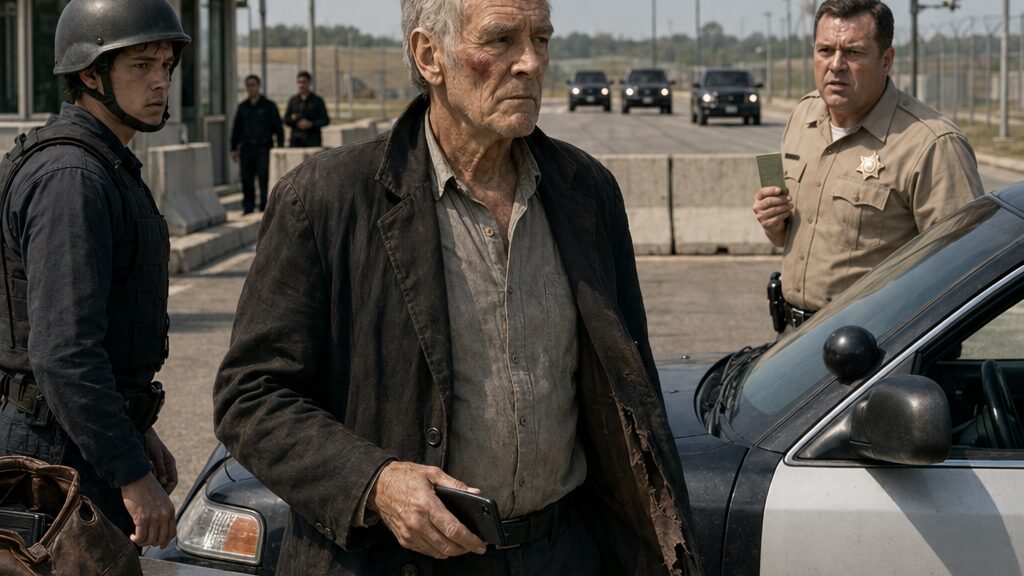
The Sheriff Slapped the Old Man at the Base Gate and Awakened a Buried Command
Chapter 1: The Slap Before the Gate Opened
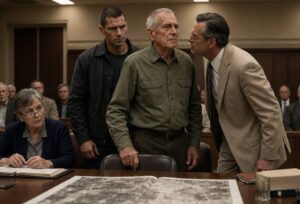
The sheriff’s palm struck Richard Harris before anyone in the waiting line understood why the old man had been pulled aside.
The sound cracked through the inspection lane. Richard’s head turned with it. His worn coat collar snapped against his cheek, and the corner of his mouth opened against a tooth.
For one second, the front gate of the military base seemed to stop working.
A delivery truck idled beside the concrete barriers. Two civilian cars waited behind it. A gate guard stood frozen near the inspection table, one hand still hovering above Richard’s open leather bag.
Sheriff Mark Brown lowered his hand slowly.
“That,” he said, “is for talking back.”
Richard straightened without touching him. At seventy-two, he no longer recovered from sudden movement as quickly as he once had, but his balance returned before Mark’s satisfaction had fully formed.
A thin warmth reached Richard’s lower lip.
He wiped it with his thumb and looked at the red mark left there.
Then he looked at Mark.
The sheriff was broad through the chest, his tan uniform fitted too tightly around a duty belt crowded with equipment. His badge shone in the midday light. Behind him, Deputy Christopher Green watched the line of cars instead of Richard’s face.
The young base guard finally moved.
“Sheriff, you can’t—”
Mark turned one eye toward him. “Brian, unless the base has changed the agreement since Tuesday, suspected theft involving property outside the secure perimeter remains a joint matter.”
Brian Smith swallowed. He was young enough that his helmet still looked issued rather than worn. “This began as a visitor inspection.”
“And now it’s a criminal detention.”
Richard glanced past them at the raised barrier. Beyond it, the road ran between clipped grass and low administration buildings. He had been expected inside twenty minutes ago. He could have ended the confusion before it began by giving Brian one name.
He had chosen not to.
A visitor should be processed as a visitor, he had thought. No calls ahead. No officers at the gate. No salutes. No doors opened because someone remembered what he had once been.
Now Mark pointed at Richard’s leather bag.
“Search it again.”
Brian’s eyes flicked toward Richard. “I already completed the inspection.”
“Then complete it properly.”
Ten minutes earlier, Brian had placed the bag on the stainless-steel table and asked Richard to open it. The process had been ordinary enough to be reassuring.
Richard had removed a pair of dark gloves, a sealed folder bearing no external classification, two folded memorial sketches, reading glasses, and a small tin of mints. Brian had run gloved fingers along the seams, opened the side pocket, checked beneath the lining, and returned each item in nearly the same place.
When the guard asked for the name of Richard’s sponsor, Richard had offered only the office.
“Historical Programs.”
“There should be a contact name.”
“They know I’m coming.”
Brian had glanced toward the guard booth. “I can call the command desk.”
“That won’t be necessary.”
It was the wrong answer, though Richard had not recognized it as such at the time.
Mark’s cruiser had rolled into the outer lane moments later, forcing a maintenance van to brake. The sheriff had stepped out as if responding to an emergency no one else could see.
He had asked why the gate was backed up. Brian had explained that a visitor’s sponsor information was incomplete. Mark had looked at Richard’s coat, his old leather bag, and the absence of anyone waiting to receive him.
Then Mark had smiled.
It was not a friendly expression. It was the smile of a man who had found a stage.
Now, after the slap, Brian began removing the same objects from the bag again.
The sealed folder.
The memorial sketches.
The glasses.
The gloves.
The tin of mints.
Nothing else.
Mark stood close enough that his shadow crossed the table. “Check the interior pocket.”
“I did.”
“Check it again.”
Brian slid his hand into the narrow compartment and withdrew it empty.
Mark’s jaw tightened.
Richard saw the shift. It lasted less than a second, but he had spent most of his life studying what people did when a plan failed.
Mark looked toward Christopher.
The deputy gave the smallest shake of his head.
“What exactly was stolen?” Richard asked.
Mark turned. “You don’t ask the questions.”
“You accused me of theft before naming the property.”
“The gate office reported a missing access card.”
Brian looked up sharply. “No report came through my radio.”
“It came through mine.”
“What type of card?” Richard asked.
Mark stepped closer again. “You seem awfully interested in the details.”
“I am the one you struck over them.”
The drivers in the waiting cars had begun watching openly. A passenger held a phone near the dashboard. Christopher noticed and walked toward the line, motioning for the vehicles to reverse, though there was nowhere for them to go.
Mark lowered his voice.
“You came here without a valid sponsor. You refused instructions. You interfered with a lawful search.”
“I opened my bag when asked.”
“You challenged my authority.”
“That is not a crime.”
Mark’s face changed at the word authority. Not much. The skin beside his mouth pulled tight.
“The missing card grants restricted maintenance access,” he said. “We’ll find out what you planned to do with it.”
Richard glanced toward Brian. The young guard’s expression had gone pale and careful.
“Maintenance access cards were changed six months ago,” Richard said. “The current cards have a blue diagonal band and embedded contact strip. If the missing card is the older green type, it would no longer open anything.”
Brian stared at him.
Mark did not.
“How would you know that?” the sheriff asked.
“The replacement program was listed in the installation’s public contracting notice.”
“You memorize contracting notices?”
“I read what concerns the places I visit.”
Mark’s right hand drifted near his belt, not touching the weapon there, only reminding everyone it existed.
“You hear that?” he called toward the waiting drivers. “He knows the card system. Knows which credentials work. Shows up with no sponsor willing to claim him.”
Richard watched the story forming in real time. Mark was not investigating facts. He was arranging them.
Christopher returned from the traffic line. “Cruiser camera’s catching the table.”
Mark looked at him. “Move the car.”
Christopher hesitated. “For what reason?”
“It’s blocking the inspection lane.”
It was not. The cruiser sat at an angle beside the outer barrier, leaving enough space for two cars to pass.
Christopher understood. So did Richard.
The deputy climbed behind the wheel. The cruiser rolled forward, then turned until its front camera faced the concrete divider rather than the search table.
Brian’s eyes followed it.
Mark seized Richard’s bag.
“You’ve had your hands on that enough,” Richard said.
The sheriff pushed the bag against Richard’s chest and forced him backward. “You’re coming over here.”
Richard planted his feet. “The search should remain in view of the gate personnel.”
Mark shoved harder.
The steel table scraped behind Brian as he moved aside. Richard’s shoulder struck the side of the cruiser, sending a dull ache beneath his coat.
“Christopher,” Mark said, “clear the lane.”
The deputy began directing Brian toward the booth, but Brian did not move.
“Sheriff,” he said, “we need to log any evidence where it’s recovered.”
Mark’s gaze settled on him.
“Then get your log ready.”
He pulled Richard behind the cruiser, into the narrow space between the vehicle and the concrete barrier. The position hid them from the waiting cars and from the primary camera above the gate.
Richard could still see Brian through the cruiser windows.
The young guard was watching.
Mark pushed one hand into Richard’s leather bag. He searched the main compartment, then the side pocket Brian had already emptied twice.
He withdrew nothing.
For a moment, irritation exposed the calculation beneath his anger.
Then Mark turned slightly away.
His hand disappeared inside his own uniform jacket.
When he faced the gate again, a faded green military access card lay between his fingers.
He lifted it high enough for Brian to see.
“There it is,” he said. “Just where I said it would be.”
Chapter 2: The Card That Was Not There
Mark placed the green access card on the cruiser hood and pointed at Brian.
“Tell Deputy Green where you found it.”
Brian remained beside the inspection table, the evidence log open in front of him. His pen did not touch the page.
“I didn’t find it.”
The sheriff’s expression hardened. “You were conducting the search.”
“Yes, sir.”
“You opened the suspect’s bag.”
“Yes.”
“And the card came from that bag.”
Brian looked at Richard, then at the card.
Richard’s lower lip had begun to swell. A bright smear stained his thumb. He kept both hands visible, though no one had ordered him to.
“The card appeared after the sheriff took my bag behind the cruiser,” he said. “Write that first.”
Mark slapped his palm against the hood. The card jumped on the metal.
“You don’t dictate an official record.”
“No. But I can help make it precise.”
Richard looked at Brian.
“Your first inspection began at approximately eleven forty-two. You removed five categories of objects. The folder. The drawings. The glasses. The gloves. The tin.”
Brian’s eyes moved involuntarily toward each item on the table.
“You opened the side compartment twice,” Richard continued. “Once during the standard inspection, and again when Sheriff Brown ordered it.”
Mark stepped between them. “He’s coaching a witness.”
“I’m describing what happened.”
“You’re manufacturing doubt.”
“Then provide the exact recovery location.”
The sheriff’s nostrils flared.
Richard nodded toward the card. “Which compartment?”
“The side pocket.”
“The narrow one?”
“Yes.”
“Facing the handle or the outer seam?”
Mark stared at him.
Brian looked down at the bag. The side pocket was barely wider than his hand. The access card on the hood was made from rigid laminated plastic. Its corners were blunt but thick.
“Outer seam,” Mark said.
Richard turned to Brian. “Record that.”
Mark grabbed Richard by the front of his coat.
The fabric tightened across his shoulders. One of the inner seams gave way with a dry tearing sound.
Brian saw a strip of dark lining peel open. Beneath it was the corner of an old leather wallet stamped with an embossed seal too worn to read from a distance.
Above the torn seam, four faint stitch marks formed a small square where something had once been attached.
Richard looked down at the damage.
For the first time, anger sharpened his face.
Not rage. Not fear. Something colder.
“Take your hand off the coat,” he said.
Mark smiled again, though uncertainty had entered it. “Or what?”
Richard raised his eyes. “Or the next thing you damage will become another item you must explain.”
Christopher stepped closer. “Sheriff, we should move this into the booth.”
Mark released the fabric.
The torn lining hung loose inside Richard’s coat. He pressed it flat with one hand, covering the leather wallet.
Brian looked at the side pocket again.
He remembered the first search with unwelcome clarity. He had run two fingers into the full depth of that compartment because a loose thread had caught against his glove. He had turned the bag sideways and shaken it gently. Nothing rigid had struck the metal table. Nothing had resisted his hand.
He could not have missed the card.
Mark saw the conclusion arrive on his face.
“Private Smith,” he said, using the rank printed on Brian’s temporary gate credential, “your mother still works over at the county records office?”
Brian’s posture stiffened.
“I believe she does,” Mark continued. “Good woman. Be a shame if this incident created questions about how your family handles official materials.”
Christopher looked away.
Richard’s attention shifted from the sheriff to Brian. The threat had been delivered casually, almost kindly. That made it worse.
“His family is irrelevant,” Richard said.
“Everything is relevant when government property goes missing.”
Mark picked up the evidence log and wrote across the first empty line.
“Restricted card recovered from suspect’s side compartment during joint inspection.”
He shoved the log toward Brian.
“Sign.”
Brian stared at the sentence.
“If I didn’t recover it—”
“You were present.”
“That isn’t what this says.”
Mark leaned closer. “Obstructing a law-enforcement investigation can end a gate assignment. It can end a clearance. You want to test which one happens first?”
Richard saw Brian’s grip tighten around the pen.
The young man wanted the conflict to disappear. He wanted a superior to enter the lane, take the decision from him, and make obedience safe again.
Richard had once believed institutions worked because individuals followed their assigned lines. Years had taught him that those lines could become hiding places.
Still, he said nothing about who was waiting for him inside.
He told himself his identity should not matter.
The thought no longer felt clean.
Christopher moved Richard toward the gate booth. “Sit down. Let them sort it.”
“I’ll stand.”
“That wasn’t a request.”
Richard looked at him. Christopher’s voice carried no appetite for harm. Only fatigue.
“You did not see that card recovered,” Richard said.
The deputy’s eyes hardened defensively. “I saw it in the sheriff’s hand.”
“That was not my question.”
Christopher glanced toward Mark.
“My report will reflect that property was recovered during the search.”
“Words can hide inside each other,” Richard said. “Until someone asks what each one means.”
“Save it for the interview.”
Mark entered the booth carrying a one-page form. He set it on the counter beside Richard.
At the top, in block letters, was a statement acknowledging possession of restricted government property.
Several blanks had already been filled.
Richard Harris.
Military base outer gate.
Unauthorized access credential.
Intent unknown.
“Sign it,” Mark said. “You cooperate, we may treat this as confusion instead of theft.”
“You wrote the conclusion before asking a question.”
“I’m offering you a way out.”
“A way out of what you created?”
Mark’s face reddened. “You old men come through here thinking age is a permit. You ignore instructions, invoke old connections, and expect everyone to step aside.”
Richard looked at the form. “You do not know what I expect.”
“I know your kind.”
“No. You know the kind of person you can usually frighten.”
Christopher shifted near the door.
Brian had followed them inside with the evidence log. He placed it on the counter without signing.
Mark noticed.
“You want to join him?”
Brian’s voice was quieter than before. “The main gate camera won’t show behind the cruiser.”
“So?”
“The timestamp system will show when vehicles and personnel crossed each lane sensor. It may establish when you moved out of view.”
The booth went still.
Richard turned toward Brian. That detail did not prove a planting, but it could narrow the sequence. Sometimes truth survived through fragments too small for dishonest people to notice.
Mark picked up Richard’s leather bag and emptied it onto the floor.
The sealed folder struck the tile. The tin of mints rolled beneath a chair.
Then the sheriff thrust both hands into Richard’s coat pockets.
Richard resisted only enough to remain upright.
Mark removed a handkerchief, keys, and a plain black phone.
The screen lit in his hand.
A missed call filled the display.
ANDREW LEWIS.
Beneath the name appeared a title preview from the contact entry.
CHIEF INTERNAL AFFAIRS INVESTIGATOR.
Mark’s anger faded into a more careful expression.
He looked from the phone to Richard’s torn lining and the old leather wallet concealed behind it.
“Why,” he asked, “is Internal Affairs trying to reach you?”
Chapter 3: The Name Behind the Torn Lining
Brian’s radio crackled before Richard could answer.
“Outer gate, command desk. Confirm status of scheduled Historical Programs visitor.”
Brian lifted the handset from his shoulder. Mark still held Richard’s phone.
“Command desk, outer gate. Visitor screening has been delayed.”
A pause followed.
Then the voice returned, louder through the booth’s speaker.
“Has General Harris arrived?”
Brian’s eyes rose to Richard.
Christopher stopped near the doorway.
Mark had heard the surname, but the radio transmission had broken beneath a burst of static. “What did they call him?”
Brian opened his mouth.
Richard spoke first.
“Do not repeat it.”
The command desk called again. “Outer gate, confirm General Richard Harris is on site. Historical Programs reports he is overdue for the memorial consultation.”
Mark looked at Richard, then laughed once.
It was a short sound without humor.
“So that’s the game.”
Richard held his gaze. “There is no game.”
“You walk in without proper sponsorship, carry a restricted card, and now someone on the radio calls you general.”
“I did not ask them to.”
“You expect me to believe you’re a retired flag officer?”
“I expect you to examine the facts of your own accusation.”
Mark turned to Brian. “Call the command desk back. Tell them we have a possible impersonator attempting to gain access under a false identity.”
Brian did not lift the radio.
“The desk confirmed his appointment,” he said.
“The desk confirmed a name. That proves nothing.”
Richard looked through the booth window toward the gate road. Somewhere inside the installation, a memorial committee was waiting beside a set of architectural drawings and a list of names that had taken years to release.
One of those names had belonged to a young intelligence officer whose body had never returned from an evacuation Richard had commanded.
The consultation was supposed to be private. No ceremony. No photographers. Richard had agreed to attend only after being assured that the memorial would identify the dead by name rather than by unit.
He had not come to be recognized.
He had come because memory, mishandled long enough, became another form of abandonment.
Brian stepped closer and lowered his voice. “Sir, I can contact the base commander’s office. They can verify everything.”
“No.”
The answer came too quickly.
Brian frowned. “That would resolve the identity question.”
“It would resolve it by changing how everyone in this booth treats me.”
Mark spread his hands. “There it is. He wants special treatment but doesn’t want to admit it.”
Richard turned toward him. “I want the same treatment you would give a mechanic, a retiree, or a delivery driver accused without evidence.”
“You’re getting it.”
“No,” Richard said. “That is precisely the problem.”
Mark’s smile disappeared.
Brian glanced again at the torn coat. The loose lining had shifted, exposing the four small stitch marks. Whatever insignia had once been there had been removed carefully. The leather identification wallet beneath them bore a federal seal pressed deep into the cover, its edges softened by years of use.
The pieces aligned slowly.
Richard’s posture.
His knowledge of the access system.
The way he reconstructed time without looking at a clock.
The command desk asking for him by rank.
Brian felt a new fear, but it was not fear of Richard. It was fear of how much damage had already been done while he waited for someone louder to tell him what was right.
“General—” he began.
Richard stopped him with a look.
“Mr. Harris,” Brian corrected, “your appointment is in less than half an hour. If we don’t contact someone, Sheriff Brown can remove you from the gate before Historical Programs reaches us.”
“That appears to be his intention.”
Mark pointed toward Christopher. “Bring the cruiser around. We’re booking him in town.”
Christopher remained still. “On theft or impersonation?”
“Both.”
“We don’t have confirmation of impersonation.”
“We have an old man using a rank he can’t prove.”
“I have not used it once,” Richard said.
Mark ignored him. “And we have stolen property.”
Brian’s eyes moved toward the green card on the counter.
The sheriff saw it.
“Put that in an evidence sleeve.”
Brian reached for a clear plastic pouch but stopped before touching the card.
“Who last handled it?”
“I did.”
“Before that?”
Mark’s voice sharpened. “The suspect.”
“I didn’t see him handle it.”
“You’re very close to becoming part of this.”
Christopher stepped into the space between them. “Brian, bag it. Note that the recovery is disputed.”
Mark turned on him. “I decide what goes in the report.”
Christopher’s expression tightened, but he lowered his eyes. “Yes, Sheriff.”
The surrender was quiet and practiced.
Richard recognized it.
He had seen rooms full of capable people abandon small pieces of truth because each piece seemed too minor to justify a career. By the time the pieces were assembled, everyone insisted the final failure belonged to no one.
Brian sealed the card without signing the recovery line.
Mark picked up Richard’s phone again. The screen had gone dark. He pressed the side button, and Andrew Lewis’s missed call returned.
“Internal Affairs investigating you?” he asked Richard.
“No.”
“Then why is its chief calling?”
Richard did not answer.
Andrew had left two messages that morning. Richard had not listened to either. Their last conversation, months earlier, had ended with Andrew saying that retirement had become Richard’s favorite locked door.
At the time, Richard had thought the remark unfair.
Now, standing in a booth while Brian’s career bent beneath Mark’s threat, he was less certain.
His phone vibrated in Mark’s hand.
Andrew Lewis again.
Mark stared at it.
Brian moved before being told not to. “That call may verify his identity.”
Mark pulled the phone away. “It may be coordination.”
“With Internal Affairs?” Brian asked.
“Corrupt people use official offices too.”
Richard almost smiled at the accidental truth.
Mark rejected the call.
The screen went black.
“Bring the car,” he ordered Christopher. “We leave before the base turns this into another jurisdiction lecture.”
Christopher went outside. Through the booth window, Richard watched him reposition the cruiser toward the exit lane. If they crossed the painted boundary beyond the outer barrier, local procedures would begin swallowing the incident. Booking paperwork would replace the gate timeline. The card would move through Mark’s department. Brian’s unsigned log might disappear beneath a corrected version.
Richard could stop it with a sentence.
He could give Brian the number of the base commander. He could demand the duty officer. He could invoke authorities Mark could not intimidate.
But every option tasted like the old machinery of privilege.
A name opened a door.
A title changed a tone.
A call made rules become flexible.
Years earlier, he had watched those same mechanisms close around someone without rank. He had promised himself that he would never again mistake access for justice.
Mark took a pair of handcuffs from his belt.
Brian stared at them. “He has not resisted.”
“He’s refused to cooperate from the beginning.”
Richard looked at the cuffs, then at the young guard.
“Call the command desk,” Brian said quietly. “Please.”
Richard heard what lay beneath the request.
Not save yourself.
Do not leave me alone in this.
The phone vibrated once more on the counter where Mark had set it.
Andrew Lewis.
Richard reached toward it.
Mark covered the phone with his hand.
Richard stopped.
For a few seconds, neither man moved.
Then Richard withdrew his hand.
“Not yet,” he told Brian.
Outside, Christopher opened the rear door of the cruiser.
Chapter 4: What Richard Once Chose to Protect
Mark switched on the recorder before Richard had taken the chair.
“Richard Harris knowingly entered a restricted military installation while carrying an unauthorized access credential,” the sheriff said into the device. “When confronted, he falsely claimed senior military status and attempted to interfere with lawful detention.”
He looked across the narrow interview room.
“Is that accurate?”
Richard remained standing.
The room had once been part of the gate administration office. Its walls were bare except for an evacuation map and a clock that ran two minutes slow. The only window faced the inspection lane, where Christopher was moving the cruiser toward the outer boundary.
“You have supplied my answer for me,” Richard said.
“I supplied the facts.”
“You supplied the version you need.”
Mark leaned back against the table. “Sit down.”
“No.”
The sheriff glanced at the recorder. “Subject refuses a lawful instruction.”
Richard pressed the torn lining of his coat flat against his ribs. The old leather wallet beneath it felt heavier than it had that morning.
Mark noticed the gesture.
“What’s in there?”
“Nothing relevant to your accusation.”
“Everything you hide is relevant.”
Richard looked toward the open doorway. Brian stood beyond it with the evidence pouch in one hand. The green access card inside looked almost black beneath the plastic.
“Has the card number been entered into the log?” Richard asked.
Mark’s patience thinned. “You’re not conducting this interview.”
“The number will identify when it was issued, when it was retired, and who last held it.”
“I know what a serial number does.”
“Then you know why it should be recorded before leaving the gate.”
Mark reached over and turned off the recorder.
The small red light vanished.
“You think this place protects you,” he said. “It doesn’t. The base needs the town. Fuel contracts, road access, housing, local courts. They complain about me until they need something signed. Then they remember my number.”
His tone carried no boast now. Only certainty built through repetition.
Richard had heard that kind of certainty in larger rooms.
Years earlier, an intelligence specialist had entered his office with a complaint against a senior operations officer. She had brought dates, messages, and the names of two people who had seen enough to know she was telling the truth.
The program had been days from deployment.
A formal investigation would have suspended clearances, exposed methods, and delayed an operation that senior officials believed could save lives.
Richard had not dismissed her complaint. He had done something he had considered more responsible.
He authorized a quiet transfer, a sealed reprimand, and a confidential settlement. The senior officer lost a promotion but kept his position. The program moved forward. No classified details reached the public.
Every requirement had been satisfied.
Months later, the specialist sent Richard a single-page letter.
You protected the mission from what happened to me. You did not protect me from it.
He had kept the letter until retirement. Then, on the day he removed the insignia from the inside of his coat, he burned it.
The words had remained.
Mark switched the recorder on again.
“Let’s try this one more time. You found the card near the inspection table and placed it in your bag because you believed it would help you enter the installation.”
“No.”
“You later claimed to be a general when the card was discovered.”
“I made no such claim.”
“You encouraged gate personnel to treat you as one.”
“I asked them to follow their own procedure.”
Mark placed a prepared statement on the table and pushed a pen across it.
“You sign this, we book the possession charge without adding impersonation. You can explain confusion to a judge.”
Richard read the first paragraph.
It stated that he had picked up the access card believing it was inactive.
A softer lie than theft.
A more survivable lie.
The kind institutions preferred because everyone could call the outcome reasonable.
“Who wrote this?” Richard asked.
“I did.”
“Before or after the card appeared?”
Mark’s hand closed around the edge of the table.
Christopher entered behind him. “Cruiser’s ready.”
“Good. Get the cuffs.”
The deputy did not move immediately.
Richard looked at him. “How many statements has he written before asking the accused what happened?”
Christopher’s jaw shifted.
Mark turned. “Don’t answer that.”
“I wasn’t asking you.”
Christopher reached for the handcuffs on his belt. His fingers touched them, then fell away.
“Enough to know the form,” he said quietly.
Mark stared at him.
Christopher kept his eyes on Richard. “People sign because the first charge is worse than the statement. Trespass becomes disorderly conduct. Theft becomes possession. Resisting disappears if they admit they were confused.”
“And you witnessed this?” Richard asked.
“I processed paperwork.”
“That is not an answer.”
“It’s the only one I can afford.”
Mark crossed the room and shut the door behind Christopher.
“You want to lose your pension over him?”
Christopher’s face tightened. “No.”
“Your daughter still has two years before college. Your mortgage reset last spring. You think the state will carry you because you suddenly discovered a conscience?”
Christopher looked at the floor.
Mark turned back to Richard with the faint satisfaction of someone restoring order.
“There. Now you understand why people cooperate.”
Richard did understand.
That was the trouble.
Christopher had constructed a moral shelter from practical needs. He had told himself that signing forms prevented beatings, that reducing false charges made him a moderating influence, that remaining beside Mark kept worse men away.
Richard had once used different words.
Operational continuity.
Protection of sources.
National necessity.
The structure beneath them was the same.
“You believe staying has limited him,” Richard said.
Christopher looked up.
“You believe that if you leave, someone crueler will take your place. So each thing you permit becomes the price of preventing something worse.”
“Richard,” Mark warned.
Christopher’s expression changed. Not toward courage. Toward recognition.
Richard pressed the torn lining again.
“I once made the same calculation,” he said.
Mark studied him. “About what?”
Richard did not answer. The memory belonged to the person he had failed, not to Mark’s curiosity.
Outside, an engine started. The cruiser waited beyond the window, rear door open.
Mark took the cuffs from Christopher.
“Hands behind your back.”
Richard remained still.
“You have no lawful basis to remove evidence from this gate before it is logged.”
“I have jurisdiction.”
“You have a badge. Those are not always the same thing.”
Mark caught Richard’s left wrist and pulled it behind him. The motion drove a sharp pain through his shoulder.
Brian appeared in the doorway. “Sheriff, the command desk has requested we hold all visitors until a duty officer arrives.”
“They requested. They did not order.”
“The duty officer is on the way.”
“Then he can meet us at the county line.”
The first cuff closed around Richard’s wrist.
He heard the ratchet click once, twice, three times too tight.
“Sheriff,” Brian said, “that needs to be checked for spacing.”
Mark forced Richard’s other arm back.
Richard’s shoulder protested. His balance shifted, and his coat opened far enough for the old identification wallet to show before the torn lining fell across it again.
“You had several chances,” Mark said near his ear. “All you had to do was show respect.”
Richard turned his head as far as the position allowed.
“You wanted submission.”
Mark pulled the second cuff closed.
“Same thing where I come from.”
“No,” Richard said. “That difference is why men like you survive.”
Mark spun him around.
The strike came without warning.
The sheriff’s palm caught Richard across the face, harder than before. Richard’s shoulder hit the wall. The clock above him trembled against its hook.
For a moment, the room narrowed to the metallic taste in his mouth.
Then he saw Brian standing in the doorway, pale and motionless.
He saw Christopher watching the floor.
He saw the unsigned statement on the table and the recorder still running.
Richard had spent years calling his silence restraint.
Now it looked exactly like what it had become.
Permission.
He steadied himself against the wall and raised his eyes to Brian.
“Give me my phone.”
Chapter 5: The Call That Changed the Jurisdiction
Brian stepped between Mark and Richard before fear could stop him.
The movement was clumsy and too fast, but it placed his body directly in the sheriff’s path.
He took Richard’s phone from the counter and pressed it into the old man’s cuffed hand.
“Private,” Mark said, “move.”
Brian’s breathing was audible in the small room. “The phone may contain identity verification relevant to the detention.”
“You just obstructed an arrest.”
“I preserved evidence.”
Mark reached for the phone.
Richard turned his bound hands away, trapping the device between his palm and the torn side of his coat.
The leather identification wallet slipped partly into view.
Mark saw the embossed seal. His hand slowed.
Richard looked at Brian. “Remove the cuffs.”
Brian hesitated.
“Do it,” Mark said, “and I’ll charge you beside him.”
Richard shifted the phone into one hand. “Leave them.”
Brian stared at him.
“The marks should be documented as they are.”
That answer unsettled Mark more than resistance would have.
Richard used his thumb to return Andrew’s call.
It connected before the first full ring.
“Richard?”
Andrew Lewis’s voice arrived sharp and immediate.
Richard had not heard it in months. Time had roughened it slightly, but the old discipline remained.
“I’m at the outer gate,” Richard said.
“I know. Historical Programs called when you didn’t arrive. What happened?”
Richard looked at Mark.
The sheriff stood with one hand near his belt. Christopher remained by the closed door, his face drained of color.
“Commissioner? One of your rookies just struck me. Strip his badge, or I’ll strip yours.”
Silence held the line for half a second.
Then Andrew’s voice changed.
“General Harris, stay exactly where you are.”
Mark’s eyes fixed on the phone.
Richard continued before Andrew could issue another order.
“Freeze the gate recordings. Primary camera, secondary lane sensors, booth audio, entry logs. A restricted access card was introduced after the first completed search. It is in a plastic evidence pouch handled by Private Smith.”
Brian looked at the pouch in his hand.
“Who is detaining you?” Andrew asked.
“Sheriff Mark Brown.”
A quieter voice sounded near Andrew, followed by a car door slamming.
“We’re less than three minutes away,” Andrew said. “Do not allow the card or your bag to leave federal property.”
Mark moved.
He seized the evidence pouch from Brian and turned toward Christopher.
“Get him in the cruiser. Now.”
Christopher did not move.
Mark shoved the pouch against his chest. “Take it.”
Christopher accepted it by reflex.
“Drive them both to the station.”
“Both?” Christopher asked.
“The old man and the guard.”
Brian’s face tightened. “You cannot arrest active-duty gate personnel on post without command coordination.”
“I can detain anyone obstructing a felony investigation.”
Richard spoke into the phone. “Andrew, Mark is attempting to remove the card and witnesses.”
“I heard him,” Andrew said. “Put me on speaker.”
Richard did.
Andrew’s voice filled the room.
“Sheriff Brown, this is Chief Investigator Andrew Lewis. The gate is now an Internal Affairs preservation site connected to an active interagency inquiry. Do not move any person, vehicle, recording, or physical item.”
Mark laughed, but the sound lacked force. “Internal Affairs has no command over county law enforcement.”
“Your department accepted oversight terms when it renewed the base security agreement.”
“That agreement covers contract conduct.”
“It covers evidence handling on federal property. You signed it.”
Mark’s mouth tightened.
Richard watched comprehension enter slowly. Andrew was not responding only to the slap. He had been waiting near enough to arrive in minutes because something else had already been scheduled.
“Andrew,” Richard said, “how long has Brown been under review?”
Another brief silence.
“Long enough,” Andrew said. “Not long enough to keep witnesses.”
Mark’s gaze shifted toward Christopher.
The deputy was holding the evidence pouch as if it had become hot.
“What witnesses?” Richard asked.
“Former detainees. Base contractors. Two families from town. Complaints of altered statements, property appearing during searches, charges reduced after waivers were signed.”
Brian looked at the unsigned confession on the table.
Mark pointed at the phone. “This is intimidation. He calls a former subordinate and suddenly an investigation appears.”
Andrew answered him directly. “The review meeting was scheduled for noon. Your personnel file is in the lead vehicle.”
A low engine roar approached beyond the gate.
Not one vehicle.
Several.
Mark turned toward the window.
Richard understood the shape of the trap now. Mark had come to the base hoping for a public arrest before the review—proof that the town still controlled the boundary. He had chosen an old man without an escort because he needed someone who looked unlikely to resist.
The target had been accidental.
The method had not.
Mark reached for the plastic pouch in Christopher’s hand.
“Give me that.”
Christopher stepped back.
The sheriff’s expression became dangerous. “Deputy.”
“You said I saw the card recovered,” Christopher said.
“You did.”
“I saw it in your hand.”
“That is recovery.”
“No.” Christopher looked toward Richard, then at the floor. “It isn’t.”
Mark moved closer. “Think carefully.”
“I have.”
“You have a pension because I protected your position.”
Christopher’s fingers tightened around the pouch. “You protected my silence.”
“And your family benefited from it.”
The words landed harder than a threat. Christopher flinched because they were true.
Mark pointed toward Richard. “This man walks in with a title and one phone call, and you think he’ll care what happens to you when this is over?”
Christopher looked at Richard.
Richard did not offer rescue.
“You will be responsible for what you did,” he said. “Whether you tell the truth or not.”
Christopher’s face sagged.
“That’s not much of a promise.”
“It is the only honest one available.”
Outside, tires struck the lane markers.
Four black SUVs swept around the final bend in tight formation. The first braked across the exit. The second stopped nose-to-nose with Mark’s cruiser. The remaining two sealed the inspection lanes, black doors aligned beneath the gate cameras.
Brian stared through the glass.
Mark pushed past him and stepped outside.
Richard followed as far as the cuffs allowed.
The base barrier descended behind the cruiser with a mechanical hum.
Its red arm locked into place.
The first SUV’s doors opened.
Chapter 6: Four Black Vehicles and One False Story
Andrew stepped from the lead SUV and ordered everyone, including Richard, to keep their hands where he could see them.
The command stopped Mark halfway between the booth and his cruiser.
For the first time since arriving at the gate, the sheriff obeyed without argument.
Investigators emerged from the other vehicles wearing plain dark jackets and body cameras. Two moved toward the inspection table. Another photographed the position of the cruiser, the lowered barrier, and the green access card inside Christopher’s evidence pouch.
Andrew approached Richard last.
His hair had gone silver at the temples since their last meeting. He carried himself with the same compact control Richard remembered from years earlier, but there was no recognition ceremony in his face.
He looked at the handcuffs.
“Who applied those?”
“I did,” Mark said. “After he resisted arrest.”
Andrew turned toward him. “I asked Mr. Harris.”
Richard held up his bound wrists. “Sheriff Brown.”
“Were you physically resisting?”
“No.”
Mark stepped forward. “He shoved me during the search, planted that card when the guard looked away, then called political contacts to interfere.”
Andrew raised one hand.
“Stay where you are.”
“You’re letting his title decide this.”
“His title has decided nothing yet.”
Andrew motioned to an investigator, who photographed the cuff placement before unlocking them. Deep red bands circled Richard’s wrists. Another investigator photographed his swollen lip, the mark across his cheek, and the torn lining of his coat.
Richard did not look away.
“Bag his coat,” Mark said. “If this is a real investigation, treat him like a suspect.”
Andrew glanced at Richard.
Richard removed the coat and handed it over.
The afternoon air touched the sweat between his shoulder blades. Without the coat, he looked smaller. The dark shirt beneath it hung loosely from his frame.
Andrew seemed to register the choice.
“You’re willing to surrender it?” he asked.
“It was searched and damaged during the incident.”
“The identification wallet is inside.”
“I know.”
An investigator placed the coat in a large paper evidence sack, leaving the wallet where it was.
Mark seized on the moment.
“There. He carries retired credentials, withholds them during screening, then creates a confrontation so he can use influence when it suits him.”
Richard flexed his aching fingers. “My identity explains why I was expected here. It does not explain how the card entered my bag.”
Andrew nodded once. “That is the correct distinction.”
They separated the witnesses.
Brian was taken to the guard booth. Christopher stood beside the second SUV with the evidence pouch resting on its hood. Mark remained near his cruiser under the eye of two investigators.
Richard sat at the inspection table where his bag had first been opened.
Andrew placed a digital recorder between them.
“Start from your arrival.”
Richard did.
He gave times where he knew them and approximations where he did not. He described Brian’s first search, each item removed, Mark’s arrival, the second search, the movement of the cruiser, and the card appearing after Mark took the bag behind the vehicle.
He did not mention being a general.
He did not describe Mark as corrupt.
He did not say the slap proved guilt.
When he finished, Andrew asked, “Why didn’t you identify your sponsor?”
“I believed I should be screened without preference.”
“That decision prolonged the encounter.”
“Yes.”
“It also deprived the gate guard of information he needed.”
Richard looked toward the booth.
“Yes.”
Andrew waited.
Richard added, “I was wrong.”
The admission settled between them with more weight than Andrew’s expression showed.
An investigator approached carrying a tablet.
“We have lane sensor timestamps. The cruiser crossed the outer magnetic strip at eleven forty-eight and repositioned at eleven fifty-four. Sheriff Brown moved behind the vehicle for forty-three seconds before the claimed recovery.”
“Video?” Andrew asked.
“Primary camera loses the area behind the cruiser. Secondary camera catches only his shoulders. We cannot see his hands or the bag opening.”
Mark heard from several yards away.
“So you have nothing.”
The investigator ignored him.
“The booth audio confirms Private Smith said he had already searched the side compartment. But it doesn’t show what was inside.”
Mark raised his voice. “Because the old man planted it between searches.”
Andrew turned. “You will have an opportunity to give a recorded statement.”
“I’m giving one now. He assaulted me when I found the card.”
Richard looked at Mark’s uniform. There was no dust on his back, no torn seam, no sign of contact except the redness in his own striking hand.
Andrew noticed Richard looking.
“Did you touch him?” he asked.
“Only when he pushed my bag against my chest. I braced against the vehicle.”
Mark pointed at Richard. “That’s assault.”
“Then document the contact accurately,” Richard said.
Mark gave a humorless smile. “Listen to him. Everything measured. Everything rehearsed. That’s what powerful men do. They make their version sound clean.”
For the first time, the accusation found a place to land.
Richard had sat across from people who said similar things years ago. People who believed the institution had already chosen which voice sounded credible.
Andrew must have seen something in his face.
“This case will not turn on tone,” he said.
“It already has,” Mark replied. “The SUVs show up because he bleeds. Nobody brought four vehicles for the people who complained before.”
Silence moved through the gate.
The statement was self-serving, but it was not entirely false.
Richard looked toward Brian in the booth. The young guard sat rigidly while an investigator spoke to him. Every few seconds, his eyes shifted toward Mark.
Andrew followed Richard’s gaze.
“We need his account of the first search,” he said.
Mark called across the lane. “Brian, remember who employs your mother.”
An investigator stepped between them.
Brian’s mouth moved, but no sound carried through the glass.
Andrew walked to the booth and entered. Richard could see him speaking without urgency, then placing the unsigned evidence log on the desk.
Brian stared at the line Mark had written.
After several minutes, Andrew returned.
“He confirms the compartment was searched,” he said. “He will not state that it was empty.”
Mark smiled.
Richard felt no anger toward Brian. Only the consequence of his own delay. He had left the young man alone beneath a threat and called it principle.
Andrew looked toward Christopher.
“The deputy is the remaining direct witness.”
Christopher stood with his shoulders rounded, watching investigators photograph the card.
Mark’s confidence returned by degrees.
“Chris knows what happened.”
Andrew called him over.
Christopher approached slowly.
“Did you see Mr. Harris possess the access card?” Andrew asked.
Christopher looked at Mark.
The sheriff gave a small nod.
Richard recognized it as the same gesture Mark had used during the first search. A reminder of arrangements, debts, and consequences.
Christopher swallowed.
“I saw the card recovered during the inspection.”
Andrew’s face remained neutral. “That is not the question.”
Christopher closed his eyes briefly.
Mark spoke. “Answer him.”
Christopher looked at Richard’s bare arms, at the red cuff marks being photographed like any other evidence. Then he looked at Mark, whose badge still caught the sunlight.
“No,” he said.
Mark went still.
Christopher continued, each word seeming to cost him.
“I never saw the card in Harris’s hand or bag. I saw it after Sheriff Brown came out from behind the cruiser.”
“You liar,” Mark said.
Christopher flinched but did not retract it.
Andrew faced Mark.
“Remove your weapon and badge.”
The sheriff’s hand hovered near his belt.
Two investigators shifted their stance.
Mark looked toward the lowered barrier, then at the four SUVs sealing the gate.
“You take this badge,” he said, “and the base goes down with me.”
Andrew’s expression did not change.
Mark pointed toward the administration buildings beyond the barrier.
“You think those old complaints disappeared because I scared everyone? Ask them who asked me to keep arrests quiet. Ask them who needed town cooperation more than they needed clean hands.”
His gaze settled on Richard.
“Strip my badge, General. Then explain what your base agreed to bury.”
Chapter 7: The Victims Behind the Sheriff’s Badge
Andrew opened the sealed complaint file and turned the first page toward Richard.
The inventory code printed at the top matched the green access card taken from Mark’s hand.
For several seconds, no one in the base security office spoke.
Richard sat at the end of a narrow conference table wearing his torn coat again. Investigators had returned it after photographing the lining, the cuff marks, and the old identification wallet inside. The fabric would not lie flat now. Each time he moved, the loosened seam exposed a sliver of worn leather.
Mark had been taken to a separate room under guard. His weapon and badge were sealed as evidence, but his accusation remained in the office like smoke.
What the base agreed to bury.
Andrew tapped the code with one finger.
“This card was listed as destroyed seven months ago.”
The base security official across from him leaned closer. “That cannot be the same card.”
“It is the same inventory number.”
“Then the destruction record is wrong.”
“Or false,” Andrew said.
The official sat back. He was older than Brian but young enough to have never served under Richard. That should have made the conversation easier. Instead, Richard watched the man glance repeatedly at the torn coat and avoid looking directly at his face.
Andrew opened a second folder.
The complaint came from a civilian maintenance worker stopped outside the base six months earlier. Sheriff Brown claimed the worker had stolen restricted equipment. The property was later found inside the worker’s truck during a search conducted beyond the gate cameras.
The charge had been reduced after the worker signed an admission of careless possession.
Another complaint involved a housing contractor.
Another, a delivery driver.
Each account differed in detail. The rhythm did not.
A stop near the base.
An item appearing during a search.
A severe initial charge.
A lesser statement offered as escape.
A signature.
Silence.
“Why were these not connected?” Richard asked.
The official folded his hands. “They were local matters.”
“They involved military property.”
“Property recovered outside the installation.”
“The card planted on me was introduced inside the installation.”
“That changes the current incident.”
“It does not change the earlier ones.”
Andrew turned another page. “Three referrals were sent to base security. None produced a joint investigation.”
The official’s voice tightened. “The sheriff’s department handles road access, demonstrations, off-post housing disputes, and emergency support. At the time, preserving cooperation was considered—”
“Operationally necessary?” Richard asked.
The official stopped.
The phrase had come too easily. Richard heard his own past in it.
Andrew looked at him but said nothing.
A knock sounded. An investigator entered carrying Christopher’s signed preliminary statement. Behind him stood Brian, helmet under one arm, his face still colorless.
“Deputy Green has admitted he did not witness recovery of the access card,” the investigator said. “He also identified four earlier cases where reports were altered after Sheriff Brown reviewed them.”
The official’s eyes closed briefly.
“Four?”
“Four he is willing to name so far.”
Brian looked at Richard’s swollen lip, then down at the table.
Andrew placed the statement beside the complaint file.
“That is enough to suspend the town-base evidence-sharing arrangement pending review.”
“Suspending it today could disrupt access tomorrow,” the official said. “We have a convoy scheduled before dawn. Local traffic control is required.”
Andrew’s impatience surfaced. “Then find another arrangement.”
Richard watched the two institutions begin measuring the cost of truth.
Not whether Mark had caused harm. That question had already shifted.
The question was how much inconvenience accountability would create.
The official turned to Richard.
“General Harris, on behalf of the installation, I want to apologize for what occurred at our gate.”
Richard’s fingers rested on the edge of the old identification wallet.
“Mr. Harris is sufficient.”
The official nodded too quickly. “Of course. Historical Programs is prepared to receive you immediately. The memorial consultation has been delayed, but the room remains available.”
Andrew’s gaze sharpened.
The offer continued.
“We can arrange private transportation from this building and complete your statement later. Internal Affairs has jurisdiction now. There is no need for you to remain involved in the broader administrative review.”
Richard looked toward the window. From the security office, he could see the outer gate in the distance. The four black SUVs remained in place around Mark’s cruiser. The barrier was still down.
“You are asking me to separate my assault from the other complaints,” he said.
“No. I am saying your incident can proceed on its own evidence. The older matters require careful verification.”
“They required it months ago.”
“We cannot assume every disputed search was fabricated.”
“No.”
Richard turned the complaint file back toward himself.
“But you assumed every signed admission was reliable.”
The official’s face hardened with professional restraint. “Those individuals had legal representation available.”
“Available is not the same as trusted.”
Andrew leaned back, letting Richard decide where the conversation would go.
The memorial folder inside Richard’s leather bag waited against the wall. He could see the corner of one architectural drawing through the unfastened flap.
He had come to correct names carved into stone.
Now other names sat hidden inside sealed files.
The official lowered his voice.
“You have already forced action. Sheriff Brown is suspended. His department is under review. Entering the memorial now would not diminish that.”
Richard knew the offer was not entirely corrupt. The official wanted to protect the memorial process, preserve tomorrow’s convoy, and prevent the base from being accused of allowing local misconduct. He likely believed those interests could coexist with justice.
Richard had believed the same thing once.
He remembered the intelligence specialist’s letter.
You protected the mission from what happened to me.
On the table, Andrew placed a blank witness statement beside Richard’s old identification wallet.
“We should discuss one more issue before you sign,” he said. “If we formally connect your incident to the earlier complaints, defense counsel will examine your history with internal investigations. All of it.”
The official glanced at Andrew. “Is that necessary?”
“It will become necessary.”
Richard understood. His command record would be searched for hypocrisy. The sealed resolution he had approved years ago could surface. The specialist’s complaint, the transfer, the protected program—everything he had spent retirement refusing to explain might become part of Mark’s defense.
Brian stood near the door, listening.
Christopher’s statement lay on the table. He had risked his pension only after years of helping Mark.
Richard could not ask frightened people to speak while preserving his own silence.
He opened the leather wallet and removed his retired identification. Four stars were printed beside a photograph of a younger face.
He placed the card flat on the table.
Then he kept the torn coat on.
“This establishes who I was,” he said. “It does not establish that I was right.”
Andrew’s expression changed slightly.
Richard drew the blank statement closer.
“Link my complaint to the others. Record that I refused to identify my sponsor. Record that my refusal delayed intervention and increased pressure on Private Smith.”
Brian looked up.
“And record,” Richard continued, “that while I was in command, I approved a quiet internal resolution in a case where institutional exposure was treated as a greater danger than the harm reported.”
The official stared at him. “That is not relevant to Sheriff Brown.”
“It is relevant to whether I understand what these people were asked to accept.”
Andrew uncapped a pen but did not hand it over yet.
“Once included, it cannot be withdrawn.”
Richard looked at the sealed complaint files.
“Neither can what happened to them.”
He took the pen.
Before signing, he met Andrew’s eyes.
“Add my failure to the record before you ask another frightened witness to trust the process.”
Chapter 8: The Gate Opened Without a Salute
The barrier rose for Richard at six seventeen that evening.
He watched it climb from the security office window, then turned away and returned to Andrew’s interview table.
“The memorial room is ready,” Andrew said.
“So is the rest of my statement.”
Outside, Mark’s cruiser had been moved to an evidence bay. One black SUV remained near the gate. The others had taken investigators to the county office, where records were being secured under the oversight agreement Mark had signed and later dismissed as meaningless.
He was suspended and detained pending formal charges.
Nothing beyond that was guaranteed.
Andrew had made the limits clear. The camera had not captured the planting itself. Mark would challenge Christopher’s credibility, Brian’s memory, and Richard’s motives. The earlier complaints would have to be reopened one by one.
Justice had not arrived in four black vehicles.
Only the chance to begin it had.
Richard sat and signed the final page.
The torn lining of his coat caught against the chair arm. He examined it, then removed a plain safety pin from the security office’s supply drawer. His fingers were stiff from the handcuffs, and closing the pin took two attempts.
Andrew watched without offering help.
Richard fastened the lining over the old identification wallet. The repair was visible and inelegant, but it held.
A knock sounded.
Brian entered carrying Richard’s leather bag.
The memorial papers had been returned to their original order. The glasses were wrapped in the dark gloves. The mint tin had a new dent from striking the floor.
“I checked the inventory twice,” Brian said. “Nothing else is missing.”
Richard took the bag. “Thank you.”
Brian remained standing.
He seemed to be waiting for something more.
Praise, perhaps. Reassurance that returning the phone had erased everything before it.
Richard closed the bag.
“When did you first know the card had not been in the side pocket?”
Brian’s face tightened. “After Sheriff Brown said where he found it.”
“Not before?”
“I suspected it when he ordered the second search.”
“And when did you decide to say so?”
Brian looked through the open door toward the gate.
“After he struck you.”
Richard nodded.
“That is the moment you should remember.”
Brian blinked. “Not when I gave you the phone?”
“No. Remember how long you knew before you acted.”
The words landed without cruelty, which made Brian receive them more fully.
“I was afraid for my mother,” he said.
“You had reason to be.”
“I still should have spoken.”
“Yes.”
Brian lowered his eyes, then straightened. “I gave Internal Affairs a complete statement. Including the first search.”
“That matters.”
It was not absolution. It was enough.
Christopher waited in the corridor under the supervision of an investigator. He no longer wore his deputy’s badge. His uniform shirt showed a pale outline where it had rested for years.
Andrew handed him a thick statement.
“Read every page before signing.”
Christopher did. Slowly.
When he reached the section describing altered reports, his hand began to shake.
“I told myself the reduced charges helped people,” he said.
No one answered.
“I thought if I stayed, I could keep Mark from making things worse.”
Richard stood across from him. “Sometimes staying prevents worse harm.”
Christopher looked up hopefully.
“Sometimes,” Richard continued, “that is only the story we tell because leaving would cost us.”
The hope disappeared, but Christopher did not look away.
He signed.
An investigator took the statement and escorted him toward another room. Christopher was not treated as a hero. His cooperation would be considered alongside his participation.
Richard found that more honest than redemption delivered in a single afternoon.
The base security official arrived with two uniformed personnel waiting behind him.
“We can provide an escort to Historical Programs,” he said. “The memorial committee would also like to acknowledge your service before the consultation begins.”
Richard looked past him at the two waiting personnel. Their posture was formal. One held a folded ceremonial flag.
“No escort.”
The official hesitated. “They have been waiting several hours.”
“So have the people in those files.”
“This is separate.”
“That is what institutions say when separation is convenient.”
The official absorbed the rebuke.
Richard softened his voice. “The memorial is not about me. If I enter behind a flag and a title tonight, everyone will remember the man who was struck. They should remember the names they invited me to review.”
After a moment, the official dismissed the escort.
Andrew gathered the complaint files into a locking case.
“We will begin contacting prior complainants through protected channels tonight,” he said. “No promises about outcomes.”
“Good.”
Andrew looked at Richard’s safety-pinned coat. “You once told me retirement meant knowing when to leave.”
“I was wrong about what leaving meant.”
“And now?”
Richard lifted his leather bag.
“Now I leave the room without leaving the responsibility.”
They walked together toward the gate.
The lowered sun stretched the barrier’s shadow across the pavement. Traffic had resumed through a neighboring lane. Drivers showed credentials, guards checked names, and the machinery of ordinary procedure continued.
At the inspection table, Richard paused.
This was where Brian had opened his bag.
Where Mark had created a crime from an object.
Where Richard had mistaken silence for fairness until someone weaker was forced to carry its cost.
His retired identification remained hidden behind the pinned lining.
Brian stood at the booth. When Richard approached, he did not salute. He checked the visitor record, confirmed the Historical Programs appointment, and handed back the pass.
“Everything is in order, Mr. Harris.”
Richard accepted it.
“That is all it should have required.”
The barrier lifted.
Beyond it, the memorial building waited with its uncorrected names.
Richard crossed the gate alone, wearing the same worn coat, carrying the same dented bag, and leaving no title behind him—only a signed statement that would not disappear when he did.
The story has ended.