The Young Soldier They Sent Behind the Line Never Missed a Single Shot
Chapter 1: The Soldier Sent Behind Her Own Invitation
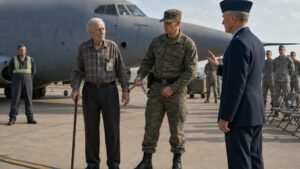
Lieutenant Brandon Davis’s forearm struck the air in front of Christine Torres before her second boot crossed the painted entrance line.
“Back of the formation, soldier.”
Christine stopped so sharply that the battered gear bag on her shoulder swung against her injured leg. Pain climbed from her knee into her hip, clean and bright. She kept it out of her face.
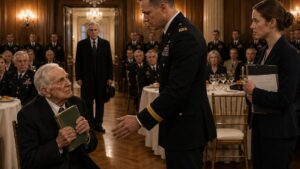
Beyond Brandon, six neat rows of personnel stood between the range lanes and a temporary ceremony platform dressed with unit colors. Folding chairs faced a lectern where Jack Clark would receive his promotion. Some of the guests were still taking their places.
Brandon pointed past all of them.
“Rank still means something here.”
Heads turned. Someone in the second row laughed under his breath.
Christine shifted the bag’s weight higher on her shoulder. She had changed into a clean uniform in a maintenance washroom after her second consecutive duty shift, but fatigue remained in the gray beneath her eyes and the slight delay between thought and movement. Her right hand trembled against the canvas strap.
“I’m here for Sergeant Clark’s ceremony, sir.”
“You and everyone else.”
“My name is on his guest list.”
Brandon glanced at the worn bag as if she had claimed admission with a sack of laundry. He was young for the authority he projected, his uniform immaculate, his new insignia catching the late-morning light.
“The controlled section is for assigned personnel, ceremony participants and authorized exhibition staff. General guests form behind the marked line.”
Christine looked down. Her boots were exactly where the staging protocol required invited active-duty guests to report before being directed to seating.
“Invited service members check in at the entrance lane,” she said. “The rear line is for civilian overflow and unverified arrivals.”
The laughter stopped.
For one second, Brandon’s expression emptied. Then he smiled.
“Thank you for reciting the sign to me.”
Christine had not read the sign. It was turned away from her, facing the parking area.
A few soldiers noticed. One of them, a young recruit standing near the aisle, looked from the sign to Christine with open curiosity.
Brandon stepped closer.
“Name and unit.”
“Christine Torres.”
She gave him the rest without embellishment. No qualifications. No history. No explanation for the bag or the limp. She had learned that details offered under pressure were often treated as pleas.
Brandon checked the tablet held by a ceremony assistant. The guest document was not loaded.
“No Torres.”
“The printed list is at the platform,” Christine said. “Sergeant Clark submitted it with the promotion packet.”
“Sergeant Clark is preparing to be promoted. He doesn’t need someone interrupting the formation because she couldn’t follow directions.”
The words were pitched for the rows behind him.
Christine felt the familiar urge to reduce herself—to step back, let the moment pass, find Jack afterward, return the rifle to Mark and leave without becoming a problem in anyone’s day.
Her thumb pressed against the outside of the gear bag. Beneath two layers of faded canvas, she found the straight line of the rifle’s receiver. She touched it with two fingers and breathed once through her nose.
The movement steadied her thoughts, but not her hand.
The young recruit near the aisle saw the tremor.
Their eyes met briefly. The recruit looked away too fast.
Brandon followed the exchange. “Long morning?”
“Yes, sir.”
“Technology fail you? No sleep-tracking alert telling you when to rest?”
A louder laugh moved through the nearest row. It was not cruel at first. It was the reflexive laugh of people who had recognized where power stood and wanted to stand near it.
The young recruit joined a beat late.
Christine saw the regret arrive on her face almost immediately.
“My shift ended forty minutes ago,” Christine said.
“So you came to a formal event exhausted, carrying unverified equipment, and expected the formation to rearrange itself around you.”
“No, sir.”
“Then back of the line.”
Christine looked toward the platform. Jack was not there. A promotion folder rested on the lectern, its dark cover secured beneath a brass clip. Mark Harris stood near the range boundary speaking with two instructors. If she raised her voice, he would hear. If Mark came over, the dispute would stop being about a guest-list error and become a contest between a drill sergeant and a new lieutenant in front of multiple units.
She stepped back.
Brandon’s shoulders relaxed, but only slightly. Compliance had not satisfied him. It had merely confirmed the shape he had assigned her.
The gear bag slipped as Christine turned. Her hand failed to close fully around the strap, and the bottom corner struck the ground with a dull metallic weight.
Brandon looked down.
“What’s in the bag?”
“Training equipment scheduled for return.”
“What kind of equipment?”
Christine paused.
That was enough.
“Range officer,” Brandon called.
Christopher Lee looked up from the weapons inspection table. He was older than Brandon, broad through the shoulders, with hearing protection resting around his neck and a clipboard tucked beneath one arm. He crossed the concrete with the irritated speed of a man who considered every interruption evidence that someone else had failed.
“What is it?”
Brandon pointed at the bag. “Unverified soldier. Unverified weapon case. Entered through the ceremony lane.”
“I reported through the designated entrance,” Christine said.
Christopher held out his hand. “Identification.”
She gave it to him.
He checked the card, then her face. His eyes settled on the tremor in her fingers.
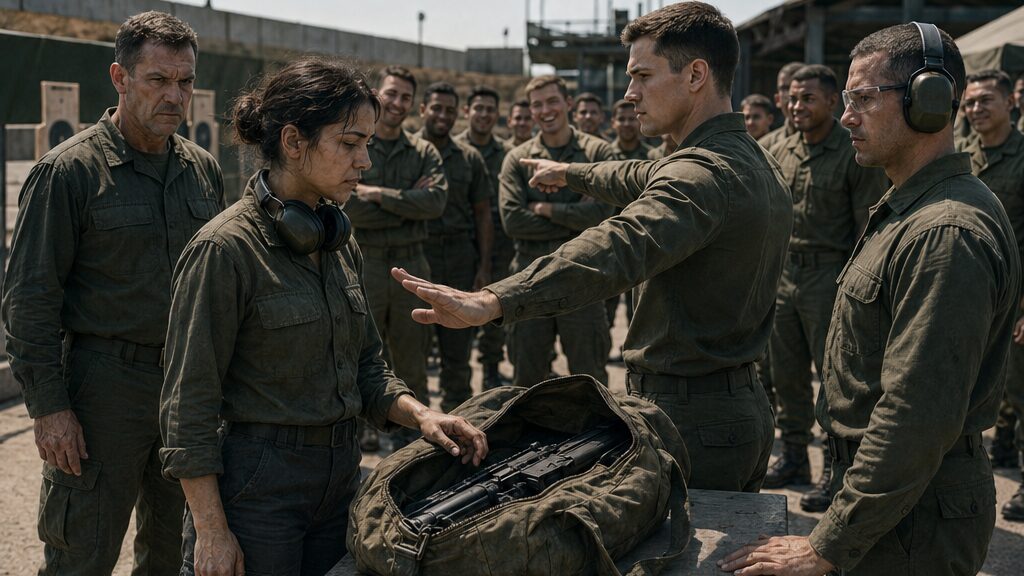
“Set the bag on the table.”
“It is documented and cleared for transport.”
“I didn’t ask whether you believed it was cleared.”
Christine lifted the bag. Pain tightened across her leg, forcing a brief unevenness into her step.
Christopher noticed that too.
By now, the nearest formation row had shifted enough to watch openly. Brandon did not order them back into position. Instead, he moved alongside the inspection table as though escorting evidence.
Christine laid the bag down carefully.
Christopher reached for the zipper.
“Sir,” she said, “the muzzle is oriented toward the range. The chamber flag is installed. The transport record is in the outer pocket.”
His hand stopped for less than a second.
Then he opened the main compartment instead.
The zipper teeth separated with a long, rough sound. Faded foam appeared, followed by the dark receiver of the training rifle nested inside.
Christopher looked at the weapon, then at Christine’s shaking hand.
His voice carried across the formation.
“Why did an unsteady soldier bring a rifle into my controlled range?”
Chapter 2: The Inspection That Became Public Entertainment
Christopher pulled the metal magazine from its fitted slot and dropped it onto the inspection table.
It landed flat with a crack that made several people flinch.
“Identify every fault before I return control of this weapon.”
Christine looked at the magazine, then at the rifle still secured in the foam.
“There is no ammunition present. The follower is intact. Feed lips show normal wear. The body is free of deformation.”
Christopher turned it beneath the sunlight. “You missed contamination.”
“There is dust on the exterior.”
“Dust becomes contamination.”
“Not in the feed path.”
Brandon leaned one hip against the table. “She sounds confident now.”
The formation had loosened. Soldiers who had been facing the ceremony platform were angled toward the inspection station. Others stood on the edges of the assessment lanes with their arms folded. The promotion ceremony had not begun, yet Christine could feel it being displaced by something smaller and uglier.
Christopher set the magazine down and removed the rifle.
His palm crossed the receiver carelessly, his fingers entering the trigger guard before he had completed his visual check.
Christine’s fatigue disappeared beneath a hard pulse of attention.
“Finger,” she said quietly.
Christopher looked at her.
“Outside the guard until the safety sequence is complete.”
The people nearest the table went silent.
For the first time, Christopher’s severity cracked. His finger moved out. His eyes dropped to the weapon, then returned to Christine.
She could have raised her voice. She could have made sure everyone saw the correction. Instead, she turned slightly, placing her body between his hand and most of the watching formation.
“The chamber flag is seated,” she continued. “Bolt forward against the flag. Selector on safe. No magazine inserted.”
Christopher performed the sequence again, correctly this time.
Brandon watched them both.
“What’s the transport authorization?” he asked.
“Outer pocket,” Christine said.
Christopher opened it and withdrew a folded form protected in a clear sleeve. The issuing section belonged to Mark Harris’s training detail. The serial number matched. The return time had not yet passed.
“Why bring it through a ceremony?” Brandon asked.
“The ceremony is beside the return point.”
“You could have returned it first.”
“The armorer is supporting the assessment until thirteen hundred.”
Christopher read the final line of the form. “That’s correct.”
A small shift moved through the crowd. Not approval. Recalculation.
Brandon took the paper from Christopher and scanned it. “Assigned to today’s course inventory.”
“For training rotation,” Christine said.
Christopher examined the bolt face and chamber. “Weapon is clear.”
“Then we’re finished,” Christine said.
It was the first thing she had said that resembled a request.
Brandon’s gaze moved to the assessment lanes. Four firing stations stretched toward the berm: a standing barricade, a low barrier, a reload table and a final unsupported transition point. Electronic target indicators sat dark in the distance.
“Actually,” he said, “the event directive allows qualified active-duty personnel to enter the combat-readiness assessment.”
Christopher took the form back. “It allows voluntary entrants after verification.”
“She’s qualified, isn’t she?”
“That isn’t the same as volunteering.”
Brandon looked amused by the distinction. “The lieutenant in charge of formation has a soldier carrying assessment inventory into a controlled event while visibly impaired. I think a proficiency check is reasonable.”
Christine heard the trap inside the word reasonable. Refusal would become confirmation. Acceptance would turn the entire range into the theater Brandon wanted.
“I came for Sergeant Clark’s promotion,” she said.
“And afterward?”
“To return the equipment.”
“Then this costs you a few minutes.”
A soldier behind Brandon muttered, “Maybe more than a few.”
Laughter broke out again.
Christopher did not join it. He placed the rifle back into the foam but did not close the bag.
Christine’s right hand trembled harder now. She folded it against her thigh.
Brandon noticed. “We can make accommodations. Larger controls. Slower lane. Maybe someone can hold the rifle for you.”
The young recruit near the aisle stared at the ground.
Christine looked past Brandon toward the ceremony platform. The chairs were nearly full. The promotion folder remained untouched. Jack would arrive soon. She could imagine his first sight of the day: her standing at the center of a crowd with his ceremony reduced to background scenery.
“I decline,” she said.
Brandon straightened.
It should have ended there.
Instead, he lifted the transport form and tapped Mark’s section designation with one finger.
“Interesting.”
Christopher’s jaw tightened. “Lieutenant.”
“Drill Sergeant Harris signs out equipment to soldiers who can’t demonstrate current control?”
Christine’s eyes moved to him.
That was no longer about her.
Brandon saw the change and continued. “Or is this what passes for readiness under his training model? Memorize procedure, repeat doctrine, hope nobody asks for performance?”
Christopher lowered his voice. “The weapon is documented. The soldier declined. Close the bag.”
But he did not close it himself.
Christine understood then that Christopher had begun to see what Brandon was doing. He simply had not decided whether stopping it was worth contradicting a lieutenant in front of the range staff.
Brandon turned to the formation.
“For those observing today’s assessment, this is why standards matter. Confidence is not competence. Neither is reciting a checklist.”
Mark had heard him now.
He stood at the far boundary, motionless, eyes fixed on Christine. Even from that distance she could read the warning in his posture: Do not let him choose for you.
Brandon picked up the range roster.
“Lieutenant,” Christopher said, sharper this time, “she has not completed medical screening or entrant paperwork.”
“Then complete them.”
“She has not consented.”
Brandon’s smile thinned. “A qualified soldier afraid of a standard assessment creates a readiness concern. I’m offering her the simplest way to resolve it.”
Christine could still walk away. The thought came cleanly.
Let him speak. Let the laughter follow. Jack would know why she had come. Mark would understand. None of them needed her to prove anything.
Then Brandon raised his voice.
“Christine Torres, next participant.”
A technician at the scoring booth looked up and, assuming the order was legitimate, entered her name into the system.
The electronic board above the lanes flickered.
TORRES, CHRISTINE appeared beneath the previous scores.
The crowd turned toward her as one body.
Chapter 3: The Mentor Who Saw the Tremor Clearly
Mark pulled the equipment-shelter flap shut hard enough to rattle the aluminum frame.
“If your fingers are numb, I will remove you from that line myself.”
Christine stood beside a folding workbench, the gear bag resting between them. Outside, the range loudspeaker announced a delay in the assessment schedule. The voice was neutral. The reason was not.
“My fingers aren’t numb.”
Mark held out his hand. “Grip.”
She gave him her right hand.
His grip was firm but controlled, pressing along the base of her fingers, testing resistance. Christine closed around his hand. The first two fingers responded. The last two lagged.
Mark released her.
“How long?”
“It started near the end of shift.”
“That isn’t an answer.”
“Twenty minutes before I arrived.”
“And the leg?”
“Stable.”
“You limped into the shelter.”
“The bag shifted.”
“Christine.”
The use of her first name carried more force than any command he had given outside.
She looked toward the seam in the shelter flap. Sunlight cut through it in a thin vertical line.
Mark lowered his voice. “Can you run the receiver check?”
“Yes.”
“Without losing sensation?”
She did not answer.
His face changed—not into surprise, but confirmation. He had trained her too long to mistake silence for uncertainty.
“You didn’t report recurrence.”
“It settles with rest.”
“You haven’t rested.”
“I had back-to-back duty.”
“You accepted back-to-back duty.”
“There was a gap in coverage.”
“There is always a gap in coverage for the person who never says no.”
The words landed harder because there was no anger in them.
Christine reached for the gear bag. “I’m leaving. That solves it.”
She lifted the strap.
The old repair near the buckle gave with a dry snap. Three stitches pulled loose, and the bag dropped several inches before she caught it against her hip. Pain flashed down her right side.
Mark took the weight from her.
The torn repair exposed a line of pale thread beneath the darker stitching. Jack had sewn it during a training rotation with a field kit and no patience, swearing the whole time that equipment manufacturers designed straps for people who never carried anything.
Christine touched the loose thread.
Mark saw where she was looking. “You came straight here for him.”
“I said I would.”
“And you thought he’d prefer this over an empty chair?”
“He won’t know.”
“He’ll know the second he sees your face.”
Christine sat on the edge of the workbench because remaining upright had begun to require visible effort.
Outside, a burst of laughter rose and disappeared.
Mark set the bag down gently. “Tell me what the medical section said at your last review.”
“That I could return to full training progression.”
“With conditions.”
“Manageable conditions.”
“What conditions?”
She looked at him.
He already knew. He wanted her to say them.
“Stop with recurring numbness. Report tremor lasting beyond exertion. Avoid unsupported load after consecutive shifts.”
“And you did none of those.”
“The tremor is fatigue.”
“It is also information.”
Christine’s jaw tightened. “If I report every recurrence, they pull my qualification and restart evaluation.”
“Maybe they should.”
Her head came up.
Mark did not soften it. “You think I trained you to hide a failing hand because you can force it to work for another five minutes?”
“I can complete the course.”
“That is not the same as being cleared to complete it.”
“If I walk away now, Davis makes it about your training.”
Mark’s mouth flattened. There it was—the argument neither of them had wanted to name.
“Let him.”
“He already has a platoon listening.”
“That platoon is my responsibility.”
“He’s making them believe control is weakness.”
“And you plan to correct that by concealing symptoms and firing under pressure?”
Christine looked down at the torn stitching.
Mark braced both hands against the workbench. “I am proud of the way you held your temper out there. I am not proud of this.”
She said nothing.
“Silence is not always discipline,” he continued. “Sometimes it is dishonesty with better posture. Christopher cannot make a safety decision with facts you refuse to give him.”
The loudspeaker clicked outside but no announcement followed.
Then Brandon’s voice carried through the shelter wall, unamplified and deliberately loud.
“This delay is exactly the problem with old-school training. Soldiers taught to perform rituals instead of producing results. Fragile under pressure, protected by procedure.”
Mark turned toward the flap.
Christine stood before he could move.
His expression warned her again, but this time the warning was aimed at himself as much as her. Brandon had found the place where Mark’s restraint was weakest.
“Do not go out there for me,” he said.
“I’m not.”
“That is not true.”
Christine adjusted the torn strap, winding the loose end around her wrist. “Not entirely.”
Outside, Brandon continued speaking to the platoon.
“Readiness does not care who trained you. The lane does not care about reputation.”
Christine opened the shelter flap.
The light struck her eyes. Across the staging area, soldiers stood in uncertain clusters between the ceremony seating and the range. Christopher remained beside the inspection table, the rifle secured but the bag still open. Brandon faced the platoon as though conducting an impromptu lesson.
Emily Green stood near the front now. She looked at Christine’s hand, then quickly at her face.
Christine crossed the concrete with Mark one step behind her.
Brandon stopped speaking.
Christopher watched her approach. “Have you reconsidered?”
“Yes.”
Mark’s voice came from behind her. “State everything.”
Christine placed both hands on the inspection table. The tremor remained visible.
“I have recurring fatigue-related tremor and intermittent loss of sensation connected to a training injury,” she said. “It increased near the end of my shift. I have not completed entrant medical screening, and I will not enter the lane without it.”
The crowd had gone quiet enough for the target mechanisms to be heard ticking in the distance.
Christopher studied her, then Mark.
Brandon folded his arms. “Convenient.”
Christine did not look at him.
She looked only at Christopher.
“I will participate,” she said, “after a documented medical evaluation and a complete weapons check. If I am not cleared, my refusal will be recorded as medical, not proficiency.”
Christopher’s face settled into something more serious than severity.
“And if you are cleared?”
Christine’s two fingers rested against the bag directly above the cold line of the receiver.
“Then apply the same standard to everyone.”
Chapter 4: A Clearance That Proved Less Than Expected
The medical evaluator did not lower her voice.
“You can pass every target today and still be removed from tomorrow’s duty roster.”
Christine sat on the edge of the narrow examination cot while the evaluator pressed two fingers against the inside of her wrist. Through the open side of the medical station, the assessment lanes remained visible. Brandon stood near the scoring booth, checking his watch as though Christine’s injury were an administrative delay arranged to inconvenience him.
“Understood,” Christine said.
“Say what you understand.”
“That participation may document recurring symptoms. Medical can order reassessment regardless of performance.”
“And if the numbness returns?”
“I stop.”
“If your stability changes?”
“I stop.”
“If you feel that proving someone wrong matters more than either of those instructions?”
Christine met her eyes. “I stop.”
Mark stood by the entrance with his arms crossed. He had not spoken since they arrived. His silence was not approval. It was the only way he trusted himself not to interfere.
The evaluator tested Christine’s grip, reflexes and balance. Christine managed each request, though standing on her injured side sent a slow burn upward from her knee. When asked to close her right hand three times, the first two movements were clean. The third came with a tremor.
The evaluator wrote it down.
Brandon appeared at the station entrance.
“How much longer?”
The evaluator did not look at him. “As long as the examination requires.”
“We have a ceremony schedule and a range schedule.”
“You also have a soldier with disclosed neurological symptoms.”
“Fatigue-related tremor,” Christine said.
Mark’s eyes cut toward her.
The evaluator capped her pen. “Do not edit my assessment while I am making it.”
Christine looked down at her hand.
Brandon glanced toward the crowd gathering near the lanes. “She requested this process.”
“She requested a documented process because you entered her into an assessment without consent,” Mark said.
Brandon turned. “Drill Sergeant, I did not ask for your interpretation.”
“No. You asked for her performance.”
The air tightened.
Christine slid off the cot and placed both boots squarely on the floor. “Can I be cleared for one controlled run?”
The evaluator watched her stand. “With restrictions.”
Mark stepped forward. “What restrictions?”
“One attempt. Standard course only. No repeat for score. Immediate stop on loss of sensation, instability or increased pain. Range officer retains full authority to terminate.”
Brandon opened his mouth.
The evaluator raised one hand. “And this clearance does not certify her fit for unrestricted duty tomorrow.”
Christine nodded.
A paper form was set before her. The medical evaluator marked three boxes, signed at the bottom and handed Christine the pen.
Christine hesitated over the acknowledgment line.
The consequences were no longer private. Her signature could reopen months of evaluation, restricted training and questions she had worked hard to silence. She could still refuse, attend Jack’s promotion and return the equipment later.
Outside, a burst of commands rolled down the range. Boots shifted. Metal struck metal.
Christine signed.
At the scoring booth, Christopher accepted the clearance form and clipped it beneath the entrant sheet. His manner had changed. The impatience remained, but it had lost its edge of contempt.
“One controlled run,” he said. “My stop command ends it immediately.”
“Yes, sir.”
He opened the gear bag for the second inspection.
Christine stood beside him and ran two fingers along the outside canvas, following the seam above the rifle’s receiver. She pressed lightly, testing sensation through the fabric.
Canvas. Foam. Metal beneath.
She could feel each boundary.
Mark saw the movement. “That is not a clearance.”
“I know.”
Christopher removed the rifle and followed the inspection sequence without error. Muzzle toward the range. Finger clear. Chamber verified. Flag seated. Magazine well empty.
When he finished, he carried the rifle to the preparation rack himself.
Inside the scoring booth, rows of names and times filled a monitor. Brandon’s sat at the top.
Christopher pointed to it. “Raw time, fifty-three point four seconds. One procedural review at the second barrier.”
“What kind of review?” Christine asked.
“His muzzle crossed the barrier line during the transition. The angle remained inside the safe sector.”
“Penalty?”
“Waived during the demonstration run.”
Brandon had followed them in. “It was reviewed and cleared.”
Christine studied the score. “Then it stands.”
Christopher looked at her. “You could challenge it.”
“I’m not here to change his score.”
Brandon’s mouth tightened, as though her refusal to attack him were another insult.
A range technician approached with the revised course card. “Lieutenant Davis authorized an adjustment.”
Christopher read it once. “No.”
Brandon held out his hand. “The event directive permits command variation.”
“You shortened the reload window and raised the required target count.”
“To better reflect operational pressure.”
“After the entrant was named.”
“The course should test adaptability.”
Christopher lowered the card. “Then the same variation applies to every score on the board.”
Brandon glanced toward his own name.
“That is unnecessary. Prior entrants completed the published standard.”
Christine looked from one man to the other. Christopher was finally resisting, but resistance on her behalf could become another kind of exception.
“Apply the variation,” she said.
Mark moved beside her. “No.”
She faced Christopher. “Erase the previous ranking if the course changed. Use one standard for everyone.”
Brandon’s confidence flickered. “You are willing to invalidate the other soldiers’ runs?”
“No. Keep their published-course scores. List mine separately under the variation.”
“That gives you an excuse before you start.”
“It gives the record the truth.”
Christopher studied her for a long moment, then handed the revision back to the technician.
“Separate category. Full notation. No comparison entered as official.”
Brandon’s jaw worked once.
The preparation timer was clipped to Christine’s belt. Its wire ran upward beneath her uniform blouse to a sensor at her shoulder.
A voice came from behind them.
“Who turned my promotion day into a trial?”
Jack Clark stood at the edge of the scoring booth in his ceremony uniform, one hand still holding the dark folder he was supposed to carry to the platform.
His eyes went first to the timer.
Then to Christine’s trembling hand.
Chapter 5: The Promotion Guest Who Refused Rescue
Jack reached for the timer lead.
Christine caught his wrist with the same hand the entire formation had watched shake.
“Don’t.”
His eyes dropped to her fingers around him. The grip was weak, but deliberate.
“You’re not running this course.”
“It’s cleared.”
“You can barely close your hand.”
“I can close it.”
“That was not what I said.”
Behind him, the ceremony assistant waited near the platform stairs, trying not to appear as if she were listening. The assembled personnel had gone quiet again. Even the range staff seemed reluctant to move.
Jack turned toward Christopher. “Remove her name.”
Christine released his wrist. “You don’t have authority over the range.”
“I have authority over whether my ceremony becomes cover for this.”
Brandon stepped closer. “Sergeant Clark, the assessment is separate from your promotion.”
Jack looked at him. “Then why is every chair facing this direction?”
Brandon’s face hardened.
Christine moved between them before Jack could say more. “Go back to the platform.”
“No.”
“You are holding your promotion folder.”
“And you are wearing a range timer.”
“I chose to continue.”
“After he cornered you in front of half the staging area.”
Christine kept her voice low. “If you stop it because today is yours, then my place here becomes another favor attached to your rank.”
Jack stared at her.
The repaired strap of her gear bag hung loose beside the preparation rack. His old stitching was visible where the thread had torn.
He noticed it.
“You still carry that thing?”
“It still carries what I need.”
“It failed.”
“So did your stitching.”
For half a second, something almost like a smile crossed his face. Then it was gone.
“You were supposed to sit in the front row,” he said.
“I tried.”
The words settled between them.
Jack looked toward Brandon, then at Mark. “Tell her.”
Mark’s expression remained closed. “I already did.”
“And?”
“She told the truth to medical. Late, but she told it.”
Jack’s attention snapped back to Christine. “What truth?”
She did not answer quickly enough.
His face changed.
During the training cycle two years earlier, Jack had frozen inside a smoke-filled movement lane when a collapsing barrier struck the ground beside him. Christine had gone back instead of clearing the course. She had dragged the barrier far enough for both of them to move, then completed the final station on a leg that had already begun to fail.
Jack had repaired her torn bag strap that night while she waited for transport to medical. He had called it repayment. Neither of them had said what it was really for.
“The symptoms came back,” he said.
“Fatigue aggravated them.”
“And you worked two shifts.”
“There was a coverage gap.”
Jack closed his eyes briefly. “There is always a gap when you volunteer to become one.”
Brandon checked the course clock. “This discussion can happen after the assessment.”
Mark turned on him. “You have done enough directing for one morning.”
Brandon’s voice dropped. “Your platoon still looks at you before it looks at me.”
The admission was quiet enough that only those closest heard it.
Mark did not move.
Brandon continued, “I give an order, and they wait to see whether your face agrees. You trained them to trust the instructor more than the officer.”
“I trained them to verify before they act.”
“You trained them to treat confidence as danger.”
“No,” Mark said. “I trained them to treat unearned confidence as danger.”
Brandon’s eyes flashed. For a moment, Christine saw the real pressure beneath his cruelty: every command he gave was measured against a man who no longer needed to raise his voice.
He could have stopped then.
Instead, he pointed toward the ready line.
“The entrant has been medically cleared. The range is prepared. We proceed.”
Mark’s hands curled at his sides.
Christine stepped in front of him. “Not for you,” she said softly.
His gaze shifted to hers.
“Not for him either,” she added.
Jack touched the torn bag strap. “You do not need to prove you deserved your place beside me.”
“I know.”
“Then why?”
Christine looked toward the formation. Emily Green stood near the aisle, pale and rigid, her arms held too straight against her sides.
When Christine met her eyes, Emily stepped forward.
“I laughed,” she said.
No one answered.
Emily swallowed. “At the entrance. I laughed because everyone else did.”
Brandon’s head turned sharply. “Return to formation.”
Emily obeyed the first half of the command—she straightened—but did not move.
“I thought she was scared,” she said. “I thought that meant she didn’t belong.”
Christine felt the purpose of the course shift.
The score no longer mattered. Brandon’s humiliation no longer mattered. Even Mark’s reputation was not the deepest thing at risk.
A recruit had watched rank turn cruelty into instruction and had mistaken obedience for truth.
Christine faced Christopher. “Prepare the lane.”
Jack caught her arm. “Christine.”
“I’m not doing this to beat him.”
“That does not make your leg safer.”
“No. The rules do.”
She looked at Christopher. “And I will follow them.”
He nodded once.
Jack released her slowly. “If the symptoms change, you stop.”
“Yes.”
“Not after one more station.”
“Yes.”
“Not after one more shot.”
“Yes.”
He stepped back, still unconvinced.
Christopher escorted Christine to the ready line. The rifle rested on the preparation stand, chamber flagged and muzzle downrange. The final course card had been posted beside it: increased target count, compressed reload window, separate scoring category.
Christine placed her feet on the marks.
Jack watched from beside the ceremony platform. Mark stood behind the safety boundary. Emily had returned to formation but kept her eyes fixed on Christine’s hands.
Christopher raised the timer.
“Shooter, confirm condition.”
“Clear and ready.”
“On command, remove the chamber flag, load and begin.”
Christine reached for the rifle.
Her fingers touched the receiver.
Jack recognized the gesture. So did Mark.
Two fingers along cold steel. Pressure. Sensation. Breath.
Christine tried to close her hand around the grip.
The last two fingers did not move.
The range remained silent.
She opened her hand and tried again.
Nothing.
Across the lane, Brandon smiled.
Chapter 6: Two Fingers Against the Cold Receiver
Christine did not hide the failed grip.
She removed her hand from the rifle, opened her fingers fully and held them where Christopher could see.
“Reset the safety count.”
A murmur passed through the formation.
Christopher lowered the timer. “Reason?”
“Grip failure before load command. Sensation present. Motor response delayed.”
Brandon’s smile disappeared.
The medical evaluator stepped to the boundary. “Pain change?”
“No.”
“Numbness?”
“No.”
“Instability?”
Christine tested her weight. Her injured leg held.
“No.”
Christopher looked at her hand. “You may withdraw without penalty.”
“I know.”
Mark’s voice came from behind the line. “Make the decision for the lane you’re standing on. Not the people watching.”
Christine exhaled.
That was the hardest order he had ever given her because it removed every excuse to continue for someone else.
She flexed her hand once, then placed two fingers against the rifle’s cold receiver.
The first point was temperature. She felt it.
The second was texture—the faint roughness where the finish had worn near the control. She felt that too.
Her fingers moved to the bolt.
Steel. Edge. Resistance.
The ritual had never been affection, though it looked like tenderness from a distance. Mark had taught her to break panic into facts after the injury: identify what the body could feel, what the weapon was doing, what the next safe action required. No future station. No watching crowd. Only the point beneath her fingers.
Christine closed her hand.
This time, all four fingers responded.
“Ready,” she said.
Christopher raised the timer again.
“Shooter, stand by.”
The tone cut through the range.
Christine pulled the chamber flag, drove the magazine home and worked the bolt in one hard motion. The first target rose.
Her rifle cracked.
The indicator flashed.
She moved to the second target, then the third, each shot following the same narrow sequence: sight, breath, pressure, reset. The rifle’s report struck the barriers and returned in flat echoes.
At the first reload station, she dropped the empty magazine into the marked zone, drew the replacement and seated it without looking down. Bolt forward. Muzzle controlled. One step left.
The compressed timer sounded.
She cleared the next array before the warning ended.
No one laughed.
At the standing barrier, Christine’s tremor tried to return through her support hand. She adjusted pressure rather than fighting it, allowing the rifle to settle into bone and structure. Two targets appeared at different heights.
Two shots.
Two flashes.
The split time appeared on the scoring monitor.
She was ahead of the published standard and four-tenths behind Brandon’s demonstration pace.
Brandon stood beside the booth, watching the numbers rather than Christine.
She reached the second reload.
The magazine released cleanly. Her replacement hand moved toward the pouch.
Her injured leg buckled.
Her hip struck the barrier, and the rifle dipped.
A sharp breath moved through the crowd.
Christine froze the weapon inside the safe sector. She did not fire. She did not force the reload while unstable.
The timer kept running.
One second.
Two.
Brandon’s best time moved beyond reach.
Christine widened her stance and tested the leg. It shook beneath her, then held. She reseated her heel, recovered the magazine and completed the reload.
Christopher’s hand hovered near the stop control.
“Status?”
“Stable.”
“Continue.”
Christine moved.
The next target rose as she entered the low-barrier position. Her raw time had fallen behind, but the scoring display showed no safety penalty. No missed target. No procedural fault.
The crowd could see the difference now.
Brandon had crossed that same barrier quickly enough to earn a review. Christine had surrendered time rather than send one uncontrolled movement downrange.
She fired from the corrected base.
The indicator flashed.
A second target appeared farther right. Christine shifted from the hips, not the injured knee, and struck it before the exposure window closed.
At the booth, the split calculation changed.
She was now only two-tenths behind Brandon after penalty weighting.
Christopher looked at the screen, then at her.
The final station warning illuminated.
Unsupported transition.
No barrier. No sling support. A lateral step onto the injured side followed by three targets at staggered distances.
Mark’s training voice lived in her memory: Never borrow control from the next shot.
Christine stepped into the final box.
Pain cut beneath her kneecap. Her sight picture wavered.
The closest target rose.
She could have fired through the movement and probably hit it. Speed would hide the hesitation from the score, perhaps even from the crowd.
Her finger remained straight.
The target exposure window began to close.
Brandon leaned toward the monitor.
Christine stopped competing with his time.
She stopped competing with the laughter, the formation, the lieutenant’s smile, even the version of herself that believed stopping was weakness.
She built the position again.
Foot.
Hip.
Shoulder.
Breath.
The sight settled.
She fired.
The closest target flashed a fraction before dropping.
The second rose at middle distance. Christine transitioned, fired and held the reset long enough to confirm control.
Flash.
The final target appeared at the far edge of the lane.
Her leg trembled violently now. The muzzle moved in a small, dangerous arc.
Christopher lifted the stop control.
Christine felt the rifle through the receiver, through the stock, through every point where her body met the tool. The tremor was not a command. It was information.
She reduced pressure in her injured leg, shifted weight to the rear foot and allowed the sight to enter the target from below.
One clean pause.
One shot.
The indicator flashed.
The final tone sounded.
Christine locked the bolt to the rear, removed the magazine and presented the chamber. Christopher stepped forward, verified clear and inserted the flag.
Only after he touched her shoulder did she lower the rifle.
Her leg nearly gave way. She caught herself against the preparation stand.
Mark did not cross the boundary.
Jack did not rush forward.
They waited for her to decide whether she could stand.
Christine straightened.
Across the formation, Emily’s hands were clenched beneath her elbows. When Christine looked at her, the recruit slowly opened them.
The electronic board began calculating.
Raw time appeared first.
Christine’s was slower than Brandon’s.
A quiet breath escaped somewhere near the booth.
Then the system processed accuracy.
Every target turned green.
Procedural penalties: zero.
Safety penalties: zero.
Brandon’s name remained above hers for one second more while the weighted assessment recalculated.
Then the ranking lines disappeared. The monitor displayed the separate variation category Christopher had ordered.
TORRES, CHRISTINE
ACCURACY: PERFECT
SAFETY: PERFECT
PROCEDURE: PERFECT
FINAL ASSESSMENT: PROCESSING
Christopher stared at the screen.
The final field blinked once.
Then again.
No one spoke.
Christine handed him the cleared rifle.
“What does it say?” Brandon demanded.
Christopher did not answer.
He looked from the result to Christine as though the most important part of the assessment had not yet occurred.
Chapter 7: The Coin She Would Not Carry
Christopher turned from the scoring monitor and faced the formation.
“Perfect assessment.”
No one moved.
The words seemed too small for the silence that followed them.
Christopher raised one hand before anyone could cross the painted boundary. “Remain behind the safety line. The weapon is clear, but the range is still active.”
The order held the crowd in place.
On the monitor, Christine’s raw time remained visible beneath Brandon’s faster demonstration run. Beside it, three green fields told the rest of the story.
Perfect accuracy.
Perfect procedure.
Perfect safety.
Brandon stared at the numbers as though one of them might correct itself.
Christine stood beside the preparation rack with the cleared rifle cradled across both palms. Her injured leg shook hard enough now that the movement reached her shoulder. She lowered the rifle into its foam bed rather than risk carrying it farther.
Christopher watched every motion.
“Symptoms?” he asked.
“Increased pain.”
“Numbness?”
“Not yet.”
The medical evaluator stepped through the boundary and took Christine by the elbow. Christine almost pulled away from habit, then stopped herself.
“Sit,” the evaluator said.
Christine sat on the edge of the inspection table. The crowd watched without laughter now, but she did not find the silence comforting. Admiration could turn a person into an object almost as quickly as contempt.
Mark remained where he was.
He had not smiled.
Jack stood near the platform stairs, the promotion folder held against his side. Relief showed in his face, but so did anger. Not at Brandon alone. Some of it belonged to Christine.
The scoring technician printed the assessment sheet. Christopher read it, signed it and laid it beside the medical form.
“Raw time slower by one point eight seconds,” he said. “No penalties. All required targets struck within exposure. Variation standard completed.”
Brandon finally spoke.
“The course was altered.”
Christopher looked at him. “At your direction.”
“It was listed separately.”
“Yes.”
“So it does not replace the published ranking.”
Christine lifted her eyes to him. “I never asked it to.”
That answer seemed to leave Brandon with nowhere to place his defense.
Several soldiers glanced away from him. Others looked toward Mark, waiting for the drill sergeant to claim what had happened as proof of his methods.
Mark only said, “Check her hand.”
The medical evaluator tested Christine’s fingers. Sensation remained, though the last two responded slowly.
“Your day is finished,” she said.
Christine nodded.
“And tomorrow?”
“Reassessment.”
This time she did not add a qualification.
Jack heard it. His shoulders loosened by a fraction.
Brandon stepped away from the scoring booth and reached into his uniform pocket. When his hand emerged, a dark metal unit coin rested in his palm.
The gesture drew every eye back to him.
He approached Christine slowly. The confidence had left his stride, but the public instinct remained. He positioned himself where the formation could see both of them.
“Soldier Torres,” he began, “today’s misunderstanding revealed an exceptional level of preparation and skill. On behalf of the unit—”
Christine looked at the coin.
Not at his face. Not at the watching soldiers.
At the coin.
His apology had already shifted the shape of the morning. A misunderstanding. A difficult inspection. A test that had somehow occurred without anyone choosing to make it cruel.
Brandon extended his hand.
“This recognizes your performance.”
Christine stood carefully.
The medical evaluator moved as if to stop her, then allowed it when Christine found her balance.
She placed two fingers against the edge of the coin.
For an instant, Brandon seemed to think she would accept it.
Instead, Christine folded his fingers over the metal and pressed his hand gently back toward his chest.
“Keep it,” she said. “Lead them better.”
A breath moved through the formation, but no one applauded.
Brandon’s face reddened. He looked at the closed fist between them.
“I was attempting to acknowledge—”
“A coin does not correct the record.”
His eyes lifted.
Christine kept her voice low enough that he could have answered without losing the entire crowd. He chose not to.
Christopher stepped forward. “Lieutenant, the inspection and entrant sequence will be documented.”
Brandon turned toward him. “You participated in that sequence.”
“Yes.”
The admission changed the space between them.
Christopher took the transport form from the table. “I opened the equipment before reviewing the documentation. I handled the weapon incorrectly during the first check. She corrected me without making it public.”
Several heads turned toward him.
He did not look away.
“I will include that.”
Brandon’s jaw tightened. “This is still an internal matter.”
A supervising command representative had arrived beside the ceremony platform during the final station. Until then, the officer had remained silent, observing from beyond the rows of chairs.
Now the representative approached.
“Does Soldier Torres consider the matter resolved?”
The question was directed at Christine, not Brandon.
The promotion folder waited in Jack’s hand. The chairs remained turned toward the range. One answer could end the disruption immediately.
Christine could say yes.
Jack would receive his promotion. Mark’s platoon would return to formation. Brandon would carry the humiliation privately, perhaps enough to change, perhaps not. Christopher’s report might soften before it reached anyone who mattered.
Silence had always offered Christine that kind of bargain: absorb the cost now and call it unity.
She looked at Emily.
The recruit stood in the front row with her hands open at her sides, watching not the score, but Christine.
“No,” Christine said.
Brandon’s head came up.
Christine faced the command representative. “Lieutenant Davis ordered me behind the formation without verifying the guest list. He used a weapons inspection to question my competence publicly after the equipment was shown to be documented. I declined the assessment. He entered my name anyway and described refusal as a readiness concern.”
She paused.
Her leg trembled beneath her.
“He also attacked Drill Sergeant Harris’s training to force my decision.”
Brandon’s mouth opened, but the representative held up one hand.
Christine continued.
“I failed to disclose recurring symptoms before arriving. I minimized them during the initial inspection. That prevented the range officer from making a fully informed safety decision.”
Mark’s gaze settled on her.
There was no pride in it now. Something quieter stood in its place.
The representative asked, “Are you accepting medical reassessment?”
“Yes.”
“Voluntarily?”
Christine looked at the printed medical form.
“Yes.”
The answer cost more than the perfect score had.
The representative turned to Brandon. “You are relieved of event authority pending review. Return the roster and course-control materials to the range officer.”
No one gasped. No one celebrated.
Brandon placed the coin back in his pocket. For the first time that morning, he looked toward his platoon without performing for it.
They did not look to Mark.
They waited for Brandon to obey.
He handed the roster to Christopher.
“Yes, sir.”
Christopher collected the forms, the altered course card and Christine’s assessment printout. “I will submit my account with the range data.”
The command representative nodded, then stepped aside.
Jack looked at the platform clock. “We are twelve minutes late.”
The ceremony assistant glanced nervously at him.
Jack straightened the folder beneath his arm. “Then we should begin.”
He turned to Christine. “Front row.”
She looked at the medical evaluator.
“You may sit,” the evaluator said. “Then you come with me.”
Christine lifted the battered gear bag. The torn strap slipped through her hand.
Jack took it before it fell.
“You are not carrying this on that leg.”
“I carried it here.”
“That has stopped being a persuasive argument.”
He looped the damaged strap around his wrist and walked beside her toward the chairs.
The promotion ceremony resumed without mention of the assessment. Jack stood before the lectern, received his new rank and answered the formal words in a steady voice. He did not thank Christine publicly. He did not turn his promotion into a tribute to what had happened on the range.
When it was finished, he returned the bag to her.
“I’ll repair the strap again,” he said.
Christine examined the loose thread. “Your first repair lasted two years.”
“That is not praise.”
“It is data.”
He gave her a tired look. “Go to medical tomorrow.”
“I said I would.”
“You say many things while planning to do something else.”
She adjusted the bag against her uninjured side. “I’ll go.”
Mark approached them. His eyes moved from the bag to Christine’s hand.
“You reset the safety count,” he said.
“Yes.”
“You stopped at the barrier.”
“Yes.”
“You reported the symptoms.”
“Eventually.”
“That word is carrying too much weight.”
Christine nodded.
Mark could have told Jack that the perfect assessment proved his training worked. He could have looked toward Brandon’s platoon and allowed them to draw that conclusion.
Instead, he said, “The score belongs to her. The mistakes do too.”
Christine met his gaze.
“So does the report,” she said.
Mark gave one small nod.
At the equipment-return area, Christopher signed the rifle back into custody. He did not rush the inspection. He did not touch the trigger guard before checking the chamber.
Emily stood nearby with another piece of training equipment waiting for verification.
She watched Christopher complete the sequence, then looked at Christine.
“I thought the fast part was what mattered,” she said.
Christine glanced toward the range, where the target indicators had gone dark.
“It matters.”
Emily waited.
“After control,” Christine added.
The recruit placed her equipment on the table. Before lifting it, she straightened her stance and exhaled slowly. Two fingers traced the outer seam near the receiver—not as performance, not as imitation of speed, but as a careful check of where the metal rested beneath the canvas.
Mark saw it.
He said nothing.
Christine settled the battered bag onto her shoulder. Her limp was more pronounced now, each step measured to keep the pain from taking the leg entirely.
She passed the rows of chairs, the scoring board and the painted line where Brandon had stopped her.
The board still held her perfect result.
She did not turn to look at it.
Behind her, Emily checked her grip once more before lifting the equipment safely from the table.
Christine kept walking.
The story has ended.