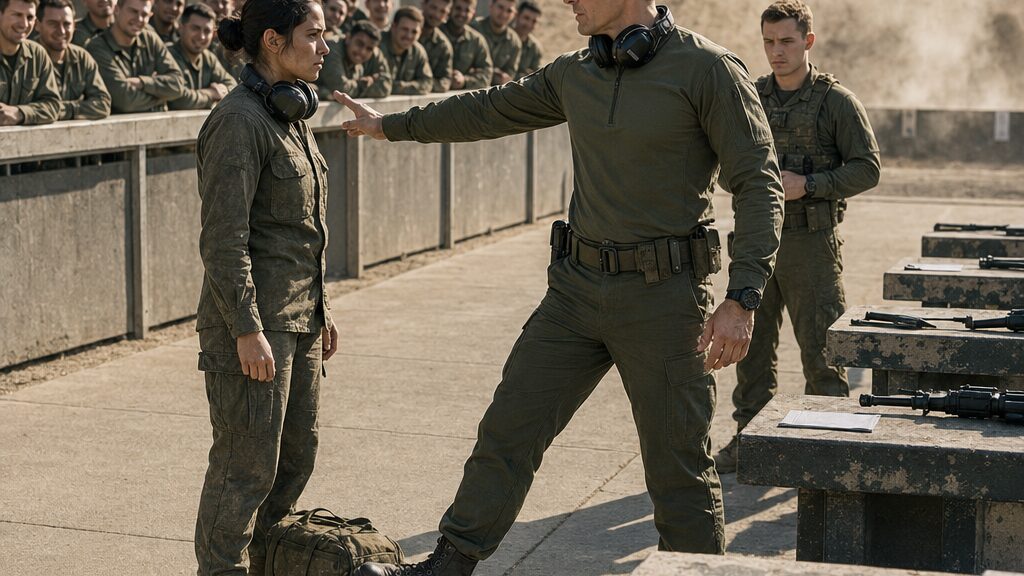
They Gave the Young Soldier the Worst Firing Lane, Then the Whole Platoon Stood Silent
Chapter 1: The Bag Gregory Kicked Across the Concrete
Gregory Moore’s boot caught the side of Maria Flores’s gear bag and sent it skidding beneath the premium firing benches.
The canvas scraped across the concrete, struck a metal leg, and collapsed on its side. A pair of visiting children stopped near the family-support tent. Their mother pulled them onward while several soldiers beside the range fence laughed.
Maria looked first at the bag, then at Gregory.
He wore polished electronic hearing protection around his neck and enough new equipment to make his uniform seem built around it. His competition belt sat straight. His gloves were clean. Even his boots looked untouched by the dust spreading across the recreation grounds.
Maria’s faded olive uniform had been washed pale at the knees and elbows. One boot dragged slightly whenever fatigue tightened her left leg.
Gregory nodded toward the bag.
“Equipment checkout is inside,” he said. “Surplus collection is somewhere else.”
More laughter came from the soldiers gathered behind him. Most belonged to the infantry platoon visiting for the community weekend. They had been watching range demonstrations between family events, enjoying the rivalry with Maria’s affiliated unit.
She stepped past Gregory, crouched, and pulled the bag toward her.
A distant artillery concussion rolled over the berm.
For half a second, the recreation area vanished beneath pressure rather than sound. The music from the family tent disappeared. Mouths continued moving without voices. A clean metallic ring filled Maria’s skull.
She waited for the world to return.
Then she opened the bag and checked the interior. The heavy canvas was worn into a long dark shape where issued rifles had rested during years of armory work. She ran two fingers along that mark, found no tear, and closed the zipper.
Gregory watched the gesture.
“Sentimental about government property?”
“No, Sergeant.”
Her voice sounded distant inside her own head.
At the armory counter, a clerk took the authorization sheet Maria placed beneath the window. The stamp at the top identified the advanced armor lab. The equipment listed below it was specialized enough that the clerk read the page twice.
“You’re here for the sensor package and reinforced carrier assembly?”
“Yes.”
The clerk checked the time. “Pickup closes at sixteen hundred. Qualification verification has to be entered before then.”
Maria glanced toward the range. “My certification is current.”
“Not for that package.” The clerk pointed to a line in smaller type. “Observed live-fire validation required on issue day.”
Gregory leaned one elbow against the counter as though the building belonged to him.
“She didn’t mention that?”
“I read it,” Maria said.
“You arrived late.”
“My unit released me when the overnight inventory ended.”
Gregory looked at her uniform again, at the crease left by a body-armor strap and the gray dust on one sleeve.
“Consecutive shifts don’t lower the standard.”
“I didn’t ask them to.”
The clerk’s eyes moved between them. “Range control can add her to the active roster if there’s space.”
“There isn’t,” Gregory said.
Maria turned her authorization so the second page faced him. The approval contained a priority code and a signature from the laboratory’s equipment officer. Gregory read far enough to understand that refusing her outright would create a question he could not easily answer.
His jaw shifted.
“Fine,” he said. “She qualifies today.”
He walked toward the staging board.
Maria followed, carrying the bag against her leg. Each step sent a dull pull through her hip. Around the range, community-weekend banners snapped in the breeze. Families moved between food tables, vehicle displays, and shaded seating. The live-fire section had been fenced off, but nearly every bench beyond the barrier had spectators.
At the roster board, Matthew Nelson stood with a clipboard and a radio clipped to his vest. He was the designated range safety officer, and his attention kept dividing between the firing lanes, the visitor area, and a schedule already marked with delays.
Gregory spoke to him in a low voice.
Matthew looked toward Maria, then at her paperwork. “You’re Flores?”
“Yes.”
“You were scheduled for lane two after Miller.”
Maria looked at the board.
Her name had been written beneath Brian Miller’s, though the ink beside Brian’s name was fresher. A faint erased line remained above his entry. Maria could still see the first letter of her own surname beneath it.
She touched the edge of the paper.
“I was ahead of him.”
Gregory did not look at her. “Roster changed.”
“By whom?”
“By the NCO responsible for keeping this event moving.”
Brian stood beside the preparation table, adjusting a sling on a new rifle. He was near Maria’s age, broader through the shoulders, with a spotless uniform and a nervous habit of pressing his thumb against the magazine well.
He met her eyes briefly.
Then he looked away.
One of the rival soldiers leaned toward another and said, loudly enough to carry, “Her unit sent an armorer to save its score.”
A few men laughed.
Maria saw Gregory watching her, waiting for a reply that could be called disrespectful.
She gave him none.
Matthew checked the laboratory authorization. “Lane two is the cleanest lane. Miller’s already staged there.”
“Then put me on three.”
“Three is reserved for the demonstration score,” Gregory said.
“Four?”
Matthew’s hesitation was small, but Maria caught it.
Lane four sat at the far end of the line beside the artillery berm. Its firing bench was older than the others. One support had been marked with yellow inspection paint, and the signal position was partly hidden by a barrier panel.
“Four was downgraded this morning,” Matthew said. “Target timing was inconsistent.”
“It passed the reset,” Gregory replied.
“Barely.”
Gregory lowered his voice. “We have families waiting, two units behind schedule, and laboratory equipment about to be reassigned. She wants to qualify today, she uses the available lane.”
Maria looked beyond him.
At the premium benches, Brian had been placed directly in front of both platoons. Gregory’s competition case was open beside him, displaying custom accessories Brian was not permitted to use during the official test but could admire before it began.
Maria understood that the lane was not the only thing Gregory was protecting.
Matthew exhaled and uncapped his pen. “One observed attempt. Standard course. If the lane malfunctions, we stop.”
Gregory took the roster from him.
He drew a hard line through the number beside Maria’s name.
Then he wrote 4.
The artillery-side lane.
The worst lane on the range.
Chapter 2: The Favorite Soldier Who Could Not Miss
Brian Miller’s first dry run ended with his hand on the rifle before the lane had been declared clear.
Matthew noticed.
Maria noticed.
Gregory noticed fastest.
He stepped between Brian and the observers, blocking the rival platoon’s view while Brian removed his hand.
“Reset,” Gregory said quietly.
Matthew frowned at his clipboard. “That was an early contact.”
“It was a rehearsal.”
“The dry sequence is still evaluated for procedure.”
Gregory turned just enough for Matthew to see the stripes on his sleeve. “Are you recording rehearsals now, or are we trying to get soldiers qualified before the community schedule collapses?”
Matthew’s gaze moved toward the visitor area. A demonstration was already fifteen minutes late. Children leaned against the barrier while volunteers tried to keep them interested with bottled water and paper flags.
He made no mark.
Brian swallowed and started again.
This time he watched Gregory instead of the signal panel.
Gregory lifted two fingers. Brian moved.
Gregory flattened his hand. Brian stopped.
The signals were not wrong, but Maria saw the problem immediately. Brian was not reading the range. He was reading one man.
At the preparation table, Maria opened her bag for inspection. Her issued rifle lay inside with the action open and a chamber flag visible. The metal receiver was plain and cold beneath her fingertips.
Gregory’s equipment occupied half the neighboring table. Electronic ear protection, range timer, competition gloves, optical tools, spare components—each piece arranged with deliberate neatness.
A rival soldier glanced from Gregory’s kit to Maria’s faded bag.
“Maybe the lab ordered an antique display.”
“She matches it,” another said.
Maria continued the inspection.
The bolt moved correctly. The sling showed wear but no damage. She checked the sights, then the magazine well, then the chamber again.
Gregory walked behind her.
“You can stop petting it. It won’t improve because you’re gentle.”
Maria closed the action under Matthew’s supervision and set the rifle down.
“It doesn’t need improving.”
The laughter behind the barrier sharpened.
Gregory smiled without amusement. “Confidence from someone who nearly missed her reporting time.”
“I made the window.”
“For now.”
He looked toward Brian. “Miller’s qualification has priority.”
“Why?”
Brian’s head turned.
Gregory answered before he could. “He’s being considered for a readiness assignment. Today’s score completes the packet.”
“Your recommendation packet?” Matthew asked.
Gregory’s face tightened for a moment. “I trained him. I know what he can do.”
Maria looked at Brian. His attention had dropped to the table.
The partial answer settled into place. Gregory was not simply protecting a lane. Brian’s score would certify Gregory’s judgment.
Matthew called for the next preparation step.
Brian lifted the rifle and moved toward lane two. The target area was still occupied by a lane assistant replacing a paper face. A red indicator remained lit above the firing point.
Brian reached for the magazine.
Maria caught his wrist before he seated it.
“Red light,” she said.
Brian froze.
The lane assistant looked up from downrange.
For one second, no one spoke.
Then Brian drew the magazine back and lowered it.
Maria released him immediately.
She had used no more force than necessary, but Gregory crossed the space as though she had attacked Brian.
“Keep your hands off him.”
“He was loading on an occupied lane.”
“He had not inserted the magazine.”
“He was about to.”
Brian stared at the red light. Shame moved across his face before he covered it.
Gregory looked toward the spectators. Several had seen enough to understand. The rival platoon was no longer laughing.
That silence injured him more than their jokes had injured Maria.
He stepped close.
“You trying to create doubt around his qualification?”
“No.”
“You want his slot.”
“I want the lane cleared before anyone loads.”
“That’s my responsibility.”
“Then handle it.”
The words were flat, not loud. That made Gregory’s expression darken.
Matthew came between them. “The lane was occupied. Flores made the correct intervention.”
Gregory turned toward the roster. “Then Flores can demonstrate how well she performs under pressure.”
He drew a circle beside Maria’s name.
“One attempt,” he announced. “No restart for nerves, hesitation, or failure to follow commands.”
Matthew looked at him. “Lane malfunction still requires a stop.”
“Mechanical malfunction. Not operator delay.”
Maria heard most of the sentence. The edges blurred beneath the ringing that had never fully left after the morning concussion.
Brian moved into position again.
This time he completed the loading sequence correctly, but only after looking to Gregory for confirmation at every stage. When Matthew raised the official signal, Brian’s eyes flicked away from it. He waited until Gregory nodded.
Maria saw Matthew notice.
The qualification had not yet begun, but Brian was already failing in a way the scoring system would not capture.
During the next pause, Brian approached Maria near the water station.
“You didn’t have to grab me.”
“You didn’t have to reach for the magazine.”
His jaw flexed. “I knew the lane was red.”
“You were looking at Gregory.”
“He’s running the line.”
“Matthew is.”
Brian glanced toward Gregory, who was speaking to two members of the rival unit about a civilian competition trophy.
“This assignment matters,” Brian said. “You don’t know what’s attached to it.”
Maria twisted the cap back onto her bottle. “Then earn it without needing anyone to hide the mistakes.”
His face flushed.
For a moment she thought he might answer angrily. Instead, he looked toward lane two.
“He said I was ready.”
“Are you?”
Brian did not reply.
A loudspeaker crackled above the range. Maria heard only the first syllable before static swallowed the rest.
Matthew raised his voice to call the next instruction.
At that same instant, artillery fired beyond the berm.
The pressure struck Maria’s chest. The concrete trembled beneath her boots. Every voice dropped away, replaced by a piercing tone that seemed to come from directly behind her eyes.
Around her, soldiers responded to Matthew’s command.
Hands moved. Rifles shifted. Bodies turned.
Maria remained still.
Gregory looked at her across the range.
And smiled.
Chapter 3: The Command Maria Never Heard
Gregory stepped close enough that Maria could see the small scratches on his polished hearing protection.
He tapped one earpiece with his index finger.
“Too young to be broken,” he said. “Too weak to be here.”
Maria caught the words by watching his mouth.
The artillery ring still occupied everything else.
Behind him, soldiers stared from the staging line. Brian stood near lane two with his rifle lowered. Matthew was speaking into his radio, but Maria could not separate his voice from the thin metallic scream inside her skull.
She looked at the indicator panel.
Amber.
No movement authorized.
Her hands remained away from the rifle.
Gregory turned toward Matthew. “She ignored a direct range command.”
Maria saw Matthew answer but missed the first half.
“—artillery overlap. Repeat the command.”
Gregory faced her again and spoke quickly, deliberately keeping his mouth angled away.
The sounds reached Maria as broken pressure.
She caught nothing.
“What was the command?” he asked.
“Repeat it visually.”
A murmur moved through the platoon.
Gregory cupped a hand behind one ear. “What?”
Maria held his gaze. “Use the established visual signal.”
“You don’t get custom procedures because you’re tired.”
“It isn’t custom.”
Matthew approached with the clipboard. “Visual commands are authorized when noise exceeds verbal reliability.”
“Then why didn’t she request them before entering the roster?”
Maria felt the question land harder than Gregory’s insult.
Because a request became a notation. A notation became a review. A review could move her out of operational support and into a room where everyone spoke slowly to her.
She had watched it happen to older soldiers. She was twenty-three. She had no intention of becoming a medical concern before she had become anything else.
“I can follow the range,” she said.
Gregory pointed to the soldiers who had already obeyed. “You didn’t.”
“The artillery masked the command.”
“It masked it for everyone.”
“No.”
The word came out sharper than she intended.
Matthew studied her face. “How often does that happen?”
Maria looked toward the berm.
The ringing had begun to thin. The family-weekend music returned first as a low pulse. Then came the clack of equipment, the scrape of boots, the wind against the barrier.
“Sometimes.”
Gregory laughed once. “That’s not an answer.”
Matthew led Maria toward the control table, away from the rifles. He requested her readiness file through the range terminal while Gregory stood over his shoulder.
Maria watched the screen populate.
Training dates. Qualification history. Duty status.
Then a medical notation appeared.
Prior acoustic trauma. No current restriction. Monitoring advised.
Matthew read it twice.
Gregory leaned closer. “There it is.”
“There what is?” Maria asked.
“An undisclosed safety issue.”
“It is disclosed. You’re reading it.”
“You didn’t disclose it to range control.”
“The file says no restriction.”
“It also says monitoring advised.”
Matthew raised a hand before Gregory could continue. “The question is whether she can receive and confirm commands reliably.”
“I can.”
“Verbal commands?”
Maria hesitated.
It lasted less than a second, but Gregory saw it.
He took the roster and wrote beside her name.
Delayed response—verbal command.
Maria reached for the clipboard. “You don’t make the medical determination.”
“I make range observations.”
“You created the condition.”
“I fired the artillery?”
“You refused the visual repeat.”
Gregory’s mouth hardened. “Combat doesn’t repeat itself because your ears hurt.”
The statement drew a few approving looks from the rival platoon.
Maria turned toward them. “Combat also doesn’t excuse unsafe command procedure.”
The laughter stopped.
Matthew placed the clipboard flat on the table. “Enough. Flores, repeat the safety sequence.”
Gregory began to object, but Matthew cut him off.
“Let her answer.”
Maria faced the range.
“Red indicator means no handling. Amber means prepare only after lane-clear confirmation. Green alone does not authorize fire without the start signal. Cease-fire is raised fist followed by lateral sweep. Immediate stop is both arms crossed overhead. Misfire procedure requires muzzle downrange, finger indexed, thirty-second hold, then range officer inspection.”
She continued through every instruction she had seen Matthew demonstrate that morning.
When she finished, Matthew’s expression had changed.
“You know the procedure.”
“Yes.”
Gregory tapped the notation he had written. “Knowing it and responding to it are different.”
He was not entirely wrong.
That was what made Maria hate him most in that moment.
She knew the commands. She could read the range better than Brian could. But if an order came from behind her during artillery fire, knowledge would not turn it into sound.
She could tell them the truth. She could say the ringing had worsened after the last field exercise. She could admit that sometimes voices disappeared even without an explosion. Matthew would stop the qualification. The advanced armor lab would hold the equipment. Her unit would receive a medical review notice instead of the package it needed.
Gregory watched her struggle and mistook it for surrender.
“She’s done,” he said.
Maria looked at Matthew. “Give me the visual protocol.”
“You should have requested it at check-in.”
“I’m requesting it now.”
Matthew glanced at the schedule, the crowd, lane four, then the medical notation.
“One attempt,” he said. “Outer lane. Full visual start and cease-fire protocol. Any missed signal ends the run.”
Gregory shook his head. “You’re rewarding concealment.”
“No,” Matthew said. “I’m creating a measurable condition.”
Maria felt a brief surge of relief, followed by shame. She had not told the whole truth. She had told only enough to stay on the line.
Matthew lifted the signal card from the control box and handed it to Gregory.
“You’ll stand where she can see you. Standard sequence only.”
Gregory accepted the card.
His thumb covered the printed diagram.
Maria followed him toward lane four. The battered bench waited beside the berm. Beyond it, the target frames hung in the hard afternoon light.
Gregory took his place at the visual-signal position.
Not where Matthew had stood during the demonstration.
Farther to the side, partly hidden by the barrier.
He looked directly at Maria and raised the card.
Then he smiled again.
Chapter 4: The Worst Lane Was Not an Accident
The target lifted before Matthew gave the signal.
It rose halfway, shuddered against the frame, and dropped again with a metallic snap.
Maria had not touched the rifle.
Matthew lowered his radio. “Hold the line.”
Gregory remained beside the barrier with the visual card raised. “Reset delay. It happens.”
“You said the lane passed inspection.”
“It passed after reset.”
Maria looked downrange. The target mechanism was hidden behind the berm, but the firing bench carried its movement through the concrete. A faint tremor had reached her palms before the paper silhouette appeared.
Not artillery.
Mechanical.
She set the rifle down with the action open and stepped back.
Gregory lowered the card. “Why are you leaving position?”
“The target cycled without authorization.”
“You were told the lane had timing issues.”
“I was told it passed.”
Matthew walked to the bench and pressed one hand against its edge. The front support shifted with a dull click.
A strip of yellow inspection paint crossed the brace beneath it. A hairline gap had opened where the fastener met the frame.
Gregory looked past it toward the growing crowd.
“Bench movement doesn’t affect the target controller.”
“It affects the firing position,” Maria said.
“Then adapt.”
Maria crouched without touching the brace. Dust had gathered along one side of the fastener, but the other side was clean. The joint had been moving all morning.
She placed two fingers against the tabletop.
The ringing in her ears had softened to a narrow tone. Through her fingertips came a different language: the low rolling pressure of distant artillery, the quick tap of boots behind her, and the irregular vibration from the target motor.
“Cycle it again,” she said.
Gregory folded his arms. “You don’t direct range control.”
Matthew did not look at him. “Lane assistant, cycle four.”
The target rose.
A pulse traveled through the concrete, then up the unstable brace. The bench tilted barely enough to disturb a settled position.
Maria lifted her fingers.
“The brace moves before the target locks.”
Matthew crouched and examined the fastener. “She’s right.”
Gregory’s voice hardened. “The course can be fired from standing and kneeling. She doesn’t need the bench.”
“The course includes a supported stage,” Matthew said.
“We’re already behind.”
That sentence changed the way Matthew looked at him.
Not because Gregory was wrong about the schedule. Families had begun clustering near the demonstration area. The next group waited outside the gate. The armory clock continued toward the equipment deadline.
But schedule pressure did not explain why Gregory had insisted on this lane after its morning downgrade.
Matthew stood. “Did you sign the reset sheet?”
Gregory’s silence lasted too long.
A lane assistant at the control station glanced toward him.
Matthew followed the glance. “Who cleared lane four?”
The assistant spoke reluctantly. “Sergeant Moore said the target had completed three clean cycles.”
“Did you observe them?”
“Two.”
“And the bench?”
“It was marked for maintenance after the event.”
Gregory stepped closer. “The lane remained operational. We have used worse equipment under field conditions.”
Maria looked at him. “This isn’t a field improvisation. It’s an official score.”
“Exactly. A soldier qualified for advanced equipment should manage imperfect conditions.”
The argument sounded almost reasonable. Maria understood why soldiers followed him. He knew how to turn risk into a test of character and caution into weakness.
Matthew pointed toward the yellow mark. “Approved imperfections are documented. This brace wasn’t.”
A small crack opened in Gregory’s authority. Not enough to break it, but enough for Brian to notice.
He stood behind the preparation table, watching the three of them. His scorecard remained clipped beneath Gregory’s folder. The first stage had been left incomplete after the safety interruption.
Maria moved to the equipment rack and took an approved support block from beneath the table.
Gregory stepped in front of her. “What are you doing?”
“Stabilizing the bench within range procedure.”
“You alter the lane, the run is invalid.”
She held up the block so Matthew could see its inspection stamp.
“Approved adjustment,” Matthew said. “Place it under the rear brace only. No contact with the firing surface.”
Maria knelt and slid it into position. The bench settled.
She pressed two fingers against the tabletop again while the target cycled. The motor pulse came through cleanly now, separate from the deeper artillery roll.
“Stable,” she said.
The small success did not feel like victory. It felt like removing one of several hands from her throat.
Gregory turned toward Brian. “Check your equipment.”
Brian obeyed, but his eyes stayed on Gregory.
The lane assistant came from the control station carrying a cable tester. Gregory met him halfway. Their voices dropped, though Maria could see their mouths.
“Any delayed response,” Gregory said, “record it as operator failure. No restart.”
The assistant glanced toward Maria. “Even if the target sequence slips?”
“If the system completes the cycle, the lane is live.”
Matthew was examining the brace and did not hear them.
Brian did.
Maria saw the moment in his face. His head lifted, then turned slightly toward the two men. Gregory noticed and motioned him closer.
They moved behind the barrier panel.
Maria could not hear the first words, but Gregory’s posture was unmistakable: shoulders squared, chin lowered, one hand pressed against Brian’s score folder.
“You wanted this assignment,” he said.
Brian answered too quietly for Maria to read.
Gregory leaned nearer. “I recommended you. I put my name on your readiness. You admit confusion now, you don’t just lose the slot. You make both of us look dishonest.”
Brian’s lips tightened.
“You said I was ready.”
“You are ready.”
“I nearly loaded on a red lane.”
“You corrected.”
“She corrected me.”
Gregory glanced toward Maria. “Because she wants your place.”
“No. She could’ve let me do it.”
“Then she would have had a public failure to point at. Don’t confuse strategy with kindness.”
Brian looked at the ground.
Gregory’s next words came slowly enough for Maria to catch.
“Keep your mouth shut, pass your stages, and this day ends well for everyone.”
He returned to the signal position.
Brian remained behind the barrier for several seconds. When he emerged, the shame in his face had changed. Before, he had been ashamed of needing help. Now he seemed ashamed of accepting it.
Matthew finished inspecting the support block.
“Lane is stable enough for the supported stage. Target timing still requires a manual confirmation before each exposure.”
“I can manage the signal,” Gregory said.
Matthew handed him the card again. “Standard sequence. Full visibility.”
Gregory moved to the side position where the barrier cut across Maria’s line of sight.
“Two steps left,” she said.
“I’m visible.”
“Not when I’m in supported position.”
“You don’t dictate where the signal officer stands.”
Matthew looked from Maria’s sight line to Gregory’s boots. “Move left.”
Gregory shifted one step.
“Another,” Matthew said.
He obeyed, but the movement exposed his anger more clearly than refusal would have.
Maria took her place behind the rifle. Her left leg tightened as she lowered herself. She adjusted the sling, settled the stock, and checked the indicator panel.
Red.
Then amber.
The target remained down.
Gregory raised the card.
His left hand formed the preparation signal correctly. His right hand remained hidden behind the card.
Maria watched his shoulders. Something was wrong. The transition he prepared did not match the printed sequence Matthew had demonstrated.
Behind the line, Brian stared at Gregory’s hands.
Gregory began to turn the card.
Brian stepped away from lane two.
“Stop.”
The word cut across the range.
Matthew turned. “What is it?”
Brian’s face had gone pale, but he kept walking until he stood beside the control table.
“That isn’t the authorized start signal,” he said. “The second movement is wrong.”
Gregory lowered the card.
“Return to your lane, Miller.”
Brian looked at him, then at Maria.
“No, Sergeant.”
Chapter 5: Two Fingers Against the Cold Steel
“Step away from the rifle,” Gregory ordered.
Maria remained in position.
The action was open. Her finger rested straight along the frame. The muzzle pointed downrange. Nothing about her posture violated procedure.
“I haven’t received a valid start signal,” she said.
“That means the attempt is over.”
“No,” Matthew said. “It means the attempt never began.”
Every conversation behind the barrier had stopped.
The community music continued beyond the range fence, absurdly cheerful beneath the hard silence around lane four. Families who did not understand the procedural dispute understood enough to know that authority had split.
Gregory turned on Brian.
“You are out of sequence and interfering with an active firing point.”
Brian’s hands hung rigid at his sides. “The card was rotated before the start sweep.”
“It was a preparatory correction.”
“It isn’t on the procedure sheet.”
“You saw half a movement from behind the line.”
“I watched you practice it with the lane assistant.”
That landed visibly.
Matthew took the signal card from Gregory and unfolded the printed diagram. “Show me.”
Brian pointed to the second stage.
“He was going from prepare directly into exposure confirmation. She would’ve been waiting for the lateral start sweep.”
Gregory’s jaw tightened. “The target exposure itself would have been the start.”
“Not under visual-command protocol,” Matthew said.
“She asked for special handling after failing a verbal order.”
“She asked for an authorized alternative.”
Gregory looked toward the rival platoon, then toward his own soldiers. The attention that had once fed him now trapped him.
“You’re letting one injured armorer rewrite the line.”
Matthew’s face changed.
“No. I’m taking control of it.”
He clipped the signal card to his own vest and pointed toward the staging area.
“Sergeant Moore, step behind the control boundary.”
Gregory did not move.
“Now.”
For the first time that day, Gregory obeyed without adding a word.
Matthew positioned himself directly within Maria’s sight line. He reviewed the sequence with her using both speech and hand signals. She repeated each stage back.
“Any uncertainty?” he asked.
Maria could have said no.
The old answer rose automatically. No problem. No limitation. No need.
Instead she looked at the target indicator, then at Matthew.
“Confirm each stage visually. If artillery masks the verbal command, hold the hand signal until I acknowledge.”
Matthew nodded. “Agreed.”
The admission felt more dangerous than the rifle.
Maria settled behind the stock.
The bench no longer shifted. The support block held. The afternoon light lay flat across the target line, bright enough to sharpen every edge.
Behind her, someone whispered. Another voice answered with a laugh that died before it fully formed.
Maria placed two fingers against the receiver.
Cold steel.
A smooth line worn faintly brighter where countless hands had worked the action. She followed it toward the bolt, not with affection exactly, but recognition. The rifle did not care about her uniform, her age, Gregory’s trophies, Brian’s assignment, or the noise trapped inside her head.
It required only truth.
Position. Pressure. Timing. Control.
Her breathing slowed.
Matthew gave the preparation signal.
Maria acknowledged.
The first target rose.
His hand swept laterally.
The stillness inside her broke cleanly.
She drove the action forward, settled the sight, and fired.
The shot struck as the target reached full height. She moved to the next exposure without chasing the sound. Recoil came through her shoulder as information. The bench carried the target mechanism into her support hand. She read the course through light, movement, and pressure.
A second target.
Then a third.
Her body became economical. No wasted lift of the elbow. No hurried correction. Each movement ended where the next began.
The artillery fired beyond the berm.
The concussion swallowed the report of her rifle.
For two rounds, Maria heard nothing but the high interior ring. Yet Matthew’s signals remained visible, his arm fixed until she acknowledged each change.
Kneeling stage.
Transition.
Supported stage.
She moved with her faint limp hidden inside deliberate placement. Pain tightened along her hip, but the rifle remained steady.
Behind her, the platoons had gone quiet enough that she could sense their stillness without hearing it.
The next target hesitated.
Its mechanism pulsed through the bench, but the paper silhouette remained below the berm for a fraction too long. A shooter depending only on visual rhythm might have fired into empty space or broken sequence.
Maria felt the motor strain through the receiver and support block.
She held.
Gregory’s voice came faintly from behind the boundary. “Delay. Operator delay.”
Matthew kept the hold signal raised.
The target jumped into view.
Maria fired the instant it locked.
Center.
The course accelerated.
Two rapid exposures appeared across separate frames. Maria cycled, shifted, fired, returned. Her bolt work was aggressive without becoming rough, each motion ending against its mechanical limit with the same certainty as a closed door.
The final stage required a compressed string.
Matthew raised the preparatory hand.
Maria acknowledged.
For one heartbeat, her fingers crossed the receiver again.
Then the targets rose.
The rifle moved.
Shots came in a tight, unbroken cadence. Not wild speed. Measured speed, each report placed where breath and sight aligned.
The last target dropped.
Maria opened the action and stepped back.
Only then did sound begin returning.
A casing rolled across the concrete.
The range ventilation fan hummed.
Somewhere beyond the fence, a child asked a question.
Matthew checked the rifle, then the indicator board. “Clear.”
Maria lowered her shoulders.
The electronic scoring screen flickered.
Rows of marks appeared, nearly all centered.
At the bottom, one red box flashed.
MISS — TARGET 7
Gregory came forward before Matthew could stop him.
“Failed course.”
Matthew raised a hand. “Stay behind the boundary.”
“One miss invalidates the perfect score.”
“I didn’t claim a perfect score,” Maria said.
Gregory looked at her. “You claimed you belonged on the line.”
Maria’s pulse remained steady, but something colder moved beneath it. She knew the seventh target. It had been the delayed mechanism. She had felt it lock. She had seen the sight settle.
“That target registered late,” she said.
“The system registered a miss.”
“The system also exposed out of sequence.”
Gregory addressed the observers. “Now the equipment is to blame.”
Maria turned to Matthew. “Physical inspection.”
Gregory gave a short laugh. “You don’t inspect every missed target because the shooter dislikes the result.”
“Range procedure requires physical verification when electronic timing malfunctions during an exposure.”
Matthew looked toward the target controller. The lane assistant avoided Gregory’s eyes.
“Did target seven log a delay?” Matthew asked.
The assistant checked the panel. “Point-six seconds.”
“Outside tolerance?”
“By point-two.”
Gregory stepped closer. “It still reached full exposure.”
“After the expected window,” Maria said. “Inspect the paper.”
For several seconds, Matthew did not move.
The schedule remained behind. The advanced-lab deadline was less than an hour away. A physical inspection meant stopping all lanes while someone went downrange.
Maria saw the same weakness in him that had allowed Gregory to control the morning: the desire to keep the day moving.
Then Matthew looked at the medical notation still displayed on the control screen, at the damaged brace, and at Brian standing apart from his rifle.
“Cease fire, all lanes,” he called.
He gave the crossed-arm signal as well.
Maria acknowledged before anyone else.
The line cleared. Actions opened. Flags went in.
Matthew walked downrange with the lane assistant.
Gregory stood beside the scoring screen. “You think one paper target changes what happened?”
Maria removed her hearing protection. The world came in unevenly.
“No.”
“Then what are you proving?”
“That the score should say what happened.”
“You hid a hearing problem to get on my range.”
“It isn’t your range.”
“You missed a command.”
“You denied the repeat.”
“You think field conditions will arrange themselves around hand signals?”
“No.” Maria met his eyes. “I think leaders should know the difference between pressure and sabotage.”
His face hardened, but he did not answer.
Brian moved closer, though not beside either of them.
“I should have said something earlier,” he said.
Gregory turned. “You have said enough.”
Brian looked at the score folder beneath Gregory’s hand. “No. I haven’t.”
Before he could continue, movement downrange drew every eye.
Matthew was returning with the paper target held flat against a backing board.
The lane assistant followed, carrying the electronic sensor plate.
At the scoring table, Matthew placed the paper beneath a transparent shot template. The center was ragged from repeated impacts. Most of Maria’s rounds had passed through nearly the same opening.
He aligned the sensor record.
Target seven showed no separate hole.
Gregory exhaled through his nose. “Then it was a miss.”
Matthew shifted the template slightly and pointed to the enlarged center tear.
“The paper fibers are fresh on the lower edge.”
He turned the target toward Gregory.
“The round passed through the existing center hole.”
Chapter 6: When the Platoon Stopped Laughing
Matthew laid the earlier target record over Maria’s paper face and aligned the corners.
The enlarged center hole matched the electronic path.
He marked the disputed round by hand, initialed the correction, and wrote the final score across the bottom.
Perfect.
No one cheered.
The rival platoon stopped smiling first. One soldier straightened, then another. Boots shifted against concrete in a single hard movement as the line came to attention.
Maria’s own affiliated soldiers followed.
Within seconds, both groups stood silent behind the barrier.
The quiet was not empty. It held the weight of every joke they had allowed, every assumption made from a faded uniform and worn bag.
Maria looked away from them.
Gregory stared at the target.
“The sensor did not record impact,” he said.
“The paper did,” Matthew replied.
“A damaged target face is unreliable.”
“The sensor also logged a delayed exposure. Under the verification rule, the physical target controls.”
“You are overriding the system because she demanded it.”
“I am correcting the system because procedure requires it.”
Matthew signed the scorecard.
“Maria Flores. Qualification complete.”
The armory clerk, who had come to the range when the delay threatened the checkout window, took the card and checked the time.
“Advanced-lab authorization remains valid,” the clerk said. “Equipment can be issued.”
The words should have brought relief.
Instead, Maria felt only the persistent ring and the knowledge that Gregory’s notation about her delayed response still existed.
The score had answered whether she could shoot.
It had not answered whether she should have remained silent about what she could not hear.
Brian stepped toward the scoring table.
His incomplete card lay beneath Gregory’s folder.
Gregory placed one hand over it. “Miller will resume on lane two after reset.”
Brian looked at the hand.
“No.”
Gregory’s expression barely changed. “That was not a request.”
“I’m not finishing today.”
“You need the score for the assignment.”
“I need to be ready for the assignment.”
“You are ready.”
Brian’s eyes moved toward the red lane indicator, then toward Maria.
“I almost loaded while someone was downrange. I watched you instead of range control. And when I realized the signal for her was wrong, I waited because I was afraid of losing a slot I hadn’t earned.”
A pulse of discomfort moved through the soldiers at attention.
Gregory lowered his voice. “You are making a temporary mistake permanent.”
Brian pulled his card from beneath the folder.
“You moved me ahead of her. You put me on lane two so the other platoon wouldn’t see what I was doing.”
“That is not what happened.”
“You told me to keep quiet about the delayed-response instruction.”
Gregory glanced toward Matthew.
Brian continued before fear could close his mouth.
“You knew lane four had been downgraded. You knew she needed the visual sequence. You still told the assistant to count any delay against her.”
The lane assistant looked down.
Matthew’s face became still. “Is that accurate?”
Gregory squared his shoulders. “I applied a readiness standard under schedule pressure. Miller’s interpretation is emotional because he performed poorly.”
Brian flinched, but did not retreat.
“I performed poorly because I wasn’t ready.”
He tore neither the card nor the assignment form. He simply placed the incomplete scorecard on top of the certification stack.
“I want retraining.”
That choice changed the range more completely than Maria’s score had.
Gregory could argue with equipment, timing, and paper fibers. He could not easily dismiss the soldier he had protected when that soldier refused the protection.
Matthew collected both scorecards.
“Qualification activity is suspended on lanes two and four pending review.”
Gregory’s voice sharpened. “You do not have cause to suspend lane two.”
“I have an admitted procedural failure, an undocumented lane condition, and conflicting instructions from the supervising NCO.”
“You are turning a corrected event into misconduct.”
“I’m preserving the record.”
The phrase struck Maria because it was so plain.
Not punishing.
Not humiliating.
Preserving what happened.
The platoons were released from attention, but few moved. Their silence remained, altered now by unease.
Maria gathered her rifle and cleared it for return. Her hands were steady. When she zipped the worn bag around it, the sound was crisp enough to cut through the ringing.
At the armory office, the clerk entered her qualification and brought out the specialized sensor package and reinforced carrier assembly. Each item was sealed, numbered, and heavier than it appeared.
Maria signed the issue ledger.
The equipment was hers to carry back to her unit.
Matthew entered before she finished packing it.
He held two forms.
“One documents the range-safety failures,” he said. “The other addresses conduct and misuse of authority.”
Maria looked through the open doorway.
Gregory stood near the firing line without his hearing protection. Brian was speaking with a lane assistant. The rival platoon had broken formation, but nobody laughed now.
Matthew set the papers beside Maria’s bag.
“You’re the affected soldier. Your statement matters.”
She read the first page.
Visual command denied.
Lane defect not fully documented.
Delayed exposure.
Conflicting signal sequence.
Then the line she had feared:
Relevant medical or sensory limitation affecting command reception.
Signing would preserve the truth about Gregory.
It would also preserve the truth about her.
The second form offered space to describe his insults, the kicked bag, the public remarks, and his attempt to end her qualification.
Maria picked up the pen.
Her unit needed the equipment. She had it now. She could leave. Without her statement, Matthew still had Brian’s admission and the lane records. Gregory might face questions, but her hearing would remain a notation buried in a file.
The easiest mercy was also the safest silence.
She touched the tip of the pen to the misconduct form.
Then lifted it.
“Can these be separated?” she asked.
Matthew frowned. “They already are.”
“I mean the findings. Personal conduct from range safety.”
“Yes.”
“I won’t ask you to punish him for embarrassing me.”
Matthew studied her.
Maria placed one finger on the first form.
“But the safety record stays.”
Chapter 7: The Report She Did Not Leave Blank
Gregory’s polished hearing protection sat beside the misconduct form when Maria returned to the armory counter.
The black cups were turned inward, the padded band folded with the same care he had given every piece of equipment that morning. Without him wearing them, they looked smaller. Ordinary. Incapable of granting judgment to the person who owned them.
Matthew had separated the forms as she requested.
One page concerned Gregory’s conduct: the kicked bag, the remarks, the public pressure, the attempt to end her qualification. The other documented range safety: the downgraded lane, the unstable brace, the mistimed target, the denied visual sequence, and Maria’s delayed response to a command she had not heard.
The clerk placed the last sealed component of the advanced sensor package on the counter.
Maria touched the safety report with two fingers.
The paper did not feel like the rifle’s receiver. It gave beneath her hand. It could be folded, lost, buried beneath other records.
That made it more dangerous.
The armory door opened behind her.
Gregory entered alone.
His competition belt was gone. Without the polished kit and spectators around him, he looked less like the champion displayed in photographs near the range office and more like a tired NCO who had spent the day defending one bad decision with another.
Matthew stepped away from the counter but did not leave.
Gregory stopped when he saw the forms.
“I wanted to speak before you sign.”
Maria kept her hand on the safety report. “Speak.”
He glanced at Matthew.
“Privately.”
“He is the range officer,” Maria said. “This concerns his range.”
Gregory accepted the refusal with a small movement of his jaw.
“What happened out there should not have happened.”
It was almost an apology.
Then he continued.
“The schedule was collapsing. The laboratory deadline was fixed. Miller needed the qualification for an assignment he was capable of performing. You arrived exhausted, with a medical notation and no advance accommodation request.”
Maria looked at him. “You kicked my bag before you read my file.”
His gaze dropped briefly toward the worn canvas at her feet.
“That was out of line.”
“You moved Brian ahead of me before I missed a command.”
“I had trained him for the position.”
“You trained him to watch you instead of the range.”
Gregory’s face tightened. “I was trying to make sure a good soldier did not lose an opportunity over one bad morning.”
“And you were willing to give me one bad lane.”
Silence filled the small office.
Beyond the open door, the family event was being dismantled. Metal poles clinked against one another. A volunteer dragged a folding table across the pavement. The noise reached Maria unevenly, some sounds sharp and others distant.
Gregory rested one hand on the counter.
“People freeze when pressure becomes public,” he said. “I have seen soldiers perform perfectly in training and fail when someone was watching. I push them because the field will not protect their pride.”
Maria looked at the electronic hearing protection between them.
“You did not test me.”
“No?”
“You chose the result first.”
He had no answer for that.
For the first time, she saw the fear beneath his certainty. If Brian was not ready, Gregory’s judgment had been wrong. If Maria succeeded after he had called her weak, his authority looked smaller. He had not protected standards. He had protected the image of himself as the man who recognized talent and exposed weakness.
Maria slid the personal-conduct form toward him.
“I am not signing this one.”
Gregory looked at the blank signature line.
Matthew did too.
Maria continued before either man could mistake her decision.
“I do not need a punishment recommendation for the insult, the bag, or what you said in front of the platoons.”
Gregory’s shoulders loosened slightly.
Then Maria drew the safety report back toward herself.
“This one stays.”
The relief vanished.
“If you sign that,” he said, “they will review everyone involved.”
“They should.”
“They will review your hearing.”
“I know.”
The words sounded calm. Her hand was not. A tremor had started in her fingers, small enough that only she could feel it against the paper.
She had imagined this moment differently throughout the day. In every version, she had walked out with the equipment before anyone could turn her injury into a question about her future.
The perfect score had made that escape easier, not harder. She could have pointed to the target and called it proof that nothing else mattered.
Gregory had used the same logic with Brian.
He could perform, therefore the warning signs did not count.
Maria picked up the pen.
Before she signed, Brian appeared in the doorway.
He held his incomplete scorecard.
“I requested retraining,” he said.
Gregory turned away from him.
Brian set the card on the counter beside the hearing protection. “Full sequence. No priority lane.”
Matthew nodded. “I’ll enter it.”
Brian looked at Maria. “You could have let me load.”
“Yes.”
“You could have let me fail in front of them.”
“Yes.”
“Why didn’t you?”
“Because someone was downrange.”
The answer seemed to affect him more than reassurance would have.
He looked at the blank misconduct form. “Are you reporting him?”
“I’m reporting what made the range unsafe.”
Brian’s eyes lowered. “That includes me.”
“It includes what happened.”
He nodded once. “Good.”
Gregory looked at him sharply, but Brian did not retreat.
Maria turned to the report.
She wrote that the artillery concussion had prevented her from receiving the spoken command. She documented that she had requested the authorized visual sequence only after the failure rather than before entering the range.
The admission sat on the page in her own handwriting.
She added the unstable brace, the target delay, Gregory’s altered signal position, and the instruction to count any delayed response as operator failure. She did not guess at motives. She did not describe his expression or repeat his insults.
At the bottom, she requested a formal hearing evaluation and visual-command accommodation pending review.
Her pen stopped above the signature line.
The future she had feared seemed contained in that narrow white space: temporary restriction, medical appointments, reassignment, whispers that she had earned the equipment only because procedures had bent around her.
She thought of Brian reaching for the magazine while watching Gregory instead of the red light.
She thought of herself standing motionless after a command everyone else had heard.
Different failures. The same refusal to face them.
Maria signed.
Matthew took the report carefully, as though its weight had changed.
“I will attach the lane records and my statement.”
Gregory stared at Maria’s name.
“You understand this may affect your status.”
“Yes.”
“And you still call this mercy?”
Maria zipped open the battered gear bag.
“Mercy is not pretending it was safe.”
She packed the specialized components inside, fitting them around the old rifle-shaped wear marks. The reinforced carrier assembly made the bag heavier than it had been that morning.
Brian stepped aside as she lifted it.
Gregory remained by the counter, his polished hearing protection beside the unsigned personal complaint. Maria did not forgive him aloud. She did not ask Matthew to spare him the review his choices had created.
She simply left him without the revenge he expected and without the concealment he wanted.
Outside, both platoons still occupied the path between the armory and the family-support grounds.
Conversation stopped when Maria appeared.
No command was given.
The first row came to attention, then the next. The movement traveled down the path until every soldier stood straight in the late-afternoon light.
Maria adjusted the strap across her shoulder. The weight pulled at her tired leg, but she did not hide the limp.
She walked between the silent lines.
No one applauded. No one called her name.
Near the end, Brian joined the formation behind her.
The artillery range had gone quiet. The music from the recreation area had ended. What remained was the soft scrape of Maria’s boots and the muted ring inside her ears.
At the gate, she paused and pulled the zipper fully closed over the equipment she had earned.
The sound came through clearly.
Not loud.
Enough.
The story has ended.